Category: Female led film

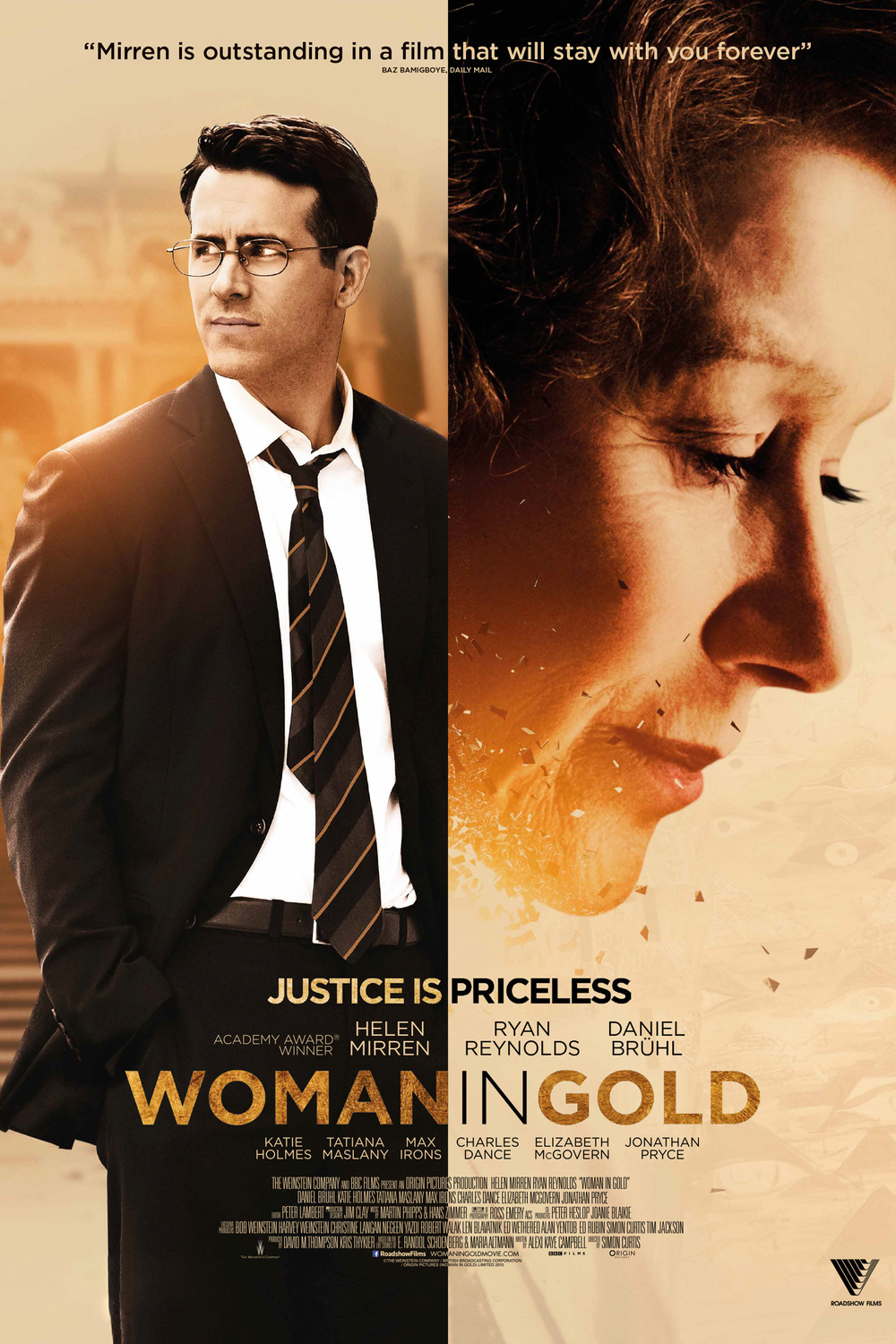
Woman in Gold (2015)


Helen Mirren and Ryan Reynolds stumble through bland Philomena rip-off Woman in Gold

Director: Simon Curtis

Cast: Helen Mirren (Maria Altmann), Ryan Reynolds (Randy Schoenberg), Daniel Brühl (Hubertus Czernin), Katie Holmes (Pam Schoenberg), Tatiana Maslany (Young Maria), Max Irons (Fritz Altmann), Charles Dance (Sherman), Elizabeth McGovern (Judge Cooper), Jonathan Pryce (Chief Justice Renhquist), Antje Traue (Adele Bloch-Bauer), Allan Corduner (Gustav), Henry Goodman (Ferdinand)
The Nazi regime across Europe was a criminal one in every sense of the word. Along with the hideous acts of murder and warmongering, Woman in Gold uses its story to remind us their leaders were also little better than common thieves.

Maria Altmann was a young Jewish woman from a wealthy family, living in Vienna in the 1930s. She escaped from Austria to the US in 1939 with her husband, but had to leave the rest of her family behind. Their fine possessions, including several paintings by Klimt, were stolen by the Nazis.

Decades later, Maria (Helen Mirren) recruits struggling lawyer Randy Schoenberg (Ryan Reynolds) to help her reclaim the paintings, now owned by the Austrian government. The government are predictably dismissive of any claims on their heritage, and are particularly unwilling to give up Klimt’s Portrait of Adele Bloch-Bauer (or Woman in Gold), a portrait of Altmann’s aunt, proudly displayed as a jewel of Austrian culture. So begins a case that will go, via the American supreme court, to the very heart of Austria’s uncomfortable relationship with its past. In parallel, Maria remembers her younger self (Tatiana Maslany) and her escape from Vienna.

I think it’s fair to say Maria is a role Helen Mirren could play standing on her head. It’s a cliché – the feisty, imperious elderly woman who cows all around her, but has a heart of (forgive me) gold. Ryan Reynolds Schoenberg is similarly predictably: a young, naïve, slightly bumbling do-gooder revealed to have hidden depths of strength, and ends up connecting with his own heritage in a “very personal” journey. In fact, every character in the “present day” plotline is a hopeless cliché. Katie Holmes has perhaps the worst role as Schoenberg’s wife – as The Wife always does in these things, she spends the first half of the film asking her husband to drop his time-consuming crusade, but come the second half she’s making the inevitable “you’ve come too far to give up now” speech.

Every bit of the modern day story is predictable, reheated slop from other, much better movies – you literally recognise every beat of every courtroom scene. Most conversations are essentially the actors spooling plot at each other, explaining everything from art history to Austrian mediation procedures. The moments where the dialogue allows the actors to focus on character land with a hamfisted heaviness, with all the subtly of Oscar “for your consideration” scenes.

Periodically the story abandons logical evolution altogether and leaps from A to B without explanation: Maria will never go back to Vienna, less than five minutes of screentime later oh no actually she will (explained by a timely, on-the-nose flashback), no she definitely won’t go back a second time, ta-da there she is. She wants to fight, then she wants to give up, then she wants to fight again. Whether these events were real or not, the film makes them feel like humdrum screenplay hokum.

You keep waiting for this to spring to life and do something fresh, but it never does. Even its odd-couple pairing is essentially Philomena reheated – but without the wit and warmth of that film’s script. It manages to turn what should have been an interesting story into something drier and duller than a documentary would have been.

The film takes wing a little more in the flashbacks to the 1930s. Again, there’s nothing new here, but the performances in are infused with a warmth, emotion and humanity missing from the other storyline – Allan Corduner is particularly good as Maria’s loving father. The sense of peril from the Nazis also gives the film a clear and unequivocal antagonist: the sequence where Maria and her husband flee Vienna is more engaging and tense than anything else in the film.

The weight of these flashbacks, however, only serves to contrast poorly with the strange, odd-couple comedy of the rest of the film. It’s literally two different films sitting uncomfortably together, neither doing either any service.

Woman in Gold is a confused film, that drags down what could have been a fascinating story into a safe, Sunday-afternoon film that never wants to say anything too controversial (even its potshots at the Austrians for overlooking their Nazi past is balanced by “good” Austrians). It reduces its characters to plot-spouting clichés, wrapped in a dry story. Although its flashback scenes carry some emotional heft, they can’t save the main plotline which spirals on and on, never engaging the viewer’s interest. It’s not gold, it’s very base metal.

Clueless (1995)


Alicia Silverstone leads her in crowd troop in neat Jane Austen reimagining Clueless

Director: Amy Heckerling

Cast: Alicia Silverstone (Cher Horowitz), Stacey Dash (Dionne Davenport), Brittany Murphy (Tai Frasier), Paul Rudd (Josh Lucas), Dan Hedaya (Mel Horowitz), Elisa Donovan (Amber Mariens), Justin Walker (Christian Stovitz), Wallace Shawn (Mr Hall), Twink Caplan (Ms Geist), Breckin Mayer (Travis Birkenstock), Jeremy Sisto (Elton Tiscia)

The 90s saw a rash of films that reworked classics into US high-school settings, aimed squarely at the teenage market. One of the most successful of these was Clueless: a decent, just-smart-enough reimagining of the plot of Jane Austen’s Emma.

Austen’s wealthy, match-making heroine here becomes Cher Horotwitz (Alicia Silverstone) – queen bee of the in-crowd in her high school. Like Emma Wodehouse, Cher is smart, beautiful and taken to meddling in the lives of those around her, sure she knows best about how they should behave – and whom they should date. She can be selfish and self-obsessed, but beneath it is fundamentally good-natured. When new girl Tai (Brittany Murphy) arrives at the school, Cher sees the scope for a makeover project – but it’s Cher herself who undergoes the greatest transformation.

The obsessions with status that populate Austen’s world actually translate very well into the high school setting, with its in and out crowds. It also a very neat restructuring of the novel, hitting all the basic plot points of Austen’s story, with some smart translations into the modern world (Christian – the Frank Churchill role – is particularly well updated). The film is sprinkled with sharp lines and snappy dialogue exchanges, and the cast are certainly in on the joke, walking a fine line between parody and playing it straight. This all contributes to the film’s fizzing energy and its charming momentum – you can see why teenagers loved it, as Heckerling has a wry wink at the camera at the concerns of teenagers, but also celebrates their potential for fun and friendship.

Watching the film over 20 years on, it’s remarkable how successfully it used the limitations of Alicia Silverstone to such great effect. It’s a bit bizarre to think Silverstone was considered the next big star of Hollywood, considering how few of her films have made any impact since this. However, here her lack of depth and shading, her unmodulated voice and rather bland style somehow work perfectly with a character who is superficial and who believes she is far cleverer than she actually is.

Clueless is that strange thing – a star-making turn that didn’t make a star, but Silverstone clicks perfectly into this role, making Cher engaging and rather charming despite her self-obsession. She delivers what the film requires in spades, even if Cher’s late character blossoming seems something required for the film’s plot rather than growing truly organically over the course of the film.

This abrupt burst of “learning and growing” partly clunks because Heckerling shies away from Emma’s more negative characteristics – tellingly, Emma’s public shaming of another character is here given to a different character. Can’t have anyone not liking the heroine for a second can we? In fact this determination to make Cher constantly as likeable as possible does rather miss the point of the original novel. It also reduces the “tension” (we all know how stories like this end!) of whether the heroine has driven her love interest away through her mistakes and missteps – and with less for the heroine to learn about herself, and less damage to repair in the relationship with the object of her affections, there’s proportionally less emotional impact to the final happy ending.

Speaking of that romantic plotline, you also can’t talk about the film without also commenting on the fact that it makes a bit of a fudge around the attraction between Cher and Josh, who (the film is at very great pains to point out) are not actuallysiblings, but do share the same father/step-father. It’s actually quite a weird twist, but I suppose just as retrospectively unsettling as Mr. Knightley loving Emma from afar from a ludicrously young age. It’s funny though to watch the film fall over itself to hammer home the non-family relationship between the two characters early on, so we don’t start shrieking “incest” by its conclusion.

All in all, the film – like its heroine – is a sweet, but superficial, candyfloss concoction, without the depth that could have lifted it from pleasing popcorn fare to satisfying story.

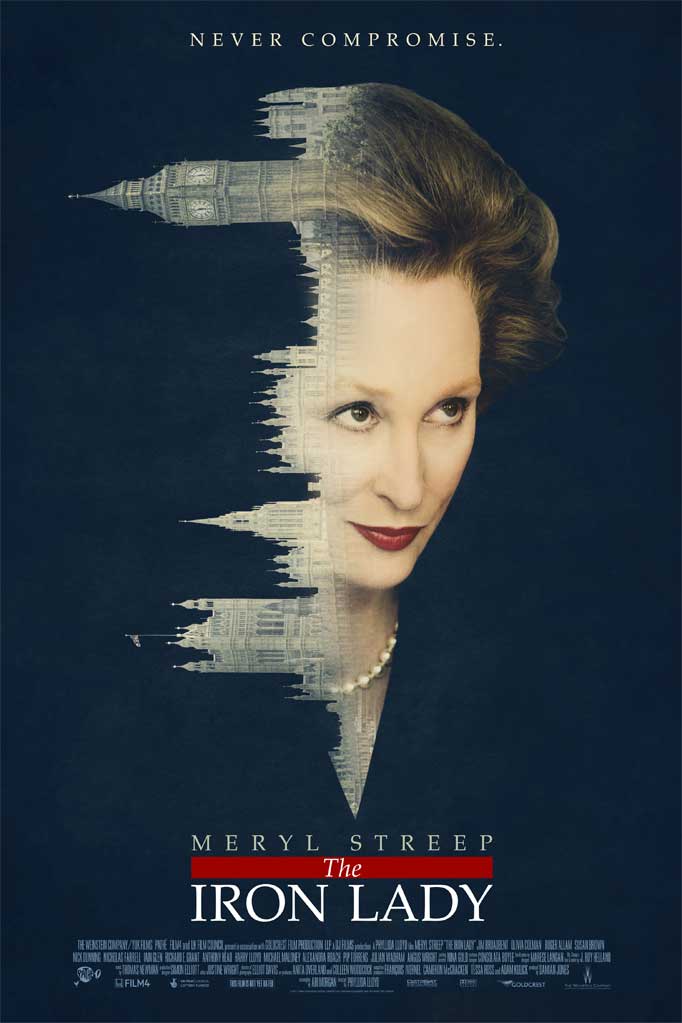
The Iron Lady (2011)


Meryl Streep impersonates the Iron Lady to excellent effect in this otherwise bland and forgettable, compromised mess of a picture

Director: Phyllida Lloyd

Cast: Meryl Streep (Margaret Thatcher), Jim Broadbent (Denis Thatcher), Olivia Colman (Carol Thatcher), Roger Allam (Gordon Reece), Nicholas Farrell (Airey Neave), Iain Glen (Alfred Roberts), Richard E. Grant (Michael Heseltine), Anthony Head (Sir Geoffrey Howe), Harry Lloyd (Young Denis Thatcher), Michael Pennington (Michael Foot), Alexandra Roach (Young Margaret Thatcher), John Sessions (Edward Heath)

In British politics has there been a figure as controversial as Margaret Thatcher? A domineering Prime Minister who reshaped the country (for better or worse depending on who you speak to), crafting a legacy in the UK’s politics, economy and society that we will continue to feel for the foreseeable future, she’s possibly one of the most important figures in our history. It’s a life rich for a proper biographical treatment; instead, it gets this film.

The film’s framing device is focused on the ageing Thatcher (Meryl Streep), now dealing with onset dementia and having detailed conversations with her deceased husband Denis (Jim Broadbent). Cared for by her daughter Carol (Olivia Colman), she reflects on her political career and the sacrifices she made personally to achieve these. Woven in and out of this are Thatcher’s increasingly disjointed memories of her political career.

The most surprising thing about this film is how little it actually wants to engage with Thatcherism itself. Perhaps aware that (certainly in the UK) Thatcher remains an incredibly divisive figure, the film’s focus is actually her own struggles with grief and approaching dementia. Her career as PM is relegated to a series of flashbacks and short scenes, which fill probably little more than 20-30 minutes of the runtime, shot and spliced together as a mixture of deliberately subjective memories and fevered half-dreams. Can you imagine a film about Thatcher where Arthur Scargill and the miners’ strike doesn’t merit a mention? You don’t need to: thanks to The Iron Lady it now exists. 

Perhaps Thatcher’s politics were considered to “unlikeable” – certainly, one imagines, by its writer and director – to be something to craft a film around, so it was thought better to brush them gently under the table. Instead the focus is to make Thatcher as sympathetic as possible to a viewer who didn’t share her politics, by concentrating on her struggles against sexism in the 1950s and her struggles with age late on. Why not accept what Thatcher stood for and make a film (for better or worse) about that? Perhaps more material on her actual achievements in office were shot and cut (the film does have a very short run time and underuses its ace supporting cast), but the whole film feels fatally compromised – which is more than a little ironic since it is about a woman famous for her lack of compromise.

In fact it’s rather hard to escape the view that Roger Ebert put forward: “few people were neutral in their feelings about [Thatcher], except the makers of this picture”. It’s a film with no real interest in either politics or history, the two things that defined Thatcher’s entire life. And as if to flag up the mediocre nature of the material they’ve chosen, it’s then interspersed with too-brief cuts to more interesting episodes from Thatcher’s life than those we are watching. Only when the older Thatcher hosts a dinner party and launches into a blistering sudden condemnation of Al-Qaeda and support of military action against terrorism (followed by her casual disregard of a hero-worshipping acolyte) do we ever get a sense of finding out something about her, or of seeing her personality brought to life.

The film’s saving grace is of course Meryl Streep’s terrific impersonation of Thatcher. I call it impersonation as the film so strenuously avoids delving into the events and opinions that shaped Thatcher that Streep gets very little opportunity to really develop a character we can understand, or to present an insight into her. Her performance as the older Thatcher – losing control of her mannerisms, deteriorating over the course of the film – is impressive in its technical accomplishment, but that’s largely what it remains. As the film doesn’t allow us to really know Thatcher, and doesn’t work with what defines her, it largely fails to move us when we see her weak and alone. So for all the accomplishment of Streep’s work, I couldn’t say this was a truly great performance – certainly of no comparison to, say, Day-Lewis as Lincoln or Robert Hardy as Churchill. I’d even say Andrea Riseborough’s performance in TV’s The Long Walk to Finchley told us more about the sort of person Thatcher was than Streep does here.

Despite most of the rest of the cast being under-used though, there are some good performances. Jim Broadbent is very good as Denis Thatcher, although again his performance is partly a ghostly collection of mannerisms and excellent complementary acting. However the chemistry between he and Streep is magnificent and accounts for many of the film’s finest moments. Olivia Colman does sterling work under a bizarre fake nose as a no-nonsense Carol Thatcher. From the all-star cast of British actors, Roger Allam stands out as image-consultant Gordon Reece and Nicholas Farrell is superbly calm, cool and authoritative as Airey Neave. Alexandra Roach and Harry Lloyd are excellent impersonating younger Thatchers.

The Iron Lady could have been a marvellous, in-depth study of the politics of the 1980s, and a brilliant deconstruction and discussion of an era that still shapes our views of Britain today. However, it wavers instead into turning a woman defined by her public role and views into a domestic character, and brings no insight to the telling of it. By running scared of Thatcher’s politics altogether, it creates a film which makes it hard to tell why we should be making a fuss about her at all – making it neither interesting to those who know who Thatcher is, nor likely to spark interest in those who have never heard of her.

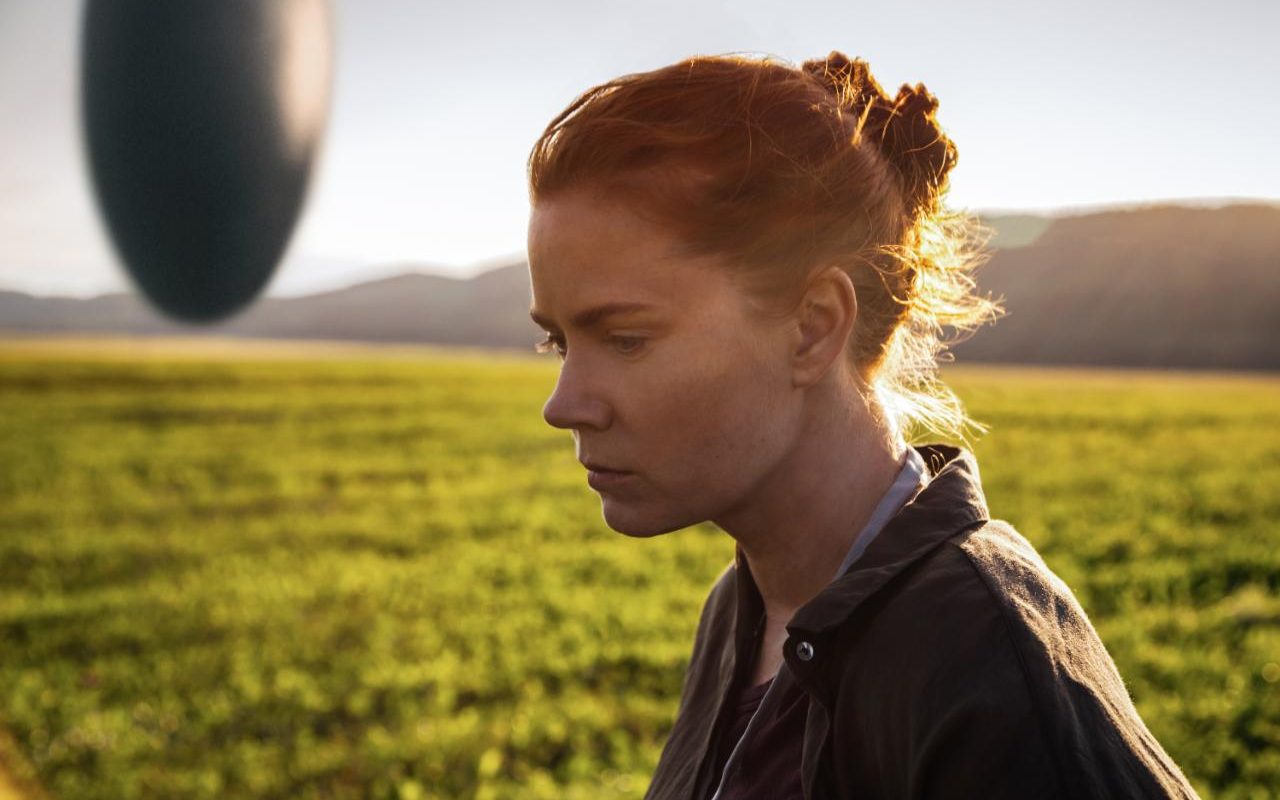
Arrival (2016)


Amy Adams tries to build an understanding with Earth’s visitors in this thinking man’s sci-fi film

Director: Denis Villeneuve

Cast: Amy Adams (Louise Banks), Jeremy Renner (Ian Donnelly), Forest Whitaker (Colonel Weber), Michael Stuhlberg (David Halpern), Tzi Ma (General Shang), Mark O’Brien (Captain Marks)

Aliens in Hollywood movies don’t often seem to mean well. For every ET you’ve got a dozen Independence Day city destroyers. But few films have really dealt directly with the complexities that might be involved in engaging with a species for the first time. How would we talk to them? How could we find out what they want?

Those are the questions that Dr Louise Banks (Amy Adams), the world’s leading linguist, has to juggle with after she is called in by Colonel Weber (Forest Whitaker) to establish communication with the inhabitants of an alien ship, one of 12 that have appeared across the globe. Working with physicist Ian Donnelly (Jeremy Renner), Banks strives to build trust and a basis for common language with the aliens. Throughout, she must deal with her military superiors’ lack of understanding of the painstaking nature of her work, the paranoia and fear of the nations of the world, and her own increasingly intrusive dreams and memories.

This is grown-up sci-fi, directed intelligently by Denis Villeneuve, whose confidence and artistry behind the camera oozes out of every shot. It’s a film that wants us to think, and urges us to consider the nature of humanity. Communication between humans and the “heptapods” is the film’s obvious focus, but it is equally interested in demonstrating how distrust and paranoia undermine how we talk to each other. Not only is this in the clashes between nations, but on a smaller scale by the communication between military and science, the uniforms in charge largely failing to grasp the slow and painstaking nature of Banks’ work. On a personal and emotional level, we see the slow growth of understanding between Banks and Donnelly, their increasing ease with each other as they break down the barriers between them, and between humanity and the aliens. 

Far from the bangs and leaps of inspiration that science normally sees itself represented by onscreen, this film attempts to follow the methodical process of building an understanding of a concept from nothing, and the careful hours of work that underpin sudden revelations. The film is very strong on the complexities of linguistics and the difficulty of conveying exact translations, including intent, context and meaning, from one language to another. In fact it’s a wonderful primer on the work of linguistics experts, offering a fascinating breakdown of how language is understood, translated and defined between two groups without a common tongue. 

This is also helped by making the aliens truly alien: I can’t remember a set of Hollywood aliens as otherworldly as these are. Not only is their language completely different (based on symbols and strange echoes like whale song), but physically they bear no resemblance to humans at all (I confess that I was momentarily distracted here, as their tentacles and residence in a gas-filled box rather reminded me of The 465 in Torchwood: Children of Earth). They lack clear arms, legs or even faces. Their technology is advanced and immediately unsettling. Jóhann Jóhannsson’s wonderfully eerie and imposing score brilliantly helps to capture this otherworldly sense, as does the crisp photography and unique production design of the alien ship. The film walks a brilliantly fine line between wonder at the aliens and a sense of unsettling dread that means we (like the characters) are never comfortable in making assumptions about their motives.

Much of the film’s success as a viewing experience also depends on knowing very little about it. For me this film delivered one of the most effective late-plot re-evaluations I’ve seen: I had no inkling of this gear shift, or how a late piece of information demands that we adjust our understanding of everything we have seen so far in the film. This is actually one of the best done examples I’ve seen of a twist (calling it a twist seems somehow a little demeaning, as if this was a Shyamalan thriller, but a twist it is) – I in no way saw it coming, but it suddenly makes the film about something completely different than you originally believed it would be. I won’t go into huge details, but the film raises a number of fascinating questions around pre-determination and fate that challenge our perceptions of how we might change our lives if we knew more about them. To say more would be to reveal too much, but this twist not only alters your perceptions of the films but deeply enriches its hinterland.

I would say the film needs this enrichment as, brilliant and intellectual as it is, it’s also a strangely cold film that never quite balances the “thinking sci-fi” with the “emotional human drama” in the way it’s aiming for. Part of this is the aesthetic of the film, which has a distancing, medical correctness to it – from sound design to crisp cinematography – and which, brilliant as it is, does serve to distance the viewer emotionally from the film. Despite the excellence of much of the work involved, I never quite found myself as moved by the plights of the characters, or as completely wrapped up empathetically with Adams’ character, as the film wanted me to be. While the ideas in the film are handled superbly, it doesn’t have quite as much heart as the plot perhaps needs to strike a perfect balance.

What emotional force the film does have comes from Amy Adams. It’s a performance that you grow to appreciate more, the longer you think about it. It’s a subtle understated performance, soulful and mourning, that speaks of a character with a deep, almost undefinable sense of loss and sadness at her core. You feel a life dedicated to communication and language has only led to her being distanced from the world. Adams is the driving force of the film – though very good support is offered from Renner as a charming scientist who also convinces as a passionate expert – and the film’s story is delivered largely through her eyes, just as the aliens’ perception of humanity becomes linked to her own growing bond with them. I will also say that Adams also has to shoulder much of the twist of the film – and it is a huge tribute to her that she not only makes this twist coherent but also never hints at the reveal until the film chooses to. 

Arrival is a film that in many ways is possibly easier to respect than it is to love: but I find that I respect it the more I think about it. It does put you in mind of other films – the aliens have more than a touch of 2001’s monolith to them and Villeneuve’s work is clearly inspired by a mixture of that film and Close Encounters. But this is a challenging, thought-provoking piece of work in its own right and one that I think demands repeat viewings in order to engage the more with its complexity and the emotional story it is attempting to tell. It may well be that on second viewing, removed from puzzling about the mystery in the centre, I will find myself more drawn towards it on an emotional rather than just intellectual level. That is something I am more than willing to try and find out from a film that I think could become a landmark piece of intelligent sci-fi.

Jackie (2016)


Jackie Kennedy patrols a White House she will soon be forced to leave behind

Director: Pablo Larrain

Cast: Natalie Portman (Jackie Kennedy), Peter Sarsgaard (Bobby Kennedy), Greta Gerwig (Nancy Tuckerman), Billy Crudup (The Journalist), John Hurt (Father Richard McSorley), Max Casella (Jack Valenti), Richard E. Grant (William Walton), John Carroll Lynch (Lyndon B. Johnson), Beth Grant (Ladybird Johnson), Caspar Phillipson (John F. Kennedy)

“Ask ev’ry person if he’s heard the story

And tell it strong and clear if he has not,

That once there was a fleeting wisp of glory

Called Camelot.”

Or so sang King Arthur in Alan Jay Lerner’s musical Camelot. It’s apt as it’s a musical cue Jackie returns to several times in this thought-provoking, if rather stately, film that with one eye looks to sharply critique the legend building of American political history, while with the other staring with adoration at the very legacy at its centre.

The film follows, in a slightly non-linear fashion, the period of time from Kennedy’s assassination through to his state funeral and Jackie Kennedy’s departure from the White House (although other scenes feature Jackie during the presidency, most notably her filming of A Tour of the White House in 1962, a TV special the film lovingly recreates with a mixture of existing and newly-created footage and audio). The framing device is an interview Jackie gives with an unnamed journalist, set after the events of the film, in which she alternates between frank honesty and careful legacy building – all the time stressing she will decide what is, and is not, printed.

The film is a both a careful deconstruction of legacy building and a celebration of it, with Jackie Kennedy portrayed as a contradictory figure – keen to give her husband a place in history and, at times, resentful of the impact of public interest in her life. In a neat scene, Jackie Kennedy asks the driver of her husband’s hearse if he has heard of the last two Presidential victims of assassination, William T. McKinley or James Garfield. He knows neither. When asked if he has heard of the first, Abraham Lincoln, he of course is able to name check victory in the civil war and the abolition of slavery. It’s a sharp reminder of the work she must do for her husband’s legacy, with his achievements ranking nowhere near Lincoln’s.

The films suggests throughout that the planning of the funeral was focused on giving Kennedy (and by extension Jackie and her children) a permanent place in American folk-lore. It’s why the reprise of Camelot works in the film – it’s sums up the attitudes of America an administration that has indeed lived on as a short time of hope, with Kennedy as the lost Golden Boy. The appropriateness of the song is something the film manages to both use and comment upon – and which it also manages to make feel fresh, despite the fact the “Camelot” has been a nickname for the Kennedy White House ever since the 1960s.

Simultaneously, though, it is a film that lingers with wide-eyed wonder on JFK himself, and which presents LBJ as a far more corrupted and overtly political figure compared to the reverence the film feels for his predecessor (his serial womanising is given only a brief mention by Jackie during her conversation with her priest). Kennedy (played by an actor with a remarkable physical and vocal similarity) is always a romantic figure, his motivations or his achievements very rarely questioned. He’s filmed like the very romantic hero, which the film is half encouraging us to question that he was – and I’m not sure this is deliberate.

The film is acute and quietly non-judgemental throughout the scenes covering the assassination, reaction and funeral plans. So much so, that the framing device of the journalist (Billy Crudup in a thankless part, scruffily dressed, alternately arch and adoring) seems like it belongs in another, dumber, movie – as if we needed Jackie to give voice to her feelings, to actually speak words stressing her power and determination in shaping what is printed about her husband, in order to understand it. It’s an obvious, TV-movie framing device that really adds very little.

This is largely because Natalie Portman gives such a sensational performance in the lead role. As to be expected, it is a brilliant capturing both of Kennedy’s vocal and physical mannerisms. But more than that, it is also a sharp performance of deeply confused grief and guilt over her husband’s fate, mixed with a public strength (at times bordering on furious anger) in her determination to plan a funeral she felt befitted her husband’s status. Weak as the journalist scenes are, she dominates them with her skilful portrayal of a woman split between a need for intimate confession and determination to maintain control over the story.

Portman’s performance also provides the emotional anchor to scenes that could otherwise be careful reconstructions. The assassination itself (filmed within the car) has rarely seemed so immediate – and the camera largely sticks with Portman’s stunned, terrified face throughout the long drive to the hospital. Her combination of lost alienation, bewilderment and shock equally dominates the rushed inauguration of Johnson, while scenes of her returning to the White House to finally remove her blood-stained clothing shimmer with emotional intensity. It’s a film that captures the stunned sense of alienation from reality that comes after undergoing any major, life-changing event.

The film has a ghostly, elegiac mood. Larrain uses rather murky photography effectively throughout the film. The slightly grainy focus given to the general world of the film allows sharper primary colours to stand out at key moments. The Oscar-nominated score for me was, however, far too insistent – a series of sharp notes and discordant sounds mixed with mournful refrains. It draws too much attention to itself and makes the same point too many times to be effective. I suspect its a score that might work better in isolation. Far better are the quiet and controlled shots of Jackie walking listlessly through a deserted White House, or the careful mixing of the tragic and the mundane (when selecting a positon in Arlington for her husband, she has to ask a companion to slow down as her shoes keep getting stuck in the mud).

It’s an intelligent, thought-provoking and adult piece of film-making, that carefully avoids passing judgement or making pronouncements. I can’t decide if it’s a film that can’t make up its mind about events, or if it challenges us to make up our mind for ourselves. Either way, Portman gives an extraordinary performance and is well supported by the rest of the cast, in particular John Hurt who gives a charming, witty performance as the Priest who Jackie allows herself (for a moment) to be completely honest with. A dynamic and interesting addition to JFK films, that manages to find a new angle and even some new ideas from well-worn ground.