Category: Female led film

Past Lives (2023)

Past Lives (2023)

Lost opportunities and the path not taken carries real emotional force in this fabulous debut

Director: Celine Song

Cast: Greta Lee (Nora), Teo Yoo (Hae Sung), John Magaro (Arthur), Seung Ah Moon (Young Nora), Seung Min Yim (Young Hae Sung), Ji Hye Yoon (Nora’s mum), Min Young Ahn (Hae Sung’s mum)

Few things carry such mystique and indestructible promise as the paths not taken. We can invest choices we didn’t make with overpowering possibilities. In them, every moment can be perfect, every outcome joyful, every conclusion perfect. But when we look back at who we were when we made those choices, our past lives can feel like exactly that: other lives of different people. The passions, desires and dreams of those people can feel completely foreign to us today, while at the same time carrying a strong nostalgic pull.

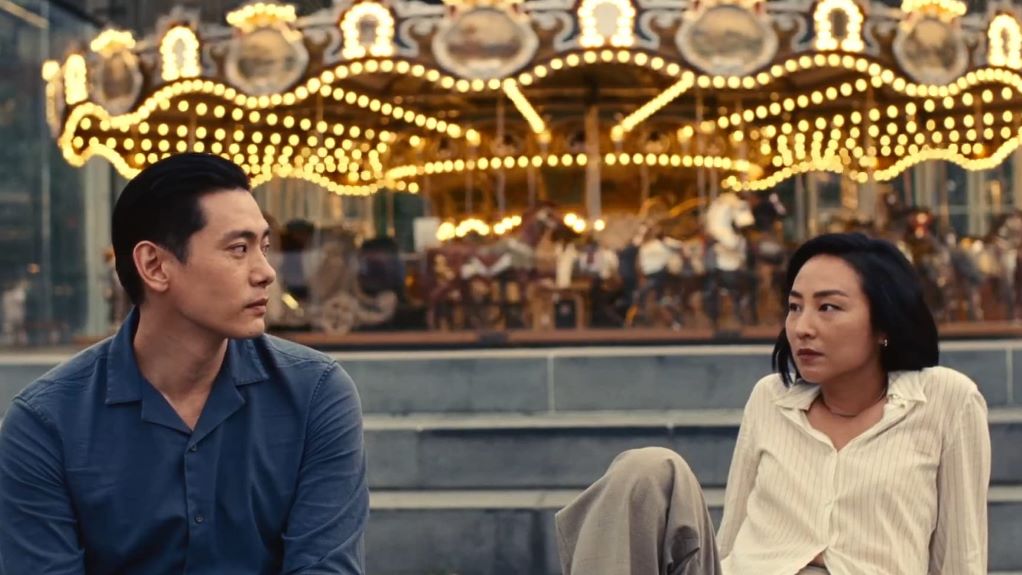
The mystique of the past is a key theme in Celine Song’s debut. Partially inspired by events in her own life, Past Lives covers 24 years in the lives of Nora (Greta Lee) and Hae Sung (Ted Yoo). Childhood sweethearts in Seoul in the late 90s, Nora migrates to Canada with her family and the two lose touch, reconnecting in their early 20s. Nora is now a writer-in-training in New York, Hae Sung an engineering student in Seoul. Communicating by Skype, they recapture some of their closeness but never meet in person before Nora cuts off contact to focus on her writing career. Twelve years later, Nora is a playwright married to novelist Arthur (John Magaro), living in the East Side of New York, when Hae Sung visits the city, looking for he-knows-not-what from Nora, who is herself torn between the pull of her past, the happiness of her present and her plans for future.

Past Lives is a romance devoid of contact, features no words of love and built on unspoken feelings and distance (a distance that covers metres in person, continents online and years in understanding). Gentle, poetic and full of lingering moments, it’s wistful and quietly involving. In many ways very little happens, but everything is at stake for all of the film’s characters and their future happiness. Song gives the dialogue a poetic naturalness, but also knows when silence speaks volumes. It’s particularly striking that nearly half the film – and 24 years – pass by before Nora and Hae Sung actually meet in person and the extent to which they recognise the differences between who they are and who they were is one of Song’s central themes.

Nora is key to this. Beautifully played by Greta Lee, she is a mix of unspoken desires and determined ambition, focused and driven but with a deep vein of romantic nostalgia in her. An immigrant who has moved from Seoul to Toronto to New York, she has a career in English but (as her husband tells her) dreams in Korean. She is also a woman who has effectively remade herself at several junctures: from the child who dreams of the Nobel Prize, to the trainee writer who wishes to win the Pulitzer Prize for journalism, to the playwright cracking Broadway. She moves forward at every point.

This contrasts sharply with Hae Sung. Ted Yoo is wonderful as this quiet, polite, romantic soul whose ambitions are simpler and desires more homespun. He’s the sensitive boy reduced to sullen, hurt silence when Nora leaves for Canada. He supports his parents, forms friendships for life (he has a core group of three university friends who remain his closest friends 12 years later – they are, by the way, a wonderful portrait of male supportiveness) and remains unspokenly devoted to Nora all his life. While she can compartmentalise him away for a decade, it’s clear her image stays with him every day, the pain of that tearful goodbye over Skype lingering through his future relationships.

He arrives in New York to see if there may be something there, to see if in-person those long-distance Skype calls (at dawn in New York and dusk in Seoul) can turn into something real. It relates to a Korean idea of In-Yun – that over several lives, an invisible force can bring people together by destiny. In-Yun is what Nora and Hae Sung both wonder may join them together: play-dates in a park in Seoul, Skype calls in their twenties, walks along the banks of the East River in their thirties. These are like different lives, but yet they keep returning to each other. Could this mean they are meant to be together? Or could this all just be groundwork for a future life to come?

The characters don’t know. Perhaps they will never know. But as Nora and Hae Sung stroll through New York – surrounded by canoodling couples at every turn – it’s hard to escape the pull of that possibility. It’s recognised by Nora’s husband Arthur, a difficult part well-played by John Maguro. In many ways, Arthur is patience embodied. Arthur, who recognises that part of the groundwork of their marriage is the pragmatism of Nora needing a green card, doesn’t complain. He sits quietly (admittedly with flashes of pain in his eyes) while they chat in Korean at a bar and makes every effort to be welcoming. But the obvious bond makes him ask, does he have the same bond with Nora? Could he affect her life, the way Hae Sung has – and the way Nora has affected his own. In a bedroom chat, he playfully (but with a tinge of passive aggressiveness) suggests she might be happier with Hae Sung. Maybe Arthur sees a lot of himself in Hae Sung – it’s not a stretch to imagine Arthur flying halfway around the world on the off-chance of a date with Nora.

If Past Lives has a fault, it is that it doesn’t do enough of really using this relationship-that-never-was as a way to delve into the immigrant experience. Nora has a passing wistfulness for Seoul and Korean culture, but Song relies a little too much on Nora bluntly telling us this. Any sense of conflict, between the pull of these two cultural heritages doesn’t really come to life in the film. Past Lives doesn’t really delve into the alienation and lack of understanding Nora now has for parts of her Korean culture – for instance she is stunned to hear Hae Sung lives with his parents and about his sense of financial obligation before marriage, but the film treats these as more personal eccentricities rather than insights into a cultural divide that has grown up.

Past Lives though builds – in a year that feels very French New Wave and inspired by Richard Linklater – into a masterful single-shot sequence that plays out a fateful wait for a taxi in real time that carries devastating emotional force, where every possible outcome guarantees pain. It uses the slightly awkward, self-conscious distance between two people who never touch but want to, to extraordinary effect and creates an atmosphere replete with longing, sadness and inevitability. With superb performances from the three leads – who are all in turns both wonderfully patient and desperately needy – it’s a simple but universal tale that grows rich in the telling.

Barbie (2023)

Barbie (2023)

Fabulously pink comedy with serious – and very earnest – things to say on sexism and gender

Director: Greta Gerwig

Cast: Margot Robbie (Barbie), Ryan Gosling (Ken), America Ferrera (Gloria), Will Ferrell (Mattel CEO), Ariana Greenblatt (Sasha), Kate McKinnon (Weird Barbie), Issa Rae (President Barbie), Alexandria Shipp (Writer Barbie), Emma Mackey (Physicist Barbie), Hari Nef (Dr Barbie), Sharon Rooney (Lawyer Barbie), Kingsley Ben-Adir (Basketball Ken), Simu Liu (Tourist Ken), Ncuti Gatwa (Artist Ken), Michael Cera (Alan), Rhea Pearlman (Ruth Handler), Helen Mirren (Narrator)

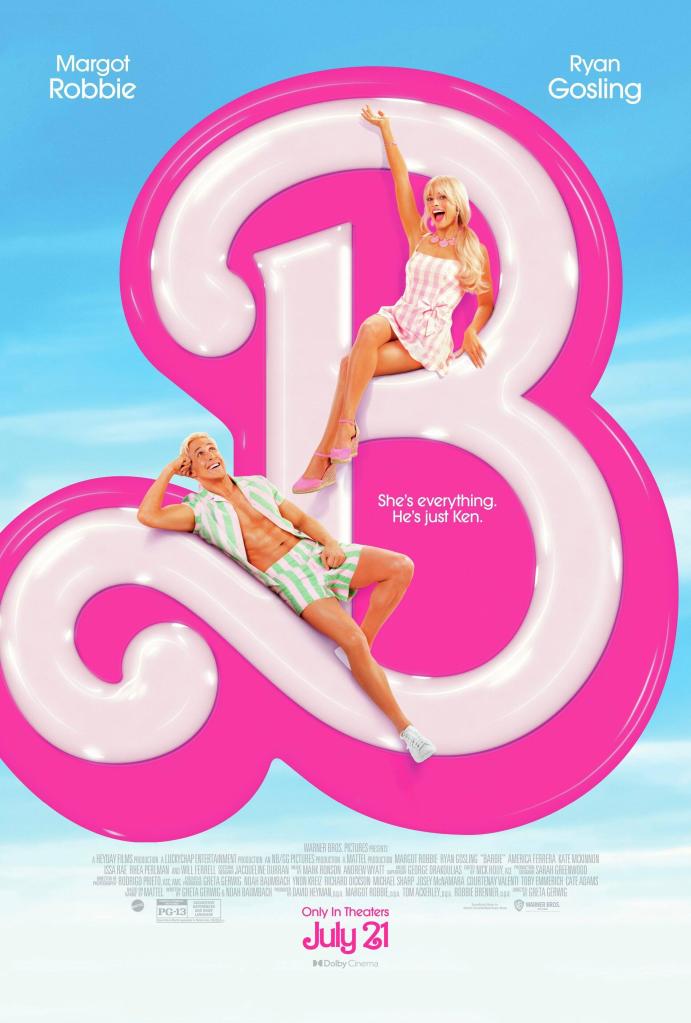
Who knew that the film which sparked the most conversation in 2023 about the roles of men and women would be one launched by a toy company, with the goal of selling toys? Barbie feels a little like a project happily hijacked. In another world this could have been a straight-forward, Adventures of Barbie flick, designed only to get kids crying out for that Margot Robbie Barbie to be appearing under the Christmas tree. Instead, thanks to the team of Gerwig and Robbie, this is a self-reverential, witty, smart and highly engaging look at gender politics which also manages to be a fun, gag-filled evening out at the cinema.

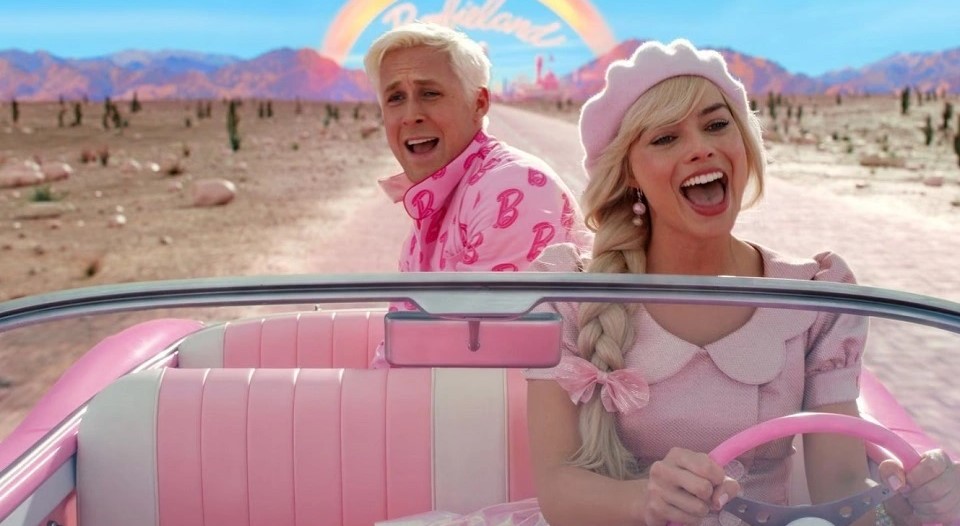
Stereotypical Barbie (Margot Robbie) leads a blissful life in Barbie-Land, where every day is the best day ever. Every Barbie knows they’ve inspired change for the better for women in the Real World. Everything is perfect until one day Barbie starts thinking about Death. Before she knows it, she has flat feet, cellulite and a crisis of confidence. The only way to fix this? A journey to that Real World to meet with the child who’s playing with her. But Barbie and Ken (Ryan Gosling) find the Real World very different from what they expected: all women’s problems are not solved and Ken discovers The Patriarchy, a wonder he is determined to bring back with him to Barbie-Land. Can Barbie save Barbie-Land and help rebuild a relationship between moody teenager Sasha (Ariana Greenblatt) and her mother Gloria (America Ferrera) in the real world?

Barbie’s sharp playfulness mixes heartfelt messages on gender politics with the sort of joyful fish-out-of-water stuff beloved of family films where a naïve figure from our childhoods finds the real world a much harsher, more cynical place than they expected. Barbie’s expects our world to reflect of the female-dominated  Barbie-Land is immediately exploded. Arriving in California, the reaction to an attractive woman roller-skating along a beach is remarkably different to what she’s used to. Wolf whistles, a parade of sexualised comments from construction workers (not a woman among them, to her shock) and a world where nearly all the top jobs are held by men.

Barbie addresses head-on whether a doll can really be an aspirational figure. In a surprisingly complex manner, Gerwig’s film looks at the pros and cons. Teenage Sasha doesn’t think Barbie has shown her world of possibilities, but instead sees her as a puppet of corporate America presenting a veneer of opportunity to women, while pushing them back into a box marked “pretty woman”. (This deadpan tirade provokes one the film’s many laugh-out loud lines as Barbie bemoans she can’t be a fascist as “I don’t control the railways!”.) Barbie may be able to do any job under the sun but this encourages attainment and also piles expectations on young women. If you can be almost anything at all, doesn’t that make it even the obligation to be something even more of a burden?

The real world is also a revelation – in a different way – to Ken. In our world, Ken discovers men (and possibly horses, Ken isn’t sure) rule though a marvellous thing called “the patriarchy”. Watching the Kens become infected by toxic masculinity, becoming high-fiveing bros who down beers, mansplain and call all the shots, is both funny and also a continuation of the film’s earnest exploration of gender politics. You can see, unpleasant as he becomes, that Ken might well want a piece of that action, coming from a world where men are so marginal they don’t even have homes (after all Mattel never made “Ken’s Dream House”). It’s also a neat gag that the other Barbies are easily brain-washed into accepting demeaning Stepfordish roles (dressed almost uniformly as French maids or in bikinis) because the confidence with which the Kens express their rightful place as masters-of-the-universe is literally mesmerising.

It’s also a neat part of Gerwig’s commentary here that the crucial factor to breaking out of this state is all about embracing the pressures of being expected to do it all: of being clever but not a know-it-all, ambitious but not a monster, raising a family but also having a career etc. If Barbie-Land in its beginning is a sort of vision of utopian feminism, then its salvation lies in accepting and embracing the struggle of marrying together a raft of contradictions and expectations. Sure, this isn’t exactly reimagining the wheel and its fairly easily digestible stuff – but it also rings true and you can’t argue with the connection its made with people.

All of which might make you think ­Barbie might be a po-faced political lecture. Fortunately, not the case when every point is filled with laugh-out-loud, irreverent humour expertly delivered by a cast clearly having the time of their lives. They are led by Margot Robbie, sensational in bringing to life a character who begins the film feeling like a doll made flesh and ends it as a three-dimensional character who embraces the contradictions of life. Robbie, who produced and set out much of the film’s agenda, is fabulous – funny, endearing, heartbreakingly vulnerable and extraordinarily sweet, mixing light comedy with genuine moments of pathos.

Equally good is Gosling playing the almost preternaturally stupid Ken with a winning sense of self-mockery, walking a brilliant line presenting a character who is (at times) the nominal villain but also a lost soul. Barbie also employs him and Robbie in some outstanding song-and-dance routines, deliciously performed and exquisitely funny. The other Barbies and Kens are uniformly excellent in their winning mix of initial shallowness and growing emotional depth while America Ferrera and Ariana Greenblatt are immensely winning as a mother and daughter overcoming a divide.

Barbie is also an explosion of delightful design and superb eye-for-detail, in its pitch-perfect recreation of a host of Barbie toys and props in real-life size, all thrown together with the perfect level of pink presentationalism. Drily narrated by an unseen Helen Mirren, every scene has a winning gag or laugh-inducing piece of business, especially when poking fun at the naïve optimism and artificiality of the Barbie world. Saying that, the film stumbles when it blurs the lines in the real world, which is half presented straight, half as a weirdly Wes-Andersonish oddity, particularly in the Mattel building and its corporate board, who are played as even more cartoonish than the actual toys populating Barbie-Land.

Barbie though generally works because it successfully mixes a heartfelt, earnest look at gender politics and the pressures on women with great gags, winning performances and a bouncy sense of off-the-wall fun that ensures nothing gets too serious. From its 2001 style opening, through its pink-led-primary colour settings, to its song-and-dance and larger-than-life-but-grounded performances, it’s a treat and in particular a triumph for its originator, producer and star Margot Robbie.

Agnes of God (1985)

Agnes of God (1985)

A chamber piece play is expanded into something less enigmatic or satisfying

Director: Norman Jewison

Cast: Jane Fonda (Dr Martha Livingston), Anne Bancroft (Mother Miriam Ruth), Meg Tilly (Sister Agnes Devereaux), Anne Pitoniak (Mrs Livingston), Winston Rekert (Detective Langevin), Guy Hoffman (Justice Joseph Leveau)

In a Montreal convent a naïve, other-worldly young novice, Sister Agnes Devereaux (Meg Tilly), has given bloody birth to a baby, that now lies strangled in a waste paper bin. The courts must decide if Sister Agnes is fit and capable of standing trial. That decision will be based on the recommendation of hard-smoking psychiatrist and atheist Dr Martha Livingston (Jane Fonda). Spending time with the devout young woman, Dr Livingston finds herself drawn to her and determined to discover why this girl who knows nothing of sex became pregnant. But she also butts heads with Mother Miriam (Anne Bancroft), the stern head of the convent, equally determined to protect Sister Agnes.

Jewison’s film – adapted by original playwright John Pielmeier – is a not entirely successful transfer of a three-hander chamber piece into cinema. The play, at its best as a series of monologues and duologues, deliberately left events open to interpretation: we have only their words and recollections to base conclusions on, all within an increasingly claustrophobic single-room set. Much of that pressure is lost in this film version, exposing instead the play’s flaws.

The “opening out” of the play focuses on introducing new characters and scenes. Unfortunately, these tend to stick out like sore thumbs. They invariably involve Dr Livingston talking to thinly sketched characters outside of the convent, who deliver stilted and dull dialogue that feels like clumsy padding. Members of the Canadian court take her on and off the case. A priest suggests she has an anti-Church bias. A brief visit to her Alzheimer’s suffering mother. A detective boyfriend passes her the odd file. All of these encounters feel exactly like what they are: scenes introduced solely so that we can see people other than the three principals.

They contrast greatly with the weightier and more engaging scenes between the three women, the meat of which is carried across from the stage play. Played with a high-pitched, breathless naivety by Meg Tilly (Oscar-nominated), Agnes is almost child-like in her interpretation of what the Lord demands of her and seems barely capable of understanding the adult world she finds herself in. She is enthralled by the ringing of bells and the sound of birds. She wants to make herself the perfect image of what she believes God wants.

It demands every inch of Dr Livingston’s professional expertise and ability to draw confidences and make psychological leaps to begin to understand this godly young woman’s psyche. Fonda is very good in a part that demands hard work with none of the flashy histrionics the other two roles have. Fonda makes Livingston a consummate professional, with a touch (not least in her constant parade of cigarettes) of the maverick to her, someone who never takes no for an answer and constantly drills deeper and deeper.

In many ways this makes her a kindred spirit for Anne Bancroft’s (also Oscar-nominated) Mother Miriam. Late to her calling, Bancroft brilliantly embraces a big, chewy part as a seemingly stern, slightly exasperated stereotypical head nun who reveals reservoirs of humanity and a strong sense of duty of care for her charges. It’s a standard twist on the grouchy older character who hides an affectionate smile, but Bancroft performs it with gusto and cements her clashes with Livingston in genuine resentment at the doctor’s initially glib assumptions about life in the convent.

The debates and confrontations between Miriam and Martha – and their attempts to both protect and draw truths from Sister Agnes – are the dramatic meat of the film and by far its most engaging moments. The problem is, the film’s attempt to expand these points with flashbacks and the grim reality of the camera undermines the suggestiveness of the original play,.

Like Equus – which demonstrated how real horses and a graphic horse-blinding scene can make a thoughtful play crude and clumsy on filmAgnes of God falls back into a POV flashback of choral singing, flying doves and undefined shadows to try and picture how Sister Agnes became pregnant. The implication seems clear that this was therefore something supernatural in this. (The film’s unsubtle love of stigmata blood smeared on various white clothes and walls hammer this home further.) What on earth does the film want us to take from that?

Especially as it ends with a confused up-beat ending, with an idyllic looking Sister Agnes (very different from the play’s bleak final monologue for Dr Livingston). If, as Sister Agnes (and maybe a part of Mother Miriam) believes, this child was conceived by God, what on earth does the film want us to make of Sister Agnes murdering (presumably) the second coming? When Sister Agnes, under hypnosis, rants and raves about her hatred for God, is she talking literally – or are we meant to think it is because the Lord has let a bad thing happen to her?

It ends up feeling incredibly unsatisfying, raising questions around faith and divinity, but pointedly running away from them and any implications they might raise. A braver film would have either kept the original’s inscrutability, or it would have dived into a truly critical look at religion and a world where God (at the very least) allows suffering. Agnes of God does neither. Despite good performances, it substitutes unsubtle bluntness for suggestion and insinuation.

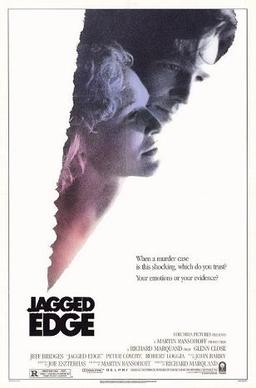
Jagged Edge (1985)

Jagged Edge (1985)

Exploitation and barmy courtroom and steamy romantic couplings abound in this silly but fun mystery

Director: Richard Marquand

Cast: Glenn Close (Teddy Barnes), Jeff Bridges (Jack Forrester), Peter Coyote (DA Thomas Krasny), Robert Loggia (Sam Ransom), John Dehner (Judge Carrigan), Karen Austin (Julie Jenson), Guy Byd (Matthew Barnes), Marshall Colt (Bobby Slade), Louis Giambalvo (Fabrizi), Lance Henricksen (Frank Martin), Leigh Taylor Young (Virginia Howell)

Teddy Barnes (Glenn Close) is done with criminal law after her time at the DA’s office, working under ambitious, unscrupulous Thomas Krasny (Peter Coyote). But she’s dragged back in to defend handsome newspaper editor Jack Forrester (Jeff Bridges), accused of brutally murdering his wife and her maid (for the money naturally). Teddy takes the case and soon crosses that line marked “personally involved” as she and Jack swiftly move from riding horses to riding each other. But what if Jack is really guilty after all?

Jagged Edge is a big, silly courtroom drama, a sort of erotic thriller B-movie that got some serious notice because two critically-acclaimed, three-time Oscar nominated actors fleshed out the cast. Written by Joe Eszterhase (for whom this was the springboard for a career of sex-filled, murder-and-legal dramas that would culminate, via Basic Instinct, with Striptease), Jagged Edge is full of pulpy, super-tough dialogue that its cast loves to chew around their mouths and spit out. It’s got the sort of courtroom dynamics that would see a case thrown out in minutes and would make its lead character unemployable in seconds. It’s daft, dodgy and strangely good fun for all that.

What it is not, really, is either any good or in any way surprising. One look at rugged, casually handsome Jeff Bridges and sharp-suited, charming-but-whipper-smart Glenn Close and you just know its only a matter of time before they end up in bed together. This leads to all sorts of unprofessional sex-capades and legal decisions, not to mention the sort of pathetically readable poker-faces in courtrooms that I would definitely not want from my lawyer.

Jagged Edge makes no secret of its hard-boiled, pulp roots. It opens with a POV home invasion as the killer breaks into his victim’s house that is only barely the right side of exploitative. Marquand doesn’t shirk any opportunities to chuck crime scene photos up on the wall. Peter Coyote’s uber-macho DA loves to say lines like “he has a rap sheet longer than my dick”. Best-in-show Robert Loggia (Oscar-nominated) is the sort of grimy flatfoot investigator who has a fridge full of booze and can’t go more than five words without cussing (when asked if his mother ever washed his mouth out with soap he simply responds “Yeah. Didn’t do no fuckin’ good”).

It’s similarly open about its sexy energy. Close and Bridges have a blue-filtered, late-night roll in the sheets, made even more exciting (perhaps) by the fact she spends half the film suspecting he did the deed. That’s the question the film challenges us with. On the one hand, Bridges seems far too boyish and aw-shucks to have slaughtered two women with a jagged knife. He sure looks upset when he visits the crime scene. Problem is there doesn’t seem to be any other possible suspect, and all that circumstantial evidence just keeps stacking up around him.

Close plays all this with a great deal of force and emotional intelligence, far more than the part (or the film) really deserves. She’s amicably separated from her husband (a very decent guy) and the film even finds a little ahead-of-its time space to make clear that Kransky’s animosity for her (and her loathing of him) is based on his sexual harassment of her as much as his flexibility with courtoom rules. Close balances the whole B-movie set-up with a real dedication – it’s effectively a warm-up (in a way) for the nonsense she’d play in Fatal Attraction.

Bridges is also pretty good, always keeping you guessing from scene-by-scene. How bothered is he when he spreads his wife’s ashes off his yacht? But then how affronted and hurt he looks when he is accused of the crime? It’s a tricky part, but he does a great job of constantly shifting the audience viewpoint and his relationship with Close’s Teddy is just smooth enough to have you guessing how genuine it is.

Wisely – perhaps – he doesn’t hit the stand during the trial. It would probably lead to drama meltdown. The courtroom is full of unbelievable curveballs, witnesses crumbling in a way they never do in real life. Every single disaster for each case is signposted by the fixed horror on the faces of the lawyers. Revelations fly-in and a new suspect effectively incriminates himself mid-trial to the delight of all (this suspect even enforces his caddishness by threatening Teddy in a car park in another moment where the film tries too hard).

The film culminates in the inevitably silly reveal, with plot twists abounding, where we are asked to believe that a killer who has ingeniously considered every single angle of his crime casually leaves incriminating evidence hanging around waiting to be discovered. Its final scene, where the killer is revealed, is either tense or unbearably, ridiculously stupid, depending on your viewpoint (everyone behaves ludicrously out-of-character and takes stupid, unnecessary risks). But for the bulk of its runtime, Jagged Edge is dirty, cheap fun.

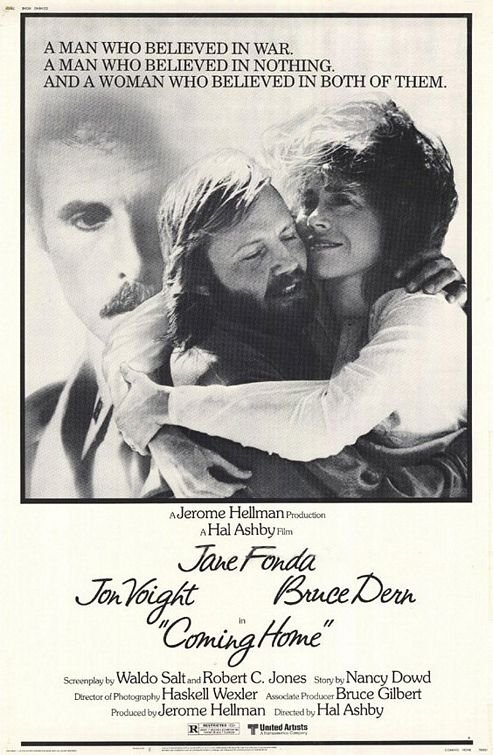
Coming Home (1978)

Coming Home (1978)

Emotional but a little too worthy Vietnam message movie, well-directed with great performances

Director: Hal Ashby

Cast: Jane Fonda (Sally Hyde), Jon Voight (Luke Martin), Bruce Dern (Captain Bob Hyde), Penelope Milford (Vi Munson), Robert Carradine (Robert Munson), Robert Gintu (Sgt Dink Mobley), Mary Gregory (Martha Vickery), Kathleen Miller (Kathy Delise)

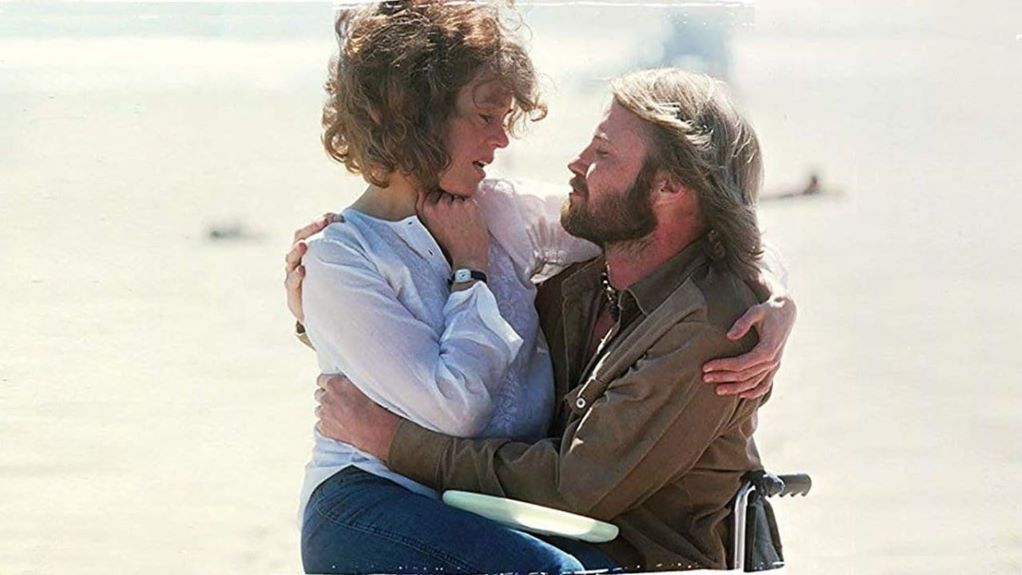
Vietnam is a jagged scar on the soul of America but, more than that, it’s been a literal scar for the veterans. Luke Martin (Jon Voight) was a college athletic star, now returned from the frontlines as an angry paraplegic, struggling with post-traumatic stress. Helping him – eventually – is old school-friend Sally Hyde (Jane Fonda), married to a Marine captain Bob (Bruce Dern) who has himself shipped out to Vietnam. Sally and Luke find themselves growing closer and closer emotionally, as their hostility towards the brutal war grows. But how will Bob – still loved by Sally and himself ever more scarred by trauma – react when he returns from the front?

Coming Home was released in the same year as The Deer Hunter and makes for an interesting comparison. While Cimino’s film is a horrific plunge into the grisly horrors of war, combined with a sort of mesmeric epic poetry, Ashby’s Coming Home is a quieter, more domestic piece, an earnest attempt to explore trauma. There is no doubting the passion of all those involved: but Coming Home is at times a little too earnest. Despite its moments of undeniable emotional impact, its sometimes feels a little too pointedly like a “message” film, worn a little too heavily on its sleeve.

But, saying that, there are many positives. It’s shot with a skilful casualness by Ashby, whose unobtrusive camera makes us a witness to events (at one crucial point it is even half obstructed by a door). Ashby has a poetic sensibility that flies in the face of what could have been its soapy roots. He lets scenes unfold with such ease and gentleness of touch that you only slowly notice how extremely well assembled the film is. There is a whimsical, lyrical sadness about the whole thing – matched with a striking lack of condemnation of people, only for a system that bends and twists human beings into killing machines.

It uses a parade of hit songs, but the songs play not as snippets but as full performances, playing out over several scenes, scenes which at first seem to be directly counter to the lyrics and tone of the song itself. Then you notice the skill with which the film has been edited to the beat of the music, and how much The Rolling Stones, The Beatles, Hendrix, Simon & Garfunkel, Bob Dylan and many others set the tone for a whole era. Coming Home captures this tone, an era of optimism crushed by brutal contact with the cold, dark realities of the world. The songs weave themselves in and out of scenes, capturing an overwhelming sense of a nation lost and confused.

It’s in this framework the relationship between Luke and Sally flourishes as Luke begins finding purpose in his life. Heavily based on the life of Ron Kovic, Jon Voight won an Oscar for his extraordinarily committed performance. From early outbursts of naked fury and pain, wheeling himself around on a hospital bed, his outbursts seemingly only prevented by medication, Voight charts the development of Luke as a humanitarian and compassionate man, committed to helping others overcome their pain and loss.

He also develops an attachment to Sally that transcends physical attraction: the two are kindred spirits. Fonda (effectively the film’s producer), generously takes on the film’s least interesting role as the disengaged, homespun Sally, increasingly horrified by the war’s impact on veterans – and the lack of interest from others (capturing the whole sweep-it-under-the-carpet attitude of the armed services, her military wives’ club refuses to include a report from Luke’s hospital in their newsletter because it’s too depressing). This translates into a deep attraction for Luke, the only other person who truly shares her growing resentment for the war.

Coming Home gained much attention at the time for its frank depiction of sex, with Luke and Sally tenderly overcoming the barriers of his disability. (Although today, their coupling – with Fonda replaced by a body double – culminating in Sally’s first ever orgasm feels a little too obvious in its comparisons with her passionless flings with Bob). But sex is less important than sharing their feelings, from Luke’s talk of dreams where he can still walk to Sally’s doubts about her life choices.

If there is a problem with Coming Home, it’s that the film doesn’t really know what to do with these characters other than showcase their pain. It tends to make sharp jumps – Luke’s recovery from initial rage to tender, thoughtful man feels very swift. And although Penelope Milford is good value as Sally’s best friend, struggling to deal with her veteran brother’s collapsing mental health, her plotline and performance is a little too obviously designed to contrast with Sally’s.

The basic problem with Coming Home is that in its rush to establish the fundamental decency of its characters – and the appalling horror of the war they are wrapped up in – it often avoids drama of struggle. It makes an interesting contrast with Zinnemann’s The Men which turned Brando’s paraplegic veteran’s psychological recovery into an entire movie: here Luke’s finding of a new purpose is as swift as his mood shift is.

The film’s most interesting plotline actually follows Dern’s Bob Hyde. Dern gives the film’s most complex performance as a dedicated solider, struggling with deep denial about his growing disaffection and unacknowledged PTSD, confronting his wife’s infidelity with a mix of anger and desperation to receive a comforting hug from her. Hyde’s discovery of the affair is its most melodramatic moment, but also strangely its most unpredictable – and a film exploring this character’s switch in perspective might just have been a little more challenging.

But Coming Home has plenty to recommend it. Voight has never been better, warm, tender and throbbing with emotion, his closing speech to a roomful of students exhorting them not to fight and choking back tears that taking another life is never worth it, is worth the price of admission alone. Ashby’s film has a poetic sensibility to it and if it sometimes feels a little too self-righteously earnest about its anti-war credentials, and a little too aware of its status as a “message movie”, at least it is a message that needs to be heard.

The Piano (1993)

The Piano (1993)

Searing emotion, passions and fascinating enigmas abound in Campion’s brilliant landmark masterpiece

Director: Jane Campion

Cast: Holly Hunter (Ada McGrath), Harvey Keitel (George Baines), Sam Neill (Alisdair Stewart), Anna Paquin (Flora McGrath), Kerry Walker (Aunt Morag), Genevieve Lemon (Nessie), Tungia Baker (Hira), Ian Mune (Reverend), Peter Dennett (Head seaman), Cliff Curtis (Mana)

What’s really striking about The Piano is how literary it feels, despite the fact it’s an entirely original cinematic work. Every moment of Campion’s intelligent, beautifully constructed, often enigmatic and unreadable film feels like it has been plucked from the pages of a lost Booker Prize winner. Juggling themes of feminism and sexual awakening alongside colonial and masculine thinking, it’s a richly beautiful film awash with superb performances and a heightened, literary reality buried inside a film grounded in the mud and squalor of reality. It remains Campion’s finest achievement.

Ada McGrath (Holly Hunter) and her nine-year-old daughter Flora (Anna Paquin) arrive on the coast of nineteenth-century New Zealand. Having refused to speak since the age of six, Ada communicates through sign language and the precocious Flora. Silent in person, her treasured piano gives her a voice and allows her to express passions she otherwise keeps carefully controlled. Ada is to marry landowner Alisdair Stewart (Sam Neill), but he baulks at carrying the huge piano from the shore to his home through the forest. Instead, it falls into the possession of neighbour George Baines (Harvey Keitel). George, besotted with Ada, offers her the chance to earn it back one key at a time, in return for allowing him to “do things” while she plays it in his house. The arrangement leads to a complex, sexual love triangle between Ada, George and Alisdair that will see passions explode.

I wonder sometimes if The Piano is a bit of a problem for some campaigners today. You can discover plenty of retrospective reviews that find it hard to mask their disappointment that the film doesn’t offer a more pointed condemnation of its two male characters. Many want The Piano to show Ada rejecting Alisdair as a repressed potential rapist and George as a manipulative sexual predator. But Campion is telling a far more nuanced, feminist story than this easy-to-swallow structure. The Piano is not about pigeon-holing people into easily definable roles. Rather it looks at how unexpected bonds can rise and how darker, deeper passions can flair in unexpected ways.

Because George’s at-first manipulative, outrageous offer actually awakens something unexpected in Ada. George is perfectly played by Keitel as outwardly a lump of inarticulate, labouring flesh but inwardly far more sensitive and strangely poetic – and his desire is based as much on a curious romantic longing and a sensitive fear of rejection. His requests are often based around the briefest of physical touches, the desire to see Ada’s shoulders and legs. He’s timid, shy and becomes increasingly open about his feelings for her.

Even more strikingly, Ada discovers that (after initial shock) she enjoys the bartering negotiation of the arrangement (offering more in-depth contact for a higher number of keys) and finds her ability to provoke desire in George both sexually liberating and exciting. So much so that, when George ends the arrangement (recognising that he cannot get what he really wants – Ada’s love – as long as it stands), her reaction is one of anger, more like a spurned lover, then a relieved victim.

This simmering desire is at the heart of Campion’s passionate work. Rewatching it’s striking how vital touch is in the film, how much it is linked to emotional and sexual connection. Campion focuses in extreme close-up on George stroking Ada’s skin through a tiny hole in her stockings – to her initial shock and increased pleasure. The slightest contact of hands between these two carries an emotional and sensual charge. It’s exactly the lack of this that becomes impossible not to notice in the relationship between Ada and Alisdair. Contact between them is minimal and when it occurs it carries darker meanings: most obviously the impotent, frustration Alisdair half-heartedly uses with Ada, then in the rain-soaked fury he will unleash when her betrayal is revealed.

Ada increasingly uses touch to control. She caresses and strokes Alisdair’s naked body at night – never allowing him to touch her in return – both to manipulate him but also, partly, to satisfy her own newly-discovered itch for sexual power, just as she grew to give herself over totally to the hold she had over George. Dressed in restrictive black, that covers almost her whole body, The Piano is about a flowering of a newly confident and sexually awakened woman from a repressed shell.

The language of the body ties into this. Campion reverses the expectations of nudity. Instead, it’s the male form of George we first – and almost predominantly – see. It turns this physically imposing man into someone vulnerable and sensitive. Like a romantic lover, he cleans the piano naked. He will reveal his body to Ada with shyness. When they first make love, he focuses on her pleasure rather than his own. He contrasts with the stiff-backed Alisdair, trapped in his formal clothes (compared to George’s indigenous tattoos and garments) who, even when Ada seduces him, uncomfortably tries to pull his trousers up over his bare buttocks.

Alisdair – superbly played by Sam Neill in a challenging role – is not a bad man, just a deeply unimaginative, repressed and self-satisfied one. He sees a woman’s duty as wife and nothing else. Just as he can only see the Māori on the land around them as simple savages, clinging to naïve superstitions (he cannot understand why they do not wish to sell or farm the land their ancestors are buried on), so he can find no common ground with Ada. He’s even subconsciously aware the piano is a means of emotional expression she refuses to share with him, causing him to do everything he can to remove it from his house with the same loathing he would have for a rival. But he’s also a timid, needy soul – witnessing George and Ada coupling, he watches from his concealment with a curious mix of envy, longing and sadness at something he will never have.

The Piano places Ada at the centre of this complex junction of feelings and emotions. Played with awards-laden brilliance (including the Oscar) by Holly Hunter, this is a woman who never speaks but whose complex emotional journey is always clear. Stubborn, difficult and demanding, we learn this is defence mechanism against a world she has so cut herself off from, so much so she has literally refused to speak for decades. Her piano is the only outlet she allows herself in a world with strict rules for women. Finding something alternative to this is a frightening and alluring prospect.

It’s one not necessarily understood by her daughter Flora (a brilliant Oscar-winning performance by Anna Paquin) who is so precocious in some ways – forcefully communicating her mother’s wishes – and so young in others. Flora understands little – with fateful consequences – of the emotional and sexual tangles around her and, like a child, often accepts the path of least resistance. She also sees the strong bond between mother and daughter as threatened by the presence of George – in a way she cannot comprehend, even after spying their intimacy together.

Campion’s film superbly ties these literary themes into a film of complex enigma and aching beauty (it’s beautifully filmed by Andrew McAlpine). The film is aided enormously in its emotional charge by the radiantly lyrical score by Michael Nyman (his distinctive sound makes the film sound like the finest film Peter Greenaway never made). The Piano offers challenging, thought-provoking and intriguing scenes at every turn, powered by a brilliant script and wonderful performances. Avoiding the obvious, it’s power and reputation has rightly only grown in the decades since its filming.

Dark Victory (1939)

Dark Victory (1939)

Bette Davis almost single-handedly lifts another tear-jerker into something grander

Director: Edmund Goulding

Cast: Bette Davis (Judith Traherne), George Brent (Dr Frederick Steele), Humphrey Bogart (Michael O’Leary), Geraldine Fitzgerald (Ann King), Ronald Reagan (Alec Hamm), Henry Travers (Dr Parsons), Cora Witherspoon (Carrie Spottswood), Dorothy Peterson (Miss Wainwright)

Judith Traherne (Bette Davis) is vivacious and fun-loving. From her grand Long Island home, her days are taken up with racehorses and fast cars, her nights with parties and booze. No wonder she keeps having headaches and making those small falls, right? Pushed to check it out at the insistence of her best friend Ann (Geraldine Fitzgerald), it doesn’t take long for brain specialist Dr Frederick Steele (George Brent) to diagnose a brain tumour. An operation is a short-term success, but Judith’s condition is terminal. At best, she has a year to live. Steele and Ann decide to keep the news from Judith – but when she discovers the truth she decides to live life to the full with Frederick, the man she has grown to love.

Watching Dark Victory is a reminder of the sometimes-limited opportunities for women in Hollywood at the time. If an actor as radiantly talented as Bette Davis were a man, she would have been playing earth-shattering roles in stirring dramas. This was when Tracy, Muni and March were playing explorers, scientists, world leaders and campaigners. Davis, like other women, saw the vast majority of strong roles for women centred on screwball comedies or as loving wives and mothers. As such she made a career propping up effective, sentimental twaddle like Dark Victory.

Which is to be a little harsh, I will admit, on a fine if unambitious tear-jerker. Dark Victory had been a Broadway play – and a flop. The stage had exposed a little too clearly the blatant emotional manipulation of the story of a woman who falls in love in the final year of her life then facing death with self-sacrificing fortitude. On film though, it could be made to work, not least through the full-throated commitment and intelligence of Bette Davis’ acting.

Davis is too often button-holed into the “camp icon” bucket, but Dark Victory – much like Now Voyager – sees her real strong suit, turning ordinary women, tinged with sadness, into portraits of deep tragedy and emotional self-sacrifice. Davis evolves Judith from a shallow, fun-loving playgirl into someone thoughtful, caring and empathetic. Davis avoids almost completely the obvious histrionics you could resort to playing a woman dying of a terminal brain tumour.

Instead, she meets her diagnosis with a carefully studied casualness that hides her fear, confronts the realisation that she has been deceived with a betrayed disappointment rather than carpet-chewing fury, and faces death with an unselfish concern for others (a physical tour-de-force as Davis acts blind – the final stage of her condition – but hides this from her husband so as not to cause him to abandon a medical research conference he has postponed frequently for her sake).

It’s all, of course, very standard material for a tear-jerking “woman’s picture” of the 1930s. A flighty woman finds love, happiness and inevitable tragedy. Davis fizzes around much of the film’s first 30 minutes with a Hepburnesque energy and wit, jodhpurs and champagne glasses abounding. A great deal of sweet charm brilliantly adds to the poignancy as, in her first consultation with Steele, she fails to identify blindfolded the same object being placed in both hands (a dice, a pencil and a piece of silk, all instantly identified in her left are met with confused incomprehension in her right). This is highly skilled, emotionally committed acting that pays off in spades as the gentle, thoughtful, caring woman underneath is revealed.

It helps that Davis has a trusted director in Edmund Goulding. Never the finest visual stylist or most compelling technician, Goulding’s great strength was his finesse with actors. He worked especially well with Davis, his careful focus on performance over technical flair giving her an excellent showpiece for her skills. Davis paired again with George Brent, a solid but generous actor (with whom Davis started a long-running affair) never better than when breathing humanity and life into an on-paper stiff roll as a noble surgeon who falls in love with his patient.

Brent and Davis’ chemistry and comfort with each other squeeze out all other potential romantic sub-plots, despite the actors in the roles. Lord knows what the Irish Republican Brent made of Bogart’s bizarre Irish accent as Judith’s roguish horse trainer. Bogart looks hilariously uncomfortable, his accent coming and going and he lacks affinity for the role or the film. He still comes off better than the rather wet Ronald Reagan as Judith’s playboy friend. Instead, the film’s finest supporting performer is the wonderful Geraldine Fitzgerald, sparky, firm-jawed and endlessly loyal while torn up with grief for her friend.

Dark Victory, though, rises and falls on the success of Davis’ performance. It certainly makes no secret of the fact that we are heading towards a tragic ending. A parade of doctors emerge to confirm to Steele that, yes, the disease is terminal. When Judith uncovers her case notes, she flips through an army of letters from eminent surgeons repeating the phrase “Prognosis: negative” – she even then asks Steele’s secretary to explain the wording. We are building up constantly towards a show-stopping, three-hankie, climax of Judith’s inevitable decease.

And yet the film still manages to get you. Again, it’s the low-key but honest performance of Davis that makes this. The moment of tragic realisation that death is arriving, then the studied determination to carry on regardless and to spare her loved ones as much pain as possible. It’s the self-sacrificing decency and honour of the very best of the “women’s pictures”. Davis delivers on it so utterly successfully, it does make you wonder what triumphs she might have had if she could have played the sort of roles males stars played, as well as breathing such conviction-filled life into gentle weepies like this.

My Brilliant Career (1979)

My Brilliant Career (1979)

Edgy and very good feminist film about a prickly and difficult woman struggling against a lack of choice

Director: Gillian Armstrong

Cast: Judy Davis (Sybylla Melvyn), Sam Neill (Harry Beecham), Wendy Hughes (Aunt Helen), Robert Grubb (Frank Hawdon), Max Cullen (Peter McSwatt), Pat Kennedy (Aunt Gussie), Aileen Britton (Grandma Bossier), Peter Whitford (Uncle Julius)

In turn of the century Australia, it’s fair to say women were not awash with choices as Sybylla Melvyn (Judy Davis) discovers. Growing up on a dust covered farm, she dreams of becoming something – an artist, a singer, a writer, a connoisseur of culture, anything rather than spending her life as a wife and mother. She is dispatched by her parents to her wealthy maternal grandmother (Aileen Britton), determined to scrub her up, shave off her rough edges and find her a good marriage. Sybylla resists, but much to her surprise finds herself attracted to old childhood friend, Harry Beecham (Sam Neill). But will Sybylla choose marriage over finding her own path in life?

Adapted from a semi-autobiographical novel by Miles Franklin (the pen name of Stella Maria Sarah Miles Franklin), My Brilliant Career was a feminist watershed in Australian cinema, also one of the first Australian films directed by a woman. Gillian Armstrong was fascinated by a story that, while a period piece, still spoke strongly to a time when women were moving out of stereotypical traditional roles they had been pigeon-holed into. My Brilliant Career is a costume drama that looks at the stark reality for women at the time (wife, mother or “spinster”). And while men could dream of lives of cultural and artistic fulfilment or economic ambition, women faced innumerable barriers.

The frustrations help explain why Sybylla is such a prickly, at times maddening, frustrated woman trapped in a constant stream of situations where her choices are narrow or she cannot decide what she wants. On her parents’ farm, her interest in art and classical music turns her into a sort of freakish bluestocking (or larrakin), her slow plonking of Schumann on the family’s out-of-tune piano sounding to them like sounds from the end of the world. Among the well-off hoi polloi of Australia, she seems scruffy and wild and her knowledge of working-class drinking songs and enjoyment of rough-and-tumble games and dancing lead to raised eyebrows (it’s telling she switches to playing the bawdy tunes of her parents’ local drinking hole on the grand piano of her grandmother’s house – she is an outsider everywhere she goes).

Sybylla is brought to life in a sensational, star-making performance by Judy Davis. Davis isn’t afraid to make Sybylla often difficult and even a little unlikeable. She’s capricious and often infuriatingly vague about what she wants. She has high-blown dreams of an artistic life, with no fixed idea about what that might mean. She is adamantly opposed to marriage, but flirts outrageously. She scorns the uncultured dirt of the poor but finds the fussy exactitude of the rich oppressive. She’s a mass of contradictory and confused impulses, all caught up in her limited opportunities: marry as everyone wants her to do and, even if she loves the man, say goodbye to the ability to make her own choices.

This is captured perfectly in Davis’ shabby impertinence. She makes Sybylla someone never afraid to speak her mind: smutty jokes at dinner tables, blunt refusals of “I’m-doing-you-a-favour” proposals. Davis makes her defiant and difficult, but also strangely vulnerable (she’s very sensitive about her appearance – not surprising considering barely a scene goes by without someone commenting on her plainness, freckles, messy hair or some combination of all three). Davis charges about the screen with a masculine tom-boyishness. She trudges through fields, clambers up trees, drives horse and carts with aggressive pace. She rarely looks comfortable in her clothes. She has a sharp, at times even cruel, sense of humour, never suffers fools and doesn’t allow anyone to talk down to her.

Armstrong’s film however makes clear this is all in the nature of the teething problems of a young woman still mystified about what she wants from life. And who can blame Sybylla at the unattractiveness of the various alternatives put to her (basically a range of glorified servant roles). She is even dispatched to serve as a governess to a group of scruffy farm children, again tellingly the only time she truly embraces the comfort of formal clothes, as if cementing her place as not among the mud. (This sequence does show Sybylla’s social flexibility as, much to her surprise, she forms a bond with these coarse workers.) It’s a situation made particularly difficult when she has two viable suitors thrust at her.

The first she can dismiss with ease – a pompous stuff-shirt played with smackable smugness by Frank Hawdon. The other is far more viable: a kindred-spirit of a sort played by an attractively charismatic Sam Neill. Harry and Sybylla capture in each other the exact qualities the other finds attractive but would cause long-term disaster in marriage. Sybylla is attracted to Harry’s humour and intelligence but would find his settled landowning life restrictive. Harry is drawn to Sybylla’s free-spirited independence but long-term would find it infuriating. Nevertheless, the temptation to marry is strong for both of them.

Armstrong’s film expertly builds the unspoken, awkward courtship between these two. They take it in turns to ignore and provoke jealousy in each other. When thrown together they go from surly silence into bawdy flirtation (including an epic outdoor pillow-fight across Harry’s farmland). The question always remains though whether marriage is the right choice for either of them. Not least as it would potentially end Sybylla’s dreams of exploring the world and her place in it.

My Brilliant Career is lusciously designed (by Luciana Arrighi) and beautifully shot (by Donald McAlpine). Gillian Armstrong brings a strong visual eye to the film – there are some superb compositions involving windows and walls creating visual barriers between characters and some terrific transitions (the finest being a cut that visually compares Sybylla’s beside her bed with her mother in her dining room at home). The film builds a wonderfully subtle feminist picture, with several women – Sybylla’s mother who has married for love and found poverty, her aunt (well played by Wendy Hughes) jilted by an unsuitable husband, her great aunt who chose freedom but is deeply lonely – presenting potential life paths that further illustrate the paucity of choice.

It makes for a prickly but eventually very involving film, with a sly wit, very well filmed that gradually makes us care deeply for a character who is initially as irritating and challenging for the viewer as she can be for the characters. With a brilliant performance by Judy Davis, My Brilliant Career is an important milestone in the Australian New Wave and a superb debut for Gillian Armstrong, that mixes strong thematic ideas and beautiful visuals.

Women Talking (2022)

Women Talking (2022)

A worthy attempt but a misfire, that frustratingly fails to grapple with deeper feminist issues, settling for a safer, less challenging consensus

Director: Sarah Polley

Cast: Rooney Mara (Ona), Claire Foy (Salome), Jessie Buckley (Mariche), Judith Ivey (Agata), Ben Whishaw (August), Frances McDormand (Scarface Janz), Shelie McCarthy (Greta), Micelle McLeod Mejal), Kate Hallett (Autje), Liv McNeil (Nietje), Emily Mitchell (Miep), Kira Guloien (Anna)

In 2010, the women of an isolated Mennonite community discover they have been victims of a policy of systemic drugged rape by the men, every night for decades. All this remains unknown until a man is caught in the act and the attackers arrested. The other men go to the city to bail them out, informing the women they will be expected to forgive on their return. The women hold a vote about what to do: do nothing, stay and fight or leave. When the vote is tied between the latter two options, the women decide the final choice will be in the hands of a small group of their number, who will debate in the community’s hay loft.

All of this happens, in voiceover, in the film’s opening few minutes. It all sounds more engaging, challenging and dynamic than what actually happens in the film. I saw Women Talking with my wife, who is passionate about the issues this film wants to deal with. We were both united in our view of the film: Women Talking is full of talking, but no one really says anything. It’s a missed opportunity that fails to convert its undeniably powerful premise – or the committed and passionate performances of its cast – into something that really successfully grapples with, and comments on, the issues, with a cast of characters who feel more like devices than fully-rounded people discovering their voices and freedom.

It’s a film that should have the urgency of a time-bound debate and the passion of a group of women discovering that they have the power to make decisions themselves. But the film feels slow (much longer than its two hours), flat and theoretical where it should be filled with debate and different ideas. It has moments of power and speeches of tragedy, but it doesn’t manage to make this something truly revolutionary.

The film would have been more interesting if it had been about everything covered in that opening monologue. In this community the women are kept illiterate, have never been allowed to be part of any decision-making and are so oppressed they don’t even have language to understand what sexual assault is. There was a fascinating film waiting to be made about these women working out exactly what had happened to them – imagine the heart-rending conversations that must have involved – and discovering they were just as capable of reaching decisions in their own right as men. Of finding their voice and freedom.

Now that is a film about feminism I want to see! I wanted to see these women who have never even considered ideas about independence and self-determination discovering they could do that. Just having a vote in a community like this one is an astonishing revolutionary act – it shouldn’t be so blandly passed over as this film does. How did these women even realise that they could decide for themselves what they to do with their lives?

Instead, we get a film where actual debate is surprisingly neutered. Frances McDormand’s character is the voice of conservatism, but walks out of the debate after five minutes and never comes back. With her gone, no counter-arguments are raised, no voice given to help understand why people (and many of them have done so) would choose to stay in relationships even after they know the truth. McDormand’s character is almost certainly wrong – the women should get out of this awful place – but we should at least hear her say why she wants to stay and the film should trust us to understand that listening to her viewpoint isn’t the same as agreeing with it.

In fact, it would have been fascinating to hear why so many women in the community heard about the systemic rape and yet voted to stay. The hay-loft debates should hum with the exchange of ideas. We should hear different viewpoints. Many people voted to stay and do nothing: why? Let’s hear what makes these women accept what’s happened to them. Are they institutionalised, love their husbands despite their faults or can’t imagine leaving their homes no matter the cost? We don’t know. It’s like the film makers were worried that a debate which actually included all potential viewpoints would have been seen as reducing the horror. In reality, however, it’s essential.

There is also a fascinating discussion to engage with about justice and forgiveness – particularly given the film’s setting in a religious community that preaches forgiveness. The men have demanded the women forgive. Ona (Rooney Mara) declares early on that forced forgiveness cannot be real. But instead of engaging with this, that throwaway is all we get. It’s a deep question which we often grapple with in the wake of terrible crimes. Whole books have been devoted to people who can or cannot forgive those who’ve committed terrible crimes against them or their loved ones. There’s so much this film could have delved into with its cast of women who’ve been told all their lives they must forgive – but it had no interest.

Instead, the film wants to make things easy. It completely shirks any debate of religion. This is a community of women whose entire understanding of the world is founded on the Bible and religious instruction. But yet God, faith and Christian ideas barely come up. It’s briefly mentioned that leaving the community means exile from heaven – but that is benched and never raised again. It should be at the heart of their considerations. There isn’t even a debate about whether their community’s teachings are legitimate (since they are partly based on systemic rape, we can guess not).

In the end rather than really tackling themes, we get conversations which do little but make the same point over and over again. Some of these speeches are undeniably powerful, and the performances of Foy and Buckley in particular are strong, but they are weakened by the lack of depth to the characters.

Women Talking is full of words but never says as much as you are desperate for it to do. The actors do a fine job with the passionate speeches and bring a lot of power to this chamber piece. But it’s frustrating that we feel robbed of seeing these women realise they have the power to choose and instead circles a highly emotive but ultimately slightly unrevealing discussion intercut with on-the-nose shots of fields, playing children and empty kitchen tables. It manages to avoid focusing on anything potentially interesting or engaging and feels like a worthy missed opportunity.

Through a Glass Darkly (1961)

Through a Glass Darkly (1961)

Faith, family and femininity are put to the test in Bergman’s bleak meditation on religion and love

Director: Ingmar Bergman

Cast: Harriet Andersson (Karin), Gunnar Björnstrand (David), Max von Sydow (Martin), Lars Passgård (Minus)

Bergman’s Through a Glass Darkly marks a new era in the Master’s filmography. It was the first of three thematically connected films about faith and religion (although you could argue The Virgin Spring really makes this a quartet). It saw Bergman make a firm commitment to seemingly theatrical chamber pieces, with small, focused casts of trusted collaborators handling complex (joke-free) and searching themes. It was also first of his films set on Fårö, a place that would become so associated with him it would effectively be rechristened Bergman Island.

Through a Glass Darkly (Bergman’s second consecutive Oscar winner for Best Foreign Language Picture) is a brooding, intense chamber piece set entirely in a house and beachside jetty on Fårö. It’s a family reunion. Author David (Gunnar Björnstrand) returns to Sweden from Switzerland to see his children. They are 17-year old son and aspiring writer Minus (Lars Passgård) and Karin (Harriet Andersson), now married to respected older doctor Martin (Max von Sydow). The real purpose of the gathering is to monitor the recovery of Karin, a schizophrenic whose condition has (without her knowledge) been declared inoperable. Karin is drawn to obey the commands of voices only she hears which she believes emanate from an abandoned bedroom, covered in cracked wallpaper. There she believes God calls for her to join him on the other side of the wall.

There is much to admire about Through a Glass Darkly, not least the striking, haunting, cinematography of Sven Nykvist. In a film that takes place on an almost silent island – there is no music, other than a few bars of Bach on the soundtrack, and barely any natural sound, so much so that a late arrival of a helicopter seems (deliberately) like an almost demonic visitor – light becomes the main force. It beats down from the sun, wraps across rooms, seems to transform spaces in front of an eye (there is a beautiful stationary shot of it flooding an abandoned boat where Minus and Karin sit in shocked horror). It picks out every feature of the scarred wallpaper in Karin’s room and casts searching shadows and stark, interrogative beams across the character’s faces.

It greatly expands both the intensity and claustrophobia of a challenging chamber piece, exquisitely directed by Bergman. The acting of the four leads – three trusted collaborators and a newcomer – is faultless. Andersson, in particular, tackles an almost impossibly difficult character who we first meet as a carefree young woman and leave as a huddled, shattered figure hiding from the light behind sunglasses. Andersson’s raw and searching performance avoids all overblown histrionics, becoming a detailed and compassionate study of a woman losing control over her actions. Bergman holds the camera on her for long takes, while Andersson lets a multitude of emotions play across her face.

Björnstrand is equally impressive as a (disparaging) Bergman stand-in, an artist neglecting his children in a quest for perfection, coldly distant to others, guilty at his selfishness (at one point he excuses himself to privately weep at his inadequacy as a father, then returns unchanged) but quite happy to take what he can from his family to use in novels. von Sydow takes a quietly restrained role as a sombre, somewhat dour man, hopelessly in love with his wife but clearly little more to her (and he accepts this) than a surrogate father. Passgård more than matches them as a depressed teenager, yearning for approval and frustrated at learning how difficult life is.

Bergman’s family follows this complex and challenging family, which becomes a filter for understanding if love is where God is in our world. The family is distant and uncommunicative with each other – the opening scene sees them laughingly return from a swim, but the second any of them split into pairs for conversations, resentments about the others come bubbling out. Is any love here real or performative? And if it’s performative, where is love and therefore where is God?

In this world, has Karin’s schizophrenia may have emerged as an attempt to insert an acceptable love that is otherwise missing from her life. Her father is a cold-fish, who immediately announces at their reunion dinner he will soon leave for Yugoslavia, then produces a series of gifts “from Switzerland” all too obviously purchased at an airport and unsuitable for the recipient (such as gloves that don’t fit Karin). Her husband overflows with desire for her, but she can hardly raise a flicker of interest in him sexually and behaves him with more like an affectionate daughter.

The most affection filled relationship she has is also the most inappropriate. She and Minus have a relationship of physical intimacy, and she kisses and strokes him with an affection that from the start feels uncomfortably close. They confide in each other emotionally in a way they never would do with others, and Minus is the first witness of one of her schizophrenic breaks, invited by her to view the room she believes is a passageway to God. This unhealthy intensity builds, through confidences and whispered confessions into a terrible encounter in a ruined boat, where Karin is commanded by her voices to seduce Minus into crossing a terrible line.

Perhaps this is a search for love and meaning “to see but through a glass darkly” as St Paul wrote. Karin is searching endlessly for love – and therefore God – but her search seems fruitless. Her family only slowly adjust, she shatters her closest relationship and eventually even her visions in her wallpapered room tip into nightmares. Bergman never lets us see the visions Karin witnesses or hear the voices she does (this places more pressure on Andersson whose controlled and measured performance is more than capable of delivering on) but we see all the traumatic impact on her as they prove as incapable of delivering confirmation of love in her world as anything else.

It’s surprising, for a film which starts as a family drama and becomes a quietly nihilistic drama, that Bergman ends on a moment of hope as David and Minus share a moment of closeness. Bergman later said he regretted this, and the moment does feel forced at the end of a downbeat drama. It may be a reflection of the fact that Through a Glass Darkly, intriguing as it is, is perhaps a little too serious and leans a little too heavily into artistic intensity. It lacks the touches of warmth, hope and humanity that makes Wild Strawberries a masterpiece and at times hits its notes of intense brooding a little too hard (its more or less from here that the Gloomy Swede label stuck).

It’s frequently an artistic triumph, but in some ways I find it less complete than other Bergmans. It’s exploration of its themes of faith and love don’t always coalesce quite as sharply as I would wish. It strains a little too much for profound importance at the cost of some of its humanity and the characters – brilliantly performed as they are – feel a little too much like puppets in the hands of God-like Bergman, going as and when according to his needs. But then, a Bergman film that doesn’t quite make it, would be the crowning achievement of other directors – and Through a Glass Darkly haunts the mind, turning over and over again in your thoughts, for days after you’ve seen it.