Category: Films about mental health

The Last Command (1928)

The Last Command (1928)

Hollywood and the revolution meet in von Sternberg’s sympathetic look at White Russians

Director: Josef von Sternberg

Cast: Emil Jannings (Grand Duke Sergius Alexander), Evelyn Brent (Natalie Dabrova), William Powell (Lev Andreyev), Jack Raymond (Assistant director), Nicholas Soussanin (Adjutant), Michael Visaroff (Serge)

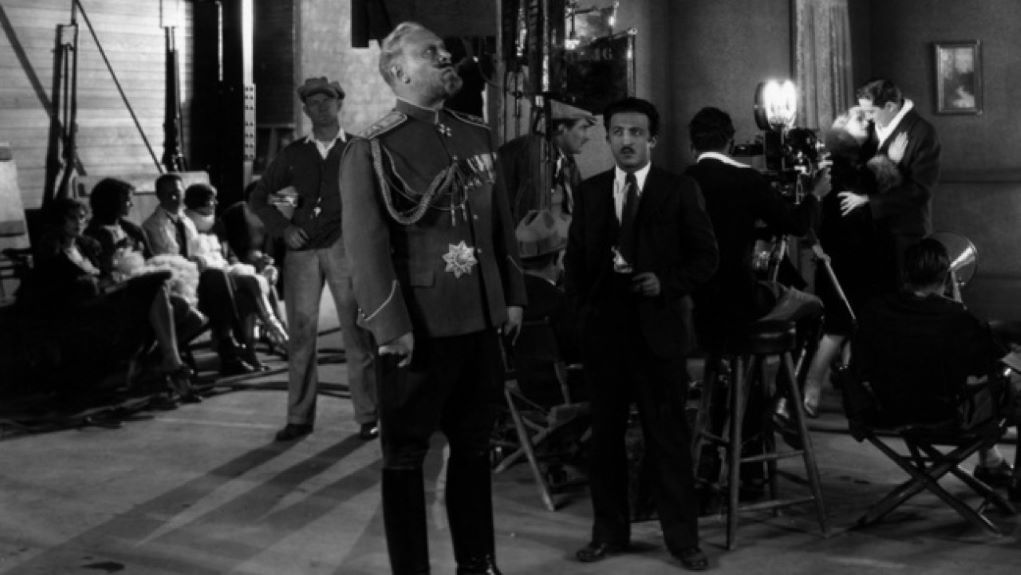
Hollywood director Lev Andreyev (William Powell) flicks through photos of extras, searching for someone to play the Russian General in his WW1 epic. His eyes light up – the perfect face! Sergius Alexander (Emil Jannings) is summoned. But Andreyev has ulterior motives: Sergius Alexander is a former Grand Duke who clashed with the revolutionary Andreyev in Russia ten years ago and this is the chance for revenge Andreyev has longed for. A cousin of the Tsar, Sergius Alexander was commander of the Western Front. Imperious but noble, deeply patriotic, he gave everything for Russia, despite falling in love with revolutionary Natalie Dabrov (Evelyn Brent). The revolution turned Sergius into a traumatised shell and kitting him out in uniform again impacts his sanity.

Von Sternberg’s The Last Command is two films mixed into one. It’s partly a satire on Hollywood, a machine specialising in creating artificiality that chews extras up and spits them out with little regard for their well-being (rather like the trench system the film is set in). The other – and more dominant – part is a classic melodrama of a noble Russian lost and powerless as his world collapses around him. It’s this second part that dominates the film, almost an hour of its ninety-minute run-time being taken up with its Russian flashback sequence. Like many von Sternberg films it’s charged with a mix of sex and sadomasochism, while also being a sympathetic, white-Russian look at the revolution.

Emil Jannings received the first ever Best Actor Oscar for this (and the now lost The Way of all Flesh). At the time Jannings was seen as one-of (if not the) greatest actor in the world, based on his mastery of the expressive arts of silent cinema. Janning’s physicality, his emotion-filled piercing gaze is duly showcased. Jannings effectively plays two parts: the Sergius Alexander of the Russian era, the Russian aristocrat who emerges as a man of honour, dignity and patriotism; and the Sergius Alexander of the present day, a timid, broken man, forever twitching, scared to look people in the eye. In both cases, von Sternberg’s camera constantly pulls back to Jannings whose ability to transform and twist his body – from ram-rod officer to broken husk – is executed perfectly.

Von Sternberg’s gives the bulk of the film’s run-time over to the build-up of the Russian revolution. While The Last Command gives some criticism to the ancién regime – our first shot is of a poverty-stricken mother and baby sitting in the snow, while the Tsar is a paper king more interested in parades than reality – von Sternberg’s affection is clearly for the decent nobles trying to make the system work. The revolutionaries are largely violent or shadowy manipulators (we get a brief scene with obvious Lenin and Trotsky stand-ins, presented as hypocritical middle-class looking schemers focused on power). On the contrary Sergius Alexander is interested only in the good of Russia.

It’s that which wins him the unexpected respect of feared revolutionary Natalie Dabrova, well played by Evelyn Brent. Dabrova is a power-keg whose fire and passion seizes the fascination of Sergius. Their initial meeting is the only time von Sternberg presents him as a tyrannical figure, sitting in an office questioning potential revolutionaries for his own amusement (including a whip across the face for Andreyev). But from there Sergius’ essential decency emerges – his politeness, his old-school chivalry. He treats her like a lady and (eventually) courts her with a Victorian gentility.

That contributes to Natalie’s shift towards seeing Sergius as a man trying his best in difficult circumstances rather than the ogre she assumed. Von Sternberg masterfully shoots the pomp and pageantry of the old Russia, full of military parades, fine dining and smart uniforms using this pageantry to show how it disguised the real threat facing the country. There are also elements of the sado-masochistic in the relationship between Natalie and Sergius. This bastion of the system is attracted to this woman who wants to burn the whole thing down. Visiting her in her bedroom, spotting a hidden pistol, is there an air of debased excitement when he turns his back on her and all but invites her to shoot him? In turn, Brent is almost a prototype of the classic Dietrich character, a strong, imperious woman, who dominates men, torn between conflicting desires.

There is a neat series of contrasts and contradictions in all the characters in The Last Command. Sergius is both a Tsarist bully, a decent man interested only in his country and a shattered husk in Hollywood. Lev is a firebrand revolutionary and an aristocratic Hollywood director. Natalie is a fascinating mix: a banner-waving anarchist who fits neatly into Sergius’ cocktail parties, who despises and loves the General. Duality and hidden identities hints at hidden desires within all the characters in a world tearing itself apart.

That collapse of order is the stunning heart of von Sternberg’s film. The seizure of Sergius’ train by revolutionaries, the final act before his exile, is superb in its vibrant tracking shots and Eisenstein-inspired energy. Jannings is placed at the heart of the crowd in a series of tracking-shot marches through baying crowds all pulling, spitting, pushing and abusing him that is part walk to calvary, part fantasy of humiliation. There are moments of understanding for the masses – a scene shows Tsarist soldiers machine-gun down a mob – though it’s balanced by the ruthless shooting they carry out on wounded soldiers. Sergius is reduced to the lowest-of-the-low, a humiliated figure shovelling coal for his revolutionary masters while they conduct (what looks like) an orgy in his state compartment.

Humiliation is also the name of the game in Hollywood. While The Last Command is more about its sympathetic look at good White Russians let down by the system (fitting von Sternberg’s imperialist sympathies), it throws in to its first and final act an uncomfortable look at Hollywood. Extras crowd at the studio door as another sea of desperate humanity (Sergius’ buffeting here in this crowd, must remind him of that humiliating walk through the mob in Russia). Costumes are flung at people identified only by tickets. Assistant directors treat people like dirt and extras are seen only as props.

But the satire is blunted by the fact that the treatment on set is motived by personal animosity. After all this is Lev – William Powell, rather good and clearly channelling von Sternberg – living out his own revenge fantasy. A sharper satire would have had no link between director and extra, merely seen the heartless system exploit a past trauma for its own benefit – with terrible consequences.

The Last Command is less a satire on Hollywood and more a rose-tinted look at the decent figures in the Tsarist system, with touches of satire on revolutionaries who are either power-mad middle-classes or working-class simpletons seduced by the temptations of drink and sex. It’s also a subtle smuggling in of the director’s own sexual fascinations, with Jannings a superb vehicle for this fantasy of humiliation with Brent shot with the sultry imperiousness of a potential dominatrix. For all this it’s a fine film, a visual marvel and a fascinating character study.

Persona (1966)

Persona (1966)

Bergman’s masterpiece, a fascinatingly brilliant Rorschach test that challenges and rewards the viewer

Director: Ingmar Bergman

Cast: Bibi Andersson (Alma), Liv Ullman (Elizabet Volger), Margareta Krook (Doctor), Gunnar Björnstrand (Herr Volger), Jorgen Lindstrom (Boy)

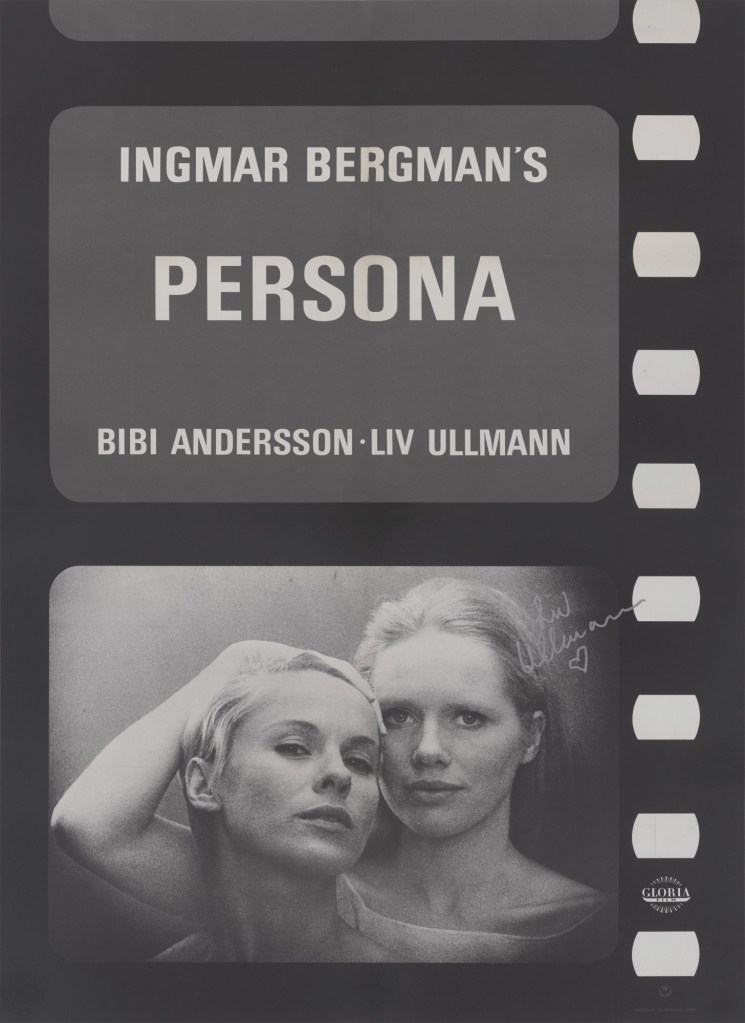
Even Bergman considered Persona a moment he “had gone as far as I could go…touched wordless secrets that only cinema can discover”. Persona, Bergman’s most consciously artistic and psychologically challenging work is a mass of contradictions and puzzles that defies easy categorisation (even Bergman claimed to be only half sure what definitively was happening). A whirling mix of themes, haunting moments and unknowable incidents all within a framework that constantly reminds us we are watching a film, Persona has been influencing, challenging and fascinating viewers for over 60 years. If cinema’s Everest is Citizen Kane, Persona is its K2.

The plot seems simple. Famed actress Elizabet Volger (Liv Ullman) fell silent for a minute during a production of Electra, then carried on. A day later she stopped speaking and hasn’t spoken since. Her doctors can’t find an answer so she is sent to an island to recuperate, with the support of a nurse, Alma (Bibi Andersson). On the island, Alma fills the silence with long monologues that become more and more confessional, intimate and personal. Does Elizabet betray these confidences in a letter to her doctor? Does Alma plot revenge? Are these events even happening? As the personalities of the two women blur, merge, swop and consume each other the film fractures (at one point literally so) until we are left as uncertain of who and what is real as perhaps the women themselves.

There is, in some ways, no understanding Persona. It perhaps best resembles a cinematic Rorschach test. I’d argue it’s a fool’s journey to stare at it for a definitive answer. Different days, different moods, different conditions will make the picture re-shape and resemble something else. Bergman has created a film devoid of traditional ‘clues’, that provides no trace of an ‘answer’, but instead asks – demands? – us to take away only what we choose.

Throughout, Bergman makes it vitally clear film is a constructed, artificial representation of reality. Persona starts and ends with film literally spooling through a projector, the arc lights cranking up to project a reality. The opening prologue is a host of suggestive images which may, or may not, relate to what we are about to watch. Their meaning is almost deliberately vague – much as the epilogue’s brief shot of Bergman and crew shooting the film is – but it lets us know beyond doubt this is a subjective presentation of a series of images, not real life. Perhaps reading meaning into it is as impossible a task as trying to interpret the contents of a library from the page of a single book.

Which is to say, I think Bergman is both inviting us to interpret the film but also warning us that this isn’t a jigsaw, but a deliberately obtuse and open-ended work, our experience of it controlled by the director. Film is after all a dream – a world where we think we move freely, but in fact we never do. Which might make you think Persona is Bergman’s punking the world, a Thermot’s Last Theorem designed to infuriate. It isn’t because it’s made with such grace, humanity and honesty.

To understand Persona you can only discuss – and wonder – at the complex, multi-layered themes and decide which speaks most to you on the day. A lot of this boils down to how you are affected by the breathtaking, seismic performances from Andersson and Ullman. Playing two characters whose identities merge, shift, mirror and absorb each other both performers give outstandingly intelligent, infinitely challenging and unreadable performances. For Andersson the film is virtually a monologue, where the more Alma talks, the more our grasp on who (or what?) she is slips through our fingers. Ullman’s impassive face, awash with micro-expressions (caught in scintillating close-ups) constantly disorientates – is that a sneer or a smile? Is that head-turn impatience or a desire to know more?

At several points I find myself falling into the trap Bergman lays of wanting to categorise the film, as I became convinced first one than the other of these women was just an element of the psyche of the other. It’s not as simple as that. They are both the same and different, two people and one. Bergman frequently frames their bodies overlapping and, in one horrifying moment, their face literally merged half-and-half. Elizabet, we think at first, is a near vampiric figure sucking the life out of Alma, drawing confessions from Alma to restore herself. Then Elizabet becomes a ghostly figure, moving in the margins of Alma’s life, a horrific silent figure from her subconscious holding her back. Then you feel Alma to be nothing more than Elizabet’s id, demanding her right to be independent.

The unreadability of the film becomes ever more acute at the half-way point. After an enraged Alma deliberately leaves Elizabet to cut her foot on glass, the film pauses, burns away and then restarts with an echo of its earlier montage. Has the story restarted? Did all or any of what went before actually happen? Or is everything from this point a cinematic fantasy? Later in the film Bergman throws in a sequence with Alma and Elizabet back in the hospital before returning to the island – is this a flashback or a dream or a vision or something else entirely?

Bergman’s mastery of horror comes to the fore. The haunting repeated shot of Elizabet embracing Alma from behind, the two of them starring into a mirror (and the camera) at times seems sexually charged, at others disturbingly possessive at others supernaturally controlling. Is Bergman’s point that the context of an image can change its meaning? These hazy definitions of truth and reality lie throughout. The confrontations between the two taking on an increasingly surreal nature.

In a stunning sequence, Bergman repeats the same Alma monologue twice, one focused solely on Elizabet (her face contorted with pain as she hears of her rejection of a child), the second on Alma (now dressed identically to Elizabet), Alma’s bitterness now taking on a totally different light. Alma, back in nurses’ outfit, confronts Elizabet screaming that she is her own person even as her words collapses into an incoherence that might as well match Elizabet’s silence. Which is projection and which reality? When they leave at the film’s end, do they go their separate ways or merge? Does Alma imagine herself with Elizabet’s husband, or when Elizabet’s husband recognises Alma as his wife is he tipping the nod to us?

Bergman gives no clear reasons for Elizabet’s silence. It could be connected to horror at the world’s terrors (Vietnam and the Holocaust are referenced). It could be shame at her own post-natal depression. It could be that the silent Elizabet is a projection of the Alma-Elizabet’s own turmoil and isn’t real in the first place. After all the hospital we are introduced to Elizabet in doesn’t feel like a real place but a sparsely dressed film set (and shot like it).

Sex weaves it’s way tellingly through the film. The sexual bond between Alma and Elizabeth, physically, seductively close and possibly sleeping together is clear. Alma relates a hugely erotic monologue about an orgy she and a friend initiated on a beach, the only time she describes herself a purely happy and content. Is this her memory or a fantasy of Elizabet’s? If Alma is Elizabet, is this what she longs for or the thing she finds missing now from her own life? Alma talks of wanting a family – but in a haphazard, casual way and has already had an abortion. Elizabet has a son but doesn’t want him – is Alma what she dreams she could be, or is Elizabet the truth Alma doesn’t want to face? At various points both, all or nothing of the above could be true.

The film opens with a mysterious boy starring at a blurred series of images of female faces. We never learn who he is (theories abound from Elizabet’s son to Bergman himself). He wakes seemingly from the dead, but perhaps he is given life by the film. Perhaps, Bergman is saying, Alma and Elizabet are themselves given life only by the film. That both of them are fictious illusions, as unreal as the blurred pictures on the wall. Persona is the sort of film only a director of pure courage could have made. An object that fascinates and frustrates but always leaves you wanting to reconsider and reposition it to see if the picture becomes clearer or if new truths are presented if you look at it from a different angle. Maybe Elizabet is a succubus. Maybe Alma is an angry inner self, longing to escape and liver her own life. Maybe Alma is the silent actress. Maybe Elizabet longs for the simpler life of the nurse. Perhaps every single idea is true and perhaps none of them are. That’s part of the mystery that makes Persona one of the greatest films ever made.

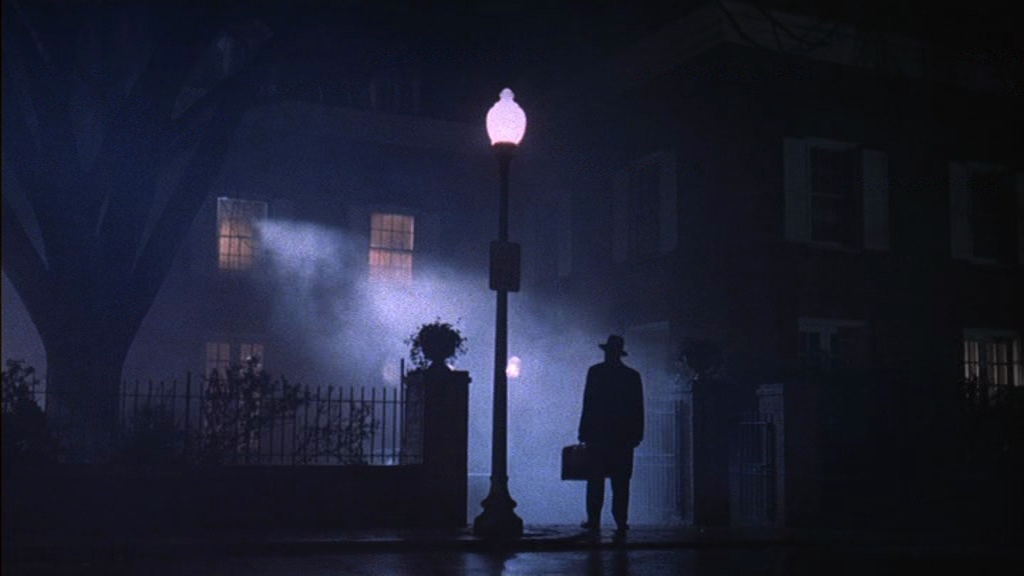
The Exorcist (1973)

The Exorcist (1973)

Unimaginable horrors seep into your mind in Friedkin’s hugely influential terrifying shocker

Director: William Friedkin

Cast: Ellen Burstyn (Chris MacNeil), Jason Miller (Father Damien Karras), Max von Sydow (Father Merrin), Linda Blair (Regan MacNeil), Lee J Cobb (Lt William F Kinderman), Kitty Wenn (Sharon Spencer), Jack MacGowran (Burke Dennings), Father William O’Malley (Father Joseph Dyer)

Growing up in the 90s in the UK it was easier to get your hands on a porno than a video copy of The Exorcist. For 12 years the film was banned because its influence was considered so insidious that it would inevitably lead to the corruption of the children who would (of course) dig out a copy to watch. Why was The Exorcist considered so powerful? After all no-one banned The Omen. Perhaps because there is something existential – unknowable, unexplained and unstoppable – at the heart of The Exorcist, while The Omen is a pulpy slasher about imaginatively bumping off Brit character actors. The Exorcist has a poetic nihilism, that reaches into your soul and takes a long-hard squeeze.

Hollywood actress Chris MacNeil (Ellen Burstyn) has problems. Her daughter Regan (Linda Blair) is growing increasingly unbalanced, suffering mood swings and saying the unsayable in grotesquely crude, sexual language. Doctors can’t find anything wrong with her. Above all they can’t explain her increased strength, contortions, the shaking of her bed and the freezing conditions in her bedroom. Could it be that Regan is possessed by a force darker than any we understand? After an unexplained death, Chris has no choice but to consult psychiatrist turned priest Father Damian Karras (Jason Miller) who reluctantly agrees that Satanic forces have taken control of Regan – and that an exorcism by himself and experienced Father Merrin (Max von Sydow) may be the only option.

Adapted from a chilling novel by William Peter Blatty (who also wrote the screenplay and produced), The Exorcist is an all-consuming experience film, directed with immersive power by William Friedkin. Everything in it is designed to unsettle, disturb and dig deep into the fears of the viewer. What could revile us more than a child, her body twisted into the features of a revolting, malign spirit, spouting revolting, bile-filled rants and revelling in a twisted, macabre sexuality? All this wrapped inside a film that makes your skin crawl with its coldness, precision and drained out colours, where sound is unpredictable, discordant and unnatural and which offers very few answers.

The Exorcist does this in spades. It’s methodical and quietly repetitive in aspects of its editing and framing, constantly using visual and audio association to build dread. Friedkin’s prowling camera glides constantly through the MacNeil’s luscious townhouse, gliding up the stairs to Regan’s bedroom to reveal new horrors. Friedkin builds the dread, his camera first studying the shock and horror on the faces of the characters, before cutting to reveal the terrors they are looking at.

We move from subtle moments – Regan’s Ouija board, through which she communicates with imaginary friend ‘Captain Howdy’, whose glider jumps unprompted from Chris’ hands. The moments of chilling flatness in Regan, such as when she tells a visiting astronaut he “will die up there”. The violent, uncontrollable, impossible shaking of her bed. Regan’s astonishing strength that can hurl people across rooms. All this builds us towards the real grotesqueness: her deformity, her sex-obsessed rantings, impossible body contortions and her revolting sexual defilement of a crucifix. It increases in immediacy, graphicness and in its breaking of social convention, until you get the feeling you watching something that can only be classed as a revolting, all-pervading, all-corrupting evil.

Evil is at the heart of The Exorcist. Friedkin superbly suggests a mystical, eternal clash between that and good at its heart. It’s opening sequence, with the discovery of the relics of the demon Pazazu in an Iraq is awash in suggestive menace: the percussive drum beat of the excavator’s tools, gusts of unexplained wind, the barking of battling dogs. A mist-filled skyline sees Merrin (and the granite faced von Sydow feels like a mythical figure) confronting a terrible statue of Pazazu. The moods –particular the audio features of this landscape – are echoed throughout the film, tying disparate locations together and subtly suggesting an age-long war that can never end.

That lies at the heart of The Exorcist’s ghastly appeal. Everything feels undefeatable, with regular streets and homes transfigured into places of inhuman dread. Little moments – a dog, a tramp, a train – take on echoes of sounds and sights associated with the demon. The brilliant repetitive use of Mike Oldfield’s Tubular Bells provides a mesmeric rhythm that always echoes the discordant tones of other sounds and sights. Friedkin plays this up with visual touches – subliminal imagery is used to flash horrors past us and the film plays with visions of suggestive unease. The demon similarly plays on underlying fears – of guilt, inadequacy and repressed desire – that it flings horrifically to the fore, through parroting the voices of others to changing its shape and appearance.

No wonder medicine is flummoxed. The Exorcist, considering its reputation, surprises for being such a slow-burn. It takes nearly two thirds of the runtime before the idea of the exorcism arises, during which we watch never-ending medical tests on Regan. Friedkin shoots these with a cold, impersonal professionalism (an angiography, with blood spurting from Regan’s neck, is almost unwatchable in its realism) which makes it feel even more powerless against the demon’s existential evil.

The Exorcist gently glides over narrative and logic gaps (not least the sudden onset of Regan’s worsening condition) because it retains a mystic power and the nightmare inducing dread of knowing exactly what is happening, but being unable to step into the film and tell the characters. It all leads perfectly into the exorcism scenes, when the film’s horror culminates in scenes of extraordinarily intensity, difficult to watch, with just the right amount of gore and suggestion.

Is The Exorcist about anything? That might be its greatest flaw. So enamoured is it with infecting us with dread, that it neglects to offer much that can give lasting spiritual or intellectual nourishment. Like a brilliantly constructed haunted house, it thrills but leaves you with little else to consider (other the costly struggle against evil). At heart, it’s a superbly well-made B-movie, a terrific horror-thrill ride where every single moment is masterfully designed to illicit an effect from the audience.

It’s helped by the superbly horrific make-up (not to mention von Sydow’s hugely convincing ageing) and effects whose practical realism increases their dread. Friedkin – at the height of his dictatorial auteurism – directed with little regard for cast and crew, focused on producing the desired effect. Guns were fired to illicit shocks. He slapped Father William O’Malley seconds before shooting a scene to make him look distressed. Burstyn and Blair both suffered lasting back injuries from being jerked around and the exorcism was shot in such refrigerator conditions, the actors couldn’t spend longer than fifteen minutes in the room.

But Friedkin’s determination to produce his vision through every means necessary worked. The Exorcist has a power few other films can dream of. The actors do their part: Burstyn’s increasingly raw pain and distress grounds it extremely well, Blair’s innocence makes her later horrors (voiced by a gravelly Mercedes McCambridge) even more disgusting, Miller is very good as the film’s eventual hero whose soul becomes a battle-ground, von Sydow invests Merrin with a rich hinterland.

They are framed with a film that is immediate, discordant and subtly grotesque. It leaves little to the imagination, but nevertheless encourages the mind to add its own horrors. It feels like the film itself can be a quiet demon, working its way inside to change you. It’s a horrific ride, and if it feels like it ends on a beat of grimness and desolation (despite Blatty’s intentions) that feels fitting for a film that may have little to truly say but affects viewers in a way few other films do. That’s why it was seen as having such power, because it invests deep, subliminal meaning and import to what could have been just (as its sequels are) an exploitation flick. That’s why it was banned.

The Silence (1963)

The Silence (1963)

Bergman’s third film in his “faith” trilogy, is an intriguing Sartresque puzzle

Director: Ingmar Bergman

Cast: Ingrid Thulin (Ester), Gunnel Lindblom (Anna), Jörgen Lindström (Johan), Birger Malmstein (Waiter), Håkan Jahnberg (Hotel porter)

Two sisters, Esther (Ingrid Thulin) and Anna (Gunnel Lindblom), mother to ten-year-old Johan (Jörgen Lindström), are travelling home on a train through Europe. Ester, a translator, is already ill and her health takes a sharp downturn, leading to the group being forced to rest in a hotel in a town called Timoka, in an unnamed (fictional) European country. Anna resents what she sees as the judgemental expectations of her older sister and sees her obligation to care for her as a burden. Over a few days in the hotel, the two sisters move awkwardly around each other, avoiding addressing their problems while struggling in a country where neither of them speak the language.

The Silence was the third, and final, film in Bergman’s loose thematic trilogy on the absence of God in the modern world. It’s also possibly his most bleak and Sartre influenced work so far, a film of oppressive silence (devoid of music, the only noises coming from objects in the rooms of the hotel) with events occurring in a disturbing, slightly surreal world, where the normal rules of human interaction seem to be hold. Perhaps that’s because the characters move, like ghosts, through a world where they have no ability to communicate other than stumbled words and hand gestures, residing in a hotel where there seems to be no timescale on how long they are (or have been) there.

It also feels like an entrée to Persona, Bergman’s next major work. Like that, The Silence revolves around a symbiotic relationship between two women, who together seem to form two halves of one personality. Esther is intellectual, reserved but also vulnerable and adrift, dependent on others for help and frequently resorting to drink to dull her pain. Anna is more earthy, sensual but insecure, resentful and feels judged by others, finding temporary peace in casual sexual encounters. Both sisters are locked in a relationship that feels both disconnected and mutually dependent, constantly clashing with each other but living in worlds defined by their feelings for the other.

They are played majestically by two performers at the height of their powers. Thulin seems cold but conveys great depths of pain and suffering beneath what seems like her confidence and assurance. Thulin’s expressive face communicates great emotional turmoil, even with only the slightest movements and gestures. It’s a beautifully delivered performance of a woman who is unknowable, distant, difficult but also highly sympathetic. Lindblom’s physical assurance is counter-balanced by the great uncertainty she manages to communicate in every beat of Anna’s life. Her general demeanour of icy chill, interrupted with emotional breakdowns which alternate rage with tears and hysterical laughter, is faultlessly delivered.

These two characters increasingly feel trapped inside a world where they can’t easily communicate, with the threat of turmoil constantly rumbling on the margins. This unnamed country teeters on the edge of war – tanks and other military equipment make constant intrusions on the streets and the train tracks and the rumble of planes can be heard in the air. They are also rendered increasingly mute and isolated by their inability to speak the language. Communication with people around them is impossible and understanding is only fractured.

This is where Bergman’s views on God slowly take their form. For, as he observed in other films in the trilogy, what is this world but one where we strain in vain for the voice of God? Isn’t that like being adrift in a country where the language is unknown? And if, as Bergman so heartily expresses elsewhere, God is love what does it mean that this film revolves around character who have such negative to indifferent opinions on others. Ester may love – as she argues – Anna, but Anna has interpreted this love as smothering and oppressive her whole life and rejects Anna utterly. Anna seems disinterested in her son Johan (who Ester yearns to be closer to, but can never quite find the way to close the gap) and impatient with her sister. Not only are the characters trapped in a world of silence, they are also trapped in circles of loveless relationships.

It’s striking then that this was Bergman’s most sexual film so far. Bizarrely – for a film as austere, glum and challenging as The Silence – it was a box-office hit. This was, in large part, connected to its comfort with sex scenes. Anna watches a couple sat next to her having passionate (and beautifully lit) sex in an opera house, before engaging in wordless (of course) intercourse with a waiter (Anna even mentions the benefits of the man not understanding a word she says). The more frustrated Ester masturbates alone – no coincidence that she later speaks of her disgust with the sexual act and its bodily fluids. This is a film without love but with a lot of base, meaningless, carnal love in it – all part of a Godless world leaning into its nihilistic close.

The Silence is extraordinary in its filmic confidence. It’s exquisitely shot by Sven Nykvist, his camera (far more mobile than almost any time before in Bergman) tracks down corridors and through rooms of its luxurious but chillingly empty hotel (you can see The Silence’s influence on Kubrick’s The Shining). It uses light, shade and shadow in strikingly meaningful ways, arcs of light suggesting a host of underlying emotions and unspoken longings.

The Silence is a film that invites analysis and theorising, partially because its characters speak in such gnomic, Bergmanesque mysteries. Some have theorised Johan is in fact Ester’s child, raised begrudgingly by Anna, now longed for by his real mother at her end. Some have suggested Ester and Anna are such contrasting sides they may in fact be the same person (traces of Lynch’s Mulholland Drive) others see an incestuous longing in Ester for her sister. Bergman increases the unknowing mystery by presenting much of the film from the perspective of the precocious (not many children read Turgenov) but innocent Johan, a child who sees but cannot interrogate the actions around him.

It makes The Silence feel like a bridge from one era of Bergman to the next. The last hurrah of his spiritual study, before a series of films that would explore the interconnected lives of women whose desires, needs and dependencies motivate and merge into each other. That makes it a fascinating and vital milestone in Bergman’s development – as well as another extraordinary, haunting and fascinating work from a great director.

Shine (1996)

Shine (1996)

Middle-brow and safe biography that takes easy choices and makes reassuring points

Director: Scott Hicks

Cast: Geoffrey Rush (David Helfgott), Armin Mueller-Stahl (Peter Helfgott), Noah Taylor (Young David Helfgott), Lynn Redgrave (Gillian), Googie Withers (Katherine Susannah Prichard), John Gielgud (Sir Cecil Parkes), Sonia Todd (Sylvia), Nicholas Bell (Mr Rosen), Alex Rafalowicz (Child David Helfgott)

A hugely talented pianist, David Helfgott (played by Noah Taylor then Geoffrey Rush) trained at the Royal College of Music in the late 1960s but developed schizoaffective disorder, a condition that stalled any music career. What happened next is debated, but according to Shine years of mental institutes and sheltered housing eventually led to rediscovery and a life turned round by marriage to Gillian (Lynn Redgrave). This provided a happy home to Helfgott, who had grown up under the domineering hand of his father Peter (Armin Mueller-Stahl), a Polish-Australian who had narrowly escaped the Holocaust and disowned his son after he travelled, against his wishes, to Britain.

Shine repackages Helfgott’s life into a crowd-pleasing triumph-against-adversity biopic which plays fast and loose with facts. Shine makes no mention of Helfgott’s first marriage, it’s portrayal of his father as a misguided tyrant has been disputed by other members of Helfgott’s family and the level of estrangement Helfgott had from his family (his brother claimed David continued to live with the Helfgott family after his return) has been strongly disputed. Shine smooths off all rough edges and emphasises dramatic potential in others to create its stereotypical heart-warming tale.

What it also does is turn Helfgott’s life into a middle-of-the-road biopic, a highly convention film full of expected arcs (struggle, triumph, collapse, triumphant return) and directed with a middlebrow assurance by Hicks. It’s a film that flatters to deceive, offering only cursory insight into its subject and ends with a sentimental scene in which we are all-but-invited to join the characters in a standing ovation for a Helfgott comeback performance (which the film doesn’t even show us).

Shine has almost no interest in Helfgott’s illness, what bought it on, how it developed or what he and those around him did to help him function in society (his marriage to Gillian gets barely ten minutes of the film’s runtime). It has very little interest or insight into music – other than Rachmaninov being ‘very hard to play’ and some guff about finding the heart behind the notes which sounds full of import because anything said by John Gielgud sounds important. It takes a fascinatingly conflicted character like Peter Helfgott and bends over backwards to make him as two dimensional as possible, with only a brief throw-away line that leans into how quite possibly his views on the importance of family might just have been affected by the slaughter of the rest of his in the Holocaust. Everything is designed to make us feel that standing ovation is earned.

The film gets a much better performance than it deserves from Armin Mueller-Stahl as Peter Helfgott. Here is an actor with more compassion and insight into his role than either the film or the director has. On the surface everything Peter does is appalling; controlling what his son plays, demanding he wins competitions, blocking opportunities for progress, beating him in a rage twice and throwing him out of the house. But Mueller-Stahl plays the fragility and vulnerability under Peter exquisitely. This is a man so terrified about losing his family that he goes to extraordinarily damaging lengths to hold it together. So much so he destroys it.

And you understand that in every moment of Mueller-Stahl’s sensitive and immaculately judged performance. He looks at his son with tenderness and adoring love. His eyes dance with fear at the prospect of David going out alone into a world he thinks is dangerous. Its fear that leads him to react with violence – the terror of weakness pours from Mueller-Stahl. It’s a rich, layered, superb performance which seems almost smuggled into a film that does it’s very best to present Peter Helfgott as a controlling, destructive bully who (it believes) was the root cause of David’s illness.

The drama of the film – most of its first hour – revolves around the clash between this domineering father and the young Helfgott, played by Noah Taylor. It tells a very familiar story: the quiet, but talented son and the monster behind him, but does it solidly enough. Quiet, mumbling and shy – but with subtle traces of condition we know will seize him later in life, Taylor is marvellous. The training sequence at the Royal Academy, again familiarly reassuring for its pupil-mentor set-up, also allows a lovely showcase for an-almost-swansong role for Gielgud, sparkling, wry and charming.

It’s strange than that the Best Actor awards were poured onto Geoffrey Rush who only appears in two scenes before taking over the role at the 67-minute mark (of a 100-minute film). Rush, then unknown internationally, gives the sort of grand performance beloved of awards ceremonies. I admire Rush enormously: but Shine is all technique and no insight. Rush twitches, talks at a thousand miles a minute and plays the piano like a natural. Never once is he given the opportunity to really get inside what motivates Helfgott. He doesn’t even get the main dramatic meat of the film (he shares one brief scene with Mueller-Stahl). It’s ironically like a note-perfect but professionally smooth piano recital: the sort of role you feel Rush could actually have done standing on his head.

Shine even fudges moments of stand-up-and-cheer. Helfgott has been told he cannot play a piano because it affects his nerves. We frequently see him starring wistfully at a piano. The film opens with a rain-soaked Helfgott barging into a closed café hoping to be allowed to use the piano. The film is clearly building towards the moment when Helfgott plays the piano in that café, wowing the clientele with his virtuosity after a clumsy initial test playing of a few keys. We should have been wondering: does he still have it after all these years? We’re not because Hicks has thrown away Helfgott’s first playing of the piano in years five minutes early by having him hammer the keys with brilliance in a piano in his hostel (the instrument subsequently locked by his annoyed host). Why not have the piano locked from the start, sitting in his room, present but out of reach? Wouldn’t that have made it even more triumphant when Helfgott played like a master in that café one evening?

It’s cack-handed moments like that exposes the weakness in Shine, a film that flatters to deceive, offering only the most conventional and safe perspectives on a life. It boils things down to goodies and baddies and simplifies mental problems into being solved by just a little love and affection.  It’s a film that wants us to applaud Helfgott – and, by extension, to feel better about ourselves. But Shine offers very little in the way of insight or understanding and boils all its events down into easily digestible narrative homilies. It’s middle-brow filmmaking of the middlest kind.

Agnes of God (1985)

Agnes of God (1985)

A chamber piece play is expanded into something less enigmatic or satisfying

Director: Norman Jewison

Cast: Jane Fonda (Dr Martha Livingston), Anne Bancroft (Mother Miriam Ruth), Meg Tilly (Sister Agnes Devereaux), Anne Pitoniak (Mrs Livingston), Winston Rekert (Detective Langevin), Guy Hoffman (Justice Joseph Leveau)

In a Montreal convent a naïve, other-worldly young novice, Sister Agnes Devereaux (Meg Tilly), has given bloody birth to a baby, that now lies strangled in a waste paper bin. The courts must decide if Sister Agnes is fit and capable of standing trial. That decision will be based on the recommendation of hard-smoking psychiatrist and atheist Dr Martha Livingston (Jane Fonda). Spending time with the devout young woman, Dr Livingston finds herself drawn to her and determined to discover why this girl who knows nothing of sex became pregnant. But she also butts heads with Mother Miriam (Anne Bancroft), the stern head of the convent, equally determined to protect Sister Agnes.

Jewison’s film – adapted by original playwright John Pielmeier – is a not entirely successful transfer of a three-hander chamber piece into cinema. The play, at its best as a series of monologues and duologues, deliberately left events open to interpretation: we have only their words and recollections to base conclusions on, all within an increasingly claustrophobic single-room set. Much of that pressure is lost in this film version, exposing instead the play’s flaws.

The “opening out” of the play focuses on introducing new characters and scenes. Unfortunately, these tend to stick out like sore thumbs. They invariably involve Dr Livingston talking to thinly sketched characters outside of the convent, who deliver stilted and dull dialogue that feels like clumsy padding. Members of the Canadian court take her on and off the case. A priest suggests she has an anti-Church bias. A brief visit to her Alzheimer’s suffering mother. A detective boyfriend passes her the odd file. All of these encounters feel exactly like what they are: scenes introduced solely so that we can see people other than the three principals.

They contrast greatly with the weightier and more engaging scenes between the three women, the meat of which is carried across from the stage play. Played with a high-pitched, breathless naivety by Meg Tilly (Oscar-nominated), Agnes is almost child-like in her interpretation of what the Lord demands of her and seems barely capable of understanding the adult world she finds herself in. She is enthralled by the ringing of bells and the sound of birds. She wants to make herself the perfect image of what she believes God wants.

It demands every inch of Dr Livingston’s professional expertise and ability to draw confidences and make psychological leaps to begin to understand this godly young woman’s psyche. Fonda is very good in a part that demands hard work with none of the flashy histrionics the other two roles have. Fonda makes Livingston a consummate professional, with a touch (not least in her constant parade of cigarettes) of the maverick to her, someone who never takes no for an answer and constantly drills deeper and deeper.

In many ways this makes her a kindred spirit for Anne Bancroft’s (also Oscar-nominated) Mother Miriam. Late to her calling, Bancroft brilliantly embraces a big, chewy part as a seemingly stern, slightly exasperated stereotypical head nun who reveals reservoirs of humanity and a strong sense of duty of care for her charges. It’s a standard twist on the grouchy older character who hides an affectionate smile, but Bancroft performs it with gusto and cements her clashes with Livingston in genuine resentment at the doctor’s initially glib assumptions about life in the convent.

The debates and confrontations between Miriam and Martha – and their attempts to both protect and draw truths from Sister Agnes – are the dramatic meat of the film and by far its most engaging moments. The problem is, the film’s attempt to expand these points with flashbacks and the grim reality of the camera undermines the suggestiveness of the original play,.

Like Equus – which demonstrated how real horses and a graphic horse-blinding scene can make a thoughtful play crude and clumsy on filmAgnes of God falls back into a POV flashback of choral singing, flying doves and undefined shadows to try and picture how Sister Agnes became pregnant. The implication seems clear that this was therefore something supernatural in this. (The film’s unsubtle love of stigmata blood smeared on various white clothes and walls hammer this home further.) What on earth does the film want us to take from that?

Especially as it ends with a confused up-beat ending, with an idyllic looking Sister Agnes (very different from the play’s bleak final monologue for Dr Livingston). If, as Sister Agnes (and maybe a part of Mother Miriam) believes, this child was conceived by God, what on earth does the film want us to make of Sister Agnes murdering (presumably) the second coming? When Sister Agnes, under hypnosis, rants and raves about her hatred for God, is she talking literally – or are we meant to think it is because the Lord has let a bad thing happen to her?

It ends up feeling incredibly unsatisfying, raising questions around faith and divinity, but pointedly running away from them and any implications they might raise. A braver film would have either kept the original’s inscrutability, or it would have dived into a truly critical look at religion and a world where God (at the very least) allows suffering. Agnes of God does neither. Despite good performances, it substitutes unsubtle bluntness for suggestion and insinuation.

Winter Light (1963)

Winter Light (1963)

Faith is thoughtfully questioned in Ingmar Bergman’s spare, bleak and striking masterpiece

Director: Ingmar Bergman

Cast: Gunnar Björnstrand (Pastor Tomas Ericsson), Ingrid Thulin (Märta Lundberg), Gunnel Lindblom (Karin Persson), Max von Sydow (Jonas Persson), Allan Edwall (Algot Frövik), Kolbjörn Knudsen (Knut Aronsson), Olof Thunberg (Fredrik Blom), Elsa Ebbesen (Magdalena Ledfors)

It would surprise many to hear Bergman held Winter Light in the highest regard among his films. An austere chamber piece, largely set in a cold, naturally lit church, it’s the middle chapter of his thematic trilogy on faith and it serves to correct any sense of hope left remaining from in Through a Glass Darkly. Winter Light – with its lead character a semi-biographical combination of Bergman’s father (himself a Lutheran Pastor) and Bergman himself – begins with a robotic preaching in a Church and ends firing up another such sermon to an empty Church. This is a world where, if there ever was a God, he has long since gone silent and disappeared over the horizon.

You could argue Tomas Ericsson is the most ill-suited priest in the history of cinema. He’s played with a peevish, grumpy lack of hope, inspiration or joy, self-loathing seeping from every pore by Gunnar Björnstrand in what might just be his finest hour. Björnstrand, more comfortable with comedy, struggled with this counter-casting (and his cold, which was written into the script), the bottled-up pressure of the role almost shattering his friendship with Bergman. Following a single afternoon in Ericsson’s life, Winter Light charts his complete disillusionment with his faith, his utter failure to provide spiritual comfort to parishioners and his mix of dependence, indifference and contempt for schoolteacher and some-time lover Märta (Ingrid Thulin), herself a needy, unhappy woman content to play second-fiddle to Tomas’ deceased wife.

Tomas’ faith in God has long since vanished. Winter Light is his own Gethsemane, a parade of painful events and conversations where he waits desperately for some sort of sign or word from the Almighty and is left instead wondering, like Christ, why God has forsaken him. Tomas has become bitter, self-obsessed and self-loathing, going through the motions with a dwindling congregation and unable to muster even the faintest bit of belief in the words that pass his lips.

Winter Light follows up ideas of Through a Glass Darkly (Tomas even talks of a “Spider God”, a destructive force at the centre of a world made of pain). There is an echo throughout of the idea that, if God is love, then letting love into your life (or acknowledging the existence of Love in the world) is proof enough that there is a God, even if he is now silent. If so, Tomas’ rejection of any form of love goes hand-in-hand with his rejection of faith. If he felt love, it was for his late wife – and her death matches the decease of his faith in God. Now he angrily slaps away offers of affection with the same contempt he addresses towards questions of faith.

That offer of love comes from Märta, a mousey teacher trapped under an unflattering hat, the bags under her eyes and spinsterish clothes. She’s played in a performance of sustained, emotive brilliance by Ingrid Thulin. Märta captures her feelings for Tomas – right down to her acknowledgement that she knows he does not love her – in a sprawling, stream-of-consciousness letter (which Tomas has delayed reading – and when he does, he scrunches it into a frustrated ball).

That letter is conveyed to us in a stunning, almost interrupted, seven-minute take where Bergman focuses the camera on Thulin in close-up who delivers the contents of the letter straight to camera. This is a tour-de-force from Thulin, by terms unblinking, honest, self-denying, pained, resigned, hopeful and frustratingly simpering, a masterclass that marks one of Winter Light’s most striking moments of directorial and actorly technique. Few actors could pull this scene off with the grace and emotional commitment Thulin brings to it – and still leave us understanding why Tomas later, with anger frustration, cruelly tells her he has simply had enough of her all-forgiving love.

There is no place for that sort of saintly, Christ-like, love in Tomas’ life. His focus remains his own self-loathing. When meeting with Jonas (Max von Sydow – even more carved from granite than normal, his fixed stillness contrasted with Björnstrand’s twitchy unease), who has come to Tomas for spiritual reassurance to help overcome suicidal thoughts, Tomas can only complain of his own lack of faith. Tomas fails utterly to offer any solace to Jonas, a further mark of his own failure as both a priest and human. Jonas’ suicidal misery at the dread of oncoming Armageddon in the nuclear age, becomes grist to Tomas’ own misery and our priest in turn feels no shame in turning to Märta immediately for reassurance and comfort.

The only person who seems to have considered the nature of faith is disabled sexton Algot (a marvellous performance by Allan Edwall). Algot reflects that the suffering on the cross was not Christ’s true sacrifice – after all that was over in hours. The real suffering was hearing God’s silence on that cross, of the horror of suddenly thinking your life’s work may have been a waste of time, that he evangelised for someone silent or indifferent or worse. It would tie in directly with Tomas’ own doubts – except it’s pretty certain Tomas isn’t listening to him.

Maybe that’s partly the problem. We don’t listen to God, because we no longer expect him to talk. At one point, Tomas asks why God has fallen silent while behind him light suddenly pours through the Church window. Is that a sign of a sort? If it is Tomas doesn’t look and when he does, he doesn’t think. Instead, he contributes to the silence of God – as the closest thing to his vessel he fails to listen, fails to help and focuses only on his own pain.

Winter Light is a gorgeous film, full of striking light and shade by cinematographer Sven Nykvist. It’s also a bleak, grim, hopeless film, the best hope it can offer being God might have been real but he’s long since turned his back on us, just as we’ve turned out back on him. It’s magnified when we reject the thing he might have left for us, love itself. Winter Light is intensely thought-provoking, but rivetingly intelligent in the way the best of Bergman is. Björnstrand is superb and Thulin is extraordinary, in a film that carries worlds of meanings in its spare 80 minute runtime.

Coming Home (1978)

Coming Home (1978)

Emotional but a little too worthy Vietnam message movie, well-directed with great performances

Director: Hal Ashby

Cast: Jane Fonda (Sally Hyde), Jon Voight (Luke Martin), Bruce Dern (Captain Bob Hyde), Penelope Milford (Vi Munson), Robert Carradine (Robert Munson), Robert Gintu (Sgt Dink Mobley), Mary Gregory (Martha Vickery), Kathleen Miller (Kathy Delise)

Vietnam is a jagged scar on the soul of America but, more than that, it’s been a literal scar for the veterans. Luke Martin (Jon Voight) was a college athletic star, now returned from the frontlines as an angry paraplegic, struggling with post-traumatic stress. Helping him – eventually – is old school-friend Sally Hyde (Jane Fonda), married to a Marine captain Bob (Bruce Dern) who has himself shipped out to Vietnam. Sally and Luke find themselves growing closer and closer emotionally, as their hostility towards the brutal war grows. But how will Bob – still loved by Sally and himself ever more scarred by trauma – react when he returns from the front?

Coming Home was released in the same year as The Deer Hunter and makes for an interesting comparison. While Cimino’s film is a horrific plunge into the grisly horrors of war, combined with a sort of mesmeric epic poetry, Ashby’s Coming Home is a quieter, more domestic piece, an earnest attempt to explore trauma. There is no doubting the passion of all those involved: but Coming Home is at times a little too earnest. Despite its moments of undeniable emotional impact, its sometimes feels a little too pointedly like a “message” film, worn a little too heavily on its sleeve.

But, saying that, there are many positives. It’s shot with a skilful casualness by Ashby, whose unobtrusive camera makes us a witness to events (at one crucial point it is even half obstructed by a door). Ashby has a poetic sensibility that flies in the face of what could have been its soapy roots. He lets scenes unfold with such ease and gentleness of touch that you only slowly notice how extremely well assembled the film is. There is a whimsical, lyrical sadness about the whole thing – matched with a striking lack of condemnation of people, only for a system that bends and twists human beings into killing machines.

It uses a parade of hit songs, but the songs play not as snippets but as full performances, playing out over several scenes, scenes which at first seem to be directly counter to the lyrics and tone of the song itself. Then you notice the skill with which the film has been edited to the beat of the music, and how much The Rolling Stones, The Beatles, Hendrix, Simon & Garfunkel, Bob Dylan and many others set the tone for a whole era. Coming Home captures this tone, an era of optimism crushed by brutal contact with the cold, dark realities of the world. The songs weave themselves in and out of scenes, capturing an overwhelming sense of a nation lost and confused.

It’s in this framework the relationship between Luke and Sally flourishes as Luke begins finding purpose in his life. Heavily based on the life of Ron Kovic, Jon Voight won an Oscar for his extraordinarily committed performance. From early outbursts of naked fury and pain, wheeling himself around on a hospital bed, his outbursts seemingly only prevented by medication, Voight charts the development of Luke as a humanitarian and compassionate man, committed to helping others overcome their pain and loss.

He also develops an attachment to Sally that transcends physical attraction: the two are kindred spirits. Fonda (effectively the film’s producer), generously takes on the film’s least interesting role as the disengaged, homespun Sally, increasingly horrified by the war’s impact on veterans – and the lack of interest from others (capturing the whole sweep-it-under-the-carpet attitude of the armed services, her military wives’ club refuses to include a report from Luke’s hospital in their newsletter because it’s too depressing). This translates into a deep attraction for Luke, the only other person who truly shares her growing resentment for the war.

Coming Home gained much attention at the time for its frank depiction of sex, with Luke and Sally tenderly overcoming the barriers of his disability. (Although today, their coupling – with Fonda replaced by a body double – culminating in Sally’s first ever orgasm feels a little too obvious in its comparisons with her passionless flings with Bob). But sex is less important than sharing their feelings, from Luke’s talk of dreams where he can still walk to Sally’s doubts about her life choices.

If there is a problem with Coming Home, it’s that the film doesn’t really know what to do with these characters other than showcase their pain. It tends to make sharp jumps – Luke’s recovery from initial rage to tender, thoughtful man feels very swift. And although Penelope Milford is good value as Sally’s best friend, struggling to deal with her veteran brother’s collapsing mental health, her plotline and performance is a little too obviously designed to contrast with Sally’s.

The basic problem with Coming Home is that in its rush to establish the fundamental decency of its characters – and the appalling horror of the war they are wrapped up in – it often avoids drama of struggle. It makes an interesting contrast with Zinnemann’s The Men which turned Brando’s paraplegic veteran’s psychological recovery into an entire movie: here Luke’s finding of a new purpose is as swift as his mood shift is.

The film’s most interesting plotline actually follows Dern’s Bob Hyde. Dern gives the film’s most complex performance as a dedicated solider, struggling with deep denial about his growing disaffection and unacknowledged PTSD, confronting his wife’s infidelity with a mix of anger and desperation to receive a comforting hug from her. Hyde’s discovery of the affair is its most melodramatic moment, but also strangely its most unpredictable – and a film exploring this character’s switch in perspective might just have been a little more challenging.

But Coming Home has plenty to recommend it. Voight has never been better, warm, tender and throbbing with emotion, his closing speech to a roomful of students exhorting them not to fight and choking back tears that taking another life is never worth it, is worth the price of admission alone. Ashby’s film has a poetic sensibility to it and if it sometimes feels a little too self-righteously earnest about its anti-war credentials, and a little too aware of its status as a “message movie”, at least it is a message that needs to be heard.

Freud (1962)

Freud (1962)

This intriguing film makes an excellent attempt at exploring the nature of thought

Director: John Huston

Cast: Montgomery Clift (Sigmund Freud), Susannah York (Cecily Koertner), Larry Parks (Dr Joseph Breuer), Eric Portman (Dr Theodore Meynet), Susan Kohner (Martha Freud), Eileen Herlie (Ida Koetner), Fernand Ledoux (Dr Charcot), David McCallum (Carl von Schlosser), Rosalie Crutchley (Amalia Freud)

Few thinkers had as much impact on the 20th century as Sigmund Freud. For generations, Freud’s theories on psychology and sexuality were defining texts shaping perceptions of our inner world. John Huston was fascinated by his work, translating its spirit into this thought-provoking, if at times clinical, film that focuses on a few key years in Freud’s life and does its very best to communicate the thought behind the theory, while being careful to never delve too far into thornier matters. (Despite the poster’s blaring tagline “He dared to search beyond the flesh!”).

Freud is played by Montgomery Clift, whom we meet in 1885 Vienna as a young doctor. Freud’s theories that physical ailments might have a psychological cause are widely dismissed by the medical establishment, represented by smug Dr Meynet (Eric Portman). However, Freud is convinced the secret of treating neurosis lies within – not least since he recognises symptoms of neurosis in his own dreams, haunted by half-memories of his mother and complex feelings for his father. Working with his mentor Dr Joseph Breuer (Larry Parks), Freud explores hypnosis to access patients’ repressed feelings, working closely with Cecily Koertner (Susannah York), a young woman who has inexplicably lost the ability to walk. Slowly Freud begins to form a theory of sexuality in children, as well as discovering guided discussions and word association to be more effective than hypnosis.

Huston’s film is shot in luscious black and white by Douglas Slocombe, composed of a mixture of images that balance painterly influences with surrealist nightmares. Freud and Koertner’s dream sequences are shot with a grainy intensity, a series of chilling images ranging from Freud being dragged towards his enthroned mother by a roped dwarf to Koertner’s mother domineering a beach from a grand tower. These surrealist touches tear through a film that otherwise presents a more earnest exploration of Freud’s theorising. It serves as a necessary contrast to the constraining formality of 19th-century Vienna, where inner passions and feelings are routinely stamped down.

Freud studiously explores the evolution of its subject’s thinking, in particular through his analysis of the fictional Cecily (standing in for several patients). Played with gusto by Susannah York, the film carefully structures her psychological make-up as a detective mystery to be slowly peeled away, with wrong-turns, false dawns and incorrect assumptions abounding. Initially treated with caring patience by Breuer’s hypnosis, slowly Freud replaces his mentor first as a doctor and then (to his subtle discomfort) as the subject of Cecily’s transposed attractions. These interior searches, eventually culminating in Freud’s first experiments of psychoanalysis and word association, are fascinating moments that pivot the film, with convincing false conclusions regularly introduced to constantly challenge the viewer’s assumptions.

It leads to the formulation of Freud’s Oedipal theories that cross a Rubicon his mentor cannot. In that, Breuer is joined by most of the medical profession. Huston’s film is strong on the stuffy self-confidence of the establishment, too hide-bound by its own ideas to recognise genius in their midst. Portman’s grandiose Dr Meynet gently, but firmly and devastatingly, rubbishes any nascent idea that neurosis patients are anything other than idlers and whingers. Meetings where Freud presents papers offer choruses of raucous boos and naked fury (at one point a dignified doctor literally stands up and spits at Freud’s feet in disgust). Hypnosis, with its vague medical support for its method is used as something close to a parlour trick by an otherwise supportive Dr Charcot (Fernand Ledoux) to pass physical symptoms from patient to patient, demonstrating the symptom is psychological even as he does nothing to understand the cause.

The path to decoding the human mind – as the film firmly believes Freud’s theories have done, hammered home by Huston’s narration which opens and closes the films and intermittently provides an internal monologue for Freud – is a bumpy one. Freud is frequently disturbed by the implications of his investigations. A young solider – a fragile David McCallum – alarms him when, under hypnosis, he reveals a deep, sexual longing for his mother via the fondling of a mannequin (naturally concealed under his father’s uniform). Freud’s closeness to his mother – a marvellous Rosalie Crutchley – becomes wrapped up in his theories, his dreams and memories haunted by half-remembered encounters and longings that cause him great unease.

Much of the clarity of this unease – and the tension as the unsettling implications of Freud’s nascent beliefs become more apparent – owes its success to Clift’s performance in the lead role. Clift was in extremely poor health at the time, still suffering from the effects of a near fatal car crash (including cataracts that affected his vision). An addiction to painkillers and alcohol had shot his memory to pieces. He struggled to remember lines (so much so the studio attempted to sue him for the film’s many delays), but his soulfulness appears to glorious effect. He makes Freud a profound and troubled but artistic thinker, a humanitarian full of empathy which also makes him a conduit for guilt and shame. His impassive face makes him the perfect listener but does not hide his own torment. It’s a marvellous performance, one that manages to convey the power of thinking.

Unfortunately, its genesis is also bound up in the story of the film’s making, that has often dwarfed the film itself in discussions about this intriguing movie. Huston – increasingly angry at Clift’s unreliability, compounded by his alpha-male disgust at Clift’s homosexuality – bullied the actor relentlessly during the film’s making, forcing him into take-after-take after every line flub to the increased anger of the other actors (York, in particular, was outspoken in her disgust at this). Huston had also originally written a script with Jean-Paul Sartre but, not surprisingly, the two were incompatible, Sartre eventually having his name removed from the credits.

It’s a shame these stories have dominated the discussion of the film, as it is a rich, intriguing work directed with a thoughtfulness by Huston that helps it become a thoughtful and patient film, rather than a triumphalist one (the film lacks either a eureka moment or a closing triumph, leaving Freud still rejected by the establishment and quietly visiting his father’s grave, having come to terms with his own feelings). With a marvellous performance by Clift – even if his treatment on set was shocking – it’s an intelligent, intriguing and well-handled exploration of a complex theme. It’s more than a curiosity, it’s a measured and serious film with flashes of surrealism that engages intelligently with important themes.

Solaris (1972)

Solaris (1972)

Tarkovsky’s search for inner meaning and depth in the framework of space

Director: Andrei Tarkovsky

Cast: Donatas Banionis (Kris Kelvin), Natalya Bondarchuk (Hari), Jüri Järvet (Dr. Snaut), Vladislav Dvorzhetsky (Henri Burton), Nikolai Grinko (Kelvin’s Father), Olga Barnet (Kelvin’s Mother), Anatoly Solonitsyn (Dr. Sartorius), Sos Sargsyan (Dr. Gibarian)

When Tarkovsky saw 2001 he was not impressed, calling it “a lifeless schema with only pretensions to truth”. Tarkovsky thought science fiction was in thrall to machinery and effects, rather than intellectual heft. (By the way, it shows how much Tarkovsky saw himself as a philosopher-poet, that he felt Kubrick a lightweight). Tarkovsky’s aim with Solaris was to present science fiction about people and ideas, rather than technology. Solaris is in equal parts fascinating and frustrating, wilfully slow (as Tarkovsky liked it) but also hypnotic, a film that never quite manages to marry up his stated aim to explore human feelings with his own intellectualist distance as a film-maker.

Adapted from Stanislas Lem’s novel, Solaris is set in an unspecified future and revolves around psychologist Kris Kelvin (Donatas Banionis). Kelvin is sent to a station orbiting the alien world of Solaris, an ocean world that quite possibly might be a gigantic living brain. It’s hard to tell if that’s the case, because contact with the planet has proved impossible over decades. Now the last three scientists on Solaris station are sending back strange reports and Kelvin’s job is to decide if the programme should continue. On the station he discovers the planet has somehow accessed the inhabitant’s dreams and made figures from their subconscious flesh – and he is horrified and then overwhelmed when his late wife Hari (Natalya Bondarchuk) appears on the station, a ghost made real by the strange powers of Solaris. How human is she? And does it matter?

Lem cordially disliked Tarkovsky’s Solaris. He couldn’t understand why the film didn’t exactly follow the book – where were the long chapters of scientific philosophical discussion? He felt it a shallow palimpsest of his work. I like to imagine that infuriated Tarkovsky, a director who prided himself on his intellectualism like few others. Huffily retorting films are different from novels, nevertheless he later claimed Solaris was the least favourite of his films, preferring the pretentious Stalker. But Solaris is ghostly and haunting in a way that the self-important Stalker (for me) never is.

Tarkovsky’s view of man’s exploration of the stars is that it blinds us to the more rewarding search for truth and meaning here on Earth. Not for nothing does the film start with a long, wordless, sequence following Kelvin walking through the grounds of his father’s dacha. Reeds dance in the river, long grass strokes Kelvin’s waist, rain spatters down from the sky.  Nature is a key part of what makes us human – on the station, the scientists affix paper streamers to air vents to replicate the sound of wind among the trees, to make Solaris feel a little more like home. To Tarkvosky space is a boring, featureless mass, and Solaris nothing but a pale shadow of Earth’s glories.

What’s the point of hitting the stars, if we are cold and lifeless ourselves? Kelvin is this at the start of the film, a distant, emotionless man, plagued with regret, barely engaged emotionally with his world. A mysterious child runs around his father’s house – we assume it must be Kelvins daughter (Tarkovsky never confirms) but our hero never takes an interest in her. This will change with the appearance of Hari, exactly as he remembers her – unaged (she died at least twenty years ago) and a strange mix of who she was and his half-remembered memories.

But Kelvin isn’t ready to explore this yet. He puts the ghost in a rocket and shoots her off into space. Pointlessly, as his fellow inhabitants of the station tell him. They’ve tried similar with their own ‘visitors’ – they always reappear when they wake from sleep. And Kelvin can’t do the same again with the second Hari. Especially as this Hari is so distressed at the slightest separation from him, she tears her way through a metal door after he closes it on her.

It turns Solaris into Tarkovsky’s real aim: an exploration of what lies within, rather than ethereal dreams among the stars. As Dr Snout says, real exploration would require mankind to find a mirror not a rocket. Solaris becomes about how far Kelvin will go to emotionally connect to a woman who may or not be real and both is and isn’t the person he remembers. How much will he put aside his doubts and reconnect with feelings he has long suppressed? And in Hari’s case, as her self-awareness grows with every minute of her ‘existence’, how much will she change? And, as she is born from Kelvin’s guilt at her suicide, is she always destined to embrace self-destruction?

Solaris (1972 Andrei Tarkovsky) Donatas Banionis and Natalya Bondarchuk

These ideas become the heart of Solaris, unfolding in Tarkovksy’s trademark style. Solaris is awash with long unsettling takes and an eerie lack of music – and even, in places, ambient sound – in which the actors move with a coldness and lackadaisical precision. Solaris is, in many ways, an awkward fit for the director. Tarkovsky is not one to embrace raw emotion. Donatas Banionis remains, throughout, an austere and unknowable figure, whose exact feelings remain at times unconnectable behind his stoicness. Solaris is like a terrible ghost story that looks at the impact of loss with the same professional interest Kelvin as a psychologist has. At times Tarkovksy seems like a philosopher juggling the enigma of humanity, but getting a little bored with the question. Crude as he would find it, an emotional outburst or two would do wonders for Solaris.

But perhaps that would sacrifice part of what makes Solaris as compelling, haunting and lingering as it can be. Because there is a feeling the whole thing is taking place in a drained-out dream that could cross into a nightmare. Hari is beautifully played by Natalya Bondarchuk, carefully balancing the slow flourishing of a shadow into a human, scared and alarmed by the onslaught of emotions she cannot understand. Her slow of a distinct personality, rather than as an extension of Kelvin, contrasts with the cagey uncertainty of the rest of the characters. And makes us wonder how real they might be, since she feels at times the most vibrant.

Tarkovsky’s film uses his style to wonderful effect throughout. His lack of interest in the trappings of the modern world actually adds to its eerie disconnect. Clothing and technology basically look exactly like the 1970s, cars are unchanged, the space station is a grimy wreck. Kelvin’s journey to the space station takes about 45 seconds of screen time – compare to the long, dreamlike drive Burton takes through the city (actually – and clearly – Tokyo). Tarkovsky’s heart is in the poetry of a horse’s movement. It adds to the sense of space exploration as a chimera and the 45 minutes the film takes in its prologue on Kelvin’s father’s dacha reminds us that understanding the world around and inside us is where Tarkovsky feels our aims should be directed.

Solaris ends with a sequence that has stayed with me for decades. Kelvin repeats his long walk through his father’s land, all of it this time in a chilling stillness. Not a gust of air or ripple on the water. He approaches his father’s house to see rain falling inside. A long cut back shows the truth. It’s a close to the theme Lem felt was least engaged with by Tarkovsky: the impossibility of communication between two species so fundamentally different they can only offer a simulacrum of each other’s behaviour.

Tarkovsky is straining for a different type of psychological journey. Solaris offers little in the way of emotional investment – it’s far too restrained, cold and distant for that. Such emotions are placed at the heart of Soderbergh’s remake – but that sacrificed the austere, ghostly haunting of this. Solaris plays like a construct from the planet of our emotions, thoughts and fears, its characters moving in journeys of discover in our world much as Hari does in theirs. It’s unknowability and discordant stillness and jagged long-shots make it unique. It’s one of the Tarkovsky films I always want to revisit.