Category: Films about obsession

Rebecca (1940)

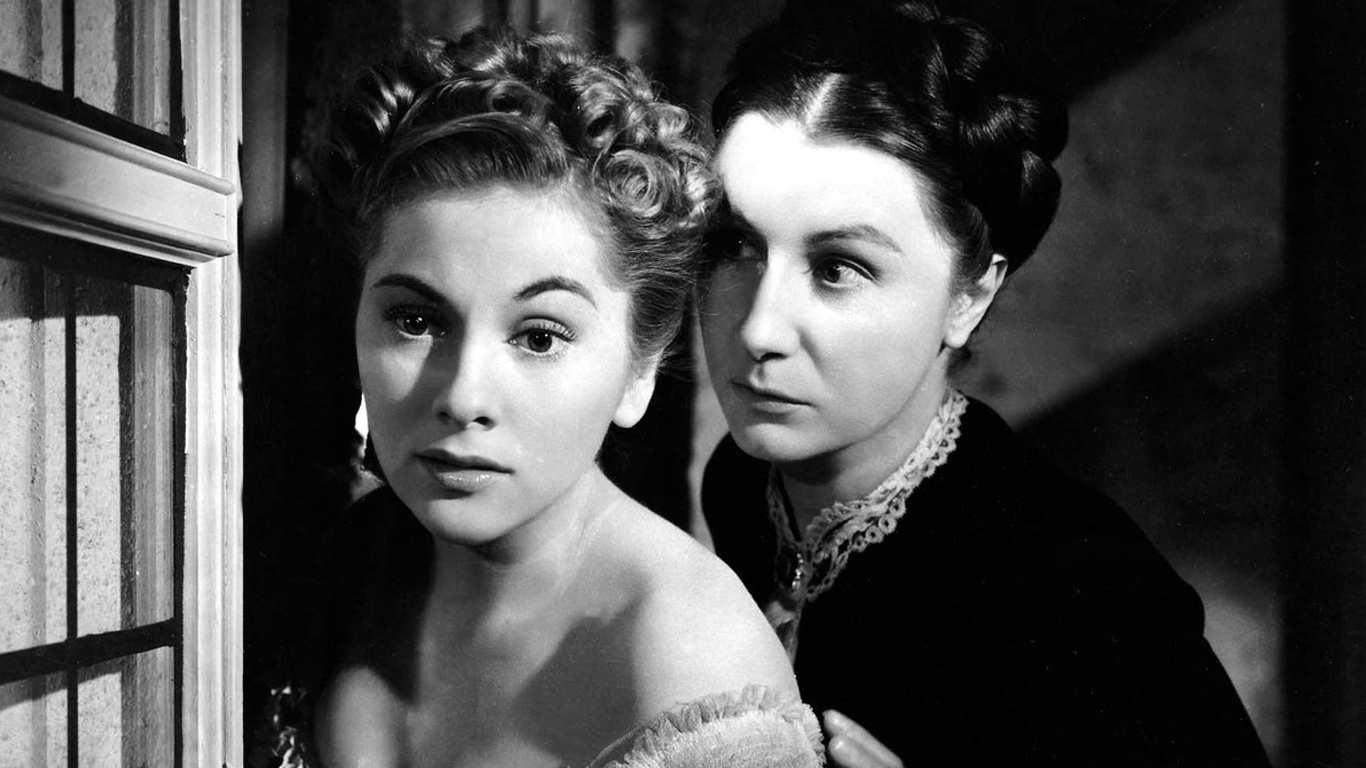
Joan Fontaine and Laurence Olivier find married life isn’t a bed of roses in Rebecca

Director: Alfred Hitchcock

Cast: Joan Fontaine (The second Mrs de Winter), Laurence Olivier (Maxim de Winter), Judith Anderson (Mrs Danvers), George Sanders (Jack Favell), Reginald Denny (Frank Crawley), Gladys Cooper (Beatrice Lacy), C. Aubrey Smith (Colonel Julyan), Nigel Bruce (Major Giles Lacy), Florence Bates (Mrs Edythe Van Hopper), Edward Fielding (Frith), Leo G. Carroll (Dr Baker)

It’s impossible to know what people are really thinking isn’t it? Rebecca is a film all about secrets and misconceptions, the biggest enigma of them all being that title character, the deceased wife casting a ghostly shadow over every scene. Adapted from Daphne du Maurier’s best-selling novel, Rebecca was Hitchcock’s first American picture and a masterclass in atmosphere with a vulnerable and deeply sympathetic lead, packaged into a wonderfully entertaining film combining the best of producer David O. Selznick’s sense for literary translation with Hitchcock’s filmic virtuosity.

On the French Riviera, a naïve young woman (Joan Fontaine), working as a paid companion for widower Mrs Van Hopper (Florence Bates), meets and becomes engaged to the aristocratic Maxim de Winter (Laurence Olivier). Maxim is a widower, whose previous wife Rebecca drowned. Becoming the second Mrs de Winter, our heroine quickly finds herself out of her depth in Manderley, Maxim’s colossal country home. Every where she goes there are memories of Rebecca, her husband still seems to be in love with his first wife and the housekeeper Mrs Danvers (Judith Anderson), still fanatically loyal to Rebecca, takes every opportunity to subtly remind the second Mrs de Winter of her own inadequacy. But is there a darker mystery behind the death of Rebecca?

Hitchcock’s Oscar-winning film (his only one, although he didn’t get the Director award) is a gothic delight. The action takes place in a mist-filled Cornwall, in a house where every nook and cranny has a dark secret. From its opening sequence, with the camera tracking through a fogbound forest before emerging in sight of a the intimidatingly grand Manderley, this is a film swimming in atmosphere and a dread of dark, psychological secrets, wrapped up in a dynamic melodrama.

At its heart is the vulnerable second Mrs de Winter – so timid we never even learn her name – beautifully embodied by Joan Fontaine. Nervous, awkward and shy, her hands often clasped together and shoulders (under a parade of unglamourous cardigans) tense, she rarely (if ever) looks comfortable. Fontaine’s wonderfully judged performance makes her bashful and deferential but also kind and guileless. Her polite eagerness to do the right thing and help people makes us warm to her instantly. And it’s impossible not to empathise with this gentle middle-class girl, parachuted into being the grand mistress of a huge house. Everyone seems to find her wanting – even Maxim’s decent sister (a droll performance by Gladys Cooper) good naturedly criticises everything from her lack of hobbies to poor dress sense.

That house would make anyone feel inadequate. Hitchcock frequently shoots Fontaine dwarfed by Manderley’s huge interiors, with its walls which seem to stretch on forever. She looks like a small frightened rabbit, as hopelessly oppressed by the building as she is bewildered by the procedures involved in running a house like this. Plus, there are all those reminders of Rebecca – everything seems to carry a monograph and not an item in the house seems to be without her personal touch. In many ways Rebecca is a ghost story without a ghost, where Rebecca’s presence (or lack of it) dominates the entire world of the film.

And our heroine (so uncertain of who she is, she tells a phone caller “I’m sorry Mrs de Winter has been dead for some time” before she suddenly remembers that is now her) won’t be allowed to escape that legacy. Not least because Mrs Danvers is there to remind her. In a superbly cold, calculating and chilling performance of barely repressed obsessiveness, Judith Anderson is outstanding as this housekeeper from your nightmares. Mrs Danvers is determined to turn Manderley into a mausoleum to her lost mistress – and ideally the new Mrs de Winter into a human sacrifice. Hitchcock manages to suggest more than a hint of sexual obsession into Mrs Danvers – she fondles with awe Rebecca’s negligee, drapes herself in Rebecca’s fur coats and remembers her with a breathless intensity. It’s an obsession that makes her subtly unbalanced and deeply dangerous.

Rebecca contains many of the themes that would run through Hitchcock’s work. Obsession obviously has a dark hold over Manderley, not least over Maxim who has the air of a man capable of violence. Unspoken, unknown crimes haunt over Manderley. The death of Rebecca is constantly bought back to us, not least with the film’s continual visual reference to crashing waves. The second Mrs de Winter feels isolated and watched at every turn, a stranger (and potential victim) in her own home. Several shots hammer home giddy, vertigo-inducing heights – from Maxim’s introduction on the cliffs, to the long drop from the heights of Manderley which Mrs Danvers urges a distraught Mrs de Winter to consider taking.

But what’s superb about Rebecca is that the reveals we expect to find are of course totally different to the reveals we get. A lot of this hinges on Olivier’s complicated and fascinating performance as Maxim. In many ways a man of total self-assurance – he barely breaks away from his breakfast to phone Mrs Van Hopper and inform her he will marry her companion – the more time we spend with him, the more his vulnerability, insecurity becomes clear, as does his patrician pride which leads to a self-damaging bluntness. When the secrets are revealed, its striking how this scion of the upper classes becomes suddenly lost – just as finally receiving some answers and reassurance turns Fontaine’s Mrs de Winter into someone more sure of herself than we have ever seen.

The film’s final act spools out a well-paced, intriguing courtroom drama, turned reversed murder-mystery. While some of the original novel’s developments are changed for code-related reasons (the usual provisos on crime and punishment), it makes very little impact on the compelling nature of the vice that seems to be trapping Maxim and his wife. Much of this is powered by George Sander’s superbly hissable turn as a preening playboy (and total shit), purring lines such as “I say marriage to Max is hardly a bed of roses is it?” with a near sadistic glee. It builds to a denouement straight out of horror, with Mrs Danvers taking rightful place as a demonic lord of misrule.

Rebecca was a product of the collaboration between Selznick and Hitchcock: two strong personalities who knew their own mind. Their relationship was fraught and troubled – they basically agreed on almost nothing – but the clash produced a work that stands as some of their best. Selznick demanded Hitchcock stick to the book – he had wanted to name the lead character ‘Daphne’, and introduce a running joke of sea sickness and a Jane Eyre-ish ‘mad woman in the attic’ – and in turn Hitchcock refused to film Selznick’s suggested flourishes (such as a smokey “R” filling the night sky for the final shot). Goes to show that conflict can produce great art.

Rebecca is an outstanding gothic melodrama, superbly acted (there is not a weak link in the cast) and brilliantly directed with a mist-filled flair and sense of heightened tension. A fascinating psychological puzzle while also being superbly gripping entertaining, it’s one of the finest Best Picture winning films of all time.

Doubt (2008)

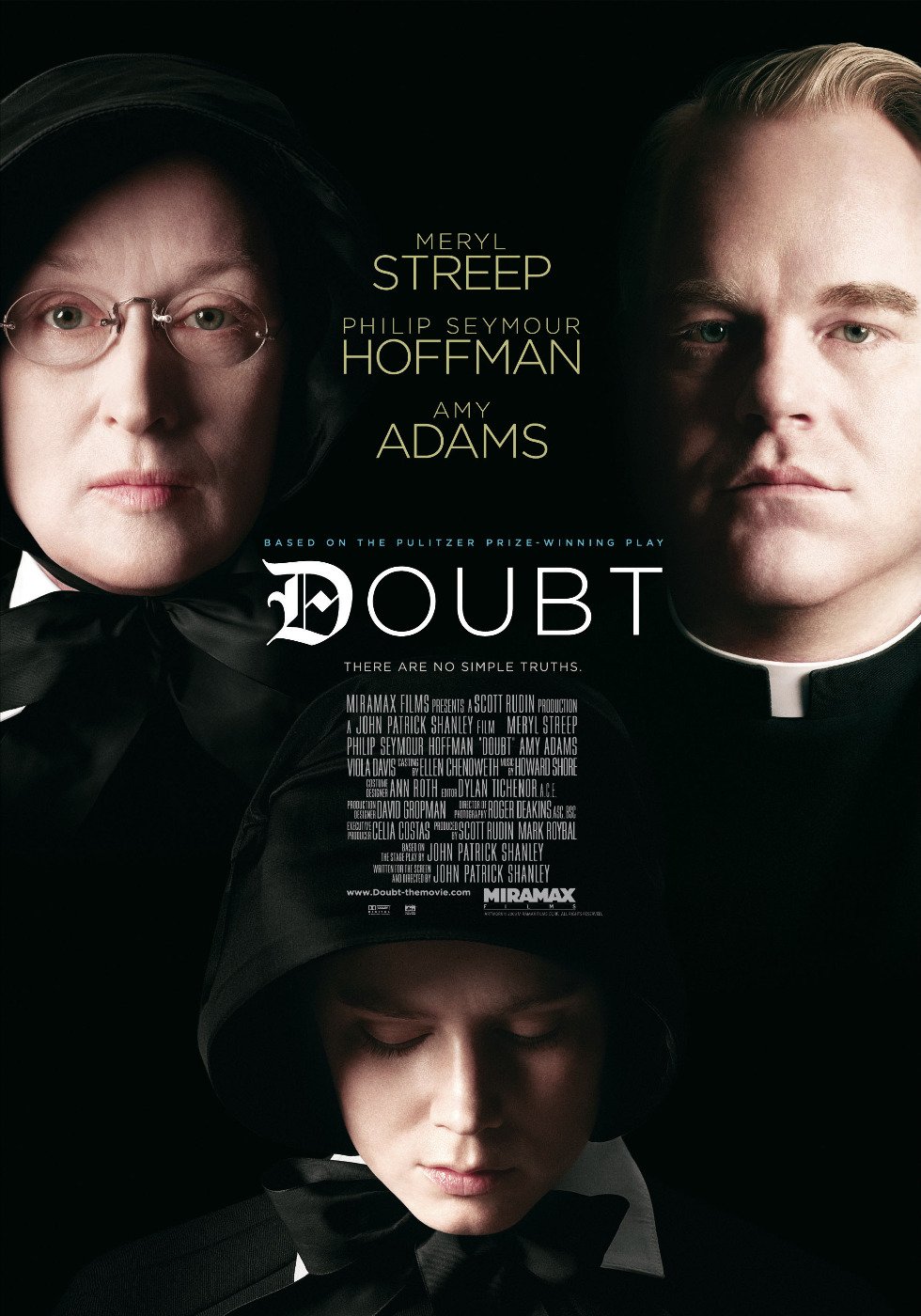
Amy Adams and Meryl Streep wrestle with certainty and Doubt

Director: John Patrick Shanley

Cast: Meryl Streep (Sister Aloysius Beauvier), Philip Seymour Hoffman (Father Brendan Flynn), Amy Adams (Sister James), Viola Davis (Mrs Miller), Joseph Foster (Donald Miller)

It’s 1964 in a Bronx Catholic School, run with an iron hand by Sister Aloysius (Meryl Streep). This arch-conservative is in the middle of an unspoken struggle with progressive reformer priest Father Brendan Flynn (Philip Seymour Hoffman), who doesn’t feel Catholicism has to be stern, unyielding and guilt-inducing. These tensions underlie Sister Aloysius’ concerns about Father Flynn’s closeness to the boys – in particular the school’s only black student, Donald Miller (Joseph Foster). When young and naïve Sister James (Amy Adams) reports that Donald returned from a meeting with Father Flynn with alcohol on his breath, Sister Aloysius is convinced Flynn is guilty of sexual misdemeanours – and makes it her mission to remove him from the school.

Adapted from a Tony-Award winning play, and directed by its author John Patrick Shanley, Doubt is an intense, well-staged, subtle opening-out of a four-hander, that works on screen due to Shanley’s flexibility with the material and the wonderful performances from the four principals. The story serves as a parable of sorts for clerical sex scandals, but ties this smartly into questions of faith and the limits of belief.

Because there are no clear answers in the film (or the play). We never know with cast-iron certainty if Father Flynn is guilty or not. All we have are his passionate denials, Sister Aloysius’ equally passionate certainty of his guilt, and a few moments we witness of his interaction with Donald Miller and the other students that are left open to interpretation. Tied into this as well, we have a very clear clash between modernisers and conservatives within the church – and we worry that, in being drawn towards the more sympathetic Flynn, we are in fact rooting for a sex-offender.

Doubt is a film that is likely to keep you questioning who you believe. I even found that repeat viewings can change your perspective on guilt or innocence – this time I was far more alarmed by Hoffman’s genial Father Flynn than I remembered (a lecture on clean nails he gives to the boys walks a wonderful line between hygiene and unsettling creep). Shanley’s expansion gives us more scenes of Flynn interacting with other priests. It’s clear the priesthood is a boisterous boys club, with jokes and drinking – much more fun than the staid, milk-drinking silence of the nuns’ meals – but this is also the clubbish pact of secrecy that let real-life paedophiles be quietly moved from parish to parish.

Sister Aloysius may be practically a poster-child for why people find religion off-putting, but she’s absolutely on-the-money in her determination to root out abuse. Yet while her determination to rid the church of abusers is genuine, does she really believe in Flynn’s guilt, or is it a prop she reaches for to justify her own dislike of him and his beliefs about the church? We’re never certain.

And that is part of the smartness of Shanley’s work. Because in the end all we have to go on is faith and our own belief. Which is pretty much like the whole of religion itself. There is enough in the film to convince you of the guilt or innocence of Flynn, the upright justice or corrupt selfishness of Aloysius. Their approaches to religion are radically different – Flynn sees it as their duty to be open and involve the community, to integrate their interests; to Aloysius the church only works if it is strict, austere and sets a moral example to all. A meeting between the two of them is a masterclass in micro-aggressions over everything from choice of chairs, pouring of tea, serving of sugar, closing blinds, you name it.

This is the trace of theatre in the piece – and theatre is when it is at is strongest. Shanley’s direction is largely unfussy, although he is prone to overuse Dutch angles to hammer home the uncertainty and to overplay a metaphor of the wind (a storm is coming you know!). But when he avoids too much fuss, the film is very effective. The opening up of the play works very well, with most of the additional characters (be they added nuns, parishioners or children in the school) largely used as silent extras that help to create a wider world as well as adding more reaction shots that help us build up even more our questions and doubts about the versions of a story we are hearing..

And the added question over this is the identity of the victim. As the only black child in the school, does his dependence on Flynn come from Donald’s sense of isolation? Is he vulnerable because of bullying and simply in need of the genuine kindness of a substitute father figure, in place of the bullying and violent father he actually has? Or does this isolation make him the perfect target for a predator? Most daringly, Foster’s mother (brilliantly played by Viola Davis in a single extended scene) when confronted with the possibility of abuse by Sister Aloysius even suggests that abuse might be price worth paying for the opportunities being at the school will give her son, the sort of opportunities his parents never dreamed of. Race is a low-key note, but it’s there.

Doubt’s real strengths are in the acting. All four of the principals were Oscar-nominated. Streep was the obvious choice as Sister Aloysius and she delivers one of her finest performances. Aloysius is stern, unbending, dangerously, even recklessly certain of herself and her faith in herself as a force of justice – but believes she is acting for the best motives (or at least is very vocal that she is, rather that is actually true is a whole other question). Streep adds wit (this is after all a woman who views ballpoint pens as the end of civilisation), but also understanding of the vulnerabilities under Aloysius’ rigid conservatism. It’s an outstanding performance.

Amy Adams is charmingly sweet and endearing as a woman caught between two poles, naturally inclined to Flynn’s liberalism and desire to win hearts as well as minds – but also open to using Aloysius’s tactics in the classroom in her struggle to maintain order. Sharply divided, Adams leaves it open whether her desire to see the best in people make her either saint-like or a rube. Hoffman walks an extraordinarily difficult tight-rope as a character both engagingly warm but also (by necessity) unknowable and unreadable. It’s a performance bursting with emotion, but which skilfully disguises that emotion’s motivations. Davis offers a master-class of restrained anxiety, using every ounce of control to keep her difficult life together.

Doubt is a thought-provoking and well-handled staging of a very-good play. Brilliantly acted, it expands the staging of the play but never loses sight of what makes it effective to start with: and will leave you thinking over small moments and as uncertain about truth and prejudice as Sister Aloysius is at its conclusion.

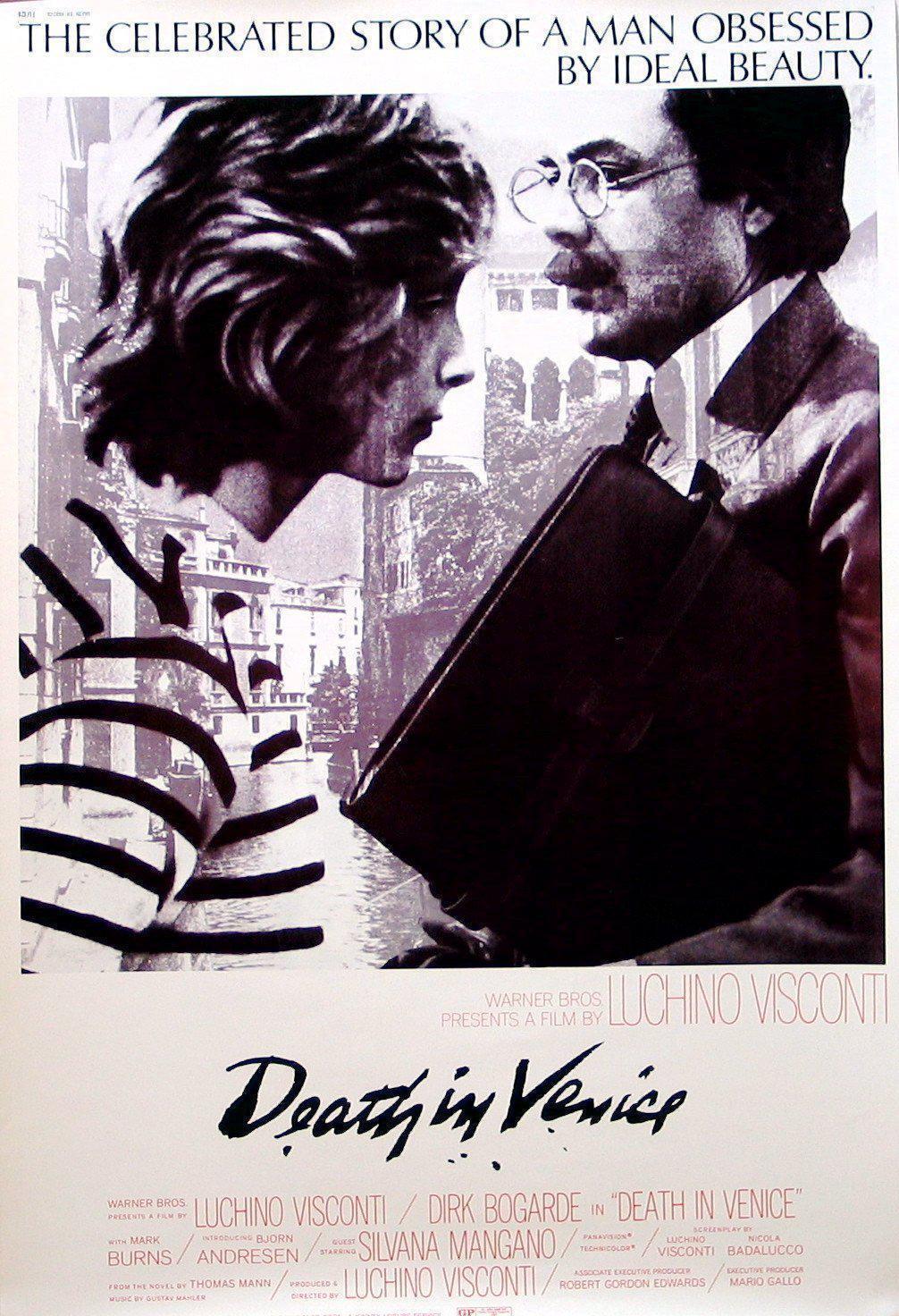
Death in Venice (1971)

Dirk Bogarde falls victim to obsession in Death in Venice

Director: Luchino Visconti

Cast: Dirk Bogarde (Gustav von Aschenbach), Mark Burns (Alfred), Marisa Berenson (Frau von Aschenbach), Björn Andrésen (Tadzio), Silvana Mangano (Tadzio’s mother), Romoloa Valli (Hotel manager), Nora Ricci (Governess), Franco Fabrizi (Barber), Carole André (Esmeralda)

In the early 1900s a famed German composer, Gustav von Aschebach (Dirk Bogarde), travels to Venice for his health. A repressed artist who believes beauty is found not in the sensual but the spiritual, his world is turned upside down when he becomes fascinated/infatuated with a divinely beautiful teenage boy (Björn Andrésen) staying at his hotel. Gustav lingers in the city, never speaking to the boy, but reduced to watching him at the beach and following him and his family puppy-like through the city. A city that is on the verge of falling into a serious cholera pandemic. With Gustav’s health rapidly deteriorating, the title alone tells you where this all going.

That opening paragraph will probably also tell you all you need to know about whether this is the film for you or not. Increasingly, the idea of a famed artist starring with a longing, breathless admiration at a (very young looking) teenage boy (who is also at times shot with a coquettish flirtatiousness, increasingly aware that he is being looked at) has more than a whiff of Operation Yewtree to it. Take a moment though: Visconti’s extremely delicate and deliberate film largely manages to walk a tightrope between sexual interest and a deeply closeted admiration for physical beauty in the style of classical statues or paintings.

The film is not a leering pederast’s fantasy, but a melancholic meditation where this young man as much represents the loss of youth amidst a life of regret and closeted repression as it does sexual interest. Don’t get me wrong, sex bubbles under there. Gustav – even if he is struggling to process his own feelings – has a giddy schoolboy like love for this unattainable boy, something he seems aware he can (and will) never act on. Gustav becomes a rather tragic even pathetic figure. By the time the film ends and he has caked his face in the same “young” make-up that disgusts him when he sees it on the face of another ageing roue on his arrival in Venice, it’s hard not to feel he has lost his way. He seems aware death is knocking and that it is simply a matter of opening the door.

Visconti’s film is perhaps the ultimate arthouse classic. Long, slow, with lashings of Gustav Mahler playing while the camera slowly pans across incredibly detailed sets (rumour has it, even the unopened drawers were filled with period specific props) and lavish costumes. It’s got more than a puff of self-importance, taking as its subjects art, love and beauty. It’s the sort of film where nothing much really happens (there is no real dialogue for the first ten or last ten minutes), but what little happens is laced with an overwhelming spiritual and poetical importance.

The film is however outstandingly beautiful. Venice has never looked so striking – or so original. It’s not a picture postcard: the sky is frequently doom-laden pinks and reds, the streets are lined with litter, antiseptic wash and later small fires to burn away the bad air. But everything is presented with a painterly, if doom-laden, beauty. As mentioned, the period detail is exquisite and faultless. There are more than a few comparisons with Barry Lyndon in its obsession with detail, the pictorial and period over such trivial matters as storyline and humanity. Like that film it also has a languid self-importance, that has helped make it ripe for parody throughout the years.

And yet, it engages at some level slightly more than Barry Lyndon perhaps because Dirk Bogarde is a far more skilled actor than Ryan O’Neal. Bogarde is a master of the small detail. A huge portion of the film is basically Bogarde starring at Tadzio and letting a range of emotions play across his face: fascination, shame, fondness, intrigue, self-disgust, longing. Visconti frequently lets the camera just study Bogarde’s face as the actor thinks, capturing moments of almost youthful excitement that tip as swiftly into an old-man’s shame. It’s a compellingly cinematic performance from Bogarde, an actor who never quite gets the credit he deserves.

Of course, it’s also an important land-mark in gay cinema. It’s one of the few films where we have a man express a confused yearning and admiration for a beautiful teenage boy (films – such as American Beauty – which cover similar ground with men and teenage girls are far more common). Despite this, the film never tips into feeling too icky, largely because Gustav himself is a rather sexless figure. Flashbacks show his failed fumblings with (female) prostitutes and traces of a marriage with a wife (a silent Marisa Berenson – another Barry Lyndon link), with whom he shares grief at the loss of a daughter, but seemingly little else. The implication is that Gustav has carefully suppressed all his emotions in to raise himself to a higher artistic plain. Tadzio perhaps shows him there is also beauty in youth and life, rather than just intellect.

Or you might think that’s just hogwash, and an excuse for a man in his fifties to leer at a pretty young boy. There are times when Visconti makes Tadzio too coquetteish, at times casting him in the role of distant seducer (although there are hints at least some of these glances and poses are in the imagination of the infatuated Gustav). Björn Andrésen has spoken about his discomfort in making the film (where Visconti and others allegedly tended to treat him with an icky fascination) and dealing with its legacy. Often the film plays more awkwardly today and while Visconti is partly aiming for the sort of admiration of beauty we see in classic Renaissance art – like Rubens co-directed the film – he’s still at times also positioning a young teenage boy as something close to a sex object. The film is not as simple as that, and its far from being crude while Aschenbach never feels predatory or dangerous only deluded – but touches of it are there.

Death in Venice has faced years of parody. It’s an easy film to snigger about, with its self-consciously arty look and feel. Visconti wants you to know this is an important film, and like Tarkovsky often hammers this home by making it slow and ponderous. But it’s also a beautiful and strangely engrossing film. A slow-paced two hours – pace that could have been helped if the heavy-handed flashback discussions about art between Gustav and piano player (lover?) Alfred had been trimmed out. Visconti directs it with a poetic mesmerism.

It’s got the feel of a classic painting. But it’s a film: and parts of that make it troubling at times. It never questions the appropriateness or not of this semi-sexual fascination of Gustav (for all that it stresses his increasingly pathetic delusion). However, it just about works because of the overwhelming air of tragedy and regret that hangs over it – and Bogarde’s delicately judged performance. Visconti indulges himself terribly here – but produces something that feels very much his own. Death in Venice is intriguing because its simultaneously bloated and self-important, but also mesmerising and beautiful.

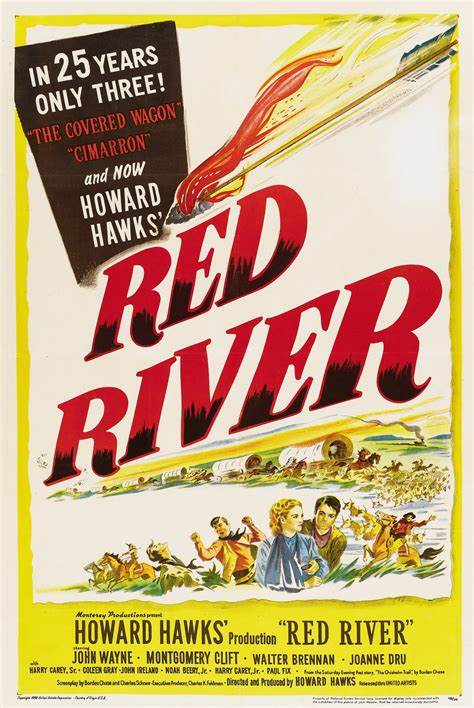
Red River (1948)

John Wayne and Montgomery Clift as duelling surrogate father and son in Red River

Director: Howard Hawks

Cast: John Wayne (Thomas Dunson), Montgomery Clift (Matt Garth), Joanna Dru (Tess Millay), Walter Brennan (Groot), Coleen Gray (Fen), Harry Carey (Melville), John Ireland (Cherry Valance), Noah Beery Jnr (Buster McGee), Harry Carey Jnr (Dan Latimer), Chief Yowlachie (Quo)

Some say Red River is, even more than Citizen Kane, the masterpiece in American film. That’s pushing it. But Red Rivercertainly is a prime slice of beefy entertainment. Hawks’ first Western (and how odd a director so associated with them didn’t turn his hand to them until late in his career – and then only made six), there is no greater compliment to make than to say you could mistake it for John Ford.

In fact, Ford was beyond impressed, famously observing of Wayne “I didn’t know the big son of a bitch could act”. Act he certainly does here as monolithic obsessive Thomas Dunson (surely a forerunner to the equally troubled – and troubling – Ethan Edwards in The Searchers). Dunson has spent almost two decades building his Texan cattle empire. Unfortunately, the Civil War means the bottom has dropped out of the Texas beef market. To make good his investment, Dunson needs to take the cattle (all 9,000 of them!) up north to Missouri (over a thousand miles) to sell at a good price. Along the way, Dunson’s ruthlessly focused ambition tips into tyranny, with Dunson (literally) judge, jury and executioner among his team. Can his more liberal adopted son, Matt Garth (Montgomery Clift), stop Dunson from destroying everything around him?

Red River covers the movement of cattle up the Chisholm Trail, a huge economic migration that saw millions of cattle moved from Texas to where their price was increased by a factor of ten. But the film has only a passing interest in the history – and the romantic, nostalgic look at it here, as a sort of boys-own adventure that goes wrong, is far more about the movies than social history. What the film is really focused on is the personal clash between two generations of men: one a relic of the first years of the new frontier, the other younger, more modern in his thinking, with a streak of humanity the other has beaten down.

Hawks’ film mixes this up with some terrific location footage. How did they wrangle all those cattle? The film is very strong in capturing the sense of excitement in the Frontier – the setting off on the trail, with its quick shot cacophony of horse-backed men whooping with joy, is full of a sense of adventure. The film is a triumph of quick-quick-slow story-telling. The 15 years of Dunson’s empire-building passes by with montage and Wayne voiceover which begins and ends with Wayne in the same position, but the actor considerably aged. Context is skilfully and swiftly given to us, but the tensions between Dunson and Matt are grow and develop naturally, simmering for a good hour-plus before erupting. Transition text between sequences bridges us from scene to scene, and is especially effective in charting Dunson’s descent into tyranny.

Tyranny is what it is all about. This is one of Wayne’s darkest – but also greatest – roles. Hawks taps into the despotic rigidity in this slab of Americana. Dunson is a man utterly and completely convinced not only of his invulnerability, but his rightness, embodying American manifest destiny. Claiming swathes of land as his own, Dunson is a man on the move, constantly striding forward (Hawks often shoots him in progressive, shark-like motion). He’ll leave behind him everything from the woman he loves (with a shocking toughness, as he looks back on the burning remains of the wagon train he left her in) to the land he claimed, to anyone who lets him down.

Dunson is also a ruthless embodiment of a time before law. No one seems to question the way he executes those who cross him. Practically the first thing he does on arrival in Texas is out-draw and kill the man sent to question his arrival. His farmstead has a full graveyard. A dark comic touch is added with his insistence in “reading the words” over graves of men he’s killed. On the trail he has those who back out, run away or question his leadership whipped or shot. Wayne’s certainty as an actor tips into a (literally) black-hatted despotism. His manly focus and ability to outdraw anyone turns him in the end into a nightmare avenger, a Western Terminator.

Opposite him is Clift (equally superb) as a more modern minded kid. Matt is the sort of man who knows that at times a bit of bend and a sympathetic ear gets better results than a beating. Hawks brilliantly builds the love-hate relationship between these two men who have very little in common, other than mutual affection. (Clift and Wayne themselves were polar opposites in acting style, social views and personalities.) There is a real love there – which makes it all the more inevitable Dunson will view Matt’s questioning of him as a betrayal nothing less than blood will redeem. The two of them, and their clash (like the clash between two sides of America) dominate the film, not letting too many other characters have a look-in.

Of the rest, Walter Brennan is a very good as Dunson’s loyal number 2, who may not always agree with the chief but largely (if reluctantly) sticks by him (for all he mutters to him “You’re wrong Mr Dunson”). John Ireland’s cocky gunslinger, who joins the trail because he admires Dunson’s no bullshit attitude, promises much at first but fails to deliver on much-hyped clashes. (Possibly because Ireland fell out with Hawks over a competition for the affections of his future wife Joanna Dru, his role later cut to ribbons in revenge.) There is however a strange, almost homoerotic, link between Clift and Ireland – mutual respect leading to an admiration love-in and much fondling of each other’s firearms during competitive rock shootings.

Red River’s ending has gained some criticism – largely because the film builds its sense of violence between the two leads so well that it feels a bit of a disappointment that they are effectively told to pull themselves together (by a woman of all things!). But, for all the film mines the clashes between two different outlooks, it never loses track of their very real affection. Sure Dunson may talk about killing Matt – but he certainly won’t in cold blood (even if he happily guns down anyone who gets in the way) and at the end of the day, he’s still the closest thing he’ll ever know as a son. Matt is emotionally mature enough to know Dunson is to-all-intents-and-purposes his father, even if he’s not above throwing a few punches at him. The clash is effectively a narrative dead-end – for all it would be exciting to see them take shots at each other, this is a family. And most families fight and make-up, not plug each other with bullets.

And it distracts from the grand entertainment of Red River, its excited love for the open country (the late act scenes inside are as disconcerting for us as they are the characters). This is a western of psychological depth successfully mixed with grand adventure. It’s hugely entertaining but also feels very true. It has two wonderful performances from Wayne and Clift. It’s not the Great American Film, but it’s directed by a superb understander of cinematic narrative and a hard film not to love.

Fatal Attraction (1987)

Glenn Close and Michael Douglas embark on a disastrous affair in Fatal Attraction

Director: Adrian Lyne

Cast: Michael Douglas (Dan Gallagher), Glenn Close (Alex Forrest), Anne Archer (Beth Gallagher), Ellen Hamilton Layzen (Ellen Gallagher), Stuart Pankin (Jimmy), Ellen Foley (Hildy), Fred Gwynne (Arthur), Mug Mundy (Joan Rogerson), Tom Brennan (Howard Rogerson), Lois Smith (Martha)

It was one of the biggest hits of the 1980s and was said to bring to life every man’s worst nightmare – which as David Thomson rather astutely put it, probably meant “too many men in the 1980s were worrying about the wrong thing”. Dan Gallagher (Michael Douglas) is a successful, middle-ranking lawyer representing a publishing company. He flirts with editor Alex Forrest (Glenn Close). Then one weekend, when his wife Beth (Anne Archer) is away with their daughter, he spends his time sleeping with her. Problem is, Alex won’t accept it was just a brief fling. Soon she’s calling his office, visiting his wife, claiming to be pregnant as part of a swift descent into furious obsession, demanding Dan leave his family for her. It won’t end well.

Fatal Attraction is a film that is going to struggle the more we move into the #metoo era. While in the 1980s audiences could be expected to be reasonably sympathetic to a man who just wants a bit on the side – and then feels oppressed by the moral consequences that follow – today it’s a bit tricky to feel the same. Put bluntly, Dan is a selfish man who is desperate to be seen to be doing the right thing. And while he realises he’s probably made a mistake after his first one-night stand, he still throws himself into a second day of flirting and sex with Alex (out of a sense of social obligation).

But then Fatal Attraction is a deeply conservative film that plays into feelings of fear and anxiety at the idea of the perfect domestic life being assaulted by an outsider. It portrays the damaging impact on Dan and his family as entirely the responsibility of Alex, instead of admitting that clearly both Dan and Alex are to blame for what happens. Sure, Alex becomes a (literal) bunny-boiler (this film is the origin of the phrase) and later a knife-wielding psychopath. But all this spins out of Dan’s selfishness and his fundamental lack of regard for the feelings of either his wife or Alex (both of whom he wants to think of him as being a good guy – which he probably isn’t).

Dan’s “have his cake and eat it” attitude is the real villain here – and while he is, of course, unlucky to hook up with someone as unbalanced as Alex, any perfectly rounded person would be expected to at least match some of Alex’s reactions. She’s right to say that he is shirking his responsibility, right to say that its wrong for him to use her for a bit of fun and discard her, and she’s right to be disgusted at his automatic offer to pay for the abortion he assumes she will agree to.

A more modern version of Fatal Attraction would probably play out a bit more like the TV multi-perspective drama The Affair (where Dominic West and Ruth Wilson’s characters split the narrative between their very different perspectives on a life-shattering love-affair). It would show more sympathy for Alex’s desperation, loneliness and sadness – and really explore what it is that happened in her past that made her react as extremely to rejection and betrayal as this. And it would have greater criticism for Dan’s cavalier attitude to other people’s feelings.

But then a film like that wouldn’t have been a hit. Glenn Close may not have liked the reshot ending – which came out of test screenings that showed audiences really wanted Douglas to kill that bitch – with Alex entering the Gallagher country home with murder in mind. But the final desperate battle between Dan/Ruth and Alex – and the nuclear family being re-cemented in the shedding of Alex’s blood – was what made the film such a hit. Because who wants the complexity of shared responsibility when “The Other Woman” can literally rise from the dead to strike one final blow before being gunned down?

The film also worked of course due to Glenn Close’s fabulous performance in the lead role. Close worked hard to not position Alex – for all the film aims to do this – as a creepy stalker. Instead she invests her with a righteous fury of a woman who feels she has been terribly wronged, whose every attempt at peace-making has been slapped away and responds with justified anger. There is a real fragility in Close – who consulted psychiatrists to understand Alex’s fragile mindset – and she never lets us forget the pain motivating her actions, even as the film becomes ever more melodramatic and turns her character into more and more of a horror film staple.

Opposite her, Michael Douglas is equally good. This was Douglas’ first in a run of roles where he seemed to embody something in the everyday American-man that lived in terror of female independence and sexuality (he would be terrified on screen by Sharon Stone, Kathleen Turner and Demi Moore over the next seven years). Douglas is great though because while he looks the American dream, he conveys this sense of weakness and compromise. He convinces completely as a rather weak-willed man, terrified of being made to face the consequences of his actions. Archer is also first-rate in a surprisingly low-key role as the wronged wife.

Fatal Attraction starts out as a fascinating look at morality and morals in modern America and ends as a slasher film. A more complex film might have lasted better – even if it wasn’t such a hit – but it throws just about enough depth in there, before the madness descends.

Rebecca (2020)

REBECCA
Lily James and Armie Hammer do their best in an overblown Rebecca the swops Gothic chills for lovely costumes and locations

Birector: Ben Wheatley

Cast: Lily James (The second Mrs de Winter), Armie Hammer (Maxim de Winter), Kristin Scott Thomas (Mrs Danvers), Keeley Hawes (Beatrice Lacy), Ann Dowd (Mrs Van Hopper), Sam Riley (Jack Favell), Tom Goodman-Hill (Frank Crawley), Mark Lewis Jones (Inspector Welch)

Hitchcock’s film version of du Maurier’s novel casts a long shadow. Few have taken up the challenge to film it since – and Ben Wheatley’s is the first film version in nearly 80 years. But you can be pretty certain that, unlike Hitchcock’s, this one probably won’t be being watched 80 years from now.

In Monte Carlo, a young woman (Lily James) meets and falls in love with rich Cornish landowner Maxim de Winter (Armie Hammer), a widower on holiday. They marry and return to his seat at Manderley. However, on arrival the second Mrs de Winter finds that she is living in the shadow of Maxim’s deceased first wife, Rebecca. This feeling is encouraged by the passive aggressive manipulation of Rebecca’s devoted housekeeper Mrs Danvers (Kristin Scott Thomas). Slowly, the second Mrs de Winter starts to worry that even her sanity starts to be slipping.

Wheatley is a director with a love of thriller and horror, and he really should be a natural fit to take on du Maurier’s gothic creepiness. But Wheatley feels almost constrained by the period title and beauty. This is a film that totally misses its gothic beats, instead settling for being a lusciously filmed costume drama. It has only a few traces of the unsettling psychology or air of ghostly possession that the story requires, and even those are chucked in haphazardly and then forgotten in order to make way for a pretty sunset or generic shot of Lily James looking sad in the rain.

The inescapable feeling on watching this is that Wheatley actually wants to turn the story into a more conventional romance. The age difference between Maxim and the second Mrs de Winter has been almost removed.  With Armie Hammer too young and Lily James too pretty, there is no ambiguity to Maxim’s feelings or motivations, nor any power imbalance to their charming, sunlit courtship, filled with carefree drives and charming beach picnics. Gone are the suspicions (for both the second Mrs de Winter and us) as to what a rich, sophisticated older man could see in a shy, unremarkable, average-looking girl who’s employed as little more than a servant.

It also removes much of the vulnerability and uncertainty Mrs de Winter should feel, by bringing her onto more equal terms with her husband. From du Maurier’s vision of an innocent woman feeling out of her depth as she’s plunged into an alien world, unable to break through the hauteur of a distant, older husband, we instead get far more of a conventional whirlwind romance that sours when the couple return home.

It’s not really the fault of the two leads, who give sterling work. Lily James has just about the right vulnerability to her, even if she’s still got a bit more spark than the quiet, demure character needs. But James has a fabulous sense determined earnestness to her, an eagerness to do the right thing and not let anyone down (her greater dignity and strength also pays off in sequences where Mrs de Winter takes on a stronger position in the marriage).

As Maxim, Armie Hammer has the right sort of authority and conveys the distance and coolness of the character, even while he is clearly too young and at times seems a bit hampered by his accent and setting. (Like some American actors, he at times struggles to fully comprehend the issues of class within the film.) Perhaps the main weakness to the casting is, by playing up his charm and romanticism, you never really think for a moment that this is a bloke who might have murdered his wife. It also makes him never feel like the sort of chap who could honestly ever have though about dispatching his new wife. It again strips out much of the darkness and dread of the original.

Needless to say, Kristin Scott Thomas has a ball as Mrs Danvers, the obsessed and bitter housekeeper, a part that hardly pushes her to her limits but which she delivers more than enough in. Wheatley pays homage to several of Hitchcock’s shooting decisions around the character, and the conveying of her menace is probably the film’s most successful beat.

However, the film fails at too many other important points. The sense of the previous Mrs de Winter haunting the home is lost completely. Too often the creepiness and psychological fear the film is aiming for gets lost, with periodic bursts of Cornish singing used too obviously to suggest unsettling menace. One very successful sequence set in a room of mirrors just serves to flag up how painfully absent the sense of threat and fear are from the rest of the film. To be honest, it’s a film that needs more darkness, more shadows. Instead everything is lit with all the prestige handsomeness of Merchant Ivory and Sunday dramas. Why did Wheatley go for this visual approach? Did he feel that it was expected from the lovely locations and luscious costumes?

And the costumes and the sets do look lovely. The shooting colours are vibrant and beautiful. It’s very grand and charming and it turns a haunting novel with dark deeds at its heart into something safe and neutered.

 The final product is what happens if a combination of styles are thrown together in a way that service not the story, but how each element of it could be best presented. When the film wants to show off the set and costumes, it’s bright and beautiful. At the few times it wants to suggest ghostly intimidation, we get some chanting and a few darkened rooms and billowing curtains. Neither plays well off the other and the film ends up feeling professionally mounted but workmanlike. It’s a shame as Wheatley could have really made something of this. But it feels like he has been forced into a prestige costume drama straightjacket.

The Searchers (1956)

Searchers header
Jeffrey Hunter and John Wayne on a long search, in John Ford’s exploration of racism in the West The Searchers

Director: John Ford

Cast: John Wayne (Ethan Edwards), Jeffrey Hunter (Martin Pawley), Vera Miles (Laurie Jorgensen), Ward Bond (Reverend Captain Samuel Johnson Clayton), Natalie Wood (Debbie Edwards), John Qualen (Lars Jorgensen), Olive Carey (Mrs Jorgensen), Henry Brandon (Scar), Beulah Archuletta (Look), Ken Curtis (Charlie McCorry), Harry Carey Jnr (Brad Jorgensen), Hank Warden (Mose Harper), Dorothy Jordan (Martha Edwards), Walter Coy (Aaron Edwards), Pippa Scott (Lucy Edwards)

John Ford’s career was a long tribute to the decency of the regular American. How fascinating then that one of his greatest films is in fact a dark investigation into the dangers of obsession, vengeance and prejudice in ordinary Americans. Working with his regular leading man, John Wayne, together they created a character who shared many qualities with Ford’s other leading men – a rugged, determined, taciturn man of the wilderness – but laced him with deeply negative attitudes and a horrendously damaged psyche. The Searchers becomes a masterpiece, presenting how narrow the line between hero and villain can be while – in an admittedly very gentle way – posing questions about the claims of the settlers to moral superiority.

Ethan Edwards (John Wayne) returns to his brother’s homestead from an unspecified (though clearly morally questionable) career as a gun for hire after fighting for the confederacy (a cause he sees no reason to disavow). He’s an awkward presence, with an unspoken love for his brother Aaron’s (Walter Coy) wife Martha (Dorothy Jordan) and a racial hostility towards their adopted son Martin (Jeffrey Hunter) who is one-eighth Cherokee. Shortly after his arrival, an Indian raid draws him and most of the local men on a futile chase. While they are gone, the Edwards’ homestead is destroyed, with the family all murdered except daughter Debbie. Ethan and Martin begin what becomes a five-year quest to find her and bring her home – although as he discovers Debbie has become wife to her kidnapper, the war chief Scar (Henry Brandon), Ethan’s aim shifts from rescue to executing Debbie for racial disloyalty.

Racism is what lies at the heart of The Searchers and around discussions of the film today. Firstly, let’s acknowledge how brave the film is in presenting Ethan’s racially motivated rage without excuse. This was after all John Wayne, the straightest shooter of the lot. Here, in no doubt his greatest ever performance, Wayne’s Mount Rushmore-like qualities are inverted into a bitter, lonely man whose murderous rage against the Native Americans is extreme, even within an environment which sees the tribes as a dangerous “other”.

Edwards’ racism tips into everything and is there right from the start: “I could mistake you for a half breed” he scowls at Martin. Later he will prevent Martin drinking alcohol – a clear reference to the belief among settlers that one drop of alcohol turns Indians into savage beasts. One of his first actions on the trail is to desecrate the buried corpse of an Indian, shooting out his eyes (condemning him to walk sightless in the afterlife). In a gunfight he has to be stopped from shooting retreating Indians in the back. Later, in a crazed fury, he guns down buffalo simply to deny them as food to the tribes. That’s not to mention his disgust with every trace of indigenous culture.

What’s striking watching the film is that, even though he’s the central character and is played by John Wayne, Ethan may well actually be the villain of the piece – or at best an anti-hero wild card. Our actual hero is the kindly, decent and brave Martin Pawley, played with a slight nervousness by Jeffrey Hunter. Martin is appalled by Ethan’s violence, his anger and above all by his plan for enforcing racial harmony by exterminating the niece he sees as a race traitor. It’s not just the fact he has Cherokee blood that makes Martin appalled by the danger in Ethan. It’s the simple fact that he’s just a decent guy, who recognises that good and bad isn’t a question of race but a question of people. And his presence on the quest, it’s made clear, is as much about protecting Debbie from Ethan as it is finding and rescuing her.

You can see these attitudes quite clearly late in the film, where the pair encounter white women who have been recovered from Indian kidnappers. These women are confused and traumatised. But while Martin attempts to communicate with and comfort them, to Ethan they are worse than nothing now. “They ain’t white anymore” he scowls at a soldier. Leaving them, Ford holds the shot on Wayne who turns to look back at them with a face dripping with such disgust and loathing, it sears into the memory.

Does the film condemn these attitudes? You can argue that the film plays into a racial nightmare – white women kidnapped and violated by savage tribesmen. But Ford is, I’d suggest, presenting racism here – and going as far as he could in the 1950s to attack it. Ethan and Martin encounter an Indian settlement that has been attacked by the cavalry. The settlement is a burnt-out husk, with Indian women and children among those indiscriminately slain – visually it is immediately reminiscent of the burnt-out Edwards homestead. Another later cavalry charge against the Indians will again see panicked women and children flee in terror. Even Scar, the villain of the piece, is motivated just like Ethan by anger – his actions are a response to the murder of two of his children. And his scalping, rape and murder don’t look so different from Ethan, who shoots people in the back, plans to murder his niece and later scalps a dead man.

The Searchers takes a slightly nihilistic view that the West was a violent place – for all the beauty Ford discovers in his crisply sublime shots of monument valley – and that many of the people in it had questionable motives and principles. A ”hero” for this time might well be Ethan, a sullen and violent man under a veneer of gentlemanly politeness, clearly motivated from the start far more by a desire for revenge for the murder of the woman he loves. Ford, Wayne and Jordan establish this love between Ethan and Martha subtly but unmistakably – the opening scenes are littered with moments of the two of them sharing glances and a hesitant but unmistakeable physical intimacy.

Again, a lot of the quality of this comes back to the wonderful work Ford draws from Wayne, helping the actor to find the cracks and flaws in this marble bust of Americanism. Wayne’s Ethan is awkward, angry, distant, difficult, cruel – a natural outsider, who has grown bitter against the world. Discovering Martha’s body, Wayne also allows Ethan to crumple into the sort of grief that translates within seconds into an iron loathing for the world and everything in it. He talks of the certainty of finding Debbie – but it’s a certainty born more of his idea of his own superior (white) determination rather than any faith (for all the language could suggest that). Ethan is in fact hostile and contemptuous of faith of any sort.

Ford frames Ethan frequently as an outsider, often framed uncomfortably in doorways, darkened walls seeming to close around him. Nowhere is this more beautifully done than in the film’s final shot which finds Ethan alone and forgotten outside the Jorgensen homestead, a man who has no place in the civilised world of family and friends, but an outsider with no place anywhere who must return to the wilderness. Wayne does this with a quiet, deflating gentleness – a beautiful suggestion of Ethan’s knowledge that the world is leaving him behind. Ford frames this beautifully in mid-shot to create one of the iconic images of cinema.

The Searchers isn’t perfect. There is a prolonged, slightly comic, sub-plot around Martin’s marriage to Laurie Jorgensen (Vera Miles in a thankless part), which culminates in the sort of fisticuff based comic stuff that looks more suited to The Quiet Man than here. The beautiful shots of monument valley are brilliantly done – but they also serve to point out the odd decision to shoot many of the exteriors on such obviously fake soundstages. While the film questions the attitudes and assumptions made about the Native American people in Hollywood films, the violent figure of Scar is the only Native American character given any real screen time (Martin’s accidental “wife” Look is treated as a joke, right up to her surprisingly tragic fate), making it easier to still see the tribes as an existential threat to civilisation, for all that Ford tries to contrast their suffering with the death of the settlers.

But Ford was trying to sneak something in here under the wire, at a time when people would only accept straight-forward stories of goodies and baddies in the West. He did this by turning Wayne for a pillar of taciturn goodness into someone who is almost a mirror image of his nemesis Scar, both men motivated by racial hatred. He parallels the violence of the Indians with the cavalry. He suggests in fact that there was good and bad on both sides. And I can’t think of another film where the viewer is convinced for a huge portion of the runtime that our hero intends to carry out an honour killing. The Searchers presents a man who holds racist views and trusts that we are smart enough to see the danger in Ethan’s extremism. Thankfully most of us are.

Cold War (2018)

Tomasz Kot and Joanna Kulig are lovers divided in Cold War

Director: Paweł Pawlikowski

Cast: Joanna Kulig (Zula Lichon), Tomasz Kot (Wiktor Warski), Borys Szyc (Lech Kaczmarek), Agata Kulesza (Irena Bielecka), Jeanne Balibar (Juliette), Cédric Kahn (Michel)

Pawlikowski’s film is a heartfelt, heavy fictionalisation, of his own parent’s marriage. Or at least the emotions and clashes that lay at the heart of this turbulent marriage, rather than the actual events themselves.

In post-World War II Poland, the Polish government are funding the creation of a folk-music ensemble, to promote Polish culture. Wiktor (Tomasz Kot) is the lead conductor, helping to select the members. One of the applicants, Zula (Joanna Kulig) is a talented musician who has misled the committee on her background. Wiktor recruits her anyway and she swiftly becomes lead singer of the troupe – just as she and Wiktor begin a heated relationship. When the troupe journeys to perform in Berlin, Wiktor takes the opportunity to cross the border – but Zula, frightened of the risk, refuses to go with him. Over the next fifteen years the couple intermittently come together again. When apart, they long for each other. When together, it never takes long for joy to transform into envy, bitterness, anger and frustration.

The film is called “Cold War” – but it’s about the feuding relationship between these two different but very similar people, and the clashes between them caused by their hearts. Pawlikowski creates some neat commentary around how the Cold War – that division of Europe into two opposing camps – throws up even more boundaries between the two. The defection of one from Poland instantly makes it nearly impossible to meet. Both long for their Polish homes, aware that they can never lead the life they want there.

What’s a shame is that these themes don’t mix very well with the dark romance of the main storyline. It’s impossible watching the film not to think about Pawlikowski’s previous film Ida. Like Cold War, Idawas shot in gorgeous black-and-white (using the non-widescreen Academy ratio 4:3) and explored family problems in post-War Poland. But Ida managed to be both a deeply emotional investigation into the traumas historical and political events have inflicted on a family, while also giving a riveting insight into the scarred land Poland was for much of the twentieth century. Cold War misses this additional layer, focusing excessively on the personal, with two characters at its centre that it’s harder to relate to.

I always feel bad when I’m reduced to saying that the film didn’t work so well for me because I didn’t care for the lead characters. There is very little to fault in the performances. Both have an absorbing chemistry, and develop characters that are prickly, difficult, passionate, firey figures. Kot is, by turns, reserved and obsessive, prone to rash decisions he regrets at leisure. It’s something he shares with Zula. Joanna Kulig is very impressive here, carrying a defensive coldness at her heart that she only rarely allows to melt. She is a character rife with contradictions – decisive (except when she isn’t), passionate (except when she’s rational), loving (except when she hates). She’s a cocktail of confused emotions – perhaps stemming from a troubled childhood.

Both characters have striking self-destructive streaks. The film – like many of Pawlikowski’s films told in a very tight runtime, little more than 80 minutes – charts how these two characters time-and-time again find themselves in a position where they could seize happiness – only too promptly ruin it with jealousies, bitterness and narrow-mindedness. After a while, I confess, I found it wearing. Their decisions are so often – so obviously – wrong, naïve and stupid, that it gets too much. Their relationship is so fuelled by selfishness and disregard for others – partners, spouses, children – that after a while I found myself wanting to give them a shake and tell them to sort themselves out.

Essentially, for all its heartfelt passion and poetic beauty, it’s a “can’t live with, can’t live without”  tale. Its told with pace, but I felt I could actually do with a few more minutes to understand these two people better. There is probably one too many rural peasant troupe performance eating up runtime that could have been better spent getting a grasp on the characters.

The black-and-white shooting is extraordinarily beautiful, and Pawlikowski’s direction is, as always, perfectly judged, well-paced and tender. But for me this becomes a slight film about two people its’ hard to warm to, with an ending that suddenly tips into something both far more operatic and also slightly too pleased with itself. I missed the grace, beauty, wisdom and depth of Ida, which looks more and more like a perfectly judged masterpiece that balances the personal, the emotional and the social perfectly. Cold War, on the other hand, only feels like it scratches the surface of many of these themes.

Whatever Happened to Baby Jane? (1962)

Bette Davis and Joan Crawford rant and rage in Whatever Happened to Baby Jane?

Director: Robert Aldrich

Cast: Bette Davis (Jane Hudson), Joan Crawford (Blanche Hudson), Victor Buono (Edwin Flagg), Marjorie Bennett (Dehlia Flagg), Maidie Norman (Elvira Stitt), Anna Lee (Mrs Bates), BD Merrill (Liza Bates)

Age isn’t kind on the careers of Hollywood actresses. Move into your 40s and the part offered quickly becomes “the grandmother”. It’s a fate that saw the careers of some of the greatest actresses of the Golden Years of Hollywood crash screeching to a halt. However, these actresses remained popular with many cinema goers. So it occurred to Robert Aldrich, why not throw a couple of them into the sort of roles that can riff on their careers and public images? Match that up with jumping on the bandwagon of films like Psycho and you could have a hit on your hands.

That’s what he got as well with Whatever Happened to Baby Jane. Jane Hudson (Bette Davis) is a former “infant phenomenon” on the stage, whose career fell apart as soon as she hit puberty. Her sister Blanche (Joan Crawford), on the other hand, grew up to have a promising career in Hollywood – which then collapsed when a late-night driving accident (which Baby Jane is widely believed to be responsible for) left her paralysed from the waist down. Now in middle age, Jane and Blanche live in domestic disharmony, Blanche trapped upstairs at the mercy of Baby Jane, whose longing to rebuild her career sees her head down an ever steeper spiral of insanity.

Whatever Happened to Baby Jane started a new genre in Hollywood – the freak hag-horror or psycho-biddy genre (those names alone show that at its heart this genre was basically demeaning) which saw Hollywood Grande Dames (frequently Davis and Crawford, though others got a look-in as well) parley their reputations into ever more formulaic riffs. Films like this quickly became cult viewing. Their extremes of make-up and performance, matched with the arch camp of the leading ladies hamming it up, made the genre extremely popular – and left films like Whatever Happened… far more fondly remembered than they deserve.

It’s popular to see Sunset Boulevard as a sort of precursor to this genre, a first try-out in taking an older era of Hollywood and turning it into a ghastly waxwork show. But Sunset still has affection  for what it shows (and above all captures the tragedy of the death of Silent Hollywood, treating its characters as people rather than freaks), while Whatever Happened has none, basically seeing the past as a parade of monsters, and these relics as waxworks to be mocked. There is no affection here for the past successes and glories of either star, instead we are invited to sit back and wonder at how far they might be willing to go to see bums on seats again. All of this to make money for the producers. Far from the art of Sunset Boulevard, this feels more like the exploitation of screen greats.

Although of course both stars were more than happy to get involved, even if they were less than happy working with each other. The background to the film, to be honest, often carries more interest than the very long, often slow, horror/black comedy during the film’s over-extended run time. Famously Davis and Crawford were long-standing rivals and their relationship over the course of making and promoting the film disintegrated into cheap one-upmanship and bitter recrimination. While the feud does probably give some edge to the screen antics, the very fact that it’s nearly the first thing people remember about the film probably tells you how memorable the actual experience is.

Davis throws herself into all this with creditable abandon. (She was Oscar nominated and Crawford wasn’t – although Crawford got the last laugh, having arranged on the night to collect the Oscar on behalf of eventual winner Anne Bancroft, performing on Broadway that night.) Davis designed the freakish but iconic look of Baby Jane, all painted face and little girl mannerisms, and her demented attempts to recreate her childhood act in her 50s (culminating in a bizarre and skin-crawling “Writing a Letter to Daddy” dance which was weird enough watching a 12 year old perform) can’t be faulted for commitment. Davis also manages to invest the bullying and cruel Jane with a deep sense of loss, regret and guilt (for her sister’s accident) that frequently bubbles over into resentment. It’s certainly a larger-than-life performance and Davis frequently dominates the film, even if the role is basically a cartoon invested with Davis’ own grace and glamour.

It doesn’t leave much for Crawford, whose Blanche is frequently left with the more po-faced, dull and reactive lines. Crawford doesn’t often make Blanche as sympathetic as you feel she should be – although the part plays into one of her strong suits of playing the martyr – and the film saddles her with a late act twist that doesn’t have enough time and development to really make much sense. However again you can’t fault her commitment, either to screams or to a scene where she attempts to climb down the bannisters of the stairs from her trap on the upper floor, where the effort, strain and pain on Crawford’s face are astonishingly real.

Those stairs dominate many of the shots of Aldrich’s serviceable and efficient direction – although he lacks any sense of the mix of cruel poetry and dynamite sensationalism that Hitchcock bought to similar material in Psycho. But it works nicely to give a sense of Blanche’s confinement and as a visual metaphor for the trap the house feels like. Aldrich also throws in a couple of other decent flourishes, not least as Davis’ lounge turns into a proscenium stage as she imagines returning to the big time.

But the film itself is, despite it all, lacking in any sense of kindness or warmth really for either its stars or old Hollywood. We are instead invited to gasp at them in horror, while the film drags on at great lengths, stretching a very thin plot (barely a novella) into over two hours of screen time. There are effective moments, but it’s a film that seems barely serviceable today.

Moby Dick (1956)

Gregory Peck on a voyage of obsession as Ahab hunting Moby Dick

Director: John Huston

Cast: Gregory Peck (Captain Ahab), Richard Basehart (Ishmael), Leo Genn (Starbuck), Orson Welles (Father Mapple), Friedrich von Ledebur (Queequeg), James Robertson Justice (Captain Boomer), Harry Andrews (Stubb), Bernard Miles (The Manxman), Noel Purcell (Carpennter), Edric Connor (Daggoo), Meryn Johns (Pelog), Joseph Tomelty (Peter Coffin), Francis de Wolff (Captain Gardiner)

There might be fewer books that lend themselves less to being turned into a film than Herman Melville’s monumental Moby Dick. Perhaps the greatest of all American novels, its’ the story of New England whaler the Pequod’s Captain Ahab’s obsessive quest to kill Moby Dick, the great white whale that took his leg. But it’s also an intense intellectual and spiritual journey into the nature of humanity, which has thrown the book open to multiple interpretations, even more tempting with a book that defies explanation. Try capturing that on film.

John Huston’s Moby Dick is a noble attempt, more criticised at the time than it probably deserves, with the visual language of film unable to ever capture the metaphorical weight of the original novel. What Huston needed to do is to try and capture some of the spirit of the novel, bring its central story to life and make a film that ideally makes you want to search the book out. I would say Moby Dick succeeds on that score.

Reducing the monumental novel (often described as one of the great “unread” books in people’s homes) to under two hours, brings out the narrative, stressing the surface story as an adventure on the high seas, a doomed quest under an obsessive captain. The detail of the reconstruction of the whaling ship, its operations on the sea (including some graphic slaughter of some, fortunately, fake whales) and the atmosphere of the time is brilliantly reconstructed. The film is staffed by an extraordinary collection of actors, whose faces speak of lives led in salt-spray. 

So, starting with the idea that no film could ever capture the depth and richness of the book, Moby Dick is a decent, smart enough attempt. The key themes are there in strength. It captures obsession and the idea of the ship being a sort of microcosm of society, led astray by a leader who has his own passions at heart, over and above the well-being of the crew, but has enough magnetism to pull the crew with him nevertheless. 

Huston laboured long and hard to bring the film to life, in a wrestle with Melville. Even adapter Ray Bradbury claimed he had “never been able to read the damn thing”, with Huston and Bradbury clashing constantly during the writing process. It works, and Bradbury’s adaptation is beautifully done, but in a way John Huston himself was a sort of Ahab with the book as his whale. 

In fact you could argue – as many have – that Huston himself was the natural casting for Ahab (take a look at Chinatown to see what I mean). A charismatic raconteur, ruthless and fixated on his goals, that’s an Ahab we could buy into. Perhaps in that world, Orson Welles – here giving a neat little cameo that avoids bombast as Father Mapple – would have been the perfect director, marrying mastery of cinema with a wonderful understanding of transforming literature into film.

Gregory Peck is the Ahab we do get. At the time the casting was strongly criticised – people just couldn’t buy the straight-as-an-arrow Peck as the destructively bullying Ahab. Peck himself remained strongly critical of his performance here all his life. Separated from the time, Peck’s performance is stronger than you anticipate, capturing a gruff fixation and magnetic charisma that you can believe pulls people in. Peck may strain a little too hard for the elemental anger, but Peck’s Ahab has a bass richness, a sort of inverted Lincolnish (he even looks a little like Lincoln) self-righteousness that makes you believe he could rouse a ship to choose its own destruction. Peck also brings a spiritually dead look to Ahab, a man turned from hope to destruction. Huston teasingly keeps Ahab in reserve for almost a quarter of the film until his first appearance, allowing the build in the audience’s expectations.

The casting of the crew uses a fine selection of British and Irish actors (the film was shot in Ireland), with Harry Andrews particularly strong as jolly but non boat-rocking first mate Stubb. Leo Genn gets the meatiest material as Starbuck, a decent, working man with a firm sense of principle but who lacks any sense of the charisma needed to swing people to his point of view. The film bumps up Starbuck’s role, centralising his growing unease at Ahab’s madness, opportunities which Genn (nearly underplaying to contrast with Peck’s theatricality) works a treat. Richard Basehart – a good voice for narration but much less of a presence – gets a bit lost as Ishmael. There is an intriguing bit of casting – something that would never happen today – that sees Austrian aristocrat turned actor Friedrich von Ledebur play the Maori-inspired Queequeg, a visual disconnect that is more than a little distracting for a while.

Moby Dick is beautifully filmed and assembled, even if Huston throws in the odd obvious shot – sun beating down on the ship, a close up of the whale’s eye. It has a unique look – on the remastered blu-ray – with the image reflecting the faded, bleached look of whale prints (an effect achieved by superimposing a black-and-white negative over a colour one, draining most of the colours our), which gives it a great deal of visual interest. It’s never going to replace the book – but honestly what could? As an exploration of the ideas at its heart it’s wonderful – and a great prompt to pick it up – but with a marvellous sense of life on sea, a stirring score and a wonderful sense of intelligent construction it more than works.