Category: Films about revenge

The Ox Bow Incident (1943)

Henry Fonda tries to change the fate of a lynching, in gripping social-issue drama The Ox Bow Incident

Director: William A Wellman

Cast: Henry Fonda (Gil Carter), Dana Andrews (Donald Martin), Harry Morgan (Art Croft), Frank Conroy (Major Tetley), Harry Davenport (Davies), Anthony Quinn (Juan Martinez), Francis Ford (Alva Hardwicke), William Eythe (Gerald Tetley), Mary Beth Hughes (Rose Swanson), Jane Darwell (Ma Grier), Marc Lawrence (Jeff Farnley), Paul Hurst (Monty Smith)

Spoilers: Can’t quite believe I am saying this about a film that is over 60 years old – but I’m going to give away the whole plot here. Because you can’t really talk about the film without it. It’s a film that’s well worth watching not knowing what is going to happen, so you are warned!

We all like to believe that, when push comes to shove, we live in a civilised world. That when the chips are down, we would behave nobly and stand for what was right. The Ox Bow Incident is a challenging western, because it defiantly says the opposite. The world is a cruel and judgemental place – and sometimes good people are ineffective, regular people panic and lash out and decent people pay the price.

Gil Carter (Henry Fonda) and Art Croft (Harry Morgan) ride into town. Cattle rustlers are plaguing the town and a popular rancher has been gunned down outside his home. With the sheriff absent and the judge ineffective, the townspeople take justice into their own hands. Led by a faux-Civil War major Tetley (Frank Conroy) and aggrieved friend of the dead rancher Jeff Farnley (Marc Lawrence), they form a posse and ride out to lynch the three suspects (Dana Andrews, Anthony Quinn and Francis Ford). Carter and Croft follow, reluctant, but worried that if they protest too much suspicion will fall on them.

The Ox Bow Incident is a film you keep expecting to make a veering turn towards positivity – you keep expecting it to suddenly draw breath and for everything to turn out okay. Instead, it’s a grim insight into how mob mentality can drive people into sudden and cruel actions. It’s equally a testimony to how ineffective protest and principles can be in the face of anger and revenge. It’s a Western that feels years ahead of its time – there is no romanticism here, just grim everyday life.

In many ways it’s a po-faced and serious morality tale, and revolves around one long scene where the lynch victims are tried by mob justice, plead for their lives, are given a brief respite to say their prayers, protests from a few men are swept aside, and then they are strung up. Every time the viewer starts to think righteousness will slow things down, the certainty of the mob stops decency from taking hold. It’s a slippery slope towards the deaths of men we find out almost immediately afterwards were completely innocent.

The Ox Bow Incident is a film that preaches – and it feels very stagy, a feeling increased by the obviousness of its sets and the intense chamber feeling of the limited locations and scenes. But it works, because it’s so brilliantly put together and so grippingly involving. Wellman’s film is trimmed to the bone, the writing is very strong with Lamar Trotti’s script bristling with moral outrage at humanity’s weakness and fear. It’s a story of injustice and mob rage – and it works because it manages to tell a compelling story while also dealing with universal themes.

Henry Fonda listed this as one of his few early performances he felt was good. Fonda is often remembered as the archetype of American justice, so it’s fascinating here to see how ineffective and compromised Carter is. Carter knows what they are doing is wrong – but he lacks the decisiveness, strength of will or character to persuade people. In fact, his main contributions are quiet comments, or sniping from the wings of the action. 

It’s an inversion almost of Twelve Angry Men’s juror #7 – Carter can’t lead us to justice, because he’s a bit too afraid, a bit too weak, a bit too compromised. At the end, as he reads Martin’s final heartfelt and forgiving letter (beautifully filmed by Wellman with Croft’s hat obscuring Carter’s eyes while he reads, a shot that has multiple symbolic meanings), he projects not moral force but the shame and guilt of a man who, when it came down to it, didn’t have the determination to do what was right. It’s a perfect comment on what a writer may have felt was happening all over in 1943.

The real advocate of justice is Harry Davenport’s humane shop-keeper – but he can’t persuade anyone (Davenport is excellent). Instead, all the big personalities are leading the lynch mob, from Frank Conroy’s bullying Major, who just wants to see the action and stamp his domination on others, to Jan Darwell’s vile honking old woman excited by the killing, to Marc Lawrence’s just plain angry Farnley. Everyone who knows what they are doing is wrong – like Tetley’s weak-willed son (well played by William Eythe) – are just too weak, scared or uncharismatic to do much more than vainly protest. Their regular joe victims (all three actors are excellent as in turn, decent, old and confused and suspiciously alien) don’t stand a chance.

The Ox Bow Incident is a perfect little morality tale, crammed with brilliant performances and moments. It even has the guts (for the time) to reference that most lynchings didn’t have white victims, and introduces a sympathetic black honorary padre who is equally powerless. It’s a film that really feels like it came from an era when the world was going to hell in a handbasket, but it speaks to all ages. Because our fear and readiness to attack – and punish – those people we see as different hasn’t gone away. It’s chilling to think that the world hasn’t changed and this story could just as easily be transposed – with no changes – to half a dozen locations around our world today.

War for the Planet of the Apes (2017)


Andy Serkis goes to war as Ape Leader Caesar in the final entry in the new Planet of the Apes saga

Director: Matt Reeves

Cast: Andy Serkis (Caesar), Woody Harrelson (The Colonel), Steve Zahn (Bad Ape), Karin Konoval (Maurice), Terry Notary (Rocket), Ty Olsson (Red), Michael Adamthwaite (Luca), Toby Kebbell (Koba), Judy Greer (Cornelia), Sara Canning (Lake), Gabriel Chavarria (Preacher)

The Planet of the Apes trilogy of the past few years is so far superior to the original films (bar the first) that even decent efforts still stand tall over their forebears. War isn’t quite the classic you want, but it is a worthy companion to the two previous films, and sets a tough act to follow for (inevitable) sequels and remakes.

Caesar (Andy Serkis) is nearing the end of a long war with humanity, desperate for peace to allow the apes to set up their own home. But after a night attack by demagogue rogue soldier The Colonel (Woody Harrelson) leaves Caesar suffering a huge personal loss, he finally succumbs to his rage and anger and goes on a quest for vengeance, accompanied only by his oldest and closest companions. Along the way he discovers the doom of mankind has already begun, with a virus slowly robbing them of the power of speech and reason.

It’s a slight shame that the final film in an excellent trilogy isn’t quite the knock-out I hoped it would be. It’s a good film, but not a great one. It won’t exactly leave anyone disappointed, but it doesn’t quite send the entire trilogy out on as triumphant a high as hoped. Part of the problem is that I just found it a slightly more straightforward, less thematically rich than the other films. It’s more of a simple “revenge” story, married up with a host of film genre references from Apocalypse Now to Westerns to old-school Hollywood Biblical epics.

The title suggests a bit more action than the film actually offers. The war, such as it is, turns out to be almost a macguffin – a feud between rival groups of humans rather than an ape-human smackdown. It’s actually the most internalised conflict yet – the war to decide the sort of planet the apes will inherit is in the soul of the sort of leader Caesar will decide to be. Like all revenge dramas around sympathetic characters, the big question is will our hero decide to lay aside vengeance – to be the better man. It’s a tribute to the film that the answer is as difficult and unclear-cut as you expect the question would be.

As this film, more than any other, is ape-centric (there are at best three human characters), it rests even more than on the strength of Serkis’ acting. It feels unoriginal to say it now, but what Serkis has achieved is astonishing. He has turned a special effect with an actor behind it into a living, breathing character – someone you never doubt is real. His performance is a complex internalisation, as far away from flashy as you can get – it’s all about the eyes, and Serkis’ shine with life.

It’s lucky that Serkis is  here, as he elevates the entire film to a higher level, where otherwise it can occasionally  feel like a careful assembly of bits and pieces of other films. Caesar and gang’s journey through the snowy depths of North America looks and feels like a spaghetti western. By the end of the film, Caesar feels like a Moses figure leading his people to the promised land. The biggest influence by far however is Apocalypse Now. The soldiers all feel like angry Vietnamese war vets, the opening battles through the forest have a definite air of the jungle, while Woody Harrelson’s slightly underpowered villain is so reminiscent of Kurtz, he even does a Brando impersonation at points. The structure of the film even matches Heart of Darkness, Caesar on a trek “down river” to confront a rogue soldier turned cult leader.

It’s not exactly unique and recycles much of its content, but Reeves is still a damn fine director and not only shoots with dynamism, but also ensures there is heart and depth behind everything. There is a subtle understory of ape civil war, with the followers of Koba now serving the humans out of an “enemy of my enemy” mentality. Making the Colonel the leader of a maniacal cult also makes him a good contrast with Caesar’s standing with the apes. At least two characters develop in ways far different than you are led to expect, due to clever playing with the viewer’s expectations of how movies are “supposed” to pan out.

So why doesn’t it all quite work as well? If it’s so full of good stuff, why doesn’t it sing like the others? Well maybe it’s a little too long. Maybe the Colonel isn’t quite a good enough antagonist for Caesar. Maybe the grim mood and focus on the revenge arc mean some of the thematic richness of the previous films has been lost. Maybe there just isn’t quite enough “humanity” in this story of apes. It’s hard to put your finger on – but it’s just not quite as good as the others, not quite as memorable. It’s a strong well-made film, very well directed and superbly acted by Serkis and the other motion capture artists – but it’s not quite the classic it feels like it could be. You’ll be slightly unsatisfied but find it hard to work out exactly why.

Zero Dark Thirty (2012)


Zero Dark Thirty tries to raise questions and views, but dodges many of them

Director: Kathryn Bigelow

Cast: Jessica Chastain (Maya), Jason Clarke (Dan), Jennifer Ehle (Jessica), Mark Strong (George), Kyle Chandler (Joseph Bradley), James Gandolfini (CIA Director), Stephen Dillane (National Security Advisor), Harold Perrineau (Jack), Mark Duplass (Steve), John Barrowman (Jeremy), Joel Edgerton (Patrick), Chris Pratt (Justin)

Zero Dark Thirty is a deeply troubling film: a journalistic investigation into the hunt for Bin Laden, shot with an action thriller film ethos. It wears its factual accuracy and research with an ostentatious pride on its sleeve, but ducks out of making any judgement on the issues it presents, as if afraid to pollute the events it displays with editorialising. But some events demand discussion and a point of view: as one critic said, you wouldn’t make a film about slavery that focuses on the cotton output. Similarly, a film that drives us towards the killing of the vile Bin Laden should also challenge us more about the methods used to capture him, the extent to which we “became what we hunted”.

And I don’t buy that the film is challenging us to recognise this ourselves. It starts with recordings from the 9/11 flights (a moment which made me feel uneasy to say the least and many family members were also unhappy with), its lead character Maya is caught up in two bombings and an assassination attempt, her best friend (well played by Jennifer Ehle) is killed in a suicide bombing. All of this, along with the film’s omission of any exploration of the terrorists themselves, is encouraging us to look at a particular side of the argument. Cementing this is the end of the film which, despite caveats, has a “mission accomplished” feeling – it may not be flag waving, but it does want us to feel the professionalism of a job well done, reinforced by the tearful release of 12 years of tension from Maya. We are not being encouraged to question the attitudes or assumptions of the characters in front of us; we are being steered towards a particular view of these characters and events. Without an explicit endorsement, but implicit suggestions that ends may well have justified means.

Of course, 9/11 was an abomination – but setting the deck the way the film does means it makes it easier to condone the terrible things that the CIA do in this film to get the results it got. That’s the problem with the film’s “stanceless stance” – its patting itself on the back for not taking sides means it doesn’t acknowledge any depths to its facts, it gives no context. There are many, many issues and motivations, from both sides, behind the events we see here – but we don’t learn anything about any of them. Instead the film is like a Wikipedia page with brilliant photography and editing: a skilfully presented PPT deck that shows us what happens, but doesn’t feel like it tells us anything about why or how it happened.

Torture is of course the main issue here. The film opens with a gruelling extended torture sequence of almost 25 minutes. The information it yields directly is questionable, but it does eventually lead to a crucial name, which is backed up later by Maya watching videos of others undergoing “extreme interrogation” and saying the same name. Now, torture in something like 24 feels different: there at least (a) the whole world was a cartoon, (b) the danger was immediate (“a nuclear bomb will go off in thirty minutes dammit!”) and (c) there was a sense of conflict in its perpetrators. Neither is the case here.

That’s not a defence of 24, but here it’s full on psychological and physical assault over a sustained period of time with no identified imminent threat and no real sense that the torturers feel they are doing anything wrong (I guess the film is suggesting they have become deadened to it, but still would it hurt to say something along those lines?). And it actually happened, and not just to bombers and terrorist kingpins, but (in this film) to couriers and bankers. Surely that demands some sort of acknowledgement in the film that it was wrong? Instead the film fudges this and the torture of suspects is shown to contribute in some way to the successful delivery of Bin Laden; there is no real questioning of whether the value of the information it directly obtained justified its use.

Part of the problem of the film is that it was originally commissioned as a film about the hunt for Bin Laden – the US actually finding him rather screwed up the narrative. There are elements of that original film in there: a hunt for a chimera, an obsession with one man that blinds us all to the bigger picture: “You’re chasing a ghost while the whole fucking network grows all around you” Kyle Chandler’s character cries out with frustration at one point. Maya (and the film) slaps him down – it never questions whether Bin Laden was worth the focus and expense. But it hints at the repurposed nature of the film, which would have had to tackle this question head on before Bin Laden was found. Was this the best use of their efforts? Was there a benefit to the war on terror outside of the satisfaction of punishing Bin Laden? How in control was Bin Laden of the jihad by then?

It feels to me that this film is two films uneasily mixed together. One film wants to explore the nature of obsession, and wants to question if it’s worth catching one man at the cost of diverting attention from hundreds of others. The other film is a triumphant story of patience and dedication rewarded. You can’t help but feel that a film released prior to Bin Laden’s killing might have been a more interesting and profound piece of work, which could have looked at the nature and cost of obsession. Instead, history itself pushes the film into saying “well it had ups and downs but the ends justified the means eventually”.

None of this doubt about the final film is of course an apology for the appalling crimes of Bin Laden and his followers. And Zero Dark Thirty is, however you cut it, a very well made film and Bigelow is an extremely good director. Jessica Chastain invests a character almost devoid of personality, about whom we learn almost nothing, with an emblematic depth that makes her feel like a profound embodiment of American determination and will, like some sort of morally conflicted female Gary Cooper. The film also does feel like it has something to tell us about an America under siege – although again, by shying away from editorialising, it loses the chance to present a specific commentary on how 9/11 affected the country, and its sudden sense of vulnerability and unease in the world.

It’s a troubling film, a film that seems to be dodging taking a moral stand on areas. It could still have said “some of things that were done were bad but the end result was good”: that would have been fine. But by not making any statement at all, it feels like it’s dodging the issue, not challenging us.

John Wick (2014)


Keanu Reeves: Architect of violence in this witty pulp thriller

Director: Chad Stahleski, David Leitch

Cast: Keanu Reeves (John Wick), Michael Nyqvist (Viggo Tarasov), Alfie Allen (Iosef Tarasov), Adrianne Palicki (Ms. Perkins), Bridget Moynahan (Helen Wick), Dean Winters (Avi), Ian McShane (Winston), John Leguizamo (Aurielo), Willem Dafoe (Marcus), Lance Reddick (Charon)

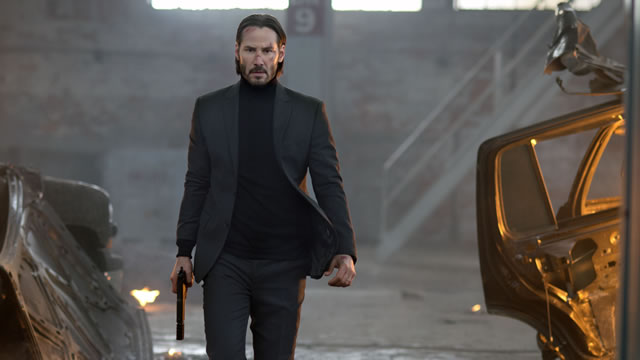
When B-list movie-making works, it can be a treat. John Wick is such a film. Set in a very distinctive criminal underworld, the recently widowed super assassin John Wick (Keanu Reeves) has left the life of crime behind but is dragged back in when the son (Alfie Allen) of a Russian mafia kingpin (Michael Nyqvist) murders his dog, a final gift from his wife. Wanting revenge for the loss of his last link with his wife, Wick undertakes a roaring rampage of revenge.

John Wick is a film all about momentum. It’s sharp and brutal, with fights and events piling on top of each other. However, it’s also a film told with quite a bit of wit and imagination – it’s got a cool sense of humour, and presents a tongue-in-cheek view of its super assassin story. The film’s pace and immersive action is punctured regularly and very effectively with amusing moments that really hit home. The idea of the criminal underworld having its own secret code, rules, havens and even currency is several times expanded wittily to bring an everyday element into the extraordinary. As an exercise in briefly and simply “building a world” you could look at few better examples than the script for this film.

Keanu Reeves is actually a fine choice for the lead role. His limitations as an actor have always been based above all in his flat and unmodulated Dude voice, so it’s only at moments of vocal emotion (there is one such angry outburst that he struggles with in the film) where even the audience feels that awkwardness of watching an actor at the limits of their range. But his best quality has always been his inherent lovability. As an audience member, you can’t help but care about him. Combine that with his physical brilliance and you have the perfect combination required for this role: you can believe totally in him as a ruthless killer, while also feeling a great deal of affection for him.

With Reeves’ physical abilities, the fights are then very well framed to showcase the fact that the actor is doing the stunts himself. If Quantum of Solace is perhaps the most inept example of high-cut frenetic action, this is at the other end of the scale totally. Simple, clear camera set-ups allow us to follow what happens at all times. Establishing shots and tracking shots show us exactly what is going on and where. This means you can relax and settle into the crackingly efficient violence that fills the film. The fights are inventive, shot with wit, and highly enjoyable in their execution without being excessively bloody or violent. The calm angles and stable camera serve to really accentuate the speed of those in the fights, making the fights visually very original. Despite the enormous body count, it never revels in violence. The patient build up to the first burst of violence also serves to really bond us to Wick’s backstory and his grief at his loss.

However, it’s not perfect. Strangely, despite the fact that the film is quite short, it’s still too long. There is a natural culmination point in the film at the end of Act Two that feels like a very natural, thematic stop point. Act Three resets the table hurriedly to reposition another character as a principal villain and to bring us another confrontation: this time however, the motives are less clear, and the action  just a little too much more of the same. It feels less witty and original than some of the other sequences in the film and to be honest I felt my attention drifting it a bit; the motivation for the final clash just isn’t there in the way it is with the initial enemies.

But this is a very enjoyable piece of pulpy film making, its wit and imagination embraced by some very enjoyable performances from the actors. The fight scenes not only have a unique look to them, they get the balance exactly right between violence and enjoyment. It’s almost the definition of a guilty pleasure .

Money Monster (2016)


A bad day at the office was ahead for George Clooney

Director: Jodie Foster

Cast: George Clooney (Lee Gates), Julia Roberts (Patty Fenn), Jack O’Connell (Kyle Budwell), Dominic West (Walt Camby), Caitriona Balfe (Diane Lester), Giancarlo Esposito (Captain Marcus Powell)

For as long as there has been TV, then the world of Film has looked down its nose at the mass market medium. “It’s in your homes! It makes you dumber! It stops you caring!” Set a film in a TV studio and it’s a fair bet that, before long, some shallow media types will appear, a dramatic on-air event will take place, a shallow man will rediscover his soul and the camera will cut back to punters at home watching the drama as if they it was just part of the show.

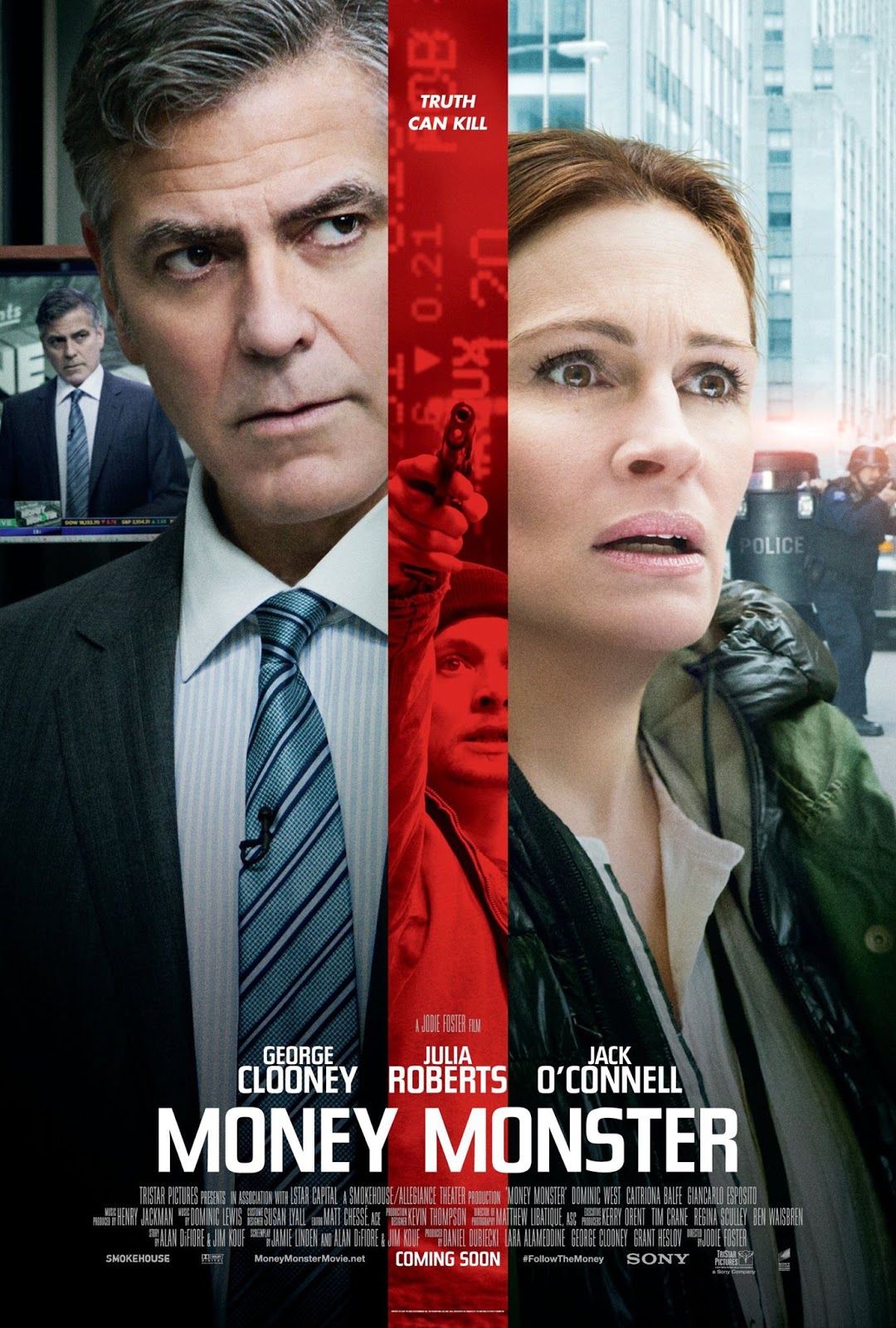
All this is exhibited to its full in Money Monster, a passably entertaining hostage drama set in the studio of a fictional Wall Street themed entertainment and “news” show. Lee Gates (George Clooney) is a shallow, image and money-obsessed TV personality taken hostage after a desperate grief-stricken viewer Kyle Budwell (Jack O’Connell) loses his life savings on one of Gates’ tips. However, with the prodding of his director Patty (Julia Roberts), Gates slowly begins to rediscover his journalistic integrity.

Watching the film when it rather heavy-handedly enters into the world of media satire, it’s pretty hard not to remember better films in the same genre. Network covered much of this ground so well 40 years ago, it’s almost not been necessary to watch another film about the manipulation of the media. The Truman Show so successfully skewered the thoughtless collaboration of the watcher at home, that this film’s attempt feels like a rather mundane repeat.

Saying that, George Clooney does a grand job of portraying the shallow, media man re-discovering his depths – although lord knows he’s played this sort of part often enough to do it standing on his head. But he gets the dark comedy of it, and he is also able to deliver on the growing decency and integrity of the character. Julia Roberts is pretty good as a confident professional who has allowed her principles to slide for too long. In this illustrious company, Jack O’Connell more than holds his own, delivering brilliantly as a desperate and angry man.

The hostage taking sequences are quite well done, and threaded in well with the general satirical air of the film. At two key moments during the crisis, the film successfully pulls the rug out from under the feet of the viewer by delivering a different outcome than we might have expected. It’s probably when the film is most effective. It also does a good job threading many of the themes, locations and characters that will become important by the end of the film into its opening moments – many of them done so gently, you won’t even notice until they become important later.

The dark satire around the uncaring nature of big business and its lack of principles also hits more than a few familiar beats (big business being another thing multi-million film companies love to lay into), but this side of the plot is interesting enough – and I didn’t quite work out how the dodgy dealing had worked out. The final reveal and confrontation around this is well staged. It doesn’t tell you anything new, or present its old points in a unique or intriguing new way, but it does it in an entertaining way.

The film generally deserves some congratulation for its staging – Foster directs with a tightness and the flimsy conception of the film is delivered in a taut 85 minutes (almost in real time) which certainly means it doesn’t outstay its welcome. The acting is decent and the points it makes are well delivered, no matter how familiar they are. The film effectively plays with and changes your views on its characters over the course of its runtime. Honestly there are worse ways you can spend an hour and a half. It’s just not something that is going to stick with you for long.

Sleepy Hollow (1999)


Rumours that Johnny Depp is tapping into his eccentric style are of course unfounded

Director: Tim Burton

Cast: Johnny Depp (Ichabod Crane), Christina Ricci (Katrina Van Tassel), Michael Gambon (Baltus Van Tassel), Miranda Richardson (Lady Van Tassel), Casper Van Dien (Brom Van Brunt), Jeffrey Jones (Reverend Steenwyck), Richard Griffiths (Magistrate Philipse), Ian McDiarmid (Dr. Thomas Lancaster), Michael Gough (Notary Hardenbrook), Christopher Lee (Burgomaster), Christopher Walken (The Headless Horseman), Claire Skinner (Beth Killian) 

Tim Burton’s films often take on a larger-than-life quality, an overblown fanciful journey into a world that is a few degrees off from our own. So a bizarre ghost story about a headless horseman lopping off bonces left, right and centre, in an isolated town that feels more like a construct from a series of other films than any sort of real place, probably suits him perfectly.

After a series of murders via decapitation in the small town of Sleepy Hollow, Iachobad Crane (Johnny Depp) is called from New York to investigate. An eccentric (what else, it’s Depp) moderniser, Crane believes in logic and forensic investigation and is having none of the fears of the townspeople that the murders are being committed by a headless ghost. However he soon changes his views…

This adaptation bears little or no resemblance whatsoever to the original source material, bar a few homages, one or two brief scenes and a few character names. Burton, indeed, seems to have no interest in it at all: what he is interested in doing is paying homage to high-blown Hammer horror films from the 60s and 70s. Whether you enjoy this largely depends on whether you were a fan of either Burton or this style of film-making going into it.

I found the film rather too arch throughout – from the stylised performances of the actors, through to the slight tongue-in-cheek tone. It’s not particularly scary at any point, despite the blood and gore – largely because nothing ever feels real, there’s no sense of dread or peril. Heads are lopped off with an almost comic athleticism, bouncing around floors or rotating on necks. Only one sequence – the murder of a family – carries any real sense of unease about it. The rest of the film is one not-particularly-witty black comedy, in which a lot of time and talent seems to be invested in something not particularly interesting.

Depp is of course perfectly suited to this, his “look at me” acting style springing to the fore as Crane. As usual he overloads the character with quirks and mannerisms, the sort of tricksy emptiness it’s easy to mistake for great acting. The rest of the cast go about their business with a trained professionalism. However, despite the array of British acting talent on display, in truth none of them make much of an impression, with the exception of a nice cameo from Alun Armstrong as a senior New York policeman, and Miranda Richardson who has fun with her role as a sinister housewife with hidden depths.

The awards attention for the film focused on its finest aspects – its look and design. The production design of the film is impressively constructed and the artificial look of the exterior sets actually fits in very nicely within the world of the film. Emmanuel Lubezki’s photography also looks fantastic, shooting the film with a slightly off colour, 70s style that adds a vibrant red to the large amount of blood on screen. Costumes and other technical aspects are also impressive. The film looks fantastically striking, like a brilliantly designed coffee table book – and has about as much plot as one. It’s my problem with Tim Burton – this whole “unique vision” of his, often seems to be an excuse for littering his films with in jokes, arch design and stylisation and leaving out the things we actually care about, like characters, emotion and drama.

In the end, it’s really not a lot more than a joke, a pastiche of a certain genre of film that seems much more like one for the fans than a joke that we can all take part in. I’m aware not liking it throws me open to accusations of not “getting it” or expecting more from it, but I basically didn’t really find the joke funny enough. Its arch style make it hard to relate to, and despite the clear enjoyment of all involved, not a lot of the wit behind the scenes is clear in the final product. With nothing to really invest in, a rather sudden ending and a mood throughout that is trying to be creepy rather than genuinely so. Don’t expect a retelling of its plot around a camp fire to awaken too many goosebumps.