Category: French films

La Ronde (1950)

La Ronde (1950)

Ophüls masterful film is a cheeky end-of-pier comedy in smart clothes and subtle musing on filmmaking

Director: Max Ophüls

Cast: Anton Walbrook (Master of Ceremonies), Simone Signoret (Léocadie, the Prostitute), Serge Reggiani (Franz, the Soldier), Simone Simon (Marie, the Chambermaid), Daniel Gélin (Alfred, the Young Man), Danielle Darrieux (Emma Breitkopf, the Married Woman), Fernand Gravey (Charles Breitkopf, the Husband), Odette Joyeux (Anna, the Young Woman), Jean-Louis Barrault (Robert Kuhlenkampf, the Poet), Isa Miranda (Charlotte, the Actress), Gérard Philipe (the Count)

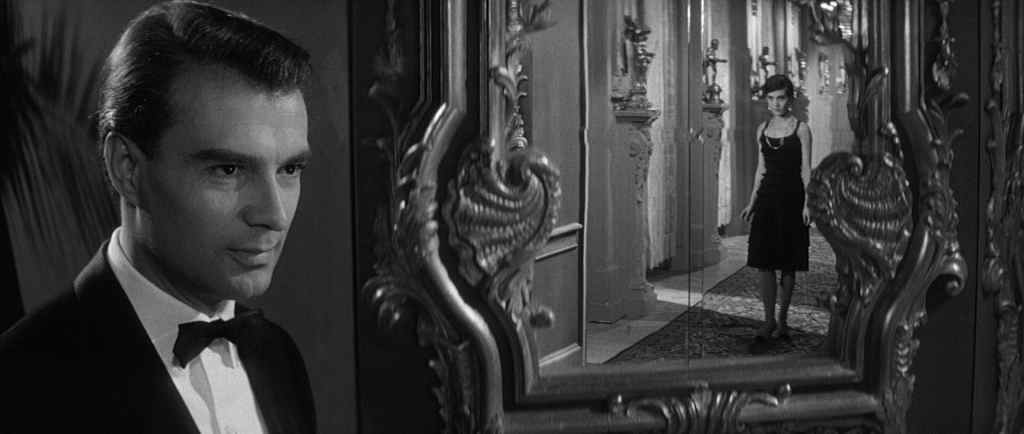
La Ronde is the sort of film many would describe as elegant and sophisticated, with its Edwardian Viennese setting, gorgeously expansive costumes and luxuriant sets. Which is perhaps part of Max Ophüls’ joke: because, in many ways, La Ronde is a sublimely naughty end-of-the-pier show where a suave Master of Ceremies (a gloriously arch Anton Walbrook, standing in for Ophüls himself), manipulates events and people to present a chain of sexual encounters that eventually loop back round through the partners to the prostitute (Simeone Signoret) who started it all. Only of course she didn’t start it, since Walbrook’s MC instructed her exactly which soldier she was to invite for a romantic knee-trembler. La Ronde is a sex comedy of manners – but it’s also an intriguing commentary on the act of film-making.

Walbrook’s MC is essentially the film’s director. He all but tells us this, as Ophüls camera (in one of the director’s signature long, roving camera moves) tracks him walking in evening garb in front of what looks suspiciously like a painted backdrop… and then is immediately revealed to indeed be one as Walbrook guides us past a film camera onto another set, changes his clothes and begins handing out instruction to actors. Over the course of the film, Walbrook will guide characters between sets (through a blatant back-stage area), take on a series of small roles to directly intercede in the action and even snip out the film of La Ronde’s most smutty part. He’ll even cue the sun to rise. Walbrook’s archly artificial performance is crammed with assurance, charm and a supremely entertaining streak of naughtiness: for what is a film director but a sort of enthusiastic child who enjoys playing out his stories for us.

It makes sense that La Ronde takes place in a curiously artificial world, that often seems to be only populated by whichever pair of lovers Walbrook happens to have introduced. Its design echoes the circular narrative of the piece. Ophüls camera frequently moves through circular tracking shots, while the frame is stuffed with circles. From the merry-go-round the MC rides on, circles are everywhere: courtyards and rooms are circular, stair-cases and walkways roll round on themselves, characters are framed through chandeliers or circular gaps in ormolu clocks. The set seems to loop around as much as the story does, characters being forced into rotation, as if they were constantly riding the merry-go-round (which indeed we see, at one point, kitted out with a whole dinner service) not in control of their own fate but driven forward by endless momentum.

It’s an endless momentum that crashes only once, the MC’s roundabout breaking down when a young lover suffers from a bout of impotence. It’s telling that, during this sequence, we get the closest we get to an adult conversation between two lovers, Daniel Gélin’s eager-to-please young man and the relaxed worldliness of Danielle Darrieux’s married woman. Just as it’s telling that the only encounter not punctuated by sex, but instead by an earnest conversation that there are more important things in a marriage than the buzz of passion, is between Darrieux and Fernand Gravey’s fusty but strangely vulnerable Husband. Aside from that, these encounters have a constant frission of desire beneath them, only rarely punctuated by more complex emotions.

In fact, there is something very stereotypically French about a film that essentially says a constant parade of sexual encounters between willing partners is perfectly harmless, so long as eyes are open and honesty prevails. It’s also striking how, from encounter-to-encounter, characters switch from seduced to seducer.  Simone Simon’s Chambermaid goes from the arms of Serge Reggiani’s enthusiastic soldier (whose interest in her declines almost immediately after the deed), to shamelessly provoking the lust of Gélin’s young man who then immediately, enthusiastically, courts Darrieux. Odette Joyeux coquettishly plays along with Gravey’s extra-marital tumble and then finds herself swept up with Barrault’s poet who is putty in the hands of Miranda’s actress.

It all eventually loops us back round to Simone Signoret’s prostitute: and if there is anything in La Ronde about the cost of love, it seems fitting it should be connected to the loneliness of the only person to whom this is a professional obligation rather than a choice. Signoret makes the woman surprisingly melancholy and regretful, more desperate perhaps than anyone else for a taste of genuine connection: be it from Reggiani’s soldier (to whom she offers a free romantic encounter, which he only accepts so long as it doesn’t involve a ten minute walk to her apartment) or later from Philipe’s count, where she seems not even surprised that he awakens claiming to not remember a thing about the night before. La Ronde bookends a frequently light, sexy, cheeky film with its most tragic character (another sign of Signoret’s skill at pained neglect).

Aside from this, it’s a surprisingly light, playful and cheeky confection – one which relies on its impact from the masterfully graceful filming it receives from Ophüls, at the top of his game here. No point is made too forcefully, every scene smoothly but relentlessly builds towards a comic highlight, each shot is framed to perfection, from the gliding tracking shots to the Dutch angles and circulatory framing. This is a director’s film like few others: so, its immensely fitting it should, with Walbrook’s character, effectively make the director the key character, delightedly telling us every part of his design, guiding our eyes where to look and manipulating and positioning the other characters so they add to our enjoyment. There are few films quite like La Ronde in that all this is done with an astonishing lightness of touch. Nothing here is to be taken too seriously, or to be hammered home too hard. Instead, it’s a whimsical naughty story intended to leave you with a grin on your face when you recount it to friends.

Last Year at Marienbad (1961)

Last Year at Marienbad (1961)

Ultimate arthouse film, designed to reward constant analysis and interpretation with no answers

Director: Alain Resnais

Cast: Giorgio Albertazzi (X), Delphine Seyrig (A), Sacha Pitoëff (M)

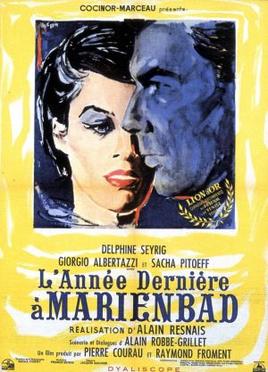
If there is one film that could practically stand as a dictionary definition of art-house cinema, it might be Last Year at Marienbad. A striking collaboration between director Alain Resnais and novelist Alain Robbe-Grillet, is puts the vague in Nouvelle Vague (French New Wave to you and me). Last Year at Marienbad is a film almost unlike any other, a work of art that lays itself out in front of you and asks you to bring your own viewpoint to bear to decide what (if anything) it’s actually about. You could call it a riddle wrapped in a mystery inside an enigma (to borrow a phrase from Churchill – and lord knows what he would have made of it).

Last Year at Marienbad is set in a sprawling, Versailles-like palace (which might be a hotel), where grand, art-laden corridors go on forever, every room drips with fine details the grounds are mini-countries and opulent, geometric designs fill ever corner of the building. Within this, a parade of people dressed in evening finery move like impassive robots, uttering flat banalities and either moving slowly between rooms or standing impassively like statues. Among these strange, ghost-like figures a man (Giorgio Albertazzi) waylays a woman (Delphine Seyrig) and tells her a year earlier they met somewhere else (possibly Marienbad, but could have been Frederiksbad, Karlstadt or Baden), fell in love and planned to elope a year later. She doesn’t remember him at all. He spends the film trying to persuade her. Another man (Sacha Pitoëff), who might be her husband, engages the first in a mathematical card game (nim) which he defeats him at constantly.

If that sounds sparse, it’s because a plot description barely functions for a film so wilfully oblique it’s about whatever you decide it’s about. Resnais and Robbe-Grillet’s purpose perhaps can be seen when our two could-be lovers discuss a classical statue. (In a neat touch, the statue itself was specially carved for the film). Their conversation revolves around different interpretations of what these Roman (or Greek) figures are doing: is the man protecting the woman from walking into danger? Is the woman protecting the man? Are they in love? Are they arguing? Why is there a dog sitting at her feet, looking away? This conversation is framed through a series of lingering shots from multiple angles, that invite us to bore our eyes into the statue and decide for ourselves.

And that’s basically the film in microcosm. It’s a series of beautifully haunting images and scenes, shot by a gliding camera and accompanied by Francis Seyrig’s hypnotic score, that invites the views to stare at this film like they would a painting in a gallery and spot as many (or as few) tiny details as they like and see if it changes their view of the artist’s overall intention. Last Year at Marienbad, in effect, nearly defies any sort of logical criticism. What you take out of depends entirely on what you put in. Which is to say, it’s as perfectly legitimate to say it’s a pile of pretentious, piss-taking piffle as it is to call it a gorgeous, transcendent piece of art that leaves you thinking for days.

Everything is designed to leave things open to question, with the normal rules of logic and cinematic structure routinely discarded. Characters will be in frame at the start of the shot and then, as the camera drifts away from them, suddenly appear in another (impossible) location – for example one shot starts with X at a card table, then drifts across the room to the doorway to see him enter.

The people move like functional props, or bored actors trotting through their marks. There is barely a facial expression or jot of intonation in anyone. They stand mutely to attention, or shift through a senseless parade of conversations, waltzes and card games. There is a ghostly, dream-like, never-world quality to the entire hotel (it’s influence on The Shining – from Resnais’ controlled, Steadicam style shots, to the haunting sense that mankind has no agency or influence in the building – is really clear). It’s as cold as a block of marble, and the people often feel like statues that have walked off their pedestals into the world.

Locations are inconsistent and change all the time: Resnais shot the film in multiple palaces and stitched the locations together, hiding cuts with carefully placed objects (in one instance A walks down a corridor seemingly in one shot, but Seyrig is actually walking through about three totally different locations). The pattern, design and contents of rooms change (A’s bedroom shifts through myriad designs and layout, most noticeable in its constant swopping between either a mirror or a painting above the mantelpiece). An exterior balcony next to that statue subtly changes location as well (and even appears as a detailed landscape painting).

Everything shifts, twists and contorts all the time as if the film reforms depending on the angle you are looking at it from. The hotel could be a purgatory or a dream. It could be a half-formed memory. X could be an Orpheus striving to save his Eurydice. Or a self-aware film character. Or a trapped dead soul. A could be an amnesiac, a fantasy figure, a ghost, a part of X’s psyche. M could be her husband, X’s alter-ego, death or a complete stranger. Every single interpretation is legitimate and you could pull out different moments to support any one of them.

Myself, I saw it as like a dive into X’s memories. Everything about the shifting scenery, strange dis-jointed logic of the film moving seemingly at random between past and present, the repetitions and reframings of the same conversations, seemed like a man sifting his memories. X even stops and argues against certain scenes (‘It didn’t happen like that.’) There are hints of a dark trauma: repeated shots of A cowering in her room, brief moments of shock, tears and her pulling away from X. We see multiple hints of A’s death, including a possible shooting by M. I started to think this was X reframing his memories to absolve himself: that after rejection by A, he assaulted her in some way, she committed suicide (the opening play the characters are watching is Romers based on Ibsen’s play about a man haunted by the suicide of his wife). X is now forcing his memory to adjust this into a tragedy where he was the victim – and as part of that must persuade A she loved him.

But that’s just my view. You could just as well say X is so bored watching Romers, he makes up a whole fantasy based on it to keep himself entertained (inevitably, the set of the play changes completely whenever we see it). I do think it interesting most 60s criticism took X completely at his word as a victim, while more recent criticism has often cast X as an unreliable narrator (if that term has any meaning here). What matters more is whether you are intrigued enough to find dwelling on what this all means (the way we dwell over a Picasso) worth your time. For me it unquestionably is.

Napoleon (1927)

Napoleon (1927)

Gance’s monumental film takes the breath away, packed with innovation, invention and drama

Director: Abel Gance

Cast: Albert Dieudonné (Napoléon Bonaparte), Edmond Van Daële (Maximilien Robespierre), Alexandre Koubitzky (Georges Danton), Antonin Artaud (Jean-Paul Marat), Abel Gance (Louis de Saint-Just), Gina Manès (Joséphine de Beauharnais), Vladimir Roudenko (Young Napoléon), Marguerite Gance (Charlotte Corday), Yvette Dieudonné (Élisa Bonaparte), Philippe Hériat (Antoine Saliceti), Max Maxudian (Barras), Annabella (Violine Fleuri), Nicolas Koline (Tristan Fleuri)

There is a marvellous quote from Victor Hugo when he wrote about the young life of the most famous Frenchmen who ever lived: Déjà Napoléon perçait sous Bonaparte. Which roughly translates as ‘already Napoleon was bursting through Bonaparte’ – or to put it another way, the man was already being consumed by the legend. That idea dominates Abel Gance’s extraordinary, epic, retelling of the Young Napoleon’s life, an origins story that sees a young man become increasingly distant and legendary before our eyes. Gance’s film may be resolutely old-fashioned in its historiographical approach, but is revelatory in its cinematic flair and invention, with almost every scene demonstrating Gance pushing the medium in new directions.

Napoleon was planned as only the first of no-less-than six films that would cover the cradle-to-grave story of the man who defined his whole era. Such was Gance’s ambition through, that even across five hours he felt he had only scratched the surface of the first 27 years of Napoleon’s (Albert Dieudonné) life from his childhood education (snowball fights and all) at Brienne – where he is seen as a Brutish Corsican outsider – via the French revolution, his failed attempt at revolution in Corsica, his successful siege of Toulon and promotion to General at 24, nearly losing his life in The Terror, Thermidor and his crushing of the Vendemaire uprising, marriage to Josephine (Gina Manès) and the beginning of his campaign in Italy.

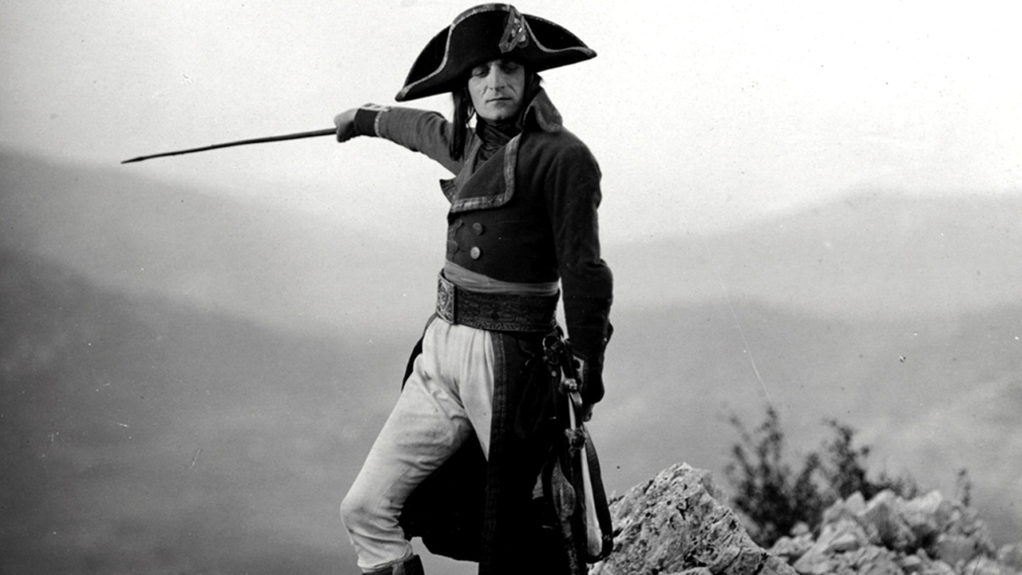
Gance unfolds this in a film brimming with cinematic verve and invention. Much like its lead character, it is a seismic and larger-than-life (literally so in its most famous innovation, the three frame wide-screen effect achieved for its final twenty minutes). Napoleon practically defines the notion of historical epic, reproducing many at historical events at a 1:1 ratio. At its centre is a magnetically hypnotic (almost literally) performance from Albert Dieudonné (so enamoured with the role, he was buried in his costume) juggling the impossible by suggesting some of the many shades of this fascinating figure, part revolutionary, part tyrant, part romantic, part war-monger.

There is something truly striking and original in every frame of Napoleon. Gance presents a picture of the famous general more than touched with an old-fashioned Great Man theory of history, but still suggests he is almost two men in one. He is Bonaparte, the slightly-chippy, awkward young man who clumsily woos Josephine (barely sure where to do with hands, tugging shyly at his sash), struggles to get noticed in a map-making office and finds it challenging to make friends, either at school (where he is a painfully serious outsider) or as an adult. But he is also Napoleon, the totem of history who Gance frequently frames as almost communing with a historical version of himself.

This Napoleon bursts from the awkward Corsican shell of Bonaparte. Gance frequently frames him almost confronting the camera, light shimmering around him to form halos, with a piercing stare that freezes people into place. He comes to identify himself with the flag and the revolution. So much so that, in his escape from Corsica, he will be borne across the seas by a tricolour jerry-rigged into a sail and visualise himself being hailed by the executed ghosts of the revolution as its natural heir. Indeed, the film ends with Napoleon atop a mountain starring into a montage of his future achievements, as if he was bending history around him.

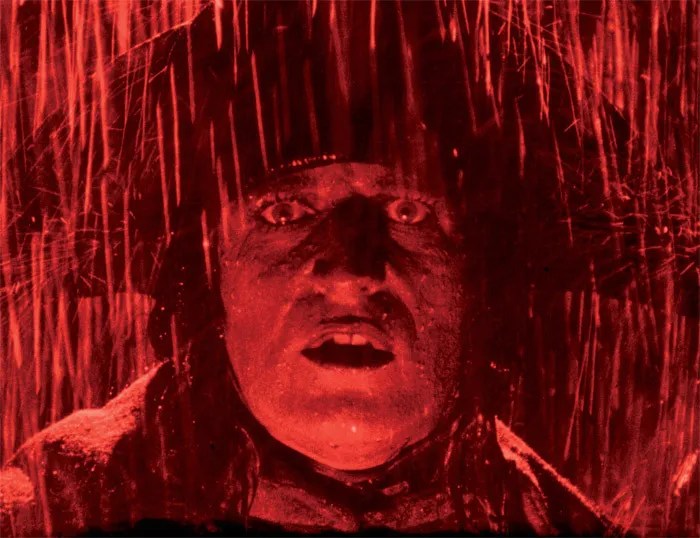
Which isn’t to say Gance sees him as a constantly sympathetic figure. While there is no question he is a force of nature – he controls the frame, frequently centred and when the camera moves (such as the careering gallop that takes him to Italy) he is always at the eye of its propulsive tracking shots – he is also an imposing, even scary figure, distant and cold. In dyed red frames, he looks positively demonic, such as when he looms forward out of the rain in Toulon, his face filling the frame to demand relentless attack. His self-identification with the revolution becomes monomaniacal.

Gance re-enforces his distance from normal human reaction by returning constantly to the Fleuri’s, a working-class family who shadow the Great Man (Violine loves him hopelessly and her father and brother worship him) but whom he never notices. It’s part of him being crafted into marble before us – with all the terrifying lack of human understanding that suggests. Throughout he’s shadowed by an eagle, a visual representation of his mystical, greater-than-human nature, a bird of destiny that drives him relentlessly on. He’s contrasted constantly with other would-be leaders: the itchy Marat, the empty windbag Danton and (most noticeably) the curiously ineffectual Robespierre, an uncharismatic man who can’t control a crowd, is lost behind darkened glasses, follows the orders of others and is comically dwarfed by an eagle statue not elevated by it.

Gance’s history has a slight school-book Victorianism to it. He’s very proud of “historical” facts – quotes and events are frequently branded with the on-screen phrase “(Historical)” so we can see his behind-the-scenes research – and has more than a little love for irony. Of course, the final island covered in school-boy Napoleon’s geography class is “St Helena”! Of course, the English sailor who spots him escaping from Corsica (and is refused a request to sink his ship) is Nelson! The film is littered with cameo appearances from later Napoleon rivals and allies. There is also a darker irony playing here: we know that when Napoleon is praised by the ghosts of the revolution that, far from protecting it, he will in fact become its final destroyer.

But what really singles out Napoleon is it’s intense, cinematic inventiveness. It’s an explosion of unique, fascinating images packaged into a single film. Gance reinvented the wheel multiple times on this one, not least on his of ghostly images and cross-fades. To achieve this – such as the ghostly appearance of the Great Revolutionaries in an otherwise empty Assembly Hall, he re-exposed the same film multiple times (sometimes as many as twenty) to achieve the effect. The same for Napoleon’s schoolyard fights, a single sequence with the screen split into nine squares each showing a different moment in time achieved by covering different parts of the frame for each exposure.

Gance’s camera is strikingly mobile, his editing frequently thrilling and thought-provoking. The famous sequence of Napoleon’s escape from Corsica is superbly intercut with the clash in the Assembly that will lead to the execution of the Gironists. The swaying of the ship is increasingly echoed by the swaying and eventually full-blown swinging of the camera in the Assembly room. Both events merge together through cross-fades. The camera whips through some scenes with real pace and aggression – witness the fast-paced tracking shots that follow Napoleon to Italy.

That’s matched as well with imaginative scenes of quiet beauty. The young Napoleon quietly communing with his pet eagle. The marvellous “shadow marriage” Violine conducts with a cardboard doll of Napoleon, positioned to cast a full-length shadow on the wall. There are moments of black humour – the coffin Robespierre and Saint-Just keep the death sentences they’ve passed in – and moments of soaring, lyrical inspiration such as the first singing of the Marseilles which takes on a mystical quality. To achieve this, Gance pushed the camera places it had never been before, patenting new techniques and devices to achieve frames, angles and cross-fades never seen before.

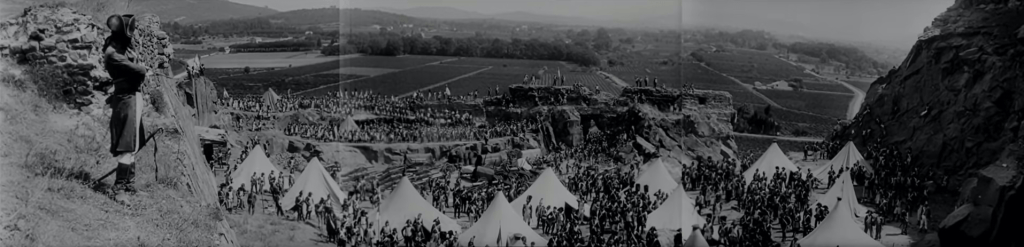
The most stand-out being the astonishing three-frame wide-screen effect. Perfectly mapped, with the small distortion in the joins almost adding to the power, this creates Panavision decades before Hollywood had even coined it. It creates awe-inspiring vistas of Napoleon’s Italian army – although the battle scenes Gance shoots are often cruel and dirty, with bodies twisted and crushed by the violence of war – but it also allows Gance to present three different images side-by-side, something he exploits to maximum effect in the closing moments that presents a giddyingly cut (it’s Eistensein-influence is clear) montage of past moments in the film that have led up to the Napoleon we see standing on a mountain before us starring into the future.

For Gance through, it is a future that wouldn’t come. Napoleon was not a success – perhaps people couldn’t quite process the scale of it, perhaps the money-men were terrified that Gance had spent the budget of six films on one and still hadn’t got round to Austerlitz, Borodino and Waterloo. The film was butchered and tinkered with for decades before it was reborn. And what a relief, because this is a stunning epic, which (for all its narrative simplicity) has something to wonder at in every frame. An extraordinary film, which everyone should see at least once.

L’Argent (1983)

L’Argent (1983)

Bresson’s final film: challenging, cold, hard to watch, definitely leaves you thinking

Director: Robert Bresson

Cast: Christian Patey (Yvon Targe), Vincent Ricterucci (Lucien), Caroline Lang (Elise), Sylvie van den Elsen (Grey haired woman), Michel Briguet (Grey haired woman’s father), Beatrice Tabourin (Ka photographe), Didier Baussy (Le photographe)

Robert Bresson is today so widely acclaimed as one of the patron saints of cinema, it’s odd to think that in 1983 at Cannes he was furiously booed when he won the director prize for L’Argent. But Bresson’s style had always been divisive – before the vindication of history – and L’Argent, his final picture, is one of the purest, most uncompromising slices of Bressonism you are likely to see, not to mention an uncomfortable and deeply challenging work of art. Uncompromising in almost every sense, it is a film that climbs under your skin and troubles your mind for days after watching.

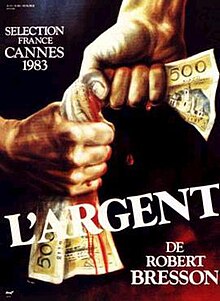
Based on a short story by Leo Tolstoy, L’Argent’s theme is the corrupting influence of money. Two rich kids, troubled by the small allowance from their parents, forge a 500 Franc note and exchange it for change in a photography shop. The owner, keen to get rid of the offending note, instructs his assistant Lucien (Vincent Ricterucci) to pay working-class Yvon Tonge (Christian Patey) with it. When Yvon uses it in a café, he is arrested and charged, his pleas of innocence ignored. Losing his job, with a wife and child to support, Yvon slides down a slippery slope encompassing theft, jail time, tragic bereavement and murder leaving him a brutal shell of the man he was before.

Bresson’s film deals with the inexorable inevitability of fate, once it is prodded in a certain direction by the destructive forces that govern our world. Those forces are themselves governed by cold, hard mammon and the selfishness and casual cruelty of those who have it or want it. Bresson’s film is littered with shots of hands at work – nearly always that work involves the passing of bank notes from one place to another. Money is what makes the world go around – it dictates power and privilege and it fundamentally decides who is believed and who is punished.

Yvon can plead in vain he is innocent of passing fake notes, because no one is going to listen to a working class joe with scarcely a penny to his name rather than the vouched-for employee of a respectable middle-class businessman. Yvon even ends his first court case by being rebuked for bringing into disrepute the names of such thoroughly respectable people. By contrast, when concerned her son might get caught up in the whole filthy affair, the mother of one of the original forgers simply hands over a wedge of cash to the cheated shop-owner to make the problem go away. Money talks.

And it has cast its verdict on Yvon, deciding he should be chewed up by the system and spat out a very different man. From the moment we first see Yvon arrested for the false note, we know he is doomed. Just as we know, from seeing Yvon’s first reaction to being accused (a violent shove that sends a waiter tumbling and glass smashing on the ground) that there is a capacity for violent revenge in him. Later, like a dim echo of this first moment, glass will shatter again on another floor, dropped by a grey-haired old woman hiding the fugitive Yvon. It’s a salutary reminder (one the film delivers on, with chilling impact, a few minutes later) that Yvon has a darkness that can harm others.

It’s a hardness sharpened by time in prison. Returning to the fertile ground of A Man Escaped, Bresson offers a chilling indictment of the prison system. Formal, cold and uncaring, it is a breeding ground for resentment and rage. The authorities read all incoming mail, but in no way think about its contents and the impact it will have on the receiver (the mail reading room is a voyeur’s paradise, the chance to observe the secret goings on of everyone before they even know it themselves). Incoming mail discovers Yvon’s sick daughter has died and his wife is leaving him for good. No attempt is made to support Yvon who quickly succumbs to rage (looking to strike a mocking fellow inmate with a metal serving spoon), punishment by isolation and a suicide attempt through stockpiling chill-pills (much easier to shut inmates up rather than help them).

Throughout Bresson shows the onslaught of cruel events on Yvon with his characteristic spare style (no music, well drilled actors, perfectly timed shots, composed to convey information in the most economical style possible). But L’Argent is also a film strikingly devoid of moral judgement. It’s very much left open to us when, how and why we may or may not lose sympathy with Yvon. After all we truly see him suffer, after trying his very best to play by all the rules (reporting where he got the fake note from, telling the truth in court) only for him to lose everything.

Is there a chance for redemption for Yvon? He discovers money talks and the world is fundamentally uncaring (after all it took his freedom, child, wife and a large part of his mental health). Photography shop assistant Lucien reaches the same conclusion: he’s been fleecing his crooked boss for weeks (‘I thought crooks looked after each other’ he tells his boss) but decides on one last theft to redistribute the wealth to the needy. Same conclusions, different methods to punish the world.

Yvon however decides to no longer restrain the dark impulses within him. He murders senselessly twice, grabs a few notes from a hotel cash desk and then finds himself protected be a selfless older woman (who he encounters initially eyeing up for theft). Staying in her home, her family in the same house, what will he do with this woman who does good things and expects nothing in return?

L’Argent is far from an optimistic film, with a hard-working family man turned into a family-free convict. In this uncompromising film, the final sequence is almost unwatchable in its bleak, terrible power as Yvon commits his final, inevitable, sins with a passion-free fixity of purpose almost impossibly horrible to watch. Bresson’s perfectly constructed film, full of detailed, clockwork precision has been slowly building to this horrific end, a natural one for a film highlighting the uncaring cruelty of the modern world.

Because money also doesn’t care about the damage it leaves, the collateral deaths or the cost on those on the margins. Was it this hopeless, systemic, inevitability the viewers at Cannes found so worthy of boos? The progress of events, one connected to another (and L’Argent, despite its structured formalism, is full of events of the least-Bressonist you can imagine, including a car chase) that forms a terrible, unsettling and unreassuring picture? Bresson leaves our judgement of Yvon entirely up to us: Tolstoy’s novella looked at the journey of redemption for its lead character. Bresson shows us the crimes and nothing else. If there is to be redemption or forgiveness we must ask ourselves if we can do it.

Caché (2005)

Caché (2005)

Haneke’s fascinating puzzle is a profound and challenging modern masterpiece

Director: Michael Haneke

Cast: Daniel Auteuil (Georges Laurent), Juliette Binoche (Anne Laurent), Maurice Bénichou (Majid), Lester Makedonsky (Pierrot Laurent), Walid Afkir (Majid’s son), Annie Girardot (Georges’s mother), Daniel Duval (Pierre), Bernard Le Coq (Georges’s boss), Nathalie Richard (Mathilde)

Is any film more aptly named than Caché? Haneke’s film keeps its cards so close to its chest, it’s entirely possible revelations remain hidden within it in plain sight. Caché famously ends with a final shot where a possibly crucial meeting between two people we’ve no reason to suspect know each other plays out in the frame so subtly many viewers miss it. It shows how Haneke’s work rewards careful, patient viewing (and Caché is partially about the power of watching and being watched), but also how unknowable the past can be. It’s a chilling and engrossing film that fascinates but never fully reveals itself.

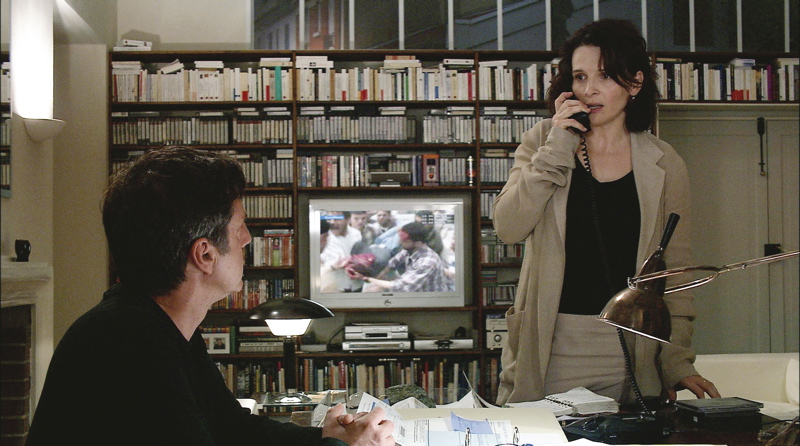
Georges Laurent (Daniel Auteuil) lives a life of success. A wealthy background, host of a successful TV literary debate show and living in an affluent suburb of Paris, he’s married to publisher Anne (Juliette Binoche) and father to young champion swimmer Pierrot (Lester Makedonsky). But there’s a serpent in his Garden of Eden. Georges and Anne are plagued by a stream of videos arriving at their house. These show long, static shots of their home and are accompanied by crude, graphic drawings. Someone is watching their house and the dread that this could escalate at any time is consuming them. But does Georges know more – do the messages chime with guilty memories in his past?

Haneke’s film is a multi-layered masterpiece, a haunting exploration (free of clear answers) into the things we prefer to forget, the hidden horrors we supress. It’s a film all about the shame and guilt buried amongst the everyday. Haneke even shoots the film on hi-definition video so that the surveillance footage of Georges and his home visually merges with the ‘real’ images of the couple. Within that, Caché starts to unpack the hinterland we hold as individuals (and, quite possibly as entire nations) of the guilts of our past that keep bubbling to the surface to bite us.

Caché is shot through with Haneke’s genius for menace and veiled threat. Can you imagine anything creepier than a camera set up outside your home, filming everything you do – but never knowing where it is? It’s an invasion of privacy that is insidious and covered in the additional menace that, at any time, it could escalate to something worse. The creeping, invasive tyranny of surveillance is in every inch of Caché, its omnipresence giving every interaction the feeling of being watched (something Haneke plays up – watch a man watching Anne when she sits in a café with a friend).

So gradually the book-lined world of the Laurents becomes a base under siege, a feeling amplified by Haneke’s mix of smooth camera movements adrift from establishing shots: constantly the camera glides through a space where we feel we neither truly understand the geography or are confident about the time. It’s accentuated by the window-free room the Laurents largely inhabit. In fact, their whole home feels window free, with curtains frequently drawn and rooms plunged into darkness, the family throwing up a shield to protect them from the outside world.

Or is it to cut them off from the unpleasant facts of life? It becomes clear Georges has built a world around himself, where he is the hero and all traces of the unpleasant or disreputable in his past have been dismissed to the dark recesses of memory, never to be accessed. Played with a bull-headed arrogance by Daniel Auteuil, under his assurance Georges is prickly and accusatory, liable to lash out verbally (and perhaps physically, considering the threat he carries in two key scenes). Auteuil masters in the little moments of startled panic and stress that cross Georges’ face, a man so used to a world that matches his needs, that anything questioning that is met with rejection.

It’s why he lies to Anne about his growing suspicions about the source of the tapes. The cartoons hint at a series of (deeply shameful) interactions, when he was a child in the 60s, with a young Algerian boy, Majid, who his parents considered adopting after the death of Majid’s parents. It was Georges lies that forced this boy out of his perfect farm-house into the cold-arms of the unfeeling French orphanage system. This is the original sin of Georges’ life, arguably the foundation of his success – a guilty secret that so haunts and disgusts him, even the slightest mention of it brings out the muscular aggression he otherwise keeps below the surface.

Of course, it’s hard not to see an echo of France’s colonial past. One of the things that works so well with Caché, is that this subtext is there without Haneke ever stressing it. Just as Georges’ lies forced Majid into a life of depression and misery, so France’s treatment of Algeria is the terrible shame the nation would rather forget. Majid’s parents died in a famously brutal stamping out of an Algerian protest in Paris in October 1961 (the deaths of over 200 people at the hands of French government forces only came to light decades later). The anger many show when presented with inconvenient, horrible past deeds (both personal and national), only feels more relevant today with our culture battles over history.

Georges sees himself as a victim of a vicious campaign. But, when Georges meets Majid, played with startling vulnerability by Maurice Bénichou, he seems light years away from the sort of man who could possibly be capable of such a campaign. Indeed, when a video of Georges encounter with Majid is widely shared, it is Georges (as even he admits) who appears the bully and aggressor. Majid has been demonised in Georges’ memory – in his nightmare he becomes an axe-wielding monster-child – but he’s an innocent, who had everything taken from him in a micro-colonialist coup carried out by a 6-year-old Georges. A coup the adult Georges has let himself forget, making him little different from France itself. (We are reminded the cycle continues, with constant background news footage of Iraq, ignored by the Laurents.)

The mistakes repeat themselves, but they don’t trouble the complacent middle-classes who benefit from them. Georges will even use his influence to have Majid and his son bundled into a police van. Of course it leads to an outburst that will shake this world up. Haneke’s films have always been realistic when it comes to the visceral horror of violence, and Caché contains an act of such shocking violence that it will leave the viewer as speechless and distressed as the witnesses.

And still the question hangs: who? It could be anyone. At one-point Georges storms out of his front door to confront the mystery video-sender, only to return to find a video wedged in the door. It’s literally impossible for this video to be placed without him seeing it done. Haneke is so uninterested in the whodunnit part that, perhaps, he’s implying the perpetrator is the director himself, using the mechanics of film-making to entrap the guilty parties. It fits with the coldly intellectual steel-trap part of Haneke’s mind, the part that uses films (like Funny Games) to tell off and preach. What other director would be more likely to set himself up as unseen antagonist in the film?

And does Georges learn anything? He will continue to confront characters who challenge his world view and dispatch (like nations) his guilt to the recesses of memory. His begrudging peace with his wife – a superbly restrained Juliette Binoche, increasingly resentful at her husband’s secrets – seems built on the shaky ground of their continuing mutual comfort. And suspicions linger over his son, an increasingly hostile figure who (just perhaps) is learning more about the flaws of his parents than they would be comfortable with.

Of course, this might all be open to interpretation from multiple angles. After all the film is called Caché. Haneke has hidden enough subtle implications in it that it can reward analysis from multiple angles. Shot with his characteristic discipline that suggests a dark, creeping fear behind every corner, it’s a masterclass in suggestion and paranoia. Brilliantly unsettling and constantly reworking itself before your eyes, it’s a masterpiece.

Beau Travail (1999)

Beau Travail (1999)

Denis poetic, art-house classic is intense, searing and transformative, crammed with beautiful images

Director: Claire Denis

Cast: Denis Lavant (Adjudant-Chef Galoup), Michel Subor (Commandant Bruno Forestier), Grégoire Colin (Légionnaire Gilles Sentain), Richard Courcet (Légionnaire), Nicolas Duvauchelle (Légionnaire)

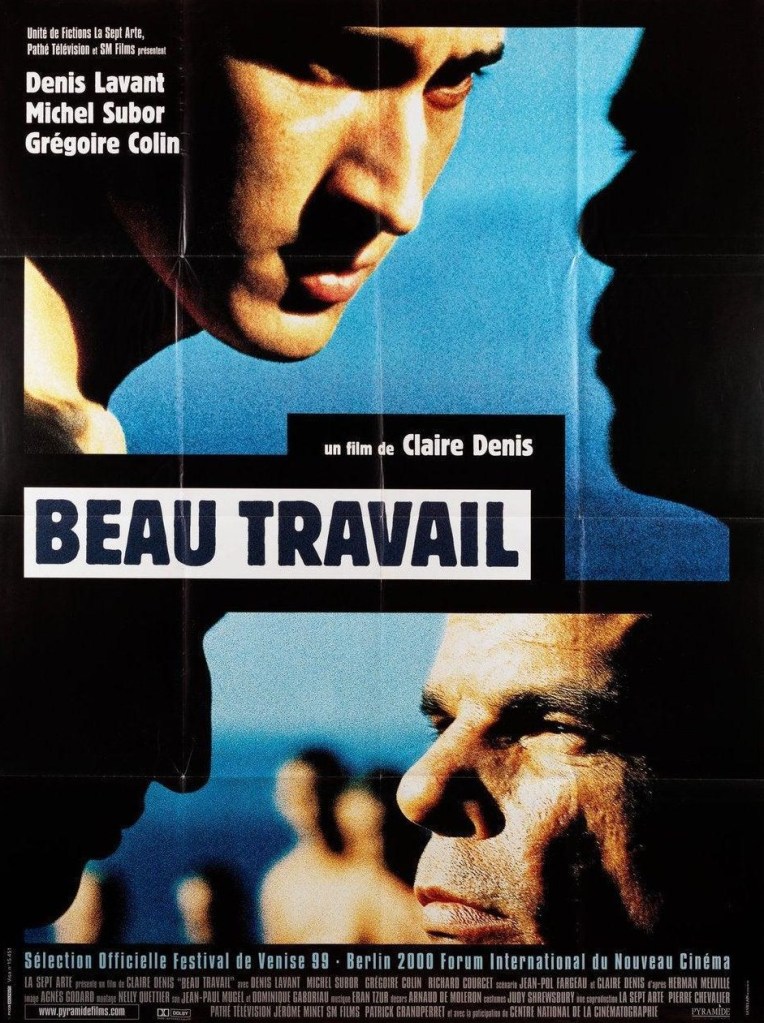
I think it’s fair to say Beau Travail will not be to everyone’s taste. For every person (a bit like me) who comes out of the film humming ‘Rhythm of the Night’, they’ll be another who will never have made it far enough into the film to even understand why anyone would. Denis’ poetic film, shot like a combination of art project and choreographic exercise almost wilfully foregoes plot and character in favour of experience. Framed around a voiceover that could be almost anything from a diary, to a letter to a suicide note, Beau Travail is a film that wants you to be as uncertain about its aims and intents, as its lead character is about his own.

Denis’ film is a remix of several literary sources, most notably Melville’s Billy Budd – though you can also make a case that there is more than a trace of Othello in there. Set in a French Foreign Legion unit based in Djibouti under the command of veteran Forestier (Michel Subor), our focus is his Adjudant-Chef Galoup (Denis Lavant). Galoup is a rigid stickler for duty and an obsessive legionnaire, distant from those around him. He takes an almost instant, irrational, dislike for new recruit Sentain (Grégoire Colin) who can form easy rapport with those around him. Galoup schemes to destroy Sentain. In a framing device, Galoup recounts the story having left the Foreign Legion.

It should probably be restated that this brief summary of the plot pretty much covers every detail in this brief but poetically open-ended film. It takes over a third of the film’s runtime for the unexplained conflict at the film’s heart to even begin and Denis scrupulously avoids anything you could categorically call an answer. Which in a way is an answer in itself. Because Beau Travail is, it is easy to forget, a memory piece. It’s framed with Galoup remembering his career in the Foreign Legion, and everything we see in the film is filtered through his recollections. How reliable are these? How much do the strangely intricate, beautifully choreographed desert training sequences reflect reality and how much are they the result of an unreliable narrator?

Perhaps Galoup’s motiveless loathing for Sentain is rooted in his own inability to understand himself and his own longings. Embodied in a performance of immense physical exactitude by Denis Lavant, Galoup is a tightly drawn spring, a mass of careful, well-chosen movements. He’s naturally content with the labours of the French Foreign Legion: scrupulously ironing creases into his clothes, making his bed with careful perfection, striding through the desert wilderness. At the nightclub with his men, he’s a distant observer – he can’t even really take part in their campfire sing-alongs. He only finds physical ease in their ritualised training sequences.

These training sequences are extraordinary, more like Gene Kelly dance sequences than anything you might associate with training. While in the dance clubs the men are awkward movers, on the training field they have sinewy grace. Ritualised fight training sees their bodies move through pre-set positions with a striking, musical beauty. Even back and leg stretches see twenty men moving with perfect co-ordination in the desert sand, leaving matching trails in the dust.

There is a reason why the title translates as Beautiful Work. The film is a continual stream of military tasks in the desert, most of which seem pointless. Camps are built, holes are dug, rocks are smashed. It’s combined with a series of domestic tasks treated with an equal almost fetishistic relish. Men whip water from their laundry as they peg it up to dry. In unison they iron their shirts into a perfect finish. Potatoes are peeled with casual ease. The training they undertake, powering through assault courses, sees them move with a graceful physical ease. There may never seem to be a point to all the things they do but it’s done with a real beauty. You can totally imagine this idealised vision of unison is exactly how Galoup would want to remember his days in his beloved Legion.

Denis’ transformation of Galoup’s memories of the Legion’s work into unspoken dance sequences, also points towards the increasing homoerotic undertone. This feels like more than a clue about Galoup’s undefined hostility to Sentain who is in many ways a spiritual brother-in-arms. But Lavant’s simmeringly intense, buttoned-up (literally) Galoup could never express such feelings. Is that why some of these training sequences that he remembers feel oddly sexualised? A wrestling practise session, bare-chested, feels like nothing less than aggressive competitive hugging. In one training session Galoup and Sentain walk around in an ever-decreasing circle in what feels like the entrée to a tango or a romantic clinch.

It’s not just Galoup. Michel Subor’s professional soldier Forestier watches the topless training sessions with an unspoken (unrealised) fascination. Galoup’s idolisation of his commander – he even carries a dogtag bracelet of Forestier’s in his exile like a totem – is another motivation, jealousy clearly on his mind as his commander takes a shine to the brave new soldier. Galoup it’s suggested is a man who barely understands himself, let alone others, lashing out with violence and aggression at others due to longings he barely feels or understands in himself.

All of this plays in Denis’ slow, observant, film full of carefully composed cross-cuts taking us in and out of the camp and nearby town and throws up a chorus of Djiboutian women who observe the men and interject at crucial points. Beautifully shot by Agnes Godard, it’s a film of striking images often beautifully composed into intriguing montages that go from nightclubs, to deserts, to seemingly abandoned military vehicles. It is I think vital, at every point, to remember that everything we are seeing is being framed through the memories of a man who, Denis implies, is deeply repressed in (possibly) several ways.

Frequently we see scenes Galoup can have no knowledge of. Others– like Sentain finally provoked into striking his senior officer – are played out with a near-dream like unreality. The eventual fate of a character in the desert could be wish-fulfilment for Galoup – after all he could have no idea. Does he imagine his Legionnaires singing to him as he boards his flight to exile? Above all, as he wanders without purpose through the streets of Marseilles, what is he intending to do? Why is he writing his reflections (if you can call such vague narrative interjections that)? Is it an elaborate suicide note?

All of this comes to a head in Denis’ fascinating and beautifully striking final scene. As Galoup lies on his bed – perfectly made – gun in hand, the camera pans across his body to focus on one of his arm muscles twitching rhythmically. Then we cut to Galoup in that Djubati nightclub: but now he looks like a different man, casually dressed, relaxed – and he explodes into a no-holds-barred dance to Rhythm of the Night, full of the frentic, effortless, improvisationary energy he’s denied himself utterly. Is he imagining a fraction of the life he could have had if he was able to embrace feelings and emotions in himself he can barely understand? (A critic observed, Galoup may be so repressed the closest he can get to imagining being gay is relaxed dancing.) Denis told Lavant to dance ‘as if between life and death’. Is this his idea of an afterlife?

Beau Travail won’t be for everyone – and even at its slim 93 minutes, it’s refusal to interject much in the way of pace or characterisation (aside from Galoup, almost every other character is a cipher and Galpoup has crushed almost any trace of personality in himself). But go into it expecting not a throbbing tragedy (as I did at first) but instead something almost akin to a half-remembered dream and it will provide an experience you will be eager to revisit and explore.

Further reading

Au Hasard Balthasar (1966)

Au Hasard Balthasar (1966)

Bresson uses an animal to make a powerful spiritual point in a simple but insightful movie

Director: Robert Bresson

Cast: Anne Wiazemsky (Marie), Walter Green (Jacques), François Lafarge (Gérard), Philippe Asselin (Marie’s father), Nathalie Joyaut (Marie’s mother), Jean-Claude Guilbert (Arnold), Pierre Klossowski (Miller), Jean-Joel Barbier (Priest), François Sullerot (Baker), Marie-Claire Fremont (Baker’s wife)

Robert Bresson valued naturalism in his actors above all things. So much so he would make them rehearse even the simplest actions hundreds of times, to drain all artificiality and performance from it and make it as ‘real’ and controlled as possible. He worked best with non-professional actors, whose lack of training meant there was one less barrier of artifice for him to break down. So, its perhaps not a surprise that one of his best collaborators, in one of his finest films, was such a non-professional he wasn’t even human. He was a donkey.

Au Hasard Balthasar (or Balthasar, at random) also throws in Bresson’s other great strength: a profound, but not overbearing, spirituality, a mark of Christian faith that turned simple stories told on an intimate scale into searching and intriguing metaphors for the human condition. He achieves something quite remarkable here, with a film that places a donkey near its centre but then becomes a meditation on the human condition and our capacity for cruelty and selfishness. And the donkey himself becomes a passive, Christ like figure, undergoing his very own passion on the way to his own Calvary where he will literally die because of – and maybe for – our sins.

Balthasar’s life is one of seemingly random, disconnected movements from one owner to another, all of whose lives loosely entwine. First, the kindly Marie (Anne Wiazemsky) who, as a child, adopts Balthasar and brings him into her home. This blissful life lasts a short time before the donkey is palmed off to farmhands then a baker whose delivery boy Gérard (François Lafarge) is a tearaway and criminal. Gérard treats the animal poorly – largely because he envies Marie’s love for it. They enter into an abusive relationship, while Balthasar is taken on by alcoholic Arnold (Jean-Claude Guilbert) who uses him to guide tourists up the Pyrenees. Balthasar works as a circus animal and a beast of exhausting labour for a miller, while in the background the threat of Gérard and his malign influence on Anne and his abuse of Balthasar lurk.

Perhaps the most striking thing about Au Hasard Balthasar is how readily Bresson embraces the nature of the donkey. Balthasar is never anything other than a dumb animal. He has no insight into what is happening around him. Instead, he stands passively chewing. He only rarely seems to recognise and respond to people. Events happen to and around him, but there is no attempt to show them having any impact on him. He is – and remains – simply a donkey, incapable of anything other than what a donkey can do. Bresson allows not a second of anthropomorphism. Babe this isn’t.

Instead, what happens to this donkey tells us more about the humans he encounters around him. This gives us a stunning insight into humanity and how we treat those below us. To most the donkey is not a person or even a creature, it is just a tool. As the miller says, it will be worked until it can work no more and then it will be euthanised. Gérard sees it as a petty scab to pick, a chance for a bit of casual sadistic fun, tying fire-crackers to its tail and watching its distress. The closest to a companion he has, outside of Marie, is Arnold – and even Arnold works him incessantly and drags him back to servitude from a brief release at the circus.

What Bresson does with this, is invest this donkey’s story with immense spiritual impact. The events that happen to Balthasar parallel the stages of the cross, moments of tenderness from strangers and friends mixed with labours dragging his own cross and the mockery of those who watch him. He’s met with indifference and disregard so many times, that his suffering eventually seems to be providing some sort of chance of retribution for the deeply flawed characters around him, that by treating him well the might save their own souls. Instead, Gérard will drag him over the border carrying smuggled goods and he will, uncomplainingly, suffer the punishment for him.

We can but hope that it is to give Gérard a second chance. But I doubt it. Bresson’s impact with his actors, beating the ‘acting’ out of them gives them a flat naturalness – but also allows us to layer our own feelings on top of them. Gérard is a choir boy with an angelic voice – but he’s also a selfish sadomasochist and a bully, charismatic but naturally cruel. Nevertheless, he has a demonic charm. The baker’s wife willingly covers him his theft and showers him with gifts.

And of course, Marie is drawn towards him with self-destructive yearning. She should love her childhood friend Jacques, but he’s a dull, uninspiring, sap. Gérard is rough, tough, wears a leather jacket and can sing like an angel and (you imagine) cuss like a demon. Their first encounter sees Marie torn between fear, fascination and attraction, as a roadside encounter leads to a sexual encounter in a car that has the whiff of lack of consent. Despite this, Marie returns again and again to Gérard, throwing away parts of her life and family to hang on his arm.

It’s only Balthasar it seems she can connect with. Perhaps because they are both sacrificial figures. Marie’s father loses his farm due to pride and stubbornness. She devotes herself to a bad man and rejects the one who idealises an idea of her. Marie’s motives defy logic to us – but maybe this is because she is closest to the donkey and, like him, content (condemned?) to lead a life where she is buffeted by events and people rather than controlling them.

Bresson plays this all out with a quiet, unfussy, contained camera, playing shots out in controlled takes and carefully selecting moments to cut to Balthasar. He avoids moral judgements but presents actions as they are. After all, shouldn’t a miller work a donkey hard? Shouldn’t a baker need him to walk miles? Don’t we go to the circus or zoo all the time and not think about the animals performing for us? Things are presented as they are and we are not pushed towards one view or another.

Except at the end as Balthasar makes his final sacrifice, lying down on his personal Calvary as Schubert plays on the soundtrack (the film’s only real sustained use of music). Quietly, life drains from this animal as sheep flock around him as if to pay tribute. It’s profoundly simple but somehow intensely moving – as if the pointless culmination of this life somehow sees the donkey transcend into something higher and more meaningful, and eternal symbol of virtue and sacrifice.

It’s what makes Au Hasard Balthasar linger in the memory. Bresson’s signature simpleness and restraint, his deliberate, observatory distance from characters and events leave it open to us to interpret what we will. Maybe it’s just a story about a dumb animal. Maybe it’s a story about all of us, about how we exploit things around us and how we treat each other with selfishness and greed. Eventually Bresson leaves it up to us to decide what we can take from it.

Jean de Florette & Manon des Sources (1986)

Jean de Florette & Manon des Sources (1986)

Luscious scenery and combines with fine acting to produce a sort of French Merchant Ivory

Director: Claude Berri

Cast: Yves Montard (César Soubeyrnan), Daniel Auteuil (Ugolin), Gérard Depardieu (Jean Cadoret), Emmanuelle Béart (Manon Cadoret), Elizabeth Depardieu (Aimée Cadoret), Ernestine Mazurowana (Young Manon), Hippolyte Girardot (Bernard Olivier), Margarita Lozano (Baptistine), Yvonne Gamy (Delphine)

At the time this double bill (which I’ll refer to as Jean de Florette unless specifically referring to the sequel only) were the most successful foreign language films ever released. Shot over seven months, they were also the most expensive French films ever made and garlanded with awards, including a BAFTA for best film. Jean de Florette turned Verdi into the soundtrack for France, while its photography transformed the rural idyll of Provence into a major tourist destination and the dream location for holiday homeowners. The films themselves remain rich, rural tragedies, gorgeous French heritage films, a sort of French Gone with the Wind replayed as Greek tragedy.

Told in two parts – although designed as one complete movie – they tell a story of how greed destroys lives in 1920s rural Provence. César (Yves Montard) is the childless landowner whose only hope of a legacy is his hard-working but dense nephew Ugolin (Daniel Auteuil). Ugolin dreams of growing carnations but the perfect land is frustratingly not for sale. When an argument with the owner leads to his accidental death, the land falls to Jean Cadoret (Gérard Depardieu) hunch-backed former tax collector from the city and son of Florette, the girl who broke César’s heart decades ago when she left the village while he impulsively served in the foreign legion.

César and Ugolin resent Jean – Jean of Florette as they call him – and hatch a plan to see his dream of a rabbit farm fail. They secretly block up the spring on Jean’s land and keep his connection to Florette a secret from the rest of the village, encouraging them to see him as an outsider and hunchbacked bad-luck charm. Ugolin befriends the decent, optimistic and hard-working Jean and watches the farm disintegrate. A decade later, in Manon des Sources, Jean’s daughter Manon (Emmanuele Béart) plots revenge for her father on Ugolin and César.

Jean de Florette and Manon des Sources were adapted from Marcel Pagnol’s novel – written, ironically, after Pagnol’s film Manon des Sources was butchered down by the studio in 1952 from four hours into an abbreviated two. It’s a richly filmed, luscious picture crammed with gorgeous locations, sweeping camerawork and marvellous score that riffs on Verdi. It’s an entertaining story of injustice and comeuppances. It’s first half (Jean de Florette) is an, at-times painful, unfolding of Jean’s inevitable failure. The second (Manon des Sources) sees all those chickens come home to roost as Manon’s suspicions about César and Ugolin’s duplicitousness are confirmed.

But what perhaps made Jean de Florette as successful as it was, is its mix of Merchant Ivory and BBC costume-drama. Many outside of France essentially took it as art because the characters spoke French. But Jean de Florette is a tasteful, classy, very well-made prestige package designed to be easily digestible. Claude Berri marshals events with the skill of a natural producer – he’s effectively a sort of French Richard Attenborough with a great deal of natural talent with actors, but without the true inspiration of the greats. You couldn’t mistake Jean de Florette as something made by Carné let alone Godard or Truffaut. It’s decidedly too carefully, tastefully made for that.

Which is not to say it isn’t in many ways a very fine film. Its construction is well-executed across its two parts. Berri makes clear that – for all the film showed a picture post-card view of France, encouraged to promote tourism and ‘traditional values’ by the government – the village our film is centred around is rife with prejudice and underlying hostility. It’s all too easy to for them to take against Jean: not only he is an outsider, he’s a tax-collector and a hunchback to boot. Prejudice naturally sets them against him (the villagers gleefully watch this “city man” destroy himself vainly trying to turn his dry land fertile). Manon des Sources makes clear the whole village at the very least suspected the spring had been deliberately dammed but effectively couldn’t be bothered to help.

It’s not a surprise as Jean’s techniques are totally alien to the traditionalists. Played by Depardieu with a wide-eyed enthusiasm, guileless honesty and trust, Jean takes on farming as if its another mathematical problem. He has books full of calculations and productivity rates he expects to hit, covering everything from rabbit breeding to the daily amount of soil and water needed for crops. He is prepared for anything except the cruelty of humans and the weather (Berri makes clear that, even with one arm tied around his back by the spring being blocked, he nearly manages to pull it off).

Instead, his super-human efforts come to naught. Forced to walk miles a day to carry gallons of water back to his farm to irrigate his land, he starts to resemble the weighted down donkey he drags with him. Rubicons are crossed one by one: even his wife’s necklace is eventually called on to be pawned, for all his promises that it would never come to that (fitting the Zolaish tragedy here, the necklace turns out to be worth sod all). Ugolin does everything he can to befriend and support Jean without helping him, even ploughing the land for him when Jean comes close to finding the hidden water supply. The events beat down Depardieu, here in one of his finest “man of the soil” peasant roles, until he is literally left shouting at the heavens, imploring God to give him a break.

This makes is all the easier to despise César and Ugolin, especially as Berri cuts frequently to these hypocrites giggling at their own deviousness and Jean’s suffering. It makes Manon des Sources – arguably the even more rewarding part – all the more satisfying as we watch the two of them slowly destroyed, events replaying themselves from the other direction. Manon des Sources features a performance of Artemis-like grace from Emmanuelle Béart as the older version of Jean’s daughter (the younger noticeably never trusted Ugolin), whose beauty enraptures Ugolin and who in turn dams the source of the village’s water to expose the crimes against her father.

It leads to a series of shattering reveals that break César and Ugolin from their satisfaction and complacency. These two villains are portrayed in masterful performances by Yves Montard and Daniel Auteuil. Under buck teeth and a foolish grin, Auteuil is sublime as a man who has it in him to be decent but is all too easily led by his forceful uncle. He regrets his actions, while never making an effort to reform and reverts all too easily into a love-struck Gollum, spying on Manon and literally sewing her lost ribbon into his skin. He’s a pathetic figure.

Montard has the juiciest part, which flowers into one of true tragic force in Manon des Sources. César is a man whose life of regret and loneliness has turned him into a bitter old man, grasping, greedy and hungry for a legacy. He treasures the few possessions he has of Florette – faded letters and a single hair comb – like relics and subconsciously can’t bring himself to actually meet her son. Suppressed sadness makes him every more tyrannical and foreboding. But Manon explodes this exterior, as events and revelations strip away all he holds dear. It culminates in a breath-taking sequence of raw grief from Montard – which depends on the magnetic power of his eyes – as his last delusions are stripped away and the true horror of his actions exposed to him.

It’s this emotional power that gives the two parts of Jean de Florette its force and impact and lift it the higher plain of its costume drama roots. It may be a very self-consciously prestige picture, designed to appeal to the masses, but Berri’s conservative style is matched with a great skill of drawing powerful performances from the actors. He does this in spades with his four leads and events eventually gain, through their performances, some of the force of a Provence Greek Tragedy. Jean de Florette manages to avoid melodrama and provides real dramatic meat and, while it is not high art, it’s certainly very high drama.

La Règle du Jeu (1939)

La Règle du Jeu (1939)

Shallowness, selfishness and self-indulgence swirl in Renoir’s masterpiece, that plays like a giant metaphor for Europe in the 1930s

Director: Jean Renoir

Cast: Nora Gregor (Marquise Christine de la Chesnaye), Paulette Dubost (Lisette Schumacher), Marcel Dalio (Robert, Maquis de la Chesnaye), Roland Toutain (André Jurieux), Jean Renoir (Octave), Mila Parély (Geneviève de Marras), Julian Carette (Marceau), Gaston Modot (Edouard Schumacher), Anne Mayen (Jackie), Pierre Magnier (The General), Léon Larive (Chef)

When you are at the top of society, the rules bend to your will. They are, after all, for the little people. Get to the very top and life is all a game anyway – birth, death, marriages they are just movements in a great dance, none need cause you any concern if you don’t let them. Renoir’s masterpiece La Règle du Jeu explores in microcosm a whole fractured society of pampered, myopic focus on immediate pleasures, outweighing real life tragedies. And, whether at the top of bottom of the social ladder, no one seems able to move beyond a blasé and shallow attitude to life.

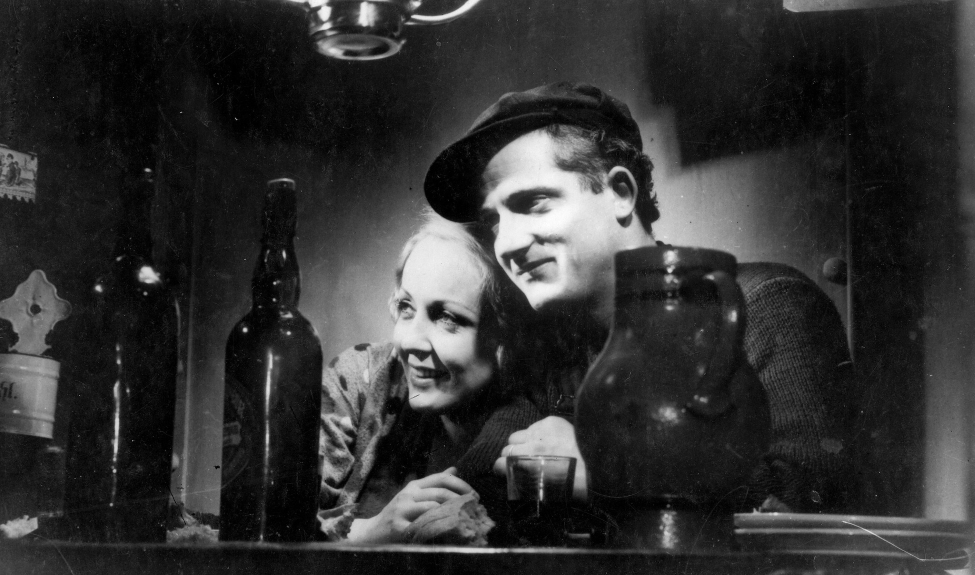
La Règle du Jeu is set at a weekend shooting party in the French countryside, hosted by Robert, Maquis de la Chesnaye (Marcel Dalio). Robert is married to a German wife, Christine (Nora Gregor) but having an affair with Geneviève (Mila Parély). But that’s fine, Christine is having a half-hearted affair with naïve airman André Jurieux (Roland Toutain). Below stairs, Christine’s maid Lisette (Paulette Dubost) yawns through her boring marriage with stuffy groundskeeper, the German Schumacher (Gaston Modot) by flirting with cheeky poacher-turned-employee Marceau (Julian Carette). Over the weekend, flirtations and affairs simmer to the boil, with Octave (Jean Renoir), a family friend, moving uneasily between parties trying to do the right thing.

The timing of Renoir’s film could not have been better. The story of people, as he put it, “dancing on the volcano” found its way into cinemas in July 1939. Europe was on the edge of the precipice. Within a year France would be literally ripped in two by Hitler. And here was Renoir releasing a blackly dark drawing room comedy, with its characters obsessed about small, shallow and trivial details and utterly ignorant of the world around them. Even worse, when violence and death intrude, it’s brushed under the carpet. It was a film that embodied the head-in-the-sand attitude of France, a country just months away from being steam-rollered by the Nazi war machine.

It wasn’t until 1959 that it was rediscovered and took its place as one of the great films. Renoir creates both a delightfully dark and droll comedy of manners, but also a rich and overwhelming metaphor for global chaos. Everything here is magnificent surface, with everyone pretending they are fine, upright citizens while flitting in and out of each other’s beds and never letting anything like morals or genuine emotions intrude. The game demands life be played as lightly as possible.

Everyone seems to know everything, but it’s all a joke. Robert is sleeping with the imperiously bitter Geneviève – so he seems less bothered about his wife Christine’s affair with airman André. Renoir’s film opens with André’s return from a cross-Atlantic flight. The media swarm around him, but André retreats into a funk when he sees Christine is not there to greet him. Even would-be heroes in this film are insular and self-obsessed. Toutain makes André strangely pathetic (you wonder – as does she at times – what the cultured and daring Christine saw in someone so prone to self-pity and devoid of drive). He whines about an affair which won’t take fire, does nothing to drive it and turns a car accident suicide attempt into a sulky fit of pique. He’s neither a romantic hero or a tragic figure.

But then no-one fills their role. Robert hosts the event, but he’s a strangely winsome, at times insecure figure (Dalio used his personal unease as a Jewish actor cast in a very Aryan role to skilled effect). He both puffs about how he doesn’t care about conventions – willingly inviting his wife’s lover to the weekend – but is also a fussy, eccentric figure who delights in clockwork machines and amateur theatricals. He has a casual, playboy attitude to money and life – everything comes easy, so he values very little. He doesn’t like conflict, preferring to let people off the hook, partly why he’s keen to end his relationship with Geneviève as he can’t bear the idea of Christine finding out.

Christine, played with a very effective awkwardness by Nora Gregor, feels surprisingly out of place among this social mileu. She’s consciously aware of her German background, looks uncomfortable in fine clothes, doesn’t enjoy social events and seems less assured than her bolshy, irreverent maid Lisette. She seems less like a Countess than Geneviève, played with cool austere sharpness by Mila Parély. Christine shrugs off the arrival of her lover André (to the respect of all) but on discovering her husband’s parallel affair seems unsure how to deal with it: she goes from bouncing mutual jokes about Robert with his lover, to considering half the household as potential elopement mates. Renoir felt Gregor was uncomfortable in the role – but her discomfort works superbly.

At the heart of this weekend retreat – and the film itself – is a brutish, extended hunting sequence. Renoir, who loathed the killing of animals, knew that nothing speaks more about the nature of man than how he treats those weaker than himself. The hunt is machine-like in its rounding up of birds, rabbits and other animals to be blazed down by the rich and powerful, with the carcasses chucked into the back of a van and never thought of again. Renoir shoots a single rabbit death with intense sympathy, the creature halting then curling itself vainly into a ball in its death throws. It reminds us queasily not only of the blood baths in fields like this only 20 years earlier, but also the carnage to come. It also foreshadows the death the film ends on, the victim falling as pathetically as the rabbits.

This same hunting party is also the catalyst for a string of disasters. Marcel Dalio’s Robert spontaneously affronts the tiresomely officious Schumacher (an unbending, unsympathetic Gaston Modet, rigid in his Prussian militarism) by not only shrugging his shoulders at the actions of charming poacher Marceau (a Hancock-ish Julian Carette, as charmingly amoral as anyone in the film) but actually hiring him. Needless to say, Marceau is less grateful and more delighted at the opportunities for shamelessness this presents him with and instantly attempts to seduce the maid Lisette (a coquetteish Paulette Dubost), setting him on a collision course with Schumacher. All stemming from Robert’s blasé indifference to rules and the contempt for hierarchy only those at the top can afford.

Renoir brings all these events together in a series of masterful sequences. This is a film that frequently shifts in tone and transition. The film moves so comfortably between storylines, from upstairs and downstairs, that it’s unfocused and meandering narrative reflects its themes and delivery. Above all, Renoir yet again demonstrates his mastery of marrying film and theatre. La Règle du Jeu could be a classic piece of farce, but is constructed with the skill of a master cineaste.

Much of the final act of the film is taken up with a truly sublime sequence, edited and shot to perfection, that sees all plotlines and entanglements intermingle in a dinner party. Renoir’s camera roves and tracks through the house. Events and characters play out in the back of scenes, while our focus is elsewhere. Figures at the edge of the frame suddenly seize the camera’s attention. We’ll move rooms and characters we left five minutes ago will march in continuing arguments. It’s a breathtaking display of planning, narrative and cinematic panache, expertly directed.

Renoir himself, as Octave, is the closest thing we have to either an audience surrogate or master of ceremonies. Of course, he’s neither of these things: he’s a clumsy bear of a man (even dressing as a dancing bear for the amateur theatricals), who tries to do the right thing out of stubbornness and masochistic pride. He pushes André and Christine together even though he loves Christine – in fact he sets at it with more energy than either of them. He fantasises about himself as a conductor, and that’s what he wants to be: controlling the dance rather than playing the tune. But he’s clueless, clumsy and ineffective and his actions inadvertently push a man to his death.

That death ends the film. Renoir triumphantly doesn’t make this epic or even tragic – it’s a clumsy case of mis-identity, the victim of one of these unhappy lovers settling accounts and picking the wrong person. But the game goes on: everyone pulls together to re-establish the status quo and stress it was an all accident, no one should feel bad, these things happen and everyone back to your drinks. Master and servant come together to keep the status quo ticking over and nothing is allowed to intrude on life. It’s a stage-managed ending that allows nothing to be learned and nothing to change.

After all, the rules mustn’t be changed when everyone is comfortable with them. La Règle du Jeu is a masterful metaphor for an entire society where shallowness, selfishness and self-indulgence win out over duty and decency. Everyone we see is preoccupied only with their own desires, from the whimsy of Robert to the flirtations of Lisette, the self-pity of André and Octave’s desire to influence the narrative. It whirls round and round like a merry-go-round until someone falls off and dies. The volcano is primed to explode, but the dance goes blithely on.

The Passion of Joan of Arc (1928)

The Passion of Joan of Arc (1928)

Dreyer’s searing, close-up dominated, silent masterpiece is a truly unique piece of cinema – and still astounding

Director: Carl Theodor Dreyer

Cast: Renée Jeanne Falconetti (Joan of Arc), Eugène Silvain (Bishop Pierre Cauchon), André Berley (Jean d’Estivet, prosecutor), Maurice Schutz (Canon Nicholas Loyseleur), Antonin Artaud (Bishop Jean Massieu), Gilbert Dalleu (Jean Lamaitre, Vice-Inquisitor), Jean d’Yd (Nicholas de Houppeville), Louis Ravert (Jean Beaupère), Camile Bardou (Lord Warwick)

It falls to few films to have the grace to redefine what cinema could do. Dreyer’s The Passion of Joan of Arc is one of those films that simply demands to be seen – and once seen will haunt you forever. For a film in many ways so profoundly simple, it is also profoundly wise, deeply affecting, troubling, moving and finally almost unbearably painful. Shot in an iconic collection of interrogative close-ups, Dreyer’s masterpiece earns its place as one of the greatest films ever made.

Dreyer’s masterstroke here was not to create a conventional biopic. We see nothing at all of Joan’s finding of her faith, her campaign against the English or exploits on the battlefield. Instead, we witness only the final days of her life, pulled up as a heretic before a biased and arrogantly superior ecclesiastical court. We first see her not as a strong figure (or even defiant) but a frightened girl creeping into frame, dwarfed by spears and towered over by a priest. If the French producers were expecting a triumphant eulogy to their recently beautified national saint, they had a shock.

Mind you, they had plenty of shocks already. Dreyer’s film used one of the most expensive sets ever built. Seven million francs were shelled out on an intricate medieval castle and courtyard, full of interconnecting passage ways. Dreyer’s surviving model of the set is impressive. You have to assume the real thing looked impressive as well, because the film almost never shows it. The Passion of Joan of Arc takes place in tight, fixed, searching close-ups – most strikingly of Joan but also of her interrogators and the witnesses of her martyrdom. The epic is pulled down to the tightest and most intimate framing of all: the human face, with all its blemishes, imperfections and dizzying emotions.

Those emotions play most sharply across the face of Renée Jeanne Falconetti. Falconetti had performed briefly in one film eleven years previously, but this was effectively her only work on camera. And it is extraordinary, one of the most searing, memorable performances in the history of cinema. You will never forget the fixed glare of her eyes, the devotional joy in her face and the self-accusatory pain in those same eyes when she briefly recants. Dreyer and Falconetti worked closely together to chart every single moment of the complex array of emotions.

Hope, despair, defiance, fear, self-loathing, determination, shrewdness, timidity – all these expressions form both in micro and in carefully held shots that allow Falconetti to naturally move from one to another. This is one of the few films that really has the patience to record thinking. We see realisations dawn upon her, her face slowly changing to process them and then (frequently) her eyes filling with genuine, heart-rending emotion. It becomes an intense – painful – study in powerlessness and vulnerability, dappled with little moments of hope. Her joyful face when the shadow of a window forms a cross on the floor is almost unbearable.

Not least, because as she stares enraptured at this shadow, we cut back and forth to her interrogators forging a letter from the Dauphin to further break her spirit. Dreyer introduces the priestly interrogators with one of the few motion shots, a long tracking shot panning across the rows and rows of well-fed, comfortable men who are about to stand trial over this young woman. The close-ups reveal as much about the priests as it does Joan. A complacent, arrogant Bishop smirks while he picks his ear. Others snigger and stare in disgust at this abomination.

But Dreyer’s film is remarkable for how much scope he gives many of the priests. We see some of them begin to form serious doubts as Joan’s sincerity flies in the face of their expectations. Schutz’s Canon – writer of that fake letter – doubts grow, finally seen sadly turning away as she is prepared for burning. Even Silvain’s Pierre Cauchon isn’t a sadist, or really a bully – just someone who can’t imagine a world in which he is wrong. It’s what leads him to push and push, sometimes with a resigned unease, willing Joan to recant. Some burn her sadly: but burn her none-the-less.

Dreyer’s film though is a passion – and, like the medieval plays that inspire it, it wants to take us on a journey to understand the power of Joan’s faith and nobility of her martyrdom. The priests convey us and Joan to the torture chamber – one of the few wide shots Dreyer uses, to show us the extent of the ghastly devices. A giant breaking wheel is turned with increasing, horrifying speed, its many spikes blurring, as Cauchon demands Joan recant. It drives her into a fainting fit and she is bled. A real AD gave up his vein to produce shockingly, horrifyingly genuine spurts of blood.

Dreyer’s claustrophobic close-ups are not designed to throw us into Joan’s POV, but to make us feel as trapped as she does. It’s striking that many of the close-ups can’t be either Joan’s perspective or the priests. There isn’t always continuity between them – we’ll cut from a full-on view, to a side-on one, a camera angle above and then below, staring up or glaring down. The effect is less about putting us into the eyes of its characters, than to make us feel like a spirit in the room, powerless to intercede. There are no establishing shots for geography, only the onslaught of faces shouting at the camera or starring with confessional pain at the lens.

Which helps even more with the sense of devotional mystery play Dreyer is aiming to create, using the language of cinema in ways no theatre-maker ever could. As Joan is mocked, and garlanded with a false crown, by braying English soldiers, we feel as trapped as she does. When her hair is sliced away, the shears feel uncomfortably close, but just as traumatising is the agony of guilt on Falconetti’s face, at the realisation she has turned her back on her God.

It’s been said watching the film is like watching, as if by a miracle, actual documentary footage of the trial. This realism is one of Dreyer’s master-strokes. So many other directors would have allowed touches of medieval pageantry, of poetry among the stark images. The closest we get to this is a doubtful Joan starring at freshly dug up skull, from the eye socket of which wiggles a worm, while deciding whether to confess. Other than that, the lavishness (that perhaps the producers expected) is nowhere to be seen, helping make the film as punishing and (finally) moving to watch as it is.

The final burning offers no release. The camera maintains its focus on Joan, who quietly passes the rope to her executioner so he can bind her to the stake, then turns her eyes one final time to heaven before her face is obscured in smoke and flames. Dreyer’s camera doesn’t flinch, and its fair to say Joan’s death is as horrifying as anything caught on screen. An alarmingly life-like body blackens, burns and shrivels in uncomfortable mid-shot. In a stunning swinging camera shot, soldiers prepare weapons to disperse the crowd. Dreyer’s camera doesn’t shy away from this atrocity either: bodies are battered, a fallen woman stares sightlessly in the camera, screaming mothers run with children in their arms, a cannon pans across the camera and fires into the crowd. The smoke of the burning – to which we constantly cut back to – fills the screen. It’s bleak and hellish.

This is truly a passion, a sense of the ascension of the spirit through the dread of pain and suffering. And we feel every moment of it through the uncomfortable but profoundly moving immersiveness of Dreyer’s camera – and the breathtaking camerawork of Rudolph Maté – and the astonishing raw performance of Falconetti. The Passion of Joan of Arc sears itself onto your memory, a visceral, unique piece of film-making unparalleled in the history of the medium.