Category: Harry Potter series

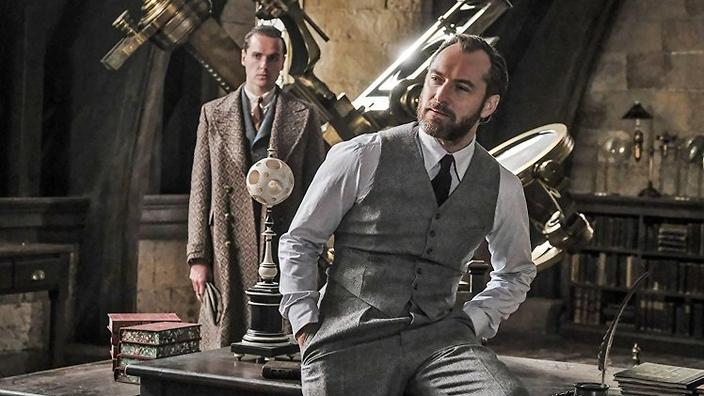
Fantastic Beasts: The Secrets of Dumbledore (2022)

Fantastic Beasts: The Secrets of Dumbledore (2022)

The Potterverse goes through its death throws in this anaemic offering in a misguided franchise

Director: David Yates

Cast: Eddie Redmayne (Newt Scamander), Jude Law (Albus Dumbledore), Mads Mikkelsen (Gellert Gindelwald), Ezra Miller (Credence Barebone/Aurelius Dumbledore), Dan Fogler (Jacob Kowalski), Alison Sudol (Queenie Goldstein), William Nadylam (Yusof Kama), Callum Turner (Theseus Scamander), Jessica Williams (Lally Hicks), Victoria Yeates (Bunty), Richard Coyle (Aberforth Dumbledore), Poppy Corby-Tuech (Vinda Rosier), Fiona Glascott (Minerva McGonagall), Katherine Waterston (Tina Goldstein)

If the House of Potter teetered after the not-very-good Crimes of Grindelwald, it collapsed with the release of The Secrets of Dumbledore to waves of indifference. It’s proof that if you super-size your series not because you have a genuine story reason but because you think a fat goose will lay even more golden eggs than a thin one, you’ll eventually end up with a dead obese goose.

A year or something has passed and Dumbledore (Jude Law) and Grindelwald (now Mads Mikkelsen, thank God) continue circling, neither quite willing to end their ‘friendship’. Grindelwald is determined though to seize control of the Wizarding World by manipulating the election for the Supreme Leader to launch his anti-Muggle war. Dumbledore recruits a team, led by Newt (Eddie Redmayne), to stop him – but with Grindelwald’s new power to see the future, seized from a Fantastic Beast, Dumbledore can’t tell anyone his plan (plus ca change). Meanwhile Credence (Ezra Miller), is groomed by Grindelwald to destroy Hogwarts’ favourite professor.

The Secrets of Dumbledore may be flabby, over-extended and frequently meander down alleyways and byways that feel frustratingly pointless – but it is a better film than The Crimes of Grindelwald. Its problem is, it’s nowhere near good enough to win back the massive loss of audience faith that complete shit-show (combined with all sorts of social media storms) caused.

The Secrets of Dumbledore’s major positive is the arrival of Mikkelsen as Grindelwald. Replacing Johnny Depp (and his “personal problems”), he gives the film an automatic upgrade. If you want an arrogant, sinister, manipulative, but also dashing, romantic villain, why in God’s name wouldn’t you have cast Mikkelsen in the first place? The film is more daring on the Dumbledore and Grindelwald relationship than any other Potter film before – we even hear the “L” word.

Anything focused on these two – either together or alone – is invariably the good stuff. The two of them (Jude Law is equally good) semi-threatening, semi-reminiscing, semi-flirting in a café at the start is the finest scene, and the genuine regret between them is rather well done. Rowling also writes in, pretty much direct from the final book, the entire tragic Dumbledore-backstory reveal which the final Deathly Hallows film bizarrely cut (perhaps she thought it was as terrible an idea as I did?). Law plays this little moment to perfection.
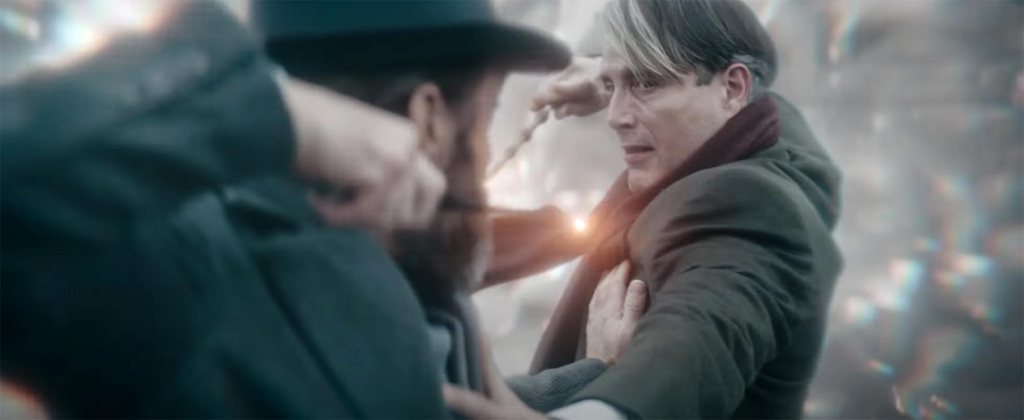
You end up wishing the film was a more personal story between these two. Unfortunately, we get this over-inflated mess. The most bizarre thing about Secrets of Dumbledore is that simultaneously loads is going and the plot feels incredibly slight and mostly pointless. Frequently events bend down alleys or fizzle out into pointlessness. Far from being full of secrets, Dumbledore and his brother fall over themselves to share their secrets at every opportunity to keep the plot moving forward.

After the money-grabbing decision to squeeze as much cash out of this franchise (five movies!) as possible, The Secrets of Dumbledore feels like it has taken on a lot of padding to get up to length. Rowling, to put it frankly, isn’t that great at structuring a screenplay (it’s telling Steven Kloves was bought back to help bang this into shape). It’s a reminder it’s a very different set of skills telling a coherent story, full of twists, turns and universe building over 2 hours compared to 700 pages.

Grindelwald’s plan involves the complex and poorly explained, killing and resurrection of a magic goat. There is a lot of talk of “the people getting a say” in the election: an election where no one gets a say, since the leader of this civilisation is chosen on the whim of said magic goat. Our heroes go to the German Ministry of Magic solely, it seems, so Newt’s brother can be captured. A “spy” is planted among Grindelwald’s forces who does no spying, has parts of his memory wiped for no reason and then rejoins the heroes. Two characters communicate via a magic mirror, even though they’ve never met and couldn’t know who the other is. A labyrinthine plot about an assassination has so many hastily explained twists I genuinely have no idea what was going on. At regular intervals the heroes reconvene with Dumbledore, like players in a video game being given a brief for the next level.

Even more than the last one, the “Fantastic Beasts” idea feels like a burden. They’d have done better just starting a new “Dumbledore vs Grindelwald” franchise. The plot sort of revolves around a poorly explained magic animal. Theseus is whacked in a prison guarded by a deadly scorpion. In a bizarre tonal zig-zag, Newt distracts this beast’s scorpion-y minions by doing a funny dance – interrupted every so often by it grabbing a “political prisoner”, eating them alive and then spitting out the half-chewed corpse for its minions to consume. Remember when this felt like this series was going to be about the charming adventures of a naïve zoologist?

The legacy characters stumble through with little to do. Redmayne’s Newt is a character so bizarrely ill-conceived as the lead in a prelude-to-war series he’s often quietly relegated to side missions. Dan Fogler’s Jacob and Alison Sudol’s Queenie continue a nonsensical emotional journey (she, let’s not forget, defected to Grindelwald – the man who wants to destroy Muggles – because she wasn’t allowed to marry a Muggle). Katherine Waterston’s Tina is relegated to a cameo.

Then there’s Credence. This character, the central Macguffin of the last two films, is here relegated to the role of heavy whose long-hyped clash with Dumbledore is a little more than a dull one-sided scuffle. It’s hard not to think the character has been reduced to glorified extra due to the increasingly toxic public image of Ezra Miller (has there ever been a franchise more unlucky in its casting?). But the unceremonious dumping of this entire plotline so crucial to films one and two hammers home the feeling that there is no consistent planning going on here at all.

I said in Crimes of Grindelwald this franchise in need of a new creative eye. David Yates directs his seventh Potter film and, while he does nothing wrong, I don’t think he’s got a single new idea in the tank. The look and feel of this film, its visuals, the effects, its tone, its colour palette – all of it is now achingly familiar, making it feel even more like something tipped carelessly off a production line. It also looks shockingly over-processed: I know it’s about magic but by Merlin’s Beard nothing looks real. Does it feel magic to be back at Hogwarts? No, it looks like a freaking CGI nightmare.

The lack of freshness surely contributed to its death at the box-office. No one seems to have stopped and asked “would someone who hasn’t been working on Potter full time for over 12 years care about this?”. I don’t think they did. If you work the Golden Goose night and day, demanding it produces an egg a day, eventually it will keel over. It didn’t have to be like this, but there is more chance of Depp returning than anyone making the next two films in this misbegotten series.

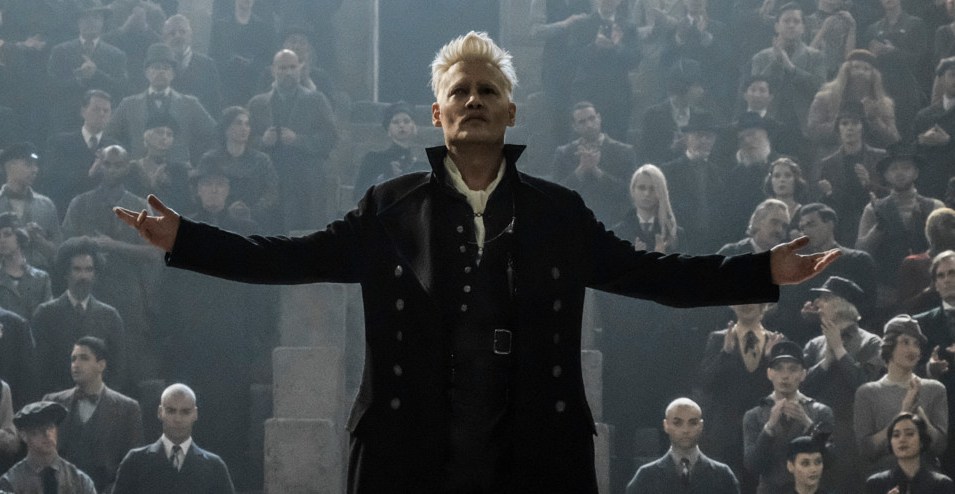
Fantastic Beasts: The Crimes of Grindelwald (2018)

Eddie Redmaynes wades his way through the murky Crimes of Grindelwald

Director: David Yates

Cast: Eddie Redmayne (Newt Scamander), Katherine Waterston (Tina Goldstein), Dan Fogler (Jacob Kowalski), Alison Sudol (Queenie Goldstein), Jude Law (Albus Dumbledore), Johnny Depp (Gellert Grindelwald), Ezra Miller (Credence Barebone), Zoë Kravitz (Leta Lestrange), Callum Turner (Theseus Scamander), Carmen Ejogo (Seraphina Picquery), Claudia Kim (Nagini), William Nadylum (Yusuf Kama), Kevin Guthrie (Abernathy), Brontis Jodorowsky (Nicolas Flamel), Derek Riddell (Torquil Travers)

What were the Crimes of Grindelwald? Well the main one is this film. Grindelwald does what we thought might have been impossible – he features prominently in the first flat-out bad Harry Potter film. Fantastic Beasts: The Crimes of Grindelwald is a near incomprehensible mess of clumsy set-up for future plots, tedious side-plots, poorly executed drama and a vast array of not particularly interesting characters struggling through not particularly interesting events with low stakes. I feel asleep twice for a few moments in the film. There is very little in it to recommend.

Dark wizard Grindelwald (Johnny Depp) opens the film by escaping from captivity and flees to Paris. There he plans to – well to be honest I’m not terribly sure what he is planning to do at all. I think it involves something about world domination. Also it involves locating and winning to his side mysterious young wizard Credence (Ezra Miller) from the first film. Meanwhile Grindelwald’s old friend (or was it more? The film ain’t saying) Albus Dumbledore (Jude Law) sends Newt Scamander (Eddie Redmayne) to Paris to find Credence first. Lots of things sort of happen after that, but most of them are building up to the next three (three!) films.

Three films? Seriously? Was that something they had in mind from the start? It feels a lot more likely it’s an idea that came out of the financial success of the first film, rather than any artistic decision. It’s certainly very hard indeed to see many narrative, tonal or thematic links from the first film carrying across to this one. This one feels like it comes from a completely different type of story. More than anything, the film-makers seemed to desperately want to forget the whole “fantastic beasts” angle we started this damn thing with. The odd beast is thrown in every so often to keep ticking the title box, but this flies off (or tries to) into such different, would-be darker, stakes that the beasts never feel a natural link. This is a film that wants – with its muted palette, murders, darkness and (in one supremely misjudged moment) a Holocaust reference – to set us on a dark path to future misery and war. Whatever happened to chasing beasts around to catch them in a suitcase?

Instead the film doubles down on Potter-lore.  You virtually need a PhD in the Potterverse to keep on top of what’s going on. Spells, objects, phrases, charms and incantations are thrown in all over the place, with very little explanation for the audience. Now I can roll with this a certain amount, hell we’ve all read the books and seen the films, but there are at least a few things in here that could desperately do with some reminders for the audience (what is an obscurus again?) so that we can understand their contextual importance. Instead the film barrels along, throwing plot points all over the place and ramming information into our ears.

In fact, most of the film is like an epic info-dump of material designed to set up stuff for later films. Again, you can’t help but feel that they suddenly realised after completing the first film that if they were going to spin this out into another multi-volume series, there were lots and lots and lots of plot threads they hadn’t even attempted to introduce at the start. Instead of taking a bit of time to build these things in and make us care about them, this film throws them into the mix as quickly as possible to make up for lost time.

In all this mass pile of information thrown at us, the film could really do with less going on. There is a massive, red-herring- filled plot about a character’s family history that takes up loads of screen time and eventually turns out to mean absolutely nothing at all. This is a misdirection that could work well in a book – but in a film as crammed and packed as this one, it makes you tear your hair out. How long did we spend on this and it means naff all at the end!

In fact, you can’t help but feel that Rowling as tried to write a book here rather than a film. These sprawling bits of wizarding lore, universe building, red herrings and other plots would have worked really well if she had 500 pages of prose to explore and build them in. But she’s not experienced enough a screenwriter to make them work well here. If another scriptwriter had adapted her ideas into something that works as a screenplay – the sort of focused work that changed the sprawling Order of the Phoenix into a tightly focused couple of hours – the film would be far better.

But instead, the film feels like everyone has got far too used to producing these epics, to a certain style of making the films. There is a lack of fresh ideas here, with a lack of independent or new eyes to see the whole and suggest how an outsider could see it. This also extends to David Yates’ direction which, while competent and well managed as ever, now feels like he has run out of ideas of how to film this wizarding stuff in a new way, which is fair enough after five films. It’s a film that desperately needs fresh new blood in it, and a universe that needs the sort of creative kick-up-the-backside that Alfonso Cuaron gave in The Prisoner of Azkaban.

You feel sorry for some of the actors carried across from the first film. Dan Fogler has so little to do that he would have been better off not being in the film. His absence (for instance, if his memory wipe from the previous film had stuck) would at least have been motivation for the actions of Queenie in this film, who gets a rushed and nonsensical character arc that seems to completely change the character we got to know in the first film. Katherine Waterston is saddled with virtually nothing as Tina.

Instead, far more time is given over to Johnny Depp. Depp’s casting was controversial to say the least – and not worth it. Depp gives one of his truly lazy, eccentric performances – aiming possibly for brooding intensity, he instead lands out dull and underwhelming, a charisma vacuum. It’s hard to see him leading hundreds of followers in a revolution. Jude Law does far better as a twinkly Dumbledore (even if his performance bears little resemblance to Gambon or Harris), and his scenes are the highlights of the film. The film, by the way, shies cowardly away from any real depiction at all at the alleged love affair (which Rowling talks about) between Dumbledore and Grindelwald, presumably because it would make the film a harder sell in China.

And what of our hero? Well Eddie Redmayne is still charming, but his character feels out of step with the increasingly darker tone the film aims for. He’s also saddled with a supremely dull and unengaging sort of love-triangle with his brother (a forgettable Callum Turner) and ex-girlfriend and brother’s fiancée Leta Lestrange (an out of her depth Zoë Kravitz). The film talks a bit about the troubled relationship of the Scaramander brothers – but is so rushed it never has time to really show us any of this, so instead has to tell us about it, even though everything we see basically shows their relationship as being reserved but loving.

But then that’s just par for the course of this underwhelming and deeply uninvolving film. The stakes should feel really high, but they never do because to be honest you are never really sure what they are. The film ends with the expected fire filled wizarding special effects stuff – but honest to God I had no idea what was going on, why it was happening, what was the danger or where it came from. It just felt like the film needed to end with a bang. There are moments of this film that should have had some emotional force but they don’t because it’s so crammed to the margins with plots, superfluous characters (many of whom are introduced with fanfare and then barely appear in the film) and pointless digressions that when things happen to characters we care about from the first film, it doesn’t carry the force it should. Five films of this? I’m not sure on the basis of this I’d want to see another five minutes. A major, major, major misfire.

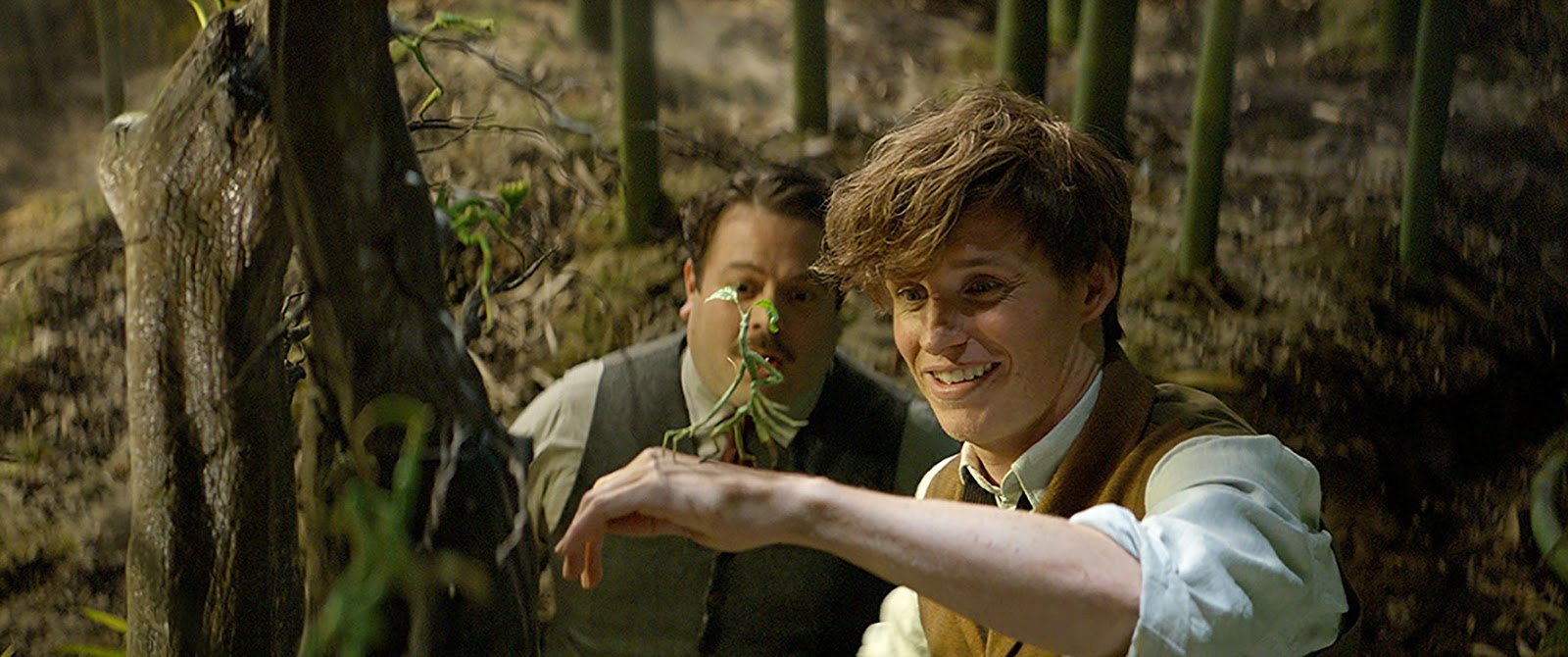
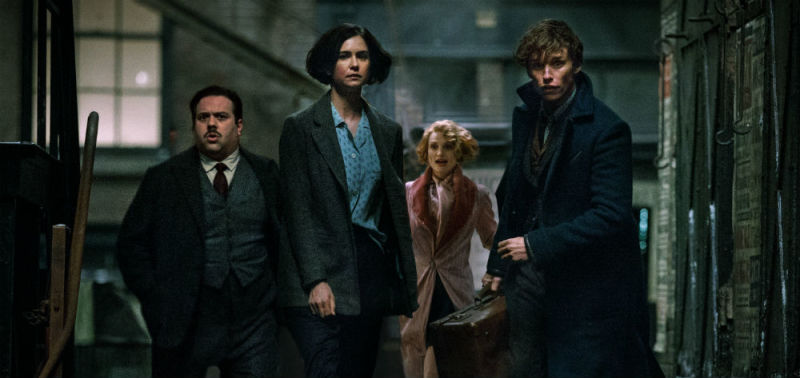
Fantastic Beasts and Where to Find Them (2016)

Eddie Redmayne and Dan Fogler uncover some Fantastic Beasts

Director: David Yates

Cast: Eddie Redmayne (Newt Scamander), Katherine Waterston (Tina Goldstein), Dan Fogler (Jacob Kowalski), Alison Sudol (Queenie Goldstein), Colin Farrell (Percival Graves), Ezra Miller (Credence Barebone), Samantha Morton (Mary Lou Barebone), Jon Voight (Henry Shaw Snr), Carmen Ejogo (President Seraphona Picquery), Ron Perlman (Gnarlack), Ronan Raftery (Langdon Shaw), Josh Cowdery (Henry Shaw Jnr), Johnny Depp (Gellert Grindelwald)

Eventually the gravy train had to come to an end. The Harry Potter franchise laid golden eggs for over a decade, until Rowling’s books came to an end. Just as well then that the incomparable JK Rowling had tonnes of invention left up her sleeve, and was keen to look at other elements of the Potterverse. So we got the creation of this sideways prequel, set in the rich backstory of the Harry Potter novels. And it is a bit of a treat.

In the 1920s, Newt Scamander (Eddie Redmayne) arrives in New York with a suitcase full of fantastic beasts. He’s there to return one of them home – but after a mix-up at a bank his suitcase ends up in the hands of muggle (or as the Americans put it “No-Maj”) and would-be baker Jacob Kowalski (Dan Fogler). As the escaped beasts cause chaos, demoted Auror Tina Goldstein (Katherine Waterston) works with Newt and Jacob to try and recapture the creatures, with the aid of Tina’s mind-reading sister Queenie (Alison Sodel). But is all the destruction truly caused by Newt’s creatures? Or are there darker forces at work? 

Fantastic Beasts is a charming spin-off, sustained by some endearing performances, its warm heart and stylish design. Whether the plot is quite strong enough to reward constant viewing as much as many of the Harry Potter films do, I’m not sure (I didn’t find its story particularly gripping the second time around), but I think there are enough incidental pleasures there to keep you coming back for more. It’s actually a film which will be interesting to re-evaluate after the later sequels emerge – there are many suggested threads set up in this one for exploration later.

It’s not a surprise that the initial plot around chasing and collecting the beasts is fairly basic, since it’s based on a slim handbook (itself based on a reference from the original Harry Potter stories) that Rowling published as a Comic Relief fundraiser. Besides the chasing around to capture the animals, it’s only really the backdrop for sight-gags, cute animals and (most importantly) our window for getting to know our leads.

And these leads are certainly well worth getting to know, with a string of excellent performances from the four principals. Redmayne anchors the film very well as the slightly dotty, professorial, socially awkward Newt, whose coy, bashful charm really endears him to the viewer. Dan Fogler is possibly even better as our viewer surrogate, an average New Yorker thrown into a mad world of magic who somehow manages to take it all in his stride and whose growing excitement and embracing of this demented wizard world makes you fall in love with him. He’s helped by a sweet, gentle and touching romance with the effervescent but lonely Queenie (a magnetic Alison Sudol). Katherine Waterston gets the trickiest part as the earnest, try-hard, play-by-the-rules Tina – but her growing fondness for Newt and his creatures works very well.

The moments of the film that focus on the interaction between these four are the finest of the film – as are those that allow us a glimpse of Newt’s wonderful creatures. Housed in a Mary Poppins-ish suitcase of infinite TARDIS-like depth, these beasts are brilliantly designed and wonderfully individual, from a cute mole-like Niffler (naughtily stealing shiny things like a magpie), to a horny Erumpent (like a hippo and rhino mixed), to the majestic Thunderbird, a sort of Eagle-Phoenix, soaring through the plains in Newt’s suitcase. Even the small Bowtruckle Newt carries in his pocket gets to develop a sense of personality. (And yes I had to look all these names up).

These creatures are both individualistic but also used for very specific purposes in the film, from lock-picking to a sort of bizarre self-defence weapon. Despite their horrific appearances, the film treats them with as much understanding sweetness as Newt does – even the dangerous ones are only dangerous when riled or threatened, and Newt’s protective nature helps us to feel as fond of them as he does.

Away from the beasts, the film largely focuses on setting up threads (and threats) for future films. A major sub-plot revolves around an anti-Magical society run by a stern-faced Samantha Morton. The film heads into darker territories here, with its references to both cults and the ill-treatment of children. Ezra Miller does well as Morton’s awkward, ill-treated adopted son, unable to escape from his oppression or express his frustration. Someone in this family is a powerful magical being called an Obscurus, and the film plays a neat game of bluff and double bluff around this.

It continues this game as it fills out the political magical world around Carmen Ejogo’s regal magical President. What game is Colin Farrell’s authoritarian Perceval Graves playing? What of the film’s opening references to dark wizard Grindelwald, and the suggested war that is bubbling under the surface in the magical world? All this darker stuff sits around the edges and margins of Newt’s beast-collecting storyline, occasionally seeping in (let’s not forget at one point Newt and Tina are literally sentenced to death for supposed crimes), but doesn’t overwhelm the lightness.

David Yates directs with a professionalism that comes from being hugely familiar with this world. His later sequences of Obscurus destruction are not always particularly different from other city-smashing scenes from other films. Not every plotline feels fully explored – Jon Voight playing a newspaper mogul and his two contrasting sons seems like a plot we could do without – but Yates does keep the film moving pacily forward, he gets the tone of light slapstick and family warmth and he still shoots the wonder of magic better than almost anyone.

Fantastic Beasts is a film that is perhaps a little too light and frothy to really be a classic – it juggles too many plots and doesn’t always bring them together well. It’s mixture of darkness and lightness is a little eclectic, and it sometimes feel very much like a film designed to set up future films effectively. But when it focuses on its four leads, it’s very strong indeed and all of them – particularly Fogler – are people you want to see more of. It even manages to end the film on both a genuine laugh and a heart-warming bit of romance, tinged with sadness. It’s a fine start to a new franchise.

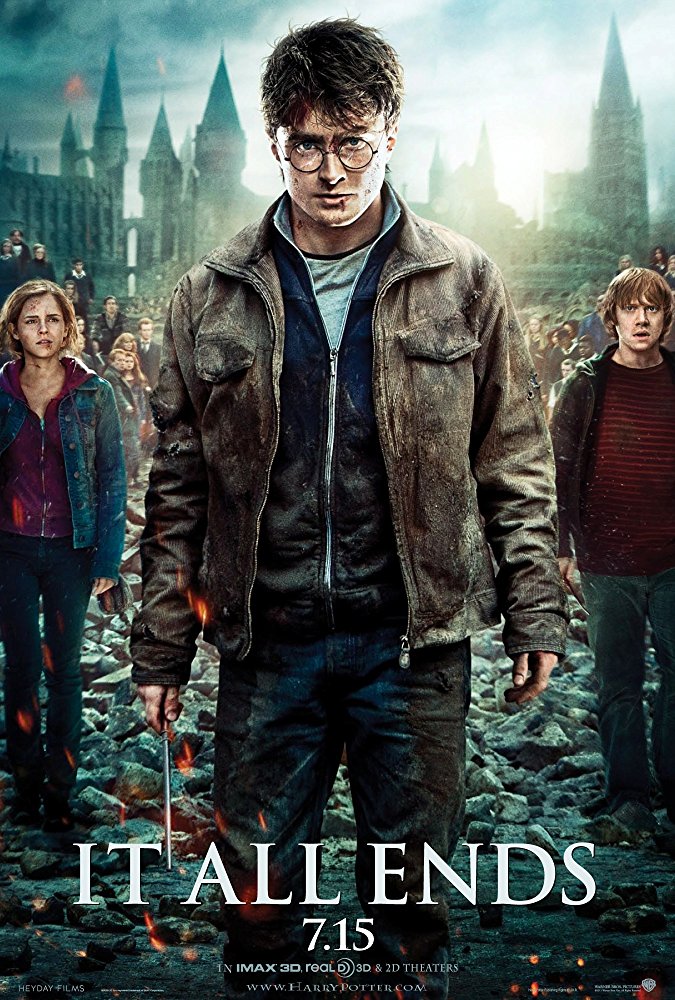
Harry Potter and the Deathly Hallows Part 2 (2011)

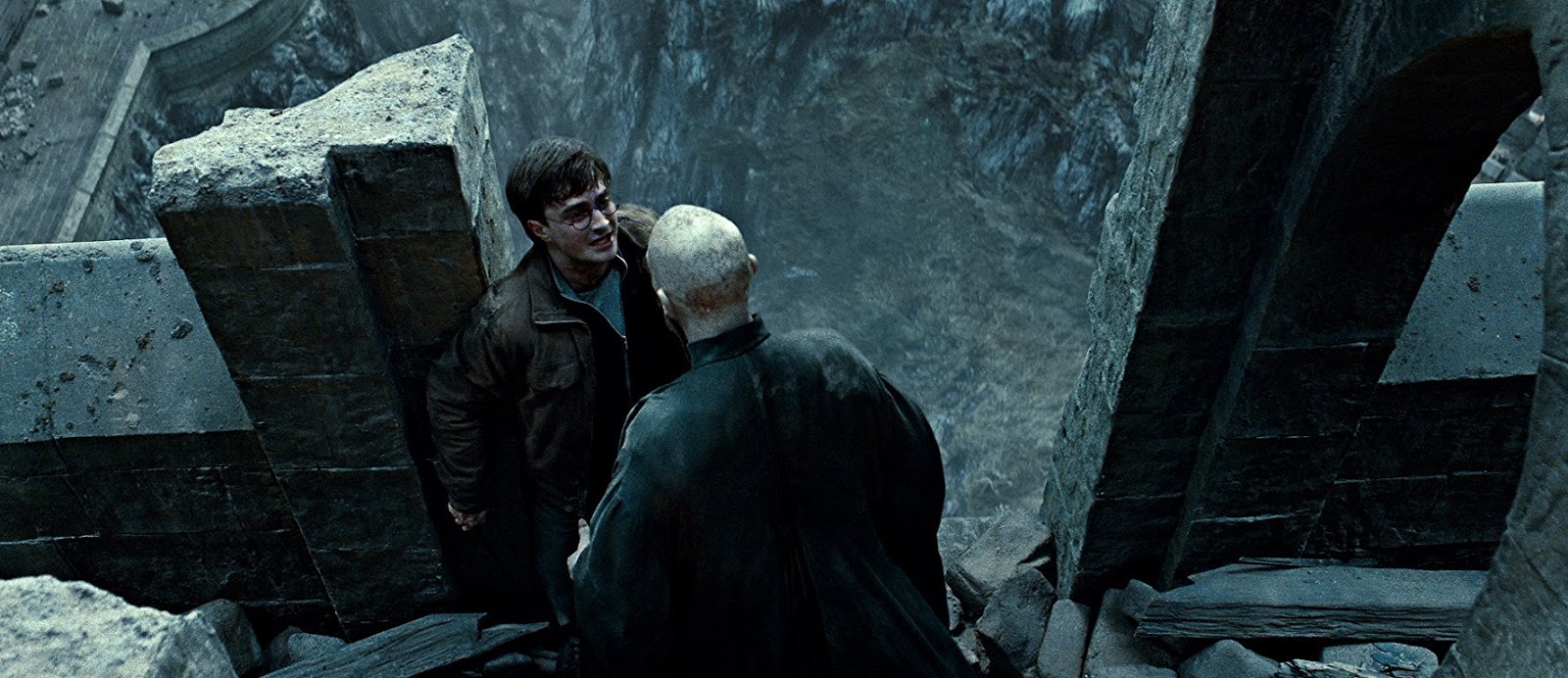
Harry and Voldemort prepare for their final showdown in Harry Potter and the Deathly Hallows Part 2

Director: David Yates

Cast: Daniel Radcliffe (Harry Potter), Rupert Grint (Ron Weasley), Emma Watson (Hermione Grainger), Helena Bonham Carter (Bellatrix Lestrange), Jim Broadbent (Professor Slughorn), Robbie Coltrane (Hagrid), Ralph Fiennes (Lord Voldemort), Michael Gambon (Albus Dumbledore), John Hurt (Ollivander), Jason Isaacs (Lucius Malfoy), Gary Oldman (Sirius Black), Alan Rickman (Severus Snape), Maggie Smith (Professor McGonagall), David Thewlis (Remus Lupin), Emma Thompson (Professor Trelawney), Julie Walters (Molly Weasley), Mark Williams (Arthur Weasley), David Bradley (Argus Filch), Ciarán Hinds (Aberforth Dumbledore), George Harris (Kingsley Shacklebolt), Gemma Jones (Madam Pomfrey), Kelly MacDonald (Rowena Ravenclaw), Helen McCrory (Narcissa Malfoy), Miriam Margolyes (Professor Sprout), Geraldine Somerville (Lily Potter), Adrian Rawlins (James Potter), Warwick Davis (Griphook/Professor Flitwick), Matthew Lewis (Neville Longbottom), Evanna Lynch (Luna Lovegood), Bonnie Wright (Ginny Weasley), James Phelps (Fred Weasley), Oliver Phelps (George Weasley), Domhnall Gleeson (Bill Weasley), Clémence Poésy (Fleur Delacour), Guy Henry (Pius Thicknesse), Nick Moran (Scabior), Natalie Tena (Tonks)

And so here we are. After 19 hours and 40 minutes, the Harry Potter franchise draws to a close in the rubble of Hogwarts. The franchise goes out swinging for some big hits – and it misses some of them – but at least it’s trying. If this turns out to be one of the least satisfying films in the franchise (at best the 6th best Harry Potter film), it’s not because they haven’t thrown anything at it.

The film adapts just under the last half of JK Rowling’s final novel. In an interesting structural twist, it actually ends up covering just over one day of time: between our heroes breaking into Gringotts Bank and the final confrontation between Harry and Voldemort, less than 24 hours has taken place. Nothing is really made of this in the film, but it’s an interesting thought. In fact Yates’ film is full of interesting half-thoughts that never go anywhere. More than any other film in the series, this is one where it is essential you’ve read the book before viewing it. Without the book you don’t get any of the rich context for most of the events.

This all culminates, for me, in the way the film falls apart in the last 20 minutes or so. This final section of the film changes, or cuts, so much of the book’s thematic depth, so many of its plot strands and explanations, that every time I see it I feel my disappointment starting to rise. I don’t want to be the guy who says “just shoot the book” – but if any film could have stuck with the book it’s this one. Why did they cut and change so much of this stuff? Did they really think, after almost 11 years and 20 hours of screen time, we wouldn’t have the patience for some of the more complex things from the book? Did they really feel that they had to stamp their own distinctive vision on it? Anyway, here are the things that always annoy me about this film:

1. Dumbledore’s backstory gets forgotten

Okay this is a minor one – and the film does leave some hints in. But for GOODNESS’ SAKE, they cut this book into two films, spent ages in the first film talking about the mysteries of Dumbledore’s dark past, then just as we meet Dumbledore’s brother Aberforth (a neat turn from Ciarán Hinds) and are about to get an explanation, Harry basically says words to the effect of “I’m not worrying about that. And neither should you folks. On with the film”.  

Even the Ghost of Dumbledore doesn’t get to explain any of this stuff. All the careful mood build of Part 1 is just thrown away. The book is about learning about death, the futility of the search for power, and humility. Dumbledore’s backstory of failed ambition is a massive part of this – and it gets dropped. It’s not like we didn’t have time in a series that has churned out films pushing up to three hours in length. I mean why put all that stuff in the first film, if you aren’t even going to reference it at all in the second film?

2. The Deathly Hallows get benched

Again wouldn’t be quite so bad if we hadn’t spent a huge amount of time in the first film talking about them – but are the words Deathly Hallows even mentioned here? Instead, just like Voldemort, the film is seduced by the elder wand, focusing everything on the ownership of this MacGuffin. The point of the book is that all this stuff is a chimera –and that the real point is learning that death should not be feared but accepted at the proper time. 

As it is, this never gets built on – and the importance of the resurrection stone (including why it tempted Dumbledore so much) never gets explained. Rather it just comes down to who controls the powerful thing, with none of Rowling’s richer themes.

Harry ends up controlling all three here but we never really get the sense of Harry controlling them all, or understand his decision to throw away the stone, or his realisation that death is not to be feared but accepted.

3. Neville gets blown away

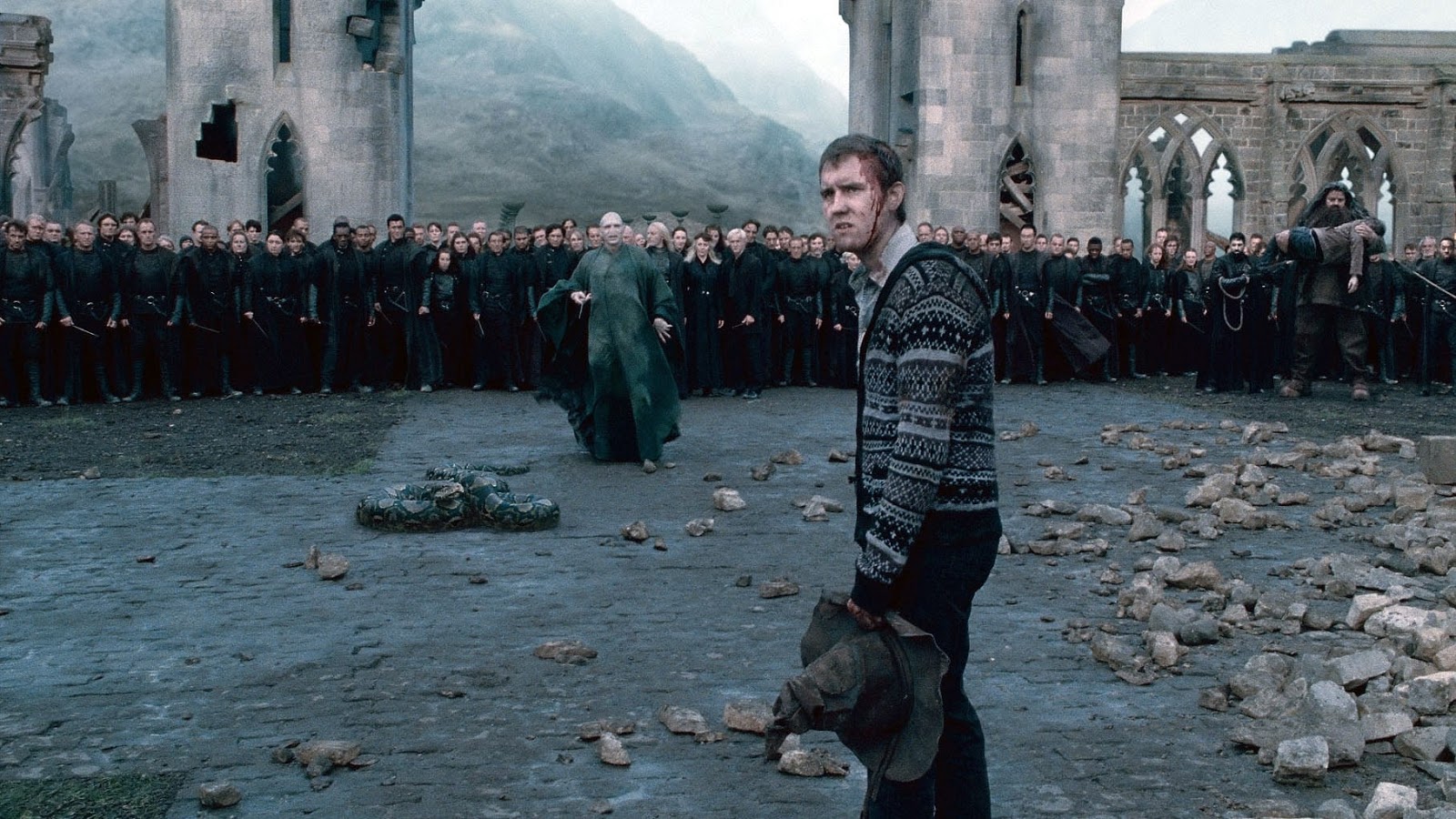
Gotta feel sorry for Matthew Lewis (who is very good here). Reading the book he must have been thrilled: “So I pull the sword out of the sorting hat and then in one move cut the head off the snake like a total bad ass”. This should have been a great moment (it’s an iconic one from the book). Instead Neville gets blasted and, presumably to give them something to do, Ron and Hermione spend ages trying to kill the snake (intercut with Harry and Voldemort fighting) until finally Neville gets to lop that head off – by which point the moment has well and truly passed.

 4. No one mentions Voldemort keeps making the same mistakes

In the book, Harry has a beautiful moment where he basically tells our Tom that he’s made the same mistakes over and over again. Namely that, by killing Harry, who sacrificed himself for love, he made exactly the same mistake as he did with Harry’s mother and now cannot harm any of those Harry died for (i.e. the rest of the cast). It’s a great moment, where finally Harry understands what the novels have been building towards. Doesn’t merit a mention.

Neither does Voldemort’s childish obsession with famous things – he is consumed with belief in the power of a wand, he can’t let go of associating his horcruxes with famous things and the lineage of iconic wizards, etc. etc. Voldemort is basically a big, silly, empathy-free, sulky teenager – the film misses this point entirely.

Instead of explanations and depth, the film reduces Harry and Voldemort’s final clashes into dull punchy-bashy stuff. The director clearly fell in love with the visual idea of Harry and Voldemort’s heads merging together while apparating. This is a visual image that I hate because it (a) feels like showing off and (b) would only work if they were semi-reflections of each other – which they certainly aren’t. They are polar opposites. It’s a flashy effect that actually makes no thematic sense what-so-bloody-ever.

5. Voldemort goes out like a 3D special effect

Perhaps not a surprise in a film, but Voldemort gets killed and disintegrates into a huge puff of 3D-film smoke. I hate this. I hate it. I really, really, really hate it. I’ll tell you why:

  • The spells used in the duel are really unclear – it’s a great moment in the book that Voldemort’s killing curse rebounds against Harry’s disarming curse – instead we get the bright lights.
  • Voldemort dreads death more than anything – and Rowling’s writing of his body falling dead to the ground like any other normal dead guy taps exactly into what Voldemort spent his whole life struggling against. It’s a beautiful irony.
  • No one knew if Voldemort was dead or not the first time because he disappeared. In the book he is killed, by his own curse, in front of everyone and his body is left behind for everyone to look at and say “yup. Guy is dead”. Not here. Here he blows up in a puff of smoke in front of no witnesses. Did Harry just head back into the great hall and say “Okay guys. Take my word for it. He’s dead. He just is. Trust me on this. It’s not like last time. Totally dead. Promise.”

Wow. Okay that’s not really a review is it? That’s just like a disappointed fan whining “I don’t like it because it is different”. But my point isn’t that this is bad because it’s different. It’s bad because it takes stuff from the original and changes it AND NOT FOR THE BETTER. Moments that worked beautifully, or carried so much weight in the original are bastardised crudely for no clear reason.

As I say, after almost 18 hours and a life time (for many viewers) of growing up with these characters: surely we could have given the film a bit more time and allowed some actual intelligent context from the books to creep in? Surely we had the patience for Harry getting to point out to Voldemort how wrong he is? Everyone in the audience was ready for that right? If there was one film people were probably willing to dedicate three hours of their life too, in order to see it done properly it was this one, right? Rather than rushed by in a little over two?

But no this film goes always, always, always for the big spectacle. Not that this always work: Yates doesn’t shoot the battle hugely well. Aside from one excellent sequence which shows our three heroes trying to get across the castle courtyard, while chaos rages around them (beautifully scored as well), the battle is unclear, dingy and not hugely exciting. Again, I’d have liked to have had a bit more of this – to get some moments with this huge cast doing stuff in the battle (especially since they are ALL back – kudos to the producers there).

It’s a real, real shame because honestly parts of this movie are really, really, really good. Tom Felton is cracking again as Draco – and the film gives real development time to showing the impact all this has on the Malfoy family with genuine empathy. The break-in at Gringotts is exciting and fun – as well as giving Warwick Davies his best moment in the series as two-faced Griphook. Inventions and flourishes, such as Harry having visions of an enraged Voldemort slaughtering the staff of Gringotts in fury, are chilling.

Some moments of the book are carried across really well, in particular Snape’s escape – a powerfully filmed sequence of bravery from the pupils, and some great work from Maggie Smith. Yates really understands how to get moments of magic to work: the creation of the shield around Hogwarts is totally spine-tingling. When the film sits and breathes it generally gets it right. Fiennes is terrific still as Voldemort, serpentine, arrogant, unsettling. He gets some lovely moments here – from fury, to pained fear (as horcruxes bite the dust) to an almost-funny-awkward-mateyness as he tries to seduce Hogwarts pupils to his side (his awkward hug of Draco is terrific).

The three leads are of course great. Daniel Radcliffe could certainly have delivered the more complex moments of the book if he had been given the chance. He even does his best to sell the slightly awkward coda “19 years later”: a controversial sequence, it makes a great footnote in the book but it was always going to be a tough ask to make three teenagers look like 40 year olds convincingly, particularly when we are nearly as familiar with their faces as our own.

There are some troubling and failed moments in this film, stuff that doesn’t work. But then there is this:

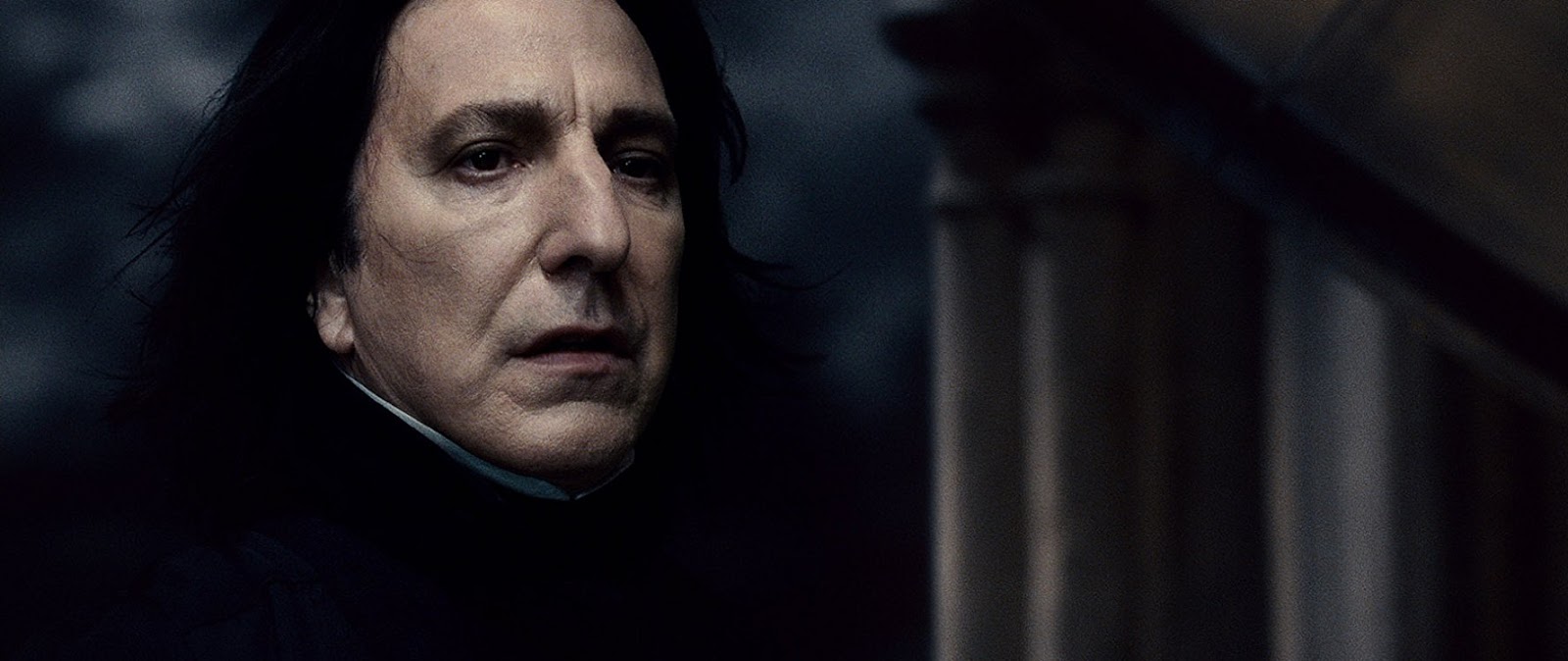
Oh wow. For all that the film changes stuff from the books for the worst – this is a moment it unquestionably does better. And a massive, massive part of this has to be down to Alan Rickman. Rickman was told this backstory from the start of the films – and he delivers it with a passionate commitment here. Helped by brilliant score, and fascinating re-editing of moments from previous films seen from new angles, Rickman delivers the reveal of Snape’s heartbreaking moments perfectly.

Was I tired? Was it the added impact of Rickman’s own depth? I don’t know but I shed tears watching this again. It’s just a beautiful, beautiful, beautiful piece of film making. Everything in it works perfectly: directing, writing, music, editing, filming and above all the acting. It’s just sublime. For all the film misses the point elsewhere it finally totally gets it here. I would take this moment over dozens of moments of Harry and Voldemort fighting each other.

And yes this Harry Potter film might miss the point, and it might bungle the ending, and it might well fail to carry across the richness and intricate plot explanations of Rowling’s original. Yes it gets bogged down in “who controls this wand” and yes it misses the point completely about the film being about learning to overcome a fear of death and defeat (something Voldemort totally fails to do) but then it has moments where it works wonderfully like this. 

But in these films we got a beautiful franchise, with some excellent films. It’s always going to reward constant viewing. And it will always move the viewer. And it’s always going to be great.

Always.

Harry Potter and the Deathly Hallows Part 1 (2010)

Harry and friends are on the run in the excellent Harry Potter and the Deathly Hallows Part 1

Director: David Yates

Cast: Daniel Radcliffe (Harry Potter), Rupert Grint (Ron Weasley), Emma Watson (Hermione Granger), Helena Bonham Carter (Bellatrix Lestrange), Robbie Coltrane (Rubeus Hagrid), Ralph Fiennes (Lord Voldemort), Michael Gambon (Albus Dumbledore), Brendan Gleeson (Mad-Eye Moody), Richard Griffiths (Vernon Dursley), John Hurt (Mr Ollivander), Rhys Ifans (Xenophilius Lovegood), Jason Isaacs (Lucius Malfoy), Bill Nighy (Rufus Scrimgeour), Alan Rickman (Severus Snape), Fiona Shaw (Petunia Dursley), Timothy Spall (Peter Pettigrew), Imelda Staunton (Dolores Umbridge), David Thewlis (Remus Lupin), Toby Jones (Dobby), Tom Felton (Draco Malfoy), Peter Mullan (Yaxley), Evanna Lynch (Luna Lovegood), Julie Walters (Molly Weasley), Mark Williams (Arthur Weasley), Bonnie Wright (Ginny Weasley), Helen McCrory (Narcissa Malfoy), George Harris (Kingsley Shacklebolt), Clémence Poésy (Fleur Delacour), Domhnall Gleeson (Bill Weasley), Warwick Davies (Griphook), Nick Moran (Scabior), Guy Henry (Pius Thicknesse), David O’Hara (Albert Runcorn), Sophie Thompson (Malfada Hopkirk), Steffan Rhodri (Reg Cattermole), Simon McBurney (Kreacher)

The final book of the Harry Potter series made its own slice of film history: it was the first time a book was adapted in two films to “get the whole story of the book across” (or to make double the box office cash – take your pick). There was scepticism about creating a film about the first half (or so) of The Deathly Hallows, as a large chunk revolves around our heroes walking around the countryside, confused, lost and adrift. Instead, Harry Potter and the Deathly Hallows Part 1 turns this material into one of the richest, most engaging and best films in the series. Any film that expands a throw-away reference from the books to Hermione removing her parents memories of her, into an affecting opening scene showing Emma Watson doing the same is really inventively playing with the original source material.

David Yates takes on his third Harry Potter film – and this is possibly the best he filmed. In fact, the whole film feels fresher and different – perhaps because it’s the only film to not have a single scene at Hogwarts. Instead our characters are out in the forest and on the run – and the film has completely different vibe, immediately lending it a uniqueness. Equally, it isn’t shy about pointing out our heroes are all-at-sea. Harry doesn’t really know what he is doing, or where to start with his self-imposed quest: and surely when Ron angrily asks why Dumbledore didn’t tell him more (or if Harry wasn’t even listening properly) he’s voicing some of the questions of the audience.

This film, more than any other, focuses on the relationship between the leading three characters. While getting an idea of their friendship and loyalty to each other, we also get a sense of the tensions and envy between them. Not least in Ron’s grudging acceptance that he is the number two. Rupert Grint has been slowly building under David Yates’ films from a comic relief character to an increasing (slightly surly) teenage insecurity and troubled sexual maturity. 

This really pays off in this film: Ron is bitter and jealous. These feelings might be exacerbated by the necklace the characters must take turns wearing, but it’s just bringing to the surface Ron’s darker feelings of inadequacy: and Yates even brings them to the screen in a necklace-induced vision of a naked (but artfully concealed in smoke!) Harry and Hermione alternately making out and rubbishing Ron. It’s a plot point that covers Ron overcoming his resentment and cementing his position in the gang. It’s very well done – and Rupert Grint is very good.

Equally good is the gently sad, mutually affectionate relationship between Harry and Hermione. Alone together for large chunks of the film, the characters’ bond is firmly established, the chemistry between the two actors never clearer. The film plays with the subplot it’s been suggesting for a while of a potential deeper relationship between Harry and Hermione: not least in its beautiful silent dancing sequence to Nick Cave in the tent (one of the best ever entirely invented scenes in the series) that is friendly, but with a hint of the possibility of something more – something the characters seem to consciously decide to bench. This sort of emotional reality is what makes the film really stand out. It turns the “camping trip” of the novel into something more profound and engrossing – I’d say this is the only sequence that really outdoes the books altogether in the entire series.

But of course there is still plenty of action, and humour, a highpoint for both being our heroes infiltrating the Ministry of Magic, disguised as ministry employees. Playing the adult disguises of our heroes brings out three hilarious and sharply observed physical performances from David O’Hara, Steffan Rhodri and Sophie Thompson. In fact, the film has a bit of a thing for disguises, from a disfigured Harry (who may or may not be recognised by Draco, in another piece of excellent acting from Tom Felton as a terminally out-of-his depth and terrified Malfoy), to the opening scenes featuring half the cast being disguised as Harry. Daniel Radcliffe excels in this sequence, playing versions of most of the young cast with real wit and skill.

Yates allows a creeping sense of imminent danger to hang over the whole picture, straight from the off. A “conference of baddies” at Malfoy manor shows us Voldemort (the ever sinister Ralph Fiennes) re-establishing his murderous villainy from the start – and also belittling and mocking poor Lucius Malfoy (a crushed Jason Isaacs). From there, via a gripping escape from Harry’s home, to a wedding scene that quickly collapses into a terrifying attack from Death Eaters, it’s a film full of excitement.

Yates shoots this with tension and edge. A sequence with Harry and company fleeing through the forest from snatchers is so well-done, so intense and immersive, that they used it for the poster. This sequence uses really interesting camera work and tracking shots – in fact the whole film is very well filmed and extremely well-paced. It’s also got an eye for the real nastiness of regimes like Voldemort’s: people like Umbridge (an increasingly Himmlerish Imelda Staunton) flourish, while bullying thugs like Yaxley (an intimidatingly excellent Peter Mullan) rule the roost.

Kloves script sets up a lot of the fascinating back-story from the novel, not only around Dumbledore but also the Deathly Hallows themselves (I’ll not mention for now that most of this build-up is fumbled in the last film). There is a beautiful animation sequence establishing the history of the Deathly Hallows, which is an artistic highlight. The slow unveiling and revealing of facts is wonderfully done – and rewards the patient viewer.

The film culminates in a final sequence at Malfoy manor that carries a great wallop of emotional torment and dread (first torture scene in a Potter movie for those interested…). Surprisingly a lot of this emotional force comes from Dobby the elf – irritating as he was in Chamber of Secrets, here he gets a few scenes that carry real emotional force. 

Harry Potter and the Deathly Hallows Part 1 is possibly the only Harry Potter film that is an actual improvement on its original source material (there I said it). I think it’s a brilliant film, a film which carries real emotional weight and has genuine things to say, not just about good and evil, but also about the sort of teenage angst and yearnings we’ve all had. The three leads are all excellent, and there is barely a bum note in the whole thing.

Harry Potter and the Half-Blood Prince (2009)


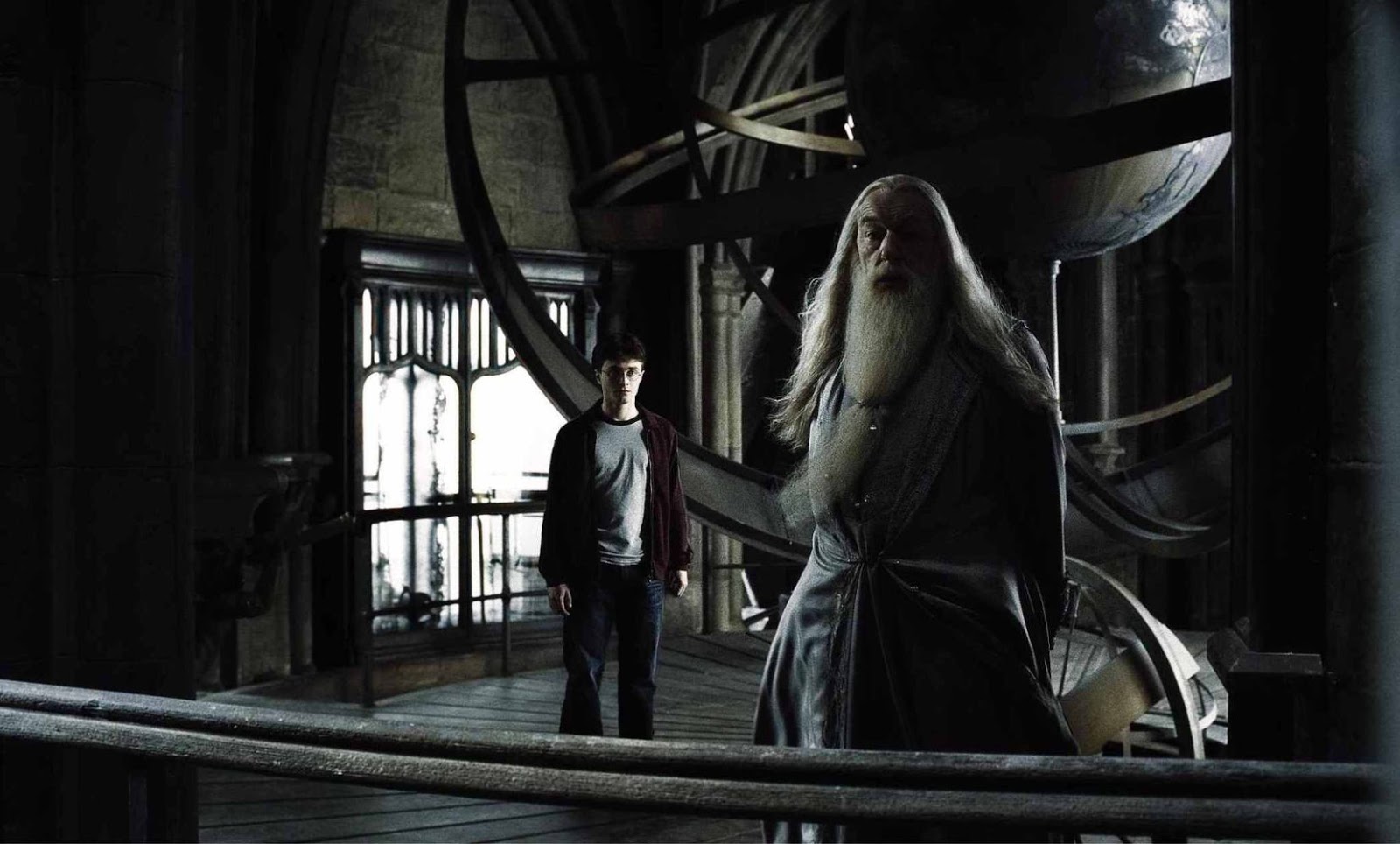
Harry and Dumbledore prepare for war in Harry Potter and the Half-Blood Prince

Director: David Yates

Cast: Daniel Radcliffe (Harry Potter), Rupert Grint (Ron Weasley), Emma Watson (Hermione Grainger), Helena Bonham Carter (Bellatrix Lestrange), Jim Broadbent (Horace Slughorn), Robbie Coltrane (Rubeus Hagrid), Michael Gambon (Albus Dumbledore), Alan Rickman (Severus Snape), Maggie Smith (Minerva McGonagall), Timothy Spall (Peter Pettigrew), David Thewlis (Remus Lupin), Julie Walters (Molly Weasley), Mark Williams (Arthur Weasley), David Bradley (Argus Filch), Tom Felton (Draco Malfoy), Gemma Jones (Madam Pomfrey), Evanna Lynch (Luna Lovegood), Helen McCrory (Narcissa Malfoy), Natalia Tena (Tonks), Bonnie Wright (Ginny Weasley)

Harry Potter and the Half-Blood Prince is perhaps the least stand-alone of the Harry Potter novels. Intended as a bridge into the final book (and carrying a lot of mystery), for obvious reasons it also has no Dumbledore-explains-the-plot-to-Harry chapter at the end (making it unique in the series). It also has the series’ least interesting MacGuffin – the identity of the Half-Blood Princehimself being considered of such little note here that it barely gets a mention in the film. But despite all this, the highly experienced Harry Potter crew deliver another exciting, dramatic and fully engaging film.

While I may not have thought David Yates was a natural film director, I have to say in this film his cinematic craft has really kicked into gear. There are images of fascinating depth and beauty here, and the film is beautifully shot by Bruno Delbonnel (Oscar-nominated). Like never before, Hogwarts seems like a place of inky greens and deep soulful shadows. The camera often allows characters’ faces to fill the middle of the frame, while still giving us depth of vision of the world around them. Carefully composed shots show the rich detail of plenty of objects, from dead birds to photographs. It’s a luscious film.

It also has a sad nostalgia to it: it feels like it’s about things coming to an end. Unlike any other film in the series, there are very few scenes of hi-jinks in Hogwarts. Comic relief characters like Neville and Hagrid are noticeable by their (mostly) absence. 

Instead the film looks at that sad half-way house between being a child and an adult. Or rather, the responsibilities and duties of an adult being thrust onto a child. Obviously Harry is scarcely ready to take on his mantle of chosen one – and feels bereft and lonely. But, in a neat contrast, Draco Malfoy is also being pushed into a task he is far too young for, and ill-suited to. The film could have actually made more of pulling out the contrasts between these two characters – although time is always at a premium in these films, with so much of Rowling’s plot to squeeze in.

Despite this, Tom Felton gives his finest performance in the series as a tortured and deeply scared Draco Malfoy, who for the first time seems like just a normal, insecure boy terrified of the dark acts he feels he has to do. The film gets a lot of emotional mileage out of this (more than it does, actually, from Harry’s predicaments) and Felton’s expressive agony and tearful lack of control for the first time make him someone we can relate to, and feel sorry for.

It also brings out different character traits in other characters, not least the protective side of Snape. Alan Rickman gets one of his meatiest roles in the series here, wonderfully playing multiple different emotions and motivations under a cold inscrutable surface. His character is a constantly intriguing shift of feelings – but it’s clear he does, in his way, care for Draco’s safety (just as he does for the other children in his care). Rickman also gives a brilliant sense of Snape’s moral uncertainty, and his every look suggest waves of emotion under tight control. It’s a wonderful performance of suggesting a lot under the surface while not doing a lot. Not to mention Rickman also manages to skilfully leave everything open for debate as to Snape’s true motives.

It’s striking how many of the series regulars come into prominence here. Not just Felton and Rickman, but this is also Gambon’s finest performance. By now Gambon had pretty much nailed Dumbledore, giving the part a great deal of compassion and quiet moral force. His sad urging for Draco to ask for his help near the end of the film is rather moving, as are the soft, sad tones Gambon drops throughout the film suggesting Dumbledore’s pain and guilt. Gambon gets a perfect balance between a twinkly charm and a quiet authoritativeness that works wonderfully.

Surprisingly however, what works less well is Harry’s plotline. Daniel Radcliffe is underpowered and slightly underwhelming, a little too sullen and sulky to really win our sympathy (Radcliffe himself has named this as his least favourite performance). It doesn’t help either that there is no chemistry between him and Bonnie Wright as Ginny Weasley. Wright, bless her, is not a strong actor and she constantly undersells each of these scenes – unable to bring the sort of bright, sexy playfulness her book equivalent has. Instead both she and Radcliffe feel sulky and awkward, and the romantic scenes between them (of which there are many) fall flat time and time again. Once you notice this total lack of spark between them you can’t see anything else!

Radcliffe has far more chemistry with Emma Watson – but she and Rupert Grint (along with many of the rest of the younger cast) have very little of any real consequence to do. The dysfunctional middle of the film, with Radcliffe and Wright flirting, drifts all the time, meaning the focus of the film zeroes in on the “adult-character” plots. Yates and screenwriter Steven Kloves do their best to add drama and excitement to a book where most of the dramatic high points are Dumbledore and Harry either watching memories, or Harry using a book to do much better at potions.

And by and large they succeed. Action sequences are added: the opening attack on the Millennium Bridge by Death Eaters is terrific, and there is an exciting (if totally plot free) attack by Death Eaters on the Weasley home. Yates again sells the moments of awe: there are some beautiful shots in Voldemort’s cave hideaway, and once again he makes Dumbledore’s power a true jaw-hits-the-floor moment. 

Half Blood Prince is beautifully filmed and well directed, even if one of its primary sub-plots doesn’t really work. There are some terrific performances: Felton, Rickman and Gambon possibly do their best work here, while Jim Broadbent is wonderfully funny but also touchingly sad and rumpled as Slughorn. It’s not Radcliffe’s finest hour, but it’s a film that works very well as an entrée to the series’ final arc. And it really captures a sense of morose sadness, mourning and regret wonderfully effectively – the final sequences carry real emotional weight. It’s a fine film – and one of Rowling’s favourites as it turns out.

Harry Potter and the Order of the Phoenix (2007)


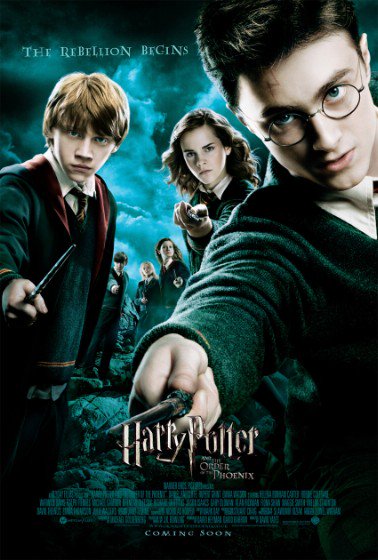
Harry Potter and friends prepare to face the Dark Lord in Harry Potter and the Order of the Phoenix

Director: David Yates

Cast: Daniel Radcliffe (Harry Potter) Rupert Grint (Ron Weasley), Emma Watson (Hermione Grainger), Helena Bonham Carter (Bellatrix Lestrange), Robbie Coltrane (Hagrid), Ralph Fiennes (Lord Voldemort), Michael Gambon (Albus Dumbledore), Brendan Gleeson (Mad-Eyed Moody), Richard Griffiths (Vernon Dursley), Jason Isaacs (Lucius Malfoy), Gary Oldman (Sirius Black), Alan Rickman (Severus Snape), Fiona Shaw (Petunia Dursley), Maggie Smith (Minerve McGonagall), Imelda Staunton (Dolores Umbridge), David Thewlis (Remus Lupin), Emma Thompson (Sybill Trelawney), Julie Walters (Mrs Weasley), Mark Williams (Arthur Weasley), Robert Hardy (Cornelius Fudge), Tom Felton (Draco Malfoy), Matthew Lewis (Neville Longbottom), Evanna Lynch (Luna Lovegood), Katie Leung (Cho Chang), David Bradley (Argus Filch), Natalie Tena (Tonks), George Harris (Kingsley Shacklebolt)

By the fifth film, the Harry Potter franchise was really on a roll – and a lot of the core creative team that would carry the series through to the final film were in place. It’s particularly striking how much a distinctive look and tone the series now had, that is both different from the books and a logical extension of them. It’s also the film where I think the series finally decided it would tell it’s own version of Rowling’s story, rather than an exact staging. 

Rather than simply tightening the plot of Rowling’s mammoth book, Order of the Phoenix decided to rework the story to deliver what it wanted to do. Vast amounts of Hogwarts material is ruthlessly cut, including large sections of Ron and Hermione’s sub-plots. The film streamlines the story, reducing Harry’s feelings of isolation in the story (the film instead centres the importance of friendship and loyalty). And despite turning one of the longest books in the series into the shortest film, this captures the sense of the book excellently. It clearly identifies the key themes that drive Rowling’s series and runs with these very effectively. This film, more than any others so far, shows the deep bonds of loyalty that connect not just the central trio, but also the other members of the school. The Dumbledore’s Army sequences have a wonderful sense of camaraderie about them – these people genuinely feel like a group of friends.

These sequences also give Daniel Radcliffe some great material to play with. Harry clearly would make a hell of a teacher – Radcliffe makes him encouraging and supportive, capable of drawing the best out of his students. Radcliffe does his expected excellent job all the way through this film. His ability to play scenes of grief and longing has increased dramatically – his reaction to the death of Sirius Black is really well done. But he also presents Harry as essentially a warm and caring person – exactly the polar opposite of the man Voldemort has become. It’s another terrific performance.

Order of the Phoenix was David Yates’ first film as a director of the series – Yates has gone on to direct all the subsequent outings in the Potterverse – and part of the reason he seems to have cemented the role is that he gives a perfect mixture of Columbus, Cuarón and Newell. He can juggle elements of Rowling’s story, he works very well with actors, he has enough creativity and vision as a director to present this world in interesting new ways. He’s a perfect combination of a number of skills from the previous directors – and he really runs with that legacy here.

Order of the Phoenix is a dark and gorgeously shot movie, with a tight story structure (it’s the only film not written by Steven Kloves, and Michael Goldenberg’s fresh take on the film I think really helps). Every scene has a painterly brilliance, and scenes simmer with tension and paranoia – Yates doesn’t lose track of the fact that Harry is being persecuted by the authorities for taking an unpopular stance on Voldemort’s return. 

Yates establishes his intention to turn this into a notably darker episode from the very start, opening with a vicious Dementor attack (redesigned to make them more fluid). This is followed quickly by a show trial at the Ministry. Then to a darker, gloomier Hogwarts now a den of unjust rules (the expulsion of Thompson’s gentle Sybil Trelawney is a particular fine heartstring-tugging moment), and cruel punishments. It’s a film that never allows us to forget death has entered Harry’s world. By the time we hit the final battle sequences in the Ministry of Magic, we know our heroes are putting their lives on the line. Scary as this is, we also appreciate the bonds of love that have taken them there all the more.

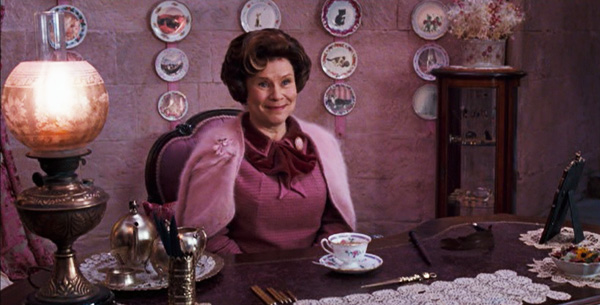
A lot of the creep and cruelty of the film emerge from Imelda Staunton’s Dolores Umbridge. Staunton is brilliantly cast as the twee ministry official who hides a ruthless viciousness, buttressed by a sociopathic conviction that whatever she does must be right. Staunton’s soft politeness is the perfect vehicle for showing Umbridge’s sadistic cruelty. Umbridge is the worst form of politician –blindly following the orders of any authority figure who can promote her on their coat-tails. The design of her character is similarly spot-on: she dresses almost exclusively in fluffy pink knitted suits, and her office is an explosion of pink, china plates and fluffy animal pictures. Staunton is almost unbelievably vile in her smug, condescending moral emptiness.

It’s further evidence of what a brilliant job this series did with casting. By this point, truly great actors were appearing in this film while sharing less than a dozen lines between them: Thewlis, Gleeson, Smith, Thompson and even Coltrane get remarkably little do in this film, but still seize your attention. Wonderful performances also come from the less famous names: George Harris gives a brilliant twinkly wisdom and gravity to Kingsley Shacklebolt while Robert Hardy (quietly excellent in the previous films) gets some more material to showcase his skills as the wilfully blind Fudge.

Of the other stand-outs, Helena Bonham Carter is brilliantly malevolent as the psychotic Bellatrix. Jason Isaacs gets some marvellous moments of smooth patrician wickedness as Malfoy. Gary Oldman is the ideal roguish father-figure as Sirius, the actor’s obvious bond with Radcliffe really coming across. Gambon is very comfortable now as Dumbledore, really showing the authority behind his Dumbledore’s eccentricity.

Then you have actors who dominate from mere minutes of screen-time. Fiennes again delivers in a short scene at the close of the picture. And then of course we get Rickman: he makes so much of such brief moments as Snape. He has probably the two biggest laugh-out-loud moments (both totally reliant on his delivery of non-descript words like “Obviously”). His occlumency classes with Harry showcase him at his best: trying to help, but unable to overcome his essential bitterness and resentment. These sequences are wonderfully contrasted with Harry’s comfort as a teacher to his friends: by contrast Snape is dismissive, impatient and unsympathetic.

The film finds moments of humanity and comedy throughout. Rupert Grint finally gets to show another side of Ron, as Ron matures slightly into a loyal wing-man , who makes it clear he will not countenance criticism of Harry in his hearing. And while this is a dark film, it’s also the one that deals with Harry’s growing romantic feelings for Cho – and he gets a beautifully played little romance that reminds us that Harry is (at the end of the day) still a nervous kid. It’s a film that understands friendship and love and their importance.

So it’s why the final battle sequence in the Ministry of Magic works so well. Tense and dangerous, we also root overwhelmingly for the courage of the kids. The work Yates had done on the wizard battles really pays off – they have a greater sense of choreography than ever before, while the apparating (in a trailing, misty, fast-moving cloud) really adds a fantastic visual element. Little shots work so well – I love the cut from Harry fighting alongside Sirius to his friends crouching behind a rock staring up at their friend in awe. It’s a beautiful reminder that what Harry is doing is so brave.

Of course, the film ends in the series’ first truly gripping wizard fight as we finally get Dumbledore taking on Voldemort. It was a great sequence in the book – and is translated wonderfully to the screen with a series of gripping visuals. There are brilliant beats throughout and we learn about the characters. We see Voldemort’s targeting of the defenceless Harry throughout, the way Dumbledore puts himself in the way of danger (including angrily throwing Harry backwards with magic when he steps forward). Above all you see Harry’s own courage (and his impulsiveness motivated by caring so much).

Order of the Phoenix is another excellent entry into a series that flourished and became richer the longer it went on. Yates showed that he was in tune with the fundamental ideas of Rowling’s writing and that he was able to marry excellent performances with impressive visuals. It’s brilliantly made – shot wonderfully, very well edited with a marvellous score – and is an impressive and muscular piece of film making. Very impressive.

Harry Potter and the Goblet of Fire (2005)


Our heroes face an increasingly dark future in Harry Potter and the Goblet of Fire

Director: Mike Newell

Cast: Daniel Radcliffe (Harry Potter), Rupert Grint (Ron Weasley), Emma Watson (Hermione Granger), Robbie Coltrane (Rubeus Hagrid), Ralph Fiennes (Lord Voldemort), Michael Gambon (Albus Dumbledore), Brendan Gleeson (“Mad-Eye” Moody), Jason Isaacs (Lucius Malfoy), Gary Oldman (Sirius Black), Miranda Richardson (Rita Skeeter), Alan Rickman (Severus Snape), Maggie Smith (Minerva McGonagall), Timothy Spall (Peter Pettigrew), Frances de la Tour (Madame Maxime), Mark Williams (Arthur Weasley), Robert Pattinson (Cedric Diggory), David Tennant (Barty Crouch Jnr), Jeff Rawle (Amos Diggory), Tom Felton (Draco Malfoy), Robert Hardy (Cornelius Fudge), Roger Lloyd Pack (Barty Crouch), David Bradley (Argus Filch), Clémence Poésy (Fleur Delacour)

After Alfonso Cuarón announced he would only direct one Harry Potter film, the producers faced a stiff challenge. The third Harry Potter film had been the best so far, and elevated both the acting and design into a far more filmic, epic position than before. Could Mike Newell match this in Goblet of Fire? Sure he could.

If nothing else, Goblet of Fire is a triumph of adaptation. Used to the page-to-screen translations of the earlier films, it was expected that the film would be split into two parts. Instead Newell and screen-writer Steven Kloves turned Rowling’s huge fourth book into a tightly structured and focused film that places Harry’s emotional journey firmly at its centre, and includes only the things that support the building of that story. 

Goblet of Fire is a film of fascinating contrasts. In fact, it’s probably the lightest, most ‘teenage’ of the films, while also containing a dark final chapter and more death than we’ve had so far in the series. But this film is actually rather funny and allows its characters to focus on the challenges and stresses of growing up, with only a few flashes of danger and darkness – before they get wrapped up in the battle against Voldemort that will dominate the next few films.

So this is the film where we get crushes, where Harry and Ron struggle to get dates for the ball, where we get a sense of Hermione not only growing up – but growing in confidence. Harry develops a hopeless crush on Cho Chang – his “Willyougotoballwithme” hurried date proposal is all too familiar to most men, as is his “oh no never mind not a problem” when she (reluctantly) says no. Meanwhile, Ron struggles to understand his own hormonal feelings towards Hermione. It’s all well done and very funny. The ball itself is a highlight of teenage awkwardness, as well as genuinely feeling like a teenage party (including a sort of wizarding mosh pit). 

This teenage awkwardness carries across into Harry’s involvement in the Tri-wizard Tournament, a series of stirring set-pieces against dragons, mer-people and a wicked ever-shifting maze. The tournament offers a range of puzzles Harry needs to solve – more than enough opportunity to allow other characters to get involved. Neville Longbottom particularly moves to the fore for the first time – not only embracing dancing (hilariously nearly every boy is as embarrassed by it as you might expect) and landing a date, but also using his knowledge of plants to help Harry, and we get increased insight into his own tragic backstory. It’s great to see Matthew Lewis being able to stretch himself – and show the roots of the good young actor he’s become.

The film spends a lot of time on family roots, both tragic and happy, in particular fathers and sons. We have no fewer than four father/son match-ups in these films, and each gives us a slightly different perspective on family relationships. Mark Williams’ matey but loving Arthur Weasley gets more screen time than ever before, and Williams develops him into a protective but warm patriarch. Contrast that with the troubled coldness the Crouches show each other – and the swift speed with which Barty Crouch denounces his own son. We get a glimpse of the sort of father Harry could have had with a brief ghost appearance of Harry’s parents. The strongest father-and-son relationship we get to see is that between the Diggorys, an immeasurably proud father and a perfect son.

Mentioning Amos Diggory means we have to bring up one of the most extraordinary acting cameos in the entire series: Jeff Rawle’s work here is brilliant. Is there a more moving moment in the franchise than his uncontrollable grief when Cedric is killed? His anguished crying of “That’s my boy” will haunt many a viewer for years to come. It’s a measure of the brilliance Mike Newell had with actors, and the shrewdness of the casting throughout. Would anyone else have thought of George Dent from Drop the Dead Donkey for this King Lear-like cameo? Would anyone else have thought of Trigger as strict disciplinarian, Barty Crouch (Roger Lloyd-Pack is terrific). The film also shrewdly cast David Tennant about five minutes before he became one of the most popular actors in the country, for an excellent malevolent cameo of pride and bitterness.

The acting throughout is terrific – Mike Newell has the reputation of an actor’s director, and he really shows it here. The three leads are no longer children but teenagers, and they feel like it. Radcliffe plays Harry with increasing maturity and emotional depth, balancing with nuance and quiet confidence the light comedy of Harry’s hormonal yearnings, his fear during the tournament, and his terror and resolve during the confrontation with Voldemort. It’s quite a range he has to go through here, and this features his best performance so far.

Similarly, Grint increases his comedic range with a sullen, teenage I-don’t-want-to-admit-I’m-interested-in-girls series of exchanges. Watson demonstrates her obvious chemistry with both her co-stars, and also does a great job of showing Hermione’s growing emotional maturity and confidence. Many of the other regulars continue to do great work, with Gambon really settling into this role of Dumbledore (although his fury when Harry’s name emerges from the Tri-wizard cup seems strangely out of character). 

The new cast members as always offer plenty. Miranda Richardson delivers a lot of comic flourishes, and snappy media pot-stirring, as gossip columnist Rita Skeeter. Brendan Gleeson carries all the charisma you would expect as a maverick, perhaps even unbalanced Mad-Eyed Moody. In a further testament to the excellent casting directors here, Robert Pattinson (five minutes before his fame exploded) is very good as a suave, handsome, slightly cocky but charming Cedric Diggory.

The film though is building towards its surprising gear-change late in the story – and the introduction of Voldemort, murder and death into a film that until now has been an engaging and amusing action film and teenage comedy. Perfect casting for Voldemort was secured with Ralph Fiennes. Of course Fiennes could play Voldemort standing on his head, but his softly-spoken suaveness and patrician charm is absolutely perfect for the role. You really get a sense of ice running through his blood, and his cold cruelty and arrogance. Fiennes is pretty much iconic in this role. 

The final sequence itself is brilliantly done, a thrilling and terrifying sequence, which really hammers home the extent of Harry’s powerlessness and vulnerability – while the brutal, instant dispatching of Cedric immediately changes the ball game for the rest of the series. The scene is brilliantly shot with a series of blacks and greens for mood and offers a sensational conclusion, as well as an expertly shot duel between Harry and Voldemort that established the filmic language for all subsequent duels that were to come.
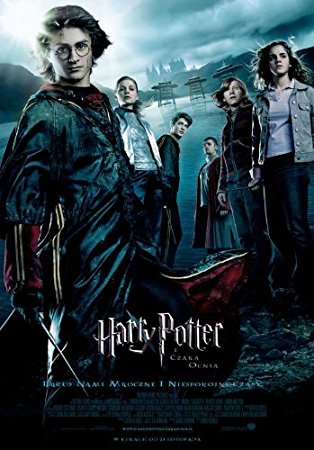
Goblet of Fire is another example after Prisoner of Azkaban of a great piece of franchise film-making. It’s not quite as stand-alone, or as perfectly dramatically formed, as the previous film – but that’s because this one ends, like none of the other films before, on a cliffhanger. For the first time, this series wasn’t offering an opponent and obstacle that could be overcome and left behind at the end of the film. Here the baddies win – and the feeling going forward is that, with the help of friends and family, we can battle the evil, but it will still be there. It’s an engaging, funny and very well-structured film, packed with decent twists, and ends with a humdinger of a scene in a film that has already had plenty of excellent moments. Harry Potter is surely one of the best franchises there is.

Harry Potter and the Prisoner of Azkaban (2004)


Harry Potter friends confront wanted killer Sirius Black in Harry Potter and the Prisoner of Azkaban

Director: Alfonso Cuarón

Cast: Daniel Radcliffe (Harry Potter), Rupert Grint (Ron Weasley), Emma Watson (Hermione Granger), Julie Christie (Madam Rosmerta), Robbie Coltrane (Rubeus Hagrid), Michael Gambon (Albus Dumbledore), Richard Griffiths (Vernon Dusley), Gary Oldman (Sirius Black), Alan Rickman (Severus Snape), Fiona Shaw (Petrunia Dursley), Maggie Smith (Minerva McGonagall), Timothy Spall (Peter Pettigrew), David Thewlis (Remus Lupin), Emma Thompson (Sybill Trewlawney), Julie Walters (Molly Weasley), Mark Williams (Arthur Weasley), Tom Felton (Draco Malfoy), David Bradley (Argus Filch), Robert Hardy (Cornelius Fudge), Pam Ferris (Marge Dursley)

Well this is more like it. The first two films set the tone and established the universe. But Prisoner of Azkaban – filmed after a year’s break from the back-to-back filming of the first two films – is such a notable step-up in quality from the previous films, it completely stands alone as a marvellous piece of cinematic storytelling, not just as part of a franchise.

Why is this? Well I think the answer is pretty clear. After the solid, but unspectacular, direction from Chris Columbus, the reins were handed to a gifted filmmaker in Alfonso Cuarón. Harry Potter and the Prisoner of Azkaban has all the visual invention and dynamism the first two films lacked. Alongside that, Cuarón tells the story with a brilliant mixture of light and dark. For the first time, the adaptation also escaped the need to dramatise everything in the book onto the screen – this film is a good 20 minutes shorter than Chamber of Secrets but immeasurably superior.

Prisoner of Azkaban looks fantastically gorgeous, and is brilliantly shot. The production and costume design has been spruced up, to give the film a sort of steam-punk 1950s look, as if the wizarding world had slightly arrested a few decades behind the rest of the world. Cuarón was also one of the first directors in the series who seemed relaxed enough to let the children act like children – so we get scenes of them mucking around in the dormitory or dressed with a teenage coolness. Hogwarts becomes a castle of shadows and gloom, in a magical, wintry whiteness and Scottish Highlands shades of greens and blues. More than any of the previous films, its a world that feels ‘real’ and lived in. It’s a style that would dominate all the remaining films: Cuarón essentially set the tone for the rest of the series to come.

It also helps that Cuarón was blessed with perhaps the strongest of Rowling’s stand-alone stories, a tight and taut thriller that reaches a surprising conclusion and features playful use of things like time travel and illicit magic. Cuarón, however, really embraces the emotional core of that story, and allows all these characters to expand in richness and depth. Harry faces real torment and anger when confronted with the story of the death of his parents, and his desperate yearning to have some sort of connection with them is a key thread that runs through almost every scene.

The film highlights the growing flirtation and connection between Ron and Hermione. Hermione herself is increasingly shown as a level-headed, empathetic young woman, who really understands the feelings of her friends. Several other characters are allowed to show depths: don’t forget this is the film where we see Snape’s first reaction when confronted with a werewolf is to put himself between it and the children. Rickman, by the way, is brilliant in this film, giving us the first hints of the deep and abiding feelings Snape held for Harry’s mother in his bitter anger at Sirius.

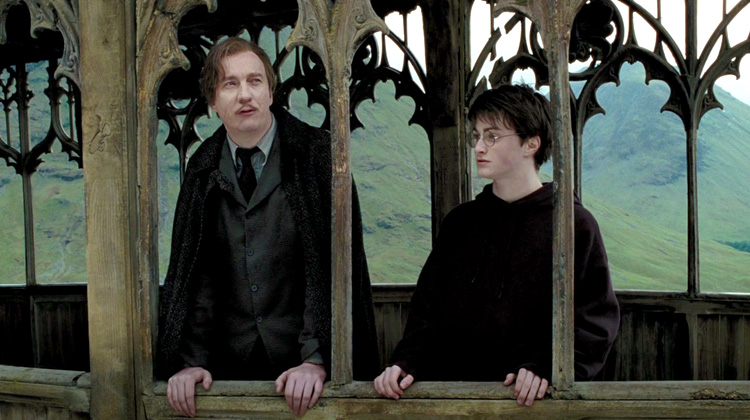
As always the film introduces some fantastic new characters into the mix. Gary Oldman is simply superb as Sirius Black, bringing to life his torment and rage, but most especially Blacks warmth and generosity (as well as his boyish enthusiasm). It was a major change of pace for Oldman, who has credited the film with changing his image in Hollywood away from one-note villain. Emma Thompson is very funny as (possibly) delusional divination teacher Sybil Trelawney. David Thewlis though waltzes off with the movie as a sad-eyed Remus Lupin, a man who clearly has known great losses. Thewlis plays Lupin with a caring, scruffy charm, an ideal teacher and mentor – generous but also firm when needed. It’s impossible not to end the film caring deeply for him. He’s terrific – it’s a real shame he never got another real showpiece scene in the rest of the franchise.

This is also our first introduction to Michael Gambon as Dumbledore – a replacement for the late Richard Harris. Gambon plays the part with a curious twinkly cheekiness, and a greater physical robustness, along with a faint Irish twang which feels like a homage to Harris. It’s a slightly uncertain start, but Gambon’s unusual, slightly-faded-hippie take on the part stands out from Harris’ austere wise-man very nicely. His lightness makes the moments of power all the more awe-inspiring. It also rather fits in with the tone of Cuarón’s slightly off-beat style.

Cuarón has a real eye for the offbeat gag – from a cleaner almost being blown away by a monster’s howl in the Leaky Cauldron, to the kids eating animal sweets in their dormitory, to Dumbledore’s off-camera delay tactics with Fudge (“Well it is a very long name minister” he says when asked to sign something), there are many delightful sight and sound gags throughout the film to make it a joy to discover. His balance of this with the heart of the story is brilliant: the inflation of Pam Ferris’ vile Aunt Marge is both brilliantly funny, but also clearly motivated by the revolting things she openly says to Harry about his parents. It’s a great balance the film pulls off time and time again.

The film is wonderfully structured and beautifully paced. It’s got a very clear five act structure, and thematic thread running through the whole film of grief and needing friends to help cope with this. The parts of the book that don’t contribute to this have been skilfully trimmed down. Cuarón then brilliantly interweaves set-piece moments, many of them introduced with an off-the-wall inventiveness, such as the umbrella dancing in the wind before the storm-swept Quiddich match (is there any health and safety in this school at all by the way?).

By the time you hit the final sequences, thanks to the film’s structure, you’ve no doubt about the revolting dangers of the Dementors. These spectral creatures are returned to again and again by Cuarón’s careful editing, as we see them drifting around the borders of Hogwarts, killing flowers and freezing lakes by their very presence. These terrifying creatures are the creepy stuff of nightmares – and Cuarón doesn’t flinch from this. It also makes Harry’s successful conjuring of a Patronus at the film’s conclusion a stirring and triumphant moment, a suitable triumphal ending to the film.

Cuarón’s direction of this film re-set the table for the entire franchise. Both Mike Newell and David Yates would follow in his footsteps, and present the world as Cuarón imagined it: dark blacks, and muted primary colours, as much a world of creepy, unsettling threat and danger, as it was of delight and wonder. From this point on the films would start to stand on their own feet, focusing on exploring the themes and emotions of Rowling’s story, rather than covering every scene. Prisoner of Azkaban is the best of the Harry Potter films and the most important landmark in the series. It’s not just a great Harry Potter film, or a great fantasy film or kids’ film. It’s a great film.

Harry Potter and the Chamber of Secrets (2002)


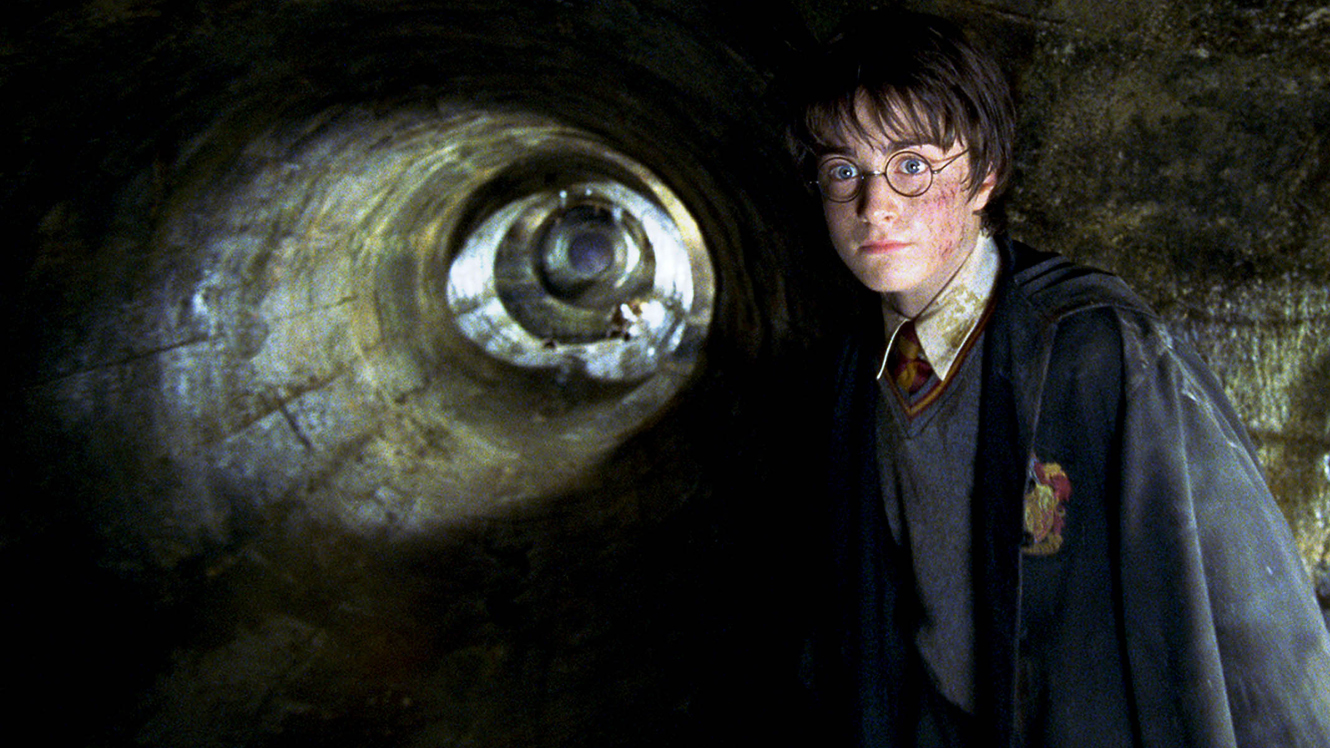
Daniel Radcliffe discovers dark goings on in the bowels of Hogwarts in Harry Potter and the Chamber of Secrets

Director: Chris Columbus

Cast: Daniel Radcliffe (Harry Potter), Rupert Grint (Ron Weasley), Emma Watson (Hermione Granger), Kenneth Branagh (Gilderoy Lockhart), John Cleese (Nearly Headless Nick), Robbie Coltrane (Rubeus Hagrid), Christian Coulson (Tom Riddle), Richard Griffiths (Vernon Dusley), Richard Harris (Albus Dumbledore), Jason Isaacs (Lucius Malfoy), Miriam Margolyes (Professor Snout), Alan Rickman (Severus Snape), Fiona Shaw (Petrunia Dursley), Maggie Smith (Minerva McGonagall), Julie Walters (Molly Weasley), Mark Williams (Arthur Weasley), Tom Felton (Draco Malfoy),  David Bradley (Argus Filch), Toby Jones (Dobby), Gemma Jones (Madam Pomfrey), Robert Hardy (Cornelius Fudge), Matthew Lewis (Neville Longbottom), Julian Glover (Aragog)

Another movie, and time for another everyday school year for Harry and friends: classes, exams, sports days and saving the entire population of the school from a grisly death. It’s a tough job but someone has to do it right? So welcome to the second Harry Potter film, that mixes the fun of flying cars and tricky elves with giant spiders and ferocious snakes.

Chris Columbus and team went virtually straight from the first film into making this one, and it’s pretty clear they had learned a lot from the last one. Sure, Columbus is still a safe pair of hands rather than an inspired director, but there is a bit more flair from cast and crew here. It also manages to look a lot less like a primary colour explosion or an illustrated version of the book, and more like a piece of film-making. Maybe this can be attributed to new cinematographer Roger Pratt, who gives the film a far more imaginative palette of darks blacks mixed with beautiful core colours (no surprise he returned to shoot Goblet of Fire). In addition, both design and costumes are far more adult and less Dickensian-robey than I remembered (though there’s still a way to go until we get to the steampunk 50s look of Prisoner of Azkaban that would dominate the rest of the films).

It also helps that the introduction to the wizarding world was covered so well in the first film. In fact, this is the last film where anyone felt it necessary to shoe-horn recaps into the dialogue, reminding us of who (and what) everything is. A particular moment of irritance for me is the first entry of Dumbledore and McGonagall: met with Harry breathlessly saying their names – just in case you were one of those people who didn’t contribute to the $1billion the first film made worldwide, or who hadn’t read any of the books by this point.

Anyway, Columbus got the principles out of the way in the first film so he could focus a bit more on this slightly darker, more developed story (just as Rowling was able to do in the books). The mystery of the Chamber of Secrets is more compelling than that around the Philosopher’s Stone in Potter’s first outing, and this is the film where we properly meet the series antagonist Voldemort – here played with a smarmy, casual cruelty by Christian Coulsen (it’s a shame this didn’t lead to bigger things for Coulsen). Radcliffe gets the chance to get his teeth into a decent final confrontation – and also the series’ first big action set-piece, quite well-shot with a creepy menace – as he takes on a basilisk.

In fact Radcliffe is much stronger in this movie – more relaxed, more confident and embracing Harry’s essential decency and sense of honour (the qualities that are always duller to play as an actor). He’s still struggling a bit at the moments that call for real emotion – but he does very well here indeed. Most importantly, you believe him and everything he does – which is quite something for a child actor to accomplish. 

He gets more depth and range to play with than Rupert Grint who was already being shoehorned into being gurning comic relief. There are few faces Grint isn’t asked to pull in this movie – and get used to that sad-sack downward grin, or the teeth-clench of terror, because these are going to become major weapons in his arsenal. Watson doesn’t actually get a lot in this movie, but even by this point it was becoming clear that she was pretty much a perfect fit for the character. 

The series also confirmed it had great roles for the cream of British acting – and that it was going to be a fine pension plan for most of Equity. Jason Isaacs plays the wicked Lucius Malfoy with relish and a scowling, patrician pride – no wonder he became not only a regular in the series, but one of its champions. He’s very good here indeed, as is other new addition Mark Williams, a perfectly charming shambolic dad as Arthur Weasley.

The show however is carried off by Kenneth Branagh as Gilderoy Lockhart. Branagh offers a performance close to of self-parody of his public perception, as a swaggering self-promoter, a preening egotist who can’t help but brag about his (almost non-existent) achievements and accomplishments. Branagh is deliriously funny as Lockhart, not only getting a lion’s share of the best scenes, but also bringing out some delicious comic rebuttals from the rest of the teachers – not least Rickman and Smith – who clearly can’t stand Lockhart. It’s a great performance – cocky, old-Etonianesque, full of surface charm and puffed up pride, but with a nasty selfish mean steak just below the surface.

It all feels part of the generally more free and engaging direction this film takes compared to the first one. Some of the best actors from the first film get relegated in screentime, but it shows the greater confidence the filmmakers have in the kids. The film really begins to introduce the ideas of good vs evil and the principles of friendship, humanity and love that differentiate Harry from Voldemort. Columbus isn’t quite the director to bring all this together into an epic vision, but he is good enough to deal the cards effectively. He gives it enough pace and shine so that we are never bored, though we’re also never wowed.

Despite the increased darkness and greater emotional depth, Columbus never loses track of the sense that he is making a family entertainment. He may still not be able to bring an artistic flourish to events, but he balances the light and dark very well. Not least the fact that the racism under the surface of the wizarding world emerges here. In the first film Voldemort alone was the villain, but in this one we first hear the term “mud blood” bandied about to describe Muggle-borns. We also find out that the wizarding world has its own slave class in elves (given a sometimes irritating Jar-Jar Binks-lite face by Dobby, a character with far more appeal to the kids than the parents). These are complex ideas – and all part of the world becoming richer.

Harry Potter and the Chamber of Secrets is still in the lower tier of Harry Potter films, but it’s a significant step-up from the first film. Visually it’s richer and more interesting. The stakes are higher, the themes deeper and more intriguing. It’s still very much a children’s film, and it still inclines towards being an over-faithful adaptation – it’s a bum-numbing 2 hours and 40 minutes so keen is it to not leave anything out – but this has far stronger material in it than the first film, and is a sure sign that this series was building a foundation it could flourish from.