Category: High school drama

Goodbye Mr Chips (1939)

Robert Donat is superb (and Oscar winning) as an (eventually) beloved teacher in Goodbye Mr Chips

Director: Sam Wood

Cast: Robert Donat (Mr Chipping), Greer Garson (Katherine), Lyn Harding (Dr John Hamilton), Paul Henreid (Max Staeffel), Terry Kilburn (John Colley/Peter Colley I/Peter Colley II/Peter Colley III), John Mills (Adult Peter Colley), Scott Sunderland (Sir John Colley)

Goodbye Mr Chips is the sort of film that feels ripe for spoofing. The sort of idealised stuff-upper lip, Tom Brown’s Schooldays look at the past that should have you spluttering and chuckling. But it’s done with such warmth, such genuine emotion and tenderness, that instead you can’t help but feel yourself welling up while watching it. I certainly did (although I was watching it at half seven on a Sunday morning…)

The film follows the fortunes of Mr Chipping (Robert Donat) from his first joining the school in 1870 as a naïve young Classics teacher, struggling to exert authority over the children, to a beloved elder statesmen of the school in 1933. Along the way, he deals with a host of personal and worldly trials and tribulations, falls in love with a young suffragette Katherine (Greer Garson) who recognises his tender soul, and eventually helps the school through the national trauma of World War I.

It’s a quite beautifully done piece of old fashioned film-making, crammed with those moments of suppressed emotion and unspoken depths that get me every time. Maybe it’s something peculiarly English, but nothing can touch our repressed souls than seeing a kindred spirit struggle to keep his emotions locked down. Chipping loves his job, he loves the children he teaches and he will work tirelessly to give them the best start in life he can. The schoolchildren across 60 years are his children – can he express any of this before his deathbed? Of course not, he’s British.

It’s a film that celebrates the strength of that indomitable British characteristic of keeping on, of struggling forward, of keeping traditions and decency going. It’s a strongly conservative message, I’ll give you that, but it’s carried by such nobility and morality that it stresses the positives of this patriarchal affection. And Wood’s direction avoids over-sentimentality at nearly every point, helped by a wonderfully constructed script by Journey’s End playwright RC Sheriff (among others).

And Chipping himself is such a gentle, unassuming and kindly character – a decent, compassionate man who does everything he can to help others – that the film never feels forced. Indeed, it gives many scenes a real emotion. The courtship between Chipping and Katherine is all the more affecting for understanding how unnatural and difficult it is for the shy and reserved Chipping to open himself up to love. It’s also deeply sweet and endearing to see how Katherine is able to see past his awkwardness and bashful quietness to understand the caring, deeply humane person below the surface, and how hard she works to help this better man flourish.

This humanity is behind everything that Chipping does in the film: from the start it’s clear he cares deeply for the pupils at the school, even if he struggles to build a connection. It’s there on his first day where he tries – ineffectually – to comfort a new boy. At first he is led to believe domineering discipline is needed to keep his authority. What marriage – and Katherine’s love – teaches him is that he can allow people to see his natural warmth, and that personal affection makes discipline all the easier and natural. And makes him a better teacher.

It’s that romantic subplot between Katherine and Chipping that really gets the cockles warmed at the centre of the film. Beautifully played, with sensitivity and tenderness, by both Donat and Garson this is an extremely sweet relationship, where Katherine has to make most of the running to get round Chip’s shyness. You can enjoy – as Chip’s best friend Max Staefel (a lovely performance by Paul Henried) does – the fact that his colleagues expect Katherine to be some sort of aged harridan rather than a beautiful young woman. And it’s clear to see why the boys become devoted to someone warm, friendly and charming like Katherine. In Greer Garson’s first major role, she is superb – a character you feel as strongly about as Chips does, and feel her loss as deeply. 

The death scene – and its reaction – nails everything perfect about Robert Donat’s Oscar-winning performance. Chipping’s shell-shocked, robotic return to work is a brilliant demonstration of his trauma, his determination to not let it affect his work, and (in his quiet, middle-distance staring) his utter inability to get over the pain of losing the most important person in his life. Donat’s performance is superb throughout, convincingly ageing over 60 years during the film, but never losing that consistent sense of Chips being a man who has to learn how to find the balance between the warmer side of his character and the needs of being in a position of authority.

It’s a balance he finds wonderfully, by slowly allowing his humour to be seen by the boys – winning him a reputation as a sort of beloved eccentric, and surrogate father to hundreds of boys. This comes together beautifully as he guides the school through the horror of World War I. The film captures perfectly the shock and horror – under that English reserve – of so many dying for so little, of entire generations of former pupils being lost. Donat’s speech in the church near the war’s end seems to capture these feelings of reeling at the senseless violence.

But what the film does so well is not to make these moments sickly, but play them straight and let the emotions of these moments speak to themselves. We don’t need sentimental camera tricks or swooping music, or zooms into tear laden faces. Robert Donat’s performance brilliantly plays into this – he’s an absolute pillar of gentle reserve and kindness and every moment (he’s in every scene) rings absolutely true. It’s a beautiful, gentle, star turn at the heart of a film that slowly becomes deeply moving.

If… (1968)

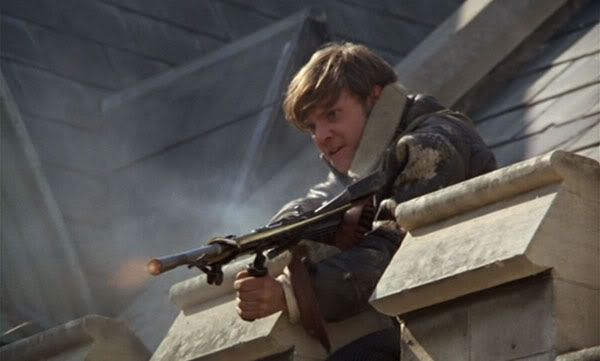
Malcolm McDowell as contemptuous bitter student Mick Travis in counter-culture classic If…

Director: Lindsay Anderson

Cast: Malcolm McDowell (Mick Travis), Richard Warwick (Wallace), David Wood (Johnny), Christine Noonan (The Girl), Robert Swann (Rowntree), Peter Jeffrey (Headmaster), Arthur Lowe (Mr Kemp), Mona Washbourne (Matron), Ben Aris (John Thomas), Robin Askwith (Keating), Robin Davis (Machin), Rupert Webster (Bobby Phillips), Geoffrey Chater (Chaplain), Anthony Nicholls (General Denson), Graham Crowden (History Master)

Lindsay Anderson’s If…emerged in the late 1960s, at a time of furious counter-culture reaction to the establishment. Only a few months before its release, Paris had been torn by student riots against everything from the government to class discrimination, which had sparked over a month of protests and strikes that consumed every part of society. If… was released in the midst of the aftermath to this event – and managed to capture the mood of Europe with an astonishing prescience.

In an unnamed English public school, “College House” is run by the senior prefects (“Whips”) who impose a harsh discipline upon the rest of the students. The head of house (Arthur Lowe) is an easily manipulated weakling, the school headmaster (Peter Jeffrey) is a well-meaning but distant figure, most of the staff are either bizarre, creepy, disinterested or all three. Mick Travis (Malcolm McDowell) and his friends Wallace (Richard Warwick) and Johnny (David Wood) are three persecuted lower sixth formers, who (particularly Mick) have a burning resentment for the structures and traditions for the school: a resentment that slowly builds towards outright rebellion.

Lindsay Anderson’s background was Cheltenham College followed by Oxford. Only someone so thoroughly grounded in the background of private education as that could surely have produced a public school film as furious as this one. The entire film is like a kick in the teeth. Anderson understands the cruel traditions and oppressive rules of public schools completely, and the entire film is awash with moments like this that govern school life. There is not a single, solitary moment where there appear to be any positives at all in the life at the school, or any educational benefits (the school is proudly focused on turning out “gentlemen”). 

Anderson shoots all this with a careful eye for the surreal and flights of fancy. Much has been made about the black and white sequences that pepper the film. The natural light in the chapel caused the colour stock to be over-exposed, forcing Anderson to shoot the scenes there in black and white. However, Anderson loved the effect, and filled the film with scenes shot in monochrome to unsettle the audience and make them question the nature of what they are seeing. And that’s something you need to do with If…, as the film walks a fine tightrope between what is real and what is imagination.

While the film starts off grounded in a reality of cruelty and traditions, as it progresses it develops into something unusual and perverse. An extended sequence where Travis and Johnny skip school and head into town, steal a motorbike, drive to a country café and Travis seduces a Girl (Christine Noonan) becomes ever-more hyper real. Is the Girl even real? The speed of her seduction certainly seems to owe more to the boys’ adolescent fantasies of attractive women than any reality. In fact, the use of Noonan’s character (as sex object) is both a dated moment and an expression of the boys’ immaturity and fantastical longings.

The film is building of course towards the final act of rebellion: a firearms-laden shoot-out after the rebel boys discover a secret cache of automatic weapons on campus (this is in itself unlikely) and then proceed to machine gun visiting dignitaries and their oppressors from the roof of the school, who in turn return fire with their own machine guns. How much of this is real and how much is a flight of fancy from the students and from the film makers? It’s unclear – there is no consistency in the filming of this sequence. When does reality in the film start to cross over to fantasy? There are plenty of moments where this could be happening.

It comes down to the title of the film. If – is this Kiplingesque title suggesting the possibility of such things happening, or such things coming to pass in certain situations, rather than an actual reality? Anderson’s fury at the ghastliness of the class system in this country, and the institutions that promote it (the army, politicians and the church get the same short shrift) suggest a fantasy of bringing the whole system down in a violent outburst. It’s a fantasy, initially grounded in reality, that suggests a poetic realism with lashings of the surreal (most famously the reveal of the schools bullying and vile chaplain as living in a large drawer of a desk in the Headmaster’s office).

The film’s fury and counter-culture joy has the perfect lead actor in Malcolm McDowell, whose simmering, edgy anger as an actor, and chippy rage with a sneering sense of defiance, are perfect for Travis. I’m not sure if McDowell ever topped this first performance, one where he burns through every frame and brilliantly seems to embody every single cog in the system that wanted to thumb its nose at the boss (to mix some metaphors). Anderson and McDowell are clearly working in perfect sync in this film (they collaborated three more times on spiritual sequels). It’s a beautiful performance of simmering resentment and fury at the hypocrisy around him.

The film’s exploration of the injustice of the school doesn’t feel outdated at all. The brutality of fagging and caning plays is like a darkly twisted version of Tom Brown’s Schooldays. Robert Swann is particularly good as leading Whip Rowntree, a hypocritical patrician, and memorable sequences capture the eccentric inadequacy of the teaching, the drilling of school rules into new students (brainwashing them into continuing the pattern in the future) and the arbitrary cruelty of the Whips. Peter Jeffrey’s liberal but distant and ineffective Headmaster is a perfect Thomas Arnold parody, a man with grand ideas but no knowledge of the actual school he is running, who claims to understand the boys but knows nothing about them.

However, interestingly, it’s the rebellion itself that seems rather dated today. In the 1960s, it was easier to whole-heartedly invest our sympathies in the counter-culture rebellion of Mick and his friends – but it’s harder today, with our climate of school shootings in America (there was one the day before I watched this film), to root for our heroes carrying out an indiscriminate shooting, for all the vileness of the institutions Travis is taking on. Of course this sequence is shot with a surreal eye (and I’m not sure any of it is meant to be an expression of something that is literally true, just spiritually true), but it’s a little uncomfortable today.

But at the time, this gut punch of a picture by Anderson wouldn’t have been troubled by these doubts. It’s a brilliantly directed film, that burns with a genuine fury against the institutions it is addressing. There is virtually nothing sentimental or kind about the film – it’s entirely about kicking against the tracks. Nothing in the school is redeemable or decent, everything is corrupt and twisted. It’s a sneering, burning, angry shout of a movie that manages to avoid preaching to the audience and instead presents its hellish vision of class in this country with a witty grace. If… is a film that perfectly captures the mood of the time and understands the “small world” culture of public schools like few others: it’s an essential classic.

Election (1999)


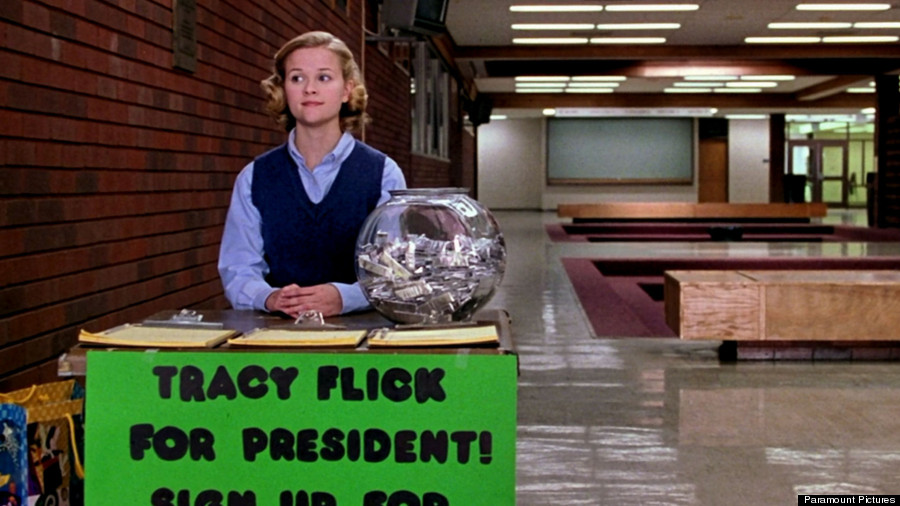
Reese Witherspoon runs for office in high-school satire Election

Director: Alexander Payne

Cast: Matthew Broderick (Jim McAllister), Reese Witherspoon (Tracy Flick), Chris Klein (Paul Metzler), Jessica Campbell (Tammy Metzler), Phil Reeves (Principal Walt Hendricks), Molly Hagen (Diane McAllister), Colleen Camp (Judith Flick), Delaney Driscoll (Linda Novotny), Mark Harelik (Dave Novotny)

High school can be a great setting for films that want to comment on our adult world, because they are such exact microcosms for society. Few films get this idea as effectively as Alexander Payne’s simply superb Election.

In an Illinois high school, Jim McAllister (Matthew Broderick) is a civics teacher who loves his job but is increasingly annoyed by high-achieving student Tracy Flick (Reese Witherspoon), who he also unconsciously blames for the dismissal of his friend Dave for having an affair with her. Tracy is a ruthless careerist, the sort of girl whose hand is always first up in class, and she wants more than anything to win the election to school president. Feeling it his duty to stop Tracy, McAllister persuades football star Paul Metzler (Chris Klein) to run against her – and slowly unleashes a hurricane of ruthless campaigning and dirty tricks that leads to disaster.

This sharp and brilliant satirical comedy avoids jumping to any easy conclusions: instead it ruthlessly skewers everyone involved. Other films would make McAllister a crushed victim, broken down by events and Tracy’s unstoppable force of will. Instead, Payne turns him into an increasingly self-deluding whiner whose impending mid-life crisis becomes more and more evident. There is a particularly sly decision to cast Broderick as this weak-willed, selfish, self-proclaimed victim. Who cannot think about Ferris Bueller now all grown up into a klutzy loser, ineptly trying to initiate an affair with his wife’s best friend and mentally super-imposing Tracy’s head onto his wife’s body during a routine pregnancy-focused coupling?

In fact, watching the film it’s fascinating to see how much it charts McAllister’s disintegration into bitterness and self-justification. By any measureable standard, everything he does is fairly indefensible, while his annoyance with Tracy is rooted in his barely self-acknowledged sexual fascination with her. By the end of the film, as his cheery voiceover recounts his failures and personal and professional disasters with a self-deceiving optimism, you can’t help but begin to wonder how much this manic cheerfulness infected everything McAllister has told us from the start.

It’s things like this that make the film so much more than a straight political satire. Tracy Flick may be a ruthlessly ambitious young woman, who believes she has a nearly divine right to win – but she’s also the child of an equally ruthless woman (using Tracy to relive her own life), who has been sexually exploited by one of her teachers, whose smiles and enforced cheerfulness and drive hide a volcanic anger and insecurity. She could have been simply a smiling force of political ambition – but instead she feels like a real person diverting her own problems into a domineering careerism.

All of which adds a rich hinterland to the film and helps make it even funnier than it could have been. This might be the best political satire ever made. It’s certainly one of the funniest. There are zinger lines every few minutes. The satire is pin-sharp. Tracy is the qualified political hack that the normal people can’t relate to. Paul the Bush-like jock who can speak the language of the common man but manifestly lacks all qualifications. Tammy represents the anarchic frustration and alienation so many feel for the political process. The entire election is a shrewd, subtle skewering of every campaign in politics you’ve ever seen. Even the jobsworth geeks who run these things get it in the neck – “Larry, we’re not electing the fucking Pope” McAllister snaps (at the end of his tether) as he has the ludicrously elaborate election rules explained to him again.

But the film doesn’t forget the humanity: McAllister is a deluded man, but he feels real. He’s so inept at everything from seduction to deception it’s hard not to feel a little sorry for him. (As if to visualise his uselessness, he spends the last third of the film mostly with a massive swollen eye from a bee sting). Tracy has her own problems. Paul, far from being a heartless jock, is the most sensitive and caring person in the film (even if he is as dim as a failing lightbulb). Tammy’s a touching combination of good natured cynicism and obsessive, vengeful stalker.

Of course, it also helps that the acting is outstanding, the comic timing (both in acting and direction) perfect. Reese Witherspoon might never have been better than as the ruthless Tracy, a hurricane of hilarious repeated concepts from political biographies. Chris Klein is very sweet as Paul, a guy it’s impossible not to like. Jessica Campbell is perfect. Broderick holds the entire film together with a superb schleppy moral weakness. Payne’s direction brings all these elements together brilliantly – and has a way with the freeze frame and quick edit that provides a series of striking visual gags.

Election is a classic film – a brilliant satire on politics and elections, but also human nature itself. The characters have depth and reality that makes the jokes hit home with force. The use of voiceover narration from all the main players helps bring us even closer to them, and helps expose their inner personalities even more. I think this might be the best film Payne has made – Sideways and The Descendantsreceive the greater plaudits and attention, but this is his sharpest, wittiest film, and the one that is perhaps the most rewarding of repeat viewing. It’s simply a brilliant, small scale classic.

Clueless (1995)


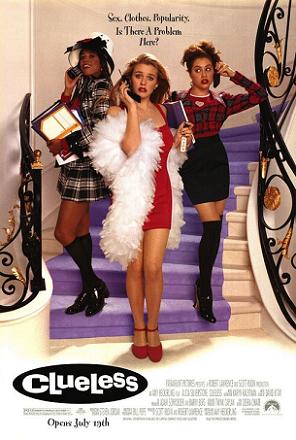
Alicia Silverstone leads her in crowd troop in neat Jane Austen reimagining Clueless

Director: Amy Heckerling

Cast: Alicia Silverstone (Cher Horowitz), Stacey Dash (Dionne Davenport), Brittany Murphy (Tai Frasier), Paul Rudd (Josh Lucas), Dan Hedaya (Mel Horowitz), Elisa Donovan (Amber Mariens), Justin Walker (Christian Stovitz), Wallace Shawn (Mr Hall), Twink Caplan (Ms Geist), Breckin Mayer (Travis Birkenstock), Jeremy Sisto (Elton Tiscia)

The 90s saw a rash of films that reworked classics into US high-school settings, aimed squarely at the teenage market. One of the most successful of these was Clueless: a decent, just-smart-enough reimagining of the plot of Jane Austen’s Emma.

Austen’s wealthy, match-making heroine here becomes Cher Horotwitz (Alicia Silverstone) – queen bee of the in-crowd in her high school. Like Emma Wodehouse, Cher is smart, beautiful and taken to meddling in the lives of those around her, sure she knows best about how they should behave – and whom they should date. She can be selfish and self-obsessed, but beneath it is fundamentally good-natured. When new girl Tai (Brittany Murphy) arrives at the school, Cher sees the scope for a makeover project – but it’s Cher herself who undergoes the greatest transformation.

The obsessions with status that populate Austen’s world actually translate very well into the high school setting, with its in and out crowds. It also a very neat restructuring of the novel, hitting all the basic plot points of Austen’s story, with some smart translations into the modern world (Christian – the Frank Churchill role – is particularly well updated). The film is sprinkled with sharp lines and snappy dialogue exchanges, and the cast are certainly in on the joke, walking a fine line between parody and playing it straight. This all contributes to the film’s fizzing energy and its charming momentum – you can see why teenagers loved it, as Heckerling has a wry wink at the camera at the concerns of teenagers, but also celebrates their potential for fun and friendship.

Watching the film over 20 years on, it’s remarkable how successfully it used the limitations of Alicia Silverstone to such great effect. It’s a bit bizarre to think Silverstone was considered the next big star of Hollywood, considering how few of her films have made any impact since this. However, here her lack of depth and shading, her unmodulated voice and rather bland style somehow work perfectly with a character who is superficial and who believes she is far cleverer than she actually is.

Clueless is that strange thing – a star-making turn that didn’t make a star, but Silverstone clicks perfectly into this role, making Cher engaging and rather charming despite her self-obsession. She delivers what the film requires in spades, even if Cher’s late character blossoming seems something required for the film’s plot rather than growing truly organically over the course of the film.

This abrupt burst of “learning and growing” partly clunks because Heckerling shies away from Emma’s more negative characteristics – tellingly, Emma’s public shaming of another character is here given to a different character. Can’t have anyone not liking the heroine for a second can we? In fact this determination to make Cher constantly as likeable as possible does rather miss the point of the original novel. It also reduces the “tension” (we all know how stories like this end!) of whether the heroine has driven her love interest away through her mistakes and missteps – and with less for the heroine to learn about herself, and less damage to repair in the relationship with the object of her affections, there’s proportionally less emotional impact to the final happy ending.

Speaking of that romantic plotline, you also can’t talk about the film without also commenting on the fact that it makes a bit of a fudge around the attraction between Cher and Josh, who (the film is at very great pains to point out) are not actuallysiblings, but do share the same father/step-father. It’s actually quite a weird twist, but I suppose just as retrospectively unsettling as Mr. Knightley loving Emma from afar from a ludicrously young age. It’s funny though to watch the film fall over itself to hammer home the non-family relationship between the two characters early on, so we don’t start shrieking “incest” by its conclusion.

All in all, the film – like its heroine – is a sweet, but superficial, candyfloss concoction, without the depth that could have lifted it from pleasing popcorn fare to satisfying story.

WarGames (1983)


“Would you like to play a nice game of Chess” – if only he had said yes…

Director: John Badham

Cast: Matthew Broderick (David Lightman), Dabney Coleman (Dr John McKittrick), John Wood (Dr Stephen Falken), Ally Sheedy (Jennifer Mack), Barry Corbin (General Beringer)

If you worked in a nuclear launch centre and received orders to launch out of the blue, would you want to make a phone call to confirm? That’s the compelling idea that opens this tense but engagingly playful film on nuclear politics that successfully balances teen high-school drama with the possibility of Armageddon. For the record, the man who wants to make the call (played by Leo McGarry himself, John Spencer) outrages his subordinate so much with this breach in protocol that the subordinate pulls a gun on him and demands he follows the orders.

David (Matthew Broderick) is that staple of high-school drama, the geeky genius who coasts through school. He’s a computer genius and, attempting to impress cool girl Jennifer (Ally Sheedy), one-day he finds a back-door into NORAD’s weapons control system WOPR (aka JOSHUA). Thinking he’s found a computer games company, he accepts its invitation to play “Thermonuclear Global War”. Before he knows where he is, he’s in custody and bombs are fueling in their silos.

The opening of the film (a brilliantly self-contained mini-movie) perfectly encapsulates the swiftness of escalation in a nuclear war. At least three more times in the movie, we see how swiftly events can push on from DEFCON 5 to 1. This is a film that questions the very purpose of both the nuclear deterrent and nuclear war itself. There isn’t a single character who truly advocates the purpose of the weaponry, and none of them is anything but terrified at the prospect of pushing the button. But this questioning is handled lightly, and Badham’s direction never allows it to dominate proceedings. The film tackles such a big topic with such a sharp and fun script, and at such a rollicking, enjoyable pace with laughs and thrills, that it must count as a some sort of minor classic.

The film is also of course about computers and hacking. There is actually a lot of charm in watching, on my tablet, a film where a computer takes up the space of a room and an actual telephone is used to hack into an external network. This is probably one of the first films ever to demonstrate hacking and the potential influence of computers. Thrillingly, the film has both a warm acceptance of the advantages computers could bring, and a suitably sci-fi dread of what they may (unwittingly or not) unleash on the world if granted full power over us.

Because this film recognises, arguably ahead of its time, that the mechanisation and omnipresence of computers is terrifying. Like John Spencer in the film’s opening, most of us (I hope!) would want to speak to another human being before pressing the buttons. JOSHUA is scary because it is so benignly controlling – it believes that nuclear war is just another game, and has no understanding at all of the impact on the world its actions will have. JOSHUA isn’t a villain at all – it’s literally an ill-educated child that hasn’t learned its actions have consequences and can’t tell the difference between simulation and reality. It’s the nightmare scenario of having all the empathy and emotional intelligence removed from the world of decision-making.

This isn’t just a film about technology and nuclear politics though – far from it. It’s an engaging human story, told in a tight and streamlined way, and staffed by a very well written selection of characters who all feel tangible and real. Broderick and Sheedy are wonderfully engaging leads, with a great deal more depth than the cliché: David is far more assertive and determined than you might expect, while Jennifer has much more sense and humanity than a high-school Queen. This extends to our NORAD location: Dr McKittrick is far more empathetic and willing to listen than first impressions suggest, and General Beringer is a thoughtful, sensitive man at odds with his obstructive, gung-ho first impression. John Wood (a great stage actor who never quite got the film roles he deserved) plays Dr Falken with wit and a knowing wink, his disillusionment with the world sitting alongside a wry delight.

I was actually surprised how much I enjoyed this film and how well it stands up. It’s thought-provoking but it’s also a lot of fun and very well written, acted and directed. There is a very good mixture between “action” sequences – a wild drive and run to get into NORAD before it is locked down is particularly exciting – and conversation scenes that, due to their high stakes and impassioned acting, play like verbal action scenes. It’s superbly designed too, with the NORAD “war room” in particular setting the pattern for all such locations in future movies.

This is a perfect marriage between the blockbusting mindset of the 1980s and the cynicism of the 1970s. Because it’s a blockbuster and has kids in leading roles, it’s never got the credit it deserves – but this has as much merit as many political and conspiracy thrillers of the cynical 1970s.