Category: Historical epic

A Night to Remember (1958)

A Night to Remember (1958)

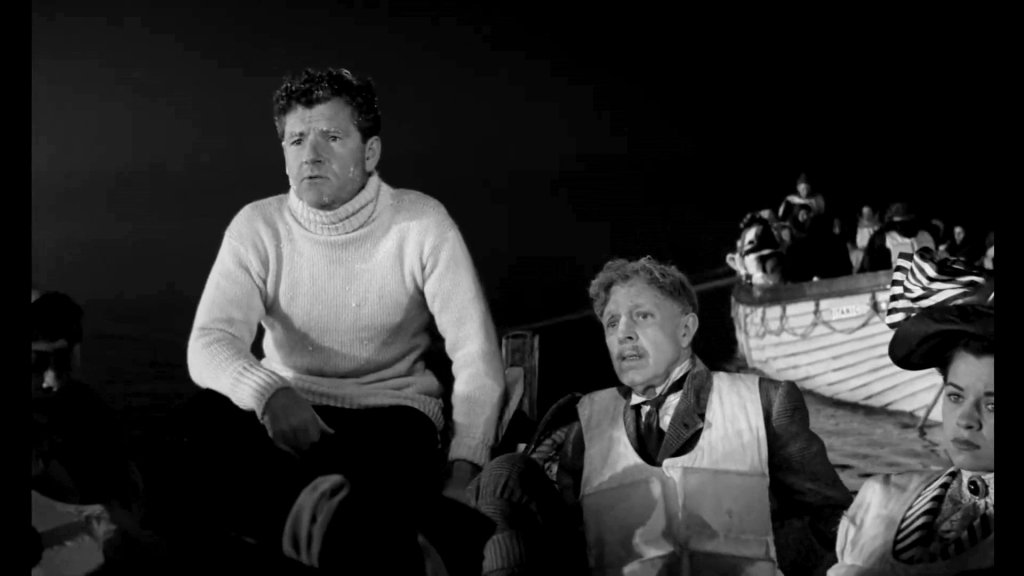
Still one of the definitive Titanic movies, a compelling documentary-influenced look at the disaster

Director: Roy Ward Baker

Cast: Kenneth More (Charles Lightoller), Michael Goodliffe (Thomas Andrews), Laurence Naismith (Captain Edward Smith), Kenneth Griffith (Jack Phillips), David McCallum (Harold Bride), Tucker McGuire (Molly Brown), Frank Lawton (J Bruce Ismay), Richard Leech (William Murdoch), John Cairney (Murphy), John Merivale (Robbie Lucas), Honor Blackman (Liz Lucas), James Dyrenforth (Colonel Archibald Gracie IV), Anthony Bushell (Captain Arthur Rostron)

The sinking of the Titanic on 14 April 1912 is one of the most iconic events in twentieth century history. A Night to Remember brings the ship’s final hours to life in forensic detail, based on Walter Lord’s carefully researched book. Told with documentary-style distance, mixed with admiration for stiff-upper-lip British pluck, the film cemented many people’s perceptions of the night of the sinking and remains one of the best-known films about the disaster.

To tell the story, the production decided it needed a central figure and selected Second Officer Charles Lightoller, recruiting a British star to play the role. And no one did bluff, charismatic middle-class decency better than Kenneth More, born to play roles like this. Lightoller would be placed at the heart of the keep-calm-and-carry-on evacuation of the ship, More’s reassuring presence letting the audience know everyone involved was doing their best under impossible circumstances.

A Night to Remember remains very effective. It’s special effects and recreation of the ship are highly impressive. Even tilting sets were built to replicate the ships list, meaning drinks tilt in glasses and the careering skid of a dinner cart in the dining room was done for real. But where it really scores is its effective capturing of a very particular British mood: the determination to carry-on in terrible, appalling circumstances. While it’s easy to look at this unflappability in the face of disaster as almost comic, what’s so effective in A Night to Remember is that below the surface it’s clear almost every single character is screaming in terror.

You can see it in the shell-shocked disbelief of Captain Smith (a very effective Laurence Naismith, an excellent portrait of man in ultimate authority with no power at all to affect the situation) who stares with shame at the hundreds of people he can’t save. It’s in the guilt of Thomas Andrews (Michael Goodliffe, full of wry humour that slips away leaving him a shell) who blames himself and vainly tries to save others without creating panic. The grim-faced determination of radio operator Jack Phillips (a remarkably restrained Kenneth Griffith) who taps out the SOS until the bitter end. These feelings are carefully hidden and suppressed – for the good of morale – but the screaming panic and despair of the passengers in the final moments of the ship are simply giving voice to hidden feelings earlier.

What comes across very well in A Night to Remember is the utter powerlessness of the situation, matched with the bad luck and poor preparation that condemned more to death. It’s clear to everyone in authority, from the start, that there are insufficient lifeboats and quickly becomes apparent no help is not coming. While not raising enough urgency around the evacuation did contribute to deaths, it’s also clear to the officers it’s the only way they can hope to maintain any sense of order for as long as possible. If they fronted up on the real disaster heading their way, those guns they grab from the armoury would have all been exhausted keeping control.

A Night to Remember subtly suggests the fault is not personal, but somehow systemic: that Titanic is just the rash a whole host of societal problems have come out in. You can see the arrogance and unwillingness to question in the huffy pretension of the man on the train who pulls Lightoller up for mocking a soap advert that celebrates the ship. The behaviour of many of the passengers that safety precautions are at first an imposition, then that their class and position should automatically entitle them to particular treatment. The thudding refusal of many to accept the reality that the unsinkable ship can go down. The stunned look on people’s faces when the truth hits them and, as Lightoller says late in the film, it suddenly feels like they can never trust so blindly again.

Alongside this, it’s a tribute to bravery and self-sacrifice, often expressed with that classic British reserve and dry humour in the face of imminent disaster. From Lightoller and the sailors who fight, up the final moment, to assemble two collapsible boats even as the deck sinks under water around them to the engineering crew who willingly agree to stay below deck to keep the power on – a certain death sentence (“And it’s my birthday today and all” someone good naturedly moans, while the others gather a water-logged cup of tea). Perhaps uniquely for Titanic films, there isn’t even a villain: it’s one of the few adaptations that doesn’t show Ismay (a never-the-less pompous and weasily Frank Lawton) ordering the ship to go faster. In fact Ismay is shown energetically throwing himself into the evacuation (even told to stop trying to help by Lightoller) who steps into a boat (self-loathing covering his face) only when no one else tries to take one of the available seats.

Despite which, the film doesn’t avoid the fundamental errors. The treatment of the second and third-class passengers is shockingly abrupt and impatient, as if the saving of their lives is an inconvenience on a busy night – by the time they are allowed on deck, one plaintively moans that the lifeboats have already left. A group of bellboys are ordered to remain where they are (and instructed to not smoke!) condemning them. As the scale of the disaster grows, several passengers in under-filled boats complain that they are ‘already too full’ to go back for survivors. Even Lightoller’s decisions (interpreting ‘women and children first’ as ‘women and children only’, a decision that led to half-full boats sent away) are criticised.

A Night to Remember also sprinkles itself with several touching personal stories that carry real impact. The first-class passenger who asks Andrews for a no-bullshit appraisal, then quietly ensures his wife and sleeping children board a lifeboat. The Stausses who refused to separate and go down with the ship. A lost child saved from trampling by a steward, who promises him it will all be over soon as they sink. The young couple crushed by a falling funnel. The heartless card sharp who turns out to have a capacity for calm self-sacrifice.

And it could all have been avoided. More than any other film A Night to Remember focuses on the unquestioning crew of the Californian who watch the sinking from ten miles distance (including the never-ending launch of emergency rockets) but having no instructions or initiative don’t do a thing (they switch their radio off rather than try and find out more). The rigid mindset of the system right there: disasters just don’t happen to British ships (Britannia rules the waves after all) so no reason to rock the boat. They are contrasted with the professional urgency of the Carpethia (who did leave their radio on) who race against hope to help.

A Night to Remember captures this all extremely effectively, remaining a powerful and documentary look at the simple facts of the world’s second most iconic (after Pompeii) disaster. Full of some very fine performances and shot with a pacey assurance by Roy Ward Baker, it remains one of the definitive studies of the diaster.

Mutiny on the Bounty (1962)

Mutiny on the Bounty (1962)

Epic retelling that sticks with the same melodrama and nearly destroyed Brando’s career

Director: Lewis Milestone (Carol Reed)

Cast: Marlon Brando (Lt. Fletcher Christian), Trevor Howard (Captain William Bligh), Richard Harris (John Mills), Hugh Griffith (Alexander Smith), Richard Haydn (William Brown), Tarita Teriipaia (Princess Maimiti), Matahiarii Tama (Chief Hitihiti), Percy Herbert (Matthew Quintal), Duncan Lamont (John Williams), Gordon Jackson (Edward Birkett), Chips Rafferty (Michael Byrne), Noel Purcell (William McCoy), Tim Seely (Midshipman Ned Young), Henry Daniell (Admiral)

After the success of Ben-Hur, MGM thought it had cracked the mystery of making those cash-registers go ring-a-ding: massive historical pictures, with scale and run-time dialled up to “epic”. Mutiny on the Bounty was one of the most famous stories of all time and they’d had signed up Marlon Brando, universally seen as the greatest actor alive. It couldn’t go wrong, could it? Months of shooting and a disastrous box-office release later (despite a MGM campaign that landed this a Best Picture nomination), and Mutiny on the Bounty effectively destroyed Brando’s career for the next ten years and became a by-word for star excess.

Brando played mutineer Fletcher Christian – but in a manner completely different from Clark Gable (who, Brando disparagingly stated, only played himself minus the moustache). Brando’s Christian would be British and then-some: posh, foppish, a gentleman torn between the rules of society and those of fair play. Bligh – played with a constant sneer by Trevor Howard – would follow in the footsteps of Laughton, but Brando wanted to make something more serious, more historical. Less of a blood-and-thunder naval drama and more a character study that would give a fair crack of the whip (so to speak) to the Tahitian natives the mutineers lived among.

The film we ended up with though is no more historically accurate than the 1935 Best Picture winner. Part of the film’s disastrous reception might well be that this epic tells more-or-less exactly the same salacious story of a devilish sadist scowling as he whips men to death (far from the truth of the real Bligh, a poor leader but not a monster) until his noble number two steps up (the real Christian was a spoilt weakling) but in what feels like twice the time with half the fun. If you want to watch this version of the Bounty story, why would you want to choose this one? (We’d have to wait until the 1984 version for a more fair-handed telling.)

Not that Mutiny on the Bounty is as terrible as its reputation suggests. It touches – particularly in its thoughtful post-mutiny coda on Pitcairn island – on an interesting character study of the mixed motivations of Christian, filled with regrets and self-pitying sulking. It wants to explore where the balance lies between what is right by the letter of the law and by its spirit. Nothing Bligh does in the film is wrong as such, but his relish and zeal in doing it are. Christian isn’t a conventional hero, but a smirking, foppish character prone to snide remarks and affecting an air of disconnected duty for large chunks of the film. If the film had allowed Bligh more sympathy, rather than the two-dimensional monster he’s portrayed as here, it might have made for an interesting character clash.

Instead, it tends to be slow, self-important and pompous, not helped by Brando’s indulgent performance which sacrifices drama for portentousness. For all the film offers a cartoonish villain, it’s resolutely unfun and deathly serious. Shot with a professional, disengaged widescreen flatness by Milestone (called in from decades of retirement as a “safe-pair of hands”, after the sacking of Carol Reed), it’s uninspired and mistakes size for visual interest. The ship, in particular, is shot with a wide-angled spaciousness which feels completely wrong for a location supposed to be ripe with claustrophobic tension.

The drama attempts to make up for this with its parade of lashings, keel-haulings and bodies (or obvious dummies) tumbling to their death from the rigging. Trevor Howard delivers exactly what’s asked fork here, sneering and constantly in the wrong. It’s one of the film’s failings that it leans into psychological complexity in some places, while most of its events and its second lead are presented with cartoonish silliness. Its location shooting in Tahiti looks great (although the all-too-obvious intercutting of this with scenes on sound stages, sometimes from one cut to another, jars) but a widescreen image of glistening sea would look gorgeous in even the most workmanlike hands.

Perhaps the film is, at times, a chore because it all too clearly was for many involved. Reports of Mutiny on the Bounty have regularly focused on its disastrous making, with directors fired, location shoots awash with dysentery, shooting months over schedule. Above all, Brando rewriting the film on the fly, muscling a disinterested Milestone aside to direct certain scenes. Not a surprise that the studio decided all the blame would be dropped on him not them (they were also stung by the contract they gave him, at $5k a day overtime, Brando’s perfectionism becoming one of the main factors of the film going months over schedule), leaving him virtually unemployable for a decade.

But is that fair? Brando arguably become the awkward, unlikeable, misunderstood Bligh with the cast and crew as the mutineers, all of them intent on a voyage of mutual self-destruction. Put simply, this was a clash between Brando’s immersive, deep-dive acting style and Old Hollywood. To Brando “professional” meant something very different to the “hit-your-marks-say-your-words” attitude of Milestone and the crew: it meant searching over time for the heart of a character. The sort of psychological depth Brando was aiming for was just anathema to many of those he was working with, coming across as the unprofessional self-indulgence of a spoilt star. Combine that with Brando’s stand-offish shyness and professional selfishness and you had a recipe for disaster.

Severed from any director he respected (he made it all too clear he considered Milestone a hack studio Yes-Man) and with no-one having either the power or inclination to restrain him, Brando threw every idea he had at the screen, no matter how awful. So we got Christian with a ludicrous, giggle-inducing accent, a performance stuffed with foppish eccentric touches (and awful costume choices) that aims at thoughtful re-invention but comes across as a camp, bizarre mess. The tragic thing is Brando is clearly passionate about the project, putting more thought and commitment into this performance than he ever offered in barely-bothered turns in films like Sayonara.

Brando was also working with a group of Reed-recruited actors with no sympathy for him. This group of macho British and Irish heavy-drinkers (Hugh Griffith, in a crucial role, frequently disappears for no reason as his alcoholism eventually became such a burden he was fired mid-shoot) had no sympathy for the fey Brando or his acting style. Richard Harris’ loathing of his co-star – who responded to their open dislike with petty on-set power-plays, only making the whole problem grow – in particular is all too-clear. Brando looks most comfortable working with the Tahitian actors (he had long been a passionate anti-racist campaigner) and later married Tarita Teriipaia. It’s one of the few times where he makes Christian feel fully human rather than a mixed bag of conflicting actorly tricks.

Mutiny on the Bounty has its moments: unfortunately it’s all the wrong ones. For a film that wanted to be a more serious, historical exploration of the mutiny, its best parts revolve around Howard’s lip-smacking villainy, combined with flashes of its on-location shooting. Problem is, that’s not dissimilar from what we got in the 1935 original – and really you’d just be better off watching that.

Die Nibelungen (1924)

Die Nibelungen (1924)

Wagnerian epic is crammed with gorgeous, dramatic imagery and relentless pace

Director: Fritz Lang

Cast: Paul Richter (King Siegfried of Xanten), Margarete Schön (Kriemhild of Burgund), Hans Adalbert Schlettow (Hagen of Tronje), Theodor Loos (King Gunther of Burgund), Hanna Ralph (Queen Brunhild of Isenland), Rudolf Klein-Rogge (King Attila), Bernhard Goetzke (Volker of Alzey), Rudolf Rittner (Margrave Rüdiger of Bechlarn), Georg John (Mime the Goldsmith/Alberich the Dwarf/Blaodel)

Fritz Lang wanted to create a film that would help a shell-shocked Weimar Germany start to feel proud of its heritage and culture. He would do this with a film of the legend of Siegfried. It’s not really Lang’s fault that this Aryan feel-good stuff, coupled with Lang’s flawless visual compositions dripping with power and authority, would turn into the wet dreams of the Nazi party Lang fled Germany to escape. Die Nibelungen has unfortunate associations, but it stands as a towering pinnacle of Lang’s visual artistry. An adaptation of the legend, not the Wagner operas, Lang created something both mystic but also subtly questioning the idealistic figures it celebrates.

He would do all this in two (epic of course) films, totalling almost five hours. In the first Siegfried, the hero (Paul Richter) overcomes dragons and murderous dwarves to gain powers of almost (that almost is key) total invulnerability, strength and invisibility. Powers he puts to the test to win the weak King Gunther of Burgundy (Theodor Loos) the hand of Brunhild (Hanna Ralph) by invisibly aiding Gunther best this Valkyrie at a series of challenges. He even takes on Gunther’s form to help lead Brunhild to the bridal bed. Brunhild however discovers the truth from the loose lips of Siegfried’s wife (and Gunther’s sister) Kriemhild (Margarete Schön). Brunhild’s tricks Gunther and his loyal heavy Hagen (Hans Adalbert Schlettow) to murder Siegfried via a spear in his one weak spot. In Kriemheld’s Rache, Kriemheld plots the destruction of everyone who conspired in the death of her husband, via a marriage with the warlord Attlia the Hun (Rudolf Klein-Rogge).

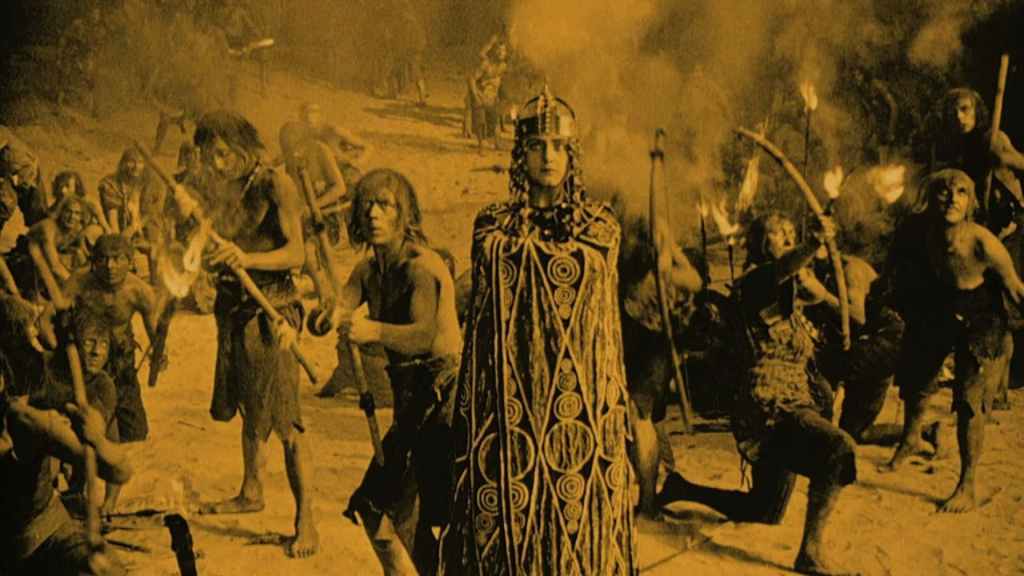
The first thing that strikes you about Die Nibelungen – aside from its surprisingly electric pace – is the powerful, undeniable beauty of nearly every single frame. Lang composed each image as if it was a painting, from Siegfried introduced in steaming smoke at the forge, to the formalist imperialism of the castle of Burgandy and the rigid order and symmetry of its soldiers. Locations, from grand castles to mystic forests, underground caverns full of scheming, wicked creatures are superbly bought to life. There is a martial power Lang’s composition of so many of these images, their perfect angles and symmetrical blocking: parts of Die Nibelungen are some of the greatest pageantry displays in movies.

There is a wonderful sense of overblown, geometric, artificiality in all this – Lang deliberately creates a world larger than life and full of the unworldly and impossible. Buildings tower over crowds, courts that hold thousands to view events of grand importance, sieges of burning halls that fill the frame, staircases up impossibly high buildings. The sort of world of medieval excess where Gunther and Kriemheld disembark from a boat by walking across a bridge of shields created by half-submerged knights. Power and magnificence come from every frame.

It’s matched with an impressive creation of the bizarre and magical. Of course Siegfried kills a giant, animatronic dragon (strangely it’s obvious – even then surely – fakeness works in a film where everything is a heightened, from the emotions to the buildings to the costumes). Siegfried trains in something not far off from Vulcan’s forge and the forest feels like a sort of fairy-tale wonderland. Lang pioneered cross-fades and double exposures to make extraordinary effects, as Siegfried disappears under a veil of invisibility and jumps impossible distances. There is an extraordinary shot where Brunhild, still in the midst of her Valkyrie-like super-powers, seems to jump straight into the camera lens at full force. A beautiful edit sees a tree seem to reform itself into a skill in front of the eyes of the grieving Krimhild.

But Die Nibelungen places its world of power and magical forces in an increasingly costly human world of realpolitik and conspiracy, where its mystical but naïve and simple hero is out of step. Even before then, Siegfried’s status as a hero is subtly questioned. The dragon he kills seems a peaceful, inoffensive creature for all is scale, sitting placidly when Siegfried attacks and stabs it in the eye. Lang introduces a lovely touch where it’s dying tail flick will send the leaf that shields a crucial spot of Siegfried’s back from the torrent of invulnerability-granting dragon’s blood he bathes in. Siegfried is easily manipulated by the dwarf Albereich (a Gollum-like, uncomfortably antisemitic in appearance) before a large dose of luck allows him to defeat his opponent and gain the treasure of Nibelungen.

At the court of Burgundy, for all his courage and blunt honesty, Siegfried is at sea among the subtle power dynamics. The kingdom is ruled by chronically indecisive weakling Gunther (a snivelling Theodor Loos), easily manipulated by Wagnerian-costumed Hagen (an imposingly arrogant and faintly psychotic Hans Adalbert Schlettow). Siegfried’s main acts are to trick and then break the resistance of Brunhild (a dynamic Hanna Ralph) while impersonating the weakling – hardly acts to brag about, which doesn’t stop Siegfried doing exactly that to his wife who then blurts it out to Brunhild in a fit of pique. This isn’t a hero covering himself with glory, just as even the formally idealistic Brunhild (much to her later self-disgust) is reduced to scheming and plotting revenge, a far cry from the noble actionee she prided herself on being.

It’s not a surprise to find Part 2 heads into a Götterdämmerung as Kriemhild’s obsessive, destructive desire for revenge against Hagen (her husband’s murderer) meets with Gunther’s own stubborn-short-sighted protection of his controlling vassal. Nearly half of Part 2 is dedicated to the prolonged siege of the King and his followers by the massed armies of Kriemheld’s new husband Attila the Hun, her manipulations of him helped a great deal by Hagen’s arrogant, impulsive violence against Attila’s people. This extended battle sequence is astounding in its scale, violence and excitement – you can see the influence it had on The Two Tower’s Helm’s Deep – and is shot with the same visual mastery as the more stately first half, even as it seeks into bloody desperation.

It must be stated that Die Nibelungen does feature more than its share of clumsily presented racism. As mentioned, the hook-nosed, gold-obsessed, murderous dwarf Albereich is a painful antisemitic stereotype. Rudulf Klein-Rogge is caked under layers of make-up as the ugly, Slavic Attila while his Hun army resemble crouching Orc like figures, frequently ripe for the sword edge of the relentless German soldiers. It’s the uncomfortable flip side of the Aryanism idealism and romantic framing given to Siegfried, that these un-German figures are painted so monstrously.

But Die Nibelungen’s subtle criticism of the flaws in its German leads – it would go some to call them heroes – balances this out. From the flawed, empty-headed, foolishness of Siegfried to the increasingly sadistic, unrelenting cruelty of Kriemheld (Margarete Schön’s performance is excellent, going from sweetly retiring to unblinking fanaticism over the course of the film) the Germanic characters are compromised, weak and cruel: Hagen and Gunther are no one’s ideas of admirable figures. Compared to them, for all his clumsy racist appearance, Atilla feels like a reasonable figure, loving his family, caring for his people and refreshingly free of vindictiveness and cruelty.

It makes for an intriguing complex undercurrent in a film which, of course, the Nazis interpretated entirely on surface-appearance as a celebration of Aryan super-might. Or at least they did for Part 1 – even they couldn’t kid themselves that Part 2 didn’t quite fit that bill. Today Die Nibelungen provokes the same interesting thoughts. But above all it’s a visual marvel from a gifted film director, a truly painterly masterpiece that, for all its great length, never flags and offers a new marvel, camera trick or miraculous composition with every frame. This is silent cinema at its best.

Napoleon (1927)

Napoleon (1927)

Gance’s monumental film takes the breath away, packed with innovation, invention and drama

Director: Abel Gance

Cast: Albert Dieudonné (Napoléon Bonaparte), Edmond Van Daële (Maximilien Robespierre), Alexandre Koubitzky (Georges Danton), Antonin Artaud (Jean-Paul Marat), Abel Gance (Louis de Saint-Just), Gina Manès (Joséphine de Beauharnais), Vladimir Roudenko (Young Napoléon), Marguerite Gance (Charlotte Corday), Yvette Dieudonné (Élisa Bonaparte), Philippe Hériat (Antoine Saliceti), Max Maxudian (Barras), Annabella (Violine Fleuri), Nicolas Koline (Tristan Fleuri)

There is a marvellous quote from Victor Hugo when he wrote about the young life of the most famous Frenchmen who ever lived: Déjà Napoléon perçait sous Bonaparte. Which roughly translates as ‘already Napoleon was bursting through Bonaparte’ – or to put it another way, the man was already being consumed by the legend. That idea dominates Abel Gance’s extraordinary, epic, retelling of the Young Napoleon’s life, an origins story that sees a young man become increasingly distant and legendary before our eyes. Gance’s film may be resolutely old-fashioned in its historiographical approach, but is revelatory in its cinematic flair and invention, with almost every scene demonstrating Gance pushing the medium in new directions.

Napoleon was planned as only the first of no-less-than six films that would cover the cradle-to-grave story of the man who defined his whole era. Such was Gance’s ambition through, that even across five hours he felt he had only scratched the surface of the first 27 years of Napoleon’s (Albert Dieudonné) life from his childhood education (snowball fights and all) at Brienne – where he is seen as a Brutish Corsican outsider – via the French revolution, his failed attempt at revolution in Corsica, his successful siege of Toulon and promotion to General at 24, nearly losing his life in The Terror, Thermidor and his crushing of the Vendemaire uprising, marriage to Josephine (Gina Manès) and the beginning of his campaign in Italy.

Gance unfolds this in a film brimming with cinematic verve and invention. Much like its lead character, it is a seismic and larger-than-life (literally so in its most famous innovation, the three frame wide-screen effect achieved for its final twenty minutes). Napoleon practically defines the notion of historical epic, reproducing many at historical events at a 1:1 ratio. At its centre is a magnetically hypnotic (almost literally) performance from Albert Dieudonné (so enamoured with the role, he was buried in his costume) juggling the impossible by suggesting some of the many shades of this fascinating figure, part revolutionary, part tyrant, part romantic, part war-monger.

There is something truly striking and original in every frame of Napoleon. Gance presents a picture of the famous general more than touched with an old-fashioned Great Man theory of history, but still suggests he is almost two men in one. He is Bonaparte, the slightly-chippy, awkward young man who clumsily woos Josephine (barely sure where to do with hands, tugging shyly at his sash), struggles to get noticed in a map-making office and finds it challenging to make friends, either at school (where he is a painfully serious outsider) or as an adult. But he is also Napoleon, the totem of history who Gance frequently frames as almost communing with a historical version of himself.

This Napoleon bursts from the awkward Corsican shell of Bonaparte. Gance frequently frames him almost confronting the camera, light shimmering around him to form halos, with a piercing stare that freezes people into place. He comes to identify himself with the flag and the revolution. So much so that, in his escape from Corsica, he will be borne across the seas by a tricolour jerry-rigged into a sail and visualise himself being hailed by the executed ghosts of the revolution as its natural heir. Indeed, the film ends with Napoleon atop a mountain starring into a montage of his future achievements, as if he was bending history around him.

Which isn’t to say Gance sees him as a constantly sympathetic figure. While there is no question he is a force of nature – he controls the frame, frequently centred and when the camera moves (such as the careering gallop that takes him to Italy) he is always at the eye of its propulsive tracking shots – he is also an imposing, even scary figure, distant and cold. In dyed red frames, he looks positively demonic, such as when he looms forward out of the rain in Toulon, his face filling the frame to demand relentless attack. His self-identification with the revolution becomes monomaniacal.

Gance re-enforces his distance from normal human reaction by returning constantly to the Fleuri’s, a working-class family who shadow the Great Man (Violine loves him hopelessly and her father and brother worship him) but whom he never notices. It’s part of him being crafted into marble before us – with all the terrifying lack of human understanding that suggests. Throughout he’s shadowed by an eagle, a visual representation of his mystical, greater-than-human nature, a bird of destiny that drives him relentlessly on. He’s contrasted constantly with other would-be leaders: the itchy Marat, the empty windbag Danton and (most noticeably) the curiously ineffectual Robespierre, an uncharismatic man who can’t control a crowd, is lost behind darkened glasses, follows the orders of others and is comically dwarfed by an eagle statue not elevated by it.

Gance’s history has a slight school-book Victorianism to it. He’s very proud of “historical” facts – quotes and events are frequently branded with the on-screen phrase “(Historical)” so we can see his behind-the-scenes research – and has more than a little love for irony. Of course, the final island covered in school-boy Napoleon’s geography class is “St Helena”! Of course, the English sailor who spots him escaping from Corsica (and is refused a request to sink his ship) is Nelson! The film is littered with cameo appearances from later Napoleon rivals and allies. There is also a darker irony playing here: we know that when Napoleon is praised by the ghosts of the revolution that, far from protecting it, he will in fact become its final destroyer.

But what really singles out Napoleon is it’s intense, cinematic inventiveness. It’s an explosion of unique, fascinating images packaged into a single film. Gance reinvented the wheel multiple times on this one, not least on his of ghostly images and cross-fades. To achieve this – such as the ghostly appearance of the Great Revolutionaries in an otherwise empty Assembly Hall, he re-exposed the same film multiple times (sometimes as many as twenty) to achieve the effect. The same for Napoleon’s schoolyard fights, a single sequence with the screen split into nine squares each showing a different moment in time achieved by covering different parts of the frame for each exposure.

Gance’s camera is strikingly mobile, his editing frequently thrilling and thought-provoking. The famous sequence of Napoleon’s escape from Corsica is superbly intercut with the clash in the Assembly that will lead to the execution of the Gironists. The swaying of the ship is increasingly echoed by the swaying and eventually full-blown swinging of the camera in the Assembly room. Both events merge together through cross-fades. The camera whips through some scenes with real pace and aggression – witness the fast-paced tracking shots that follow Napoleon to Italy.

That’s matched as well with imaginative scenes of quiet beauty. The young Napoleon quietly communing with his pet eagle. The marvellous “shadow marriage” Violine conducts with a cardboard doll of Napoleon, positioned to cast a full-length shadow on the wall. There are moments of black humour – the coffin Robespierre and Saint-Just keep the death sentences they’ve passed in – and moments of soaring, lyrical inspiration such as the first singing of the Marseilles which takes on a mystical quality. To achieve this, Gance pushed the camera places it had never been before, patenting new techniques and devices to achieve frames, angles and cross-fades never seen before.

The most stand-out being the astonishing three-frame wide-screen effect. Perfectly mapped, with the small distortion in the joins almost adding to the power, this creates Panavision decades before Hollywood had even coined it. It creates awe-inspiring vistas of Napoleon’s Italian army – although the battle scenes Gance shoots are often cruel and dirty, with bodies twisted and crushed by the violence of war – but it also allows Gance to present three different images side-by-side, something he exploits to maximum effect in the closing moments that presents a giddyingly cut (it’s Eistensein-influence is clear) montage of past moments in the film that have led up to the Napoleon we see standing on a mountain before us starring into the future.

For Gance through, it is a future that wouldn’t come. Napoleon was not a success – perhaps people couldn’t quite process the scale of it, perhaps the money-men were terrified that Gance had spent the budget of six films on one and still hadn’t got round to Austerlitz, Borodino and Waterloo. The film was butchered and tinkered with for decades before it was reborn. And what a relief, because this is a stunning epic, which (for all its narrative simplicity) has something to wonder at in every frame. An extraordinary film, which everyone should see at least once.

Lancelot du Lac (1974)

Lancelot du Lac (1974)

Bresson’s bleak film is the least romantic, most depressing Arthurian film out there

Director: Robert Bresson

Cast: Luc Simon (Lancelot du Lac), Laura Duke Condominas (Queen Guinevere), Humbert Balsan (Gawain), Vladimir Antolek-Oresek (King Arthur), Patrick Bernhard (Mordred), Arthur De Montalembert (Lionel)

Only Bresson could have made a King Arthur film like this. Lancelot du Lac takes Bresson’s spare, thoughtful style and applies it to that most unlikely of genres, the historical epic. What we end up with (for better or worse) is something perhaps bleaker and more difficult than any other King Arthur film out there. Bresson repackages Camelot not as the dreaming spires of hope, but a spare, vaguely mechanical world where Arthur and his knights are going through the motions of duty and honour, while stumbling towards inevitable death. However much the characters want to believe in a higher purpose, they can’t escape the cynical truths of the world, or their own lusts and desires.

Lancelot du Lac opens with the return of the knights from a disastrous Grail Quest. The best of them, Percival, never came back. Neither did most of the rest, all dead in some distant land. Arthur (Vladimir Antolek-Oresek) is a worn-out man who doesn’t seem to know what to do next. He’s delighted to see Lancelot (Luc Simon) return. Just as pleased is his queen Guinevere (Laura Duke Condominas), whose historical affair with Lancelot is an increasingly open secret in Camelot. Lancelot talks about letting it lie in the past, but temptation inevitably fractures the kingdom as Mordred (Patrick Bernhard) plots a coup.

Bresson doesn’t compromise on any of his distinctive style. Scenes mix between carefully structured longer takes, that frequently feature on obscure parts on the body (in particular legs, whose motion frequently fills the frame) and simple cutting between the faces of two people in conversation. He casts non-professional actors and, as before, ruthlessly drills them until they deliver every line with a flat, defiantly non-actorly, monotone. Nearly every event of note happens off screen. Every human is a choiceless cog in a much larger machine, unable to impact or effect the actions around them.

There is no romance whatsoever in Lancelot du Lac. The film is bookended with what passes (in Bresson) for moments of action. A clash between knights at the start ends (after a very short and perfunctory swinging of swords) with a blood spurting decapitation and another blood spurting disembowelment. (The blood spurting style was effectively piss-taked within a year by Monty Python and the Holy Grail.) It ends with a deliberately underwhelming Battle of Camelan, in which we see no fighting only faceless knights dead in a woody clearing, as archers rain arrows down. There is no glamour here, no glory or honour in combat – just pointless, mechanical sacrifice.

It’s the same with the jousting tournament which takes up a surprisingly large portion of the film’s runtime. Bresson shoots this almost with an almost irritatingly cheeky lack of spectacle. As horses charge at each other, the camera lingers on: the arms of a bagpipe player, the legs of horses, the ends of spears and the impassive faces of Arthur and Gawain in the crowd. Occasionally flags go up to denote new jousts and helmets crash down over faces. But any sense of what’s going on, or the point of it, is secondary to the sense of the knights as nothing more than humble parts of a great, pointless machine, churning out martial events by rote.

That sense of a machine is behind all of Bresson’s vision of Camelot. The actors all wear armour, all the time, clunking around the set like clumsy automatons, every flinch accompanied by the clank of armour. (John Boorman’s Excalibur would present the Wagnerian contrast of this same aesthetic choice.) Towards the end, Bresson repeats four of five times in sequence near identical shots of knights slamming helmets over their faces making them look like even more like robots.

It’s here where the actors deliberately lifeless performances work, and actually create a sort of hypnotic power. Bresson’s style makes them all feel like tired, exhausted figures at the end of their tethers, scarcely knowing the point anymore. Lancelot looks like a middle-aged bank manager sticking to the letter of a code because it’s all he’s got. Arthur is so disengaged from any sense of the ‘dream of Camelot’, he practically allows a civil war to break out due to apathy. Gawain is so constrained by his idea of duty that he allows himself to be killed, seeking revenge for the death of a brother he couldn’t stand. Mordred is the only guy who really feels aware of the world he lives in, a middle-manager who stirs up trouble and then gets others to deliver for him.

No wonder Guinevere constantly questions the whole set-up and the point of anything anyone is doing. Why shouldn’t she and Lancelot try and cling to something real, even if it will destroy everything else? After all it’s not the original sin: Camelot was already long since corrupted, way before they hooked up. There is no sense in Bresson’s work that medieval honour really means much to anyone, and the only people who really talk about it (Gawain and Lancelot) respectively die for no reason and betrays everyone after convincing himself his betrayal was an act of honour.

There is a fatalistic, hypnotic quality to this after a while as we watch characters square their actions against abstract ideals irrelevant to the situation they are in. So, Lancelot steals Arthur’s wife and then rides to a pointless death for the man he betrayed. Arthur allows men to die on crusades, allowing his kingdom to become fatally weakened in pursuit of purity. Everyone talks about honour all the time, but no one does anything to turn the situation into something actually honourable. Instead, their lives are ones of empty, unknowing fatalism leading to inevitable ends. It makes for a powerfully bleak Bresson tale – and faith and Christianity is notable by its absence in this world. Without it, it seems the knights have nothing to cling to.

Napoleon (2023)

Napoleon (2023)

Scott’s epic of the most famous Frenchman of all time looks good but is empty at heart

Director: Ridley Scott

Cast: Joaquin Phoenix (Napoleon Bonaparte), Vanessa Kirby (Josephine Bonaparte), Tahar Rahim (Paul Barras), Ben Miles (Caulaincourt), Ludivine Sagnier (Thérésa Cabarrus), Matthew Needham (Lucien Bonaparte), Sinéad Cusack (Letizia Bonaparte), Édouard Philipponnat (Alexander I), Ian McNeice (Louis XVIII), Rupert Everett (Arthur Wellesley, Duke of Wellington), Paul Rhys (Talleyrand), Catherine Walker (Marie-Antoinette), Mark Bonnar (Jean-Andoche Junot)

Is Bonaparte cinema’s White Whale? Filmmakers have often tried and failed to bring this epic life – who else so dominated their era that’s its literally named after them? – to the screen. Abel Gance’s silent epic could only squeeze his early years into five-hours and the planned five sequels never materialised. Famously, Kubrick spent decades planning a Napoleon film (he had a veritable library of Napoleonic research) but could never deliver. Napoleon has popped up in films as wide ranging as Time Bandits and Waterloo, but the definitive film has never been made. Is Scott’s Napoleon it?

Napoleon takes a rather old-fashioned approach to the biopic. The fashion now is to focus on a single event that becomes a window into its subject’s life. Napoleon, in its two and a half hours, takes a far more cradle (or revolution) to grave approach. We join Napoleon Bonaparte (Joaquin Phoenix) as an anonymous artillery captain and leave him (via 13 Vendémiaire, Egypt, the 18 Brumaire coup, self-coronation, Austerlitz, Borodino, Moscow, St Elba, Waterloo and Helena) dying in exile. It’s as swift and pacey a run-down of his life and times as it sounds like, with the film’s main focus being on his complex, love-loath relationship with Josephine (Vanessa Kirby).

Scott’s film is a visual treat – don’t those uniform’s look gorgeous! – and it works best as a coffee-table book of the life-and-times of one of History’s most controversial figures. What it doesn’t work as is as film where you feel you gain any real understanding of what motivated Napoleon or where the charismatic energy that made millions of soldiers flock to him time-and-time again came from. Scott’s Napoleon emerges as a maladjusted, emotionally-stunted oddball, apt to glower and sulk who is never the master of events or people. It’s a revisionist view that doesn’t ring true.

It’s not helped by a surprisingly low-key performance by Joaquin Phoenix, bulked up and lumbering, playing up the “Corsican Brute” angle that so alienated the Emperors he negotiated with. Phoenix’s performance is all pout and emotionally inarticulate self-pity, with small flashes of domineering force that come across as childish sulks. But it’s never the performance of a man who looks like he could motivate a nation to march with him into a mincer (several times!). Nor a performance that brings a sense of the fierce-ambition of a man who wanted to control and reshape the world. It focuses instead on one small aspect of his personality and misses vast swathes of his rich, autodidact personality.

It doesn’t help that filtering Napoleon’s life through his relationship with his wife feels like a gossipy approach used because tackling Napoleon’s complex attitudes towards his Corsican ancestry, contradictory interests in instituting democratic systems in a dictatorship and desire to bring peace to Europe via a series of destructive wars would be too tricky. Instead, we get a Napoleon who plans his movements and campaigns to compensate for his sexual inadequacy at being cuckolded by his wife, rushes back from Egypt to confront his cheating wife and seemingly escapes from exile because he’s pissed at his wife flirting with the Tsar. It’s not helped that the most interesting mechanism in their relationship – she was older and more experienced than him, with two children already – is compromised by Vanessa Kirby clearly being far younger than Phoenix.

Saying that Kirby is good in the film, conveying a complex set of emotions towards a husband who sometimes amuses her but, just as often, repels her with his bullying possessiveness (not to mention his militaristic sexual technique). Napoleon uses their relationship as a constant frame to interpret events, not only as motivation but also as a narrative device, letters between them constantly updating us on events off-screen. But the film only lightly sketches what drew them together in the first place (basically his attraction and her use of her sexuality to win protection) and the film ends up stuck in the same cycle of fall-out followed by Napoleon’s desperation to possess her again.

The time given to sketching out the broad strokes of this relationship means we never get a sense of history behind events or where the qualities, that made Napoleon the guy who governed most of Europe, came from. Scott’s film is (which, with its stressing of the deaths caused in his wars, settles for an anti-Napoleon stance) plays up his negative qualities and gifts him few positive ones. Phoenix’ performance is almost perversely anti-charismatic: he never laughs, is constantly shown as a pompous windbag who only children are wowed by, loses all his raconteur charm and is frequently victim to events – be that panicking at his attempted coup (where he’s bailed out by his brother) or only at Austerlitz looking like he has any particular military skill.

Still the film bowls along, too fast to ever really engage with events. A host of strong British Actors pop-up (their character names and functions plastered on the screen), but their appearances and dialogue are often so truncated it’s hard to really understand why they are there. Julian Rhind-Tutt’s Sieyes pops up to announce he plans to seize power with Napoleon and is never heard of again. Ben Miles and Paul Rhys rush through exposition as Caulaincourt and Talleyrand. A host of actors playing Generals stand in the background and snatch lines when they can. There are a few inadvertently comic casting choices – I did snigger when former News Quiz host Miles Jupp pops up as Francis I.

This historical gallop means years frequently pass between scenes and we often get very little idea why developments are taking place: for example, Napoleon seems to become Emperor on the basis of a half-muttered suggestion from Talleyrand. Conquests of whole countries are skipped over in seconds. Josephine’s offspring appear as children and are next seen as adults. Other than them, no one ages at any point over the film’s near 20 year span, with Phoenix and Kirby in particular looking little different at the end as they did at the start. (The film also rewrites heavily the comparative ages of its two leads – Josephine was in fact several years older, partly why conceiving an heir became such a problem.)

The battles are impressive though – even though they take up not quite as much screen time as you might think. The campaign in Egypt boils down to essentially a single cannon ball pot-shot at the Great Pyramid (never happened of course). Borodino is a cavalry charge. Austerlitz and Waterloo are the only battles that get real screen time, with both offering remixes of the actual history (Waterloo, incidentally, looks less impressive and smaller in scope than the Bondarchuk film managed). The photography is beautiful (as it is throughout) and the film doesn’t flinch on showing the impact of bullets and cannon balls. But it has no interest in understanding Napoleon’s actual strengths as a general (essentially, skilful movement of forces from a distance) substituting them with him leading not one but two cavalry charges – a suicidal risk he never took.

“At least it looks good” pretty much sums up the strengths and weaknesses of Napoleon. It’s enjoyable enough and buffs might enjoy the odd Historical Easter Eggs, but it never gets to the heart of understanding its subject and settles for a ticking off events and personalities rather than placing them into an informative context. You’d come out of this wondering how this guy got to where he was – and that makes you feel the film has failed to answer its implicit question in the tag line “He came from nothing. He conquered everything.” How, eh? How?

Richard III (1955)

Richard III (1955)

Olivier stamps his claim to Shakespeare’s greatest villain in this gorgeous theatrical epic

Director: Laurence Olivier

Cast: Laurence Olivier (Richard III), Cedric Hardwicke (Edward IV), John Gielgud (Clarence), Ralph Richardson (Buckingham), Claire Bloom (Lady Anne), Helen Haye (Duchess of York), Pamela Brown (Mistress Shore), Alec Clunes (Lord Hastings), Laurence Naismith (Lord Stanley), Norman Wooland (Catesby), Clive Morton (Lord Rivers), Douglas Wilmer (Dorset), Stanley Baker (Richmond), Mary Kerridge (Queen Elizabeth), Esmond Knight (Ratcliffe), John Laurie (Lovell), Patrick Troughton (Sir James Tyrell), Michael Gough (Murderer)

Olivier had played the greatest Shakespeare hero in Henry V and made Hamlet the most romantic princes of film. Having scaled those heights, did he also want to set the benchmark for Shakespearean villainy? Perhaps, with his vaulting ambition and competitiveness, he knew his clipped, precise tones and physical suppleness was perhaps best suited to playing the villain. What better role to prove it than the “poisonous, bunch-backed toad” himself, Richard III. Olivier bought to the screen a performance that would be as influential as his Hamlet (perhaps even more so), an embodiment of the role that all future Richards would be compared to.

I like to think of Richard IIII as a twisted inversion of Henry V. Like that film, the action is shot in lusciously beautiful technicolour, with beautiful costumes and a marvellously stirring, magnetic score by William Walton. It has courtly intrigues, a charismatic lead, the seduction of a young princess, many of the same actors and caps itself in a bravura battle shot on location. The only difference being that, instead of “the mirror of all Christian kings”, our lead is a twisted, remorseless killer who acts as his own Chorus to bring us on-side with his Machiavellian schemes. (There is a fun little opening message, stressing that this is a legend not the truth, that almost feels like an apology in advance to the Ricardian societies of today).

Olivier’s performance is the heart and soul of this film, and it’s possibly his finest cinematic (and certainly his finest screen Shakespeare) role. This Richard is openly – almost proudly – cruel and hypocritical, sociopathic in his amoral ease with the death and slaughter of his nearest and dearest (including his beloved wife, brother and nephews to whom he is sweetness and charm), overwhelmingly impressed with his own cunning and eagerly inviting us to share in his villainy. Olivier practically caresses the camera in his readiness to get close to us, forever turning towards it with a smile, quick aside or delighted breakdown of schemes to come. Olivier inverts his matinee idol looks into a stooped smugness (his costume, with its dangling sleeves, frequently makes him look like a spider) and his clipped vocal precision is dialled up to stress his heartless self-confidence.

Stare into Richard’s eyes and all we see is an uncaring blankness, the chill of a man who cares for nobody except himself. His sigil maybe a boar, but he resembles a wolf, devouring the Lords around him. Much of the first two thirds sees him keep a steady illusion of outward good fellowship. He comforts Gielgud’s Clarence with genuine care, greets Hastings like an old friend, is mortified and hurt by the suspicions cast on him by the Queen and her family, smiles with affection at his cousins. It means the moments where Olivier lets the mask slip even more shocking: the matter-of-fact abruptness he urges murderers not to take pity on Clarence, the whipped glare of pure loathing he shoots at the princes after an ill-advised joke about his hunched back or the imperious hand he shoots at Buckingham to kiss after being acclaimed by the crowds, harshly establishing the hierarchical nature of their ‘friendship’.

While the charisma of course is natural to a performer as magnetically assuring as Olivier – and this Richard is truly, outrageously, wicked in his charm – he also nails the moments of weakness. Having achieved the crown, Olivier allows not a moment of enjoyment of his feat, but his brow furrows into barely suppressed concern and anxiety that he may be removed by schemes exactly like his own. The threat of armies marching on him sees him first lose his temper publicly and then leap to cradle the throne in his arms like a possessive child. The morning of Bosworth, he even seems quietly shocked at the very idea that he could feel fear.

Richard III, despite its length, makes substantial cuts to the original play, including throwing in elements from Henry VI. Several characters – most notably Queen Margaret, whose major confrontation scene with Richard is lost altogether – are cut or removed all together. Olivier reshuffles the order of events, most notably shifting the arrest of Clarence to split up the seduction of Lady Anne. Richard’s late speech of remorse before the battle of Bosworth hits the cutting-room floor (Olivier’s Richard never seems like a man even remotely capable of being sorry for his deeds). Several small additions from the 18th century by Colley Cibber and David Garrick are kept in (most noticeably his whisper to his horse on the eve of battle that “Richard’s himself again”).

The film is deliberately shot with a sense of theatrical realism to it, Olivier favouring long takes so as to showcase the Shakespearean ease of the cast (much was made of the cast containing all four of the Great Theatrical Knights of the time in Olivier, Richardson, Gielgud and Hardwicke). The camera frequently roams and moves, most strikingly during the film’s first monologue from Olivier, where it flows from the coronation retinue outside the throne room, through a door, to find Richard himself waiting for us in the hall. It’s set is similarly theatrical, a sprawling interconnected building (with some very obvious painted backdrops) where the Palace of Westminster, the Tower of London and Westminster Abbey seem to be one massively interconnected building.

The film makes superb use of shadows, the camera frequently panning from our characters (especially Richard) to see their shadows stretch across floors and up walls. The claustrophobia of the interconnected set also helps here, making events seem incredibly telescoped (it feels like the film takes place in just a few days at most). It makes the court feel like a nightmare world completely under the control of Richard, who knows every corner to turn and can seemingly be in several different places at once. In that sense, filming Bosworth outside on location in Spain seems like a neat metaphor for Richard’s lack of control of events: suddenly he’s in a sprawling open field, where it’s possible to get lost and it takes genuine time to get from A to B.

Olivier may dominate the film with a performance of stunningly charismatic vileness, but he has assembled a superb cast. Ralph Richardson is superb as a supple, sly Buckingham, a medieval spin doctor whose ambitious amorality only goes so far. While I find Gielgud’s delivery of Clarence’s dream speech a little too poetic, there are strong performances from reliable players like Laurence Naismith’s uncomfortable Stanley and Norman Wooland’s arrogant Catesby while Stanley Baker makes a highly effective debut as a matinee idol Richmond. Claire Bloom superbly plays both Lady Anne’s fragility but also a dark sexual attraction she barely understands for this monster. Perhaps most striking though is Pamela Brown’s wordless performance as Mistress Shore (mistress first to Edward IV then Hastings), a character referred to in the play but here turned into a sultry, seductive figure who moves as easily (and untraceably) around the locations as Richard does.

Fittingly for a film obsessed with the quest for power, we return again and again to the image of the crown. It fills the first real shot of the film, bookmarking its beginning and end and frequently returns to fill the frame at key moments. With the films gorgeous cinematography, it’s a tour-de-force for its director-star and a strikingly influential landmark in ‘traditional’ Shakespeare film-making.

Cleopatra (1934)

Cleopatra (1934)

DeMille’s blockbuster is a fun, camp spectacle with plenty of his suggested sex and naughtiness

Director: Cecil B DeMille

Cast: Claudette Colbert (Cleopatra), Warren William (Julius Caesar), Henry Wilcoxon (Marc Anthony), Joseph Schildkraut (King Herod), Ian Keith (Octavian), Gertrude Michael (Calpurnia), C Aubrey Smith (Enobarbus), Irving Pichel (Apollodorus), Arthur Hohl (Brutus), Edwin Maxwell (Casca), Ian Maclaren (Cassius), Eleanor Phelps (Charmion), Leonard Mudie (Pothinos)

When a sand-and-sandals epic opens with a not-particularly-disguised naked woman cavorting erotically with incense, you know you are in Cecil B DeMille territory. Thirty years before the ill-fated Taylor-Burton epic, DeMille’s Cleopatra was the box-office hit of 1934. It was also a stompingly silly film, crammed with hammy performances and sexual imagery which it got-away-with in those pre-code days because it was an important historical subject taking place on humongous sets. But Cleopatra is also extremely good fun, a film so camply delighted in its naughtiness (and bowling along with such pantomimic energy) that it knocks spots off the turgid 1963 flop.

This Cleopatra follows pretty much the same structure (literally in half the time). Cleopatra (Claudette Colbert) is at war with her brother for the throne of Egypt. Smuggled into the presence of Julius Caesar (Warren William) wrapped in a carpet, she reveals the evil machinations of her rival Pothinus (Leonard Muddie) and seduces Caesar (possibly more with the prospect of controlling Egypt, since this Caesar is a power-mad cold-fish). When Caesar is dispatched by conspirators during the Ides of March, Cleopatra’s focuses on man’s-man Marc Anthony (Henry Wilcoxon) who is very open to her seduction. Before they know it though, the two are at war with envious technocrat Octavian (Ian Keith) who marches all of Rome to Cairo to crush the two. Bring on the asps!

DeMille shoots all this with relentless energy and pace, though not quite enough that you don’t notice the dialogue clunking out of the actor’s mouths (“You and your Friends, Romans, Countrymen…” a bitter Octavius observes about Anthony’s funeral oration). Cleopatra, like many of the Great Showman’s finest films (of which this is unquestionably one) gives us all the sex and smut we could possibly want, disguised in its classic setting. Cleopatra absolutely drips in lust and is crammed with suggestive imagery from top to bottom.

From that cavorting incense-carrier, we cut to the rooms Cleopatra has been kidnapped from. These look like nothing less than the aftermath of a kinky orgy, including a hog-tied servant who looks like he’s passed out in an asphyxiation sex-game. Colbert models a series of deep-dive dresses that leave little to the imagination. Poor, randy Marc Anthony doesn’t stand a chance (we know he’s a hot-blooded man because he never goes anywhere without his two barking greyhounds). Cleopatra even dresses at time like some musicals starlet, trailing billowing fabric behind her as she descends stairs.

Meeting her on her pleasure barge (this ship is practically Tardis-like in its interior dimensions) he’s treated to the sort of show that wouldn’t be out of place in Amsterdam’s Red-Light district. Scantily-clad ladies cavort, dancers dressed in skin-tight leopard skin are marshalled by a whip-carrying ring-master, while they cavort and engage in (literal) cat-fights until broken up by a crack of the whip. All the time Cleopatra reclines on a silk-covered bed, Colbert’s eyes flashing unmistakable “come hither” glances. No wonder the randy sod quickly finds himself going all-in on Egypt.

Along with sex, the film mixes in plenty of action. Caesar’s assassin is rather imaginatively filmed through a POV shot (“You? You too Brutus?!” Warren William intones in despair), as daggers fly in. The forthcoming battles are teased in an early scene where Caesar, bored with an Egyptian delegation, fiddles with various models of siege engines. All of these come into play in the film’s later sequences, that sees a parade of fast-cut war scenes overlaid: siege engines fire, armies plough at each other over deserts, ships clash at sea, men drown in agony. Much like the epic scale of Cleopatra’s court and barge, the film doesn’t skip on the epic conflict.

Between these two tent poles, we basically get a soap dressed to-the-nines in sandals, short skirts and armour. Claudette Colbert in a banner year (this was one of three hits she had, and she won the Oscar for It Happened One Night) is sultry, playful and if she never feels for even-one-minute like a figure from antiquity, at least she has that in common with the rest of the cast. She gives Cleopatra a charismatic energy that makes her believable as a figure round whom all else revolves. Wilcoxon plays Anthony with a thigh-slapping, hail-fellow-well-met quality. Warren William underplays as Caesar – which can make him look dull in a film as overblown as this – but makes for an effectively cold and calculating man.

Egypt, in its voluptuous naughtiness makes all Rome look rather dull though. Our capital is introduced in a house-party where the conspirators pose and moan like hammy matinee performers, stroking their historically incorrect beards, while the ladies bitch like New York housewives gleefully spreading catty gossip. Octavian is re-imagined as whining middle-manager, a weasily Ian Keith constantly moaning about never getting enough attention and clearly far-too inhuman to ever be stirred by Cleopatra the way the lusty Anthony is. With the frame of the film being classic antiquity, we can even pretend this is somehow serious drama when really it’s just Dallas.

These actors march their way through a series of break-ups and get-togethers, punctuated by moments of silly drama. (Cleopatra, Hamlet-like, even stabs Porthinus through a curtain seconds before he can assassinate Caesar!) But it all kind of works because you suspect nothing is really taken that seriously. DeMille is making a big pageant here, a walloping epic of lusty suggestion, powered by larger-than-life performances. It’s meant to fill you with excitement and awe, to make you gasp in awe. It doesn’t really matter that we get a shit-stirring King Herod (a smirking Joseph Schildkraut) or an Enobarbus who puffs like a regimental sergeant-major (C Aubrey Smith, giant of beard). It’s all about the spectacle, the drama and showmanship. And no one really does that sort of stuff better than Cecil B DeMille.

War and Peace (1956)

War and Peace (1956)

Tolstoy is boiled down in this epic and luscious but soapy adaptation of the greatest novel ever

Director: King Vidor

Cast: Audrey Hepburn (Natasha Rostova), Henry Fonda (Pierre Bezukhov), Mel Ferrer (Andrei Bolkonsky), Vittorio Gassman (Anatole Kuragin), Herbert Lom (Napoleon Bonaparte), Oskar Homolka (Field Marshal Mikhail Kutuzov), John Mills (Platanov), Anita Ekberg (Hélène Kuragina), Helmut Dantine (Fedor Dolokhov), Tulio Carminati (Vasily Kuragin), Barry Jones (Mikhail Rostov), Milly Vitale (Lisa Bolkonskaya), Lea Seidl (Natalya Rostova), Anna Maria Ferrero (Mary Bolkonskaya), Wilfrid Lawson (Nikolai Bolkonsky), May Britt (Sonya Rostova), Jeremy Brett (Nicholas Rostov)

Let’s just say it right from the start: you can’t do Tolstoy’s War and Peace in three hours. All you can hope for is the little chunk of it you’ve bitten on is the most succulent part. King Vidor’s War and Peace zeroes in on the elements of the book Hollywood is most comfortably reproducing: a golden-tinged romance between Natasha and Pierre and the sweeping epic spectacle of Napoleon’s soldiers surging towards Moscow and limping home in the snow. While War and Peace, bravely, barely cuts a single major character or development, almost every other theme Tolstoy attempted gets shoved to the margins. This makes it both a SparkNotes version of the Greatest-Novel-Written, but also a very earnest attempt to do the impossible.

Tolstoy’s story stretched over seven years. The great Russian struggle against Napoleon is a backdrop to the lives of dilettante-turned-thinker Pierre Bezukhov (Henry Fonda), vivacious and impulsive Natasha Rostov (Audrey Hepburn) and stolid-but-thoughtful Andrei Bolkonsky (Mel Ferrer). Around them swirl other characters: Natasha’s warm-but-useless family, worthless womaniser Kuragin (Vittorio Gassman), his sister and Pierre’s faithless wife Hélène (Anita Ekberg), heartless roister Dolokhov (Helmut Dantine) and of course Napoleon (Herbert Lom) and his military antagonist, the pragmatic Kutuzov (Oscar Homoloka). Natasha falls in love with Andrei, betrays him then finds maturity caring for soldiers retreating from Napoleon, all while silently loved by Pierre.

This is compressed together into a film that certainly doesn’t feel like it is covering seven years despite its epic run-time. No one seems to age (just as well since everyone starts the film far too old) and the attempt to cover as much of the plot as possible means the film is moving forward so swiftly any sense of time is lost. It also means that the script frequently has to fill in the dots, communicating vital information that alters the lives of characters – major figures often die or are married off in short, easy-to-miss, sentences – and the ideas Tolstoy masterfully expounded about spirituality, destiny, fate, the quest for a life of meaning, are pretty much rinsed out in the plot focus.

War and Peace effectively reduces Tolstoy down into a sudsy romance against an epic backdrop. The romance is handled reasonably well, even if there is very little chemistry of any sort between any of the three protagnonists. Tolstoy’s rich leads, with the fascinating inner lives, are reduced to pen-portraits. There are odd moments where we have access to the inner thoughts and voices – sprinklings of voiceover dot around the picture – but they never feel real. Andrei has been robbed of the decency and warmth behind his thoughtfulness that attracts Natasha, while Pierre feels more like a second father or benevolent uncle than a soul mate.

This stripping down of Tolstoy’s complex characters to their bare principles fatally compromises all three lead performances. Hepburn comes off best, making a decent fist of Natasha Rostov. This is, after all, a character who embodies in her mix of passion, loyalty, fecklessness and self-sacrifice the very nature of Russia itself. No adaptation has ever managed to translate Tolstoy’s unplayable creation, but Hepburn has all the radiance and self-sacrificial guilt down pat. The film has to rush through her foiled elopement with Kuragin (Hepburn has more chemistry with Gassman than any of the others and their near elopement is artfully framed by Vidor with mirrors, reflections and a real illicit charge). Hepburn conveys the mesmeric impact this playboy has on Natasha and her selfish, tear-stained fury at the foiling of her disgraceful plans is laced with enough genuine guilt and pain by Hepburn to keep us caring. Hepburn skilfully translates this into a far wiser and more generous Natasha, placing others needs before her own.

By contrast, literally nobody reading the novel could picture Henry Fonda as Pierre (he’s the wrong age, shape, manner – there is nothing right about him at all), but Fonda does his best (as one reviewer at the time mentioned he’s one of the few actors who looks like he has read the book). He never convinces as the drunken playboy who gets into duels (he looks and sounds far too mature) and similarly doesn’t capture any of Pierre’s doubt and uncertainty (Fonda always looks like he knows exactly what he needs to do). It’s an intelligent reading for all that, but fundamentally miscast. Which is more than you can say about Mel Ferrer who turns Andrei into a stuff bore, ramrod straight and flatly monotone, an intellectual we never get interested in.

Honestly the film would have done better cutting more. Fonda is so unconvincing as the reckless young Pierre, they may as well have made him officially middle-aged to begin with. Similarly, Natasha’s brother Nicholas and his one-sided romance with cousin Sonya is given a mention so token its likely to confuse casual viewers. Andrei’s first marriage gets about five minutes and his sister Mary is reduced to a few dull scenes. Even John Mills’ thoughtful performance as Platanov strips out the characters worldview (and its profound impact on Pierre), turning it into one of simple, symbolic tragedy. It’s all the more noticeable when the film gets some stuff right, most notably Helmut Dantine’s bullying Dolokhov who war turns into someone with a sense of shame.

Faring much better are the historical characters. Like all War and Peace adaptations, this dials up the presence of Napoleon played with an excellent puffed-up grandeur by Herbert Lom, prowling with a swagger stick and collapsing into childish frustration, then silent tears as his plans for world domination collapse. Equally stand-out is Oscar Homoloka as scruffy realist Kutuzov.

Vidor’s film may offer a simplified, romantic vision of the characters but he delivers on the scale. If you can bemoan the fact the peace leaves the characters neutered, the film completely nails the war.  War and Peace is a beautifully filmed by Jack Cardiff. From the sweeping vistas of the battlefield of Borodino, to the Dante-tinged flames at Moscow that cast orange light through the arches of a monastery where the Rostov’s take shelter, through the white-and-blue chill of the snow-covered retreat from Moscow, the film is an explosion of gorgeous colours. It’s also got the scale that old Hollywood loved. Borodino is restaged seemingly at 1:1 scale with a literal army of extras, soldiers and cavalry charging in their hundreds in long-shot and cannon fire peppering the land as far as the eye can see. Ballrooms are overflowing with extravagantly costumed extras and seemingly never-ending lines of Frenchmen march through the snow in the films closing moments.

It’s what this War and Peace is: a coffee-table accompaniment to the novel. You can look at the images it brings to life and the sweeping camera work Vidor uses to create nineteenth century Russia. But you’ll not understand anything that makes the novel great. In fact, to the uninitiated, you are likely to come away thinking the film must be a sort of high-brow Mills-and-Boon page-turner, a Gone with the Snow. What this tells us, more than anything, is that fifteen years on from the definitive Hollywood epic, Hollywood was still trying to remake it – and bringing Tolstoy to the screen was very much second to that.

Hamlet (1964)

Hamlet (1964)

Kozintsev’s masterful version of Hamlet is one of the greatest Shakespeare films ever made

Director: Grigori Kozintsev

Cast: Innokenty Smoktunovsky (Hamlet), Mikhail Nazvanov (Claudius), Elza Radziņa (Gertrude), Yuri Tolubeyev (Polonius), Stepan Oleksenko (Laertes), Anastasiya Vertinskaya (Ophelia), Vladimir Erenberg (Horatio), Igor Dmitriev (Rosencrantz), Vadim Medvedev (Guildenstern), Aadu Krevald (Fortinbras)

One of the main reasons Shakespeare remains timeless is that he can be shifted and adjusted through any society or perception and new riches will be discovered in his work. That’s why the, perhaps, greatest film version of Hamlet doesn’t even have an actual word of Shakespeare in it: Grigori Kozintsev’s epic, paranoia-tinged Hamlet with the dialogue translated into robust, poetic Russian by Boris Pasternak, takes huge liberties with the text but creates a richer, commanding and, above all, cinematic version of Elsinore than almost any other version yet made.

Kozintsev was a leading Russian theatre director who had written extensively on Shakespeare. He bought to his film both a brilliantly cinematic eye but also a comprehensive understanding of the play. Kozintsev’s Hamlet is filtered through Stalinist Russia. Where other Hamlets of the era focused on Freudian themes and the poet Prince, his Hamlet would be starkly, strikingly political.

Here Elisinore is a place devoid of privacy, where every word is overheard and every action watched. It’s controlled by Claudius as an eminence grise turned king, a smooth and assured political player who understands the machinations of power and the importance of appearance. Koznitsev’s rearranges Claudius opening speech into three discrete chunks. The first sees a herald reading out Claudius’ announcement of his wedding and the new regime to a crowded courtyard of peasants. We then cut to crowded room of Ambassadors of various European powers roaming, where we hear snippets of conversation each delivering a separate line from Claudius’ oration. Finally, the conclusion of the speech, and his plans for Fortinbras, is delivered by the king himself to a room of nodding courtiers. That’s imaginative cinematic translation of Shakespeare right there.

This is a Hamlet that lives and breathes the fear of living in an oppressive regime, under the thumb of a smiling autocrat. Mikhail Nazvanov’s Claudius charms but has a resolute, ruthless coldness behind his eyes. The court is drenched in paintings of the great leader – including one grand armoured horseback painting that looks like a Claudius head has been swiftly painted over his brother’s. Claudius controls all privacy in the castle: Koznitsev fills the film with shots of closing doors, lowered portcullises and a constant stream of background observers for every conversation. Only Claudius can gain solitude – tellingly he is the only character who speaks his soliloquy out loud, because he is the only character who knows for sure his words are for his ears alone.

This Elsinore is a castle where knowing too much is dangerous and the threat of being wrapped up in the wrong side of a purge is a very real one. Laertes’ aborted rebellion may see him forgiven – but the citizens who follow him to charge into the castle are escorted way, hands bound, never to be seen again. Claudius’ soldiers are increasingly visible presence in every doorway and corridor. When Hamlet unsettles the King with the Player’s performance, the courtiers practically fly away from the would-be dissident, as if worried that even the faintest contact could infect them with the same danger of exile and death that Hamlet is flirting with.

In this authoritarian production, our Hamlet is not the poet prince that so many Western productions at the time presented him as. Instead, portrayed with a chilling intensity by Innokenty Smoktunovsky, Hamlet is a dangerous man, filled to the brim with suspicion and resentment, who trusts nothing and confides to no-one. Rarely alone in this crowded Elsinore, he strikes a lonely figure, who finds isolation only on the cliffs staring out to the sea. His soliloquies are all internal voiceover monologues – less due to their internalised nature, and more that you feel he cannot risk speaking his feelings out loud (an impression created by his voiceover of his “Too, too solid flesh” speech delivered while Smoktunovsky moves through a crowd of courtiers).

Hamlet’s destructive bitterness is sparked by the Ghost. Cutting the first scene, Koznitsev introduces Hamlet and us to the Ghost at the same time. Unlike the smooth, ornately collared Claudius, the Ghost is an armour-clad rigid behemoth, his face almost completely obscured by his helmet. (There is a brief shot of his eyes which I would have removed – better that it had been kept completely distant from us). The camerawork stresses both its deliberation and size while Dmitri Shostakovich masterful score helps to build its sense of power and might (so effectively, that only a reprise of its theme is enough to suggest its reappearance to Hamlet later). It is a terrifying, other-wordly figure.

Smoktunovsky’s Hamlet barely ever raises his voice but has the intense determination of a man of natural action. Koznitsev has removed virtually every line that dabbles in doubt, uncertainty or hints even vaguely at delay. Smoktunovsky is merely biding his time for his chance at taking a hit at Claudius – a chance that will rarely come, in a court crowded with military protection for the King. He never forgives and even the slightest delay rouses him to anger rather than self-analysis. Koznitsev has trimmed out most of his lines with Horatio, who becomes an almost silent, scholarly observer and makes Smoktunovsky even more of a distant figure, liable to break out into dangerous violence at any moment, with no regard for the consequences.

The most visible of those consequences is Ophelia, who Smoktunovsky’s Hamlet uses coldly as a tool for probing the weaknesses of his enemies. Portrayed with a touching vulnerability by Anastasiya Vertinskaya, Ophelia is likewise never alone, unable to escape a crowd of duennas, who train her in dancing like a clockwork toy. Polonius (here an arch and scruple free political fixer, played by Yuri Tolubeyev) shows almost no interest in her at all, bluntly dismissing her and her distress when his need for her is done. After his death, she is literally locked into a metallic corset by her maids and covered by a gauzy funeral dress – even her clothes are cages. Her madness scene inevitably takes place in a room full of soldiers: even at the end she cannot escape the eyes of strangers.

In the cold, Bergmanesque quality of Koznitsev’s film (the players, in particular, look like they have rolled in from The Virgin Spring), the stoney castle on the cliff (despite its renaissance, wood-lined interiors) is an imposing, terrible place. After the death of Polonius, Hamlet is dragged into (essentially) a show-trial (including a stenographer) before being dispatched to England. Rosencranzt and Guildernstern are empty-headed, ambitious minor officials who Hamlet displays not a moment’s hesitation in dispatching to their deaths. The only moment of reflection Smoktunovsky affords Hamlet is over Yorick’s skull – and even then, the cut suggests his focus is on the lost opportunities of great men. Certainly, Smoktunovsky’s grief over Ophelia is as much motivated by Laertes’ ostentatious show of public grief as sadness (and certainly not guilt, which he lacks entirely).

Koznitsev’s supremely visual film, beautifully designed and shot, reorders and reworks the text to maximum effect to continuously stress Hamlet’s highly political nature. It does mean characters like Gertrude fade into the background, but it repositions Elsinore highly effectively as a dangerous, ruthless place where life can be cheap. Like Stalinist Russia, the wrong word can condemn you and even our hero is as much a potential dictator as our villain. Hamlet is the most imaginative, revelatory and intelligently distinctive reading of the play on film, a production that interprets the play rather than just presenting it. It is a masterclass in adapting the Bard for the screen.

Watch the film here!