Category: Jack Ryan film

The Hunt for Red October (1990)

The Hunt for Red October (1990)

Shailing into Hishtory! The Hunt for Red October is the finest Tom Clancy adaptation made

Director: John McTiernan

Cast: Sean Connery (Captain Marko Ramius), Alec Baldwin (Jack Ryan), Joss Ackland (Ambassador Andrei Lysenko), Tim Curry (Dr Petrov), Peter Firth (Ivan Putin), Scott Glenn (Commander Burt Mancuso), James Earl Jones (Admiral James Greer), Jeffrey Jones (Skip Tyler), Richard Jordan (National Security Advisor Jeffrey Pelt), Sam Neill (Captain Vasily Borodin), Stellan Skarsgård (Captain Viktor Tupolev), Fred Dalton Thompson (Rear Admiral Joshua Painter), Courtenay B Vance (PO Jones)
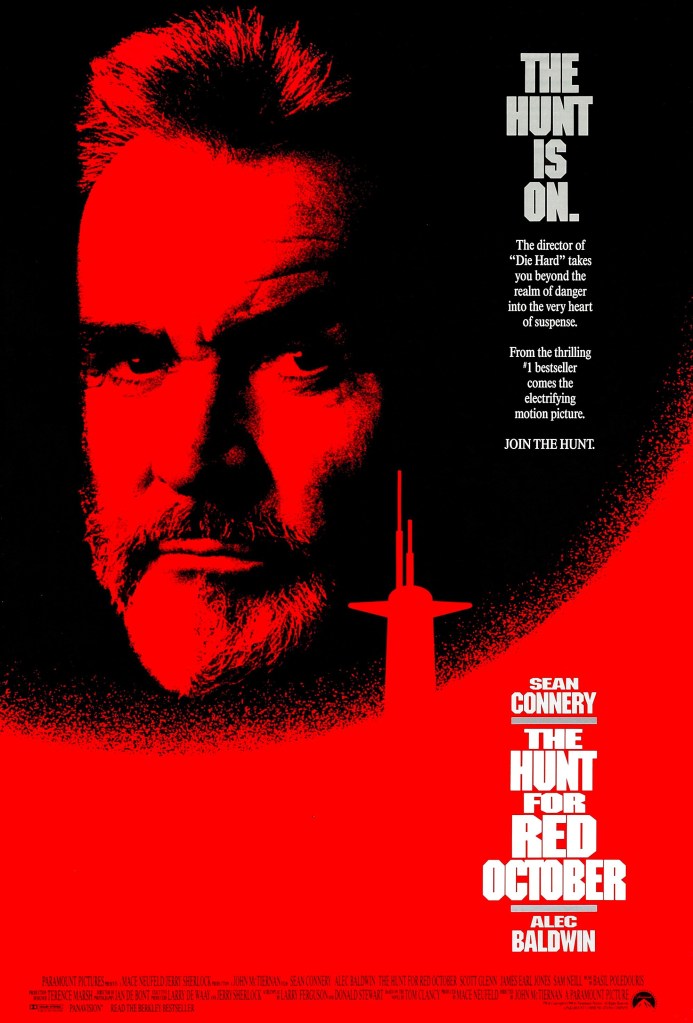
“We shail into Hishtory!” It’s the film that launched a thousand Sean Connery impressions. Only Connery could get away with playing a Soviet submarine captain with the thickest Scottish accent this side of Lithuania. He only took the role – from Klaus Maria Brandauer – at short notice, but he’s a pivotal part of the film’s success. The Hunt for Red October is a superb film, the finest Tom Clancy adaptation ever made and one of the cornerstones of the submarine genre. It expertly mixes beats of conspiracy, espionage, naval adventure and even touches of comedy, into a superbly entertaining cocktail.

Connery is Captain Marko Ramius, the USSR’s finest naval captain, given command of The Red October on its maiden voyage. The Red October is equipped with a technical miracle: a “caterpillar drive” that uses a water powered engine to run silently, making it invisible to sonar. So why is the entire Russian fleet being scrambled to find and sink the submarine? Could it be, as the USSR tells the US, that Ramius has gone mad and plans a nuclear strike? Or is it, as CIA analyst Jack Ryan (Alec Baldwin) argues, because Ramius plans to defect and bring the technological marvel with him?

Of course, we know Connery plans to defect. After all, we’ve already seen him murder shifty political officer Ivan Putin (Peter Firth – to whom alphabetical billing is very kind) and tell his handpicked crew of officers, led by loyal second-in-command Borodin (Sam Neill, so dedicated to affecting a Russian accent it’s as if he felt he needed to do in on behalf of himself and Connery) that there is no turning back. The film’s expert tension – and it rachets it up with all the precision of a well-oiled machine – is working out how. How will Ramius evade the Russian fleet? How will he manage to arrange his defection without communicating with the US? And will he and Ryan – unknowingly working together – persuade the US not to blow The Red October out of the water?

With McTiernan, in his prime, at the helm it’s not a surprise the film is expertly assembled. The parallel plot lines are beautifully intercut. Our two heroes, Ramius and Ryan, face very different obstacles (dodging Soviet torpedoes vs patiently making his case to sceptical superiors mixed with risky long-range travels to far-flung US subs) but somehow seem to be building a bond before they even meet. Ryan is an expert on Ramius and his career, while his thoughtful, good-natured decency is exactly the sort of American Ramius tells his crew they need to meet (as opposed to “some sort of buckaroo” – a word Connery relishes).

McTiernan isn’t just an expert mechanic though. There are lovely touches of invention and magic here. The Hunt for Red October has possibly one of the finest transitions ever. Connery, Neill et al start the film speaking in Russian. Ramius meets with Firth’s Putin (great name) in his quarters to open their orders. The two chat briefly in Russian, then Putin reads from Ramius’ copy of the Book of Revelations. As Firth reads (in fluent, expertly accented Russian), McTiernan slowly zooms in on his lips until he reaches the word “Armageddon” (the same in both languages) – the camera then zooms out and both Firth and Connery continue the scene in English (Firth switching mid-shot from Russian to English without missing a beat). It’s a beautifully done transition, rightly a stand-out moment.

But then it’s a film full of them. Many rely on Connery’s performance, superb as Ramius (this was his career purple patch, where one effortlessly excellent performance followed another). Ramius has a grizzled sea-dog charm and a twinkle in his eye, but he’s also nursing a private grief and pain that motivates his defection. He can be demanding of his men, but also inspires loyalty – that “We Shail into Hishtory!” pep-talk speech is delivered perfectly (and McTiernan makes Soviet sailors singing the Soviet anthem a punch-the-air moment even though (a) we know they are technically the bad guys and (b) we know Ramius is lying through his teeth in his speech). But he is always a commander, Connery investing him with every inch of his movie star cool.

Ramius is also an interesting reflection, in a way, of Ryan. Played with a great deal of young-boy charm by Baldwin (and also wit, Baldwin dropping impersonations of other cast members into the film – including a stand-out Connery), Ryan is brave, determined but also slightly naïve and out-of-his-depth. But like Ramius he respects his “enemy”, is open to negotiation, thinks before he acts and wants to save lives. The two even share similar upbringings. The film triumphantly shows a desk man, spreading his wings and doing stuff he couldn’t imagine: the guy who tells an air hostess in an early scene he can’t sleep on flights due to fear of turbulence, will later have himself dropped into the sea from a perilous helicopter flight, steer a Russian sub and duke it out with the last Soviet hard-liner standing in The Red October’s missile room.

McTiernan shoots Ryan’s conversations like combat scenes: quick reversals and cross shots and even whip pans and zooms. It ratchets up the tension and drama in these sequences – and allows him to play it cooler in the sub shots which (with its more constrained set) where patient studies of tense faces follow sonar reports of the approach of torpedoes or enemy subs. Sound is a triumph in Red October – every ping or sonar shadow is sound edited to perfection, with much of its tension coming from their perfect rising intensity.

It builds towards a superb resolution as several plot threads come together in a dramatic face-off that gives us everything from sub v sub to gunfights, with tragedy and triumph all mixed in. It’s a perfect ending to a film that is a masterpiece of plotting and construction, acted to perfection by the whole cast (Connery and Baldwin, but also Jones, Neill, Glenn – perfect casting as a no-nonsense naval captain – and several reliable players in smaller roles). McTiernan directs with exceptional pace and excitement, it’s sharply scripted and technically without a fault – from its gleaming Soviet sub (with church like missile room) to brilliantly edited sound-design. It’s a joy every time I watch it.

Clear and Present Danger (1994)

Clear and Present Danger (1994)

Tom Clancy’s door-stop thriller is turned into an involving conspiracy thriller that makes masterful use of Harrison Ford

Director: Philip Noyce

Cast: Harrison Ford (Jack Ryan), Willem Dafoe (John Clark), Anne Archer (Dr Cathy Ryan), Joaquim de Almeida (Colonel Felix Cortez), Miguel Sandoval (Ernesto Escobedo), Henry Czerny (Bob Ritter), Harris Yulin (James Cutter), Donald Moffat (President Bennett), Benjamin Bratt (Captain Ramirez), Raymond Cruz (Domingo Chavez), James Earl Jones (Jim Greer), Tim Grimm (Dan Murray), Hope Lange (Senator Mayo)

Tom Clancy’s Jack Ryan has always been the All-American hero (his slimy, besuited CIA rival even frustratedly snarls “you are such a Boy Scout”). Ryan is almost too-good-to-be-true: pure as the driven snow, incorruptible, a success at everything he does and a devoted family man. What chance does someone like that have in Washington? In Clear and Present Danger, Ryan is dragged into the War on Drugs, unwittingly becoming the front man for an illegal military assault team against the Columbian cartels, ordered by a US President on a vendetta for the death of a friend. When the truth comes out, you’ve got one guess who takes it on himself to save the soldiers who are hung out to dry by the suits in Washington.

We know he’ll do the right thing as well, because he’s played by Harrison Ford. Ryan is basically a blank slate as a character, so Ford’s straight-as-an-arrow everyman decency does most of the heavy lifting to establish who he is. As an action hero, Ford has the chops but his real strength is his ability to look frazzled, scared and muddling through – rather like the rest of us would. Ryan gets in some real scrapes here, from dodging missiles in an attack on a diplomatic convoy to desperately fighting for his life in a timber factory. Ford’s strength as an actor is to be both authoritative and also vulnerable – his willingness to look scared but determined works wonders.

Clear and Present Danger also gives plenty of scope for Ford to employ his other major empathetic weapon: the clenched jaw and pointed figure of moral outrage. He does a lot of both here, a central scene seeing Ryan confronting besuited rival Ritter (played by a weaselly, bespectacled Henry Czerny, the polar opposite of Ford’s clean-cut everyman-ness) earnestly telling him he broke the law and is heading to jail (laughed off). There can’t be an actor more skilled at getting you to invest in someone, to both simultaneously worry about him while being confident he will do the right thing. It’s a rare gift, and Clear and Present Danger exploits it to the max.

Ford is the centrepiece – and main strength – of a competent, well-made conspiracy thriller, directed with a professional assurance by Philip Noyce. It makes a good fist of translating Clancy’s doorstop novel – with its huge complexities – to the screen (although you might need a couple of viewings to work out the twisty-turny, backstabby plot, where wicked schemers turn on their own schemes). Noyce has a special gift for keeping dense technical and exposition scenes lively. At one point he cross-cuts a parallel investigation into a fake car bombing between Ryan (who flicks doggedly through textbooks) and his Cartel rival who employs gadgetry and computers. Plot heavy scenes like this are well-shot, pacey and capturing plenty of reaction shots, even if they only feature characters messaging each other on clunky 90s computers or walking-and-talking in shadowy metaphors.

Clear and Present Danger also successful juggles its Washington shenanigans, with parallel intrigue in its Columbia setting. There ruthlessly charming Cortes (played with a wonderful cocksure suaveness by Joaquim de Almeida) is scheming to takeover his boss’ (a blustering Miguel Sandoval) operation. These plot unfold both together and in parallel, allowing for a little bit of neat commentary contrasting the cartels and Washington. The film manages a bit of critique of America’s thoughtlessly muscular intrusion into the affairs of other countries, with a President turning a blind eye after passing on implicit instructions (but still with a boy scout hero who will sort it all out).

Noyce also pulls out the stops for a couple of brilliantly executed scenes. Great editing, sound design and committed acting makes a scene where Luddite Ryan races to print off incriminating evidence from a shared drive while technically assured Ritter deletes the files, edge-of-the seat stuff. Never before has racing to fill a printer with paper seemed more exciting.

That pales into significance with the film’s centre piece, a genuinely thrilling Cartel ambush on a US diplomatic convoy, with Ryan stuck in the middle. With perfect build-up – from James Horner’s tense score to the skilful editing – the attack (with Oscar nominated sound design) is hugely tense, leaves our heroes terrifyingly powerless and is flawlessly executed by Noyce and his crew. It makes the whole film a must watch all on its own.

It’s surrounded by several other well-handled action set pieces, featuring the Marines sent on a covert mission (and then hung out to dry). As the operation leader, Willem Dafoe plays very successfully against type as a (ruthless) good guy, as Clancy’s other regular character, uber-fixer John Clark. Dafoe also has the chops to go toe-to-toe with Ford, and like de Almedia’s charmingly wicked Cartel-fixer also serves as another neat contrast to Ryan’s decency-with-a-fist.

The film is rounded out by a troop of reliable actors. Anne Archer has little to do as Ryan’s supportive wife, but Donald Moffat is good value as the shifty President (communicating both intimidating authority and Nixonian survival instinct), Harris Yulin perfectly cast as a President-pleasing apparatchik and Raymond Cruz as an ace but naïve marine sharp-shooter. Clear and Present Danger has few pretensions to be anything other than an involving thriller – but that also helps make it a very enjoyable one.

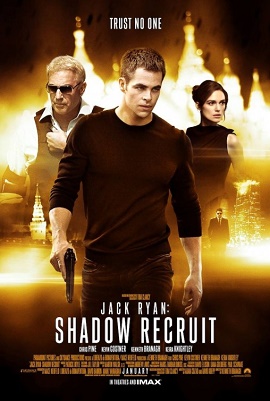
Jack Ryan: Shadow Recruit (2014)


Chris Pine comes out from behind the desk to head into the field in Jack Ryan: Shadow Recruit

Director: Kenneth Branagh

Cast: Chris Pine (Jack Ryan), Keira Knightley (Cathy Muller), Kevin Costner (Commander Thomas Harper), Kenneth Branagh (Viktor Cherevin), Len Kudrjawizki (Konstantin), Alec Utgoff (Aleksandr Borovsky), Peter Andersson (Dimitri Lemkov), Elena Velikanova (Katya), Nonso Anozie (Embee Deng), Colm Feore (Rob Behringer), Gemma Chan (Amy Chang), Mikhail Baryshnikov (Minister Sorkin)

Jack Ryan is the all-American, ordinary-analyst-turned-CIA Agent at the centre of the late Tom Clancy’s books. He’s been played by a range of actors, from Alec Baldwin to Ben Affleck via Harrison Ford, but his character remains the same – a boy scout, a man of principle and simple courage, pushed to do what must be done. He’s smart and quick-witted. Jack Ryan: Shadow Recruit was meant to serve as another reboot, to restart the Jack Ryan franchise after a mixed reception to Ben Affleck’s The Sum of All Fears. Sadly, it was another false start.

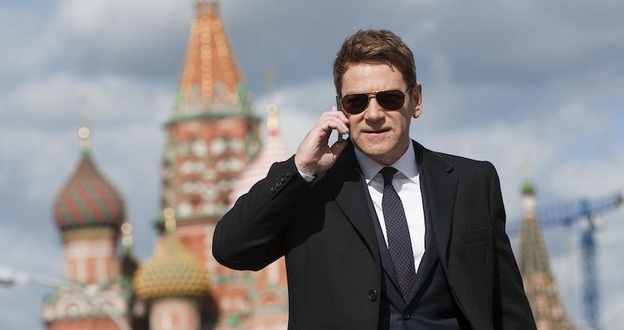
An origins story, it opens with Ryan (Chris Pine) studying at the LSE, before joining the marines in the wake of 9/11. He is critically injured in a helicopter crash, where he hauls two men from the wreckage while suffering from a broken back. Learning to walk again, he falls in love with Dr Cathy Muller (Kiera Knightley) and is recruited as a financial analyst by Thomas Harper (an effectively gruff but charismatic Kevin Costner) from the CIA’s Department of Making-Sure-We-Don’t-Get-Hit-Again (catchy name). Collecting financial intelligence while working as an auditor at a Wall Street firm, he notices some worrying financial deals from funds controlled by Russian tycoon Viktor Cherevin (Kenneth Branagh). Going to Moscow under the guise of auditing Cherevin, he and Cathy quickly find themselves embroiled in a dangerous terrorist conspiracy.

Jack Ryan: Shadow Recruit is decent fun. It’s also a rather impersonal and safe piece of film-making, that structurally and creatively feels like a 1990s action film reset in the 2010s. In a world of Jason Bourne, it genuinely feels a little old-fashioned and uninspired. It takes recognisable elements from dozens of action films and remixes them with a certain flair, but not a lot of imagination. It feels like the least “Branagh” film Branagh has directed, the camerawork being surprisingly restrained and contained considering his love of sweeping opera and dynamic, showy visuals.

But Jack Ryan is not a bad film, it’s just an enjoyably average one. It puts Ryan front-and-centre of the film, and Chris Pine really delivers in establishing Ryan’s old-fashioned principles of right and wrong, his sense of duty and his willingness to do what needs to be done when called. Pine also does a great job of demonstrating Ryan’s fear and panic as he finds himself increasingly out of his comfort zone – not least in a terrifying hotel bathroom brawl with an under-used Nonso Anonzie – in the aftermath of which he drops his mobile while trying to call for backup, and then can’t remember where the hell “Location Gamma” is when told to report there to meet a contact.

Of course, this incarnation of Ryan as an analyst rushed into the field doesn’t last, and the film succumbs from there to turning Ryan into an old-school action man, the sort of guy who drives cars at 85 mph through Moscow streets with ease, jumps on a motorbike and roars off in pursuit of a bomb with maverick self-assurance and takes on a trained assassin with a Die Hard-ish confidence. It’s a shame that the interesting character work of the first 2/3rd of the movie gets lost in the final third – but it’s another sign of the film delivering what it feels an action film should be rather than finding something unique and original.

At least Pine gets some good material to work with, which is more than can be said for Kiera Knightley. For all her American accent, this is Knightley at her most British Rose, her toothy, coy grin ever-present in every scene – and that’s about all she contributes. Not that this is entirely her fault, since Cathy is a character sketched on a fag packet, a successful doctor who obsessively worries that her husband is having an affair, making her feel weaker and needier than the filmmakers perhaps realise Later she exists to be a Damsel in Distress, and is then given a spurious involvement in identifying the villain’s target – which she identifies not because it is a medical facility she is familiar with, or perhaps somewhere she visited as a child or on a professional call-out, but solely because Her Man works there. (As if these CIA geniuses couldn’t work out that a financial terror attack on the US might be targeting Wall Street).


The villain’s plot is dully labyrinthine, but can be safely boiled down into having something to do with financial chicanery and a bombing attack, to destroy the US economy. Not that it really matters – it allows a suitable mix of booms, bangs and the sort of tense “breaking into the office to download the files against the clock” sequence that you’ve seen several times before. Kenneth Branagh cuts himself a bit short with Cherevin, a character who seems sinister but is really barely competent and hits every villain trope from pervy leering to executing an underling. We barely get any sense of his motivations or his background.

He’s also probably the only Russian nationalist in the world who is a Napoleon Bonaparte fan. Last time I checked, Napoleon was the enemy in the War of 1812 that redefined Russian history for the next 100 years. But then I’ve read a few Napoleonic era books, so I’m biased… This film clearly knows nothing about Bonaparte, with Ryan declaring at one point that the planned attack is “straight out of Napoleon’s playbook” – how Napoleon’s trademark fast movement and combined use of infantry and artillery, drilled to perfection, relates to a basic distraction strategy I don’t know but never mind. But then this is a dumb action film that name checks Napoleon because you’ve probably heard of him, rather than because it makes sense.

There is a lot to groan at, or say meh to, in Jack Ryan. But yet, I’ve seen it three times and it grows on me each time. Chris Pine is a very likeable screen presence, and the build-up of the film works well. Branagh directs it with a taut efficiency, even if it’s a film that lacks any real inspiration and feels like one for the money. But it presents its 1990s-style action beats with enough conviction and sense of fun that you kinda go with it. Yes it’s totally forgettable, but run with it and you’ll find yourself strangely charmed by it.

The Sum of All Fears (2002)

Morgan Freeman and Ben Affleck save the world from nuclear armageddon

Director: Phil Alden Robinson
Cast: Ben Affleck (Jack Ryan), Morgan Freeman (William Cabot), Bridget Moynahan (Dr. Catherine Muller), James Cromwell (President J. Robert Fowler), Liev Schreiber (John Clark), Ciarán Hinds (President Alexander Nemerov), Alan Bates (Richard Dressler), Michael Byrne (Anatoly Grushkov), Colm Feore (Olson), Ron Rifkin (Sidney Owens), Bruce McGill (Gene Revell), Philip Baker Hall (David Becker) 

In the aftermath of 9/11, people debated whether that atrocity would lead to a change in how Hollywood made blockbusters. Would the public still have the taste for American landmarks being destroyed in the name of entertainment? I guess the answer was “sure they would”, because less than a year later Baltimore was being wiped out by a nuke in The Sum of All Fears. And people generally did find it entertaining. As they should: this is not a smart film, but it is fun, and with hardly any violence or swearing it’s a perfect “all generations” viewing thriller.

The fourth entry in the on-again, off-again Jack Ryan franchise, a series of loosely connected but enjoyable films based on Tom Clancy’s novels, this reboots the saga after two entertaining airport-novel style films starring Harrison Ford. Ryan (Ben Affleck) is now a young CIA analyst who is suddenly thrust centre stage in the Agency when Alexander Nemerov (Ciarán Hinds) rises to power in Russia. Before he knows it, he is working closely with CIA chief William Cabot (Morgan Freeman) and briefing the President (James Cromwell). Working with agent John Clark (Liev Schreiber), Ryan investigates rogue nuclear weapons in Russia, little knowing that it is part of a fiendish plan by European neo-Nazis, led by Richard Dressler (Alan Bates), to plunge Russia and the US into a nuclear confrontation.

First off the bat, Tom Clancy hated this film. He even does a commentary on the DVD which is a scene-by-scene breakdown of all the things he doesn’t like and the terrible changes he felt had been made from his book. I can see why he’s upset, but this is actually a very entertaining, solid, slightly old-fashioned piece of film-making. Clancy’s books aim to be “a few degrees to the left” of reality, to present something that could happen. This film is more of a Bond movie, not least in its choice of baddies. The book uses Arab terrorists. Wisely (I think) the film changes this to a set of Bond-villain like Nazis, embodied by Alan Bates’ enjoyable scenery-chewing performance as a slightly camp chain-smoking Nazi (“Ze Fuhrer vasn’t crazee. He vas stoopid”). There is even a scene where one of the plotters, Goldfinger-style, announces ’I will have no part in this madness’ only to be swiftly bumped off. Clancy hated it, but it’s something a little different and also enjoyably silly.

Besides, you might have felt there was enough vibe of reality in there for Clancy with the reaction to the big one being dropped on Baltimore. The build-up to this sequence is very well done, cut and shot with tension, and Jerry Goldsmith’s score really effectively helps with this build. It’s also quite shocking to actually see the plan succeed: and the shots of a mushroom cloud over the city are presented with a sombre sorrow. There is probably more Clancy criticism for Ryan’s effortless travel around the irradiated city (and his totally unaffected cell phone) but this sequence is still damn good.

Similarly skilfully done is the reaction of the politicians. Daringly, the US politicians are to a man sweaty, stressed old white guys (Air Force One takes off to the accompaniment of them screaming at each other). One of them even has a heart attack. The American politicians may be reluctant – but they are the fastest to rush towards pushing the button. They are also shown to be hopelessly lacking judgement when it comes to appraising the likely reactions to their decisions: one reassures the President that the Russians won’t respond to a full nuclear strike against military targets! The fast build from angry words to a bombers is terrifically done.

The Russians are similarly twitchy – and unlike the Americans, far more susceptible to bribery and collaboration with our villains – but interestingly their President is the “reasonable man”, whom Ryan (and the audience) respects. Charismatically embodied by that wonderful character actor Ciarán Hinds (the film deservedly brought Hinds to America’s attention and he hasn’t looked back since), Nemerov is the wisest, smartest guy in the room – a realist and level-headed man. Hinds is actually the stand-out in the film, superbly backed up by Michael Byrne as a shady (but surprisingly cuddly) KGB fixer.

The build-up to the remorselessly exciting nuke and aftermath sequences is pretty traditional fare but well directed by Phil Alden Robinson and a very good cast of actors largely deliver in their roles. Affleck at the time was heading into the height of his Bennifer unpopularity: he gives a decent performance as Ryan, but Ford is a tough act to follow and Affleck doesn’t quite have the same “ordinary-joe” quality Ford and Baldwin brought to it earlier. He also doesn’t quite have the leading man charisma the part needs to carry the film (Affleck’s best work is as a character actor, but he is trapped by his leading man looks). Fortunately Morgan Freeman, calmly contributing another of his wise mentor roles, offers sterling support. Schreiber and Cromwell are also good in key roles.

This is a very traditional, quite old-school thriller, inspired by a combination of Goldfinger and 1970s political thrillers. It’s not a special film – and not even the best in the franchise – but it is invariably entertaining, has a host of well-done scenes, and barrels along. Robinson also has an eye for tension in smaller sequences – a marvellously tense scene simply involves Ryan trying to get a card swipe machine to work – although he is less confident with some of the action. But in showing how quickly our trigger happy masters can push towards Armageddon, this is a film that seems to be endlessly relevant. And wouldn’t you rather have Nemerov of even Fowler running the US than Trump?