Category: Japanese film

An Autumn Afternoon (1962)

An Autumn Afternoon (1962)

Ozu’s final film feels like a perfect summation of the rich sense of ordinary life in his work

Director: Yasujirō Ozu

Cast: Chishū Ryū (Shuhei Hirayama), Shima Iwashita (Michiko Hirayama), Keiji Sada (Koichi Hirayama), Mariko Okada (Akiko Hirayama), Teruo Yoshida (Yutaka Miura), Noriko Maki (Fusako Taguchi), Shinichiro Mikami (Kazuo Hirayama), Nobuo Nakamura (Shuzo Kawai), Eijirō Tōno (The Gourd), Kuniko Miyake (Nobuko Kawai), Ryuji Kita (Professor Horie)
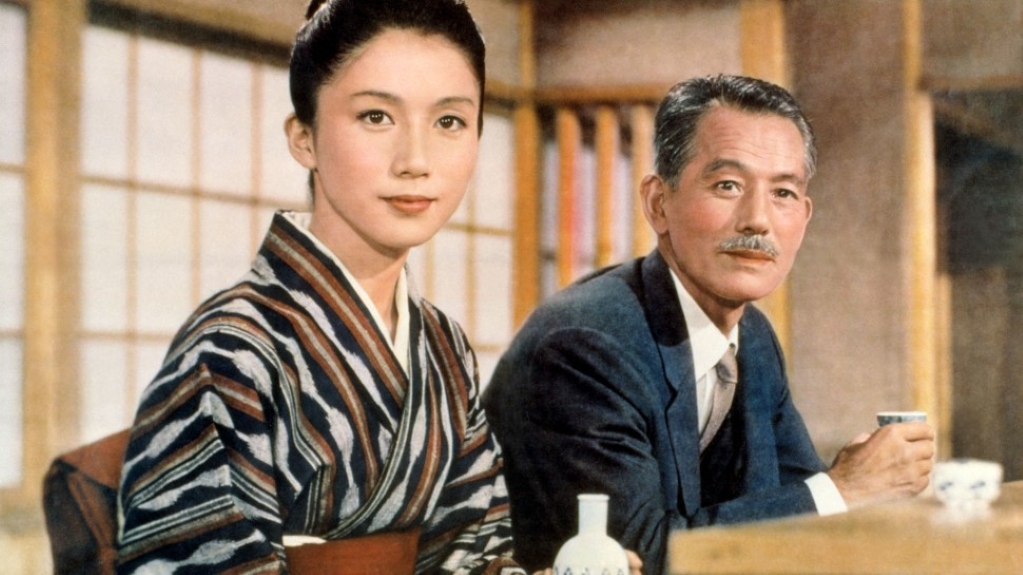
Ozu’s final film feels like a luscious, beautifully filmed summation of a life’s work. Deceptively quiet, simple and gently paced, like the best of Ozu’s work it throbs with a deep understanding of the quiet joys, regrets and pains in ordinary life, where the march of time can relentlessly change and mould your world. An Autumn Afternoon returns to themes familiar from Ozu past work – you see it as almost a remake of Late Spring (with Chishū Ryū, effectively, in the same role) –with his subtly effective recognition of how each generation echoes and reimagines the one before. It’s a deeply humane film from a director who understood everyday life better than almost any other.

Once again, a man feels pressured to marry off a daughter. Shuhei Hirayama (Chishū Ryū) is a middle-ranking factory manager, whose home is tended to by 24-year-old daughter Michiko (Shima Iwashita). Hirayama’s old school-friend and colleague Kawai (Nobuo Nakamura) suggests an arranged marriage for her. Hirayama quietly lets the subject drift, little motived to shake up his home. His opinions slowly shift as he re-encounters his former teacher The Gourd (Eijirō Tōno), now a down-at-heel noodle restaurant owner, who lives with an unhappy spinster daughter. Does Hirayama sees parallels between himself, Michiko and this pair? Is Michiko bothered either way?

It’s a classic Ozu set-up: the different views and perceptions of the generations, contrasted against each other. In many ways, very little happens in An Autumn Afternoon, but in other ways a whole life-time plays out. Skilfully, with an observing, restrained (Ozu’s final film is stiller than ever) camera, Ozu observes people in the Spring, Summer, Autumn and Winter of their lives. In doing so, he captures a particular moment of Japanese history, where pre-War, war and post-war generations confront the world with subtly different outlooks.

In the first darkening of the Autumn of his life, Hirayama is a quiet man with a rich vein of humour. He’s from a generation which sees itself on being more liberal than those before. He meets regularly with a bunch of former school friends, who pride themselves on holding their drink and frequently prank each other in dead-pan comic exchanges. There is a delighted ragging of their friend Professor Horie’s barely concealed sexual glee at his new (younger) wife. They have traditional values (Hirayama assumes marriage will lead to immediate resignation for his young secretary) but enjoy the post-war flourishing of Japan.

Hirayama is comfortable with Americanised Japanese culture, from bottled beers and baseball to American bars and their stools. He drinks too much, make generous offers to others and indulges his children. He’s perfectly happy with the way things are: perhaps because he already fears what his life may be like when his two youngest children flee the nest. It’s a beautifully judged performance from Ryu, genuine, relatable, quietly content but with a subtle sense of sadness and anxiety at change.

There is a sense Ryu’s Hirayama doesn’t want the world shaken, as he has already lived through enough shaking to last a lifetime. He’s a former career Naval officer, who captained a ship in the War. His late wife, it’s implied, died in the American bombing of Tokyo. (Of his children, only two can really remember her, talking about her only wearing trousers during air raids). Bumping into one of his former petty officers, the two men indulge in reminiscences and reflections of what life might have been like in victory (in an American themed bar of all places). Hirayama is drawn to return to the bar again and again, as the barmaid reminds him of his late wife (this small detail would be the entire plot of another film) – although Ryu’s quietly sombreness suggests the memory is to painful to dive into.

But this man contrasts sharply with his children. Hirayama never re-married, and his children have filled the companionship gap in his life. While Michiko matches neatly the traditional view of a Japanese woman as dutiful and guarding of the home (she wears a kimono more than any other female character), his youngest son Kazuo dresses like an American teenager and isn’t afraid to criticise his father. And even Michiko too wants to make her own choices about her life, regardless of the views of others.

The most intriguing contrast though is the marriage between his oldest son Koichi (Keiji Sada) and Akiko (Mariko Okada). Here power dynamics are strikingly different. Both partners work – indeed at one point, Akiko arrives home to find Koichi cleaning and cooking. Decisions are made between them, with Akiko frequently calling the shots. A dispute about Koichi’s plan to spend the excess of a loan from Hirayama on a second-hand set of golf clubs, sees Akiko take firm control of finances (Koichi seems to have inherited his father’s quiet desire not to rock the boat) and has the final say. It echoes, in a way, Professor Horie’s second marriage, where his wife has a level of control over his comings-and-goings that surprises Hirayama and Kawai.

Hirayama may also be quietly disturbed by a vision of what the winter of his life might be like, from ‘The Gourd’, a respected teacher of his childhood, played with a superb desperation and forced good humour by Eijirō Tōno. This once-respected man now works for customers who barely look at him and is totally reliant on a daughter miserable at her life (Ozu quietly watches her break down in tears dealing with her drunken father) and gets embarrassingly pissed at the slightest opportunity when someone else is paying. Considering Hirayama is also a heavy drinker (both men are prone to slumping forward, or swaying on the spot when under the influence) there is a lot that suggests his Winter might not be wildly dissimilar from the Gourd’s.

All of these multi-generational issues are superbly explored by Ozu, all without forced commentary, in a film that is a triumph of his distinctive style of low-angle static cameras, transitions that ground us in location, made even more striking by the film’s gorgeous use of colour (especially its reds). And the film leaves it all open to us to interpret. Because there is no right-or-wrong in Hirayama’s situation: should he let his daughter remain or help her move on and embrace her life?

An Autumn Afternoon concludes with one of the most quietly heart-breaking moments in Ozu’s cinema – under-played to utter perfection by Ryu – as Hirayama sits alone, drink swishing around his guts, singing songs of a martial Japan and facing an unknown future that might see him forced to confront the loneliness he has avoided since his wife died. As the final shots complete of Ozu’s final work – a series of cuts to parts of Hirayama’s home – it feels like a perfect final statement from an artist who looked at the small tragedies of life like no other.
Letters From Iwo Jima (2006)

Letters From Iwo Jima (2006)

Thoughtful, sensitive, respectful and insightful war-movie – one of Eastwood’s best

Director: Clint Eastwood

Cast: Ken Watanabe (General Tadamichi Kuribayashi), Kazunari Ninomiya Private Saigo), Tsuyoshi Ihara (Lt Colonel Baron Takeichi Nishi), Ryō Kase (Private Shimizu), Shidō Nakamura (Lt Ito), Hiroshi Watanabe (Lt Fujita), Takumi Bando (Captain Tanida), Yuki Matsuzaki (Private Nozaki), Takashi Yamaguchi (Private Kashiwara), Eijiro Ozaki (Lt Okubo)

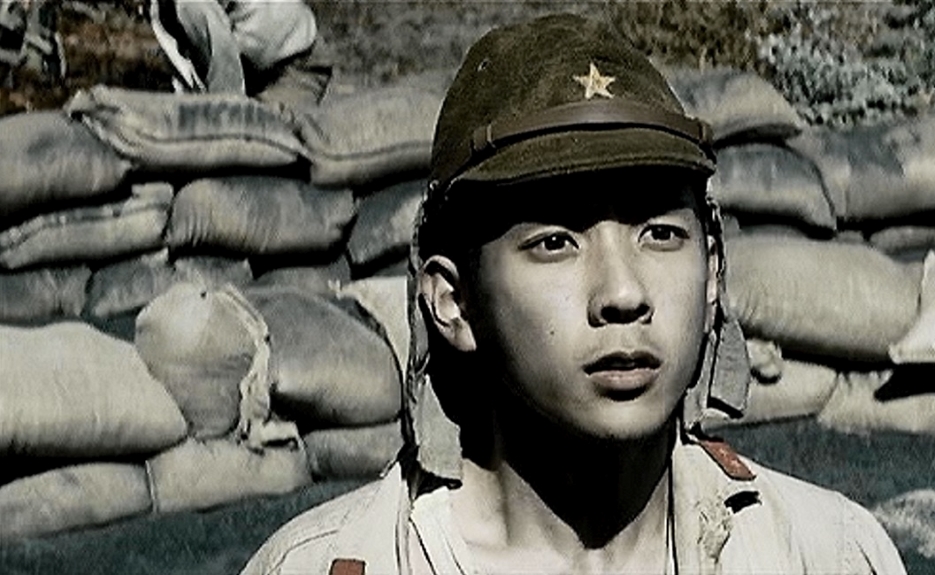
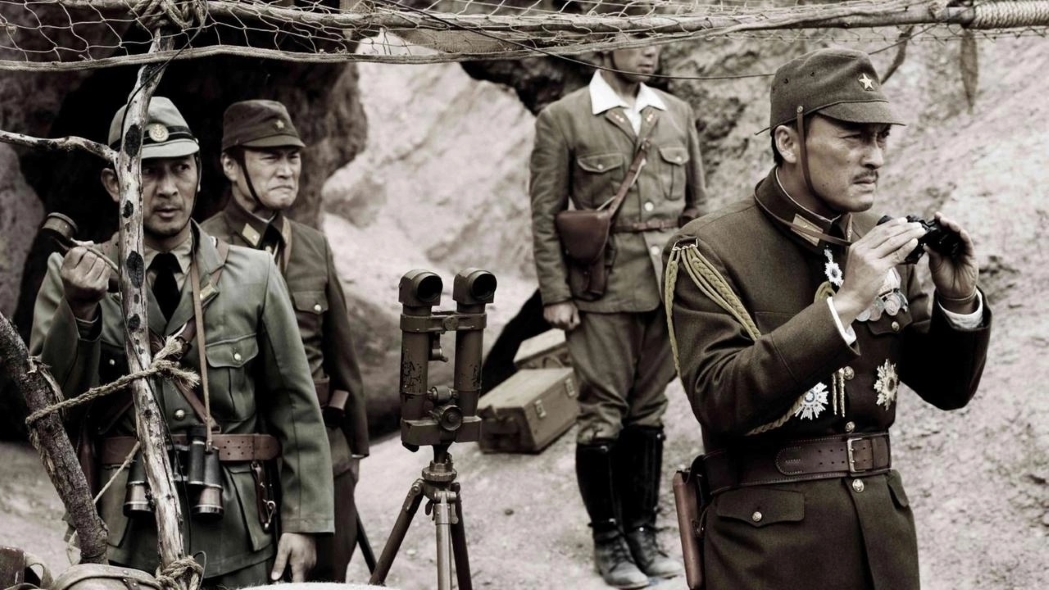
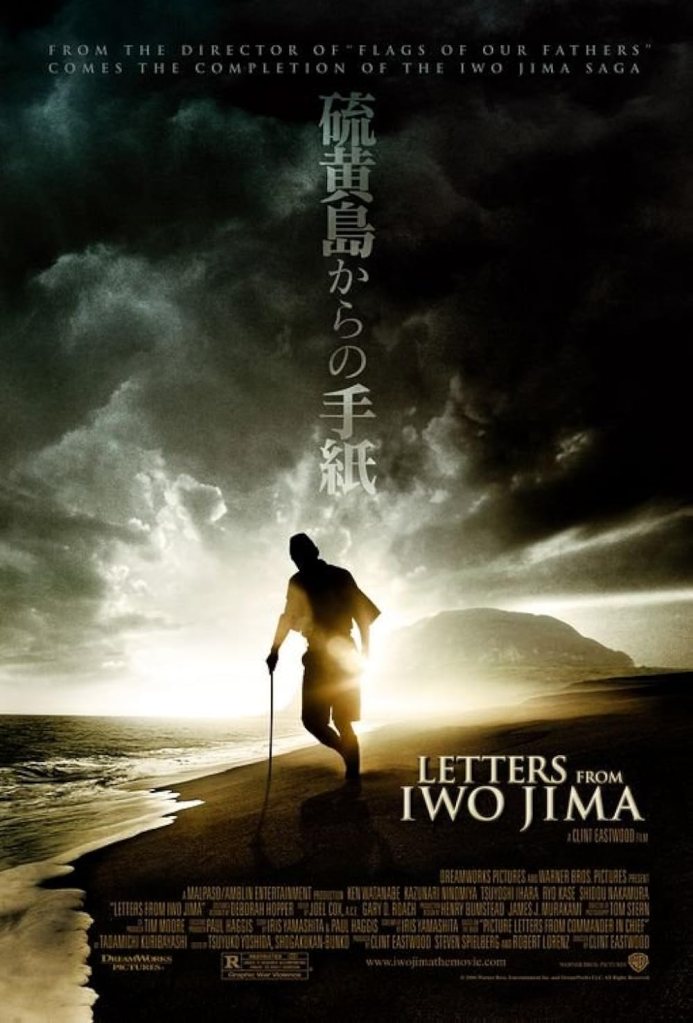
Eastwood’s original plan for his Iwo Jima epic was to tell the story from both perspectives, like a sort of Tora, Tora, Tora on the beaches. But, as the amount of story expanded and expanded, he decided to make two films (it helps being a Hollywood Legend when you change your mind like this). The American story would be covered in the melancholic-but-traditional Flags of Our Fathers, focusing on the soldiers who rose that famous flag on the peak of Mount Suribachi. For the Japanese story, Eastwood would do something more daring: tell the story in Japanese, entirely from their perspective presenting their military culture not as wicked or misguided but as a legitimate mantra as prone to extremes as the American one.

Letters From Iwo Jima is equally melancholic as its partner film, helped by its elegiac music score from Michael Stevens and Kyle Eastwood. It’s shot in a coldly austere, sepia-toned monochrome – there is barely any colour in it – and large chunks of it play out in gloomy subterranean quietness where the only sound of war is the artillery ground-pounding above the entrenched Japanese soldiers. This is the apogee of Eastwood’s moody, restrained style – perhaps he recognised and admired the reserve and formality in Japanese culture. Letters From Iwo Jima seems at first unfussy and objective so it’s a surprise how affecting and humane it becomes, all while seeing the virtues and deep flaws in a military system where the individual mattered a lot less than the whole.

Iwo Jima was a brutal fight to the death over an island less than 12 mi2, a grey rock in the Pacific that’s only value was as an air strip for launching bombing raids on mainland Japan. Over 110,000 American soldiers took on 20,000 Japanese defenders in a campaign expected to last just a few days, but dragged out over a punishing 36. The relentless Japanese defence resulted in over 25,000 American casualties and c. 90% fatalities for the Japanese. Letters From Iwo Jima explores the mentality of an army that almost completely accepted (from commanding officers down to junior privates) their destiny, no their duty, was to not survive the island’s defence.

The defence’s success is due to the skilled command of General Tadamichi Kuribayashi, a remarkable, restrained performance of relentless determination mixed with deep humanity from Ken Watanabe (unfairly snubbed at the Oscars). Kuribayashi over-rules his senior officers desire for a bayonet charge against the overwhelming American landing forces on the beaches. He knows this traditional attack would lead to suicidal instant defeat for the out-numbered, out-gunned Japanese. Instead Kuribayashi orders a tunnel network built across the island, to allow hit-and-run attacks designed to inflict maximum casualties. Rather than committing suicide at their posts on defeat, soldiers were ordered to withdraw from indefensible positions to continue the fight for as long as possible.

This strategic defence-in-depth strategy is denounced by several of his senior officers as either defeatism or American-sympathy. Kuribayashi knows victory is impossible – he arrives on the island writing a letter to his wife stating he will not live to see her again. But he also knows his tactic is the only way to slow down the American juggernaut. In his opinion, protecting Japan from air attack for a few more weeks is worth sacrificing his and all the lives of the 20,000 men under his command.

Kuribayashi respects Americans – flashbacks show his happiness in the 30s as a military liaison in California, his easy friendships with American officers and desire for co-operation with the USA. But in the same scene he unquestioningly (though with a warm smile) says he will serve his country no matter what. He’s a man of principle and honour, and even if he doesn’t agree with the war, he is for Japan right-or-wrong and will not think twice about giving his life in its service. This attitude soaks through the Japanese soldiers, and Letters From Iwo Jima presents it largely without moral judgement. There are shocking moments where defeated soldiers in Suribachi, weep as they looks at photos of their loved ones while clasping live grenades to their chest so that they may die at their post rather than live with the shame of failing their country. But, the film subtly asks, how different is this from the self-sacrifice countless American war films have (rightly) praised in their soldiers?

The difference is cultural. Very few American soldiers would choose suicide in a cave rather than the thought of confronting their families as defeated men. For Japanese soldiers, this is the ultimate strength, a view shared not just by incompetent, trigger-happy bullies like Captain Ito but right up to Kuribayashi himself who never considers for a moment surrender and living, choosing a suicidal night attack with his last soldiers and suicide on the last piece of earth on Iwo Jima that could still be just about considered Japanese. That’s an institutional expectation of total self-sacrifice, even when the sacrifice is completely symbolic, that has no real comparison in Western militaries.

The soldiers – as we hear in their letters, read to us in voiceover – love their families and they relate to a wounded GI from Oklahoma who talks about his mother (a slightly twee moment in another wise subtle film), but they also believe that the whole (Japan) is far more important than the individual (themselves). Trees should always be sacrificed to slow the fire and protect the forest. Letters From Iwo Jima may show the dangerous excesses this produces in the most fanatical, but doesn’t denounce this extreme penchant for sacrifice or give a clumsy moment of realisation that it is inherently ‘wrong’. Neither does it present Western, individual ideals as superior (indeed the few American soldiers seen are a mixed bag, as much prone to vengeful violence as their opponents).

Letters From Iwo Jima follows Private Saigo (very well played with a bewildered sense of fear and growing desire to live by Kazunari Ninomiya), the character closest to acting as a criticism of the Japanese mindset. A baker, who wants to see his wife and new-born child, he doesn’t really want to die on the island, but never questions it is his duty to do so. And his objections to suicidal orders or kamikaze attacks isn’t grounded in their senselessness but that they run contrary to Kuribayashi’s wider orders. Even our most relatable (to Western eyes) character, one who eventually accepts the idea of surrender when all is lost, is still part of the same culture where placing your own needs and desires before the whole is considered deeply shameful.

Perhaps this thoughtful, non-judgemental exploration of Japanese culture is why Letters From Iwo Jima (unusually for American war films) did very strong business in Japan. Unlike the eventual death cult of Nazism (see the exceptional Downfall), where suicide came from bitter pride and fear, here it’s the ultimate, terrible-but-logical outcome for a mentality that turned a small island into a respected world power. It’s not presented as a freakish aberration or some sort of national genetic character flaw: it’s in many ways a sort of perverse nobility which has, like all noble systems, advocates who are broad-minded and empathetic and those who are prejudiced and fanatical. Letters From Iwo Jima’s strength is it never presents it as inherently evil, rather a choice with good and bad outcomes.

Eastwood’s superbly directed film, perhaps one of his finest, is full of such thoughtful, unjudgmental reflections on duty and service and what loyalties to something larger than ourselves drive us to do. Shot with an austere, haunting chill and superbly played by a faultless cast, Letters From Iwo Jima is an earnest, mature piece of work and a quite extraordinarily unique war film.

Evil Does Not Exist (2024)

Evil Does Not Exist (2024)

Haunting, enigmatic parable on nature and modern society that leaves a lingering impression

Director: Ryusuke Hamaguchi

Cast: Hitoshi Omika (Takumi Yasumura), Ryo Nishikawa (Hana Yasumura), Ryuji Kosaka (Takahashi Keisuke), Ayaka Shibutani (Mayuzumi Yuuko), Hazuki Kikuchi (Sachi Minemura), Hiroyuki Miura (Kazuo Minemura), Yûto Torii (Tatsuki Sakamoto), Takako Yamamura (Yoshiko Kizaki), Takuma Nagao (Tomonori Hasegawa), Yoshinori Miyata (Akira Horiguchi, Takahashi), Taijirô Tamura (Ippei Suruga)

Imagine a beautiful Japanese mountain village, where the water is so clean, jugs of are taken straight from the stream to the local restaurant where its unique taste adds to the food’s beauty. Everything here is in careful harmony. Until a corporation reckons it’s the perfect site – keen to exploit, while it can, lingering Covid subsidies – to build a glamping site with a 95% effective septic tank (because that’s fine with government regulations). The corporation hosts a charade of a consultation where the plans are rejected by the community, unconvinced by the ‘trickle down’ wealth promised and more concerned with that 5% sewage being tipped into their gloriously pure water supply.

Perhaps the point of Evil Does Not Exist is that there is no real malevolence here. The corporation that wants to effectively shatter the harmony of this community isn’t doing it because they are cruel, they’re just doing what they do to create profits. And they genuinely don’t really see the problem because with a classic lack of empathy they’re convinced what is good for them is good for everyone. And that deep-down everyone shares their outlook. The villagers are just angling for a bigger pay-outa and they don’t really need to fix the septic tank because it falls within the rules and the water will still be okay with a little bit of sewage in it.

Evil Does Not Exist it seems, because most of the bad stuff happening in the world is because of empathy-free systems, people not really caring about impact of their actions and a general lack of interest in long-term impacts over short-term gain. Hamaguchi’s beautifully filmed, Godard-inspired (from title fonts, to shooting-style to Hamaguchi’s use of non-professional actors) environmental parable carefully and subtly deconstructs a world where the beauty of nature can be rinsed away simply out of a sense of inevitability and quick-buck expediency.

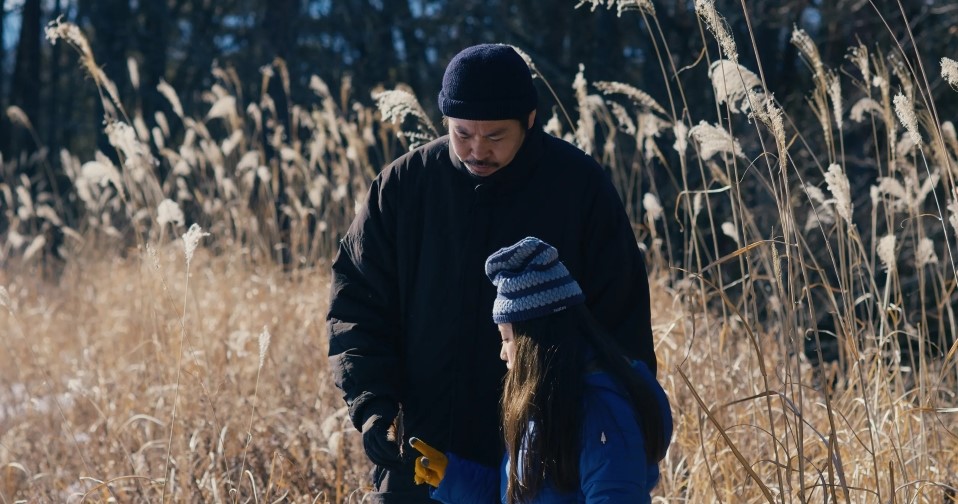
Originally envisioned as a short film that would showpiece the beautiful orchestrations of its composer Eiko Ishibashi, Hamaguchi expanded it as he shot more and more material, eventually developing it into a fascinating and open-ended parable about our relationship with nature. Nature here is an elemental and unknowable force: the first five minutes of the film is a sustained tracking shot through the trees, the only sounds we hear being Ishibashi’s music. It’s almost ten minutes before we hear any dialogue. The village’s ‘odd-job man’ Takumi (Hitoshi Omika) is very much one with the natural world around him, taking only what he needs and living in gentle, stoic harmony with the environment.

Hamaguchi’s film – utilising his careful, Ozu-inspired camerawork and Godardian love of realist observation – creates a natural world which is both beautiful and hauntingly mysterious. In the film’s calm shots of nature, the forest becomes a haven but one strangely inhuman. There is a feeling of unknowable, unrelatable forces in this world, an organic Gaia understanding that the villagers are unconsciously plugged into, which governs the ‘rules’ of existence. It’s an understanding utterly inaccessible to those who arrive from the city and want to pave paradise and put up a parking lot.

Evil Does Not Exist pivots around its consultation meeting, which takes place in a town hall, chaired by initially bored consultants going through the motions with a slide deck they don’t understand and a ring-binder of notes they are unfamiliar with. As the villagers quickly discover (their adroit questioning taking the under-prepared consultants off guard), this consultation is a sham – anyone with any control over the fate of the project isn’t there and the glamping site is happening regardless of anyone’s feelings. All this meeting is about (as the head of the company later says, dialling in to chat to his consultants on a video call) is demonstrating the company has ‘listened’ and to tweak a few token issues (it’s telling that the head of the company describes the disastrous meeting as a complete success). None of this is evil of course: it’s just the bureaucratic acquisitiveness of the modern world, which values procedures and rules over impacts and end results.

Both consultants however find themselves taken with the village. But Hamaguchi demonstrates this is always rooted in a patronising sentimentality that’s as much about themselves as it is the actual village. Takahashi (Ryuji Kosaka) in particular, a disaffected company drone, spontaneously decides he can just jack it all in and become a skilled man of the wilderness like Takumi. Takahashi comes across as an embarrassing romantic, identical in many ways to the likely glamping customers (who want a sense of the nature without actually living there). He’s hideously clueless about the fauna of the forest and his practical skills (captured in a hilariously awkward attempt to chop wood) are woefully inadequate. None of this stops him from assuming he can fit right in on a whim with no preparation or training. Takumi’s just an odd-job man, how hard can that be to pick-up?

It doesn’t kid Takumi, who stares at him with an impassive face that hints at a range of emotions from contempt to humorous indulgence. Perhaps he’s aware that Takashi (again patronisingly) sees him less as an individual and more as his personal Yoda, placed on earth to mentor Takashi’s personal growth: to the outsiders the village and its inhabitants are always filtered through what they can do for them. Takashi’s patronising expectation that Takumi will welcome a ‘student’ isn’t wildly different from the company’s view that Takumi can be won over to supporting the project because they’ve offered him a job and a semi-decent salary.

This all culminates in a mysterious, open-ended conclusion which sees Hamaguchi lean into hints of folk-horror. Does the conclusion of Evil Does Not Exist show the dangerous consequences of mankind’s interference of nature on the most innocent? Does Takami represent a resentful natural world biting back? Questions hang over the film’s cryptic ending, which has been neatly foreshadowed throughout.

Evil Does Not Exist has a quietly hypnotic quality to it, but also a haunting chill behind its beautiful imagery. But it also asks subtle but intriguing questions about our link to nature and how a myopic focus on our own interests and needs inadvertently damages the world far more than actively ‘evil’ acts ever could.

Yojimbo (1961)

Yojimbo (1961)

Kurosawa’s dust-filled samurai actioner is a very Japanese Western and huge fun

Director: Akira Kurosawa

Cast: Toshiro Mifune (“Kuwabatake Sanjuro”), Eijirō Tōno (Gonji), Tatsuya Nakadai (Unosuke), Seizaburo Kawazu (Seibei), Kyū Sazanka (Ushitora), Isuzu Yamada (Orin), Daisuke Katō (Inokichi), Takashi Shimura (Tokuemon), Hiroshi Tachikawa (Yoichiro), Yosuke Natsuki (Farmer’s Son), Kamatari Fujiwara (Tazaemon), Atsushi Watanabe (Coffin maker)

An unknown stranger arrives in a dust-filled border town and finds himself stuck in the middle of a long-running feud between two gangs with only his wits and skill with his weapon for any advantage. If you had any doubt about the influence American Westerns had on Akira Kurosawa, look no further than Yojimbo. Perhaps the most purely enjoyable movie Kurosawa ever made, Yojimbo can also lay claim to being one of the greatest Westerns ever made, given greater depth with Kurosawa’s subtle social satire on Japanese samurai culture. This is Kurosawa at his best: stripped-back and dynamic with a weight behind the fun.

Our unnamed samurai is (Toshiro Mifune), now a wandering ronin. The gangs: on one side Seibei (Seizaburo Kawazu) the town’s long-term boss, whose ruthless wife Orin (Isuzu Yamada) is the power behind a throne she intends to pass to their timid son Yoichiro (Hiroshi Tachikawa). On the other: Ushitora (Kyū Sazanka), Seibei’s former number two furious at being passed over as heir apparent, backed by his brothers, dim but strong Inokichi (Daisuke Katō) and would-be gunslinger Unosuko (Tatsuya Nakadai). The rivalry has bought the town to the edge of ruin and our unnamed samurai – giving himself the spontaneous pseudonym “Kuwabatake Sanjuro” (literally “Mulberry Field aged Thirty”) – use his wit and ingenuity to play both sides against each other to get rid of them.

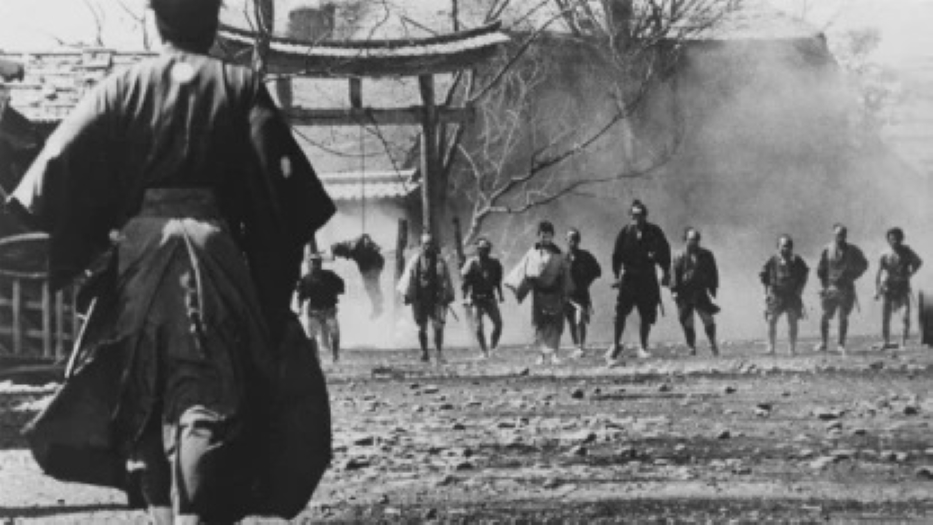
The Western influences in Yojimbo are immediately obvious. The town looks like a Fordian dustboal frontier towns, Kurosawa delighting in the widescreen, windswept streets the site of so many slow-burn face-offs. Rivals meet on main street, facing each other at opposite ends, like High Noon. Seibei operates out of a worn-out brothel, Sanjuro stays in a saloon run by a weary old-timer, a local sheriff is a hopelessly inept foreluck-tugger, Sanjuro has the same gruff excellence with a sword as John Wayne and Alan Ladd had with a gun. By the time Unosuko turns up clutching the town’s only gun and preening like Jack Palace in Shane, it’s impossible to miss we are in the Old Japanese West.

This is a town in total breakdown, where the coffin-maker makes a huge income creating piles of tombs for the rival gangsters who fall in constant duels. Both gangs are in, their way, pathetic. Far from intimidating, Seibei (a hilariously whiny Seizaburo Kawazu) is a puffed-up old man, easily brow-beaten by his wife. Unosake has more swagger and guts, but he’s as cluelessly inept as Seibei. Both gangsters have crews stuffed with fighters but lack almost anyone with any actual skill. When the gangsters are first manipulated into facing-off, they posture and feint at each other like blow-hard school bullies then seem relieved when the arrival of a local official leads to a sudden ceasefire.

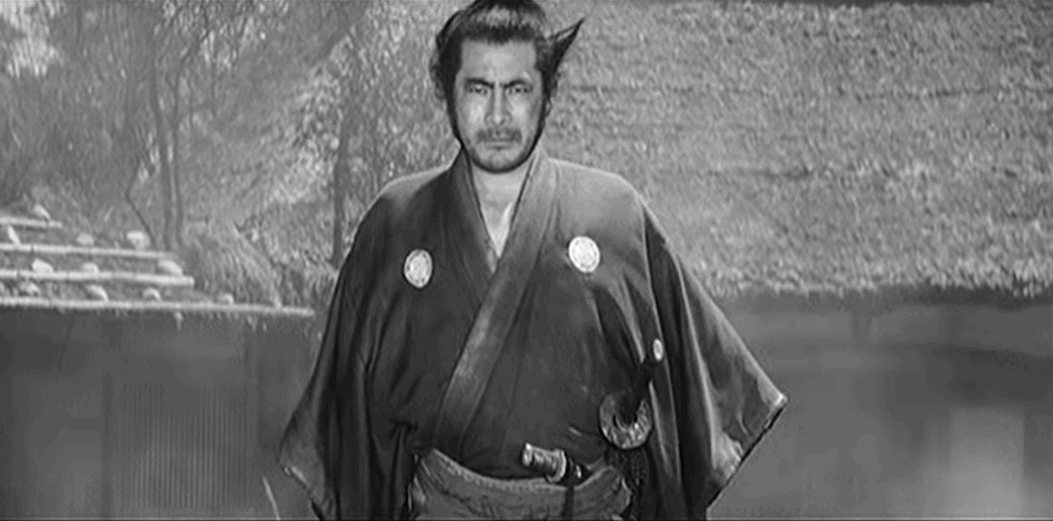
Parodying the old Samurai class, Sanjuro is a million miles from the sort of elite honour-bound soldier we expect. In one of his finest performances, Toshiro Mifune is scruffy, cynical and works very hard to give the impression he’s more interested in his immediate needs than any higher purpose. Mifune is gruff, constantly scratching or chewing: he’s a prototype Clint Eastwood (and Yojimbo was ripped off by Leone for A Fistful of Dollars, leading to a Toho Studios legal case), a morally ambiguous figure who does the right thing when it coincides with his own interests. His motives are unknowable. Why does he set-out to destroy both gangs? Is it sympathy for the mess of the town, or is it because he sees a chance to make a quick buck from the mess? Is it because he’s bored (and eventually annoyed) and does it for his own amusement?

The brilliance of Mifune’s shaggy-dog performance is that it could be all or none of these things. Sanjuro does just one, unmistakeably, decent, selfless thing in the film: saving Ushitora’s unwilling mistress and her downtrodden family. What does it get him? Their near suicidal deference and ostentatious gratitude drives him nearly to distraction and leads to a near-fatal beating. But it really rankles Sanjuro because it’s possible he despises the idea of decency in himself, an intriguing insight into what could be unknown darknesses in his past. Does he know selfless acts can become the only chink in your armour?

Aside from that, his mastery of the situation is hugely entertaining. Never mind two steps, he seems a marathon ahead of the rest. Provoking a pointless early clash with Ushitora’s heavies, he bests them in seconds with a series of lightning fast sword strokes (Star Wars Mos Eisley-based Kenobi swordplaywas clearly inspired by this), establishing in seconds he’s the alpha both sides need to compete over. When action kicks in, Sanjuro is unmatched by the Dickensian collection of street thugs both sides have amassed, his swift reflexes and expert slices reducing even a hideously outnumbered fight into a curb-stomp clash. You can see Kurosawa’s influence over Leone here: clashes in Yojimbo have long build-ups and explosive, sometimes violently bloody outcomes (an arm severed here, a spray of blood there, characters bleeding out).

But Sanjuro’s other skill is his ability to appraise rivals instantly. None of them disappoint in their transparent greed and shortsightedness. Kurosawa visually embodies Sanjuro’s shrewdness by frequently having him climb up a tower platform on the main street to literally look down on the results of his manipulations. No one can match him. Orin – a pleasing twist on her Throne of Blood role as an ineffective Lady Macbeth by Isuzu Yamada – thinks she’s smart enough to double-cross him, but her brains only look impressive matched against the mediocrities of the town. Daisuke Katō’s Inokichi – so dim he can’t even count with the aid of his fingers – literally believes anything he’s told by the last person who spoke to him. Only Tatsuya Nakadai’s smug Unosuke is in anyway threat, but he’s a preening show-off whose only qualification for being the toughest guy in town is because he owns the only gun (which he can’t help fetishistically stroking at every opportunity).

The gun is another sign of a culture at crossroads – the major threat to Sanjuro comes not from any human, but from a distance-killing tool that could wipe out his vastly superior tactical and fighting ability in a second. Yojimbo is showing us a Japan tipping over the edge into a future where ruthless gangs, with more brawn than brain, will drive towns like this into the ground – but our hero, a symbol of a bygone age of heroics, isn’t traditionally heroic either: he’s a scruffy, self-interested loner, who despises nobility. Our other samurai, Seibei’s pet-trainer, is hardly a great advert for samurai either, peddling his skills for cash and huffily walking out when his value is not recognised.

All this is wrapped up in a film that is undeniably hugely entertaining. The action, when it comes, is truly exciting. Mifune is superb, charismatic, likeable with a wry charm and scruffy smile. Kurosawa’s dust-blown pseudo-western is brilliantly assembled, and its wry social satire on an increasingly disorganised Japan falling into chaos (with a golden age that wasn’t that golden behind it) never buries the thrills and spills of his masterfully constructed action drama. Yojimbo is certainly his most purely entertaining film, stripped back and avoiding the overindulgence and bombast of his less successful films. It’s a treat.

The Hidden Fortress (1958)

The Hidden Fortress (1958)

Kurosawa’s samurai entertainment is overlong but has just enough action and adventure

Director: Akira Kurosawa

Cast: Toshiro Mifune (General Rokurota Makabe), Minoru Chiaki (Tahei), Kamatari Fujiwara (Matashichi), Susumu Fujita (General Hyoe Tadokoro), Takashi Shimura (General Izumi Nagakura), Misa Uehara (Princess Yuki), Eiko Miyoshi (Yuki’s lady-in-waiting), Toshiko Higuchi (Prostitute)

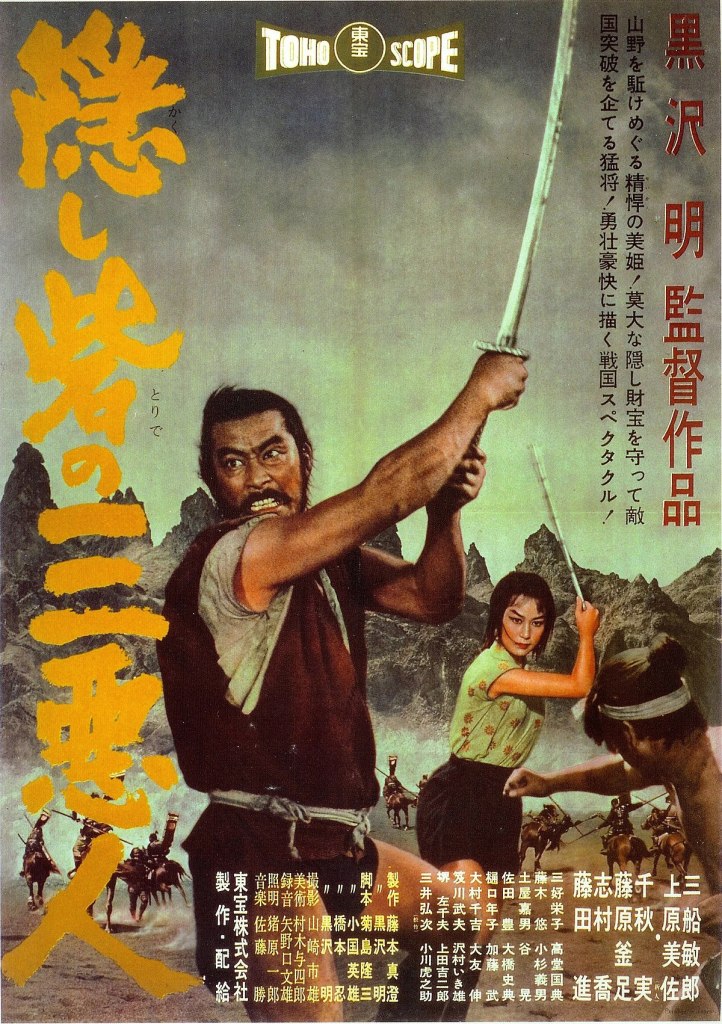
A princess hides in a castle from the wicked forces who have captured her kingdom. Her only hope is a noble general who has concealed the kingdom’s gold in bundles of wood, hidden in a lake at a mysterious castle. The general needs to get the gold and the princess through miles of hostile territory, with only a pair of greedy, incompetent peasants to help. This fairy tale structure is spun by Kurosawa into a samurai action-adventure with Mifune (inevitably) as the general, Misa Uehara as the Princess and Minoru Chiaki and Kamatari Fujiwara as the peasants. It’s good fun, overlong, but an entertaining ride – and one now best known now for its influence over Star Wars.

Kurosawa, after pouring his heart and soul into Throne of Blood, needed to relax. He decided it was time for an entertainment, something to please the crowds. The Hidden Fortress is certainly that, Kurosawa’s first film shot on impressive widescreen Tohoscope, with plenty of horse-bound action and swordplay. It’s really a Kurosawa Westerns, with heroes on the trail on a mission with bad guys to foil. But, as is sometimes the case with Kurosawa, it’s length and scope frequently makes it feel slightly indulgent, while it’s mix of comedy and drama doesn’t always sit comfortably together.

The Hidden Fortress is though highly cinematic. As well as Kurosawa’s enjoyment of the wide-angle lens – soaking up the slopes of Mount Fuji, often rolling in a beautiful mist – it frequently employs Kurosawa’s love of fast-editing tricks, in particular fast wipes to move us seamlessly from one place and time to another (one of many flourishes that influenced George Lucas who made these Kurosawa wipes internationally famous). A horse charge, where General Makabe chases down the samurai hunting them, is a grippingly frenetic with its pace and energy.

Kurosawa mixes this with comedy, though his unusual POV characters. In another move cited by Lucas’ as the inspiration for C3PO and R2D2, much of The Hidden Fortress takes place from the perspective of its peasant sidekicks. But, unlike the genial droids, Tahei and Matashichi are greedy, cowardly and selfish, frequently proving themselves untrustworthy. But, then in a touch of social commentary, perhaps they don’t owe anything to a general who treats them as slaves and (initially) plans to kill them once they are no longer useful. They are played with energetic larger-than-life force by Minoru Chiaki and Kamatari Fujiwara that contrasts neatly with the gruff authority of Mifune.  

It’s them we follow from the start, feuding over robbing the body of a slain samurai before being flung into the slave mines of the Princess’ former kingdom. One of Hidden Fortress’ gently played themes is the class difference between these two sons-of-the-soil and the upper-classes they (reluctantly) serve. For starters, that service comes with no choice – it never occurs to Makabe that they have a say in the matter – and they are told almost nothing about the purpose of their journey. They are instead tools for a higher purpose, just as the Princess’ similar-looking maid is sent to town to be captured and executed, to help protect the bloodline of the royal family.

It’s an attitude the Princess – well played by Misa Uehara as a stubborn young woman, full of righteous indignation at her restrictive office – comes to deplore. She, unlike anyone else among the elite, questions the idea of the poor as unimportant puppets for their betters, and it is she who is drawn to protect people, including a mis-treated prostitute who she insists Makabe buys the freedom of. It’s also she – more than anyone else, including the two peasants – drawn towards the anarchic Fire Festival they encounter, with its dismissal of worldly goods and embracing of enjoying life. But, perhaps Kurosawa’s point is it’s only the wealthy who can afford to indulge themselves with such thoughts: peasants have far fewer options and no choice but to scrabble in the dirt for coins.

This social commentary would perhaps be more widely discussed if the film had kept Kurosawa’s original title, Three Bad Men in a Hidden Fortress: a title that tips Tahei, Matashichi and Makabe into the same morally ambiguous pot, all obsessed with worldly needs (money or the continuation of the royal house) over any concerns about those around them. But, somehow, it’s easier to focus on the wheedling greed of the peasants, and overlook the lofty cold distance of the general, because he’s a noble guy, brave and daring who spares his opponent after a fair duel.

It’s also because The Hidden Fortress is less focused on these elements – Seven Samurai did the snobbery of the samurai class and the mixed motives of the working classes more effectively in any case – and more on being a rollicking, road-movie entertainment. It’s Western-style (in both ways) misfit band adventures, features expertly filmed action set-pieces. Best of all the previously mentioned chase, and a gripping one-on-one duel between Rakabe and his rival General Tadokoro (a fine performance of quiet dignity from Susumu Fujita), that is edge-of-the-seat in its mix of graceful camera work and exciting sword play.

The Hidden Fortress is entertaining, but it’s hard to escape the feeling there is too much of it. Despite not being as long as Seven Samurai, it feels less forceful narratively, largely features less compelling characters and is less well balanced between depth and action. Its plot feels almost deliberately lightweight and the resolution feels rushed. The film’s fairy-tale simplicity really needs a relatable hero at its heart – but the focus on the sometimes irritating peasants means we don’t get that. Fundamentally, The Hidden Fortress is an adventure story from a director, taking a rest from more complex work. It entertains, but feels like it lives in the shadow of other films, even before its connection to Star Wars turned it into a footnote in another film’s story.

Late Spring (1949)

Late Spring (1949)

Ozu’s marvellous heart-rending simple tale of difficult family decisions carries universal strength

Director: Yasujirō Ozu

Cast: Chishū Ryū (Shukichi Somiya), Setsuko Hara (Noriko Somiya), Yumeji Tsukioka (Aya Kitagawa), Haruko Sugimura (Taguchi Masa), Hohi Aoki (Katsuyoshi Taguchi), Jun Usami (Shuichi Hattori), Kuniko Miyake (Akiko Miwa), Masao Mishima (Jo Onodera), Yoshiko Tsubouchi (Kiku Onodera)

In post-war Japan, Professor Shukichi (Chishū Ryū) and his twenty-seven-year-old daughter Noriko (Setsuko Hara) live together in contentment. But what is to be done when her Aunt Masa (Haruko Sugimara) proclaims its time Noriko left the nest and made her own life, with a marriage Masa can arrange with a family friend. Can Noriko’s reluctance be overcome, or will it need the imminent threat of her own father’s potential remarriage to an attractive widow?

From a small-scale, intimate set-up like this – a slight story that can be summarised in little more than a few sentences – Yasujirō Ozu crafts a story of family, ageing, maturity and loss, sacrifice and regret that’s both uniquely Japanese and universal. So carefully is the whole film assembled, so patient Ozu’s intricate, formal structure of each scene that it’s ending of quiet, emotional force takes you overwhelmingly by surprise. It also leaves you challenging all sorts of perceptions you might have had about the rights and wrongs of duty and familial obligation.

Ozu’s Late Spring, like the greatest of his work – which this undoubtedly is – uses a series of carefully designed, stationary camera shots (so much so, it feels a shock when a camera tracks alongside Noriko and her father’s assistant Hattori, as they cycle to a beach) to carefully build a world both intimate and immediate and also oppressive. Furniture in rooms loom around the edges of the frame of the low positioned cameras or are lined up in such a way as if to force movement in one direction (such as, at one point, two parallel rows of chairs leading inevitably to a doorway). Characters are framed in doorways or surrounded by furniture, their choices visually whittled down to a single path.

It’s fitting for a film all about a decision – that everyone believes is for the best – being pushed directly onto Noriko. On paper of course, it certainly is. Surely, it’s no life for a young woman to essentially become nothing more than a housekeeper to her father? Noriko organises the house, dutifully prepares his meals, reminds him to shave – and seems completely content with this. But surely, it’s not what she should want – or indeed what anyone would want for her?

But yet it’s what she wants. Noriko is beautifully played by Setsuko Hara, in the first of her collaborations of Ozu. Hara creates a woman who is warm, bright, funny and greets every day with a beaming smile. She is content with her lot, shrugging off any idea of change. She barely seems to recognise the shy attempts at seduction that Hattori (a suitably bashful Jun Usami) tries – smilingly turning down his concert invitation (a concert we then see him attend alone, his hat filling the second chair he purchased) and reacting with smiling happiness when he reaffirms his long-running engagement is indeed progressing to marriage (far from, it is clear, his first choice).

Noriko’s world is only shaken by the suggestion of marriage, an idea that reduces her to withdrawn, downcast quietness, shuttering herself off from the world. The only thing that could horrify her more is the idea of her father remarrying – she’d already confessed her distaste at her honorary uncle, Shukichi’s colleague Onodera, re-marrying. Her rejection stems from her desire, it seems, for things to remain as they are – and people to do so as well. But that’s also because change requires the old life to be left behind – and her father makes clear he will accept a reduced role.

You could argue its right to push Noriko away from a life of sheltered self-sacrifice and towards something that feels more real and mature. That feels like the modern world. But isn’t this just the old social rules reapplying themselves in new ways? Late Spring takes place at a turning point in Japan. Shukichi and Masa are of a pre-war generation: their homes and clothing are as well, even their formal movements, speech, Shukichi’s love of Noh theatre and (in Masa’s case) clinging to old wives tales smacks of a pre-1945 way of thinking. There everything has a natural order – and Noriko’s marriage is an inevitable part of this.

But there are signs of a new Japan all around them – literally so, as the path to the beach is lined with American military and Coca-Cola signs and a Tokyo increasingly filled with Western coffee bars, along with kids playing baseball and giggling talk of Gary Cooper and other film stars. Noriko even has an alternative path presented in the form of her friend Aya (a charming performance by Yumeji Tsukioka). Aya has decided not to remarry after her post-war divorce, learned English, trained as a stenographer and dresses in the latest Western fashions. Her home is full of Western furniture and the traditional Japanese floor sitting leaves her with sore knees after minutes. She’s the sign of a new Japan on the horizon, one where traditions carry less weight, and choices can be more personal.

The problem is Noriko’s conservative choices don’t work in either worlds. She’s not radical enough to follow Aya (despite half-hearted enquiries), and the idea of non-marriage is alien in the world she wants to stay in. As Ozu and Hara make clear, this locks her into clinging to no change at all. She clearly would never-leave unless pushed. And a white lie from her father is what does it: for Noriko knows that would end her role in her father’s home and her duty to him would be leave. It’s the only duty that would never be her choice.

Nevertheless it’s clearly what her father believes is best for her. Beautifully played by Chishū Ryū, he’s a seeming curmudgeon at first who reveals himself to be a man of deep feeling and self-sacrifice – there is a beautiful moment when he outwardly denies his white lie about intended marriage, while his face subtly twitches. Ryū makes Shukichi a man of quiet dignity, determined to do the best for his daughter, regardless of his own feelings (which are clearly to continue things as they are).

So both parties work towards the ending of a way of life they both desperately want to cling to, doing so in a misguided act of duty towards the other. Is it though? Ozu makes that hard for us to be completely comfortable: our last sight of Noriko, in her wedding garb, sees her bow one final time to the father she loves while the film’s coda gives a heartbreaking moment of unbearable emotional toil for Ryū while he simply sits peeling an apple.

Does it have to be like this? The idea of a daughter subjugating her life to her father feels mistaken, but isn’t that her choice not ours? But how alien is such a conservative and non-traditional choice, in a country at a turning point between tradition and new possibilities? And can you blame people for sacrificing what they want, because they believe the result is better for someone else? It’s an eternally relatable scenario that gives Ozu’s film an undeniable, compelling emotional force, which creeps up on you and crashes over you like high tide waves Ozu closes the film with. Marvellous.

Wheel of Fortune and Fantasy (2021)

Wheel of Fortune and Fantasy (2021)

Low-key, beautifully made short-story anthology, crammed with wonderfully little touches

Director: Ryusuke Hamaguchi

Cast: Kotone Furukawa (Meiko), Ayumu Nakajima (Kazuaki Kubota), Hyunri (Tsugumi Konno), Kiyohiko Shibukawa (Segawa), Katsuki Mori (Nao), Shouma Kai (Sasaki), Fusako Urabe (Moka Natsuko), Aoba Kawai (Nana Aya)

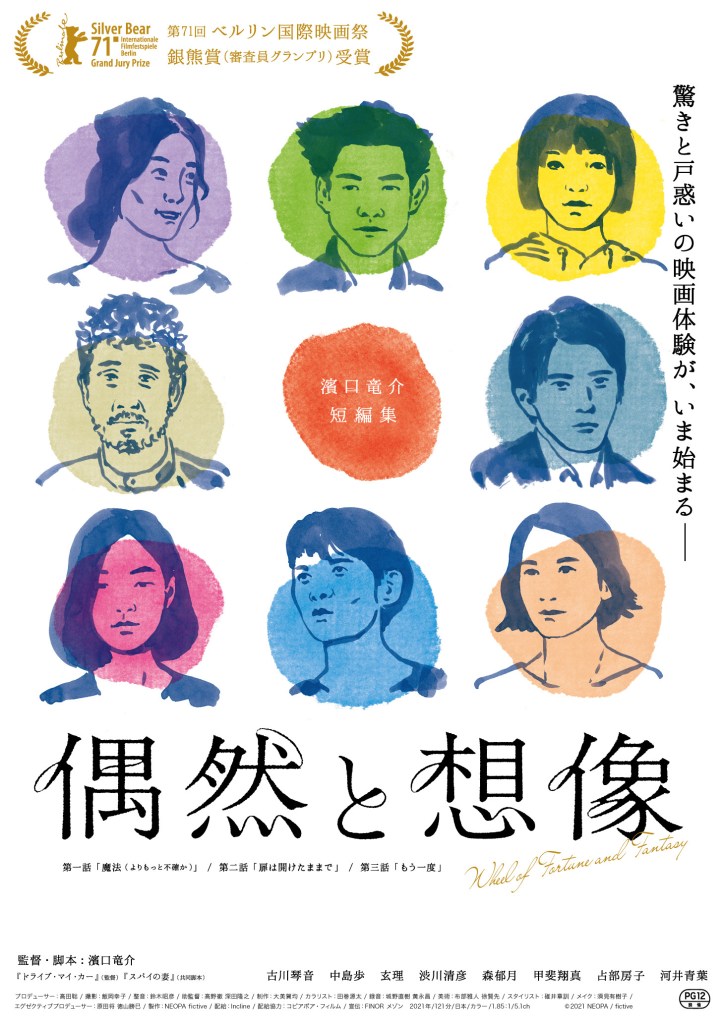
Hamaguchi’s Wheel of Fortune and Fantasy feels deceptively simple. But it’s the Japanese auteur combining an Ozu-inspired sensibility with the narrative flair of Chekhov. In its three acts, Wheel of Fortune and Fantasy presents three short stories, each chamber pieces, each revolving around intimate, intense and life-changing conversations between two people. Hamaguchi demonstrates how lives can rotate on their axis in split seconds, with conversations shifting for one or both participants with no warning, generating unexpected, emotionally surprising results.

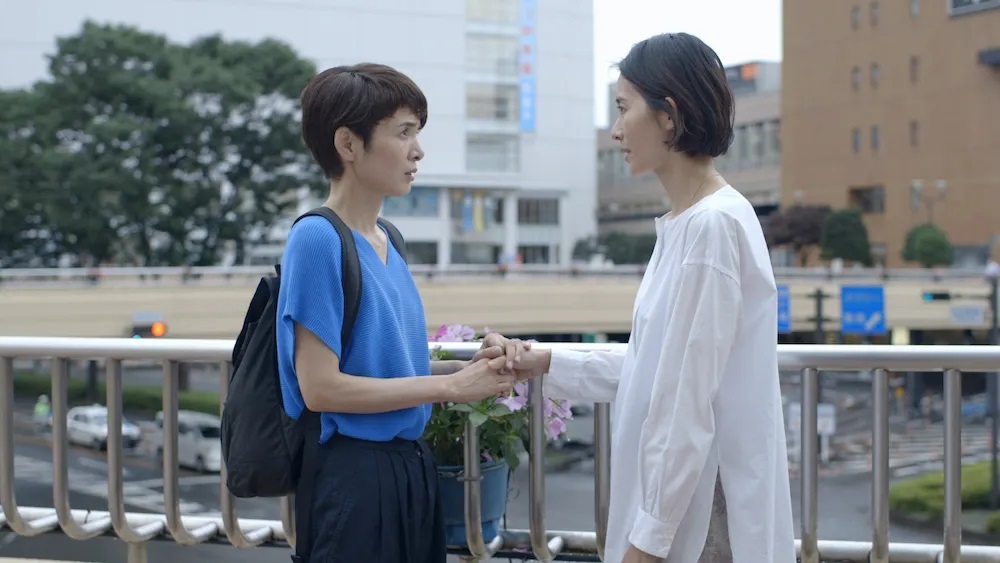
‘Magic’, the first story, revolves around model Meiko (Kotone Furukawa) and best friend Tsugami (Hyunri). During a long cab journey, Tsugami tells Meiko all about her new romance – only for Meiko to realise, part way through, she is talking about Meiko’s ex-boyfriend Kazuaki (Ayumu Nakajima) with whom Meiko may still love. ‘Door Wide Open’ sees distinguished professor and author Segawa (Kiyohiko Shibukawa) become the unsuspecting target of a honey trap by Nao (Katsuki Mori), after her friend-with-benefit’s Sasaki (Shouma Kai) had his media career-plans derailed by Segawa failing him. Nao and Segawa however find unexpectantly common ground. Finally, ‘Once Again’ has Natsuko (Fusako Urabe) excitedly bumping into her former high school girlfriend Aya (Aoba Kawai) at a train station – only to find, when they return to Aya’s home, both have mistaken the other for someone else. These two strangers however find it easier to talk and bond.

All three of these stories are deceptively simple. Only ‘Once Again’ features any unusual set-up (a computer virus has rendered all computers unusable, a sci-fi insertion that only exists to remove any chance of the mix-up being avoided).  Hamaguchi shoots each story with an unaffected simplicity, frequently employing long-takes and staging the bulk of each story (each is about 40 minutes) in single, every-day locations – from taxis to offices to homes.

But Hamaguchi’s approach allows the performances to grow with a subtle, skilful naturalness, capturing intense (but often hidden) changes of mood in the slightest micro-expressions. Each of the three key conversations underpinning the stories develops in utterly unexpected ways and part of the magic of Wheel of Fortune and Fantasy is immediately wanting to play each of back and try and spot the moments where they changed their participants lives.

Hamaguchi carefully builds our empathy with these characters, using Ozu-inspired stationary set-ups complemented with unfussy two-shot set-ups, but culminating in moments of complete immersion where POV shots place us behind the eyes of each character, looking directly at the person they are talking with. It’s a superb way of quietly building our connection with the characters and the events they are experiencing and works brilliantly to immerse us in these moments that we know will shape their emotional development over months and years to come.

This gives these small scale – and they are defiantly small-scale – stories real impact. Hamaguchi’s film is about real people facing real problems: lost loves, frustrated ambitions, childhood regrets. The very human feelings in play here help make the stories affecting. It’s helped again by the subtle performances Hamguchi draws from the cast. When Meiko – a marvellous ambiguous Kotone Furukawa – fumes against her ex-boyfriend for moving on, is she angry at him or at herself for letting him go? Does Segawa (a perfectly dour, almost unreadable Kiyohiko Shibukawa) feel fear at his reputation being damaged or because of stirrings of sexual longing he has clearly repressed? Does Natsuko (a gorgeously fragile Fusako Urabe) relish the freedom of speaking her mind to a complete stranger even more than she would talking to the actual person she is recalling?

Hamaguchi mixes this with intriguing moments of fantasy. A deliberately clumsy camera zoom at one point indicates to us a no-holds-barred conversation in a café has just been in the imagination of one of its participants. Sasaki fantasises about himself reporting on the television about his former mentor. Hamaguchi also brings a wonderful sense of magic to everyday locations (not to mention the fairy tale like set-up of the final stories lack of computers, which feels like the aftereffects of a witch’s curse). The escalator Natsuko and Aya meet on takes on a mystic beauty as it moves them past each other on careful tracking shots. Meiko walks through city streets and stares back at a skyline that feels filled with meaning. Hamaguchi isn’t afraid to slow the film down at key moments to soak up atmosphere and observe the everyday beauty in objects around us.

It lends even more power to the sudden changes these characters experience. Each story carefully builds on the emotional impact of the one before, taking us through ambiguity to complex mixed feelings to a final cathartic moment at a train station that carries real emotional force. Every story ends in a very different place from what we expected at the start – or arguably even the middle – without Hamaguchi ever overplaying his Dahlish Tales of the Unexpected card.

Wheel of Fortune and Fantasy is a small-scale expression of Hamaguchi’s directorial mastery, a perfect expression of his ability to infuse small-scale stories with great emotional force and psychological depth. It’s a highly skilled piece of short-film-making, pulled together into an effective collection. A clear indicator that this – combined with Drive My Car – marks Hamaguchi out as a future great.

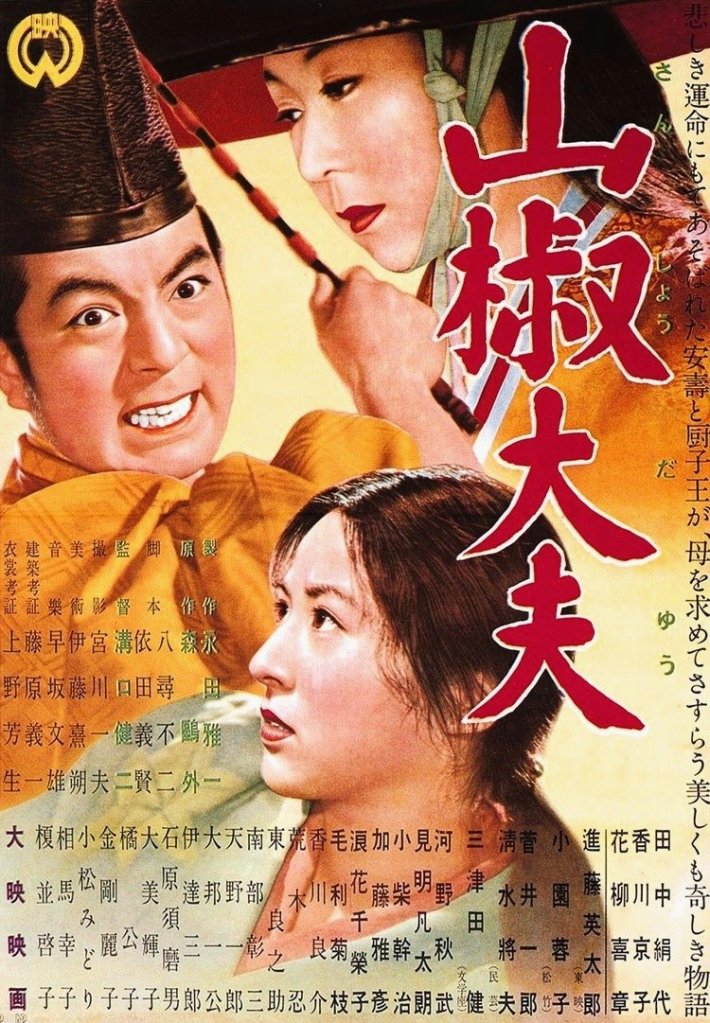
Sansho the Bailiff (1954)

Sansho the Bailiff (1954)

Mizoguchi’s masterpiece, a stirring, humane fable tinged with the tragedy of the real world

Director: Kenji Mizoguchi

Cast: Kinuyo Tanaka (Tamaki), Kyōko Kagawa (Anju), Eitarō Shindō (Sanshō the bailiff), Yoshiaki Hanayagi (Zushiō), Ichirō Sugai (Minister of Justice Niō), Ken Mitsuda (Fujiwara no Morozane), Masahiko Tsugawa (Zushiō as a Boy), Masao Shimizu (Taira no Masauji), Chieko Naniwa (Ubatake), Kikue Mori (Priestess), Akitake Kōno (Tarō), Ryōsuke Kagawa (Donmyō Ritsushi)

You could imagine the lead characters of Sansho the Bailiff as Hansel and Gretel. There is a fairy tale quality to Sansho the Bailiff, combined beautifully by Mizoguchi with a throbbing humanism. Imagine a fairy tale named after The Wicked Witch of the Gingerbread House then spliced with the trauma of captivity. Mizoguchi’s film is a gorgeous, deeply moving and heartbreaking fable, that yearns for us to hold to our inner goodness but shows the terrible struggle to sustain this in a cruel world and the terrible costs we go through for glimmers of hope.

Based on an old Japanese folktale, an eleventh century feudal official is unjustly dispatched into exile. He leaves his family with a mantra: “without mercy, man is a beast. Even if you are hard on yourself, be merciful to others.” A few years later, while travelling, his wife Tamaki (Kinuyo Tanaka) and children are tricked and sold into slavery. Tamaki becomes a prostitute on the island of Sado, her children slaves on the estate of the brutal Sansho (Eitarō Shindō). As young adults, the son Zushiō (Yoshiaki Hanayagi) has buried his humanity as a cruel overseer but his sister Anju (Kyōko Kagawa) still clings to hope and her father’s principles. Can Zushiō’s principles be reborn, despite the brutality of their surroundings?

Mizoguchi’s film is a masterpiece on man’s capability to inflict suffering and cruelty, most particularly on women. Although full of qualities of a classic folk tale, Sansho the Bailiff is grimly realistic and unflinching about the suffering that slavery can inflict and remarkably unblinking in the human cost escaping from such a world can be. There are no fairy tale endings in Sansho, no clear victories, no satisfying conclusions. For every flash of hope, there is the grim realisation of the cost others have paid to achieve it. In particular, women carry an appalling burden of sacrifice.

The family is cruelly invaded in Sansho suffering a double separation – first the other members from the father, then the wrenching separation of mother from children. Shot throughout with a calmly controlled focus by Mizoguchi, with long takes combined with carefully controlled angles that frequently give a terrible distance to events, making the viewer feel powerless to prevent them. Tamika – played with extraordinary humanity and depth of emotion by Kinuyo Tanaka – suddenly understands what is happening and responds with a desperate struggle (which sees her faithful servant unceremoniously dumped off a boat to drown) while her children struggle hopelessly on land. Superbly subtle editing and framing that stresses distance (placing mother and children at opposing ends of the frame in alternate shots) only add to the sense of a family being torn apart.

This is as nothing to the grim world of Sansho’s estate. Slaves who do not work are beaten. The children are thrown into a shack and bluntly told to work or die. Anyone attempting to escape the estate is brutally branded. Old retainers at the end of their working life are expelled to die in the hills. Even Sansho’s son Tarō (Akitake Kōno) can’t bear life on the estate, refusing to brand recaptured slaves (much to the contempt of his father) and leaving for a life as a priest. Mizoguchi wants to show us a world where humanity has no concern for its brothers and sisters. Later we will see no one in power really gives a damn about the morality of estates like Sansho.

In this environment, the son gives up and makes the sacrifices he needs to survive. He becomes dead-inside, forgetting his father’s words and killing his humanity, the man Tarō refused to be. He will brand a recaptured slave (an old man who welcomed him on his arrival years ago) without a second glance. Yoshiaki Hanayagi’s eyes are dead, his spirit a curled animal which has forgotten itself. It’s his sister Anju, beautifully played with sensitivity and hope by Kyōko Kagawa, who clings to their past life and the belief that they can return to it.

To make that return, it’s Anju who will make terrible sacrifices. Sansho the Bailiff is awash with the cost of the world’s cruelty and lack of humanity on women. Tamika is torn from her children, her faithful servant drowned. On Sado, Tamika’s desperate attempt to escape and find her children sees her dragged back to the brothel and hamstrung to prevent her trying again. The dream of seeing her children again – captured in a beautiful sequence as she hobbles to the top of a cliff and sings notes of her sad song of longing for her children – becomes almost a curse, a continual beating on a bruise that will never heal, a longing others will taunt her with.

Memory lies through Sansho the Bailiff like a golden thread. Moments of quiet nature remind Tamika of her husband. His words will be constantly repeated by his family, the last-remaining link to an old life and principles that feel impossible to sustain in their new one. To close your mind to memory and the past, as Zushiō does, is to kill part of yourself. Tamika’s song of yearning is a new memory link. These memory links are strong – they have to be to try and sustain us.

And the words of her song travel. A new slave in the estate speaks of the sad song, to Anju’s delight – finally contact of a sort with her mother. In a moment of magical spiritualism, the words Tamika sang on the cliff seems to travel across the wind to be heard by her children at their lowest point. Zushiō in particular seems to wake from a deep sleep, and suddenly finds the humanity he had so brutally repressed. Mizoguchi shoots these moments with the same affecting simplicity – but it’s that carefully composed, painterly minimalism that gives them such huge power.

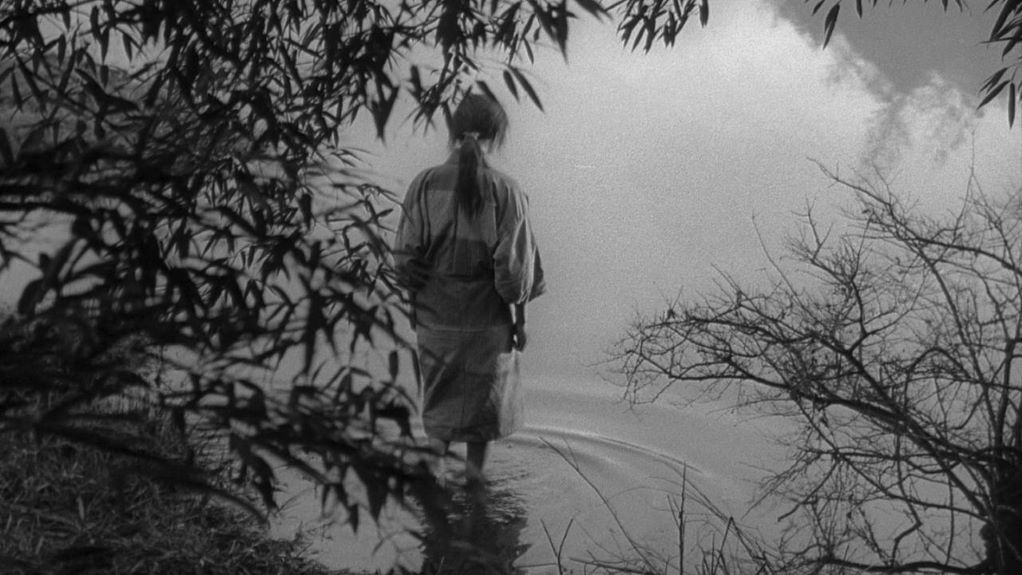
This powerful minimalism is nowhere more effective than Anju’s supreme sacrifice (the fate of women in Mizoguchi’s world). Giving Zushiō the chance to escape, Anju becomes aware that torture for knowledge of where her brother went is inevitable. With serene certainty she walks into the river to drown herself, moving with a sense of freedom she has not known for years. In a single shot we see her walk until Mizoguchi cuts away then back to show bubbles calmly rising to the surface of the water. It is an act of love, stunningly simple and hugely moving – and apiece of a world where freedom and any trace of goodness can only come about through irreversible sacrifices.

Like a folk tale Zushiō is restored to his father’s office, but finds he can make few changes. Slavery is abolished at Sansho’s estate – but the system cannot really be changed. The slaves know this to – they take their chance to sack the estate, aware that fortune’s wheel could return them once again to servitude. Sansho learns nothing from the events, and the suspicion is the next governor will pardon him (after all he brings more revenue in than anyone else). Sansho is the real world and he is inescapable – so much so he even owns the name of a film in which he is a minor player.

It builds towards the final conclusion on a windswept beach, perhaps one of the most heart-rending moments on film. In a Western film, this would be a scene of joyful reconciliation in which two damaged people heal through sharing grief. Mizoguchi had lived through the horrors of war and knew this would have been a lie. Reuniting doesn’t wash away the pain or heal the wounds – physical or spiritual – and doesn’t change the world. It’s just two people on a beach, clawing towards a moment of peace in a difficult world.

Sansho the Bailiff is clear-eyed and realistic about a world where people hurt each other and care nothing. Told with a classic, artistic simplicity, it is both a deeply moving and deeply spiritual piece, a great humanistic artist making his ultimate statement on the nature of the world. An essential film.

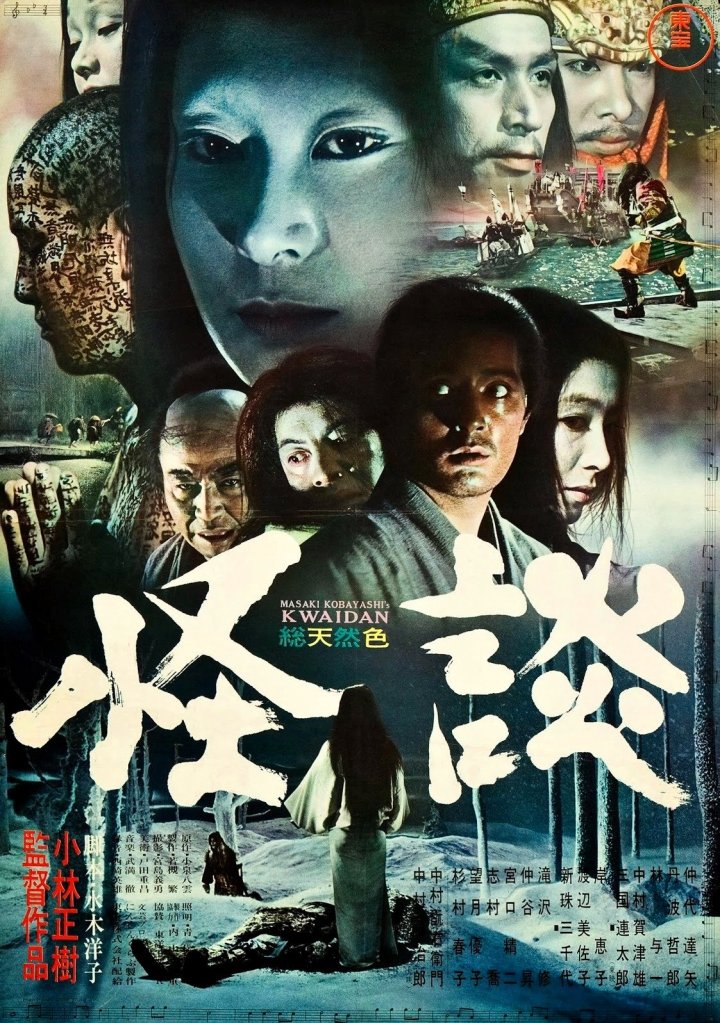
Kwaidan (1964)

Kwaidan (1964)

Unsettling dread abounds in this beautiful, terrifying collection of ghost stories

Director: Masaki Kobayashi

Cast: The Black Hair – Rentarō Mikuni (Samurai), Michiyo Aratama (First wife), Misako Watanabe (Second wife); The Woman of the Snow – Tatsuya Nakadai (Minokichi), Keiko Kishi (Yuki-Onna); Hoichi the Earless – Katsuo Nakamura (Hoichi), Tetsurō Tamba (Warrior), Takashi Shimura (Head priest); In a Cup of Tea – Osamu Takizawa (Author), Noboru Nakaya (Shikibu Heinai), Seiji Miyaguchi (Sekinai)

What is horror? For many people, it’s guts and gore. But I’ve always found far more unsettling the creeping terror of the unnatural, the unsettling dread of the unknown. The best ghost stories do this: the horror of encountering something that, by all logic, shouldn’t be there. The paralysing fear of coming face-to-face with something that surely cannot be real. The MR James style of ghost stories, where supernatural powers are unknowable and unrelenting. Kwaidan, Kobayaski’s collection of Lafcidio Hearn’s Japanese ghost stories, trades brilliantly in this – each of the stories contains moments of real spine-tingling dread that sent goosebumps racing over my body.

Kwaidan is built around four short stories, each separate but thematically linked. In The Black Hair, a samurai (Rentarō Mikuni) leaves his faithful first wife (Michiyo Aratama) for a loveless marriage with the daughter of a rich man. Realising his mistake, he finally returns to her but he stumbles into a haven that becomes a nightmare. In The Woman of the Snow, woodcutter Minokichi (Tatsuya Nakadai) encounters a terrible spirit (Keiko Kishi) in the forest who swears him to secrecy on pain of death – can he keep his silence from Yuki (Kishi again), the woman he marries? In Hoichi the Earless, Hoichi (Katsuo Nakamura) a blind ballad singer, is unwittingly hired by the spirits of a dead warlord. And in In a Cup of Tea, a samurai (Seiji Miyaguchi) is horrified when he sees a reflection that is not his own in a cup of tea.

Simple concepts – and in many cases you can see where this might be going just from the description – but the unnerving sense of dread and the uncontrollable inevitability of the supernatural horrors are what makes this truly terrifying. Kobayashi’s film is slow, careful, precise, and it is this very quality that contributes most effectively to its terror. As the camera moves slowly through unnaturally still and quiet locations, with a soundtrack made of a mix of silence and deeply unsettling, jarring chords and discordant sound from Toru Takemitsu, you actually feel like you want nothing more than to turn and run. Whatever Kobayashi’s camera is slowly edging towards showing us, we know it can’t be anything good. The expectation is a large part of the terror.

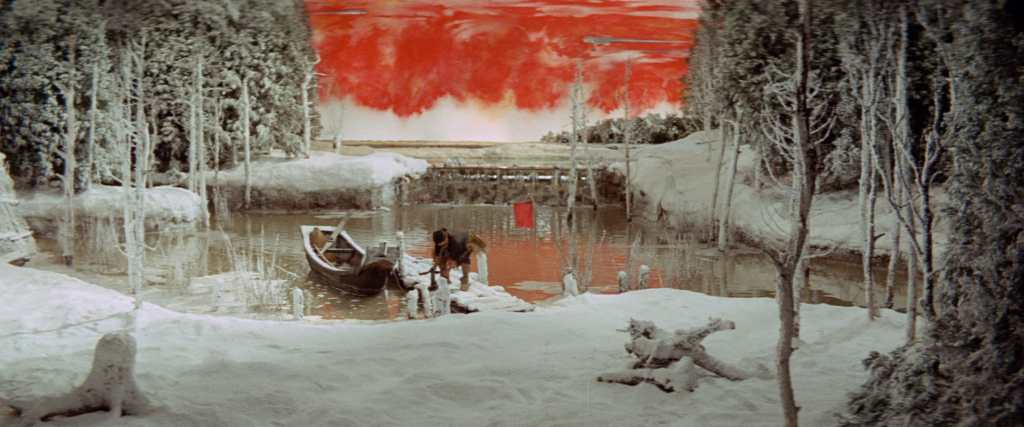
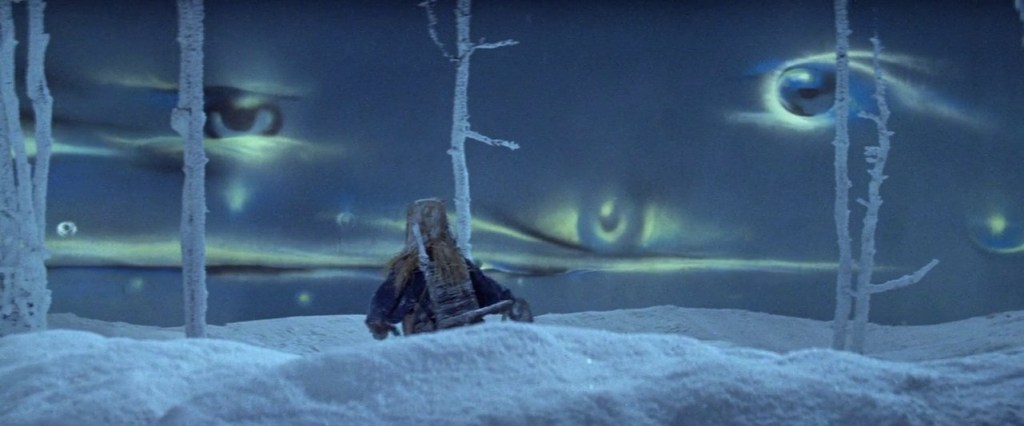
The unsettling world of Kwaidan is magnified by Kobayashi’s desire to control every element of the world he constructed. Bar a few shots of wave-lashed coasts and a Samurai riding competition (presumably too difficult to recreate inside), every scene was filmed inside a massive air-hanger studio. No attempt is made to disguise this. Instead, this exquisitely beautiful film makes a virtue of this to add to the unnerving sense of unreality. Skylines and backdrops are swirling whirlpools of paint and colour, never once trying to suggest a reality. Buildings, fields and even lakes subconsciously feel hemmed in by massive walls of painted unreality. It adds a terrifying fable quality – a nightmareish unreality – to the entire film.

It also makes Kwaidan a uniquely beautiful film. Not since Jack Cardiff’s work with Powell and Pressburger have scenery and backdrops looked as beautiful as this. Kwaidan is an explosion of gorgeous colours, used vividly and imaginatively to suggest mood, themes and threats. In The Woman of the Snow, the spirit seems to suck everything but blues and whites out of the palette – something we notice even more from the orangey skies that surround the woodcutter at every other point. The faded, paler colours in The Black Hair when the samurai returns to his first wife clue us in that all is surely not well. Splashes of red throughout spell danger – a coat, the lining of a pair of sandals, a torn flag, the lining of a cup, all of which the characters ignore.

They ignore these dangers at their peril. One of most dreadful things about the unsettling terrors of Kwaidan is that we can see the outcomes of their mistakes long before the characters do. The stomach-churning dread is waiting for it to happen. It’s executed to perfect effect in The Black Hair. The pompous samurai (a fine performance by Mikuni) is naturally due to be punished for abandoning his wife – and the faded home but unchanged wife he visits after years warn us well before him that horrors will follow. But Mikuni’s horrified shriek when confronted with the truth – and the staggering, nightmare-like, lack of control he seems to have over his body when he realises it (like a dream where you need to run but can’t) – makes this short chapter honestly one of the most unsettling things I’ve ever seen, a true Japanese MR James classic.

Equally fine is the second story The Woman of the Snow. It’s the most lusciously filmed of the four – its painted backdrops are Van Goghian works of art and the colour contrast between the warm summer and terrifying, pale blue winter is extraordinary. Its story is slight, but its spirit – Kishi moving with, again, a nightmarish precision that is deeply unnatural – is terrifyingly relentless. It offers no plot shocks, but the terror of inevitability, to excellent effect.

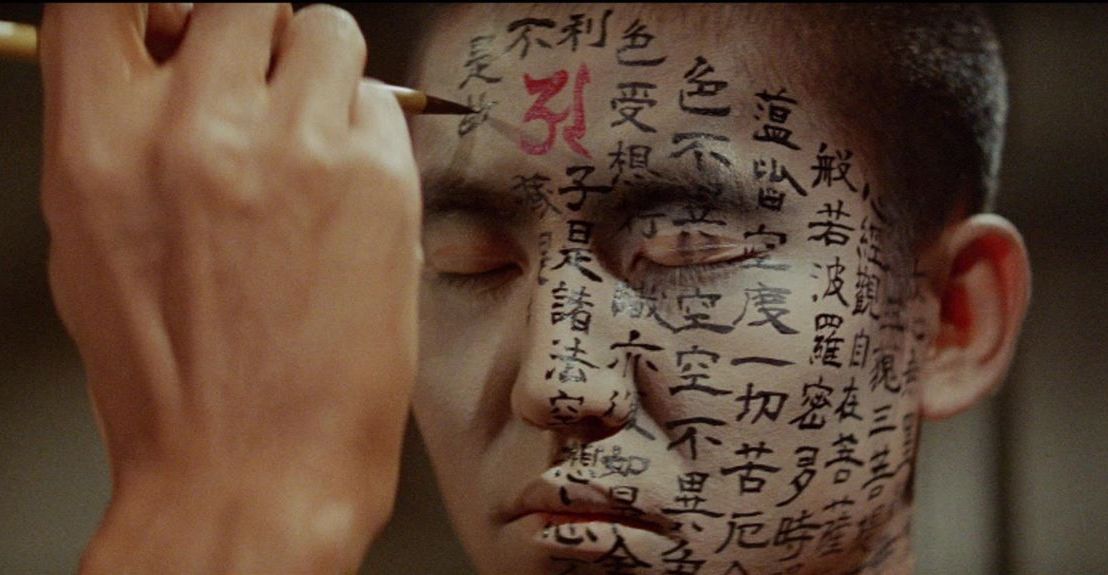
Kwaidan’s two final stories are less satisfying than these two masterpieces. Hoshi the Earless is very long – almost half the run time alone – and the story most dependent on an understanding of Japanese history. It recreates with a deliberately artificial beauty an ancient Japanese naval battle – clearly taking place in a water tank before a painted backdrop, but dreamlike in its execution, like a half-remembered vision, crammed with striking colours and images. The actual story of Hoshi is the least haunting, but provides Kwaidan’s most lingering cultural image, of a body covered (almost) from head to toe in writing to ward off spirits. Kwaidan concludes with a curiosity In a Cup of Toe a deliberately un-finished story – although the reason it remains unfinished provides Kwaidan with its final burst of shocking horror and another striking, unforgettable image of nightmarish dread.

Images of nightmarish dread abound in a film constructed intricately and deliberately artificially to heighten its sense of horror. The inevitability of many of the outcomes in its story detracts not one jot from the terror – if anything they add to it. Kobayashi’s direction is detailed, controlled, perfectly paced and wrings every last drop of unease from the audience. It’s a film that is long and slow, because the best terror often comes from the lingering slow-build – and its world of disjointed noises and sounds works perfectly to never allow the audience to relax. Kwaidan is an essential and masterful horror film, a collection of the sort of ghost stories that would make you run from the campfire.

Seven Samurai (1954)

Seven Samurai (1954)

Superb, archetypal action-adventure men-on-a-mission film: Kurosawa’s masterpiece, brave, bold and thrilling film-making

Director: Akira Kurosawa

Cast: Toshiro Mifune (Kikuchiyo), Takashi Shimura (Kambei Shimada), Daisuke Katō (Shichirōji), Isao Kimura (Katsushirō Okamoto), Minoru Chiaki (Heihachi Hayashida), Seiji Miyaguchi (Kyūzō), Yoshio Inaba (Gorōbei Katayama), Yoshio Tsuchiya (Rikichi), Bokuzen Hidari (Yohei), Yukiko Shimazaki (Rikichi’s wife), Kamatari Fujiwara (Manzō), Keiko Tsushima (Shino), Kokuten Kōdō (Gisaku)

I’ve often been a Kurosawa sceptic. But it’s hard to stay critical, when he made a masterpiece as near perfect as Seven Samurai. It’s one of those films that is long (the favoured cut is nearly three and a half hours) but never once drags. Kurosawa directs with such intelligence, skill and pace, you can’t help but be swept up in it. It’s one of the finest action epics ever made, but also has a rich vein of sadness and melancholy. After all, the samurai may fight the good fight, but they always lose.

In the sixteenth century, a farming village is under-threat from a bandits, rogue samurai turned ronin, who plan to steal the harvest. To protect themselves, the village elder (Kokuten Kōdō) declares they need samurai of their own (and since the farmers have little to offer, they better “hire hungry samurai”). They recruit a team of seven, led by experienced Kambei (Takashi Shimura), who accepts out of nobility. Among the team is wild-card peasant-turned-wannabe-Samurai Kikuchiyo (Toshiro Mifune). The seven arrive in the village and prepare for battle: but, even when working together, no one ever completely forgets the rigid societal boundaries of Japanese culture.

Seven Samurai is a wonderful character study, a sublime action film and complex and engaging exploration of Japanese history and society. It also has a perfect three act structure, it’s run time expertly divided into the samurai’s recruitment, preparation and defence of the village. This careful construction counters that epic run time – each act tells an almost self-contained story, meaning the film’s momentum never slackens.

It’s bought together by a director making a perfect fusion between Japanese cinema and his American and European influences. Kurosawa had never been shy about his admiration for directors like Ford and Hawks. You see elements of cowboy flicks throughout: from the set-up of the villagers as homesteaders, the samurai as the cavalry and the rogue ronin as the Indians, down to sweeping camera shots and vistas straight from Ford (the kinetic energy of Stagecoach is surely an influence). His Western influences always made Kurosawa more digestible than (for example) Ozu.

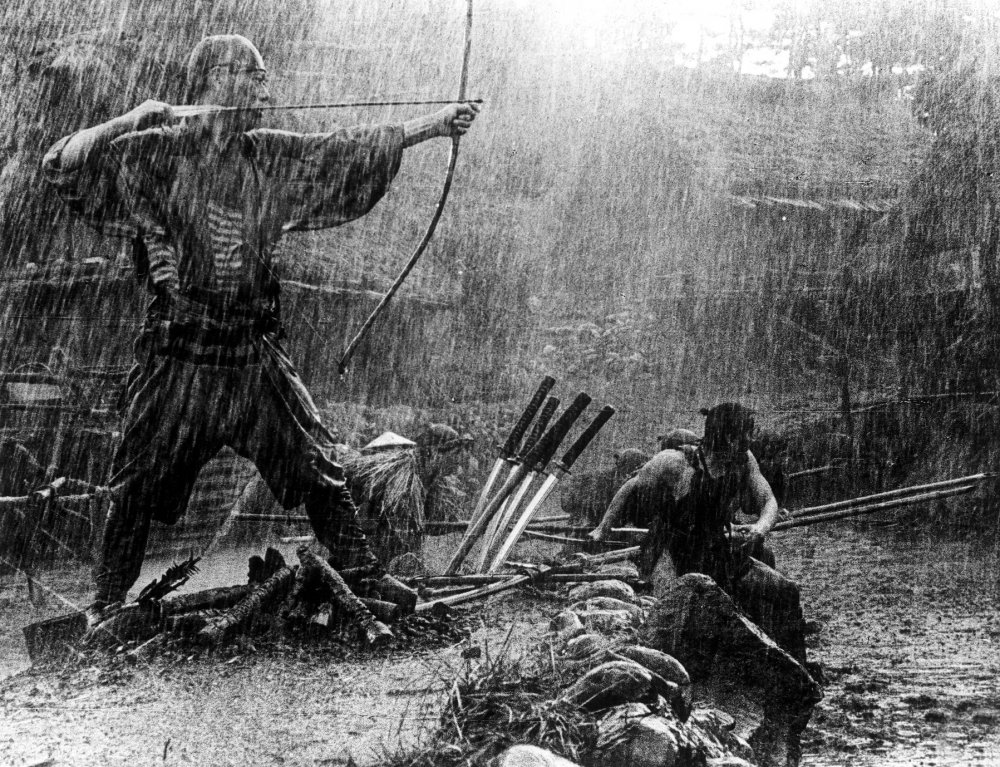
Seven Samurai is an also electric employment of Eisenstein style techniques of skilful editing, dissolves, fast cutting and an embracing of the language of cinema. Kurosawa accentuates action with slow motion: when Kambei dispatches a bandit (in his superb introduction scene), the body falls seemingly forever, death building in impact. Zoom cuts introduce locations, bringing us closer and closer to events. Kurosawa shot the battles with three cameras (a master and two roving cameras) allowing him to capture the kinetic action of his rain-soaked finale. Brilliant montages introduce concepts, characters and themes. It’s a masterclass.

It’s also masterful at quickly sketching character. We know from his first introduction – a brilliant cold-open fifteen minutes or so into the film – that Kambei is a man of both shrewd tactical awareness and puts duty before superficial pride, by his willingness to shave his hair so he can pass as a monk to rescue a child. (The gasps of those watching say it all at this willing acceptance of a cultural mark of shame). Kyūzō is introduced duelling with wooden swords. Why don’t we swop to real blades says his opponent: because you’ll die, Kyūzō matter-of-factly describes, his matter-of-fact bluntness and lack of bragging backed up by his immense skill when the chap dies seconds later. Gorōbei’s shrewdness is shown by the ease he dodges Kambei’s ambush test, just as Kikuchiyo’s rawness is when he blunders straight into it (and promptly loses his temper). Little moments like this abound, in a film stuffed with clever character beats.

The film presents a Japanese culture where concepts of honour and self-sacrifice sit awkwardly alongside regimented hierarchical and societal rules. The samurai can’t help but look down on the peasants – even while they see it as their duty to protect the weak. The villagers, in turn, look at the samurai as barely-to-be-trusted potential oppressors or dangerous parasites who steal their land and daughters (or both). Much of the film’s second act, as the samurai train the villagers to resist the attack, is about these two communities learning to respect each other. But it’s a tenuous alliance, held together by circumstance: when the dust settles, the surviving samurai are no longer welcome.

The samurai are a dying breed. Kambei knows the future belongs to people who provide industry and food. Samurai principles of honour and duty, pride in their skill, is also increasingly irrelevant in a world where the gun decides conflict. The ronin have three rifles and these deadly weapons are no respecter of skill or honour (none of the seven are bested in conflict, but all who fall do so to a bullet). Perhaps this is why the samurai cling to their principles and their honour. They know the world they knew is dying away and that there may be no place for them in the new.

This conflict is given a human shape by Kikuchiyo. Played with an electric, charismatic wildness by Toshiro Mifune (allowed to let rip, he’s a breath-taking explosion of jagged movements, eccentric line deliveries and unbound energy), Kikuchiyo is neither peasant nor samurai. Bought up from working stock – carrying stolen papers of nobility to try and pass himself off as samurai – he’s also rejected by his farmer peers for his warrior status. This makes him a character who can expose hypocrisies on both sides: denouncing the farmers pleading for help but cowering from the samurai; then angrily arguing samurai selfishness and pride have left the peasants with little choice but to horde food and riches to survive.

Not that Kurosawa is shy of admiration for the samurai. Yes, the flaws of their class are exposed – and we see more than enough their potential for arrogance, pride and violence. But the seven also contain a collection of their best traits. Takashi Shimura is brilliant as Kambei: selfless and honourable who takes on the task to honour the peasant’s offering all they can (however little that be). Heihachi (played by an ebullient Minoru Chiaki) represents generosity and warmth. Kyūzō (an enigmatic Seiji Miyaguchi) is awash with self-effacing warrior skill, shrugging off his feats with simple matter-of-fact statements. Shichirōji and Gorōbei are loyal and thoughtful warriors, Katsushirō (a charming Isao Kimura) a decent man eager to prove his worth. These are the best of their class.

They’ll need to be to win in this desperate action. Their preparation carefully outlines the obstacles facing to defence of this village – and to corral the villagers to defend their property. Houses outside the village walls are abandoned (Kambei seeing down a near rebellion on this, with threats of immediate justice), a raid on the ronin’s base aims to reduce their numerical advantage, the difficulty of turning the terrain against superior numbers repeatedly made plain. Kurosawa’s visual storytelling means the action when it comes is not only captivating, but completely understandable.

And what action. Seven Samurai can take its place on any list of the greatest war films ever made. The final hour features attack-after-attack on the village, interspersed with raids, skirmishes and derring-do. Both Kyūzō and Kikuchiyo take solo missions out of the village, though Kikuchiyo’s hunt for glory, even while he captures a rifle, leaves part of the wall undefended and leads to tragedy (Kambei is furious at this failure in discipline). It culminates in a rain-soaked final stand, shot with an all-absorbing power and engrossing kinetic energy.

The samurai sacrifice much for the village. But for what thanks? A peasant disguises his daughter as a boy, because he assumes, if discovered, the samurai will instinctively rape her. When the ronin don’t arrive as expected, the peasants grumble that the samurai are eating more than their fair share. As the samurai fall, their deaths are marked with a decreasing lack of notice (the final deaths don’t even gain on-screen funerals). With victory assured, the peasants return to their crop and don’t even lift a hand to wave the samurai goodbye.

It seems like poor reward for people who have sacrificed so much. But then that’s part of the point Kurosawa is making. Some samurai chose honour. Some choose the opposite. But they are always relics of a feudal system that is being left behind by events and the modern world. Its not just guns that will take them eventually. It’s a sadness that adds an even richer vein to this gripping, superb action drama. Kurosawa’s films may have flaws – but he doesn’t put a foot wrong in Seven Samurai.