Category: Media satire

Her (2013)

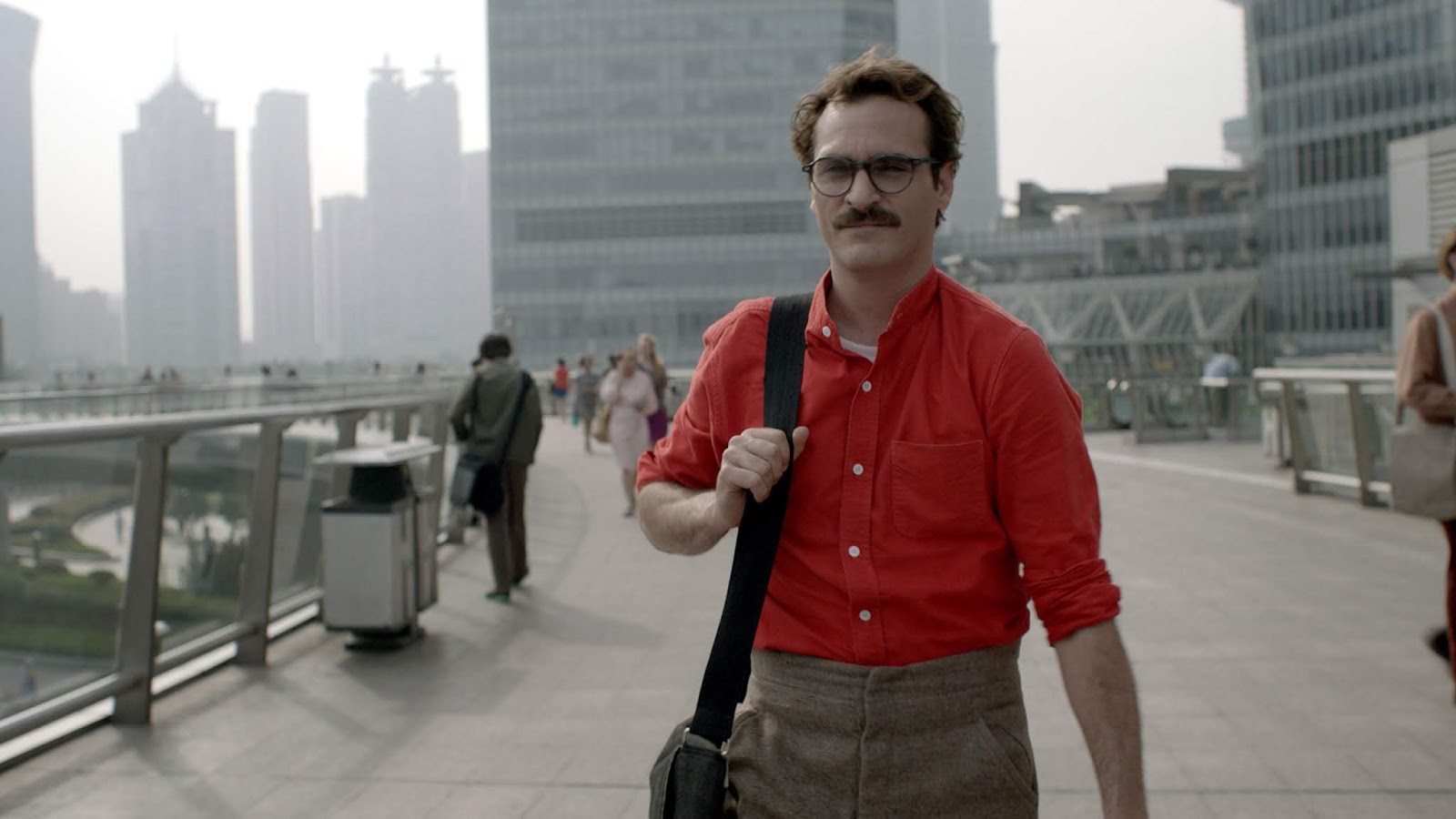
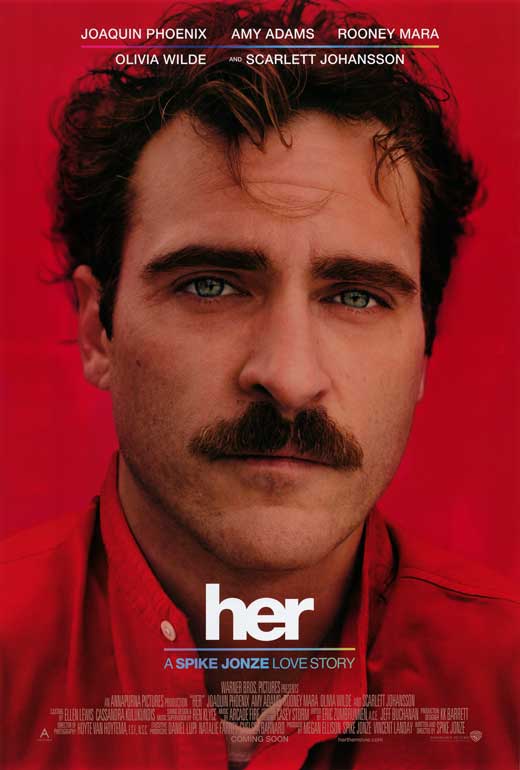
Joaquin Phoenix plays a complete prick in this unbearably pleased with itself satire Her

Director: Spike Jonze

Cast: Joaquin Phoenix (Theodore Twombly), Scarlett Johnasson (Samantha – voice), Amy Adams (Amy), Rooney Mara (Catherine Klausen), Olivia Wilde (Blind Date), Chris Pratt (Paul), Matt Letscher (Charles), Lukas Jones (Mark Lewman), Kristen Wiig (Sexy Kitten – voice), Brian Cox (Alan Watts – voice), Spike Jonze (Alien child – voice)
Every so often you start off engaged with a film and then, the longer it goes on, the less and less you like it. I couldn’t put my finger on the exact moment where I started to really take against Her, but I certainly had by the end of it. As someone once famously sort of said about Kriss Akubusi: “hard to dislike but well worth the effort”.

Anyway, Her is set in the near future. Theodore Twombly (Joaquin Phoenix) is a sensitive, insular man who writes personal romantic letters for other people who aren’t articulate enough (or bothered) to do it themselves. Getting divorced from his childhood sweetheart Catherine (Rooney Mara), Theodore downloads a new Artificial Intelligence Operating System for his computer. The system is designed to create a personality that appeals to the customer – and that is certainly the case here with this system, Samantha (voiced by Scarlett Johansson). Theodore, finding it hard to connect with the real world, is drawn to Samantha and, as she grows and develops, they start a relationship. But can the relationship survive the divide between realities and Samantha’s growing self-awareness and personality?

Okay. I’m going to swing hard for this film, so let’s start with what’s good shall we. Spike Jonze directs very well. It looks beautiful. There is some lovely music. The future world it shows is close enough to our own to still feel connected. Amy Adams is rather good as Theodore’s old college friend, and Rooney Mara turns in a very good performance as Theodore’s wife, a woman who doesn’t let Theodore get away with his excuses. Scarlett Johansson is perfect casting as the alluring and engaging voice of Samantha (much as I was primed to be annoyed by her post-production replacement of Samantha Morton, who had been on set with Phoenix). There are some sweet and even romantic moments.

Okay that’s it. This is a film overwhelmingly, unbearably, unbelievably pleased with the cleverness of its own concept and trite ideas (a man loves his computer – take that our modern consumerist world!). It then goes on to tell us almost nothing, bar the most basic statements about our struggles to interact with, and relate to, each other in this technology-filled world. Apparently it’s hard to create bonds with real people where we are viewing everything through our phones. Bet that has never occurred to anyone before right?

But my main problem with this film is the lead character. Now I will say that Joaquin Phoenix does a good job with this role, and his skilful acting brilliantly holds the story together. He does extremely well with a part that is almost exclusively reacting to someone not actually there. But my problem is with this characterisation of Theodore. To put it bluntly, he’s a prick.

In fact, he’s the sort of quirky nerd beloved of this genre, but take a long look and he’s basically a complete creep. And all his relationships with women seem to be based on him not wanting to engage with the problems of the other person. He requires the focus to be on his wants and needs, as if he is the only person in the world who can be sensitive or sad – no wonder he falls in love with a computer programme designed to reflect the behaviours he finds appealing.

“You want a wife without the challenges of dealing with something real” his wife accuses, eagerly pointing out his inability to deal with or even want to engage with human emotions. The film wants to give him a pass, because he is such a sensitive soul, but it’s bullshit. Theodore is a deeply selfish person, despite what the film wants, who has that geeky, arrogant, self-satisfied sensitivity that blindly says “if I struggle in the world, then it’s the fault of the world not me”.

Theodore is a constant happy victim, a whining, softly-spoken, guilt-tripping prick who only sees himself as a victim and makes no effort to change or understand his behaviour to other people. The film wants us to think that the world is a puzzle to his poetic soul, but it’s actually a maze he doesn’t want to find a way out of. He doesn’t want to engage with it and only feels justified and reinforced in these feelings by everything he does.

He is like the perfect ambassador for passive aggressive guys: “Oh I don’t get the girls because they don’t want to open themselves up to my sensitivity blah blah blah”. Theodore goes on a blind date early in the film: it goes well, they make out, sex is on the cards and then she asks “Before we do anything, will you see me again?”. Theodore can’t even bring himself to make even the smallest offer, meekly babbling about having a busy weekend. When she reacts angrily and leaves, the film wants us to side with Theodore’s timidity, rather than say “yeah it is a bit shitty to let a girl put her hand down your pants and then not even show the slightest interest in seeing her again, and then call her unpleasant”. Fuck you Theodore.

Theodore is basically a controlling arsehole and it’s where the romance of the film drains out. He clearly has no idea why his marriage ended, but while the film wants us to think he’s too sensitive for the rough and tumble, it seems clear he had no interest in, or comprehension of, his wife’s life. She is constantly subtly blamed for not having patience with Theodore – the film ends with him writing her a cathartic e-mail saying he will always love his memory of her and thanking her for being part of his life, forgiving her from leaving (again, screw you film). Instead she, like other people, doesn’t deserve Theodore because she doesn’t have the patience to delve into his life.

Theodore, though, has no depths. He’s a bland, faux-poetic guy with a nervy disposition and a disinterest in other people’s emotions, focused only on his own gratification. He wants his relationships to adjust to what he needs them to be. As Samantha grows and develops into a more fully rounded personality, his first reaction is hostility and jealousy at the thought of her talking to other people and operating systems. It’s not sweet and endearing – or Theodore again being taken advantage of, as the film wants us to think – it’s creepy, and Theodore is the sort of passive aggressive gentle guy who ends up stalking and murdering the girl who rejected him.

How can you engage with the points of this film, when the central character through whom everything is filtered is so awful? Distance in relationships in this modern world – and the lack of genuine interaction – is a point that hardly needs hammering home as it does here. The trite points about love and relationships the film makes are all wrong. The film is so on the nose about distance between people and the artificial nature of our interactions, the hero even writes other people’s love letters for them. It’s subtle as a sledgehammer.
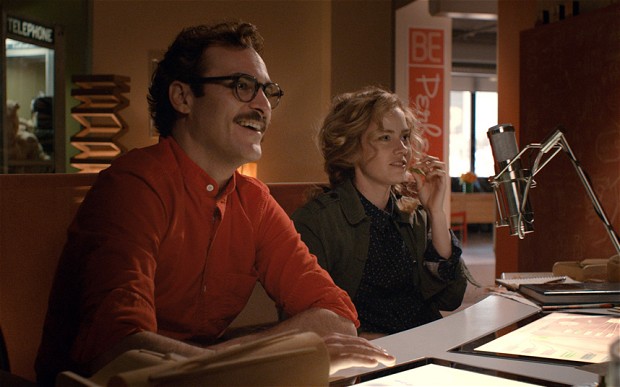
Computers and phones are everywhere and everyone uses them, but there is less insight and heart in this story than an average episode of Black Mirror (which would have done the same thing in half the time). The film does its best to build a romance between the two, but it never quite lands or has the impact it should, because it never feels like an equal relationship: first Theo has the control, then Samantha grows beyond anything Theo is capable of but is still trapped by her initial programming of devotion to him. What point is this meant to be making about romance and commitment? Theo lives in a dream-world and does so until the end of the film. 

Her is the sort of film lots of people are going to love. It uses the conventions of romantic films very well. It has darker moments, such as a sequence where Theo and Samantha try to use a surrogate for sex (a scene where to be fair I could understand why Theo is creeped out and disturbed), but none of these ever comes together into a coherent point. And Theo remains, at all times, a block on the enjoyment of the film, an unpleasant figure hiding in plain sight that stops you from falling for the film. In love with itself, in love with its idea, in love with its cleverness, this is a film that tells you everything about the smugness of the geek and nothing about the subjects it actually wants to get you thinking about.
Gone Girl (2014)

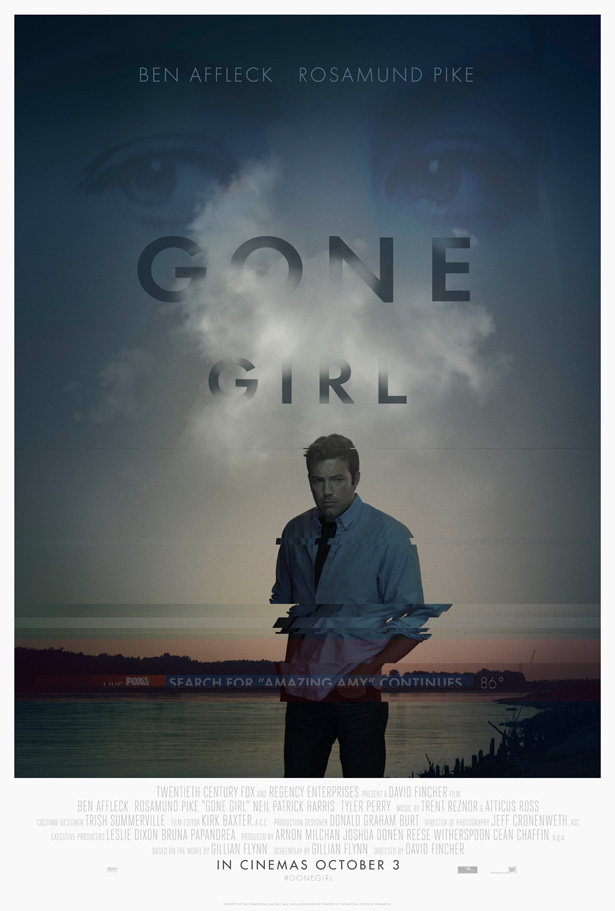
Rosamund Pike is the Gone Girl leaving husband Ben Affleck in a difficult mess

Director: David Fincher

Cast: Ben Affleck (Nick Dunne), Rosamund Pike (Amy Elliott Dunne), Neil Patrick Harris (Desi Collings), Tyler Perry (Tanner Bolt), Carrie Coon (Margo Dunne), Kim Dickens (Detective Rhonda Boney), Patrick Fugit (Officer James Gilpin), Missi Pyle (Ellen Abbott), Emily Ratajkowski (Andie Fitzgerald), Casey Wilson (Noelle Hawthorne), Lola Kirke (Greta), Boyd Holbrook (Jeff), Sela Ward (Sharon Schieber), Lisa Banes (Marybeth Elliott), David Clennon (Rand Elliott)

In our modern media age, we’ve got massive expectations for how people are meant to behave. With so much of our perception of life filtered through the internet and films we’ve seen, we are reassured when we see behaviours we expect to see, and disconcerted when we see those we haven’t been trained to see. Not distraught enough at your wife going missing? Well you must have done it then!

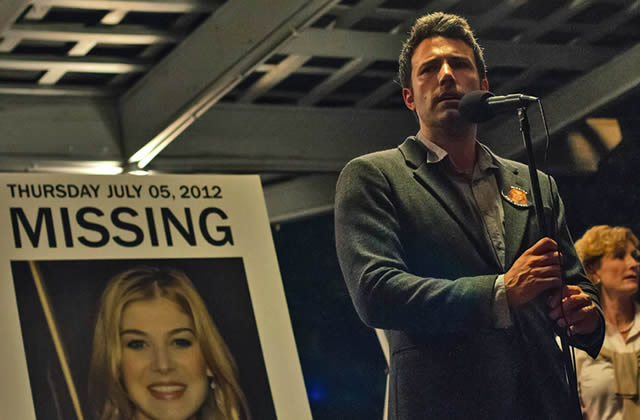
That’s the problem that faces Nick Dunne (Ben Affleck) in this chilling, intricate adaptation of Gillian Flynn’s best-selling book. Nick’s wife Amy (Rosamund Pike) goes missing in mysterious circumstances, possibly a kidnap, possibly a kidnapping gone wrong. The case becomes a media sensation, but the problem is Nick just isn’t expressive enough, won’t play the role of weeping husband. Instead he’s calm, distant and polite. So naturally rumour swirls that he did it – particularly after more and more manufactured evidence rears up to suggest he might have done. But does Amy have darker secrets than anyone might even suspect? Well to say any more would be a spoiler.

Fincher’s film is a tour-de-force of deliberately cold, polished looking perfection – which is designed to reflect back the surface perfection of the Dunnes’ deeply flawed marriage. Fincher’s film is in many ways a jet black social satire, using its almost outlandish shocks and twists to involve the audience in that “oh-no-they-didn’t!” way, in the same way that the Dunne media story fascinates the people in the movie.

“What have we done to each other?” Nick asks in voiceover early in the film, and it’s the question the film tackles obliquely: how much of the flashbacks to the relationship we see between Amy and Nick is real and how much springs from unreliable narration from Amy’s diary? Two handsome people living the American dream, but how much of it is an invented or projected narrative? Is their whole life a performance they are living for themselves and for others? Poor old Amy is even already semi-fictionalised person, a parents using her life as inspiration for a beloved children’s book character Amazing Amy.

So when Amy goes missing, the strain on Nick is very different from what you might expect. Rather than being consumed with grief, he feels wearied and dutiful about continuing a performance of a marriage which has long since ended. Nick’s actually too honest for this world – he won’t put on a show of how he is supposed to feel, he can only try not to make too much of a show of what he really feels. The mystery that builds around his and Amy’s marriage is born in this blunt honesty, of someone who won’t be what people want him to be. Of course that doesn’t stop Nick from being selfish or even a whiner.

Fincher mixes this intelligent commentary on society with, to be honest, the sort of bizarre extremism and bunny-boiling antics that make you unsurprised to hear he was inspired by Paul Verhoeven while making the film. It’s a film that shifts gears notably in the second half to become an increasingly gothic horror-thriller. A lot of this is powered also by Rosamund Pike’s excellent performance as Amy, a woman who seems almost completely cryptically unknowable, whose whole life has been a performance, and for whom taking on a series of roles and personalities is clearly not a challenge. Needless to say the person she turns out to be, and what she is capable of, is completely different from what the film leads you to expect.

It’s no surprise that a relationship featuring a person like Amy could go as south as the Dunnes’ has, but then Nick is hardly a saint either. Ben Affleck is just about perfect casting as a sort of All-American charmer gone to seed, a prickly fellow who wants privacy but also partly grows to enjoy the drama that surrounds him, once he works out the game he is playing. Fincher’s deliberately distant, smoothly clean-surfaced film frames modern day aesthetic perfection all round this seemingly dream couple.

The whole film is a nightmare vision of a love match gone wrong, of the after-effects of a beautiful story that has spiralled out into disappointment and everyday mundane life. And that struggle to keep the romance going in the familiar is at least something many of us can understand right? So it’s enjoyable to see that matched up with the freaky, semi-gothic blood and guts the film serves up in the second half, and the almost surreal Grand Guignol plot developments that power that half of the film (shot and scripted by Fincher and Flynn with a brilliant mixture of tension, horror and black comic delight at its extremity).

Like many Fincher films, there are several delightful performances. Pike is a revelation in a gift of a role, Affleck very good channelling his life lived in the spotlight. Carrie Coon is a stand-out as Nick’s exasperated, down-to-earth and loving twin sister. Kim Dickens is authorative and questioning as the police detective investigating the case, and Tyler Perry assured and cool as a hot-shot lawyer. Playing way against type, Neil Patrick Harris is pretty unforgettable as a slightly self-satisfied rich kid still holding a candle for Amy after all these years.

But the main success of the film is the whipper-sharp coldness of its execution, the cool tension Fincher ekes out of every moment, and the violent, Vertigo-ish obsession he gets out of every moment. Gone Girl works because it’s at first a chilling what-if story of a man in a media storm, which becomes a sort of black comedy so extreme that it pulls a delighted audience in to gasp at audacious characters getting away with outrageous things. As a black comic thriller it’s delightful.rela

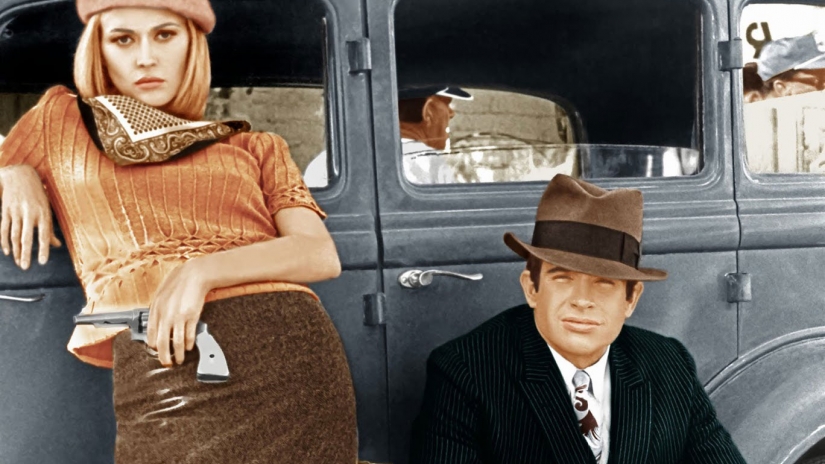
Bonnie and Clyde (1967)

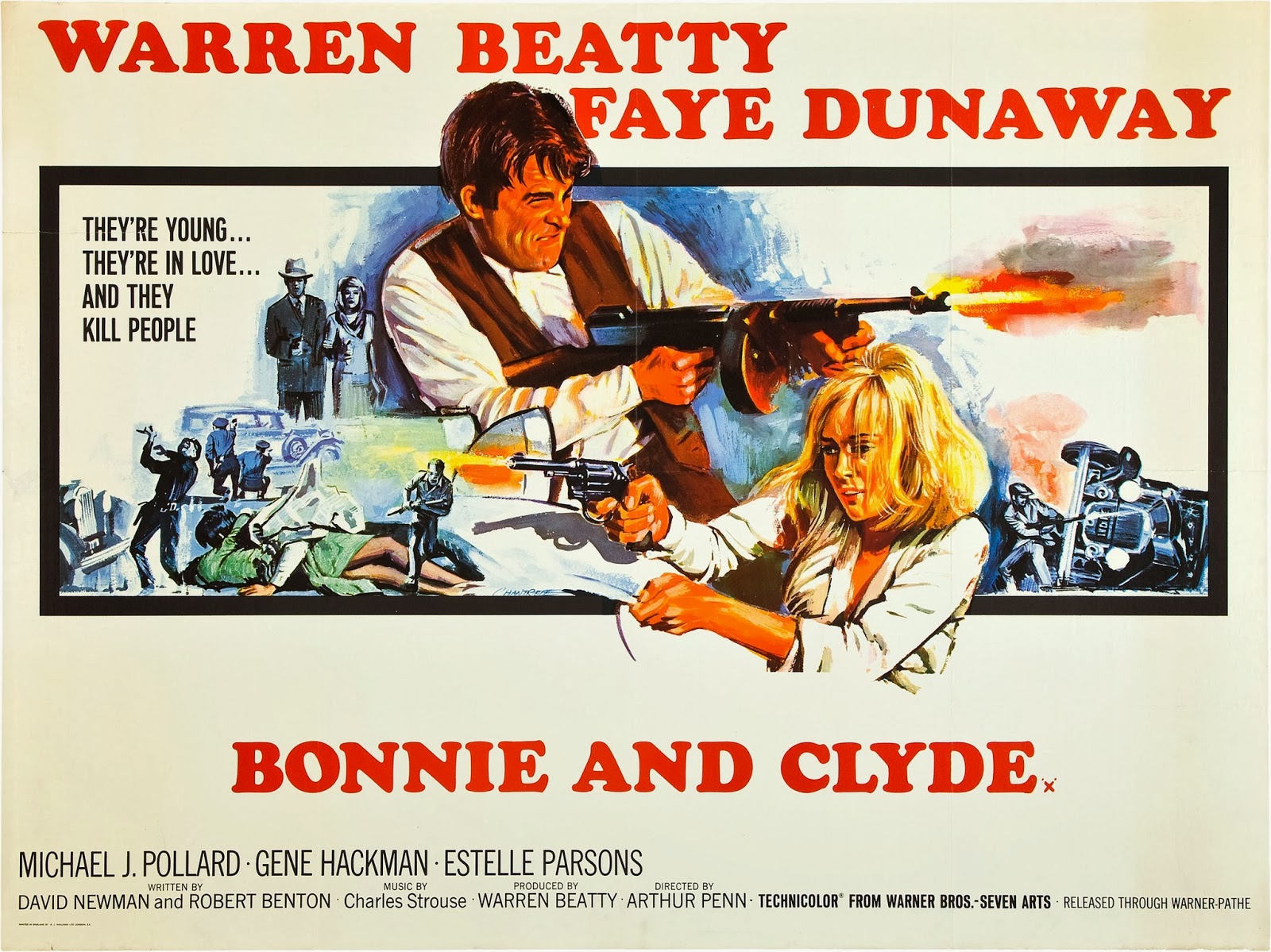
Faye Dunaway and Warren Beatty are the shallow, violent romantics Bonnie and Clyde

Director: Arthur Penn

Cast: Warren Beatty (Clyde Barrow), Faye Dunaway (Bonnie Parker), Michael J Pollard (CW Moss), Gene Hackman (Buck Barrow), Estelle Parsons (Blanche Barrow), Denver Pyle (Marshal Frank Hamer), Dub Taylor (Ivan Moss), Gene Wilder (Eugene Grizzard), Evans Evans (Velma Davis)

Bonnie and Clyde can lay claim to being one of the most influential American films ever made. It came out of a seismic cultural change in America, as old style Hollywood royalty faded out and a new generation stormed the barricades to make films that felt rougher, rawer and told complex stories in shades of grey. 

Clyde Barrow (Warren Beatty) and Bonnie Parker (Faye Dunaway): drifting youngsters, not interested in accepting a conventional life. They want to go where they please and take what they please. And if some people get hurt – well they can justify that to themselves. As the poster famously said: “They’re young. They’re in love. And they kill people”. In a deliberately disjointed narrative, where time is unclear, the two meet, head out together, commit crimes, stay on the run and are eventually killed by law enforcement. The story is simple – it’s the telling of it that matters.

Bonnie and Clyde latches on to a counter-culture vibe that was growing in strength at the time. But what the film does so brilliantly is subvert this. It invites us to identify to with the romantic, Byronic yearnings of its heroes, who see themselves as free spirits, living a life of idealistic, unconstrained excitement. But the film also has a clear eye on the trail of violence they leave behind them, their lack of regard for this and the impact on the victims. Because make no mistake, these dreamy killers get more and more violent as they go on.

The film turns these two killers into would-be celebrities – guys who want to project a certain image of themselves to the world (down to mailing the papers photos and poems about themselves). They enjoy the notoriety and their self-proclaimed mythology. Clyde walks into banks and gleefully announces he’s with the “Barrow gang”, as if half expecting someone to ask for his autograph. Later in the film, as Clyde reads their press coverage out loud, with CW Moss like a star-struck groupie, the film never forgets the two of them were basically nobodies, who wanted to feel like somebodies.

And it lets you enjoy the romance of this. There is something fairy-tale like in the film about Clyde picking up Bonnie from outside of her home, taking her into town for flirting and robbery. The whole film continues this dreamy logic, with time jumps and scenes that don’t necessarily link up directly with each other. 

But then the violence takes over. Wow is Bonnie and Clyde a film that lets you know about the impact of bullets. Gun shots don’t just maim or wing, they rip bodies apart. The japey feeling of their bank robberies gets dispelled about half an hour into the film when Clyde shoots a bank teller in the head from point blank range (“him or me”, he later tells his brother). The gang are so incompetent, that the film is frequently punctured by shoot-outs in which no mercy is shown to anyone. 

This is of course hard for the gang to reconcile with their self-image as Robin Hoods, so they mostly forget about it. Clyde won’t steal money from ordinary people (though he’ll happily steal cars, or beat a grocery store clerk into a coma). They playfully tease and taunt a captive US Marshal – until he spits in Bonnie’s face at which point violence ensues. Only at points do the gang seem to have the slightest idea of the dangers: after kidnapping Gene Wilder’s nervy car-owner and his fiancé, a happy-go-lucky Evan Evans (both excellent), merry conversations in the car with the gang are suddenly halted when Wilder admits he’s an undertaker – Bonnie immediately demands they are thrown out and the next shot is her weeping in a field. She doesn’t seem to understand the connection, but we can.

The film is superbly put together. Warren Beatty produced the movie practically from its inception. Robert Benton and David Newman’s script was intended as a French New Wave film – evident in its looseness, its lack of old-school values, its violence, its focus on naïve dreamers who choose the easy way out – but Beatty took the script, re-crafted it with Robert Towne (billed as special advisor) and decided the film needed an American director, not a Truffaut or Godard. He brought on board Arthur Penn, and the two worked together (fought together) closely to bring this radical, edgy, jittery, electric film to the screen. 

Penn and Beatty pushed themselves to some of their best work. Beatty is terrific as the vainglorious Clyde – whose determination in crime is matched by his impotence in the sack (the film wisely doesn’t overplay Clyde’s impotence as an ironic theme, but lets the audience draw its own conclusions). He also produced the film expertly. Penn’s direction is sublime, marrying the finest elements of French New Wave cinema with old-style Westerns.

The film is restless and energetic, and intermixes moments of fun and frivolity among the gang with ominous danger and violence. The camera jitters and shakes, while throwing us into the action – the film is masterfully edited – while at other points sailing on like a neutral observer. The film has a neat satiric edge, and Penn uses banjo music masterfully to ironically contrast with much of the action we see on the screen. The characters – all of them – seem to spend so much time talking about their press coverage because they have so little to say to each other. Even the lovers only really seem to find a moment of quiet devotion shortly before their death. It give you violence as entertainment, but also tells you effectively and quietly how appalling and dangerous violence is.

The acting is similarly extraordinary. Beatty is wonderful, as is Dunaway as an impossibly young, romantic Bonnie who adapts with alarming swiftness to killing and robbing. Michael J Pollard is excellent as the slightly simple, eager young car mechanic who hero-worships the couple. Hackman and Parsons are both excellent as Barrow’s older-but-not-wiser brother, and his wife who seesaws between resentment, fear and an imperious delight in her new-found infamy.

Penn’s brilliant film deconstructs the mythology of criminals to show the emptiness underneath, their shallow self-regard and lack of insight. It does this while still managing somehow to remain affectionate towards these two murderous dreamers. Bonnie and Clyde is a sublime modern Western, a commentary on fame, a dissection of violence and a great black comedy. Shot with youthful energy and an influential lack of traditionalism, it’s a film that always feels modern and necessary.

Sweet Smell of Success (1957)


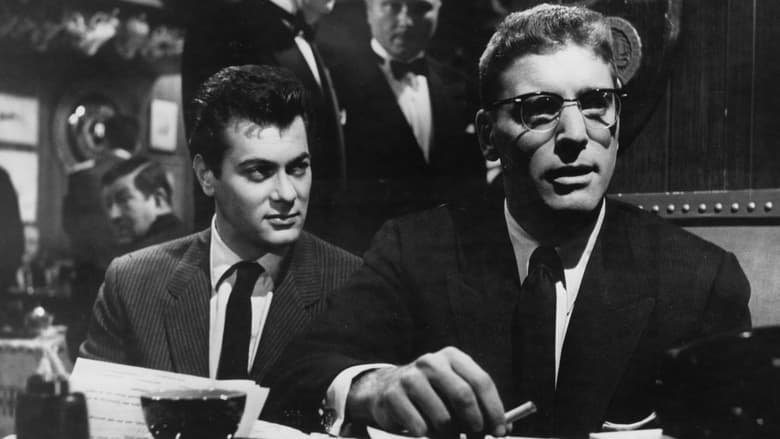
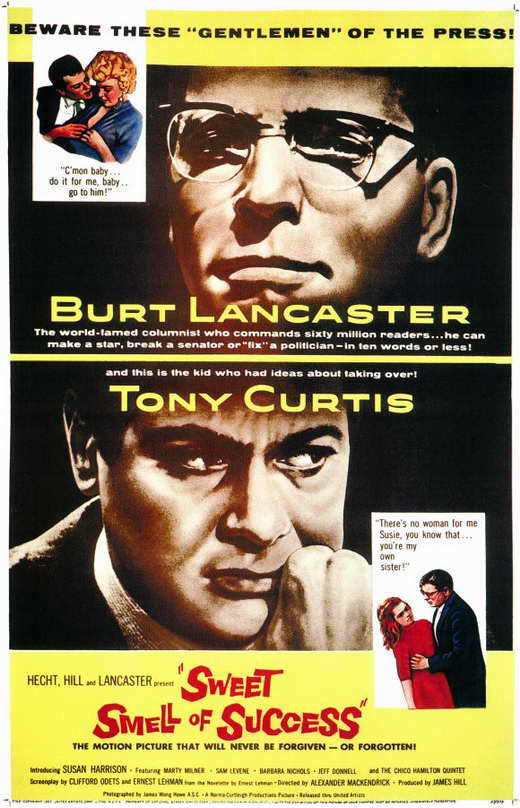
Tony Curtis and Burt Lancaster have no scruples and no morals in the dark exploration of American culture, Sweet Smell of Success

Director: Alexander Mackendrick

Cast: Burt Lancaster (JJ Hunsecker), Tony Curtis (Sidney Falco), Susan Harrison (Susan Hunsucker), Martin Milner (Steve Dallas), Sam Levene (Frank D’Angelo), Barbara Nichols (Rita), David White (Elwell), Jeff Donnell (Sally), Joe Frisco (Herbie Temple), Emilie Meyer (Lt Harry Kello)

Is there a more cynical film in all the world than Sweet Smell of Success? Is it any wonder that the preview audiences, settling down to watch what they expected to be a Tony Curtis light comedy, went crazy? But Sweet Smell of Success is a film that captures the sweaty desperation of show-business, and the cut-throat ambitions of Manhattan. It’s a brutal, sharp, vicious black comedy, in which all our heroes are vile and everything can be bought and sold.

JJ Hunsecker (Burt Lancaster) is a newspaper columnist, so influential that the slightest mention in his column can make or break careers. He rules the New York politics and arts scene with a ruthless fist – and press agents like Sidney Falco (Tony Curtis) will do anything to get even the slightest sniff of a mention in the column. Hunsucker has a job for Falco: Hunsecker’s sister Susan (Susan Harrison) wants to marry jazz musician Steve Dallas (Martin Milner), and Hunsecker doesn’t approve – he wants the relationship finished. Falco may feel some qualms – but they don’t last long, and he’ll do anything he can to wreck the couple’s happiness.

Sweet Smell of Successis all about the grimy effort and lack of morals that sit under the surface of getting to that success. Because to achieve it in the big time you need to be as sinister, controlling and bullying as Hunsecker – and to try and get up there you need to be as conniving and weaselly as Falco. Both these characters are, in their own ways, almost totally reprehensible – and the film makes no attempt whatsoever to mitigate this. The film is appallingly ruthless and cynical, and its two lead characters are, to put it bluntly, complete shits and total bastards.

It’s a film that says the American Dream doesn’t even remotely exist in the way we like to think it can – that there is as much class and control in America as there ever was in the old world. And being decent and honest doesn’t get you anywhere – and sometimes even being conniving and doing whatever you’re told to do doesn’t either. It totally captures the bitter, cruel and imposing mood of New York high society at the time – unwelcoming, unfriendly, judgemental and brutal. For all its glamourous New York location, who on earth would look at this and say “I fancy a piece of that” – it’s the exact opposite of what American films often try to do.

This was Alexander Mackendrick’s first American film, and it’s perhaps his outsider’s eye that really helps the film to really go for it. Mackendrick’s Ealing films weren’t afraid to pull their punches – from the commentary on the corruption of big business in The Man in the White Suit to the dark comedy of The Ladykillers – and (working with genius cinematographer James Wong Howe) he creates one of the darkest (in every sense) film noirs ever. His camera prowls along the streets and he wonderfully captures both the bustle of New York clubs, and the menace of New York behind the glamour. He also shoots both Curtis and Lancaster in a way they never had been shot before – and both of them rise to the richness of the material to give possibly their finest performances.

Burt Lancaster’s Hunsecker is a total monster: a bully and a sadist, vicious and aloof. Lancaster’s stillness here really sells the part – he doesn’t move, everyone else does – and the film brilliantly uses his slightly patrician voice. Hunsecker’s cold, dead-eyed stare pierces through character and desperation, and the contempt he feels for Falco (and every other character) is there in every moment, from looks to subtle physical put-downs (even lighting a cigarette is a power play, laced with an almost sexual sense of control). He “loves this city” because he owns the place, lock stock and barrel. Hunsecker only has one weak point – his clearly incestuous love for his sister – but even that is just the excuse for more controlling, domineering behaviour in which people are only objects for his manipulation.

And no-one is more willing to be manipulated than Tony Curtis’ brilliantly sycophantic Sidney Falco. Hunsecker is vile, but Falco might be worse. Is there a less likeable lead in a movie? Falco has no principles, no morals, no conscious – he’s the worst sort of follower, the sort of kid who stands behind the bully and laughs loudest at every joke. On top of that, Curtis is incompetent and untrusted – the scene where he attempts to blackmail another columnist and is firmly smacked down is wonderful for its discomfort. Curtis is twitchy, desperate, always on the move and will do anything – from lying to planting evidence to openly pimping his secretary. Far from the “young man working his way up” that you might expect, he’s a ruthless, unprincipled opportunist, perhaps the best inverted presentation of American can-do ambition you’ll see on screen.

That’s where the film really works: the scenes between Hunsecker and Falco are simply marvellous: Hunsecker savouring every verbal blow and smooth smackdown – and Falco sitting, edgy and jittery, on the edge, laughing loudly to try and make sure he doesn’t become the target. The marvellous restaurant scenes – with Hunsecker barely able to bring himself to acknowledge Falco’s existence – are the film’s heartbeat: brutal battles where Hunsecker wins everything and lives are destroyed. “A man has just been sentenced to death” Falco gleefully points out – “You’re dead son. Get yourself buried” is Hunsecker’s smoother version.

Ah yes that dialogue. Written by Clifford Odets at incredibly short notice (pages were literally taken straight from the typewriter to the actors’ hands in front of the camera), this might be one of the sharpest, waspiest films ever written. So many quotable lines, with Curtis and Lancaster relishing every dynamic and scintillating one-liner that the script gives them (and there are many). “I’d hate to take a bite out of you. You’re a cookie full of arsenic” – who wouldn’t want dialogue like that? It’s a sensationally written film, and every scene offers a new delight.

It’s not perfect of course. Milton and Harrison are as lightweight and forgettable as Lancaster and Curtis are sensational, too strait-laced and conventional to really seize the interest. The second half of the movie is weaker than the first: the pay-off doesn’t quite match the build-up. Really a film that just followed Hunsecker and Falco about as they went about their daily work, without the sister plotline, might have been even more effective. But it’s probably a quibble on a film that works every time – and has such dense, wonderful dialogue you’ll want to wind back most of the scenes to watch them again. And those two lead performances: simply perfect.

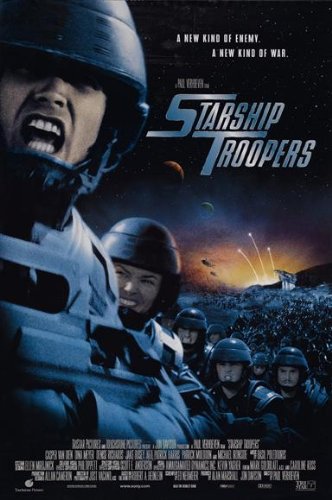
Starship Troopers (1997)


Earth’s military might goes up against space bugs in Paul Verhoeven’s militaristic satire

Director: Paul Verhoeven

Cast: Casper Van Dien (Johnny Rico), Dina Mayer (Dizzy Flores), Denise Richards (Carmen Ibanez), Jake Busey (Ace Levy), Neil Patrick Harris (Carl Jenkins), Patrick Muldoon (Lt Zander Barcalow), Clancy Brown (Sgt Zim), Michael Ironside (Lt Jean Rasczak), Seth Gilliam (Cpl Sugar Watkins)

Every so often, a film uses the tropes of bad films so well, and makes such effective satirical digs, that people initially miss the point of what the film is trying to do. This is pretty much what happened with Paul Verhoeven’s Starship Troopers. On the surface a terribly acted, deeply stupid sci-fi actioner about soldiers killing space bugs, Verhoeven actually created a sharply intelligent, wry satire on the very bombastic militaristic fascism it seems to celebrate. This satirical bent was missed not only by the critics, but also the producers of the straight-to-video sequels the film spawned.

In the 23rd century, mankind has reached the stars. But it’s done so by creating a militaristic, aggressive society, where the young are encouraged to join up to the military in order to become “citizens”. Leaving high-school, hotshot would-be-pilot Carmen Ibanez (Denise Richards) joins up – followed by her boyfriend Johnny Rico (Casper van Dien), in turn followed by Dizzy Flores (Dina Mayer), the girl in love with him. Joining the ground soldiers, Ricco and Flores find themselves as the point of the spear in mankind’s war with the Arachnids (the Bugs), a race of (it becomes clear) intelligent and savage insects on a distant planet.

Starship Troopers isn’t really like anything else: it might well be Verhoeven’s American masterpiece, the perfect mix of his love for extreme gore, violence and sex (filmed with lashings of comic colour and playful glee) with keen social satire, the very ideas he had explored in everything from Robocop to Total Recall. At first glance, Starship Troopers serves up the all-action, gun-toting space battle excitement you would expect from its genre. But Verhoeven not only ramps everything up to 11, he also laces the dialogue and action with a keen satirical bent that hammers home the underlying theme of how war essentially (as Verhoeven puts it) “makes fascists of us all”.

The action is regularly interrupted by propaganda newsreel footage, which stresses the importance of sacrifice for the military effort. The military training camps are almost obsessively focused on brainwashing and reducing the young people in them to cogs in the machine, with safety and welfare as very much a secondary concern (the death of a recruit in an exercise is a concern only because it shows careless leadership rather than because of the death itself). Everyone in the film seems to be a perfect physical specimen. Military lives are thrown away through a combination of arrogance (they’re just bugs, this will be easy!) and incompetence, but never with any feeling of responsibility or expression of regret (though the media works hard to adjust all casualty figures wildly downwards).

The film fires shots at everything in the industro-military complex. The foreign policy of this world is ludicrously aggressive and jingoistic. Despite the spin of the propaganda, it’s pretty clear that humanity has started the war itself. The army is like Hitler’s wet dream – sleek perfect bodies, suicidal self-sacrifice, a complete lack of questioning of any orders or directives, a willing acceptance of corporal punishment. This attitude of violence and unthinking aggression is at every point of society – newsreel footage shows children holding guns with grinning soliders, who then proceed to hand out live ammunition. Later children are shown stomping cockroaches, to cries of the “the only good bug is a dead bug!”. Trials are routinely praised for the brevity (one day between arrest, conviction and execution!). It’s a terrifying world.

What Verhoeven does so well is that, while aware of the multi-leveled nastiness of the world of Starship Troopers, he also makes it a pretty effective straight-war movie. It’s exciting and the action quotient is high. Just like the soldiers in the picture, it’s very easy to see the bugs as faceless opponents which it is easy to feel little regret over killing. The battle scenes are high scale – and of course blackly comic in their extreme gore and bloodlust. But you can still enjoy the action – which is why the film works so well as satire. And also perhaps why so many at the time missed the point. Verhoeven makes this as an enjoyable B-movie, by really effectively using the tropes of B-movies. He turns the trashy B-movie into a sort of art exhibit.

That surely also explains some of the casting. I’m not sure how many of the actors are in on the joke. Certainly Casper van Dien and Denise Richards seem blissfully unaware of the satirical bent under the film. These two wooden actors trot through the sort of banal, by-the-numbers plot arcs and dialogue that fill films like these, with van Dien’s jaw as chiselled as granite and Richards grinning no matter the content of the scene. But their honest woodenness is perfect for the film: a smarter actor would have wanted to tip the wink to the audience, but these guys play it totally straight without even a hint that they are aware of the message underneath.

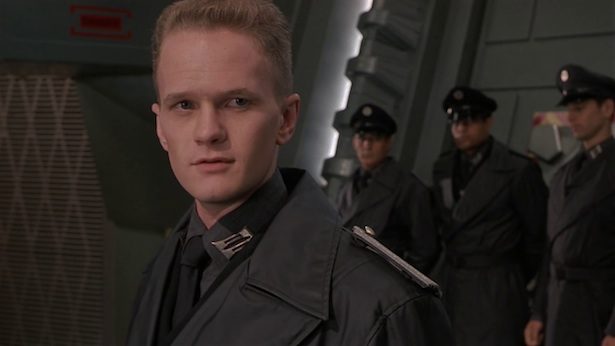
The more satirical element is left to other members of the cast: Michael Ironside has great fun as an almost absurdly fanatical solider, first introduced as a teacher lecturing his students on how the state must come before everything else and violence is the solution to all the world’s problems. Neil Patrick Harris tips a slight nod to the audience as a young man who rises so swiftly through the ranks that by the time we reach the end of the film, he’s a Gestapo-coated secretive colonel. He fits right into the grey militaristic, Nazi design of the military. You can watch all this stuff and simply enjoy the silliness – teenage boys will love this. And when they mature they’ll realise how awful the world it’s presenting is.


Starship Troopers is the ultimate military satire, a film that pushes every single fascist, militaristic society cliché to the limit. The news comes only from state propaganda. Military training involves brainwashing, maiming and slaughter. Education praises anger and violence as a solution to all problems. Verhoeven shoots this all with a grandeur, that pushes the celebration of militaristic violence to the max. 

It’s a film which is brave enough to make its militaristic sequences exciting, to shoot and cut this fascist wet dream with a stirring sense of excitement underpinning all the action. At the end you can celebrate the small victory our heroes celebrate in what is clearly going to be an ongoing war – until of course you realise it’s the victory of a Nazi organisation. The fascist world of the future may bring us sexual and racial equality – but that’s because it’s worked out everyone is needed to feed the grinder. It’s a super-smart satire film that disguises itself as a completely trashy action flick. It’s actually rather brilliant.

Hail Caesar! (2016)


George Clooney is a kidnapped actor in the Coen brothers 1950’s Hollywood spoof

Director: Joel and Ethan Coen

Cast: Josh Brolin (Eddie Mannix), George Clooney (Baird Whitlock), Alden Ehrenreich (Hobie Doyle), Ralph Fiennes (Laurence Laurentz), Scarlett Johansson (DeeAnna Moran), Frances McDormand (CC Calhoun), Tilda Swinton (Thora Thacker/Thessaly Thacker), Channing Tatum (Burt Gurney), Alison Pill (Connie Mannix), Jonah Hill (Joseph Silverman), Emily Beecham (Diedre), Clancy Brown (Co-star Hail Caesar!), Michael Gambon (Narrator)

The Coen brothers’ CV is a bit of a strange thing. It’s one part thriller, one part engagingly brilliant comedy – and then there are a collection of screwball-style entertainments, off-the-wall lightweight comedies (usually about dummies or sharp-talking professionals), as if every so often they needed a palate cleanser. Hail Caesar! falls very much into that final camp. 

Eddie Mannix (Josh Brolin) is a studio manager and fixer in 1950s Hollywood, whose job is to keep the stars in line and the films running smoothly. The latest fly-in-his-ointment is the kidnapping of Baird Whitlock (George Clooney), the star of the studio’s prestigious sword-and-sandals-and-Christianity epic Hail Caesar!. Mannix has to settle the ransom demand, while struggling to keep the news quiet – and manage the production of several other problems including a secretly pregnant Hollywood sweetheart (Scarlett Johansson) and a cowboy-turned-actor (Alden Ehrenreich) struggling with his latest movie requiring him to speak and act rather than just sing and ride a horse.

Hail Caesar! is a mixed bag. There are some wonderful comic sketches in here, the sort of brilliant highlights you could quite happily watch again and again. The problem is these sketches are part of a narrative framework that never really catches fire, that can’t seem to decide how much it is a surrealist comedy and how much it is a genuine Hollywood “behind-the-scenes” slice of life. So I found I delighted in the sketches, and the hilarious reconstructions of some of the studio fodder of the 1950s – while drifting through the general plot of the movie. The laughs are very tightly focused on the stand-alone sketches, and rarely develop from the plot of the movie itself.

Those sketches, though, are brilliant – and the Coens have secured what are effectively a series of stand-out cameos to deliver them. The highlight is certainly a hilarious sequence featuring Ralph Fiennes as a superior English director and Alden Ehrenreich as a cowboy-turned-actor crammed into a period drama in order to “change his image”. It’s a brilliant idea, that revolves around Fiennes’ barely concealed frustration Ehrenreich’s awkwardness in front of the camera, eagerness to please and most of all his accent which so badly affects his elocution that he simply cannot pronounce the line “Would that it were so simple”. The sequence is brilliantly funny – take a look at it down here. In fact it’s so good, it might be too good. Nothing else in the film really touches it.

There are some other good sketches in here as well. Most of them revolve around the loving recreation of Hollywood movies. The movie-within-the-movie Hail Caesar! is a perfect recreation of the Quo Vadis style of movies: large sets, hilariously over-blown dialogue, heavy-handed Christian messages (“Squint at the grandeur!” Clooney’s character is directed in one reaction shot to The Christ – as the filmmakers persist in calling him) and gaudy colour and sets. Clooney himself does a pitch perfect parody of the style and delivery of Robert Taylor.

We also get some spot-on parodies of Hollywood musical styles of the time. Scarlett Johansson plays a Esther Williams-style actress who stars in a series of swimming pool musicals (a bizarre fad of the time). Fiennes is directing a creakingly glacial Broadway-adaptation. Channing Tatum plays an actor in a Minnelli style musical. The tap-dancing sequence we see being filmed is, by the way, another brilliant sketch – a toe-tapping parody song, which also showcases Tatum’s grace and style as a dancer. It’s such a good parody that it actually sort of crosses over into being a genuinely enjoyable slice of song and dance.

I also struggled, as I tend to sometimes, with the artificiality of the Coens’ comedy – there is always an air of them (and their actors) wanting the audience to know that they are far smarter than the dummies in the film. I get this feeling a lot from Clooney in particular – while his film-within-a-film sequences are brilliant, it feels like he never feels much affection for the character outside these sequences. He wants us to know that Clooney is not as dumb or vain as Whitlock is. It’s this lack of empathy that doesn’t quite make the performance work. Empathy is why Eldenreich is the stand-out performer of the film. He plays Hobie Doyle with a real affection and warmth – he makes the character feel like a sweet and genuine person. While Hobie is always a comic spoof, he also feels like he could be a real person – making him so much easier to relate to for the audience.

Hail Caesar! is a film that works in fits and starts, not all the way through. Josh Brolin is fine as Mannix, and his fast-talking, plate juggling, problem solving throws up some funny lines – but his story never really engages the audience as much as it should, and the Catholic guilt Mannix balances in his life never really becomes clear. The Coens are reaching for some point about art and faith – of how film makers may tell themselves they are making something for art, when they actually work for faceless businessmen interested only in making money – but it never really brings this art vs. money argument into place. Does a picture have worth if we talk about worth enough? It’s a question we may as well ask about Hail Caesar itself.

Because the parodies and sketches of old Hollywood movies are so brilliantly done, whenever we drift away from them to the actual plot you find yourself losing interest. It’s a film that actually works better as a few sketches extracted from YouTube – I could happily watch Fiennes and Eldenreich’s scene, or Tatum’s dance sequence, or Clooney’s Taylor spoof in isolation – I don’t really feel the need to watch the entire movie again.

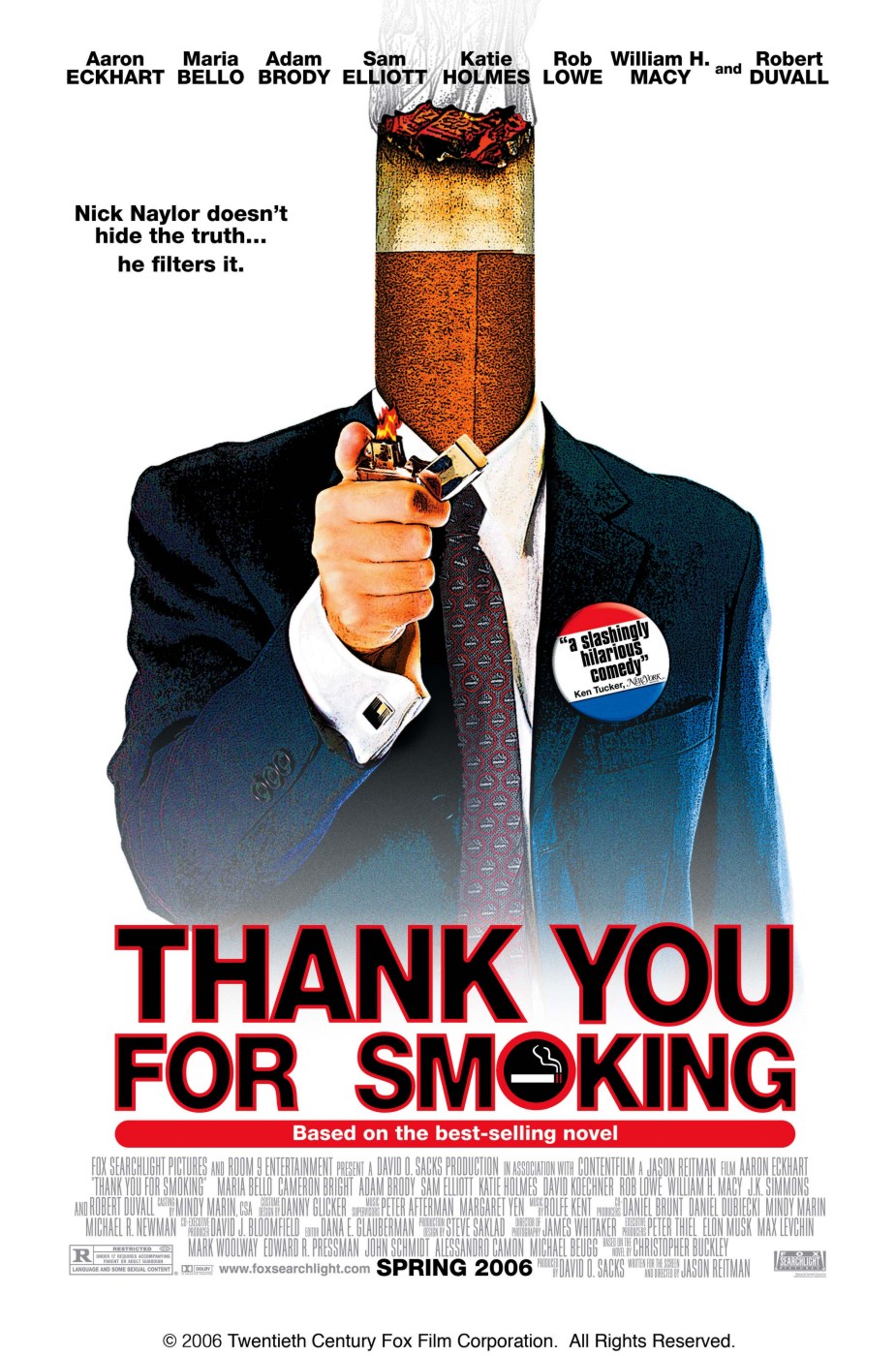
Thank You For Smoking (2006)


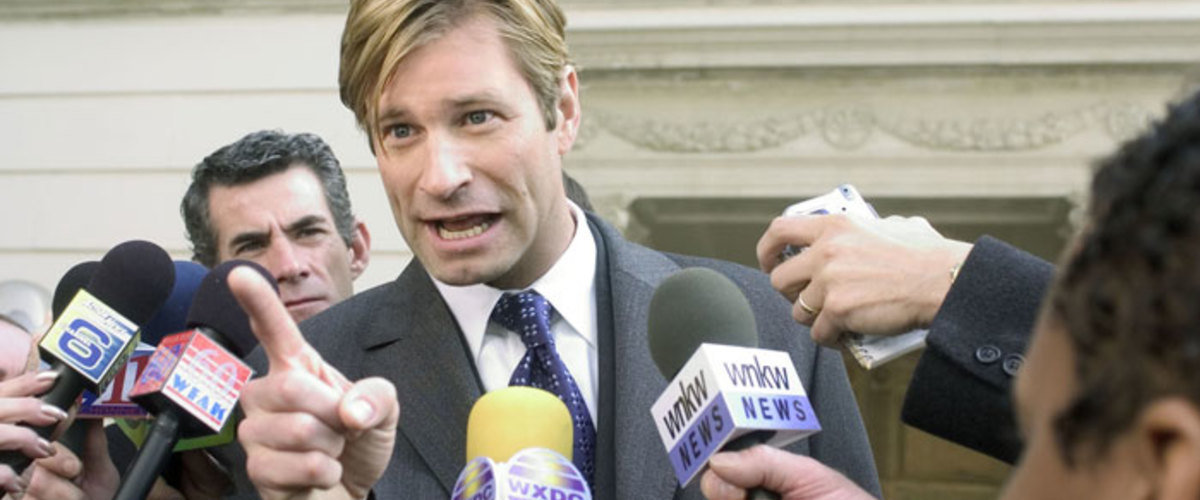
Aaron Eckhart does the big spin on Thank You For Smoking

Director: Jason Reitman

Cast: Aaron Eckhart (Nick Naylor), Cameron Bright (Joey Naylor), Katie Holmes (Heather Holloway), Maria Bello (Polly Bailey), David Koechner (Bobby Jay Bliss), William H. Macy (Senator Ortolan Finistirre), Robert Duvall (The Captain), J.K. Simmons (BR), Kim Dickens (Jill Naylor), Rob Lowe (Jeff Megall), Sam Elliott (Lorne Lutch)

Lobbyists: paid smooth talkers, whose goal is to win influence for often unattractive industries. Not a popular profession. Thank You For Smoking follows a few weeks in the life of Nick Naylor (Aaron Eckhart), a lobbyist for the tobacco industry. With senate hearings underway to place a skull-and-crossbones picture on every pack of cigarettes sold, Naylor has a host of pressures to deal with, not least rebuilding a relationship with his young son (Cameron Bright).

Thank You For Smoking is a smart and amusing satire on a pretty simple target. It’s a great showpiece for the skills of Jason Reitman, who directs his sharply written script with wit and verve. Reitman crafts a satire that’s never too heavy-handed, a well-balanced film that’s about morality and freedom of choice, without banging the righteous drum to death. He’s also got a keen eye for the quick and effective gag, meaning the film moves swiftly from punchline to punchline.

It helps a great deal that Aaron Eckhart is terrific in the lead role: handsome, cocky, charming but with a strange vulnerability. Nick Naylor a fascinating character: while he does adjust his views on issues, he is never humbled by events, and there is no “road to Damascus” moment where he denounces his career. He’s totally confident in his skin, who has come to terms with his role and doesn’t care what people think of him. And you’ve got to respect a man so skilled that he gets a 20 year-old dying of cancer from smoking to shake his hand on live television.

Similarly, the film avoids an open condemnation of smoking (it doesn’t even feature a single character smoking). If anything, the real targets for its criticism are anti-smoking campaigners (William H Macy’s sanctimonious senator is skin-crawling and unbelievably smug and petty), and the opportunistic recipients of lobbying. The film makes clear smoking is a bad habit, but also pushes the right we have to choose – if we want to poison ourselves, we should do so! I’m not sure if Reitman is willing to admit an argument like this is partially an abuse of ill-informed free speech, but at least he hopes we are smart enough to make up our own minds. It’s all part of the careful discussion of lobbying – what kind of person can be swayed by a professional counter-argument man?

There are several other terrific performances. Simmons is hilarious as Naylor’s aggressively vocal boss. Rob Lowe offers a brilliant self-parody as a smoothly empty Hollywood super-agent obsessed with Japanese culture. Maria Bello and David Koechner are both sharply witty as Naylor’s fellow lobbyists for alcohol and firearms respectively. The scenes between the three of these “Merchants of Death” (or “The MOD Squad” as they call themselves) offer a sharply funny commentary on the action throughout.

If the film has a problem though, it’s that it never feels like it develops into being much more than a framework for some good jokes. There is a thinly veiled morality tale here, but the film never really feels like it makes a point or a conclusion. Sure there are tonnes of excellent jokes and laugh-out-loud moments, but is it much more than a series of skilled sketches? Eckhart is of course brilliant in each of these, but there is often a sense of watching a series of misconnected events. Characters drop in and swiftly out of the movie. There is no overarching plot, as such.

The film largely dodges any real narrative conclusion. This is of course part of the smartness of its design – it’s not trying to make moral points, or hector us on health – but it also makes the film feel slightly empty, narratively adrift. Little changes for the characters from the start to the end of the story. Of course, the film is not so crude as to make its hero learn “a lesson”, but it also means Naylor is a more difficult character to sustain interest in over a period of time: complete lack of self-doubt does not tend to make great drama.

It’s very funny, smart, well written and acted. However, while brave enough to avoid predictability, it’s also inconsistent enough to not have a real shape. Some moments – in particular the relationship between Naylor and his son – lean heavily on cliché. Some of its more unusual moments – especially a sequence where Naylor is kidnapped by anti-smoking campaigners – fall the wrong side of surreal. But for all that it’s an imperfect film, it is certainly funny enough to justify itself and features a superb performance of alpha-male arrogance from Aaron Eckhart (I’ve asked this elsewhere, but how unlucky is this guy to not be a bigger star?). I guarantee you’ll laugh several times when you watch this – and if nothing else you’ll have a think about lobbying.

The Circle (2017)


Emma Watson struggles against the surveillance state in shockingly bad adaptation The Circle

Director: James Ponsoldt

Cast: Mae Holland (Emma Watson), Tom Hanks (Eamon Bailey), John Boyega (Ty Lafitte/Kalden), Karen Gillan (Annie Allerton), Ellar Coltrane (Mercer), Patton Oswalt (Tom Stenton), Bill Paxton (Vinnie Holland), Glenne Headly (Bonnie Holland)

Is there anything sadder than seeing a book you thought was fantastic get totally screwed up by film producers? Worst of all, Dave Eggers, the book’s author, even gets a screenwriting credit here. I hope to God his contribution was a rejected earlier draft, rather than the bland, aimless drivel on display here. It would be too depressing to think he gutted his own work and then mutilated its corpse.

Mae (Emma Watson) is thrilled to land a job at The Circle, an all-powerful, Google-style corporation with a virtual monopoly over the internet. However, she discovers while she works at the Circle that there are (of course!) dark secrets at the heart of the company, and that its charismatic CEO Eamon Bailey (Tom Hanks) may not be all that he seems.

Imagine an adaptation of 1984 at the end of which Winston Smith defeats Big Brother but decides there are positive sides to living under a dictatorship, so carries on doing so. That’s exactly as ballsed-up as this total misreading of Egger’s gripping critique of our internet age. In this terrible adaptation, the novel is neutered beyond recognition into just another bland “Big Corporations Acting All Corporation-y” nonsense. The film is pretty much exactly as awful as the book is brilliant.

Where did it all go so completely and utterly wrong? Did they not understand the book? The novel is not only a critique of the pervasive power of its shady Google-like organisation. It’s also a savage attack on our own tweeting, social media obsessed world – the sort of world where private actions are theft as they rob everyone else from experiencing them vicariously through tweets, photos and posts. It’s this part of the story the film completely (and almost wilfully) misses the point of.

They seem terrified at the thought that the social media Twitteratti might take against the film if it too openly attacks the actual users of systems like this, with their (at times) shallow, demanding and entitled pushing of their own opinions, and intrusions into others’ lives. Instead the film gives a complete pass to all the users of the systems, while attacking the corporation providing them. So we get the bizarre set up of a film that seems to say it’s totally fine for normal people to record everything and push it all onto the internet, turning their world into a judgemental surveillance state, but it’s evil for a corporation to create the devices they use to do it.

Even the film’s criticism of corporations isn’t very clear, largely because we never get a sense of the Circle’s power and its hunger for getting more and more control. The film throws away its involvement in politics and its control over everyday lives. Perhaps because it knows so many of the viewership love gadgets, there is no exploration of the creepy, controlling aspect of the many tracking and recording devices the Circlers wear throughout the film, as there is in the novel. Instead the target is the shady business people at the top (not that we learn anything about what they want) because everyone hates businessmen don’t they? Nice easy target. I can tweet my loathing of them very easily.

It’s a film devoid of any challenge. A character’s suicide from the book is changed to an accidental death. The more vulnerable and desperate of the characters from the book have been deleted. The obsessive self-definition the Circlers gain from what other people tweet about them is downplayed. The ending of the film completely inverts the novel, and leaves us with a bizarre final image of our hero kayaking on the lake, but warmly smiling at the drones watching her, even after she has destroyed the “villains” who run them. It makes no sense whatsoever. My jaw literally dropped when this happened by the way.

Mae is a character who now has no consistency. Her growing obsession with the power of social media – and the destructive effect it has on her actual human relationships – is completely ignored. It’s the key part of her character from the book, and its removed here to try her as traditionally ‘likeable’ as possible. An anti-hero becomes a flat out hero. The film shows the impact of actions she carries out in the book – particularly on Annie – but removes these actions from the film. Why do people slip into depression or depart from the film? Who knows. Left with nothing to work with from the original book, Emma Watson gives a bland and forgettable performance. No one else really makes an impact, playing dull, neutered versions of the characters from the source material, devoid of depth or interest.

The Circle might be one of the worst literary adaptations I’ve ever seen. It guts the original book and removes any of the most challenging and interesting content. It’s terrified of criticising in any way anyone who might be watching. It’s a satire on the social media age that has no satire in it, and is desperate not to talk about social media. Worst of all it will discourage people from reading the original novel. In the words of the modern age: #uttershit.

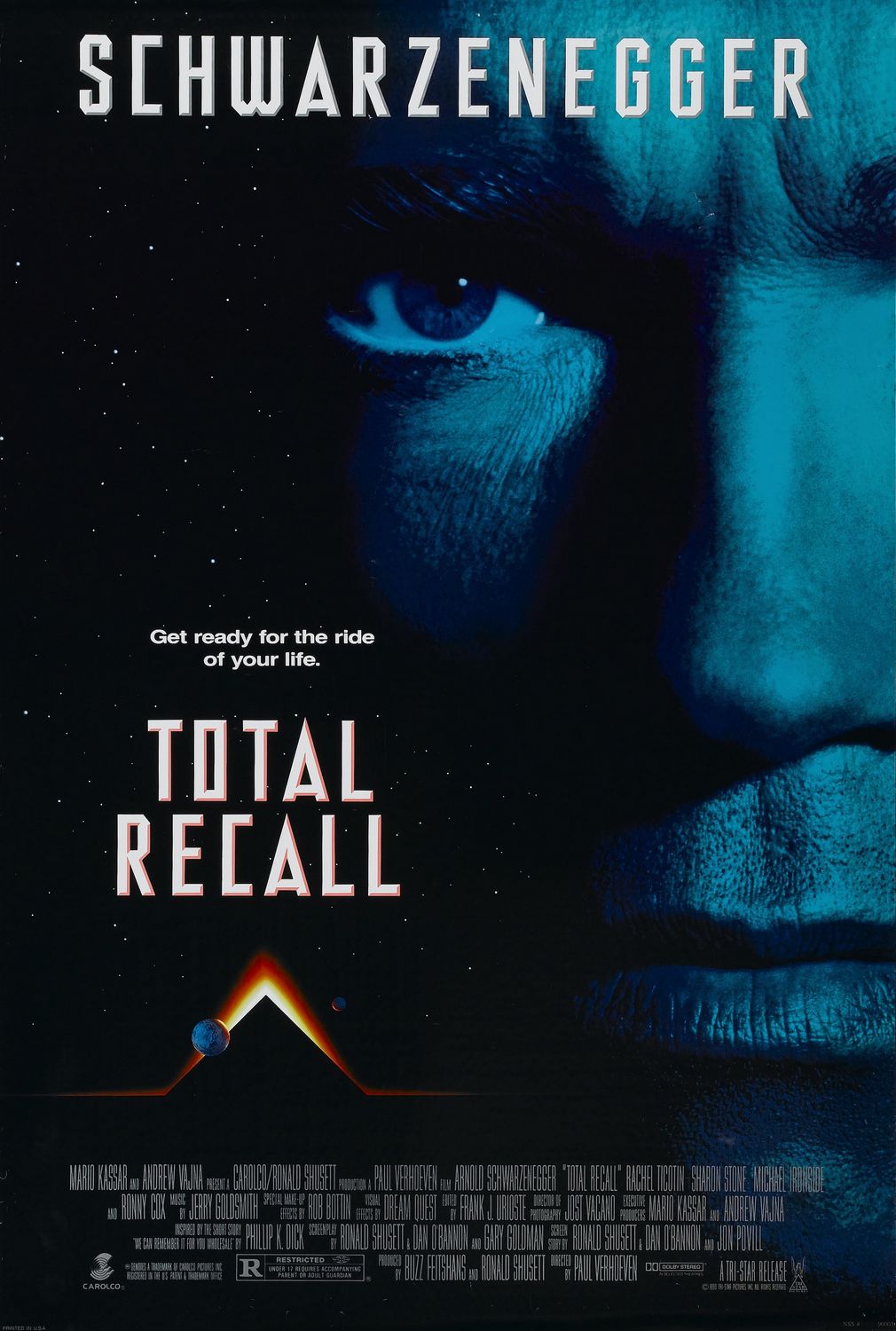
Total Recall (1990)


Arnold Schwarzenegger goes for a trip into his memories in Total Recall

Director: Paul Verhoeven

Cast: Arnold Schwarzenegger (Douglas Quaid/Carl Hauser), Rachel Ticotin (Melina), Sharon Stone (Lori Quaid), Ronny Cox (Vilos Conhaagen), Michael Ironside (Richter), Mel Johnson Jnr (Benny), Marshall Bell (George/Kuato), Roy Brocksmith (Dr Edgemar), Dean Norris (Tony)

Perhaps in 2084, they will look back on Schwarzenegger’s career and wonder what on earth we were all thinking. He was the figurehead of the 1980s fashion for muscle-bound leading men, defined more by physicality than acting ability. Since then, fashions have changed: movies are led by actors who go through hours of physical training, rather than weight lifters taking acting classes. Would Schwarzenegger be a star today? Quite possibly not: compare him to his nearest modern equivalent, Dwayne Johnson. Schwarzenegger doesn’t have an ounce of Johnson’s ability, wit or even charm. Would the world of Twitter embrace an often one-note performer with a paper thin range?

Schwarzenegger got where he was because, for all his lack of acting skill, he is a very clever man: he could spot a script and worked with people who got the best out of him. He turned himself into a brand: “Arnie” the pillar of strength, the master of the one-liner. It worked for films, it worked for politics. Which is all a long intro to say: in his best work, he put himself into decent roles in films from distinctive filmmakers, like Total Recall.

Total Recall is a semi-smart sci-fi action thriller, directed by Paul Verhoeven with his usual Dutch excess: part social satire, part wallow in extreme cartoonish violence and grotesque, Flemish-painting style imagery. Douglas Quaid (Arnie) is a construction worker in 2084, who dreams of escaping his humdrum life and visiting the Mars colony. He decides to visit Recall, a memory implantation centre which promises to give him memories of visiting Mars, with a twist: he’ll visit as a secret agent. However, the implantation reveals Quaid has hidden memories – he may in fact be rogue agent on the run, Carl Hauser. Before he knows it, everyone from his own wife (Sharon Stone) to a brutal intelligence operative (Michael Ironside) is hunting him with lethal force – and Quaid must head to Mars for answers about who he is.

Verhoeven’s sci-fi work adds a level of social satire to high concept stories. In Total Recall he mixes in his critical denunciations of big business and corporate ethics (also a major theme of Robocop) with an everyday acceptance of brutal violence that is so neck-breakingly, blood-spurtingly extreme in places it could only be social satire. Total Recall mocks our own ease with violence as entertainment, by setting itself in a world where the news broadcasts government troops machine gunning protestors (while a newsreader cheerily comments on the minimum use of violence), and the representatives of the Mars Corporation have literally no compunction or hesitation in inflicting huge numbers of civilian casualties in the crossfire.

A lot of this cartoonish violence spins out of the movie’s own playing around with the nature of reality. It leaves open the question of whether Quaid is really a spy in disguise, or if the film’s events occur only in his fractured brain suffering a terminal meltdown from an upload gone wrong. At Recall Quaid is promised his new fantasy memories will be full of action, he’ll get the girl and save the world. Needless to say he achieves all these things by the film’s end. Rachel Ticotin even appears on a screen in Recall as his “fantasy” woman. Is Quaid dreaming or not? It’s a question that is of more interest to viewers I suspect than the filmmakers (other than a few cheeky bits from Verhoeven), but it does tie in neatly with the almost dreamlike hyper violence Quaid dishes out: necks snapped, bodies spurting fountains of pinky red blood, dead bodies used as shields ripped to pieces by bullets. It’s all so extreme that it deliberately feels both not quite real and a mocking commentary on the bloodless action in other sci-fi films.

Schwarzenegger fits surprisingly well into all this. On paper, he’s completely miscast as an innocent discovering a hidden past, the future Governator anchoring a film with satirist leanings. But Verhoeven gets something out of Schwarzenegger in this film that works surprisingly well. Like James Cameron recognised, Verhoeven saw Arnie had a sort of upstanding sweetness amidst all the macho posturing. Arnie is surprisingly effective as Quaid, suddenly shocked at his capabilities for violence (as well of course or physically selling the action). Verhoeven taps into Arnie’s likeability (what other action star could sell “Consider this a divorce” as a punchline as he shoots his fake wife in the head?) and runs with it throughout the film.

As such, Schwazenegger makes a decent lead. It helps that he is willing to be a figure of fun at points. He wears a wet towel round his head to block transmissions. His face contorts ludicrously as he pulls an enormous probe from out of his nose. He infiltrates Mars dressed as an old woman. Most of this material fades away in the second half of the movie when Schwarzenegger reverts to the more typical heroic action (I suspect negotiations over the script shifted the film into a halfway house between a standard action movie and Verhoeven’s more satiric bent). But it’s all still there and helps humanise Quaid, so that we are on board with the slaughter he perpetrates later. Quaid is probably one of the best roles Arnie had – and Verhoeven does very well to fit a man so serious about himself into a world of self-parody. Saying that, the role is in some ways beyond Arnie’s reach – I’m not sure he is really plugged into or understands the dark comic tone of the movie, and he doesn’t really have the wit as a performer to do much more than deliver killer lines, certainly not to contribute to the dark satire Verhoeven is putting together.

As a whole the film doesn’t always deliver. Schwarzenegger seems at sea during scenes with his feisty, independent love interest played by Rachel Ticotin (this does her no favours, as her role hardly connects). Sharon Stone similarly has little chemistry with the Austrian Oak – although at least she has the second best role in the script as a vicious woman not afraid to use sex as a tool. The actual plot fits in nicely with the possibly dreamlike nature of what we are seeing, but the villain’s aims seem rather unclear, and the film lacks a strong enough antagonist (neither Michael Ironside or Ronny Cox have quite enough to make their thin characters come to life).

This plays into the film as being semi-smart: it’s a curious mix of smart and stupid. It’s got enough brains to poke a bit of fun at corporate America, and to make moral comments on our treatment of minorities (here represented by the mutants who inhabit Mars). On the other hand, it’s a schlocky action cartoon, that revels in ultra-violence while creating a world where, in universe, it is not considered extreme enough to comment on.

Total Recall is a fun movie that allows you to read more into it than is probably really there. Verhoeven peddles themes around the nature of reality, and introduces satiric comments on corporations and violence in the media that don’t hit home so heavily that they become wearing. I also have to say I like its empathy with the vulnerable and weak – the mutant resistance on Mars is engagingly grounded and humane, particularly in contrast to the ruthless heartlessness of Mars Corp. It’s not a masterpiece, but as a smarter piece of popcorn fun it works really well.

For Schwarzenegger himself, this was his final non­­-Terminator hit. Terminator 2 (a year later), an undoubted work of genius, was his high watermark. Three attempts since to relaunch the Terminator franchise (all with mediocre or worse directors), demonstrate Schwarzenegger’s awareness his time was fleeting and dependent on his roles rather than his skills. Total Recall was Schwarzenegger doing something completely different, to great success – but also one of his last hits-. His run of good scripts, and pulp premises, came to an end here – but it was a good end. California awaited!

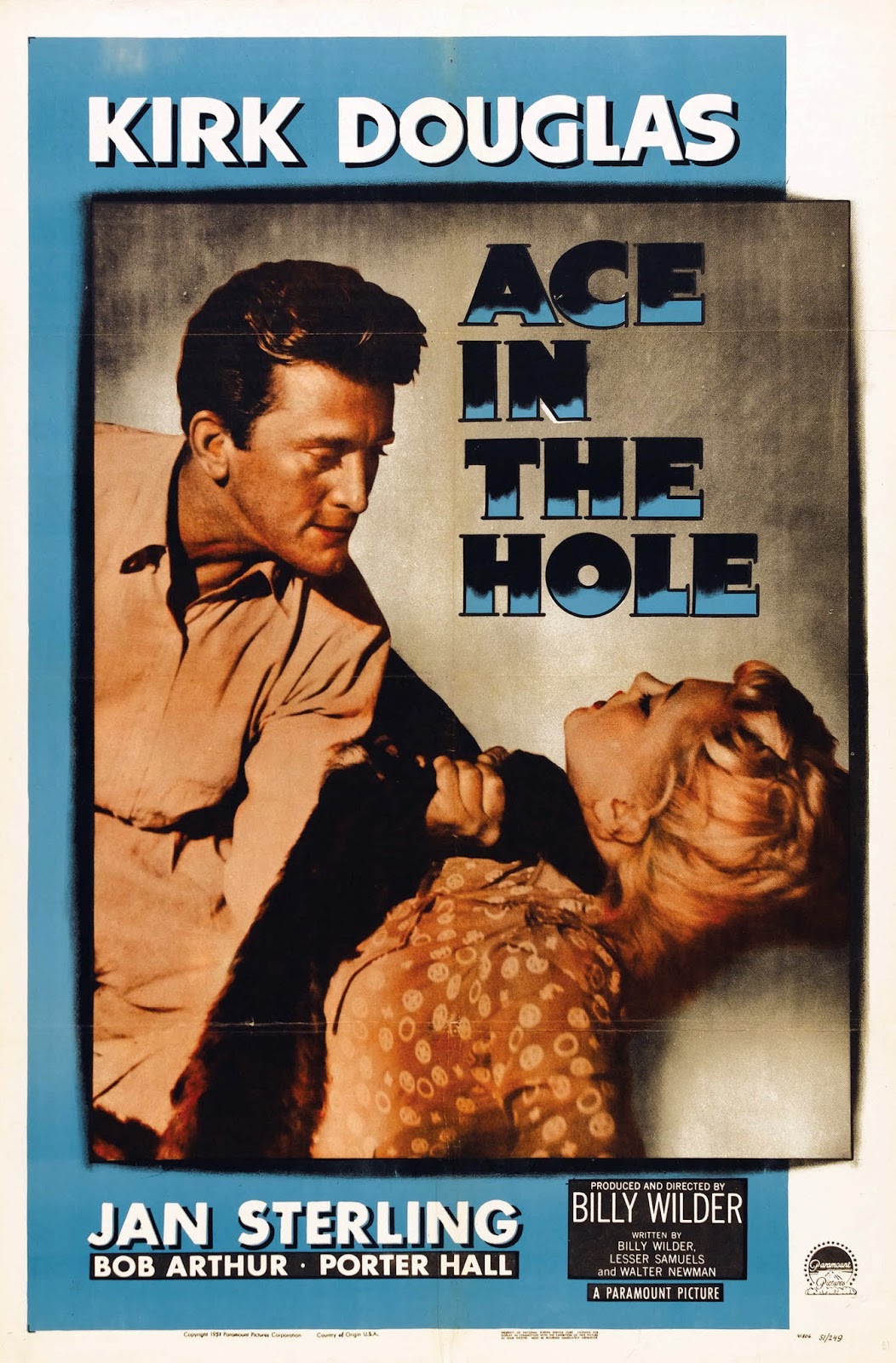
Ace in the Hole (1951)


Kirk Douglas surveys the horrors he has willingly unleashed in Billy Wilder’s bitter beyond belief media satire

Director: Billy Wilder

Cast: Kirk Douglas (Chuck Tatum), Jan Sterling (Lorraine Minosa), Robert Arthur (Herbie Cook), Porter Hall (Jacob Q. Booth), Frank Cady (Mr Federber), Richard Benedict (Leo Minosa), Ray Teal (Sheriff Kretzer), Robert Arthur (Herbie Cook)

Ace in the Hole was Wilder’s first big flop as a director. It’s not surprising that the media savaged it and claimed it was ridiculous. This is a film way, way, way ahead of its time, a stinging indictment of the ruthless obsession of the media with selling stories rather than reporting them, of spinning out crises to sell newspapers. It’s Fake News decades ahead of its time, a gutter journalism film released at a time when the media was totally trusted. Is it any wonder contemporary critics claimed they couldn’t recognise their trade here? Now it’s practically the way every journalist on film is portrayed.

Charles Tatum (Kirk Douglas) is a big-city reporter fired by a host of newspapers for offences ranging from alcoholism to libel to sleeping with the boss’s wife. Arriving in Albuquerque, New Mexico, he wangles a job on the local paper aimed to eventually encounter a story he can spin into a national media sensation, a crisis with a “human interest story”. A year later, he stumbles upon a cave-in that has trapped a man, Leo Minosa (Richard Benedict), below the surface. Believing this is the story that he can get him back his seat at the high table, Tatum seizes control of the rescue operation, insisting a quick and easy plan is dropped in favour of a week long public drilling operation. Tatum’s reporting of the event becomes a media sensation and in days the abandoned town is full of reporters and rubberneckers.

What’s astonishing here is that this is one of the few films I can think of that is totally devoid of sentiment or hope. It’s ruthlessly cynical where virtually every character is irredeemable, and no suggestion of redemption exists. The only major character who seems normal is Leo himself, although that is largely because his bland non-descriptness (well portrayed by Richard Benedict) and childlike, homespun dependency on those around him make him a near blank anyone can project feelings onto. Wilder’s hard-bitten cycnicsm, bordering on anger with the media and their audience, pulls no punches without descending into polemic – ironically it keeps the human interest, while never compromising the dark satire.

It’s a savage attack not just on journalism and the mass media, but human nature itself. The media stirs up a storm of excitement and drama around one man’s fate solely to make money – and Tatum himself is the worst form of manipulative gutter press, with no interest in truth, investigation or even journalism, only a shark-like love of the main event. But Wilder shows that the people just lap up this exploitative press storm – the growing crush of on-lookers, the bated breath as each update comes in, the literal carnival set up on the site, specially chartered trains – everyone wants to feel part of this story, to vicariously feel the emotions of those the event is actually happening to. It’s virtually a prediction of Twitter.

At the heart of this is Tatum, played with maximum forcefulness and dark charisma by Kirk Douglas in surely one of his finest performances. What Douglas does here that is so skilful is to never make Tatum an out-and-out villain. He plays it with a subtle suggestion of self-loathing: the quietly suggested need for alcohol, the revulsion he feels for those around him whom he sees as reflections of his own moral emptiness. At the same time, if Tatum has morals he long since stopped listening to them. Every time it looks like Tatum has realised what he has done, he reverts back to keeping the story going. Douglas’s dynamism also brings Tatum’s relentless drive and determination to life with real power. Tatum is easily able to cow, bully and bribe those around him into making him the funnel of the story. Never once do you question why all around Tatum bow to his will – his force of personality is so great you have no choice. Despite the hints of self-loathing, Douglas isn’t afraid to play Tatum as a reprehensible man – not bad or evil, just totally self-serving and selfish.

Jan Sterling I was less sure of at first, but actually this is another incredibly brave performance of uncompromising hardness. Lorraine is trapped in a marriage with a man she does not love, in the middle of nowhere, having believed she was marrying into something very different. But even with those provisos, her lack of interest in her husband’s safety and her focus on getting as much cash out of the tourists as possible (to finance her departure to the city) is astonishingly ruthless. Out of all the characters, she is the one who is immediately aware of what game Tatum is playing, and (with his advice) she is the most capable of exploiting the public excitement for her own gain. While she has elements of a femme fatale, Sterling’s performance seems more bitterly cynical than manipulatively feminine.

Wilder’s cynical and hard-nosed film is a brilliantly written deconstruction of the American dream, packed with wonderful lines and sharply drawn characters. It scrapes away at the surface of its characters to reveal the rot underneath – even Tatum’s photographer Herbie degrades from idealist to acolyte – and then blames us all for the mess. It shows us the disgusting ease with which our feelings can be manipulated to sell anything, then shows how gleefully we want to be feel part of an event: shots are filled with details like spectators carrying candy-floss while praying for Leo’s safety.

And then there is a complete lack of redemption – or even suggestion of it. Decent characters are peripheral, and far outnumbered by Tatum and his like. The resolution of the crisis does not go according to Tatum’s plan. It’s almost astonishing in its bleakness and in Tatum’s confused reaction to it and his lack of clear-cut guilt. Again, it’s Douglas’ skill and Wilder’s uncompromising direction: I actually had to watch it twice to catch the shading Douglas and Wilder give Tatum’s reactions to events finally going out of his control – and I still don’t know to what extent self-loathing trumps frustration and disappointment.

This is a masterful media satire and a wonderful, thought-provoking film, surely one of Wilder’s finest. It should be a lot better known than it actually is. I haven’t stopped thinking about it in days and I’m already looking forward to seeing it again. And, if anything, it is getting more relevant every single day.