Category: Mission Impossible films

Mission: Impossible: The Final Reckoning (2025)

Mission: Impossible: The Final Reckoning (2025)

Cruise’s final mission is really a tribute to the star himself and his never-ending force of will

Director: Christopher McQuarrie

Cast: Tom Cruise (Ethan Hunt), Hayley Atwell (Grace), Ving Rhames (Luther Stickell), Simon Pegg (Benji Dunn), Esai Morales (Gabriel), Pom Klementieff (Paris), Henry Czerny (Eugene Kittridge), Angela Bassett (President Erika Sloane), Holt McCallany (Serling Bernstein), Janet McTeer (Secretary Walters), Nick Offerman (General Sidney), Hannah Waddingham (Rear Admiral Neely), Tramell Tillman (Captain Bledsoe), Shea Whigham (Briggs), Greg Tarzan Davies (Theo Degas), Charles Parnell (Richards), Mark Gatiss (Angstrom), Rolf Saxon (William Donloe), Lucy Tulugarjuk (Tapeesa)
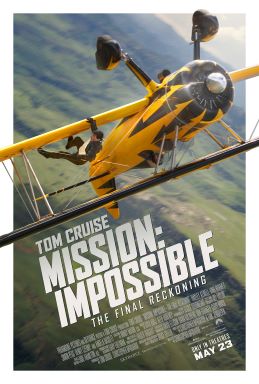
Almost thirty years after the first film trotted into the cinema, Tom Cruise signs off (he claims) his franchise of death-defying stunts with a final entry that dials the global threat up so far you can almost hear the desperate whirring as the doomsday clock tries to keep up. Mission: Impossible: The Final Reckoning is big in every single way, packed with set-pieces, dense procedural plot mechanics that require reams of exposition, global annihilation round every corner and at the centre the towering, chosen-one aura of Ethan Hunt himself, the only man who can save the world.

The Final Reckoning takes off a few weeks after the now-rechristened Dead Reckoning (after it under-performed they didn’t want to scare people off with a Part 2 subtitle). AI demigod The Entity is hellbent on gaining control of the world’s nuclear arsenals so that, having presumably binged Terminator, it can SkyNet-like wipe out humanity. Ethan (Tom Cruise) is on the run, but he has a plan. Dig out the sunken Russian sub where the Entity was ‘born’, fish out its source code, hook it up to an Entity-killing virus and trap the AI would-be-overlord in what’s essentially a glowing USB drive. This mission will involve lots of running, fighting, defusing of nukes, diving to the bottom of the ocean, jumping between bi-planes mid-flight… he might as well chuck the kitchen sink as well.

Mission: Impossible: Final Reckoning has plenty of fun, even if it is hellishly overlong. It’s the sort of crowd-pleaser that gets people clapping at the end (as several people in my packed-out screening did). When the stunts come, they’re hugely well-staged. As always the Tom Cruise USP is front-and-centre: if you see him do it, he did it. Yes, Tom really did jump out of a naval helicopter into the raging Atlantic. Yes, that really is Tom, climbing over a speeding bi-plane thousands of feet-up with only a pair of goggles to keep him safe. It’s no-coincidence the villain is an AI who creates an artificial digital reality. The Mission: Impossible films are all about it keeping it solidly real.

But, once the initial adrenaline rush subsides, I’m wondering if its pumped-up thrills are going to be a bit more wearing second-time around. What struck me about The Final Reckoning is, that for all the huge amount of stuff going on, there is precious little heart in it. More than any other M:I film since the little-loved M:I:2 (practically the only film in the franchise not to get a shout-out here), the act of saving-the-world here is a job for one never-wrong superhuman. Cruise does almost everything, his team’s main role being getting into the right place to send him a message or wire up a computer. On top of that, the best of the series set-pieces had flashes of Ethan’s stress, fear and sense of ‘I cant believe I have to do this’ humour – all of that is mostly missing here.

The Final Reckoning loses a lot of the heart of what made the earlier films so rewarding. It loses the moments of friendship or sparky interplay between the team. Cruise and Pegg, the series main comic relief, share almost no scenes together. Klementoff and Davies do virtually nothing as new team members, other than shoot guns and get captured. Cruise shares more time with Atwell, but the bizarre is-it-a-romance-or-not between them is as oddly undefined as Ethan’s relationship with Rebecca Ferguson’s Elsa was (in fact it makes you realise the most sexual thing Ethan has done since film three is hold someone’s hand). Cruise is so often on solo missions, that the film could probably have dispensed with the team altogether with only a small plot impact.

The film only affords to slow down to give Ving Rhames (the only other guy to appear in every film) a moment of genuine emotion – though special mention must go to Rolf Saxon and Lucy Tulugarjuk who from small moments craft characters I genuinely grew attached to and worried about. Otherwise, the bonds of friendship that powered the franchises most successful non-stunt moments are absent. In fact, also missing are the heist caper set-pieces – even the famous face-masks are only employed very briefly.

The Final Reckoning dials the stakes up so much, they are effectively meaningless. In previous films, high-stakes were mixed with personal ones: we were always more invested in whether Ethan save his friends rather than the word. The film also struggles without a real antagonist. Its nominal human opponent, Esai Morales’ Gabriel, little more than a smirk and an obstacle. Shorn of the most-interesting element of his character – his fanatical loyalty to his AI master – Gabriel is neither particularly interesting or a threat. In its vast runtime, Final Reckoning has no time to actually explore what the personal link between Ethan and Gabriel actually was, making you wonder why on earth they bothered to put it in both films in the first place.

It’s not helped by the fact that the film is so constantly in motion, that virtually every single scene of dialogue is about communicating what’s going to happen next. There are constantly (admittedly skilfully batted around) conversations explaining why Ethan has to go there, get this, bring it here, do this to it, put it in that all within a ridiculously small window of time. Sometimes, to shake it up, we cut across to the US bunker where a gang of over-qualified actors (Bassett, Offerman, McCallany, McTeer and Gatiss) similarly explain what the Entity is doing to each other. (Although, like Rhames, Bassett gets the most interesting stuff to actually act as a President facing a Fail Safe like terrible choice).

What you realise is that The Final Reckoning is pretty confident that what really pulls the audience in is Tom Cruise doing crazy stunts, so that’s what it gives us. In fact, rather than a tribute to the series (despite closing plot points from Missions 1 and 3) what the film really feels like is a tribute to Cruise, the last man-standing among the old-fashioned superstars. Most of the dialogue puffs up Cruise’s Ethan into Godlike status (it’s not quite “living manifestation of destiny” like Rogue Nation put it, but close). Cruise carries out two extended fight scenes in his pants (though if I looked like that at 61 so would I). No other actors intrude on his stunts or messianic sense of purpose.

Which is amazingly done of course. Literally no-one does it better than Cruise. The fact that the movie feels like Cruise effectively shot most of it alone with just the crew, means it almost doesn’t matter that its plot is merely to link together set-pieces. And if someone deserves a victory lap – which is what this is – then that guy is Cruise. I’d have wanted more of the fun, humour and warmth that made most of the other films such massively rewarding hits. But The Final Reckoning gives more of what the series does that no other series does. And I guess that’s a fitting finale.
Mission: Impossible: Dead Reckoning Part 1 (2023)

Mission: Impossible: Dead Reckoning Part 1 (2023)

Action and impossible stunts continue to deliver entertainment in Cruise’s running and jumping franchise

Director: Christopher McQuarrie

Cast: Tom Cruise (Ethan Hunt), Hayley Atwell (Grace), Ving Rhames (Luther Stickell), Simon Pegg (Benji Dunn), Rebecca Ferguson (Ilsa Faust), Vanessa Kirby (Alanna Mitsopolis), Esai Morales (Gabriel), Pom Klementieff (Paris), Henry Czerny (Eugene Kittridge), Shea Whigham (Jasper Briggs), Cary Elwes (Director Denlinger), Greg Tarzen Davies (Degas), Frederick Schmidt (Zola Mitsopolis), Charles Parnell (NRO Director), Mark Gatiss (NSA Director), Indira Varma (NRO Director)

When they promote Mission: Impossible films, the stunts are front-and-centre. So much so that the film’s life-risking (what else?) stunt of the Cruiser driving a motorbike off a cliff and parachuting to safety was not only in every trailer but they even released a social medial film showing how it was done. Mission: Impossible films are thrill rides – and knowing what you are going to get doesn’t reduce the excitement of getting it. There’s plenty of excitement in Dead Reckoning Part 1 but that desire to entertain doesn’t always work when the film tries to tackle more emotional content.

Dead Reckoning starts, Hunt for Red October-like, with the sinking of a radar-invisible Russian sub (there is even a neat twist on that film’s switch from Russian to English). The disaster is caused by its AI supercomputer, known as The Entity. While intelligence agencies compete to control it, the Entity uses its ability to predict every outcome to plot world domination. The only threat it predicts? Ethan Hunt (Tom Cruise) of course. Ethan will stop at nothing to destroy this threat, in a country-hopping adventure with his regular team (Ving Rhames, Simon Pegg and Rebecca Ferguson) that rotates around mysterious thief Grace (Hayley Atwell) and a ruthless old enemy of Ethan’s, Gabriel (Esai Morales).

Dead Reckoning is, of course, huge fun. Shot over years, due to Covid (responsible for its budget ballooning to an eye watering $300 million) it never lets events go on too long without throwing in a twist and turn filled set-piece which plays off its lead characters’ skill under pressure. Despite the vast numbers of set-pieces, you rarely shift in your seat, because each is paced to perfection with just the right balance between tension and wit. That long shooting process also means its villainous AI plotline (clearly the makers binged on AI drama Person of Interest beforehand) seems zeitgeist rather than something from science fiction.

The film is a masterclass in shooting action. The recent Indiana Jones film threw in a seemingly never-ending three-way car chase. Dead Reckoning probably dedicates more time to its jaunt through the streets of Rome, but it’s always clever enough to keep shifting gears. We go from shoot-out, to Cruise and Atwell handcuffed together and awkwardly sharing the driving, to switching of cars (a ludicrous yellow mini which even Ethan can’t work out, impotently turning the windscreen wipers on and off), pratfall spins down the Spanish steps, all with a free-wheeling sense of improvisational fun that only comes from months of careful storyboarding and determination to never settle for “things move fast until they stop”.

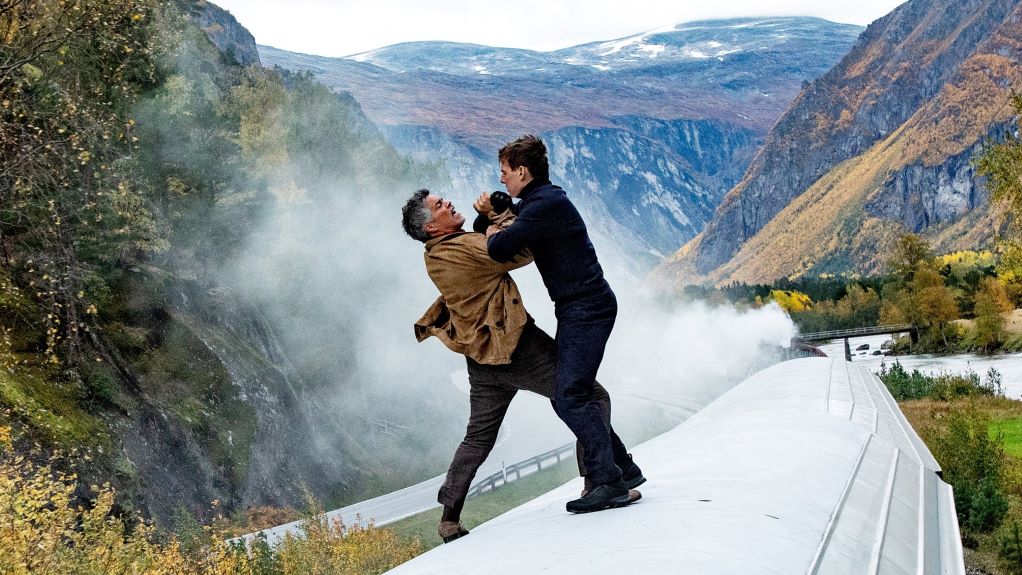
Dead Reckoning is a reminder that no-one since Buster Keaton puts themselves through as much as Cruise does (it seems fitting the finale builds towards the biggest train crash since The General). It’s Cruise’s USP: he does it for real. Even at 60 he pushes himself in the way few actors have ever done. Run full-pelt through the streets of Venice? Climb along the roof of a speeding train? Fight two actors half his age in a cramped corridor? You can sort of understand why the film doesn’t shirk on dialogue paying tribute to Cruise/Ethan’s superhuman determination and endurance (and the film is a further reminder Ethan’s only flaw is caring too damn much).

Let’s not forget also Cruise pretty much produces and co-directs these missions. Dead Reckoning is a triumph of the producer’s art – McQuarrie and Cruise are practised experts at pulling together locations, resources and expertise. They are equally ace at assembling tense sequences that don’t involve death-defying stunts. A first act cat-and-mouse chase around a huge Dubai airport sees Cruise tracking Atwell, while dodging a US government team sent to capture him, while Pegg hunts for a suspicious bag, while Cruise is also tracked by Morales. None of this involves stunt work (although Cruise and Atwell both learned how to perform sleight-of-hand tricks in camera) just timing and an ability to constantly present events in a dynamic way. This is consummate box-office ride assembly, marshalled to perfection with all the skill of expert showmen.

The set pieces are so gripping, it sometimes draws your attention a little bit too much to how perfunctory all the joins can be. A host of British actors (Gatiss, Varma and rent-a-villain Cary Elwes) gather in a room to throw plot statements at each other. The conversations between the team are often dominated by the narrative need to establish who will go where and why. The script has a tendency to demonstrate how people feel by having them bluntly state it (“My friends matter more to me than anyone!”). When trying to be human, rather than a thrill ride, it can stumble.

It’s perhaps why the moments that aim for tragedy feel like they land slightly awkwardly, as if you aren’t quite sure how sad you should be feeling. Dead Reckoning throws in an emotional mid-act that strains for a depth a film primarily designed to entertain popcorn munchers, isn’t quite able to deliver on. Put simply, the film can’t afford to have Ethan get caught up in grief when ten minutes later we need an exasperated Cruise to jump off a mountain. This ride don’t stop for anyone.

The film also suffers from the characters spending the entire runtime chasing a mysterious key which they have no idea the purpose of, but the audience has had explained to us in that opening Russian prologue. This is a series that thrives best on carefully concealing things from us, on the characters having a card or two up their sleeves. It somehow doesn’t quite work that we are more aware of the bigger picture than the characters. It makes Dead Reckoning feel like an extended opening act.

But this ride is fun enough for now. Atwell is charming, funny and has superb chemistry with Cruise; Morales is a chillingly arrogant villain, Klementieff enigmatically vicious as a near-wordless henchman. Whigam and Davies are good fun as contrasting agents vainly chasing the uncatchable Ethan. And above them all is Cruise: jumping, running, diving, punching and generally putting life-and-limb on the line, all to entertain us. Maybe he is a bit mad, but it’s impossible not to applaud him.

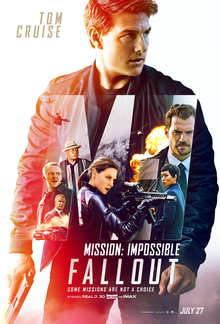
Mission: Impossible – Fallout (2018)

Tom Cruise gets the gang back together for high octane excitement in Mission: Impossible Fallout

Director: Christopher McQuarrie

Cast: Tom Cruise (Ethan Hunt), Henry Cavill (August Walker), Ving Rhames (Luther Stickell), Simon Pegg (Benji Dunn), Rebecca Ferguson (Ilsa Faust), Sean Harris (Solomon Lane), Angela Bassett (Erica Sloane), Michelle Monaghan (Julia Meade), Alec Baldwin (Alan Hunley), Vanessa Kirby (Alanna Mitsopolis/White Widow), Frederick Schmidt (Zola Mitsopolis), Wes Bentley (Patrick)

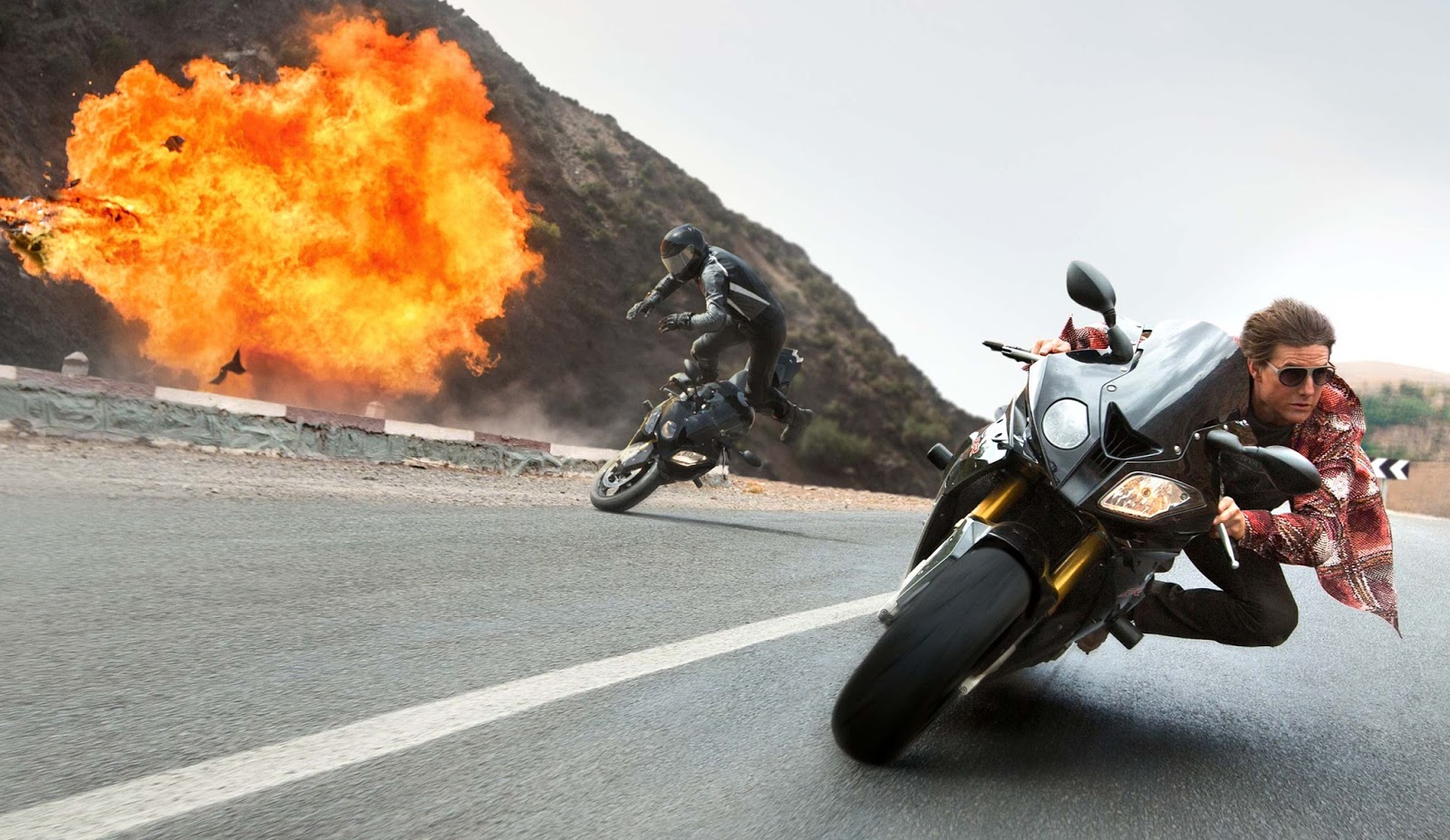
It’s probably not something many people would expect watching a Hollywood blockbuster, but part way through Mission: Impossible Fallout, as Tom Cruise motorbikes into a stream of traffic round the Champs-Élysées, I was reminded of Michael Crawford in Some Mother’s Do ‘Ave ‘Em. If there’s one thing these two have in common, it’s having a star willing to constantly go above and beyond to perform their own stunts. Which mainly makes you think as well that Crawford and Cruise are probably both a bit nuts.

Mission Impossible: Fallout picks up almost exactly where Rogue Nation left off. The villain of that film, Solomon Lane (Sean Harris), may be in custody, but the remnants of his organisation have reformed as The Apostles, chosen a new leader (known only by the pseudonym John Lark), and are trying to seize three nuclear warheads. Ethan Hunt (Tom Cruise) is deployed to stop them. During the mission, Hunt chooses to save the lives of his team rather than complete the mission – leaving the IMF force with a race against time to regain the warheads, and leading to clashes and alliances with enemies and friends old and new, including Lane and Hunt’s female counterpart Ilsa Faust (Rebecca Ferguson).

Mission: Impossible Fallout is big. By golly gosh it’s big. They aimed to make this the biggest and most stunt-filled, action-packed entry in the series – and they probably succeeded. More than any other film in the series, this one feels like a series of action sequences joined together by scenes of story and dialogue. Never has the overall aim of the villains, or their scheme, been so swiftly outlined – or essentially so inconsequential to the events we are watching. Do we need to know why the Apostles (an organisation we never even encounter in the flesh!) or Lane or any combination of the film’s baddies want to blow up three nuclear bombs in Kashmir? The film gambles that we won’t really care, that all we really care about is watching Hunt and co prevent them on a 15-minute deadline. It’s a gamble that the film more or less gets right.

The film also skims quickly, depending on you having seen the three preceding films so that it can spend time less on character re-establishment and more on those action scenes. It plays off emotions we have developed for the characters over previous episodes – and relies on us carrying across our knowledge of their past relationships. Alongside this, the film is crammed with callbacks to pretty much every film in the series – most prominently of all to Hunt’s marriage in the third film. This is a plot development, you feel, largely introduced to allow the characters to move on: it’s clear Hunt and Faust are the series intended romantic leads going forward (though Faust is never anything less than Hunt’s equal in all areas), so we need to know that Hunt isn’t cheating on a wife somewhere along the line, and that they have mutually decided to go their separate ways. The film accomplishes this – and also allows a few beats to suggest that, under the surface, all this Impossible Missioning has given Hunt the odd small emotional problem.

But not too many, as establishing Hunt’s decency is pretty central to the film. One of its themes is Hunt’s unwillingness to sacrifice any innocents or indeed anyone who doesn’t deserve it. This theme runs throughout the film, and is used to suggest that part of the reason Hunt so often instigates such insanely grandiose schemes is that he is completely unwilling to let the needs of the many outweigh the needs of the few: give him the choice of sacrificing one man to get nuclear warheads easily, or jumping through the sorts of insane loops, schemes and dangers this film throws him into, and Hunt will choose the hard option every time. (Of course I could also be mean and say that Cruise has developed a character whose only real flaw is that he cares too much.)

At least this makes him really easy to root for. Which is just as well, as Fallout throws Hunt front and centre. Perhaps more so than any film since the second one, the team feels like a one-man army. Hunt does everything difficult or dangerous – which means Cruise is dragging himself to take on a number of insane stunts, from HALO jumps, to driving against the Parisian traffic, to hanging off the bottom of a flying helicopter. Of course, we also get no fewer than six speeches praising Hunt to the heavens – but when Cruise is willing to go such insane lengths (one stunt famously left him with a broken ankle and shut down filming for eight weeks) you can’t hold it against him that much.

And like all the rest of the series, this is a very fun film. It takes a while for the sense of fun to really kick in – much of the first half-hour feels deathly serious – but eventually that sense of fun, of enjoying the lunacy, settles in and you start to run with it. A madcap chase over the roofs and office blocks of London that ends at the Tate Gallery is a perfect example of a sequence that mixes hi-jinks, death-defying stunts and tongue in cheek humour. 

And that’s really the secret of this franchise. It’s a mix of absurdly OTT action, incredible dangers, and death-defying stunts that its star throws himself into with an insane abandon all played with a certain lightness of touch. The series, for all its world-endangering excitement and merciless villains, also has a family feeling behind it. Hunt’s team is his family and it’s that warmth which underpins all the drama. Fallout is huge fun – in fact, if it has any real flaws it is that it is too big by the end, with an action sequence that never seems to end – and a great rollercoaster to climb on board.

Mission: Impossible 2 (2000)

Tom Cruise joins forces with his ego to take on Mission: Impossible 2

Director: John Woo

Cast: Tom Cruise (Ethan Hunt), Thandie Newton (Nyah Nordoff-Hall), Ving Rhames (Luther Stickell), Dougray Scott (Sean Ambrose), Brendan Gleeson (John C McCloy), Anthony Hopkins (Mission Commander Swanbeck), Richard Roxburgh (Hugh Stamp), John Polson (Billy Baird), Radé Sherbedgia (Dr Nekhorvich), William Mapother (Wallis), Dominic Purcell (Ulrich)

Okay. I love this franchise. Always have. But every franchise has its misfire right? Its Phantom Menace? Ladies and gentlemen: welcome to this total turkey. Can you believe this was the biggest box office hit of 2000? Has anyone watched it since then? Did anyone like it even then?

Anyway, the plot for what it’s worth, plays like Hitchcock’s Notorious if it had been roughly humped after a drunken dinner by The Fast and the Furious. Ethan Hunt (Tom Cruise) has to recruit the bizarrely named Nyah Nordeff-Hall (Thandie Newton), a society catburgler and sort of hot Raffles. Why? Well of course her ex-boyfriend and rogue MIF agent Sean Ambrose (Dougray Scott) has pinched a deadly virus and we need her to get back into his bed and trust to find out more so MIF can pinch it back before it hits the market. She’ll be ready to deceive a man though because “she’s a woman, she has all the training she needs” – or so says Anthony Hopkins’ half-asleep Mission Commander. 

Mission: Impossible 2barely has a plot though. Rarely has a film looked more like a story loosely written around some pre-determined action set-pieces. Much as I like Tom Cruise, no film looks more like a cocky vanity project than this one. The camera lingers on Cruise’s chiselled torso and general macho physicality like a lovestruck teenager. Remember when the MIF was a team organisation? Not anymore. Cruise is now a one man army, who barely needs the help of his two sidekicks (the job of one is to press keys on a computer, the other flies a helicopter. That’s it).

So the whole film is about making Cruise look good. From punching, to climbing freestyle up a cliff, to flashing the famous grin, to driving cars and bikes really fast, the whole film is blinded by his smile. Poor Thandie Newton and Dougray Scott can only watch as the Cruiser bestrides the film like a colossus, creeping about to find themselves dishonourable graves. Both performers are crushed by the weight of Cruise’s ego and the film’s front-and-centering of it. Newton can barely raise her performance above balsawood. Poor Dougray Scott not only gives an utterly bland performance, but was stuck on the set for so long by production delays he had to pull out of the first X-Men film, giving his role of Wolverine to an unknown West End actor by the name of Hugh Jackman. Ouch.

Perhaps as a reaction to the first film being seen as too confusing (it really isn’t…) the plot is almost laughably simple, verging on pointless. The film homages (rips off) other, way, way better films everywhere you look. So we get flirting-through-racing-fast-cars from GoldenEye. We get the almost the whole plot of Notorious with the woman sent to spy on her former lover by a handler who is now in love with her (the film even has an extended racecourse sequence). “I will find you” Cruise bellows at Nyah at one point like a low rent Last of the Mohicans. It doesn’t help that the film sounds like the writers spent about five minutes on the dialogue: “Damn you’re beautiful” Cruise tells Nyah. Well, be still my beating heart. This shit was penned by the writer of Chinatown for fuck’s sake.

The slight plot could probably be comfortably wrapped up in about an hour, if it wasn’t for the film’s constant (embarrassing) use of slow motion at every conceivable opportunity. I guess it’s meant to add style and depth, but it’s actually crushingly annoying and often gives us laughable moments (none more so than Cruise walking past a flaming doorway in slow motion for no reason). You just want to tell the film to get a bloody move on.

But then that is part of the John Woo style. Hard to believe this style of shooting an action film was once considered cool beyond belief. It looks so pretentiously, artily, self-importantly, thuddingly dull now. There are a huge number of action scenes here but none of them are particularly exciting, and none of them hugely memorable. There is a bit with a bike, a bit with cars, a shoot-out in a base, an infiltration of a big building. Yawn. Perhaps because Ethan Hunt feels less like a human, more like an empathy-free, ego-mad super soldier, it’s hard to care. In every other film, time is invested to make him appear human – here he’s an asshole who forces a woman to give her body for secrets, grins like a lunatic and slaughters people left, right and centre. It’s like he’s been given an arsehole upgrade from the first film (the third film would correct all this). 

The film has no humour whatsoever. It’s po-faced and serious and desperately in love with itself. I keep banging on Cruise, but I think I do blame him. Other than Hopkins, no one in the film can compete with his charisma which feels like a deliberate choice. Every single memorable thing in the film is done by him. No other character is allowed to contribute anything to the resolution of the problem. On top of that every character seems to have a Tom Cruise mask – meaning Tom also gets to play at least three other characters as well. 

John Woo shoots all this with a tedious flashiness that is completely empty. Logic is left lying battered and bruised on the sidewalk. By the time we get to the final resolution, we are desperate for Nyah (who has been used for sex, humiliated and infected with a deadly virus) to tell Cruise to get stuffed. Instead (after watching him gun down a pliant Sean Ambrose, who is never allowed to appear as a worthy adversary) they go on a sun dappled date in Sydney, with Cruise all but turning to the camera to wink. “Don’t you wish you were me?” he seems to be saying. Christ I really don’t.

Mission: Impossible – Rogue Nation (2015)


Tom Cruise is the Living Manifestation of Destiny in Mission: Impossible Rogue Nation

Director: Christopher McQuarrie

Cast: Tom Cruise (Ethan Hunt), Jeremy Renner (William Brandt), Simon Pegg (Benji Dunn), Rebecca Ferguson (Ilsa Faust), Ving Rhames (Luther Stickell), Sean Harris (Solomon Lane), Alec Baldwin (Alan Hunley), Simon McBurney (Atlee), Tom Hollander (Prime Minister)

Tom Cruise may be getting on a bit now, but he still does his own stunts with reckless disregard for his own safety: part of the franchise’s appeal is seeing the latest insane thing the Crusier will do. In M:I RN he gets this out of the way early (pre-credits) with a madcap stunt involving holding onto a plane while it takes off. A clever little tease, if for no other reason that no-one can complain about it being a spoiler when said stunt was placed on the poster and all the trailers, when it’s literally the first thing he does in the film.

Anyway, the mission accepted this time is Ethan Hunt (Tom Cruise) going toe-to-toe with a shadowy organisation known as The Syndicate (a sort of evil IMF), run by the serenely sinister Solomon Lane (Sean Harris). Things are made more difficult by IMF being disbanded (again!) by CIA director Alan Hunley (Alec Baldwin). However, help is at hand from old friends Benji (Simon Pegg), Brandt (Jeremy Renner) and Luther (Ving Rhames) – and possibly from mysterious double (or is it triple?) agent Ilsa Faust (Rebecca Ferguson) who may or may not be playing for the angels.

This continues the rich vein of form for this series. It’s light, fast-paced and huge amounts of fun that bombs along with plenty of cool stuff happening all the time. Once again, the stunts are pretty stunning and the set-pieces feel like they offer fresh alternatives. In fact Mission: Impossible – Rogue Nation might be one of the most fun entries in what’s already a hugely enjoyable franchise.

It’s still very much the Cruise franchise though. There’s a fascinating documentary on the DVD. It’s called “Cruise Control”, which is a revealing pun while you watch Tom constantly stand over the shoulder of Chris McQuarrie during shooting. He sets the camera, he storyboards the scenes, he talks to the actors, he edits the film. To all intents and purposes, he’s at lease the co-director. Perhaps this is why Cruise is so overwhelmingly the focus of the film. He spends a good 15 minutes displaying his chiselled body topless. Alec Baldwin even has a ludicrous speech where he calls Hunt “the living manifestation of destiny”. Fun as the film is, make no mistake it’s a showpiece for Cruise.

Here’s Tom hanging off a plane. Say what you like the guy is committed. Or should be committed.

Not that there is much wrong with that if the end result is such good fun. Simon Pegg does a good job of puncturing the pretentions. Every 15 minutes we also get some sort of gripping action set-piece: Tom fighting in the Vienna Opera House, Tom holding his breath in an underwater computer bank for an unfeasibly long period of time, Tom driving a car then a motorbike (no helmet!) through a series of crazily risky chases… Even when escaping from captivity early from the film, he springs his escape with a nifty upside-down acrobatic jump-climb from a pole. Sure it’s all Tom, but he does it all so well that you can’t not be entertained.

But away from Tom, there is actually a nice sense of family that keeps the story bubbling over. Benji and Hunt increasingly feel like heterosexual life partners (in a really nice touch, it’s Benji who fills the damsel in distress role at the end of the film). The other returning characters, Brandt and Luther, don’t have masses to do but immediately settle into the bickering dynamic that keeps the family ticking over. Ilsa Faust is thrown into this boys-only club partly as a femme fatale, partly as some sort of a potential surrogate stepmum, who the kids are working out whether to trust.

Ilsa Faust could be the best thing about the film, a sort of super-efficient female version of Ethan, bests him a couple of times, and can do all the running, punching, shooting and driving that Tom does almost as well. Sure the camera can’t quite resist a few tracking shots up her body in a nice dress or motorcycle gear, but all-in-all she’s pretty well presented. There is a curious semi-flirtatious, semi-siblingy relationship between Faust and Hunt, with the film eventually settling as a kinda sweet dance of “what might have been”. Ferguson is terrific in the role, not only matching Tom’s athleticism, but also giving Faust a sort of arch mysteriousness. Goodness only knows what Hunt really makes of the first female interest he’s had in the series who can match him.

McQuarrie may, I suspect, be as much Cruise’s collaborator as the director, but he does craft an exciting and confident piece of film making. The Syndicate plot line is suitably twisty and turny – and helped by Sean Harris’ softly spoken, arrogant menace as Lane. You’ll be kept guessing as to the true agenda of nearly everyone involved. Simon McBurney offers good smarm as a shady MI6 head (called, bizarrely, Chief Attlee at every turn hardly the title you’d expect). A spycraft action sequence at the Vienna Opera House is a brilliantly entertaining routine of misdirection, which feels close in tone to the original Mission: Impossible film in its old-school smarts behind new-school flash.

Rogue Nation is, quite simply, a damn entertaining thrill ride – and it doesn’t really have pretensions to be more than that. McQuarrie and Cruise keep the action churning along nicely, each of the thrilling set pieces is exactly that, and the core characters on this rollercoaster are engaging and interesting. McQuarrie is a skilled enough writer to rope together some memorable scenes among the mayhem. It’s charming and hugely entertaining – any doubt that this franchise isn’t here for the long term can be firmly dispelled.

Mission: Impossible (1996)


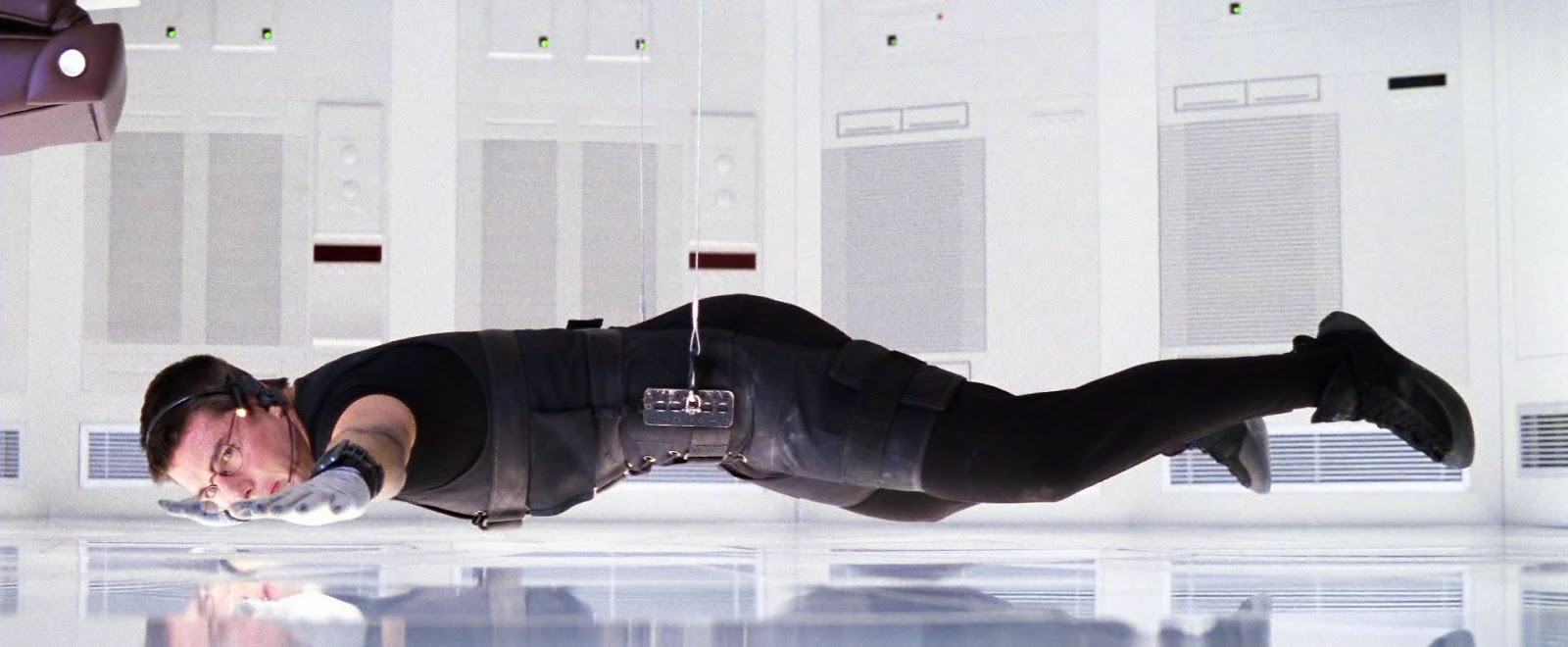
Tom Cruise doesn’t hang about in the most iconic sequence from the first Mission: Impossible

Director: Brian de Palma

Cast: Tom Cruise (Ethan Hunt), Jon Voight (Jim Phelps), Emmanuelle Béart (Claire Phelps), Henry Czerny (Eugene Kittridge), Jean Reno (Franz Kreiger), Ving Rhames (Luther Stickell), Kristin Scott Thomas (Sarah Davies), Vanessa Redgrave (Max), Emilio Estevez (Jack Harmon), Ingeborga Dapkūnaitė (Hannah Williams)

Everyone knows how it goes right? Bum bum bum-ba-bum-bum bum-ba-bum bum… Yup it’s the Mission: Impossible theme tune. Originally a hit TV series, it’s arguably more familiar now as this Tom Cruise-starring film series, a showpiece for his reckless physicality and insane commitment to ever more elaborate stunts.

Ethan Hunt (Tom Cruise) is framed as a traitor after a disastrous mission in Prague. While trying to reclaim a list of agents’ cover names, Cruise and his team are betrayed by a mole within IMF. The rest of his team, including his mentor Jim Phelps (Jon Voight), are killed though Phelps’ wife Claire (Emmanuelle Béart) survives. On the run, he has to steal the real secret list himself to help discover the identity of the traitor.

Who would have thought over 20 years later Tom Cruise would still be heading out on Impossible Missions? The success of the franchise is rooted in this engaging spy thriller. How many times have I seen this film? Countless times. It’s inventive and playful. It’s got a decently intriguing plot that keeps you on your toes.  Above all it’s fun.

At the time of its release people talked about its impenetrable plot, but it’s basically a standard “double cross” film. Someone we think is a hero is basically a wrong ‘un, so our hero has to follow every means in his power to find out who it is – including pretending to be a wrong ‘un himself. Understand that, and the plot is pretty basic. The main reason people find it confusing is the film assumes you’re smart enough to follow what’s going on, without characters sitting down and spelling everything out. Isn’t clumsy exposition the sort of thing we criticise other films for? Isn’t it nice not to have a film that just assumes you can follow the whole thing?

Anyway, the plot and characters are largely there to carry us from one spectacle to another. The film starts with a bang. Can you think of many films that kill off most of the cast (and the recognisable actors) in the opening 15 minutes? It’s such a daring opening it leaves a whiff of peril over everything else – even after we discover some people weren’t actually killed, and despite no other characters dying apart from the baddies.

Killing off the team does mean the film is a bit more “Tom Cruise with some back-up” rather than a team effort – but that doesn’t really matter does it? Wee Tom of course does all his own stunts and looks cracking. Acting wise, he’s “cruising” through his standard turn as a cocky protegee who goes through a steep learning curve. But it doesn’t really matter, because he looks great and everything he does is pretty damn cool. He even manages to mine some real emotional pain when he realise some of the people closest to him have betrayed him.

The film’s centre piece, that famous spiderlike descent from the roof to break into a sealed computer room in Langley, is probably most responsible for making this film a hit. How many times has that scene been spoofed? (So much so people no longer remember its almost completely lifted from 1960s crime caper Topkapi) It carries more impact than the big top-of-the-train scene that ends the film, because we immediately understand the difficulty of what Hunt is trying to do. How many times have we had to balance, played a game where you couldn’t step on something, had to be as quiet as possible, or keep as calm as you can? I’ve never had to balance on top of a speeding train, but I’ve had to do all that stuff. Everyone watching it can relate to the tension of doing this stuff. It’s a little masterpiece scene that also owes a fair deal to Riffi’s silent robbery scene.

The scene also shows what a triumph of style this is. De Palma directs with a breezy lightness and love for the business of spycraft (I suspect he was taking the money big time, as he injects very little of his personality into it, but it works and he has an eye for the memorable shot), Tom Cruise is pretty damn cool. The film understands the simplicity of iconic shots – Cruise jumping away from an exploding aquarium in a restaurant is a simple stunt, but it looks great. The film has a great range of small-scale spycraft as well – from Cruise cracking a bulb and sprinkling the glass outside a door as an early warning detector, to him carefully timing how long to stay on a phone call to allow a trace to go so far.

Of course, some things in the plot make very little sense. The traitor seems rather randomly motivated (he’s basically pissed off at the end of the Cold War, despite earning way more than the average joe and being married to an impossibly attractive younger wife) and his effectiveness and smartness fluctuates according to the demands of the plot (Bond villain-like, he inexplicably leaves Hunt alive at one point for no reason). The idea of a government organisation where missions can be chosen to be accepted or not is in itself rather silly. The use of the internet and e-mail in the film looks hilariously dated today (Hunt basically sends a series of random e-mails to made up addresses – Max@Job314 indeed…).

To be honest, its breakneck pace is probably why some people struggle to keep up with what’s going on, but generally I wouldn’t let it bother you. It helps as well that there is a terrific cast of interesting actors – one of the great strengths of this series has always been its unconventional casting decisions. Would anyone else have thought of Béart and Scott Thomas as secret agents? Each actor has the skill and confidence to invest often paper-thin characters with depth – Rhames plays Luther so well, he stuck around for the rest of the series, despite us learning very little about him here. Voight has a perfect world-weary fixedness as Phelps, Reno is great value as a sociopathic hired gun and Redgrave has a lot of a fun as a cut-glass arms dealer.

Mission: Impossible is, to be frank, tons of fun. It’s basically a simple film disguising itself as a complex one, but it’s rewarding enough that you enjoy working out the plot alongside Hunt. It treats the viewer with a certain rewarding confidence and it’s crammed with distinctive and iconic shots. Is it any wonder Cruise saddled up five more times (and counting) and chose to accept the mission again?

Mission: Impossible III (2006)


Tom Cruise and Kerri Russell take on a truly challenging assignment in Mission: Impossible III

Director: JJ Abrams

Cast: Tom Cruise (Ethan Hunt), Philip Seymour Hoffman (Owen Davian), Ving Rhames (Luther Stickell), Billy Crudup (John Musgrave), Michelle Monaghan (Julia Meade), Jonathan Rhys Meyers (Declan Gormley), Maggie Q (Zhen Lei), Keri Russell (Lindsay Farris), Simon Pegg (Benji Dunn), Eddie Marsan (Brownaway), Laurence Fishbourne (Theodore Brassel)

If there is one thing Tom Cruise does better than anyone in the movies, its run. Man, can that guy run well on camera. It’s not as easy as you’d think – watch people run in real life, and they probably look galumphing and awkward. But Tom looks as sleek as a gazelle. Every stride stresses his authority and unflappable coolness. I mention it because Tom does a lot of running in this film. The dénouement is basically him running over a mile and half, nearly in real time, a lot of it one long shot. 

JJ Abrams came to Mission: Impossible off the back of his successful TV series, Alias, in which Jennifer Garner’s undercover agent takes on a variety of disguises, working in a team, on a series of missions to get impossible-to-obtain artefacts against terrific odds. JJ Abrams carries the formula that worked so well in that series straight into this one.

The whole film plays out like an Alias movie. It even uses that series regular gambit of an opening scene throwing us dramatically into the story before flashing back “72 hours earlier”. Just like Alias, we have our lead trying to make a relationship work without saying what they do for a living, a family feeling in the team’s relationship, a geeky tech guy with a heart of gold, double and triple agents, glamourous locations – it’s everything an Alias fan could want, with Cruise’s Ethan Hunt essentially Sydney Bristow in all but name. This also brings out the best in Cruise, who looks like a man born again in the role.

Mission: Impossible: III is truly delightful, big-screen fun, rebirthing the series and placing team interplay firmly back at the centre, setting the tone and template the next two films have followed. Ethan Hunt (Tom Cruise) is in semi-retirement, training agents and planning to marry Julia (Michelle Monaghan). However when his young protégée Lindsay Faris (Keri Russell) is captured while investigating sinister arms dealer Owen Davian (Philip Seymour Hoffman), Hunt sets out to rescue her – and finds himself up to his neck in shady and dangerous goings-on.

Every action scene in the film is brilliantly entertaining (the mid-film drone assault is wind-it-back-and-watch-again exciting.). Of course, Cruise takes more than his fair share of the juicy moments – including a crazy jump off the roof of a Hong Kong building that has to be seen to be believed – but Abrams makes this a team movie in the way neither of the two previous films had been. Each member brings crucial skills to the table, and has moments to shine. Pegg takes the stand-out role of a witty, nerdy tech back at the base (sure enough his role was expanded later), but each feels an essential part of the story.

It also helps that the film has a terrific baddie to bounce off – the series has not had a better villain than Hoffman’s ice cold arms dealer. Sure Davian is pretty much a part Hoffman could play standing on his head – but he’s got just the right balance of rage and ruthless intellect.

If you want to see a single example of why this film works, take a look at that opening scene. Who could resist a film that opens with a scene as masterfully directed as this, sizzling with tension and ending with a smash cut to black over a gun shot and into the opening score? Hoffman and Cruise are excellent (Hoffman’s ice-cold control providing a great contrast to Cruise, who runs the gamut of defiant, furious, faux-reasonable, desperate and pleading), but it sets out the huge stakes for the film, it keeps us nervily waiting for the film to catch-up with what we’ve seen, and it tells us how vitally important what Davian wants is to him – and how desperate Hunt is to protect Julia.

Abrams has a perfect understanding of dramatic construction.  Everything in the film is carefully established and set-up, so we always understand the dangers and the threats. MI3 also uses its macguffin extremely well. What do we learn about “the Rabbit’s Foot”, the possession of which is of such vital importance? It’s small enough to fit in a suitcase, it’s stored in a round glass tube, it’s got a biohazard label and it’s worth millions. That’s it, but it doesn’t matter: Abrams establishes the most important thing – it’s dangerous and Davian wants it more than anything. Everything spins out from that with smooth efficiency.

The pace never lets up, but the characters and their relationships are never left behind. In particular Monaghan and Cruise’s relationship is skilfully established in surprisingly few scenes, and something we end up really rooting for. Abrams never goes overboard – the film is stuffed with action and excitement but never feels bloated or indulgent: the final confrontation is particularly effective because it is fairly small scale and is focused on the Hunts’ relationship.

Mission: Impossible 3 is one of the most joyful entries in a film franchise that deserves a lot of kudos for (by and large) focusing on plot, story and character alongside action sequences that have a feeling of tangible reality about them. It’s not completely perfect – a shock reveal about a turncoat in the IMF is hardly a surprise, considering the small number of candidates and the actors playing them – but it’s about as close as you can get to an endless enjoyable fairground ride.