Category: Movies about movies

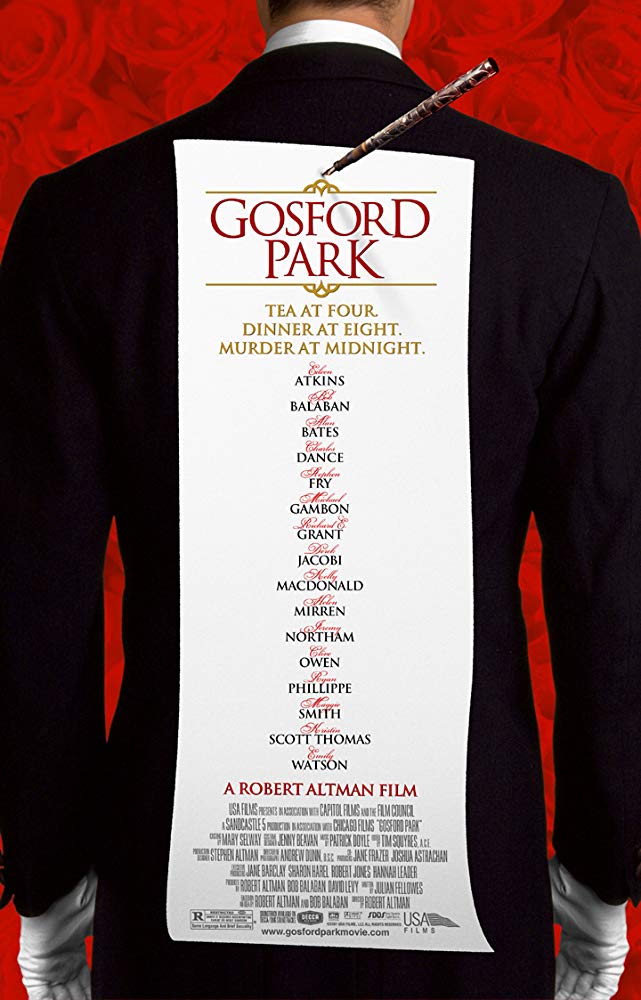
Gosford Park (2001)

Cruelty, snobbery and viciousness – just another night at Gosford Park

Director: Robert Altman

Cast: Eileen Atkins (Mrs Croft), Bob Balaban (Morris Weissman), Alan Bates (Mr Jennings), Charles Dance (Lord Stockbridge), Stephen Fry (Inspector Thompson), Michael Gambon (Sir William McCordle), Richard E. Grant (George), Derek Jacobi (Probert), Kelly Macdonald (Mary Maceachran), Helen Mirren (Mrs Wilson), Jeremy Northam (Ivor Novello), Clive Owen (Robert Parks), Ryan Phillippe (Henry Denton), Kristin Scott-Thomas (Lady Sylvia McCordle), Maggie Smith (Constance, Countess of Trentham), Emily Watson (Elsie), Claudie Blakely (Mabel Nesbitt), Tom Hollander (Lt Commander Anthony Meredith), Geraldine Somerville (Lady Stockbridge), Jeremy Swift (Arthur), Sophie Thompson (Dorothy), James Wilby (Freddie Nesbitt)

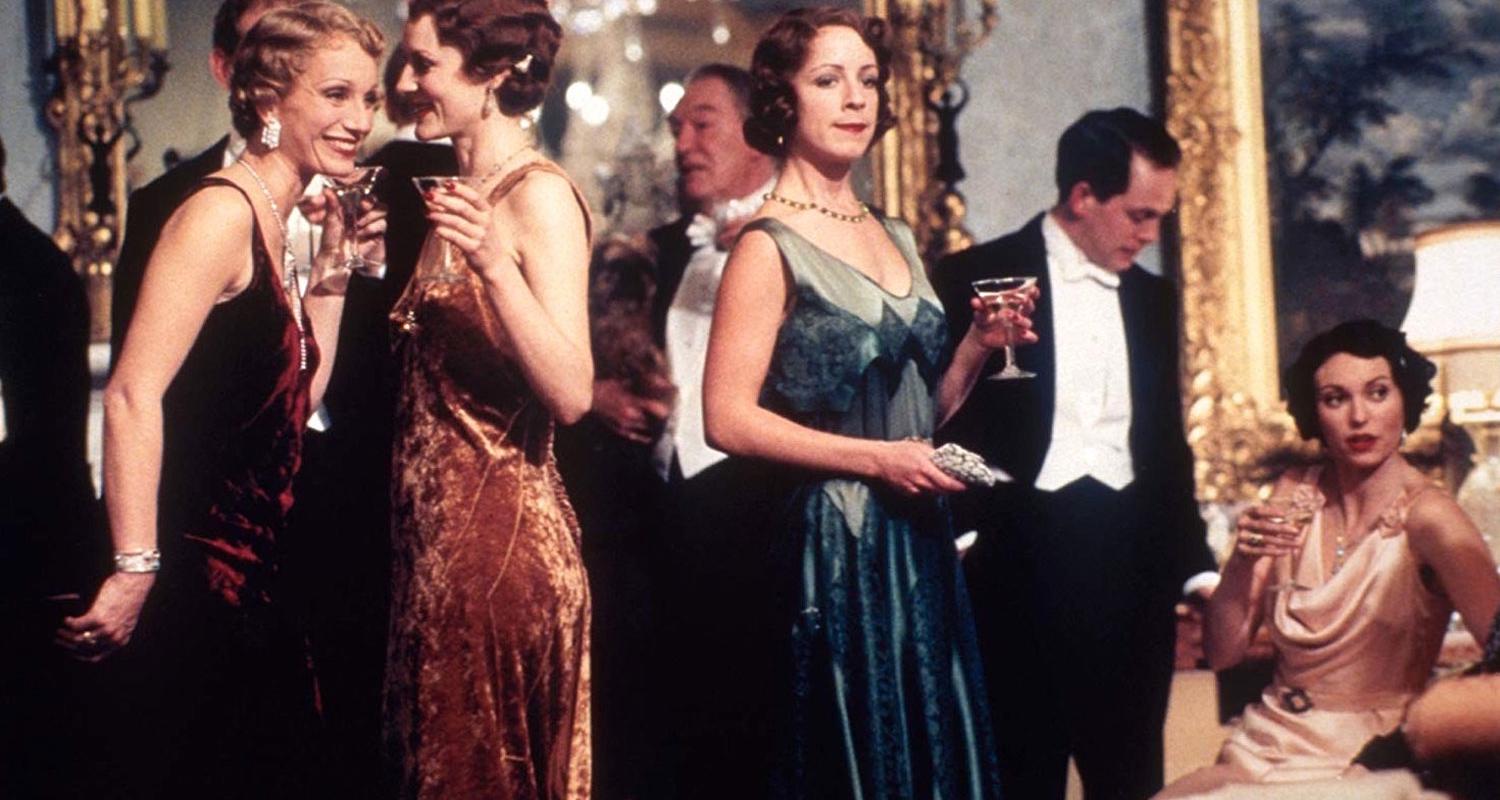
We’ve always fancied ourselves that when Brits make films in America – think John Schlesinger’s brilliant analysis of New York hustlers in Midnight Cowboy – they turn the sharp analytical eye of the outsider on American society. But do we like it when America turns the same critical eye on us? Gosford Park is a film surely no Brit could have made, so acutely vicious and condemning of the class system of this country, without the hectoring that left-wing British filmmakers so often bring to the same material, it’s just about perfect in exposing the hypocrisy and cruelty that undermines our class system. You’ll never look at an episode of Downton Abbey the same way again.

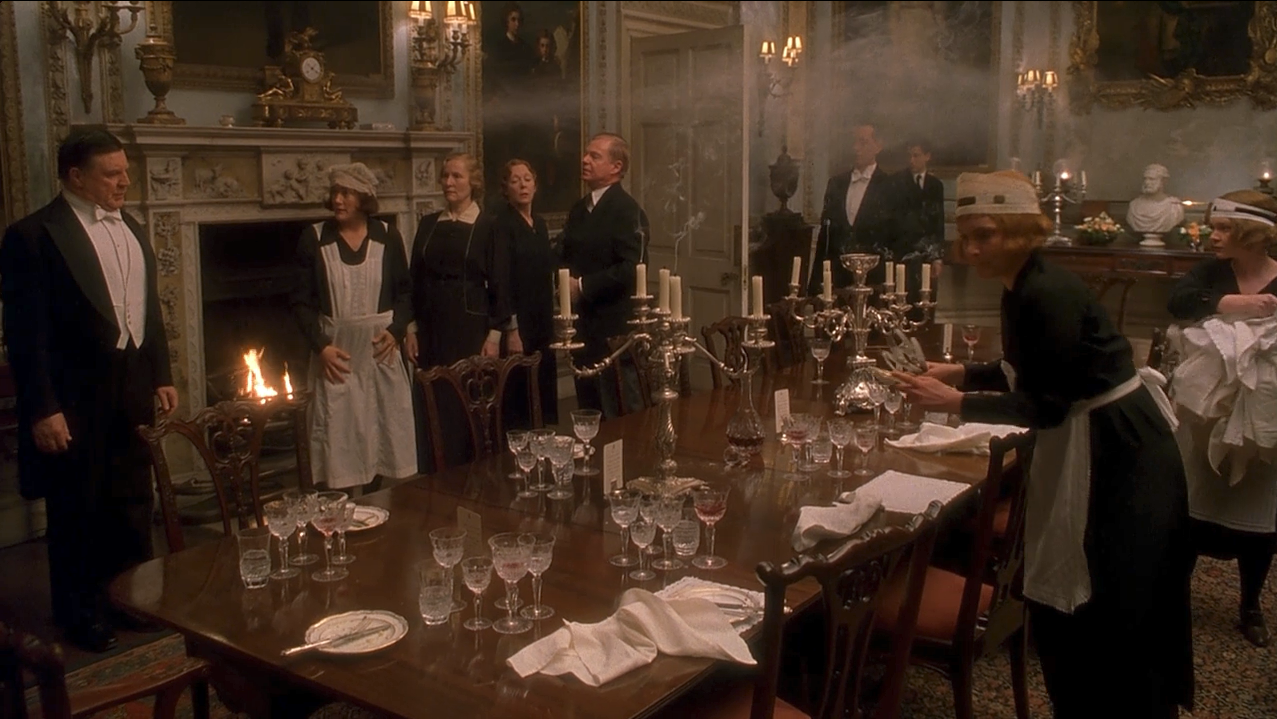
In November 1932, Sir William McCordle (Michael Gambon) hosts a shooting party at his country house. McCordle is almost universally despised by his relatives and peers – most especially his wife Lady Sylvia (Kristin Scott-Thomas) – but tolerated as his vast fortune from his factories basically funds the lives of nearly everyone at the house party. While the upper classes gather upstairs, downstairs the servants of the house led by butler Jennings (Alan Bates) and housekeeper Mrs Wilson (Helen Mirren) order the house to meet the often selfish and thoughtless demands of the rich. The house is rocked midway through the weekend, when a murder occurs overnight. With motives aplenty, perhaps the new maid Mary (Kelly Macdonald) of the imperious Countess Trentham (Maggie Smith) has the best chance of finding the truth.

First and foremost, it’s probably a good idea to say that this is in no way a murder-mystery. Robert Altman, I think, could barely care less about whodunit. While the film has elements that gently spoof elements of its Agatha Christie-ish settings, Altman’s interest has always been the personal relationships between people and the societies they move in. So this is a film really about the atmosphere of the house and most importantly how these people treat each other. Altman despised snobbery, and in a world that is fuelled by that very vice, he goes to town in showing just how awful and stifling so many elements of the class system really were.

“He thinks he’s God Almighty. They all do.” So speaks Clive Owen’s Robert Parks, valet, of his employer the patrician Lord Stockbridge (Charles Dance, excellent). You’ve got the attitude right there: the rich see themselves as a different species to those pushing plates around and cleaning clothes below stairs. The idea of there being anything in common is laughable. Slight moments of casual conversation between servant and master in the film are governed by strict laws and carry a quiet tension. 

It’s so acute in its analysis of the selfishness, snobbery, cruelty and arrogance of the British class system that each time I watch it I’m less and less convinced that Downton Abbey (the cuddliest version of this world you could imagine) creator Julian Fellowes had much to do with it. This film is so far from the “we are all in this together” Edwardian paternalism of that series, you can’t believe the same man wrote both. All the heritage charm of Downton is drained from Gosford, leaving only the cold reality of what a world is like where a small number of people employ the rest.

Upstairs the hierarchy is absurdly multi-layered. Everyone is aware of their position, with those at the top of the tree barely able to look those at the bottom in the eye, let alone talk to them. The rudeness is striking. Maggie Smith (who is brilliant, her character totally devoid of the essential kindness of her role in Downton Abbey has) is so imperiously offensive, such an arch-snob, she can only put the thinnest veil over her contempt when she deigns to speak to her inferiors. Her niece, played with an ice-cold distance by Kristin Scott-Thomas, embodies aloofness, selfishness and casual cruelty.

Ivor Novello (Jeremy Northam, superb) – the one real person in the film, and a film star – is treated like a jumped up minstrel player, with characters falling over themselves to make snide comments about his career. His guest Morris Weissman (an excellent Bob Balaban), a Hollywood film producer, is treated with similar contempt – when reluctant to divulge details of the film he is in England researching (a Charlie Chan film) for fears he will spoil his plot, the Countess bluntly informs him “oh, none of us will see it”. Later, as Novello plays the piano (essentially singing for his supper) only the servants are pleased – most of the upper classes endure it under sufferance (“Don’t encourage him” the Countess says when there is a smattering of applause). You can see why, after only a few hours in the house, Weissman whispers to Novello: “How do you put up with these people?”

The servants themselves are bits of furniture, or barely acknowledged at all. Altman doesn’t shoot a single scene without a servant present, but this often hammers home their irrelevance to the upper classes (it’s made even more effective by seeing actors like Bates, Jacobi, Grant, Macdonald, Owen and Watson essentially being treated as extras). There are no bonds between upstairs and downstairs at all. Any upset witnessed on either side is responded to with silence. When Emily Watson’s Elsie (a brilliant performance of arch awareness of her place) momentarily forgets herself and speaks out at the dinner table, it’s treated like she has crapped on the floor – needless to say her career is finished.

The servants however echo the pointless rituals and ingrained hierarchy of their masters below stairs. For ease (!) the house servants insist the visiting servants are only addressed by the names of their employers not their own names. At their dinner table, their seating reflects the hierarchy of their employers. Many of the servants are more grounded and “normal” than the upstairs types, but they are as complicit in this system continuing as anyone else. They simply can’t imagine a life without it, and accept without question their place at the bottom rung of the house. 

Ryan Phillippe, later revealed as an actor masquerading as a servant (for research), immediately shows how hard it is to move between the two social circles. The servants despise him as a traitor who may leak secrets about their views of the employers. The guests see him as a jumped up intruder, even more vulgar than Novello and Weissman. His later humiliation is one of the few moments that see both sides of the social divide united (it’s fitting that it is an act of cruelty that reinforces the social rules that brings people together). 

The focus is so overwhelmingly on the class system – with Altman’s brilliant camera work (the camera is never still) giving us the sense of being a fly-on-the-wall in this house – that you forget it’s a murder mystery. Here the film is also really clever, archly exposing the harsh realities of the attitudes held by your standard group of Christie characters. Dance’s Lord Stockbridge in a Christie story would be a “perfect brick” but here we’ve seen he’s a shrewd but judgemental old bastard. The film throws in a clumsy Christie-style incompetent police detective, played by Stephen Fry. This is possibly the film’s only real misstep as Fry’s performance touches on a farcical tone that seems completely out of step with the rest of the film. But the Christie parody is generally wonderful, exploding the cosy English world the public perception believes is behind Christie (even if the author herself was often darker than people remember!).

It’s a hilarious film – Maggie Smith in particular is memorable, from cutting down her fellow guests, to judgementally tutting at shop-bought (not homemade) marmalade – but it’s also a film that creeps up on you with real emotional impact. Kelly Macdonald is very good as the most “everyday” character, who takes on the role of detective and has superb chemistry with Clive Owen’s dashing valet. But the film builds towards a heart-rending conclusion – a conclusion that, with its reveal about the darker side of Gambon’s blustering Sir William, feels more relevant every day – that shows the secret tragedies and dark underbelly of these worlds, with a particularly affecting scene between Atkins and Mirren (Mirren in particular is such a peripheral figure for so much of the film, that her final act revelations and emotional response carries even more force).  It’s heart rending.

Gosford Park is a film continually misremembered as either a cosy costume drama or a murder mystery. It’s neither. It’s a brilliant analysis of the British class system and a superb indictment of the impact and damage it has had on people and the country. Hilarious, brilliantly directed by Altman with a superb cast – it’s a masterpiece, perhaps one of the finest films in Altman’s catalogue.

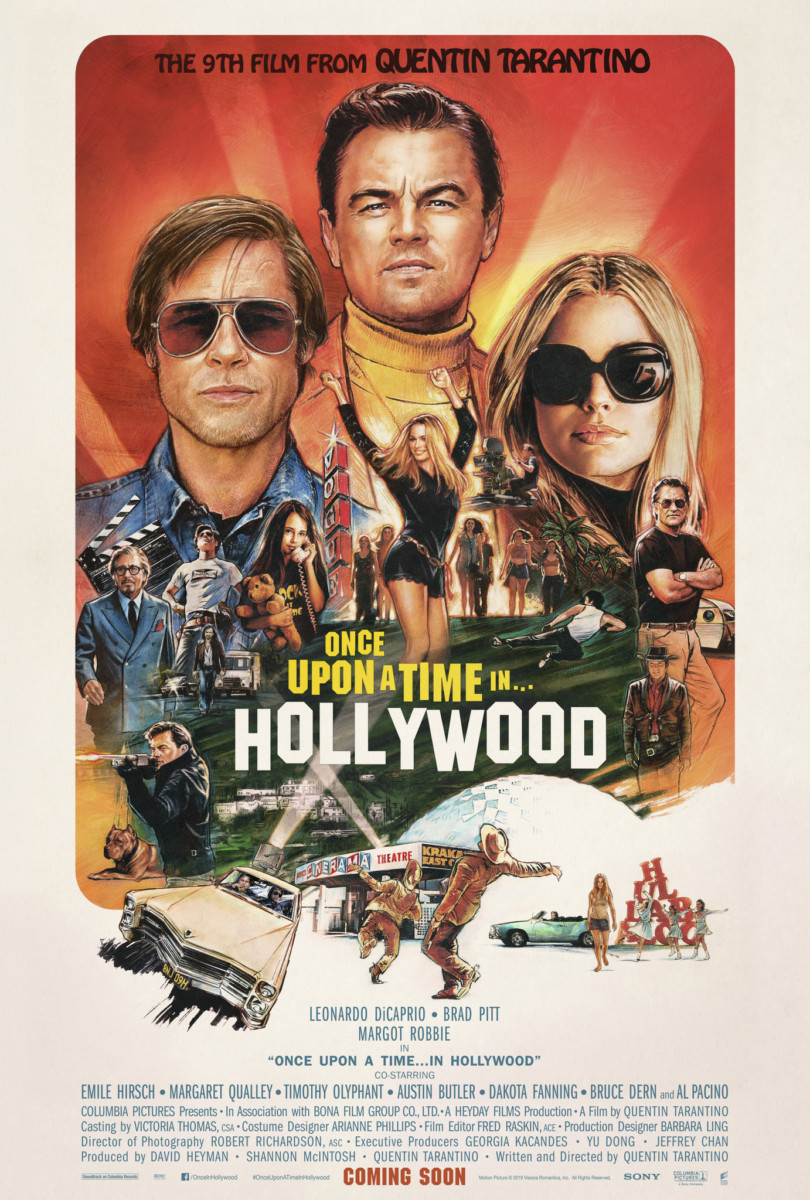
Once Upon a Time In Hollywood (2019)

Brad Pitt and Leonardo DiCaprio have fun in Tarantino’s appalling Once Upon a Time in Hollywood

Director: Quentin Tarantino

Cast: Leonardo DiCaprio (Rick Dalton), Brad Pitt (Cliff Booth), Margot Robbie (Sharon Tate), Al Pacino (Marvin Schwarz), Emile Hirsch (Jay Sebring), Margaret Quailey (Pussycat), Timothy Olyphant (James Stacy), Julia Butters (Trudi Fraser), Austin Butler (“Tex” Watson), Dakota Fanning (Squeaky), Bruce Dern (George Spahn), Mike Moh (Bruce Lee), Luke Perry (Wayne Maunder), Damian Lewis (Steve McQueen), Brenda Vaccaro (Mary Alice Schwarz), Nicholas Hammond (Sam Wanamaker)

Spoilers: I’ll discuss the film’s final 40 minutes in detail. I mean when you watch it you can guess where it’s going. But those final moments are truly central to my visceral hatred of this film.

There seems to be three eras of Tarantino movies. The first (Reservoir Dogs, Pulp Fiction and Jackie Brown) saw him work with pulpy themes focused on strong stories and character development. The second (Kill Bill and Grindhouse) saw him indulge his fascination with the B-movie and low-rent TV of his childhood. His third (Inglorious Basterds, Django Unchained) sees him making strange revenge fantasies on behalf of other groups. Once Upon a Time is a marriage between his second and third eras. And I hated it. I hated, hated, hated, hated it. I genuinely can’t remember seeing a film I hated more at the cinema (maybe Transformers: Revenge of the Fallen). It’s a self-indulgent, tasteless, overlong, smug, unbearable pile of pleased with itself shit. It’s grotesque and it left me feeling dirty.

The plot (such as it is) follows three days in the lives of fictional Hollywood-turned-TV actor Rick Dalton (Leonardo DiCaprio) and his stunt double Cliff Booth (Brad Pitt), Dalton’s best friend, chauffeur and personal assistant who can’t get a job in Hollywood due to his terrible reputation. Dalton lives next door to Roman Polanski and his wife Sharon Tate (Margot Robbie). On Feb 8th 1969, Dalton is offered a role in spaghetti westerns and preps for his next episodic TV show. On Feb 9thDalton shoots the pilot of Lancer a new TV western (and a real TV show) as the baddie, suffering a crisis of confidence about his career and talent. Meanwhile Booth does some odd jobs and has an odd encounter with the Manson family. Intercut with this are scenes of Sharon Tate going about her everyday life, including joyfully watching one of her films in the cinema. Finally we join the action after a time jump on August 8thas, after returning from filming in Italy, Dalton and Booth get drunk and high and accidentally waylay the Manson gang on their way to Sharon Tate’s house and – this being now Tarantino’s thing – brutally and bloodily murder the three Manson family killers.

Sigh. I think a question now has to be asked about what Tarantino’s problem is. As I realised where this film was going, my heart sank. This sort of revenge porn is, I’ll be honest, revolting, demeaning, tasteless and, leaving all else aside, not Tarantino’s place. It also demeans and cheapens the actual tragedies that happened to real people. Just as shots of Hitler’s head being machine-gunned to pieces in Inglorious Basterds while Jewish-American paratroopers machine-gunned a room of Nazi’s seemed to be grossly inappropriate, lowered the victims to the level of the killers and cheapened the actual deaths of real people in the Holocaust, making them seem like weak victims (as well as hardly being Tarantino’s place being neither Jewish or having any connection to the Holocaust) so it’s equally tasteless here. He just about gets away with it in Django Unchained, a black revenge thriller from a director who is not black and has littered his scripts with the “n-word” as all these guys were at least fictional people. But here it’s just grotesque.

We pride ourselves now that we have left the Gladiatorial ring behind, or that we no longer gather round on a Bank Holiday weekend to watch a convicted criminal being hung, drawn and quartered. But as I watched the Manson killers being bludgeoned to death, mutilated by a dog, their Glasgow kissed skulls crushed against a mantelpiece and immolated by flame thrower, I thought we’re not that far off. It’s basically a pornographic level of violence, that the film excuses because the Manson killers were bad guys (don’t get me wrong they were) but asking us to take pleasure in killing, is basically what Manson himself asked his followers to do. I find watching this sort of stuff not only feels like it cheapens the actual brutal, tragic murders of an eight-month pregnant Tate and her three friends, but also lowers me the level of the killers themselves. Tarantino’s films increasingly feel like the director himself would be fully on board with that episode of Black Mirror (“White Bear”) – where a killer is tortured everyday by tourists, and then has her mind wiped so she can go through it every single day – being turned into a reality.

In fact Once Upon a Time in Hollywood is a worrying voyage into the man’s soul, and what I saw there was partly this muddled vanity and obsession with revenge (I mean who gives him the right to take revenge on behalf of others? Someone please tell me? There is an arrogance to that I find deeply unattractive), partly the tragically boring geeky tedium of the video-store nerd, mixed with a loving regard for white men and a worrying lack of interest (bordering on contempt) for anyone different.

I loathed and despised the final forty minutes of this film, but to be honest the opening two hours are not a lot better. This film is almost three hours long and contains about thirty minutes of plot if that. What it mostly is, is a chance for Tarantino to indulge to a ludicrous degree his obsession with low-rent culture of the 1950s and 1960s. To show off his knowledge of obscure films of the age (he’s heard of The Night They Raided Minsky’s you know…) and recreate in painstaking detail pastiches of the type of TV shows he grew up watching. These sequences seem to go on forever and ever, with the odd good line and decent gag not suddenly making it anything other than increasingly tedious.

What he really, really, really needs is a collaborator to tell him when less is more and certainly when too much is too much. The first two thirds of the film seem to stretch on for an indulgent eternity, and their content reveals more and more of the director’s obsession. White men are idealised and the old-school values of Hollywood, the world of the studio and simpler non-PC times are looked back on with a fussy nostalgia. The film takes every opportunity for Booth and Dalton to lambast hippie culture and the growing anti-establishment of the era, and has every character we meant to like yearning for the good old days.

Bruce Lee appears in the film, here interpreted as a braggart arsehole, showing off to the stunt men, who is humiliated by Cliff in a brawl. It’s a scene that amuses for a second and then makes you uncomfortably realise you are watching the most prominent non-white person in the film being put into his place by a middle-aged white man. It’s got more than a hint of racism to it. And Tarantino claims to be a fan of Bruce Lee! By contrast, while the film brutally murders the Manson killers, James Stacy (played by Timothy Olyphant here) the chiselled white-male star of Lancer, a man later jailed for repeated child molestation, is treated with a laudatory romance. Guess there are different rules for white guys who starred in Tarantino’s favourite shows. Whither the revenge saga where his victims mutilate him eh?

Women don’t get a better deal in this film. Sharon Tate is essentially an elevated extra, although Tarantino gets one lovely sequence out of her watching her latest film – a playful swinging 60s spy caper with Dean Martin – in a cinema and gleefully enjoying both the film and the audience reaction with a childish, delighted grin. But then a lot of the success of this is due to Robbie’s marvellous performance. Tarantino himself does his best to ruin it with his foot fetish, throwing Margot Robbie’s naked feet into virtually every shot. Aside from this, the film shoots and treats Tate like a teenager observing someone they have a crush on, romantically idealising her without ever getting anyway near understanding her or scratching the surface of her personality, instead following her with doe-eyed devotion.

But at least she gets lines. Every other woman in this is either a slut or murderer (or both) from the Manson cult, a shrew (like Booth’s dead wife and Kurt Russell’s stunt manager’s wife) or a bimbo (like Dalton’s eventual Euro-wife). There is no in between. It’s a film for men, written by a man, where the men take centre-stage, and a smugly held up as never doing anything wrong, with the film uncritically indulging their vices as symptoms of their tragedy of being left behind by a more progressive and changing country.

Both Pitt and DiCaprio enjoy swaggering twists on their images. DiCaprio overacts wildly, in an overly mannered performance full of actorly quirks (he has a stammer so we know he’s a sensitive soul deep down!), that riffs on other performances of his and largely involves shouting and swearing. Even scenes of emotional vulnerability carry a method fakeness about them – but then Once Upon a Time is a film with no heart, so it’s not surprising that when one of its characters tries to show one, the film stumbles spectacularly into artificiality. Pitt fares better, with a performance of McQueen like-cool, even if the film seems to believe that even if Cliff did kill his wife (as many believe) it’s fine because she was clearly a bitch.

All of this is shot with a flatness and lack of visual interest that is surprising for Tarantino, usually a much more vibrant director. Maybe he was just echoing the TV styles at the time. Maybe he was saving the fireworks for his orgy of (what he would call) cathartic violence at the end. Maybe it’s just a pretty mundane film. Maybe if Tarantino wasn’t the film-buffs darling, more people would call out his flatness and lack of imagination behind the camera and the soulless flatness of much of the films shooting and pacing. Its mediocrity and smug wallowing in the culture of yesteryear is appalling.

Because Once Upon a Time is a teenager’s film, and worst of all, a teenage bore. It’s got a major crush on Sharon Tate, but barely any interest in her personality. It drones on endlessly about geeky knowledge and old film and television that no one else knows anything about so that it sounds interesting and cool. It takes a childish, immature, sickening delight in fantasising about killing bad people in the most horrific ways it can possible imagine. It thinks it’s really clever and profound, but it’s actually a horrible, horrible film that’s also really tedious and which leaves a deeply unpleasant taste in the mouth, while demeaning the real-life victims of a crime by spinning some ludicrous revenge fantasy around them. It morally offended me after two hours of boring me. I hated it. I hated it. I really, really, really, really hated it. I hated it so very much.

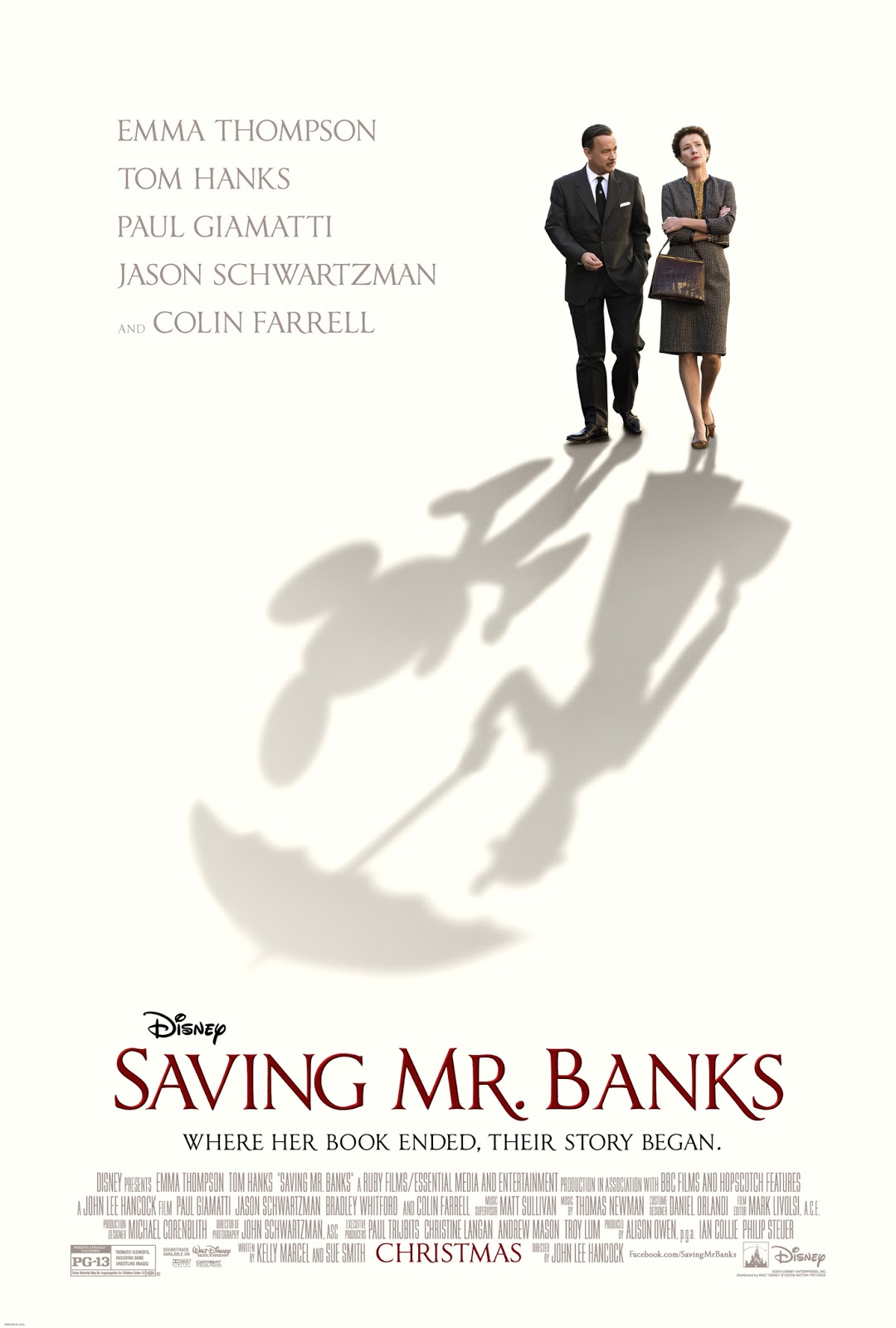
Saving Mr Banks (2013)

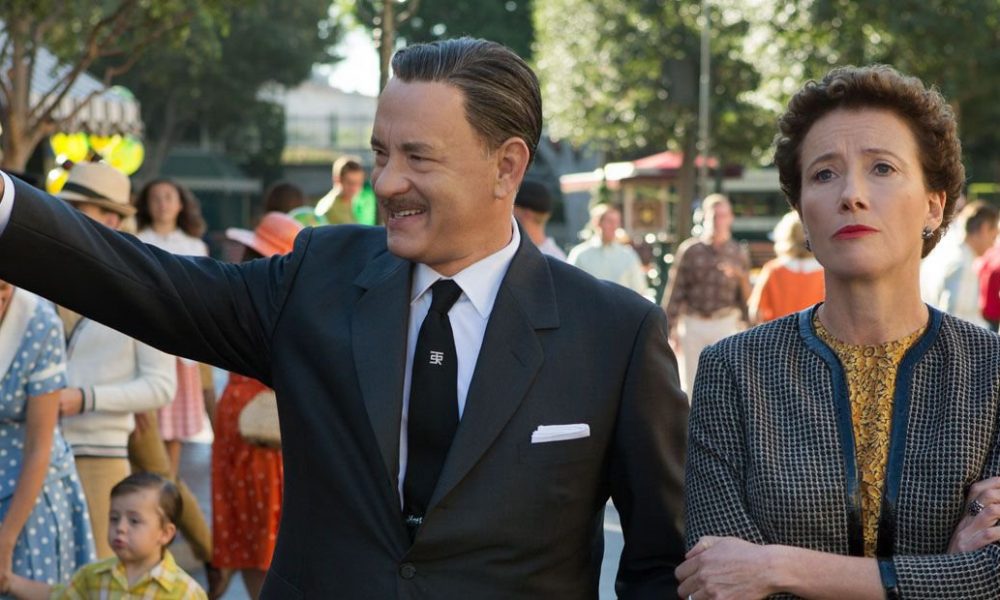
Tom Hanks and Emma Thompson clash on the making of Mary Poppins in Saving Mr Banks

Director: John Lee Hancock

Cast: Emma Thompson (Pamela Travers), Tom Hanks (Walt Disney), Colin Farrell (Travers Robert Goff), Ruth Wilson (Margaret Goff), Paul Giamatti (Ralph), Bradley Whitford (Don DaGradi), Jason Schwartzman (Richard M Sherman), BJ Novak (Robert B Sherman), Kathy Baker (Tommie), Melanie Paxson (Dolly), Rachel Griffiths (Ellie), Ronan Vibert (Diarmuid Russell)

Walt Disney was a man used to getting what he wanted. And what he wanted more than anything was the rights to PL Travers’ Mary Poppins series. It was his kids favourite books, and he had promised them he would make the movie. It took decades – and Disney had to wait until Travers needed the money – but finally a deal was struck, with Travers having full script approval. So the hyper-English Travers is flown across the Atlantic to Los Angeles where she reacts with a brittle horror to every single suggestion from the Mary Poppins creative team, and distaste at the commercialisation of Disney’s enterprise. Based on the actual recordings (which Travers insisted on) from the script meetings, Emma Thompson is the imperious PL Travers and Tom Hanks the avuncular Walt Disney.

John Lee Hancock’s film is a solid crowd pleaser that, if it feels like it hardly delivers a completely true picture of the making of Mary Poppins, does put together an entertaining and interesting idea of the difficult process of creation and the tensions when writers (who don’t want to change a thing!) clash with film production companies. These problems being made worse by the clashing worlds of the loose, casualness and breezy friendliness of Los Angeles, and the intensely cold, buttoned-up Edwardianism of Travers, hostile to all shows of affection and any touches of sentimentality.

The film gets more than a lot of comic mileage out of these mixed worlds, with Travers’ every look of aghast, repressed, British reserve (“Poor AA Milne” she mutters while manhandingly a stuffed Winnie-the-Pooh toy out of her way, followed by “You can stay there until you learn the art of subtlety” as she dumps a massive Mickey Mouse cuddily toy against the wall of her bedroom) bound to raise sniggers at both her blunt hostility and cut-glass wit. Against this the American characters – all of them forced to dance to her tune – meet wave after wave of hostility with a practised American friendliness and warmth. It works a treat.

The film walks a fine line with its portrayal of Disney who is both a charming uncle figure and also a savvy and even ruthless businessman. Tom Hanks is spot-on with showing both sides of this man, making it clear how he managed to make so much damn money but also from how he managed to inspire such loyalty from many of his staff. Yes the film soft-peddles on many of Disney’s negatives – from refusing to show a single second of Disney smoking, to no mention of his active union-busting activities – but this is a film focused on Disney the impresario and negotiator. 

And what a person to negotiate with! That the film works is almost exclusively down to Emma Thompson’s imperious performance in the lead role. Thompson has a very difficult job here of turning someone so consistently rude, aggressive, arrogant and unpleasant as Travers (and over half of the film goes by before she says something nice to anyone) into a character we genuinely invest in, care about and laugh with as much as gasp at her rudeness. It’s a real trick from Thompson, adding a great deal if inner pain and vulnerability just below the surface, but only allowing a few beats of letting these feelings out for all the world to see. It makes for a performance that is superbly funny, hugely rude but also someone we end up caring about.

A lot of that spins from the careful recreation of Travers’ past in flashback, particularly her relationship with her father, Travers Goff (played with charm by Colin Farrell), an alcoholic bank manager in Australia when Travers was a child, who lived a life of irresponsibility mixed with bursts of playful, imaginative games with his daughter. It’s the realisation, by the elderly Travers, that her father was feckless and irresponsible that motivates her writing of Mary Poppins, the super-Nanny who flies in and saves not just the whole family, but specifically the father. Equally good in these sequences is Ruth Wilson as the despairing Mrs Goff.

It adds a sadness to the backstory of Travers – and an understanding of why she behaves the way she does – and the film also brings it round to a neat mutual meeting ground between her and Disney, who himself had problems with a father who drove him hard to achieve. It also explains Travers’ growing warmth to her chauffer, played by Paul Giamatti as a loving dad, the one person she demonstrates some affection to within the film.

It’s a film that wants to have its cake and eat it though, and it can’t resist adding a “happy ending” to the story of Travers finally accepting (even if she denies it) that she enjoys the Mary Poppins film and is moved by the saving of Mr Banks that it contains. In reality of course, Travers hated the film (though claimed some of it was passable) and refused Disney all permission to ever make any sequel. But that hardly matters here, to this fairy tale of saved souls which wants to see Travers saved – even if the truth was far more complex.

Trumbo (2015)

Bryan Cranston is the put-upon idealist Trumbo under the scornful eye of Helen Mirren

Director: Jay Roach

Cast: Bryan Cranston (Dalton Trumbo), Diane Lane (Cleo Trumbo), Helen Mirren (Hedda Hopper), Louis CK (Arlen Hird), Elle Fanning (Nikola Trumbo), John Goodman (Frank King), Michael Stuhlbarg (Edward G Robinson), Alan Tudyk (Ian McLellan Hunter), Adewale Akinnuoye-Agbaje (Virgil Brooks), Dean O’Gorman (Kirk Douglas), Stephen Root (Hymie King), Roger Bart (Buddy Ross), David James Elliott (John Wayne), Christian Berkel (Otto Preminger)

Hollywood loves to make movies about itself. It particularly loves to make movies where Hollywood is seen to be working on a higher moral plane. Trumbo is a film about the Hollywood Ten – the ten major screenwriters, directors and actors in Hollywood whom the industry blacklisted in the 1940s because of their sympathy for communism. Their leading light was Dalton Trumbo (Bryan Cranston), a rich screenwriter who finds himself imprisoned and unemployable. Trumbo encourages the writers to group together and write under pseudonyms for cheap film studios – although the right-wing in Hollywood continues to persecute them. Trumbo cannot reveal his identity as a writer – even after winning two Oscars – until 1960 when Kirk Douglas gives him a credit for Spartacus.

Trumbo is a very earnest, straightforward and rather bland re-tread of a key moment in Hollywood. It’s made with very little imagination, and remixes the world of 1940s politics into something that bears more resemblance to the political situation now than it does to the time. That’s not to defend the House Committee on Un American Activities (HUAC), the Congress Committee that led the campaign against communist subversion in Hollywood. Their persecution of communists flew in the face of American ideals of free speech, and their ruin of the lives of innumerable actors, writers and directors not found to be ideological pure is appalling.

But this is a film that simplifies its politics into a world of good and bad. It also works hard to try and whitewash Hollywood. Watch this film and you would believe it was Congress that had worked overtime in order to ban certain Hollywood creatives from working. Not so: the black list was put forward by the movie studios themselves and endorsed by the various guilds. Famous actors and directors, such as Humphrey Bogart and John Huston, furiously dropped their support for the Hollywood Ten after feeling they had been deceived by the Ten about their Communist associations. The film mentions none of this of course, running with a Hollywood-vs-Congress story line and crowbarring in people like McCarthy and Nixon who had very little to do with HUAC.

The main Hollywood figures campaigning against the Black List are either faceless Motion Picture Alliance for the Preservation of American Ideals types, or lip-smacking, practically mustachio-twirling gossip columnist Hedda Hopper (played with ludicrous OTT camp wickedness by Helen Mirren). John Wayne is the only recognisable Hollywood “legend” shown on the side of these guys – and, while he does get mocked for his non-war-record early on by Trumbo, he is quickly shown to be a moderate pushing for forgiveness for those who repent (and is noticeably absent from the villainy of the organisation later in the film) – Hollywood doesn’t want to be too harsh on one of its own.

Roach’s political simplicity also affects the actors who found themselves in an impossible position. As Michael Stuhlbarg’s Edward G Robinson points out, writers can work under a pseudonym, actors can’t. I was reminded of when Elia Kazan won an honorary Oscar and several famous Hollywood actors refused to applaud him, as Kazan had “named names” (or rather confirmed names HUAC already knew) when pulled before the committee. Robinson here is rammed into the same position, denounced as a snitch and a traitor for confirming the names of the Hollywood Ten when many of them are already in prison. As at the Oscars, I’m not sure it’s our place to judge. It’s cosy to assume “I would have told them no” but who can say if we would have or not? And can we really judge those who decided they didn’t want to go to the wall for a communist cause they didn’t believe in (as Kazan and Robinson didn’t, being more left-wing sympathisers than Stalinists like Trumbo)?

It’s another part of the film’s simplicity that Communism is not of course interrogated any further. Watch this film and the political views of Trumbo and his colleagues come across as nothing more than a more idealistic version of Obama-ism. In reality, Trumbo was a Stalinist who pushed for non-intervention in World War II until Russia was attacked by Hitler. This is not mentioned or explored in the film at all. In fact, the complexity of these idealists climbing into bed with a regime soaked red with blood that was suppressing freedom across large chunks of the globe isn’t even raised. Roach wants to tell a story about good-old-fashioned-Hollywood-democrats being persecuted by nasty right-wingers.

Away from the film’s simplicity it’s nothing special. Roach does competent work and there is the odd good scene. Trumbo himself is basically a rather selfish arsehole, who judges everyone around him and frequently ignores his put-upon family. Cranston does a decent job as Trumbo – but you can’t help but feel his generous Oscar nomination was in part a recognition for his work on Breaking Bad. Dean O’Gorman and Christian Berkel get some of the best scenes as Kirk Douglas and Otto Preminger working with Trumbo on Spartacus and Exodus. Bizarrely, the film totally avoids diving into the themes of Spartacus– or exploring what Trumbo was thinking about when he wrote “I’m Spartacus”, that paen to unity from the pen of a man abandoned by everyone, surely a hugely personal line not in the original source material – and instead skirts only on the surface, ticking off events. It kinda sums the film up: a solid enough to watch, but basically forgettable, that never engages with the inner lives of the men it claims to understand.

Singin' in the Rain (1952)

Singin' in the Rain (1952)

The most beloved of all musicals gives you a burst of pure enjoyment no matter when it plays

Director: Stanley Donen, Gene Kelly

Cast: Gene Kelly (Don Lockwood), Debbie Reynolds (Kathy Selden), Donald O’Connor (Cosmo Brown), Jean Hagen (Lina Lamont), Millard Mitchell (RF Simpson), Cyd Charisse (Woman in the green dress), Douglas Fawley (Roscoe Dexter), Rita Moreno (Zelda Zanders)

Is there a more loved musical than Singin’ in the Rain? Is there a more famous musical from Hollywood’s golden age? That second point is particularly interesting, as this was possibly the last of the big Hollywood song-and-dance films – most of the rest that followed were film versions of Broadway hits. Singin’ in the Rain also has that “late discovery” quality: inexplicably not nominated for Best Picture (or hardly any other Oscars), it was for many years considered a second tier musical behind works like An American in Paris. Now it stands tall over the lot of them.

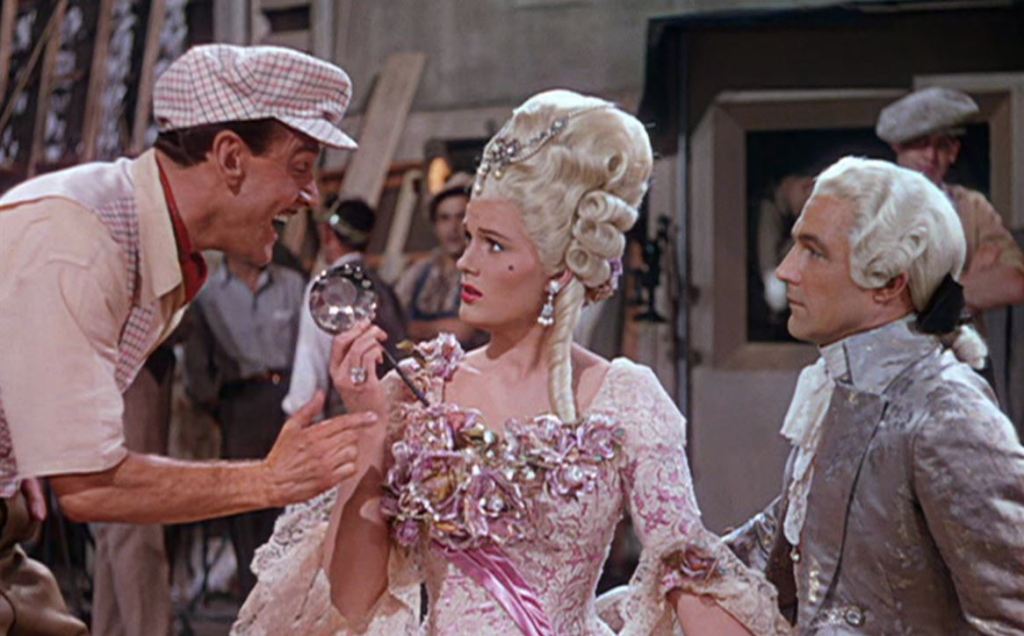
Singin’ is a film assembled from a collection of songs MGM held the rights to. The songs were given to Kelly, Donen and the screenwriters with the instruction to “come up with a movie”. What they came up with was this delightful film-about-films. Don Lockwood (Gene Kelly) and Lina Lamont (Jean Hagen) are the biggest stars of the silent screen in Hollywood, whose careers are in trouble overnight when sound is introduced. He can’t really act and she has a voice like nails on a blackboard. But Lockwood can sing and dance – so why not make their latest film a musical? Especially since the talented Kathy Selden (Debbie Reynolds), who Lockwood has fallen in love with, can sing and act and can dub Lina’s voice. What could go wrong?

There are few more purely enjoyable films than Singin’ in the Rain. Nearly every scene has a moment designed to make you burst out in a smile, be it a cracking line of dialogue, a piece of prodigious dancing skill or the simple warmth and joy of the leading actors. Every second something delightful seems to happen. The entire film is an explosion of gleeful joy in the sheer exuberance of singing and dancing. Kelly’s choreography brilliantly uses everyday props and pieces of furniture to give the numbers an exciting everyday charm. It gives the songs an immediate “gotta dance” energy. How could you not like it?

Threading these songs around a structure of Hollywood taking on sound for the first time was a brilliant idea. The recreation of the acting styles and technology of Hollywood is brilliant. Lockwood is a hopelessly stagy actor, hideously artificial in his gestures, while poor old Lina Lamont is horrendously wooden with an awful voice, and a complete lack of any talent. Jean Hagen as Lina Lamont is in many ways the butt – but she’s so demanding, bullying and selfish we don’t mind that most of the jokes are on her.

The shift towards sound in Hollywood is actually interesting as well as hilarious. Where do we place the mikes? How should the actors get used to speaking into a mike? How do we cancel out the background sound? What do we do with loud props? One of the highlights is the screening of this film-within-a-film to an audience for the first time. All the terribleness Lockwood and Lamont gets revealed. In a particularly genius moment, the sound of the picture gets out sync with the picture, with the voices seeming to come out of the young actors’ mouths to hilarious effect.

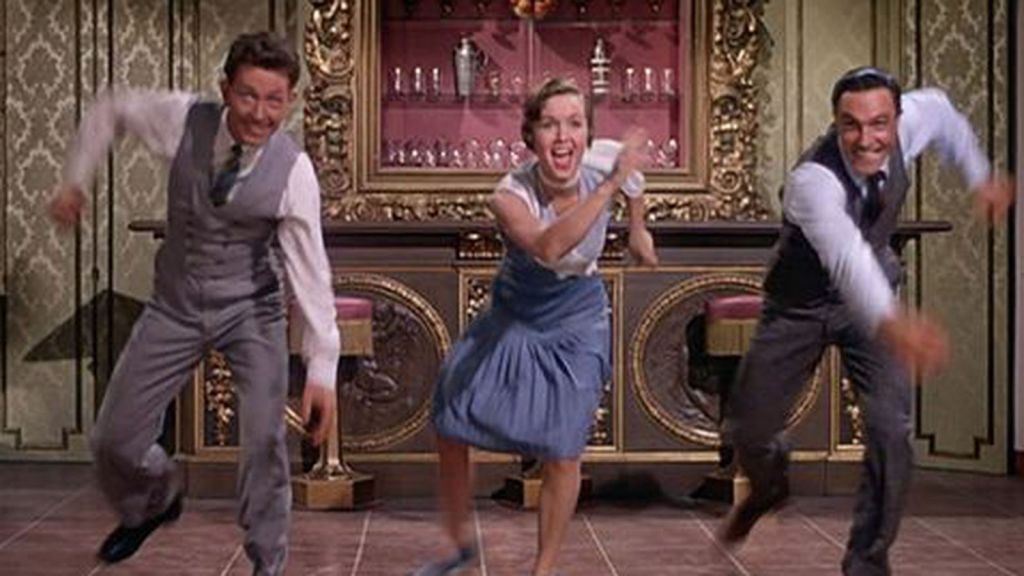
Alongside this we get some of the finest song-and-dance routines in the history of the movies. Donald O’Connor is electric as Cosmo and his dance routine for “Make ‘em Laugh” is an astounding early pace-setter in the film: how does he do what he does here? O’Connor goes bouncing off walls, swirling in circles on the floor, springing from place to place without a single pause for breath. Most of this number (like many of the others) is done in one take with electric pace. And that’s the film just warming up.

Debbie Reynolds famously described doing Singin’ as being (along with childbirth) one of the hardest things she’d ever done in her life. You can see that in ‘Good Morning’, another electric three-way number with herself, Kelly and O’Connor – she is pounding the floor to keep up with these two masters (and does a brilliant job). She was pushed to the extremes by Kelly who privately considered her a not quite strong enough dancer. Kelly dropped her from Broadway Ballet Medley, a complex ballet-heavy (as per all Kelly films from On the Town onwards – a sequence that I must confess I find a little dull). She’s still excellent – charming, sprightly, light, glorious fun – but it did mean Kelly re-worked the main number to showcase just himself.

Ah yes. ‘Singin’ in the Rain’. This sequence of the film is probably wedged in everyone’s mind. Even if they’ve never seen the film, people are familiar with Gene Kelly, soaked to the skin, dancing through puddles and swinging around lampposts. Kelly is of course marvellous in this sequence (hard to believe he was apparently suffering from the flu at the time) and the number has complete charm to it – that carefree vibrancy of realising you are falling in love. Especially as Lockwood’s ego is finally being put to one side in order to celebrate feelings he’s having for another person. But the whole scene is just sheer cinematic magic. And for something so famous, you never get tired of it. 

But then Kelly has pure star-quality here. Lockwood is a charming, handsome and smooth film star – but the film is happy to puncture his pomposity, or demonstrate in its opening sequence the self-aggrandising version of his early career (“Always dignity!”) with the reality of faintly embarrassing and dignity-free stage and stuntman work. Kelly is so charming you don’t mind that the film gives him an easy ride, considering Lockwood is actually quite selfish.

Singin’ in the Rain is pretty close to perfect. Even though I find some of the ballet stuff a little boring myself, it’s still filmed and shot with skill. It’s a pet discussion between film experts to ask how much of the film was directed by Kelly and how much of it was done by Donen. I guess it doesn’t really matter except to cinephiles, as the film is just beautifully directed: light, frothy, fun and with real technical expertise – the slow crane shot at the end of the famous number is justly famous. The pace is spot on, and the film is hilarious. Its understanding of filmmaking really pays off in the sequences that chronicle early film making.

So why did this film not get recognised at the time? Well to be honest, there were probably too many movies like this out at the time. It was a lot easier to miss in the crush of mega-MGM movies. It followed on the coat-tails of An American in Paris which had worn a huge number of Oscars (and was pushed back into cinemas in place of Singin’ in the Rain). Singin’ was still a big hit – but it perhaps needed film-fans to embrace it because it so perfectly married a love of Hollywood with the technicolour delight of 1950s musicals. Either way, Singin’ in the Rain is a delightful masterpiece which is guaranteed to pop a smile on your face. No matter the weather.

Hugo (2011)


Martin Scorsese’s Hugo: a kids film in name only

Director: Martin Scorsese

Cast: Asa Butterfield (Hugo Cabret), Chloë Grace Moretz (Isabelle), Ben Kingsley (Papa Georges), Sacha Baron Cohen (Inspector Gustave Dasté), Ray Winstone (Claude Cabret), Emily Mortimer (Lisette), Jude Law (Mr Cabret), Helen McCrory (Mama Jeanne), Michael Stuhlbarg (René Tabard), Christopher Lee (Monsieur Labisse), Frances de la Tour (Madame Emilie), Richard Griffiths (Monsieur Frick)

Martin Scorsese isn’t exactly the first name you think of when your mind turns to directors of children’s films. So perhaps it makes sense that, in Hugo, he directed a children’s film aimed at virtually anyone except children. A huge box-office flop, Hugo was garlanded with awards and critics’ acclaim – but I’d be amazed if you find any child with a DVD of it. It’s a film made by a passionate lover of cinema, aimed at lovers of cinema, which just happens to have a child at the centre of it. 

Hugo Cabret (Asa Butterfield) is an orphan, living in the Paris train station fixing the clocks, and attempting to fix a curious automaton which his late father (Jude Law) had taken from the Paris museum to repair. After being caught by Monsieur Georges (Ben Kingsley) stealing parts from his toy shop in the station, Hugo must earn back his confiscated notebook on the workings of the automaton. Hugo starts a friendship with Georges’ god-daughter Isabelle (Chloë Grace Moretz), and together they begin to investigate the mysterious past of Papa Georges – and his connection with the early days of cinema.

Any understanding of what makes a good film for children is missing here. It’s not exciting, it’s not engrossing, it’s not particularly fun, it doesn’t place the child (really) at the heart, and most importantly it doesn’t have a story children can relate to. The characters spend a lot of time talking about the glorious adventure they’re on – but none of the excitement translates to the screen. Instead the action creeps forward uncertainly, with the motivations of Hugo himself unclear. There are half hearted attempts to aim at a universal fear children can relate to – losing your parents and searching for new ones – but the film doesn’t run with it. 

Its real interest is the power of the movies. So Hugo’s story gets lost halfway through the film, as Scorsese focuses in on the redemption of famed cinema auteur and pioneer Georges Méliès. The children’s adventure is nothing more than visiting a library to find out who Méliès was – after that, they are effectively superfluous to the story. Details about Hugo’s relationship with his father, or with his distant uncle, are completely dropped – and the automaton that seemed like it held the key to Hugo’s purpose, becomes a MacGuffin. It’s a film about a giant of cinema, made by a giant of cinema.

So let’s put aside the marketing of this film as children’s film. The only element of the film that feels remotely like it is part of some sort of kids’ flick is Sacha Baron Cohen’s slapstick, funny-accented railway inspector – and as such Cohen’s hammy mugging sticks out like a tiresome sore thumb. The rest of the film is what you would expect from a cinema enthusiast making a film about the movies – a glorious, loving recreation of old silent movies and the methods of making them, shot and told with a sprinkling of movie magic. 

The film looks wonderful. The cinematography is gorgeous, the production design astounding. It’s beautifully made and has a light and enchanting score. Scorsese goes all out to homage the shots and set-ups of old silent movies. In fact the film only really comes to life in its second half, where flashbacks show the methods Méliès used to make his films. The recreation of scenes from these old classics is brilliantly done – and Scorsese’s designers delight in filling the screen with the sort of colour that you couldn’t find in the original. The photography also goes out of its way to give these scenes the sort of colour tinted look that the hand-painted prints of old movies had. Even the editing is designed as much as possible to replicate these old films.

Truly, these sequences are delightful – and Scorsese’s joy in making them is evident in the camerawork, and the emotional force he gives to Méliès’ story (helped as well by Ben Kingsley’s sensitive underplaying as the depressed genius). It’s just a shame that he couldn’t get as engaged with the first part of the film. Hugo’s story is largely dramatically inert – in fact the whole plotline around Hugo feels like a hook on which to hang the second half of the film. As if Scorsese couldn’t make the second part of the film without making the first. 

That’s why this film doesn’t work for children, but works better for film-loving adults. The ins and outs of Hugo’s early story just aren’t that interesting – and we aren’t given any real reason to relate to Hugo or to feel any empathy for his journey (whatever that might be). In fact the film stretches this plot line long past any actual content – already I’m struggling to remember exactly what happened in the first hour of the film. This is no comment on the performances of Butterfield or Moritz, who are both very good (even if Moritz is saddled with sub-Hermione Grainger character traits). While it always looks great, it never really finds the heart to get us engaged with Hugo.

So Hugo is a film for cinema-fanatics. Scorsese directs with great invention – but it’s all too clear where his heart is: and that’s why the film failed so spectacularly as a kids’ film. Compare this to Toy Story 3say, and it’s clear which one most children are going to want to watch. However, if you want to see Scorsese make a charming film about his passions, one that is overlong but looks gorgeous, that playfully recreates the silent cinema era, even while its narrative is basically pretty dramatically inert, you’ll love it. There are moments in this film to treasure – it’s just not really for kids. Just because Scorsese made a film without someone’s head in a vice or zipped into a bodybag, doesn’t suddenly mean he’s going to find a new audience.

Youth (2015)


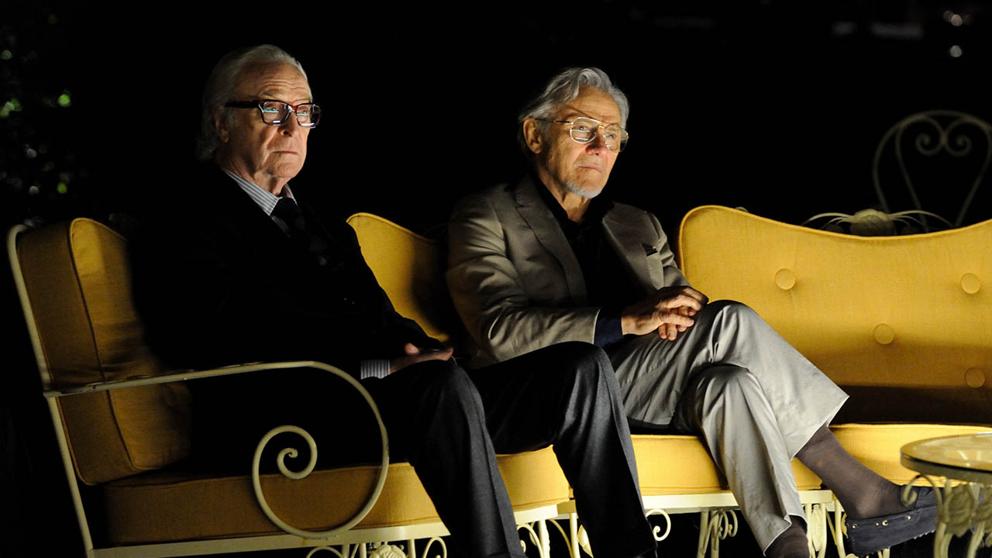
Michael Caine and Harvey Keitel try to embrace their past in Paolo Sorrentino’s mesmeric Youth

Director: Paolo Sorrentino

Cast: Michael Caine (Fred Ballinger), Harvey Keitel (Mick Boyle), Rachel Weisz (Lena Ballinger), Paul Dano (Jimmy Tree), Jane Fonda (Brenda Morel), Roly Serrano (Argentinian Footballer), Alex MacQueen (Queen’s emissary), Robert Seethaler (Luca Moroder), Ed Stoppard (Julian Boyle), Paloma Faith (Herself), Tom Lipinski, Chloe Pirrie, Alex Beckett, Nate Dern, Mark Gessner (Screenwriters)

Well this is something different. Youth is a hard to categorise film from Paolo Sorrentino. Sorrentino often seems the definition of (admittedly beautifully filmed) style over substance. But he’s also able to suggest great, unseen depth, a hard to define quality. Sometimes these qualities result in an impressive but frustratingly empty work. And sometimes it results in something simply wonderful. Youth falls firmly into the second category. In fact, it fits so firmly into this that I think it might be the most wonderful film Sorrentino has made. Put frankly, I loved this film. I can’t quite put my finger on why somehow, but I loved it.

It’s set in a Swiss retreat, peopled by the rich and famous. There are film stars, Miss Universe, famous pop stars and an overweight former Argentinian footballer (who could be anyone right?). Fred Ballinger (Michael Caine) is a world-famous composer, a man officially in retirement, uninterested in answering entreaties from the Royal Family to perform his famous “Simple Song #3” at Prince Philip’s birthday. He is accompanied by his daughter Lena (Rachel Weisz), who acts as his assistant, and struggles with her father’s difficult personality and her resentment towards him. Fred’s best friend Mick Boyle (Harvey Keitel), a famous director, is also staying at the resort with a gang of screenwriters, preparing his script for what he intends to be his final film (his “testament”).

Youth is a film that conveys great depth and emotional strength, while never falling into any category or offering up clear answers or spoon-fed themes. Instead it explores, in a gentle way, age, disappointment, hope, lost opportunities and warm memories. It’s nominally a film about old people reflecting on their youth, but it’s also full of moments that show these characters still have moments of vibrancy. In a beautiful moment, the footballer (barely able to get himself out of a pool without oxygen) carries out a series of beautifully skilful keepie-uppies with a tennis ball for over a minute, before he wheezes and has to stop. That’s kinda the whole film right there in an image: age and youth all in one go. It’s beautiful. I loved it.

Sorrentino loves the flashy shot, and carefully framed image. This film is full of them, and they work wonderfully well. It’s sprinkled throughout with gorgeous dream sequences and fantasy moments, from Boyle seeing a field full of his leading ladies past, to Lena dreaming of a hilariously overblown music video showing her unfaithful husband (a slimy Ed Stoppard) and Paloma Faith (a very good sport) undulating over a speeding car. We see Fred sitting in a field conducting a semi-imaginary orchestra of cows with bells. Imaginative shots are sprinkled throughout, everyday things seen from new and unique angles. 

And its so emotionally fulfilling, filled with both lump-in-the-throat moments and moments of searing, magical hope and joy. It explores what matters to us as we get old – and how what matters to us in our lives changes as we age. Sometimes these things remain the same, sometimes we move with the times. Sometimes we adjust, and sometimes we don’t. It’s a film where some characters struggle to recall events, others reinterpret their lives as they happen. You could criticise the film for not having a clear central theme, but its theme if anything is life – and life is not easy to categorise. It’s a mountain of different moments and attitudes: and that is what this film likes. It’s messy and hard to predict. And it’s strangely beautiful. 

So Sorrentino crafts a feast of a film here, crammed full of dialogue that should be almost too weighty and overtly “important”, but somehow never comes across like that. It’s partly because it’s delivered with such experienced, lightly worn skill, but also because Sorrentino pulls off the trick of positioning it as profound rather than overbearing. Shot with a gentle, elegiac expressiveness, it’s a film that brilliantly works, that conveys and carries great weight. It’s about the human condition, and it feels real and human at all times.

It also helps that it’s superbly acted. There isn’t a dud performance here – and some give some of the most beautiful work of their career. Michael Caine takes a few minutes to accept as a world famous composer (something about him just doesn’t quite work), but you quickly let it go because he is astonishingly good here. Caine’s Fred carries great reserves of regret and loss, but also many memories of joy. Caine is beautifully expressive – part observer, part driver of the action. He has the wonderful air of being young-old and an old-young-at-heart. He’s playful but also tired. He’s strangely unknowable but at times open. It’s a beautiful performance.

Just as good is Harvey Keitel. The film is full of these two guys – like Stadler and Waldorf – moaning about getting old. But Keitel brings a great tragic depth to Boyle, a great director fallen on hard times, a man whose best days may well be behind him but who refuses to let the light die. He’s both funny and (by the end) incredibly moving. Rachel Weisz is radiant as Lena – a scene where she finally lets years of anger out is wonderful – but another late scene as she quietly weeps with a sort of sad joy is simply superb. She has a gentle romance that builds with real sweetness. She’s impossible to look away from in this, she’s brilliant.

Youth also has moments where it explores the nature of art and its legacy. Ballinger feels he is probably a good-but-not-great composer. Boyle feels there are moments he touched greatness, but is never sure if it’s there or not. Paul Dano plays a great stage actor who is known worldwide for his role as a robot in a Star Wars style smash. What is art? The film doesn’t dare to answer the question, but it does ask what are artists? How do they question themselves? Why do they do what they do? Artists in this film are always watching – even the footballer – they are always looking to become a part of their world or comment on it. 

Sorrentino’s film is marvellous. I really loved it. It’s crammed full of brilliant moments. Even Jane Fonda’s overblown cameo as a film star works (I think just). It’s played with such brilliancy, structured with such light playfulness, that it is able to carry great depth and grace. It’s a film that rewards reviewing – I’m not sure I’ve worked out the implications of the final shot, or what it might mean for how we should interpret Ballinger’s final actions – and I can’t wait to see it again.

Molly's Game (2017)


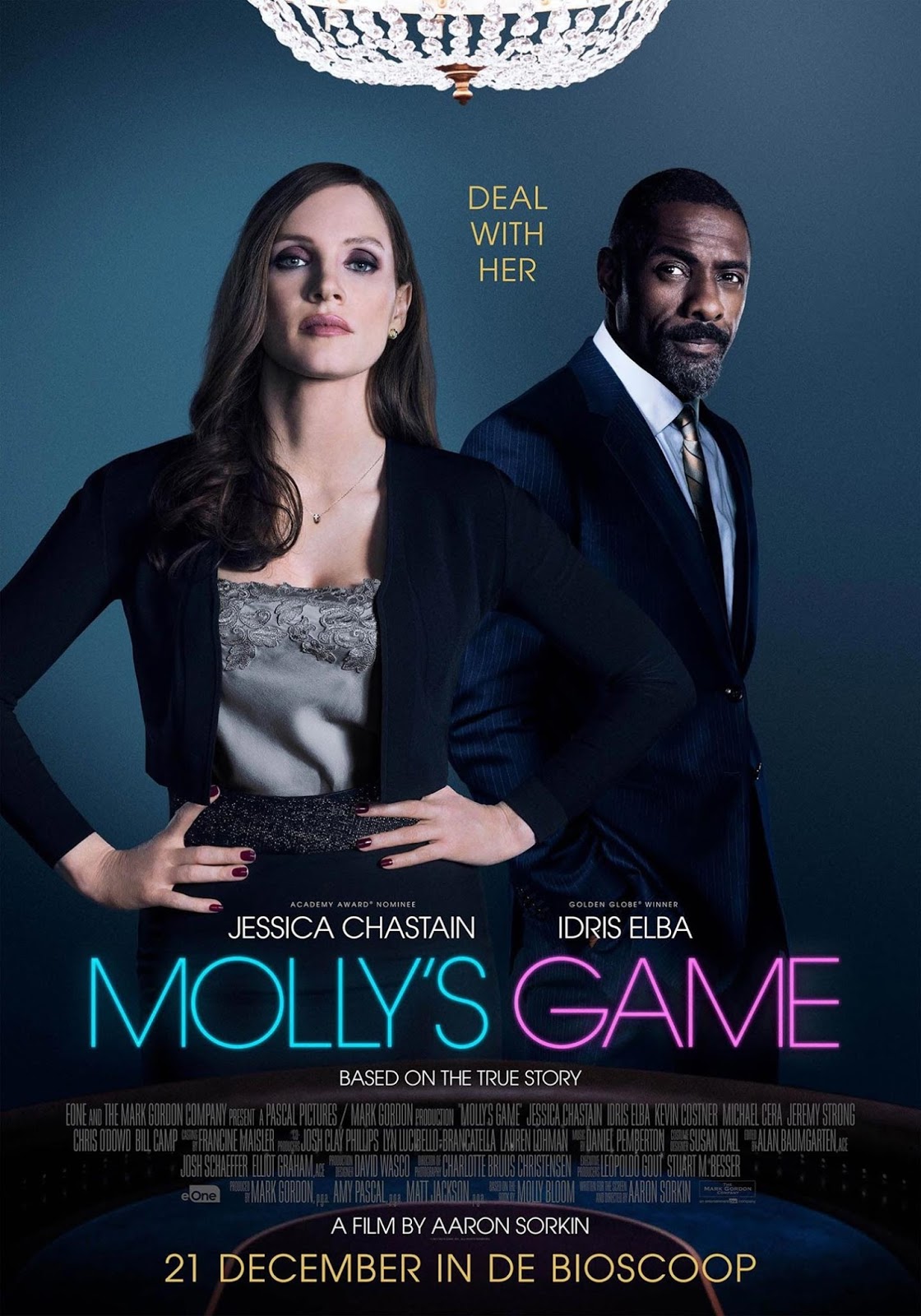
Jessica Chastain and Idris Elba excel in Aaron Sorkin’s dynamically scripted Molly’s Game

Director: Aaron Sorkin

Cast: Jessica Chastain (Molly Bloom), Idris Elba (Charlie Jaffey), Kevin Costner (Larry Bloom), Michael Cera (Player X), Brian d’Arcy James (Brad), Chris O’Dowd (Douglas Downey), JC MacKenzie (Harrison Wellstone), Bill Camp (Harlan Eustace), Graham Greene (Judge Foxman), Jeremy Strong (Dean Keith), Angela Gots (B)

Molly Bloom (Jessica Chastain) is all set to join America’s Winter Olympics team, under the guidance of her ultra-demanding psychiatrist father Larry (Kevin Costner), when a freak accident ends her career. So she heads to LA and becomes embroiled in the world of high-stakes poker, eventually setting up and running her own high stakes games in LA and New York, earning millions. But, over a decade later (in a parallel plotline) she has had a millions seized and is battling against imprisonment for her connections to the mob, with only lawyer Charlie Jaffrey (Idris Elba) on her side.

Sorkin’s zippy new drama has plenty of sparkling dialogue – as you could expect! Sure this film probably also proves he’s not really a director (it’s over-long, a little flabby, and structurally not very clean) but the guy can certainly put a speech together. My main issue with Molly’s Game is I’m just not quite sure what its point is. Maybe it only exists to entertain, but it feels like it wants to put together a touching story about family, faith and the value of your word. I’m not sure it really manages to achieve any of this. 

The parallel plotlines don’t always do the film a lot of favours. The present-day plotline of Molly and Jaffey working to clear her from the various charges she has been accused of, continually hints at some serious gangsterism set-ups later on: largely these never really transpire. Actually, the film heads into pretty standard “my-Daddy-didn’t-love-me” territory. It shy’s away from being something different and interesting about excess and punishment into psychiatry solving our problems.

Sorkin doesn’t always get the structure right, as if he hasn’t got the patience to actually make sure the fundamental plot information was clear enough, so eager was he to get on with the verbal pyrotechnics. Time is spent carefully exploring several poker hands – but the exact nature of the illegality of what Molly does running her poker games gets glossed over in seconds. 

But then this is a film that isn’t really that interested in plot dynamics, or even in over-arching themes. What it’s interested in is sizzling dialogue, and letting actors deliver it. The camera sits back and watches. So it’s not a surprise the most memorable scenes feature Jessica Chastain and Idris Elba (both superb) in a room, talking (or arguing) with each other. It’s the moments like these where the film really works – and Sorkin the director basically stays out of the way, using a two-camera set-up to record the scenes, like a filming of a Broadway play. 

Those two actors dominate the film. Chastain is excellent as Molly – ambitious, driven, playful but also vulnerable and ever-so-slightly bitter, who gets where she is through her own intelligence and hard work. Chastain also embraces playing a character with such a strong moral code – she’s terrifically warm and human in the part. Elba is equally fine, a wry professional with his own strong moral code (yup, The West Wing writer still loves those liberals of great conscience), an articulate (of course!), passionate advocate who is far warmer than he first appears.

The rest of the film never quite lives up to this, maybe because the poker games are never really that interesting, or because the life Molly leads among the rich and famous seems ill-defined (she has possibly the least impactful drugs addiction seen on screen). For someone who remains loyal to the end to her clients, we are never really clear why other than a suggestion of her basic sense of honour. Her projects are all set-up with ease, and the film builds towards a solution buried in psychiatry speak that similarly feels a little too easy.

Because while it is great that Molly is not defined by a romantic relationship – she is defined by men in virtually every other way. Her entire career is based on pleasing rich, middle-aged men (from whom she frequently has to bat away expressions of devotion or sexual interest). Three times she falls victim to senior male partners in business relationships. Above all, she is defined by her relationship with her overbearing father (well-played by a low-key Kevin Costner). The scene where this comes to a head, a father-daughter exchange late at night on a snowy New York bench, is so well-written and played you almost overlook its pattness.

Sorkin’s script is the most important thing here – and the film is built around it. Like Scorsese’s Casino(a film he must have seen a couple of times!) most of its opening act is structured heavily around Chastain’s expertly delivered voiceover. The actors get to enjoy delivering his engaging rat-a-tat dialogue, the expert playing and sharp dialogue ends up carrying a lot of uplifting moments in the film. It’s a film that embraces Sorkin’s scripting, and doesn’t worry about being too filmic about it: the zippiest moments of editing are so because the dialogue or voice-over demands it.

Some of the roles aren’t quite so well drawn: Michael Cera is just plain miscast in a role that needed a young Rob Lowe as an absurdly glamourous Hollywood poker addict (I can’t imagine people crossing a street let alone a continent to play cards with Cera). The rest of the women in the script get short shrift – even Molly’s mother is little more than a walk-on part. 

Molly’s Game is a lot of fun, even if it’s probably about 15 minutes too long. It’s got some great dialogue and, if Sorkin turns out not to be the best interpreter of his own work, he’s certainly no dud as a director. Overall, the themes and plot don’t quite come together as well as they should. But it’s very well acted – Elba and above all Chastain are absolutely terrific – and it has more than enough sparkle to it for an enjoyable Friday night.

My Week with Marilyn (2011)


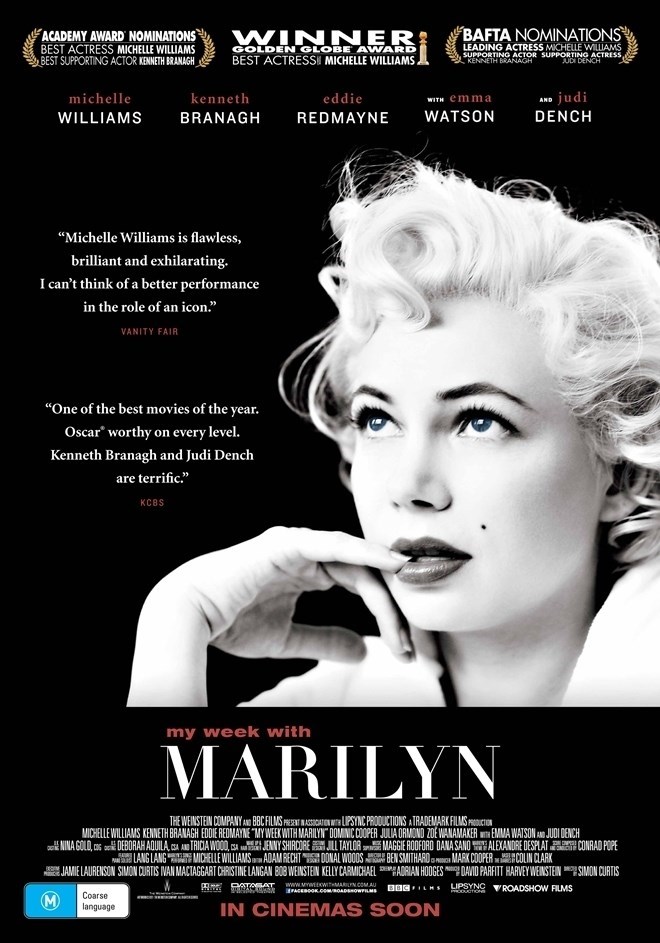
Michelle Williams navigates the world of fame as Marilyn Monroe, escorted by Eddie Redmayne

Director: Simon Curtis

Cast: Michelle Williams (Marilyn Monroe), Eddie Redmayne (Colin Clark), Kenneth Branagh (Laurence Olivier), Judi Dench (Sybil Thorndike), Emma Watson (Lucy), Dominic Cooper (Milton H. Greene), Derek Jacobi (Owen Morshead), Dougray Scott (Arthur Miller), Toby Jones (Arthur P Jacobs), Julia Ormond (Vivien Leigh), Zoë Wanamaker (Paula Strasberg), Michael Kitchen (Hugh Perceval), Philip Jackson (Roger Smith), Simon Russell Beale (Cotes-Preedy), Robert Portal (David Orton), Jim Carter (Barry), Richard Clifford (Richard Wattis), Gerard Horan (Trevor)

In 1956 Laurence Olivier was the greatest actor in the world; Marilyn Monroe was the biggest star (and sex-symbol) in the world. Surely when they came together to make a movie, it would be cinema gold. It wasn’t. Olivier directed and starred with Monroe in The Prince and the Showgirl, an almost impossibly slight puff piece, partly assembled (so rumour goes) so Olivier could sleep with Monroe. But it turned out Monroe’s fragile psyche and Stanislavkian approach to acting was incompatible with Olivier’s well-honed craft. The two did not get on.

Simon Curtis’ gentle, at times charming, but basically very lightweight film follows the making of the film through the eyes of Colin Clark. Clark, son of the famous art critic Kenneth Clark, was a naïve, romantic young man keen for a career in the movies through his father’s contacts. Hired by Olivier’s production company, Clark is tasked to take care of Monroe throughout the film. He becomes increasingly fascinated and infatuated with her as they spend more and more time together.

The film is based on Clark’s diaries, and he is played by Eddie Redmayne at his most fresh-faced. The problem with Clark is that, to be honest, rather than a young man on a journey of self-discovery, he comes across a little like a social-climbing creep and borderline stalker. Clark recounts a short-lived friendship that obviously had huge importance to him – but the film doesn’t want to deal with the fact it probably meant virtually nothing to Monroe, beyond some company during a lonely time. 

It’s not helped by the fact Clark comes across slightly like a pushy groupie, the self-proclaimed guardian of Monroe’s needs – qualifications barely justified by his actions. The film wants us to think he got closer to the magic of celebrity than anyone, but he feels like a stranger with his nose a little closer to the portcullis. Quite frankly, Colin is the least interesting character in his own story, and Redmayne fails to really give him much depth for us to engage with. Instead he remains a slightly unsettling inverted snob, manipulated by Monroe. The film, you feel, just doesn’t get this. At the end someone tells Colin he is “standing taller” than when he first met him (the implication being the relationship has made a man of him – as if spending a bit of downtime with a celebrity was the only route to emotional maturity). But rather than being part of a sweet star-crossed romance, Colin feels like someone creepily attaching himself to someone vulnerable. 

However, Michelle Williams is very good as Marilyn, capturing a real sense of her emptiness and insecurity. She perfectly captures Monroe’s physicality and vocal mannerisms. She is very good at capturing Monroe’s sense of permanent performance, of her glamour, kindness and innocence, mixed with her maddening vulnerability and (inadvertent?) selfishness. It’s a fine performance – better than the film deserves. 

Because the film is afraid of remotely criticising Monroe at all – or really engaging with the deep psychological reasons for her depression, or addressing the possibility that part of her appeal was her slight blankness that any desires could be projected onto. Instead, the film suggests, she’s sad because men just use her. Apart from Colin of course. His kissing, skinny-dipping and sharing a bed with her are entirely unmotivated by any lustful yearnings.

The film is in love with Monroe, presenting her just as Colin saw her – perfection. In fact, just as Dougray Scott’s put-upon Arthur Miller says, she was probably exhausting and all-consuming. She certainly sucks the naïve Colin into her orbit, in a way he (or the film) hardly notices or understands. It wants us to think of this as a romance – in fact, Monroe’s fragility created a neediness that meant she didn’t feel she needed to consider other people, so overwhelmingly concerned was she with her own brittleness. The film essentially believes she was a star, so is basically allowed to do what she wants. The fact that she did so with an air of gentle vulnerability means the film gives everything she does a pass.

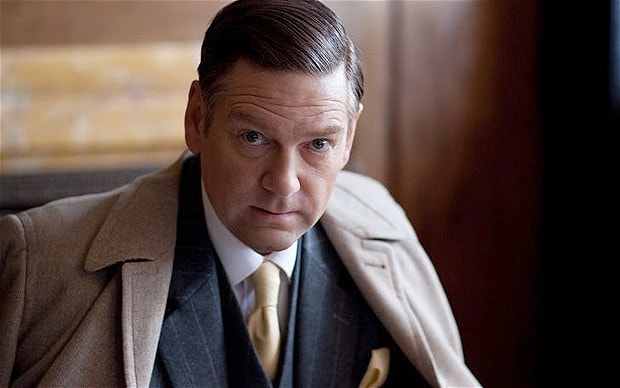
So it’s rather hard not to sympathise with Olivier’s growing frustration with Monroe’s unreliability. Kenneth Branagh triumphs as Olivier, surely the role he was born to play: very funny, but also with a patrician charm and all-consuming arrogance. Branagh taps into Olivier’s vulnerability, his sense that he may not be able to communicate his acting strength into movie stardom, that he is yesterday’s man. For all her difficulty, Monroe had that “star quality” that makes her the centre of your attention. I’d argue Olivier almost certainly had the same – but the film is so in love with Monroe, it needs to slightly bring Olivier down. Branagh, however, is so good that he constantly punctures the film’s attempt to force Olivier into a less sympathetic role than the one it indulges Monroe with.

My Week with Marilynis far from terrible – it’s just a rather empty film. It has a terrific cast with these British star actors all offering fine pen portraits of assorted actors, producers and agents. The film however is slight, and so in love with its fairy-tale elements, it doesn’t notice that Clark’s story is slightly more creepy and certainly a lot more emotionally empty than the film wants it to be. It wants to take us behind the curtain of a 20th-century icon – instead it accidentally shows how impenetrable their screens are, and how easy it is for ordinary people to persuade themselves that the most fleeting of contacts was something special.

Hail Caesar! (2016)


George Clooney is a kidnapped actor in the Coen brothers 1950’s Hollywood spoof

Director: Joel and Ethan Coen

Cast: Josh Brolin (Eddie Mannix), George Clooney (Baird Whitlock), Alden Ehrenreich (Hobie Doyle), Ralph Fiennes (Laurence Laurentz), Scarlett Johansson (DeeAnna Moran), Frances McDormand (CC Calhoun), Tilda Swinton (Thora Thacker/Thessaly Thacker), Channing Tatum (Burt Gurney), Alison Pill (Connie Mannix), Jonah Hill (Joseph Silverman), Emily Beecham (Diedre), Clancy Brown (Co-star Hail Caesar!), Michael Gambon (Narrator)

The Coen brothers’ CV is a bit of a strange thing. It’s one part thriller, one part engagingly brilliant comedy – and then there are a collection of screwball-style entertainments, off-the-wall lightweight comedies (usually about dummies or sharp-talking professionals), as if every so often they needed a palate cleanser. Hail Caesar! falls very much into that final camp. 

Eddie Mannix (Josh Brolin) is a studio manager and fixer in 1950s Hollywood, whose job is to keep the stars in line and the films running smoothly. The latest fly-in-his-ointment is the kidnapping of Baird Whitlock (George Clooney), the star of the studio’s prestigious sword-and-sandals-and-Christianity epic Hail Caesar!. Mannix has to settle the ransom demand, while struggling to keep the news quiet – and manage the production of several other problems including a secretly pregnant Hollywood sweetheart (Scarlett Johansson) and a cowboy-turned-actor (Alden Ehrenreich) struggling with his latest movie requiring him to speak and act rather than just sing and ride a horse.

Hail Caesar! is a mixed bag. There are some wonderful comic sketches in here, the sort of brilliant highlights you could quite happily watch again and again. The problem is these sketches are part of a narrative framework that never really catches fire, that can’t seem to decide how much it is a surrealist comedy and how much it is a genuine Hollywood “behind-the-scenes” slice of life. So I found I delighted in the sketches, and the hilarious reconstructions of some of the studio fodder of the 1950s – while drifting through the general plot of the movie. The laughs are very tightly focused on the stand-alone sketches, and rarely develop from the plot of the movie itself.

Those sketches, though, are brilliant – and the Coens have secured what are effectively a series of stand-out cameos to deliver them. The highlight is certainly a hilarious sequence featuring Ralph Fiennes as a superior English director and Alden Ehrenreich as a cowboy-turned-actor crammed into a period drama in order to “change his image”. It’s a brilliant idea, that revolves around Fiennes’ barely concealed frustration Ehrenreich’s awkwardness in front of the camera, eagerness to please and most of all his accent which so badly affects his elocution that he simply cannot pronounce the line “Would that it were so simple”. The sequence is brilliantly funny – take a look at it down here. In fact it’s so good, it might be too good. Nothing else in the film really touches it.

There are some other good sketches in here as well. Most of them revolve around the loving recreation of Hollywood movies. The movie-within-the-movie Hail Caesar! is a perfect recreation of the Quo Vadis style of movies: large sets, hilariously over-blown dialogue, heavy-handed Christian messages (“Squint at the grandeur!” Clooney’s character is directed in one reaction shot to The Christ – as the filmmakers persist in calling him) and gaudy colour and sets. Clooney himself does a pitch perfect parody of the style and delivery of Robert Taylor.

We also get some spot-on parodies of Hollywood musical styles of the time. Scarlett Johansson plays a Esther Williams-style actress who stars in a series of swimming pool musicals (a bizarre fad of the time). Fiennes is directing a creakingly glacial Broadway-adaptation. Channing Tatum plays an actor in a Minnelli style musical. The tap-dancing sequence we see being filmed is, by the way, another brilliant sketch – a toe-tapping parody song, which also showcases Tatum’s grace and style as a dancer. It’s such a good parody that it actually sort of crosses over into being a genuinely enjoyable slice of song and dance.

I also struggled, as I tend to sometimes, with the artificiality of the Coens’ comedy – there is always an air of them (and their actors) wanting the audience to know that they are far smarter than the dummies in the film. I get this feeling a lot from Clooney in particular – while his film-within-a-film sequences are brilliant, it feels like he never feels much affection for the character outside these sequences. He wants us to know that Clooney is not as dumb or vain as Whitlock is. It’s this lack of empathy that doesn’t quite make the performance work. Empathy is why Eldenreich is the stand-out performer of the film. He plays Hobie Doyle with a real affection and warmth – he makes the character feel like a sweet and genuine person. While Hobie is always a comic spoof, he also feels like he could be a real person – making him so much easier to relate to for the audience.

Hail Caesar! is a film that works in fits and starts, not all the way through. Josh Brolin is fine as Mannix, and his fast-talking, plate juggling, problem solving throws up some funny lines – but his story never really engages the audience as much as it should, and the Catholic guilt Mannix balances in his life never really becomes clear. The Coens are reaching for some point about art and faith – of how film makers may tell themselves they are making something for art, when they actually work for faceless businessmen interested only in making money – but it never really brings this art vs. money argument into place. Does a picture have worth if we talk about worth enough? It’s a question we may as well ask about Hail Caesar itself.

Because the parodies and sketches of old Hollywood movies are so brilliantly done, whenever we drift away from them to the actual plot you find yourself losing interest. It’s a film that actually works better as a few sketches extracted from YouTube – I could happily watch Fiennes and Eldenreich’s scene, or Tatum’s dance sequence, or Clooney’s Taylor spoof in isolation – I don’t really feel the need to watch the entire movie again.