Category: Murder mystery

Jack Reacher: Never Go Back (2016)


Tom Cruise and Cobie Smulders on the run – not as exciting as it should be

Director: Edward Zwick

Cast: Tom Cruise (Jack Reacher), Cobie Smulders (Major Susan Turner), Aldis Hodge (Captain Anthony Espin), Danika Yarosh (Samantha Dutton), Patrick Heusinger (The Hunter), Holt McCallany (Colonel Sam Morgan), Robert Knepper (General James Harkness)

Titling a sequel to any film Never Go Back is a real hostage to fortune. It’s not a great surprise that a quick internet search for reviews of this film throws up a plethora of puns around the film’s subtitle. It’s pretty obvious: but considering the general meh nature of this film, it’s also kinda fair.

Jack Reacher (Tom Cruise) travels back to Washington DC to visit Major Susan Turner (Cobie Smulders), a Military Police officer who has helped him with a number of problems in the past. He arrives, however, to find her under arrest for espionage – and after he starts asking questions, he quickly joins her in lock-up, under arrest for murder. Busting out of prison, they go on the run together to try and find out who has framed them.

Now I loved the first Jack Reacher film: I’ve seen it three times now and it has a brilliant combination of well-cut action sequences, witty lines, an involving plot and some interesting eccentric fringe characters (not least Werner Herzog’s Russian mobster mastermind), which fleshed the movie out into an entertainingly different man-gotta-do movie. This sequel shakes up the formula – but in doing so makes itself much more of an identikit movie, full of tropes we’ve seen before.

For starters, the main appeal of the first Reacher film was the character himself: a loner who plays by his own rules, operating like some sort of master-less samurai, was interestingly different; it was hard to predict how he might react in different situations. Here, teaming him up with Turner (good as Smulders is in the role) and a character who may-or-may-not-be his daughter turns Reacher into just another leg of a mismatched trio, an odd bunch on the run. Cruise tackles well Reacher’s conflicted reactions to taking on a father-child bond that has never crossed his mind before, but adding this parental element to the mix makes the movie start to feel like a high-class Taken reprise.

Secondly, Zwick’s direction doesn’t have the zing that the rather dry and uninvolving plot needs to bring it to life. There is very little of interest in the script, and no memorable lines at all. The best scene in the film is Reacher’s introduction – practically the only scene that captures the character’s slightly cocky defiance of authority, his seemingly omniscient awareness of how events will unfold and his simmering potential for violence coupled with a strong moral code. The storyline that built up to that opening scene sounds really interesting: I wish the film had been about that. No scene after that point really comes to life again. Zwick’s action directing is perfunctory and he can’t add the visual wit that Christopher McQuarrie introduced to such great effect in the first film.

Thirdly the story is just plain not that interesting. The conspiracy is hard to fathom (or care about) and the villains are poorly defined ciphers. In fact, outside of Smulders and Cruise, not a single actor makes an impression in this film: each supporting character is little more than a plot device, sketched with broad strokes. The family dynamic between Reacher-Turner-Dutton feels rather old-hat and robs us of Reacher’s most unique asset as a character – all part of turning the film into another run-of-the-mill thriller. For a fourth or fifth film in the series, doing something very different with the character might have worked: here we still want to explore the loner.

That’s really harsh: it’s not a bad film, just a disappointingly average one. There are some decent scenes and some grins. Cruise and Smulders give good performances. I’m glad they made a Reacher sequel. I just wish it had been a better one. I’m sorry, I can’t resist – this is one film that you will probably Never Go Back to.

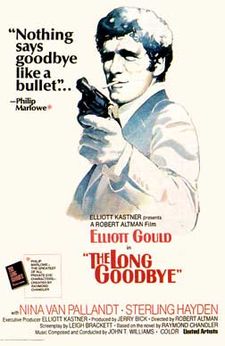
The Long Goodbye (1973)

Philip Marlowe: You ain’t seen the great detective this dishevelled before

Director: Robert Altman
Cast: Elliott Gould (Philip Marlowe), Nina van Pallandt (Eileen Wade), Sterling Hayden (Roger Wade), Mark Rydell (Marty Augustine), Henry Gibson (Dr. Verringer), David Arkin (Harry), Jim Bouton (Terry Lennox), Ken Sansom (Colony Guard)

Philip Marlowe: The Great Gumshoe as you’ve never seen him before. Altman has taken Chandler’s original novel and re-set it into the 1970s. Marlowe (Elliot Gould) is still a private eye but a sort of eccentric Don Quixote, an ambling, mumbling oddity too noble to take on “divorce work”. After he gives his friend Terry Lennox (Jim Bouton) a lift to Mexico, he is left facing police wrath after Terry’s wife is found dead. He is cleared only when Terry is found dead in Mexico, having signed a confession. But Marlowe can’t believe his friend capable of murder – and investigates further.

Altman’s Chandler adaptation was widely criticised at the time – largely because it was completely mis-sold as a mystery detective yarn, which it certainly is not. There are no clues, the mystery is pretty vague at best and the detective hero not only does virtually no detective whatsoever, but is such a naïve soul with such a trusting 1950s style code of honour that he seems swept along by events like a broken reed in a stream. Far from the Marlowe of Bogart or Mitchum, Gould’s Marlowe was an almost wilfully uncool, awkward social misfit, whose lack of engagement with the world stemmed far more from his own lack of understanding than any cynicism.

On top of that, the film is an unusual blend of old and new. Marlowe is a scruffy man out of time, constantly smoking (no one else in the film does) and shuffling from encounter to encounter. Vital conversations happen outside of our (and Marlowe’s) hearing. The camera roams as wilfully as its lead character, rarely standing still to let us absorb the action, but constantly offering us a series of subjective angles. Like much of Altman’s work, the naturalistic sound recording lets dialogue overlap and clash. The entire soundtrack is a riff on the themes in the title song, the music popping up throughout like pleasant musak. Vilmos Zsigmond’s photography is both an inversion of film noir with its California brightness and (through a technique of deliberate overexposure called ‘flashing’) a sepia infected look at the 1970s that draws a link back to the source material’s 1940s origins.

But the tone of the movie is the most unusual thing: a strangely addictive hipsterish take on Marlowe, in which the majority of other characters are as shallow and self-obsessed as you would expect of the 1970s: aside from Marlowe, the only character who seems to apologise or keep to his word at any point is the film’s least sympathetic and most violent character. The eventual killer reacts to being confronted with his crime with a blasé self-entitlement. Across the apartment from Marlowe’s bizarre old-school Hollywood apartment block, a commune of hippie ladies exercise topless outside at all hours; everywhere you turn there are clashes between the old and the new.

The film’s opening immediately establishes what the film is going to be like, and is also one of the best sequences in the film: a quiet, gently paced quest Marlowe undertakes to find cat-food in the middle of the night and his inability to persuade said cat to eat the “wrong” brand of food that he brings back home. This secluded existence is only broken by the arrival of Terry Lennox, who immediately beats Marlowe at a bet on the number of 7s in the serial number on a $10 bill (which he wins despite Marlowe having the higher number of 7s, as he successfully lures Marlowe into an incorrect challenge). It’s a wonderful summation of the film’s plot, as well as a series of clear insights into Marlowe’s personality: a man out of time easily manipulated by those around him, who can’t fool a cat or win a bet with the best hand.

Gould’s performance is absolutely central to the mood and tone of the film. His Marlowe is a counterpoint to the hard-bitten detectives of film noir. Instead, he is a scruffy mumbler, whose continual, conversational patter throughout the film feels more like a commentary he is running for his own amusement than any attempt to communicate with the world around him. Gould’s charm and otherworldly quality basically is the film: he’s hardly off screen and he “sets the tone”: the film’s ambling, slightly confused glances at the modern world, where dialogue and motives are both equally unclear, exactly match the beats of Gould’s interpretation of the character. It’s a perfect performance for the film, a sly gag that also has heart and character.

The film’s off beat tone and lackadaisical attitude are punctured at several moments by astonishingly sudden upturns in tempo, and scenes that sizzle with the threat of (or actual) violence. These moments are linked to Mark Rydell’s brilliant performance as fast-talking Marty Augustine, a man whose actions are totally unpredictable. He is responsible for the film’s only real act of violence – but it’s a striking moment of brutality that no-one sees coming (least of all the other characters, on whose shocked faces and stunned silence the camera lingers).

Rydell’s exceptional performance is the stand out supporting one here, but there is also some very good work from Nina van Pallandt as a woman who is part vulnerable wife, part femme fatale, and whose emotional state and motivations constantly seem to shift and change (at a pace the audience barely keeps up with, let alone poor Marlowe). Sterling Hayden’s Hemingway-esque author is one of those primal force-of-nature performances that can grate, but it works in a film where so many of the other characters are restrained.

The film is an absorbing character study, and at the same time a sly commentary on both the 1970s, the source material and film itself: Gould’s Marlowe at points seems to be pushing on the wall of self-awareness (most notably in a hospital scene late in the film, a masterpiece of misdirection): later, Third Man style, he walks past another character without offering a beat of recognition, before (as the credits roll) he inexplicably starts dancing down a boulevard, the camera watching him in long shot. Hooray for Hollywood (the only other music in the film) bookends the film.

It’s a fascinating and highly enjoyable film with a series of striking scenes and character moments that capture the attention and imagination. It’s a film that needs, however, a certain expectation going into it. Don’t expect a detective story, don’t expect detection even, but instead a unique merging of comedy, social commentary, satire and drama powered by an almost wilfully off-hand lead performance. It’s the sort of unique concoction only Altman could have made. There isn’t really anything else like it.

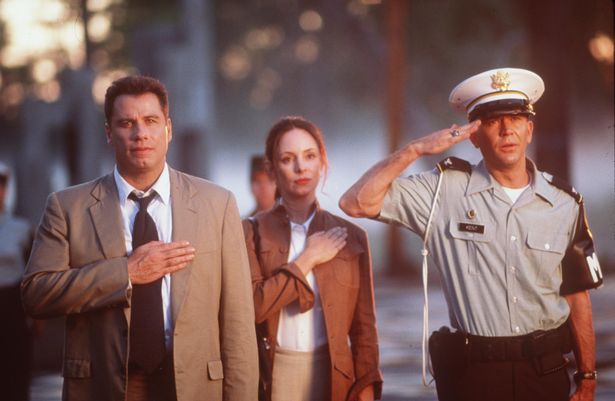
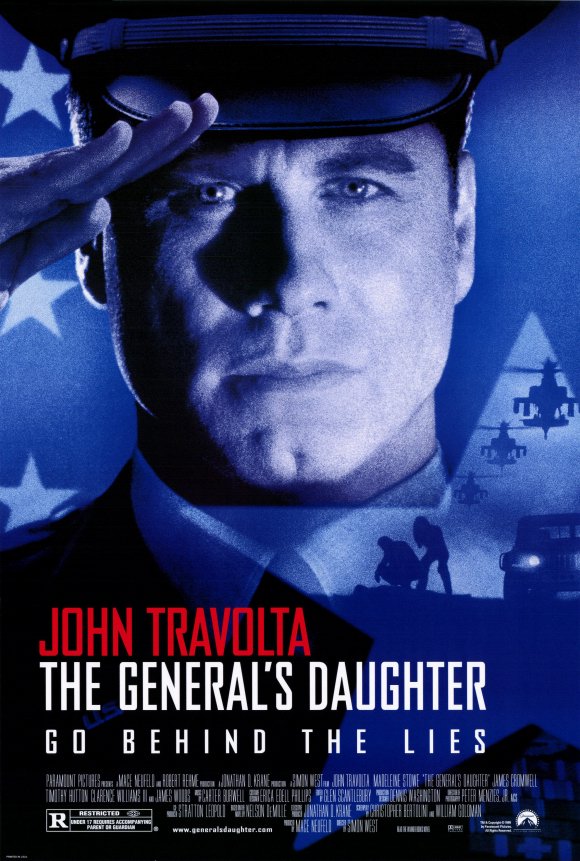
The General's Daughter (1999)


Probably one of the most subtle moments from Travolta’s appalling star vehicle about rape

Director: Simon West

Cast: John Travolta (Chief Warrant Officer Paul Brenner), Madeleine Stowe (Chief Warrant Officer Sarah Sunhill), James Cromwell (Lt. General Joseph Campbell), Timothy Hutton (Col. William Kent), Leslie Stefanson (Captain Elisabeth Campbell), Clarence Williams III (Col. George Fowler), James Woods (Col. Dr. Robert Moore)

The General’s Daughter is a mundane thriller from the late 1990s, now largely forgotten and quite rightly too. Travolta plays an army Warrant Officer, called in to investigate the rape and murder of the daughter of a decorated Army general (played in his best martinet style by James Cromwell). He works with a female Warrant Officer (Madeleine Stowe) with whom he has Unresolved Sexual Tension. Investigations quickly reveal of course that virtually everyone on the base seems to have had some sort of intimate relationship with the victim.

It’s a pretty straight-forward investigative thriller, but it takes a rather unpleasant leering interest in its victim, with the camera lingering frequently too long on her naked body – even during a rape scene the camera and direction invites the audience to admire the victim’s body: “Sure this is awful, but look ain’t she got great legs!”. Revelations that the victim has a sex dungeon, and indulged in sadomasochistic sex with several people, immediately lead our heroes to state that of course “the circumstances of her death are linked to her life” or words to that effect. In fact, the whole film has a slightly unpleasant air of exploitation about it.

Even more unsettlingly after that, the film-makers strap the fig-leaf of social concern over their film with an end card that mouths platitudes about female soldiers and asks us to pat ourselves on the back about the rise in number of female soldiers and the steps taken to prevent rape occurring in the army again. A bit rich from a film that has taken an ogling fascination in its victim as sexual figure throughout the film.

So let’s be charitable and say its attitudes are a bit dated, and that it does sort of try to say something at the end (however ham-fistedly). It’s still not that good a movie. I’ll give it a point for the fact that I didn’t guess the final killer (though I really should have done), although my wife and I managed to predict pretty much everything else between us. And its attempts to tuttingly wag its finger at the army’s attitude to female soldiers are totally undermined by its pervy aesthetic and grimy, exploitative subject matter.

Travolta throughout aims for cocky maverick but comes across more as a complete cock. His chemistry with Stowe is pretty much zero, which is appropriate as that is the same level of interest I had in their ill-defined past relationship. James Woods phones in another of his quirky wackos, James Cromwell is pretty decent as the General. The best performance probably comes from Clarence Williams III as a hero-worshipping adjutant.

The first twenty minutes of the film are a showpiece for an out-of-shape Travolta to rough up a few suspects and to give him “a very personal motivation” for the case (which almost suggests a guy can’t be expected to care that much about a rape victim unless he had met and flirted with her in advance) – it could effectively be skipped to be honest. The rest of the plot is as basic, half thought-out and mildly tasteless as the film itself. If you wanted to make a film about promoting the rights of women in the army, then this was almost a textbook example of how not to do it.

Sleepy Hollow (1999)


Rumours that Johnny Depp is tapping into his eccentric style are of course unfounded

Director: Tim Burton

Cast: Johnny Depp (Ichabod Crane), Christina Ricci (Katrina Van Tassel), Michael Gambon (Baltus Van Tassel), Miranda Richardson (Lady Van Tassel), Casper Van Dien (Brom Van Brunt), Jeffrey Jones (Reverend Steenwyck), Richard Griffiths (Magistrate Philipse), Ian McDiarmid (Dr. Thomas Lancaster), Michael Gough (Notary Hardenbrook), Christopher Lee (Burgomaster), Christopher Walken (The Headless Horseman), Claire Skinner (Beth Killian) 

Tim Burton’s films often take on a larger-than-life quality, an overblown fanciful journey into a world that is a few degrees off from our own. So a bizarre ghost story about a headless horseman lopping off bonces left, right and centre, in an isolated town that feels more like a construct from a series of other films than any sort of real place, probably suits him perfectly.

After a series of murders via decapitation in the small town of Sleepy Hollow, Iachobad Crane (Johnny Depp) is called from New York to investigate. An eccentric (what else, it’s Depp) moderniser, Crane believes in logic and forensic investigation and is having none of the fears of the townspeople that the murders are being committed by a headless ghost. However he soon changes his views…

This adaptation bears little or no resemblance whatsoever to the original source material, bar a few homages, one or two brief scenes and a few character names. Burton, indeed, seems to have no interest in it at all: what he is interested in doing is paying homage to high-blown Hammer horror films from the 60s and 70s. Whether you enjoy this largely depends on whether you were a fan of either Burton or this style of film-making going into it.

I found the film rather too arch throughout – from the stylised performances of the actors, through to the slight tongue-in-cheek tone. It’s not particularly scary at any point, despite the blood and gore – largely because nothing ever feels real, there’s no sense of dread or peril. Heads are lopped off with an almost comic athleticism, bouncing around floors or rotating on necks. Only one sequence – the murder of a family – carries any real sense of unease about it. The rest of the film is one not-particularly-witty black comedy, in which a lot of time and talent seems to be invested in something not particularly interesting.

Depp is of course perfectly suited to this, his “look at me” acting style springing to the fore as Crane. As usual he overloads the character with quirks and mannerisms, the sort of tricksy emptiness it’s easy to mistake for great acting. The rest of the cast go about their business with a trained professionalism. However, despite the array of British acting talent on display, in truth none of them make much of an impression, with the exception of a nice cameo from Alun Armstrong as a senior New York policeman, and Miranda Richardson who has fun with her role as a sinister housewife with hidden depths.

The awards attention for the film focused on its finest aspects – its look and design. The production design of the film is impressively constructed and the artificial look of the exterior sets actually fits in very nicely within the world of the film. Emmanuel Lubezki’s photography also looks fantastic, shooting the film with a slightly off colour, 70s style that adds a vibrant red to the large amount of blood on screen. Costumes and other technical aspects are also impressive. The film looks fantastically striking, like a brilliantly designed coffee table book – and has about as much plot as one. It’s my problem with Tim Burton – this whole “unique vision” of his, often seems to be an excuse for littering his films with in jokes, arch design and stylisation and leaving out the things we actually care about, like characters, emotion and drama.

In the end, it’s really not a lot more than a joke, a pastiche of a certain genre of film that seems much more like one for the fans than a joke that we can all take part in. I’m aware not liking it throws me open to accusations of not “getting it” or expecting more from it, but I basically didn’t really find the joke funny enough. Its arch style make it hard to relate to, and despite the clear enjoyment of all involved, not a lot of the wit behind the scenes is clear in the final product. With nothing to really invest in, a rather sudden ending and a mood throughout that is trying to be creepy rather than genuinely so. Don’t expect a retelling of its plot around a camp fire to awaken too many goosebumps.

23 Paces to Baker Street (1956)


Van Johnson hears something’s up

Director: Henry Hathaway

Cast: Van Johnson (Philip Hannon), Vera Miles (Jean Lennox), Cecil Parker (Bob Matthews), Maurice Denham (Inspector Grovening), Isobel Elsom (Lady Syrett), Estelle Winwood (Barmaid), Liam Redmond (Mr. Murch), Martin Benson (Pillings), Patricia Laffan (Alice MacDonald) 

It’s an age-old truth that the movies always believe we can admire a hero more, if we see them struggling to overcome some form of disadvantage or disability that would normally rule them out of carrying out the actions they are trying to do. So what fits into that mould better than a blind man going up against a gang of criminals?

Philip Hannon (Van Johnson) is a successful American playwright living in London, who has lost his sight. One day in a pub, he overhears a conversation between a man and a woman that he suspects is related to the planning of a crime. But, unable to persuade the police of his suspicions, he has only his former secretary Jean (Vera Miles) and butler Bob (Cecil Parker) to help him investigate.

This is the sort of reliable B movie material, with some decent parts and interesting twists, that usually gets remade as a big-star, big-budget modern Hollywood drama. You know the sort of thing: Russell Crowe is a blind writer investigating a crime. In fact, it’s almost a surprise that this has never been remade, as it is an entertaining, diverting small-scale movie – the sort of thing that you can imagine settling down in front on a wet Sunday afternoon.

It’s a sort of sub-Hitchcock drama –fairly similar in tone to Rear Window – and there are several beats in there that totally fit with the master’s dramatic style. In fact, that’s what makes it such a quintessential B movie: everything about it feels like a slightly cheaper alternative to a major picture. Which isn’t a criticism as such: it’s just a very workmanlike, efficient little thriller, which fits neatly into Hathaway’s CV of safe, unspectacular film making. It’s still well made and does exactly what you would expect, but it’s not going to knock anyone’s socks off.

Van Johnson may similarly be a low rent Jimmy Stewart, but he’s pretty effective in this role, suitably vulnerable in places, while still suggesting enough of the prickly demeanour of the man who doesn’t want to be a victim. He also resists the temptation to overplay the blindness – something the whole film actually does quite well. As the man holding the entire film together he does a good job, and he even manages to be more or less believable as a successful playwright. Watching it, you think it’s a bit of shame he’s not better known today – he’s a good (if unspectacular) actor. Vera Miles offers some good support as a supportive love interest while Cecil Parker is quite droll as the butler.

The mystery itself has a few nice twists in it – the final twist is nicely set-up, enough for you to see it coming as we reach the dénouement (a well-staged confrontation in a darkened flat, which gets a lot of tension from watching our blind lead trying to identify all the lights in the house so he can remove their bulbs). The story sometimes doesn’t give us too much of a chance to work out the twists and turns before key clues are revealed by Hannon, but that’s no major problem. It’s also quite well filmed, with some nice shots of 50s London skylines.

It’s a decent and interestingly done film that gets some fresh content out of the blindness of its hero, never portraying him as a victim but as a proactive and determined man. Claims that this is some sort of lost classic are overdone – it’s never more than a sub-Hitchcock B picture – but it’s still highly watchable, has some engaging characters and some decent thriller sequences, and you care about the lead characters, even if you don’t particularly care about the crime itself and its victims (the victims in particular are pretty vague characters). It also relies rather heavily on the legendary heightened senses that blind always seem to have in Hollywood films. But for something that basically sounds like the plot of an ITV two part drama, this is solid craftsmanship.

One final note: the title means nothing. At one point Hannon guides a man through the fog. Turns out he’s 23 paces from his destination: Baker Street. The Hollywood suits were keen to drop in the “Baker Street” reference, to suggest a link to Sherlock Holmes. So goes to show – Conan Doyle, always good box office!