Category: Political drama

Citizen Kane (1941)

Citizen Kane (1941)

Believe the hype: Orson Welles changes the course of film history in this landmark masterpiece

Director: Orson Welles

Cast: Orson Welles (Charles Foster Kane), Joseph Cotton (Jedediah Leland), Dorothy Comingore (Susan Alexander Kane), Agnes Moorehead (Mary Kane), Ruth Warwick (Emily Monroe Norton Kane), Ray Collins (Jim W Gettys), Erskine Sanford (Herbert Carter), Everett Sloane (Mr Bernstein), William Alland (Jerry Thompson), Paul Stewart (Raymond), George Coulouris (Walter Parks Thatcher), Fortunio Bonanova (Signor Matiste), Harry Shannon (Kane’s father)

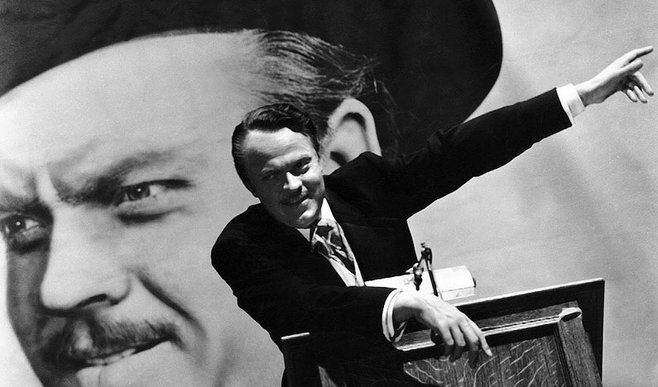
Writing about Citizen Kane is rather like writing about the Mona Lisa. Both are works of art so famous and influential that you are intimately familiar with them even if you’ve never seen them. But what makes them such constant delights is that, leaving everything else aside, the Mona Lisa is beautiful to look at – and Citizen Kane is hugely enjoyable to watch. Welles’ masterpiece – frequently hailed as the greatest film ever made – is about as close to perfection as you can get.

Entire books have been written about seemingly every aspect of the film’s creation. Welles’ original intention was to call the film American. It’s a fitting title. Citizen Kane is perhaps the finest film ever made on the corruption that ambition, money and power bring to the American spirit. Kane starts out as a pioneering idealist, but his fatal flaw his is need for power. That need to seize control of everything extends from buying all the art he can find in Europe to controlling the lives of all around him. It’s the mentality that will force his second wife into an opera career she is hopelessly unsuited for. It will eventually leave him sitting alone in his huge mansion, surrounded by wealth but bereft of friends. A large part of the American Dream is about “making it big” – and few make it bigger than Kane, and have so little to show for it at the end.

The film is a character study of ambition and power, using a framing device of the late Kane’s final word: “Rosebud”. What did he mean? Will finding out provide the key to understanding this powerful, elliptical man? A reporter (William Alland) aims to find out by interviewing key people from Kane’s life. From their recollections, the story of Kane’s life slowly comes together in a non-linear style. Charles Foster Kane (Orson Welles) as a young child inherits one of the world’s largest gold mines. Coming of age, Kane decides to use his wealth to become a press baron. He builds a news empire and runs for Governor – but the public revelation of his affair with amateur singer Susan (Dorothy Comingore) ruins his campaign. He builds a mansion on a man-made mountain, Xanadu, but is isolated and friendless in the echoing rooms of his own mausoleum.

You can argue the same thing happened to Welles himself. Citizen Kane is his own mausoleum, the only time in his life when everything went right. Also, probably the only time Welles’ attention stuck to something long enough to deliver. Welles memorably called working on a film set “the biggest electric train set any boy ever had”, and the entire film is saturated in his creative glee at trying so many new tricks. Citizen Kane bought to the forefront so many methods of film-making, its influence has been so pervasive on film today, that it’s hard to see how revolutionary it appeared at the time.

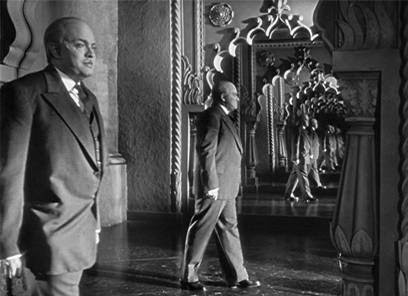
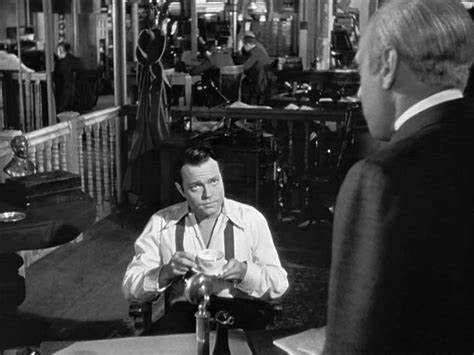
Welles worked with cameraman Gregg Toland to push the film into a whole new visual language, deeply influenced by German expressionistic film. It’s a beautiful film to look at, and each shot is covered with meaning, Welles’ eye for the theatrical image matched with Toland’s genius for visual language.

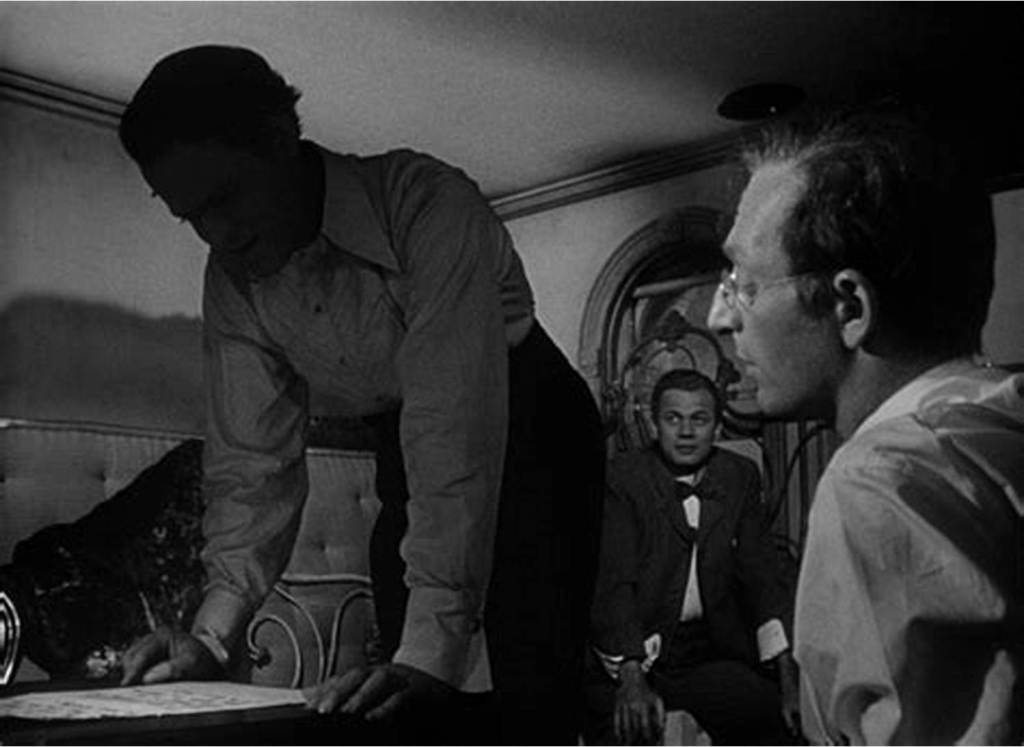
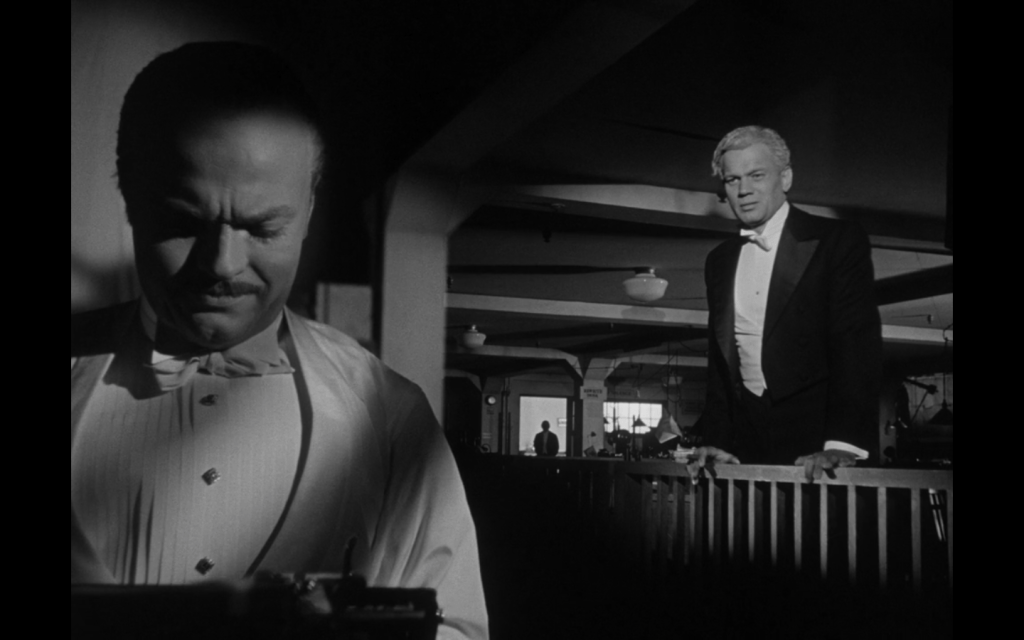
Citizen Kane is rarely thought of as a noir film, but it’s possibly the most noirish film you’ll ever see. Watching it again I was struck with how often shadows dominate the screen. Faces are frequently obscured, most famously in the projection room scene, where Thompson receives his instructions to find out what “Rosebud” means. But at key moments, faces disappear into black – while preparing his “Statement of principles” that will fill the front page of Kane’s first edition at the Inquirer, his face is lost in murky darkness. We hear what he is saying, but what is he thinking at this moment? It’s impossible to tell. Long shadows and inky black segments fill the frame frequently – it’s a film that gives a true feeling of darkness and unknowability at its heart.

This is mixed with the theatrical flourish of its constant deep focus. Almost unheard of at the time, every shot of Kane is in perfect focus. It makes for visual compositions inspired by theatre, and ripe with dramatic meaning. Kane’s parents and his guardian William Parks Thatcher (George Coulouris) organise the future of the young Kane in the foreground, while we see the child playing outside in the show through a window. The deep focus turns Xanadu into a museum of lost chances and dreams, and the Inquirer newspaper office into an increasingly dark corridor of ambition, with people’s fates decided in foreground while we see them trapped in the background.

If that wasn’t enough, Toland uses angles Hollywood films hadn’t dreamed of. For some scenes, trenches were dug into the set and the camera placed in it, allowing the camera to stare up, with the actors towering over us. Citizen Kane is often claimed to be the first film where ceilings needed to build for the sets, as Toland’s angles and camerawork frequently made them visible. It’s not completely true, but it speaks to the visual impact of the film. Nothing really like this had been widely seen before. And I’ve not even mentioned the soaring, swooping tracking shots that pass through signs and buildings, the sort of inspired movement of the camera so many directors before had avoided in favour of stationary recording of the story. It’s visionary stuff.

The same was true for the film’s sound and music. Welles used his experience from radio to turn the soundscape of the film into something truly different. In radio, all cuts are managed by sound, but film had traditionally used only visuals to mark edits. Here, sound is used as often as visuals. When Kane runs for Governor, the sound and vision cut seamlessly from Leland on the stump for Kane to Kane finishing the same speech at a cavernous rally. Early in the film, the words “Happy Christmas” are skilfully cut together to leap forward years. Bernard Herrmann’s spare but perfect score, rather than laid over every scene, only comes in (as on radio) where emotional or transitional change is needed.

But then this is a film that uses editing as a way to tell story that few films before had tried. The sequence showing the collapse of Kane’s marriage to President’s niece Emily Monroe Norton (Ruth Warwick) is the perfect example. Over about two minutes of screen time we see several short scenes, all set at the breakfast table. Each scene shows a progressive step in their relationship collapsing, from loving exasperation to annoyance to anger to mute loathing. The scenes are no more than 20-30 seconds each, but the film perfectly moves from one to the other. The music slowly changes from a romantic waltz to a cold discordant rhythm. Transitions are marked by wipes. In each scene the actors move further apart at their breakfast table, the dialogue becomes harsher, sharper and more confrontational as the room they sit in becomes grander. In a few moments, an entire marriage story is told. It’s quite simply marvellous. The sequence is bookended by matching camera movements, gliding in and then out from the room.

You could speak for pages and pages (as indeed people have) about what a marvel Kane is. Welles’ vision and willingness to push the boundaries created an environment where all his collaborators worked to achieve their best, set free from the restrictions of more traditional moviemaking to stretch themselves as artists in a way rarely allowed. But it’s easy to forget what a marvellous story Citizen Kane is, what an entertaining and brilliantly constructed film it is and how every scene has something that delights and enthrals.

There’s controversy over who wrote the script. Welles and Herman J Mankiewicz are credited – although arguments have been made that each deserved the lion’s share. Whoever did create it, the script is quite simply superb. Economic, but packed with wonderful lines and some extraordinary speeches (Mr Bernstein’s speech about a powerful memory of a young woman he saw once from a distance is quite simply one of the best small-scale speeches you’ll see). Every scene is brilliantly assembled, and gives fabulous material to an extraordinary cast of actors.

It makes for a compelling character study, wrapped into a series of brilliantly done vignettes. Each set of recollections – from Thatcher, business manager Mr Bernstein (Everett Sloane), old friend Jedidah (Joseph Cotton) and ex-wife Susan (Dorothy Comingore) – makes for a fabulous series of self-contained scenes, each gaining richer and deeper meaning with every subsequent reflection that follows. There are so many sensational scenes I hardly know where to begin: you could write an essay about each one. Thatcher’s serio-comic reflections of the roguishly cheeky Kane are wonderful. Bernstein’s memories of the chancer coming good – with a brilliantly playful celebration scene – wonderfully entertaining. Jedidah and Susan’s far more tainted reflections of the man’s flaws make for wonderfully constructed drama, presenting a corrupted and bullying Kane. In every scene there is a beautiful moment of dialogue or drama which sticks in the memory.

The acting is equally good. Cotton settles into the groove many of his finest roles would fit into – the never-quite-grew-up schoolboy, who slowly realises his hero has feet of clay. Comingore is wonderfully fragile and then increasingly bitter as Kane’s ill-used second wife, forced into a humiliating career because Kane won’t be married to a failure. Sloane is charmingly loyal, with beautiful moments of profound sadness, as Bernstein. Coulouris is brilliantly funny as the exasperated Thatcher. Ray Collins’ is smooth and unabashed as Kane’s political rival. Agnes Moorehead is tinged with sadness and ambition for her son as Kane‘s mother.

But at the heart of Citizen Kane – in every sense – is Welles. His handpicked crew was some of the best in the business – but it was Welles’ inspiration, his willingness to imagine techniques and approaches un-attempted before, that encouraged them to their finest work here. With the magnetic force of personality that was his hallmark, he inspired everyone to give their very best. And he led from the front. The film is a triumph of drama, tragedy and comedy, directed with sublime grace. Welles the actor is perfectly cast, the part almost a riff on his own cult of personality, the mix of pride and overweening ambition and little-boy cheek crossed with self-destructive laziness. Welles’ performance is faultless in the film, taking Kane from the smirking chap happy to lose a million dollars a year (“at the rate of a million dollars a year I’ll need to close this place…in 60 years”) to the bloated old man, trashing his wife’s room after she walks out. Perfect.

The only tragic note about Citizen Kane is that this wasn’t the first in a career of non-stop genius from Welles. Instead, flaws in his own personality, combined with his ability to make enemies and lack of ability to focus on the task in hand, increasingly consumed Welles, making him eventually a lost great, a man wandering from film set to film set, taking on small roles for cheques that might one day help him make a film. But he’ll always have Kane, the sort of film that is a marvel which can never, ever disappoint. With every scene a classic, every moment compelling, every beat in it perfectly judged, its influence stretching to almost every film made since the late 1940s – it deserves its place as the greatest film of all time.

Land and Freedom (1995)

Ian Hart fights for Land and Freedom in Ken Loach’s impassioned Spanish Civil War drama

Director: Ken Loach

Cast: Ian Hart (David Carr), Rosana Pastor (Bianca), Frédéric Pierrot (Bernard Goujon), Tom Gilroy (Lawrence), Icíar Bollaín (Lawrence), Marc Martinez (Juan Vidal), Paul Laverty (Militia Member)

What do we really know about our elders? After David Carr passes away, his granddaughter finds a box full of memories from his time as a young man (Ian Hart) who went to Spain in 1936 to fight against fascism. His granddaughter uncovers a whole side of her radical grandfather she never knew – his passions, his love and the reasons for his disillusionment with the communist party.

If there was someone who was going to make a film about the Spanish Civil War, it would be Ken Loach. The Spanish Civil War is a totemic event for left-wing politics, where the dream of a truly commune-based left-wing government in Europe, by the people for the people, died in a long civil war with right-wing military forces. Loach’s film hums with anger at this missed opportunity and fury at the way these crusaders for justice were left high and dry by both the rest of Europe, and the Russian-controlled forces that should have been on their side.

The Spanish Civil War is a war that it’s easy to slightly forget – a dress rehearsal for World War Two but with a different result. It’s striking that this is one of the very few films – perhaps the only film – to really tackle it. Perhaps that’s because, for many, it’s a hazy and confusing combat with no clear goodies and baddies. On one side the left-wing forces were riddled with internal conflict, with many in thrall to Stalin, while the right-wing forces were anti-Stalin (good) but fascist (very bad). It’s a war that ended with an elected government overthrown in a military coup, tacitly endorsed by the Allied powers – not something that fits well with our narrative of the World War Two era.

It’s clearly a war where Loach has picked a side. His sympathies – and the film’s – are certainly not with the leadership of the communist party, who are portrayed as heartless, two-faced and only concerned with assuring Soviet control over the country. Instead he sides with the common working-class man, fighting in the trenches, full of idealistic passion and righteous anger. Loach’s film is unashamedly political, awash with ideas and idealism.

Not many other films feature at their heart an impassioned, semi-improvised, debate on the merits of forming a commune and economic self-determination. This scene, the key moment in the film, really works by the way, with the actors throwing in their contributions alongside extras, many of them veteran Spanish trade unionists. You can question the naivety of it – and also the way, as often, Loach tends to paint compromise as a vice nearly as bad as betrayal – but it makes for surprisingly compelling viewing. Because, if nothing else, it’s clear everyone, from the director down, really believes in the virtues of the politics being offered and the hope they bring – and that’s infectious.

It’s also because Loach is a highly skilled director who has carefully used the film to build our empathy with these brave campaigners. There are some truly impressive performances. Ian Hart is superb as the young David Carr, young, idealistic, funny, brave and angry. Rosana Pastor is just as good as the woman he loses his heart too, the sort of feminist warrior ideal that is the staple of films like this, but whom she makes feel exceptionally vibrant and alive. Loach throws us into the trenches with these guys, showing us their lives and loves, allowing us to follow them through triumph and loss. It’s a film that demands we respect and admire these people who came from far and wide to fight for what they believed in – and it’s right to do so.

As always with Loach, what I miss is the shades of grey. You cannot doubt the honesty and true feeling behind these people’s views. They believe that what they are saying is the only way. What Loach tends to do – and does here – is show anyone who disagrees with this view, no matter the reason, as either cowardly or self-serving. An American communist who stresses the need for moderation in their politics (to win sympathy from the Western powers) and professionalism in the military campaign is dismissed as a sell-out and a patsy. As often with Loach, the idea of getting results from moderation and organic change is seen as worse than a romantic failure that sticks completely to ideals. Perhaps it’s an interesting insight into why so many left-wing political movements have ended in failure?

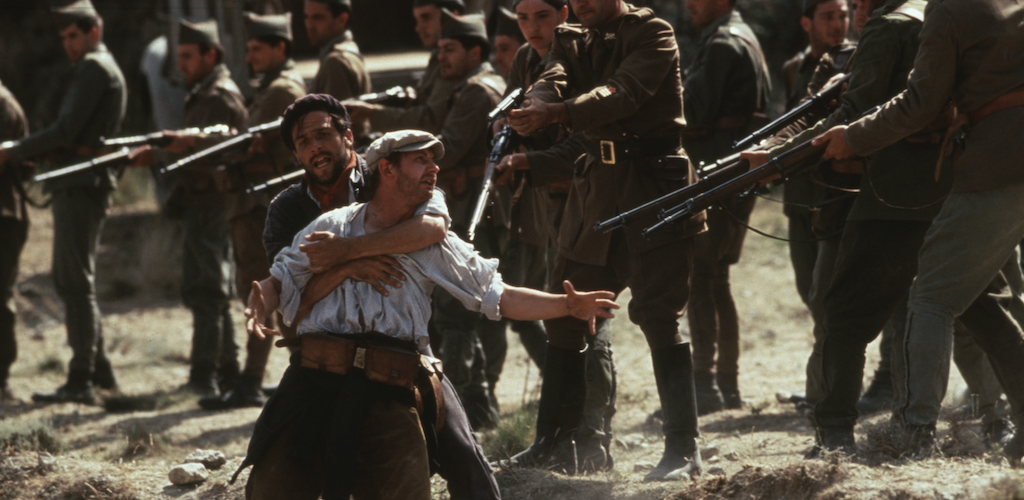
But away from the politics this is a fine film, one of Loach’s best. The reconstruction of the Civil War – often confused, rushed trench warfare fighting unclear enemies – is brilliantly done. A storming of a village by David Carr’s militia group is shot with the sort of immediacy that would make Paul Greengrass jealous. And what Loach does better than almost any other filmmaker is bring real, living, passion to the screen. As the militia is finally betrayed for good by the Communists, the spittle-flecked, teary-cheeked anger of the characters at the Soviet-backed forces rounding them up feels almost unwatchably real.

I don’t always agree with Loach’s politics – and I strongly favour compromise and moderation as a better way of achieving long-term goals than blindly sticking to principles – but I have no argument with his qualities as a filmmaker. And Land and Freedom is so clearly one-from-the-heart that you can’t argue with it. No matter your political stance, you must be moved by it. And feel a profound sorrow about how a generation saw their dreams ripped away and betrayed.

The American President (1995)

The buck stops with Michael Douglas in Aaron Sorkin’s dress rehearsal for TV, The American President

Director: Rob Reiner

Cast: Michael Douglas (President Andrew Shepherd), Annette Bening (Sydney Ellen Wade), Martin Sheen (AJ MacInerney), Michael J Fox (Lewis Rothschild), Richard Dreyfuss (Seantor Bob Rumson), David Paymer (Leon Kodak), Samantha Mathis (Janie Basdin), John Mahoney (Leo Solomon), Anna Deavere Smith (Robin McCall), Nina Siemaszko (Beth Wade), Wendie Malick (Susan Sloan), Shawna Waldron (Lucy Shepherd), Anne Haney (Mrs Chapil)

Taken solely on its own merits, The American President is a charming, witty romantic comedy which makes some shrewd (liberal-tinged) comments about American politics. But no-one is ever going to take The American President on its own merits. Because this Sorkin-scripted bundle of joy is so clearly a dry-run for The West Wing, it’s hard to watch it without spotting the roots of it here: everything from shared characters to scraps of dialogue. Perhaps only M*A*S*H stands with this film as so dwarfed by its spin-off.

President Andrew Shepherd (Michael Douglas) is a widower, raising his daughter Lucy (Shawna Waldron). Heading into the third year of his first term, he’s got a domestic agenda dominated by his new crime bill (although Shepherd won’t risk increasing gun controls). Charming, articulate and passionate – he’s also lonely. But his life changes when he falls for environmental lobbyist Sydney Ellen Wade (Annette Bening), their courtship seeing them fumble through “boy-meets-girl” when boy just happens to be the most powerful man in the world. Will the President’s popularity survive him dating someone outspoken and passionate? Or will it be a tool for his Republican rival Senator Bob Rumson (Richard Dreyfuss) to hit him on everything from family values to patriotism?

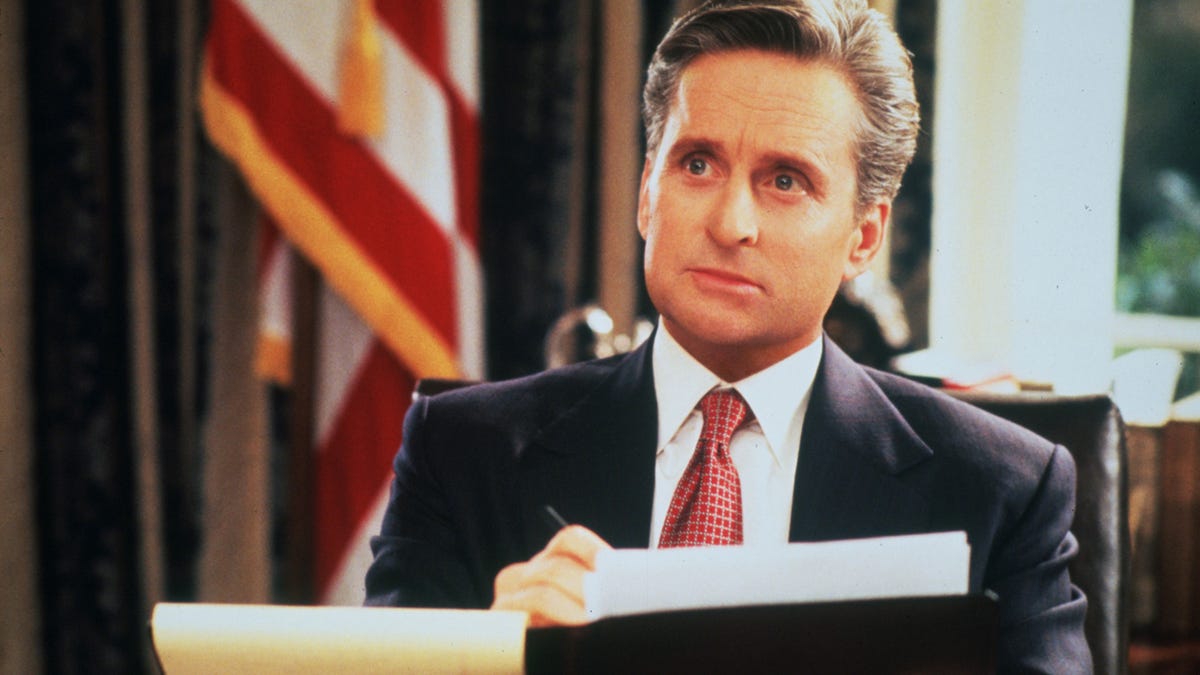
It’s impossible not to enjoy The American President. Sorkin’s playful, articulate and smart dialogue is of course an absolute triumph. The cast are extremely well-chosen. Few actors look as damn Presidential as Michael Douglas, not to mention carrying with them an air of impassioned authority and commanding bonhomie. Annette Bening is spot-on as exactly the sort of feisty and intelligent woman that would attract a liberal minded President, but turn off pundits and regular people. Martin Sheen was obviously so comfortable with Sorkin’s dialogue style that promotion to the President seemed inevitable (seriously it’s very odd watching the film and seeing Sheen not being treated like the President!). Michael J Fox’s entire career was revitalised by Sorkin tapping into the frantic, fast-paced comic energy that is the actor’s forte.

Rob Reiner’s direction is fresh, relaxed and perfectly complements the dialogue. We get a few West Wing style walk-and-talks (does this make Reiner the inventor of it?). The film superbly balances romantic comedy with serious political discussion on military intervention and proportional response (“the least Presidential thing I do”), the environment and gun control. It also gets a neat idea of the shady, and dirty, business of generating votes in the House – and the deals that need to be done to secure legislation. Reiner gets great stuff from the actors (Sorkin didn’t question his casting, since so many of them ended up in The West Wing) and keeps the momentum up beautifully.

The film has a lovely Capra-esque feel to it. Sorkin is even witty enough to lean on this by having Sydney discuss Capra openly with a White House security guard – also a lovely moment to establish Sydney’s genuineness and openness, as compared to the jaded I-don’t-care attitude of her colleague. There is a real feel in it – and of course this optimism carries across to The West Wing – that good people in the right place can change the world. That decency and compassion can trump (so to speak) the cynicism of Washington insiders. (The idea appeals to everyone – what is Donald Trump but a nightmare version of a plain-speaking man in Washington who says what he thinks?).

Balanced with some lovely comedy, it works extremely well. Along with the debate, Sorkin has a great feeling for the absurdity of the Leader of the Free World trying to work out how he can behave like a regular Joe and ask a girl out on a date. Simple ideas, from sending flowers to the etiquette of having someone stay over, are laced with difficulties. The film gets a wonderful sense of how the public eye can unjustly tear people apart – all drummed up by Dreyfuss’ eminently hissable villain.

There is some great chemistry between Douglas and Bening. Douglas is at possibly his most charming and authoritative here, effortlessly selling the lightness but also the powerfully effective speeches Sorkin crafts for him (his final press conference speech that effectively closes the film is a barnstormer). Bening, as well as being perfectly cast, walks a neat line between serious professional and girlish crush, that comes across extremely well.

It’s hard though, for all the film’s romantic charm, not to look at it through the filter of The West Wing. It’s both a first pass, and a historical curiosity. Sorkin recycled many of the ideas touched upon here (most noticeably Sheen’s President would spend an entire episode discussing proportional responses) and also expanded several characters. Douglas’ teacher turned President, widely read and with a liberal outlook, is a clear forerunner of Bartlett. Sheen himself plays a character who is all but Leo. Fox plays a character combining elements of Josh and Toby. Anna Deavere Smith is a CJ without those distinctive touches Allison Janney bought to the role. Names, plot developments, concepts are all recycled. Stylistic flourishes in the writing match.

The American President isn’t as good as The West Wing of course – few things are. But as a boiled down, Hollywood version with a romantic twist, it’s still pretty damn good.

The Trial of the Chicago 7 (2020)

Sacha Baron Cohen leads a campaign for justice in Aaron Sorkin’s The Trial of the Chicago 7

Director: Aaron Sorkin

Cast: Eddie Redmayne (Tom Hayden), Sacha Baron Cohen (Abbie Hoffman), Joseph Gordon-Levitt (Richard Schultz), Mark Rylance (William Kunstler), Yahya Abdul-Mateen II (Bobby Seale), Michael Keaton (Ramsey Clark), Frank Langella (Judge Julius Hoffman), John Carroll Lynch (David Dellinger), JC MacKenzie (Tom Foran), Alex Sharp (Rennie Davis), Ben Shenkman (Leonard Weinglass), Jeremy Strong (Jerry Rubin), Kelvin Harrison Jnr (Fred Hampton), Noah Robbins (Lee Weiner), Daniel Flaherty (John Froines), Caitlin Fitzgerald (Daphne O’Connor)

Aaron Sorkin’s work celebrates the great liberal possibilities of America. Is there any writer who has more faith in the institutions of the American state – while being so doubtful of many of the actual people running those institutions? You can imagine Sorkin sees more than a bit of himself in Abbie Hoffman, jocular prankster and wordsmith, angry at his country in the way only someone who really loves it can be. This idea is at the heart of Sorkin’s biopic of the trial of seven activists for promoting violence in the build-up to the Democratic convention of 1968 in Chicago.

Vietnam is in full swing with young men dying in their thousands to defend a cause many are starting to believe isn’t worth it. Nixon has just been elected – and his government wants to make an example of these left-wing, hippies he believes are drowning out “the silent majority”. Student leaders Tom Hayden (Eddie Redmayne) and Rennie Davis (Alex Sharp), hippie activists Abbie Hoffman (Sacha Baron Cohen) and Jerry Rubin (Jeremy Strong), and pacifist David Dellinger (John Carroll Lynch) are arraigned in court for conspiracy to incite a riot, facing a ten year prison sentence. Black Panther Bobby Seale (Yahya Abdul-Mateen II), who wasn’t in Chicago at the time, is thrown in to make them look more threatening. With radical lawyer William Kunstler (Mark Rylance) in their corner, the defendants deal with a slanted case from the government, being backed all the way by the judge Julius Hoffman (Frank Langella) who can’t hide his contempt for them.

The Trial of the Chicago 7 feels like it’s on the cusp of making a grand statement about the rights and liberties of Americans, at a time of great civil unrest. With the country more divided now than it’s  ever been since the events of the film, this should be a timely message. But somehow the film doesn’t quite manage to deliver it. There is too much going on – an attempt to cover divisions in the left and counter-culture, the events in Chicago in 1968, the trial, clashes outside of court – it’s almost as if Sorkin the director has failed to marshal Sorkin the writer into making a clear and coherent thematic point. Instead the film becomes a chronicle of shocking courtroom events, affecting, but not as earth-shaking as it should be.

Part of this is the fragmented script. An occasional device is used, whereby Hoffman turns the events of the trial into a lively stand-up routine at some unspecified future point. This is a pretty neat idea as a framing device – however it only pops up at odd moments rather than giving a spine to the film (as well as missing the chance to filter events through the perception of one member of its sprawling cast). You end up thinking it’s just Sorkin the writer coming up with a way of giving us information Sorkin the director can’t work out how to do visually.

This tends to affect a lot of the stuff outside of the courtroom. Sorkin’s dialogue is surprisingly plodding here, too often ticking the boxes or establishing backstory and motivation that will play out later. He has his moments and his gift for capturing revealing details make for brilliantly inspired speeches and dialogue riffs that reveal acres of character while feeling very light. But, considering what he is capable with (and could have done with this material) it feels like autopilot.

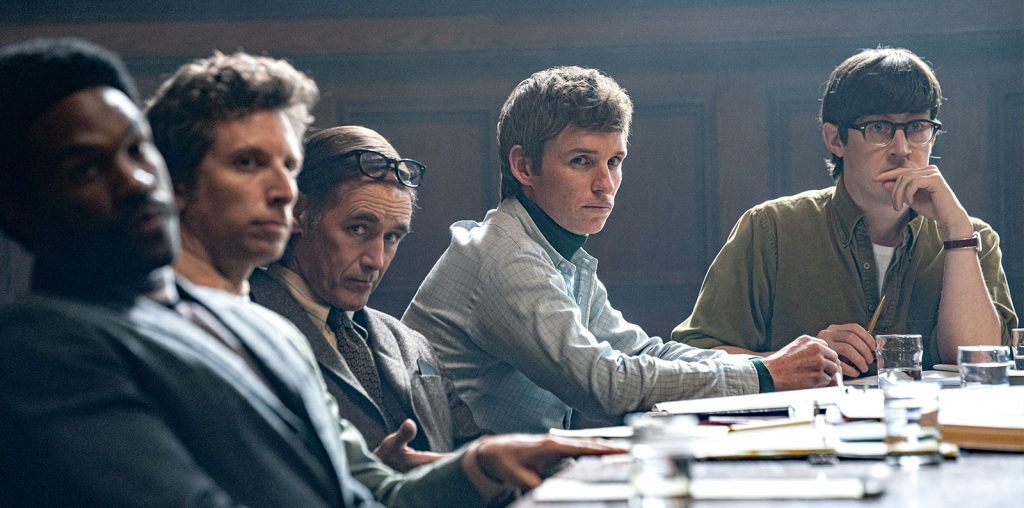
That’s the problem here: it’s a little too pedestrian. Only an argument between frustrated liberal Hayden and his lawyer Kuntsler captures something of the dynamic pace of Sorkin at his best. Other scenes – such as an out of courtroom scene between decent just-doing-my-job prosecutor Richard Schulz (a low-key but very good Gordon-Levitt) and Hoffman and Rudin – are a little too on-the-nose in making their points about liberty, truth and justice. 

The strongest moments by far are in the courtroom – and the true-life staggering lack of proper procedure followed there. The film is rightly angry, without tipping too much into outright preaching. It’s shocking to see how little the rights of the defendants were respected. Much of this came from the attitude of the judge, Julius Hoffman: a traditionalist, his contempt for the defendants clear throughout, handing out contempt of court charges like sweeties. Frank Langella stands out as a man so convinced of his own morality – and so locked into his own certainty about right and wrong – that he is completely unaware many of his rulings are biased and is deeply hurt at being accused of racial imbalance, while having the only black defendant literally bound and gagged.

Yahya Abdul-Mateen II is superb as Bobby Searle, the Black Panther leader furious at being roped into the trial. Searle loudly – and vigorously – protests the trial has not been delayed to allow his lawyer to attend and that he has been refused (consistently) by the judge his right to represent himself. The treatment of him is shocking and appalling. But it feels like no attempt is made to put this in wider context either of civil rights at the time or in America since. And that feels like a major miss. We’re only a few degrees from the same effectively happening today.

This is part of the film’s general problem in finding its real focus, or wider context. I suspect its heart is probably in the views expressed by Hoffman on the stand – particularly those around not having his thoughts on trial before – but this film is too scatter-gun.

What the film does do well is with the quality of its performances. Sorkin may be a rather a visually flat director – his shooting of the convention riots completely fails to conceal the lack of budget – but he encourages great work from actors. Redmayne and Cohen give skilled performances as the acceptable and radical faces of left-wing politics. Strong is wonderful as a hippie with a firm sense of right and wrong, while Carroll Lynch is great as a pacifist driven to the edge. Mark Rylance excels as radical lawyer Kunstler, softly spoken but passionate, who brings fire to proceedings.

It’s a shame though that The Trial of the Chicago 7 settles for mostly being a walk-through of the trial. An attempt to really capture a sense of the deeper politics gets lost, and the failure of the film to really draw parallels with today or place these events in their wider context feels like a missed opportunity. Even the film’s end captions don’t give you as much information as you would hope – especially telling considering its abrupt ending. A well-meaning effort, but a middle-brow film.

The White Ribbon (2009)

The kids are not all right in Michael Haneke’s The White Ribbon

Director: Michael Haneke

Cast: Christian Friedel (Teacher), Ernst Jacobi (Narrator), Burghart Klaußner (Pastor), Steffi Kühnert (Pastor’s wife), Rainer Bock (Doctor), Susanne Lothar (Midwife), Roane Duran (Anna), Leonie Benesch (Eva), Ulrich Tukur (Baron), Ursina Lardi (Baroness), Maria-Victoria Dragus (Klara), Leonard Proxauf (Martin), Josef Bierbichler (Baron’s steward)

I think it’s fair to say Michael Haneke has a mixed view of humanity. His films look at the dark side of human nature, and the hypocrisies and cruelty underpinning much of our society. The White Ribbon explores these ideas further, a parable focusing on a small German village in the months before World War One, looking at how the life in one village perhaps helped lay the moral and societal groundwork for the younger generation to grow up and embrace Nazism.

In the fictional village of Eichwald, tradition is strong. The town, and its morals, are governed by traditional authority figures. However, each of these figures fails to live up to the values they – often brutally – enforce on the village and, most especially, its children. The Baron (Ulrich Tukur) is a distant autocrat, who talks of a duty of care but treats the villagers like property. The pastor (Burghart Klaußner) preaches morality and abstinence, but bullies his (many) children and condemns utterly even the slightest deviation from his own rules. The doctor (Rainer Bock) is a studious clinician, who humiliates and devalues his lover, the town’s midwife (Susanne Lothar), and sexually abuses his teenage daughter Anna (Roane Duran). In late 1913, a series of unexplained and increasingly violent events occur, from an attempt to cripple the doctor to arson, kidnap, theft and the beating of the midwife’s handicapped son. The perpetrators remain a mystery – one which the decent but ineffectual teacher (Christian Friedel) attempts to uncover – his older self (Ernst Jacobi) providing an, at times, naïve narration.

Haneke’s aim is to explore the conditions that led a generation to embrace a regime that promotes the unthinkable. While it’s clear that a future of Hitler and fascism – neither mentioned once in the film – hover over everything, this parable could serve for any totalitarian regime. Haneke is not interested in specifics. What fascinates the director is the creation of a mind-set that enables people to willingly align themselves with horrific actions. The brilliance of The White Ribbon is that could be as easily applied to Stalinism and the Khmer Rouge as it can to Nazism.

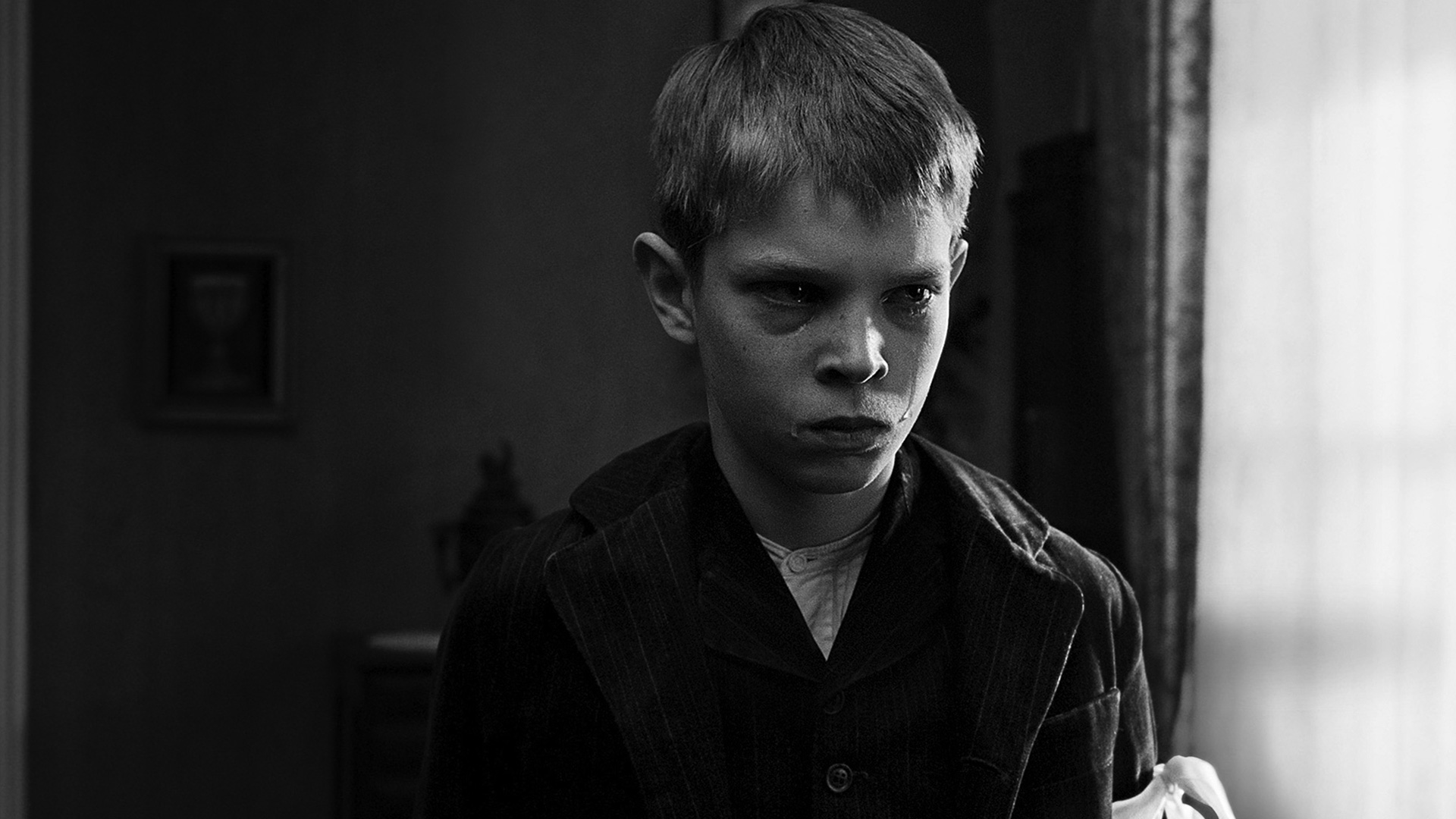
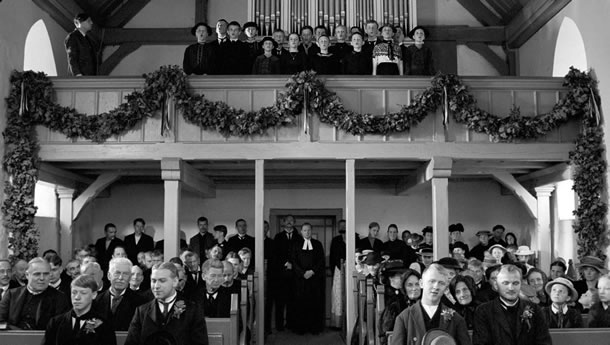
Shot in a beautiful black-and-white, the film presents a series of striking images, imbued with an immense psychological depth and haunting sense of dread. Haneke’s mastery of visual imagery is sublime, and he paces the film perfectly. While it is easy to claim the film is slow – and it does take its time – the deliberation of the pacing, and the precision of each shot, is all part of giving the film its thematic weight. It’s like a medieval passion play, with every moment giving depth to the whole.

The film’s focus is on the children – tellingly, only characters below the age of about 20 are named. It’s their faces the camera returns to time and again – and the film is set in a key moment of many of their lives, where disillusionment with adults begin. The age when they begin to realise their parents are far from perfect and even hypocritical. The film more than suggests that it is the children – working in some combination or alone – responsible for the crimes that take place in the village. Their motivations range from anger and resentment to despair and a longing for escape.

Many of these events centre around the pastor’s family. Played with a perfect emotional austerity by Burghart Klaußner, the pastor judges all around him as unworthy, with his children suffering the brunt of his discipline. It’s easy to see he is overly harsh, hypocritical (the sheer number of his children suggests he hasn’t worked hard to suppress his own sexual feelings) and unjust. His son is tied to his bed while he sleeps to prevent “impure touching” and his daughter is blamed, and publicly humiliated by him, for a school disturbance she is trying to stop. He’s a father who demands respect but cannot inspire love.

Almost worst of all, he requires his children to wear a white ribbon, to constantly remind them of moral standards they have failed to live up to. These acts of stigmatisation and bullying are not balanced with any outward affection – whatever he may actually feel, the pastor is far too restrained to show any warmth – and Haneke demonstrates his children are taking all the wrong lessons from him. The learn to be cold, distant and judgemental, and that strength is vital and weaknesses are not to be tolerated: they beat out individual thinking, and replace it with cold conformity. A basically good man – and the pastor clearly believes he is doing his best to protect his children – rears children who see others as inferior and different, and stigmatisation as an essential part of life.

The whole village lives in medieval thrall to the baron. You could be believe this village was hundreds of years in the past, not a single century. The villagers slave on the baron’s fields, meekly tugging their forelocks to him in church. The baron takes unilateral decisions affecting everyone’s lives. His own family life is cold – his wife doesn’t love him (and her sexual, not romantic, faithfulness is the only thing that matters to him), while his weak young son is the victim of at least two crimes. It’s a pattern of distant, selfish authorities who believe they work for the good of the community, while taking everything they can from it.

But then corruption is also endemic at the home. Rainer Bock gives a chilling performance as the local doctor, respected by the community for his dedication, who treats those closest to him with disdain at best, and abusive cruelty at worst. A controlling, cruel man, the doctor is the clearest example in the film of the hypocrisy of the older generation, demanding respect, decency and obedience from the younger, while treating them with selfish vileness.

Haneke’s film is a grim – and disturbing – study of this sort of everyday horror and it effect on the psyche. The dehumanisation of the young is clear, and the growing casual cruelty they begin to dish out to others becomes more and more striking. The film taps into a Wyndhamish fear of the young, the children moving in packs, their respectful words not matching their air of menace. This unsettling feeling only grows because, for many of the crimes, we are never given a firm answer to who carries them out (although we can guess). Saying that, at least three acts of violence and sabotage are explicitly shown, all of them carried out by the young – enough for the viewer to suspect the others can be tied to the same generation.

The film does pepper itself with touches of hope – enough to suggest not everyone is destined to succumb to malevolent forces. The schoolteacher – sweetly played by Christian Friedel – is well-meaning, if ineffectual, and his courtship of the baron’s dismissed nanny Eva (an endearing Leonie Benesch) has a charming bashfulness. (Although the fact the couple are brow-beaten into postponing their marriage by her domineering father reminds us of the dominance of the older generation). After the pastor’s pet bird is killed (by his daughter, who crucifies the creature on his desk), he is moved to tears when his youngest son offers him his own pet bird to make him feel better (although inevitably the offer only promotes a curt “thank you” from the Pastor while his son is in the room). The women of the older generation all show signs for reluctance or discontent with the behaviour of the patriarchs, although any protest is of course in vain.

It’s touches like this that prevent Haneke’s film from being a lecture. The village isn’t inherently bad, just terribly misguided. This all enforces the universality of the film. You’re kidding yourself if you think this could only happen in Germany. These generational clashes and the twisting of an entire generation could happen anywhere. The world is what we make it, and the white ribbons that help us remember our innocence can just as easily be used to categorise us as the worthy and the unworthy. Haneke’s film is a brilliant, profound and challenging piece of work that rewards thought, analysis and rewatching. Quite possibly his masterpiece. 

Queen and Slim (2019)

Jodie Turner-Smith and Daniel Kaluuya are on the run from injustice in Queen and Slim

Director: Melina Matsoukas

Cast: Daniel Kaluuya (Slim), Jodie Turner-Smith (Queen), Bokeem Woodbine (Uncle Earl), Chloe Sevigny (Mrs Shepherd), Flea (Johnny Shepherd), Sturgill Simpson (Officer Reed), Benito Martinez (Sheriff Edgar)

You could say Queen and Slim was the film of 2020 that was unlucky enough to be released in 2019. There can be few other films that have captured so effectively the injustice that the killing of George Floyd revealed to the wider world. But watching Queen and Slim reminds many of us in more privileged positions that the sort of systemic outrages that 2020 has brought to light existed for decades prior to this.

Our unnamed leads are “Queen” (Jodie Turner-Smith), a criminal defence lawyer, on an awkward Tinder date with “Slim” (Daniel Kaluuya). The date is not a huge success – possibly because the determined and ambitious Queen has little in common with the gentle, Godly and quiet Slim – but their lives are changed forever when Slim gives her a lift home. Pulled over by an increasingly aggressive police officer, innocent questions from Slim, and Queen’s challenge of his authority, lead to his gun being drawn, Queen shot in the leg and a scuffle with Slim that leaves the officer shot dead. Now wanted for killing a police officer – and convinced that their side of the story will never get an equal hearing – they go on the run. But their cause seizes the public imagination, and “the Black Bonnie and Clyde” end up inspiring others to take a stand across an unjust system.

Queen and Slim uses common conventions of a road movie: two young people on the run for a crime who discover new things about themselves and the world as they travel, drawing closer together. In that sense there is nothing too revelatory about it. Indeed half of the film’s impact – rather like Thelma and Louise – is taking expected tropes and presenting them to us from new perspectives. But what Matsoukas’ film does so effectively is to add a completely new political and social dimension to this. This road movie instead becomes a searing commentary on race in America and the injustice of the system.

Endemic unfairness runs through the entire movie. From the pulling over of the young couple at the start of the film – a search that becomes increasingly invasive and aggressive for no other reason than the officer’s reaction to their colour – to their final confrontation with a lethally trigger-happy police force, there is no fair crack of the whip for this couple. Queen’s restatement of her and Slim’s rights when pulled over is seen as a violent action. The media swiftly turn the couple into ruthless, dangerous killers. A parade of law enforcement (certainly all of the white officers) sink quickly to using crude, racially tinged stereotypes. And there is of course no question that an unjust, one-sided trial ending in (at best) a life-long prison sentence awaits this couple if caught.

But the film also shows brilliantly another side of America. On the road trip, Matsoukas’ camera captures the distant, sometimes run-down, ghettoised communities of non-White groups in America (to the extent that a traditional picket-fenced house visited late on by the couple seems like a foreign land). The camera pans through parts of America we rarely see – and also sees the communities there. These are people who know, in their hearts, that Queen and Slim are the victims here – that the police are more than capable of shooting black people who look like they might cause trouble, whether they have or not. But they also know that there is no chance of justice for them, that they are destined to become martyrs. And that like them, every Black person in America could be a breath away from falling victim to police brutality.

This gives the film a real edge, that gains extra force the more events from the news remind us that issues like this are far from fiction. It gives a political force to the film that serves as a superb snapshot of America today. Matsoukas’ film is shot with vibrant freshness and she draws a great couple of performances from the leads.

Both are contrasting souls, who find themselves drawn closer together as they slowly absorb each other’s qualities. Jodie Turner-Smith is superb as the lawyer with a chip-on-her-shoulder, whose unhappy family life has led to her putting up emotional safeguards that only slowly erode over the course of the film. In many ways the road journey gives her a freedom she has never had before – while Slim’s gentleness encourages her to express sides of herself she has kept long-hidden. Daniel Kaluuya is similarly wonderful as the devout and gentle Slim, who discovers in himself an anger and resentment at the injustice he had accepted as part of everyday life.

Queen and Slim marshals this altogether into a compelling package that will open many people’s eyes to the truth of racial politics in many parts of America – and the tensions underneath it. 

JFK (1991)

Kevin Costner goes on a quest for the truth in Oliver Stone’s crazy but brilliant JFK

Director: Oliver Stone

Cast: Kevin Costner (Jim Garrison), Sissy Spacek (Liz Garrison), Kevin Bacon (Willie O’Keefe), Tommy Lee Jones (Clay Shaw), Jack Lemmon (Jack Martin), Walter Matthau (Senator Russell B Long), Gary Oldman (Lee Harvey Oswald), Joe Pesci (David Ferrie), Donald Sutherland (Colonel X), Laurie Metcalf (Susie Cox), Michael Rooker (Bill Broussard), Jay O. Sanders (Lou Ivan), Edward Asner (Guy Banister), Brian Doyle-Murray (Guy Banister), John Candy (Dean Andrews), Sally Kirkland (Rose Cheramie), Wayne Knight (Numa Bertel), Priutt Taylor Vince (Lee Bowers), Tony Plana (Carlos Bringuier)

When great events happen, it’s hard for us to accept they might take place for random reasons. Rather than freak occurrences or boring individuals, we’d rather see them taking place due to an impenetrable web of shadowy figures. There is something in us that rejects randomness and embraces order. Conspiracy theories are the (ironic) result of these, with their exponents often the most passionate believers in the all-pervading genius of big government. Events like the death of President Kennedy can’t be because some nobody shot him. Instead it must be part of a wider junta of baddies, with every man you see merely a front for a cabal of the wicked. It’s hard not to be swept up by the lure of the conspiracy theories (they invariably have the best stories after all) – and Oliver Stone’s JFK is perhaps the definitive mainstream conspiracy theory essay.

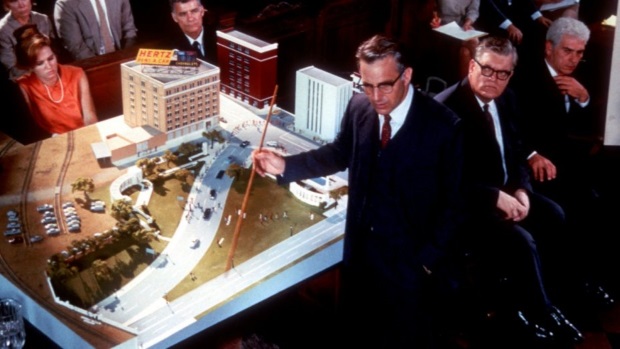
Taking the campaign of Louisiana DA Jim Garrison (Kevin Costner) to find out the “truth” about the murder of President Kennedy, Stone’s film is part a fascinating presentation of half-truths and “might-have-beens” and part a sprawling mess of irresponsible nonsense. Either way it’s assembled with astonishing panache, a level of filmic skill that makes it (literally) almost impossible to tell whether what you are seeing is true and what is invention. Stone’s film superbly interweaves a variety of film stocks and effects to seamlessly splice together newsreel footage, Zapruder film and his own reconstructions so brilliantly it frequently becomes hard to tell which is which.

The same logic also applies to the script. JFK is frequently engaging and fascinating. But you have to remember that it is the equivalent of meeting the most literate and articulate street corner “End-of-the-Worlder”. Such is Stone’s skill he could, I am sure, have created an equally compelling film which would have you questioning the Moon Landings or the shape of the Earth. JFK throws an army of questions, objections and theories at the screen. And while it rarely provides much in the way of answers, only points that it wants you to think about, these theories frequently fascinate. Imagine JFK as a sort of video essay, linked together with dramatic scenes, with its points delivered by authoritative and trusted actors like Donald Sutherland, Jack Lemmon and Walter Matthau.

There is absolutely no doubting the technique of Stone here, or his mastery of the language of cinema. The work of Robert Richardson’s photography, with its myriad styles, and of Joe Hutshing and Pietro Scalia’s editing, pulling together a host of images, snapshots and flash cuts into an insidiously convincing whole, is breathtaking. Light in particular is superbly used, casting some characters in shadow, flaring up to (literally) blind others – light frequently plays across Garrison’s glasses, a visual metaphor for his own struggle to see the light. The speeches he writes for his characters are superbly done, and make their points with great skill – Sutherland (superb) has a hugely convincing story of military black ops action (and inaction) before and after the assassination that fills almost 20 minutes of screentime.

There are compelling arguments made about the ability of Oswald to fire the shots, the triangulation of fire, the spurning of an easier shot before the fateful turn, Oswald’s seemingly illogical movements after the shooting etc. etc. There is decent reasoning behind all of this, and the points are marshalled very well. But, like all extremist theories, suddenly it will turn into something just a little batshit (Lyndon B Johnson ordering the hit or some sort of cabal of Cubans, CIA, FBI and Secret Service working together to conduct a coup).

Much of Stone’s passion for finding the truth (the film’s mantra) is rooted in his own romantic view of Kennedy, as some sort of lost “Prince Who Was Promised”. To Stone, Kennedy would have withdrawn us from Vietnam (news I am sure to the President who started and escalated America’s involvement in it), ended the military industrial complex (contrary to his platform when elected of a stronger US military), bought the Cold War to an end (again, running against his sustained opposition to the Soviet Union) and introduced full Civil Rights (a cause he was lukewarm on at best – unlike his brother or his successor Johnson).

But Kennedy was a romantic figure who had the ability to invite people to invest him with whatever qualities they wanted (both good and bad), a magic cemented forever by his untimely murder. In reality there is no indication that JFK would do (or want to do) any of the things JFK argues he was assassinated for. But that’s all part of the magic of the conspiracy. Facts and events can be marshalled into whatever you want them to be. (Tellingly the only member of Garrison’s investigative team who questions these theories is shown to be a creep in the pay of the conspirators.)

So Kennedy can be a saint, and the film can outline (with no evidence at all beyond a series of coincidences and unlikely or random events) a grand vision of master schemers reshaping America over the body of a dead President. Does it really stand up? Well no of course not. But I will say it is compelling viewing – even if it is essential to keep an open mind about it. Stone later wished he had made clearer that much of the work here was pure fiction (and speculative at best). Certainly it’s a point to keep in mind.

Perhaps Stone should also have looked again at some of the other beats in the film. The film’s version of Jim Garrison as a kind of saintly campaigner for justice flies in the face of many (then and later) who believed the Louisiana DA a shameless self-promoter – an argument made easier to believe by the real Garrison’s cheeky cameo in the film as his ‘nemesis’ Earl Warren. No mention is made in the film that the case he brings against Clay Shaw was dismissed by the jury after less than an hour, and the film avoids explicitly showing his lack of evidence. Costner delivers the final speech, with its famous “back and to the left” commentary on what seems like Kennedy’s unnatural movement after being hit by a bullet and breakdown of the “magic bullet” (both theories now largely discredited), with aplomb, but the film puts a halo on Garrison which doesn’t really stand up.

But again at least it’s entertaining. Other parts of the film don’t even manage that: the baseline narrative that links up the various compelling conspiracy lectures is frequently dull, insipid and lamely written. Sissy Spacek has perhaps the most thankless role in film history as Garrison’s wife whose nearly every line is a variation on “Honey please stop reading the Warren Report and come to bed”. Even that though pales against the exploration of the 1960s gay scene in Louisiana (which Clay Shaw and his “fellow conspirators” were leading members of) which has an unpleasant stink of homophobia, playing into a host of deeply unpleasant (and false) stereotypes of gay people as perverted, promiscuous and preying on the straight. One suspects there was more than a little truth in the idea that Garrison’s fury at Shaw was at least partly motivated by homophobia.

These sequences work considerably less well today – and frequently go on far too long – but when the film focuses on its Kennedy theories it is at least compelling, even if it’s all rubbish. The film made it mainstream to believe Kennedy was killed by a conspiracy in which Oswald was, if he was involved at all, only a patsy. How different would the world have been if Oswald had lived and been made to explain why and how he killed Kennedy? But then chances are, being such an average an unremarkable man, people wouldn’t have believed him anyway.

Stone’s film is a triumph of agenda-led fantasy. Stuffed with faults it makes you at least ask questions – even if you wisely use those questions to affirm many of its points are questionable at best. But any film buff will love the skill it’s told with and the beauty of its technical assembly. Costner was perhaps a little too bland to drive the thing along (although the film uses his innate morality very well), but there are several good performances not least from Gary Oldman who is brilliant as put-upon, used but unknowable Oswald. Nuts, crazy and packed with compelling nonsense, it at least always encourages you to find out more about the actual history.

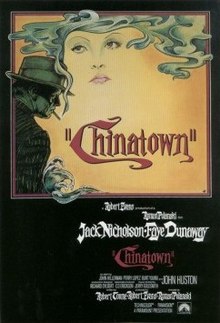
Chinatown (1974)

Jack Nicholson struggles against the system – and loses – in Chinatown

Director: Roman Polanski

Cast: Jack Nicholson (JJ Gittes), Faye Dunaway (Evelyn Cross Mulwray), John Huston (Noah Cross), Perry Lopez (Lt Lou Escobar), John Hillerman (Russ Yelburton), Darrell Zwerling (Hollis Mulwray), Diane Ladd (Ida Sessions), Roy Jenson (Claude Mulvihill), Roman Polanski (Man with Knife), Joe Mantell (Lawrence Walsh), Burt Young (Curly), James Hong (Kahn)

“Of course I’m respectable. I’m old. Politicians, ugly buildings and whores all get respectable if they last long enough.” So says Noah Cross in the superlative Chinatown, the sort of the film you’ll want to start watching again the second it ends. Cross is of course a respectable businessman and an absolute monster. And his mantra applies just as much to Los Angeles as envisioned by Polanski and writer Robert Towne. It’s a corrupt, dirty place where terrible, appalling things are regularly allowed to happen but everyone pretends the place is fabulous. It’s such a sublime film, while also so bleakly, despairingly dark that you are surprised you fall in love with its excellence.

In 1937 private detective JJ “Jake” Gittes (Jack Nicholson) is hired – or so he thinks – by the wife of Water Board director Hollis Mulwray (Darrell Zwerling) to investigate his infidelity. When he does seem to uncover it, he founds not only was his client not Evelyn Mulwray (Faye Dunaway), but that shortly after his pictures appeared in the press (without his knowledge), Hollis himself winds up dead, having drowned in a dry river bed. What does this all mean? And how does Evelyn’s father (and Hollis’ business partner) Noah Cross (John Huston) play into this all? Gittes investigates further, to uncover shady schemes to manipulate the cities water supply for profit, under-handed business deals and unspeakable family crimes that leave lives shattered.

Polanski’s film has such a timeless wonder about it, perhaps because it was filmed with such careful and beautifully designed classicism that it has never dated. Seen at the time as a film told in the style of the classic film noirs (although it is of course full of blazing LA sunshine), but crammed with a darkness and corruption classic Hollywood shied away from it now seems to take its place as the most masterful of Hollywood mysteries. It’s recreation of 1930s detail is perfect, while its film making is restrained, controlled, unflashy but creates an atmosphere of simmering mystery and tension behind every frame. It’s a masterfully restrained piece of film-making that deals with matters of shocking horror.

And tension there should be as this explores the darkest underbelly of America. With Jerry Goldsmith’s sublime music score under every beat – riffing on classic Hollywood tunes, but with a haunting faded grandeur that suggests a whole melancholic world going to the wall – the film looks like classic, beautiful America but uses that to counter-frame terrible, heartless acts. LA is corrupt from top to bottom. Businessmen are asset stripping the city and its surroundings to line their own pockets. Wealth brings total immunity from all sorts of crimes, regardless of how foul they are. Even family ties are polluted by terrible lusts and greed. And for Gittes, Chinatown is representative of this – a one word reference to his career as a cop, where his ability to do any good at all was forever compromised by corruption.

Jack Nicholson’s performance as Gittes is central to the film’s success. He’s in every scene and the story is told entirely from his point-of-view – so much so that when he is knocked out, Polanski slowly fades out sound and picture. Nicholson is best known for his flamboyance, but here he brilliantly underplays too present a complex picture of an idealist disguised as a cynic. Gittes tries his best to coolly accept the world is what it is, and even that he is just trying to get what he can out of it. But he’s in fact a decent and honourable man with a deep-rooted sense of morality, who struggles in the world because it’s ill-suited for a guy who just wants to do the right thing. He has a sort of outdated charm and nobility about him, an almost courtly gentleness at times, and only lashes out in anger when he feels is either being lied to or his sense of honour impugned. He has a natural sympathy for the little guy and for all he may try to spin the sort of cynical Marlowesque dialogue, you don’t feel his heart is really in it. He is a dreamer who wants to believe.

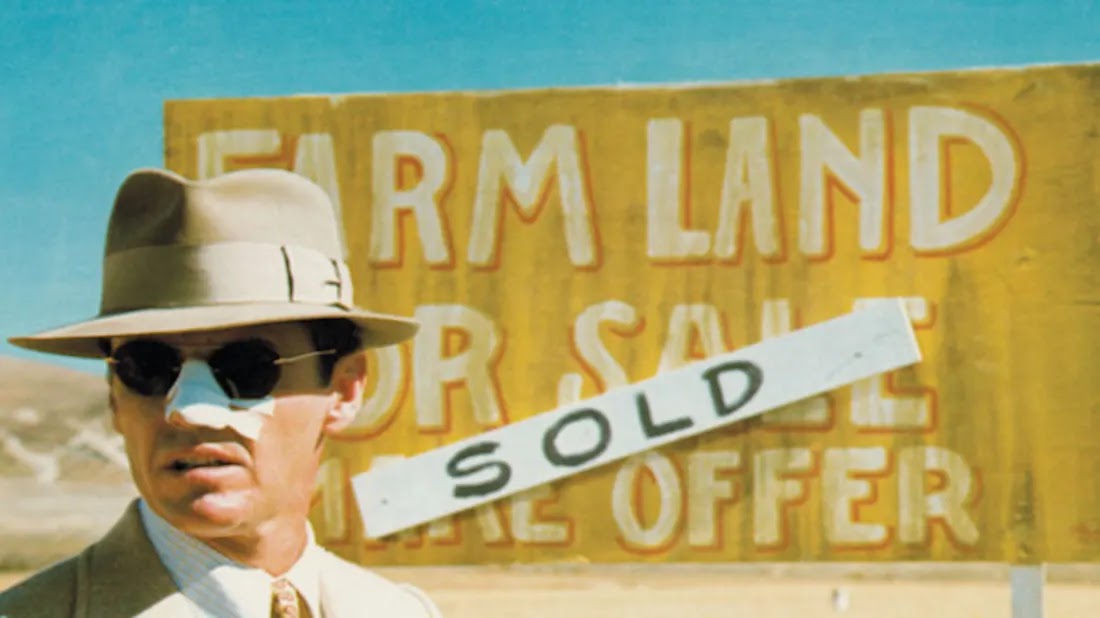
And he’s totally ill-suited to this world he ends up with. Gittes uncovers every inch of the mystery – but nothing he does has any positive impact. He completely fails to protect anyone, his attempts to ensure happy endings end in disaster, he’s regularly beaten to a pulp (most famously having his nose slit by a cameoing Polanski as a weasily little hoodlum) and he’s at sea when dealing with most of the characters of the film. Even his carefully built emotional armour breaks down, leaving him vulnerable to making even more mistakes. There are perhaps few characters so ineffective – and again it’s a credit to Jack Nicholson’s charisma that he makes this character feel like such a proactive figure.

Gittes senses at all times that there is some dark secret underpinning all these events he encounters. But he’s too innocent to begin to suspect the horrors that Evelyn has put up with at the hands of her abusive father. Faye Dunaway brings a marvellous fragility and vulnerability to a character who transcends the traditional femme fatale. (Dunaway famously hated both Polanski and working on the movie). At first seeming imperious and even suspicious, the film slowly breaks her character down into a wounded and vulnerable woman putting on a front, determined to try and protect herself but doomed to forever be the victim.

And Noah Cross is the dark heart of this. Played with a sensational sense of gentility masking supreme corruption and greed by John Huston, Cross is genteel and polite while being ruthless and grasping. He also reveals himself capable of huge, destructive acts, indifferent to the pain this causes and utterly implacable in his vileness. Huston’s performance – he’s only in three scenes – embodies the terrible dark heart of America, where money and power it seems can let you get away with anything you want, no matter who knows. (And I love the way he persistently mispronounces Gittes name, turning it into a growling Anglo-saxon “Gits”.)

Robert Towne’s superb screenplay is perfectly paced and pieces together an intricate and fascinating plot where every small detail mounts together into a devastating whole. It’s a film that demands careful watching, and that revels in small details and character beats that gain greater impact the more you see the film. Brilliantly, the macguffin here is water – the control of a substance that should be a right for every man, becoming a superb metaphor for the theft from ordinary Americans of justice and their country. 

The film culminates – as you feel it must when watching it – in a nihilistic ending where evil triumphs and good loses out. “Forget it Jake – it’s Chinatown”, goes the famous closing line. It works so superbly, because in Towne’s and Polanski’s vision of America here, there is no chance of the right thing winning out if the powers that be would have otherwise. With Jake’s Chinatown career in the police force becoming emblematic of everything that’s wrong in American justice, sure it makes sense that his return there as a private eye would see the same outcome. Towne pushed for a more upbeat ending, but Polanski knew – correctly – that only the shock of murder could end this tale, especially a murder that would have no repercussions.

Polanski’s direction is faultless, cool, calm, wonderfully observant with a superb sense of the 1930s – the film looks beautiful – and using the sunlight and brightness of LA to stress that just because we can see clearly, doesn’t mean we understand what we are looking at. With one of the greatest scripts ever – and a superb performance by Jack Nicholson in one of his finest roles – this is one of the best mysteries in Hollywood history, a timeless classic.

Gandhi (1982)

Ben Kingsley excels as Gandhi in Richard Attenborough’s Oscar winning epic

Director: Richard Attenborough

Cast: Ben Kingsley (Mahatma Gandhi), Rohini Hattaggadi (Kasturba Gandhi), Roshan Seth (Jawaharlal Nehru), Pradeep Kumar (VK Krishna Menon), Saeed Jaffrey (Vallabhbhai Patel), Alyque Padamsee (Muhammad Ali Jinnah), Virendra Razdan (Maulana Azad), Candice Bergen (Margaret Bourke-White), Edward Fox (Brigadier General Reginald Dyer), John Gielgud (Lord Irwin), Trevor Howard (Judge Broomfield), John Mills (Lord Chelmsford), Martin Sheen (Vince Walker), Ian Charleson (Reverend Charles Andrews), Arthul Fugard (General Jan Smuts), Geraldine James (Mirabehn), Amrish Puri (Khan), Ian Bannan (Senior Officer Fields), Richard Griffiths (Collins), Nigel Hawthorne (Kinnoch), Michael Hordern (Sir George Hodge), Om Puri (Nahari)

In 1962, Richard Attenborough was approached by Motilal Kothari, an Indian civil servant, who believed Attenborough was the man to bring the life of Mahatma Gandhi to film. All this despite Attenborough having never directed a film. But the life of one of history’s greatest men, and passionate advocate of peace and non-violence, spoke deeply to the socially-engaged Attenborough who dedicated 20 years of his life to bringing the film to the screen, immersing himself in Indian culture along the way and winning the support of Nehru (until his death delayed the project again) and Gandhi’s family. The eventual film was a huge success, cementing the public perception of Gandhi and beautifully capturing both the importance of the story, and its emotional heart.

Opening with Gandhi’s assassination in 1948, the film covers in flashback his life from combatting anti-Indian prejudice in South Africa as a young, British-trained, lawyer to his return to India and long involvement in the campaign to win India its independence from the British Empire, stressing non-co-operation, his eventual success but also his failure to hold the Hindu and Muslim parts of the country together and his attempt as “father of the nation” to put an end to religious violence, a failure that will eventually lead to his assassination. 

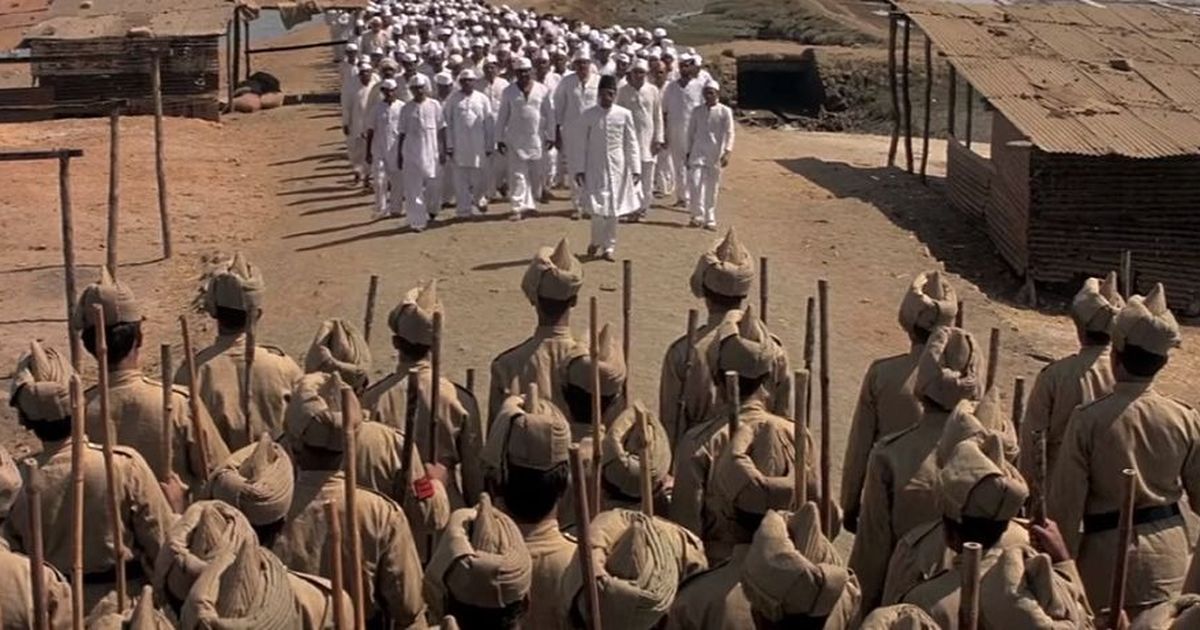
Attenborough’s grand, epic film marshals thousands of extras to bring to life pages of history. At times events fly by with speed, but Attenborough never loses sight of the emotional heart of the story – both Gandhi and the status of Indians as not being masters in their own home. Attenborough directs scenes of real power, most strikingly a heart-rending peaceful march on a salt works (the tax on salt use being a major burden on many poor Indians) that culminates in line after line of peaceful Indian protestors walking calmly forward to be beaten down by soldiers. Despite being the grandest and largest of films, it allows questions of pure morality and decency to lie at its heart and, supported by a parade of British acting greats, keeps the Indians at the heart of their own story and the masters of their own destinies.

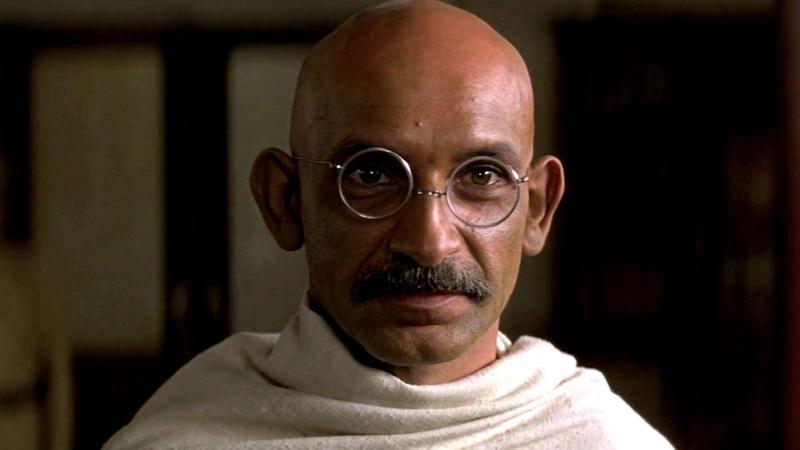
The film’s impact though may be directly connected to the gloriously transcendent performance of Ben Kingsley in the title role. For years it was believed the film could only work with a British actor in the title role – imagine how it would be received today if Gandhi had been played by (as it nearly was) a browned-up Anthony Hopkins or John Hurt (who famously told Attenborough he looked absurd). Instead half-Indian unknown RSC actor Ben Kingsley took the role. Kingsley so completely and utterly immersed himself in Gandhi – everything, the physicality, the morality, the voice, the intellectualism – that not only has he become so completely associated with the role but it’s hard to imagine anyone else playing it.

Ageing almost 50 years over the course of the film, Kingsley’s Gandhi is above-all moral, softly-spoken, observant and considerate – the very spirit of the original man seems to be up on the screen. Far from the sort of histrionics you might expect from a subject of an epic movie, Kingsley is not afraid to be quiet, gentle even underplayed. He completely understands that the charisma and power in Gandhi laid in his moral authority, not his speech-making, but his careful example-setting of even-handedness, patience and desire for peace. 

But Kingsley is also willing to show Gandhi as shrewd and stubborn, even while mixing it with both a deep pain at the loss of life. Kingsley is superbly good at the smaller quieter moments – he wrings heart-rending force from the loss of his wife (a similarly impressive and quietly authoritative performance from Rohini Hattaggadi), which partly works because the film quietly centres the truth and faith in their marriage. This is extraordinary work from Ben Kingsley, that seems to carry not just the entire film but the sense of a nation.

Attenborough though was a director who was at his best when working with actors, and his ability to coax truthful and heartfelt moments from quiet scenes are what gives the other sequences the emotional force to make them work. Attenborough seemingly called in every favour to assemble the supporting cast that backs up Kingsley, many of them juggling only a few scenes. Among the stand-outs we have a martially certain Edward Fox as General Dyer, an archly arrogant John Gielgud and a frustrated John Mills as viceroys, Trevor Howard representing decent British rule as an honest Judge and Martin Sheen as a reformist minded journalist. That’s to overlook dozens of others in small roles, all of them clearly committed to the intention of the project.

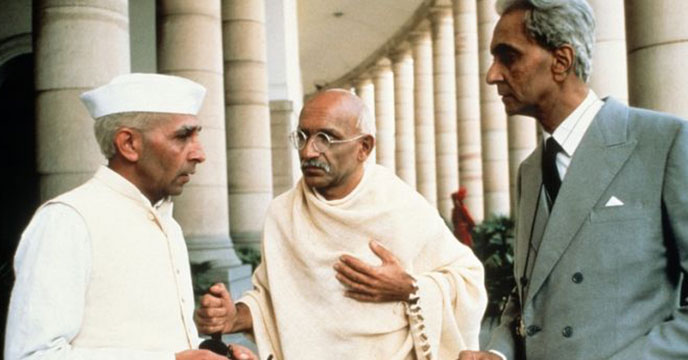
The film though allows the Indians themselves to take centre stage, even if it is easy to criticise some of the simplifications of many of the issues that would eventually culminate in partition. The film has a clear hostility towards the idea of religion, seeing it as the root of much of the violence that erupted in India in the last years of Gandhi’s life. While Roshan Seth is excellent as Nehru, the character is portrayed more as the faithful follower of Gandhi than the shrewd politician in his own right (it’s a role most of the other leading members of congress are also placed in). Alyque Padamsee carries a high level of charisma as Jinnah, founder of Pakistan – but the film can’t quite resist painting him into the corner as a semi-villain, ignoring Gandhi’s desperation to get Jinnah to invest in a united India.

It’s part of what has been seen since as the film’s more hagiographic stance towards Gandhi. Certainly later historiography has outlined a few shades of grey in Gandhi – although I would argue that seeing him as a man and not a saint only heightens (similar to Mandela) the awe at what he went on to achieve. The film’s whistle stop tour of Indian history – taking in every major event and personality, some in a matter of moments – looks particularly old-fashioned now with our current trend being biographical films that focus only on crucial moments, not the whole life. It adds a slight air of schoolboy history to the project, an unfortunate side-effect of the passionate earnestness with which the story is told.

But then even in 1982 – when it lifted 8 Oscars including Best Picture, Director and Actor and most of the technicals – it was seen as slightly old-fashioned. Attenborough has generously repeatedly said that he believed Steven Spielberg was more deserving of Best Director for ET. And it’s true that Attenborough was in many ways a producer at heart with these epics than an inspired director like Lean. His marshalling of crowds, finances and simply forcing the will together to make the picture – and to allow it to focus on Indians rather than Westerners – is a tribute to his organisational skills. His strengths as a director were more in performances, and as with many of his epic films the most memorable moments are smaller, intimate ones. The larger moments are shot with an assured professionalism rather than inspiration, but Attenborough understands how to wring emotion from moments and how to let character drive action.

Gandhi works above all because even today you can see it is a passionate labour of love, that everyone involved in clearly believed in passionately. It may well be that at times it is workmanlike or simplistic – and covers the sweep of history with an earnest completeness, even while it is unafraid to be critical certainly of the British – but it still invests it crucial moments with humanity, life and deep emotion. You can’t help but be moved by it – and you are instantly stunned by the sheer brilliance of Kingsley as Gandhi, one of those performances like George C Scott as Patton which seems more like the man than the real thing. Gandhi may be old fashioned, but that’s not a crime when the quality is still there.

The Last Hurrah (1958)

Spencer Tracy runs for office in John Ford’s toothless satire The Last Hurrah

Director: John Ford

Cast: Spencer Tracy (Major Frank Skeffington), Jeffrey Hunter (Adam Caulfield), Dianne Foster (Maeve Caulfield), Pat O’Brien (John Gorman), Basil Rathbone (Norman Cass), Donald Crisp (Cardinal Martin Burke), James Gleason (“Cuke” Gillen), Edward Brophy (“Ditto” Boland), John Carradine (Amos Force), Willis Bouchey (Roger Sugrue), Ricardo Cortez (Sam Weinberg), Wallace Ford (Charles J Hennessey), Basil Ruysdael (Bishop Gardner)

Mayor Frank Skeffington (Spencer Tracy) is running for a fifth term of a “New England city”. Skeffington’s roots lie in the town sprawling Irish population, and has successfully played the game of machine politics all his life. He’s alienated the members of the towns traditional elite – who can trace their ancestors all the way back to the Mayflower – but he’s loved by the regular people of the city. But is Skeffington going to find himself out of touch with a political world starting to embrace populism and the power of television?

John Ford’s adaptation of a hit novel by Edwin O’Connor, is one of his rare “present day” pictures. But it’s a bit of a busted flush. What should have been an exploration of a tipping point in American politics, totally fails to successfully land any of the points it could make. It’s a film that doesn’t understand the Kennedy-esque world America was moments away from embracing, and looks with such ridiculously excessive sentimentality at old-school politics it manages to tell us nothing about the corruption and dirty deals of this sort of machine politics. Effectively it’s a film that takes two long hours to tell us almost nothing at all. 

The film adores two things – and it’s not a surprise in a Ford film – the past and the Irish. Anything from yesteryear is covered in a halo, with the parade of old-school Hollywood character actors from the Ford rep company taking it in turns to denounce and condemn anything and anyone less than 40 years old. Every young person in the film is either a feckless idiot – Skeffington and Cass’ sons are a playboy and an embarrassing moron – or, like Jeffrey Hunter’s Adam Caulfield (Skeffington’s nephew covering the election for the local paper) is there merely to provide doe-eyed adoration. 

As for the Irish, the film loves the grace and charm of this old immigrant community. Skeffington’s Irish political machine is sanitised beyond belief. In the real world these sort of organisations operated on a system of back room deals, intimidation and careful arrangements to deliver set quotas of votes on polling day. Sure many of these politicians also delivered a number of social reforms – as Skeffington does – but any suggestion that any of Skeffington’s dealings could ever be described as dirty are roundly dismissed. Here it’s all about what Skeffington could do for other people, and no mention of the endemic corruption in many politicians like this. Instead Skeffington is presented with nothing but rose-tinted sentimentalism, a respectful widower, a kind man, whose actions are often more about other people than politics.

Former Boston mayor James Michael Curley – who Skeffington was clearly based on – was imprisoned for corruption. No chance of that happening to Skeffington who only uses intimidation and back-street savvy to fight the causes of orphans and widows (literally) and takes nothing at all from the public purse (although he still lives in a lovely big home). By contrast his elite opponents are the sort of scowling, greedy, penny-counters you might find in a Frank Capra film, shameless bankers and newspaper types who care nothing for truth and justice and only their own selfish needs.

Perhaps that’s why Skeffington’s opponent McCluskey (an early Kennedy substitute with his perfect family life, war record and lack of actual accomplishments) is portrayed as such an empty suit, a mindless, grinning yes-man who has nothing to say and no goals to meet. Ford’s contempt for him – and for the new word of television – drips off the screen. The TV shot we see McCluskey shooting is a farcical mess, poorly shot, edited and delivered with stilted artificiality by McCluskey and his tongue-tied wife. Not only is it not particularly funny, the presentation of this just shows how out of touch Ford was with modern America. Two years after this, Kennedy would win an election largely off the back of his ability to present a dynamic image on TV. Skeffington even crumbles in the election due to his traditional, press-the-flesh campaign not competing effectively with TV slots. How can that look even remotely convincing when Ford shows his rival has no mastery of the new media at all? That in fact he’s worse at making TV than Skeffington proves to be?

What exactly was Ford going for? By failing to criticise anything at all about the old-school politics and pouring loathing on the new politics, he ends up saying very little at all. Skeffington is a twinkly angel, but we never understand why so many in the church and the city oppose him – other than the fact I guess that he is Irish. Donald Crisp’s cardinal promises at one point near the end to reveal why he always opposed Skeffington – only to be hushed. If anything bad ever happened, Ford ain’t telling us making this one of the most dishonest of his tributes to Old America.

None of this is to criticise much of the acting, which is great. Spencer Tracy dominates the film with his accustomed skill and charisma, his Skeffington both a twinkly charmer and a practised flesh-presser who manages to subtly pitch and adjust his character depending on his audience and whose physicality helps to assert his dominance in every scene. Pat O’Brien does fine work as his fixer and Basil Rathbone is suitably sinister as a his principle financial opponent. Ford also puts together some memorable shots – especially a long walk Skeffington takes past a victory parade – and scenes, but the film is an empty mess. And, with its extended final twenty minute coda, goes on way too long.