Category: Prison films

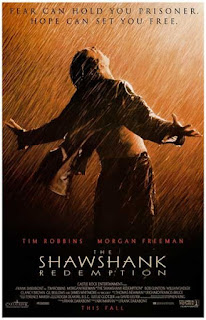
The Shawshank Redemption (1994)

The Shawshank Redemption (1994)

Hope and friendship are put to the test in one of the most beloved films ever made

Director: Frank Darabont

Cast: Tim Robbins (Andy Dufresne), Morgan Freeman (Ellis Boyd “Red” Redding), Bob Gunton (Warden Samuel Norton), William Sadler (Heywood), Clancy Brown (Guard Bryon Hadley), Gil Bellows (Tommy Williams), James Whitmore (Brooks Hatlen), Mark Rolston (Bogs Diamond)

You’d hardly believe it… but the film now routinely listed as one of the most beloved films of all time was actually a box office bomb. The Shawshank Redemption tops many public polls of great films. It’s been the number one film on IMDB practically since the site was built. What is it about it that has had such a connection with people? Perhaps it’s because, under the multitude of genres the film touches on, it’s a film about the strengths of two things crucial to all of us: hope and friendship.

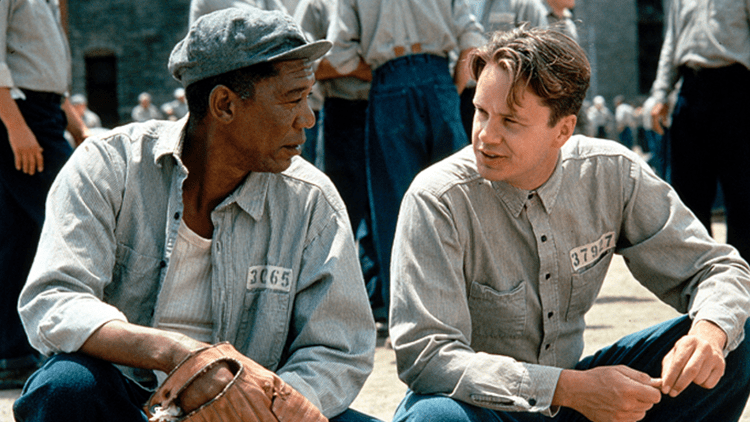
In 1947 Andy Dufresne (Tim Robbins), a mil-mannered bank manager, is imprisoned for life in Shawshank State Prison for the murder of his wife and her lover. For the next twenty years, Andy will get busy living rather than get busy dying, finding what moments of warmth, friendship and hope he can from rebuilding the prison library to helping his fellow prisoners. But he’ll also face daily danger, from sexual assault from brutal fellow prisoners to the machinations of corrupt warden Samuel Norton (Bob Gunton). During his time in prison, his confidant and closest friend is Red (Morgan Freeman), a smart fixer who has spent decades failing his parole hearings.

This is possibly the finest Stephen King adaptation ever made – the other major contender, Kubrick’s The Shining, has the disadvantage of being loathed by the author – perhaps because it captures both the Dickensian sprawl and sentiment of King’s best work, mixed with his edge and danger. There is a charming shaggy-dog story element to The Shawshank Redemption that helps make it delightful to watch. Not only that, it carefully builds up empathy for two people, both of whom are convicted murderers. It manages this as it turns its prison setting into a universal metaphor for the helpless victim trapped in a system.

Because, for all the pious spouting of the Warden (Bob Gunton at his most hypocritically vile), Shawshank is a place devoid of justice. On Andy’s first night in prison, a fellow new arrival is beaten to death for refusing to stop his terrified whining by head guard Hadley (a terrifyingly blank and amoral Clancy Brown). Abuse of power is pretty much endemic in Shawshank – as Andy discovers as he witnesses the guard’s casual brutality, and his accounting skills drags him into building the corrupt financial empire Norton runs with the slave labour of the prisoners.

Shawshank is all about squeezing hope out of people. It’s nothing less than a dystopian hell hole where there is no right and wrong. That’s Andy’s big impact on the place: for all its hellishness, he helps create some sort of freedom. Darabont wonderfully establishes the crushing dehumanising of the prison, so that moments where people can pretend for a moment they are free carry even more power. Whether that’s drinking cold beers on a freshly tarred roof (inveigled by Andy in return for sorting out Hadley’s inheritance tax problems) or listening to Mozart over the prison speakers. It’s there in the rebuilding of the library as a place prisoners can feel pride in or Andy coaching others to gain their school diplomas. And we feel every moment of it with them.

And that’s not even thinking about how brutish some of the other prisoners are. Much of Andy’s first few years in prison see him dodging gang rape from a group of particularly violent prisoners (led by a sneeringly vicious Mark Rolston). For that opening act, Andy is tossed as low as you can go, Darabont pulling no punches on vicious beatings or terror he has to endure. Hope becomes more powerful when it grows out of despair.

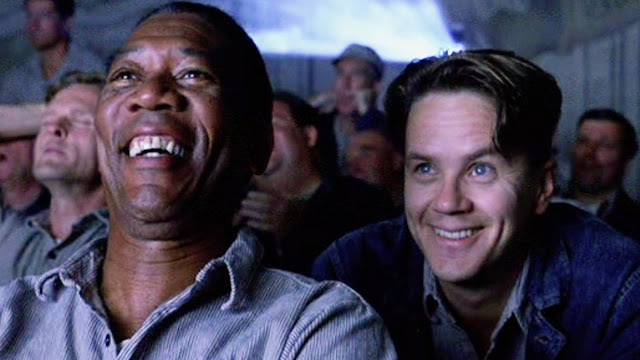
But that suffering is crucial because it gives even more warmth and power to the friendship between Andy and Red. Shawshank Redemption is a beautiful platonic love story, about a deep and lasting bond between friends. The warmth, regard and affection between these two characters, who discover how much they have in common is beautifully paced and supremely engaging.

It’s also helped a great deal by two fabulous performances from the leads. Tim Robbins’ baby-faced inscrutability is perfect for a man who may or may not be a murderer, and looks like he both needs protection and also has the internal strength to see him through anything. You can see why Red thinks, on first meeting him, he might be weak – but also never doubt for a moment that he’s strong enough to wade through the filth of Shawshank.

Opposite him is an iconic, beautiful performance from Morgan Freeman. Darabont’s film uses Freeman’s gorgeous tones to perfection through Red’s narration. Freeman of course gives Red a wonderful world-weary wisdom but also a sort of innocence. Red has worked out perfectly how to bend the rules of the prison – so confidently that he’s an awe of someone who finds out a way to break them completely. This is some of the actor’ finest work, making Red witty, shrewd, self-aware but also in some ways touchingly naïve and scared that he could never survive outside the prison.

Institutionalisation is a major danger in prison: it’s part of the danger of giving up hope, of accepting the status quo that your whole life is those four walls. But then, it’s also the terror of leaving a regimented world, where some decisions are made for you and you can always know your place. One of the film’s finest sequences covers the tragic end for Brooks, wonderfully played by James Whitmore, an educated and respected librarian inside but an irrelevant, old man outside, day-dreaming of one day being allowed to ‘go home’. It’s a danger Red knows could hit him too – after all he’s the best fixer inside, but a man with no such purpose outside.

Darabont’s film understands it. In fact, the film itself encourages the viewer to get a bit institutionalised themselves. The audience enjoys Andy’s triumphs, the commadre between the prisoners, the fun of the tables subtly turned. So much so the viewers can forget that this should be a film about getting out of this hell. (In fact you can argue, after a time, it makes prison look a little like an eternal boys camp). It shakes the viewer up as much as Andy when this status quo we’ve started to enjoy gets shaken up by the arrival of young thief Tommy (Gil Bellows). It’s a moment where the viewer realises that the film made a subtle shift from being a prison drama to a buddy movie where our heroes eek out little wins from the system: not least because this is the point when the system reminds Andy (and us) that it’s not to be messed with.

Darabont’s film reforms into a wonderful caper movie, a super-clever heist, covering Andy’s eventual escape. This is classic Ocean’s Eleven stuff and has the double delight for the audience of paying off Andy’s mistreatment and injustice and also allowing us to really enjoy how ingenious he is. Then the film switches gears effortlessly on a sixpence after this moment of delightful triumph with a low-key, tender, Red-focused coda which taps us straight back into the beautiful warmth of that friendship.

Perhaps this is why The Shawshank Redemption is so universally beloved. It’s a prison film and a buddy film, it’s a caper and it’s a film about a crushing system, it’s a film of hellish suffering and deep hope, all framed around a wonderfully judged, life-affirming friendship. Darabont’ script and direction is perfectly judged and immensely moving and the acting is perfect. It works so well because it constantly brings us back to feelings of hope and friendship. Those are universal feeling and they are beautifully presented in the film. We live with Andy being put through the wringer, and relate to him so much, that we feel as cleansed by the rainfall as he does. It’s that which lies at its success; and the brilliant way it gets you to invest in the fate of its characters.

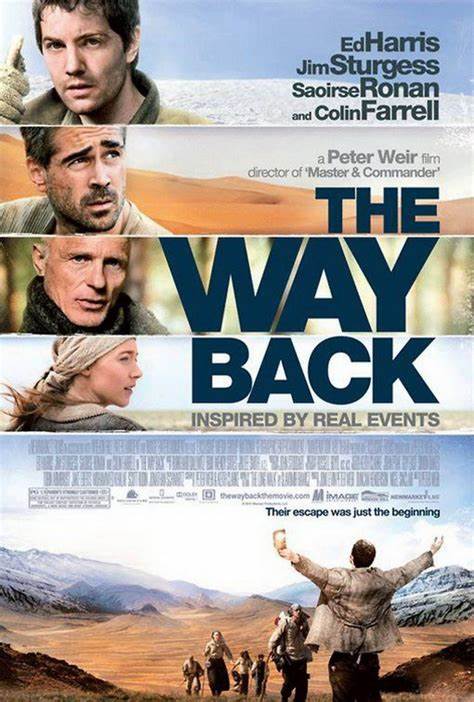
The Way Back (2010)

Harris, Sturgess and Farrell cross a great distance in Peter Weir’s The Way Back

Director: Peter Weir

Cast: Jim Sturgess (Janusz Wierszczek), Ed Harris (Mr Smith), Saoirse Ronan (Irena Zielinska), Colin Farrell (Valka), Dragos Bucor (Zoran), Alexandru Potocean (Tomasz), Gustaf Skarsgard (Andrejs), Sebastian Urzendowsky (Kazik), Mark Strong (Andrei Khabarov)

During the Second World War, Stalin spent almost as much time rounding up potential enemies of the state as he did fighting the Nazis. This was also his exclusive focus during the early years of the war when, in league with Nazi Germany, Russia invaded half of Poland. Polish officers were rounded up – many were massacred but Katyn, but some were sent to the gulags of Siberia. Among that number is Janusz (Jim Sturgess). But he is desperate to get home – so, with a collection of fellow prisoners, including American Mr Smith (Ed Harris) and hardened criminal (and pro-Stalinist) Valka (Colin Farrell) he escapes. Trouble is freedom is over 4000 miles away – through Siberia, Mongolia, the Gobi Desert and the Himalayas. To even contemplate the walk is staggering.

Which is more than you can say about the film. I never thought I would see a Peter Weir film that left me cold, but I now I have. How did Weir manage to make a compelling survival story into a film at times so unengaging you feel you have done the walk in real time? The real problem is the lack of characters. Halfway through the film the group encounters a young woman (played by Saoirse Ronan). She asks them what their background is – and they tell her (off-camera). And she tells them to Ed Harris. And he tells her his backstory off camera – and she tells it to Jim Sturgess. And there is the problem in a nutshell.

We’ve spent nearly an hour with this lot by then – and in that hour you’d struggle to know their names and certainly don’t know anything personal about them. We have no idea where they came from, what they lost or what they are yearning to return to. An hour during which it was hard to tell them apart (except for the more famous actors) but the film still wants me to invest in them fighting against the elements. Now, I know for many people, this isn’t be a problem. But for me it was an insurmountable obstacle.

I can admire the work that has gone into location shooting, make-up and costumes that show the ravages of this impossible journey. But, at the end of the day, if I know nothing about these characters and have no reason to invest in their fate, all the skill in the world won’t make this into a film I can invest in. Look at the great survival films – from The Flight of the Phoenix to another true-life (more of that later) story Apollo 13 – what makes them work is the dread that something awful might happen to the characters we care about. Without that feeling, it’s just pictures, nothing more. Weir’s mistake is to focus so much on how the Gulag crushes personalities and creates alliances of convenience, that he gives us no reason to bond with the characters.

The wispy, thin script gives very little for the actors to work with. Colin Farrell has the best part as a blackly comedic man of violence (and he drops out well before the end of the film). Mark Strong makes a big impact from a few short scenes as a prisoner who is all talk but no trousers. The others make little impression. Ed Harris does his trademark gravel, Saoirse Ronan adds much needed warmth (and provides a hugely needed audience surrogate figure – again far too late) but Jim Sturgess lacks the presence or force of character to carry the film. Force of character is missing throughout – you don’t get the sense of the strength of will needed to even undertake this, not to mention the psychological impact of this level of hardship.

It’s also oddly paced – you really lose track of how far or how long they have been travelling. Big time jumps take us from the first day of the escape to a cave in the forest which (we assume) they have spent weeks travelling to, reaching the edge of starvation. Then, before we know it they are at the border, then Mongolia. The film gets lost in a huge sequence in the Gobi Desert (for some reasons the characters always walk in the day and rest at night, the exact opposite of what anyone would do) – emerging with 12 minutes to go, bounding over the Himalayas in about 30 seconds (was it too difficult to film there?). The film caps with a bizarre “he walked forever” sequence, with superimposed walking feet over newsreel footage – a failed attempt to hammer home that Janusz needed to wait until the end of the Cold War before he could get home.

It’s nominally based on a true story. The author of the book it is based on is believed to have either invented or stolen the story from someone else and there is huge debate about whether it happened or not and if so who did it. This should have given Weir some freedom – but instead it seems to have given him too little to build on. Most damning in it I can’t find any reason in it to care whether they make it to freedom or not, instead the time dragging as much as the characters swollen feet. A terrible missed opportunity – and a rare misfire from a great director.

Birdman of Alcatraz (1962)

Burt Lancaster excels in prison drama Birdman of Alcatraz

Director: John Frankenheimer

Cast: Burt Lancaster (Robert Stroud), Karl Malden (Harvey Shoemaker), Thelma Ritter (Elizabeth Stroud), Neville Brand (Bull Ransom), Betty Field (Stella Johnson), Telly Savalas (Feto Gomez), Edmond O’Brien (Thomas E Gaddis)

What is prison for? Is it just a cage – or should it offer reform and self-improvement? Debates like this have existed from the moment the first mass-prison opened. Birdman of Alcatraz taps into this, presenting a romanticised image of the life serving time of Robert Stroud (Burt Lancaster), a double convicted murderer (including killing a guard in prison) who narrowly escapes a death sentence, sentenced to a lifetime in solitary confinement. Stroud develops a passion for ornithology, eventually becoming one of the world’s experts on avian disease – all while confined to his cell.

Front and centre in Birdman of Alcatraz is Burt Lancaster. Made by his production company, and hand-picked director (after firing Charles Chrichton), Lancaster’s prickly persona and patrician distance is wonderfully re-directed as a man who, for much of the film, carries a strong whiff of danger and violence. Surly, bitter and unrepentant, Lancaster brilliantly captures Stroud’s monomania which blossoms into a realisation his own life has been wasted. Oscar-nominated, Lancaster makes Stroud hard-to-like, but one who we slowly relate to as his brutality into a sort of recognisable humanity, however sharp-edged and un-appealing he can be.

Frankenheimer’s well-made film – it’s strikingly less flashy than much of his early work, instead using a restrained sense of documentary realism – is one I found both entertaining and involving, but also strangely troubling. But first the positive: there is no doubt this is a great “prison” movie, perfectly capturing the monotony and boredom long-term solitary confinement brings. It reduces the world into something small and oppressive – Stroud has a cell, a corridor and an exercise yard – and Frankenheimer pours on the sympathy for prisoners who are caged in a system that removes any individuality from them to turn them into docile drones.

Stroud faces a permanent struggle to win the right to keep and study his birds – including going into business selling his bird illness remedies – in the face of a system that wants him to sit in his silently in his cell. It’s hard not to be engaged with Stroud, and the lengths he must go to sustain the new hobby that has given him a reason for living. A birdcage is fashioned out of a crate after months of work. Endless variations on cures are attempted to deal with an outbreak of disease. There is even a bureaucrat warden – well played by Karl Malden as a functionary who is all duty and no imagination – who strongly believes indulging this nonsense is letting him off lightly. And maybe he’s right.

And it’s that issue which I find troubling at a film. This is a conscious attempt to turn Stroud into a sort of Mandela of Ornithology. But, scratch the surface of researching the film, and you discover Stroud was a man repeatedly diagnosed as a psychopath, who committed acts of brutal murder. This is a film that asks us to look at a man and sympathise with him, based on his passion for his hobby – like a Herman Goering biopic that focuses on his love for art. Reflecting real life, in the film Stroud never expresses a jot of regret or remorse for his crimes. The film argues his work with birds shows he has been rehabilitated – but I would argue his utter inability to recognise any moral responsibility for his actions, shows he is in no-way suitable for release.

Let this idea trip into your head and then, no matter how well made the film is made – or how well acted or engaging the story is – you suddenly twig this is a film about a man who forms stronger relationships with birds than he does with other human beings. Stroud will slave for months to save his bird – but barely bat an eyelid at the death of a man. His closest bond seems to be his antagonistic relationship with Malden’s warden, while even his closest prisoner companion (an Oscar-nominated Telly Savalas) is someone who passes out of his life for years at a time with no reaction from Stroud, and who seems capable of more regret and reflection than Stroud.

Fitting his sociopathic profile, Stroud’s only real human contact is formed with his mother. And, like White Heat’s Cody Jarrett, they have the same all-encompassing (and damagingly facilitating) relationship. His mother – played with a skilful sense of control and emotional manipulation by Thelma Ritter – constantly excuses her son’s sins, while demanding she remain his principle (ideally only) personal contact. To her, all other people – especially women – are a dangerous corrupting influence. This is not a healthy relationship, but the film doesn’t explore it, other than positioning the mother as a beast, who furiously drops her son when he decides to marry (for convenience so she can visit him) a fellow ornithologist, played by Betty Field.

In real life, Stroud was a brutal killer – not the rogueish old man he becomes by the film’s end, charming journalists – but his personality is re-positioned to take a stance on the ethics of prison reform. The film has, not surprisingly, an optimistic 1960s feeling that free-will and independence should be prioritised and that the system only crushes those feelings. Life isn’t as simple as that, however much Birdman of Alcatraz wants it to be. However, it shows you can still hugely enjoy a film that you disagree with. I guess that’s the sort of oddity that makes us human.

The Truman Show (1998)

Jim Carrey starts to wonder if there is more to his life than meets the eye in The Truman Show

Director: Peter Weir

Cast: Jim Carrey (Truman Burbank), Ed Harris (Christof), Laura Linney (Hannah Gill/Meryl Burbank), Noah Emmerich (Louis Coltrane/Marlon), Natascha McElhone (Sylvia/Lauren Garland), Holland Taylor (Alanis Montclair/Angela Burbank), Brian Delate (Walter Moore/Kirk Burbank), Paul Giamatti (Simeon), Peter Krause (Truman’s boss), Harry Shearer (Mike Michaelson), Philip Baker Hall (Network executive), John Pleshette (Network executive)

Have you ever fantasised that your whole life was a movie? It would be great wouldn’t it? You’re the star of every scene, the story lines always have a happy ending and you always emerge as the hero. But what if your life really was a massive TV series? What if everyone you had ever met was an actor playing a role? What if every experience in your life had been carefully scripted? What if nothing you knew was a real or even remotely true? That’s no-where near as fun.

Of course the odd thing today is that I suspect there are more than a few people out there who would still consider that a decent pay-off – even if they couldn’t know that they were on television, at least they would be on it. The Truman Show predated much of the surge of reality TV that was to come in the 00s, when shows like Big Brother made putting everyday (at least at first) people into situations and simply watching what happens became TV gold. Truman Burbank (Jim Carrey) is approaching his 30th birthday. Little does he know that his entire life he’s been at the centre of an elaborate TV show and that the hometown he has never left is a giant self-contained film studio. But as incidents begin to pile up, Truman suddenly questions his reality – while the show’s cast and production team work to keep him in ignorance. After all, we can’t let this ratings cash cow die!

With a precise, sharp and intelligent script by Andrew Niccol, Peter Weir’s film is a triumph. It’s partway between drama and satire, but never lets the one compromise another. It could have become a lumpen message film about the intrusion of media into our lives. Instead it’s an acute satire of TV gone mad, with a very real, sympathetic character who we invest in. Effectively the movie works on the same premise as the fictional TV show: the viewers know the world they are seeing is larger than life, but they know the character of Truman is grounded and true. It works as it bases its satirical attacks around a heartfelt story of a man (unwittingly at first) on a quest for freedom.

It’s two horses the film rides extraordinarily well – and even effectively comments on. Throughout the action we cut to the same regular joes watching the show: people in a bar, security cops, a pair of old ladies on a sofa. These people are aware they are watching a show – and watching a man effectively imprisoned – but have their emotions manipulated with ease, first by the producers then by the excitement of Truman’s very real quest. As they gasp and cheer as Truman works his way out of his prison, there is not a shred of acknowledgement to them that buy ‘booing’ the TV network they should also be booing themselves for watching in the first place. Instead they treat it just as another episode of their favourite show, the celebrations as transient and hollow as their tears of joy as the producers reintroducing Truman’s long-lost father in an attempt to ‘explain’ the strange circumstances he’s seen.

The Truman Show itself takes place in a perfect, unintimidating slice of 50’s inspired nostalgia. It’s a perfect picture of Americana – and its conservatism is itself a satire. Of course the producers set the show in the most cosy, comforting setting they could imagine. The rose-tinted past is always something we turn to for comfort viewing (take a look at the success of Downton Abbey). Alongside that, it’s a world run by advertising: Truman’s wife frequently stops to deliver scripted adverts, singing the praises of household products; a pair of old buffers have the job of pushing Truman up against a different advert hoarding every day; Truman’s friend Marlon praises their beer with every sip.

And in the sky: we have the studio itself, run by the shows creator Christof. Superbly played by Ed Harris, as part hipster artist, part messianic genius (“I am the creator” he tells Truman near the end, his voice coming through a beam of skylight, adding after a half-beat “of a television show”), Christof has carefully plotted Truman’s entire life from birth. He partly sees himself as Truman’s father – but he as much sees Truman as a tool he can manipulate for his own ends. A hands-on show-runner, Christof believes himself a genius whose will cannot be questioned. This softly-spoken dictator is a terrifying insight into what happens when self-appointed artistic geniuses can explore their ideas with no regard for morality and no restraints.

Truman himself is a charming, sweet, decent fellow – I suppose if nothing else Christof has done a superb job of bringing him up. But his entire life is a manipulated lie. The whole town is full of subconscious messages encouraging him to stay – as is the advice from his wife and best friend. Most cruelly of all, he has been deliberately traumatised into a terror of water by being made to feel responsible as a boy for the drowning of his father. Christof even boasts of his ingenuity in this “plot line” to help insure Truman would be too scared to ever consider leaving his home.

Jim Carrey was a revelation as Truman – Weir was the first director to refocus his comic mania into something more intimate and true. The part still makes a lot of hay from Carrey’s rubbery comedic chops – its part of Truman’s charm – but he matches it with a Jimmy Stewartish decency and earnestness. As the illusion begins to crack, his bemusement turns to something between disbelief and anger, but never compromises his humanity. You can see why billions of people watched him – and also understand why a man so accommodating and decent has not questioned his life before. Witty, gentle and human it’s a great performance.

But perhaps the film’s greatest strength is Weir’s sharp, clear-eyed, largely unobtrusive direction. The film makes nifty use of all the thousands of cameras contained in Truman’s world – with shots taken from button cams, CCTV, dashboards and all sorts. Its intermixed with normal camera angles, but gives us a beautiful sense of Truman’s world, and the TV world coming together throughout. The pace of the film is perfect and its slow reveal of information delicately done. Weir’s intercutting between ‘fictional’ and real world is superbly judged and the film wears its satire very lightly as well superbly mixing what could have been a dark film of imprisonment and abuse with a lightness and charm. Above all, it manages to both be a compelling story with a sympathetic hero and a sharp-pronged criticism of the shallowness of media and its viewing public.

It might well have been far too ahead of its time when it was released. It looks smarter and smarter each passing year. Truman’s world is an Instagram paradise, and with social media we’ve got even more used to spending our leisure time looking through other people’s lives rather than our own. It’s all part of what helps make Niccol’s script so sharp and prescient. Directed superbly by Weir and wonderfully acted – perhaps most of all by Harris’ Warhol turned dictator – it keeps you entertained, invested and leaves you cheering. Just like the viewers watching Truman being manipulated. Which makes you realise: is the film attacking its audience as much as anyone else? After all, we’d all watch this stuff in real life: look at how we rubberneck at accidents. What’s wrong with us eh?

The Great Escape (1963)

Steve McQueen is the Cooler King (King of Cool?) in The Great Escape

Director: John Sturges

Cast: Steve McQueen (Captain Virgil Hilts), James Garner (Flight Lt Bob Hendley), Richard Attenborough (Sqd Leader Roger Bartlett), James Donald (Group Captain Ramsey), Charles Bronson (Ft Lt Danny Welinski), Donald Pleasance (Flt Lt Colin Blythe), James Coburn (FO Sedgwick), Hannes Messemer (Oberst von Luger), David McCallum (Lt-Commander Eric Ashley-Pitt), Gordon Jackson (Ft Lt Andy MacDonald), John Leyton (Ft Lt Willie Dickes), Angus Lennie (FO Archie Ives), Nigel Stock (Ft Lt Dennis Cavendish), Robert Graf (Werner)

Is there a film in Britain more associated with holidays than The Great Escape? While I was growing up it felt like a day-off wasn’t complete unless the BBC screened it as part of their afternoon schedule. In Britain is has a status as a sort of cosy uncle, a part of the furniture of many people’s filmic lives. There is always something comforting and reassuring about The Great Escape. So much so, people forget it ends with a large bodycount and the majority of our heroes further away from freedom than when they started.

But it doesn’t really matter, because The Great Escape is one of the last hurrahs of effective, nostalgic war-films. The sort of hugely enjoyable caper that recognises the cost of war, but also celebrates the pluck, ingenuity and guts of Allied servicemen, running rings around those dastardly cheating Nazis. Where we would all like to look back and remember those days when men-were-men and worked together towards a common goal. Sturges has created a marvellous tapestry of a movie, that pulls together several striking scenes, characters and snippets of dialogue into a true ensemble piece that reflects the camaraderie and unity that exists between the prisoners as they work towards their escape.

In some ways, The Great Escape is such good fun, such well-packaged entertainment and telling such an exciting, uplifting and (in the end) moving story that it’s almost immune to criticism. You’d have to have a pretty hard heart not to enjoy it. And you’d have to be pretty cynical not to enjoy the way it presents a series of obstacles and then carefully demonstrates the fascinating and rewarding ways the prisoners resolve these. It’s also notable that, aside from the shadowy Gestapo types, the film doesn’t really have an antagonist. The enemy is that fence. Most of the Germans are just regular soldiers doing a job – it’s only the brutal final-act Gestapo who are aren’t playing this eccentric game. But this helps us sit back and enjoy the film as a caper – just as it makes the burst of machine-gun fire that (nearly) ends the film even more impactful and shocking.

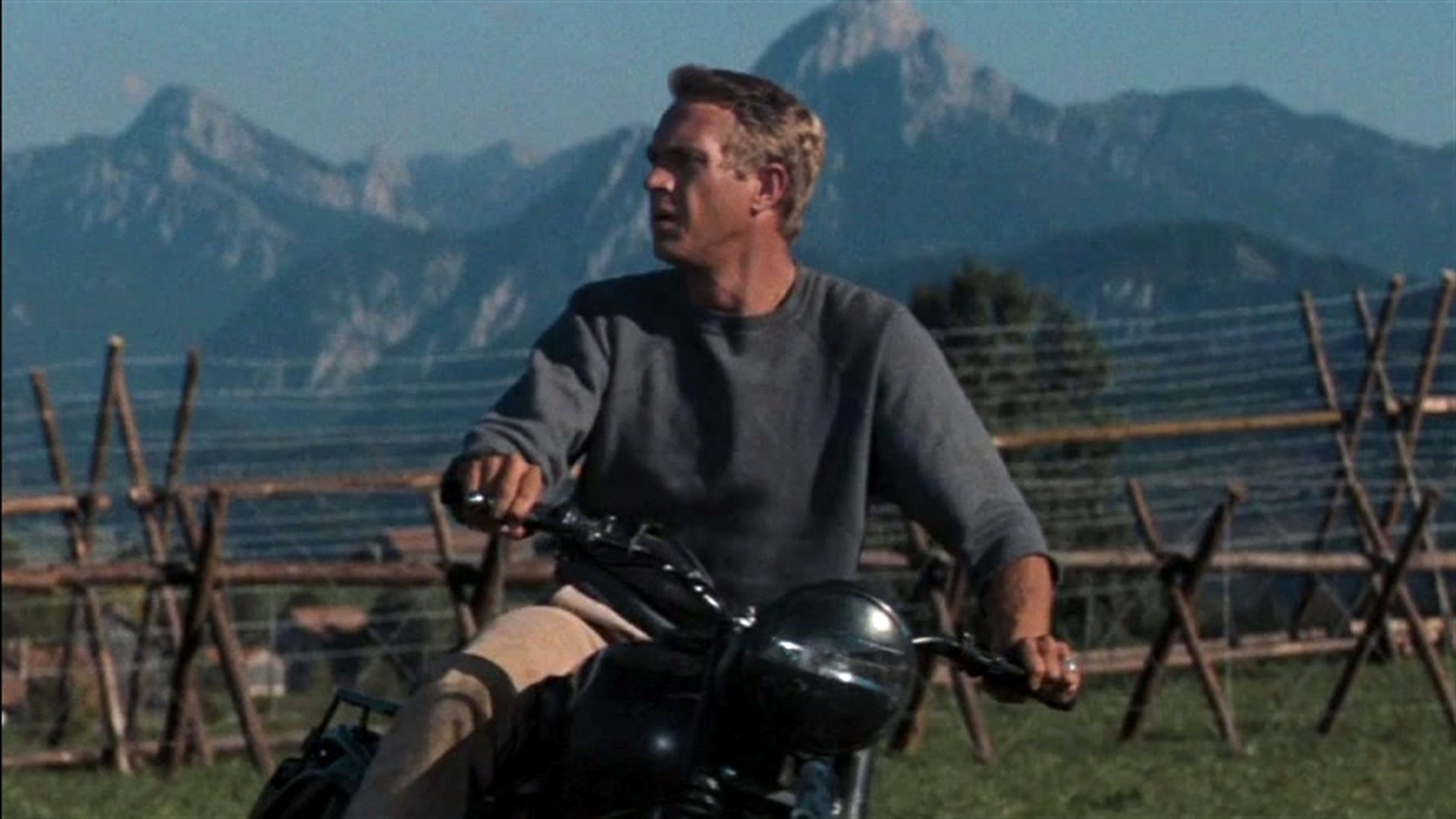
Sturges’ gets the tone of the film spot-on, and also draws a series of perfectly balanced performances from his all-star cast. I think it’s fair to say a lot of the film’s success was connected to Steve McQueen’s casting in the crucial role of Hilts. McQueen channels a sense of 1960s anti-establishment cool into the film (unlike the rest of the POWs, he seems to be wearing basically his own clothes in t-shirt, chinos and bomber jacket). Iconically bouncing his ball against the wall in a cooler, a natural loner (who of course still does his bit), with a cocky sense of defiance and some exceptional motor-bike skills, Hilts is undeniably cool. He’s the face of the film – and the one you walk away wanting to be.

He also gets the film’s definitive claim to fame, with a series of daring motorbike stunts as he races across Germany to escape. Mostly performed by McQueen himself (although not the most famous fence jump, done by a stuntman) this last act chase is a gripping, action counter-point to the more cagey, paranoid runs of the other escapees. It’s so exciting and feel-good, it’s a surprise to remember that Hilts actually gets caught. But then, if he hadn’t, we’d have lost McQueen’s cool, wry shrug of acceptance as he and his mitt were sent back to the cooler in the camp for another 20 days.

The film tees up plenty of sub-plots for the rest of the cast, with Sturges’ spreading the love very effectively. Charles Bronson gets perhaps the best plot as “tunnel king” Danny Welinski who holds back his crippling claustrophobia almost long enough. I think this might be Bronson’s finest hour, giving a real vulnerability to Danny, with genuinely quite affecting whimpers and fear at confronting the tunnel – making his struggle all the more moving. Bronson makes a wonderful double-act with John Leyton as fellow tunneller Willie Dickes, the two of them forging an affecting bond of loyalty.

A similar bond also forms between James Garner’s suave and playful scrounger Jack Hedley and Donald Pleasance’s professorial forger Colin Blythe (has there ever been a more “Colin” Colin on film than Pleasance?). The final moments between this pair carry perhaps the biggest gut-punch of a film that has a surprising large number of them. Pleasance’s sad attempts to hide and combat growing blindness are genuinely affecting, while Garner is a master at conveying depth beneath a light surface. Sturges’ film taps into the nostalgic memories most of us have (or have picked up) of this war being one where life-long friendships were formed against horror and adversity.

Attenborough does most of the thankless heavy-lifting as Big X, but the film uses his Blimpish authority well. Gordon Jackson has a memorial role as the number #2 famously caught out by his own vocal trap (the sort of irony films like this love). Fans of the TV show Colditz can enjoy seeing David McCallum in a very similar role as a daring young escapee. James Donald channels British reserve as the senior officer. The film’s single truly bizarre performance is from James Coburn, with an Australian accent from the Dick van-Dyke school of ineptitude, so terrible even Sturges surely noticed it when cutting the film.

The Great Escape marshals all these cards extremely well. Any combination of any of these actors produces fireworks. It’s one of the best boys own adventure you can imagine. It in fact gets the perfect balance: you can spend a large chunk of the film thinking that being locked up in a German POW camp looks like the best time ever – and then it chillingly reminds you with its sad coda of the terrible cost of war. But it’s that first hour and half and its celebration of grit, guts, determination and ingenuity that really works – and it’s so entertaining that it solves immediately any mystery as to why any public holiday you’re 10-1 to find this popping up on your afternoon TV listings.

They Made Me a Fugitive (1947)

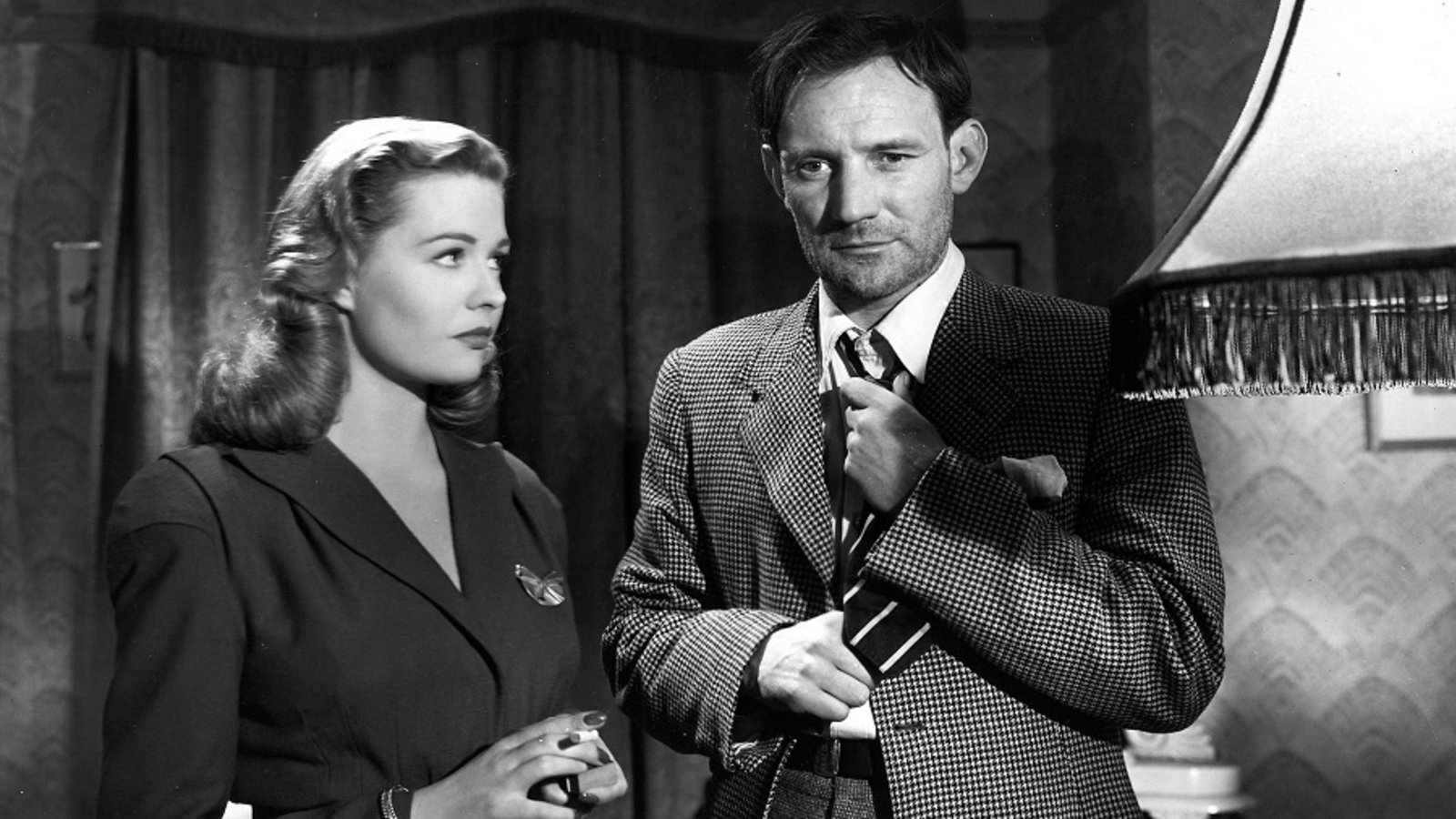
Trevor Howard is on the run in They Made Me a Fugitive

Director: Alberto Cavalcanti

Cast: Trevor Howard (Clem Morgan), Sally Gray (Sally), Griffith Jones (Narcy), René Ray (Cora), Mary Merrall (Aggie), Charles Farrell (Curley), Cyril Smith (Bert), Phyllis Robins (Olga), Vida Hope (Mrs Fanshaw), Eve Ashley (Ellen), Jack McNaughton (Soapy), Maurice Denham (Mr Fenshaw)

The Second World War is over – but the country is awash with ex-servicemen, not sure where they fit in, trained to kill. Clem Morgan (Trevor Howard) is one of them. A former RAF man, who escaped from a POW camp, he doesn’t know what to do with himself on civvie street. So he’s definitely open to an offer to work for black marketeer Narcy (Griffith Jones) – but not so keen once Narcy’s business dealings expand into drug smuggling and violence. Clem gets framed for the killing of a policeman and banged up in Dartmouth – where he receives a visit from Narcy’s mistreated girlfriend Sally (Sally Jones) who needs his help to prove Narcy is the real villain. Clem escapes, a fugitive, looking for, and on the run from, justice.

Cavalcanti’s film is a marvellous mix of noir, early kitchen-sink and faded post-war crime drama. The locations are run-down and dirty, the mood faded and worn out. The film is remarkably bitter, cynical and short on hope. Clem’s encounters take him past a gallery of those struggling in post-war Britain: black marketeers, shallow glamour-pusses, bored policemen, common criminals, vengeance minded housewives and brutal heavies. Everyone is corrupt, has violence or treachery in mind and don’t think twice about putting others through suffering. And to be honest, as a shambling, scruffy drunk, Clem makes a pretty good fit among them, a man whose best days happened somewhere in Germany in the 1940s and who hasn’t had a clue what to do with his life since.

The post-war Britain painted here isn’t nice. No wonder ruthless, thuggish black marketeers like Narcy (short for Narcissus of all things – which manages to be both a commentary on self-obsession, while being an abbreviation that sounds like Nasty or Nazi) are flourishing. Narcy – played with a callous, charismatic black-heartedness by Griffith Jones, in a performance bereft of any trace of morality – has no problem with any criminal act what-so-ever so long as it gets him what he wants. Smuggle drugs? Not a problem. Beat a woman? Line ‘em up. Murder a cold-footed subordinate? As many as needed. Narcy is a perfect emblem for this world, uncaring, brutal, sadistic and enjoying the fact that so many others are desperate.

His kingdom is a subterranean hell, in the basement of a undertakers. (It even has a huge sign reading RIP on the top of the building.) His haunts are foggy docksides, chilling streets and rough pubs. His followers are cowed former servicemen – although even they draw the line at using guns – and the police seem unable to touch him. But then Narcy’s world is pretty similar to the rest of England. The countryside Clem journeys through from Dartmouth to London to get his revenge is equally fog-ridden, cold, dirty and unattractive, full of farmers who shoot at him with buckshot and housewives who blackmail him to carry out their dirty deeds.

The film hinges at the half-way point on this surreal scene. Clem arrives at a home where the woman of the house – played with a sort of hypnotic monotone by  Vida Hope – allows him to wash, gives him new clothes, feeds him – and then hands over a gun and asks him to shoot her husband (a shambling drunk played by Maurice Denham). Clem refuses – he’s killed once in his life, while escaping a POW camp, and has no intentions of doing so again. He makes a run for it – at which point the woman does the deed herself, and places the blame on Clem. It’s a bizarre scene, but strangely magnetic – its a window into this topsy-turvy world. Killing means something different to everyone after years of the world tearing itself apart, and behind the chintz curtains of middle-class Britain, we can’t be certain there doesn’t lurk something dark and dangerous.

Trevor Howard makes a perfect lead for this sort of grimy world. He’s got the “hail well met” stance of Clem down perfectly: but he’s a character who also carries a natural integrity to him, someone who we can trust. No matter how drunken, shambling and untidy he gets when he’s in his cups, there is something decent in him we can trust. It also means we can root for him when the chips are down (which they are for most of the film), and while he finds himself in bizarre and dangerous situations, from being shot at by farmers to struggling to escape the curiosity of lorry drivers.

Howard powers the whole film, even if Griffith Jones perhaps carries it away in the more colourful part of Narcy. Sally Jones makes for a relatable woman of fixed morality (perhaps the only truly moral person in the whole film) who has somehow found herself in a dirty world. Cavalcanti’s world is filthy. He shoots it with a delicate but immersive intensity. It’s a surprisingly violent film. Knifes are used, shots are fired and Narcy beats two women with a viciousness (the first is shot with a whirling camera, which might go a little too far to get us to relate to the dizzying violence).

It’s also a film that seems low on hope. It ends on a downer. The forces of good – like the police – seem distant, uninvolved or, at best, useless in the face of all the crime. The forces of evil are left to effectively police themselves and corrupt but decent men like Clem get stuck in the middle. They Made Me a Fugitive makes for an involving and gripping thriller, a perfectly made little British B movie.

Alien 3 (1992)

Sigourney Weaver goes through the motions again in Alien 3

Director: David Fincher

Cast: Sigourney Weaver (Ellen Ripley), Charles S. Dutton (Leonard Dillon), Charles Dance (Dr Jonathan Clemens), Brian Glover (Warden Harold Andrews), Ralph Brown (Aaron), Paul McGann (Golic), Danny Webb (Morse), Lance Henriksen (Bishop), Pete Postlethwaite (David), Peter Guinness (Gregor), Christopher Fairbank (Murphy), Phil Davis (Kevin), Niall Buggy (Eric)

Few films feel more like a grim contractual obligation than Alien 3. If you want a real blood bath, you’d get more entertainment from reading about the tortured history of its production. Over nearly six years it saw off several scripts, at least two directors (including David Fincher resigning over continual studio interference) and Sigourney Weaver only agreeing to do the film if she was killed off at the end (well that and a big pay cheque).

All of this ended up as a depressing, grim and largely unenjoyable mess that goes over the same old ground as the first two films, but with diminishing returns. After the events of Aliens, our heroes ship crash-lands on a prison planet. Everyone on board is killed other than Ripley (we’ll come back to that…). The planet is populated by criminals who have embraced religion, led by Dillon (Charles S. Dutton) and a small staff of warders (Brian Glover and Ralph Brown) and Dr Clemens (Charles Dance). The company orders Ripley to sit tight and get picked up. But did an Alien on the ship lead to its crash? Is there now an alien on the planet? And is Ripley carrying an Alien inside of her?

It won’t surprise you to hear that the answers to all these questions are of course “yes”. And the film takes a painfully long time to get there. This is made all the more painful by the shockingly, uninvolving grimness of the story’s telling. Nowhere is this more clear than in the ruthless killing off of the surviving characters from Aliens. After the warmth and humanity of that story – and Cameron’s skilled creation of a family dynamic between Ripley, Hicks and most especially the mother-daughter bond between Ripley and Newt, it’s hard not to feel that their brutal off-screen deaths are a real slap-in-the-face. At a stroke all the character development of the previous film is negated. And so we get back on the treadmill of another monster hunt.

It’s not helped either by the fact there is hardly a character here you could give two hoots about. The prison is almost completely staffed by British character actors, peppered with the odd American. The script totally fails to give any of these people really distinctive personalities at all, before the Alien starts munching through them. On top of which the lazy script is littered with effing and jeffing, that serves to make the characters very angry all the time and even less engaging. The film’s most interesting new character, troubled Dr Clemens (a decent performance of world-weary sadness from Dance) is dead by Act Two, and the rest are basically an identikit pile of same-old-same-old. Dutton gets some good speeches as the prisoner’s morally complex leader, but he’s fighting an up-hill battle against turgid dialogue and tired old plotting.

Already by Alien 3 it feels like the franchise was out of ideas. Yet again “the company” is up to no good, only interested in making a buck off the creature. A post-industrial landscape again sees a number of people killed off in ever more familiar ways. The alien looks a bit like a dog this time (or an Ox if you watch the longer and even duller extended cut), but that’s about the most original thing here. And at the centre of the misery we have a grimly resigned and disinterested Weaver, who seemingly can’t wait for that Alien to burst out of her chest and end her association with the franchise for good.

It’s very hard to find anything enjoyable at all about this film. And it feels odd to say that about a film which is about people being brutally murdered one-by-one by an alien. But the others had touches of hope, humanity and demonic poetry to them. This is just a parade of slumming it British character actors, playing foul-mouthed rapists and murderers, getting torn apart. And then the film ends with a colossal downer even more downier than all the rest of the sludge you’ve had to sit through.

Basically Alien 3 reminds us that, with the monster as a motiveless killing machine, there weren’t many places to go with it. It’s not like it could suddenly reveal a motivation or something. So it seems the franchise was doomed – as it has been almost ever since this – to be a familiar parade of facehuggers, dark rooms, slow builds as people meander towards death down corridors, blood splatter and people who barely qualify as characters meeting grisily ends. Alien 3 is depressing and unrewarding in so many ways.

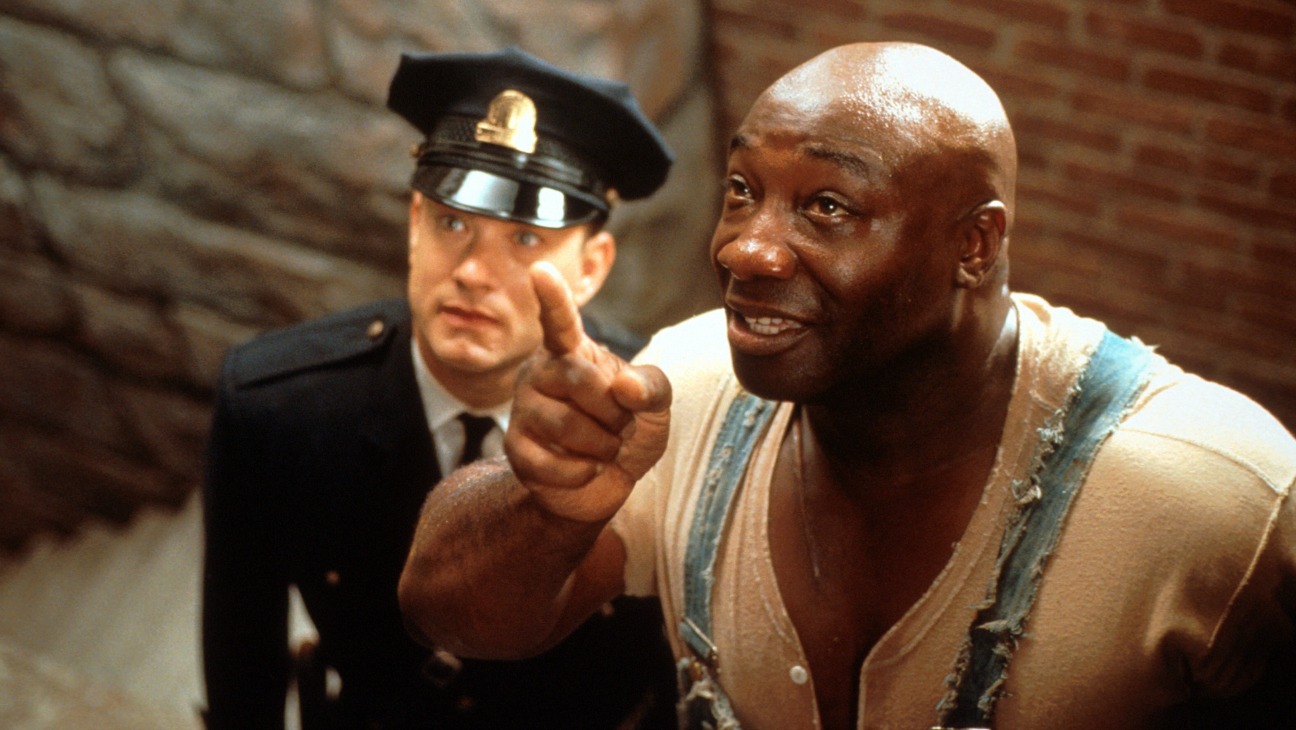
The Green Mile (1999)

Tom Hanks and Michael Clarke Duncan excel in the over-long but moving The Green Mile

Director: Frank Darabont

Cast: Tom Hanks (Paul Edgecomb), David Morse (Brutus Howell), Bonnie Hunt (Jan Edgecomb), Michael Clarke Duncan (John Coffey), James Cromwell (Warden Hal Moores), Michael Jeter (Edward Delacroix), Doug Hutchison (Percy Wetmore), Sam Rockwell (William “Wild Bill” Wharton), Barry Pepper (Dean Stanton), Jeffrey DeMunn (Harry Terwilliger), Graham Greene (Arlen Bitterbuck), Patricia Clarkson (Melinda Moores), Harry Dean Stanton (Toot-Toot), Dabs Greer (Old Paul)

Stephen King’s novels are often thought of solely as horror novels – but that’s to forget that he also carries with him a profound sense of the human condition and a sharp ability to create moving and surprising human stories. That’s why his works can inspire films as diverse as The Shining and The Shawshank Redemption. The Green Mile, the second King novel bought to the screen by Frank Darabont, definitely falls into the latter camp – probably why it has continued to be met with warmth and regard decades after its making.

In present day Louisiana, Paul Edgecomb (Tom Hanks – played as an old man by Dabs Greer after Hanks’ make-up tests proved unconvincing) recounts his days in 1935, working as a prison guard on “the Green Mile”, the death row section of a prison. Paul’s life was changed forever with the arrival of a gentle giant, John Coffey (Michael Clarke Duncan), a seemingly simple-minded man found guilty of raping and murdering two young girls. However, John doesn’t match the personality Paul expects of a hardened criminal – and events soon prove he is far more than just an ordinary prisoner…

Frank Darabont’s adaptation of King’s novel – an adaptation King still lists as his favourite adaptation of his work – is long at almost three hours, and frequently takes its time. But it does so too carefully, and in detail, build the world it sits in – namely the prison – and the characters who live in it. Everything is carefully paced in order to create the sense of a real world, with (most of its) characters defying easy conventions or definitions. 

We know of course that the guards on this cell are largely decent, hard-working and respectful of the prisoners – not least because they are led by Tom Hanks at his most everyday, grounded and quietly moral. Darabont is very good at letting the world breathe – and, as a skilled scriptwriter, also in sketching character quickly and clearly. Both guards and prisoners are fully crafted characters, and while some of them do verge a bit more on the cartoonish villainy, their motivations and feelings feel real. 

You could criticise the film for the sentimental views built into this. All the guards are basically decent men – apart from Doug Hutchinson’s cowardly, whining bully Percy Whetmore, who owes his job to his family background, picks on the prisoners, reads porn and is motivated only by wanting to “see one cook”. While the film tries to give him some depth, a weakness of character, he’s basically easy for us to dislike. Similarly among the prisoners, all of them are polite, calm and resigned to the justice of their fate – minus an appalling, virulent racist hill-billy (played by Sam Rockwell with a manic intensity). There are very little doubts about who we are supposed to be rooting for here.

Racism as a whole gets only the barest of mentions. A few slurs are thrown at African-American John Coffey, but no real mention that in 1930s Louisiana there was little chance of a black man getting any form of justice at trial. Typically the only characters to espouse racist views fall squarely into the villain’s camp. Perhaps the intent is to show the prison as a melting pot of sorts – the final stop-off for people’s lives, where all men are basically equal, and the guards taking to heart their role as custodians for their final moments. But it’s also a bit of a cop-out.

We’re shown in detail the work Edgecomb and his team put into ensuring the prison is run smoothly and justly, and that the executions are committed as humanely as possible (frequent rehearsals – with Harry Dean Stanton rather funny as an eccentric stand-in condemned man – are called for). The good guards and good prisoners form bonds – and while this adds to the sentimentality, it perhaps makes sense in a system where the most extreme price is to be paid for their acts, and that any other judgement is unnecessary. We see three executions throughout the film, each carrying its own tone: one is a “how-it-should-be-done”, one is a horrifying, tortuous disaster, with Percy sabotaging the humane elements out of spite, the third sees Edgecomb finally questioning the role he has chosen for his life.

It’s not a film that touches a great deal on the morality – or otherwise – of legal executions, but it does use the setting to explore questions of faith and spirituality. Because what is going to put such things into your mind quicker than working in a place where life and death is literally your business? Some of this is more heavy handed than others – John Coffey’s initials should be a bit of a give-away – but the film does ask questions of what is important to us as people, and at what points should we question the decisions we take about how we live our lives.

These questions of faith don’t quite coalesce into something truly coherent, as it never quite feels if the film wants to deal with the implications of John Coffey’s gifts of healing. The possibilities of a wider world outside our understanding never really come together, and instead Coffey’s gift of healing by touch seems to be a blessed skill that he has developed rather than something more profound. There is also something troubling about the film’s sole black character (in 1930 a segregated Louisiana of all places) serving the purpose to heal white people and be sacrificed.

But when the film focuses on story and character rather than its rather unclear themes, it does well. Hanks is very good in the lead role – Darabont wrote the film specifically for him – with solid support from Morse, Pepper and DeMunn as the main “good” guard characters. Michael Jeter gives some heartfelt work as eccentric prisoner Delacroix. But the stand-out – in every way – is Michael Clarke Duncan, whose John Coffey is sweet, naïve, polite, gentle but also carries a suggestion of pain and guilt beneath his surface which is expertly sketched out.

The Green Mile may be overlong, but it’s hard to work out what you would cut as it’s a film that relies so strongly on mood, atmosphere and careful world creation. Well scripted and confidently directed by Darabont, it may be hard to work out exactly what it wants to say – but it has a richness and confidence to it, as well as an emotional force, that sometimes makes you feel that doesn’t really matter.

One Flew Over the Cuckoo's Nest (1975)

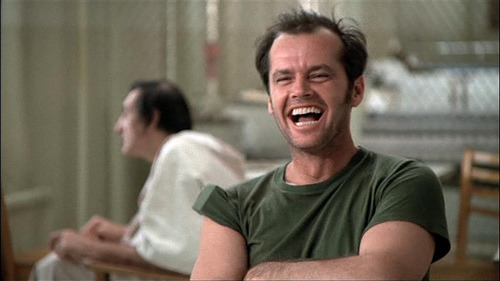
Jack Nicholson is superb as McMurphy in One Flew Over the Cuckoo’s Nest

Director: Milos Forman

Cast: Jack Nicholson (Randle P McMurphy), Louise Fletcher (Nurse Ratched), Will Sampson (“Chief” Bromden), William Redfield (Dale Harding), Brad Dourif (Billy Bibbit), Sydney Lassick (Charlie Cheswick), Christopher Lloyd (Max Taber), Danny DeVito (Martini), Vincent Schiavelli (Bruce Frederickson), Dean Brooks (Dr John Spivey), William Duell (Jim Sefelt), Scatman Crothers (Turkle)

One Flew Over the Cuckoo’s Nest is one of the landmark films of the 1970s, one of those films that’s on everyone’s list for great masterpieces. It lifted all five of the Big Oscars (Picture, Director, Actor, Actress and Screenplay), one of only three to do so. It’s widely loved for its celebration of rebelliousness and individualism, but there is more to the film than that. It’s as interesting for the things it doesn’t explore as much as the things it does.

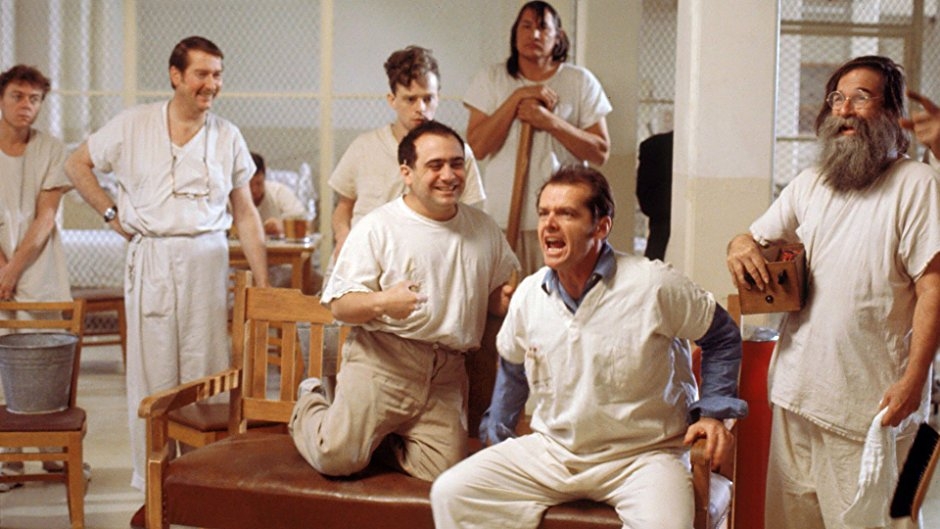
Randle McMurphy (Jack Nicholson) has himself sent to a mental institution rather than a prison farm, under the belief that serving his time in the institution will be far easier than doing hard labour. However, he finds the ward he is locked into is under the authoritarian control of Nurse Ratched (Louise Fletcher), a passive-aggressive bully with a strict interest in the rules at the cost of all humanity. The inmates are cowed, but McMurphy encourages them to express themselves and seize their freedoms – little realising that his freedom is dependent on being signed off by the doctors, not the length of his original short sentence, and he has made no friends in the hospital authorities – or that Ratched is determined to break his influence over the other patients.

Forman was a perfect choice for directing a film that directly echoes his own iron-curtain upbringing. OFOTCN is a film that celebrates the freedom of the individual – but also recognises that authority and the state always wins out in the end. The hospital ward is cold, oppressive, a white-lined world where Ratched observes and quietly controls everything from her booth, softly issuing directives that carry a quiet menace. The film rotates around clashes between McMurphy wanting to do his own thing and Ratched stridently reinforcing a fixed hospital agenda. At one point Forman’s camera tracks from McMurphy on the basketball court, up to Ratched watching behind a full length window like an imposing Stasi officer. Forman totally understands the struggle of expression and free will in oppressive regimes, and it’s this that has given the film such a rich life – who doesn’t want to land on the side of freedom?

It helps as well that representing freedom we have possibly Jack Nicholson’s finest performance as McMurphy. A roaring, bubbling, manic, burst of nature, an impish anti-authority figure who rips through every scene with intense energy. It’s a marvellous, inspiring performance. And it makes McMurphy exactly the sort of rebel without a cause we would like to be, the guy who can inspire and lead through force of will alone, who refuses to be cowed or crushed. 

Nicholson’s performance however is a perfect mixture of larger-than-life drama and moments of reflection. The film splices in a few conversations between Nicholson and the doctors that, over the course of the film, change more and more from spry defiance and mockery towards a quieter, more despairing resignation as he slowly begins to realise how trapped he is. Not that he wants to show any of that to his fellow inmates, or to Ratched with whom he keenly engages in a battle of wills.

Ratched herself is exactly the sort of cold, rules-bound, inflexible authority figure we are naturally placed to hate. Louise Fletcher is wonderful, with her softly spoken iciness matched with certainty about her moral position. Is she even interested in curing the patients? Her focus seems to be completely on controlling and running the patients’ lives rather than changing the status quo. 

This battle of wills drives the film, but it’s interesting as well for what it tells us about McMurphy. He seems to have no understanding of the fact that, while his fellow inmates are cowed, they are all to some degree mentally ill and certainly all frightened and unpredictable. McMurphy sees them as people who need to be encouraged to seize their own destinies, but these are people who are incapable of really understanding what McMurphy is trying to do or have any interest in it. He shakes up their world, but has little real impact on them in the long term.

It’s not a film that engages in any great understanding of mental illness, but suggests that perhaps McMurphy and Ratched are in their own ways as insane as the people they are fighting over in the asylum. McMurphy is a self-destructive force who pushes for small things with huge passion, but then drifts through the major things. He acts without thinking and doesn’t try to understand the people around him. Ratched meanwhile is so obsessed with controlling her own small universe, she has defined her entire life around her governance of the ward.

The film has a slightly troubling relationship with women – which is not necessarily a criticism, but an observation since the film’s only prominent female character is Ratched and all the inmates are men. The things that Ratched stops the men from doing are the sort of typically “male” activities that McMurphy delights in – gambling, sports, girls – while McMurphy himself is (in what is the only truly dated moment in the film) in the slammer partly for having under-age sex with a girl, which he eagerly describes to his doctor. McMurphy pushes all the inmates to become more like the sort of man he understands men should be, and while it is a freedom of expression, it’s also one that has little place for women in it, other than as sex objects.

But that’s not the real aim of the film, so you can forgive it. McMurphy is not an intellectual or a man on a mission, he’s an unthinking burst of energy that burns up the world around him and demands the freedom to not be told what to do. That’s what gives the film its real emotional impact and why it spoke so much to Vietnam era America, and continues to speak to us today. And of course it’s linked to the fact that the film is a massive tragedy.

Because in the end the forces of oppression do win and McMurphy’s spirit is crushed. Sure McMurphy more than contributes to his own failures – he allows his own to drift away, and his pushing of his own agenda of what he feels men should want dooms poor Billy Babbit (a stuttering slice of timidity played by Brad Dourif). The film has a Pyrrhic victory in his inspiring the “Chief” (William Sampson), a giant native American flying under the radar by pretending to be deaf and dumb, into carrying out McMurphy’s dreams.

But for our hero it’s a bust. Forman’s film is a brilliant celebration of the energy and futility of lords of misrule like McMurphy, with a commanding performance from Jack Nicholson that’s one for the ages. A wonderful piece of ensemble playing in a set that becomes a metaphor for oppressive regimes, it’s remained remarkably undated and a force to be reckoned with on any top ten list.

The Collector (1965)

Samantha Eggar is held captive by Terence Stamp in the unsettling The Collector

Director: William Wyler

Cast: Terence Stamp (Freddie Clegg), Samantha Eggar (Miranda Grey), Mona Washbourne (Aunt Annie), Maurice Dallimore (Colonel Whitman)

A lonely butterfly collector wins the pools. He’s rich, he can have everything he wants – but he’s still an outsider who can’t get a girl. Surely if a woman would just get to know him he’d find love. So the easiest way of doing that is probably kidnapping the woman you had a crush on at school, locking her in a carefully furnished basement in your Tudor mansion house and just wait for her to fall in love with you. Sounds like a perfect plan right?

William Wyler’s adaptation of John Fowles’ best-selling literary first novel sees Terence Stamp as the maladjusted loner and Samantha Eggar as his victim. It’s fascinating reading about the film today and the attitudes and perceptions towards it. Today the film is chilling in the obsessive, dangerous, self-pitying self-justifications of Freddie Clegg. But in the mid-60s a number of reviewers commented on the pity they felt for the kidnapper, and even expressed that in many ways he was acting on fantasies every healthy man has had (they haven’t). Quite rightly the film comes across differently today, a far more unsettling and disturbing portrait than it did at the time.

Wyler’s direction is intimate and a fine mixture of the theatrical – with its often single locations and two-actor scenes – and cinematic, particularly in the way he subtly builds up a Hitchcockian level of tension around the possibility of discovery and escape for Miranda. Sure visually he is a little too much in love with the crash zoom on key items (chloroform for example in Freddie’s car), and devices that seem a little too obvious (like the use of black and white for the film’s only significant flashback) but he mounts the entire film with an unsettling claustrophobia that works very well.

Further he draws out two fantastic performances from the leads. Terence Stamp was not a natural choice for the shy, timid outsider turned abductor – he’s obviously way too handsome and physically assured for the role – but he marshals very well the blinded arrogance of a man who believes the whole world would march to his tune if it only stopped and listened. His Freddie Clegg is softly-spoken, polite and controlled – so much so you almost forget how insane he is. Stamp also does a remarkable physical performance, making himself seem shorter and less dynamic than he really is, his body language having more than the hint of the schoolboy about it. Domineering, controlling, bullying and totally incapable of internal analysis of his actions. 

You realise watching the films events unfold – and Freddie’s inability to analyse the emotional truth behind them – that he is alone because he fundamentally doesn’t understand human relationships. While many of the (male) film reviewers at the time found this strangely tragic, today it’s hard to feel anything but contempt for his cruel self-pity.

The more difficult role falls to Samantha Eggar as Miranda. Wyler’s attempt to get the best performance from here seems pretty kin to the abduction the character goes through in the film – she was kept in isolation on the film set, Stamp was instructed to not talk to her outside of shooting while Wyler constantly held the threat of dismissal over her. More than a few echoes of Hitchcock in that – and Wyler’s praise on the film’s completion for Eggar’s (Oscar nominated and Cannes Award winning) performance as more than a whiff of self-praise to it. But Eggar herself is superb as a woman who oscillates between panic, desperation, ingratiating kindness, anger, contempt and fear. Miranda is a woman who tries everything she can to get out of this situation, only to constantly butt heads against the twin devils of her countryside isolation and Freddie’s own lack of emotional and intellectual intelligence.

Because the film interestingly makes clear what a tedious and not-very-bright monomaniacal man Freddie is, compared with the educated and quick-witted Miranda. When she tries to engage him on a discussion about modern art, he is utterly incapable of beginning to appreciate artists such as Picasso (‘It doesn’t look real’), completely fails to grasp any of the ideas in The Catcher in the Rye (the book she suggests he reads) or their relation to him, and is drawn only towards the blandest, most traditional drawings that she creates while whiling away the time in captivity. He fanatically collects butterflies, rooms lined with framed specimens that he can discuss in detail but with no concept of their beauty. Every time Miranda tries to scratch the surface of Freddie to connect with him she constantly discovers he has no depths at all, he’s a little boy lost in the world who can’t understand why he can’t collect people with the ease he catches and kills butterflies.

Whether the film has some sympathy for Freddie is less clear. Maurice Jarre’s luscious score certainly seems to suggest we should feel something for this misguided guy, but today it’s almost impossible to do so. The film works just as well without those feelings of implied sympathy though, which is a tribute to Wyler’s even-handed and controlled direction. Certainly Miranda’s fear and oppression are easy to connect with.

Is this a Stockholm syndrome film? Miranda – an intelligent and cunning woman – quickly realises that while she is the victim, Freddie’s desire to be seen as sort of chivalric gentleman does give her some power over his treatment of her – he wants her to fall in love for real with him. How much does she start to feel sympathy for this misguided loner? Is there any hint of real feeling at any point in her eventual attempt to seduce him (I doubt it heavily watching the film, but I may be adding a modern perspective, as I suspect Wyler wants to leave a hint there – again the score supports this feeling a bit)? I’m not sure – but the film’s eventual ending does leave little doubt that Freddie is a dangerous man, and the world is a less save place with him in it.

The Collector isn’t perfect – and perhaps its attitudes have dated – but it still has a real skill to it, some wonderful scenes – and two terrific performances from its lead actors, who I think have never been better than they are here. Wyler’s last success – and you can see his debt to the later work of Michael Powell and Alfred Hitchcock in each frame, even while he fails to match either of them – it still makes for an unsettling, troubling and fascinating watch.