Category: Private Detective film

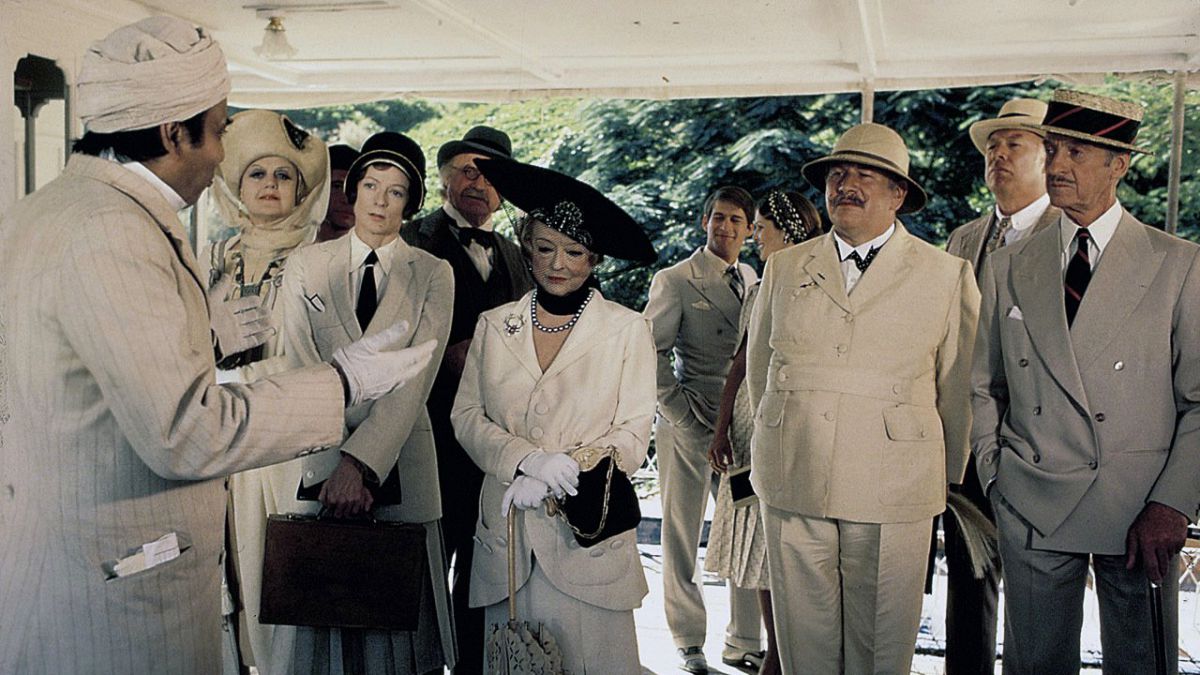
Death on the Nile (1978)

The all-star cast line-up for murder and mayhem in Death on the Nile

Director: John Guillermin

Cast: Peter Ustinov (Hercule Poirot), Jane Birkin (Louise Bourget), Lois Chiles (Linnet Ridgeway Doyle), Bette Davis (Marie van Schuyler), Mia Farrow (Jacqueline de Bellefort), Jon Finch (James Ferguson), Olivia Hussey (Rosalie Otterbourne), George Kennedy (Andrew Pennington), Angela Lansbury (Salome Otterbourne), Simon MacCorkindale (Simon Doyle), David Niven (Colonel Race), Maggie Smith (Miss Bowers), Jack Warden (Dr Bessner), IS Johar (Mr Choudhury), Harry Andrews (Barnstaple)

Is there anything more perfect for a Bank Holiday afternoon than an all-star Agatha Christie adaptation? Take a look at the TV schedules on those days and sure enough one of them will pop up. So on New Year’s Day, I took my place on the sofa for a welcome revisit to dastardly goings-on aboard a luxury cruise ship sailing down the Nile. 

Simon Doyle (Simon MacCorkindale) has jilted his lover Jacqueline de Bellefort (Mia Farrow) in order to marry the fabulously wealthy Linnet Ridgeway (Lois Chiles). It’s a tricky love triangle – so you can imagine the newly-married Doyles are far from pleased to find Jacqueline popping up on their Nile cruise holiday. Things eventually explode into a confrontation between Simon and Jacqueline that leaves him shot in the leg and her sedated. While they are both out of the picture, Linnet is murdered in her bed. With the two obvious suspects out of the picture, who among the (all-star) passenger line-up did the deed? Just as well Hercule Poirot (Peter Ustinov) is on the ship to solve the puzzle.

Following on the heels of the smash hit success of 1974’s Murder on the Orient Express, the producers of that film didn’t really shake up the formula too much. Hire a load of star actors, pick one of Agatha Christie’s most picturesque-set novels and then watch the money come pouring in. Albert Finney wasn’t available to come back (rumour had it he wasn’t keen in any case on the huge amount of make-up involved) so instead Peter Ustinov came on board and away we went.

Death on the Nile feels very much like a film following a formula. Perhaps it struggles to live up to the first film because it is a slightly less compelling mystery than the first film (although still a damn good puzzle with a real twist of a solution). Perhaps it was more difficult to recapture the magic? Or perhaps it’s because it lacks the quality of direction that Sidney Lumet brought to the first film. Lumet managed to create something that always felt more than a vehicle for star turns – the more plodding John Guillermin instead feels like the sort of guy brought in to manage the day-to-day realisation of a producer’s vision (essentially the same role he fulfilled on The Towering Inferno). Death on the Nile feels very comfortable on the television perhaps because it is filmed in a very straightforward, unobtrusive style with less visual panache than many of the David Suchet series Poirots (even the earlier ones).

But the film does a good job in hiring Peter Ustinov. Ustinov has the comedic chops – matched with the acting prowess – to walk a fine line between the drama and the slight air of comedy that underpins the film. The sort of performance that tells everyone that this is essentially a Christmas treat and shouldn’t be treated too seriously – but still conveys enough of the character’s humanistic shock and anger at violence and murder. Poirot can very easily become a slightly ridiculous character, and Ustinov is canny enough to realise that (relative) underplaying of the character actually works rather well to make him engaging and entertaining, but not too heavy.

Not that heavy is the film’s problem, as this is a pretty light soufflé. The all-star actors happily go through their paces, although you can pretty much tell most of them are in this for the free holiday and the pay cheque. Most of them have fun with their parts – none more so than Angela Lansbury who goes way way way over the top as a bohemian novelist – but they pretty much go through the motions. Shaffer’s decent screenplay doesn’t do much in any case to sketch these characters out – and you suspect much of the bitchy duelling between Bette Davis’ selfish rich widow and Maggie Smith’s put-upon companion was spun out post casting. 

Saying that, I was rather taken with Olivia Hussey’s performance as a fundamentally decent person in the middle of the madness, while Lois Chiles is good enough that you regret her career didn’t really go anywhere after this film. Simon MacCorkindale and Mia Farrow also do well with tricky parts. But it’s all pretty much paint-by-numbers stuff.

Visually the film looks lovely on the Nile. The costumes and designs are great – even if some of them look pretty much straight out of the 1970s rather than the 1930s – and you can tell that the money has been lavished on it to make a pure, old-fashioned entertainment. Shaffer’s script does a decent job of adapting one of Christie’s most twisty tales – even if it does give us what feels now a pretty racist portrait of the meek and crawling ship manager played by IS Johar.

But this is safe and comfortable entertainment – and it definitely is entertaining – rather than something that feels truly filmic. You could argue that this film more than any other set the tone for what we expect from an Agatha Christie adaptation – and its mixture of light comedy and grisly murder set in a lush 1930s location is pretty much de rigeur for everything else that follows. And you know what, I don’t think that’s a bad thing.

Gumshoe (1971)

Fulton Mackay and Albert Finney in charming Liverpool set Chandler spoof Gumshoe

Director: Stephen Frears

Cast: Albert Finney (Eddie Ginley), Billie Whitelaw (Ellen Ginley), Frank Finlay (William Ginley), Janice Rule (Mrs Blankerscoon), Carolyn Seymour (Alison), Fulton Mackay (Straker), George Innes (De Fries), Billy Dean (Tommy), Wendy Richard (Anne Scott), Maureen Lipman (Naomi)

Film noir is a genre beloved by many, and – with its many conventions and, in particular, its hard-boiled Chanderlesque style – it’s also ripe for parody. That’s what Gumshoe does here, transplanting the rough, grimy mysteries of Philip Marlowe and Sam Spade to Liverpool in the 1970s. In doing so, it allows Albert Finney to let rip with the sort of hugely enjoyable personality performance that plays to his strengths.

Finney plays Eddie Ginley, a would-be comedian and entertainer in his thirties, obsessed with Chandler and Hammett. Placing an advert in the paper offering his services for private investigations in the spirit of a lark, he finds himself hired to look into a decidedly complex affair concerning a female lecturer, a fat South African, an occult bookshop, an unhappy South African political refugee and quite possibly his brother William (Frank Finlay) and his old flame and now sister-in-law Ellen (Billie Whitelaw).

Gumshoe is a an enjoyable, small-scale, cine-literate drama, with a playful script by Neville Smith that has a wonderful ear both for the style of Hollywood detective drama, and the streets of Liverpool – and knows how to mix them together. Shot simply by Stephen Frears (who rather sweetly claims on the blu-ray documentary to not have had a clue what he was doing), the film rattles along with a few good jokes, some decent set-ups and an actually rather good mystery. It largely falls just the right side of parody – not too smarmy, affectionate enough but never taking itself too seriously. It’s a very well judged pastiche – and it’s also a pretty damn good mystery itself.

The film was somewhat of a passion project for Albert Finney (his production company put up much of the funding).  And you can see why, as Finney is excellent – relaxed, smart and funny. Eddie Ginley is part dreamer, part realist trying not to see the truth around him. He knows this world of detecting is partly a game, partly dangerous, partly a fantasy – but he wants to enjoy while it he can. Finney also clearly enjoys the sort of Marlowesque dialogue, just as he gives real emotional depth to a man who has always been looked down on by his brother, and jilted by his girlfriend for said brother. It’s one of his best performances, he’s outstanding – a charming, playful, warm and also super-smart and cunning performance.

The rest of the film gives playful highlight moments for a number of performers, wrapped up in the enjoyment of the material. Finlay does a decent job as a stuffed-shirt straight man, Billie Whitelaw enjoys a sly parody of any number of femme fatales from 1940s movies, and Janice Rule is intimidating as a very different type of suspicious female. The best supporting performance however comes from Fulton Mackay as a brusque but wry Scottish hitman, tailing Ginley throughout the film to reclaim money he feels is owed to him. 

It’s a shame that a fun, playful and engaging film has in some places dated so badly. Not least in its language aimed at a black heavy Ginley gets into a scrap with. Intimidated and off-guard, Ginley falls back onto banter aimed to put the heavy off balance – but which listened to today is basically a string of vile racial slurs using words like jungle, bananas, trees etc. etc. etc. And the attitudes are repeated time and again in the film, with the character constantly referred to in the most derogatory and racialist terms. Mind you at least Oscar James as the butt of this gets a neat dig at Ginley hardly being “the Great White Hope” after a brief bout of fisitcuffs.

It’s an interesting sign of how dated the film is that the villains are racist apartheid South Africans, Finney was at the time a leading campaigner against Apartheid, but neither he nor the film clearly  put calling a black man a monkey into the same bracket as that bigoted system. No one involved really is a racist, not even the characters – it just wasn’t deemed a problem to say those things in the 1970s. (Even the booklet in Indicator’s excellent blu-ray dwells on this uncomfortable dated material).

But, bench that from your mind, and you’ve got a charming, fun pastiche that pokes a lot of fun at Bogart and Chandler. The make-believe fun of Eddie’s Marlowesque hard-boiled dialogue is constantly punctured by him having to explain what he’s trying to say. The film has a lot of fun with the details of a mystery, but still keeps that smart sense of tongue-in-cheek. It’s packed with some excellent lines and some sharp performances. Finney is superb. It’s a pastiche and an affectionate homage of a whole genre – and, although it is old-fashioned and feels a bit dated, it will I think stand up to re-watching.

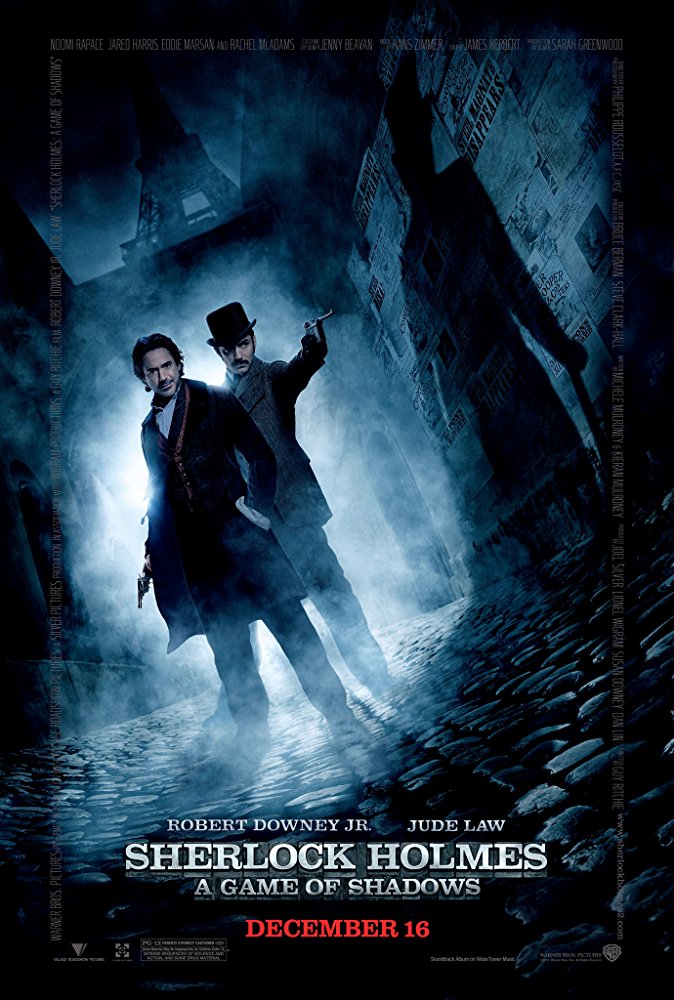
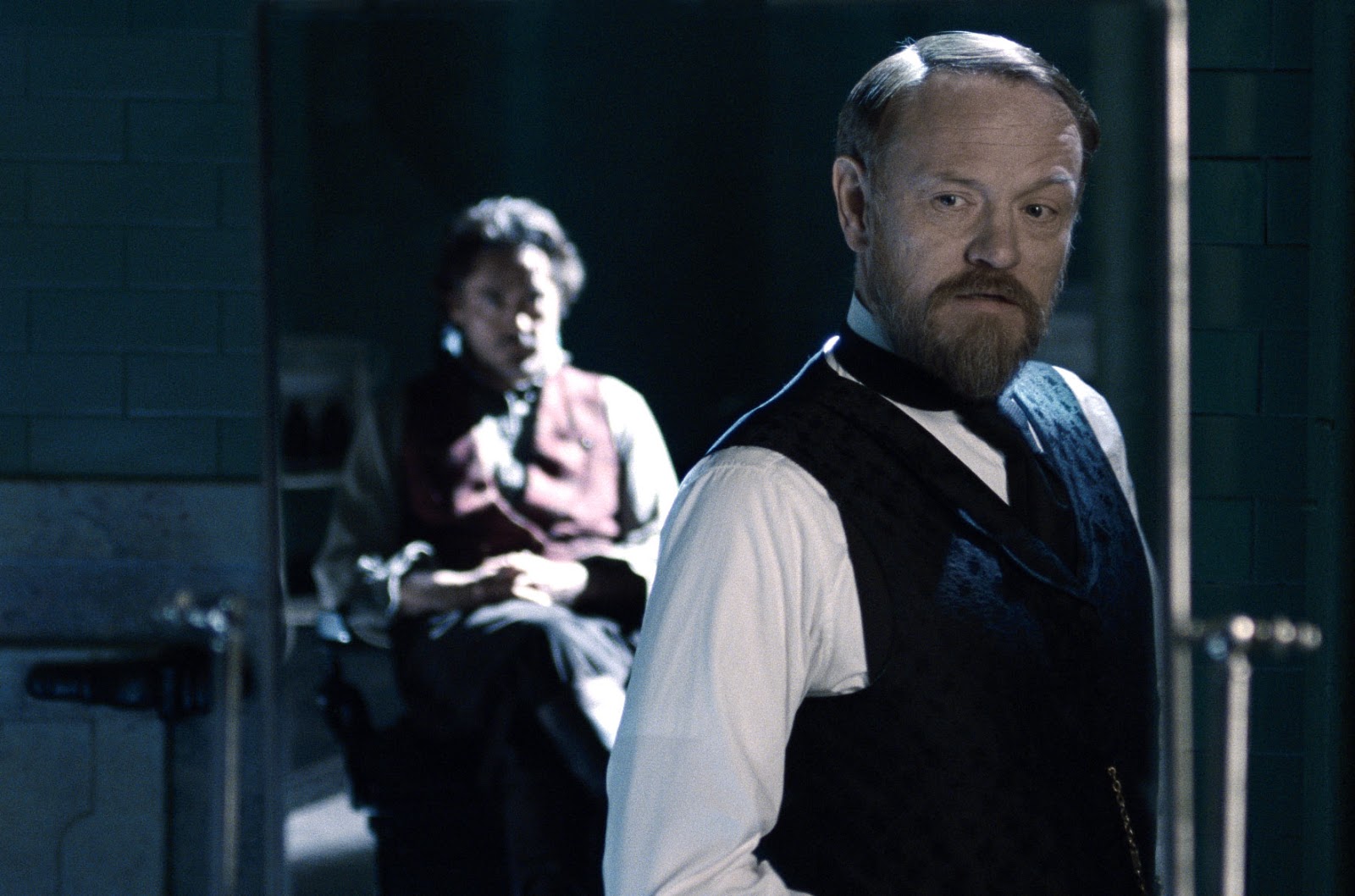
Sherlock Holmes: A Game of Shadows (2011)

Our heroes are on the run in Sherlock Holmes: A Game of Shadows

Director: Guy Richie

Cast: Robert Downey Jnr (Sherlock Holmes), Jude Law (Dr John Watson), Jared Harris (Professor James Moriarty), Noomi Rapace (Madame Simza Heron), Stephen Fry (Mycroft Holmes), Kelly Reilly (Mary Morstan), Rachel McAdams (Irene Adler), Eddie Marsan (Inspector Lestrade), Paul Anderson (Sebastian Moran), Geraldine James (Mrs Hudson), Thierry Neuvic (Claude Ravache)

Sequels are tricky beasts. You need to work out what people liked about the first film and double down on it, while also expanding the story in new and exciting ways. When I first saw Sherlock Holmes: A Game of Shadows in the cinema, I was very sceptical about whether this film managed that. But actually, viewing it a second time around (and almost seven years later), I enjoyed it a lot more than I remembered.

As Watson (Jude Law) prepares for his wedding to Mary Morstan (Kelly Reilly), Sherlock Holmes (Robert Downey Jnr) is consumed into an investigation targeting the “Napoleon of Crime” Professor James Moriarty (Jared Harris). A series of bombings across Europe is being blamed on anarchists – but is it in fact a scheme launched by Moriarty’s military-industrial complex to instigate a world war (from which he can make a profit)? Well what do you think?

Sherlock Holmes: A Game of Shadows doubles down most strongly on the relationship between Holmes and Watson. Recognising that the things from the first film everyone loved was the brotherly banter between these two, the sequel places it front and centre. While the first film felt the need to introduce a traditional love interest for Holmes, this film kills off Irene Adler in the first few minutes (despite this, poor Rachel McAdams has better material here than most of the first film). Instead the true “romantic” relationship of the film is Holmes and Watson, as they banter, bicker and make huge sacrifices to protect each other. 

It’s helped again by Downey Jnr and Law’s excellent performances and their strong chemistry. Saying this, the first half hour of the film thinks it’s funnier than it is, with its intermixing of Watson’s stag night with a series of Downey fights. There is a little too much brashness to it early on, without sufficient grounding in the warmth between the two characters. But once we hit the real action 40 minutes into the film, the balance between comedy, affection and peril is pretty effectively met.

And Ritchie directs some very fine action sequences here. There is an extraordinary sequence of a chase through the forest, which uses an exquisite mixture of hand held cameras, Steadicam, slow motion and half a dozen other tricks to deliver a series of striking and immersive shots. Yes it’s overblown and in-your-face but it works perfectly. The film is crammed with brash, powerful action scenes like this that really strike you between the eyes. 

It also still keeps in touch with the original novels in a nice way. Some of the best dialogue scenes are those between Holmes and Jared Harris’ muscular but serpentine Moriarty (Harris is very good, a far stronger villain than the first film). These scenes use dialogue from the original stories extremely effectively. Meanwhile, its build towards its version of the Reichenbach fall is actually very clever, one that twists on the movie’s “calling card” of Holmes predicting every move of a fight before it begins by having Moriarty pull the same trick (which is in itself a neat scene).

Where the film does fall short amidst all this action and explosions and jokes (some good, some bad) is that we don’t get much in the way of investigation or deduction. There is a bit of sleight-of-hand and a touch of pocket picking, but most of the “deductions” are based on highlighting with the camera or dialogue objects that might as well be labelled “Important Plot Device”. Holmes doesn’t so much as investigate here as charge head first from one combat sequence or dangerous situation to another. There isn’t a lot of patience in his method here – and not a lot of patience in the film itself. But then this film is largely based on The Final Problem, probably one of the least “detective” of the stories in the cannon.

But Game of Shadows is very good fun, has some neat action sequences, is well shot and is more or less entertaining, even if some of the comedy suggests it’s a little too pleased with itself. Sure it loses some of the smaller-scale delights of both the books and original film in its rush to make sure you are wowed. But I enjoyed it a lot more the second time round, since I’d watched the original film more recently and was tuned up into what it was trying to do.

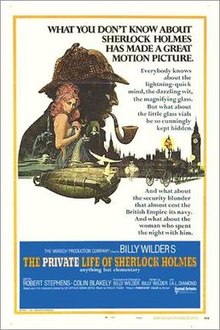
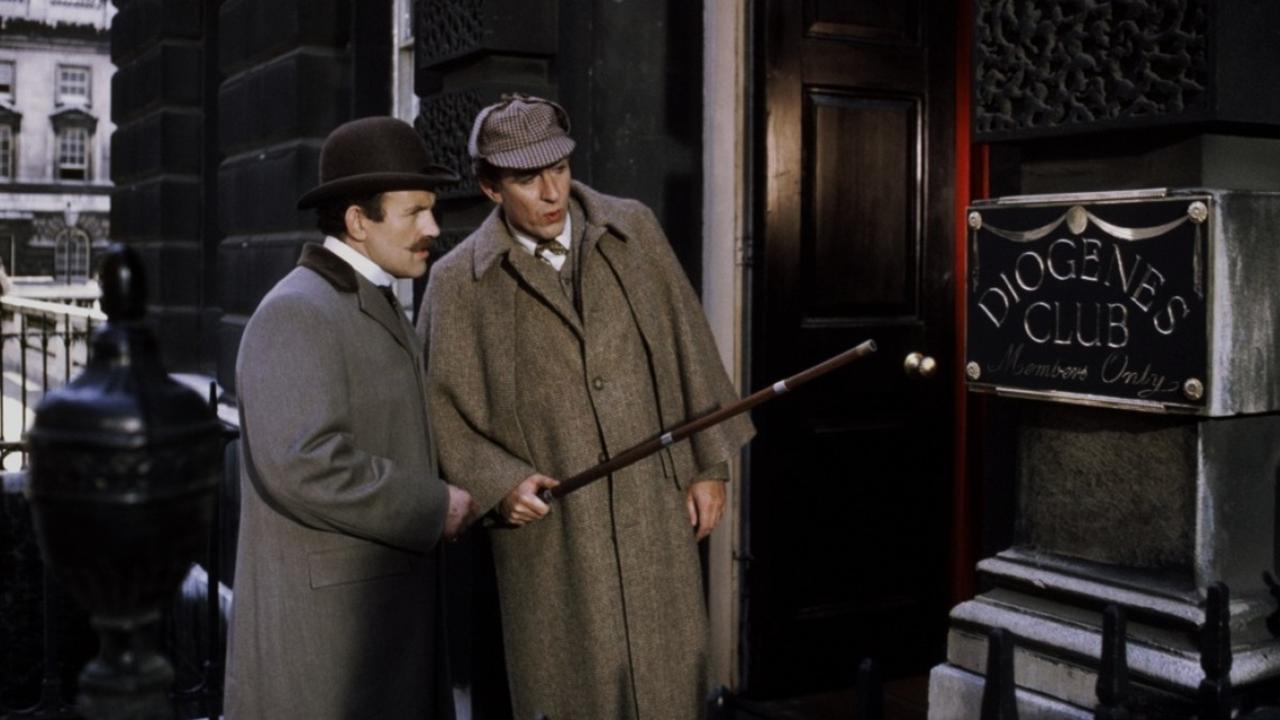
The Private Life of Sherlock Holmes (1970)


Robert Stephens and Colin Blakely explore the mysteries of the Private Life of Sherlock Holmes

Director: Billy Wilder

Cast: Robert Stephens (Sherlock Holmes), Colin Blakely (Dr John Watson), Geneviève Page (Gabrielle Valladon), Christopher Lee (Mycroft Holmes), Irene Handl (Mrs Hudson), Clive Revill (Rogozhin), Tamara Toumanova (Madame Petrova), Stanley Holloway (Gravedigger), Mollie Maureen (Queen Victoria), Catherine Lacey (Old Woman)

The Private Life of Sherlock Holmes may just be the best Sherlock Holmes film you’ll see. It’s certainly one of the most original. Wilder’s semi-pastiche, described by Mark Gatiss as “both reverent and irreverent”, was a major box-office disaster at the time, but it’s a film that has grown richer and more enjoyable with age – particularly as we’ve caught up with its “fan fiction” style, its placing of the great detective in unusual emotional and social situations. 

Wilder’s film follows two “buried” cases of Sherlock Holmes, both suppressed by Watson. In the first (taking up the first quarter of the film), Sherlock Holmes (Robert Stephens) and Dr Watson (Colin Blakely) are invited to a production of Swan Lakeby the Russian Royal Ballet, where a curious and unusual case is proposed to Holmes. In the second story, a mysterious woman suffering from amnesia (Geneviève Page) winds up on the doorstep of 221B Baker Street. Investigating who and what has brought her there leads into a case that covers continents, the upper echelons of the British government, and (possibly) the deeply hidden depths of Holmes’ own heart.

First off, it’s impossible to talk about Private Life without noting we only really have half the film. Not only did audiences not get it, nor did the studio. Both were expecting a traditional Holmes adaptation. Getting an amusing and wry exploration of Holmes’ psychology, built into a film where the great detective makes several errors, was categorically not that. So half the film was cut and chucked in the bin (including two whole cases). The footage no longer survives (there is an excellent recreation of what is left on Eureka’s new blu-ray) – but it’s a film that might have been.

It’s also a film that was apparently hell to make. Wilder had always been demanding – he demanded a completely faithful interpretation of his text, and often gave scrupulous line readings. It went to extremes here: epic rehearsals before every shot, with every line and movement dictated. For Stephens – a fragile alcoholic going through a divorce – it was too much, and part way through filming he attempted suicide. Shooting was delayed while he recovered, though Stephens’ pale, wan face needed to be overly made-up to compensate (in the opening scenes he genuinely looks like a drag act).

So you can’t forget the turmoil that brought it to the screen. But the end result (what remains) is largely a delight, even if it isn’t perfect. But it really is decades ahead of its time. Just like Sherlock (and it’s certainly the parent of that show), its main interest is not the case but the detective, his foibles and his emotional hinterland. Motored throughout by the wonderful chemistry between Stephens and Blakely (the two actors were good friends), it’s a wonderfully written film, full of wry humour and banter, mixed with moments of genuine heart and emotion. 

The film asks: who is Sherlock Holmes? Is he the cold fish he appears to be? While it doesn’t want to answer the enigma, it enjoys trying to unpeel those layers. Stephens’ Holmes is wry, witty, slightly fey, playful but also distant. He stands off from genuine intimacy and emotion – and why is that? As he spends time with Gabrielle Valadon, how much does he warm towards her – when he ruminates on his fears about trusting people, particularly women (in a marvellous late night conversation in an overnight train bunkbed), the film asks us to think: how damaged can this man who lives to investigate crimes but seems to have only one friend, be? It’s everything Sherlock took further: in fact the relationship between Holmes and Vardon has more than a few echoes in A Scandal in Belgravia.

The film’s real genius though is its opening short story, revolving around Holmes, a ballet company and a serious of unusual requests. This pastiche is very funny, very clever, beautifully played and crammed with invention and wit. The dialogue is beautiful, while both actors are perfect: Blakely is hilarious as a Watson full of joie de’vivre while Stephens’ drily amused Holmes works hard to never let surprise penetrate his raised eyebrow. The story goes down some mysterious alleyways – not least some curious questions around Holmes’ sexuality and experience with women. But it’s just about a perfect half hour of Holmesian pastiche: probably the best of its kind ever made.

The larger story doesn’t quite live up to it, but there are some beautiful moments in there, not least the growing bond between Holmes and Vardon in which nothing is ever said or done – and much is left open to interpretation – but where Holmes shows more of his humanity than he has perhaps ever done. The case itself is half humour, half expansion of Conan Doyle. By the end we are left asking ourselves how much on the back foot Holmes was for most of the case: and the case’s resolution eventually sniffs of satire. But the film itself ends on a bittersweet resolution, with Holmes facing the impact of emotions in a way he perhaps never has before.

Wilder’s film is sharp, witty and crammed with great scenes and jokes. It’s very well acted, particularly by Blakely as a hilarious Watson, full of good humour and bombast but with a sharp sense of cunning. He may not be as bright as Holmes, but he’s certainly bright enough to get the most out of life. Stephens is a little uncomfortable as Holmes (this film sparked a career nosedive that it took nearly 20 years for him to emerge from) but at certain moments he gives the part a really unique lightness masking an unknowable emotional hinterland.

It’s a film that’s easy to mistake for straight comedy, but it really isn’t. It’s a fascinating, entertaining and rewarding exploration of the leading character’s psyche, by writers who clearly know of what they speak. It throws in a case framework that smacks of the high-blown, Giant Rat of Sumatra-style cases Watson makes passing reference to in the stories. It’s a film that focuses on character and relationship – that captures a sense of friendship between Holmes and Watson that few other films have managed – and that spoofs the cannon while still feeling very true to it. 

It’s not perfect: it’s overlong and sometimes the pace drags or the sparkle fades. But Wilder and Diamond’s script has plenty of jokes and cannon knowledge (this was the first pastiche to explore Holmes’ cocaine use – and the psychological reasons for it) and has some terrific performances. Christopher Lee makes a wonderful urbane, whipper-thin Mycroft while Irene Handl is a wonderfully bumptious Mrs Hudson. Not only did it inspire Sherlock – it must also keep inspiring all fans of the great detective.

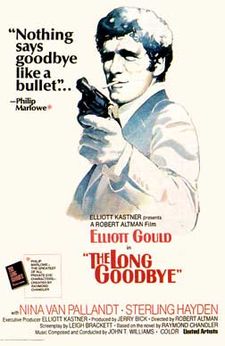
The Long Goodbye (1973)

Philip Marlowe: You ain’t seen the great detective this dishevelled before

Director: Robert Altman
Cast: Elliott Gould (Philip Marlowe), Nina van Pallandt (Eileen Wade), Sterling Hayden (Roger Wade), Mark Rydell (Marty Augustine), Henry Gibson (Dr. Verringer), David Arkin (Harry), Jim Bouton (Terry Lennox), Ken Sansom (Colony Guard)

Philip Marlowe: The Great Gumshoe as you’ve never seen him before. Altman has taken Chandler’s original novel and re-set it into the 1970s. Marlowe (Elliot Gould) is still a private eye but a sort of eccentric Don Quixote, an ambling, mumbling oddity too noble to take on “divorce work”. After he gives his friend Terry Lennox (Jim Bouton) a lift to Mexico, he is left facing police wrath after Terry’s wife is found dead. He is cleared only when Terry is found dead in Mexico, having signed a confession. But Marlowe can’t believe his friend capable of murder – and investigates further.

Altman’s Chandler adaptation was widely criticised at the time – largely because it was completely mis-sold as a mystery detective yarn, which it certainly is not. There are no clues, the mystery is pretty vague at best and the detective hero not only does virtually no detective whatsoever, but is such a naïve soul with such a trusting 1950s style code of honour that he seems swept along by events like a broken reed in a stream. Far from the Marlowe of Bogart or Mitchum, Gould’s Marlowe was an almost wilfully uncool, awkward social misfit, whose lack of engagement with the world stemmed far more from his own lack of understanding than any cynicism.

On top of that, the film is an unusual blend of old and new. Marlowe is a scruffy man out of time, constantly smoking (no one else in the film does) and shuffling from encounter to encounter. Vital conversations happen outside of our (and Marlowe’s) hearing. The camera roams as wilfully as its lead character, rarely standing still to let us absorb the action, but constantly offering us a series of subjective angles. Like much of Altman’s work, the naturalistic sound recording lets dialogue overlap and clash. The entire soundtrack is a riff on the themes in the title song, the music popping up throughout like pleasant musak. Vilmos Zsigmond’s photography is both an inversion of film noir with its California brightness and (through a technique of deliberate overexposure called ‘flashing’) a sepia infected look at the 1970s that draws a link back to the source material’s 1940s origins.

But the tone of the movie is the most unusual thing: a strangely addictive hipsterish take on Marlowe, in which the majority of other characters are as shallow and self-obsessed as you would expect of the 1970s: aside from Marlowe, the only character who seems to apologise or keep to his word at any point is the film’s least sympathetic and most violent character. The eventual killer reacts to being confronted with his crime with a blasé self-entitlement. Across the apartment from Marlowe’s bizarre old-school Hollywood apartment block, a commune of hippie ladies exercise topless outside at all hours; everywhere you turn there are clashes between the old and the new.

The film’s opening immediately establishes what the film is going to be like, and is also one of the best sequences in the film: a quiet, gently paced quest Marlowe undertakes to find cat-food in the middle of the night and his inability to persuade said cat to eat the “wrong” brand of food that he brings back home. This secluded existence is only broken by the arrival of Terry Lennox, who immediately beats Marlowe at a bet on the number of 7s in the serial number on a $10 bill (which he wins despite Marlowe having the higher number of 7s, as he successfully lures Marlowe into an incorrect challenge). It’s a wonderful summation of the film’s plot, as well as a series of clear insights into Marlowe’s personality: a man out of time easily manipulated by those around him, who can’t fool a cat or win a bet with the best hand.

Gould’s performance is absolutely central to the mood and tone of the film. His Marlowe is a counterpoint to the hard-bitten detectives of film noir. Instead, he is a scruffy mumbler, whose continual, conversational patter throughout the film feels more like a commentary he is running for his own amusement than any attempt to communicate with the world around him. Gould’s charm and otherworldly quality basically is the film: he’s hardly off screen and he “sets the tone”: the film’s ambling, slightly confused glances at the modern world, where dialogue and motives are both equally unclear, exactly match the beats of Gould’s interpretation of the character. It’s a perfect performance for the film, a sly gag that also has heart and character.

The film’s off beat tone and lackadaisical attitude are punctured at several moments by astonishingly sudden upturns in tempo, and scenes that sizzle with the threat of (or actual) violence. These moments are linked to Mark Rydell’s brilliant performance as fast-talking Marty Augustine, a man whose actions are totally unpredictable. He is responsible for the film’s only real act of violence – but it’s a striking moment of brutality that no-one sees coming (least of all the other characters, on whose shocked faces and stunned silence the camera lingers).

Rydell’s exceptional performance is the stand out supporting one here, but there is also some very good work from Nina van Pallandt as a woman who is part vulnerable wife, part femme fatale, and whose emotional state and motivations constantly seem to shift and change (at a pace the audience barely keeps up with, let alone poor Marlowe). Sterling Hayden’s Hemingway-esque author is one of those primal force-of-nature performances that can grate, but it works in a film where so many of the other characters are restrained.

The film is an absorbing character study, and at the same time a sly commentary on both the 1970s, the source material and film itself: Gould’s Marlowe at points seems to be pushing on the wall of self-awareness (most notably in a hospital scene late in the film, a masterpiece of misdirection): later, Third Man style, he walks past another character without offering a beat of recognition, before (as the credits roll) he inexplicably starts dancing down a boulevard, the camera watching him in long shot. Hooray for Hollywood (the only other music in the film) bookends the film.

It’s a fascinating and highly enjoyable film with a series of striking scenes and character moments that capture the attention and imagination. It’s a film that needs, however, a certain expectation going into it. Don’t expect a detective story, don’t expect detection even, but instead a unique merging of comedy, social commentary, satire and drama powered by an almost wilfully off-hand lead performance. It’s the sort of unique concoction only Altman could have made. There isn’t really anything else like it.