Category: Russian films

War and Peace (1967)

War and Peace (1967)

Legendary Soviet Tolstoy adaptation, awe-inspiring in its scale and creative amibition

Director: Sergei Bondarchuk

Cast: Sergei Bondarchuk (Pierre Bezukhov), Ludmila Savelyeva (Natasha Rostova), Vyacheslav Tikhonov (Andrei Bolkonsky), Boris Zakhava (Mikhail Kutuzov), Anatoly Ktorov (Nikolai Bolkonsky), Antonina Shuranova (Maria Bolkonskaya), Oleg Tabakov (Nikolai Rostov), Viktor Stanitsyn (Ilya Rostov), Kira Golovko (Natalya Rostova), Irina Skobtseva (Hélène Kuragina), Vasily Lanovoy (Anatole Kuragin), Irina Gubanova (Sonya Rostova), Oleg Yefremov (Fyodor Dolokhov), Eduard Martsevich (Boris Drubetskoy), Aleksandr Borisov (Uncle Rostov), Nikolai Rybnikov (Vasily Denisov)

During the Cold War, the superpowers had to fight with things other than nukes. They raced to space. They were gripped by chess matches. And they made rival film productions of Tolstoy’s epic novel. War and Peace, a gargantuan production (it’s really four films and took literally years to make) was the Soviet answer to King Vidor’s War and Peace. If Hollywood thought it could own the greatest Russian novel ever written by making it an Audrey Hepburn vehicle, Mosfilm would take it back. The Soviet War and Peace would treat Tolstoy with the respect it deserved, honouring its literary richness, and putting it on a scale no film had ever seen before.

War and Peace was made with the state’s full backing. Its director would have anything he needed. Rebuild Moscow on the backlot (then burn it down)? Sure. Have historical artifacts from dozens of museums shipped to the film set? Boxed up and ready. Use tens of thousands of troops – and three war-hero Generals as assistant directors – to restage the battles of Austerlitz and Borodino? Thousands of horses were shipped to the set, while seamstresses worked on over ten thousand costumes. Moscow even created an arsenal of functioning cannons which shot 23 tons of gunpowder for the recreated battles. It’s no exaggeration that no film before or since could match this for scale. Avengers: Endgame eat your heart out.

To direct this gargantuan operation, Mosfilm and the Ministry of Cuture selected Sergei Bondarchuk, relatively young in his early 40s, over the seasoned veterans who expected the gig. Bondarchuk was by all accounts a hard taskmaster, who fought, bickered and bullied practically everyone on set (burning through three cinematographers), but also had a gift for marshalling effectively a small nation for years (though not without at least two heart attacks, one of which left him clinically dead for five minutes). He also had the chutzpah to audition nearly every actor in Russia before deciding the best man for the leading role of Pierre Bezukhov was none other than… Bondarchuk himself (for good measure, Bezukhov’s seductive screen wife would be played by his own wife Irena Skobtseva).

War and Peace could have gone two ways: its scale could have flattened a lesser director or led to the sort of middle-brow, stale traditionalist fare Hollywood hacks churned out for years. Instead, Bondarchuk was fascinated by the possibility of the medium and swept up in playing with the cinematic tricks explored by his heroes and contemporaries. War and Peace is a strikingly unique, often discordant, meditative film, full of visual invention that pushes the boundaries in the most inventive ways to present its colossal scale.

You can see traces of Abel Gance’s Napoleon in its evocative use of double exposure images (showing ghost like echoes of people appear in frame, most notably the near-death experience of Andrei Bolkonsky) and its extreme close-ups, not to mention the more obvious triptych homages for key moments (such as Napoleon and Alexander III’s meeting at Tilsit). Bondarchuk’s influences went wider than that: there is a social realist immediacy in several scenes, with their jittery camera-work, throwing us into confusing battles, that wouldn’t look out-of-the-ordinary among the Italian Neorealists. There are patches of Welles and Lang in the sweeping camerawork that stress the scale and geography of the sets. Panoramic aerial shots dial up the most ambitious work of Murnau and Gone with the Wind. Bondarchuk’s decision at key emotional moments to fade out all sound except for ambient noises, such as drips, breathing or birdsong feels like he’s been studying Tarkovksy – as does the beautiful, lingering shots of nature. Bondarchuk wasn’t just going to make a stately coffee-table book: he fused distinctive flourishes from the great film-makers, to wonderful effect.

In addition, Bondarchuk (also the co-screenwriter – did his chutzpah influence that similar wunderkind Kenneth Branagh, both obsessed with tricksy, inventive camerawork) wanted to pay tribute to Tolstoy. What’s remarkable about War and Peace is how much of Tolstoy’s meditation on the meaning of life is in the film. Sure, there are cuts – Nikolai Rostov, Sonya and Maria Bolkonskaya are reduced to the bare bones – but this film finds a great deal of time for its characters to muse (either in sometimes portentous voiceover, or a deep-voiced omniscient narrator) over the meaning of life, the quest of happiness and the nature of decency and nobility.

In fact, this is a particular surprise since this version War and Peace had its roots as a patriotic demonstration of Soviet film-making might. It’s particularly striking then that it ends with a sequence that stresses how ordinary soldiers (French and Russian) have more in common than not and how much links mankind together than drives them about. This is not pro-Soviet propaganda.

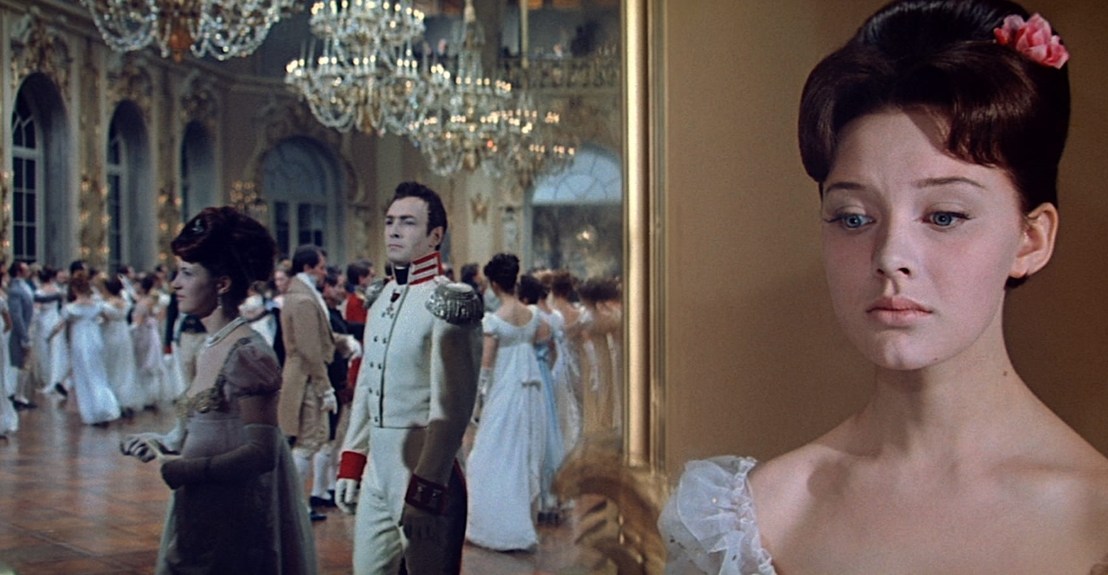
Not that War and Peace doesn’t take a few potshots at the effete, selfish rich, sitting in comfort while soldiers fight at the front. But it also finds time for the Rostov’s decency and self-sacrifice for and it doesn’t stint on the grandiosity of Tsarist Russia. A ballroom scene, site of Natasha’s meeting with Andrei Bolkonsky, is stunningly staged. In a huge mirror-laden ballroom, Bolkonsky’s camera bobs and weaves between dancers. Cinematographer Anatoly Petritsky suggested he filmed it while roller-skating, a genius innovation which creates a visual dancing effect as well as allowing us to be right among the literally hundreds of grandly costumed dancers (Bolkonsky skated alongside Petritsky, at times holding a fan slightly before the camera, to add to the effect).

The magnificence of this often gets forgotten in the awe-inspiring spectacle of the Russian military backed battles. Bondarchuk enlisted the Soviet Air Force for stunning, wide-angled aerial shots that revealed the stunning dimensions of the recreation. Petritsky also introduced a series of diving crane shots – like the camera has been set on a zip wire – that fly down from the heights into the battle’s chaotic maelstrom. (The battles are, as per Tolstoy, confusing messes where no one knows what’s going on but everyone pretends to be in charge). These battle images virtually redefine epic, mind-blowing in their scale – and the managerial and artistic force that must have been needed to organise and capture them all on screen as exquisitely as they are.

The same goes for the burning of Moscow, a dizzying outburst of flame, co-ordinated tracking shots (following Pierre through the burning wreckage) while crowds of extras run and panic. War and Peace also follows Tolstoy in being perhaps one of the grandest scale, anti-war films ever made. There are no real moments of heroism in the battle, soldiers march into injury and death and Bondarchuk frequently pans the camera across mounds of bodies or soldiers left mauled and dying on the ground. The retreat from Moscow sees Hellish suffering for the French, but that is balanced by the horrifying executions of civilians they carry out in Moscow, terrified men and boys led to stakes and gunned down in hard-hitting slow-motion. War and Peace doesn’t shy away from the suffering, pain and death that war brings, with very little glory or pride to show for it.

It’s also a film that’s often strikingly well-acted. Bondarchuk may be too old for Pierre, but his thick-set frame is perfect and his soulful eyes beautifully capture the character of a would-be-philosopher with no purpose. Vyacheslav Tikhonov makes Bolkonsky an imposingly distant man hiding his fragility. Perhaps most strikingly, ballet dancer Ludmila Savelyeva is a radiant Natasha, waif-like but bursting with energy and life, who tackles better than almost anyone else an impossibly difficult character. Bondarchuk frames her perfectly, back-lit to focus on her expressive eyes.

At times there is almost too much to everything in War and Peace. Bondarchuk is at times almost constitutionally incapable of shooting a simple scene, a relentless inventive energy that is perfect for the war but sometimes exhausting for the peace. The all-consuming screentime given to the scale of the battles and balls does eat into the time allowed to character and plot. But this is like complaining about being uncomfortably full after a generous rich meal. There is so much in War and Peace Bondarchuk gets right: from its respect to Tolstoy, but as an intellectual not as heritage figure to its stunning visuals, in every minute of its great length there is something to admire, thrill and strike you with awe. In this instance, the Soviets proved they could do Tolstoy better than the Yanks.

Andrei Rublev (1966)

Andrei Rublev (1966)

Tarkovsky’s masterpiece is one of the greatest films ever made about art and creativity

Director: Andrei Tarkovsky

Cast: Anatoly Solonitsyn (Andrei Rublev), Ivan Lapikov (Kirill), Nikolai Grinko (Danlil Chyorny), Nikolai Sergeyev (Theopanes the Greek), Irma Raush (Durochka), Nikolai Burlyayev (Boriska), Yuriy Nazarov (Prince Yury/Grand Duke Vasily I), Rolan Bykov (Jester), Mikhail Kononov (Foma)

I’ve always been a Tarkovsky sceptic. But Andrei Rublev is a masterpiece. Perhaps only Tarkovsky could have made a film about an artist and never once show a paintbrush in action or design a film about creativity that drips with shocking violence. Andrei Rublev avoids the cliches of cradle-to-grave biography – helped by the fact we know almost nothing about this medieval icon painter – presenting instead a series of vignettes suggesting possible influences on the work of an artist. It makes for an intriguing, fascinating film, challenging but infinitely rewarding.

Tarkovsky’s film roughly chronicles 24 years (1400-1424) in the life of Andrei Rublev (Anatoly Solonitsyn). But this is far from a straight-forward narrative, and the episodes themselves often seem only loosely linked and the movement of time and location often feels hazy. In many of these scenes Rublev is often a quiet observer or a man searching for depth and meaning, uncertain of his own views, aspirations and how he wishes to express his faith.

Over the course of the film, he observes a travelling Jester (Rolan Bykov) punished for mocking the social order, debates theology with his mentor Theopanes the Greek (Nikolai Sergeyev), is tempted by a pagan orgy in the forest and witnesses shocking acts of violence (including taking a life himself) in a civil war between two feuding noble brothers. Eventually taking a vow of silence, it is his witnessing of the rapturous reception of the successful casting of a giant bell – and the relieved shock of the teenage bell-master (Nikolai Burlyayev) that confirms to him the spiritual importance of providing consolation and joy to others through religious art.

Shot in a luscious black-and-white, Tarkovsky’s film presents a series of beautifully composed images that constantly invites us to re-interpret and re-imagine what we are seeing. This is not history as picture-book or progressive story. This is Tarkovsky at his best, a sprawling dream that never tries to clumsily link events to artistic outcomes or obvious motivations, but to suggest how the atmosphere of the world can form an artist’s spirit.

This is a medieval world that feels immersive, grimy and real – but also hums with a gorgeous sense of possibility. Tarkovsky frequently shoots horses, his camera lingering on these free-spirited animals that represent the freedom nature can give us. A close connection with the natural world draws the characters in time and again: Theopanes sits contentedly and allows ants to swarm over his legs, the bell is born in a dug-out crater in the earth itself. Water recurs as a symbol of possibility and temptation: Rublev’s pupil Foma daydreams of flying while washing brushes in water and later meets his death in a river; Andrei spies the naked pagan celebration in the river, then averts his eyes when rowing past their inevitable arrest. In the film’s prologue an early balloonist flies across a river, while at its conclusion Rublev and Boriska crouch and comfort each other in a water-logged field. Nature is elemental, bringing characters closer to an understanding of themselves and others.

In contrast, Tarkovsky’s film is striking for presenting what a destructive, violent and brutal force the ambitions of man can be. A yearning for power and recognition time and again develops into of violence. The jester is consigned to beating and years of imprisonment due to the close-minded resentment of intelligent-but-uninspired monk Kirill (Ivan Lapikov). A group of stonemasons are brutally blinded in the forest (violence even corrupts nature) by the Grand Duke’s men for standing by their rights. Most strikingly, Andrei witnesses a brutal massacre (vividly shot with hellish detail by, the entire sequence echoing the Eastern Front in World War II) in the city of Vladimir, where the Grand Duke’s brother’s forces indiscriminately rape and slaughter the population (including a horde of survivors searching for sanctuary in the church Rublev has just decorated with icons) and brutally torture and murder a monk (culminating in feeding him a melted golden cross). Even the bell-makers labour under the threat of instant death should their work fail and the bell crack.

Tarkovsky perhaps suggests the possibility of beauty and violence goes hand-in-hand for all of us. I feel that is the message of his fascinating – but never clearly explained – prologue. Set in an unspecified time and place, a medieval balloonist takes to the skies while, on the ground, panicked villagers (seeing the flight as witchcraft) attack his assistants. The balloonist flies with joy over the river – then crashes to the ground (and probably his death). This Icarus fable is, perhaps, about the difficulties of reaching for the sublime when the world constantly wants to pull us down. There is little place for invention and creativity in an existence that places a premium on earthly concerns, where art is just another tool for maintaining the power of the elites and the masses fear change.

It’s what Rublev is straining to rebel against. He lives in a world – and it’s hard to resist the idea Tarkovsky was suggesting Soviet Russia was little different – where art is a tool of control, feathering the glory of the powerful. He struggles to paint a Last Judgement because, as he argues with fellow artist Danlil (Nikolai Grinko) he doesn’t want to create an image designed to terrify the masses into faith. The Duke’s motivation for painting his Church is to make it grander than his brother’s. The bell is cast as a show for foreign dignitaries. The jester’s performance is punished for its satire.

Andrei is contrasted with the more overtly intellectual – but uninspired and untalented – Kirill, played with surely resentment and self-loathing by Ivan Lapikov. Judgemental and arrogant, Kirill dreams of having his genius recognised (approached by Theopanes to work with him, he is more interested in having the offer repeated publicly than the work itself) and lashes out at both the jester and his own dog for having the sort of freedom he can never find in himself.

Temptation and vanity also stands in the way of achievement. Shot in a style reminiscent of Christ in the wilderness, Andrei is fascinated by  the pagan orgy he witnesses. He is similarly drawn, for reasons he seems not quite to understand, towards the beautiful holy fool Durochka (Irma Raush), who he will brutally defend from rape in Vladimir. A vow of silence – and a Sisyphean labour moving heated rocks around a snow-bound monastery – is his self-appointed punishment for both his dreams of glory and his yearnings for romantic couplings. Art can be challenging.

But its results can be beautiful and inspire higher feelings. In the aftermath of the massacre of Vladimir, Andrei imagines a discussion with the long-dead Theopanes (Tarkovsky skilfully shoots this sequence with Theopanes appearing at every turn Andrei makes) who scorns Andrei’s grief and guilt over his burned church icons (and the false clash their beauty makes with the brutal world around them) and proclaims their beauty is a purpose in themselves. It’s a feeling Andrei only understands when seeing the people react with joy to the casting of the bell.

The final bell sequence – which brings all characters together to witness – would in itself make a masterful short movie and is certainly the finest extended sequence Tarkovsky ever made and a wonder in its own right. Immersed in the detail – and offering a fine portrait of bullish determination and artistic dictatorialness from Nikolai Burlyayev’s laser-focused Boriska – shot with a striking series of long shots and edits (some of the birds-eye shots are extraordinary) Tarkovsky creates a sequence of inspiration and tension. The careful, omnious, build-up to see if the bell will ring creates the same joyful relief in the audience as it does the watching crowds. It’s also perhaps the finest example on screen of the strangely empty, nervous release the culmination of creativity can bring.

Andrei Rublev is a fascinating, challenging and deeply engrossing art-house picture that alone cements Tarkovsky’s position among the greats. Finding colour only at the end with a series of awe-inspiring studies of the details in Rublev’s paintings, it reaches a finer understanding of the struggles in the soul of the artist than hundreds of more traditional biopics. Solonitsyn is superb as the enigmatic Rublev, the film a brilliant pageant of events (much like the medieval passion play Rublev remembers witnessing) that uses incidents to give us a final picture of understanding. It becomes one of the most oblique but constantly thought-provoking explorations of artists ever made – and a film where hours of thinking only scratches the surface of its possibilities.

Ivan the Terrible Parts 1 & 2 (1944/46)

Ivan the Terrible Parts 1 & 2 (1944/46)

Eisenstein’s final film sees him bravely turn Stalin’s dream project into a criticism of his whole regime

Director: Sergei Eisenstein

Cast: Nikolay Cherkasov (Ivan Vasilyevich ‘the terrible’), Serafima Birman (Efrosinia of Staritsa), Pavel Kadochnikov (Vladimir of Staritsa), Mikhail Zharov (Malyuta Skuratov), Amvrosy Buchma (Alexei Basmanov), Mikhail Kuznetsov (Fyodor Basmanov), Lyudmila Tselikovskaya (Tsarina Anastasia), Mikhail Nazvanov (Prince Andrew Kurbsky); Andrei Abrikosov (Philip, Metropolitan of Moscow)

The Soviet Union is at war, but Sergei Eisenstein is riding high. Fully restored to favour with the powers-that-be in the USSR with his flashy-but-traditional propaganda pic Alexander Nevsky, the master-of-the-montage was personally selected by Stalin to direct a three-part epic on the dictator’s hero, Ivan the Terrible. (You might wonder what attracted the paranoid, bloodthirsty dictator to a strong man Tsar best known for ruthless purges…) Stalin wanted an epic painting Ivan as a hero, who sometimes did bad things for the right reasons, all wrapped up in a neatly accessible package.

And he almost got it. Part 1 was met with acclaim and the Stalin Prize. Presenting Ivan as a successful politician and soldier, a true strong man binding the nation together and winning the admiration of his people, outfoxing his enemies at court (even though they successfully secretly murder his wife Anastasia), who retreats into Cincinnatus-like retirement only to be dragged back to save the country. It was the General Secretary’s wish-fulfilment wet-dream. Then came Part 2.

Part 2 was was immediately locked away in the vaults and all work on Part 3 ended instantly (every frame of footage shot was burned). If Part 1 was the dictator’s ideal Ivan-as-Stalin, then Part 2 was Ivan-as-Stalin that he definitely didn’t want to see. Now Ivan was ‘the Terrible’ doubling down on his nickname. Even worse, he did this while appearing unhinged, paranoid or (worst of all) manipulated by his poisonous advisors, none more so than jovial Beria-like Malyuta Skuratov (Mikhail Zharov). This Ivan rubbed out opponents, used terror as tool and focused all his anger and vengeance on those around him. Not something Stalin wanted to see, or was going to let anyone else see. Part 2 only emerged in 1958 ten years after Eisenstein’s death and 5 years after Stalin’s.

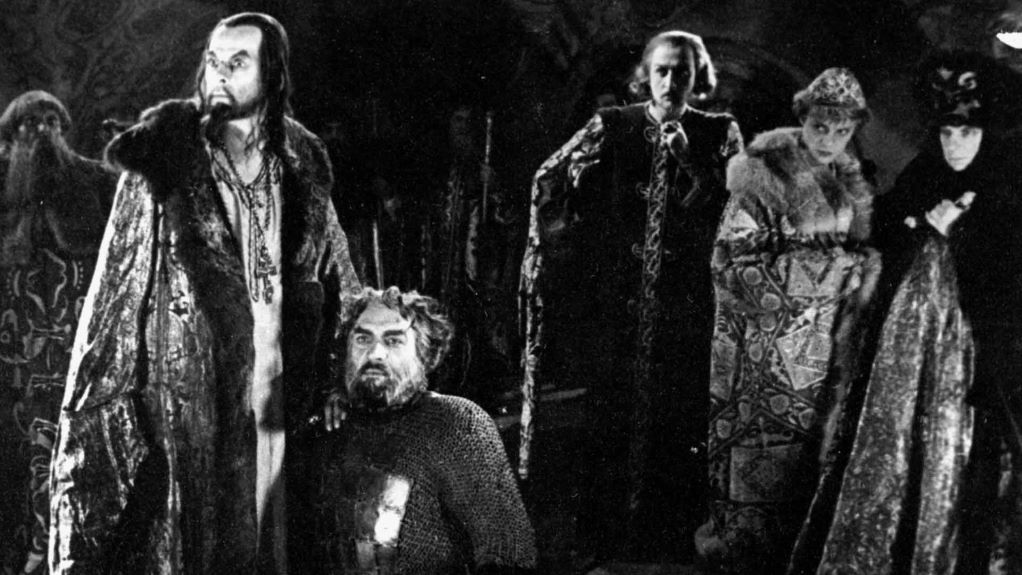
What the world ended up with, after they were allowed to see it, is a strange and hard-to-categorise film which has divided opinion for decades. To some it’s an artistic masterpiece, a triumph of symbolism and suggestion, with every shot crammed with intelligent and informed call-backs to artistic, psychological or sociological thinking. To others, it’s a somewhat turgid, hard-to-follow mess that serves as final expression of Eisenstein’s lack of interest in plot and character, not helped by his directions to the cast to echo Japanese theatre Kabuki style acting full of striking poses.

But you can’t deny the courage it must have taken Eisenstein to make this film. To have the guts to present something that deviated away from what history’s most ruthless dictator wanted and try and locate in it an unavoidable (if soft-pedalled) criticism of Stalinism. And can you blame Eisenstein if he tried to hide some of this behind art references and psychological games? Ivan the Terrible isn’t exactly easy – or fun – watching, but sometimes you just need to tip the hat to someone who has the guts to do things like this.

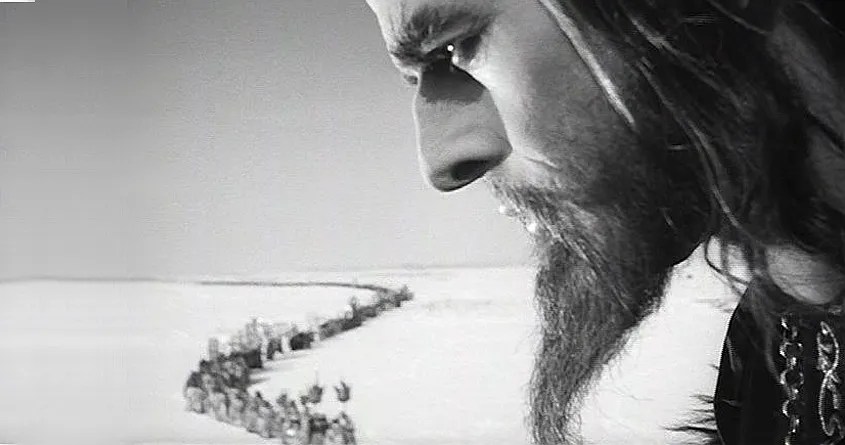
And there is plenty to admire in it. Eisenstein isn’t always recognised for his ability with the composition of shots – after all he’s the fast-cutting director’s dream – but Ivan the Terrible plays right back to his roots as a painter and designer. There are gorgeous shots here, my favourite being a looming close-up of Ivan’s face while behind him a never-ending procession of Russians slog through a white-out landscape to beg him to take back the throne. Ivan’s palace is a subterranean series of mole-like caverns, lavished with truly striking (and highly symbolic) devotional art. Firey angels are plastered across the walls above Ivan while plotting Boyars are shot huddled under mighty frescos of Death. The shadow work is extraordinary: light casts imposing, monstrous, giant black curtains. Astrolabe shadows dominate walls and advancing figures cast mighty shady pools in front of them.

Eisenstein takes his montage and arty suggestiveness of his editing work in Battleship Potemkin and October and translates it into images. The images do the work his banned formulist leanings had. Every image is rigidly thought-through and designed to make a specific implication or inference. It turns Ivan the Terrible into something ripe for analysis and exploration, the sort of film you could happily spend hours deconstructing.

It’s a film crammed with symbolism – some of it, if I’m honest, a little too clever-for-its-own-good. There are references to the work of Holbein, Botticelli, Rublev and a host of mythological figures. Sexual imagery is thrown in with blasting cannons at the siege of Kazan. It uses mirroring and contrasts throughout. Ivan’s coronation that opens in Part 1 will be echoed in a mock coronation of his would-be successor Vladimir (a fine performance of child-like simplicity and sweetness from Pavel Kadochnikov) in Part 2. As a child, Ivan will witness the death of his mother caught in the light of the doorway, very similar to the light in the doorway Vladimir will walk through to his death.

Characters are constantly positioned in framing that suggests (or hammers home) their personalities, motivations and desires. Vladimir will be cradled in his arms in a confessional Freudian clinch with first his mother and then (in an identical shot) with Ivan. The mock jovial Malyuta is given the physicality of the faithful dog he claims to be, while the villainous Efrosinia (a pantomimic, hissable Serafima Birman) rises from the ground like the serpent she feels like in almost every scene. Most of these characters are drawn in the broadest, most unsubtle strokes. It makes for some laughably unsubtle moments, but also a sort of primitive energy.

Unfortunately, it is also a film that dumps traditional narrative and characterisation for something highly stylised and impressionistic. Nowhere is this clearer than in Nikolay Cherkasov’s performance as Ivan. Constructed of a series of wild-eyed poses that would not look out of place in a silent movie, this is an over-the-top performance of hyperbolic mannerisms that probably has to be seen to be believed. There is nothing natural about this at all. It is all deployed to create a series of artistic poses and effects: what it is not designed to do is create a character we can relate to or understand.

Maybe this is how Eisenstein hoped to get away with implicit criticism of Stalinism? Ivan endorses the purges that happen, but we don’t seem him organising and initiating them. Was that, to Stalin, the worst crime of all – after all a strong man leads, even if his leadership is cruel. It’s also why, perhaps, he turned Malyuta into a jovial fixer (nevertheless Mikhail Zharov gives the film’s finest performance) rather than the ruthlessly ambitious killer he was. Part 2 shows an Ivan who allows executions not just out of ruthless paranoia but also a weakness of personality. Of all things, Stalin couldn’t take that.

Ivan the Terrible rockets along with very little sense of time, narrative or coherent, logical sense. Between the first and second scenes not only do years go by, but Cherkasov’s appearance changes so much it will take the viewer a few minutes to work out who he is. Characters sometimes go several scenes without being named. There is a Shakespearean pace to the narrative, even if it frequently flies over events, motivations, timescales and locations so quickly it’s hard to follow. It’s highly stylistic acting styles frequently make it hard for modern audiences not to raise a snigger.

Eisenstein was perhaps a little too keen to be seen as an artist, and Ivan the Terrible is at times – a bit like October – watching an overly enthusiastic art student showing you just how clever they can be. But, for all that, it’s intriguing and even if it’s not exactly entertaining, it offers many opportunities for intriguing analysis. And the very fact he dared to make a film that criticised Stalinism and then show it to Stalin is always going to be worth something.

Solaris (1972)

Solaris (1972)

Tarkovsky’s search for inner meaning and depth in the framework of space

Director: Andrei Tarkovsky

Cast: Donatas Banionis (Kris Kelvin), Natalya Bondarchuk (Hari), Jüri Järvet (Dr. Snaut), Vladislav Dvorzhetsky (Henri Burton), Nikolai Grinko (Kelvin’s Father), Olga Barnet (Kelvin’s Mother), Anatoly Solonitsyn (Dr. Sartorius), Sos Sargsyan (Dr. Gibarian)

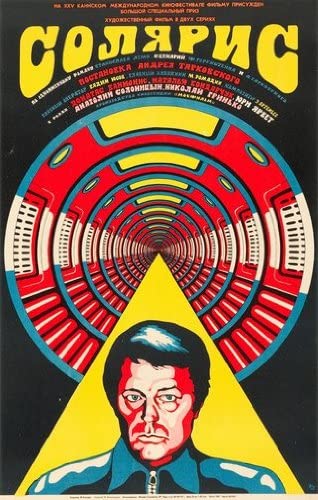
When Tarkovsky saw 2001 he was not impressed, calling it “a lifeless schema with only pretensions to truth”. Tarkovsky thought science fiction was in thrall to machinery and effects, rather than intellectual heft. (By the way, it shows how much Tarkovsky saw himself as a philosopher-poet, that he felt Kubrick a lightweight). Tarkovsky’s aim with Solaris was to present science fiction about people and ideas, rather than technology. Solaris is in equal parts fascinating and frustrating, wilfully slow (as Tarkovsky liked it) but also hypnotic, a film that never quite manages to marry up his stated aim to explore human feelings with his own intellectualist distance as a film-maker.

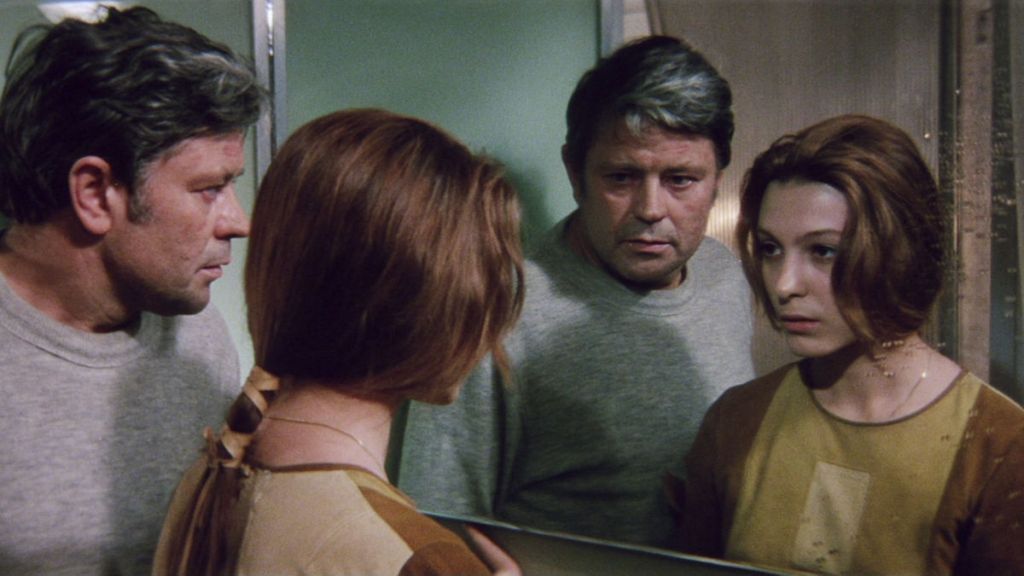
Adapted from Stanislas Lem’s novel, Solaris is set in an unspecified future and revolves around psychologist Kris Kelvin (Donatas Banionis). Kelvin is sent to a station orbiting the alien world of Solaris, an ocean world that quite possibly might be a gigantic living brain. It’s hard to tell if that’s the case, because contact with the planet has proved impossible over decades. Now the last three scientists on Solaris station are sending back strange reports and Kelvin’s job is to decide if the programme should continue. On the station he discovers the planet has somehow accessed the inhabitant’s dreams and made figures from their subconscious flesh – and he is horrified and then overwhelmed when his late wife Hari (Natalya Bondarchuk) appears on the station, a ghost made real by the strange powers of Solaris. How human is she? And does it matter?

Lem cordially disliked Tarkovsky’s Solaris. He couldn’t understand why the film didn’t exactly follow the book – where were the long chapters of scientific philosophical discussion? He felt it a shallow palimpsest of his work. I like to imagine that infuriated Tarkovsky, a director who prided himself on his intellectualism like few others. Huffily retorting films are different from novels, nevertheless he later claimed Solaris was the least favourite of his films, preferring the pretentious Stalker. But Solaris is ghostly and haunting in a way that the self-important Stalker (for me) never is.

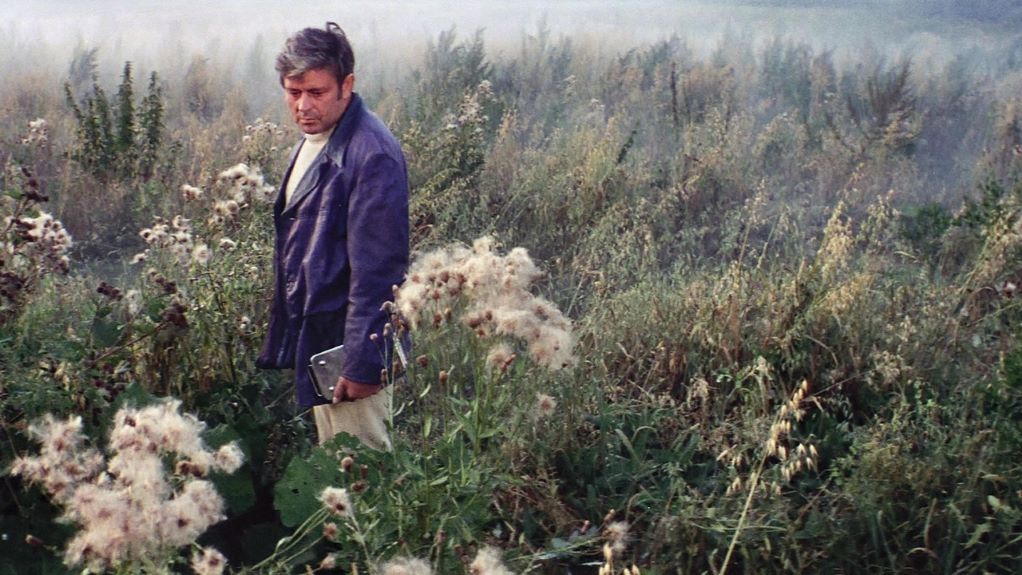
Tarkovsky’s view of man’s exploration of the stars is that it blinds us to the more rewarding search for truth and meaning here on Earth. Not for nothing does the film start with a long, wordless, sequence following Kelvin walking through the grounds of his father’s dacha. Reeds dance in the river, long grass strokes Kelvin’s waist, rain spatters down from the sky.  Nature is a key part of what makes us human – on the station, the scientists affix paper streamers to air vents to replicate the sound of wind among the trees, to make Solaris feel a little more like home. To Tarkvosky space is a boring, featureless mass, and Solaris nothing but a pale shadow of Earth’s glories.

What’s the point of hitting the stars, if we are cold and lifeless ourselves? Kelvin is this at the start of the film, a distant, emotionless man, plagued with regret, barely engaged emotionally with his world. A mysterious child runs around his father’s house – we assume it must be Kelvins daughter (Tarkovsky never confirms) but our hero never takes an interest in her. This will change with the appearance of Hari, exactly as he remembers her – unaged (she died at least twenty years ago) and a strange mix of who she was and his half-remembered memories.

But Kelvin isn’t ready to explore this yet. He puts the ghost in a rocket and shoots her off into space. Pointlessly, as his fellow inhabitants of the station tell him. They’ve tried similar with their own ‘visitors’ – they always reappear when they wake from sleep. And Kelvin can’t do the same again with the second Hari. Especially as this Hari is so distressed at the slightest separation from him, she tears her way through a metal door after he closes it on her.

It turns Solaris into Tarkovsky’s real aim: an exploration of what lies within, rather than ethereal dreams among the stars. As Dr Snout says, real exploration would require mankind to find a mirror not a rocket. Solaris becomes about how far Kelvin will go to emotionally connect to a woman who may or not be real and both is and isn’t the person he remembers. How much will he put aside his doubts and reconnect with feelings he has long suppressed? And in Hari’s case, as her self-awareness grows with every minute of her ‘existence’, how much will she change? And, as she is born from Kelvin’s guilt at her suicide, is she always destined to embrace self-destruction?

Solaris (1972 Andrei Tarkovsky) Donatas Banionis and Natalya Bondarchuk

These ideas become the heart of Solaris, unfolding in Tarkovksy’s trademark style. Solaris is awash with long unsettling takes and an eerie lack of music – and even, in places, ambient sound – in which the actors move with a coldness and lackadaisical precision. Solaris is, in many ways, an awkward fit for the director. Tarkovsky is not one to embrace raw emotion. Donatas Banionis remains, throughout, an austere and unknowable figure, whose exact feelings remain at times unconnectable behind his stoicness. Solaris is like a terrible ghost story that looks at the impact of loss with the same professional interest Kelvin as a psychologist has. At times Tarkovksy seems like a philosopher juggling the enigma of humanity, but getting a little bored with the question. Crude as he would find it, an emotional outburst or two would do wonders for Solaris.

But perhaps that would sacrifice part of what makes Solaris as compelling, haunting and lingering as it can be. Because there is a feeling the whole thing is taking place in a drained-out dream that could cross into a nightmare. Hari is beautifully played by Natalya Bondarchuk, carefully balancing the slow flourishing of a shadow into a human, scared and alarmed by the onslaught of emotions she cannot understand. Her slow of a distinct personality, rather than as an extension of Kelvin, contrasts with the cagey uncertainty of the rest of the characters. And makes us wonder how real they might be, since she feels at times the most vibrant.

Tarkovsky’s film uses his style to wonderful effect throughout. His lack of interest in the trappings of the modern world actually adds to its eerie disconnect. Clothing and technology basically look exactly like the 1970s, cars are unchanged, the space station is a grimy wreck. Kelvin’s journey to the space station takes about 45 seconds of screen time – compare to the long, dreamlike drive Burton takes through the city (actually – and clearly – Tokyo). Tarkovsky’s heart is in the poetry of a horse’s movement. It adds to the sense of space exploration as a chimera and the 45 minutes the film takes in its prologue on Kelvin’s father’s dacha reminds us that understanding the world around and inside us is where Tarkovsky feels our aims should be directed.

Solaris ends with a sequence that has stayed with me for decades. Kelvin repeats his long walk through his father’s land, all of it this time in a chilling stillness. Not a gust of air or ripple on the water. He approaches his father’s house to see rain falling inside. A long cut back shows the truth. It’s a close to the theme Lem felt was least engaged with by Tarkovsky: the impossibility of communication between two species so fundamentally different they can only offer a simulacrum of each other’s behaviour.

Tarkovsky is straining for a different type of psychological journey. Solaris offers little in the way of emotional investment – it’s far too restrained, cold and distant for that. Such emotions are placed at the heart of Soderbergh’s remake – but that sacrificed the austere, ghostly haunting of this. Solaris plays like a construct from the planet of our emotions, thoughts and fears, its characters moving in journeys of discover in our world much as Hari does in theirs. It’s unknowability and discordant stillness and jagged long-shots make it unique. It’s one of the Tarkovsky films I always want to revisit.

Alexander Nevsky (1938)

Alexander Nevsky (1938)

Eisenstein offers one of the great battle scenes in an epic that abandons his earlier style

Director: Sergei Eisenstein

Cast: Nikolay Cherkasov (Alexander Nevsky), Nikolay Okhlopkov (Vasili), Andrei Abrikosov (Gavrilo), Dmitry Orlov (Ignat), Vasili Novikov (Pavsha), Nikolai Arsky (Domash), Valentina Ivashova (Olga), Aleksandra Danilova (Vasilisa), Vladimir Yershov (Hermann von Balk), Sergei Blinnikov (Tverdilo)

And we think directors are under pressure in modern Hollywood. Eisenstein hadn’t made a film in ten years after an ill-fated tour in America, that largely left him under suspicion back home in the USSR. He’s patented montage directing style had been denounced as ideologically unsound. His last film had ended in over-budget disaster, in the aftermath of which the head of Mosfilms had been arrested, tried and executed for treason. Eisenstein was in the last chance saloon and told he could make one film. Imagine having Stalin breathing down your neck.

He picked, from a bundle of possible projects, Alexander Nevsky. A medieval Russian hero, Alexander Nevsky led Russia to historic military victories over the Germans and the Swedes. (He also had the freedom of history knowing almost nothing about Alexander beyond that). Alexander Nevsky would zero in on his victory over the invading Teutonic knights in the “Battle of the Ice” and present Nevsky (Nikolay Cherkasov) as a Russian Henry V, a legend who knew only victory, leading a unified Russia against a barbaric and cruel (German) foe. What better subject when Hitler was on the door?

Eisenstein was given a team of Stalinists to work with (to ensure he never strayed into his “formalist” style) as well as trusted cinematographer Eduard Tisse and legendary Soviet composer Sergei Prokofiev. The film would essentially be the build-up to the central battle, a propagandist celebration of the strength and unity of the Russian spirit against wicked invaders. (It’s easy to forget that Eisenstein was one of the greatest propagandaists ever.) Nevsky – seven-foot, shot often from below so he towered over the frame and played by Stalin’s favourite actor, the charismatic Nikolay Cherkasov – would be a clear stand-in for the USSR’s leader.

Alexander Nevsky is strikingly different from Eisenstein’s earlier films. Obeying strict instructions, it is shot in a more formal, almost operatic, style with longer takes and a greater dependency on camera set-ups than Potemkin or October’s use of editing and montage. This translates into the battle that makes vivid use of speed, motion and immediacy in front of a camera, with carefully timed-cuts rather than fast-editing ala Potemkin. It doesn’t prevent this being one of the most influential battles ever placed on screen. It serves as a clear structural inspiration for Olivier’s Henry V (right down to Nevsky and the knight’s leader taking part in a mano-a-mano fight in the middle of the battle) and its DNA runs through countless films that followed, right up to Jackson’s Lord of the Rings.

This is an all-out brawl, a mass of bodies and weapons piling into each other with the camera (and the viewer) in the middle. The soundtrack is drowned out in a barrage of clashing swords, and we frequently see our Russian heroes framed centrally and slightly from below in mid-shot, hewing away on all sides with swords, axes and spears. At times Eisenstein employs faster film – particularly for the movement of troops – but it’s striking how clear and lack in impressionism the editing is. There are no cuts to suggestive details or the sort of flexing hands on straining horse’s reins you might expect from his other work. Instead, narrative clarity and masculine patriotism is to the fore.

None of this stops the battle from being compelling. A furious back and forth on the ice which culminates (inevitably) in the ice breaking and many German foes sinking to the bottom of the river in their heavy armour. Eisenstein, the master propagandist, makes no attempt to humanise the Germans. The Teutonic knights are nearly to a man, steel-bucket-headed stormtroopers, impersonal robots who cruelly follow any orders. At the sack of Pskov, they toss children and babies into bonfires without a backward glance and think nothing of slaughtering the helpless. Their leader is an arrogant sadist, who faces capture with a whimper. He serves alongside hypocritical churchmen who bless the slaughter of innocents and conspire with turncoat Russian monks to subvert Novograd.

On the flip side, the Russians are united in nobility and determination. They are led from the front by Nevsky who places weapons in the hands of the peasants and motivates all around him with his wisdom, humility and courage. Cherkasov is hugely charismatic as this idealised leader – even if little is called of him as an actor other than inspired speeches and standing hands-on-hips in manly determination. He forms a bond with a brave-but-Falstaffian blacksmith (Dmitry Orlov) standing in for the ordinary Russians, who jokes about but (unlike Falstaff) fights like a tiger.

As do all the Russians. All disagreements are put to one side. Two nobles feuding over their love for the same woman form a bond of brotherly mutual respect on the battlefield. The bereaved daughter of a Pskov noble, straps on chainmail and fights in the frontline. Peasant and noble hold the line together. The most despised character is Russian traitor Tverdilo (a snivelling Sergei Blinnikov) who betrays Pskov, wheedles for advantage and (literally) stabs people in the back.

The battle – and the rest of the action – plays out to a stunning score from Prokofiev. At turns martial, terrifying, tension-filled and triumphant, Eisenstein cut portions of the film to directly match Prokofiev’s rhythms. He’s equally well-served by Tisse, who shoots the film with a mix of epic stateliness and visceral immediacy. Interestingly it’s in the editing that the film looks most primitive today. At one point in the battle the Germans move from right-to-left charge to left-to-right (a strangely disconcerting switch) while the clash between Nevsky and the Teutonic leader is disjointedly cut with obvious, jarring, jumps.

But then Eisenstein didn’t want to be accused to succumbing to this formalist style. Stalin was showed the film and loved it. Allegedly apart from one reel which was promptly utterly destroyed (or it was destroyed before he saw it, his acolytes anticipating his dislike – the story varies). The film was a huge hit – until Stalin signed a pact with Germany in 1939, at which point it was banned. When the Germans broke the pact in 1941, it was back with a vengeance, a stirring example to all Russians of the glory of fighting back against the aggressor, with it’s “don’t tread on me” message (which Eisenstein throws up in text on the screen) a rallying cry in a new patriotic war.

There isn’t much to Alexander Nevsky outside of the battle – it’s all build-up, battle and then tiring up of loose ends. There isn’t much in the way of characters – never a major interest to Eisenstein. But he did creep some things under the wire, not least an effecting end-of-battle sequence that sees the dead and dying Russians on the field whisper or call out the names of their loved ones quietly before they expire. But in a film as triumphant as this one about the indomitable might of the Russian people, Stalin could let that slide. Alexander Nevsky might be a simpler, less striking film than Eisenstein’s earlier work – but it’s still an influential piece of cinema.

Watch Alexander Nevsky here (why this video has a full colour image fronting it I have no idea…)

Further reading

As a quick note… A new feature I’m trying out here. Probably more for classic films than recent releases.

Battleship Potemkin (1925)

Battleship Potemkin (1925)

Revolutionary in more ways than one, this masterpiece still carries a real punch today

Director: Sergei Eisenstein

Cast: Aleksandr Antonov (Grigory Vakulinchuk), Vladimir Barsky (Commander Golikov), Grigori Aleksandrov (Chief Officer Giliarovsky), I. Bobrov (Young sleeping sailor), Mikhail Gomorov (Militant sailor), Aleksandr Levshin (Petty Officer), N. Poltavseva (Pince-nez woman), Lyrkean Makeon (Masked Man), Konstantin Feldman (Student agitator), Beatrice Vitoldi (Woman with baby)

If you have any doubt whether you have ever seen a film influenced by Battleship Potemkin I’d direct your attention to just one sequence. No, not the Odessa Steps. Instead: we’re on the deck of the Potemkin. The tyrannical captain has reacted to a complaint about the mouldy meat by demanding everyone refusing to eat it is shot. In a series of swift edits, mixing shots of the soon-to-be-victims, the marines who will do the shooting, different angles of the ship, we keep cutting back to Sailor Vakulinchuk’s face. What will he do? Will he protest? If you have ever seen a film build a violent crescendo with repeated cuts to a hero torn on taking action, you’ve seen something inspired by Battleship Potemkin.

It was made to celebrate the 20th anniversary of Russia’s first go-round for revolution, the series of uprisings that nearly overthrew the Tsar in 1905 (and led to him caving and allowing a degree of political representation anathema to him). Sergei Eisenstein, with the highly praised film Strike under his belt, was selected to direct. Eisenstein was offered a script full of events, but just one really spoke to him. That revolt of the sailors of the Potemkin, off the coast of Odessa. This was something he thought he could make a movie about! Eisenstein ditched nearly the whole of the script to focus on the class struggle between the sailors and workers and the faceless Tsarist system.

Battleship Potemkin would be a showcase for Eisenstein to expand the possibilities of editing images, cross-cutting to suggest inferences between events and characters. It’s no accident we cut so swiftly, and so often, from the maggot-filled meat the sailors are given and the stubbly, smug faces of the officers who insist the meat is edible. It’s pretty clear those maggots aren’t the only parasites aboard ship. The guns of the Potemkin are returned to time and again, dominating and dividing the frame or serving constantly as a reminder, first of the oppressive Tsarist regime, then of the heroic defiance of the sailors when faced with the Tsarist fleet sailing towards them.

Eisenstein’s mise-en-scene would become unimaginably influential. Not least because Battleship Potemkin is the most effective propaganda film ever made. It is impossible not to feel complete kindred with the sailors – all humble, honest, stoic Russian types, roused only to action by repeated provocation – and to despise the officer class, puffed up, dripping in elaborate uniforms, sneering at everyone, twirling moustaches over stubbly faces.

The film is shot time and again to present the sailors and the crowds in Odessa as a single, unified force. It’s rare where one of them appears alone – only reaction shots which capture their individual resolve (and, later, horror) – and they are mostly presented as united in purpose. In particular, Eisenstein shoots the citizens of Odessa as a near never-ending flow: they pour down the streets and steps (in a disciplined, respectful, mass) and fill the pier leading to Vakulinchuk’s makeshift grave. They work together and collaborate on tasks. On the other hand, the officers are frequently shot alone, either in close-up to stress their monstrous features or to capture their spittle-filled rants.

The sole exception is that meat-grinder of sabres and bullets that chews through the crowds at the Odessa Steps sequence. Here these soldiers – the brothers who don’t rise up but carry out the cruel, sadistic orders of their superiors – are barely human at all. There is no trace of personality or individuality in them. The features Eisenstein cuts to most are their marching feet, striding inexorably forward over bodies like a machine, and the bayonet tip of the rifles that relentlessly pour bullets into the crowd. If Bolshevism is a mass of individuals working as a coherent whole, then Tsarism is a brutality where the only faces are scornful and cruel officers.

The eventual coup of the sailors is masterfully cut together, fast-paced and overwhelmingly modern. It’s another indicator of the huge influence Battleship Potemkin has had on the grammar of modern filmmaking. As we watch Vakulinchuk and his fellows fight the officers, chasing them across the deck, scrabbling for weapons and the final duel between Vakulinchuk and Commander Golikov, its only the silence and black-and-white imagery that really distinguishes it from a similar end sequence in Avatar: The Way of Water. Battleship Potemkin can lay claim to being the most influential action film ever made, it’s use of fast-cutting to build tension, empathy and the imposing terror of seemingly insurmountable odds in a hostile environment second to none.

Editing and montage was central of Eisenstein’s technique – and you can argue that camerawork, character and (sometimes) narrative were secondary. Battleship Potemkin works as well as it does because it is an experience film. Its characters are ciphers, all of them Marxist tools towards an end effect. Eisenstein’s film is one of cuts designed to bring pace and rhythm, to project and create a visceral emotive reaction. He is very different from other silent directors who used the camera as a viewing tool, mobile and flowing. His movement comes from fast edits and quick cuts. Battleship Potemkin is modern in the sense that its finest sequences are a dizzying array of cuts and quick shots, that continue to influence action films today.

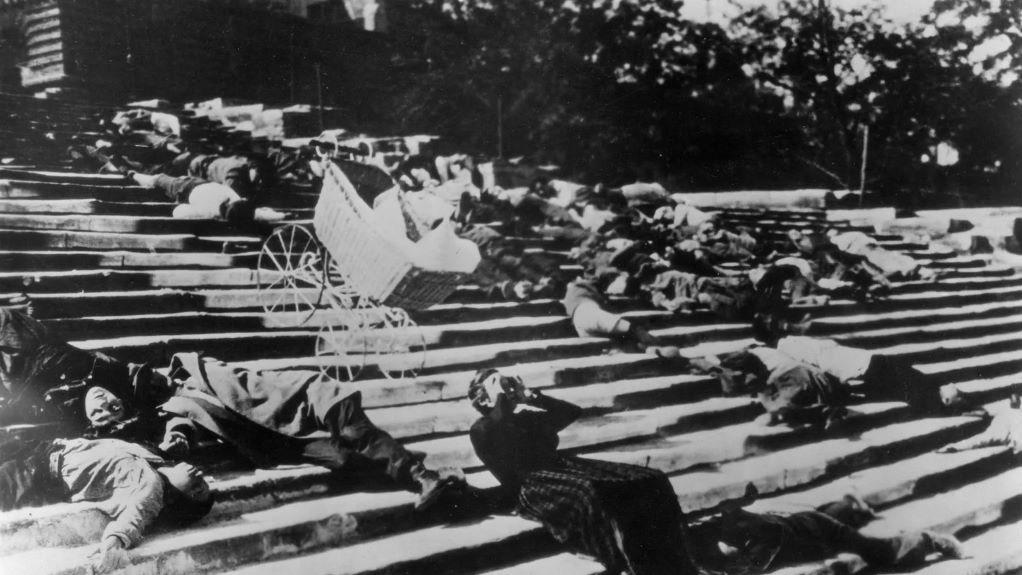
Which brings us, of course, to the Odessa Steps. Does it matter that this never happened in real life? Eisenstein essentially takes the 1905 Bloody Sunday massacre at the gates of the Imperial Palace in St Petersburg and transposes it to Odessa. It captures the mood of the time. Edits build in intensity – and swiftness – to highlight the growing tension and then explosive terror when the guns start firing. People flee in terror – one of the few tracking shots in the film follows the descent first of people, that that famous pram – down the steps. Reaction shots show a horrified mother, an older woman pleading for peace and a furious student radical.

And the furious intensity of the montage helps communicate the rampage. Careful cutting highlights the horror of a boy shot, trampled and then carried up to the soldiers by his distraught mother only to be gunned down. This is montage at its finest, and it even transforms time. People are shot and start to fall, we cut to reactions, soldiers marching, the stairs and then back to that person still falling. Is it reality? No. Is it drama? Yes. It’s a magisterial triumph of Eisenstein’s style, everything servant to the editing machine.

Battleship Potemkin is in the end all about editing. Eisenstein loves the impressions it can build. From maggots to officers. The sadistic priest’s face which constantly cuts back to his crucifix which thuds into his hand like a mace. The three lion statues – one lying down, one sitting, one standing up – cut swiftly together in sequence to give the impression the statue is reacting to events. Where Potemkin avoids camera inventiveness it more than makes up for it with the power of its montage.

And Eisenstein would argue that’s what cinema (ultimately) is and what differs it from theatre. It certainly works to make Battleship Potemkin thrillingly impactful. It’s no wonder that almost every country in the world – including the USSR – seems to have banned it at some point. It carries such visceral impact, it’s practically a weapon in the class war. Eisenstein’s influence continues to felt today, and while other pioneering directors would introduce more effective camerawork and story-telling techniques, none would harness the potential of the editing suite as effectively as Eisenstein.

Not seen it? Watch it now

Stalker (1979)

What’s it all about? Who knows in Tarkovsky’s Stalker

Director: Andrei Tarkovsky

Cast: Alexander Kaidanovsky (Stalker), Anatoly Solonitsyn (Writer), Nikolai Grinko (Professor), Alisa Freindlich (Stalker’s Wife)

Three men stand outside a room in what looks like a rain soaked, post-industrial wasteland. They debate at great length morality, optimism, fate and destiny. They all decide not to go into the room. There really isn’t any other director like Tarkovsy is there? Perhaps that’s a good thing.

Set in an indeterminate future, Stalker takes its name from the title for guides who – through some sort of sixth sense – are able to guide travellers through “the Zone”, a fenced off area, guarded by the military, that is the site of some sort of extra-terrestrial encounter (a meterorite possibly, who knows?) that gave the Zone magical power. In the centre of the Zone is a room which will grant the innermost desires of all those who enter. Travelling with our Stalker (Alexander Kaidanovsky) are a writer (Anatoly Solonitsyn) and a professor (Nikolai Grinko). Along the journey, ideas around everything from existence to the inner soul is discussed by the three men, each of them approaching from radically different perspectives.

Tarkovsky’s style was a sort of fusing of expressionism and stately filmmaking, mixed in with his own love of extended shots. In a world of cinema where the average shot in a film lasts a few seconds, in Stalker’s 162 minutes there are only 142 shots in total. Tarkovsky’s camera pans and tracks (often slowly) through the wasteland of the Zone, finding moments of great beauty and power in the industrial mess and debris, making fabulous use of the consuming power of water as it washes over and covers everything, invading every space. Tarkovsky’s painterly structure of the film is further aided by his switching between sepia (for most of the scenes outside the Zone) and muted colours (largely for those in the Zone, with a few exceptions). 

However, Stalker is also a long, slow, rather turgid film, immersive in the sense that you will feel you have lived every minute of the never-ending journey that the heroes go on. Which comes to the central problem I have with the film – and with Tarkovsky himself. The director, without a doubt, is an intellectual, straining at the leash with thoughts and ideas that he wishes to throw up into film. But Stalker is a film that suggests intellectualism, and carries all the trappings of deep thought, but in fact seems to throw ideas haphazardly at the screen with very little thought for how these hang together, or what the overall message might be (if any).

Instead we are subjected to a number of – beautifully filmed, with real artistic grace – rambling monologues that positively drip with self-importance and intellectual snobbery. Tarkovsky’s long takes and deliberate refusal to include much in the way of story, drama or character seem designed to make the film feel as much as possible like some kind of allegory. What this is an allegory of it feels Tarkovsky would consider crude to describe. Instead the film is difficult to watch and engage with, precisely because that is (it seems) what makes Great Art in the eyes of its director. When challenged by the Moscow authorities that the film was dull and slow, Tarkovsky argued it should be both duller and slower, to make those who were not of the intellectual level to engage with it leave earlier.

Perhaps he was right, as Stalkerhas become more and more of a critical darling, the further time gets from its first release. Now it seems almost blasphemy to look at the film and wonder if it is about anything at all. Almost a crime to suggest that Tarkovsky’s film is short on answers and easy meanings perhaps because the director himself seems to have little clue on what it is about. Perhaps to say that for all its slowness, length and rambling speeches, at the end of the day the film is making fairly safe and obvious points about the dangers of free will, the dreams for a better world and the terror that could ensue in a world where we can get exactly what we want with no cost. Stalker could be about any of this at all, or could be about nothing. Either way it doesn’t make for compelling viewing.

This is all why Tarkovsky for me remains an acquired taste – and not one I’ve really managed to acquire. There are moments in all his films of haunting beauty, of profound depth. But all of it is undermined by the director’s own self-importance, his pomposity, his delusions of being some sort of Plato. Above all, I find, by his own po-faced lack of humour. Is there anything amounting to a joke in any Tarkovksy film? There certainly isn’t one here, and the earnest self-importance, the frowning condescension you feel behind the camera for the unworthy viewer, strangles the life out of the film and kills any feelings of fondness you might have towards it.

And there are things to admire in here. For all his pretensions at intellectualism, and the cold sense of superiority he delivers them with, it’s impossible to argue that Stalker is not a beautifully made film. The camerawork is sublime, the slow onset of water (both visually and the drips on the soundtrack) gradually dominates the action – what this is suggestive of, of course, isn’t clear but it feels like something to do with both the destructive and cleansing power of water. The film is nominally a science fiction, and moments of thoughtfulness or haunting ideas play at the edges of the film – in particular the influence the Zone may have had on the daughter of the Stalker. 

Tarkovsky’s films though remain cold and deliberately hard watches, and I’m not sure there is as much reward in investing the time in them as many would have you think. Many of the points of Stalker can be grasped very quickly, and while part of the point is that they are delivered at such absurd length and languid pace, I’m not sure that is a recommendation. It’s not a film for actors either, with most of the performances largely comprising delivering slabs of poetry or cod-philosophical speeches to the camera, with scarcely a characterisation in sight.

Stalker is a puzzle deliberately written without an answer, that asks questions that should feel profound but perhaps are less revelatory than the film thinks, all within an extremely long runtime. In a cruel coda, the long time spent shooting Stalker in a pair of abandoned chemical plants would eventually lead to many of those involved – including Tarkovsky, his wife and two of the lead actors – dying of cancer within a few years of the film’s completion.

Tarkovsky is a cold intellectual, who talks of images producing feelings, but frequently produces films that feel like watching elaborate slide shows while being lectured at by a boring philosophy student. He is a master of form, but perhaps is the “Great Director” it’s easiest to disregard – or to feel like watching one of their films is more than enough. Stalker is something both unique in its execution, and painfully familiar in its Arthouse pomposity.