Category: Science fiction film

Twin Peaks: Fire Walk With Me (1992)


Laura Palmer and Dale Cooper trapped in Twin Peaks nightmare halfway house between this world and the next

Director: David Lynch

Cast: Sheryl Lee (Laura Palmer), Ray Wise (Leland Palmer), Mädchen Amick (Shelly Johnson), Dana Ashbrook (Bobby Briggs), Phoebe Augustine (Ronette Pulaski), David Bowie (Phillip Jeffries), Eric Da Re (Leo Johnson), Miguel Ferrer (Albert Rosenfield), Pamela Gidley (Teresa Banks), Chris Isaak (Special Agent Chester Desmond), Moira Kelly (Donna Hayward), David Lynch (Gordon Cole), Kyle MacLachlan (Special Agent Dale Cooper), James Marshall (James Hurley), Frank Silva (BOB), Kiefer Sutherland (Agent Sam Stanley), Grace Zabriskie (Sarah Palmer)

Twin Peaks was a mystifying, but very short lived, sensation. Its first series gripped America with its whodunit mystery around who killed Laura Palmer: it was an early 90s Broadchurch with added mysticism and twisted Lynchian psychosis. Just like Broadchurch, the second series stumbled from disaster to disaster as the answer to the mystery was revealed. Though this plot line was dark, disturbing and haunting, effectively contrasted with the surreal humour of the rest of the show, large chunks of the episodes were, to be honest, terrible. As Lynch’s attention turned elsewhere, the show fumbled through half a season of increasingly bizarre, pointless, laughable and plain rubbish episodes, before rallying at the end with a return to the mysterious dwelling on the nature of evil that the series is now best remembered for.

Twin Peaks is a rare anomaly – a show whose most die-hard fans would probably admit at least a quarter of the episodes were terrible. Ratings had dropped off a cliff as the series went on (sure enough it was cancelled). The cast and crew knew the show had lost something – several actors, most notably Lara Flynn Boyle (here replaced by Moira Kelly) refused to appear in the film. Even the show’s star, and Lynch surrogate, Kyle MacLachlan only agreed to return for this film for a few brief scenes (requiring an urgent re-write). However, Lynch’s interest in the concept had clearly been awakened during his writing and filming of (what would become) the final episode, surely one of the most surreal, unsettling, bizarre, intriguing and disturbing episodes of TV ever screened.

Twin Peaks: Fire Walk With Me was Lynch’s final reclaiming of the series from the toilet it had dropped into. It also served partly as a “retcon” to tie the foundations of the original series plotline into the mythology the show had deepened in its final few episodes (built upon many surreal elements Lynch had introduced in the first episodes, otherwise hinted at rather than explored). As much of this mythology was unsettling, this movie very much follows that mood, losing much (if not all) of the dark, surrealistic humour that contrasted the darkness so well in the series. Twin Peaks: Fire Walk With Me is a strange movie that is more like an expanded extra episode of the series, rather than a stand-alone. It makes no attempt at all to appeal to anyone who hasn’t seen every episode of the series: I’d go so far to say it’s almost completely impenetrable without having sat through all of Twin Peaks.

The film explores two plot-lines: the first an investigation by FBI Agent Chester Diamond (Chris Isaak) into the murder of Teresa Banks, a plotline referred to many times in the series. The film then flashes forward a year to cover the final few days of the original murder victim Laura Palmer (Sheryl Lee) and her relationship with her father Leland Palmer (Ray Wise), who is possessed by a demonic presence known as BOB, driven by it to perform acts of sexual and physical violence. Laura is aware – and terrified – of the existence of BOB (a greasy haired face from a thousand nightmares) but seems unable to recognise that BOB and her father are one and the same. It’s the discovery of this in the film that will help to tip her over the edge into despair.

If the film is about anything other than expanding the mythology around BOB and the mysterious “Black Lodge” between dimensions, where evil and violence abound, it’s about the damaging impact of domestic abuse. The film intensely explores the personality damage Laura (an excellent and fully committed Sheryl Lee, leaving nothing in the locker room in a performance of fearless intensity) has suffered as a result of years of sexual abuse from her father (Ray Wise equally good as his personality veers wildly between gentle father and possessed evil rapist). Laura’s fractured psyche is the root cause, Lynch makes clear, of her sexual promiscuity, drug addiction and flashes of cruelty. She’s even aware of the damage, as seen in her desperation to protect others (especially the gentle Donna) from being sucked into the nightmare of her life.

The unremitting bleakness of Laura’s disastrous life is intermixed with the horror of the scenes where we witness Leland’s destructive behaviour to her, while the final scene of her eventual murder is haunting in its skilful nightmare imagery and suggestive editing. Lynch’s direction remains humane and tender, and despite putting Sheryl Lee through the ringer she never feels exploited. Instead, the film has an incredible empathy for both her suffering, and the confused, damaged actions she is driven to carry out. It gives us an understanding of the damage that can be done to even the strongest seeming people by abuse.

Alongside this, Lynch unleashes the full range of dark surrealism through a series of disturbing images to build up his mystical backstory. This is a flat out horror film, with twisted images of monkeys, blood and forests guaranteed to haunt your dreams. Nearly every scene in Twin Peaks re-positions the often quirky town of many of the episodes as a nightmareish world of neon, darkened rooms and twisted sexual and physical violence. The portrayal of Laura Palmer’s fragile heart is as intensely moving as it is intensely filmed, while the views behind the red curtain into the hellish underbelly of Twin Peaks’ mystical mythology will stick with you for some time – and is sure to be central to the new third series.

Twin Peaks: Fire Walk With Me was met with intense hostility when it was released: “It’s not the worst movie ever made,” the New York Times review read, “it just seems to be”. David Lynch publically stated he had clearly done when the network couldn’t do, and successfully killed Twin Peaks. Of course that wasn’t the case – with the new third series finally coming to the screen 25 years after the screening of this film. The re-evaluation of the film has only grown in the intervening period. The nightmarish content (and the final scenes of the series) – the wicked BOB, the nightmare of the Black Lodge and the Red Room, the elements of psychological horror – these are the things that Twin Peaks is remembered as being about: the rotten core of the sweet pie of the town.

Battle Los Angeles (2011)


The aliens are coming! Get ready to fight! High-octane nonsense in Battle Los Angeles

Director: Jonathan Liebesman

Cast: Aaron Eckhart (Staff Sgt. Michael Nantz), Michelle Rodriguez (TSgt Elena Santos), Ramon Rodriguez (Lt William Martinez), Bridget Moynahan (Michele), Ne-Yo (Cpl Kevin J. “Specks” Harris), Michael Peña (Joe Rincon), Lucas Till (Cpl Scott Grayston), Adetokumboh M’Cormack (HM3 Jibril A. “Doc” Adukwu)

We are not alone, and the visitors do not come in peace. But then in films like this they rarely do. They don’t even want to be taken to our leaders. They just want to kill us. An alien invasion strikes, and Los Angeles is one of several cities on the frontline against the seemingly indestructible alien hordes. Staff Sgt. Michael Nantz (Aaron Eckhart), a veteran whom many blame for leading members of his platoon to their deaths on his last tour, is hurriedly reassigned to a platoon of fresh recruits and sent into the city to rescue a group of civilians. But they quickly find themselves trapped behind enemy lines, fighting a rear-guard action against the invaders.

Battle Los Angeles has received little love from the critics. It’s not hard to see why. The characters (such as they are) are a collection of ill-defined military types, who give voice only to the purest of clichés. Literally nothing in it is new or original, with Liebesman combining the offcuts of Saving Private Ryan, Black Hawk Down and District 9 into an alien urban shoot-‘em-up cocktail. The plot is so predictable it could be comfortably guessed in advance with only a brief description of the characters. Will Aaron Eckhart’s Distant-but-Dedicated-Haunted-Sergeant win the respect and love of his men? You betcha.

So why, despite this, did I actually quite enjoy this film? Possibly because it has no pretensions at all but solely sets out to entertain. It presents its clichés with such steel-jawed commitment, it makes them fairly entertaining. It has more heart in its affection for its staple characters than a host of other, bigger blockbusters and certainly more fun. It’s a short and high-energy ride. Despite its Michael Bay-ish, fetishistic love for the military, it’s not afraid to present the marines suffering from fear and anxiety. It’s a simple, unbloated story. Sure it’s not very good at all, but it’s not offensively bad, and catch it in the right mood and you’ll enjoy its corny heroics and “man on a mission” dynamic.

Part of this probably comes from Aaron Eckhart’s acting, which is at least several degrees better than the movie deserves. Replace him with an action lunk and it would slip into militaristic tedium, but Eckhart gives his performance a certain humanity – and inspires, I think, some decent, realistic work from his fellow actors. They more than service the “Men/Women gotta do” structure – and rather winningly the film shows all the characters as competent and all willing to go the distance to help each other.

So we get a decent, B-movie cutting of a modern war film, with the frame full of bangs, crashes and chaos. Sure, many of the characters remain indistinguishable and the plot is nothing at all to write home about, but there is an unabashed, unpretentious simplicity about the film I found strangely winning. Liebesman is no artist, but he is a solid craftsman and while he lacks any originality, he does have a schlocky sense of fun that really works here.

It’s not fit to lace the boots of any of the films it’s ripping off (you can chuck in Independence Day, Aliens and almost any war film made this century) but it’s perfectly content with being a bootroom reserve. It wants to entertain you: sit back and let it do so and it probably will. Critical thinking off!

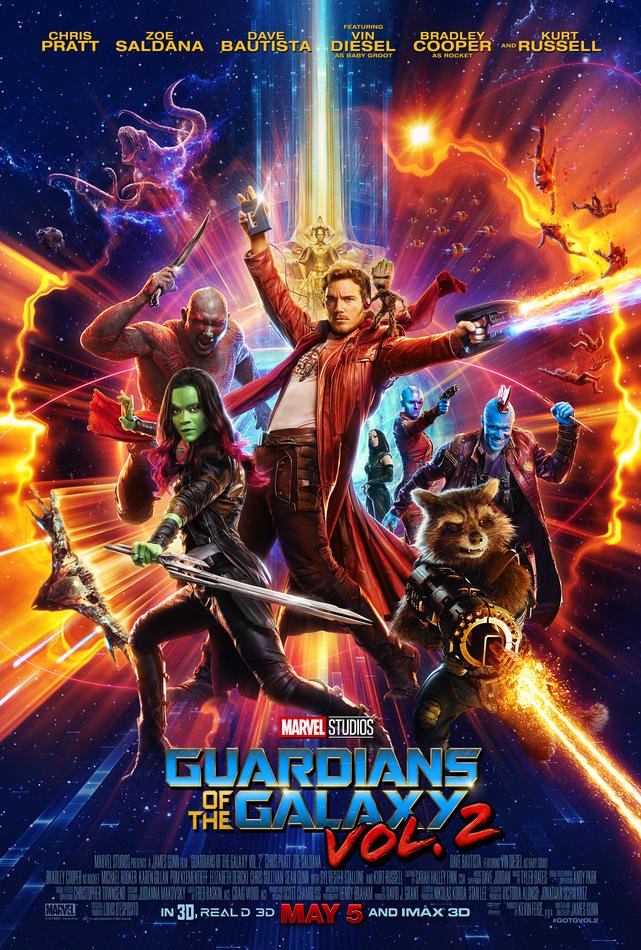
Guardians of the Galaxy Vol. 2 (2017)

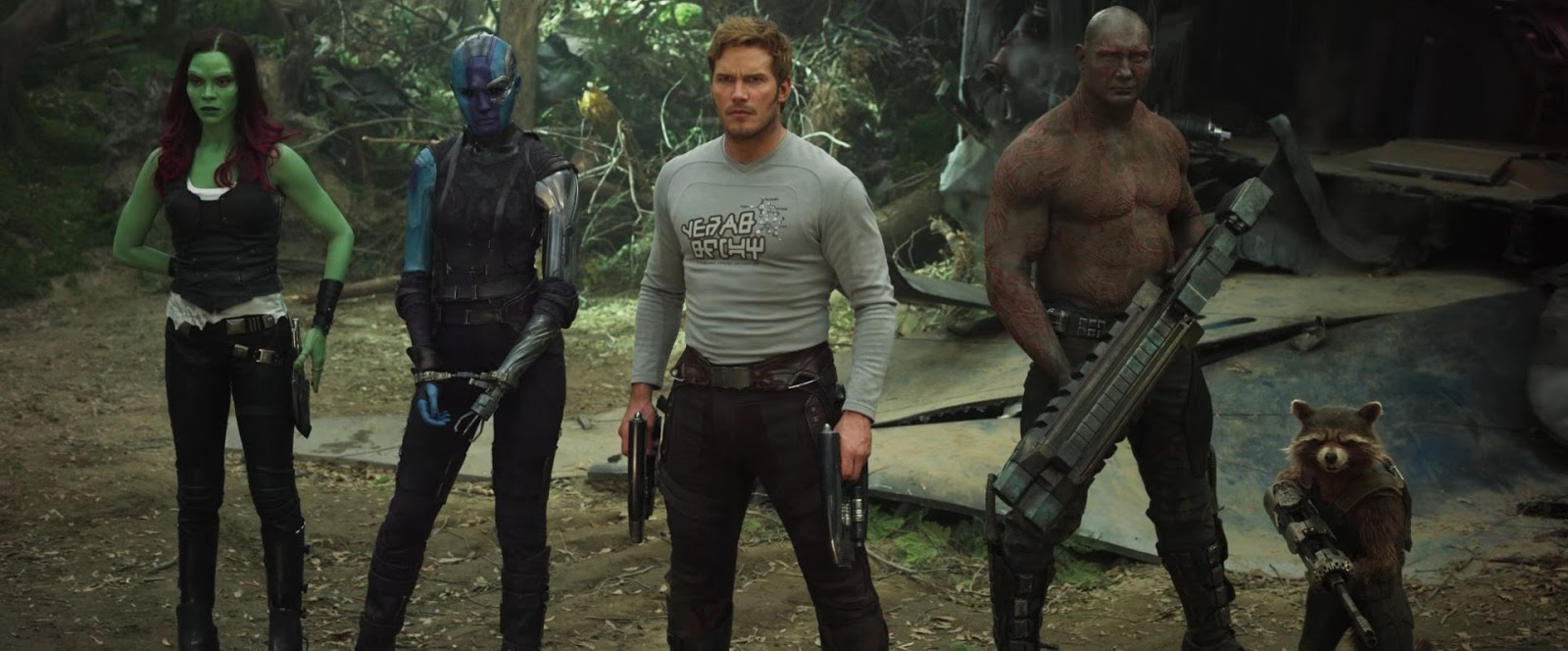
Our heroes line up for action in a fun follow-up to a more fun movie

Director: James Gunn

Cast: Chris Pratt (Peter Quill), Zoe Saldana (Gamora), Dave Bautista (Drax), Bradley Cooper (Rocket), Vin Diesel (Baby Groot), Michael Rooker (Yondo Udonta), Karen Gillan (Nebula), Pom Klementieff (Mantis), Kurt Russell (Ego), Elizabeth Debicki (Ayesha), Sean Gunn (Kraglin), Sylvester Stallone (Stakar Ogord)

In 2014, Guardians of the Galaxy was expected to be Marvel’s first flop: an odd collection of ridiculous looking characters, from a comic book few had ever heard of. Instead, its oddball charm and wit made it one of the most popular in the franchise. This is the tricky second album, which has to deliver more of the same while trying to build on the first film.

Set a few months after the first film, the Guardians are left stranded on an alien planet after a job for elitist race The Sovereign (led by a drily witty Elizabeth Debecki) goes badly wrong. They are saved by Ego (Kurt Russell) who reveals himself as Peter Quill’s long-lost father. Quill (Chris Pratt), Gamora (Zoe Saldana) and Drax (Dave Bautista) follow Ego to his homeworld, while Rocket (Bradley Cooper) stays to repair the ship with their captive Nebula (Karen Gillan). While Ego’s world hides a range of dangers, Rocket and Nebula come under attack from Peter’s former guardian Yondo (Michael Rooker), whose pirates have been hired to capture the Guardians.

First the good things: this is a very entertaining film, packed full of funny lines and entertaining moments, solidly acted (with some stand-outs) by a cast who are able to communicate their enjoyment with the audience watching. Like the best of the Marvel films, it focuses on a core cast and establishes an audience bond with their characters very swiftly, and care about their fate. The focus of the film is actually skewed in favour of character over plot and action, which makes a nice change from many of these films (the action quotient is actually fairly low for a Marvel movie, and a large chunk of the film largely involves spending time with our heroes). It’s also admirable that the film doesn’t shy away from the fact that, to varying degrees, all of our heroes are in some way anti-heroes, or perfectly willing to perform selfish, dangerous or questionable acts for their own immediate gain (even if on the bigger issues their hearts in the right place).

It’s clear what type of movie you can expect right from the opening credits, where the camera focuses on (adorable) Baby Groot dancing to music in close-up, while (out of focus) our heroes combat a space monster in the background, each of them at key moments interacting with Groot in a way that demonstrates their character. It’s a lovely, witty way of opening the movie (perfectly scored to ELO’s Mr. Blue Sky) and firmly states that character and personality will be central. Baby Groot is, by the way, possibly the star of the movie, Gunn making sure the character isn’t overused or becomes wearing. The film gets the tone more or less right: it would be easy for this to feel like a private party we’ve been invited to watch, but it just about feels inclusive enough (and avoids smugness or self-satisfaction at its own wit) to remain charming and fun.

The focus is so much on jokes and fun that the actual plot of the movie is a little bit weak: a (predictable) villain reveal is made late-on, seemingly to give the film an antagonist. The actual plot content of the film is pretty lightweight. What plot there is, is nothing new (Daddy issues, spliced with Universe-in-peril) I’d also say that the films length is probably a bit too much – considering not a lot really happens, the film takes a long time to do it – it could do with a bit more discipline in the editing room, and a bit more willingness to trim out some of the material. This is, however, not a major problem –– and the film just gets away with it because it gets the character moments so right you simply enjoy spending time with this group, even if what they are getting up to is little more than a second-rate episode of Star Trek.

Where Guardians 2 falls a little bit flat is the wearily on-the-nose “emotional” sections of the script. While in the first film much of this goes unspoken, here several scenes are featured where the characters carefully spell out their feelings. The most egregious examples are an almost laughably overplayed game of catch between Peter and his Dad, and a terrible “everything spelled out” conversation between feuding sisters Gamora and Nebula. Whenever this film goes near this emotional content, its points land with heavy punches, while coating the content with sticky sentiment that gets “bad laughs” from the audience. The film has plenty of well-crafted and funny impact lines, but its script rushes through the areas where depth is needed, and doesn’t seem to trust the audience to understand the emotions that underlie the bickering between the characters, or that some of them may be tempted to do terrible things to fulfil their emotional needs. Only the final sacrifice of a character really works – and that’s because it is the only emotional connection that is quietly built in the background of the movie, rather than in the foreground.

But that’s probably a movie trying too hard for good reasons, rather than bad. There is more than enough here to recommend the film. Interestingly, Pratt’s Peter Quill is largely sidelined for chunks of the film (the fact that its nominal plot is all about Quill and he feels like a supporting role tells you how weak the plot is) so other members of the cast really stand out. Saldana has a slightly thankless role as the “Big Sister” of the group, but manages to bring a lot of unspoken depth to her role. Bautista provides excellent comic relief as Drax (though his lines are such gifts, it would be hard to screw them up), Baby Groot is very funny, Cooper’s Rocket has a juvenile, rebellious attitude that  that deserves a more interesting subplot. Surprisingly though, the film is repositioned more as a redemption journey for Michael Rooker’s space rogue Yondo, and Rooker delivers a surprisingly emotional performance as a confirmed killer and thief struggling with his conscience. Gunn allows him contemplative moments that really ring true within the chaos of most of the rest of the film, and this feels like one of the best displays of simple “acting” you’ll see in the MCU.

Guardians 2 is not a perfect film, and I suspect its weak plot, predictable and uninteresting villain, and often ham-fisted emotional moments will grate more and more once the exuberance of the ride has worn off on the second or third viewing. But it’s got a lot going for it: genuinely funny jokes, an intention to entertain which it largely succeeds in, some charming performances and enough action in it without letting that overwhelm the film. It’s a roller-coaster rather than a gift that will keep giving, and it lacks the first film’s well balanced plotting and world-building, but it’s entertaining and a great deal of fun (if 20 minutes too long) and the final reel’s sad events do carry an emotional weight (because they are based on largely unspoken feelings) that will stay with you after the film wraps. Not as fun as the first one – but still better than many others.

Passengers (2016)


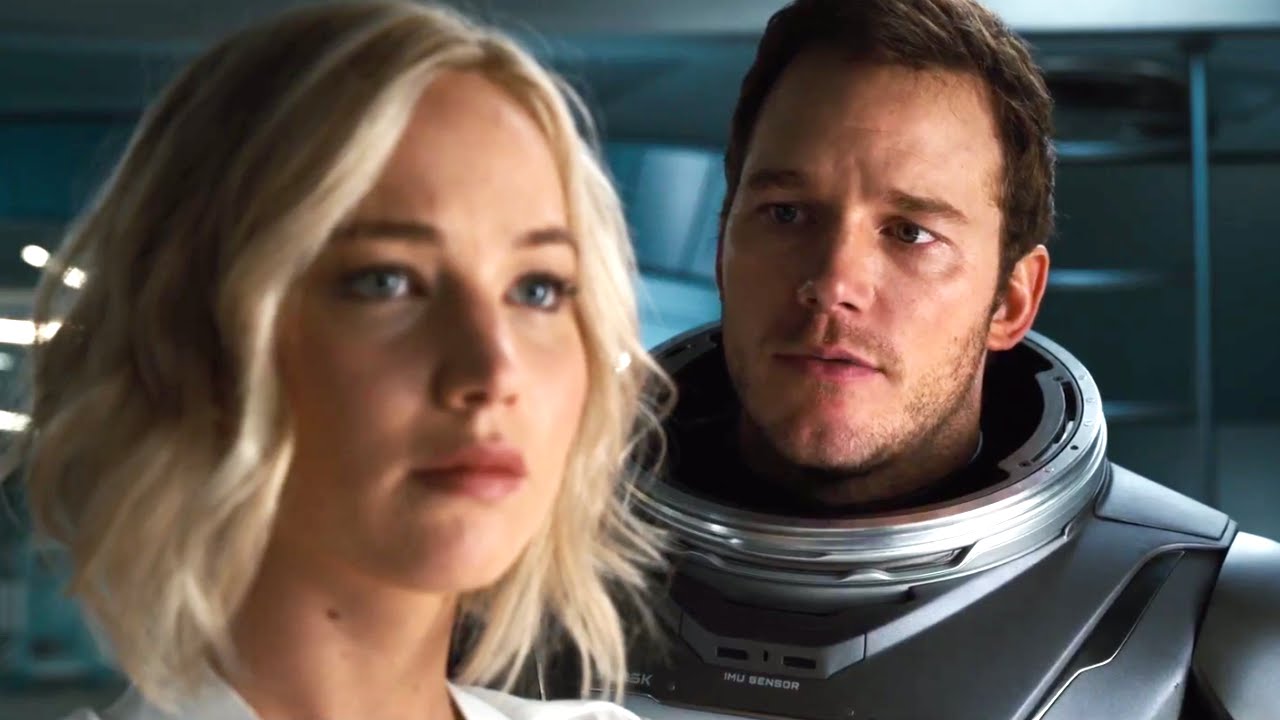
Jennifer Lawrence and Chris Pratt juggle moral dilemmas in the surprisingly dark Passengers

Director: Morten Tyldum

Cast: Jennifer Lawrence (Aurora Lane), Chris Pratt (Jim Preston), Michael Sheen (Arthur), Laurence Fishburne (Gus Mancuso)

The Avalon is a spaceship carrying over 5,000 passengers and crew to a new planet for resettlement. With the flight due to last 120 years, everyone is in suspended animation. After an accident, passenger Jim Preston (Chris Pratt) is woken 90 years early. Trapped on the ship, unable to return to cyrosleep or change the direction of the ship, and with the round-trip time for messages to Earth being 76 years, Jim faces living the rest of his life alone on a spaceship. After over a year of isolation, with only android bartender Arthur (Michael Sheen) for company, Jim succumbs to temptation and wakes another passenger, Aurora (Jennifer Lawrence), for companionship. They fall in love over time – but how will Aurora react when she finds out the truth?

Passengers was a film that received a negative reaction perhaps because it managed to successfully not spoiler its plot in advance. While the trailer seemed to promise this would combine mystery and romance in a space setting, it’s actually more about the effects of isolation and the moral quandary of relieving your own despair by placing someone else in the same position. While the film is never going to win awards for its exploration of psychosis, it certainly tries to tackle this idea and explain – but not excuse – why Jim takes the decision he does.

A lot of people felt this suggested Aurora effectively falls in love with her kidnapper-cum-stalker, and that Jim’s actions are glossed over. Well I’d argue against this. Firstly, the film never shirks the repercussions of Jim’s decisions – indeed that’s really what the film is about: can you forgive the unforgiveable? A large chunk of the film is a build up to Jim taking a decision he acknowledges is wrong, and feels tremendous guilt and shame about. The later section of the film revolves around the impact of this action coming to light. Discovery of the truth destroys Aurora and Jim’s relationship, and it’s uncertain for much of the rest of the film whether there will ever be any forgiveness for Jim. If the film had shelved the issue, or Jim had been forgiven within minutes of screentime, that would be another question.

Secondly, the film works hard to show the savage psychological impact of complete isolation, and (after a year of this) the dangerous temptation of having a companion a push of a button away. Jim is clearly not in his right mind when he makes his decision – and later when Aurora faces the prospect of similar isolation, she responds with similar despair. If there is a fault with this, it is that the film shies away from defining the time progression explicitly enough – and doesn’t quite have the courage to increase its timeline (imagine if Jim had been alone for 3-5 years rather than one. Imagine if Jim and Aurora had not spoken for 2-3 years rather than one etc. Straightaway, I think the actions in this film could have been more readily understood by people).

Thirdly, these questions of isolation and morality are not as black and white as your casual internet moaner would like. Trapped alone with no human interaction, with literally zero chance of being rescued, is a psychological situation it’s just impossible to comprehend. Expecting people to behave as they would normally is simply unreasonable. Jim and Aurora do not fall in love after the truth comes out – they fall in love well before this (sure Aurora doesn’t know what Jim has done, but her feelings for him are real) – so it becomes a question of forgiving someone you love who, in extraordinary circumstances, has done something they normally would never do.

As such, Passengers is actually the sort of film where it will benefit you to discover more about what the film is going to be about before you go into it (and how often do you hear that?). Because, once you know the sort of film you are going to get, it’s not that bad a film. It’s handling of these moral issues is, I’ll readily admit, not the most effective or thought provoking (and the lack of mention of it before the film’s release, and its slight fudging through the film, suggests the “suits” weren’t happy with it either) but at least this is a film with some ideas behind it. If it had really seized the effect of isolation as its theme, and really explored the moral issues behind Jim’s actions, it might well have avoided much of the criticism. But it does enough to make some of that criticism unfair.

Away from this main plot point, Passengers is an entertaining, high-budget, character piece. Whatever your view of the character, you can’t argue against Pratt’s charisma and wit as a performer and Lawrence is also good. It’s not their best work, but they make the relationship – with all its peaks and troughs – work, and it’s endearing or tense as required. Michael Sheen is also excellent as the humanish-but-not-human-enough android bartender. The design of the ship is imaginative and the film looks gorgeous. The second half of the film delivers a fine series of tense set-ups (even if many of them are echoes of things we have seen before), and Tyldum does well to ensure that the often swiftly changing mood of the film (despair-romance-anger-tension-danger-terror etc.) seems like a smooth progression rather than a jarring one.

Passengers doesn’t have the courage of its convictions to really explore its “Ben Gunn in Space” set-up, and much of the criticism of its plot stems from its not-completely-committed exploration of the effects of isolation. But, if you know what you are going to get, it’s an entertaining film.

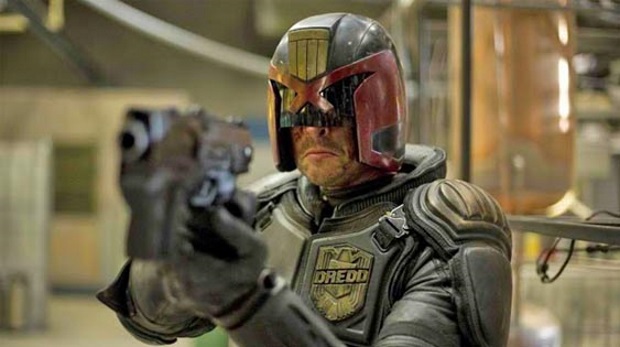
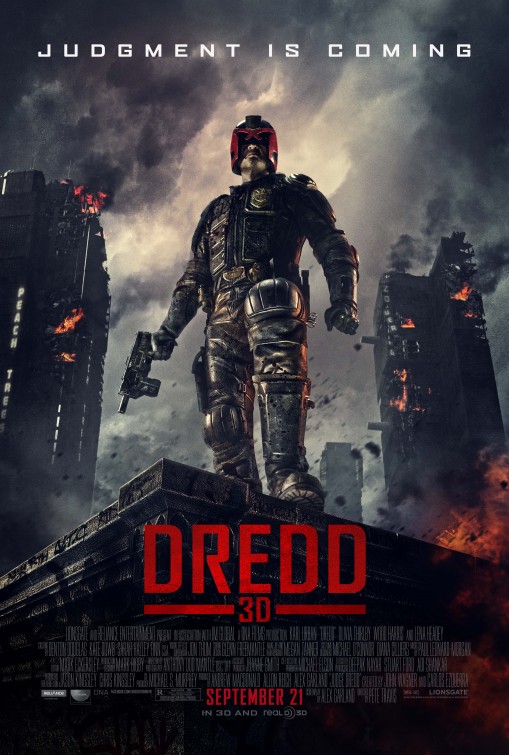
Dredd (2012)


Dredd. He is THE LAW!

Director: Pete Travis

Cast: Karl Urban (Judge Dredd), Olivia Thirlby (Judge Cassandra Anderson), Lena Headey (Ma-Ma), Wood Harris (Kay), Domhnall Gleeson (Computer expert), Warrick Grier (Caleb), Deobia Oparei (TJ), Rakia Ayole (Chief Judge)

Dredd is the second attempt to bring the brutal post-apocalyptic lawman to the screen, after a disastrous 1990s version starring Sylvester Stallone. Famously, that film gained the undying enmity of the comic book fans by having Dredd remove his signature helmet (and show his face) at every opportunity. Here, Karl Urban dutifully keeps the helmet on at all times.

In a future USA, Mega-City One is a sprawling metropolis of 800 million residents and 17,000 crimes a day. To combat crimes, the Judges are a police force with the powers to sentence and execute criminals on the spot. Judge Dredd (Karl Urban) is the most feared and experienced Judge on their books, a man of rigid rules who sees the world in black and white. Given a new psychic recruit, Anderson (Olivia Thirlby), Dredd makes an arrest at Peach Trees, a 200-storey slum building ruled by brutal crime lord Ma-Ma (Lena Headey). After Dredd and Anderson arrest one of Ma-Ma’s key lieutenants, she locks down the building, isolates the Judges, and demands their execution by the residents.

Dredd is a super violent but entertaining siege movie, with the twist being that the siege involves the heroes being locked in with their opponents – the heroes trying first to get out, then to stop their enemies getting in. Now I know very little at all about the source material, but, unlike the Stallone film, this film succeeds as a Dredd movie by simply treating its events as a “regular episode” rather than a ground-shifting, world-at-stake mega-movie. As such, it can focus on the events that are relevant to the immediate, simple story and loosely sketch out the other elements of the future (enough to keep us interested and to understand the context). It focuses on a fast-paced, exciting story and enough character detail and interest to keep you involved. 

The film is snappily directed by Travis with a decent, stripped down script from Alex Garland, and has a good performance at its centre from Karl Urban, who has the collaborative lack of ego to make Dredd, rather than his own performance, the centre of the story, . Urban also manages to make a character who is an imposing and lethal killing machine into someone we also respect for his adherence to a firm moral code. And he adds enough texture to the part to suggest a certain softening in his attitudes towards Anderson (a very effective Thrilby) across the course of the movie. Headey also makes a great enemy, a sort of Cersei Lannister on heroin and acid, a totally remorseless megalomanic.

The film packs a great deal of punch and its design is very impressive. The Peach Trees setting is an imposing vision of a crap-sack future, while also having a very clear navigation for the deadly game of cat-and-mouse Dredd and Anderson play throughout the film. The film doesn’t have much in the way of wit to it – the source material is apparently more satirical, not something that comes across here to be honest – but it does understand the rigidity and certainty of its lead character and it doesn’t flinch from the dark consequences of its hero’s actions. 

I’m no expert on the original but this is rather a lot of simple, unchallenging fun that manages to swiftly establish characters – through neat writing and good acting – that make sense, are complex and feel very true to the tone of the source material. It’s violent and bloody, and yes it has many beats in it that are slightly predictable or twists on many similar “one man against an army” movies we’ve seen, but it has more than enough merit to be worth your time.

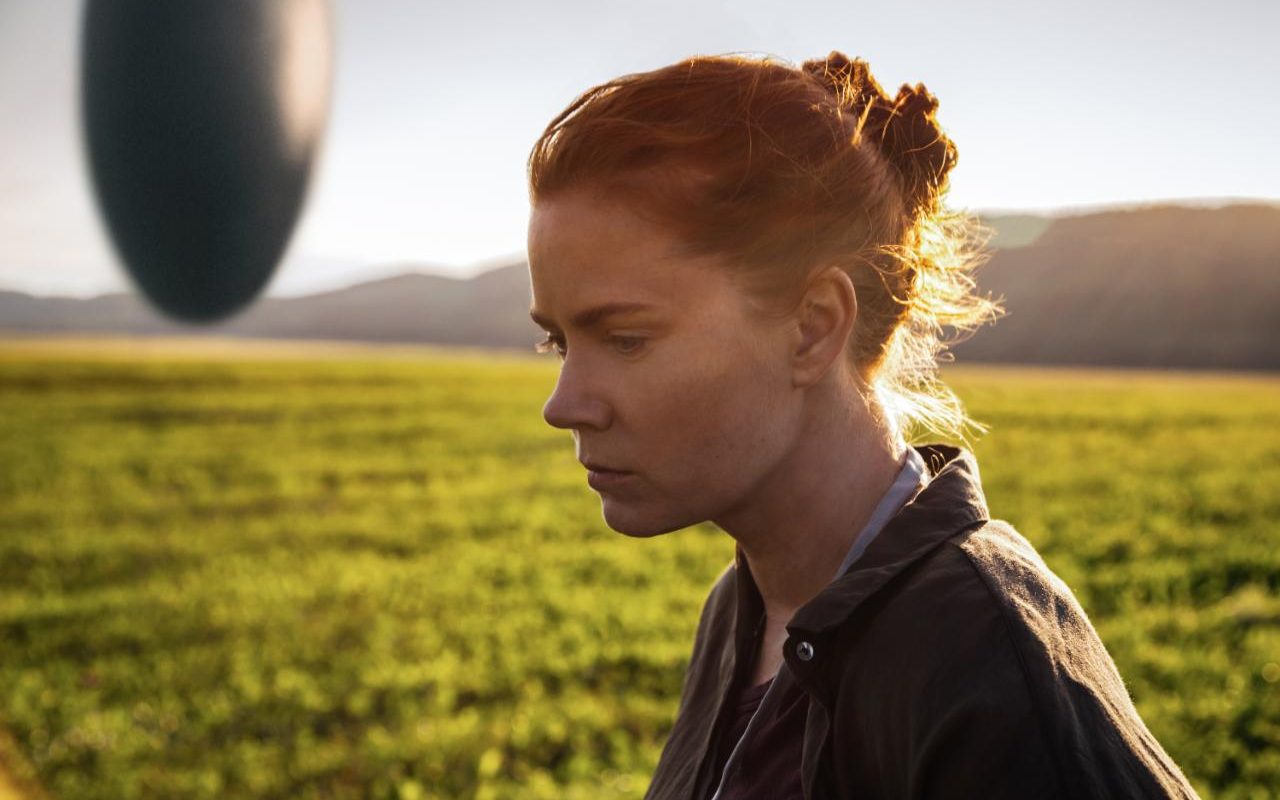
Arrival (2016)


Amy Adams tries to build an understanding with Earth’s visitors in this thinking man’s sci-fi film

Director: Denis Villeneuve

Cast: Amy Adams (Louise Banks), Jeremy Renner (Ian Donnelly), Forest Whitaker (Colonel Weber), Michael Stuhlberg (David Halpern), Tzi Ma (General Shang), Mark O’Brien (Captain Marks)

Aliens in Hollywood movies don’t often seem to mean well. For every ET you’ve got a dozen Independence Day city destroyers. But few films have really dealt directly with the complexities that might be involved in engaging with a species for the first time. How would we talk to them? How could we find out what they want?

Those are the questions that Dr Louise Banks (Amy Adams), the world’s leading linguist, has to juggle with after she is called in by Colonel Weber (Forest Whitaker) to establish communication with the inhabitants of an alien ship, one of 12 that have appeared across the globe. Working with physicist Ian Donnelly (Jeremy Renner), Banks strives to build trust and a basis for common language with the aliens. Throughout, she must deal with her military superiors’ lack of understanding of the painstaking nature of her work, the paranoia and fear of the nations of the world, and her own increasingly intrusive dreams and memories.

This is grown-up sci-fi, directed intelligently by Denis Villeneuve, whose confidence and artistry behind the camera oozes out of every shot. It’s a film that wants us to think, and urges us to consider the nature of humanity. Communication between humans and the “heptapods” is the film’s obvious focus, but it is equally interested in demonstrating how distrust and paranoia undermine how we talk to each other. Not only is this in the clashes between nations, but on a smaller scale by the communication between military and science, the uniforms in charge largely failing to grasp the slow and painstaking nature of Banks’ work. On a personal and emotional level, we see the slow growth of understanding between Banks and Donnelly, their increasing ease with each other as they break down the barriers between them, and between humanity and the aliens. 

Far from the bangs and leaps of inspiration that science normally sees itself represented by onscreen, this film attempts to follow the methodical process of building an understanding of a concept from nothing, and the careful hours of work that underpin sudden revelations. The film is very strong on the complexities of linguistics and the difficulty of conveying exact translations, including intent, context and meaning, from one language to another. In fact it’s a wonderful primer on the work of linguistics experts, offering a fascinating breakdown of how language is understood, translated and defined between two groups without a common tongue. 

This is also helped by making the aliens truly alien: I can’t remember a set of Hollywood aliens as otherworldly as these are. Not only is their language completely different (based on symbols and strange echoes like whale song), but physically they bear no resemblance to humans at all (I confess that I was momentarily distracted here, as their tentacles and residence in a gas-filled box rather reminded me of The 465 in Torchwood: Children of Earth). They lack clear arms, legs or even faces. Their technology is advanced and immediately unsettling. Jóhann Jóhannsson’s wonderfully eerie and imposing score brilliantly helps to capture this otherworldly sense, as does the crisp photography and unique production design of the alien ship. The film walks a brilliantly fine line between wonder at the aliens and a sense of unsettling dread that means we (like the characters) are never comfortable in making assumptions about their motives.

Much of the film’s success as a viewing experience also depends on knowing very little about it. For me this film delivered one of the most effective late-plot re-evaluations I’ve seen: I had no inkling of this gear shift, or how a late piece of information demands that we adjust our understanding of everything we have seen so far in the film. This is actually one of the best done examples I’ve seen of a twist (calling it a twist seems somehow a little demeaning, as if this was a Shyamalan thriller, but a twist it is) – I in no way saw it coming, but it suddenly makes the film about something completely different than you originally believed it would be. I won’t go into huge details, but the film raises a number of fascinating questions around pre-determination and fate that challenge our perceptions of how we might change our lives if we knew more about them. To say more would be to reveal too much, but this twist not only alters your perceptions of the films but deeply enriches its hinterland.

I would say the film needs this enrichment as, brilliant and intellectual as it is, it’s also a strangely cold film that never quite balances the “thinking sci-fi” with the “emotional human drama” in the way it’s aiming for. Part of this is the aesthetic of the film, which has a distancing, medical correctness to it – from sound design to crisp cinematography – and which, brilliant as it is, does serve to distance the viewer emotionally from the film. Despite the excellence of much of the work involved, I never quite found myself as moved by the plights of the characters, or as completely wrapped up empathetically with Adams’ character, as the film wanted me to be. While the ideas in the film are handled superbly, it doesn’t have quite as much heart as the plot perhaps needs to strike a perfect balance.

What emotional force the film does have comes from Amy Adams. It’s a performance that you grow to appreciate more, the longer you think about it. It’s a subtle understated performance, soulful and mourning, that speaks of a character with a deep, almost undefinable sense of loss and sadness at her core. You feel a life dedicated to communication and language has only led to her being distanced from the world. Adams is the driving force of the film – though very good support is offered from Renner as a charming scientist who also convinces as a passionate expert – and the film’s story is delivered largely through her eyes, just as the aliens’ perception of humanity becomes linked to her own growing bond with them. I will also say that Adams also has to shoulder much of the twist of the film – and it is a huge tribute to her that she not only makes this twist coherent but also never hints at the reveal until the film chooses to. 

Arrival is a film that in many ways is possibly easier to respect than it is to love: but I find that I respect it the more I think about it. It does put you in mind of other films – the aliens have more than a touch of 2001’s monolith to them and Villeneuve’s work is clearly inspired by a mixture of that film and Close Encounters. But this is a challenging, thought-provoking piece of work in its own right and one that I think demands repeat viewings in order to engage the more with its complexity and the emotional story it is attempting to tell. It may well be that on second viewing, removed from puzzling about the mystery in the centre, I will find myself more drawn towards it on an emotional rather than just intellectual level. That is something I am more than willing to try and find out from a film that I think could become a landmark piece of intelligent sci-fi.

Elysium (2013)


Matt Damon takes aim. He’s wearing as well a mechanical suit that makes him look like a building under construction.

Director: Neill Blomkamp

Cast: Matt Damon (Max Da Costa), Jodie Foster (Defence Secretary Delacourt), Alice Braga (Frey Santiago), Sharlto Copley (Agent Kruger), Diego Luna (Julio), Wagner Moura (Spider), William Fichtner (John Carlyle)

In a dystopian future, the world has become polluted and overpopulated. The rich and privileged live on Elysium, a massive orbital space station with an Earth-like atmosphere where medical equipment can cure anything. The masses on Earth yearn to join Elysium, many resorting to black market routes. Max da Costa (Matt Damon) is an ex-thief who contracts a lethal radiation infection at work. With little choice, he agrees to take part in a dangerous data heist (wearing a suit that enhances his physical abilities) in return for a black market trip to Elysium. But his heist crosses the plans of Elysium’s ambitious Defence Secretary (Jodie Foster) and her ruthless black ops operative Kruger (Sharlto Copley).

The design of this world, as per District 9 (to which this feels almost like a spiritual sequel), is impressive and really captures the visual clash between third world poverty on Earth and the paradise in the sky of Elysium. The sense of a society firmly divided into the haves and have nots is (at first) very well sketched out. There is the potential for a compelling us-against-them narrative ready to burst out, and Damon’s character seems positioned as “our champion” to bring down the system. 

This is actually a really neat concept for a movie. What it’s crying out for, though, is more than the by-the-numbers execution it gets here. I suspect there were struggles between Blomkamp’s interest in putting social issues side-by-side with sci-fi action, and the demands of “the money” to get more Damon Bourne-inspired chaos on the screen. Either way, after the initial set-up the movie goes nowhere in particular. A lot of world establishment is needed here (I’ve just struggled to explain it in one paragraph) and the film doesn’t get the balance right between setting this up and then getting into the story – it’s a good 45 minutes before the story starts and 40 minutes later the film is more or less over. I’ll give it credit that the short runtime does mean it goes nowhere fast, but it’s still a pointless destination.

Anyway, the problem that cuts to the core is you don’t really care about anything. Copley brings charisma to his heavy role, but the character is a formless one who engages in any act of villainy the film needs him to do. Foster’s cold (English accented?) bureaucrat similarly never fully comes to life, despite her best efforts. Braga is a thinly sketched bit of human interest. The film is crammed with decent actors who were obviously attracted to some sort of idea behind the script – it’s just a shame that whatever got them worked up about the material never made it to the screen.

Damon’s character is key to this: he should be someone who finds his feet as the champion of the oppressed, who makes decisions and sacrifices that initially at first seem to be out the scope of his understanding of the world. The script pushes him towards this but it never feels real – we never get to know him (either before or after the event that changes his life) and we never get a sense of him being driven by anything beyond his original narrow aims until the film suddenly calls on him to make a series of huge sacrifices. It just doesn’t feel true: the film doesn’t take us on a journey with him, meaning the end lacks satisfaction. I’ll also mention in passing that, among the poor, downtrodden, entirely-Latino urban classes, the lead is the only white character – and yet he too has a Latino name, which to me suggests a certain level of white-washing for box office.

Instead this is a poorly sketched out bit of faux-thinking sci-fi, that sketches out a dystopia that never really makes any sense (it seems easy to cure the population of the world, but the inhabitants of Elysium never do – surely some sort of reason other than apathy might have added a bit more believability to this? Perhaps if more had been made of the need to depopulate the Earth?). Instead it’s a crapsack world for the sake of it, and the characters move through a series of events that happen but never engage us. 

It’s sad, as this could have been quite a little B-movie classic. Perhaps the best review of the film comes from Blomkamp himself: “I feel like I fucked it up, I feel like ultimately the story is not the right story. I still think the satirical idea of a ring, filled with rich people, hovering above the impoverished Earth, is an awesome idea. I love it so much, I almost want to go back and do it correctly. But I just think the script wasn’t… I just didn’t make a good enough film is ultimately what it is. I feel like I executed all of the stuff that could be executed, like costume and set design and special effects very well. But, ultimately, it was all resting on a somewhat not totally formed skeletal system, so the script just wasn’t there; the story wasn’t fully there.”

Couldn’t put it better myself.

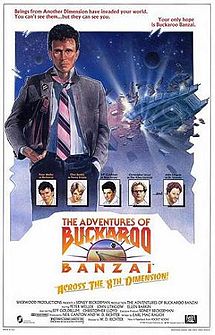
The Adventures of Buckaroo Banzai Across the 8th Dimension (1984)

Some of the costume choices in this image probably help you to see what oddness you have in store…

Director: WD Richter

Cast: Paul Weller (Buckaroo Banzai), John Lithgow (Dr Emilio Lizardo/Lord John Whorfin), Ellen Barkin (Penny Priddy), Christopher Lloyd (John Bigbooté), Clancy Brown(Rawhide), Jeff Goldblum (New Jersey), Vincent Schiavelli (John O’Connor), Robert Ito (Professor Hikita), Carl Lumbly (John Parker)

Okay so watching that was strange. If you looked up “cult movie” in the dictionary you would probably see an embedded video of this film. It’s so cult it has literally no interest at all in appealing what so ever to anyone outside of its established sci-fi crowd. If Star Wars was sci-fi for the masses, this is camp sci-fi for the cultish elite.

The plot is almost impossible to relate but Buckaroo Banzai (Paul Weller) is a polymath genius – surgeon, rocket scientist, rockstar – who perfects a device that can travel through solid matter and dimensions. But creating the device makes him a target for a race of aliens, led by Lord John Whorfin (John Lithgow) who live in the gaps between dimensions and want to use the device to escape.

The film is part straight-laced 1940s sci-fi serial, part tongue-in-cheek romp, part comic book, part satire. In fact it’s nearly impossible to categorise, which is certainly in its favour: you’ve certainly never seen anything like it before. It’s bursting with ideas and straight faced humour and clearly had an influence on sci-fi still today (for starters there are more than a few beats of Moffat-era Doctor Who here, while Banzai himself would fit in as The Doctor). It bursts out of the screen with a frentic energy, not massively concerned with narrative logic or consistency, its solely focused on being entertaining. It throws the kitchen sink at the screen with all the passion of fan fiction.

Despite all this I think you have to have a very certain sense of humour and set of interests to really enjoy it – and I’m not sure that I did. If you don’t have an encyclopedic knowledge of comic books and sci-fi you’ll probably feel like you are missing something (and you probably are). I’m also not sure there is much there to attract the “muggle” fan – Weller plays the lead with a smoothness and a charming straightness but he’s not the most interesting of characters (to be brutally honest). Lithgow counter balances him by going utterly over the top in a performance of ridiculous Mussolini-like bombast. But it’s not completely engaging. Basically if you don’t love it within the opening 25 minutes, you aren’t going to won over by anything else that happens. Every frame of the film is setting itself up as a chance for cult fans to speak to each other.

It actually rather feels like you are being invited to a party but then are left with your nose pressed up against the window. All the actors are clearly having a whale of a time with the other-the-top setting and bizarre half-gags. But I’m not sure all that enjoyment really travels across the screen to the viewer. While it’s sorta sweet in it’s almost sexless innocence (Birkin plays the lost twin of Banzai’s wife but there’s never a hint of real sexual buzz anywhere). Characters sport guns and hang around in a nightclub, but Banzai’s gang are essentially a group of 11 year olds who have taken adult form. So it’s gentle and has an innocent chumminess, but also a bit hard to engage with it.

I think in the end I just found it a little too eager and straining to be an outlandish, deliberately cultist film – it’s like an inverted elitest piece of modern fiction, that uses narrative tricks, devices and style to make itself harder for the regular viewer (or reader) to be part of its experience. So while this is something very different and almost insanely off the wall, it’s also something that is never going to move you or appeal in the way Empire Strikes Back will do.

Doctor Strange (2016)


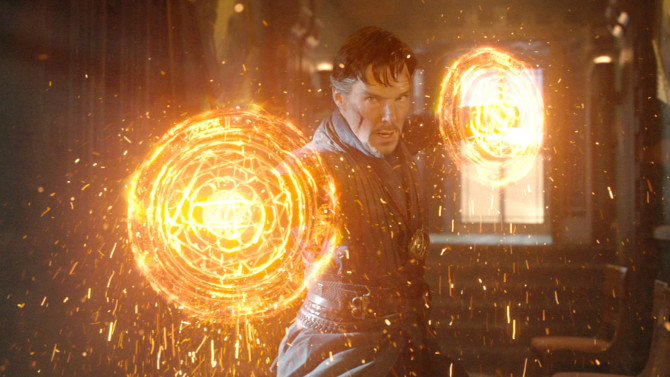
Benedict Cumberbatch goes into battle with magic. Silly but in a good way.

Director: Scott Derrickson

Cast: Benedict Cumberbatch (Dr Stephen Strange), Chiwetel Ejiofor (Karl Mordo), Rachel McAdams (Christine Palmer), Mads Mikkelsen (Kaecilius), Tilda Swinton (The Ancient One), Benedict Wong (Wong), Michael Stuhlbarg (Dr Nicodemus West), Benjamin Bratt (Jonathan Pangborn)

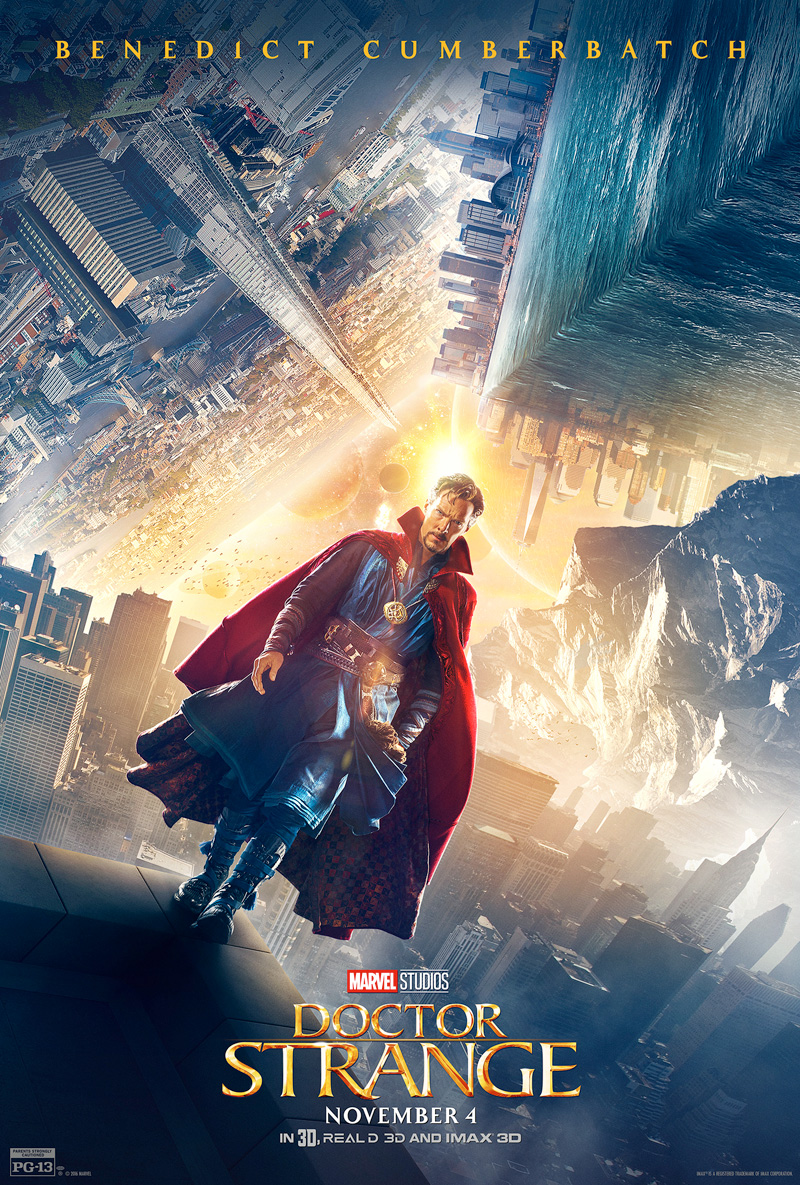
Arrogant surgeon (is there any other kind in the movies?) Stephen Strange (Benedict Cumberbatch) loses the fine motor control of his hands after a car crash caused by his reckless driving. With science unable to find a cure, he travels across the world to find another solution, eventually joining a secret group of sorcerers, led by The Ancient One (Tilda Swinton), who use energy from parallel universes to perform feats of magic in our world. Trained by Karl Mordo (Chiwetel Ejiofor) he is absorbed into a clash between the sorcerers and a rogue former protégé of The Ancient One, Kaecilius (Mads Mikkelsen) who wants to destroy the boundaries between worlds and unleash chaos.

In a film franchise that threatens to get increasingly samey, Doctor Strange is in many ways a breath of fresh air. Its twisting, mind-bending special effects (part Escher, part Inception) are stunning and showcase a great deal of visual and narrative imagination in the film, immediately making it look different from the dozens of city-smashing films we’ve seen in the Marvel franchise. It’s also told with a fair amount of wit, tongue-in-cheek beats and some lovely sight gags (Strange’s Cloak of Levitation is clearly inspired by the Carpet from Aladdin). This lightness of touch is essential to stop this concept feeling silly: with a more po-faced style this story, full of magic and things like “the Eye of Agamatto”, would have stumbled over its own ridiculousness.

This is however pretty close to being the best comic-book origins film, and certainly in the top five of this franchise. For a start, despite the visual glory, it feels like a focused more personal story: there are only really 6-7 characters (compare that to the sprawling cast of Captain America: Civil War), and the real heart of the film is the lead character’s struggle to overcome an existential crisis and find a new purpose while rediscovering his humanity. Even the final confrontation is a spin on the formula, avoiding city-wrecking super-punches in favour of intelligence and humour saving the day. It still crams in the action, and the characters are still cartoons made flesh, but at least they have been given a real depth here. There is an emotional weight to the story that makes you care about Strange and his world.

No actor right now is better able to embody intellectual brilliance matched with cool arrogance and societal disconnection than Benedict Cumberbatch. So in many ways, Strange is a part that falls well within his comfort zone. But Cumberbatch shows he can carry a major motion picture by making Strange a charismatic lead who grows and develops. Strange is deliberately unlikeable at first, but Cumberbatch invests him with an underlying vulnerability and a cocky charm that is increasingly broadened and shaded as the film progresses. Almost without realising it, you find yourself actually rather liking him halfway through (while still happy to give him a smack in the mouth for his cockiness). Cumberbatch is in almost every scene and carries the film effortlessly.

The film is dominated by it’s lead character, but gives moments to the rest of the cast. Tilda Swinton overcomes the controversy of her casting by investing The Ancient One with both a serene wisdom with dark hints of anger and impatience bubbling under the surface. Ejiofor is good as an increasingly disillusioned mentor and Wong has some great comic beats. Mads Mikkelsen, one of the greatest actors in the world, is rather wasted as a villain who never becomes quite as interesting as you’d hope. Most misused is Rachael McAdams, whose character serves very little purpose other than “ex-girlfriend” – even the director, in an interview, described her role as being there to love him, so that we can see why we should love him.

It’s still a Marvel film, and it still follows the Marvel formula, however newly presented it might be. The arc of despair, rejection, slow progress, revelation, disillusionment, rallying and overcoming personal problems is pretty recognisable from everything from Thor to Iron Man. But it is enough of an inversion, it’s got a good enough script, it’s directed with enough focus on character as well as action, and it has a sufficiently good leading actor to lift and elevate the whole idea into something that feels richer while keeping it entertaining. It’s a very good comic book movie, and it’s trying to do something different, And it mostly succeeds.

I Am Legend (2007)


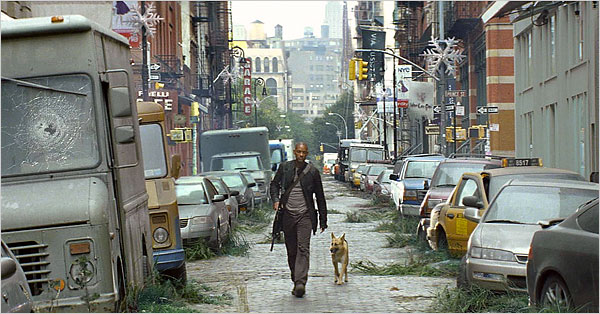
Rush hour is a lot easier to beat when its just you and your dog.

Director: Francis Lawrence

Cast: Will Smith (Robert Neville), Alice Braga (Anna Montez), Charlie Tahan (Ethan), Salli Richardson (Zoe Neville), Willow Smith (Marley Neville), Emma Thompson (Dr. Alice Krippin)

If you’re going to make a movie that involves the viewer watching one person, alone with just a dog, for well over an hour, you’d better be sure that the person you recruit to play that role can actually hold the viewer’s interest for that time. Factor in, for Hollywood, that the person you pick needs to be capable of getting big box-office, and you ain’t got a lot of choices. But casting Will Smith in this was a choice the studio largely got right.

The year is 2012 and the world has ended. Robert Neville (Will Smith) is a military virologist, the last surviving human in New York. A miracle cure for cancer went disastrously wrong three years before and killed 94% of the world’s population, mutated 5% into feral “darkseekers” who attack anything living at night, leaving just 1% of the world’s population immune. Neville lives alone in New York, with only his deceased daughter’s dog for company, and works to find a cure for the disease by capturing and experimenting on the darkseekers.

In a remarkably brave and unusual move for a blockbuster, Will Smith is essentially alone on screen for a solid hour. The film takes a measured, well-paced delight in following his daily routines, covering everything from his work in immunology to scavenging for supplies, hunting deer (escaped from the zoo), hitting golf balls off aircraft carriers, and having free run of a video store he has filled with mannequins. His Washington Square house is heavily fortified, but also remarkably homely and certainly not that bad a place to watch the end of the world from.

Following this daily routine is, by far and away, the most interesting part of the film, as it is one of the few parts that actually feels unique and original. In fact, you wish it could go on longer and that the film didn’t need to revert back its more predictable “one man against the monsters” theme. The ingenuity of survival in extreme circumstances, and the eerie freedom of the busiest city in the world completely empty, makes you wonder not only “could I do that” but also, secretly “would it be fun for a while to drive a fast car around Times Square or whack golf balls off the wing of a stealth bomber?”.

“For a while” is the key thing here, as the film also explores the deeply damaging effect extreme isolation has had on Neville’s psychology. It’s here that Smith earns his chops. He’s an extremely engaging actor, so you’re happy to spend time with him, but he’s also skilled enough to play a cracked psyche without going overboard. Neville chats (and flirts) with mannequins, knows Shrek so well he can speak in perfect unison (inflections and all) with the film, and keeps up a regular stream of conversation with his dog Sam, including asking her what she is planning to do for his birthday. Much of this is played lightly, but at key moments Smith allows Neville to snap. He also plays the tragedy gently – his reactions to Sam’s death are genuinely quite moving because they are quiet and restrained.

This is all interesting stuff. Less interesting are the “darkseekers” and the film’s final resolution. Firstly, the darkseekers themselves are bog-standard zombie monsters – screaming, running, deadly creatures with their one quirk being their fear of UV light. Other than that, it’s nothing you haven’t seen in half a dozen movies before (better). Turning them into zombie creatures does make Neville even more isolated but makes encounters with them fairly predictable, mostly inspired by films past. Most of the film’s big confrontation set pieces have a slightly tired familiar feeling to them. I’m already struggling to remember them, and I only saw the film two days ago.

The major problem with this film is its ending. I Am Legend had its ending re-shot after test audiences saw it. Originally, a reveal would have been that the darkseekers were far more intelligent than appeared, and their motivation was to prevent Neville’s experimentation on them. Two scenes still make a point of discussing Neville’s Mengele-like wall of photos of dead darkseekers, killed by his cure experiments, and other hints remain through the film: the traps they set , the presence of an “Alpha” leader among the monsters, repeated shots of the tattoo on Neville’s last captured darkseeker, which was intended to be a crucial clue that she was the mate of the Alpha.

But test audiences weren’t having that. So in the final version, all this build-up and suggestion is shoved aside as Neville grabs a grenade and blows himself and them to hell to allow a cure to be taken to the rest of mankind. As the cure is taken to an idyllic community in the country (church and all) mankind’s future is his “legend” or some such guff. It’s a major loss of nerve that makes the film just another run-of-the-mill monster flick. It doesn’t match with hints that remain in the whole film and it doesn’t tie in with the more successful first hour of the film. It doesn’t question the possible rights and wrongs of Neville’s actions (at best comprehensive animal experimentation), but fully endorses them.

It’s a shame as this has ideas, its vistas of New York being reclaimed by nature are interesting and memorable, and Will Smith is pretty good in a straight acting role. But instead it settles for being a schlocky monster pic, where we can unquestioningly cheer as everything is neatly tied up with a bow and everything we thought about all of its characters is confirmed. As such, this film isn’t a classic and it hasn’t had the sort of life it might have been able to have. Despite good moments, it’s definitely not a Legend.