Category: Silent film

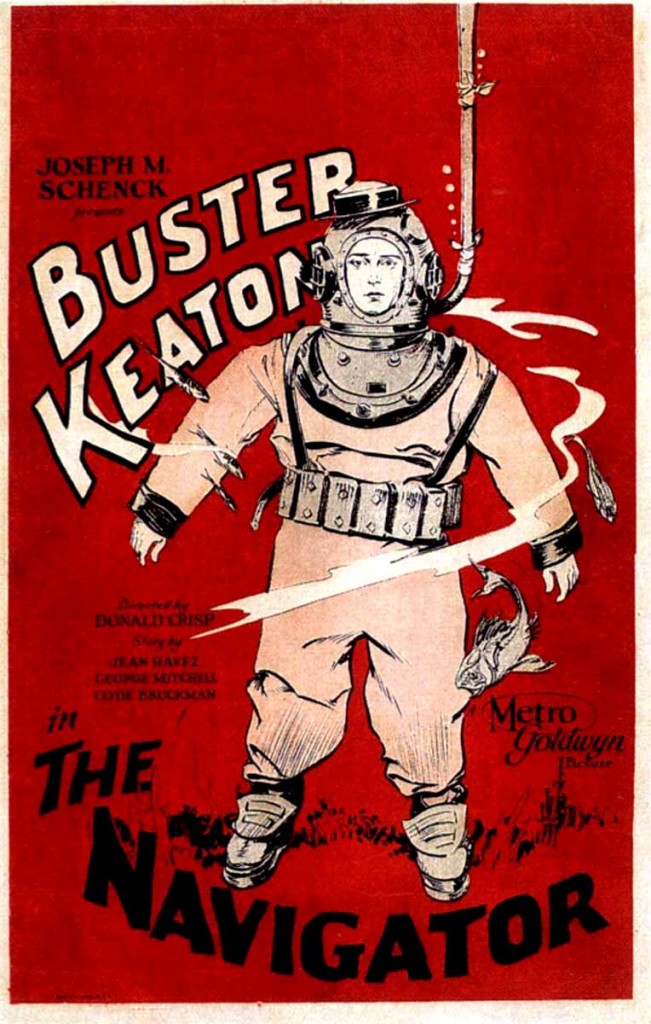
The Navigator (1924)

The Navigator (1924)

Keaton is cast adrift in a film that is all gags and no story or stakes and not the better for it

Director: Buster Keaton (& Donald Crisp)

Cast: Buster Keaton (Rollo Treadaway), Kathryn McGuire (Betsy O’Brien), Frederick Vroom (John O’Brien), Noble Johnson (Chief), Clarence Burton (Spy)

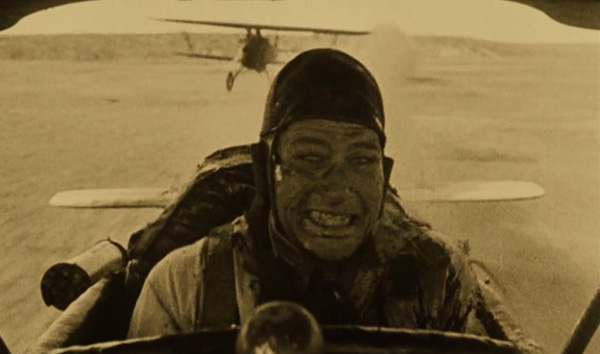
Buster Keaton claimed The Navigator was his best film. With all due respect he’s wrong. The Navigator was born out of the ahead-of-its-time failure of Sherlock Jr. When that marvel of cinematic invention didn’t land with audiences, Keaton played safe. He put a lid on the tricks and focused on the gags. In fact, he cast himself away in a boat with only Kathryn McGuire for company and they told jokes for 45 minutes. That’s the basics of The Navigator and, for me, the lack of plot, stakes or character ends up in a much weaker film.

Buster is Rollo Treadaway, a rich sap, who one day decides to get married and books the honeymoon before he’s asked his planned intended Betsy (Kathryn McGuire). When she says no, Rollo goes on honeymoon anyway but in a confusion at the docks ends up on the wrong ship, The Navigator. It’s owned by Betsy’s father – but spies for a foreign power plan to set it adrift. In further confusion, Betsy also ends up on board and she and Rollo wake-up drifting at sea. How will two pampered rich people work out how to look after themselves on a deserted ship?

The Navigator keeps things simple, cranking up the jokes in a film much closer in spirit to his shorts, all designed to be easy to digest and just tickly the funny bone. You feel they genuinely did just cast the ship out to sea and waited for Keaton to work out as many gags as he could until the camera ran out of film. Donald Crisp was hired to direct the dramatic stuff, but Keaton quickly realised he didn’t need him and didn’t like Crisp’s vague prologue about wicked spies (he was right, it’s totally forgettable unlike the equivalent opening of Our Hospitality) so set off to sea without him. (Crisp makes a visual cameo as the painting of the ship’s captain that swings in front of a porthole).

There are, for me, three key gags that work in The Navigator. Rollo’s spontaneous decision to get married (based on seeing a happy couple outside of the window), after which he distractedly bathes fully clothed then gets his chauffeur to drive him to Betsy’s house – on the opposite side of the street (the car does a big circular loop across the street). After the rejected proposal he informs the chauffeur, he needs a walk home to clear his mind.

This is, in many ways, the funniest, most inventive moment in The Navigator. It’s a great little showpiece as well for the (passionately not-getting-married) Kathryn McGuire and the finest example of Keaton’s capacity for easily led saps, overwhelmingly influenced by things they see around them. It’s the part of the film I enjoyed the most and its over after ten minutes.

The Navigator starts to drift as soon as it heads to sea. There is some neat camera work that suggests the haunting emptiness of the ship (it’s so vast we get an amusing series of visual jokes as Keaton and McGuire consistently miss bumping into each other while walking around it), but where other Keaton films would have explored more the ghostly darkness of this technological marvel (or the oppressive nature of it emptiness) The Navigator largely shies away from this.

The best sequence on the ship follows McGuire and Keaton’s attempts to cook a meal in a massive galley, hampered by the fact that (a) everything on the ship is set-up to cook for hundreds not two and (b) the two pampered souls have no idea how to open a tin can or boil a kettle, let alone cook a meal. Three potatoes are thrown into an enormous vat. Keaton goes through a series of trial error involving drills and carving knives to get into tins. McGuire can’t work out that sea water isn’t drinkable or how much coffee is needed for a cup. They are both befuddled by fish (which they basically eat raw) and can’t find cutlery so make do with kitchen utensils. It’s a sharply observed, well-constructed scene.

But other than this, the film struggles with a series of gags that rather disappoint. There is a painfully overlong underwater sequence where Keaton wrestles with a fake swordfish. There is a lack of Keaton’s trademark physical stunts (aside from a bit of business with a deckchair). An encounter with an island tribe – a bit uncomfortable today to watch these Black-skinned savages – is overlong and heads into a siege that is never particularly funny (other than a gag of Keaton accidentally dragging around a miniature cannon that no matter where he turns is always aimed at him – a gag later lifted for Jar-Jar Binks in The Phantom Menace).

The main problem I have about The Navigator is that this bag of gags never engages me because the film isn’t about anything. Neither of these people feel like real people (and, lord knows, Keaton characters were often lightly-sketched comic roles, but this is ridiculous), the film has no stakes and has no plot momentum, drifting like the boat they are stuck on. I need more for a comedy, to feel invested. Without that investment, it’s just stuff happening. A Keaton’s I won’t revisit. It was, however, his biggest hit. What do I know?

Our Hospitality (1923)

Our Hospitality (1923)

Keaton’s feature-length debut is a masterpiece of comic invention and slapstick stunt thrills

Director: Buster Keaton (& John G Blystone)

Cast: Buster Keaton (Willie McKay), Joe Roberts (Joseph Canfield), Natalie Talmadge (Virginia Canfield), Ralph Bushman (Clayton Canfield), Craig Ward (Lee Canfield), Monte Collins (Parson), Joe Keaton (Train engineer), Jack Duffy (Train conductor)

It starts with a dark and stormy night. If that sounds like cheap melodrama that’s kind of the point. Keaton’s first feature length comedy would be different from his joke-crammed shorts. This would be plot-led comedy, a drama full of jokes. As part of that, Keaton started the film with a storm-filled, joke-free, DW Griffith-inspired opening salvo that sees the lead character’s father dead in Intolerance inspired opening. With its gun flashes and bodies, we know in this film bullets kill.

The father is John McKay and he dies along with James Canfield in a deadly exchange. It’s part of a long-running feud betwixt McKays and Canfields (any similarity to the legendary Hatfield-McCoy feud is entirely deliberate), and the rest of the Canfields swear revenge on McKay’s baby son-and-heir. Twenty-one years later, Willie McKay (Buster Keaton) has grown up in New York, ignorant of the feud. When he returns to his father’s ranch, he finds himself in the awkward position of having fallen in love with Virginia Canfield (Natalie Talmadge), daughter of his newly discovered deadly enemy Joseph Canfield (Joe Roberts). How will matters be resolved?

With a great deal of laughs and a breath-taking series of stunts. Our Hospitality is early Keaton but already it cements his legend of comic invention and physical daring as well as his dynamism and imagination as a filmmaker. Our Hospitality is crammed with comic bits of pieces that Keaton would go on to explore and finetune in even greater detail in later films, but also culminates in a (admittedly slightly tongue-in-cheek) but still surprisingly gripping action sequence as our hero battles to survive a mountainous waterfall and save his love from toppling.

The film neatly divides into four acts, each subtly different in tone but all unified by Keaton’s creativity. Stone-faced and implacable, Keaton never mugs or goes overboard for the laugh but trusts that, with the intimacy of the camera, the smallest inflection or slightest turn of the head will raise a chuckle. He’s also charmingly innocent, refreshingly resourceful and rather brave – a perfect combination for a little guy (it helps, as always, that Keaton is literally a little guy) we root for.

That charm powers a lot of the film’s second act, a long incident-filled train journey McKay takes to the South. Keaton was fascinated by the comic potential of early technology – watching Willie, po-facedly, cycling with an early peddle-free bike, his feet alternately propelling the bike and lifted in the air is hilarious (the Smithsonian even asked if it could display this perfect replica) – and he deliberately set the film in 1831 to introduce a Stephenson-style rocket train, pulling its open carriages behind it. This vehicle not only looks hilariously ramshackle and strangely incongruous, it also opens an ocean of possibilities.

It is, for starters, hilariously slow – Willie’s dog has no problem keeping up with it. Its tracks have been laid with a rigid rule-following lack of imagination – at one point they ride up over a fallen tree log, the train and carriages bumping over it. The train is forced to stop by a donkey that refuses to leave the line (eventually the engineer simply drags the tracks around the donkey). There is an on-going feud between the Engineer (played by Keaton’s father Joe) and ticket-master about who is actually in charge of the train. At one point it veers off the tracks and down a road (everyone comments about how much more smoother this is) and later gets separated from the carriages at a junction, requiring Keaton gymnastics to bring it together. By the time it trundles into the station – and note how beautifully the train is filmed – you’ve had more comic invention than most other comedies.

During this journey Willie falls in love with fellow passenger Virginia (played, a little awkwardly, by Keaton’s wife Natalie Talmadge), little knowing she is a Canfield. The Canfields swiftly discover his identity: Willie asks one of her brother’s directions to his ranch, and the brother guides him there, all the while darting away at every opportunity to try and borrow a gun to take his revenge.

Most of the second act, which gives the film its title, revolves around Willie’s invite from Natalie to dinner at the Canfield house. Southern gentility declares the Canfields cannot take revenge on Willie while he is their guest – as soon as Willie realises this he does everything he can to remain in the house, as the (literal) instant he steps outside the door, guns come out. (Keaton also gets a lot of comic mileage from the cumbersome one-shot guns, which Willie frequently pinches to discharge to give himself a few precious moments to move outside while various Canfield’s reload).

When Willie eventually flees the house – disguised as a lady – it leads into a glorious, action-packed chase scene. Scaling mountains and cliffs, shot with a vertigo inducing brilliance (in reality Keaton placed the camera on its side and made it appear with his genius physicality that he was climbing rather than crawling). There are falls into rapids, Willie is dragged behind a racing train carriage and finally bobs and floats down a rapid (including one shot, kept in the film, where Keaton’s rope snapped and he was literally washed head first down a river). It culminates in an athletic, stunt-filled, precarious balance on a log suspended over a waterfall (a brilliant backdrop shot makes this feel impossibly high), swinging desperately on a rope to save Virginia from falling.

Our Hospitality is awash with comic energy and genius touches of business but it’s also an impressively ahead-of-its-time in the skill of its plotting and structure – you could pretty much remake it exactly today (but with words) without changing a detail, and it would still be a hit. But it wouldn’t be a legend because the only thing you wouldn’t have is Keaton. And he’s the lodestone that balances the whole thing.

Intolerance (1916)

Intolerance (1916)

Scale and sensation fill the screen in this ground-breaking epic that has to be seen to be believed

Director: DW Griffith

Cast: Mae Marsh (The Dear One), Robert Harron (The Boy), Constance Talmadge (The Mountain Girl), Alfred Paget (Prince Belshazzar), Bessie Love (The Bride of Cana), Walter Long (The Musketeer of the Slums), Howard Gaye (Jesus Christ), Lillian Langdon (The Virgin Mary), Frank Bennett (Charles IX), Josephine Crowell (Catherine de Medici), WE Lawrence (Hendi de Navarre), Lillian Gish (Woman Who Rocks the Cradle)

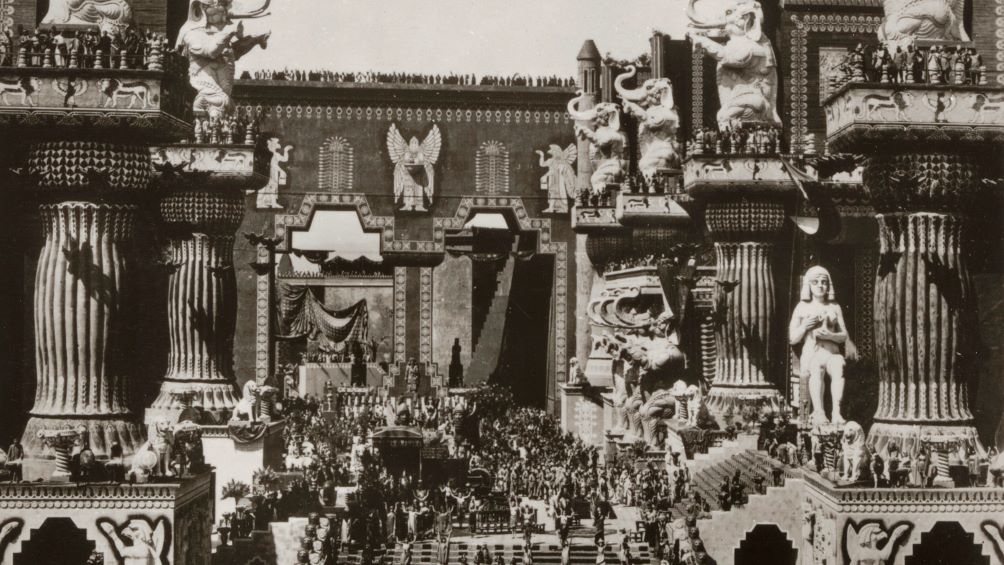
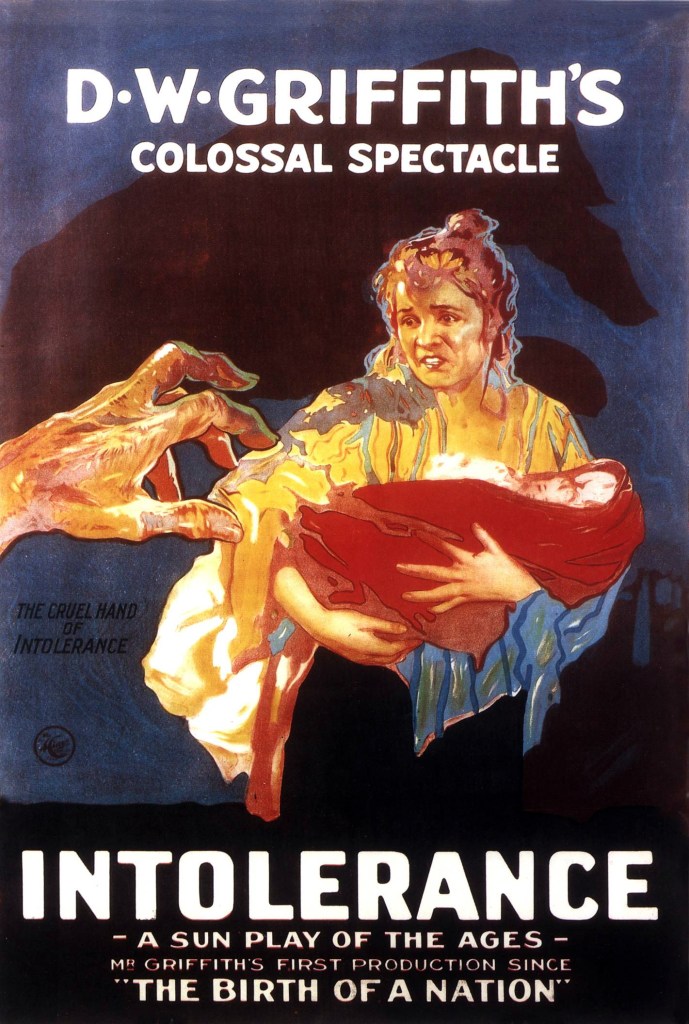
Even today I’m not sure there is anything like it. (Perhaps only the bizarrely OTT Cloud Atlas gets anywhere near it). DW Griffith’s follow-up to his (now infamous) smash-hit success The Birth of a Nation would not just be a melodrama with a social conscience (as he originally planned). Instead, it would be a sweeping epic that have as its theme humanity itself. Intolerance (captioned “Love’s Struggle Throughout the Ages”) would intercut four timelines simultaneously, each showing how prejudice, envy, and rage had shattered lives throughout the history of mankind.

Griffith wanted to make the biggest film ever. The sort of sweeping spectacle that would confine all other competitors to the dustbin of history and cement himself as the new media’s master visionary. Intolerance is certainly that, a film of dizzying technical and narrative scale. Never before had a film thematically intercut between four unlinked but complementary timelines. Nothing links these stories other than theme: all four play out in parallel, events in one reflected in another. Essentially, it’s like a massive book of fables where all the pages have been cut out, reorganised and handed back to you.

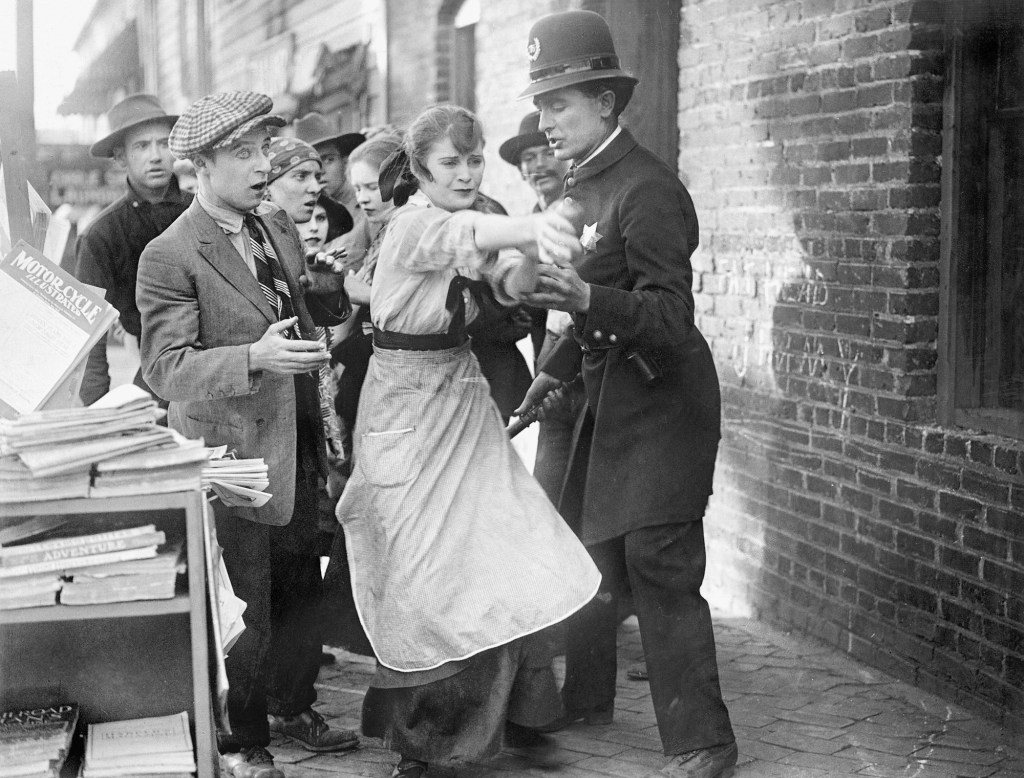
Intolerance started life as The Mother and the Law. This social-issue drama followed a young couple – the Dear One (Mae Marsh) and the Boy (Robert Harron) – forced to flee their factory community for the big city, after the brutal crushing of a strike. There, the Boy is sucked into the circle of a local gangster The Musketeer of the Slums (Walter Long). He renounces it all for love, before he is framed for theft and imprisoned. Then the couple are stripped of their baby and he is arrested again for the murder of the gangster (actually done by his moll). Will the sentence be revoked?

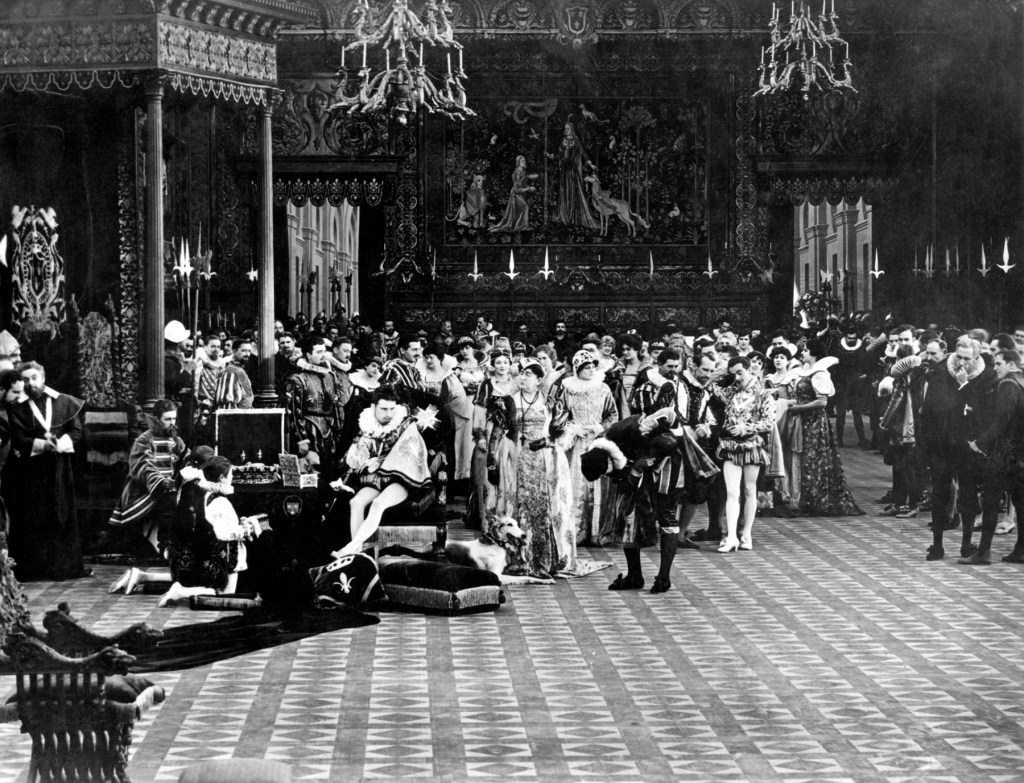
This is still the backbone – and takes up the most of the film’s runtime. But the one thing it didn’t really have is spectacle. A lot of it happens in rooms (bar a last-minute train and car chase). As well as expanding the film’s scope, Griffith also wanted to dial up the scale. Intercut with this are three grandiose historical narratives. In the largest, Griffith had the whole of Babylon rebuilt just so he could film its fall (after betrayal from the priests), despite the struggles of the Mountain Girl (Constance Talmadge) who is in-love-from-afar with Prince Belshazzar (Alfred Paget). We also get the St Bartholomew Day’s Massacre of 1572, as French Catholics butchered their Protestant neighbours. And finally, just to dial up the import, we get the last days of Jesus Christ.

The scale of it! The sets of Babylon have to be seen to be believed. Huge, towering structures so large they dwarf elephants and the thousands of extras thrown in for scale. The camera pans slowly up to stress their gigantism and zooms in slowly in tracking shots to pick out a specific face among thousands. The siege of Babylon plays out like a real military action: armies of extras play out a choreographed battle on multiple levels of the walls while elephants push siege engines into place. Some nifty special effects allow on-screen beheadings and for us to see swords, arrows and spears plunge into bodies. It’s genuinely exciting and influenced every siege you’ve seen on film since.

This scale isn’t just restricted to Babylon. The modern plotline brilliantly recreates strike action by the masses, including a brutal put-down by private and government forces. Questing for a late pardon for her husband (who is literally walking towards the gallows while they do), the Dear One and a kindly policeman hop into the fastest car they can find to chase down the Governor’s train. In 1572, the streets of Paris are skilfully recreated – as are the grand palaces – and the action of the massacre is shot with an intense, Bruegelesque immersion. Jesus is mocked by a large crowd as he drags his cross through the streets before being crucified on a bloody-sky kissed hill with flashes of terrifying red lightening.

The huge scale is also carried across in Griffith’s narrative. This was intended as important film-making with a capital I. Griffith’s film is in places surprisingly anti-authoritarian and firmly on the side of the little guy. The modern strike is caused by a factory wage cut. Why? Because more money is needed for the firm’s charity work and it needs to come from somewhere. The charity workers are, to a woman, shown as judgemental, smug and causing more harm than good from their arrogant assertion that they know best. Homes are broken up, jobs are sacrificed and mothers judged “not good enough” separated from their children. All in the name of a moral crusade that’s more focused on prohibition than protection.

In Babylon, the priests of Bel are weasily, bitter, power-hungry figures, furious at the arrival of the new female God Ishtar, selling the city out to the barbarian hordes to preserve the old religion. The French court are certain the only way to guarantee peace (but really their own positions against the Hugenout faction) is to kill them all. Jesus’ presence is met with stern-faced priests wondering what they can do to get shot of this trouble-maker. We are always invited to sympathise with humble, simple people who want to make their own choices: Brown Eyes (Margery Wilson), a Hugenout daughter hoping to marry, the boisterous Mountain Girl, the loving Dear One and the Boy.

To keep this feeling like a universal fable of hope, names are kept as non-specific as these. Small human moments abound. Brown Eyes is as giddy as schoolgirl on the day before her wedding. Henry IV weeps and nearly vomits after being brow-beaten into ordering the massacre. The Mountain Girl – dragged to a market fair for her obstinacy – decides the best way to put off husbands is to chow down on onions. The Dear One and the Boy go on a charming date, at the end of which she pleads for the strength of character to resist the temptation to let him into her flat before they are married. It’s these little beats of humanity that help sustain the scale.

Intolerance is connected together with a series of captions – frequently badly-written and pretentious (e.g. “The loom of fate wove death for the father”) – and via a recurring image of a woman rocking a cradle, which I think represents the circle of life. The editing between the storylines is masterful though and the film’s pace and structure is generally so well maintained that your understanding of when and where we are is never challenged for a moment.

There have been claims Griffith’s more human epic was a correction to his Birth of the Nation. But that’s to misunderstand the sort of era Griffith came from. In his Victorian background, it was in no-way a contradiction for a man to be both a white supremacist and a sentimental liberal. Griffith believed the South were victims of the Civil War and the ‘unjust’ Reconstruction and felt Intolerance was a logical continuation of that theme. A few of his prejudices are on show here anyway. The only black faces are sinister heavies among the ‘barbarians’ attacking Babylon. Henry of Navarre is a limp-wristed sissy. The female reformers are all ugly harridans (the caption even tells us “When women cease to attract men they often turn to reform as a second choice”). Intolerance is an interesting reminder that a director we now think of today as American cinema’s leading racist was that and a man who passionately believed in social justice. Contradiction is the most human quality we have.

There may be a little too much in Intolerance considering its crushing run-time (the Jesus scenes could be cut with no real loss at all), but generally it hits a balance between pomposity and entertainment. It has plenty of violence and naked ladies (the harem of Babylon is shown in detail – it’s pre-Code folks) to keep the punters entertained, along with charm (though you need to look past the pose-taking, broadness of the performances). Griffith has a way with little shots: there is a lovely track into the face of the Dear One as she silently mourns. The chase in the modern plotline is genuinely tense while the massacre of the innocents in 1572 actually horrifying.

Above all, Intolerance set the table for epic cinema in exactly the way Griffith intended. While it is full of big ideas – at times clumsily presented – it’s also full of breath-taking spectacle that has influenced generations to come. For that reason, if nothing else, anyone interested in film should see it.

The Passion of Joan of Arc (1928)

The Passion of Joan of Arc (1928)

Dreyer’s searing, close-up dominated, silent masterpiece is a truly unique piece of cinema – and still astounding

Director: Carl Theodor Dreyer

Cast: Renée Jeanne Falconetti (Joan of Arc), Eugène Silvain (Bishop Pierre Cauchon), André Berley (Jean d’Estivet, prosecutor), Maurice Schutz (Canon Nicholas Loyseleur), Antonin Artaud (Bishop Jean Massieu), Gilbert Dalleu (Jean Lamaitre, Vice-Inquisitor), Jean d’Yd (Nicholas de Houppeville), Louis Ravert (Jean Beaupère), Camile Bardou (Lord Warwick)

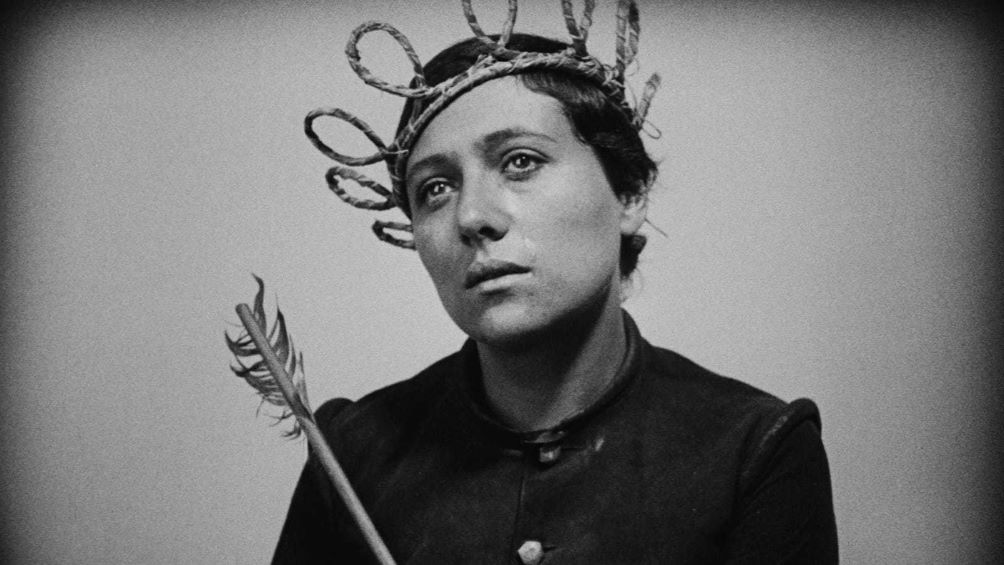
It falls to few films to have the grace to redefine what cinema could do. Dreyer’s The Passion of Joan of Arc is one of those films that simply demands to be seen – and once seen will haunt you forever. For a film in many ways so profoundly simple, it is also profoundly wise, deeply affecting, troubling, moving and finally almost unbearably painful. Shot in an iconic collection of interrogative close-ups, Dreyer’s masterpiece earns its place as one of the greatest films ever made.

Dreyer’s masterstroke here was not to create a conventional biopic. We see nothing at all of Joan’s finding of her faith, her campaign against the English or exploits on the battlefield. Instead, we witness only the final days of her life, pulled up as a heretic before a biased and arrogantly superior ecclesiastical court. We first see her not as a strong figure (or even defiant) but a frightened girl creeping into frame, dwarfed by spears and towered over by a priest. If the French producers were expecting a triumphant eulogy to their recently beautified national saint, they had a shock.

Mind you, they had plenty of shocks already. Dreyer’s film used one of the most expensive sets ever built. Seven million francs were shelled out on an intricate medieval castle and courtyard, full of interconnecting passage ways. Dreyer’s surviving model of the set is impressive. You have to assume the real thing looked impressive as well, because the film almost never shows it. The Passion of Joan of Arc takes place in tight, fixed, searching close-ups – most strikingly of Joan but also of her interrogators and the witnesses of her martyrdom. The epic is pulled down to the tightest and most intimate framing of all: the human face, with all its blemishes, imperfections and dizzying emotions.

Those emotions play most sharply across the face of Renée Jeanne Falconetti. Falconetti had performed briefly in one film eleven years previously, but this was effectively her only work on camera. And it is extraordinary, one of the most searing, memorable performances in the history of cinema. You will never forget the fixed glare of her eyes, the devotional joy in her face and the self-accusatory pain in those same eyes when she briefly recants. Dreyer and Falconetti worked closely together to chart every single moment of the complex array of emotions.

Hope, despair, defiance, fear, self-loathing, determination, shrewdness, timidity – all these expressions form both in micro and in carefully held shots that allow Falconetti to naturally move from one to another. This is one of the few films that really has the patience to record thinking. We see realisations dawn upon her, her face slowly changing to process them and then (frequently) her eyes filling with genuine, heart-rending emotion. It becomes an intense – painful – study in powerlessness and vulnerability, dappled with little moments of hope. Her joyful face when the shadow of a window forms a cross on the floor is almost unbearable.

Not least, because as she stares enraptured at this shadow, we cut back and forth to her interrogators forging a letter from the Dauphin to further break her spirit. Dreyer introduces the priestly interrogators with one of the few motion shots, a long tracking shot panning across the rows and rows of well-fed, comfortable men who are about to stand trial over this young woman. The close-ups reveal as much about the priests as it does Joan. A complacent, arrogant Bishop smirks while he picks his ear. Others snigger and stare in disgust at this abomination.

But Dreyer’s film is remarkable for how much scope he gives many of the priests. We see some of them begin to form serious doubts as Joan’s sincerity flies in the face of their expectations. Schutz’s Canon – writer of that fake letter – doubts grow, finally seen sadly turning away as she is prepared for burning. Even Silvain’s Pierre Cauchon isn’t a sadist, or really a bully – just someone who can’t imagine a world in which he is wrong. It’s what leads him to push and push, sometimes with a resigned unease, willing Joan to recant. Some burn her sadly: but burn her none-the-less.

Dreyer’s film though is a passion – and, like the medieval plays that inspire it, it wants to take us on a journey to understand the power of Joan’s faith and nobility of her martyrdom. The priests convey us and Joan to the torture chamber – one of the few wide shots Dreyer uses, to show us the extent of the ghastly devices. A giant breaking wheel is turned with increasing, horrifying speed, its many spikes blurring, as Cauchon demands Joan recant. It drives her into a fainting fit and she is bled. A real AD gave up his vein to produce shockingly, horrifyingly genuine spurts of blood.

Dreyer’s claustrophobic close-ups are not designed to throw us into Joan’s POV, but to make us feel as trapped as she does. It’s striking that many of the close-ups can’t be either Joan’s perspective or the priests. There isn’t always continuity between them – we’ll cut from a full-on view, to a side-on one, a camera angle above and then below, staring up or glaring down. The effect is less about putting us into the eyes of its characters, than to make us feel like a spirit in the room, powerless to intercede. There are no establishing shots for geography, only the onslaught of faces shouting at the camera or starring with confessional pain at the lens.

Which helps even more with the sense of devotional mystery play Dreyer is aiming to create, using the language of cinema in ways no theatre-maker ever could. As Joan is mocked, and garlanded with a false crown, by braying English soldiers, we feel as trapped as she does. When her hair is sliced away, the shears feel uncomfortably close, but just as traumatising is the agony of guilt on Falconetti’s face, at the realisation she has turned her back on her God.

It’s been said watching the film is like watching, as if by a miracle, actual documentary footage of the trial. This realism is one of Dreyer’s master-strokes. So many other directors would have allowed touches of medieval pageantry, of poetry among the stark images. The closest we get to this is a doubtful Joan starring at freshly dug up skull, from the eye socket of which wiggles a worm, while deciding whether to confess. Other than that, the lavishness (that perhaps the producers expected) is nowhere to be seen, helping make the film as punishing and (finally) moving to watch as it is.

The final burning offers no release. The camera maintains its focus on Joan, who quietly passes the rope to her executioner so he can bind her to the stake, then turns her eyes one final time to heaven before her face is obscured in smoke and flames. Dreyer’s camera doesn’t flinch, and its fair to say Joan’s death is as horrifying as anything caught on screen. An alarmingly life-like body blackens, burns and shrivels in uncomfortable mid-shot. In a stunning swinging camera shot, soldiers prepare weapons to disperse the crowd. Dreyer’s camera doesn’t shy away from this atrocity either: bodies are battered, a fallen woman stares sightlessly in the camera, screaming mothers run with children in their arms, a cannon pans across the camera and fires into the crowd. The smoke of the burning – to which we constantly cut back to – fills the screen. It’s bleak and hellish.

This is truly a passion, a sense of the ascension of the spirit through the dread of pain and suffering. And we feel every moment of it through the uncomfortable but profoundly moving immersiveness of Dreyer’s camera – and the breathtaking camerawork of Rudolph Maté – and the astonishing raw performance of Falconetti. The Passion of Joan of Arc sears itself onto your memory, a visceral, unique piece of film-making unparalleled in the history of the medium.

Nosferatu (1922)

Nosferatu (1922)

Cinematic vampires are established – along with most of the finest horror filmic ideas – in Murnau’s iconic and masterful silent epic

Director: FW Murnau

Cast: Max Schreck (Count Orlock), Gustav von Wangenheim (Hutter), Greta Schroeder (Ellen Hutter), GH Shnell (Harding), Ruth Landshoff (Ruth Harding), Gustav Botz (Professor Sievers), Alexander Granach (Knock), John Gottowt (Professor Bulwer), Max Nemetz (Captain)

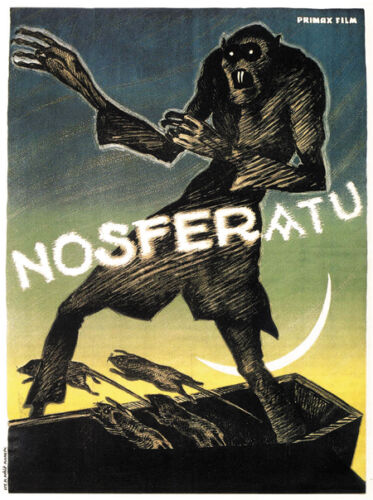
Dripping with menace, a ghastly figure rises to spread his influence across the whole world. In a similar way, FW Murnau’s Nosferatu has wormed its way into the public consciousness, with its iconic film-making beauty, laced with menace and horror – and its iconic vision of the vampire as a creature of disgusting, animalistic viciousness still carries a ghoulish impact on vampire movies today. Murnau’s film is an extraordinary piece of bravura film-making, a breath-taking example of pictorial beauty, crammed with nightmarish imagery that cements itself into your brain.

If the plot sounds familiar, you share the view of Bram Stoker’s widow. Hutter (Gustav von Wangenheim) is arrives in Transylvania to finalise a land deal with Count Orlock (Max Schreck). But, staying in Orlock’s terrifying castle, Hutter starts to dread that his nocturnal, deformed host with the long teeth and nails might have more to him than meets the eye. Orlock wants to move to Hutter’s home in Wisborg to put himself out in the world – but increasingly also due to his fascination with a picture he finds of Hutter’s wife Ellen (Greta Schroeder). Leaving Hutter imprisoned, Orlock (coffins and rats in tow) climbs on board the Demeter and sets sail. Any wonder Florence Stoker sued?

It’s nearly a miracle we even have Nosferatu today. Florence Stoker won every single court case she ever fought against the filmmakers, with the verdict almost invariably being that the negative should be destroyed. Thank goodness we do have it though, as this is not only the finest adaptation of Dracula ever made but also a landmark horror film whose reputation has only grown. Murnau created a film that is darkly insidious, worming its way inside your head just as Orlock inveigles his way into Wisborg, marking forever everything it touches.

It’s remembered often as the height of German Expressionism: but really Murnau’s film is one of classical, painterly beauty. Although he can certainly use the power of montage effectively when he wants to – witness the thrilling cross-cutting as both Hutter and Orlock race back to Wisborg, one by sea, one by land – Murnau’s real power here is in his compositions. Few people could shoot vistas – be they town or country – with soulful searchingness like Murnau. From its opening shot of the Wisborg square, through its haunting visions of the Transylvanian countryside (shot with slow pans that drip with unease), this is a film that finds unsettling tension in the beauty of our surroundings. Throw in compositions inspired by painters like Caspar David Friedrich and (in a group of scientists gathered around a corpse) Rembrandt, and Nosferatu takes its place in the story of art.

But it also has a place firmly in the story of terror. That’s due, above all, to the terrifying design of Orlock himself. Played with a rigid unknowability by Max Schreck – the mystery of what motivates Orlock remains exactly that – Orlock looks like something out of the deepest reaches of our subconscious nightmares. Rat like, wizened, with ghastly elongated nails and teeth and a stillness that feels both hunched and rigid all at once, he is a natural predator. It’s surely no co-incidence that he resembles the rats that travel with him in the Demeter, and the interpretation of his attacks by the townspeople link us to what this spirit is: death itself, unreasonable and unstoppable.

Murnau often frames him in arches and doorways, as if he was constantly positioning himself in coffins. There are innumerable flourishes to cement the awful terror he carries. In one sinister sequence, he seems to rise, utterly straight and rigid, from his tomb. He appears to a sailor on the Demeter like a nightmarish transparent figure. Hutter opens his door at night in the castle to see Orlock standing outside, like a wolf waiting to strike. In one chilling sequence, the camera watches up from the hold of the ship as he haltingly walks, framed by the rigging, to consume the unseen ship’s captain. Ellen will stare out of her window at night to half see him in an upper corner of the building opposite, watching her. Orlock’s claws reach into everything from The Exorcist to BBC adaptations of MR James ghost stories.

There is seemingly nothing human about him. At night he transforms into a wolf – and Murnau went to great lengths to secure not a wolf, but a hyena as this night-time abomination, its twisted, grinning features and distinctive face reminiscent of Orlock’s own dreadful form. What motivates him? We are given no insight into what might influence or inspire him, the way we are with Dracula. Unlike Dracula he lives alone in his castle – no brides for company here. His victims are consumed and die: none turn. He expresses no interest in the wider world and seems focused on people solely as commodities to consume.

The one difference might just be Ellen. As Orlock goes to kill Hutter on his final night at the castle, Ellen awakens thousands of miles away in Wisborg, as if she knows her husband is in danger. And Orlock seems to sense it too. In a beautiful example of cross-cutting, Ellen is at the right of the frame starring to the left in Wisborg, while Orlock is at the left of the frame starring back to the right in Transylvania. It feels like they are looking at each other, even though of course they can’t be – and it forms a link between them whose motives are kept deliberately unclear. Does Orlock want to consume or ravish Ellen? Is she repelled or intrigued by this monster? While the film downplays the sort of sexual fascination that later Dracula films (and the novel itself) would play to the hilt, there are touches of it there (not least in the strangely chaste marriage between the Hutters).

Murnau experiments beautifully with the burgeoning language of cinema. The frame is given a tint at every shot to tell us when in the day we are: daylight is tinged in yellow, dusk and dawn in red and Orlock moves freely in the blue-tinged night-time. The camera is frequently fluid. There are some quite gorgeous – and terrifyingly unsettling – shots of the Demeter sailing, seemingly uncrewed, at sea (its sails filled with Orlock’s monstrous breath) then drifting controlled but abandoned into Wisborg harbour. As Hutter rides to Orlock’s castle the screen shifts to photo negative, as if he is crossing some terrifying boundary. Only one invention doesn’t pay off today: to Murnau, sped-up film was disjointed, unsettling and terrifying. To us it’s Keystone’s Kops stuff: watching Orlock’s carriage speed around is likely to raise a surprised titter, rather than a gasp of terror.

Other elements of Nosferatu have also not aged as well. The acting is frequently performative and stagy and varies wildly in style. Von Wangenheim and Schroder strike poses, Granach’s Renfield-like Knock goes wildly over the top. Shreck’s work is often done by the make-up, although his chilling stillness carries strength. It also takes surprisingly little from Dracula in terms of themes: any references to technology, the key weapon against the count, are dropped – even van Helsing is turned into a clueless dolt; the Lucy Westerna figure is little more than an extra; the victims are almost exclusively men and the response to Orlock’s ”plague” is medieval terror not modern reason.

But Nosferatu rides above this because it is such a chilling, elemental film about death and oblivion. It can only end with that as two characters are absorbed into a dance of death that closes the film (Murnau even stages what looks like a literal dance of death at one point, as enraged townspeople chase an escaped Knock, convinced he is to blame). The association of Orlock specifically with a plague, rather than a homicidal or sexual threat, is telling: this is vampirism as a destructive danger that strikes without reason, and leaves nothing (not even a dark afterlife) in its wake. It feels like a very post-World-War-One vampire story, where whole communities are left destitute by a terrifying event outside of their control.

Nosferatu looks simply sublime, and is the work of a master-director using his craft for the first time to make something truly unique, magical and genre-defining. Horror would wear a different face after Murnau’s masterpiece: a drained, pale, toothy grin that stares fixedly at us from across the void of our nightmares.

Sunrise: A Song of Two Humans (1927)

Sunrise: A Song of Two Humans (1927)

The visual language of cinema is redefined for Hollywood, with this expressionistic, fairy-tale, silent masterpiece

Director: FW Murnau

Cast: George O’Brien (The Man), Janet Gaynor (The Wife), Margaret Livingston (The City Woman), Bodil Rosing (Maid), J Farrell MacDonald (Photographer), Ralph Sipperly (Barber), Jane Winton (Manicurist), Arthur Housman (Obtrusive gentleman), Eddie Boland (Obliging gentleman)

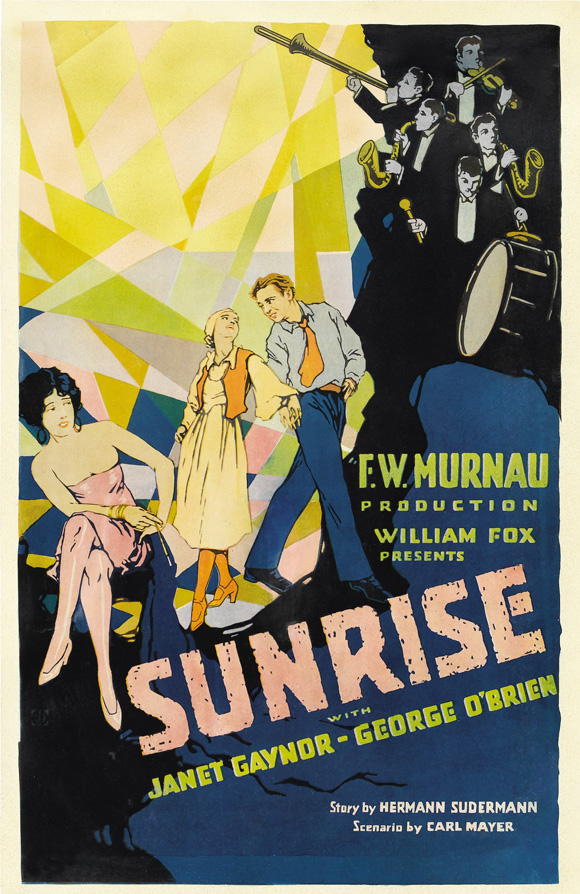
It’s 1928 and Hollywood has a neat idea. How about an annual awards ceremony toasting the best the industry has produced in the last year? But how on earth do you decide the “best” film? Isn’t comparing war films to arthouse films like comparing apples and oranges? The solution? An award for Outstanding Production and another for Best Unique and Artistic Picture. FW Murnau’s revolutionary silent movie, Sunshine: A Song of Two Humans, was the first and last winner of the latter category: a movie so technically inventive and astonishingly cinematically literate that its influence has seeped into almost every frame of footage shot by the movies ever since.

It would be fair to say Sunrise is less a narrative, more a quiet piece of expressionist art. Its plot is incredibly slim, essentially a fairy tale. In an unspecified country village (presumably in America, but it might as well be from the Brothers Grimm), a married man (George O’Brien) falls in lust with a floozy from the big city (Margaret Livingston). Before he can take the infatuation any further than canoodling by a country lake, he’s got to get rid of his wife (Janet Gaynor). He takes her out on a boat, planning to “get her drowned”, but can’t go through with it. She works out his intent though and runs. He follows her and they wind up in the big city, where a series of encounters helps them remember they actually do love each other. When they return to the village, she briefly seems lost in a genuine boating accident, before a fairy tale ending.

That’s what Sunrise is: a fairy tale. Murnau aimed at universality in his film. Namesless every people and generic, fantastic locations. A dreamlike structure and pace. It would have a monster who becomes a prince, a damsel in distress who saves the day and a wicked “crone” who wants to shatter their happiness. This is all part of turning it into a universal fable. It makes for a beautiful simplicity in narrative that is surprisingly effective if you surrender yourself to it. No one is going to mistake it for Tolstoy or Zola (for all it’s Therese Raquin remix), but you might just mistake it from something from Hans Christian Anderson.

This atmosphere benefits even more from Murnau’s artistry. One of the true founding fathers of cinema, Murnau believed in the power of images. (He died with the advent of sound – somehow that seems sadly fitting for a director whose poetic visual power would have sunk forever under the fixed rigidity of Hollywood movie cameras capturing sound.) Sunrise has fewer intertitles than almost any other silent movie. Most are concentrated in the film’s first 20 minutes, establishing plot and character. Then it relies almost entirely on the power of images.

Sunrise may be a slight story, but cinematically it’s a heavyweight. Today, transitions, flashbacks, montages, superimposed images and vivid panoramas are just part and parcel of film. But many of these techniques date from the work of Murnau, and Hollywood really woke up to them with his first American film. Sunrise is immaculately shot – photographers Charles Rosher and Karl Struss would also win one of those Oscars – a series of beautifully composed images, with a free flowing camera that looks normal today but reinvented the industry back then. Few other films, except maybe Citizen Kane, can claim to be as influential on cinematic technique.

Look at the opening montage of the big city. What seems like a straightforward fixed shot was a triumph of invention. The city was a carefully constructed set, with the shot combining forced perspective of a model train, dwarf extras and intelligent angles and camera positioning to create a vibrant, overhead shot of city life quite unlike anything anyone had seen before. (Rochus Gleis’ Oscar-winning art design is superb.) The city, when we see it in more depth, is a fascinating collection of architectural influences contrasting beautifully with the village’s homespun ruralism.

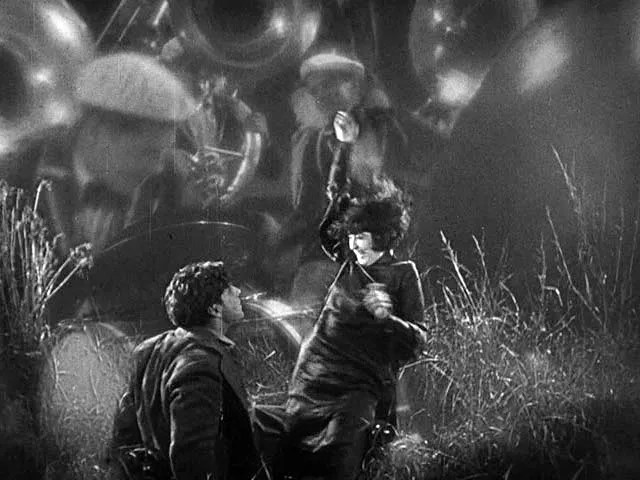
The camerawork and editing is sublime, its use of superimposed images truly extraordinary. As the man meets his fancy woman by a lake, they lie back and look at the stars. Above them, in the night sky, images of the city are imposed that stress its energy, excitement and raw sex appeal (can-can dancers and the like). It’s almost like our lovers are watching an actual movie.

Later the imposition will be reversed: after reconciling in the city, man and wife walk down a busy street – without a cut, as they walk, the street fades away and is replaced by the country fields of their home. In most cases, the imagery throws the character’s inner longings up on the screen for the viewer to digest. It doesn’t stop there. Images at various points show the city woman imposed standing behind the man as he debates killing his wife (again those inner thoughts given visual life). As the man lies back on his bed and stares at his wife, water is superimposed on top of him – it’s clear what he is thinking.

Murnau shoots with an expressionistic, early-morning brilliance, the man working home from his assignation – his slumped back and shoulders (George O’Brien joked his back did most of the work) telling us everything about his mood, in contrast with the brilliance of the surroundings, which we realise he finds as overwhelming as we do (he even gets slightly lost in the frame).

The possible drowning is a masterclass in cutting – moving swiftly from the man’s furrowed brow, as he builds up to what he must do, and the wife’s growing realisation of what he has in mind. A big part of the film’s poetic beauty is how this point of no return is an entrée to a love story. Reunited in the city, the two walk into a church and witness a wedding: the ceremony reminds them of the one they once shared, and Murnau captures the two of them emerging from the church just before the married couple, cementing the rebirth of their marriage. It’s an overwhelmingly optimistic view of love and the durability of the human spirit.

The film’s long second act of hijinks in the city can strain the patience of some. It’s effectively the couple’s second honeymoon, from having their photos taken (a candid moment of genuine love) to dancing at a Moulin Rouge style club where the man captures an escaped pig (yes seriously). It’s dreamlike (the camera work, especially in the club, reflecting this) but undoubtedly low on plot and drama. But it’s charming in its simplicity and in Murnau’s little touches of wit – the couple’s attempt to hide a damaged statue in the photographer’s studio is surprisingly funny.

It all leads us back to the narrowly averted tragedy of the final act as – irony of ironies – the newly reconciled couple are swept up in a genuine storm on the river that nearly sweeps the wife to her death. The man is distraught – so much so his homicidal rage is often overlooked him. Anyone seriously considering bumping his wife off is not well adjusted, and his reaction to the presumed loss of his wife it to attempt to strangle his lover.

This doesn’t intrude on the optimism of the tale and Murnau’s desire to present a fairy-tale like restoration of domestic bliss (after all, darker things happen in Brothers Grimm), all of which ends with an art deco sunset that kisses the frame. O’Brien’s body language may seem crude today, but it perfectly communicates the tempest at the heart of the man’s doubt. Gaynor has a beautiful innocence to her (she won an Oscar as well). Together they play enraptured love without being cloying, and are equally convincing during the rage and accusation.

Murnau, inexplicably, didn’t get an Oscar (not even a nomination), but Sunrise is a testament to his artistic brilliance with cinema. Effectively, he created a new grammar for this language, a superb use of visuals, effects, editing and production to lift a slight story into the realms of high art. Which is what Sunrise is: an arthouse poem, a visual feast that will linger with you long after its runtime has elapsed. Its influence has touched so many parts of cinema, that you might wonder today what all the fuss is about. But everything from your arthouse darling to your favourite Marvel blockbuster owes Sunrise a debt.

Wings (1927)

Charles Rogers, Clara Bow and Richard Arlen are in a wartime love triangle of sorts in the first ever Best Picture winner Wings

Director: William A Wellman

Cast: Clara Bow (Mary Preston), Charles Rogers (Jack Powell), Richard Arlen (David Armstrong), Jobyna Ralston (Sylvia Lewis), El Brendel (Herman Schwipf), Richard Tucker (Air Commander), Gary Cooper (Cadet White), Gunboat Smith (Sergeant), Henry B Walthall (Mr Armstrong), Roscoe Karns (Lt Cameron)

As the first ever Best Picture winner – and the only silent winner (until The Artist almost 85 years later) – Wings will always have a place in history. Is it the greatest silent film ever made? Of course not. In fact, it’s odd looking at Wings as a ‘Best Picture’ winner: with its rollicking action sequences, odd slap-stick comedy and slightly sentimental romance, it’s far more of a crowd-pleaser than the sort of film we think of as an Oscar winner. But it’s also filmed with an invention and verve that looks light years ahead of many other early winners – and a very enjoyable piece of story-telling.

It’s the First World War and Jack Powell (Charles Rogers) and David Armstrong (Richard Arlen) are both rivals for the affections of the beautiful Sylvia Lewis (Jobyna Ralston). Sylvia actually prefers David – but both she and David are too noble to let disappoint Jack when both men enlist as pilots. Jack has also failed to notice that his delightful neighbour (literally the “girl next door”) Mary Preston (Clara Bow) is in love with him, and that she is perfect for him. Jack and David train as pilots – a dangerous profession – and head for the front and become best friends and comrades in arms. Mary follows them to serve as a nurse – but Jack is still convinced he is in love with Sylvia, completely ignorant of the fact she is engaged to David. Will these romantic problems solve themselves, while the two men fly into dog fights in the skies?

Wings is a fabulous reminder of how dynamite and dynamic Hollywood could be before the Talkies and those years of reduced camera movement to capture live sound, with more stately editing and composition that continued to hold influence over film-making for much of the next fifteen years. I loved the visual invention of this film. Wellman pushes the camera into unusual positions and uses some truly unique shots. In an early scene Wellman straps the camera to a swing David and Sylvia are sitting in. We swing and sway with the swing, in an advance feel for what it’s going to be like in the dogfights to come. When Jack runs into frame, he actually looks wild rather than the characters on the swing (fitting considering his personality).

Wings is full of invention like this. It has a hugely influential tracking shot, which zooms across a number of tables and couples in a Parisian restaurant, getting closer and closer towards and intoxicated Jack and finally zooming in on his champagne glass. This is the sort of stuff you wouldn’t see in a Hollywood movie again for decades to come.

It all carries across into the dog-fighting scenes that will come. Wellman shot the film among the skies, with cameras following the action, others strapped to the planes to capture the actors faces (who are really up there!). Clouds are frequently used to communicate the speed the planes were moving at. Hundreds of stunt and military pilots took part in these re-staged battles which are still, despite the advances since, hugely impressive. Wellman, a former WW1 pilot, even took to the skies himself briefly when a pilot fell ill. Planes swoop, dive into clouds and plummet to the ground trailing smoke. It’s all shot with a boy’s own adventure and makes for gripping action.

The film is also a realistic look at the horrors of war, something Wellman was extremely aware of. When the action gets down into the trenches it doesn’t shirk in showing the costs of warfare, close-ups and tracking shots capturing the violence and human cost. Bodies slump in death. A tank looms over the camera. There are moments of realism: a sergeant, marching along the road, nudges a resting private only to discover (as his body slumps forward) that the man is dead. At first the sergeant marches on then he turns back, salutes and gently puts out the man’s cigarette. It’s a thoughtful little moment of human reaction in a film full of them.

It sits alongside an almost Pearl Harbor-esque plotline of romantic entanglements and confusion. Charles Rogers’ Jack is an enthusiastic, passionate but almost wilfully blind, bowled along with passion for anything that takes his interest from Sylvia to flying to his friendship with David. There is something quite sweetly old-fashioned – almost a fairy tale – about David and Sylvia keeping quiet about their love, so as to give Jack something to survive for. Richard Arlen is more restrained, but gives a decent performance. There is more than a hint of the homoerotic between Jack and David, the more exhibitionist acting style of the silent movies lending itself to an idea that the real love affair here is between these two rugged pilots (who wrestle, cuddle and even kiss), but that’s probably wishful thinking. Saying that though, the film is surprisingly daring: that French restaurant clearly has gay couples among its clientele (not to mention later a brief pre-code nude scene for Clara Bow).

But it’s still a straight-laced action film, where men are men with a key sub-plot of Mary’s unrequited love for Jack. Clara Bow, one of the biggest stars in Hollywood, landed top billing as Mary and you can almost feel her physical pain at her obvious devotion going unnoticed time and time again. Mary is basically a saint – and the film misses a chance to really explore her experiences as a Nurse on the Western Front – and to be honest her plot line is rather shoe-horned in to give a bit of feminine interest to an otherwise male-heavy plot.

It’s part of what makes Wings at times overlong. There is a slimmer two hour or so film about wartime flyers waiting in here, but Wellman’s film tries to do so much (war is hell, love, romance and rivals turned friends) that the run time balloons up to fit it all in. That stunning restaurant shot is part of an otherwise rather pointless extended “comic” sequence, involving Jack getting pissed and gleefully watching champagne bubbles (that fill the screen) before being saved from a French floozy by Mary, that outstays its welcome. The sequence largely exists to give Clara Bow something to do, but is neither particularly funny or memorable.

Certainly not compared to the action, or the moments of sadness and melancholia from the war. Gary Cooper, in one of his first roles, supplies a one-scene turn as an ace pilot who immediately dies in a training accident: we are never allowed to forget the dangers and loss of war. When our two heroes leave their lucky charms behind before flying out on one more mission, you know that things won’t go well. Wings ends with a tragic mistake and a sad homeward return coda where we really feel the cost of loss. It’s a film that maybe wrapped up in flag-waving heroics and daring-do, but has lots of genuine heart beneath the action. Sure, it’s overlong with a rather obvious romance, but it’s got more than a little brain among the thrills.

The Artist (2011)

Jean Dujardin and Bérénice Bejo delight in the light, frothy, charming Best Picture winner The Artist

Director: Michel Hazanavicius

Cast: Jean Dujardin (George Valentin), Bérénice Bejo (Peppy Miller), John Goodman (Al Zimmer), James Cromwell (Clifton), Missi Pyle (Constance), Penelope Ann Miller (Doris Valentin), Malcolm McDowell (Butler)

In 1920s Hollywood George Valentin (Jean Dujardin) is King of the Silver Screen. Why would he want anything to change? Surely these ‘Talkies’ are just a passing fad, right? Ooops. Before he knows what has happened, Valentin has gone from top of the world to the very bottom, left behind (like so many real-life silent stars) by change. Meanwhile, Peppy Miller (Bérénice Bejo), the young extra from his glory days whom Valentin briefly mentored, become a star of the Talkies. But Peppy still loves Valentin – and maybe he loves her – even while Hollywood pulls them apart.

Plot-wise, The Artist is pretty conventional. What really makes it stand out is that it’s a silent film about silent film. Perhaps that’s why the whole world went gaga for it (gifting it five Oscars, including wins for Hazanavicius, Dujardin and the Big One) – it was a genuine burst of nostalgia-tinged novelty. Everything old is eventually new again: I remember the novelty myself – sitting in a cinema and suddenly, after the music stops, hearing nothing but silence. Match that with the undeniable charm and energy the story is told with and, boom, you had a hit.

Does The Artist survive repeated viewings? Just about – though it looks increasingly like a slight film, that raises warm feelings but makes little lasting impact (I was surprised how much of it I had forgotten). Hazanvicius’ study of silent cinema has clearly been thorough, and this is undeniably a wonderful love letter to Hollywood’s history. Every technical detail is carefully reproduced, and the pastiche Fairbanks-style adventure stories Valentin stars in is spot on. The actors fully embrace the slightly exaggerated mannerisms of silent acting, telegraphing emotions with urgency.

Hazanvicius uses sound, when it comes, brilliantly. The opening of the film is bathed in music as we watch the premiere of one of Valentin’s films – only for all the sound to drop out the second the film-within-a-film ends. (We even see a “Silence behind the screen” sign before it does). We only hear everyday sounds twice – once in a hilariously haunting dream of Valentin’s where objects make noise but he cannot – and at the end of the film as Valentin finally finds a place in Talking Hollywood. Other than that, it’s scores, speaking cards (some of them witty, like Valentin’s wife’s question “Why do you refuse to talk?”) and all the style of silent cinema.

It’s a sweet and gentle film. There is no trace of the ruthless business Hollywood is, and not a trace of the darkness that touched many of this era. There is never any prospect of Valentin turning into, say, Sunset Boulevard’s Norma Desmond or any of the other washed-up waxworks in her house of broken dreams. Valentin loses everything, but remains a generous and decent guy, firing the loyal chauffer he hasn’t paid in a year (and giving him his car for free!) because otherwise he’ll never leave him. And of course, his dog loves him, so he must be a great guy. (The dog by the way was the break-out star, this charming, brave canine even getting a campaign for best supporting actor).

The film centres a love story between Valentin and Peppy. The two of them have an instant connection – but Valentin is the star, with Peppy the ingenue. This bond can survive nearly everything, even while Valentin resents her success. Hazanavicius manages to make this very sweet, even though Peppy is sometimes tediously saintly in her devotion. Valentin may have mixed feelings about his protégé – but in a housefire, the only thing he saves is footage of the two of them messing around in outtakes from one of his old films.

The film seems unbothered as well by the fact that Valentin is married. The wife (a thankless role for Penelope Ann Miller) doesn’t get a name, let alone any sense of a personality other than (it seems) being some sort of shrew.

You could also see Peppy, if you wanted to be uncharitable, as a bit of a stalker. She buys up (by proxy) all of Valentin’s goods when he goes broke, practically abducts him from the hospital after he is caught in a fire, hires his staff. Tip your head to one side and you can see her boiling a few bunnies. The Artist though sees her as more of a “Guardian Angel” (as per the title of one of Peppy’s movies) – and you can argue that there is something old-fashioned (not always in a good way) about a film where the female lead defines her success only by how it can help the man she loves.

The tinge of creepy to the Valentin-Peppy relationship isn’t helped by using a huge chunk of the Bernard Herrmann Vertigo score to underscore the film’s conclusion, not to mention the left-field melodrama of Peppy racing across town to prevent Valentin from committing suicide (motivated it seems by realising Peppy is his Guardian Angel). It’s an odd mis-step – and the sequence not only feels radically different from the rest of the film, it also seems to heavy for such a light confection.

But, negatives aside, it’s a decent little film. Jean Dujardin is the epitome of charm and old-school Hollywood wit as Valentin – it’s a master-class in physicality and he oozes matinee idol cool, and a certain boyishness. Bejo is very good as the well-meaning, kindly Peppy. The film is a puff of air, and once you get over the novelty, you’ll be amazed how little there is to it. But it’s told with such energy, charm and nostalgic wit (and ends with a lovely dance routine) as well as affectionate nods to old-school Hollywood, you won’t mind too much, even if you’re surprised it won as many awards as it did.