Category: Small town drama

The Teacher’s Lounge (2023)

The Teacher’s Lounge (2023)

A series of minor thefts leads to a school spiralling out of control in this intense, small-scale drama

Director: Ilker Çatak

Cast: Leonie Benesch (Carla Nowak), Eva Löbau (Friederike Kuhn), Anne-Kathrin Gummich (Dr. Bettina Böhm), Rafael Stachowiak (Milosz Dudek), Michael Klammer (Thomas Liebenwerda), Kathrin Wehlisch (Lore Semnik), Leonard Stettnisch (Oskar Kuhn)

Schools can be like whole societies in microcosm, with attention grabbing events having earth-shattering consequences in these tiny worlds. New teacher Carla Nowak (Leonie Benesch) finds this out the hard way when she takes matters into her own hands to solve a spate of petty thefts in the staff room, before the blame is pinned on students. Setting a trap, to her surprise she captures on film evidence that the thief is the school’s popular administrator Mrs Kuhn (Eva Löbau), mother of Carla’s star-pupil Oskar (Leonard Stettnisch). Events quickly spiral out of control, as Mrs Kuhn denies the charges and Carla’s attempts to be even-handed and fair leave her isolated at the centre of a storm pitting teachers, students and parents against each other.

The Teachers Lounge is a gripping ‘everyday’ thriller, where events on a small scale capture wider conflicts that rock whole societies. The events themselves seem small – petty theft and arguments over invasions of privacy – but Çatak’s film demonstrates they have shattering impacts on those involved. Loss of reputation, of jobs, the damaging impact on a promising child’s education, the shattering of harmony in a small community – it all explodes due to a few spur-of-the-moment decisions, building on each other so delicately that you are suddenly surprised to find it’s a crisis.

What’s really painful about The Teacher’s Lounge is how scrupulously honest and moral everything Carla tries to do is. What she’s not prepared for, is other people not playing by the same rules. Privately confronting Mrs Kuhn (having caught her distinctive blouse going on camera) with an offer to stop stealing and she’ll say no more about it, she’s amazed and totally shaken by the complete unwillingness to admit any guilt. When the matter is raised with the headmaster, Carla is dumbfounded by Kuhn’s aggressive denial and furious counter-accusation of invasion of privacy. Her cause is passionately taken up by Oskar, accusing Carla of ruining his mother’s life for no reason.

At the film’s heart is a wonderful performance of repressed tension from Leonie Benesch. Carla is a good teacher, but also a slightly distant, perhaps little-too-professional person. She engages more comfortably with the children because the ‘rules’ are clearer. With her fellow teachers, she never seems relaxed. She isn’t willing, as they are, to support (or cover up) for colleagues regardless of the situation. She judges each situation on its own merits – and Benesch superbly shows through her tense frame and strained voice how stressful this is – and adjusts her views and opinions as the situation develops. To everyone else this isn’t a positive but a huge negative, her refusal to follow an agreed line a sign of her flaky lack of loyalty to the team. (Her controversial filming is entirely caused by her mistrust of her colleagues, after watching one of them shamelessly empty an honesty box).

Çatak’s film shows how fragile the rules holding society together can be under pressure. Carla’s compassionate, thoughtful teaching focuses on developing her young students’ empathy and morality. She respects their views and asks for honesty in return. When arguments arise in class, she encourages discussion and consensus building. A jolly welcoming clapping-and-singing routine she practices every morning is about bringing the class together as a group. All of this flies out of the window as events unfold, showing how fragile these precious democratic conventions are.

The control of the teachers in the school turns out to be unbelievably fragile. Carla’s students stop co-operating with her lessons, effectively forming a union. The school newspaper – older students full of idolism about being the next Woodward and Bernstein – trap Carla into a Gotcha interview and misrepresent her opinions, fuelling the crisis (and leading to a near mutiny over a ban of the school newspaper). Carla, naturally, is blamed by her colleagues for the interview.

These fragilities and small-scale repression is just one way Çatak uses the setting to illustrate larger issues. Just under the school’s surface, there is a strong ‘us-and-them’ atmosphere. Both teachers and students demand internal loyalty to their sides. The thefts have already motivated heavy-handed members of staff to pressure (in private meetings) students to inform on their classmates. Carla objects to this but lacks the strength to end it – just as she later objects but does not obstruct a forced search of the boy’s wallets for stolen cash. It becomes more and more clear that Carla’s more considerate, diplomatic way of proceeding simply hasn’t got a chance of getting heard.

There is an uncomfortable air of casual assumptions being swiftly made. The first student suspect is the son of Turkish immigrants (the father’s job as a taxi driver all but used as evidence that the boy is likely guilty). Some of the staff simply can’t believe a boy from his background could have ready cash on him. An unbearably uncomfortable meeting with his parents – who at one point are instructed to speak German – is rife with tension. No wonder Carla is so uncomfortable with her Polish roots being discussed, that she asks a colleague with a similar background to only speak to her in German. Of course that contributes even more to the untrusted sense of distance Carla accidentally gives off to her fellow teachers.

This makes it even more heartbreaking to see Carla’s world slowly collapse in on itself as her attempts to treat everyone’s view points and demands fairly and equally ends with her attacked by both her colleagues and students. With her ever tense, bewildered decency getting ever more crushed Leonie Benesch is excellent in Çatak’s wonderful small-scale morality tale about society today, where the loudest and most strident voices win out. If you were her, you’d be finding an excuse to scream in a classroom as well.

The Night of the Hunter (1955)

The Night of the Hunter (1955)

Laughton’s only masterpiece is a fairy-tale, stuffed with beautiful images and dreamlike logic

Director: Charles Laughton

Cast: Robert Mitchum (Harry Powell), Shelley Winters (Willa Harper), Lillian Gish (Miss Rachel Cooper), James Gleason (Uncle Birdie), Evelyn Varden (Icey Spoon), Don Beddoe (Walt Spoon), Billy Chapin (John Harper), Sally Jane Bruce (Pearl Harper), Gloria Castilo (Ruby), Peter Graves (Ben Harper)

Few films have had their critical reputation change quite as much as The Night of the Hunter. When released, its reception from film critics and audiences was so negative that the crushing disappointment saw director Charles Laughton decide his debut would also be his last film. Flash forward seventy years and it’s now hailed as one of the great American films, a pictorial masterpiece. The Night of the Hunter sits alongside Citizen Kane as the classic film unappreciated in its day.

Adapted from Davis Grubb’s best-selling novel, it follows the nightmareish experiences of young John Harper (Billy Chapin) and his sister Pearl (Sally Jane Bruce). These kids witness their father Ben (Peter Graves) dragged away by the cops to imprisonment and execution – but not before he’s hidden $10,000 in Pearl’s doll and sworn them both to secrecy. Word about the money gets out: it’s why sinister ‘Preacher’ Harry Powell (Robert Mitchum) arrives and starts a-courting their mother Willa (Shelley Winters). After swiftly disposing of Willa, Powell turns his attentions to the kids – who flee down river, eventually coming under the protective wing of kindly widower Rachel Cooper (Lilian Gish) and her brood of young waifs and strays. Is it far enough though to escape Powell’s clutches?

The Night of the Hunter plays out like a fairy tale. Its images are full of the magic of the countryside and mysticism of nature. It frequently, deliberately, uses artificial sets and locations to create a dream-like state. It’s got a classic monster its heart, with Powell a demonic force-of-nature. It follows a pair of children on a journey reminiscent of Hansel and Gretel. There is a kindly old woman and a moral message of the importance of love, family, faith and loyalty. Everything in it feels, to various degrees, heightened. This is Southern drama via Hans Christian Anderson.

I wonder if that’s what threw people off on release. I’d agree that the film’s opening – Lilian Gish’s face superimposed over a starry night sky (followed by a cut of five kids heads superimposed over the same sky raptly listening) – might tee us up for the film’s mood, but looks and feels kitsch. The moments where Laughton deliberately aims at heightened, almost cartoonish, reality push the envelope of what you can accept – why does Powell, at one point, chase the kids up a flight of stairs, hands stretched out before him like he’s in a live action Tom & Jerry cartoon? Stumble onto The Night of the Hunter unwarned about its fantastical grounding and melodrama and it must look and feel odd, bizarre and even a bit laughable.

But it’s these same qualities that have made the film last. Laughton created a film of magical force and power, crammed with striking, imaginative images and beautiful sequences that tip between dream and reality. Its real heart lies in the children’s escape down the river, a remarkable sequence as the camera follows the boat drifting down an obviously artificial river, the children asleep as it glides past spider’s webs, frogs and other wildlife. From a film that opens with the aggressive arrest of the Harper’s dad, this burst of Where the Wild Things Are mysticism intentionally feels like we are crossing into a completely different world, let alone movie. But it’s also part of the film’s striking originality and quirky memorability. Few things look conventionally ‘real’ – in fact, like the farmhouse the kids stop at overnight in their long drift down river it feels even intentionally artificial – but it also gives the film a timeless, poetic feeling.

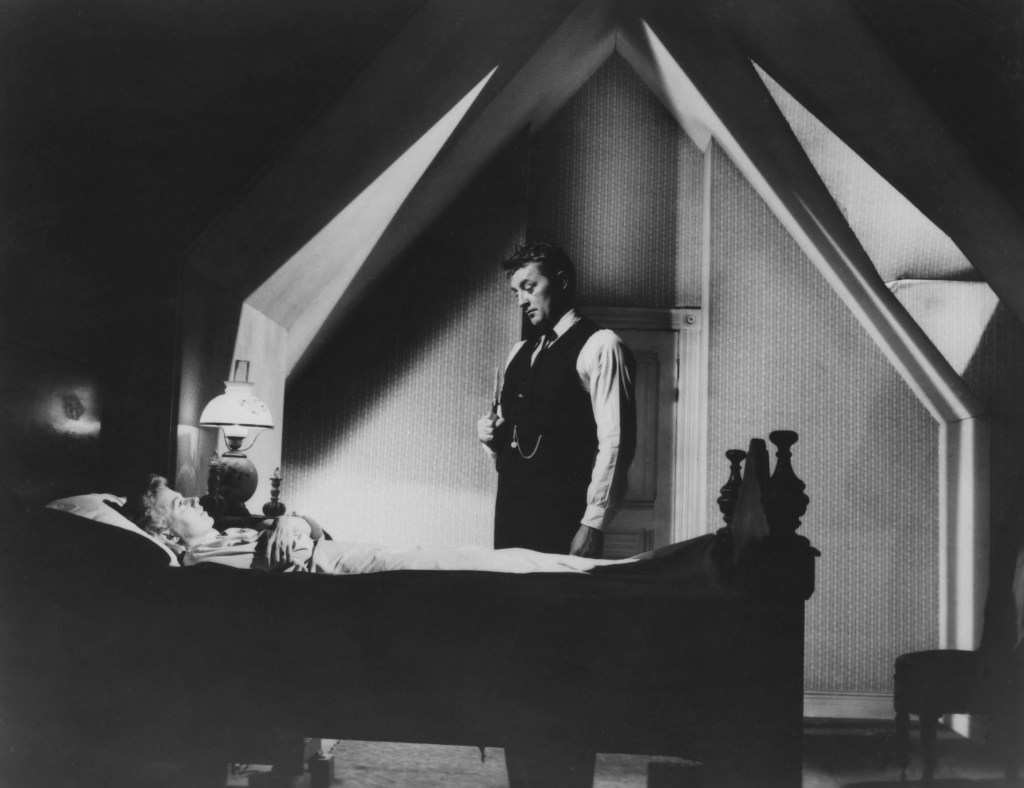
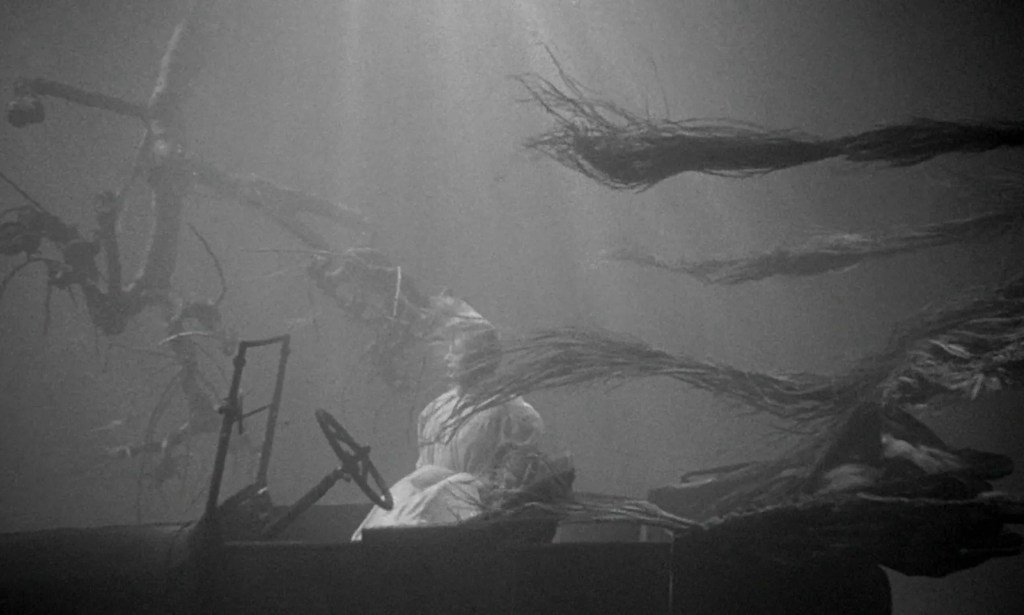
It’s a beautiful sequence in a film stuffed with them. Laughton worked closely with cinematographer Stanley Cortez and several sequences are awash with poetic visual flourishes inspired by some of the great German silent cinema of the 1920s. Who can forget the visually stunning shot of Willa’s body in a car at the bottom of the river, her hair flowing in matching waves with the weeds around her (possibly the most beautiful image of death in the movies)?  From the countryside shots that bring back memories of Murnau’s Sunrise to striking sets that seem to have emerged from The Cabinet of Dr Caligari. Most striking is the high-ceiling, Church-like set that is Powell and Willa’s bedroom, a shadow-laden expressionist nightmare. The scene is played with the same carefully choreographed expressionist force, from Mitchum’s vivid gestures to Winter’s corpse-like resting.

Death comes from Mitchum’s Preacher, one of the great monsters in cinema. With those famous ‘Love’ and ‘Hate’ tattoos, Mitchum makes the role truly terrifying. Mitchum kept up a studied public contempt for acting, but he immerses himself in Preacher in a way he did with few other roles. He makes him horrifyingly charming (he wins adult confidences easily) and his smooth gravel-voice and masculine bearing are both imposing and intimidating. But Mitchum also embraced the weirdness, the psychopathy of a man who murders without a second thought while keeping up a private conversation with the Lord. Preacher is an animalistic demon wrapped up in human skin – he lets out the most bizarre, piercing screams when foiled or injured – twisting his body into unsettling shapes before his misdeeds or letting his eyes boil with anger and disgust (most particularly at sex, something he seems to find repulsive and fascinating).

It’s an extraordinary, terrifying, monstrous performance unlike almost everything else in Mitchum’s career in its willingness to go to such twisted, eccentric, unnatural extremes. Mitchum credited Laughton as his finest director – and Laughton’s skill with actors is clear from all the performances. Shelley Winters’ has rarely been better in a role she skilfully downplays, as an unhappy woman, desperate for redemption, forced to feel ashamed of her desires. The two children are very good, in particular Chapin’s frequently raw panic and trauma and determination. The rest of the cast is stuffed with striking, Dickensian pen portraits, performances of striking eccentricity.

These performances fit within the magical realism of the film in a film that is as stylised as this. Again, I can’t imagine that audiences at the time – used to blockbusters, shot on gloriously realistic locations – were ready for something that aped so strongly the artistic flourishes of silent cinema. But it works spectacularly for a film about a children’s semi-magical quest into the wilderness. It’s hard to think of another film that leans so completely into such an aesthetic unreality as this one – even the town the kids eventually escape to feels like it’s a movie set rather than a real place.

The film’s final act in the home of Miss Rose Cooper is not as strong as those before. There is something rather po-faced and self-satisfied about the slightly clumsy moral message of finding faith and goodness which feels rather twee and disappointing considering the gothic film we’ve just watched. The film’s final sequence, on a peaceful Christmas day, belongs in a more conventional film (even though you could argue it’s also a conventional fairy tale ending). Much as I enjoy several moments of Lillian Gish’s performance as a tough old woman – like a shot-gun wielding Whistler’s Mother – the shift of focus away from Preacher’s demonic schemes feels like a loss.

The Night of the Hunter, for me, isn’t the complete masterpiece it’s sometimes hailed as – there are clumsy moments (I would agree the Tom & Jerry Preacher chase feels tonally out of place, and neither the opening or closing is strong), but it’s also filled with moments of pure cinematic magic – and has a performance from Mitchum that is one for the ages. Its imagery is beautiful, it’s tone mostly perfect and its imagination limitless. The greatest sadness about watching it is that Laughton never directed again – based on this, imagine how good his next film might have been?

Small Things Like These (2024)

Small Things Like These (2024)

Profoundly sad film of the impact of small acts, with a soul-searching lead performance

Director: Tim Mielants

Cast: Cillian Murphy (Bill Furlong), Eileen Walsh (Eileen Furlong), Michelle Fairley (Mrs Wilson), Emily Watson (Sister Mary), Clare Dunne (Sister Carmel), Helen Behan (Mrs Kehoe), Zara Devlin (Sarah), Mark McKenna (Ned), Agnes O’Casey (Sarah Furlong)

Sometimes the only hope for change, is that the balance of small acts of kindness outweighs the mass of indifference and blind-eye-turning. Claire Keegan’s acclaimed novella is about exactly such a moment. In the small town of New Ross, Wexford, just before Christmas in 1985, coal merchant Bill Furlong (Cillian Murphy) works hard to provide for his family and look out for those around him. Bill is struggling with insomnia, haunted by memories of his mother’s (Agnes O’Casey) death when he was a boy. One day he witnesses something unsettling at the local convent: a young woman (Zara Devlin) begging not to be left there. A few days later he arrives at dawn to find her locked in the coal shed. The Mother Superior (Emily Watson) assures him it is nothing to worry about and sends him on his way with a giant tip. But Bill can feel in his bones something is not right.

Small Things Like These is a sombre investigation of how an appalling scandal like the Magdalene Laundries could continue for years. The convent’s influence touches every inch of the town. Social life revolves around the Church and even organise the town’s Christmas lights. They run the school – with the Mother Superior heavily implying Bill’s actions will have a profound impact on his children’s educational prospects – and they are treated with awed deference from everyone. You slowly realise many people know things are not right at the Convent – but no one wants to rock the boat (Bill’s wife even begs him not to and the pub landlady warns him to put his own family first).

In a world like this, bad things flourish because people don’t want to put themselves and their loved ones at risk. People must hear the wailing of babies from the convent and decide to keep walking. It’s not just the convent: New Ross is full of people looking the other way to poverty and misfortune. Bill quietly does his best to help people – a generous Christmas bonus for his workers, a handful of whatever change he has to a young boy walking home alone – but even he can only look on in slack-jawed sorrow when he sees a shoeless child in the middle of the night drinking from a cat’s bowl.

Mielant’s film brilliantly captures not only the drab, gloomy atmosphere of this poor Irish town – every shot is soaking in shades of grey, brown and coal dust black – but also the grim sense of things constantly being watched passively from a distance. The film is awash of shots that frame events through doorways or at a distance, be it from across the street or in mirrors or reflections. Small Things Like These is an oppressive, claustrophobic film, largely taking place in dusk or night-time darkness, where things go unspoken and unconfronted.

The burden of inaction has had a huge impact on Bill, in a mesmerising performance by Cillian Murphy. Quiet, awkward and shy, Murphy makes Bill weighed down by an impossible burden of sadness. Large chunks of the film simply allow us to study Murphy’s face, and few actors can convey inner turmoil as beautifully as Murphy can. You feel there is a poet’s soul buried in Bill, in Murphy’s eyes haunted with an impossible melancholia: Murphy brilliantly embodies a quiet, decent man who knows the world isn’t right but is deeply torn about what he can do about it, while haunted by his own lingering childhood pain at witnessing his mother’s death and never knowing his father.

It’s interesting that this past is one of the most brightly filmed parts of Small Things Like These. Bill’s natural empathy towards the young woman he encounters at the convent – and his desire to care and provide for his own family – is rooted in his own past. Growing up without a father, the child of the maid of a wealthy family, we realise it is only due to an act of decency that Bill’s life developed as it did. As a single, unmarried woman, his mother could easily have ended up in the Magdalene Laundries herself, with Bill taken at birth to be fostered by strangers. It’s only the kindness of her employer (a tender Michelle Fairley) that saved him – though Bill still grew up bullied and mocked for his illegitimacy.

Perhaps Bill realises more the lucky escape he had, when confronted by Emily Watson’s chillingly authoritarian (under a mask of genial indulgence) Mother Superior. What would his life have been like if his mother had been crushed by someone like this fierce woman, resolute in her self-righteousness? Bill’s shame and guilt is superbly conveyed by Murphy as he leaves with a previously disputed bill settled in full (and then some) and a promise of future favours to come. The message is clear: this is how the world works and Bill should get with the programme.

That’s how wicked deeds flourish among decent people. Small Things Like These may spin an old-fashioned Edmund-Burke-inspired line, but it’s hard not to argue with its honesty, conviction and the air of impossible sadness that drips from every frame of it. At points it’s decision to leave so much unspoken does create more ambiguity than I think it intends. In particular, the music choices for some flashbacks imply shocking revelations that never arrive. Which are in fact utterly counter to the film’s eventual, slightly open-ended, reveal of Bill’s past (contrary to the more explicit book) but this a refreshingly quiet, thoughtful and meditative film (with a brilliant, grief-stricken lead performance) – that in its gentle way carries real emotional force but leaves you feeling hopeful.

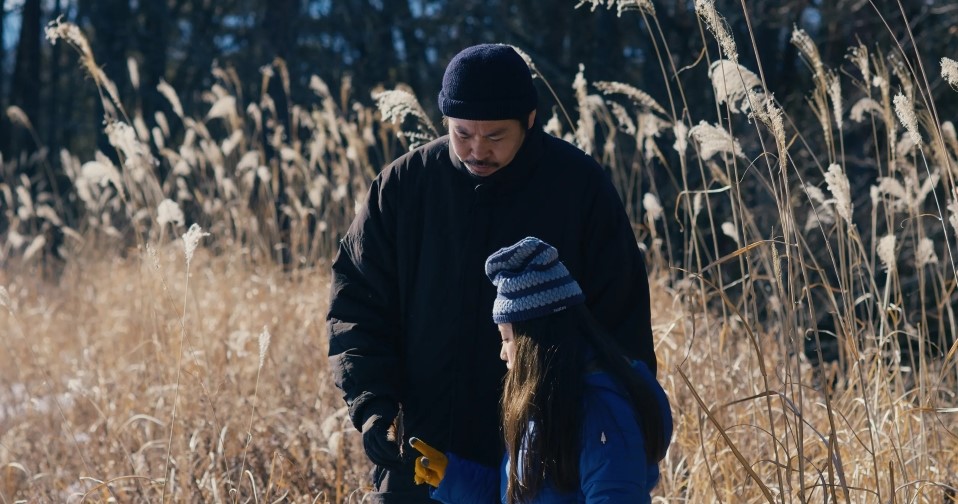
Evil Does Not Exist (2024)

Evil Does Not Exist (2024)

Haunting, enigmatic parable on nature and modern society that leaves a lingering impression

Director: Ryusuke Hamaguchi

Cast: Hitoshi Omika (Takumi Yasumura), Ryo Nishikawa (Hana Yasumura), Ryuji Kosaka (Takahashi Keisuke), Ayaka Shibutani (Mayuzumi Yuuko), Hazuki Kikuchi (Sachi Minemura), Hiroyuki Miura (Kazuo Minemura), Yûto Torii (Tatsuki Sakamoto), Takako Yamamura (Yoshiko Kizaki), Takuma Nagao (Tomonori Hasegawa), Yoshinori Miyata (Akira Horiguchi, Takahashi), Taijirô Tamura (Ippei Suruga)

Imagine a beautiful Japanese mountain village, where the water is so clean, jugs of are taken straight from the stream to the local restaurant where its unique taste adds to the food’s beauty. Everything here is in careful harmony. Until a corporation reckons it’s the perfect site – keen to exploit, while it can, lingering Covid subsidies – to build a glamping site with a 95% effective septic tank (because that’s fine with government regulations). The corporation hosts a charade of a consultation where the plans are rejected by the community, unconvinced by the ‘trickle down’ wealth promised and more concerned with that 5% sewage being tipped into their gloriously pure water supply.

Perhaps the point of Evil Does Not Exist is that there is no real malevolence here. The corporation that wants to effectively shatter the harmony of this community isn’t doing it because they are cruel, they’re just doing what they do to create profits. And they genuinely don’t really see the problem because with a classic lack of empathy they’re convinced what is good for them is good for everyone. And that deep-down everyone shares their outlook. The villagers are just angling for a bigger pay-outa and they don’t really need to fix the septic tank because it falls within the rules and the water will still be okay with a little bit of sewage in it.

Evil Does Not Exist it seems, because most of the bad stuff happening in the world is because of empathy-free systems, people not really caring about impact of their actions and a general lack of interest in long-term impacts over short-term gain. Hamaguchi’s beautifully filmed, Godard-inspired (from title fonts, to shooting-style to Hamaguchi’s use of non-professional actors) environmental parable carefully and subtly deconstructs a world where the beauty of nature can be rinsed away simply out of a sense of inevitability and quick-buck expediency.

Originally envisioned as a short film that would showpiece the beautiful orchestrations of its composer Eiko Ishibashi, Hamaguchi expanded it as he shot more and more material, eventually developing it into a fascinating and open-ended parable about our relationship with nature. Nature here is an elemental and unknowable force: the first five minutes of the film is a sustained tracking shot through the trees, the only sounds we hear being Ishibashi’s music. It’s almost ten minutes before we hear any dialogue. The village’s ‘odd-job man’ Takumi (Hitoshi Omika) is very much one with the natural world around him, taking only what he needs and living in gentle, stoic harmony with the environment.

Hamaguchi’s film – utilising his careful, Ozu-inspired camerawork and Godardian love of realist observation – creates a natural world which is both beautiful and hauntingly mysterious. In the film’s calm shots of nature, the forest becomes a haven but one strangely inhuman. There is a feeling of unknowable, unrelatable forces in this world, an organic Gaia understanding that the villagers are unconsciously plugged into, which governs the ‘rules’ of existence. It’s an understanding utterly inaccessible to those who arrive from the city and want to pave paradise and put up a parking lot.

Evil Does Not Exist pivots around its consultation meeting, which takes place in a town hall, chaired by initially bored consultants going through the motions with a slide deck they don’t understand and a ring-binder of notes they are unfamiliar with. As the villagers quickly discover (their adroit questioning taking the under-prepared consultants off guard), this consultation is a sham – anyone with any control over the fate of the project isn’t there and the glamping site is happening regardless of anyone’s feelings. All this meeting is about (as the head of the company later says, dialling in to chat to his consultants on a video call) is demonstrating the company has ‘listened’ and to tweak a few token issues (it’s telling that the head of the company describes the disastrous meeting as a complete success). None of this is evil of course: it’s just the bureaucratic acquisitiveness of the modern world, which values procedures and rules over impacts and end results.

Both consultants however find themselves taken with the village. But Hamaguchi demonstrates this is always rooted in a patronising sentimentality that’s as much about themselves as it is the actual village. Takahashi (Ryuji Kosaka) in particular, a disaffected company drone, spontaneously decides he can just jack it all in and become a skilled man of the wilderness like Takumi. Takahashi comes across as an embarrassing romantic, identical in many ways to the likely glamping customers (who want a sense of the nature without actually living there). He’s hideously clueless about the fauna of the forest and his practical skills (captured in a hilariously awkward attempt to chop wood) are woefully inadequate. None of this stops him from assuming he can fit right in on a whim with no preparation or training. Takumi’s just an odd-job man, how hard can that be to pick-up?

It doesn’t kid Takumi, who stares at him with an impassive face that hints at a range of emotions from contempt to humorous indulgence. Perhaps he’s aware that Takashi (again patronisingly) sees him less as an individual and more as his personal Yoda, placed on earth to mentor Takashi’s personal growth: to the outsiders the village and its inhabitants are always filtered through what they can do for them. Takashi’s patronising expectation that Takumi will welcome a ‘student’ isn’t wildly different from the company’s view that Takumi can be won over to supporting the project because they’ve offered him a job and a semi-decent salary.

This all culminates in a mysterious, open-ended conclusion which sees Hamaguchi lean into hints of folk-horror. Does the conclusion of Evil Does Not Exist show the dangerous consequences of mankind’s interference of nature on the most innocent? Does Takami represent a resentful natural world biting back? Questions hang over the film’s cryptic ending, which has been neatly foreshadowed throughout.

Evil Does Not Exist has a quietly hypnotic quality to it, but also a haunting chill behind its beautiful imagery. But it also asks subtle but intriguing questions about our link to nature and how a myopic focus on our own interests and needs inadvertently damages the world far more than actively ‘evil’ acts ever could.

CODA (2021)

CODA (2021)

Surprise Oscar-winner is reassuring, unsurprising feel-good fare, charming but crammed with familiar beats

Director: Sian Heder

Cast: Emilia Jones (Ruby Rossi), Marlee Matlin (Jackie Rossi), Troy Kotsur (Frank Rossi), Daniel Durant (Leo Rossi), Eugenio Derbez (Bernardo Villalobos), Ferdia Walsh-Peele (Miles), May Forsyth (Gertie)

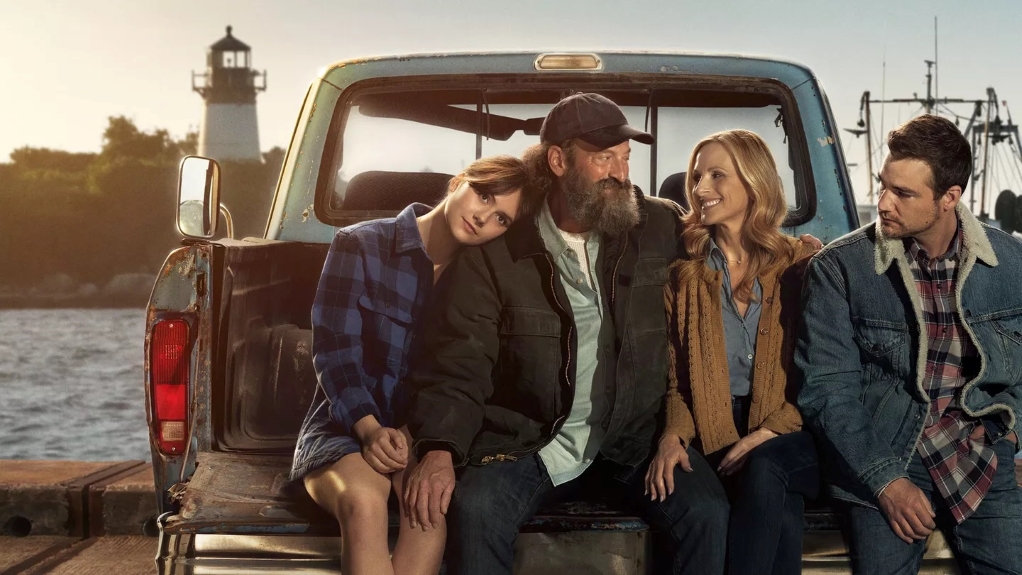
Ruby Rossi (Emilia Jones) feels like she has been working her whole life. The only hearing person in a deaf family, she’s both translator and interpreter. She works early morning shifts on their fishing ship with her father, the imposing-but-playful Frank (Troy Kotsur), and older brother Leo (Daniel Durant), and butts heads with her former-beauty-queen mother Jackie (Marlee Matlin). After graduating from high school, Ruby assumes this will be the rest of her life: until music teacher Mr Villalobos (Eugenio Derbez) helps her discover her gift for singing and, suddenly, a new future of Berkle Music College is possible. But can she balance the conflicting demands of her family and dreams?

CODA is an eminently likeable, thoroughly unchallenging film. If someone dumped a pad down in front of you and asked you to guess, sight unseen, what its main plot beats would be, pretty much anyone who has ever seen a movie would nail 90% of them. But it’s a well-told, charming small-scale story, with a positive perspective on disability and tugs heartstrings with the assured skill of a master. In the end it doesn’t really matter that nothing in it is remotely surprising, challenging or unexpected, because it delivers exactly the emotional response the viewer is likely to want from it.

It’s a film about communication. The Rossi’s need Ruby’s ability to hear, and her ease with spoken English, to navigate the world around them in the fastest, smoothest way. Ruby, meanwhile, is struggling to communicate her own passions, after a lifetime of adapting herself to her family. Unlike them, she wants more than a life on the docks. This guilty conflict with the family she adores ironically makes her constantly avoid communication both with her family and her music teacher (investing his personal time and money in her) about the pressure slowly crushing her.

These increasingly conflicted desires and choices form the film’s heart. Will Ruby make her own life, or stay with her family for as long as they need her? It’s not helped by the fact that her talent (out of all the talents in the world) is one her family can’t fully share in, meaning they struggle to understand her dilemma. (Her mother outright sees Ruby’s singing as nothing more than teenage rebellion – stating if her parents were blind, Ruby would have embraced painting). On top of which, Ruby’s genuinely loving (but insular) family have been her whole world for as long as she can remember.

The Rossis are vibrant and warm-hearted with a salty sense of humour and a stubborn independent streak. Jackie and Frank are so infatuated with each other (even after decades of marriage) they frequently engage in noisy sex (much to the embarrassment of Ruby, when a visit from a would-be boyfriend is interrupted by some extremely loud, bed pounding coitus from next door). They delight in teasing each other – from Leo and Ruby’s inventive sign-language insults for each other to the hilariously intentionally explicit sign-language safe-sex lecture Frank gives Ruby and her prospective boyfriend. But they are also a tight-team, seeing themselves as having to fight for their place in the world and discussing problems with the low income of the fishing business as a unit.

CODA is keen to establish the Rossis not as victims or people the audience should feel sorry for, but as a warm and loving family of everyday working-class Americans, who just happen to be deaf. It’s part of the film’s challenging of perceptions around disability. Frank continues a fishing business started by his father, which he intends to hand to his son, and (eventually) steps up to become a leader in his community. Jackie is a chippy, opinionated woman who still loves the glitz and glamour of her old beauty pageant days while getting stuck into managing the family’s new business interests. All of them are vibrant and romantic, sexual people, confident in themselves and who they are, far from the passive recipients of charity and help that so many disabled people in film have been.

But CODA dodges more challenging questions around disability. It never really engages with the implication that the Rossi family have got so used to having a full-time, free translator, that they have become disconnected from the world around them. I can’t help but feel there is a germ of a more interesting film here about the family (however inadvertently) allowing themselves to be cut off from others. They have let their ability to lip-read slip, filter all their communication with anyone outside the family through Ruby, and have grown so used to her manning the radio for their fishing business that they can’t run the boat effectively without her (leading to inevitable coastguard trouble).

It’s also had a knock-on effect in the fishing community: the other fishermen have clearly never had to really build a relationship with the Rossi’s (after decades, no one on the docks has learned even the most rudimentary sign language or any communication techniques like moving lips clearly when speaking). Jackie is outright resentful of the hearing wives of the other fishermen and neither she nor Frank can imagine actually running a business without Ruby’s to handle literally all the verbal communication involved. The closest the film comes to addressing this is Leo angrily telling Ruby the family aren’t helpless – they managed before she was born and they will if she leaves. But the film doesn’t want to explore the implication that the Rossis allowed themselves to slip into a comfort zone that ultimately proves isolating and even damaging for them.

CODA does get some good material from their struggle to engage with music (even if this is an uncomfortable cliché for some in the deaf community). There are well-staged moments, such as the Rossis attending Ruby’s graduation concert, where we “hear” what they hear (nothing) and need to judge the performance, like they do, from the reactions of those around them. A scene where Frank finally appreciates part of his daughter’s skill by feeling the vibrations of her singing is done with real emotional force. However, it cheats by feeding this into an off-stage conversion where the family switch (overnight) from hesitant to “all-in” for a classic last-minute-dash to get Ruby to her audition.

That’s representative of CODA shifting away from more complex, challenging themes and issues for a heart-warmingly positive tale, familiar from dozens of movies past. Saying that, Heder does a good job pulling together the familiar elements, and Troy Kotsur (Oscar winning) and Marlee Matlin both give emotionally rich performances as the parents. Ruby is excellently played by Emilia Jones – who spent months learning sign language in order to perform the part and improvise with the other actors. But CODA feels like a gentle, consensus film full of pleasant moments and reassuring insights that love will overcome, which perhaps explains why it won an Oscar in a year of more divisive films. There is nothing in it that could possibly rile you up or shake your faith in the decency of ordinary people. CODA is a film designed to wrap around you like a comfort blanket.

Yojimbo (1961)

Yojimbo (1961)

Kurosawa’s dust-filled samurai actioner is a very Japanese Western and huge fun

Director: Akira Kurosawa

Cast: Toshiro Mifune (“Kuwabatake Sanjuro”), Eijirō Tōno (Gonji), Tatsuya Nakadai (Unosuke), Seizaburo Kawazu (Seibei), Kyū Sazanka (Ushitora), Isuzu Yamada (Orin), Daisuke Katō (Inokichi), Takashi Shimura (Tokuemon), Hiroshi Tachikawa (Yoichiro), Yosuke Natsuki (Farmer’s Son), Kamatari Fujiwara (Tazaemon), Atsushi Watanabe (Coffin maker)

An unknown stranger arrives in a dust-filled border town and finds himself stuck in the middle of a long-running feud between two gangs with only his wits and skill with his weapon for any advantage. If you had any doubt about the influence American Westerns had on Akira Kurosawa, look no further than Yojimbo. Perhaps the most purely enjoyable movie Kurosawa ever made, Yojimbo can also lay claim to being one of the greatest Westerns ever made, given greater depth with Kurosawa’s subtle social satire on Japanese samurai culture. This is Kurosawa at his best: stripped-back and dynamic with a weight behind the fun.

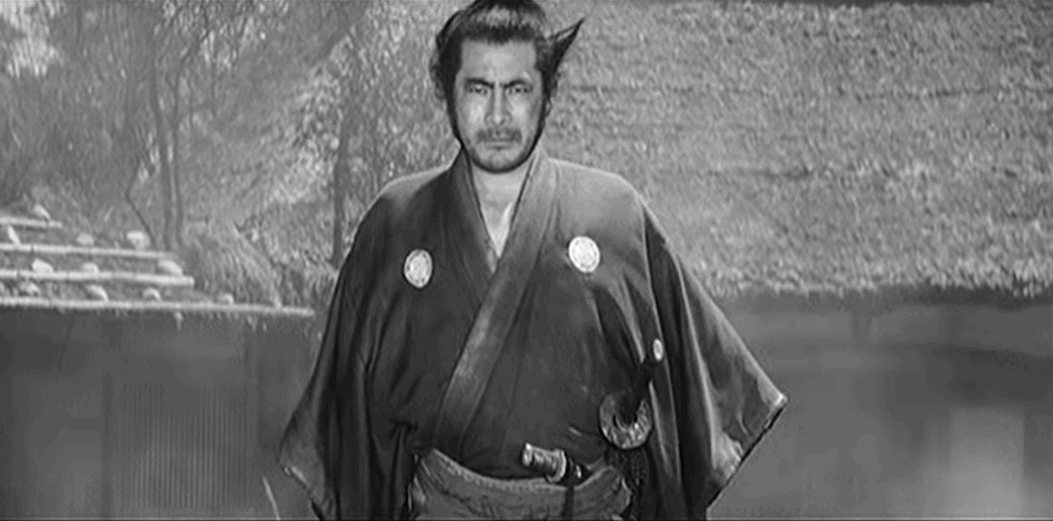
Our unnamed samurai is (Toshiro Mifune), now a wandering ronin. The gangs: on one side Seibei (Seizaburo Kawazu) the town’s long-term boss, whose ruthless wife Orin (Isuzu Yamada) is the power behind a throne she intends to pass to their timid son Yoichiro (Hiroshi Tachikawa). On the other: Ushitora (Kyū Sazanka), Seibei’s former number two furious at being passed over as heir apparent, backed by his brothers, dim but strong Inokichi (Daisuke Katō) and would-be gunslinger Unosuko (Tatsuya Nakadai). The rivalry has bought the town to the edge of ruin and our unnamed samurai – giving himself the spontaneous pseudonym “Kuwabatake Sanjuro” (literally “Mulberry Field aged Thirty”) – use his wit and ingenuity to play both sides against each other to get rid of them.

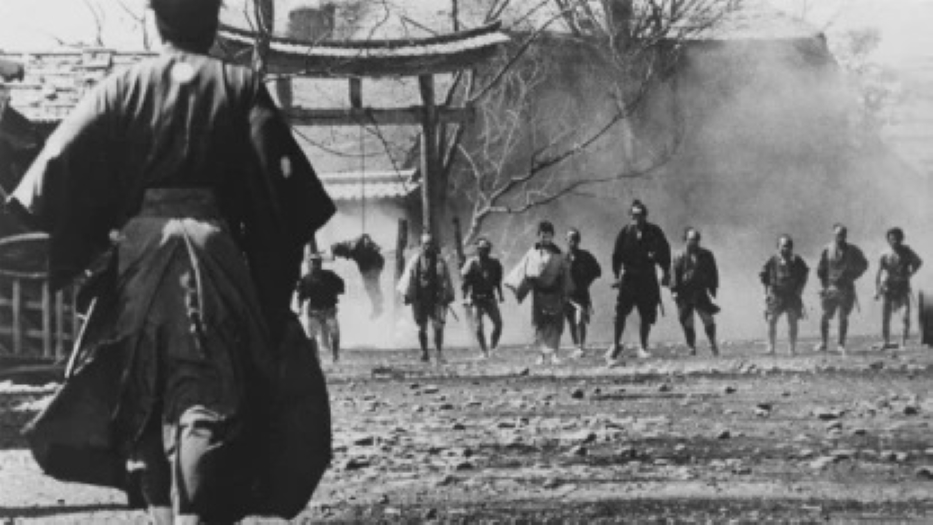
The Western influences in Yojimbo are immediately obvious. The town looks like a Fordian dustboal frontier towns, Kurosawa delighting in the widescreen, windswept streets the site of so many slow-burn face-offs. Rivals meet on main street, facing each other at opposite ends, like High Noon. Seibei operates out of a worn-out brothel, Sanjuro stays in a saloon run by a weary old-timer, a local sheriff is a hopelessly inept foreluck-tugger, Sanjuro has the same gruff excellence with a sword as John Wayne and Alan Ladd had with a gun. By the time Unosuko turns up clutching the town’s only gun and preening like Jack Palace in Shane, it’s impossible to miss we are in the Old Japanese West.

This is a town in total breakdown, where the coffin-maker makes a huge income creating piles of tombs for the rival gangsters who fall in constant duels. Both gangs are in, their way, pathetic. Far from intimidating, Seibei (a hilariously whiny Seizaburo Kawazu) is a puffed-up old man, easily brow-beaten by his wife. Unosake has more swagger and guts, but he’s as cluelessly inept as Seibei. Both gangsters have crews stuffed with fighters but lack almost anyone with any actual skill. When the gangsters are first manipulated into facing-off, they posture and feint at each other like blow-hard school bullies then seem relieved when the arrival of a local official leads to a sudden ceasefire.

Parodying the old Samurai class, Sanjuro is a million miles from the sort of elite honour-bound soldier we expect. In one of his finest performances, Toshiro Mifune is scruffy, cynical and works very hard to give the impression he’s more interested in his immediate needs than any higher purpose. Mifune is gruff, constantly scratching or chewing: he’s a prototype Clint Eastwood (and Yojimbo was ripped off by Leone for A Fistful of Dollars, leading to a Toho Studios legal case), a morally ambiguous figure who does the right thing when it coincides with his own interests. His motives are unknowable. Why does he set-out to destroy both gangs? Is it sympathy for the mess of the town, or is it because he sees a chance to make a quick buck from the mess? Is it because he’s bored (and eventually annoyed) and does it for his own amusement?

The brilliance of Mifune’s shaggy-dog performance is that it could be all or none of these things. Sanjuro does just one, unmistakeably, decent, selfless thing in the film: saving Ushitora’s unwilling mistress and her downtrodden family. What does it get him? Their near suicidal deference and ostentatious gratitude drives him nearly to distraction and leads to a near-fatal beating. But it really rankles Sanjuro because it’s possible he despises the idea of decency in himself, an intriguing insight into what could be unknown darknesses in his past. Does he know selfless acts can become the only chink in your armour?

Aside from that, his mastery of the situation is hugely entertaining. Never mind two steps, he seems a marathon ahead of the rest. Provoking a pointless early clash with Ushitora’s heavies, he bests them in seconds with a series of lightning fast sword strokes (Star Wars Mos Eisley-based Kenobi swordplaywas clearly inspired by this), establishing in seconds he’s the alpha both sides need to compete over. When action kicks in, Sanjuro is unmatched by the Dickensian collection of street thugs both sides have amassed, his swift reflexes and expert slices reducing even a hideously outnumbered fight into a curb-stomp clash. You can see Kurosawa’s influence over Leone here: clashes in Yojimbo have long build-ups and explosive, sometimes violently bloody outcomes (an arm severed here, a spray of blood there, characters bleeding out).

But Sanjuro’s other skill is his ability to appraise rivals instantly. None of them disappoint in their transparent greed and shortsightedness. Kurosawa visually embodies Sanjuro’s shrewdness by frequently having him climb up a tower platform on the main street to literally look down on the results of his manipulations. No one can match him. Orin – a pleasing twist on her Throne of Blood role as an ineffective Lady Macbeth by Isuzu Yamada – thinks she’s smart enough to double-cross him, but her brains only look impressive matched against the mediocrities of the town. Daisuke Katō’s Inokichi – so dim he can’t even count with the aid of his fingers – literally believes anything he’s told by the last person who spoke to him. Only Tatsuya Nakadai’s smug Unosuke is in anyway threat, but he’s a preening show-off whose only qualification for being the toughest guy in town is because he owns the only gun (which he can’t help fetishistically stroking at every opportunity).

The gun is another sign of a culture at crossroads – the major threat to Sanjuro comes not from any human, but from a distance-killing tool that could wipe out his vastly superior tactical and fighting ability in a second. Yojimbo is showing us a Japan tipping over the edge into a future where ruthless gangs, with more brawn than brain, will drive towns like this into the ground – but our hero, a symbol of a bygone age of heroics, isn’t traditionally heroic either: he’s a scruffy, self-interested loner, who despises nobility. Our other samurai, Seibei’s pet-trainer, is hardly a great advert for samurai either, peddling his skills for cash and huffily walking out when his value is not recognised.

All this is wrapped up in a film that is undeniably hugely entertaining. The action, when it comes, is truly exciting. Mifune is superb, charismatic, likeable with a wry charm and scruffy smile. Kurosawa’s dust-blown pseudo-western is brilliantly assembled, and its wry social satire on an increasingly disorganised Japan falling into chaos (with a golden age that wasn’t that golden behind it) never buries the thrills and spills of his masterfully constructed action drama. Yojimbo is certainly his most purely entertaining film, stripped back and avoiding the overindulgence and bombast of his less successful films. It’s a treat.

Invasion of the Body Snatchers (1956)

Invasion of the Body Snatchers (1956)

Paranoia in small-town America is superbly executed in Siegel’s creepy sci-fi thriller

Director: Don Siegel

Cast: Kevin McCarthy (Dr Miles Bennell), Dana Wynter (Becky Driscoll), King Donovan (Jack Belicec), Carolyn Jones (Teddy Belicec), Larry Gates (Dr Dan Kauffman), Virginia Christine (Wilma Lentz), Ralph Dumke (Police Chief Nick Grivett), Jean Wiles (Nurse Sally Withers), Bobby Clark (Jimmy Grimaldi)

‘Look, you fools, you’re in danger! Can’t you see?! They’re after you! They’re after all of us! Our wives, our children, everyone! They’re already here! You’re next!’

Those paranoid screams from Dr Miles Bennell (Kevin McCarthy) are part of the iconic conclusion of Don Siegel’s thrilling B-movie sci-fi conspiracy, full of the creeping horror of not trusting your own eyes or ears. It’s set in small-town Santa Mira, a sweet-as-apple-pie slice of Americana, where everyone knows everyone and life never changes. Until, of course, it does. Dr Bennell returns from a conference in Los Angeles to an epidemic of people claiming their loved ones are no longer their loved ones but that something about them is different. Bennell shrugs this off, more focused on his budding romance with fellow divorcee Becky Driscoll (Dana Wynter) – until he finds a clone of his friend Jack Belicec (King Donovan) growing in their home and faces the horrific truth: alien invaders are replacing people in the town with emotionless duplicates bent on world domination.

Siegal always claimed it was just a movie. That he wasn’t interested in political statements. You can believe that if you like, but Invasion of the Body Snatchers’ power stems from the terrible political and social parallels it draws with the real-world. The inversion reeks of 50s McCarthyite paranoia at communist infiltration, those suspicious Pinkos uninterested in individuality, only in protecting the system, where people are just cogs in its wheel. Even today, it still feeds on our fear of ‘the system’ absorbing us, crushing all that individuality we pride ourselves in having.

Even scarier at the time, Invasion doesn’t happen in the big city (where individuals are all getting lost anyway), but in that most American place of all, sacred small-town America, of picket fences and lifelong neighbours. If it can happen there, Invasions suggests, it really could happen anywhere. It’s one of many instances where Siegel makes the low-budget work effectively: in the same way he made a massive city full of people you don’t know the perfect space for a killer in Dirty Harry, he makes an intimate community the worst possible place to see people drained of humanity.

Invasions of the Body Snatchers uses that low-budget and limited locations to excellent effect. The bulk of the action taking place in the character’s homes and offices is actually more chilling. Watching a pod person mow a lawn, while his terrified niece (an effective performance from Virginia Christie) swears up-and-down he’s definitely not really her uncle, or a child running in terror from the home of his preternaturally calm mother is even more scary. That gets even more disturbing when our heroes discover replicas of themselves growing in their basements, or watch their small-town streets suddenly turn into a sea of emotionless duplicates.

There is also a hell of a lot snuck under the censor’s watchful eyes (maybe they only half-watched B-movies?) Its sharp screenplay includes plenty of surprisingly racy talk about between Bennell and Becky about his ‘bedside manner’ (‘that comes later’ he wryly tells her), or the fact that both of these characters talk openly about ‘going to Reno’, a popular euphemism at the time for divorce. For the time this is a surprisingly frank discussion of sex, not to mention the possibility of contented divorce (even Bennell’s nurse teases him about his flirtations with married ladies). What’s interesting is to consider is, if part of the appeal of the film is the horror of the familiar disappearing, perhaps the open acceptance of both divorce and sex suggests the process is already happening in different ways? Perhaps the safe world of picket fences is collapsing anyway, into something more permissive (and, who knows, plenty of people might well prefer that).

The creepy body-horror of the pods the duplicates grow in is also surprisingly disturbing for a 50s sci-fi. Splitting open to reveal the half-formed people inside, covered in foam, or the creepily serene complete copies that emerge, there is something deeply unsettling about it. No wonder Bennell’s instinct is to destroy them if he can with a garden fork, a surprisingly graphic choice. It’s hard to imagine a major Hollywood picture getting away with this sort of nightmare imagery.

It helps to build the terror of the film, which grows more-and-more relentless. Much of the final third of Invasion mixes a cat-and-mouse game with Bennell and Becky’s desperate flight from the town. It culminates in Bennell – in a scene really sold by Kevin McCarthy, who is the picture of (literally) square-jawed determination and reasonableness – disintegrate into just the sort of ranting lunatic (as he would do again in a cameo in the 1978 remake) the pod people decide they can let go, because ‘no one will believe him anyway’. Siegel shoots this sequence of paranoid ranting with a fast-cut mix of close-up and unsettling angles, as Bennell fails utterly to get anyone on the highway to slow down and listen to his warnings, like that nightmare of shouting when no one can hear you.

Perhaps it was too much for the producers, who added their own reassurance, introducing a framing device where Bennell recounts his tale to two reassuring figures of authority. I like to think Siegel – who uses visual metaphors for creeping paranoia and panic effectively throughout the film – deliberately shot these sequences as dully as possible (they remind me above all of the pedestrian final sequence of The Magnificent Ambersons) either so that we forget them (which we do) or perhaps to suggest their mundane nature implies these two-dimensional doctors and FBI agents might just be pod people themselves.

Despite the framing device, Invasion of the Body Snatchers is a tightly paced thriller, that builds in intensity throughout and uses its small-town setting as an excellent metaphor for the terrifying thought of your own family being invaded and subverted by a horrendous outside force. It makes for a compelling B-movie and leaves a deeply unsettling feeling behind: no wonder it has inspired so many remakes and reinventions. The terror of the people you know being the same and yet so completely alien and different, is going to have impact on every generation, no matter the context.

Written on the Wind (1956)

Written on the Wind (1956)

Sirk’s melodrama packs in plenty of tight psychological observation among soap suds

Director: Douglas Sirk

Cast: Rock Hudson (Mitch Wayne), Lauren Bacall (Lucy Moore Hadley), Robert Stack (Kyle Hadley), Dorothy Malone (Marylee Hadley), Robert Keith (Jasper Hadley), Grant Williams (Biff Miley), Robert J. Wilke (Dan Willis), Edward Platt (Dr. Paul Cochrane), Harry Shannon (Hoak Wayne)

Money can’t buy you love. The oil-rich Hadleys live the high-life off the oil-empire built by patriarch Jasper Hadley (Robert Keith). Unfortunately, his children are both deeply unhappy and emotionally stunted. Kyle (Robert Stack) is an alcoholic playboy, Marylee (Dorothy Malone) a lonely woman who plays with other people’s lives to make herself feel better. Both are, in different ways, in love with sub-consciously resentful Mitch Wayne (Rock Hudson), the poor-boy childhood friend turned geologist who their father sees as the son he wishes he had. Mitch is in love with Lucy Moore (Lauren Bacall), an ambitious secretary at Hadley Oil – but Kyle also falls for her, marrying her. Marylee is in love with Mitch, who doesn’t feel the same. We already know from the film’s prologue all this is going to end with a bullet.

It makes for gorgeous entertainment in Douglas Sirk’s lusciously filmed melodrama, that helped lay out the template for the sort of soapy Dynasty-type TV monoliths that would follow years after. Sirk’s gift with this sort of material was to imbue it with just enough Tennessee Williams’ style psychological drama. Written on the Wind is awash with the glamour and beauty of wealth but, at the same time, demonstrates the immense psychological emptiness at the heart of the American Dream. What’s the point of all this luxury when those who have it are as deeply fucked up as the Hadleys are?

Their family is so wealthy the Texas town they live in is named after them and the run it like a private fiefdom, with the police running around like their errand boys. It’s not made them a jot happy. Both Maryann and Kyle are deeply aware of their own emptiness, rooted in the lack of attention (and love) from their father, a work-obsessed man who seems to have written his children off at an early age and invested far more time in training up Mitch like some sort of cuckoo-in-the-nest. Perhaps to try and win back their father’s love as much as to try and find meaning in their own, both of them want to possess Mitch: Maryann is destructively desperate to marry him, Kyle seems to want to become him and if one-way of doing that is by stealing the girl Mitch loves, all the better.

Wonderfully played by Robert Stack, overflowing with false confidence, jocularity and an utter, all-engulfing emptiness, Kyle talks endlessly about how Mitch is like a brother to him all while repeating as often as he can gently disparaging references to his poor-upbringing and dependence on the Hadley’s patronage. It’s coupled with his homoerotic (unspoken of course – it’s the fifties – but you can’t miss it!) obsession with Mitch. All of these confused, contradictory feelings wrap up in Stack’s (Oscar-nominated) performance, with the weak Kyle all too-readily believing Mitch might just be bedding his wife.

It’s an idea planted by Maryann, played with a scene-stealing bravado by Oscar-winner Dorothy Malone. Despite her vivacious energy and languidly casual confidence in establishing her pre-eminence over the newcomer Lucy, Maryann is a miserable, disappointed, deeply damaged soul, painfully bereft of any love and seeking meaning in casual couplings with a parade of gas attendants and hotel bellboys. Obsessively in love with Mitch, she dwells like Kyle on their childhood and the lost dreams of what might have been, but never was. This bubbles out over the course of Written on the Wind to an ever-more destructive Iago-like manipulation of the haplessly drunk Kyle, out of a mix of wanting everyone to be as miserable as she is and a desire to either own or destroy Mitch.

Malone and Stack triumph in these show-case roles, successfully building both frustration and sympathy in the audience. Opposite them, Hudson and Bacall (the stars!) play the more sensible, less interesting parts. Bacall’s strength and firmness balance rather nicely the contradictions in Lucy. A clear-eyed realist on meeting Kyle, attracted to the display of wealth while repulsed by his shallow, well-oiled, lothario routine, she never-the-less marries him, at least partly out of a desire to mother this fragile figure (she is genuinely moved by Kyle’s cockpit confessions of inadequacy and self-loathing while he flies her from New York to Miami for a date). From this Lucy confronts the psychological mess of the Hadley family with a stoic determination to make the best of things.

When does she start to develop feelings for Mitch? Mitch is clearly smitten on first sight, glancing fascinated at her legs while she stands behind a display board. But Sirk uses Rock Hudson’s similar stoic quality to great effect, turning Mitch into the epitome of duty, loyal enough to the Hadley family to bend over backwards to support the Kyle-Lucy marriage, all while clearly carrying an immense candle for Lucy. Saying that, part of the fun in Written on the Wind is wondering how much the patient Mitch is a conscious cuckoo, displaying all the intelligence, dedication and aptitude that Jasper so publicly lambasts his children for lacking (and whose fault is that?)

All these psychological soapy suds bubble superbly inside Sirk’s intricately constructed world. Every shot in Written on the Wind is perfectly constructed, splashes of primary colours dominating a world of pristine 50s class. Sirk frames the picture gorgeously, notably using mirrors effectively to place the characters in triangular patterns (Mitch at one point strikingly appearing in a mirror standing between Kyle and Lucy) or to suggest psychological truths (one shot angled to show Lucy brushing her hair in a mirror where we see a reflection of the reclining Maryann and don’t forget that marvellous closing shot of Dorothy subconsciously mirroring her father’s pose in the painting behind her while caressing a phallic model of an oil drill).

Sirk keeps events just the right side of melodramatic excess. A brilliantly staged sequence sees Maryann – dragged home from an assignation by the police – dance with a wild abandon in her bedroom while Jasper, horrified at realising how his disregard has warped Maryann, collapses to a heart-attack on the stairs. It’s a sequence that could be absurd but has just the right amount of reality to it, grounded as it is in Maryann’s self-loathing. Just as Kyle’s belief that impotence is going to consign him to being as much a failure in continuing the Hadley line as he is in everything else. Particularly since he’s constantly reminded of his inadequacy opposite the taller, smarter, better-at-everything Mitch who everyone else in the film openly seems to prefers to him.

It’s an extraordinary balance Sirk keeps, treating the characters with utter respect and affection while placing them in an over-the-top structure full of elaborate sets and overblown, melodramatic events and heightened feelings. Perhaps because Sirk never laughs at the concepts and content he’s created, we invest in both its truth and ridiculous entertainment quality. He does this while avoiding any touch of self-importance, never forgetting this is an old-fashioned melodrama. It makes Written on the Wind a hugely enjoyable, and surprisingly rich, character study mixed with plot-boiler.

The Old Oak (2023)

The Old Oak (2023)

Loach’s swansong is a passionate, if slightly out-of-time, call for peace and understanding

Director: Ken Loach

Cast: Dave Turner (TJ Ballantyne), Ebla Mari (Yara), Claire Rodgerson (Laura), Trevor Fox (Charlie), Chris McGlade (Vic), Col Tait (Eddy), Jordan Louis (Garry), Chrissie Robinson (Erica), Chris Gotts (Jaffa Cake)

The OId Oak is likely the swansong for 87-year-old Ken Loach, Britain’s leading independent film-maker and high-priest of left-wing political cinema. It’s an engaging valedictory effort, crammed with fine Loach touches. But it’s a film that feels slightly politically out-of-time, which works better not when making tub-thumbing points but as a simple plea for a love and understanding. There are worse things Loach (who I’ve sometimes found rather trying for all his brilliance) can sign off with.

In a small town near Durham, TJ Ballantyne (Dave Turner) is a former miner and passionate union man now struggling to keep his pub, The Old Oak, alive in the face of mounting costs. World-weary, he is roped into helping Syrian refugees settle in their new homes in the town. Many locals, bitterly feeling the town has been left behind by government, can barely hide their fury at these refugees. But TJ finds they re-ignite in him a desire to make the world a better place, particularly as he forms a fatherly friendship with Yara (Ebla Mari), a passionate young photographer, who doesn’t know if her own father is alive or dead and wants to build links between the refugees and the local community.

The bond between TJ and Yara is at the heart of this gentle film, with Loach drawing beautifully natural performances from Dave Turner (a former fireman union boss) and Ebla Mari. One of Loach’s greatest strengths has always been his ability to poetically draw out hugely endearing relationships. TJ and Yara are a perfect example, two people who recognise loss and isolation in each other. TJ’s purpose in life has gone, never finding anything to replace his union campaigns of the 80s, estranged from his family and going through the motions to keep his pub alive. Yara has lost her home and everything she has known, the only memento of her father being her treasured camera, facing hostility from all around her.

The Old Oak centres this relationship in a passionate cry for empathy between different communities. The refugees arrive lost, isolated, confused and scared, fleeing conditions far harsher than many of the people in the town could understand. Far from having an easy-ride (as many accuse them of, seeing them get free homes and furniture) they desire nothing else but to go home, but are forced to make the best of it here. It’s a perspective that never occurs to many of the townspeople, seeing them only as interlopers not victims with whom their community – that has never really recovered from pit closures – has more in common with than they suspect.

TJ and Yara both recognise this – and want to build bridges not burn them. Much of The Old Oak revolves around TJ’s efforts to convert his disused back room – a shrine to union action when the room was the heart of the mining community – into a food bank to support both refugees and local alike. Loach’s humanitarianism comes to the fore here in the brief stories we hear about the users of this food bank: the small boy who can’t believe the food is free, the sulky teenager who finds care she rarely encounters elsewhere, the proud boy promised his ‘secret’ thathe needs the food bank will be kept. These are real people, with real problems, which Loach excels at bringing to life.

Loach is equally skilled at subtly staging personal pain. The director of Kes hasn’t lost his touch with the staging of deaths of beloved pets. The emotional pull TJ’s dog Mara has over him – much of his life’s meaning coming from tending for this small dog – and the impact of her loss is beautifully played with a raw grief by Dave Turner and staged with maximum emotional impact by Loach without a stroke of sentimental manipulation. Just as the smashing of Yara’s camera in the film’s opening moments by an unpleasant yob, berating the arrival of these interlopers, carries real impact from the gentle desolation on her face. The building of relationships, instigated by mutual pain and a hope for a better future, is The Old Oak’s strongest material.

It’s the political content that never quite pulls itself into focus. Loach’s sympathy for the working-class community is clear. He demonstrates forcefully these communities have been left with almost nothing, lacking hope or purpose and facing lives of underfunded lack of opportunity. No wonder kids bristle when they see refugee children given old bikes and toys for free. Or that locals bristle at seeing houses assigned for free after they have had to scrimp and save to buy theirs. But I wonder if Loach finds himself slightly confused with some of the prejudices and lack of socialistic international brotherly love in some of the working class today.

Loach has always clinged to the idea of the workers of the world uniting. But throughout The Old Oak he tacks away from really facing the racially-based anger and prejudice in some working class circles and avoids tackling where some of this racism and xenophobia comes from. Or facing the fact that it’s more widely shared, on some level, by more people than he might care to think. (He seems more relaxed linking it to old battles – inevitably one of the most hostile is the son of a scab from the mining days.)

The film shows the angry grousing of the many of the regulars, but avoids getting under the skin of why they are angry about this invasion of their space, eventually writing them off as simply lacking true working-class solidarity. While sympathising with the struggles faced by many of the working class, as a consequence of decades of under investment and alienation from the status quo, Loach feels uncomfortable with acknowledging how some of this has fed into prejudice – or how the working-class dreams of Scargill have been corrupted into “us and them” ill-informed ranting.

Instead, Loach wants to fast-track to a picture he’s more comfortable with, showing many of the local community perform sudden 360 turns towards acceptance and brotherly love, with remaining racists written off as bad apples. The creation of an atmosphere where the younger generation are encouraged to feel xenophobic racial hatred – kids beat Yara’s brother outside of the school, filming it to post on YouTube, where it is watched with glee by some of the regulars – is unaddressed. It’s telling Loach seems certain getting everyone together for an old-fashioned socialist sing-along will help solve problems. It feels like a naïve, if touching, idea that doesn’t really ring true.

The Old Oak sometimes feels like a film from a man slightly out-of-step with the times (the many clumsy shots of phones playing YouTube videos adds to this). It’s a film made up of effective scenes – including a heartfelt sequence in Durham cathedral – but not quite drawn together into a satisfying whole, with so many plot developments kept off screen that it starts to feel it hinges on contrivance. It works best as a simple, human plea for love and understanding – but a more accurate understanding, or a willingness by Loach to really turn a harsh eye on the negative side of the working-class communities he has dedicated his life to, seems to have evaded it.

Killers of the Flower Moon (2023)

Killers of the Flower Moon (2023)

Scorsese tries to tell an Indigenous story – but from the persecutor’s perspective

Director: Martin Scorsese

Cast: Leonardo DiCaprio (Ernest Burkhart), Robert De Niro (William King Hale), Lily Gladstone (Mollie Kyle), Jesse Plemons (Thomas Bruce White), Tantoo Cardinal (Lizzie Q), John Lithgow (Peter Leaward), Brendan Fraser (WS Hamilton), Cara Jade Myers (Anna Brown), JaNae Collins (Reta), Jillian Dion (Minnie), Jason Isbell (Bill Smith), Louis Cancelmi (Kelsie Morrison), William Belleau (Henry Roan)

In the 19th century, the American government forcibly shifted Indigenous nations from their rich, fertile lands to unwanted backwater reservations. The Osage nation was moved from Missouri to Oklahoma, land no-one wanted… Until oil was discovered there in the early 20th century. Suddenly hugely rich, the Osage nation’s land once again became the focus of white Americans, as keen to dispossess these Indigenous people as they were in the last century. This ruthless grab of oil rights – and the brutal exploitation and murder of dozens of Osage people – is the theme of Scorsese’s epic Killers of the Flower Moon.

Ernest Buckhart (Leonardo DiCaprio) returns from war service (as a cook) to live with his uncle William King Hale (Robert De Niro) in Oklahoma. Hale lives on a ranch in the heart of reservation country and has built himself a powerful local presence by acting as benefactor of the Osage people. But Hale is, in fact, a ruthless sociopath who smiles cheerily at his neighbours, while plotting ceaselessly to steal their oil rights. Hale persuades Buckhart to marry Mollie Kyle (Lily Gladstone), whose family own headrights. While the gullible and easily-led Buckhart truly loves Mollie, he also willingly takes an active part for years in Hale’s schemes to murder the rest of Mollie’s family, so that their oil rights will collect with Mollie – and, in effect, with Hale.

Scorsese’s film is certainly a rich tapestry, but also a curiously mixed viewing experience. It feels at times like what it is – a film that dramatically changed its focus several times during its development, eventually reaching towards bringing the Indigenous experience to the screen, only to find that reach exceeding its grasp. The original book by David Grann focused on the FBI investigation into the crimes with DiCaprio originally set to play FBI investigator White (now played by Jesse Plemons). DiCaprio instead was drawn to the role of Buckhart, with the film repositioned to focus on the killers rather than the investigators or victims. During Scorsese’s extensive work with the Osage nation, the filmmaker became increasingly compelled by the exploitation of the Indigenous people.

Watching the film, it feels like a late swerve in focus Scorsese isn’t quite able to deliver on. However, some of the film’s most compelling content is its commentary on the Indigenous experience and the brutal exploitation and murders by a white community that sees the Osage people as second-class human beings. As a sort of twisted natural progression from encroaching on land a hundred years ago, people like Hale talk of marrying into Indigenous families, breeding out the blood and turning these communities into extensions of their own white families so they can control their wealth.

Over the course of the film, Scorsese carefully shows community gatherings becoming more and more dominated by white faces. Even tribal functions and ceremonies become awash with white faces, staring on with paternalistic, unfeeling smiles. From an early montage of Indigenous people enjoying their unexpected wealth (in a mix of historical and recreations photos and film stock), we progress ever more sharply into seeing whites take over. These fall into two firm categories: Masonic pinstripe types who stick together to cover-up crimes, and trailer trash and inept lesser-family members who are farmed out like cattle to soak up Osage wealth.

Scorsese’s film doesn’t shirk from depicting the casual racism of this community. A KKK march heads through the town. When Hale attends the cinema, he first sees newsreel footage of the Tulsa massacre then The Birth of the Nation. A montage of suspicious Osage deaths is marked by a Mollie voiceover stressing the lack of investigation. Osage oil owners are dispatched with increasing blatantness, as pretence of staged suicides and accidents degenerates into shootings, executions and finally bombs. Hale rants about the need to “take back control” and coldly states that they can escape any retribution because, fundamentally, no one cares or will remember.

But yet… this is still a film where we see a traumatic event happen to a group, but which focuses overwhelmingly on the perpetrators rather than the victims. I find myself agreeing with one reviewer that it feels at times like Get Out, told from the perspective of the white people. Scorsese’s film’s main beat feels like regret and guilt and perhaps what it needed was anger. For all its noble efforts, it’s hard to escape the fact that Mollie is the only Osage character in its epic runtime who is made to feel like a character, and she remains a person things happen to. The other Osage characters are, by and large, victims – Mollie’s sisters or William Belleau as Hale’s drunken, depressed neighbour – people who pop up in order to be dispatched.

I was reminded somewhat of The Searchers. In 1956, a film that criticised a John Wayne hero as an unpleasant racist was a big statement – but in a film where the Indigenous characters were still faceless nobodies, villains or comic relief. It’s similar here: Killers of the Flower Moon shows us the vileness of its white villains, but doesn’t really give us a full Indigenous perspective. And it feels, in 2023, we should do better. Even the impact and workings of reservations, land displacements and white-guardians isn’t explained in the film. Gladstone is marvellous – her eyes are full of suppressed pain, suspicion, fury and glimmers of the possibilities of forgiveness – but her character remains somewhat of a cipher, never quite receiving the exploration the killers of her family receive.

It feels like a realisation made during the filming, but without the time to deliver (after all the stars are playing the killers). Scorsese gives two beautiful Osage-themed bookends (and his carefulness around avoiding cultural appropriation is to be applauded), but the Osage themselves become passengers in their own story, allowed only a few brief moments to protest or express their anger. In a film that stretches over 200 leisurely minutes, more really should have been done.

Saying that, the film is blessed with two wonderful performances by Di Caprio and De Niro. DiCaprio, his mouth stuffed with rotten teeth, his body stumbling from scene-to-scene, expertly walks a tightrope between weakling and coward. Does he realise the moral morass he has climbed into? Or does he not care? How does he manage the mental gymnastics of plotting the deaths of his wife and her family and yet also convince himself that he is protecting her? It’s a fascinating performance. De Niro gives his greatest performance in 25 years as a polite, gentle man who warmly means every word of his friendliness but is also capable of acts of shocking murder and violence towards ‘his friends’ without even batting an eyelid. De Niro’s avuncular presence chills noticeably over the course of the film, brilliantly letting the egotistical dark heart leak out into the surface.

There is a lot to respect about Scorsese’s film, not least the way the late Robbie Robertson’s heartbeat-inspired score constantly creates an air of menace. It’s beautifully filmed – even if it is incredibly stately in its huge runtime – and it’s trying, very hard, to address an under-addressed issue in American culture. But it fumbles the ball because, for all its good intent, it still tells the story of an Indigenous group through the eyes of white people. Worse – their white persecutors. A braver, better (and shorter) film would have centred Gladstone’s Mollie rather than making her, at times, a passenger on a very long ride. Killers of the Flower Moon strains to make amends to Indigenous Americans – but instead it feels like a long guilt-trip for its white film-makers.