Category: Social issue films

Ace in the Hole (1951)


Kirk Douglas surveys the horrors he has willingly unleashed in Billy Wilder’s bitter beyond belief media satire

Director: Billy Wilder

Cast: Kirk Douglas (Chuck Tatum), Jan Sterling (Lorraine Minosa), Robert Arthur (Herbie Cook), Porter Hall (Jacob Q. Booth), Frank Cady (Mr Federber), Richard Benedict (Leo Minosa), Ray Teal (Sheriff Kretzer), Robert Arthur (Herbie Cook)
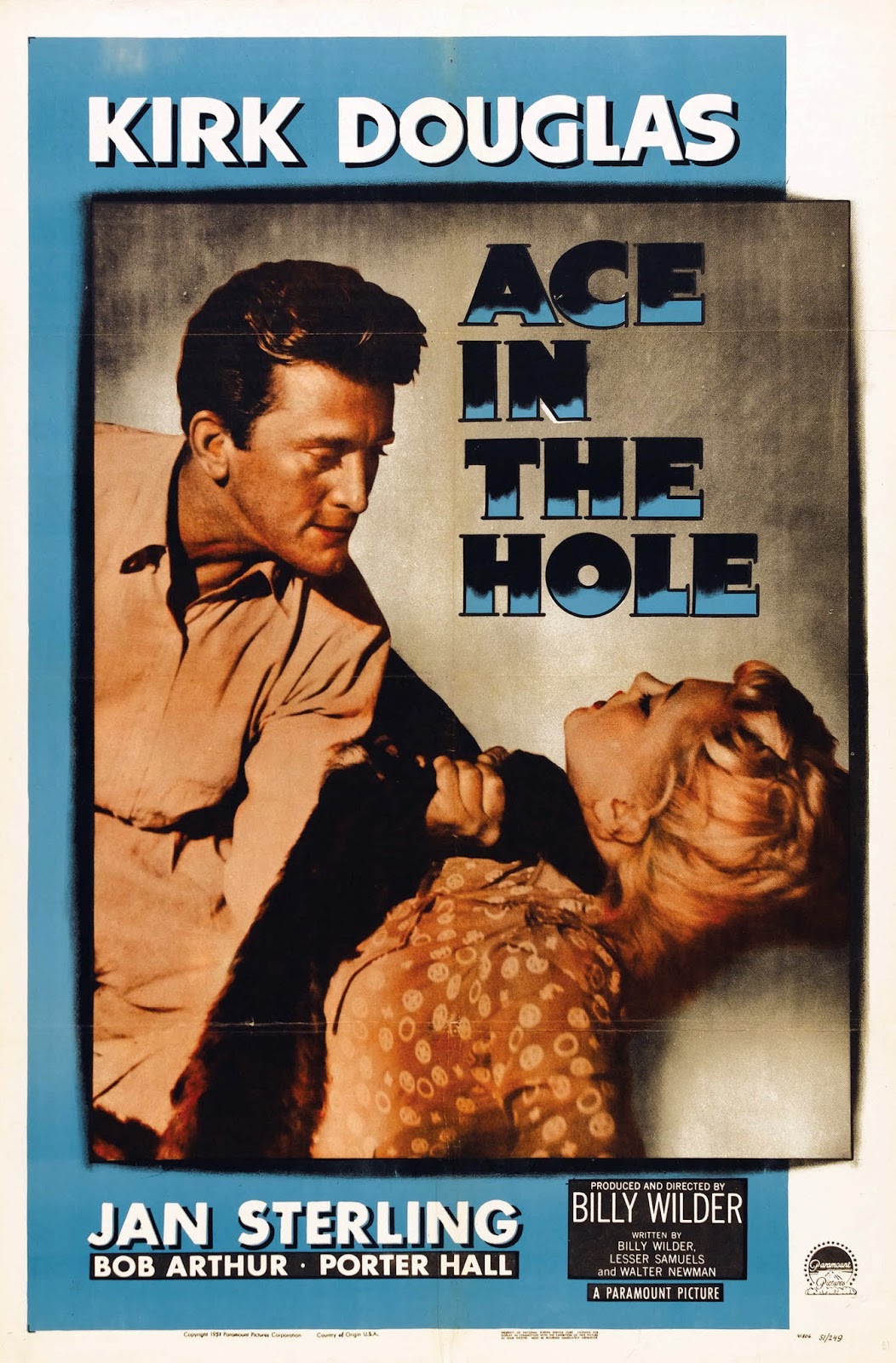
Ace in the Hole was Wilder’s first big flop as a director. It’s not surprising that the media savaged it and claimed it was ridiculous. This is a film way, way, way ahead of its time, a stinging indictment of the ruthless obsession of the media with selling stories rather than reporting them, of spinning out crises to sell newspapers. It’s Fake News decades ahead of its time, a gutter journalism film released at a time when the media was totally trusted. Is it any wonder contemporary critics claimed they couldn’t recognise their trade here? Now it’s practically the way every journalist on film is portrayed.

Charles Tatum (Kirk Douglas) is a big-city reporter fired by a host of newspapers for offences ranging from alcoholism to libel to sleeping with the boss’s wife. Arriving in Albuquerque, New Mexico, he wangles a job on the local paper aimed to eventually encounter a story he can spin into a national media sensation, a crisis with a “human interest story”. A year later, he stumbles upon a cave-in that has trapped a man, Leo Minosa (Richard Benedict), below the surface. Believing this is the story that he can get him back his seat at the high table, Tatum seizes control of the rescue operation, insisting a quick and easy plan is dropped in favour of a week long public drilling operation. Tatum’s reporting of the event becomes a media sensation and in days the abandoned town is full of reporters and rubberneckers.

What’s astonishing here is that this is one of the few films I can think of that is totally devoid of sentiment or hope. It’s ruthlessly cynical where virtually every character is irredeemable, and no suggestion of redemption exists. The only major character who seems normal is Leo himself, although that is largely because his bland non-descriptness (well portrayed by Richard Benedict) and childlike, homespun dependency on those around him make him a near blank anyone can project feelings onto. Wilder’s hard-bitten cycnicsm, bordering on anger with the media and their audience, pulls no punches without descending into polemic – ironically it keeps the human interest, while never compromising the dark satire.

It’s a savage attack not just on journalism and the mass media, but human nature itself. The media stirs up a storm of excitement and drama around one man’s fate solely to make money – and Tatum himself is the worst form of manipulative gutter press, with no interest in truth, investigation or even journalism, only a shark-like love of the main event. But Wilder shows that the people just lap up this exploitative press storm – the growing crush of on-lookers, the bated breath as each update comes in, the literal carnival set up on the site, specially chartered trains – everyone wants to feel part of this story, to vicariously feel the emotions of those the event is actually happening to. It’s virtually a prediction of Twitter.

At the heart of this is Tatum, played with maximum forcefulness and dark charisma by Kirk Douglas in surely one of his finest performances. What Douglas does here that is so skilful is to never make Tatum an out-and-out villain. He plays it with a subtle suggestion of self-loathing: the quietly suggested need for alcohol, the revulsion he feels for those around him whom he sees as reflections of his own moral emptiness. At the same time, if Tatum has morals he long since stopped listening to them. Every time it looks like Tatum has realised what he has done, he reverts back to keeping the story going. Douglas’s dynamism also brings Tatum’s relentless drive and determination to life with real power. Tatum is easily able to cow, bully and bribe those around him into making him the funnel of the story. Never once do you question why all around Tatum bow to his will – his force of personality is so great you have no choice. Despite the hints of self-loathing, Douglas isn’t afraid to play Tatum as a reprehensible man – not bad or evil, just totally self-serving and selfish.

Jan Sterling I was less sure of at first, but actually this is another incredibly brave performance of uncompromising hardness. Lorraine is trapped in a marriage with a man she does not love, in the middle of nowhere, having believed she was marrying into something very different. But even with those provisos, her lack of interest in her husband’s safety and her focus on getting as much cash out of the tourists as possible (to finance her departure to the city) is astonishingly ruthless. Out of all the characters, she is the one who is immediately aware of what game Tatum is playing, and (with his advice) she is the most capable of exploiting the public excitement for her own gain. While she has elements of a femme fatale, Sterling’s performance seems more bitterly cynical than manipulatively feminine.

Wilder’s cynical and hard-nosed film is a brilliantly written deconstruction of the American dream, packed with wonderful lines and sharply drawn characters. It scrapes away at the surface of its characters to reveal the rot underneath – even Tatum’s photographer Herbie degrades from idealist to acolyte – and then blames us all for the mess. It shows us the disgusting ease with which our feelings can be manipulated to sell anything, then shows how gleefully we want to be feel part of an event: shots are filled with details like spectators carrying candy-floss while praying for Leo’s safety.

And then there is a complete lack of redemption – or even suggestion of it. Decent characters are peripheral, and far outnumbered by Tatum and his like. The resolution of the crisis does not go according to Tatum’s plan. It’s almost astonishing in its bleakness and in Tatum’s confused reaction to it and his lack of clear-cut guilt. Again, it’s Douglas’ skill and Wilder’s uncompromising direction: I actually had to watch it twice to catch the shading Douglas and Wilder give Tatum’s reactions to events finally going out of his control – and I still don’t know to what extent self-loathing trumps frustration and disappointment.

This is a masterful media satire and a wonderful, thought-provoking film, surely one of Wilder’s finest. It should be a lot better known than it actually is. I haven’t stopped thinking about it in days and I’m already looking forward to seeing it again. And, if anything, it is getting more relevant every single day.

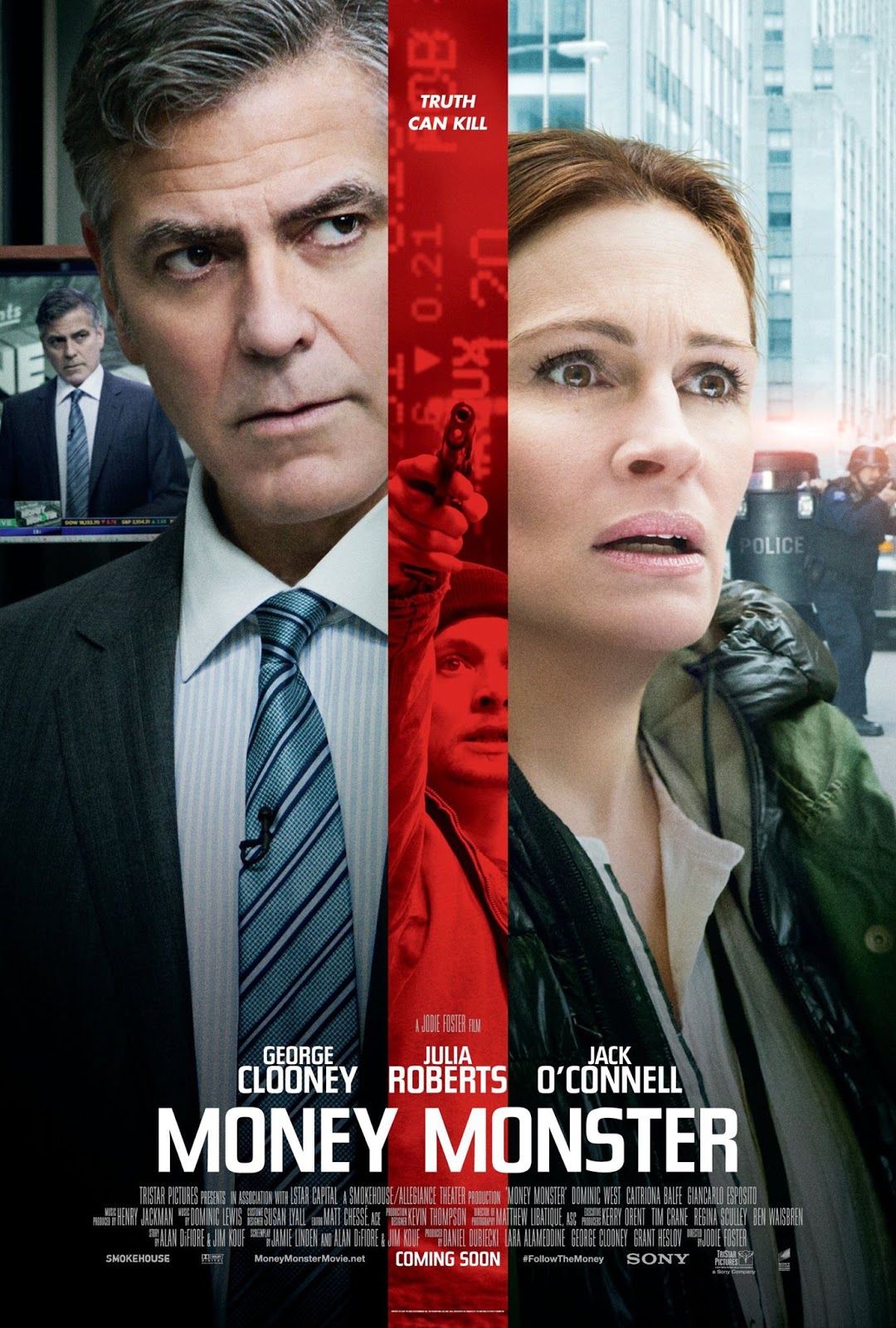
Money Monster (2016)


A bad day at the office was ahead for George Clooney

Director: Jodie Foster

Cast: George Clooney (Lee Gates), Julia Roberts (Patty Fenn), Jack O’Connell (Kyle Budwell), Dominic West (Walt Camby), Caitriona Balfe (Diane Lester), Giancarlo Esposito (Captain Marcus Powell)

For as long as there has been TV, then the world of Film has looked down its nose at the mass market medium. “It’s in your homes! It makes you dumber! It stops you caring!” Set a film in a TV studio and it’s a fair bet that, before long, some shallow media types will appear, a dramatic on-air event will take place, a shallow man will rediscover his soul and the camera will cut back to punters at home watching the drama as if they it was just part of the show.

All this is exhibited to its full in Money Monster, a passably entertaining hostage drama set in the studio of a fictional Wall Street themed entertainment and “news” show. Lee Gates (George Clooney) is a shallow, image and money-obsessed TV personality taken hostage after a desperate grief-stricken viewer Kyle Budwell (Jack O’Connell) loses his life savings on one of Gates’ tips. However, with the prodding of his director Patty (Julia Roberts), Gates slowly begins to rediscover his journalistic integrity.

Watching the film when it rather heavy-handedly enters into the world of media satire, it’s pretty hard not to remember better films in the same genre. Network covered much of this ground so well 40 years ago, it’s almost not been necessary to watch another film about the manipulation of the media. The Truman Show so successfully skewered the thoughtless collaboration of the watcher at home, that this film’s attempt feels like a rather mundane repeat.

Saying that, George Clooney does a grand job of portraying the shallow, media man re-discovering his depths – although lord knows he’s played this sort of part often enough to do it standing on his head. But he gets the dark comedy of it, and he is also able to deliver on the growing decency and integrity of the character. Julia Roberts is pretty good as a confident professional who has allowed her principles to slide for too long. In this illustrious company, Jack O’Connell more than holds his own, delivering brilliantly as a desperate and angry man.

The hostage taking sequences are quite well done, and threaded in well with the general satirical air of the film. At two key moments during the crisis, the film successfully pulls the rug out from under the feet of the viewer by delivering a different outcome than we might have expected. It’s probably when the film is most effective. It also does a good job threading many of the themes, locations and characters that will become important by the end of the film into its opening moments – many of them done so gently, you won’t even notice until they become important later.

The dark satire around the uncaring nature of big business and its lack of principles also hits more than a few familiar beats (big business being another thing multi-million film companies love to lay into), but this side of the plot is interesting enough – and I didn’t quite work out how the dodgy dealing had worked out. The final reveal and confrontation around this is well staged. It doesn’t tell you anything new, or present its old points in a unique or intriguing new way, but it does it in an entertaining way.

The film generally deserves some congratulation for its staging – Foster directs with a tightness and the flimsy conception of the film is delivered in a taut 85 minutes (almost in real time) which certainly means it doesn’t outstay its welcome. The acting is decent and the points it makes are well delivered, no matter how familiar they are. The film effectively plays with and changes your views on its characters over the course of its runtime. Honestly there are worse ways you can spend an hour and a half. It’s just not something that is going to stick with you for long.

The Lost Weekend (1945)

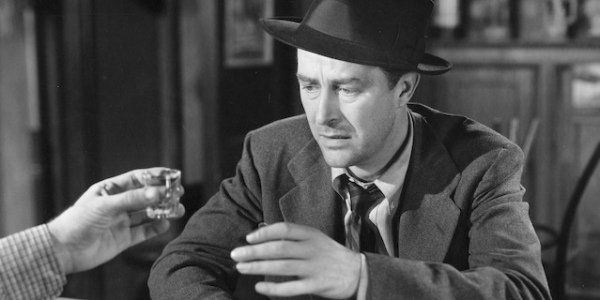
One more for the road: Ray Milland spend the rest of his life reassuring people he wasn’t an alcoholic. Talk about the film that keeps on giving.

Director: Billy Wilder
Cast: Ray Milland (Don Birnam), Jane Wyman (Helen St. James), Philip Terry (Wick Birnam), Howard da Silva (Nat), Doris Dowling (Gloria), Frank Faylen (‘Bim’ Nolan)

It opens like a counter view of the American Dream: a long pan down through the New York skyline. A voiceover leads us through the window (via a shot of a bottle hanging out of the window) onto a pair of brothers packing for a weekend away. Only of course the bottle is really the third character here, and it’s all that one of the brothers has on his mind.

The Lost Weekend is simply that: a long weekend in which we see alcoholic would-be author Don Birnam (Ray Milland) lie, cheat and steal with a shabby English charm through the bright lights of the city, occasionally resolving to quit the demon booze, but constantly drawn back by its siren charm. Other characters drop in and out of his story: an almost fanatically supportive girlfriend Helen (Jane Wyman), his weary brother Wick (Philip Terry), an ambiguousbartender (Howard da Silva – very good), a naïve hooker (Doris Dowling – innocent in the way only Hollywood golden age hookers can be) and finally a truth-telling male nurse Bim (Frank Faylen).

Probably what’s most remarkable about this film is that it was made at all, especially considering that this was when Hollywood’s “morality” dictates ruled. Film historians have suggested that Wilder’s introduction of an obvious hooker, and the suggestions of the Nurse’s homosexuality, so focused the Hays Code’s attention that they let slide that the central character is a lying, shifty drunk who feels only slight shame and very little regret for his actions, and whose announcement at the end that he has changed is potentially just the beginning of another cycle of sobriety in the addicted alcoholic.

Wilder’s genius here in filming is, instead of judging him or pitying, the camera sticks firmly with Don and makes us a co-conspirator in his low cunning and desperation to obtain alcohol. Don is a man who, during the course of the film, pawns several valuable possessions (some not his own), trashes his own apartment in search of booze, fleeces money from people with sympathetic-sounding grandiose stories, and is reduced to attempting public theft. But instead of placing us in the perspective of the (overly) saintly girlfriend frustrating us by striving to reform Don, we stick with Don and are invited to see those standing between him and the booze as the antagonists that Don perceives them to be.

Wilder also skilfully suggests that the same earnest help that Helen (and to a lesser extent Wick) are piling on Don is actually contributing to pushing him further into desperate addiction by smothering him. Don doesn’t seem to be ready to listen to anyone until, sunk to near rock bottom and hospitalised in the drunks’ ward, nurse Bim tells him out right that he is a self-destructive loser who is controlled by his addiction (I’ll also point out this doesn’t stop Don trying to bribe him to facilitate his escape from the ward). I’m also going to mention here a popular theory from film critics that Bim is a figment of Don’s imagination (his name is a near anagram of Don’s, he talks only to Don in the film, seems to know everything about Don’s inner thoughts, and his coded homosexuality links to Don’s own suggested homosexuality in the original book – the underlying cause of his addiction).

The film also has a wonderful noirish quality, capturing of the seedy world of the drunk: the bars and pawnshops that are Don’s world, and the impressionistic lighting used to dramatise Don’s drunken states. In one shot I particularly enjoyed, Don searches desperately for a bottle he hid while drunk the night before – he can’t remember where he hid it because he was pissed, but we know it’s hidden in the lightshade. The camera frames Don and his search with the lampshade constantly in shot above him. A later agonising sequence captures a hideously hungover Don staggering down Third Avenue to reach the pawnbrokers – only to find on arrival (in another moment of black comedy that permeates the film) that it, and all other pawnbrokers, are closed for the day.

The film wouldn’t work though without the excellent performance of Ray Milland in a role that he never matched again. Milland, an ex-pat Welshman with a theatre background, has just the right edge of shabby nobility to make you believe that everyone would continue to find this man endearing and constantly want to give him that second, third, fourth chance. Milland and Wilder are also not afraid to show us that Don’s only real creativity with language comes from drink – his inspired, poetic speeches grow with fervour the more beer he consumes, while his attempts to write without a drink get little further than the front page. Don is sympathetic to us, because I feel we all recognise our failures in him and our self loathing. Hating Don would almost be like hating ourselves – after all who hasn’t looked at their life and thought (to quote another classic) “I coulda been a contender”?

Brilliantly directed and with a fantastic central performance, this is perhaps one of the most empathetic films made about addiction. It’s not perfect – Wilder I think does his best to suggest that the rather sudden happy ending could be the start of another cycle of recovery and collapse, but I’m not sure if there is quite enough in the film to suggest this. Similarly Jane Wyman’s loving girlfriend is so cloyingly devoted you can well imagine she would drive a man to desperation – it’s a very dated character, and hard for a modern viewer not to see her as a facilitating doormat. But all that aside, this is a film packed with beautiful moments, great images and a knock-out performance by Milland. Recommended!

Trainspotting (1996)

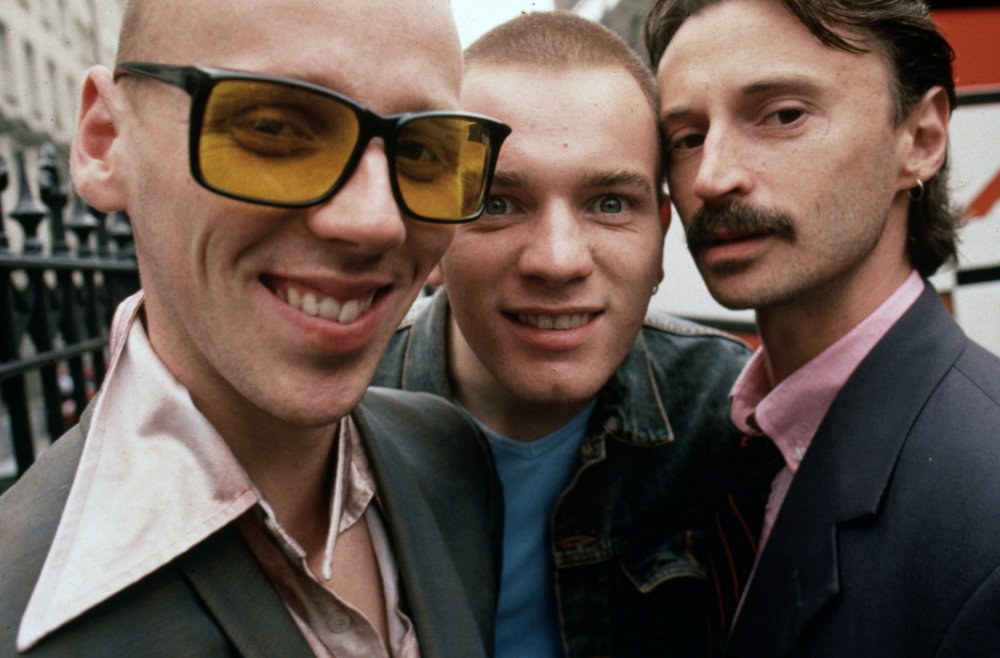
Another happy day in Edinburgh… Ewen Bremner, Ewan McGregor and Robert Carlyle define their careers in the mid-1990s phenomenen

Director: Danny Boyle

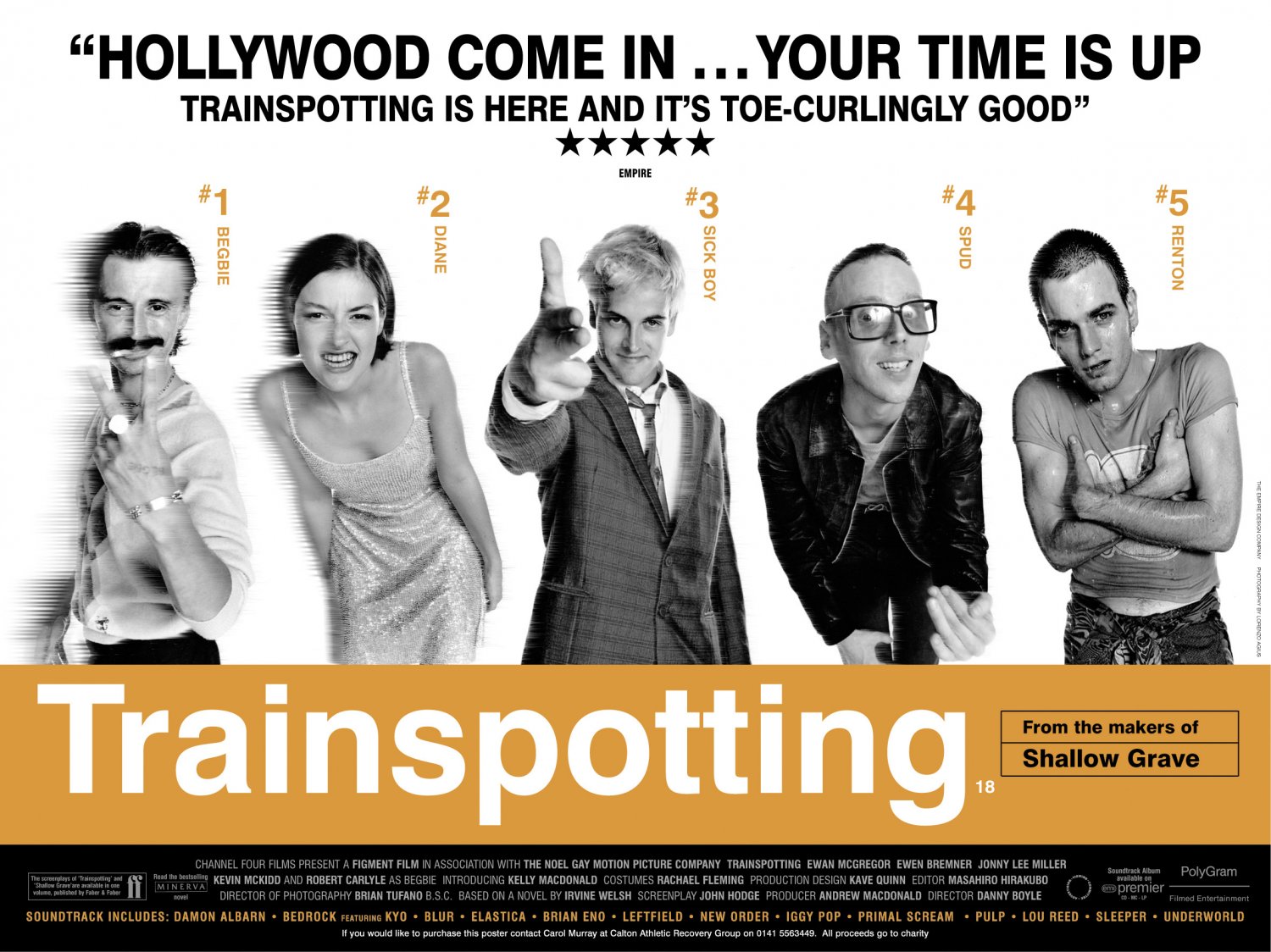
Cast: Ewan McGregor (Renton), Ewen Bremner (Spud), Jonny Lee Miller (Sick Boy), Robert Carlyle (Begbie), Kevin McKidd (Tommy), Kelly Macdonald (Diane), Peter Mullan (Mother Superior), Eileen Nicholas (Mrs. Renton), James Cosmo (Mr. Renton), Shirley Henderson (Gail Houston), Stuart McQuarrie (Gav), Irvine Welsh (Mikey)

Surprise, surprise the Drug’s Don’t Work. They just make you worse. Honestly, watching Trainspotting you would have to be a Grade A moron or wilfully missing the point to ever imagine that this film could, in any way what-so-ever, be endorsing the life of heroin addiction. The unbalanced, unreliable, sickly-looking, soul crushingly blank-eyed losers in this film are no-ones idea of an aspiration. The fate of Tommy alone, starting the film as a health freak and ending it as a smacked out, paper thin, wasting AIDS victim could only encourage the truly unbalanced to take up drugs.

You must know the story: Ewan McGregor is our “hero” Renton, a junkie with delusions every so often (the film implies this has occurred multiple times) of going clean, kicking the habit only to find that he is always drawn back in – largely it seems due to his own weak personality. Fellow junkies include Spud (Ewan Bremner), Sick Boy (Jonny Lee Miller) and later (tragically) Tommy (Kevin McKidd). On the edge of their junkie circle (not a user) is psychotic Begbie (Robert Carlyle) who doesn’t need drugs when he can get a high from starting a bar fight. The basic plot is slim in this whipper sharp film where experience is all – Renton goes clean, gets sucked back in, misses prison, goes cold turkey, escapes to London, gets sucked back into a drug deal. That’s basically it. What’s important here is the experience.

This is possibly one of the best films about addiction ever seen (I watched it in a double bill with The Lost Weekend which actually works out as a pretty natural combo). Boyle and screenwriter Andrew Hodge aren’t scared to show that drugs at times can be fun (after all if they didn’t make you feel good part of the time why would you do them?) and they can give colour to life (particularly to the shallow non entities this film centres on). The is even a strange family warmth to Renton and friends getting smacked out in an otherwise disgusting dilapidated drug pit, listening to Sick Boy dissect the Sean Connery Bond films. This is then brilliantly counterbalanced by the appalling lows – from the truly unsettling dead baby, abandoned and unfed in said drug den, to Renton’s appalling cold turkey. 

Perhaps the most remarkable thing here is that Danny Boyle directs with such verve and with a gleeful delight for every single shooting and editing trick in the book, but the film never feels like a triumph of style over substance, or as if the tricks are the centre of the director’s attention. Instead throughout the whole film you can tell the heart of the film makers – and therefore the heart of the viewer – is also focused on the story and the characters. So we get a film that crackles with energy, with a sense of youthful vitality (that is vital to understanding its characters), has an attractive anti-society message – but also reminds us that the perils of following this kind of counter culture life can be truly horrifying.

At the centre of this film is Ewan McGregor, who I don’t think has ever found a role that he could seize and bring to life as successfully as he did with this one. McGregor is captivating, managing to skilfully demonstrate without any judgement a man who believes he is strong, but is in fact desperately weak. His performance is so charismatic that you hardly notice that Renton is, actually, a pretty nasty person. High or not he has a barely concealed contempt for nearly everyone around him, his reaction to the baby death is shockingly cold, his treatment of Tommy laced with indifference, his pronouncements to the audience overflow with self-regard and delusion. But you just don’t notice.

What you do notice is that Robert Carlyle’s Begbie is a total nutter. Just like McGregor, I think Carlyle struggled to find a role that matched this one, probably not helped by the string of psychos he was offered by casting directors. Carlyle again actually isn’t in the film that much, but he nails how terrifying total self belief can be when matched with a complete lack of any moral sense. In fact most of the cast have hardly ever been better. Excellent support also comes from Peter Mullan, Eileen Nicholas, James Cosmo, Shirley Henderson and Stuart McQuarrie while Irvine Welsh pops up as low rent dealer.

Electric film making with a heart, I don’t think even Danny Boyle has topped this. There is something strangely perfect about this film – anything more and it might out stay it’s welcome, but every scene has something magic in it, some little touch that stays in the mind – either performance, dialogue, direction or all three. It looks fantastic and seemed to define its era. So fingers crossed for the sequel. No pressure…