Category: Social issue films

The White Ribbon (2009)

The kids are not all right in Michael Haneke’s The White Ribbon

Director: Michael Haneke

Cast: Christian Friedel (Teacher), Ernst Jacobi (Narrator), Burghart Klaußner (Pastor), Steffi Kühnert (Pastor’s wife), Rainer Bock (Doctor), Susanne Lothar (Midwife), Roane Duran (Anna), Leonie Benesch (Eva), Ulrich Tukur (Baron), Ursina Lardi (Baroness), Maria-Victoria Dragus (Klara), Leonard Proxauf (Martin), Josef Bierbichler (Baron’s steward)

I think it’s fair to say Michael Haneke has a mixed view of humanity. His films look at the dark side of human nature, and the hypocrisies and cruelty underpinning much of our society. The White Ribbon explores these ideas further, a parable focusing on a small German village in the months before World War One, looking at how the life in one village perhaps helped lay the moral and societal groundwork for the younger generation to grow up and embrace Nazism.

In the fictional village of Eichwald, tradition is strong. The town, and its morals, are governed by traditional authority figures. However, each of these figures fails to live up to the values they – often brutally – enforce on the village and, most especially, its children. The Baron (Ulrich Tukur) is a distant autocrat, who talks of a duty of care but treats the villagers like property. The pastor (Burghart Klaußner) preaches morality and abstinence, but bullies his (many) children and condemns utterly even the slightest deviation from his own rules. The doctor (Rainer Bock) is a studious clinician, who humiliates and devalues his lover, the town’s midwife (Susanne Lothar), and sexually abuses his teenage daughter Anna (Roane Duran). In late 1913, a series of unexplained and increasingly violent events occur, from an attempt to cripple the doctor to arson, kidnap, theft and the beating of the midwife’s handicapped son. The perpetrators remain a mystery – one which the decent but ineffectual teacher (Christian Friedel) attempts to uncover – his older self (Ernst Jacobi) providing an, at times, naïve narration.

Haneke’s aim is to explore the conditions that led a generation to embrace a regime that promotes the unthinkable. While it’s clear that a future of Hitler and fascism – neither mentioned once in the film – hover over everything, this parable could serve for any totalitarian regime. Haneke is not interested in specifics. What fascinates the director is the creation of a mind-set that enables people to willingly align themselves with horrific actions. The brilliance of The White Ribbon is that could be as easily applied to Stalinism and the Khmer Rouge as it can to Nazism.

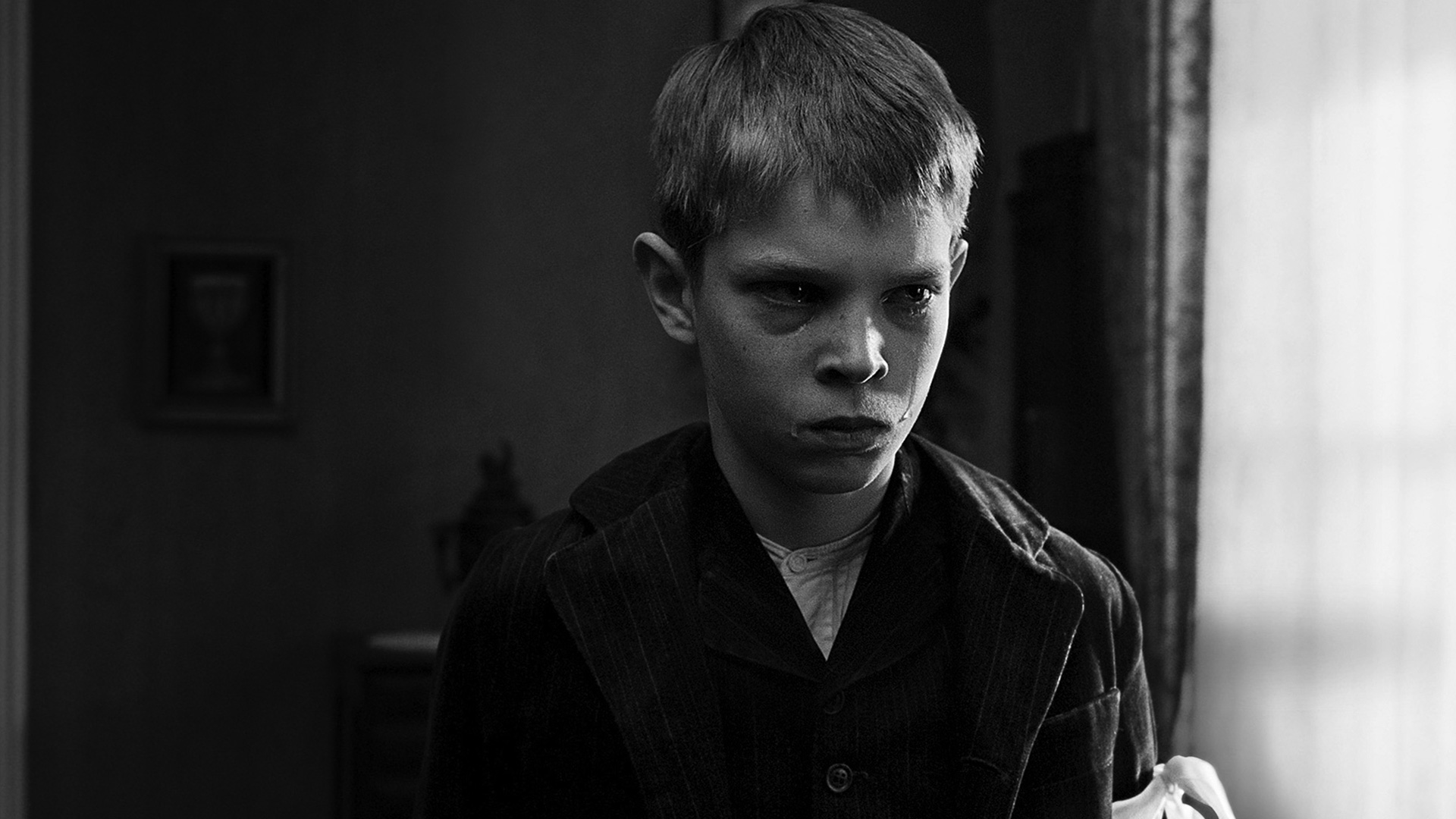
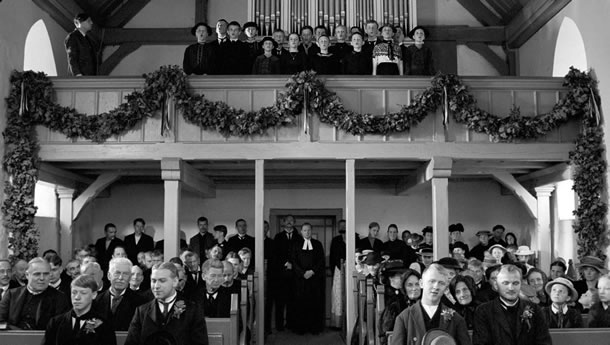
Shot in a beautiful black-and-white, the film presents a series of striking images, imbued with an immense psychological depth and haunting sense of dread. Haneke’s mastery of visual imagery is sublime, and he paces the film perfectly. While it is easy to claim the film is slow – and it does take its time – the deliberation of the pacing, and the precision of each shot, is all part of giving the film its thematic weight. It’s like a medieval passion play, with every moment giving depth to the whole.

The film’s focus is on the children – tellingly, only characters below the age of about 20 are named. It’s their faces the camera returns to time and again – and the film is set in a key moment of many of their lives, where disillusionment with adults begin. The age when they begin to realise their parents are far from perfect and even hypocritical. The film more than suggests that it is the children – working in some combination or alone – responsible for the crimes that take place in the village. Their motivations range from anger and resentment to despair and a longing for escape.

Many of these events centre around the pastor’s family. Played with a perfect emotional austerity by Burghart Klaußner, the pastor judges all around him as unworthy, with his children suffering the brunt of his discipline. It’s easy to see he is overly harsh, hypocritical (the sheer number of his children suggests he hasn’t worked hard to suppress his own sexual feelings) and unjust. His son is tied to his bed while he sleeps to prevent “impure touching” and his daughter is blamed, and publicly humiliated by him, for a school disturbance she is trying to stop. He’s a father who demands respect but cannot inspire love.

Almost worst of all, he requires his children to wear a white ribbon, to constantly remind them of moral standards they have failed to live up to. These acts of stigmatisation and bullying are not balanced with any outward affection – whatever he may actually feel, the pastor is far too restrained to show any warmth – and Haneke demonstrates his children are taking all the wrong lessons from him. The learn to be cold, distant and judgemental, and that strength is vital and weaknesses are not to be tolerated: they beat out individual thinking, and replace it with cold conformity. A basically good man – and the pastor clearly believes he is doing his best to protect his children – rears children who see others as inferior and different, and stigmatisation as an essential part of life.

The whole village lives in medieval thrall to the baron. You could be believe this village was hundreds of years in the past, not a single century. The villagers slave on the baron’s fields, meekly tugging their forelocks to him in church. The baron takes unilateral decisions affecting everyone’s lives. His own family life is cold – his wife doesn’t love him (and her sexual, not romantic, faithfulness is the only thing that matters to him), while his weak young son is the victim of at least two crimes. It’s a pattern of distant, selfish authorities who believe they work for the good of the community, while taking everything they can from it.

But then corruption is also endemic at the home. Rainer Bock gives a chilling performance as the local doctor, respected by the community for his dedication, who treats those closest to him with disdain at best, and abusive cruelty at worst. A controlling, cruel man, the doctor is the clearest example in the film of the hypocrisy of the older generation, demanding respect, decency and obedience from the younger, while treating them with selfish vileness.

Haneke’s film is a grim – and disturbing – study of this sort of everyday horror and it effect on the psyche. The dehumanisation of the young is clear, and the growing casual cruelty they begin to dish out to others becomes more and more striking. The film taps into a Wyndhamish fear of the young, the children moving in packs, their respectful words not matching their air of menace. This unsettling feeling only grows because, for many of the crimes, we are never given a firm answer to who carries them out (although we can guess). Saying that, at least three acts of violence and sabotage are explicitly shown, all of them carried out by the young – enough for the viewer to suspect the others can be tied to the same generation.

The film does pepper itself with touches of hope – enough to suggest not everyone is destined to succumb to malevolent forces. The schoolteacher – sweetly played by Christian Friedel – is well-meaning, if ineffectual, and his courtship of the baron’s dismissed nanny Eva (an endearing Leonie Benesch) has a charming bashfulness. (Although the fact the couple are brow-beaten into postponing their marriage by her domineering father reminds us of the dominance of the older generation). After the pastor’s pet bird is killed (by his daughter, who crucifies the creature on his desk), he is moved to tears when his youngest son offers him his own pet bird to make him feel better (although inevitably the offer only promotes a curt “thank you” from the Pastor while his son is in the room). The women of the older generation all show signs for reluctance or discontent with the behaviour of the patriarchs, although any protest is of course in vain.

It’s touches like this that prevent Haneke’s film from being a lecture. The village isn’t inherently bad, just terribly misguided. This all enforces the universality of the film. You’re kidding yourself if you think this could only happen in Germany. These generational clashes and the twisting of an entire generation could happen anywhere. The world is what we make it, and the white ribbons that help us remember our innocence can just as easily be used to categorise us as the worthy and the unworthy. Haneke’s film is a brilliant, profound and challenging piece of work that rewards thought, analysis and rewatching. Quite possibly his masterpiece. 

Queen and Slim (2019)

Jodie Turner-Smith and Daniel Kaluuya are on the run from injustice in Queen and Slim

Director: Melina Matsoukas

Cast: Daniel Kaluuya (Slim), Jodie Turner-Smith (Queen), Bokeem Woodbine (Uncle Earl), Chloe Sevigny (Mrs Shepherd), Flea (Johnny Shepherd), Sturgill Simpson (Officer Reed), Benito Martinez (Sheriff Edgar)

You could say Queen and Slim was the film of 2020 that was unlucky enough to be released in 2019. There can be few other films that have captured so effectively the injustice that the killing of George Floyd revealed to the wider world. But watching Queen and Slim reminds many of us in more privileged positions that the sort of systemic outrages that 2020 has brought to light existed for decades prior to this.

Our unnamed leads are “Queen” (Jodie Turner-Smith), a criminal defence lawyer, on an awkward Tinder date with “Slim” (Daniel Kaluuya). The date is not a huge success – possibly because the determined and ambitious Queen has little in common with the gentle, Godly and quiet Slim – but their lives are changed forever when Slim gives her a lift home. Pulled over by an increasingly aggressive police officer, innocent questions from Slim, and Queen’s challenge of his authority, lead to his gun being drawn, Queen shot in the leg and a scuffle with Slim that leaves the officer shot dead. Now wanted for killing a police officer – and convinced that their side of the story will never get an equal hearing – they go on the run. But their cause seizes the public imagination, and “the Black Bonnie and Clyde” end up inspiring others to take a stand across an unjust system.

Queen and Slim uses common conventions of a road movie: two young people on the run for a crime who discover new things about themselves and the world as they travel, drawing closer together. In that sense there is nothing too revelatory about it. Indeed half of the film’s impact – rather like Thelma and Louise – is taking expected tropes and presenting them to us from new perspectives. But what Matsoukas’ film does so effectively is to add a completely new political and social dimension to this. This road movie instead becomes a searing commentary on race in America and the injustice of the system.

Endemic unfairness runs through the entire movie. From the pulling over of the young couple at the start of the film – a search that becomes increasingly invasive and aggressive for no other reason than the officer’s reaction to their colour – to their final confrontation with a lethally trigger-happy police force, there is no fair crack of the whip for this couple. Queen’s restatement of her and Slim’s rights when pulled over is seen as a violent action. The media swiftly turn the couple into ruthless, dangerous killers. A parade of law enforcement (certainly all of the white officers) sink quickly to using crude, racially tinged stereotypes. And there is of course no question that an unjust, one-sided trial ending in (at best) a life-long prison sentence awaits this couple if caught.

But the film also shows brilliantly another side of America. On the road trip, Matsoukas’ camera captures the distant, sometimes run-down, ghettoised communities of non-White groups in America (to the extent that a traditional picket-fenced house visited late on by the couple seems like a foreign land). The camera pans through parts of America we rarely see – and also sees the communities there. These are people who know, in their hearts, that Queen and Slim are the victims here – that the police are more than capable of shooting black people who look like they might cause trouble, whether they have or not. But they also know that there is no chance of justice for them, that they are destined to become martyrs. And that like them, every Black person in America could be a breath away from falling victim to police brutality.

This gives the film a real edge, that gains extra force the more events from the news remind us that issues like this are far from fiction. It gives a political force to the film that serves as a superb snapshot of America today. Matsoukas’ film is shot with vibrant freshness and she draws a great couple of performances from the leads.

Both are contrasting souls, who find themselves drawn closer together as they slowly absorb each other’s qualities. Jodie Turner-Smith is superb as the lawyer with a chip-on-her-shoulder, whose unhappy family life has led to her putting up emotional safeguards that only slowly erode over the course of the film. In many ways the road journey gives her a freedom she has never had before – while Slim’s gentleness encourages her to express sides of herself she has kept long-hidden. Daniel Kaluuya is similarly wonderful as the devout and gentle Slim, who discovers in himself an anger and resentment at the injustice he had accepted as part of everyday life.

Queen and Slim marshals this altogether into a compelling package that will open many people’s eyes to the truth of racial politics in many parts of America – and the tensions underneath it. 

Thelma and Louise (1991)

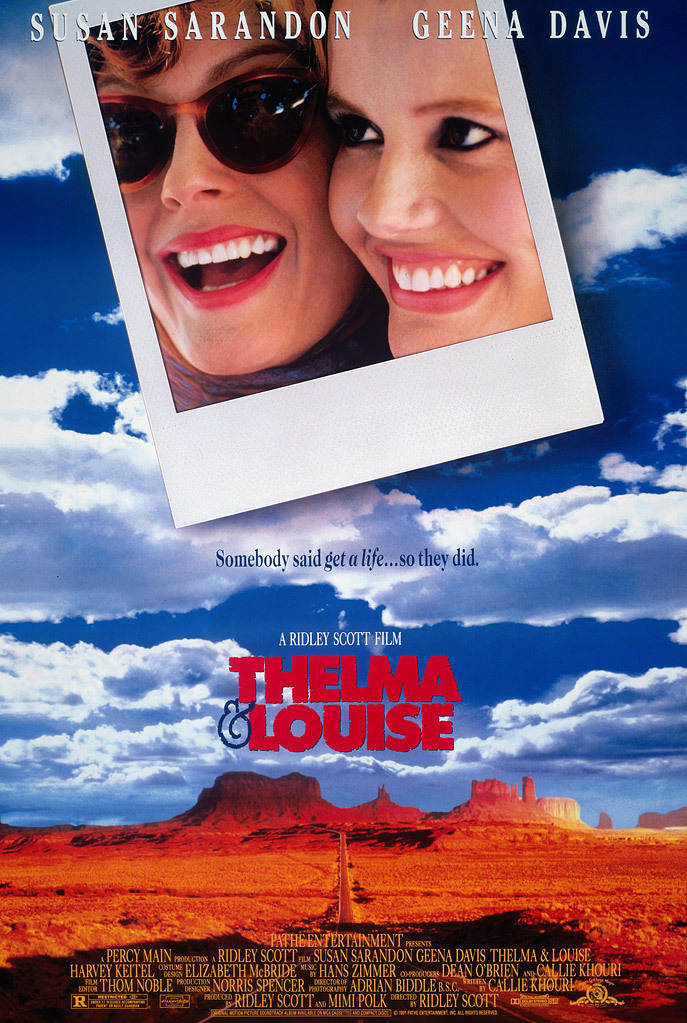
Susan Sarandon and Geena Davis hit the road in Thelma and Louise

Director: Ridley Scott

Cast: Susan Sarandon (Louise Sawyer), Geena Davis (Thelma Dickinson), Harvey Keitel (Detective Hal Slocumb), Michael Madsen (Jimmy Lennox), Christopher McDonald (Darryl Dickinson), Stephen Tobolowsky (Max), Brad Pitt (JD), Timothy Carhart (Harlan Puckett)

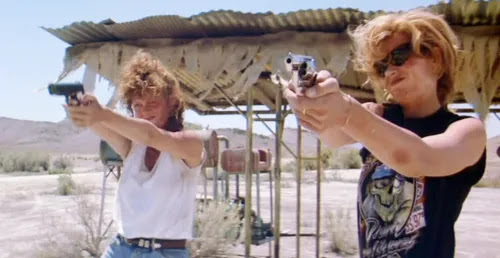
Two people on the run, dodging the police and doing what they can to survive. It’s a well Hollywood has gone back to time and time again. But in most cases the people were either two men, or maybe a man and a woman (romantically involved naturally). It was unheard of to make that most masculine of genres, the outlaw road movie, into one led by women. But that’s what we get here, in a movie that has become iconic in more ways than one, Thelma and Louise.

Louise Sawyer (Susan Sarandon) is a tough, independent-minded waitress. Thelma Dickinson (Geena Davis) is a shy housewife, whose husband Darryl (Christopher McDonald) is a jerk. With Darryl away for the weekend, Thelma and Louise head off for a weekend away together, to let their hair down and feel a bit of freedom. Unfortunately, disaster happens when Thelma flirts with a sleazy guy in a Texas bar (Harlan Puckett), who tries to rape her in the car park. Louise saves her – but guns the guy down. The two women now find themselves on the run from the law, terrified that no one will believe their side of the story. But as the women find themselves on the road, the experience changes them, with Thelma flourishing in an environment where she can make her own choices and Louise becoming more able to open herself up emotionally. But can they stay ahead of the law?

With a terrific (Oscar-winning) script from first-time writer Callie Khouri, Thelma and Louise offers a dynamic and daring twist on the Hollywood road movie. By placing women at the centre of a story like this, a fascinating new light is shed not only on the law, but also on the culture of the American South. It also gives what would otherwise be familiar situations, a fascinating new light as two underestimated people are forced to prove time-and-time again how ahead of the game they are.

Ridley Scott directs the film with a beautiful, confident flourish. The John Fordian iconography of the West is a gift for a painterly director like Scott, and this film hums with the sort of eye for American iconography that only the outsider can really bring. The film brilliantly captures the dusty wildness of the West as well as the neon-lit grubbiness of working class American bars. It looks beautiful, but also vividly, sometimes terrifyingly real. Scott then, with a great deal of empathy, builds a very humane story around this, with two characters it’s nearly impossible not to root for.

He’s helped immensely by two stunning performances from the women in the lead roles. Susan Sarandon’s is perfect for the brash and gutsy Louise, not least because she’s an actor brilliantly able to suggest a great emotional depth and rawness below the surface. Louise is a women juggling deeper traumas – past experiences (its implied a historic rape) that leave her in no doubt that the justice system will not be interested in hearing about a woman’s suffering. It’s the hard to puncture toughness that softens over the course of the film, as Louise becomes more willing to explore her emotions and allow her vulnerability to show.

Particularly so as the lead between the two is slowly taken over by Geena Davis’ Thelma. This is certainly Davis’ finest work, her Thelma starting as a beaten down housewife, just trying to let her hair down in a bar, into a scared victim, a horny teenager lusting over Brad Pitt’s hunky JD then finally into a road warrior who discovers unimagined determination and resources inside herself, toting guns and robbing stores. It’s the sort of once-in-a-lifetime part Davis seizes upon. She’s sensational and totally believable at every turn.

Placing these two women at the centre of a story like this puts the feminine perspective front-of-centre – and it’s alarming to think how little some things have changed. Can we imagine today that there wouldn’t be policemen and lawyers willing to blame Thelma – or claim she asked for it – for her near rape in a bar? Or that there wouldn’t be a fair crack of the whip in the system for Louise for gunning down an unarmed rapist? On top of that, the majority of the police tracking the two women (with the exception of Harvey Keitel’s decent cop – Keitel is very good in this) find it hard to take “these girls” seriously, finding it hard to imagine them being anything other than a joke.

Mind you the attitudes of men are laid bare at every turn. Thelma’s husband Darryl (a very good performance of selfish patheticness by Christopher McDonald) is a waste of skin, a man who can’t imagine a world where Thelma could be his equal. Timothy Carhart is all charm until Thelma denies him the sex he believes he was due for in exchange for a night if flirting and drunks, and promptly turns extremely nasty. The cops – gun totting with itchy trigger-finger – just seem to be waiting for an excuse to throw the ladies down. Even JD (a star marking early performance by a deeply attractive and charismatic Brad Pitt), who seems so charming – and proves the sort of generous and skilled lover Thelma has never experienced in her life – has no qualms about robbing the ladies of their life savings, leaving them hung out-to-dry.

Many men at the time complained (pathetically) about the presentation of men in this film (as if men haven’t had any films where they were sympathetically placed front and centre), but I think it’s a pretty clear judgement that women are not held to the same standards. Khouri’s script shows time and time again the casual sexism (and sexualisation) the women encounter – to the extent that when they finally confront (and pull guns) on the sexist, aggressive truck driver who has been following them for most of the film, you cheer along with them when they shoot out first his tyres, then his oil tanker. We’ve even had a warm-up with Thelma turning a tough intimidating cop into quivering jelly by taking control of the situation.

But that’s what this film is about – the unexpected taking control. Because this isn’t just a feminist statement because it puts women into a male genre. It does so by showing how few choices these women have in their lives before they take into the road and how liberating it is to be able to make their own choices. Because these characters have had all their choices made by men, from Thelma’s smothering marriage to Louise’s undefined past as a victim. And their futures are as much out of the control, likely to find themselves on death row for shooting a rapist. On top of all that, men continue to see them both as sex objects.

How could you not be moved by this? It’s why the films iconic ending carries such impact. These are women discovering they have the power to make their own choices and their own mistakes. It has an undeniable power to it. It’s a power that runs through the entire film, perfectly shepherded by Scott’s astute and sharp direction, with Davis and Sarandon superb. It will still give you shocking insights today into what life is like for women in a world still dominated by men.

More recently its writer and stars pointed out that the film actually ended up changing very little for women in Hollywood. There was no new wave of daringly different female-led movies, with “women’s drama” still mostly restricted afterwards to family drama and romances. There are still few exciting opportunities for female filmmakers. (And it’s a sign of the times back then that the very idea of a woman directing this feminist film was never even raised as a possibility.) Perhaps that’s why Thelma and Louise remains such an icon, because it’s still such a one-off. Either way, it’s a film that hasn’t aged a day since it was released.

My Man Godfrey (1936)

Carole Lombard and William Powell flirt, fight and buttel in My Man Godfrey

Director: Gregory La Cava

Cast: William Powell (Godfrey), Carole Lombard (Irene Bullock), Alice Brady (Angelica Bullock), Gail Patrick (Cornelia Bullock), Jean Dixon (Molly), Eugene Pallette (Alexander Bullock), Alan Mowbray (Tommy Gray), Mischa Auer (Carlo), Pat Flaherty (Mike)

My Man Godfrey is one of the most beloved of all screwball comedies. It’s also the only film in history to be nominated in every acting category and the directing and writing categories at the Oscars and still not get nominated for Best Picture (proving comedy was devalued even then). Today it still carries a heck of a comedic wallop, splicing this in with an ever more acute and profound social commentary. It’s a gem of Golden Era Hollywood.

With New York in the midst of the Great Depression, affluent socialites the Bullock sisters – snob Cornelia (Gail Patrick) and ditzy, scatter-brained Irene (Carole Lombard) – are in hunt for a “forgotten man” so they can claim victory in their scavenger hunt. In a rubbish dump – turned home for the unemployed – they find the well-spoken Godfrey (William Powell). Godfrey is having none of the condescension of Cornelia, but finds the honesty and kindness of Irene more touching agrees to help her win the prize – whereupon he promptly admonishes the upper-class crowd at the Waldorf for their lack of concern for the working man. Ashamed, Irene offers him the job of Bullock family butler, which Godfrey accepts. But as he navigates the eccentric family, is Godfrey also hiding secrets of his own, secrets that suggest he is much more than he seems?

My Man Godfrey is a very funny film, centre-piecing the fast-paced comedic delivery of the era, the script never going more than a minute without a killer line or brilliant piece of comedic business. It’s helped as well by the casting, with every actor being perfectly selected for their roles, and each of them bringing their absolute A-game. Not least the partnership of Powell and Lombard – divorced in real life but still close – who spark off each other wonderfully and keep the will-they-won’t-they question beautifully balanced throughout the whole film. 

La Cava’s film – wonderfully directed with imagination and visual chutzpah – matches this up with an extremely neat, but not too preachy, line in social commentary. The self-obsessions and petty concerns of the Bullock family are frequently contrasted with the poverty and struggles of the working man, while the families’ lack of concern for the struggles of the vagrants and down-and-outs only a taxi ride away from their mansion home is striking. Godfrey frequently points up this lack of empathy in this ‘classless’ country (which is in fact defined by class), stressing he found more decency and kindness at the rubbish dump than he did in the palaces of the mighty. 

Sure Godfrey’s secret may well be that he is from loaded stock himself – but has given it all up in shame and self-disgust – but that only makes him all the better an observer of the whims of the rich treading on the poor. In fact My Man Godfrey could well be the film for today. The scavenger hunt dinner – a brilliantly directed, frenetic scene that looks years ahead of its time in its technical accomplishment – really captures this. The guests haw and shout over each other, clutching with an ironic glee their examples of poverty (from everyday objects to a goat to, of course. the ‘forgotten’ man, who has as much value as the goat to them). We get more of it at the posh clubs and cocktail parties the Bullock frequent, the guests (while not cruel) being as blasé and oblivious of their fortune as they are of the suffering in the rest of the city.

But that makes this sound like a civics lessons, whereas the film is first-and-foremost a comedy. It has a terrific performance from William Powell as Godfrey. Powell makes the part a mix of Jeeves and Wooster: the intelligence and calm of Jeeves with the warmth and tendency for scrapes of Wooster. Powell is brilliant at balancing the wry observer quality of Godfrey, while never sacrificing his warmer, generous soul. And also brilliantly suggests his wonderful judgement of situations and characters, without ever making him smug or a know-it-all. It’s a quite exquisite performance of unflappility covering emotional depth.

Lombard sparks off him very well as Irene, allowed to frequently head further over the top as Powell grounds Godfrey in normality (Lombard was a famously electric performer, and the outtakes reel for the film frequently show her screwing up her fast-paced dialogue with copious swear-words). Today the more ditzy Irene sometimes comes across as a more tiresome, less believable character – she is so obviously a narrative construction rather than someone who could be real that it becomes harder to connect with her (or to imagine Godfrey might find her attractive). But Lombard’s energy and drive carries the film through and the film highlights her electric qualities in several show-stopping scenes.

The entire Bullock household is in fact spot in, with gorgeous performances. Alice Brady (Oscar-nominated) is the quintessential disapproving society mother, archly self-obsessed. Eugene Pallette is wonderfully funny as the exasperated father of the household, barely able to understand either his family or his investments. Gail Patrick is a delight as Irene’s manipulative sister, proud and selfish. Mischa Auer (Oscar nominated surely off the bag of his extraordinary gorilla impersonation) is very funny as Angelica’s “protégé”, a preening, talent-free musician and freeloader who spends most of his scenes eating. Jean Dixon is smart and sassy as the maid Molly. There isn’t a bum note in this ensemble.

La Cava directs all this with great skill, framing the action with a beautiful sense of composition, pace and style. You know you are in save hands with the opening scene that show the credits appearing like neon bill boards during a slow, continuous tracking shot along the New York riverside. With dialogue that glides beautifully from humour to pathos, and delivery that creates comic archetypes that feel like real people, it’s a film that gets nearly everything right – which is why it’s still a classic today.

Tokyo Story (1953)

Family life is troubled in post-war Japan in Yasujiro Ozu’s masterpiece Tokyo Story

Director: Yasujirō Ozu

Cast: Chishū Ryū (Shūkichi Hirayama), Chieko Higashiyama (Tomi Hirayama), Setsuko Hara (Noriko Hirayama), Haruko Sugimura (Shige Kaneko), So Yamamura (Kōichi Hirayama), Kuniko Miyake (Fumiko Hirayama), Kyōko Kagawa (Kyōko Hirayama), Eijirō Tōno (Sanpei Numata), Nobuo Nakamura (Kurazō Kaneko), Shirō Ōsaka (Keizō Hirayama)

When you think about Japanese cinema, many people’s minds turn to the work of Kurosawa, or high tempo manga animations. But there is another side to Japanese cinema – a more careful, meditative, almost lyrical side – and few directors express that better than Yasujirō Ozu. Tokyo Story is his masterpiece, a film so masterfully put together – but also so restrained and simple in its telling – its reputation has grown until it is considered a contender for the greatest film ever made. 

Ozu’s trick with Tokyo Story is to tell a story that is focused on a very particular time and place, but also brings with it a universal relevance. Elderly married couple Shūkichi (Chishū Ryū) and Tomi (Chieko Higashiyama) travel to Tokyo to visit their grown-up children, doctor Kōichi (So Yamamura) and hairdresser Shige (Haruko Sugimura). But their children now have their own work and life pressures – living in small, crowded homes in Tokyo that double as business places – and they just don’t have the space or time to spend with their parents. The only person who makes their time for them is their daughter-in-law Noriko (Setsuko Hara), the probable-widow of their son who went missing during the war and has not been seen in over eight years. 

Ozu’s film is about a transition in Japanese culture, as the country modernises in the post-war environment and the natural deference and familial links that had previously powered much of its way of life began to fade in importance. Families are now distant, patience and respect between the generations is fading, and many in the elderly generation struggle to understand their children. In the same way, the younger generation forge their own lives and see their priorities change from those of their parents. This is an acute issue at this post-war era of Japan – but who hasn’t experienced some level of this inter-generational confusion?

That’s perhaps why Tokyo Story carries as much impact as it does. A quiet, reflective and gently paced film, it’s striking that it doesn’t place blame or cast characters as heroes or villains. Instead, everyone is, by-and-large, trying their best, struggling with pressures of their own. While it’s easy to see the children as uncaring – it’s also clear that their own lives are hugely busy, with demanding workloads and the homes they live in are small, cramped and difficult for them to live in. Shige and her husband effectively sleep on the floor of their hairdressing parlour. Kōichi struggles to fit himself, his wife, two children and a doctor’s surgery into what looks like a pretty simple two-up-two-down home. While the children are frequently thoughtless – or quick to persuade themselves that what’s easy for them is also easy for the parents – the film makes clear that there are reasons for this.

Nevertheless our sympathies are clearly meant to lie more with the parents rather than their children. Polite, quiet and determined to think the best of their children, the parents are reserved, dutiful relics of a very different Japan. They fall over themselves to thank their children for any time or patience shared with them, and feign enjoyment of the spa (packed full of young party people) their children send them to as a treat (it takes one night of no sleep for them to decide, quietly, to leave). These are people determined not to rock the boat, resolved that everyone is acting for the best. 

However, it is clear the emotional impact of these events is greater than they might expect. Shūkichi, it emerges, has a history of too much drinking – and a few days in Tokyo is enough for him to hook-up with some old drinking buddies and stumble into Shige’s home late at night, drunk as a skunk. But the emotional impact is also clear in their growing closeness and regard for their daughter-in-law Noriko, the only person in Tokyo who seems to make an effort to spend time with them, rather than their own children.

Superbly played by Setsuko Hara, with a gentleness, slight timidity and genuine sense of kindness that makes her the warmest character in the film, Noriko thinks the best of everyone and desires all to be happy. For her adopted parents, however, her good treatment slowly awakens to them to the way Noriko has put her own life on hold since the disappearance of their son. His photo still hangs like a shrine in her home, and she shows no interest in moving her life on. Warm and kind as she is, she is as lonely as the parents. Tomi in particular becomes overwhelmingly concerned for this vulnerable person – perhaps a child that needs her protection in a way her own children no longer do. Staying the night at Noriko’s, their conversation touches – in a very reserved way – on deep emotional trouble. Tomi stresses her desire for Noriko to be happy – and as they go to sleep seems to be overcome with tears and emotion. But she won’t speak openly of her worries for Noriko.

It takes later events, and Tomi’s later illness, for Shūkichi to broach the subject openly, kindly telling Noriko that both of them worry about her future happiness and her waiting for a man who will never come back from the war.  They urge her to restart her life – a suggestion Noriko meets with an emotional out-pouring of tears, but also perhaps a sense of being given permission to re-start her life.

This emotional content plays out with all the more power due to Ozu’s restrained and quiet shooting style. A huge majority of the film is shot in mid-shot, with the camera positioned at the height of someone kneeling on a tatami mat (Ozu called them his “tatami shots”). This has the impact of making events play out gently in front of the viewer, a bit like a play, but giving things a strangely intimate stillness. The sort of cinema language we are used to – cross-cutting and over-the-shoulder shots for conversation – is completely absent. Ozu rarely cuts, keeps the camera more-or-less stationary and only occasionally throws in shots where the characters deliver dialogue effectively straight at the camera. This effect in particular adds to the intimacy, making us part of the scene with the characters expressing their thoughts or concerns directly to us.

In addition, Ozu beautifully allows scenes to both gradually play in and out. The cutting of most scenes allows an establishing shot of a location, followed by a prolonged series of tatami shots that start before the scene proper begins and then frequently continues for a few moments after the scenes finish. Again this makes the film all the more personal, as the characters expand and live beyond the confines of the requirements of the scenes. Watching characters silently continue to pack – or quietly sitting having run out of things to say – in some way carries as much power as dialogue, and really immerses you in the world of the film.This quiet, meditative effect becomes increasingly engrossing, as Ozu’s slow-paced, gentle filming style lets this small-scale story play out very effectively. Although not much really happens in the story, this story of miscommunication between the generations gains a universal strength the more you let yourself get lost in it. The acting is excellent, with Chishū Ryū (playing a character twenty years older than him) and, in particular, Chieko Higashiyama extremely moving and heartbreakingly real as the parents. But what really gives the film its heart – and its sense of hope – is the beauty of Setsuko Hara’s Noriko. It’s this character that provides the hope for a warmer, stronger, more understanding future for all. As Noriko returns to Tokyo at the film’s end – cradling a gift – we hope that a cross-generational understanding is in our grasp. 

Ozu’s final shot features the sounds of traditional children’s singing being drowned out by a train. It’s a sign of how progress has changed our society – but the film carries enough hope for us to promise ourselves that things will get better.

Still Alice (2014)

Julianne Moore excels in Alzheimer’s drama Still Alice

Director: Richard Glatzer, Wash Westmoreland

Cast: Julianne Moore (Alice Howland), Alec Baldwin (John Howland), Kristen Stewart (Lydia Howland), Kate Bosworth (Anne Howland-Jones), Hunter Parrish (Tom Howland), Shane McRae (Charlie Jones), Stephen Kunken (Dr Benjamin)

Can we imagine a more difficult illness to deal with than Alzheimer’s? Alice Howland (Julianne Moore) is a linguistics professor at Columbia, diagnosed with early onset Alzheimer’s and slowly finds her capacity to use language – and her memories – slowly fade away. At one point Alice, as her ability to function begins to disappear, wishes she had cancer instead – not only because the illness is easy for others to understand, but it offers some form of treatment however fatal the disease may prove. Westmoreland and Glatzer’s heart-rending film covers the slow decline of Alice’s abilities – from forgetting words in lectures, to getting lost in her own house searching for the bathroom, to struggling to recognise her children.

Julianne Moore is at the centre of this emotionally devastating – but tender and moving film – dominating every scene as Alice. Moore’s sharp intelligence and focus as an actress is perfect for the professor, but her dedication really comes to the fore for the sensitive and truth-laden way she explores the decline that follows for Alice. It’s a performance – like the film – that works hard to avoid sentimentality, and instead follows the heart-rending sadness of slowly feeling your personality disappear. Because what are we really but the collection of our memories and experiences – and when these are gone from us, what is really left? 

Moore’s work is superb here – she won virtually every prize going, including the Oscar – and the film is told entirely from her point-of-view. Meaning that jumps in time come as a surprise to us, as they would be for Alice. At one point a distressed Alice wakes up at 2am to try and find her phone, before being coaxed back to bed by her husband John (a carefully nuanced and realistic performance from Alec Baldwin). The next scene, the phone is found in the freezer. Alice laughs and says she was looking for that last night – “that was a month ago” John quietly tells their daughter. It’s sudden moments like that, using the language of film, that hammer home the impact of this disease. It turns a whole life into a choppily edited film, where see the highlights but never recall the day-to-day detail.

The film is clear on the burden – and the struggle for us to comprehend what will happen to us. Early in her diagnosis – while recording a series of questions (such as when is your birthday and what is your daughter’s name) – Alice secretly records a video, giving instructions for her suicide when those questions become impossible to answer. It never occurs to her that, when that moment is reached, she will struggle to comprehend the message, let alone recall the 3-4 instructions to find a secret pill stash without multiple referrals to the video. But this is part of the horror of a disease that changes our ability to be who we are. 

Westmoreland and Glatzer (who tragically died from complications from ALS shortly after the film’s completion) bought a personal connection to the material, and the difficulty of a family to watch a loved one slowly succumb to an illness in front of you. Alice’s family are supportive – but they also have their own lives to live. Her husband Jack does his best – but must continue with his career to fund Alice’s medical treatment, plus dealing with the walking death of a woman he has loved all his life. Her elder daughter, Anna, has her own family to raise. The illness does bring Alice closer to her youngest actress daughter Lydia (very sensitively played by Kristen Stewart), but that doesn’t stop Alice failing to recognise her after watching her performing in a play. There is no judgement here, just a recognition of how powerless family members can feel at times to really help those they love – particularly as they watch parts of their personality disappear in front of their eyes.

The film avoids the sentimentality of a hopeful ending. Two thirds of the way through the film has an uplifting moment of triumph – Alice successfully makes a highly personal speech to an Alzheimer’s conference (carefully highlighting her typewritten speech as she goes to be sure she doesn’t repeat herself). Many films would have stopped there, but Still Alice doesn’t avert its eyes from what comes next, as Alice continues to slowly regress, unable to dress herself or recognise even central elements from her life, language and words disappearing from her altogether.

So why Still Alice? Because deep down it’s still her, no matter if the ideas and words have been lost. In the moment – such as greeting her new grandchildren, even if she has forgotten that her daughter was pregnant – she becomes the woman she was. The film’s final conclusion shows that there is still, in there, the loving and warm woman she was – even if she can no longer use words or able to fully shape ideas in her head. 

It makes for a wonderfully involving, realistic, but also warmly realistic and genuine film that avoids sentimental and obvious answers, but instead presents the cold truth and realism of dealing with a condition. With Julianne Moore superb in the lead role, expertly charting the condition, and also capturing the mixture of frustration and agony at the knowledge of what’s being lost to mix slowly in with a more contented placidity. It’s wonderful work in a film that will provoke tears and thoughts.

Misbehaviour (2020)

What price progress in Misbehaviour?

Director: Philipa Lowthorpe

Cast: Keira Knightley (Sally Alexander), Gugu Mbatha-Raw (Jennifer Hosten, Miss Grenada), Jessie Buckley (Jo Robinson), Greg Kinnear (Bob Hope), Lesley Manville (Dolores Hope), Rhys Ifans (Eric Morley), Keeley Hawes (Julia Morley), Phyllis Logan (Evelyn Alexander), Loreece Harrison (Pearl Jansen, Miss Africa South), Clara Rosager (Marjorie Johansson, Miss Sweden), Suki Waterhouse (Sandra Wolsfield, Miss USA), John Heffernan (Gareth Stedman Jones)

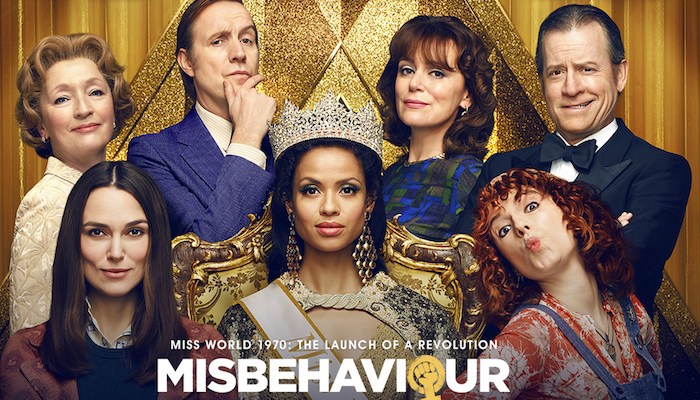
In 1970, the Miss World Competition in London was disrupted before a world-wide TV audience by Women’s Liberation campaigners, furious at the competition being the public face of a world that judged women on appearance rather than personality. The disruption was led by post-graduate UCL student Sally Alexander (Keira Knightley) and commune radical Jo Robinson (Jessie Buckley), and rather overshadowed for many the fact that, for the first time in history, black female competitors like Miss Grenada Jennifer Hoosten (Gugu Mbatha-Raw) were treated as genuine contenders for the title. Misbehaviour recreates all this wonderfully, but also makes an intriguing exploration of the different ways women can make themselves a place in the world.

It would have been very easy for Philipa Lowthorpe’s engaging film to have designated villains – after all with the casual sexism and objectification of the Miss World competition, you could easily have assigned the competition runners as baddies. Instead the film is richer than that, full of people who genuinely feel they are doing their best in the roles they’ve been given in life. If there is a villain, it’s society itself which traps women into certain roles, and doesn’t allow them to grow.

The film follows three plot lines – the women’s liberation movement, the background of staging the Miss World Competition, and the lives and expectations of the contestants themselves. Of these three plots, the women’s liberation movement is surprisingly the least engaging. Keira Knightley and Jessie Buckley do decent jobs, but their characters are more one-dimensional and lack real development (they start the film as passionate rebels and end the film the same way), with this lack of plot being padded out by movie clichés of the “you’re off the protest” variety. 

The real interest surprisingly is the competitors themselves. Like the protestors, the film is keen to not blame the contestants. The ones we follow are smart, intelligent, passionate women who are, by and large, willing to play the game to get their future ambitions realised. We see this most of all for Miss Grenada and Miss “Africa South” (a black South African shoe-horned into the competition to counter accusations of legitimising apartheid): the competition places them in the position of representing victimised minorities, groups that have their options sharply restricted. Having spent their lives being told that only being white, blonde and blue-eyed is beautiful, the chance to set an example to others is important to them – and the film doesn’t downplay or demean this at all.

This is captured particularly in the exploration of Gugu Mbatha-Raw’s Miss Grenada, Jennifer Hoosten. A woman willing to use the competition as a springboard to try and build herself a professional career, she is an intelligent and dedicated woman who understands the nature of her competition. Hoosten however rejects being positioned as a victim, as well as the way Women’s Liberation crams all women’s aims into a single homogenous goal. Why should another group of women tell her what is best for her – isn’t that what men have been doing all her life? As a black woman, her only way to get the opportunities that someone like Sally Alexander has – education and career – is to play the hand that nature has given her the only way she can. Mbatha-Raw captures this all extremely well in a quietly judged and affecting performance.

Similar feelings motivate the rest of the competitors. Miss Africa South (an engaging Loreece Harrison) just wants to keep her head down and get home to her family, letting her presence alone make her statements. Miss Sweden (a fiery Clara Rosager) rails against the control and management of the organisers on every aspect of her life while at the competition. It’s a film where women are working to find their place in the world, but accepting that not all those goals will be the same. Keeley Hawes does excellent work as Julia Morley (co-runner of the competition with her husband, a brash Rhys Ifans), a woman trying her best to reform the competition from within.

Lowthorpe juggles these interesting themes – giving oxygen to all these points of view – within a fascinatingly precise reconstruction of the competition itself and the protest. As part of this Greg Kinnear contributes a spot-on performance as Bob Hope, here a sexist comedian from a different era who can’t understand the changing world. The film gets a lot of comic mileage as well from the jaw-dropping sexism of the BBC coverage and the drooling perviness of the reporters rushing to interview the competitors.

“This isn’t the end of anything, but this could be a start” says Lesley Manville in her waspishly delightful cameo as Hope’s wife. She’s right, the world didn’t change overnight. But as the film captures it started getting people thinking, even if it accepted that not all women will have the same view. Sally Alexander and her mother can disagree on women’s roles – “Why would I want to grow up like you?” Sally berates her housewife mother (very well played by Phyllis Logan) – but the two characters can still come together and agree that having opportunities is still better than not. And perhaps that’s what the film is arguing for: all these women are stretching for opportunities. And if that means the world needs to change so half the population gets the same chances as the other half, so be it.

On the Waterfront (1954)

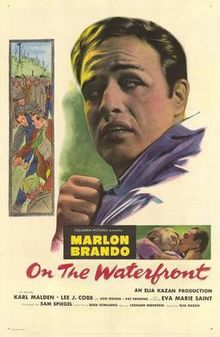
Marlon Brando reinvents film acting in On the Waterfront

Director: Elia Kazan

Cast: Marlon Brando (Terry Malloy), Karl Malden (Father Barry), Lee J. Cobb (Johnny Friendly), Rod Steiger (Charley “The Gent” Malloy), Eva Marie Saint (Edie Doyle), Pat Henning (Timothy Dugan), John F Hamilton (“Pop” Doyle), Ben Wagner (Joey Doyle), James Westerfield (Big Mac)

When’s the right time to speak out for what you know is right? It’s a question we’ve all faced at some point, and it’s the question that changes the life of Terry Malloy (Marlon Brando) after he is indirectly, and unwittingly, involved in the murder of a fellow dock worker. The killing was ordered by the corrupt, mob-connected union boss Johnny Friendly (Lee J. Cobb), who rules the workers of the shipyards of Hoboken, New Jersey with an iron fist. The victim was going to talk to the cops, and suddenly Terry finds himself in the middle of a major ethical bind: should he give evidence or play “D and D” (deaf and dumb) like the rest of the workers.

His bind grows ever tighter as the local priest Father Barry (Karl Malden) takes up breaking the power of the union as his own personal mission. Not to mention Terry’s growing closeness to the victim’s sister Edie (Eva Marie Saint), with whom he finds himself slowly falling in love. On the other side is his brother Charley (Rod Steiger), a lawyer and right-hand man of Johnny Friendly, who has been running his brother’s life forever, ruining Terry’s boxing career by ordering him to take a dive so Friendly could make a killing on the betting circuit. What will Terry do?

Elia Kazan’s multiple Oscar winner is a powerful, beautifully made, engrossing and uplifting modern morality drama that still packs a wallop today. Shot largely on location in New Jersey, with lashings of Kazan’s brilliant realism and ability to bring poetic beauty and emotional force to the most everyday of settings, On the Waterfront is sublime, a film to make you rail against the injustice of corruption and the unthinking cruelty of everyday folk when given a chance to stigmatise someone.

Kazan and screenwriter Budd Schulberg (whose script is a beautifully judged mixture of soulful dialogue and the rhythms of every day conversation) were both drawn towards the story after their engagement with McCarthyism in Hollywood. In this hunt for reds under the Hollywood bed, both Kazan and Schulberg named names. Both of them felt that they had been lied to and exploited by the communist movement in Hollywood – and also that Stalinist Russia was not a cause worth defending – but that didn’t stop many people rejecting them for breaking the rule of silence (the same rule that runs through this film). On the Waterfront is a heartfelt defence of the whistleblower (or the informer), and why that can sometimes be the only option open.

Based on a true story, Kazan’s film is a masterclass in carefully controlled, intelligent direction bringing out brilliant acting performances (always one of Kazan’s major strengths as director). Leading the way here is Marlon Brando, giving possibly the most famous, most influential acting performance in film history in the lead role. It’s not really an understatement to say it changed the face of movie acting. Brando here performs with a low-key, casual, almost tender naturalism that stands completely at odds with the more exhibitionist performers of the late 40s. And he funnels all this beautifully into Terry Malloy, a tough guy whom he inhabits with a vulnerability and gentleness that never once feels out of place with his temper and pride. There is instead an awe-inspiring transformation here, of the actor becoming the mumbling, uncertain character – not afraid for words to be lost, not worried about making eccentric or unexpected choices as a performer.

Two scenes stand out. In the first, Brando has his first long conversation with Edie Doyle, having rescued her from being set on by union men. In a single take – a carefully orchestrated willingness to let the actors explore the emotional truth of the scene from Kazan – Brando’s Terry shyly, gently, haltingly asks about her life and tries to explain his own. At one point, Edie drops her glove and Brando picks up the glove, fiddles with it and then puts it on – the sort of inspired naturalism that feels like nothing on paper, but on film carries a strange emotional force, a physical representation of the bond between them (and don’t underestimate the way Saint pulls the glove gently from his hand). The entire scene has the air of reality to it, Brando chewing gum, Saint wondering how much of herself to show to a man she isn’t sure she can trust. It’s masterful.

The other scene is of course possibly one of the most famous scenes in movies ever: I coulda been a contender. For films, this is like the To Be or Not To Be speech, a speech that has been quoted and riffed on ever since. But again, Brando resists the temptation throughout for histrionics – when Charley pulls a gun, Brando reacts not with shock or anger but sadness, almost tenderly pushing the gun aside and letting his voice fill with a world of regret for what has become of their relationship. Steiger is superb in this scene, but you can’t look at anyone except Brando here, awkward, sad, struggling to work out what to do with his life and finally confronting the broken past between the brothers with pointed regret and calm realisation rather than the anger and rage that other actors would have chosen. This is an actor who redefined his profession, at the top of his game.

The film is crammed with excellent performances. Eva Marie Saint (Oscar winning) has just the right measure of gutsy determination, fear and tender sweetness as the woman who opens Terry’s eyes to right and wrong. The film gained three Supporting Actor nominations (they all lost). Steiger is cocksure but self-loathing as Terry’s ambitious brother. Lee J. Cobb rages as only he can as the blowhard bully Friendly, demanding absolute loyalty. But on this rewatch, I loved Karl Malden’s moral certainty, courage and stubbornness as Father Barry. In any other film Barry’s speech railing against the dockers for being part of the system that oppresses them, all the time being pelted by food, would be the highlight of the film: here it’s just one of several stand-out moments.

Kazan was a superb visual stylist, this black-and-white masterpiece brilliantly shot by Boris Kaufman to create a world that feels the perfect mixture between the documentary realism and the theatrical. And working with a superb script that he felt such investment in helps to create a story that carries real emotional force, carefully investing you right from the start in Terry’s fundamental goodness and naivety, inviting you to feel rage on his behalf as he is sent to Coventry by his workmates. Topped off with a beautiful score by Leonard Bernstein – part jazzy, part wonderful orchestral stylings – this has barely aged a day in it’s over 60 years.

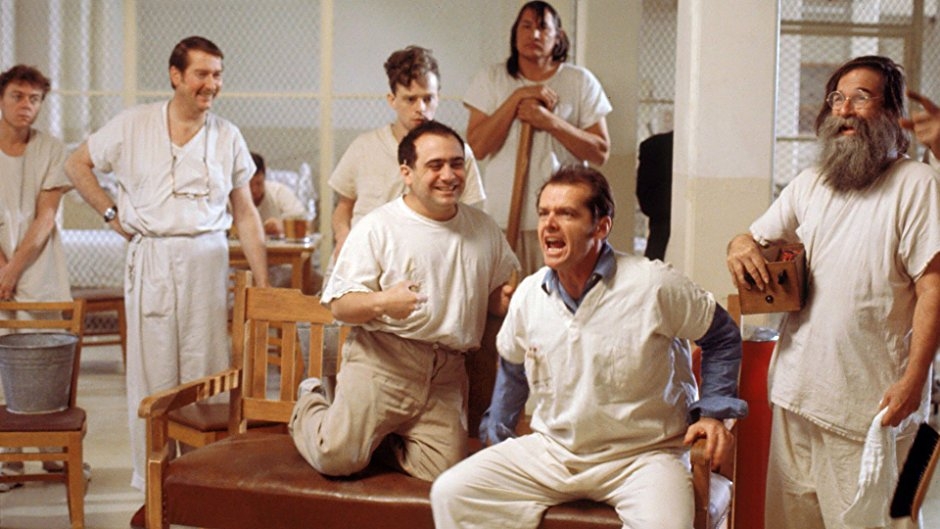
One Flew Over the Cuckoo's Nest (1975)

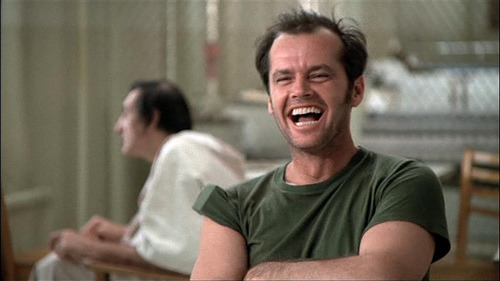
Jack Nicholson is superb as McMurphy in One Flew Over the Cuckoo’s Nest

Director: Milos Forman

Cast: Jack Nicholson (Randle P McMurphy), Louise Fletcher (Nurse Ratched), Will Sampson (“Chief” Bromden), William Redfield (Dale Harding), Brad Dourif (Billy Bibbit), Sydney Lassick (Charlie Cheswick), Christopher Lloyd (Max Taber), Danny DeVito (Martini), Vincent Schiavelli (Bruce Frederickson), Dean Brooks (Dr John Spivey), William Duell (Jim Sefelt), Scatman Crothers (Turkle)

One Flew Over the Cuckoo’s Nest is one of the landmark films of the 1970s, one of those films that’s on everyone’s list for great masterpieces. It lifted all five of the Big Oscars (Picture, Director, Actor, Actress and Screenplay), one of only three to do so. It’s widely loved for its celebration of rebelliousness and individualism, but there is more to the film than that. It’s as interesting for the things it doesn’t explore as much as the things it does.

Randle McMurphy (Jack Nicholson) has himself sent to a mental institution rather than a prison farm, under the belief that serving his time in the institution will be far easier than doing hard labour. However, he finds the ward he is locked into is under the authoritarian control of Nurse Ratched (Louise Fletcher), a passive-aggressive bully with a strict interest in the rules at the cost of all humanity. The inmates are cowed, but McMurphy encourages them to express themselves and seize their freedoms – little realising that his freedom is dependent on being signed off by the doctors, not the length of his original short sentence, and he has made no friends in the hospital authorities – or that Ratched is determined to break his influence over the other patients.

Forman was a perfect choice for directing a film that directly echoes his own iron-curtain upbringing. OFOTCN is a film that celebrates the freedom of the individual – but also recognises that authority and the state always wins out in the end. The hospital ward is cold, oppressive, a white-lined world where Ratched observes and quietly controls everything from her booth, softly issuing directives that carry a quiet menace. The film rotates around clashes between McMurphy wanting to do his own thing and Ratched stridently reinforcing a fixed hospital agenda. At one point Forman’s camera tracks from McMurphy on the basketball court, up to Ratched watching behind a full length window like an imposing Stasi officer. Forman totally understands the struggle of expression and free will in oppressive regimes, and it’s this that has given the film such a rich life – who doesn’t want to land on the side of freedom?

It helps as well that representing freedom we have possibly Jack Nicholson’s finest performance as McMurphy. A roaring, bubbling, manic, burst of nature, an impish anti-authority figure who rips through every scene with intense energy. It’s a marvellous, inspiring performance. And it makes McMurphy exactly the sort of rebel without a cause we would like to be, the guy who can inspire and lead through force of will alone, who refuses to be cowed or crushed. 

Nicholson’s performance however is a perfect mixture of larger-than-life drama and moments of reflection. The film splices in a few conversations between Nicholson and the doctors that, over the course of the film, change more and more from spry defiance and mockery towards a quieter, more despairing resignation as he slowly begins to realise how trapped he is. Not that he wants to show any of that to his fellow inmates, or to Ratched with whom he keenly engages in a battle of wills.

Ratched herself is exactly the sort of cold, rules-bound, inflexible authority figure we are naturally placed to hate. Louise Fletcher is wonderful, with her softly spoken iciness matched with certainty about her moral position. Is she even interested in curing the patients? Her focus seems to be completely on controlling and running the patients’ lives rather than changing the status quo. 

This battle of wills drives the film, but it’s interesting as well for what it tells us about McMurphy. He seems to have no understanding of the fact that, while his fellow inmates are cowed, they are all to some degree mentally ill and certainly all frightened and unpredictable. McMurphy sees them as people who need to be encouraged to seize their own destinies, but these are people who are incapable of really understanding what McMurphy is trying to do or have any interest in it. He shakes up their world, but has little real impact on them in the long term.

It’s not a film that engages in any great understanding of mental illness, but suggests that perhaps McMurphy and Ratched are in their own ways as insane as the people they are fighting over in the asylum. McMurphy is a self-destructive force who pushes for small things with huge passion, but then drifts through the major things. He acts without thinking and doesn’t try to understand the people around him. Ratched meanwhile is so obsessed with controlling her own small universe, she has defined her entire life around her governance of the ward.

The film has a slightly troubling relationship with women – which is not necessarily a criticism, but an observation since the film’s only prominent female character is Ratched and all the inmates are men. The things that Ratched stops the men from doing are the sort of typically “male” activities that McMurphy delights in – gambling, sports, girls – while McMurphy himself is (in what is the only truly dated moment in the film) in the slammer partly for having under-age sex with a girl, which he eagerly describes to his doctor. McMurphy pushes all the inmates to become more like the sort of man he understands men should be, and while it is a freedom of expression, it’s also one that has little place for women in it, other than as sex objects.

But that’s not the real aim of the film, so you can forgive it. McMurphy is not an intellectual or a man on a mission, he’s an unthinking burst of energy that burns up the world around him and demands the freedom to not be told what to do. That’s what gives the film its real emotional impact and why it spoke so much to Vietnam era America, and continues to speak to us today. And of course it’s linked to the fact that the film is a massive tragedy.

Because in the end the forces of oppression do win and McMurphy’s spirit is crushed. Sure McMurphy more than contributes to his own failures – he allows his own to drift away, and his pushing of his own agenda of what he feels men should want dooms poor Billy Babbit (a stuttering slice of timidity played by Brad Dourif). The film has a Pyrrhic victory in his inspiring the “Chief” (William Sampson), a giant native American flying under the radar by pretending to be deaf and dumb, into carrying out McMurphy’s dreams.

But for our hero it’s a bust. Forman’s film is a brilliant celebration of the energy and futility of lords of misrule like McMurphy, with a commanding performance from Jack Nicholson that’s one for the ages. A wonderful piece of ensemble playing in a set that becomes a metaphor for oppressive regimes, it’s remained remarkably undated and a force to be reckoned with on any top ten list.

Taxi Driver (1976)

Robert De Niro embodies dangerous loners everywhere in Taxi Driver

Director: Martin Scorsese

Cast: Robert De Niro (Travis Bickle), Jodie Foster (Iris), Cybill Shepherd (Betsy), Albert Brooks (Tom), Harvey Keitel (Sport/Matthew), Leonard Harris (Charles Palantine), Peter Boyle (Wizard), Harry Northup (Doughboy), Steven Prince (Easy Andy), Martin Scorsese (Passenger)

A grungy taxi ploughs through the neon-lit back alleys of New York, the glow of stop signs and tail lights washing the car in a hellish red glare. Inside that taxi, the interior monologue of its driver tips ever closer towards paranoia and fantasy. It’s no surprise that something is going to give. Martin Scorsese’s influential Taxi Driver is the definitive exploration of fractured psyches, the key text in film for exploring how isolation, loneliness and an inability to connect with people can tip someone into being a danger to others.

Travis Bickle (Robert De Niro) is our taxi driver, an honourably discharged Vietnam vet who can’t sleep so works the night shifts. He’s seemingly quiet, shy, self-contained but this hides a desperation to connect with the world, a horror at what he sees around him that he can’t understand, a paranoid disgust at the crime and dirt he feels infect the street and a desire to be someone or do something. His failure to understand to or relate to the world on any level will eventually lead to a gradual collapse as Bickle determines that he must lash out at something, must attack something, to make himself a place in the world.

Taxi Driver is such a brilliant analysis of disaffection and confusion at the world, such an insightful understanding of how feeling separate and locked out from events around them can make a person feel they must act to make their mark, that it profoundly influenced the motivations of Ronald Reagan’s would-be-assassin John Hinckley Jnr in 1981. The film was even screened for the jury as part of Hinckley’s (successful) defence that he acted due to insanity (Hinckley claimed he was trying to impress Jodie Foster). Tragic as that is, it speaks something to the power of the film and its acute understanding (but not excuse) for lonely, fractured, potentially violent souls like Hinckley.

Scorsese’s direction is pitch-perfect. The film uses a series of tightly held shots – and some go on for a very long time, staring at trivial events (such as the shot of an empty corridor while we hear Bickle being rejected on the phone by his stalking target Betsy) – or stately intercutting between actors that brilliantly serve to establish both Bickle’s isolation and his lack of connection. This is intermixed with tighter editing that captures Bickle’s undirected fury and paranoia towards the real world, presented as he drives as a concussive collection of sounds and images that seem to hammer down on the taxi, combined with Bernard Herrmann’s superb classically tense score, lyrical but haunting. 

Every scene Scorsese constructs is designed to show Bickle’s isolation, his weakness and continual succumbing to fantasy and false perspectives. His internal monologue has a monotone fluency to it, but talking to people he’s tongue tied, clumsy or prone to tip into the rantings of a crazy man. Slow motion camera tracks show Bickle moving through crowds like an alien, unable to comprehend or understand what he is seeing, later prowling the frame like a misguided hunter. New York is a hellish underworld – although you are certain we are seeing it largely as Bickle sees it, every scene filtered through his disturbed POV (Michael Chapman’s photography by the way is faultless). 

It works so well because De Niro himself is so restrained, and at first feels rather sweet, even handsome, like someone who you want to look after or feel sorry for – a million miles from the mohawked gun totter he will become by the film’s end. He’s quiet, shy and desperate for friends. He can manage bursts of seeming like a compelling person – his fooling of Cybil Shepherd’s Betsy into a date is a tribute to his ability in short bursts to appear charmingly eccentric. The date of course flounders on his inability to understand human norms (buys her a record she says she has, takes her to a porn film, points out he has a taxi when she tries to get into one to leave), and his response to it is of course to get angry and make a scene, to blame the other person for his own failings.

De Niro immersed himself in the dark psyche of this man, and never loses touch of the gentleness and vulnerability that underpin his violent actions. Bickle talks the talk often of a crazy person, but by his own lights he’s a well-meaning man. It’s just that his well-meaning actions involve multiple murders, and it’s only by a twist of fate that he guns down a house full of pimps and gangsters rather than putting a bullet through a Presidential candidate.

And that’s the scary thing about the film: Bickle is strangely sympathetic, for all his obvious psychosis. Who hasn’t felt alone and lost in the world? Who hasn’t felt scared by events around them or dangers unknown? Who hasn’t wondered “why don’t people like me”? We just deal with it a lot better than Bickle and his messianic sense of mission that he develops.

Bickle channels what human emotions he can muster or understand into ciphers he barely knows. These people become totems, or stalking targets, who he becomes persuaded must be “saved”. With Cybil Shepherd’s Betsy, the delusion is clear: here is a confident, career woman, independent and smart, for whom Bickle can feel an attraction but clearly no understanding at all beyond her being an object he cannot have. The awkwardness and later stunningly poor judgement and reactions he shows when around her mark him immediately as a weirdo and danger to others.

But the film’s smarts – and it has a terrific script by Paul Schrader, whose understanding of dark psyches was never better captured than here – is that these fixations have a totally different impact when targeted on a child prostitute. Suddenly, Bickle’s unwanted attentions have the air of righteousness, even though intellectually he makes no distinction between either Betsy or Jodie Foster’s Iris (a performance of staggering emotional maturity from an actress barely 12 at the time). For all Iris is clearly a victim of society and abuse (in a way Betsy isn’t), for Bickle she’s pretty much the same, someone he must ‘rescue’ – and from her pimp Sport (a disturbingly fey and incestuous turn from Harvey Keitel).

So Bickle takes up the guns, and eventually does what we all wish we could do sometimes. Because who hasn’t stood in front of the mirror and dreamed about saying “you talkin’ to me” to our enemies – the difference being most of us don’t fantasise about blowing them away, let alone actually go on to do it. De Niro’s brilliance is the chilling emptiness behind the exterior, the way he captures universal fears and doubts but shows us a character who has no personality of his own but only collects titbits from those around him (like his would-be murderous passenger – played by Scorsese himself – who eagerly talks about how he wishes he could murder his cheating wife).

So the violence comes – and it is horrific – as Bickle shoots up a lowlife prostitute den with sickening graphicness (nothing this violent had really been seen before). But it’s only fate that has turned him away from his real target, Senator Palatine (George Lucas must have had this film in the back of his mind when naming his Evil Emperor!), reverting to his secondary target and killing a group of people far more acceptable to Joe Public to be wasted.

Scorsese’s genius final epilogue asks us questions about truth but also perceptions. The camera takes on a “God’s view” POV overhead shot as Bickle’s slaughter ends (and De Niro’s jerky, terminator like physicality here is stupendous), tracking back through the house. Is this his soul leaving a dying body? But then we flash forward and there is Bickle in the taxi again, hailed as a hero by society for rescuing the girl – the same society that would have condemned him as psychopath if he had taken his first target. He even gets a sympathetic conversation with Betsy.

But he hasn’t changed. And the world hasn’t changed. And Bickle may be a hero now but the same dark impulses still ride within him – and they will, the film suggests, lead him to kill again. Scorsese’s film is a masterpiece of alienation and disaffection, a brilliant analysis of what makes a killer kill – and how vagaries of fate can see us miss the signs – with a wonderful script and a superb performance from De Niro, a landmark turn that manages to tap into such existential fears we all have on our place in the world that we completely miss we are starting to relate to a psychopath. Dark and brilliant, a landmark.