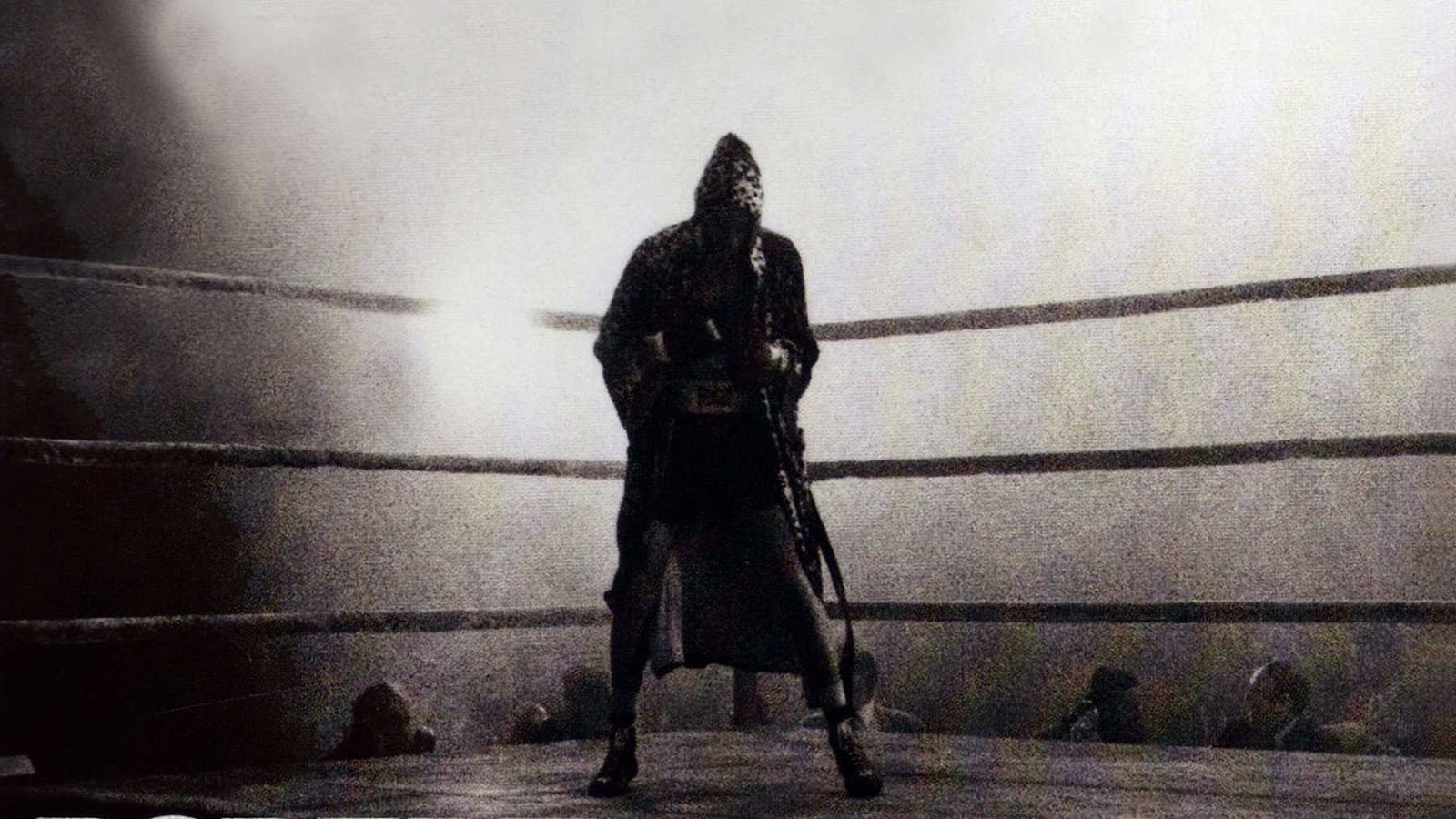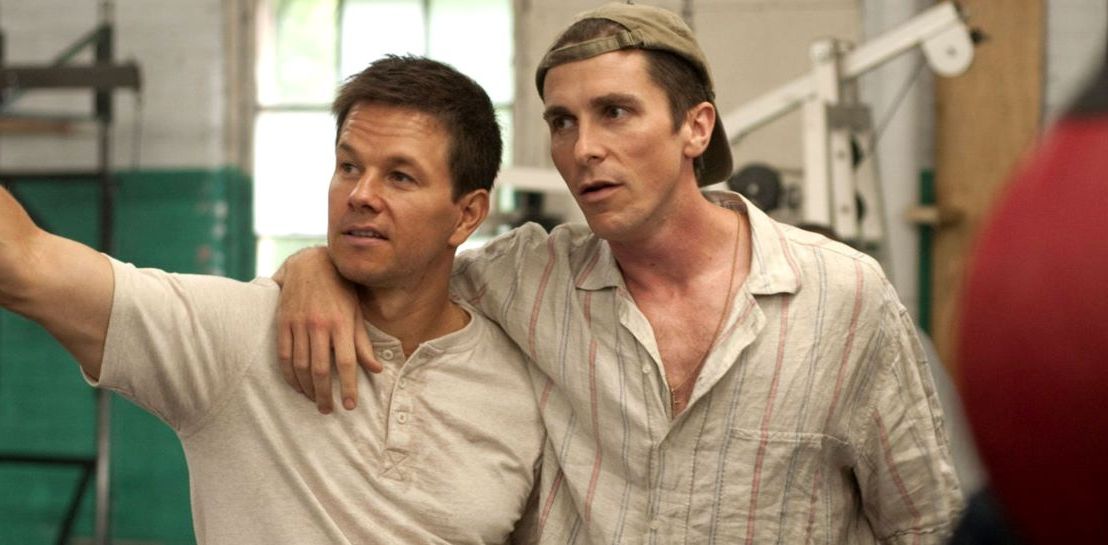
Category: Sports film

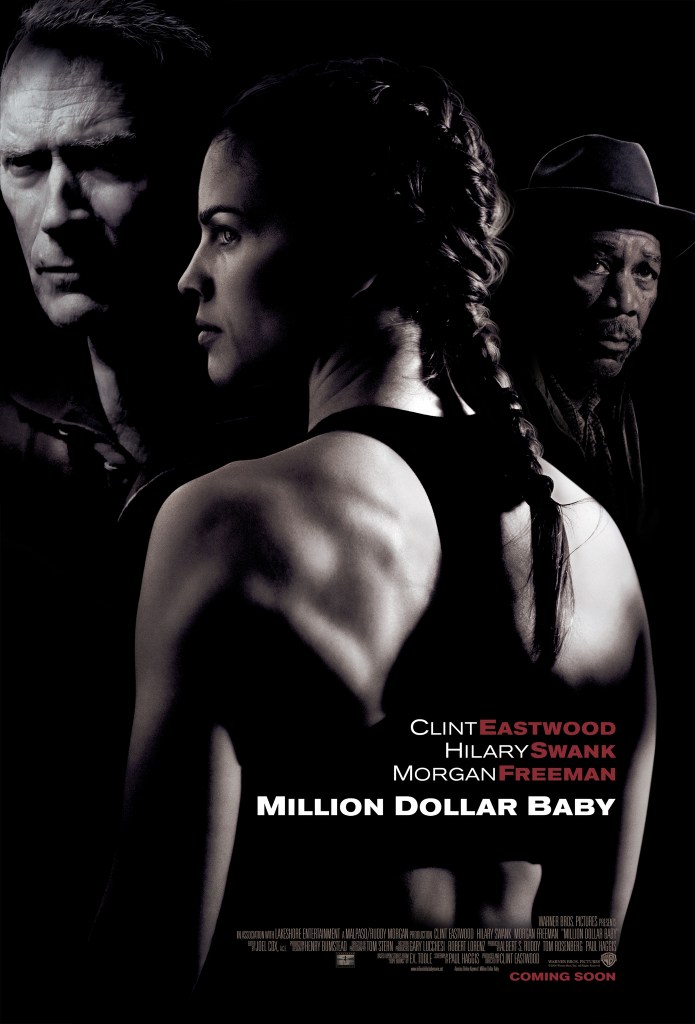
Million Dollar Baby (2004)

Million Dollar Baby (2004)

Oscar-winning sucker punch (literally) movie as a woman goes against the odds to make her boxing dreams come true

Director: Clint Eastwood

Cast: Clint Eastwood (Frankie Dunn), Hilary Swank (Maggie Fitzgerald), Morgan Freeman (Eddie “Scrap-Iron” Dupris), Jay Baruchel (Dangerous Dillard), Mike Colter (“Big” Willie Little), Lucia Rijker (Billie “The Blue Bear” Osterman), Brian F. O’Byrne (Father Horvak), Anthony Mackie (Shawrelle Berry), Margo Martindale (Earline Fitzgerald), Marcus Chait (JD Fitzgerald), Riki Lindhome (Mardell Fitzgerald), Michael Pena (Omar), Benito Martinez (Billie’s manager)

Spoilers: I thought the end of Million Dollar Baby was pretty well known, but when I watched it with my wife, I realised half-way through she had no idea where it was going. I’ll be discussing it, so consider yourself warned!

We know what to expect from most Sports stories don’t we? A plucky underdog fights the odds and emerges triumphant, winning the big match or going the distance when everyone doubted them. So it’s not a surprise Million Dollar Baby was marketed as a sort of female-Rocky. It had all the ingredients: Swank as a dreamer from the wrong-end-of-the-tracks, tough but humble and decent; Eastwood as the grizzled trainer; a working-class backdrop; a struggle to put their pasts behind them on the road to glory. Then, imagine what a sucker punch the final act of the film is when you suddenly realise you’ve not been watching a feel-good drama, but the entrée to a heart-wrenching euthanasia story.

Maggie Fitzgerald (Hilary Swank) has spent months persuading grouchy boxing trainer Frankie “I don’t train girls” Dunn (Clint Eastwood) to train her. Frankie suffers from a string of lifelong regrets, from the daughter that returns his letters unread to not ending a fight decades ago that saw best friend Eddie (Morgan Freeman) blinded in one eye. Frankie’s resistance is eventually worn down by Maggie’s persistence and the two form a close bond. Maggie is on fire in the ring – until a foul punch leads to a terrible fall leaving her paralysed from the neck down. With Maggie having lost everything that gave her life meaning, how will Frankie respond when she asks him to end her life?

Of course, the clues should be there earlier that we are not about to settle down for a triumphant Rocky II-style yarn. Eastwood’s (self-composed) maudlin score constantly works against the action, until we realise it is sub-consciously preparing us. Expectations are overturned: Frankie’s reluctance to let his fighter “Big” Willie (Mike Colter) go for a title shot – hesitation that lasts so long, eventually Willie hires a new manager – is shown to be misjudged when Willie wins. Dunn spends hours in church every day, plagued with guilt about misdeeds he can’t begin to put into words. Maggie’s family are not a supportive working-class bubble, but trailer-trash dole-scum who react to Maggie buying them with house with fury as it may affect their (unmerited) benefit cheques. We even get several shots of the stool that will eventually play a crucial role in crippling Maggie.

What the film is actually building to in its opening 90 minutes is not a story of triumph, but how a close relationship builds between a man who has lost his family and a woman whose family is a grasping horror story. Eastwood charts this with a carefully judged pace, delivering one of his finest performances as the guarded and grouchy Frankie, who uses his gruff exterior to protect himself from the possible hurt of emotional commitment. Because it’s clear Frankie actually cares very deeply, frequently going the extra mile to help people, even while complaining about it.

It’s that buried heart, that draws him towards the determined and good-natured Maggie. Rather like Frankie, Hilary Swank makes clear in her committed performance Maggie’s optimism and enthusiasm is as much of a shield as Frankie’s gruffness. She knows that she’s nothing to her family except a meal ticket and her entire life seems to have been one of loneliness, working dead-end jobs to funnel money to her mother at the cost of any life of her own. Switching away from her grinning enthusiasm leaves her in danger of staring at her own life and seeing what a mess it is.

With their two very different shields, these two characters are exactly what the other needs and one of the film’s principle delights is to see them slowly confiding in each other, sharing their vulnerabilities and filling the void their own families have left in their lives. This all takes place inside a conventional “sports movie” structure, which writer Paul Haggis almost deliberately doubles down on, as Maggie builds her skills, via training montages and Frankie starts to relax about sending people into the ring to have seven bells beaten out of them and dreams about one more shot.

This all means it hurts even more when that (literal) sucker punch comes. Eastwood’s film doesn’t shirk from the horrors of Maggie’s disability – re-enforced by the previous 90 minutes establishing how crucial movement and reflexes are to boxing, and how this element in particular helps give her life meaning. She’s covered with bed sores, can’t breathe without a respirator, it takes over an hour to lift her into a wheelchair (which she cannot operate) and eventually her infected leg is amputated. Her family visit only to get her to sign over her assets (she tells them where to get off). She is reduced to biting through her own tongue to try and bleed to death, meaning she is left sedated to prevent self-harm.

It’s all more for Frankie to feel guilty about. Although the film could have given even more time to exploring the complex issues – and moral clashes – around the right to die, it does make very clear the crushing burden of guilt and the impact his final decision will have on him. In fact, it would have benefited from spending more time on this and giving more time to O’Byrne’s priest (who quite clearly states that it’s wrong), to help give more definition to the arguments around assisted suicide (I wonder if Eastwood’s agnostic views came into play here).

Perhaps the film spends a little too long on its initial – even deliberately formulaic – rags-to-riches boxing story. In its boxing club vignettes, you can see the roots of the film in a series of short stories by former boxing trainer FX Toole. Mackie’s cocky boxy and Baruchel’s gentle intellectually disabled would-be boxer run through the film play like short story anecdotes. The narrative is linked together by narration from Morgan Freeman. It’s a natural fit for Freeman – essentially a semi-reprise of Red in Shawshank – and fits him like a glove (it was no surprise he won an Oscar). But trimming this content could have given more time to the films closing moral dilemma.

Which doesn’t change the impact it has. Eastwood’s low-key style – with its drained-out colours and piano chords – make a perfect fit, and its expertly played by himself and Swank (who also won an Oscar). Even on a second viewing, Million Dollar Baby still carries a real impact, particularly as you appreciate how subtly the sucker punch that floored so many viewers first time around is built up to.

King Richard (2021)

King Richard (2021)

Richard Williams creates two of the greatest tennis stars ever in this easy-viewing star vehicle

Director: Reinaldo Marcus Green

Cast: Will Smith (Richard Williams), Aunjanue Ellis-Taylor (Oracene “Brandy” Price), Saniyya Sidney (Venus Williams), Demi Singleton (Serena Williams), Jon Bernthal (Rick Macci), Tony Goldwyn (Paul Cohen), Mikayla LaShae Bartholomew (Tunde Price), Danielle Lawson (Isha Price), Layla Crawford (Lyndrea Price)

Sports movies have a very reliable formula. There’s the initial promise, early success, adversity, obstacles, a moment of doubt, a renewal of commitment and a final success. I think it’s fair to say that King Richard pretty much hits all the beats you expect. In fact, its pretty much exactly the film you expect it to be when it starts and doubles down hard on the charisma and charm of its star.

King Richard tells the story of how the Williams Sisters, Venus (Saniyya Sidney) and Serena (Demi Singleton), took their very first steps towards dominating the world of tennis, as told through the eyes of their father Richard (Will Smith). Richard Williams had been determined from almost the moment his children were born, that he would never stop working (and push them) to build lives that would take them away from the working-class ghetto he grew up in. Teaching himself tennis coaching, from the moment they can hold a racket the girls are coached. But, being working class and black in a white-middle-class sport, Richard must work night-and-day to win professional coaching and playing opportunities for his daughters. Not to mention, struggling to ensure that they don’t forget their roots or get chewed up and spat out by the sport.

First and foremost, King Richard is a showpiece for Will Smith. The part fits him like a glove: Williams a larger-than-life, force-of-“Will” role that feels about 2/3rds Williams and 1/3rd Smith. With Williams fast-talking patter, never-give-up determination and absolute commitment to protecting his loved ones, the role plays to all Smith’s strengths. Smith gives a quintessential movie-star performance, which to-be-honest often feels like a Will Smith personality role (the modern equivalent of a Cary Grant performance), but is very entertaining because few people are as good at crafting their personae to benefit a movie as Smith is. Smith is heartfelt, earnest, loveable, sometimes slapable (Note: I wrote that before Smith’s slap-heard-around-the-world was forever attached to his Oscar-winning performance), but always a charming guy you root for.

Which is odd, as Richard Williams is a man with a mixed reputation. He was a demanding, argumentative, often controlling presence who irritated and alienated far more people on the tour than he befriended. Some saw him as a self-promoter, others as a man at times causing problems for his daughter’s careers. King Richard doesn’t shy away from showing these qualities – the awkwardness, the temper, the selfishness, the arrogance – but presents them all in the best possible light. The film is purest hagiography and Richard Williams is always vindicated in all his calls.

Awkwardly the film is also determined to give him all the credit for the Williams’ sisters success. Now there is merit in this – and the script was developed with the sister’s input, so it feels a bit presumptuous to get angry on their behalf. The sisters would never have become what they are if their father had not put rackets in their hands so young and invested hours in training them. Similarly, they would not have been as fully-rounded people without his constant mantra about family, humility and hard work. But also, they did have quite a bit of talent themselves – and certainly they profited from lessons they picked up from the other coaches they worked with.

However, one of the points King Richard is gently making – and it is gently made, as if the film was worried its crowd-pleasing potential might have been affected if it banged this drum too hard – is that Williams had to be a domineering figure because he was fighting against a racial divide in the sport. He feels out of place in the tennis country clubs because he is. No one else on the junior tour is anything other than white and well off. Every coach and trainer is applying methods that have worked for affluent middle-class athletes, without considering any adjustment might be needed for two young women coming from a totally different background.

You can argue the hagiography is partially a course correction from years of the only black father and coach on the tour being denounced as uppity, loud-mouthed, self-obsessed and intrusive. Its still made clear he shares these traits with many other tour parents, but adding to it a massive dose of supportive parenting. There are moments when the film addresses how Williams’ obsession that he knows best might just be starting to run the risk of alienating his daughters: in particular Aunjanue Ellis-Taylor delivers a blistering late speech (which probably got her an Oscar nomination by itself, so compellingly is it performed) where she lays out in no-uncertain-terms Williams many character flaws and damaging behaviours. (Coincidentally the film’s most compelling dramatic scene).

Maybe a bit of hagiography is what we need from a film designed to be an uplifting, triumph against the odds and celebration of one man’s fatherly love and devotion to give his daughters a chance to change their stars. The film is professionally directed by Green and some of the titbits of the sisters early training (throwing American footballs to build service strength among others) is fascinating.

The film is probably at least twenty minutes too long and starts at some points to repeat the same beats again and again. It doesn’t really do anything new and is exactly the sort of film you could predict it being. But it has some good performances, Smith is at the top of his (Oscar-winning) game, and it is an enjoyable, if predictable, feel-good watch.

Rocky (1976)

Rocky (1976)

Doubters and some very steep steps are conquered in the Best Picture winning Granddaddy of Sports movies

Director: John G. Avildsen

Cast: Sylvester Stallone (Rocky Balboa), Talia Shire (Adrian Pennino), Burt Young (Paulie Pennino), Carl Weathers (Apollo Creed), Burgess Meredith (Mickey Goodmill), Thayer David (Miles Jergens), Joe Spinell (Tony Gazzo), Tony Burton (Tony “Duke” Evers), Pedro Lovell (Spider Rico)

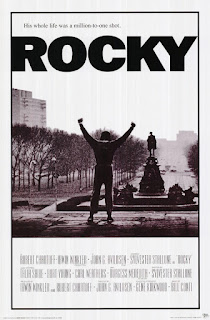
How many people have run up those steps to the Philadelphia Museum of Art? So many, they’ve renamed them “the Rocky Steps” – and placed a statue of Stallone (from Rocky III) there. You can be sure everyone hummed Gonna Fly Now while they did it. It’s all a tribute to the impact of Rocky, the iconic smash hit that led to no less than seven sequels (and counting!) and, arguably, kickstarted the 80s in Hollywood (a decade Stallone would stand tall across with both Rocky and Rambo). The original Rocky mixes genre-defining delights and a feel-good, crowd-pleasing story with a surprisingly low-key setting that deals in a bit of Loachesque reality and social commentary.

Rocky Balboa (Sylvester Stallone) is a journeyman southpaw boxer, fallen on hard times. He’s making ends meet with a bit of loan shark enforcement (although of course he’s far too nice to actually break any bones) and getting seven bells knocked out of him at low-key fights. His trainer Mickey (Burgess Meredith) thinks he’s wasting his talent, and Rocky spends the day casting puppy dog eyes at Adrian (Talia Shire) sister of Rocky’s chancer best friend Paulie (Burt Young). But Rocky’s life changes overnight when Heavyweight Champion of the World Apollo Creed (Carl Weathers) picks him at random as the nobody he will fight in a title bout (to get Apollo some free publicity). Can Rocky dedicate himself to training so he can “go the distance”?

Surely everyone knows by now, don’t they? The big fight only takes up the last ten minutes of the film. What we’ve spent our time doing beforehand is watching possibly the one of the best ever packaged feel-good stories, full of lovable characters and punch-the-air moments, directed with a smooth, professional (but personality free) charm by Avildsen. Rocky genuinely looked and felt like a little slice of Capra, a fairy tale triumph for the little guy struggling less against the world and more against his own doubts.

And it overcame some real heavyweights to win Best Picture: it knocked aside All the President’s Men, Taxi Driver and Network in a shock win. Is Rocky better than those films? No. But is it more fun to watch? Yes, it probably is – and I would be willing to bet many more people have come back to it time and time again. It was also a triumph for Stallone, a jobbing actor, who produced a first draft of the script in three days and fought tooth and nail to make sure he played the lead.

And Stallone’s performance is absolutely central to its success (can you imagine what it would have been like with, say, James Caan in the role?). Stallone gives Rocky exactly the sort of humble, shy, sweetness that makes him easy to root for. Rocky is no genius, but he’s loyal, polite, well-meaning and Stallone taps into his little-used qualities of softness and naivety. Rocky is lovable because, for all the punching, he’s very gentle – just look at him make a mess of money collecting or the way he talks like a little kid with his pets. Stallone has a De Niroish – yes seriously! – quality here: he absent-mindedly shadow boxes throughout and gives a semi-articulate passion to his outburst at Mickey. His romance with Adrian is intimate and gentle. The whole performance feels lived in and real.

Real is actually what the whole film feels like – despite the fact it’s a ridiculous fairy tale of a boy who becomes a prince for a day. It helps that its shot deep in the streets of Philadelphia, on the cheap and on the fly in neighbourhoods and locations that feel supremely unstaged (Avildsen avoided the cost of extras by frequently shooting at night or very early morning). Even that run up the stairs was a semi-improvised moment. Rocky’s world is a recognisable working-class one that for all its roughness, also feels like a community in a way Ken Loach might be proud of (even the loan sharks are easy-going). Day-to-day the film manages to capture some of the feel of a socio-realist film with a touch of working-class charm.

It also makes a lovely backdrop to the genuinely sweet romance that grounds the film: and a recognition of the film’s smarts that a great crowd-pleaser needs a big dollop of romance alongside a big slice of action. Very adorably played with Talia Shire (original choices Carrie Snodgrass and Susan Sarandon were considered too movie-star striking), Adrian feels like a slightly mousy figure (and she is as sweet as Rocky) but also has a strength to her. She’s led a tough life as sister to the demanding Paulie (and Burt Young does a great job of making a complete shitbag strangely lovable and even a bit vulnerable), but it’s not stopped her feeling love. She and Rocky complement each other perfectly – gentle, shy people, who have something to prove to themselves and the world.

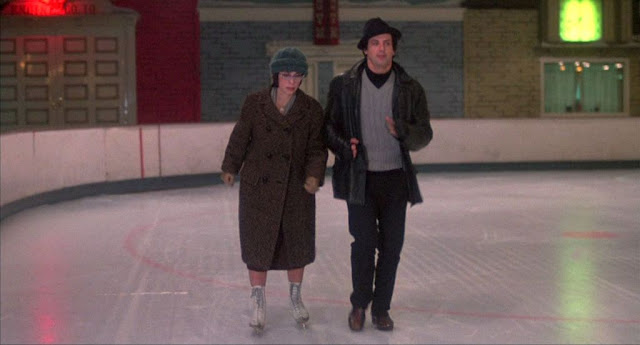
Is there a sweeter first date in movies than that solo trip to the ice rink? Cost cutting saved the day here (it was intended to be packed), that stolen few minutes skating while Rocky hurriedly tries to find out a much about Adrian as he can (an attendant counting down the time they have as they go), Adrian both charmed and bashful. It’s a lovely scene and goes a long way to us giving these characters the sort of emotional devotion that would keep audiences coming back for decades.

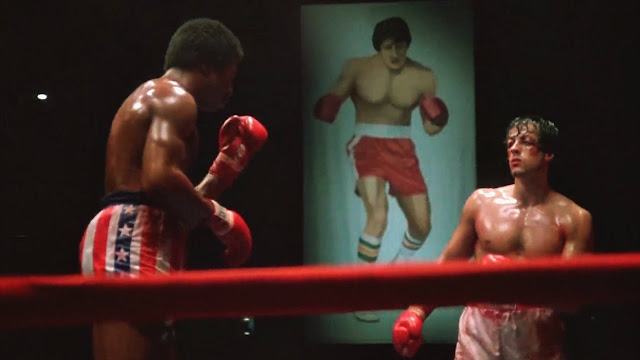
That and those boxing fights of course. Rocky’s final fight sets a template most of the rest of the films would pretty much follow beat for beat. But it’s still fun watching Rocky go toe-to-toe against all odds. Particularly as we know what is important to Rocky is not victory but proving something to himself. It helps as well that Stallone still looks like an underdog of sorts (over the next ten years he would turn himself into a slab of muscular stone).

Opposite him is Apollo Creed, with Carl Weathers channelling his very best Mohammad Ali. The underdog story makes for fine drama, and Rocky is superably packaged: there is a reason why so many other films essentially copied it. From montage, to an “against all odds” fight to Burgess Meredith’s grizzled trainer (a part you’d see time-and-again in the future from different respected character actors) there is a superb formula Rocky takes and repackages from classic films of the 40s and 50s and re-presents to huge and successful effect.

And it works because it’s so entertaining. Stallone is hugely winning in the lead role – more sweet and sensitive than he would be in later Rocky films (traits he would allow himself to rediscover in the more recent films) and it’s a perfectly packaged feel-good entertainment. But it’s also got a grounded sense of realism and reality, with an affecting love story. It’s one of the first – and best – films of the 80s, where formula and crowd-pleasing would be king.

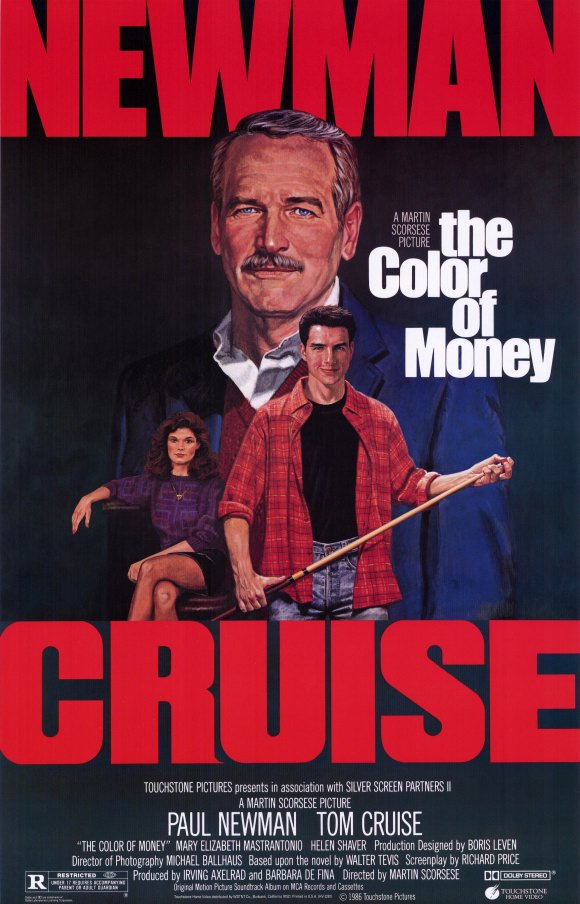
The Color of Money (1986)

Newman and Cruise set the table in The Color of Money

Director: Martin Scorsese

Cast: Paul Newman (“Fast” Eddie Felsen), Tom Cruise (Vincent Lauria), Mary Elizabeth Mastrantonio (Carmen), Helen Shaver (Janelle), John Turturro (Julian), Bill Cobbs (Orvis), Forest Whitaker (Amos), Keith McGready (Grady Sessions)

The Hustler is one of Newman’s most iconic roles. It’s remembered for his cocksure cool, leaning across the table and dispatching balls with a twinkling smirk. What people don’t remember is that The Hustler is actually more of a kitchen-sink drama than a Rat Pack party. It deals with depression, assault, corruption, injustice and suicide. It’s not even remotely a laugh a minute. The Color of Money is a belated sequel, that feels made by people who remember their impression of what The Hustler was, but don’t actually remember the tone of the film itself. But then, Scorsese intended from the very start to make an entertainment to showcase a star, so I’m sure he knew that making a real tonal companion to the original film was always going to be a no-no.

It’s 25 years since “Fast Eddie” Felsen (Paul Newman) was banished from pool clubs throughout the land by gangsters. He now earns a living selling booze to clubs, largely so he can hang out pool clubs and mentor and stake the ‘hustler’s and stars of tomorrow. The kid who catches his eye is Vincent Lauria (Tom Cruise) an exceptionally gifted pool player with a cocksure confidence and a love of the game, that perhaps reminds Eddie more than a little of himself. Vincent, and his girlfriend Carmen’s (Mary Elizabeth Mastrantonio) grifting skills leave a lot to be desired: but Eddie sees promise and takes them out on a road trip to train them up and make a fortune.

It’s a fitting title, as it’s pretty clear that The Color of Money was the main thing on Scorsese’s mind when he made this. Don’t get me wrong, this is an enjoyable and well-made star vehicle, but it’s also the only time Scorsese was a hired gun working for a star who made films he grew up watching. Scorsese has spoken openly that his main aim here was to bring it in on time and on budget (he made it faster and cheaper than that), in order to help win studio backing for The Last Temptation of Christ. (Ironically of course, most people have far fonder memories of The Color of Money than that film, but then this is a film designed to entertain not challenge.)

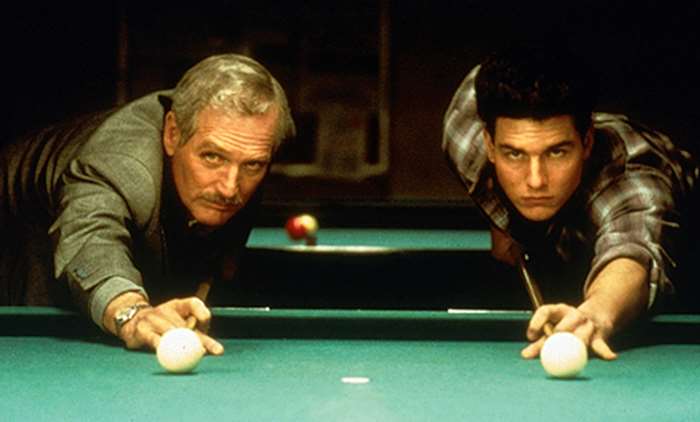
It’s a fairly traditional and even predictable storyline. The mentor and the mentee, the latter jaded but rediscovering some of his old fire from the callow exuberance of the other. To be honest not very much actually happens in the film other than pool games and some predictable feuds before the final reconciliation. Inevitable lessons are learned and understandings are achieved. Compared to The Hustler, this is a very callow piece of work indeed, a straight entertainment vehicle that takes the fun, memorable beats of the original and crafts a whole film around them. In many ways you could argue it’s as much a sort of spiritual sequel to Newman’s work in The Sting as anything else.

But Scorsese shoots the hell out of it, so there is always something to look at. No end of editing and camera tricks are used for the pool games, which are shot like action sequences. Swift pans, tracking shots, sharp camera spins are all used to turn a game of knocking nine balls into pockets into something epic. Interesting shots abound, especially several sequences where a camera is mounted on a car bonnet to product an odd Steadicam effect. This is work way beyond a journey-man-pro director, but compared to Scorsese’s other works it’s minor. Scorsese opens the film by delivering a voiceover introducing nine-ball-pool, but the film never feels personal.

What it is, is a triumph for its two leading men. The year before Newman had won an honorary ‘career’ Oscar, which he accepted with a slight air of surprised resentment. No wonder, since he won a ‘real’ Oscar a year later for this reprise. To be honest, the film doesn’t ask anything particularly demanding of Newman, compared to the heights he had achieved in, for instance, The Verdict. It’s a lot of charm and aged confidence, mixed with a mentor exasperation and an unspoken concern that his powers are fading. Newman does spice things up with some interesting character work – there is a great scene when Eddie berates himself for being suckered by pool shark Amos (also a beautiful cameo from Forest Whitaker), humiliated for having lost his touch. But, whereas the first film was a below-the-skin character study, this is more like a victory parade for a charismatic star who even signs off the film by stating “I’m back!”. He’s great but not challenged.

Cruise raises game as he always does when working with legends (see also his work with Hoffman and Nicholson). The film captures perfectly both his cocksure confidence and the gentleness and vulnerability that Cruise manages to hide beneath it. You only need to see how vulnerable and scared Vincent is of being abandoned by the more sophisticated Carmen, to know that his karate moves with a pool cue while singing along to Werewolves of London is a front of a young man wanting to look like a big one to the world. Mastrantonio is pretty good in a fairly simplistic role, that is essentially a twist on a hooker-with-a-heart-of-gold.

The Color of Money offers up fairly predictable charms and plot twists and no real surprises at all. While its original film was a piece of neo-realism tinged social drama, this is a brash entertainment, stuffed with pop songs and charismatic actors doing their thing. All pulled together by a director who wanted to prove he could make something as glossy and empty as the next man. Entertaining but forgettable.

Pawn Sacrifice (2014)

Liev Schreiber and Tobey Maguire recreate Spassky/Fischer in Ed Zwick’s pointless chess drama

Director: Ed Zwick

Cast: Tobey Maguire (Bobby Fischer), Liev Schreiber (Boris Spassky), Peter Sarsgaard (Father Bill Lombardy), Michael Stuhlbarg (Paul Marshall), Lily Rabe (Joan Fischer), Robin Weigert (Regina Fischer)

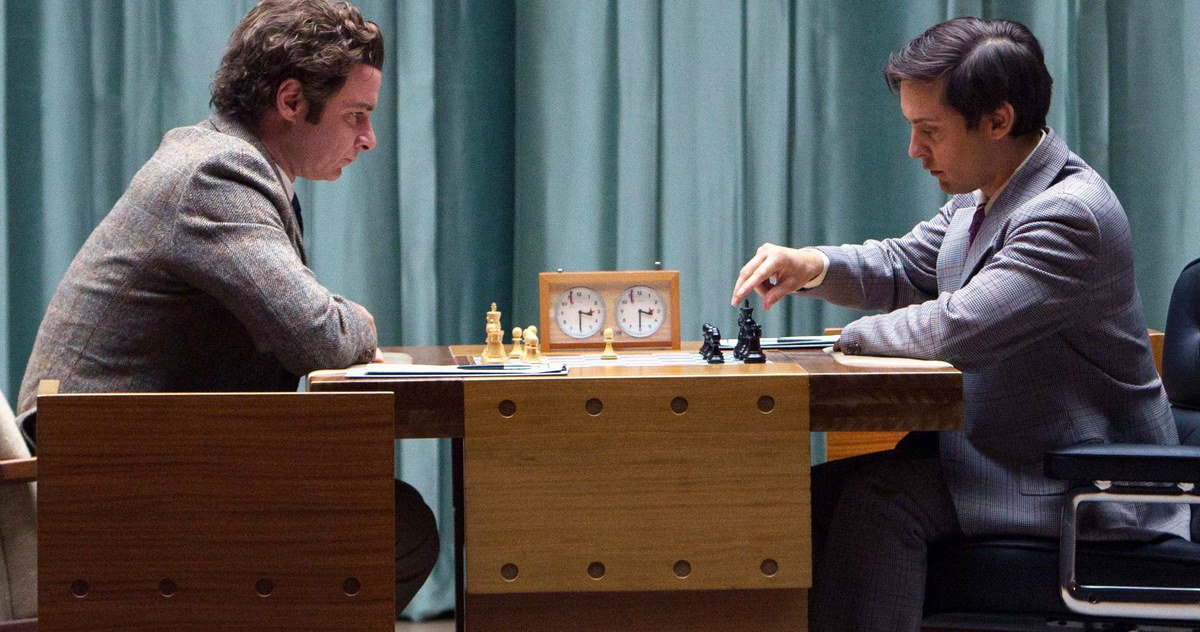
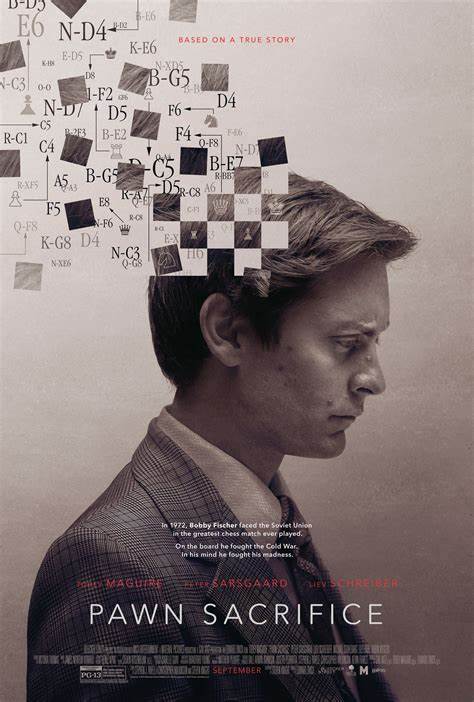
In the 1960s and 70s, Chess suddenly became world news. Like the space race before it, it was effectively a way for the USA and USSR to combat each other without the risky side effect of blowing up the whole world. The USSR had all the best players: until American chess prodigy Bobby Fischer emerged to shatter this monopoly. In 1972 the world seemed to come to a stop to watch the world championship clash between Fischer (Tobey Maguire) and Boris Spassky (Liev Schreiber) in Reykjavik. Ed Zwick’s film attempts to bring together the personal and the political – two superpowers using a game as a proxy for war – into an enlightening package. It fails.

The film opens with Fischer trashing his apartment in search for bugs on the eve of the 1972 final before flashing back in time. You’d expect the film to give us an idea of what bought our “hero” to this point. Zwick’s film utterly fails to do this. Now Fischer – very well played by an aggressively prickly Tobey Maguire – was a hugely troubled man. Though never formally diagnosed some combination of paranoia, OCD and a myriad other personality problems meant he was never more than a step away from self-destruction. Despite this he was deeply driven by an ambition to be the best chess player in the world. Its rich material, but the film never begins to get to grips with Fischer.

Could this be because it wants to tell an uplifting story – the film is really building towards the standing ovation Spassky gives Fischer in game 6 at the 1972 championship when Fischer whipped him in about 40 moves of perfect play – but is struggling with the fact that Fischer himself is deeply unsympathetic. A paranoid conspiracy freak who even by the standards of the 1960s was an aggressive, virulent anti-Semite (Fischer would later match Mel Gibson in his anti-Semitic tirades, blaming Zionism for everything from 9/11 down). A bully who refused to interact with anything except on his own terms, who cut all friends and family from his life for the most minor transgressions. There is no insight given here at all, or suggestion of what was wrong with Fischer.

It’s hard to hang a “triumph against the odds” structure – as Zwick’s unimaginative and conventional film tries to – around this. A far more interesting film would have used the 1972 tournament as an Act 2 triumph and then explored in more depth Fischer’s long spiral of self-destruction that would see him as a bearded eccentric ranting against Jews and America, in exile in Iceland. A film like that would also have then been able to properly do service to the idea of Fischer as a pawn of American state interests, who celebrate him when they want to rub the Soviet nose in it, but then drop him as soon as his purpose is served.

Instead, the film becomes formulaic and empty, leaving us with the impression that we learn nothing about Fischer at all. Why did this man of Jewish descent hate Jewish people so much? Was it self-loathing? What motivated him to seemingly self-destruct his own career so regularly? Was it a fear of being beaten? We have no idea. Instead that opening scene of Fischer destroying his apartment tells us everything we learn about the man over the course of the film. He remains an enigma – and since he’s also deeply unpleasant (the film skirts a little around how much) and we don’t get given any rich material to understand why he’s like this, he becomes a tedious figure to spend time with.

Zwick’s film also fails to communicate the cold war motivations behind this. Although there are the odd shots of the powers-that-be watching on TV in the Kremlin and the White House, we get no sense of how or why these powers are using chess to promote their own ideology. The film is endlessly reliable on vintage and reconstructed newsreel footage to constantly tell us directly things it can’t work out how to do with dialogue, from the political situation to chess moves. You learn nothing about the Cold War from this film. Michael Stuhlbarg’s lawyer turned promoter for Fischer states openly that he wants to use Fischer to show up the Russkies – but that blunt statement is it.

Instead the film is only really interesting when it is effectively recreating footage from the 1972 championship. And when a film’s strong points are recreating real events perfectly, you know you are in trouble. Zwick’s film lacks ideas, a compelling plot, insight or invention. It suffers badly today when compared to the far more dynamic and insightful The Queen’s Gambit (whose lead character is a heavily fictionalised female Fischer). Zwick’s film is him at his plodding, middle-brow worst, presenting a would-be epic shorn of anything of actual interest of controversy. The only thing that redeems it are decent performances from Maguire, Sarsgaard and Schreiber. Otherwise, this is an empty mess that tells you nothing at all about anything. You could checkmate it in about four moves.

Invictus (2009)

Morgan Freeman perfectly captures Nelson Mandela in Invictus

Director: Clint Eastwood

Cast: Morgan Freeman (Nelson Mandela), Matt Damon (Francois Pienaar), Tony Kgoroge (Jason Tshabalala), Adjoa Andoh (Brenda Mazibuko), Julian Lewis Jones (Eitenne Feyder), Patrick Mofokeng (Linga Moonsamy), Matt Stern (Hendrick Booyens), Marguerite Wheatley (Nerine Winter)

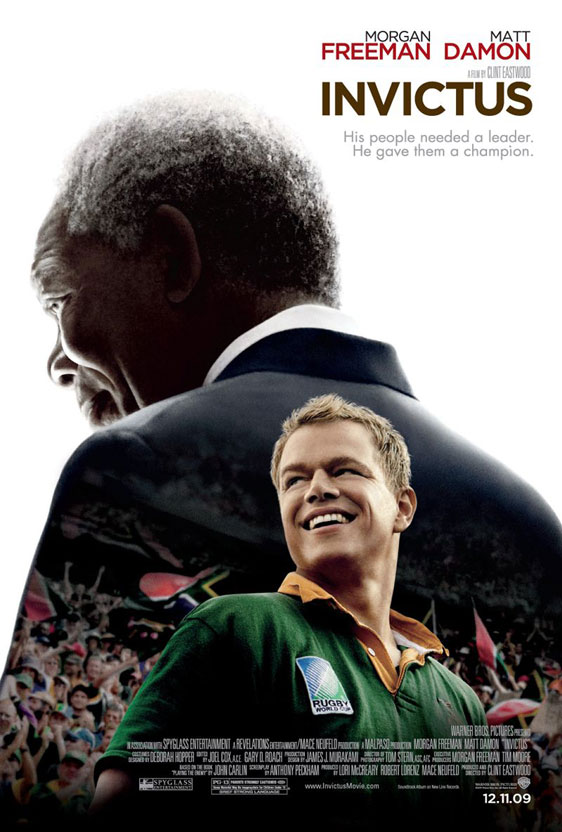
Sometimes, very rarely, a man emerges perfectly suited to his time and place. Perhaps there is no finer example than Nelson Mandela, who emerged from a hellish imprisonment for 27 years on Robben Island to become the first black President of South Africa. The man who could have sparked – and arguably would have had the sympathy of many if he had – a wave of policies that inflicted the same unfairness and injustice on the white population that they had poured onto the black for decades. Instead he chose reconciliation and forgiveness. Can you imagine many other political leaders saying when his people were wrong – and that as their leader, his duty is to tell them so? Invictus would be triumph even if it all it did was remind us of the vision and greatness of Mandela. Fortunately it does more than this.

Like many modern film biographies, the film focuses on a single moment or point in history to explore in microcosm a complex man and his dangerous times. When Mandela (Morgan Freeman) comes to power, South Africa is a country seemingly doomed to division. The whites fear and resent the new power the black population has. The black population is keen on vengeance after years of persecution. Mandela however knows there must be a new way: the hatred propagates only itself, and for the country to move on it must come together as one Rainbow Nation. But in this new nation, there are symbols that are particularly divisive. South Africa’s rugby team, the Springboks their green and gold colours a symbol of apartheid, are the most visible of these targets.

But Mandela understood that, to bring the country together, he must ease the fears of the white population that the end of the apartheid meant an apocalypse for everything they held dear. He pushes to preserves the Springboks name and their colours. He gives the team his backing, and enlists Springbok captain Francois Pienaar (Matt Damon) to help him. Because Mandela knows that the approaching Rugby World Cup, hosted in South Africa, is a glorious opportunity to show the world that the nation is solving its problems. And Mandela is shrewd enough to know that sport can bring people together in ways few other things can. Against all the odds, rugby will become the tool he will use to start the nation healing.

Eastwood’s film is sentimental in the best possible way. It presents a stirring true-life story with a simplicity and honesty that never overpowers the viewer or hammers them over the head. Eastwood also allows space to show in small but telling ways how dangerously divided this country is. From the Presidential staff who start packing up their desks the morning after Mandela’s win, convinced the new President will show them all the door (wrong), to the slow fusing together into one team of Mandela’s personal security staff (black) and their colleagues from the secret service (all white – many of whom arrested Mandela’s colleagues in the past). Even liberal whites like the Pienaar’s keep a black maid as a servant, while ANC party members push for a sweeping aside of every vestige of the old regime.

It’s a dynamite environment in which a single man can make a difference. And with a combination of the sort of patience you learn from 27 years living in a small cell, charm and an unbelievable willingness to turn the other cheek, Mandela is that man. While Eastwood’s film allows beats to remind us he is just a man – his difficult relationship with his family gains a few crucial scenes – the film is also unabashed in its admiration for this titan. And rightly so. Mandela’s smile, his humbleness and his determination to both do the right thing and to avoid provocation is awe-inspiring (his white security guards are stunned that he seems not to hear the abuse he is showered with when attending a rugby game early in his Presidency – he hears and sees everything, their black colleagues assure them).

Morgan Freeman is practically a Hollywood symbol of dignity and righteousness – if he can play God he can play Mandela – and his portrayal of the great man is a perfect marriage of actor and subject. Capturing Mandela’s speech patterns and physicality perfectly, he also brilliantly seizes on his character. This is a man who can put anyone at their ease, who humbly speaks of his excitement of meeting Pienaar, who we see putting hours into learning the names and backgrounds of every member of the South Africa Rugby squad. He’s a realist who knows that change needs time, political muscle and sometimes a willingness to cut corners and force the issue – but he’s also a man to whom principle drives all. Freeman’s Oscar-nominated performance is outstanding.

The strength of the film lies in the simple, stirring hope that it derives from seeing the struggle that even small triumphs need. As we see personal relationships begin to grow – from a security team that segregates itself in their office to eventually enjoying a kick-about together – and the growing sense of community in the nation as the world cup draws near, it’s hard not to feel a lump forming in the throat. The film doesn’t overegg this, but allows the moments to speak for themselves.

But it’s also a sport film – possibly the highest profile rugby film since This Sporting Life. The film recreates the drama of that World Cup very well – as well as the intense physicality of rugby as a sport. Matt Damon physically throws himself into it, as well as playing Pienaar with a natural ease carefully allowing his sense of national duty and awareness of being part of something larger than himself to grow (although an Oscar nod is still a little generous). The camera throws us wonderfully into the games, and the film largely manages to avoid the manufactured drama of the game (largely because what happened in real life was often dramatic enough!)

Invictus may not be the most revolutionary film ever made – and catch it in the wrong moment and you might think it was a sentimental journey – but it’s made with a matter-of-fact, low-key charm that I think manages to not overwhelm the heart. Instead it manages to produce a great deal of emotion from its carefully underplaying. With a fantastic performance from Morgan Freeman, it’s a wonderful tribute most of all to a very great man, who changed his country and the world for the better through the power of forgiveness – a power he was able to invest a whole nation with.

The Program (2015)

Ben Foster is the disgraced Lance Armstrong in this functional but insight free biopic The Program

Director: Stephen Frears

Cast: Ben Foster (Lance Armstrong), Chris O’Dowd (David Walsh), Jesse Plemons (Floyd Landis), Lee Pace (Bill Stapleton), Guillaume Canet (Michele Ferrari), Denis Menochet (Johan Bruyneel), Dustin Hoffman (Bob Hamman), Edward Hogg (Frankie Andreu), Elaine Cassidy (Betsy Andreu), Laura Donnelly (Emma O’Reilly), Sam Hoare (Stephen Stewart)

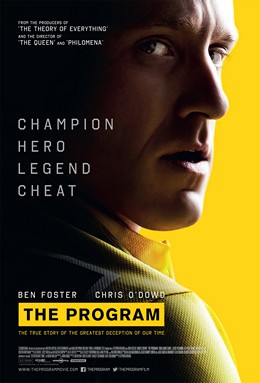
In sports there has probably never been an icon who fell so far as Lance Armstrong. Stephen Frears’ film reconstructs the story of Armstrong’s – played by Ben Foster – career, from finding his natural build and ability isn’t enough to win the Tour de France, through cancer diagnosis and recovery and then into his record-breaking run of Tour victories, all achieved off the back of running a comprehensive and professional doping system, and his final fall from grace.

Frears’ film is well-made and stylish and good at capturing the freedom and excitement of professional cycle racing. It’s also a skilled reconstruction of its time period, and a fairly well structured chronicle of events, which it reconstructs from journalist David Walsh’s (played here with a fine sense of moral outrage by Chris O’Dowd) book Seven Deadly Sins. Walsh had written stories for several years questioning Armstrong’s achievements, and Frears’ film puts together the events and testimonies that convince Walsh of Armstrong’s cheating with a documentarian skill.

Where the film fails though is its lack of drama and, crucially, its willingness to use dramatic and creative licence to attempt an exploration of Armstrong’s personality. What drove this cancer survivor to abuse his body with a parade of substances? How did Armstrong balance his passionate campaigning for a cure for a cancer with the lie he was presenting the world of how he didn’t just recover from cancer, he used it as a springboard to become the greatest endurance athlete in the world? Basically, what the film doesn’t really try to do, is get inside the head of its lead character.

Instead, the film follows its title: The Program. There is greater interest in the how of this cheating regime, not the why. Now perhaps in real life Armstrong is the shallow, narcissistic bully he often seems here, obsessed with winning at all costs with no moral quandaries at all. But it hardly makes for entertaining or satisfying drama. Foster is a brilliant physical match – and he captures the ruthless forward-drive of Armstrong very well – but this is a film that doesn’t really scratch the surface of what made Armstrong. We never get a sense of his motivations – or really his reactions as the world tumbles around him.

There is a fascinating story to tell here, but it’s almost as if the film is worried about giving this sinner some feet of clay we can sympathise with (to mix a few metaphors). Instead Armstrong is all chilled front and nothing underneath, and his villainy is so central from day one that we get neither a satisfying sense of a hypocrite unmasked nor of a Promethean fall from grace. 

Actually, Frears may well have been more interested in making a film where Jesse Plemons’ Floyd Landis was a central character – the devout Christian persuaded to take part in the doping scheme, who becomes Armstrong’s successor only to be immediately discredited in a way Armstrong would not be for years. It’s the tragedy of Landis that really has dramatic potential – a decent man who is well aware what he is doing is wrong, but is too weak to not accept the easy path to glory. It’s this story that has real dramatic potential – and might well have made a better focus for the movie.

The Program isn’t a bad film. It captures the drama of its sport well, and it brings together the events that led to Armstrong’s fall with professional skill. But it’s more of documentary than a drama and to be honest there isn’t much in it that couldn’t be picked up better from actually reading Walsh’s book. There was a lot of potential here – but it needed a film more willing to explore and understand its central character rather than just condemn him as a monster and move on.

Raging Bull (1980)

Robert De Niro takes to the ring in Scorsese’s marvellous Raging Bull

Director: Martin Scorsese

Cast: Robert De Niro (Jake LaMotta), Joe Pesci (Joey LaMotta), Cathy Moriarty (Vickie LaMotta), Nicholas Colasanto (Tommy Como), Theresa Saldana (Lenora LaMotta), Frank Vincent (Salvy Batts), Lori Anne Flax (Irma LaMotta)

On the surface, Raging Bull seems an unusual topic for Scorsese. A sports biopic? For this, the least sports-engaged director in Hollywood? Even in Scorsese’s most masculine works, sports are always noticeable for their absence. But Raging Bull is a masterpiece, a film whose legacy has seen it named as the greatest film of the 1980s, showcasing possibly Robert De Niro’s most famous performance. A brilliant combination of art, searing personal drama and boxing, Raging Bull may not always be the easiest watch in the world, but it’s a scintillating piece of cinema.

Opening in 1964, we see the overweight, ageing Jake LaMotta (Robert DeNiro) preparing for a comic stand-up routine. From there, the film flashes back to the younger Jake in the ring, with the film following LaMotta’s boxing career. However, the real drama is in his out-of-the-ring relationships, with his brother and manager Joey (Joe Pesci) and his second, younger, wife Vickie (Cathy Moriarty). LaMotta inside the ring is a bull, a man who can take unbelievable levels of punishment. Outside the ring though he is a fragile, paranoid, self-loathing man with a sharp self-destructive streak, whose envy and jealousy systematically destroys every relationship he touches.

Watching the film, its clear Scorsese knows very little about boxing but fortunately he knows everything about filmmaking. Raging Bull is a marvel, a superbly made and directed marvel. Scorsese’s triumphant decision was to shoot the film in black-and-white (some truly beautiful work from Michael Chapman). This gives the film both the classic, gorgeous feel of a 1940s Hollywood movie, but also allows the boxing matches themselves to take on an almost impressionistic artistry, with powerfully emotive monochrome images. The photography also creates a stark, documentary like sense of reality for the many scenes of domestic disharmony and violence, while later shots brilliantly allow LaMotta (lost in self-loathing and disgust) to almost disappear into the inky darkness of the frame. Raging Bull would be half the film it is, if it was in full colour.

Recovering from a cocaine addiction that nearly killed him, Scorsese was intimately familiar with self-destruction – and its perhaps this that drew him towards LaMotta’s jealousy, possibly the film’s major theme. LaMotta is a self-loathing individual, who sees little value in himself, who treats pummellings in the ring like just punishments and believes everyone is betraying him. It’s one of the finest films about the green-eyed monster ever made. Obsessed with his younger wife – whom LaMotta first encounters at age 15 and whom he marries as soon as she is legal – LaMotta also earnestly believes she is sleeping with every man around. It’s clear that these paranoid fantasies stem from his own disgust at himself, LaMotta’s own conviction that there is nothing of value in him.

It’s this jealousy that really destroys LaMotta, his trigger-happy temper seeing him able to switch on an instant from a calm – but monomaniacal – insistence that he just wants to know the truth about his wife, to indiscriminate violence. LaMotta is an impulsive, excessive creature who does everything to a huge degree, from doubting his wife, to shovelling food into his guts. Scorsese’s camerawork – particularly it’s La Dolce Vitaish love of Cathy Moriarty – reflects LaMotta’s internal dysfunction. It worships Moriarty in the same way LaMotta does, but also reflects his obsessive possessiveness.  

All of this is further captured in Robert De Niro’s iconic performance. De Niro won the Oscar for this stunning tour de force. Raging Bull became almost as famous for De Niro’s all-consuming preparation: he trained for months to achieve the physique and skill of a professional boxer (he even entered some professional bouts, winning two out of three). He then went completely the other way, the entire film going on a four month hiatus while De Niro went on an eating tour around Italy to pile on the pounds for the ageing, overweight LaMotta. At the time it seemed like no other actor had gone to such levels.

This focus on De Niro’s preparation sometimes obscures in the mind the genius of the actual performance, as if we have almost been blinded by the training and technique behind it. De Niro’s energy, his fury, his intelligent understanding of the fractured mind of the paranoid brilliantly brings LaMotta to life. So intense is the actor’s understanding of the disgust that lies at the heart of LaMotta’s personality that, even at his worst, the man is never completely unsympathetic. De Niro rages through scenes of jealous outbursts and violence, but he also has a childish gentleness of the man unable to understand the world around him, twice in the film collapsing into bursts of affecting tears. The older LaMotta is perhaps wiser, but just as inarticulate in emotions as his younger version and as unable to fix the damage. It’s a masterful performance, a physical and emotional tour-de-force.

De Niro also worked closely on the choreography of the boxing scenes, which allowed Scorsese the freedom to shoot these with an imagination and brilliance that had never been seen before. Each fight has its own unique feel, with Scorsese understanding that this sport is a neat parallel for how LaMotta sees life, a series of brutal clashes with pride and self-regard on the line. Scorsese’s fights are elemental clashes – the soundtrack frequently uses slowed sounds to create an animalistic roar.

The camera is frequently thrown into the ring with the pugilist – and LaMotta here is really more of a pugilist than a boxer, there is very little sense of tactics – with low angles and tight camerawork. Scorsese puts the camera – and the viewer – into the ring, making us part of the fights. Every punch and blow carries impact, and this is perhaps the most blood drenched boxing film in history, with the darkened liquid covering the faces of the fighters and dripping from the ropes of the ring. The fights reflect LaMotta’s mood, with one late fight seeming like an almost medieval battle, mist rolling in and the fighters flying at each other with a reckless abandon. There is nothing romantic about boxing here, it’s a grimy reality of violence with a purpose and brute strength, endurance challenges that only the strongest can emerge from.

LaMotta’s confidence and mastery of the ring is contrasted throughout with his lack of nous and understanding in the real world, and his ability to destroy everything he touches. Joe Pesci excels as his supportive brother who realises far too late the uncontrollable anger at the heart of this fighter, while Cathy Moriarty is also excellent as a young woman whose only real mistake is to want to live some part of her own life. Scorsese charts LaMotta’s destruction of both of these relationships, culminating in the washed up boxer pounding the walls of a jail cell weeping and screaming “Why! Why! Why!”, hatred for his self-destruction dripping from every pore.

Raging Bull looks unlike any other boxing film, instead like a perfectly formed art piece, its soundtrack full of classical tunes and its photography adjusting between the beauty of neo-realism and the cold realities of documentary film making. It’s superb, a masterful film, a work of art and also a profound understanding of the destructive impact of jealousy and self-loathing. Showcasing career defining work from De Niro, it’s no wonder this is still hailed as the greatest film of the 1980s and one of the greatest of all time.

Ford v Ferrari (Le Mans '66) (2019)

Christian Bale as maverick driver Ken Miles in the functional but fun Ford v Ferrari

Director: James Mangold

Cast: Matt Damon (Caroll Shelby), Christian Bale (Ken Miles), Jon Bernthal (Lee Iacocca), Caitriona Balfe (Mollie Miles), Tracy Letts (Henry Ford II), Josh Lucas (Leo Beebe), Noah Jupe (Peter Miles), Remo Girone (Enzo Ferrari), Ray McKinnon (Phil Remington), JJ Feild (Roy Lunn), Jack McMullen (Charlie Agapiou)

There are few more exhilarating things than going really, really damn fast. It’s a primal glee that James Mangold’s racing film Ford v Ferrari (or Le Mans ’66 as it seems to be known over here) taps into, roaring with exciting, fast-paced energy lashed onto a good old buddy movie as two plucky underdogs get the chance to overturn the champs and claim the title. It’s the story of any number of sports movies, but it still works here. It ain’t broke, after all.

It’s the early 1960s and the sales of the Ford Company are down: the baby boomers don’t want to be driving the dull, safe cars of their parents. They want something super sexy. Despite his hesitation Henry Ford II (Tracy Letts) is persuaded the best way to get that sexy image is to get a racing car – and if he can’t buy Enzo Ferrari’s (Remo Girone) company, then by hell he’ll spend whatever it takes to give Ford the best racing team in the world. Targeting the Le Mans 24 hour race, he recruits retired-driver-turned-designer Caroll Shelby (Matt Damon) to mastermind building a car – and Shelby recruits demanding, prickly, maverick Brit driver Ken Miles (Christian Bale) to help him design it and then drive the thing. But what to do when Miles’ blunt plain-speaking and individuality looks like it won’t make him the best spokesman for selling Ford cars?

On the surface Ford v Ferrari is pretty much your standard Sports film. Two teams, an underdog and a champion, a pair of mavericks who think outside the box, the struggle for success – met with initial failure before victory – all told through a familiar structure of brothers-in-arms, obstructing suits, supportive wives at home and plenty of carefully detailed expert recreation of sporting events. It’s a collection of familiar ingredients, but very well mixed together by Mangold (one of Hollywood’s finest middle-rank directors, a sort of heir to Lumet).

The real twist however is that the rivalry is not really about Ford and Ferrari. In fact the film might have been better titled Ford vs Ford. Because the main thing standing in the way of Shelby and Miles isn’t Ferrari – with whom they actually have a rivalry built on mutual respect – but with the bottom-line, sales-first suits who are backing them. It’s a parallel with everything where sales and the buck count more than anything, but you feel Mangold might well have related it most to Hollywood producers. What is Ken Miles, but the genius auteur director who the money-men just won’t trust to churn out the mass-market product they need to lift the share price? Henry Ford (very drily played by Tracy Letts) may have one visceral moment of excitement when placed in the passenger seat of a fast car – but fundamentally he doesn’t give a damn about the sport at all, except how it could help him shift a few more Mustangs.

Shelby and Miles’ struggles are not with the car, the engineering problems or Ferrari – they’re with the Ford VPS (in particular Josh Lucas’ incomparably smarmy Leo Beebe, a corporate man to his fingertips who probably bleeds stock tips) who want a product they can sell, far more than a product that can win. Obstacles are constantly thrown towards Shelby and Miles from their bosses – everything from engine design to race strategy receives a series of notes, comments and instructions from the Ford hierarchy. The choice of driver is most important of all – and they don’t want the demanding Ken Miles behind the wheel of their car. Because mavericks like that don’t sell Mustangs.

As Miles, Christian Bale gives a performance of pure enjoyment. Juggling a version of his own natural accent (which sounds odd – part cockney, part scouse – but works brilliantly) Bale gives the part just the right amount of that peculiar chippy Britishness, that resentment of people in authority, that hostile reaction to the stench of bullshit. Driven, determined but totally unwilling to suffer fools – exhibited almost immediately with him dressing down a prat who isn’t a good enough driver to handle the sports car he’s purchased – Miles is clearly never going to be the company man Ford wants. But with his passion for “that perfect lap”, his determination to work night and day to achieve that and – in a nice change – his warmth for his family and equal decision making with his wife (a slightly thankless part for Catriona Balfe) he’s a character you quickly take to your heart. It’s a great, charisma-led performance from Bale, who also gets nearly all the best lines.

It does suck a bit of the oxygen from Damon, who plays the straight-man as Shelby who is just as passionate but can (just about) speak Corporatese. With a Texan drawl, Damon does the legwork of the movie extremely generously, quietly driving many of the scenes and handling much of the more emotional arc of the movie. The two actors form a superb chemistry – peaking with a hilarious fight scene, your chance to see Batman clobber Jason Bourne with a loaf of bread (both actors, famous for muscular fight scenes, clearly enjoy a fight scene straight out of Bridget Jones). It’s a bromance that really works – and carries at certain points a genuine emotional force.

Mangold packages this material perfectly – and the racing sequences are brilliantly done, engrossing, speaker-shaking displays of racing, fabulously edited. The film itself is probably too long, and the sections away from the race track are sometimes so familiar in their structure and tone that they sometimes drag a little bit, as if the fierce momentum of the racing scenes can’t carry across to the rest of the film. But with fine performances and expert handling, this is certainly a number you’ll be happy to test drive.

The Blind Side (2009)

Sandra Bullock sets her own rules, campaigning for a better life for a young black man in The Blind Side

Director: John Lee Hancock

Cast: Sandra Bullock (Leigh Anne Tuohy), Tim McGraw (Sean Tuohy), Quinton Aaron (Michael Oher Tuohy), Jae Head (SJ Tuohy), Lily Collins (Collins Tuohy), Ray McKinnon (Coach Cotton), Kathy Bates (Miss Sue), Kim Dickens (Mrs Boswell)

Sandra Bullock won an Oscar for this sweet but unchallenging film, the sort of thing you could have expected to see on TV in the 1990s as a “movie of the week”. She plays Leigh Anne Tuohy, a determined and driven woman who adopts and mentors Michael Oher (Quinton Aaaron), a gentle giant of a teenager who has grown up in foster care and who struggles with shyness. Michael has been accepted by his school for his potential skill, but the school can’t cater for his requirements for a less traditional teaching model (he struggles with reading and confidence). All that changes as Leigh Anne pushes for Michael to get the support he needs and encourages him to excel as a footballer.

This is the sort of naked crowd pleaser that will leave a smile on your face – and probably escape your mind after a few days. It’s devoid of challenge and ticks every single box you would expect this kind of rags-to-riches story to cover – the initial struggle, the growth in confidence, the setback, the rebound, the happy ending. It’s all there – and packaged very well by Hancock (heck the film won a surprise nomination for Best Picture).

It’s powered above all by a forceful, larger-than-life performance by Bullock, the sort of “personality” part that the actor has always excelled at (there is no doubt she’s a hugely engaging performer and always has been). Bullock grips the film by the horns and rips through the expected scenes. She’s a glamourous rich woman who isn’t afraid to go toe-to-toe with the local gangsters! She’s wealthy but she’s still in touch with her roots! She’s beautiful but she wears the trousers in the household! It’s everything you would probably expect, and Bullock can more or less play it standing on her head. She brings all her expert comic timing and exuberance to bear and mixes it with an emotional concern and empathy rarely called for in the romcoms that have made up much of her career. In a weak year (Carey Mulligan in An Education was her only plausible rival for the little gold man) she took the prize.

It’s probably the only thing that The Blind Side will be remembered for, however much most people will enjoy it when watching it. Its story of good triumphant and a disadvantaged young man getting the chance to come to peace with himself and turn his life around, are bound to put a smile on most faces. There are lots of funny lines, and Leigh Anne is such a powerhouse she makes a chalk-and-cheese partnership with anyone she shares a scene with. But it’s basically not got a lot more to it than just showing you a rags-to-riches tale, with a few slight notes of racial tension thrown in (and then barely even explored in any depth). A more interesting film might have taken more note of the differences between the Tuohy’s background and the poverty of Michael’s childhood neighbourhood and the fate of the rest of the people who grew up (none of whom had his advantages). But this is more interested in presenting an unlikely, balsy, champion of the underdog promote his life.

I suppose you could say that this film tells the story of the troubled background and eventual success of a young black man and not only filters all this through the experience of a family of wealthy white people, but also suggests that the chances of a black man achieving this without the support of a white family was practically impossible. But, then this isn’t a film with a political agenda. It’s just trying to tell a charming, uplifting story. Take it on those terms and it’s enjoyable. Try to delve into it any deeper and it will puff up and disappear in a burst of feelgood warmth. But the only reason it will be remembered – the only reason why it even remotely stands out – is as the film Sandra Bullock won an Oscar for.