Category: Spy thriller

The Manchurian Candidate (1962)

Frank Sinatra and Laurence Harvey are brainwashed in The Manchurian Candidate

Director: John Frankenheimer

Cast: Frank Sinatra (Major Bennett Marco), Laurence Harvey (Raymond Shaw), Janet Leigh (Eugenie Rose Cheyney), Angela Lansbury (Eleanor Shaw Iselin), James Gregory (Senator John Yerkes Iselin), Henry Silva (Chun-jin), Leslie Parish (Jocelyn Jordan), John McGiver (Senator Thomas Jordan), Khigh Dhiegh (Dr Yen Lo), James Edwards (Cpl Allen Melvin)

Spoilers: Herein the biggest twist in The Manchurian Candidate is revealed
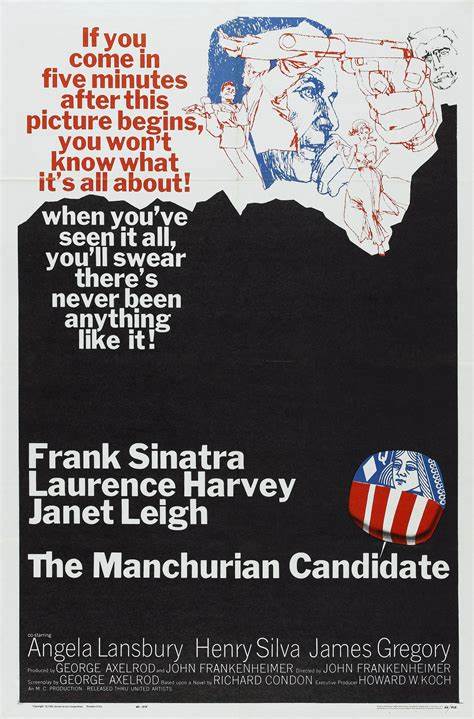
Korean War hero Raymond Shaw (Laurence Harvey) is cold, uncommunicative, reserved and difficult. So why, when asked, does everyone in his platoon say “Raymond Shaw is the kindest, bravest, warmest, most wonderful human being I’ve ever known in my life”? Welcome to the world of sinister brainwashing and mind-control. Welcome to The Manchurian Candidate.

Shaw returns from the war in Korea as a Medal of Honour winner. He saved his entire platoon – with the exception of two casualties – under heavy fire and is America’s blue-eyed-boy, already being hijacked by his ambitious mother Eleanor (Angela Lansbury) as a prop for the Presidential campaign of her second husband, her McCarthy-like puppet Senator John Iselin (James Gregory). But if things are fine and dandy, why does Shaw’s commanding officer Major Marco (Frank Sinatra) keep having a recurring nightmare of a hypnotised Shaw calmly murdering those two casualties in front of an audience of Russian and Chinese officers? Can Shaw be all he seems – or is he the new secret weapon in a deadly Cold War?

A film born at the heart of the paranoia of the sixties – it premiered shortly after the Cuban Missile and would be followed a year later by the assassination of JFK by the Shaw-esque Lee Harvey Oswald – The Manchurian Candidate captures the mood of its time in a way few other films have done. On top of which, it’s a brilliant, edge-of-your-seat ride, crammed with complex psychology and chillingly cold-hearted violence, directed with a more than a splash of cinema verité and plenty of panache by John Frankenheimer at the top-of-his-game. Touches of satire on politics and the media, are mixed with a terrifying fantasia on the powers of mind control. There is no other film that drips with as much sweat as this one (just look at some of those faces!) or plays more brilliantly into our own fevered nightmares of how we can be turned against ourselves.

The action in the film is dealt with all the expertise of a card sharp. The opening scene already tips us the wink about the lies in the memories of our heroes: not only do the soldiers clearly despise Shaw, as he plucks them out of a seedy bar in Korea, but we later see them bundled up by Commie soldiers into waiting helicopters. So, we’ve already got a pretty good idea why Sinatra’s Major Marco is as twitchy and sweaty as he is – and we’re immediately suspicious of just how Shaw managed to get his hands on the Medal of Honour (and why, perhaps, he doesn’t seem that happy about it – as if he already subconsciously knows he doesn’t deserve it).

The truth is revealed to us in an extended sequence that’s a tour-de-force or imaginative visual technique, that Frankenheimer doesn’t get enough credit for. Marco’s dream starts in a genteel hotel in America’s South, with a polite middle-class lady giving a talk about flowers on stage, surrounded by the platoon. The camera moves from the stage in a smoothly uninterrupted 360 turn looking at the audience of similarly middle-class, middle-age belles, before returning to the stage where the hotel backdrop has been replaced by huge banners of Stalin and Mao and our genteel lady has turned into a sinisterly jovial Chinese scientist.
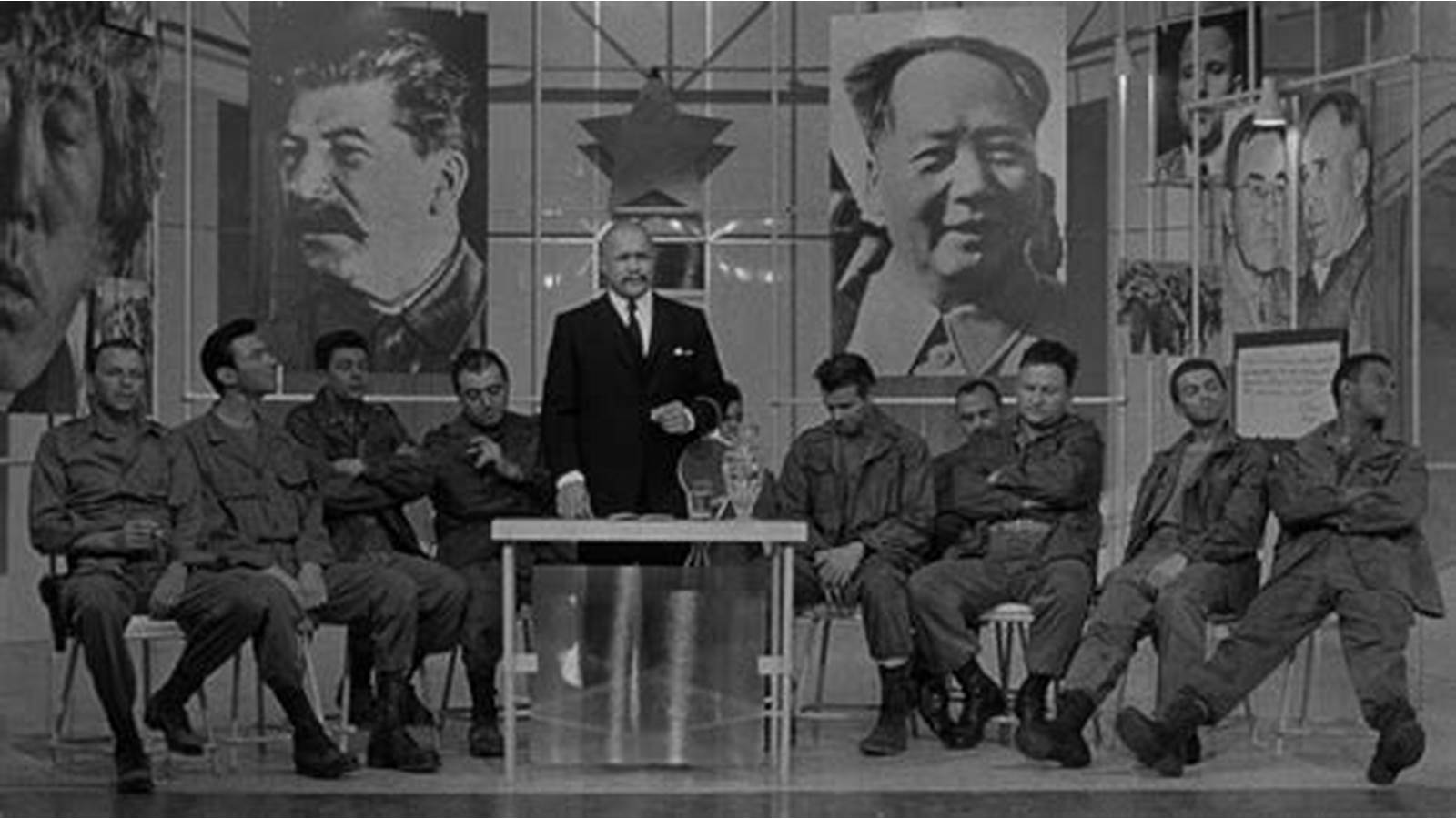
During the sequence that follows, the camera shifts constantly from the subjective (Marco’s false memory of the hotel and ladies) and the objective (a surgical observatory pit with watching Communist apparatchiks), while never interrupting the chilling scientific explanation from Khigh Dhiegh’s (brilliant in every way) scientist. During this inspired barrage of false and true memories, spliced with alarming moments of violence, we witness just how far Shaw’s brainwashing programming has gone as, with complete politeness, he goes about shooting one soldier in the head and quietly strangling another. No wonder Marco – and the other soldiers who all share versions of the same nightmare – wakes up screaming every morning.

And why did they pick Shaw? Well obviously, his mother-fixation already makes him more than susceptible to external control (under hypnosis he describes Marco as his best friend – something that, Dr Lo points out, speaks volumes for his inclination to prostrate himself to authority). Played with an austere distance by Laurence Harvey – the film expertly uses Harvey’s prickly air of patrician woodenness – Shaw is desperately weak-willed and a natural follower, who has never escaped his mother’s influence. He’s already a lonely man, nursing heart-break, loathing the brashness around him with an elitist hauteur, but lacking the force of character to do anything about it. No wonder he’s ready to be reprogrammed.

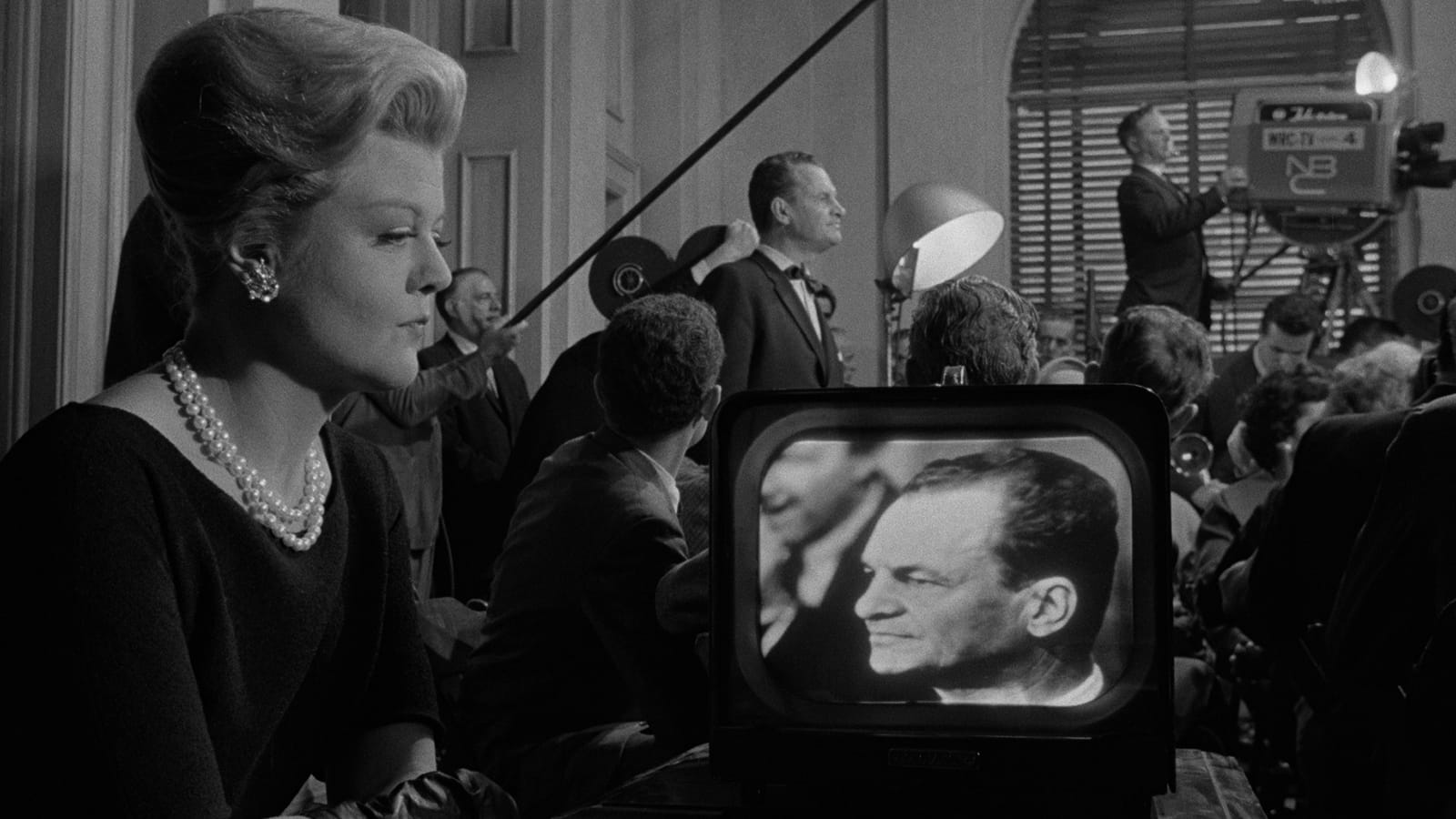
And of course, there is no controller he is more likely to follow than his mother. Angela Lansbury excels in her finest, most iconic screen role, as Shaw’s ambitious, deadly, controlling and manipulative mother. Is there a finest reveal, than her sudden invitation at a fancy-dress party for Shaw to “pass the time by playing a little Solitaire”? The film skilfully suggests that it is power rather than ideology that motivates Eleanor – even before the reveal she’s clearly the brains in the marriage with her dull husband, and a forceful, overbearing presence to her son. It’s revealed she’s already wrecked poor Shaw’s life – forcing him to jilt his true love Jocelyn (Leslie Parish), because marriage to the daughter of a political rival ain’t part of the plan. Maybe as well she’s motivated by the unsettling air of incest between the two of them.
No wonder Marco starts to feel sorry for him. Sinatra is very good in this film, striking a perfect balance between twitchy unease and a growing fatherly concern for Shaw. Notoriously a one-take actor (a key scene where Sinatra appears slightly out-of-focus – an effect that suggests we are seeing him from the screwed up Shaw’s perspective – was in fact because Sinatra was most effective in the first take, but the camera was incorrectly set-up), Frankenheimer uses his presence extremely well. He has a brutal fight scene that uses every inch of his energy, while he’s not afraid to add a touch of vulnerability into his burgeoning relationship with Janet Leigh’s stranger on a train (despite an initial scene that suggests all sorts of intriguing possibilities, this is a rather thankless part for Leigh, which she still performs expertly). Like Harvey, his face is frequently studied dripping with sweat.

It’s all shot with a brilliantly immediacy. A press conference – where Iselin (the McCarthy satire is hilariously wicked) rants about Commies in the State Department – is shot with such observatory skill, it feels alarmingly real. Moments of lightness – the slightly dreamy flashbacks of Shaw and Jocelyn running playfully together near the sea – are immediately punctured by terrifying moments of unsensational suddenness, none more so than when a programmed Shaw assassinates Jocelyn and her father (the bullet passing through a carton of milk in his hand, which pours out across the floor). It culminates in a race-against time that’s played out with a hair-raising tension.

The Manchurian Candidate combines skilful acting with real cinematic force and invention from Frankenheimer. It creeps into the darkest corners of our mind and invites our nightmares to come out to play. Dark, at times even blackly comic, it’s possibly the finest and most influential conspiracy thriller ever made.

Enemy of the State (1998)

Will Smith and Gene Hackman dodge the surveillance state in Enemy of the State

Director: Tony Scott

Cast: Will Smith (Robert Clayton Dean), Gene Hackman (Brill), Jon Voight (NSA Director Thomas Reynolds), Regina King (Carla Dean), Jason Lee (Daniel Leon Zavitz), Lisa Bonet (Rachel Banks), Barry Pepper (Agent Pratt), Loren Dean (Agent Loren Hicks), Jake Busey (Agent Krug), Lisa Bonet (Rachel Banks), Jack Black (Agent Fiedler), Jamie Kennedy (Agent Williams), Seth Green (Agent Selby), Ian Hart (Agent Bingham), Stuart Wilson (Congressman Sam Albert), Jason Robards (Congressman Philip Hammersley), Tom Sizemore (Paulie Pintero)

A congressman (a cameoing Jason Robards) is murdered for refusing to support intrusive new counter-terrorism legislation championed by NSA director Thomas Reynolds (Jon Voight). Unfortunately, someone caught the killing on camera. When the NSA come hunting, he plants the recording on an unwitting lawyer friend, Robert Clayton Dean (Will Smith). Dean has no idea he has evidence that could blow the conspiracy – and is nonplussed when they set about destroying his life. The only person who can help is mysterious surveillance expert Brill (Gene Hackman), who has spent decades living off the grid. Can the clear Dean’s name and stop the bad apples in the NSA?

Enemy of the State is a fun chase movie, that enjoys the technical possibilities of the surveillance state, packaged with the fast-pace, bright colour-filtered style of Tony Scott (this is one of his best films). There is more than enough wit and enjoyment about it – not to mention watching a host of very good actors, many of them unknowns at the time, bring a lot of sparkle to the film (you’ve got to give kudos to the casting director). Everything of course gets tied up in a neat, pretty bow but it’s a damn lovely bow so that’s fine.

In its detailed look at the power of the surveillance state, Enemy of the State was, in a way, ahead of its time. The ability for the intelligence agencies here to look into literally everything in your life is pretty unsettling, from bank details to computer accounts. Every camera is an eye and satellites are tasked at will to watch anything. In fact, it’s quite something to remember that the state is only more powerful today – the internet and mobile phones would making tracking Dean even easier than the bugs they secrete about his person, which causes him to flee our baddies stripped to his undies. (Also, if only Reynolds had waited a few years, congress would wave through legislation such as he is requesting here, without batting an eyelid).

The film also dares to shade a little bit of naughtiness into Will Smith’s character. Sure, he’s a crusading labour lawyer (we’ve got to know he’s on the right side!) but he’s also an adulterer with trust problems in his marriage. Smith’s still at his charming best here, and his frazzled desperation as he struggles to understand why on earth the NSA is destroying his life is well-handled. Regina King gets a thankless role as Dean’s shrill wife, whose trust in her husband oscillates according to the requirements of the script, rather than any internal character logic.

Enemy of the State sometimes teeters on the edge of making a point about the dangers of the surveillance state. How easy could it be to abuse this power? Unfortunately it puts most of these arguments into the mouth of Regina King’s holier-than-thou wife, which rather undermines them. It’s also made abundantly clear that we’re witnessing rogue agents. This allows the film to focus more on the cool things surveillance can do, rather than clearer moral statements about whether that’s right or not, other than it being a dangerous tool in the hands of the wrong men.

Scott’s film is more of an entertainment than a treatise though (and thank God for that). It also has a nice little touch of 1970s’ conspiracy thriller to it, something the film leans into with the casting of Gene Hackman in a role reminiscent of Harry Caul in The Conversation. Sure, I can’t remember Caul driving a car while it was on fire or blowing up a building, but Hackman still gives the film some class and a touch of old-school espionage and cynicism. Truth-be-told, other than profession, Caul and Brill have very little in common (Brill is far more confrontational and confident, and much less likely to rip his apartment apart) but it’s still a nice call-back. I also rather enjoy Gabriel Byrne’s smart, playful little cameo as ‘fake’ Brill (hardly a spoiler as you can’t move without knowing Hackman is in the picture).

Scott’s high-energy fun culminates in a smart little trap laid by Dean for all his enemies, that plays nicely off the fact that the NSA agents and the Mafia are definitely paranoid and stubborn enough to not realise they are all talking at cross-purposes. The end of the film sees everything back to normal (it’s unclear how, or if, Dean got his job back considering his unceremonious firing), but I wouldn’t worry about it. It would be nice if it had said more, but as a rollercoaster ride it’s short, sharp and sweet.

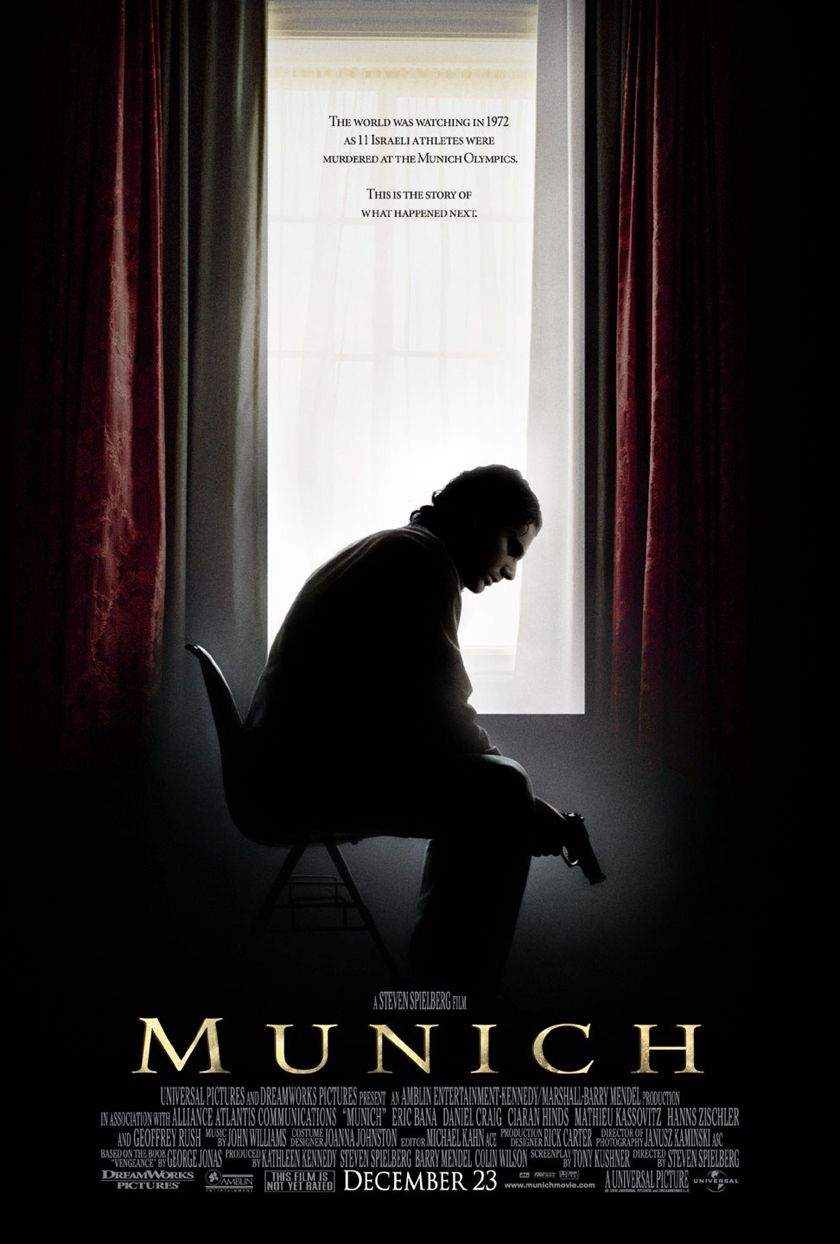
Munich (2005)

Eric Bana leads a team of Mossad agents in Spielberg’s uneven terrorism drama Munich

Director: Steven Spielberg

Cast: Eric Bana (Avner Kaufman), Daniel Craig (Steve), Ciarán Hinds (Carl), Mathieu Kassovitz (Robert), Hanns Zischler (Hans), Geoffrey Rush (Ephraim), Ayelet Zurer (Daphna Kaufman), Mathieu Amalric (Louis), Michael Lonsdale (Papa), Marie-Josée Croze (Jeanette), Lynn Cohen (Golda Meir)

At the 1972 Munich Summer Olympics, 11 members of the Israeli Olympic team were murdered by a Palestinian terrorist cell, Black September. The world was shocked and appalled. Israel responded with a hard-line anti-terrorist campaign, that saw Mossad teams traversing the globe, assassinating Palestinian leaders involved with Black September. They learned not only was terrorism a hydra, but that the moral high-ground erodes quickly when the shooting starts. Can terrorism be defeated by violence? Munich argues not: instead suggesting violence is a beast that feeds itself – an argument that, in 2005 in the fourth year of the War on Terror (the film ends with a shot of the World Trade Centre) was increasingly relevant to another country, traumatised by the slaughter of innocents.

Adapted by Tony Kurshner and Eric Roth, it’s based on a book Vengeance by George Jones about the man who claimed to be the leader of the Mossad cell (whether that is true or not is debated). He’s fictionalised here (to side-step that issue) as Avner Kaufman (Eric Bana). His team consists of driver Steve (Daniel Craig), explosives expert Robert (Mathieu Kassovitz), forger Hans (Hanns Zischler) and clean-up man Carl (Ciarán Hinds) with Ephraim (Geoffrey Rush) as their handler. The team hunt down and eliminate their targets – but as the mission goes on they pay a heavy cost, both in their eroding of their own moral certainties and in blood as they become targets for repercussions.

Spielberg’s film is his least flashy, least sentimental and (I suppose) most mature film, a cold-eyed, even-handed look at the Middle East conflict that acknowledges faults and consequences on all sides, draped in the muted colours and bleached out photography of 1970s conspiracy thrillers. It’s also a very long and very self-consciously important film, that makes mis-steps and at times is crudely obvious as well as being more interested in posing questions than presenting any answers. Where it is at its best, is demonstrating how campaigns like this are tasks worth of Sisyphus.

Munich takes a long, hard look at the cost of violence – both on its victims and its perpetrators. Death in this film is slow, painful and frequently disturbing. Shot people stagger and slump in drunken shock, dying slowly. Bomb victims are ripped apart, recognisable limps left hanging from walls and ceilings. Machine gun bursts tear bodies apart. The cost of inflicting this violence leaves increasingly deep psychological violence on the team (we don’t get to see if it does on the Palestinians, a limit to the films even handedness), as it becomes harder and harder to treat those they kill as faceless monsters, rather than men with families of their own.

Spielberg reconstructs the horror of the killings in Munich with a documentary realism, not shying away from the horror. It follows the appalling opening moments of the attack, with the athletes taken hostage and the shocked world media reaction. Spielberg returns later in the film to restage the final murder of the athletes at the Munich airport with sickening detail (perhaps too much – but more of this scene later).

Showing the impact of violence from both sides, Munich strains at always being even-handed (despite this both sides attacked it for bias). It’s an Israeli story so we mostly see the psychological impact of carrying out the violence on the Israeli team, and little of the Palestinian perspective. But the film throws in a chance meeting between Avner and what-could-be his Palestinian equivalent, where Avner is brutally told that, when fighting for their home, the Palestinians will never give up, and consider any price worth paying – attitudes he can’t help but recognise as he fights for his own home. The film has clear sympathy with the sufferings of the Jewish people, and their need for a home of their own – but wonders if this is the right way to defend it. Spielberg is a friend to Israel – but wants to be an honest one.

What starts out as clear and simple (a campaign against terror) becomes morally complex. The team’s first targets are sympathetic, family men. When Avner talks to a later bomb victim, he’s friendly and welcoming. A Palestinian cell they (accidentally or maliciously) end up sharing a safe house with, thanks to their mutual French contacts, are surprisingly relatable. The mission’s accomplishments are unclear – the targets are killed, but all that happens is more people take their place. Worse, those that do are only more infuriated by the campaign of violence.

That’s the question – how do you fight terrorism? It breeds on a belief of injustice and persecution – and Spielberg’s film suggests, all the campaign does is pour petrol on that fire. Avner becomes a paranoid psychological wreck by the end of the film, plagued with a loss of moral certainty. The film argues that the only result of all this has been the price he and other have made – an end to the violence is further away than it was at the operation’s beginning.

Spielberg’s film is strong on showing the pointlessness of this campaign. What it’s less strong on is answers. In many ways, the film boils down to a simple “deep down we are all the same, why don’t we just get along” message. While handsomely filmed and daring in its questioning about the futility of anti-terrorist (and indeed terrorist) action, it’s a simplistic film, largely lacking nuance. The characters are ciphers – Bana, for all his skill, plays a shell of a character, designed to make statements, who is alternately ruthless or questioning as the plot demands. Because the film strives so hard to remain even-handed, it brings little to the table itself in terms of proposed solutions, merely focusing on telling us what we know: an eye for an eye eventually makes his all blind.

It’s also a film that has more than its fair share of clumsy mis-steps. It’s view of the world is picture post-card in is simplicity. First thing we see in Paris, is a shot of the Eiffel Tower. Go to London and it rains. First shot in Holland is our characters on bikes. Its characters are largely plot devices, well played but rarely fleshed out in people who feel like human beings, more like mouthpieces to express viewpoints.

Most atrocious of all, the film concludes with a penultimate sequence staggering in its misjudgement. Retired and living in America, Avner makes focused, vigorous love to his wife intercut with the showing of the final deaths of the athletes in brutal detail. It’s tasteless, ill-judged and horrendously unclear. I suppose we are meant to think Avner is purging himself of his burden of guilt – but the scene is so appallingly done, so grossly detailed it comes across as both offensive and insultingly twee in using the deaths of real people (staged in detail) to help our lead character feel better about himself. When Spielberg does sex, he invariably gets it wrong – and does again here.

Munich is a very worthy film, but it’s too-long, dramatically simple, for all its daring commentary on the war on terror. It’s well-acted – Michael Lonsdale and Matthieu Almaric are very good as Avner’s French contacts, while Hinds is a stand-out among the team – but the characters are ill-formed and the entire film takes a very long time to make a very simple point. Well-made but a film trying a little too hard to always be profound.

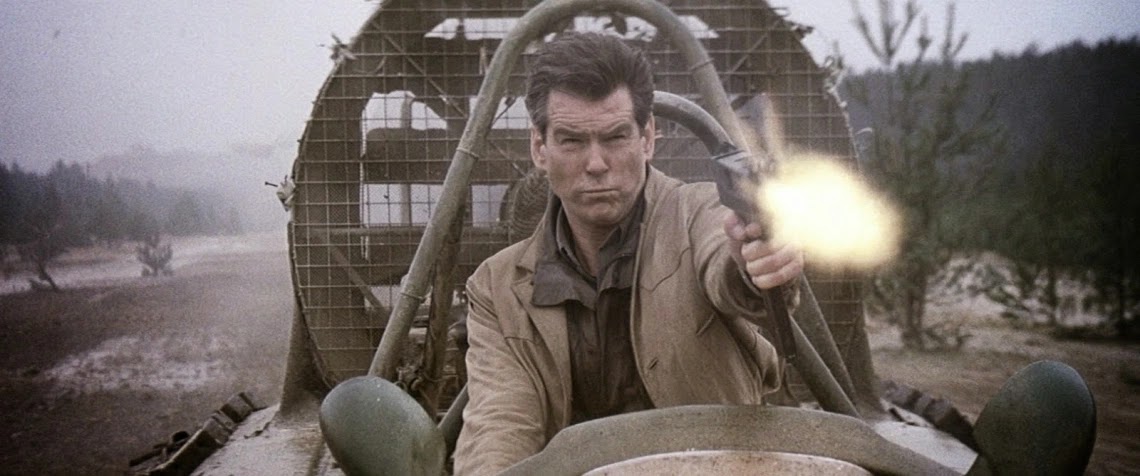
Tomorrow Never Dies (1997)

Pierce Brosnan and Michelle Yeoh take on big media in the fun Bond film Tomorrow Never Dies

Director: Roger Spottiswoode

Cast: Pierce Brosnan (James Bond), Jonathan Pryce (Elliot Carver), Michelle Yeoh (Wai Lin), Teri Hatcher (Paris Carver), Joe Don Baker (Jack Wade), Ricky Jay (Henry Gupta), Gotz Otto (Richard Stamper), Vincent Schiavelli (Dr Kaufman), Judi Dench (M), Samantha Bond (Miss Moneypenny), Colin Salmon (Charles Robinson), Geoffrey Palmer (Admiral Roebuck), Julian Fellowes (Minister)

For Pierce Brosnan’s second Bond film, they knew there was life in the old dog yet. GoldenEye’s success meant Tomorrow Never Dies could be all about bangs and fun, a Moore-esque caper with a modern touch. And fun it certainly is – exciting, amusing and with some top gadgets. This doesn’t re-invent the gun barrel, but it gives us a hell of a ride.

A British Navy ship is sunk in Chinese waters (the navy is always so luckless in Bond films!) and a Chinese MiG is shot down. Each side blames the other: but MI6 believe they are both being played against each other by a third party – media mogul Elliot Carver (Jonathan Pryce). There’s 48 hours to find the truth and stop a war. Best send Bond (Pierce Brosnan) to Carver’s HQ to shake things up, not least because he has a past relationship with Carver’s wife Paris (Teri Hatcher). Soon partnering with Chinese Intelligence agent Wai Lin (Michelle Yeoh), the two work to expose Carver’s dastardly schemes to start a war to increase his ratings and secure those lucrative Chinese broadcast rights.

Tomorrow Never Dies sometimes has a by-the-numbers feel to it – probably because the script was written on the go, with only locations and set-pieces decided in advance. Usually that’s a recipe for disaster, but with TND it works. Probably because everyone looks like they are having a whale of a time making it and the tongue is wedged so firmly in the cheek it’s practically touching the ear. And its concept of a mogul using fake news to manipulate the world seems alarmingly prescient today – think how powerful Elliot Carver would be if he ran Twitter (as he surely would today).

You can forgive Tomorrow Never Dies almost anything because it has so many stand-out sequences. The film has a (literally) explosive start, with Bond racing against time to fly some nuclear missiles out of a terrorist trading camp, before a British cruise missile blows the base sky high (and “make Chenoboyl look like a picnic”). Naturally the destruction as Bond lays waste to the camp makes you wonder why they wasted the money on a cruise missile when Bond can destroy the place for free.

Front-and-centre though is the “Bond drives a car through a shoot-out on the back-seat with a remote control” sequence. Which when written down, captures only about 5% of the sequence’s delight. Narrated by an over-cautious sat nav (constantly warning about hazards ahead, while the car is pummelled by bullets), we get all the gadgets we expect (bullet-proof glass, rockets, caltrops, a buzz saw that conveniently rises to the exact height required to cut through a steel wire obstacle) while also watching Bond masterfully steer a car around a multi-storey car-park on his phone from the back seat. Of course, Brosnan knows it’s silly and telegraphs his enjoyment, letting out a chuckle when he reinflates his tyres after driving over his own caltrops (I love this moment).

Tell me he’s not having fun.

There is a cursory sense of mystery, but TND wisely doesn’t have much patience with that. Bond is nominally under-cover at Carver’s HQ as a banker (inevitably using his own name) but, just like his Moore-heyday, Bond’s undercover skills are hilariously bad and his hints clankingly blunt. Fortunately Carver follows Bond villain form, confirming any suspicions by ordering his goons to beat Bond black-and-blue (more fool them, as Bond uses every instrument in a sound proof recording studio to best the baddies).

This was Brosnan in absolutely top form. He’s extremely charming, handles the action very well and gets more than a few grins. He looks like a guy just delighted to be there, living the dream of playing Bond. He’s both self-deprecating and cocksure and manages to be both a believable ruthless killer and a sort of charming little-boy-lost when needed. He loves a pun in a way no other Bond apart from Moore has done (“brushing up on a little Danish” indeed…) and his chemistry with Michelle Yeoh is superb, the two playing off each other like a sort of all-action Morecambe and Wise.

It’s a Bond where comedy is to the fore. An expensive satellite at Carver’s HQ is introduced (“It’s worth $300 million. You break it, you bought it”) solely so Bond can trash it without a second glance. A hitman (hilariously played in a cameo by Vincent Schiavelli) assures Bond he could “shoot him from Stuttgart” and still make it look like a suicide then apologises with embarrassment when he has to delay the hit to ask Bond how to unlock his car (“I don’t know what to say. I feel like an idiot.”). Moneypenny even calls Bond a “cunning linguist” after she interrupts by phone Bond’s tryst with a Danish professor (a joke which I certainly didn’t get when I first watched the film at a young age).

The lighter side of the script works more successfully than some of the attempts at emotion. The script bluntly states Bond had deep feelings for Paris Carver, but this never comes across at all in the performances. Probably because the emotions were torpedoed by the blatantly obvious lack of chemistry between Brosnan and Hatcher (allegedly they couldn’t stand each other). This is made all the more obvious by contrasting it to the delightful chemistry between Brosnan and Yeoh (watch the motorcycle chase with them handcuffed together – brilliant stuff, and Yeoh is excellent in this). When Paris is dispatched early in the film, Bond is cut up about it for literally 10 seconds before he’s having a whale of a time in that car park chase.

“There’s no news…like BAD news!”

Like many Bond films you can see how the franchise had become besotted with the latest “cool thing” in cinema. In this case, the film seems deeply in love with John-Woo-Hong-Kong-action gunplay. Bond probably fires more automatic machine guns in this film than he does in all the rest of the franchise put together, and the film’s finale (the dullest set-piece) is a run-of-the-mill shoot-out on a stealth boat, that feels pretty familiar from the series’ countless “face off in a sub” endings.

Spottiswoode directs with a straightforward lack of flair. Pryce has fun going OTT (and channelling Gus Hedges from Drop the Dead Donkey) as Carver even if the part is a bit under-written. But the main joy is in watching Brosnan have a huge amount of fun running around, blowing things up and shamelessly smirking through some dodgy puns. His Bond may never have been the most complex interpretation, but at his best I’m not sure anyone else was as purely enjoyable. Much like the film.

Argo (2012)

John Goodman and Alan Arkin say hoorah for Hollywood in Ben Affleck’s middle-brow, over-praised award-winner Argo

Director: Ben Affleck

Cast: Ben Affleck (Tony Mendez), Bryan Cranston (Jack O’Donnell), Alan Arkin (Lester Siegel), John Goodman (John Chambers), Victor Garber (Ken Taylor), Kyle Chandler (Hamilton Jordan), Tate Donovan (Robert Anders), Clea DuVall (Cora Amburn-Lijek), Christopher Denham (Mark Lijek), Scoot McNairy (Joe Stafford), Kate Bische (Kathy Stafford), Rory Cochrane (Lee Schartz), Taylor Schilling (Christine Mendez)

There is an art to telling a “true story”. Apollo 13 is a masterclass in turning a story everyone knows into edge-of-the-seat tension. For many people, Argo does a similar trick. It doesn’t for me. I can’t understand the praise for this middle-brow, conventional movie other than that its smoothly made blandness makes it easy to watch. I got so annoyed when re-watching it I threw my slipper down in anger, like the middle-class rebel I clearly am.

Anyway, the film kicks off with the US embassy in Tehran being stormed on 4th November 1979. While the embassy staff are taken hostage, six embassy officials escape and find shelter with the Canadian ambassador Ken Taylor (Victor Garber). But how to get them out of the country safely? CIA extraction officer Tony Mendez (Ben Affleck) comes up with the “best bad plan we’ve got” – set up a fake Hollywood production company, finance a fake movie, fly to Tehran, then fly the fugitives out on Canadian passports, passing them off as the movie’s crew on a scouting mission. The cover film is sci-fi epic Argo, and with producer Lester Siegel (Alan Arkin) and famous make-up artist John Chambers (John Goodman) on board to give the project realism, the mission is on.

Argo won itself a lot of friends on the way to its Oscar for Best Picture. Why? Because this is a very easy-to-swallow, middle-of-the-road film that successfully turns an American foreign policy disaster into a charming heist movie with a happy ending. It faithfully follows the pattern of all heist movies: the crazy idea, pulling together the perfect team, the difficult rehearsal, the weak link who pulls it out of the bag at a crucial moment even the panicked “we do it anyway!” ending as the best-laid-plans need to be partially improvised on the fly.

In fact, for all its desperate attempts to look like a smart, political, 70s-style piece of cinema making, The Sting is by far and away the 1970s film it most resembles, for all it wants you to think it’s The China Syndrome by way of All the President’s Men. The film starts with an inspired story-board montage of the way Western interference in Iranian politics from 1953-1979 effectively ruined the country. But that’s as good as it gets politically. After that, any further attempt to engage with either Iran or America’s foreign policy gets completely abandoned. It becomes a simplistic rescue story stuffed full of uncomplicated goodies and baddies.

Hollywood of course loved it. Why wouldn’t it? There’s only one thing Hollywood loves more than a film that takes good-natured insider pot-shots at itself. And that’s a film where Hollywood saves the day. Argo does both. It’s a celebration of how Hollywood may be shallow, but when push comes to shove it delivers. Alan Arkin (Oscar-nominated for a role he could play standing on his head) coasts as a (fictional) old-school producer, selling the film’s mediocre punchlines about the Golden Globes, WGA and the uselessness of directors. Argo has a real “slap-on-the-back” air to it, the sort of gentle roast you might get from a guest speaker at an end-of-year party.

But of course you want to know: why did I threw my slipper? Quite frankly, Argo is a con. It starts with a burst of documentary-style realism, charting the attack on the embassy. The film uses a range of different film stocks, including home-movie style footage and newsreel material. It gives an impression of complete factual reality. But, like the movie, that’s just an impression. None of the footage we see is from the time period. It’s all glossily re-created to give the idea that we are watching something snatched from the headlines.

It’s probably the last time the film touches reality. Because from there Argo is a “true” story only in the broadest sense. Almost every single specific in the film is invented or repackaged. Most crucially, the film presents all this as a CIA operation from top-to-bottom. In reality, it was a Canadian operation, with the CIA providing assistance. Not the impression you get here. Even worse the end even has the team at Langley smugly smacking each other on the back and saying they’ll give the Canadians the credit for National Security reasons. Ouch. Not content with that, it also falsely accuses the Brits and New Zealanders of leaving the fugitives hanging out to dry. Ouch again.

I don’t mind most of the film’s other myriad inventions. Its fine to hugely expand the Hollywood stuff, as it’s fun. I don’t care that Mendez (who was Hispanic by the way – but I guess Affleck with a beard is the next best thing) was only in Tehran for 36 hours not the several days he is in this film. Building a bit of tension at the airport passport control – until that weak link proves his worth by talking fluently through the made-up film’s plot – is classic heist cinema. It’s cliched but its fine.

What really, really bugs me is that Affleck and team obviously decided the real story wasn’t exciting enough so – while poking fun at the shallowness of Hollywood – turned this story into exactly the sort of shallow adventure-fantasy that’s Hollywood’s bread-and-butter. In real life, there were nerves at the airport, and a delay to the flight. And there is a lot of old-school-conspiracy-thriller-tension that could have been created with that – if the film really was the sort of The Parallax View style thriller it wants you to think it is.

But that’s not bombastic enough for Affleck et al. Instead the ending is ludicrously overblown, stuffed with problems to overcome. The mission is off-then-on-again (this convoluted resolution requires a real-life childless man to have two kids at school). Then the Iranians work out something is up, and tear through the airport, guns waving in a race to stop the flight. Police cars race onto the runaway as the plane carrying our heroes takes off. And then I threw my slipper.

I threw it because it makes no sense. If the Iranian secret service knew about the extraction, they wouldn’t run through the airport. They’d RADIO THE CONTROL TOWER and stop the plane taking off. They’d scramble jets to bring the plane back while it was still in Iranian airspace. They certainly wouldn’t race cars onto the runaway – and I’m not sure a civilian plane would take off with an armoured car just underneath its wing. Nothing like this happened, or would happen. Its reality filtered through the tired cliches of Hollywood movies. It doesn’t even feel true.

Argo starts trying to comment on world affairs, but then focuses overwhelmingly on a minor victory in the middle of a disaster. The Iranian hostage crisis was a national humiliation that lasted years. But in this film, Affleck shows he learnt something from Pearl Harbor just like that film’s celebration of the Doolittle raid, this uses a small success to excuse a disaster. We even get Jimmy Carter bragging in voiceover that the crisis was resolved without resorting military force: the only reason for that was because the military strike Carter himself ordered was so ineptly planned it had to be humiliatingly cancelled mid-mission.

Argo doesn’t care. It’s a cuddly story about Hollywood saving the day, that starts with a critical eye and turns into a cheerleader for Carter’s disastrous policy in Iran. The hostage crisis is a tough story it doesn’t want to talk about (a brief scene of some hostages undergoing a mock execution only reminds us that the film can’t be bothered to talk about them). It repackages disaster as triumph and pretends to be a cleverer, richer film than it is. It apes 1970s conspiracy thrillers and political films but is only a faint shadow of them. Garlanded with awards, it’s competent-at-best.

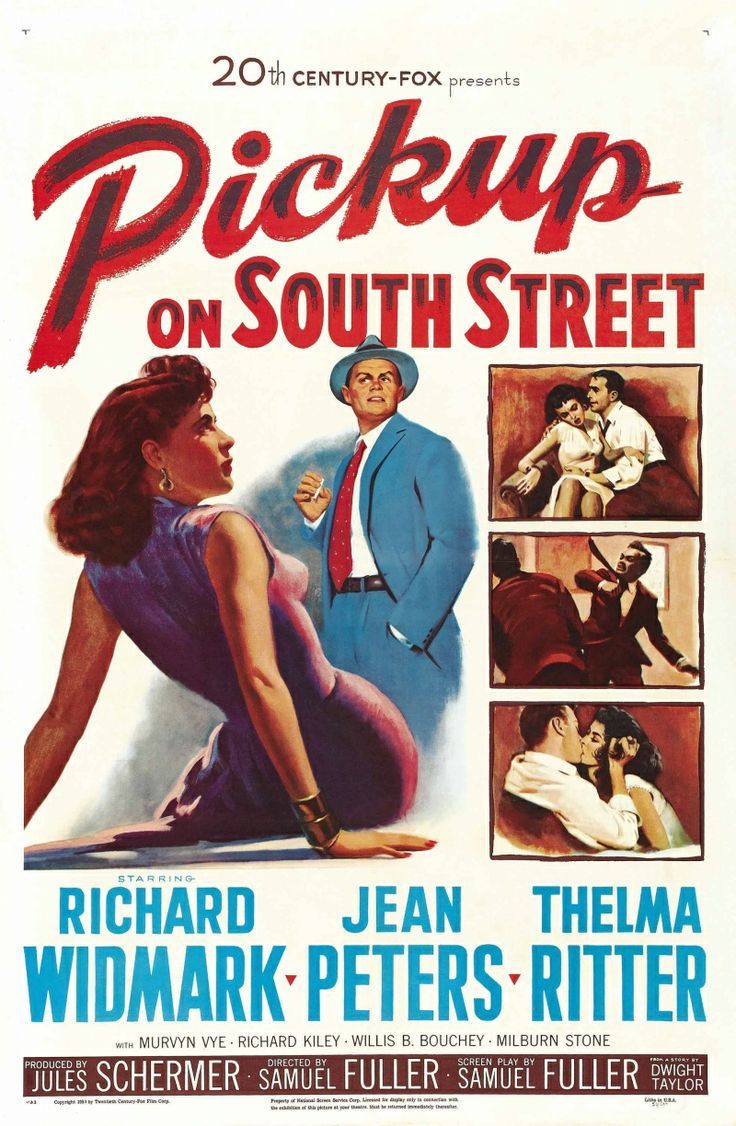
Pickup on South Street (1953)

Richard Widmark and Jean Peters feel the heat from the cops, the commies and their own passion in Pickup on South Street

Director: Samuel Fuller

Cast: Richard Widmark (Skip McCoy), Jean Peters (Candy), Thelma Ritter (Moe), Murvyn Vye (Captain Tiger), Richard Kiley (Joey), Willis B Bouchey (Zara), Milburn Stone (Winoki), Henry Slate (MacGregor)

It’s 1950s, and the biggest bogeyman in America is the Commies. Candy (Jean Peters) is one of their unwitting couriers, funnelling top secret microfilm for her ex-boyfriend Joey (Richard Kiley) to pass to his Moscow superiors (poor Candy just thinks she engaged in helping Joey with some good-old All-American industrial espionage). Trouble is, while the Feds are trailing her, they watch her being pickpocketed by career thief Skip McCoy (Richard Widmark). Skip now has on his hands on some serious state secrets. Should he return the film to the police who want to lock him up? Or make a big score by blackmailing the Commies who want to kill him?

What makes Pickup on South Street so intriguing is it’s not necessarily as straight forward as you might think. Fuller’s film is an anti-communist film – the sort of “reds under the bed” scare that terrified millions in a country still reeling from Klaus Fuchs and the Rosenbergs. But this isn’t your standard Red Scare film. Because our heroes have about as much stake in the USA as they do in the USSR. They are the down-trodden, the under-class, the grifters. At the end of the day, I’m not sure Skip McCoy really cares who ends up with the MacGuffin. He’s motivated firstly by financial gain and secondly by personal revenge. No appeal to flag and country cuts any ice with him.

Making the hero this sort of anti-social career criminal was a master-touch as it not only enriches the entire perspective of the film – what has their country ever done for these people – but also adds an air of uncertainty over the whole thing. There would never be any doubt if the microfilm had fallen into the hands of a clean-cut Henry Fonda type. The fact that it’s Richard Widmark – who always looks like he’s torn between laughing in your face or punching it – means you never quite know what he’s going to do. If it works out best for him to hand that film over the Russkies, you can be sure he will.

That’s despite the heavy-handed entreaties of the cops and feds. Skip faces a barrage of hostile interrogations, vague promises, handcuffs and searches from law agents who are damn sure he has the film, but can’t prove it. Like many Fuller films, there is more than a hint of roughness and violence in every frame – and the law and order figures aren’t averse to this. Captain Tiger (what a name!) has already served a suspension for beating Skip in custody. An illegal search or two isn’t beyond them. You can see why the FBI was unhappy with this film – not least because it shows them constantly out-thought by a pickpocket.

The Commies though are a thoroughly bad lot. After all, it’s still an anti-Communist film. Richard Kiley’s snivelling coward Joey is no true believer, but the kind of low-breed opportunist tempted by a quick buck. The other communists we meet are corrupt, shady types, sitting in backrooms puffing pipes and casually handing out death sentences. Kiley’s weak-willed and increasingly desperate Joey becomes more and more despicable as the film goes on, desperation to save himself from the fury of his paymasters leading to ever lower and despicable crimes.

So the only people who really come out as truly decent – and playing by a very fixed moral code of their own – are the criminal underclass. In this world, everyone knows where they stand. Skip isn’t angry at stool-pigeon Moe, who carefully trades information with the police – everyone has to make a living he observes. Skip will pick pockets to earn his keep, and punch back when he’s attacked, but there is no sense that he has any taste for the crimes of the Communist agents. He’ll sell on the microfilm to them – but that’s only because his own government offer him nothing but hot air and empty promises. And, as the unspoken message of the film goes, what difference would it really make to Skip and his like anyway where the film ends up?

Instead Skip becomes motivated by personal feelings – specifically his feelings for Candy and Moe. There is a genuine sexual frisson between Skip and Candy from the start: Skip’s pickpocketing of Candy is shot like a sex scene, all sweaty brows, heavy breathing and close-ups (with Skip’s hands ‘penetrating’ Candy’s handbag with all the metaphorical energy of a train speeding into a tunnel). As events draw them closer together, the two maintain this electric sexual energy – whether arguing or fighting or lying to each other they seem unable to take their hands off each other – and the intimacy of close-ups and low angles Fuller uses for this brings a real sexual charge to their scenes. Widmark – superb as a heavy with a (hidden) heart – and Peters are also great, with Peters bringing a real roughened hinterland of disappointment to her role.

The other motivator for Skip becomes the stool-pigeon Moe, brilliantly played with an eccentric bag-lady energy by an Oscar-nominated Thelma Ritter. Moe is a grifter, selling ties by day and trading information on the side. She embodies the underdog nature of the criminal world, wanting nothing more than to earn enough to buy a decent funeral when she goes. Ritter has a marvellous speech on just how tied she feels from this constant scramble of scrapping by on the edge of society. A surrogate mother figure of a sort to Skip, Ritter’s performance is a classic piece of character acting.

Fuller’s scene is lean, short and fast-paced. Like many of his films there is a lot of violence – beatings, fights, shootings – all shot superbly with the camera pulling back to soak up the action. Sex and violence go hand in hand – Skip accidentally punches out Candy thinking she has broken in to kill him, and the two of them are in a passionate embrace moments later. Mixed in with touches of reality, that bring the tough urban world the characters live in, Pickup on South Street is a lean and mean film that manages to be more than just a straight anti-Communist film. It doesn’t just give us something to fight against: it also asks how we might give people something to fight for.

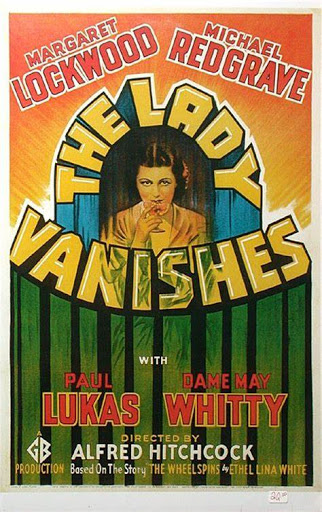
The Lady Vanishes (1938)

lady vanishes
May Whitty is searched for by Margaret Lockwood and Michael Redgrave in The Lady Vanishes

Director: Alfred Hitchcock

Cast: Margaret Lockwood (Iris Henderson), Michael Redgrave (Gilbert Redman), Paul Lukas (Dr Hartz), May Whitty (Miss Froy), Cecil Parker (Mr Todhunter), Linden Travers (“Mrs” Tothunter), Naunton Wayne (Caldicott), Basil Radford (Charters), Mary Clare (Baroness), Catherine Lacey (Nun), Googie Withers (Blanche), Sally Stewart (Julie)

In his conversations with Hitchcock, Francois Truffaut declared every time he tried to study The Lady Vanishes, all its tricks and mechanics, he always ended up too wrapped up in the plot to notice them. It’s about as fitting a tribute as a film can get, that it got one of the world’s ultimate film buffs just sit down and enjoy the ride. The Lady Vanishes is Hitchcock’s penultimate British film and it might well be one of the most enjoyable and entertaining films he ever made.

It’s late 1930s in Europe and a group of mostly British travellers have got stuck waiting for a train in the fictional country of Bandrika (but it’s clearly Germany). Iris Henderson (Margaret Lockwood) is on her way back home to (perhaps somewhat reluctantly) get married, exasperated by the loud noise made in the room above through the night by folk music expert Gilbert (Michael Redgrave). Charters (Basil Radford) and Caldicott (Naunton Wayne) are cricket obsessives, desperate to get home for the big test match. Mr Todhunter (Cecil Parker) is a lawyer, keen not to draw attention to the fact Mrs Todhunter (Linden Travers) isn’t actually his wife. When the train finally leaves the station the next day, Iris is hit on the head by a plant plot (was it pushed?) that very nearly hits governess Miss Froy (May Whitty). Miss Froy takes care of Iris on the train – but when Iris wakes after a rest, she finds Miss Froy has disappeared and – furthermore – everyone denies she ever existed in the first place. While a Bandrikan psychiatrist Dr Hartz (Paul Lukas) claims she may be suffering from concussion, only Gilbert believes her story. Will they be able to prove Miss Froy is real and rescue her from whatever peril she has found herself in?

Hitchcock’s The Lady Vanishes shouldn’t really work – not least since it takes nearly 20 minutes before we get any indication that we are watching anything other than a romantic comedy. But perhaps that’s also why it works, because those first 20 minutes are beautifully scripted, with some cracking dialogue and some skilfully drawn character work that invests us in these people long before any danger arises. It also serves as a brilliant counterpoint to the nearly non-stop tension and action that comes in the final hour of the film – who could have believed that all that light hearted banter in a guest house could end in a ruthless shoot out in the woods?

It all seems to change pace on a classic Hitchcock touch – a folk singer is suddenly, violently, strangled by an unseen assailant (why? I’ve no idea. The film doesn’t think you’ll care about the logic gap, and you don’t). But a large part of the film’s success stems from Hitchcock’s collaboration with Sidney Gilliat and Frank Launder on script-writing duties. Gilliat and Launder made a number of changes to the original novel, adding a greater espionage element. Even more importantly, they overhauled several of the characters, not least changing the Gilbert character from an engineer into a charming (if eccentric) folk music expert with a deadpan wit. Even more successfully, they introduced the hilarious ultra-British Charters and Caldicott, classic eccentric grown-up public schoolboys with a fascination with cricket (the combo was so popular Naunton and Wayne played versions of these characters another eleven times).

The script’s wit, playfulness and scintillating dialogue is what drives most of the film’s energy – and certainly what helps to make it as entertaining as it is. In particular, the dialogue exchanges between Lockwood and Redgrave hum with the sort of love-them-hate-them banter that wouldn’t seem out of place in a screwball comedy (“You’re the most contemptible person I’ve met in all my life!” “Confidentially I think you’re a bit of a stinker as well”), and the two actors shine in roles that start with classic feuding but subtly and beautifully come together as a romantic couple by the film’s end. Lockwood has pluck, guts and determination, a mix of socialite and head girl determination. Redgrave is superb as Gilbert, showing the sort of matinee idol wit and charm – not to mention an unconventional romantic sex appeal – that he very rarely got to exhibit again (sadly he didn’t get on with Hitchcock, and never worked with him again).

The film is full of wit and invention, but mixes it with a properly engrossing mystery. Every character has very clear reasons for denying the existence of Miss Froy (May Whitty is superb as a seemingly dotty old woman, hiding cunning and an unexpected capacity for action). We know that of course Iris is right – but even so, it’s hard not to begin to suspect that maybe the oily Dr Hartz (Paul Lukas whose professional smoothness neatly tips into cruelty) is right and she is suffering from concussion. The unravelling of this mystery is half Agatha Christie (vital clues pop up here and there), half famous five adventure – but the nearly “real time” playing out of the mystery injects huge amounts of tension and excitement, particularly as the villains start to be revealed.

The film also serves, interestingly, as a plea for British invention in European affairs in the era of appeasement. The train is stuffed nearly exclusively by Brits, most of whom are quite content at first to let things drift and not rock the boat. However, when the chips are finally down and its time to make a stand, the majority of the characters knuckle down and get their hands dirty to fight for justice. Even Charters and Caldicott take up arms (with a typical British reserve) to protect their fellow passengers, while Gilbert has already shown himself capable of being a man of action (as well as a pretty neat impressionist and physical comedian) when called upon. It’s telling that Cecil Parker’s Mr Todhunter is the nearest thing we see to an appeaser on the train (with a fear-and-hope-tinged expectation that everyone is playing by his own antiquated rules), and he’s the only one who angrily questions taking a stand.

It’s not surprising from Hitchcock, who made an even more passionate plea for intervention a few years later with Foreign Correspondent. Neither is it a surprise how superbly the film is made. Hitchcock is at the top of his game here, shooting the train brilliantly (the set was tiny, not that you could tell from the number of angles Hitch finds here). His mastery of the pace and tone of the film is spot on: the second half never lets up, and you never for one minute lose the film’s wit, even while the stakes become more bigger and bigger. The film has possibly the most winning romantic pairing in all of Hitch’s movies, helped hugely by the natural and winning playing of Redgrave and Lockwood. It so successfully builds up the possibility of Iris being mistaken, that it makes the audience start to question what they’ve seen.

It’s a superbly directed film, but above all it’s supremely entertaining in a way few other films can hope to be. Its re-watch value – from hearing the jokes again, to spotting the early clues – means it will be rewarding audiences for decades to come.

Ice Station Zebra (1968)

Rock Hudson takes command in the rather turgid cold war thriller Ice Station Zebra

Director: John Sturges

Cast: Rock Hudson (Commander James Farraday), Ernest Borgnine (Boris Vaslov), Patrick McGoohan (David Jones), Jim Brown (Captain Leslie Anders), Tony Bill (Lt Russell Walker), Lloyd Nolan (Admiral Garvey), Alf Kjellin (Colonel Ostrovsky)

Rumour has it that Howard Hughes loved this movie so much, he insisted on the Las Vegas TV broadcaster he owned to screen the film over 100 times. For most of the rest of us, once will probably be enough to take in all the fun that can be pulled out of this sub-par Alistair MacLean Cold War thriller, a poor relation to The Guns of the Navarone and Where Eagles Dare.

It’s the middle of the Cold War and US submarine commander James Farraday (Rock Hudson) is ordered to the North Pole to rescue a British scientific team. However that mission is just a cover for the real goal – something to do with retrieving a top secret gizmo from a crashed satellite. Farraday is ordered to transport British intelligence agent “David Jones” (Patrick McGoohan) to the Pole, who has bought Soviet defector Boris Vaslov (Ernest Borgnine) along with him. En route, sabotage nearly downs the sub, and on arrival the base has been nearly destroyed. Looks like there is a traitor on board – but is it Boris or recently arrived marine Captain Leslie Anders (Jim Brown)? Who can tell?

To be honest most people watching the film. It’s one of many not-particularly-intriguing mysteries in a hopelessly over-extended film that takes nearly two hours to get going, and then crams its paper-thin characters into a series of adventures that bounce from dull to cliché with giddy haste. Directed with a professional lack of engagement by John Sturges (who could believe the director of Bad Day at Black Rock and The Great Escape could have made something as flat as this?).

It’s a film that mistakes lack of explanations and rushed conclusions for intriguing mystery. There is barely enough actual plot here to sustain an hour and a half let alone the nearly two and a half hours the film takes to get nowhere in particular. The middle of the film is given over to a series of submarine escapades that would have already felt familiar at the time from The Enemy Below and have been bettered since in countless submarine films. From deep dives to furiously leaking compartments, there isn’t anything particularly new here.

When we finally arrive at the polar base, there is finally some decent mystery – as well as a haunting atmosphere – as the characters explore the badly damaged base and its traumatised residents (You can see how this film influenced John Carpenter as he directed The Thing). Sadly, what the film hasn’t managed to do up to this point is make us care at all about any of the characters. Rock Hudson, never a particularly inspiring performer, makes a dry and unengaging lead (first choice Gregory Peck would have made the world of difference). Patrick McGoohan does his best as the mysterious British agent, but the character is so lightly written that you never really feel particularly intrigued by his mystery. Ernest Borgnine chews the scenery as the ex-Pat Soviet while Jim Brown is serviceable as the marine captain. Virtually no other character makes any real impact.

The film culminates eventually in a confusing stand-off between the Americans and the Soviets, until the villains reveal themselves and a détente that doesn’t end up destroying the world is revealed. That’s about the sum total of interest the film can spark. Other than that, it’s slow pace, unengaging characters, uninvolving plot and unoriginal action make it a great deal of fuss about nothing in particular. Howard Hughes may have wanted to watch it a hundred times. You probably won’t want to.

Die Another Day (2002)

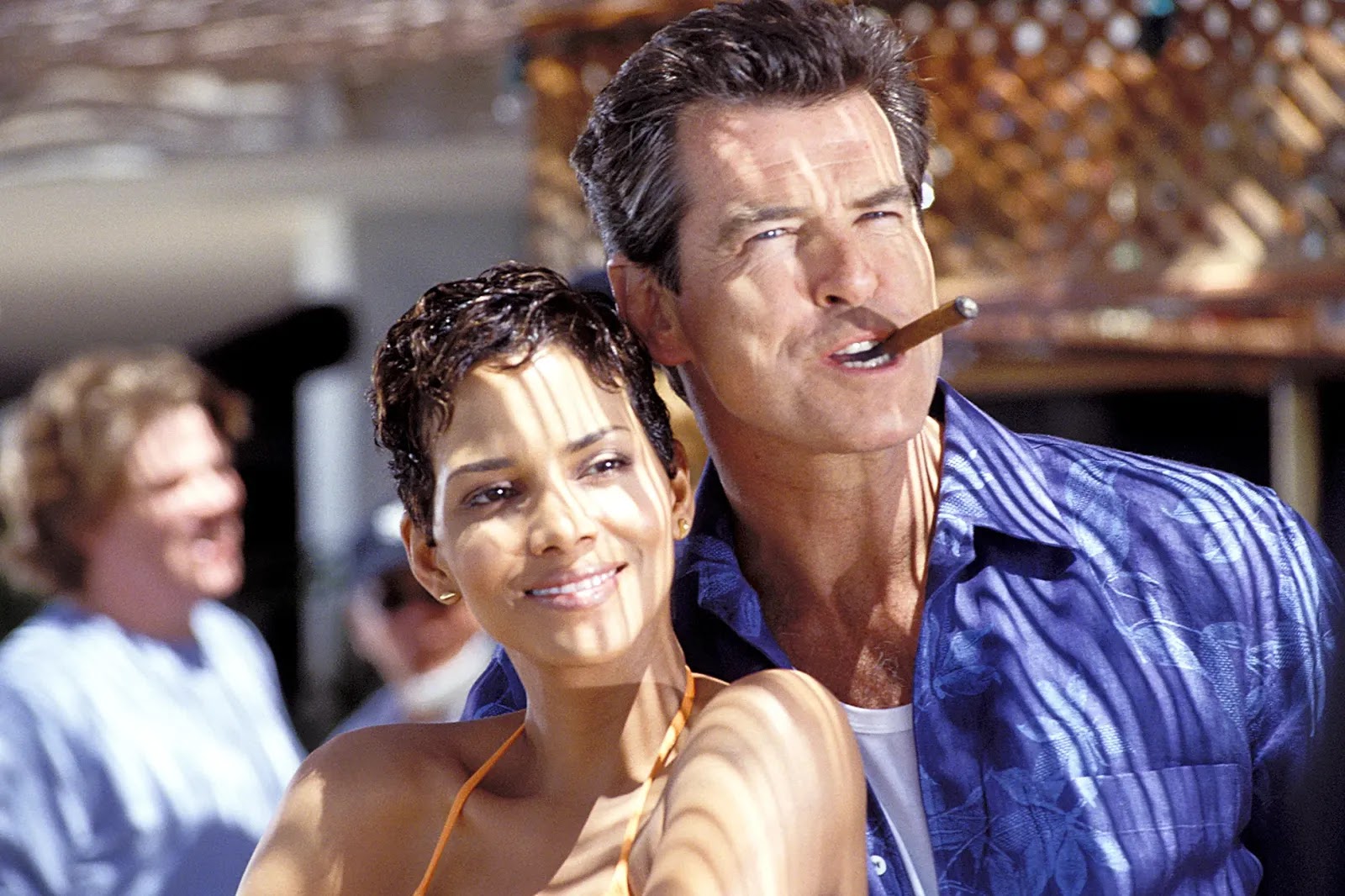
Pierce Brosnan signs off as Bond with the mess that is Die Another Day

Director: Lee Tamahori

Cast: Pierce Brosnan (James Bond), Halle Berry (Jinx Johnson), Toby Stephens (Gustav Graves), Rosamund Pike (Miranda Frost), Rick Yune (Tang Ling Zao), Judi Dench (M), John Cleese (Q), Michael Madsen (Damian Falco), Samantha Bond (Miss Moneypenny), Colin Salmon (Charles Robinson), Will Yun Lee (Colonal Tan-Sun Moon), Kenneth Tsang (General Moon), Madonna (Verity)

Die Another Day was the highest grossing Bond film ever released. So why was it almost four years before another one was made? Put simply, because this one weren’t no bloody good. Released at the Bond series’ 40th anniversary, Die Another Day was meant to be a celebration of everything Bond – instead it’s like the final nail in the coffin of an entire lifecycle in the franchise that started probably around the early Roger Moore films. When Bond came back out after this, he was radically different. 

James Bond (Pierce Brosnan) is sent undercover to Korea to take out renegade Korean Colonel Moon (Will Yun Lee). The mission is a success – but Bond is betrayed and captured by the North Koreans. Coming out of Korean prison a year later, Bond is no longer wanted by MI6. So he goes off on his own to find out who betrayed him – and finds newly emerged diamond businessman Gustav Graves (Toby Stephens) might have something to do with it. With a trail that starts in Hong Kong and heads to Cuba, the UK, Iceland and back to Korea he’ll work alongside CIA agent Jinx Johnson (Halle Berry) to find out how this all ties together and get his revenge.

Die Another Day starts a bit like a Connery Bond – and about half way through it segues into being perhaps the most ridiculously overblown Roger Moore-esque Bond you’ll ever see. I suppose you could say this was the scriptwriters trying to capture the essence of 40 years in one movie. But actually it’s probably just incoherent scriptwriting and stupid storytelling. It starts trying to be grounded – Bond is captured and tortured for a year! – but then shrugs off any aftereffects of this year of hell with lackadaisical ease before throwing us into the sort of “Ice palace! Invisible cars! A weapon that channels the power of the sun!” malarkey that even Roger might have thought was a little bit too much.

It’s not helped by the fact that the entire film is so shoddily put together and so lazy in its execution. The one liners in this film are terrible – there are no double entendres in this film only single entrendres (words like thrust, pleasure, weapon and mouthful are used with gleeful abandon) – and far from being a playful exercise in Bond’s cheekiness are just hand-in-the-mouth embarrassing. But that’s almost as nothing compared to the woeful special effects. Even in 2002, nothing in this film looked real. 

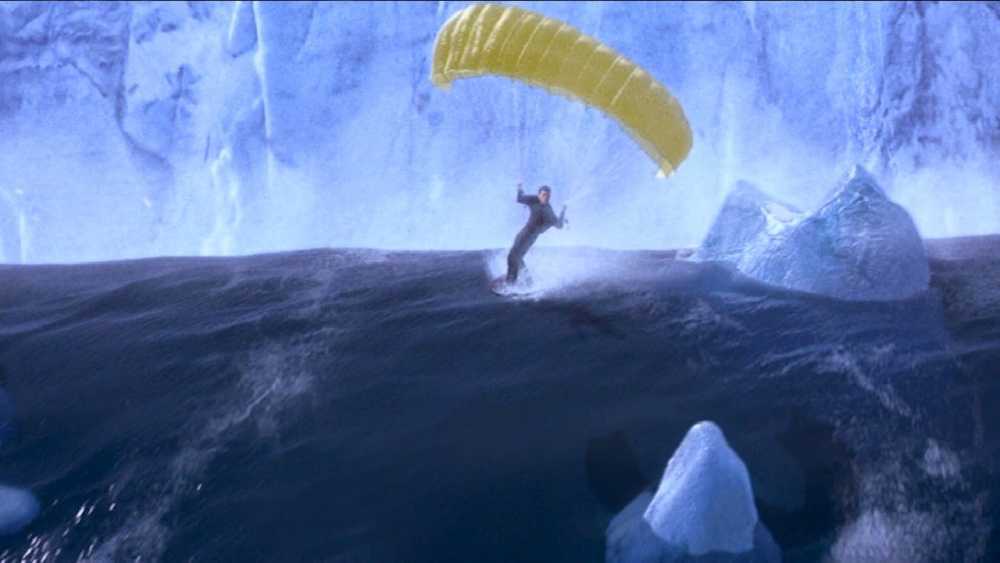
I hardly know where to start with the awful plasticky sheen of the effects here. The film opens with Bond and fellow agents surfing (!) into a deserted island – at the end of which Brosnan in front of blatant blue screen rips off his mask to show it-was-definitely-him. As if that wasn’t bad enough (Bond surfs? I’m out!) Bond surfs AGAIN in the movie halfway through, using a parachute as a sail to escape possibly the least convincing wave ever put onto film. It really has to be seen to be believed (or rather not believed). That’s not to mention the wonky overblown final plane sequence, or a laughably unrealistic looking Jinx dive from a cliff down into the water below.

Brosnan probably tries his best in all this, but even he can’t save this total mess. How does a film that started with Bond in prison and emerging damaged and on a gritty quest for revenge end with a villain wearing a robot suit controlling the sun? The script after the first 15 minutes gives Brosnan nothing to play with. The film loses all interest in the traitor plotline about halfway through, and when she is unmasked (in a twist that surprises no one at all) Bond barely seems to care. Pierce himself looks frankly too old and a little out of shape (his running in this film with his arms pumping up to his face looks terrible), something only magnified by the youth of his co-stars. 

Not that I’m saying his co-stars are any good either. When this film came out there was a brief flurry of excitement that Halle Berry’s Jinx would be worth a franchise of her own. That died shortly after the film came out – this is a character that acts tough when needed, but still needs to be saved twice in quick succession by Bond, who says faux-tough things like “Yo Mama!” but has barely two personality facets to rub together. Berry simply does her bit and meets the requirement of looking sexy and fighting. Mind you she still fares better than an embarrassing Toby Stephens, whose villain is so paper-thin the actor seems to have taken the bizarre decision to channel Alan Partridge. Rosamund Pike’s fencing MI5 agent barely registers.

Needless to say Bond beds her – as he beds all the women in this with a perfunctory inevitability that fits the box-ticking exercise of the whole film. The film is littered with references to past Bond films, although that is probably only going to make you want to watch almost any of the other films instead. Perhaps to try and up the ante and make this one “even biggerer and betterer than before” there are more gadgets than ever before. These are topped with the crowning turd of the invisible car, a nadir for the franchise, a senseless advantage (Bond at one point follows directly behind two walking heavies in the car – it’s invisible NOT silent for goodness sake!) and something so overblown that however much the producers at the time tried to justify it by pointing at military technology just sounds silly. Don’t get met started on the bizarre VR training sequence Bond carries out (later replayed for a grotesquely demeaning Moneypenny joke that made me feel sorry for Samantha Bond).

But then the whole thing basically sounds silly. Giving the villain a huge ice palace lair might have seemed like a cheeky nod, but again it just looks absurd and the producers desperately trying to find a location that hasn’t been used before. The entire film feels like a rushed attempt to get something out for the 40th anniversary (perhaps the rush helps explain the insane product placement, leading to the film being nicknamed Buy Another Day). The script has been assembled from the off-cuts of other Bond films. There are no fresh ideas at all and everything that happens in the film has the air of “well this sort of thing happens in Bond films”. The script and special effects feel half finished. Rather than a tribute to how Bond was done in the past, it feels like a tombstone. Here lies James Bond c. 1967-2002. No wonder under Daniel Craig he needed to be reborn as someone who felt vaguely in touch with something approaching reality.

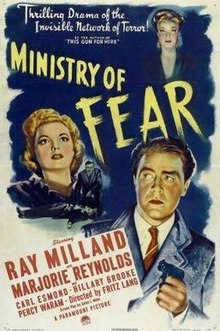
Ministry of Fear (1944)

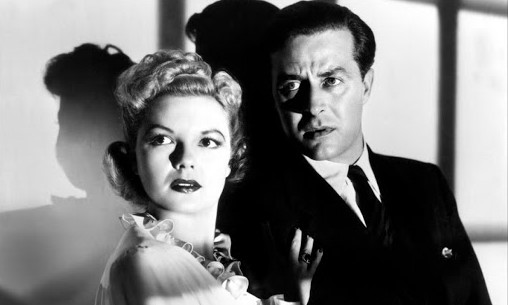
Ray Milland and Marjorie Reynolds take on Nazi agents in Ministry of Fear

Director: Fritz Lang

Cast: Ray Milland (Stephen Neale), Marjorie Reynolds (Carla Hilfe), Carl Esmond (Willi Hilfe), Hillary Brooke (Second Mrs Bellane), Percy Waram (Inspector Prentice), Dan Duryea (Cost/Travers), Alan Napier (Dr Forrester), Erskine Sanford (George Rennit)

Neither Fritz Lang nor Graham Greene (the author of the original book) cared much for Ministry of Fear. Both of them thought that the film they ended up with was only a shadow of the original novel, with both of them largely blaming the script by Seton I Miller and the producers for turning Greene’s novel into a more simplistic B-movie. And yes the film is at heart just a B-movie, that races through a conspiracy thriller – and you’d have no idea that it ever came from Greene-land unless you were told so – but it’s put together with such professionalism that you admire its skill, even while it’s no Third Man.

At the height of the Blitz Stephen Neale (Ray Milland) is released from an asylum only to find himself immediately embroiled in a load of shady goings-on with suspicious séances, hidden microfilm and Nazi sympathisers. Can the fragile Stephen get to the heart of it?

Ministry of Fear has a slightly dream like quality to it – probably because it’s a fragmented narrative that makes quick jumps from event to event, sometimes with very few links between them. Stephen emerges from an asylum straight into a charity fete, hence to a train, the centre of London and a séance, with all the speed of a logic-skipping dream. Everything is swift and somewhat low in logic. The plot of the film becomes sheer B-movie fluff, with the typical spy hijinks you might expect, lacking any of the complexity of the book. 

Greene was particularly disappointed by the deletion of the guilt Stephen feels around the death of his wife – and the film indeed skims over this very swiftly, leaving the reasons for Stephen’s being in an asylum in the first place largely unexplored and dispatched as swiftly from the film as possible. It’s not a film that has the time to explore the complexity of personalities of characters – instead it’s all about turning the content of the novel as much as possible into a high-flung spy thriller.

It’s why Lang was so disappointed with the script – and he became more and more dismissive of the film as he got older, claiming it to be bad film that he fell asleep in during a later showing – but he still bought to it a visual magic. The film is crammed with beautiful expressionistic images, present right at the start with Stephen watching a ticking pendulum through to some of its beautiful later images, in particular a shooting through a door that allows a beam of light to shine through a bullet hole in a door. Lang crams the film with striking images that help lift it above its B-movie roots.

Which is just as well because the general drift of the plot isn’t always that special, playing like the off-cuts from several Hitchcock films. Despite the artistry with which Lang presents it, he can’t hide the basically generic stuff that Greene’s book has been turned into. And its fast pace and logic jumps can perhaps find their root in the general contempt Lang had for the material he had to work with. Nothing in this feels particularly right – the England it presents is laughably wrong on several counts – while as always much of the mystery is reduced from the small cast list and tiny selection of possible suspects. 

There are some good sequences, don’t get me wrong. A séance is beautifully made and carries a fair degree of tension. The final confrontation with the architect of the misdeeds makes for a decent scene. It’s just a shame it’s counterbalanced with clumsy “this is what’s going on” scenes, such as Stephen’s briefing from British Intelligence. 

There are some good performances among the cast. Milland gives a well-judged performance of vulnerability, confusion and growing strength. He has just the right good-looking-but-not-drop-dead-handsome look to him to make him someone you can sympathise with but not completely trust (if the film hadn’t dropped some of the more interesting questions around Stephen’s guilt or innocence for past crimes this casting would have really worked to strengthen that). But he gives a fine performance. The array of suspicious characters around him are confidently performed, with Hillary Brooke a particular stand-out as a manipulative, seductive medium.

But Lang’s film is a covering of class and technique other soil that isn’t rich enough. The complexities of Greene has been lost and the film’s general plot and content doesn’t give much more than the sort of cheap thrills you could expect from a well-made B movie. With those involved this could have been more, but it never becomes a classic.