In depth, personal and opinionated reviews across the whole of film history. Old and new, classic and turkey I review them all: some you might agree with, some I'll sure will infuriate you!
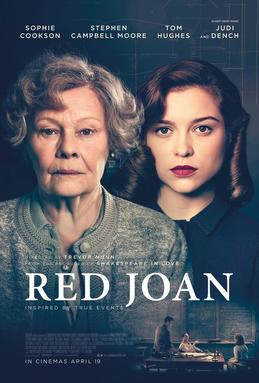
Judi Dench coasts through this weak spy drama Red Joan
Director: Trevor Nunn
Cast: Judi Dench (Joan Stanley), Sophie Cookson (Young Joan), Tom Hughes (Leo Galich), Tereza Srbova (Sonya), Stephen Campbell Moore (Max), Ben Miles (Nick), Laurence Spellman (Patrick Adams)
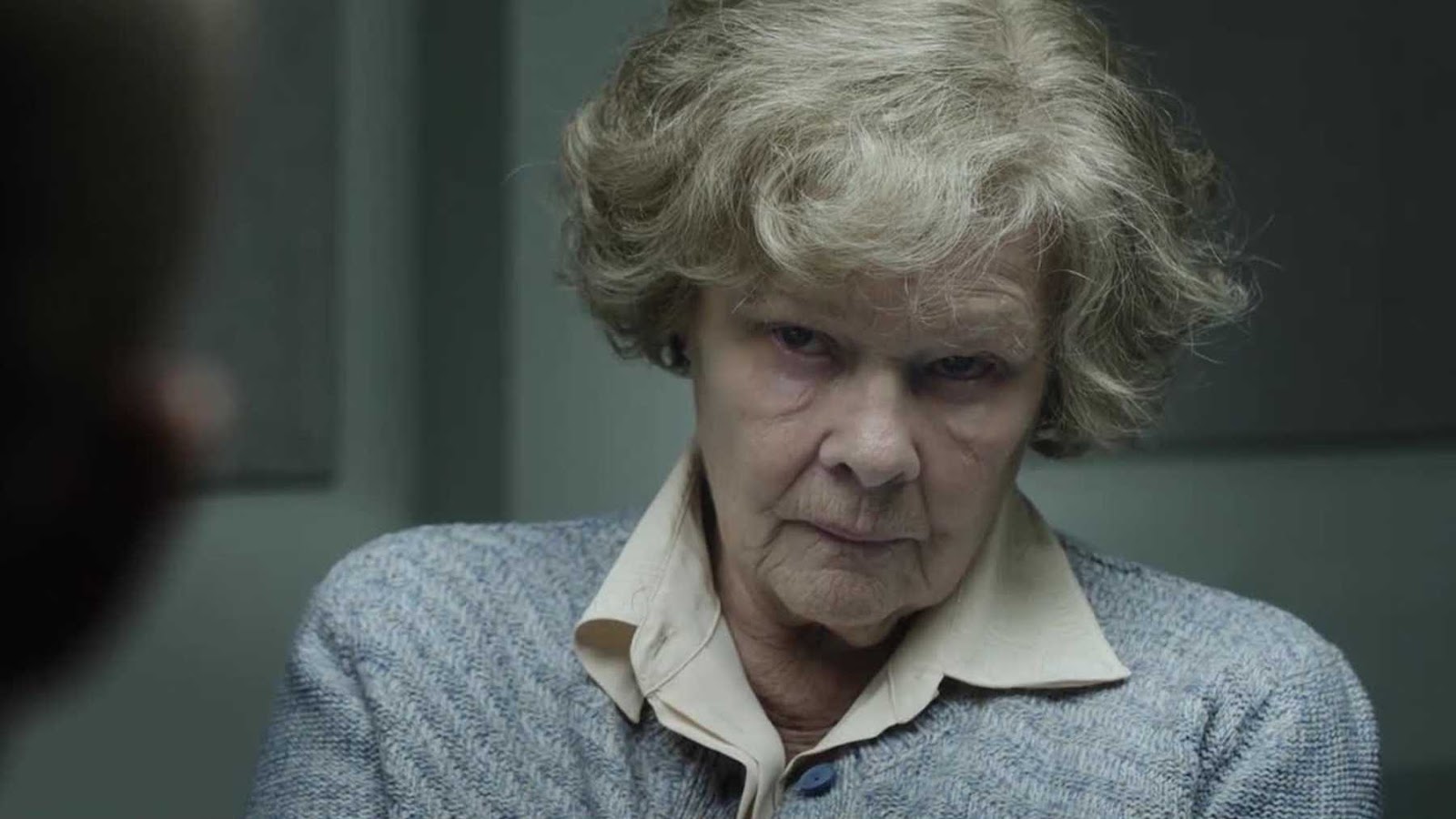
Red Joan is based on the true-life story of Melitta Norwood, the British civil servant who from 1937 passed piles of top-secret intelligence documents to the KGB. These documents helped the Soviets create their own bomb. This feeble dramatization has Joan Stanley (Judi Dench) arrested in the late 90s, with flashbacks showing her recruitment and spy work as a young woman (Sophie Cookson), motivated by her desire to “level the playing field” and by her love for shadowy KGB recruiter Leo (Tom Hughes), a German Jew.
Trevor Nunn’s flat, dull spy story has all the freshness and imagination of an ITV Sunday night drama. Tedious, dragging and very silly, it takes a ludicrous view of 1930s and 1940s espionage. The film is obsessed with downplaying the impact of Joan’s actions, and stressing that handing over these sort of secrets was fine really because the poor Russians – Stalin’s boys lest we forget – were likely to fall victim to those Imperialist Western powers that would soon be throwing their nuclear weight about.
On top of that, the film has an almost insultingly crude idea of Cold War politics, with the world neatly divided it seems into goodies and baddies and the moral implications of actions made as simple and clean-cut as possible. Joan means well, so we can’t have any problem with what she’s doing can we?
It’s a miracle she isn’t caught anyway since her espionage skills are so lamely ham-fisted. Maybe that’s because the investigation into the leak is handled so incompetently by the authorities, with heavy-handed arrests and quick and sudden lock-ups. But then that’s in keeping with the film’s view of British authorities as trigger-happy bullies, with even Clement Attlee reimagined as a “let’s drop one on ‘em” nut, desperate to have the bomb to threaten the Russkies with.
This simplistic vision of the past is made all the more clumsy by its feeble romance plot between young Joan and her romantic German spy and lover Leo (Tom Hughes, channelling his performance as Prince Albert in ITV’s Victoria). This romance should be the drive of events, but instead falls back on the usual clichés of young love on film, making some obvious points along the way about the lies we tell for love.
Joan herself is absurdly reinvented as a science expert, more adept than the men she works with (who typically look down on her as little better than a tea girl). The real Melitta was indeed little more than an office worker, but Joan here is reinvented as a pioneer of physics, a genius it seems far more evolved than the mediocre men around her. Yawn, we’ve seen it all before.
Nunn’s direction is flat beyond belief – he has never really adjusted well to film, where his (even in theatre) lack of sense of pace is often exposed – but there is a decent performance from Sophie Cookson as the young Joan, a confused idealist who struggles to do the right thing. She carries the film very well – and certainly has more to do than Judi Dench.
Dench only infrequently appears, largely for a series of “I am reflecting on the past” reaction shots. These are intercut with tediously clumsy narrative-establishing interrogation scenes, which largely serve as intros to more flashbacks (“Tell us about X now…”). There is a feeble continuation of the theme that passing nuclear secrets can’t be that serious after all, with Ben Miles as her son going through a painfully obvious arc of disbelief, anger and acceptance culminating in a “nick of time” appearance at Joan’s press conference (based on Melitta’s real life front-garden press conference to the press announcing her guilt).
Red Joan has an interesting idea, but it’s told with trivial obviousness and dramatic flatness. It’s got all the inventiveness and spark of a fairly run-of-the-mill TV drama, and despite a good performance from Sophie Cookson, it’s got little to recommend it.
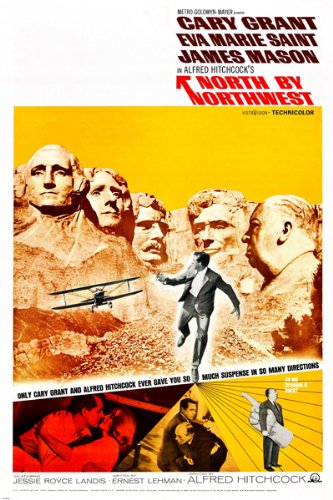
Cary Grant is on the run in the sublime North By Northwest
Director: Alfred Hitchcock
Cast: Cary Grant (Roger Thornhill), Eva Marie Saint (Eve Kendall), James Mason (Phillip Vandamm), Jessie Royce Landis (Clara Thornhill), Leo G. Carroll (The Professor), Martin Landau (Leonard), Josephine Hutchinson (“Mrs Townsend”), Philip Ober (Lester Townsend)
What is it about? Ernest Lehman went in wanting to write the “ultimate Hitchcock film”. And I think you can say he pulled it off. North by Northwest is the perhaps the most electric, fun, dynamic and nonsensical of all Hitchcock’s action-adventures, a neat bookend with The 39 Steps for Hitchcock’s career. It’s such good fun you scarcely notice the plot makes very little sense and the film is barely about anything at all other than a man getting chased. It has the most Macguffiniest MacGuffin in the whole Hitchcock career, an item of such little interest to the viewer that it never appears on screen and is only cursorily discussed.
Cary Grant is Roger Thornhill, nifty Mad Man-esque ad executive (you can imagine that Don Draper dreamed of being Roger Thornhill) who accidentally gets mistaken by shady goons for the mysterious “Mr Kaplan”, actually a non-person used as a distraction by the FBI. Cue Thornhill’s kidnapping, interrogation by the goon’s suave leader (James Mason, never more James Mason than here), escaping a murder attempt, getting embroiled in the murder of a UN official and fleeing New York in the train compartment of smart and sexy Eve Kendall (Eva Maria Saint). And that’s before we even mention killer crop dusting planes, faked shootings, auction house shenanigans and a vertigo inducing game of cat-and-mouse on Mount Rushmore. Is there a more fun film in the world?
North by Northwest gained its Hamlet inspired title (“I am but mad north-north-west. When the wind is southerly, I know a hawk from a hawksaw”) and it’s pretty meaningless – Lehman basically liked it and throws in a fictional “Northwest airline” so Thornhill can fly ‘North’ at one point (geddit?!) – but it also captures a sense of manic powerlessness in the film. Thornhill spends a good slice of the film telling anyone who will listen he is notKaplan, while every action he carries out seems to serve only to convince his pursuers he definitely is. The film’s echo of madness in its title carries across to the frantic energy of the film, and Thornhill’s belief that he must surely be the only sane man in a world of lunatic chaos.
And it’s prime Hitchcock chaos here in his most engaging, fast-paced and funny action adventure. The sort of prime piece of entertainment assembled with such skill, energy and excellence it looks really easy (but of course isn’t). Hitchcock keeps the momentum of this crazed chase perfectly pitched, and stages each of the set pieces so well that all of them have become icons of adventure cinema. Who can look at a crop dusting plane without thinking of Thornhill running in desperation, in the middle of nowhere, from a lethal plan swooping down on him from above? Who can look at Mount Rushmore without imagining Grant and Saint climbing all over it with Landau in pursuit?
It’s Grant as well that really makes the film work. He’s such an accomplished screen presence, so smooth and practised, it’s very easy to see this as a film where he is barely acting. But that would be to do him a major disservice. Not only is such a balance of light comedy and action so hard to pull off (so much so that Harrison Ford as Indy is possibly the only one who can get close – and that character is chalk and cheese with Thornhill) – but Grant builds a character who develops perceptively and clearly over the course of the film.
Initially the typical Grantish stereotype – so suave, confident and shallow that even his middle initial “O” literally stands, Harry Truman like, for nothing – Thornhill begins as a man who blithely assumes he can drift through his life and getting anything without question. Events – and his embroilment in them – however see him develop from a deeply selfish and lazy man into one who carries moral force, loyalty, determination and dedication to duty and an increasing sense of confidence and derring-do. From the man who is the victim of circumstance at the start of the film, failing to get anyone to believe him, he becomes a man who saves himself and everyone else with his pluck, daring and resourcefulness. And he does it all while never losing his light, almost put-upon, wit and playfulness. It’s a truly great personality performance with real depth and development: a hollow man who becomes a real man of standing and purpose.
He’s backed superbly by the cast who seize their roles with gusto. James Mason drips British superiority and suaveness (has there ever been two such cool actors facing off?) as VanDamme, Eva Marie Saint is every ounce the brave, resourceful, daring and clever lady that prompts Thornhill to man-up. Jessie Royce Landis gets some lovely comic mileage from Thornhill’s pecking-hen mother (hilariously she’s only 8 years older than Cary Grant). Martin Landau simpers rather effectively as VanDamme’s fey sidekick.
The script is crammed with great lines from Lehman, all of which delivered superbly by the cast. But it’s a director’s treat, and Hitchcock delivers it brilliantly. I’ve mentioned that MacGuffin – it’s some microfilm or something in a statue that’s the root of the all the problems – but it hardly matters. The film powers forward with the dynamic energy of a comic farce crossed with action adventure. Thornhill’s initials spell out “ROT” and in an affectionate thing that’s what the film is – something that doesn’t take it self seriously but sets out to entertain at all costs.
So we get Hitchcock splicing in rom-com flirtations between Grant and Saint (and no less than two shots of trains speeding down lines and into tunnels, just to hammer home exactly what they are doing to kill time on the ‘sleeper’ train) with edge-of-the-seat sequences (the slow tension build at an abandoned bus station while Grant waits for “Kaplan” only to fall victim to assault from crop duster) then segues back into comedy (the hilarious “pretend to be drunk” to escape assassination at an auction) it’s perfectly assembled. And that end sequence at Mount Rushmore – a near perfect mix of comedy, action, adventure, suspense, thriller and romance. It’s flawless.
William Goldman famously stated North by Northwest had the finest, most economical ending of all time – and it ties up perfectly and beautifully about six plot threads and cliffhangers in less than 70 seconds – but the entire film is a perfect package. Hitchcock’s glossiest chase adventure is wonderfully directed and in Cary Grant it perfectly married up possibly the only actor in the history of film with both the charisma and the acting chops to play the part with one of the greatest entertainments in the history of film. It’s mad, meaningless nonsesense – but who cares, it’s a great, great, great film.
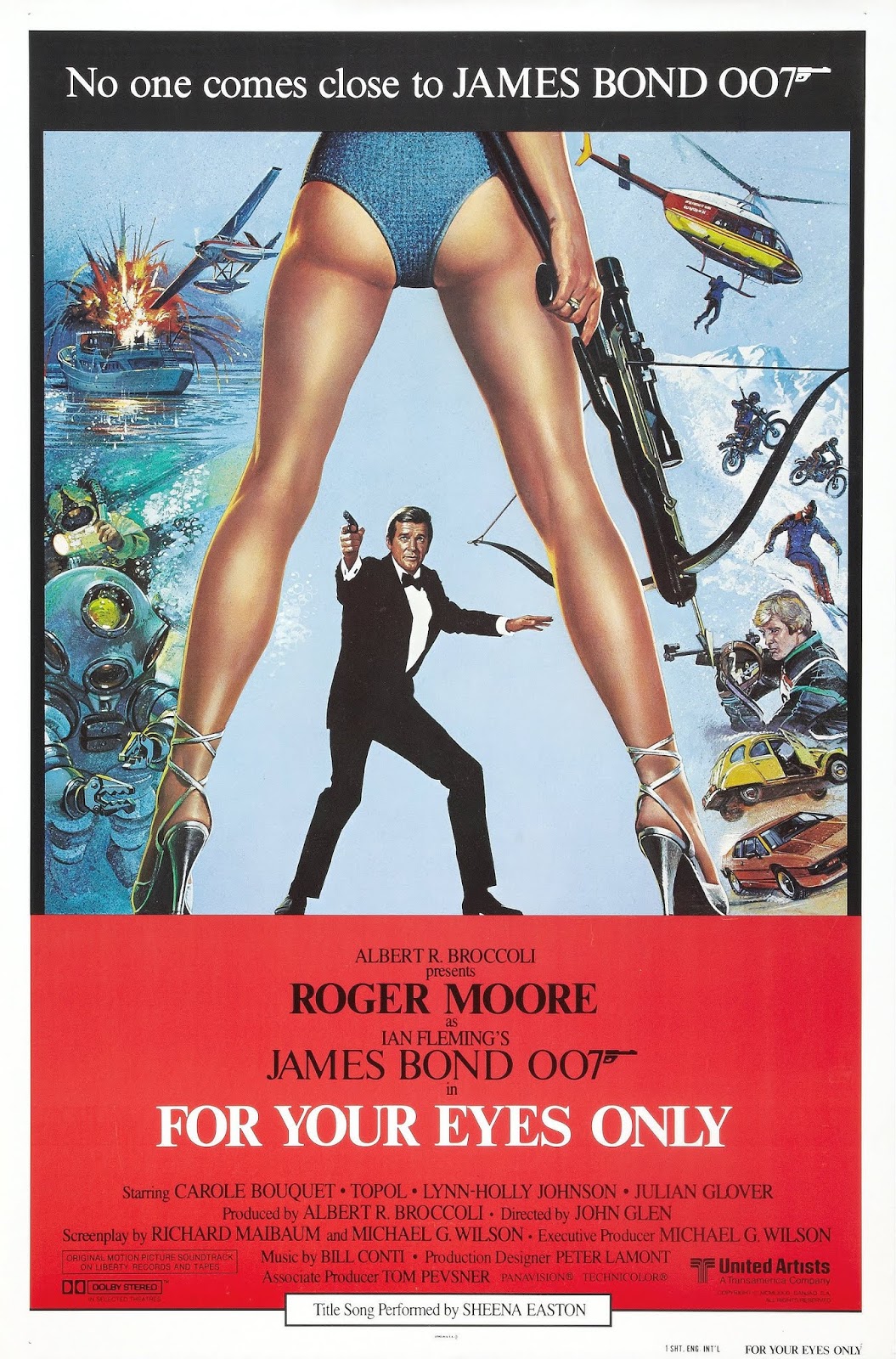
Roger Moore takes aim in this most low-key of his adventures – and one of his best
Director: John Glen
Cast: Roger Moore (James Bond), Carole Bouquet (Melina Havelock), Topol (Milos Columbo), Julian Glover (Aristotle Kristatos), Lynn-Holly Johnson (Bibi Dahl), Michael Gothard (Emile Leopold Locque), Cassandra Harris (Lisl van Schlaf), John Wyman (Erich Kriegler), Desmond Llewelyn (Q), Jill Bennett (Jacoba Brink), James Villiers (Bill Tanner), Geoffrey Keen (Minister of Defence), Walter Gotell (General Gogol), Lois Maxwell (Miss Moneypenny), Jack Hedley (Sir Timothy Havelock)
Where could Bond go after he went to space in Moonraker? Another planet? The future? The producers of Bond decided they couldn’t top that – probably wisely – so for Bond’s next outing they went back to low-key basics. For Your Eyes Only Bond would find himself in an old-school Cold-war game of cross and counter-cross, scrambling for the Russians for ownership of what looks like a cross between a typewriter and child’s cash till toy.
That toy is the ATAC (though it might as well be called MCGUFFIN) a ministry of defence system used to co-ordinate nuclear subs or some such. When the ship it’s on sinks somewhere off the coast of Greece, MI6 and the KGB swing into gear to be the first claim it from the Ocean depths. So Bond is off to Greece to investigate, not knowing who to trust: should it be MI6 contact and shipping magnet Kristatos (Julian Glover) or playboy smuggler and former resistance man Columbo (Topol)? And how will he deal with Melina Havelock (Carole Bouquet), the long-haired, half-Greek archer intent on revenge on whoever ordered her parents killed while they (without her knowledge) searched for the ATAC? Either way it will involve chases, deadly winter sports, flirtatious teenage ice skaters and a death defying climb up to a monastery at the top of a mountain.
For Your Eyes Only is one of those quiet gems of Bond movies that, because it is about something quite small scale and quiet compared to the films it precedes often gets overlooked. It’s certainly the point where Moore should have stopped making the films – when your turning down the advances of someone because she’s too young (as he does ice skater Bibi) you know it’s time to go – and to be honest Moore was flagging already here, clearly too old for the action and certainly far too old for Carole Bouquet, who looks like she could have him for breakfast (she struggles to muster much sexual interest in him). But it doesn’t really matter because this is an old-school bit of spy cool, mixed with some decent but grounded fights and chases and shot with a loving eye for Switzerland and Greece (with plenty of clichéd visuals and sound cues thrown in from both as you would expect).
The producers wanted to shy away from the gadget filled antics of the previous films. As if to make the point, Bond’s car is destroyed almost immediately, forcing him to make a getaway at one point in a bashed up Citroen 2CV. The long sequence in the film where Bond is chased around a ski resort – which takes in cross-country skiing, a ski jump, a toboggan and several other winter sports is remarkable for nary a gadget in sight, with Bond relying on his wits and native skill with skis. Even when ascending the mountain at the film’s end, he uses nothing more than standard climbing equipment, putting his trust in ropes and hooks. It’s possibly the least tech heavy Bond film since Doctor No. There isn’t even a novelty watch and no humorous Q briefing on the gadgets. The only visit to Q’s lab is to use a cumbersome facial recognition system, that hilariously uses computer disks the size of stone slabs loaded into something that today resembles a dishwasher.
Other than that Bond is on his own, and it’s fairly neat to see him go about an investigation and follow a trail – even if Bond is, as usual, a hopeless undercover agent who largely relies on waiting to see who tries to kill him first. The villains, as always oblige, spending most of the film attempting to off Bond for all sorts of confused ill-defined reasons. Perhaps it has something to do with our main villain – the rather low-key Julian Glover, playing possibly the least colourful Bond villain ever, a guy who just wants to sell the ATAC for some cold hard cash – using so many cut outs for his operations, speechless goons (including an early appearance from Charles Dance) and East German skiing champions who seem motivated to kill Bond purely for larks and the evilz.
The first half of the film though is huge fun, watching Bond blunder around the ski resort dodging hits, fighting people, punching out butch hockey players and the like that it hardly matters that most of the plot is pretty inconsequential. When Bond finally stops mucking around in Switzerland and heads to Greece the ATAC is found in about 5 minutes flat (Havelock helpfully left a map with the downed boat coloured in on it, making his daughter’s ability to translate his cryptic notes pretty much useless), while the villain immediately takes this chance to comprehensively unmask himself.
After a further elaborately sadistic attempt to off Bond involving dragging him across coral in shark infested waters (sharks are always such deadly threats in Bond films), Bond unites with Topol to storm the castle in an actually pretty gripping and vertigo inducing climb sequence, another triumph of John Glen’s mastery of the action sequence. It’s a nice touch as well to introduce the “guest star” of the film not as the antagonist but as a protagonist ally, a neat twist that must have come as quite a shock back in the day. Topol plays his role with realish, cracking nuts, gags and heads with equal glee.
The film also heads into some dark places. For all his charm, gallantry and debonair wit, Moore does his meanest thing in years here when he kicks a heavy’s teetering car off a cliff. But that’s a fair repayment for the brutal running over of his mid-film squeeze (played by Pierce Brosnan’s real life late wife Cassandra Harris) earlier on by the same heavy. The early murder of the Havelock’s is surprisingly graphic (and also gives a great reaction shot for Carole Bouquet as she turns and looks back as the plane carrying her parent’s murderers jets away, her eyes screaming “I shall have my revenge!”) and Carole Bouquet’s Melina is determined figure, who does more than her fair share of the action.
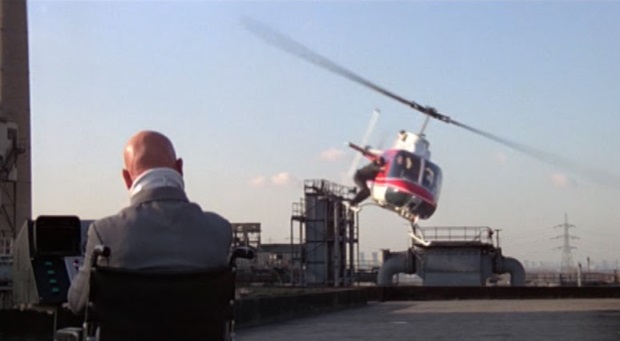
Of course the film can’t endorse too much her need for revenge. “That’s not the way” Bond, like a disapproval uncle, rather prissily tells her several times. Which is a bit rich coming from a man who opens the film by dropping his wife’s murderer down a factory chimney shaft. That opening sequence by the way is a joy, a neat call back to On Her Majesty’s Secret Service (whenever Bond went serious, it referenced Bond’s status as a widower) as well as a the dispatching of a it-could-be-anyone bald, scared, cackling villain with a white cat who makes an ill-advised attempt to kill Bond with a remote controlled helicopter (the film is so anti-Gadgets, only the baddies seem to use them and they don’t even work for them). It’s a neat “fuck you” to Kevin McCloy, at that time in a feud with the producers over the rights to Bond who had refused to allow them to use Blofield or Spectre again in the films. Keen to show they didn’t need Blofield, the producers introduced him in all but name to ignominiously kill him off, his final pathetic words a hilariously meaningless offer to buy Bond a “delicatessen in stainless steel” if only Bond would let him go.
FYEO is a crackingly old-fashioned Bond film that, despite being more grounded, has some great action sequences and a host of actors having a good time. Carole Bouquet is one of Moore’s best Bond girls and Moore himself certainly should have stopped here, this film throwing together one of his best mixes of light comedy, moral uprightedness, playfulness mixed with a dash of cruelty. John Glen did such a good job assembling this one he directed the next four films. It’s not got the smash-and-grab of The Spy Who Loved Me, but it’s an excellent action adventure.
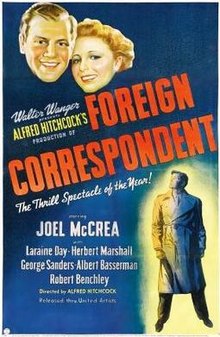
Hitchcock’s thriller is a stunning adventure story and a passionate call for action
Director: Alfred Hitchcock
Cast: Joel McCrea (John Jones/Huntley Havestock), Laraine Day (Carol Fisher), Herbert Marshall (Stephen Fisher), George Sanders (Scott ffolliott), Albert Basserman (Van Meer), Robert Benchley (Stebbins), Edmund Gwenn (Rowley), Eduardo Cianelli (Mr King), Harry Davenport (Mr Powers), Edward Conrad (Latvian)
In 1940, Hitchcock was new in America, after a parade of successes in Britain. 1940 was a red-letter year for the master, directing not one but two of the films up for Best Picture. The Oscar was carried home for his masterful gothic adaptation of Du Maurier’s Rebecca, but equally memorable was Foreign Correspondent, a stirring, heartfelt thriller about the build-up to war in Britain, a passionate cry for American intervention and brilliant propaganda contribution to the British war effort (even Joseph Goebbels tipped his hat to it).
John Jones (Joel McCrea) is the new foreign correspondent in Europe for the New York Morning Globe. Given the pseudonym “Huntley Havestock” (because it sounds better), Jones is picked out because he’s a hard-boiled crime journalist, practised at winkling out a story, rather than the cozy posh boys usually sent out to Europe. In Amsterdam, Jones attends a peace conference hosted by leader of the British peace party Stephen Fisher (Herbert Marshall), where eminent Dutch diplomat and architect of the fragile European peace Van Meer (Albert Basserman) is due to speak. While Jones falls in love with Fisher’s daughter Carol (Laraine Day), Van Meer mysteriously falls to show at the dinner – and arrives at the conference the next day only to fail to recognise Jones and immediately get assassinated. Suddenly Jones finds himself in the middle of a dangerous game of spies with only British journalist Scott ffolliott (George Sanders) and Carol to help him.
Hitchcock’s Foreign Correspondent is a masterful spy caper, in the style of many of his early successful works such as The Thirty-Nine Steps, superbly assembled by a genius at the top of his game, with access to funding and techniques beyond what he had in Britain. Hitchcock went through several versions of the script – there were no fewer than nine writers who worked on this film, four of whom are credited – but it matters not a jot when the script they finally came up with matched such superb, zingy, screw-ball style dialogue with such brilliant set-pieces.
The film also had a serious purpose as well. From the start, this is a cry of one of Britain’s most prominent ex-pats to his newly adopted nation to join the effort to preserve Western civilisation against the onslaught of Nazi oppression. Joel McCrea’s Jones – a part written for Gary Cooper, who forever regretted turning the role down – is the quintessential American, disinterested in the world, sure of America’s place in it, who has his eyes opened and passion ignited by seeing up-close and personal the dangers from the agents of totalitarianism. The agents of the enemy nation – probably Germany, a country that is referenced in passing, but the film deliberately keeps it shady in an attempt to appear even-handed – are ruthless, brutal and unscrupulous. Their plans are fiendish and they are bent on world domination. But all this is worn very lightly within a caper framework that has as much interest in Jones falling in love with Carol as it does with foiling the baddies.
It also plays neatly on Jones’ very old-school American obsession with fair-play, and bringing down the baddies no matter what. Witnessing Van Meer assassinated before his very eyes, Jones is determined to go to any lengths to ensure both that justice is done and he is the man who gets the story. At the same time, Jones also has an honest and homely sense of romanticism about him. The film gets a tonne of comic and romantic mileage out of the cracking dialogue between McCrea and Loraine Day as Carol, with the sort of intelligent, witty banter that wouldn’t seem out of place in a screwball comedy, with Jones’ blunt “I say what I mean” attitude crashing beautifully against Carol’s more English rectitude.
Hitchcock shows himself a brilliantly adept director of comedy – something he doesn’t get enough credit for – in these sequences between the two of them sparring over the course of the movie. And it’s not just them, but also his work with George Sanders – cast against type as a cool, noble British agent – brilliantly hilarious as the curiously named “ffiolliott” (the sequence, mid car chase, where he calmly explains to the befuddled Jones while bullets fly why his name has no capital letter is hilarious). Comedy is a rich vein in Foreign Correspondent and it works so well here because it lightens both the drama of the thriller elements and the political message of “pro-intervention”.
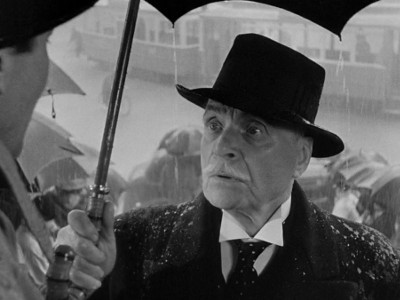
The thriller sequences are just as superb. The assassination sequence is a stand-out, a shooting on a rain soaked series of steps outside a conference, with the assassin making his retreat through a crowd of on-lookers carrying umbrellas under hot-pursuit from Jones. Hitchcock takes his camera above the crowd, meaning we only follow its progress through the disruption of the umbrellas, before the two men emerge (bullets flying) and move straight into a breathless car chase through the Dutch countryside. It’s a masterful sequence.
And it’s far from the last. The film has a superb series of tension-filled sequences, from Jones playing an elaborate game of cat-and-mouse in a Dutch windmill, trying to avoid being seen by the German agents occupying it while finding out as much as he can about their plans, to Jones reporting what he has found to a man we already know is a double agent. Edmund Gwenn, cast well-against type as a jovial, remorseless assassin, gets a brilliant sequence of attempts to kill Jones without putting him on guard, culminating in a vertigo inducing sequence at the top of Westminster Tower. It’s the second such sequence, Jones already having to climb over the roof of a hotel in Amsterdam to escape assassins (along the way brilliantly hitting the neon sign of the Hotel Europe so that it reads “Hot Europe”). Hitchcock tops it all with a brilliant plane-crash sequence shot with chutzpah and daring and is a technical marvel considering the resources available in 1940.
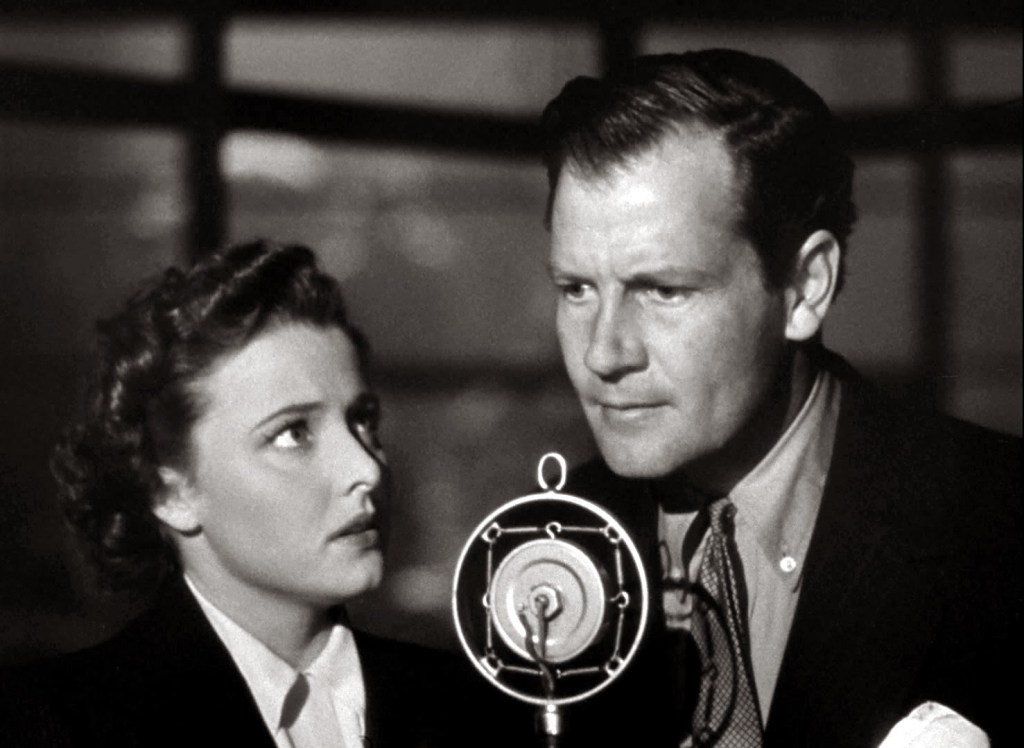
All this excitement and adventure helps to deliver the message of the film as strongly pro-interventionist to encourage the Americans to enter the war on the side of the Allies. Van Meer (a fabulous performance from Albert Bassermann of old-school nobility, made even more astonishing by the fact he didn’t speak a word of English and learned it all phonetically) has a brilliant, impassioned speech – all the more affecting for its lack of histrionics – that condemns the brutality and violence of the dictatorships. The film is capped with Jones’ Ed Murrow-style broadcast from Blitz-besieged London. Both sequences raise genuine lumps to the throat – McCrea’s delivery is perfect – and the final sequence is all the more astonishing when you realise it was conceived and shot before the Blitz even started.
Not that the film is completely obvious in its allegiances. The turn-coat Brit in the film is a complex, even sympathetic figure who is merely serving his actual home country in the best way possible. He’s largely presented as reluctant to commit crimes, but believing that they must be done and is even allowed a heroic death. His identity perhaps is fairly guessable (he even has a Germanic dog!) but it still works very well in the film.
Hitchcock draws superb performances from the cast – helped by that script of zingers. McCrea is just about perfect, Day very sweet, Sanders is brilliant, Herbert Marshall’s Stephen Fisher a brilliant portrait of arrogance and tortured duty, Robert Benchley very funny (and writing his own scenes) as Jones’ colleague who’s struggling to stay on the wagon, Harry Davenport superb as Jones’ His Girl Fridayish editor. Basserman was Oscar nominated – and deserves it for his big speech – but it could have been any of the cast who got that nod, such is the quality here. Foreign Correspondent is often overlooked among the master’s many, many triumphs. But any pro-interventionist, anti-German film that has even Joseph Goebbels singing its praises must have a fair bit going for it.
Russell Crowe and Leonardo DiCaprio fail to master the Middle East in Ridley Scott’s spy thriller Body of Lies
Director: Ridley Scott
Cast: Leonardo DiCaprio (Roger Ferris), Russell Crowe (Ed Hoffman), Mark Strong (Hani Salaam), Golshifteh Farahani (Aisha), Oscar Isaac (Bassam), Ali Suliman (Omar Sadiki), Alon Abutbul (Al-Saleem), Vince Colosimo (Skip), Simon McBurney (Garland), Lubna Azabal (Cala)
Ridley Scott is a bit of a curate’s egg as a director. You can always expect a film with a certain visual flair, as well as a story that attempts to tackle big themes and engaging topics. However, it doesn’t always produce an end result that really grips or feels like something that particularly stands out from the crowd. That’s what you end up with Body of Lies, a film that constantly feels like it is on the cusp of saying something important or interesting about the relationship between East and West, but constantly falls back on the sort of spy movie tropes it initially feels like it wants to debunk.
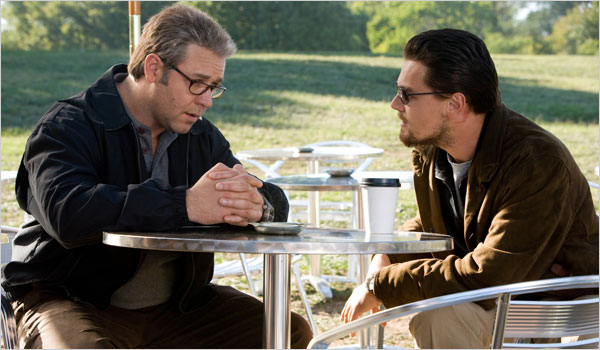
In the Middle East, Roger Ferris (Leonardo DiCaprio) is a dedicated CIA operative, with an intricate knowledge of the cultures and issues of the region. He constantly finds himself frustrated and undermined by his boss Ed Hoffman (Russell Crowe), based in Langley, who is constantly willing to sacrifice long-term gains for short-term political pay-offs. Assigned to Jordan, Ferris begins an investigation into a terrorist cell, working closely with head of Jordanian security Hani Salaam (Mark Strong) – but Hoffman’s intercessions increasingly cause tension.
Scott’s film is stylish and well assembled, with a great sense of pace and place. The contrasts between DiCaprio on the ground (in the dirt, facing dangers and tackling everything from terrorists to rabid dogs) and Crowe back in the States (rarely if ever seen without a hands-free phone set dangling from his ear, viewing everything at a distance with no understanding of the intricacies) is well drawn. The sense of complete cultural misunderstanding and lack of connection between East and West is established early, and attempts to cross it generally lead to disaster. The patience and expertise of the Jordanian security forces is contrasted constantly with the more slap-dash, hasty efforts of the CIA to meet the same goals. It’s all set for something quite interesting.
But then the film somehow doesn’t quite come together. Its episodic structure increasingly stretches out as action moves back and forth from Jordan to Langley and back again. A particularly wild scheme by Ferris (which, to the viewer not the film, suggests he is as incompetent and reckless as Hoffman) turns the film towards the sort of kidnap/torture/nick-of-time-rescue plotline that wouldn’t look out of place in 24 or James Bond. Basically, the plot turns on the film transitioning from something with a genuine political statement to make into the sort of disposal rent-a-spy-thriller that you forget pretty quickly.
DiCaprio gets a lot of “big” moments to juggle with, as well as a rather forced romance with a Jordanian nurse (something that he and Golshifteh Farahani play very well, but seems to have wandered in from an even more conventional film) but the film works hard to paint him as the “hero” who knows better than his superiors, despite the film chronicling a string of mistakes. Crowe enjoys himself as self-important windbag behind a computer, as uncaring as the institutions he represents.
The real star of the show however is Mark Strong, excellent as the suave head of Jordanian intelligence, seemingly the only character who has any understanding about what is going on. With a cool sharpness, slightly playful politeness and a slight chill of threat, Strong is the film’s most interesting character. There is a striking point made here that the most effective person in the film is a Jordanian spy chief with a mixed reputation – but the film largely shirks the possibility of really using this to demonstrate how out-of-their-depth the CIA agents are, as if worried that flagging up their manifest incompetence at every turn would sell badly Stateside.
It’s part of the film’s general lack of soul behind the skill of its construction. I know Scott is deeply interested in these themes of East vs West and the culture clashes that develop from it, but it just doesn’t come out here at all. There was a film to be made here about how the war on terror has thrown the CIA and the West into a setting they don’t understand, playing by rules they haven’t been briefed on. But all too often the film instead settles for telling us the same-old-same-old, padding out its runtime with spy story clichés and thriller plotting. Scott himself even uses visual tricks – surveillance drone shots and 24 style action – which suggest that somewhere along the line his heart wasn’t really in it. Body of Lies could have been a really interesting thriller about the world today. Instead it’s just another spy thriller about the war on terror.
Stellan Skarsgård is the Russian traitor whose secrets pose a danger for the British elite in Our Kind of Traitor
Director: Susanna White
Cast: Ewan McGregor (Perry MacKendrick), Stellan Skarsgård (Dima), Damian Lewis (Hector), Naomie Harris (Gail MacKendrick), Jeremy Northam (Aubrey Longrigg), Khalid Abdalla (Luke), Velibor Topic (Emilio Del Oro), Alicia von Rittberg (Natasha), Mark Gatiss (Billy Matlock), Mark Stanley (Ollie)
John Le Carré’s works often revolve around a dark, cynical view of government agencies as corrupt, indolent and focused on petty or personal concerns rather than doing what’s best for the country and its people. Is it any wonder that there has been such a burst of interest in adaptations on film and television of his work?
Our Kind of Traitor is straight out of the Le Carré wheelhouse. On a holiday to save their marriage (after his infidelity), Perry (Ewan McGregor) and Gail (Naomi Harris) bump into charismatic Russian gangster Dima (Stellan Skarsgård). Perry and he strike up a surprising friendship – and before he knows it Perry is agreeing to carry information from Dima to the British intelligence services. This attracts the attention of MI6 officer Hector (Damian Lewis) who sees this as an opportunity to expose the corrupt links between Russian criminals and high-level British bankers and politicians. Dima, however, will only hand over the goods if he is promised asylum for his family – something the British authorities, aware of the mess his revelations could cause, are not happy to allow…
Susanna White, veteran of some excellent television series of the last few years, puts together a confidently mounted and generally well-paced drama, with many of the expected Le Carré twists and turns. If she leans a little too heavily on the murk – the green and blue filters on the camera get a big workout here – it does at least mean that we get a real sense of the twilight world the characters operate in, meaning flashes of wide open space and bright daylight carry real impact. She also really understands how violence is often more shocking when we see the reaction of witnesses rather than the deed itself – all the most violent and tragic events in the film are seen at least partly from the perspective of the reactions of those witnessing them. The sense of danger on the edges of every action, stays with us while watching this unjust nightmare unravel.
It also works really well with one of the core themes of the movie: our ability to feel empathy for other people and how it affects our choices. Dima is driven towards defection because of his distaste for the increasing violence of the next generation of Russian criminals, and their lack of discrimination about who they harm. He’s all but adopted the orphaned children of a previous victim of violence, and his motivation at all points is to insure his family’s safety. Hector, our case officer, is motivated overwhelmingly by a sense of tragic, impotent fury about his rival ensuring Hector’s son is serving a long sentence in prison for drug smuggling.
And Perry is pulled into all this because he has a strong protective streak – something that eventually saves his marriage. Perry frequently throws himself forward to protect the weak, with no regard for his safety, from his unending efforts to protect Dima’s family to throwing himself in fury at a mobster roughing up a young woman. His intense empathy and protective streak motor all his actions and run through the whole movie.
It’s a shame then that his actual character isn’t quite interesting enough to hold the story together. Nothing wrong with McGregor’s performance, the character itself is rather sketchily written. Aside from his protectiveness we don’t get much of a sense of him and – naturally enough – he’s often a passenger or witness to events around him. Similarly, Naomie Harris does her best with a character that barely exists.
Instead the plaudits (and meaty parts) go to Skarsgård and Lewis. Skarsgård dominates the film with an exuberant, larger than life character who never feels like a caricature and reveals increasing depths of humanity and vulnerability beneath the surface. Lewis matches him just as well, at first seeming like a buttoned-up George Smiley type, but with his own tragic background motivating a long-term career man to slowly build his own conscience.
Our Kind of Traitor handles many of these personal themes very well, but it doesn’t quite manage to tie them into something that really feels special. Instead this feels a bit more like a Le Carré-by- numbers. We get the shady secret services, government greed, good people trapped in the middle – even some of the characters, from the foul-mouthed spook played by Mark Gatiss to Jeremy Northam’s jet black Aubrey, seem like they could have appeared in any number of his novels.
There is a film here that is wanting to be made about the invasion of the UK by dirty Russian money – but it never quite comes out as this Dante-esque, Miltonian spiral. Instead the film too often settles for more functional thrills, a more traditional or middle-brow approach that works very well while you watch it, but doesn’t go the extra mile to turn this into something you will really remember.
Jennifer Lawrence tries but fails with dismal material in the dreadful Red Sparrow
Director: Francis Lawrence
Cast: Jennifer Lawrence (Dominika Egorova), Joel Edgerton (Nate Nash), Matthias Schoenaerts (Ivan Vladimirovich Egorov), Charlotte Rampling (Marton), Mary-Louise Parker (Stephane Boucher), Ciaran Hinds (Colonel Zakharov), Joely Richardson (Nina Egorova), Bill Camp (Marty Gable), Jeremy Irons (General Vladimir Andreiovich Korchnoi), Thekla Reuten (Marta Yelenova), Douglas Hodge (Colonel Maxim Volontov)
Dominika Egorova (Jennifer Lawrence) is in trouble. After an act of sabotage by her dance partner, her career in ballet is over. Out of options, she is forced into enrolling at the elite FSB Sparrow School by her uncle Ivan (Matthias Schoenaerts). There young men and women are trained, under the tutelage of its controlling Matron (Charlotte Rampling), to sacrifice all their pride and their bodies for the good of Mother Russia. Thrown into the field, Dominika finds herself entangled with the CIA Agent Nate Nash (Joel Edgerton), whom she has been ordered to seduce.
Red Sparrow is a bad film on several levels. Firstly, it’s at heart a trashy espionage movie that confuses being about intelligence with actually being intelligent. A few late twists doesn’t suddenly make this a work of genius.Secondly, its attitude of being about this damn dirty business of spying manages to make it so grim it’s not even fun to watch. Finally, it’s the sort of film that thinks constantly telling us it has a strong female lead at its heart is the same as actually having a strong female lead at its heart.
To take that final point last… Poor Jennifer Lawrence. Surely only the $20million she was paid for this film attracted her to this. I’ll start by saying she feels miscast in a role that requires a ruthlessness and capacity for viciousness that is not a natural part of her range. But this film struggles to make her feel like a character with real agency. During the course of this film, she has her leg broken, nearly gets raped (twice), strips down in front of a group of people (twice), gets smacked in the face, beaten, tortured, stabbed, shot… And a few sudden last minute gear reversals which suggest that she has been playing her own game this whole time don’t shake the impression that the film is wallowing in the torture and violence that runs through the film.
Anyway, the film is reliant on that because it’s not sharp or clever enough to really have anything else in there in its place. So we stumble from violent set piece to violent set piece, while the characters talk incessantly about macguffins and characters we care almost nothing about. The film has an almost impenetrable plot, not because it’s complex, but because it’s poorly explained and impossible to care about. Actors who are way too good for this material – and I mean the whole cast – struggle to put fire and energy into a shaggy dog story that never goes anywhere.
This all serves to make it a dull film. It really should be a guilty pleasure. All the right material is in there. Spy thrillers make for fun films. It’s interesting to have a woman at the centre of it. It’s got good actors. But too many scenes and set pieces veer towards the overly violent and sexual. For a film that is about a silly spy training school turning out honey trap agents, this film seems determined to ram the grimness of spying in our faces at every turn. This makes sense for a high brow Le Carre adaptation. It makes no sense for silly high-concept Jennifer Lawrence star vehicle.
Who really needs to watch poor Jennifer being slapped about and ill-treated for over two hours? Who has the patience for it? Who is going to enjoy it? The film struggles to get across the idea that Dominika is good at this spying game so it needs other characters to say it openly. Its rug pull towards the end lacks all signposting so gives no satisfaction whatsoever. By the time it comes round you’ll have long ceased stop caring about anything in it as well. A tedious, grimy and rather unpleasant film from start to finish that leaves a sour taste in the mouth.
Richard Burton lands in Cold War trouble in classic Le Carre adaptation The Spy Why Came In From the Cold
Director: Martin Ritt
Cast: Richard Burton (Alec Leamas), Claire Bloom (Nan Perry), Oskar Werner (Fiedler), Sam Wanamaker (Peters), George Voskovec (East German Defence Attorney), Rupert Davies (George Smiley), Cyril Cusack (Control), Peter van Eyck (Hans-Dieter Mundt), Michael Hordern (Ashe), Robert Hardy (Dick Carlton), Bernard Lee (Patmore)
Spy stories fall into two camps. You get the wham-bam blast of James Bond and then you also get the grimy, isn’t-this-a-damn-dirty-trade stories that John Le Carré helped to turn into a major alternative. The book that really kicked off Le Carré’s career was The Spy Who Came in From the Cold, a slim, brilliantly written story of spies working exclusively in shades of grey. The book was a smash, the film was inevitable, and a damn fine film it turned out to be.
Richard Burton plays Alec Leamas, a former head of Berlin Station for the British Secret Service, who is recruited by the services’ leader Control (Cyril Cusack) as part of an elaborate scheme to discredit the cunning and dangerous head of the Stasi office in Berlin, Hans-Dieter Mundt (Peter van Eyck). Leamas will go through a pretence of disgraced dismissal, alcoholism, jail time and half a dozen other indecencies to attract the attention of the East German defector recruiters in the UK. But will the relationship he develops during his disgrace with librarian and idealistic communist Nan Perry (Claire Bloom) endanger the whole mission?
The Spy Who Came in From the Cold is shot in a grimy, gloomy black-and-white which is completely appropriate for the morally questionable escapades its characters get up to. Like Le Carré’s novel, the ends justify any means here, and questions of morality and justice are best benched. Characters who can’t let themselves to forget justice are doomed in this film. Genuine shows of real emotion and feeling are generally signs in this film that a person is doomed.
Martin Ritt’s literate script captures the style and tone of Le Carré extremely well – this is still one of the best, truest and most faithful capturing of Le Carré on the screen – and his direction also has a wonderful mixture of shabby kitchen-sink realism and classic Hollywood film noir class that makes for a brilliantly involving package. The pace of the film holds pretty well, beautifully carrying us through a parade of agents recruiting Leamas for the East Germans (each of which are dismissed with a shocking curtness by the next one along), and the final court room trial of Mundt (with its intricate exploration of the complex plotting of the novel) is extremely involving.
The film also has the benefit of a number of terrific performances, led by Richard Burton in the lead. By this stage of his career, Burton was already felt by many to be lost to serious acting in favour of big budget, Liz Taylor-starring pictures and Hollywood entertainment. But he rouses himself here to give one of his best ever performances. Leamas is a shabby, beaten down, little man (despite being played by Burton!) whose chippiness, dissatisfaction and aggression make him perfect as a possible defector. Ritt’s camera often focuses on Burton’s unflinching stares, his eyes seem to bore into the person he’s talking to, little oceans of anger and resentment.
Burton’s Leamas is deep down sick and tired of the world of spying, its betrayals and lies, and sickened with self-disgust at his own involvement in it. Burton skilfully underplays the role throughout, largely ignoring any temptation for grandstanding or big acting moments – instead he is as compromised, grey and lost as the rest of the film, in a superb performance of cynical disaffection. Bunched up, his grand voice dialled down, his eyes flickering with resentment – a great performance.
Claire Bloom is rather affecting as Nan (hilariously, her name was changed from Liz in the book as the producers feared she would be confused with the rather more famous Liz in Burton’s life) and Oskar Werner gives the film a major burst of energy just as it is flagging from one interrogation of Leamas too many, as a chippy, eager, sharp Stasi officer, who is determined to see justice done. The rest of the cast are filled out with some classy Brit character actors, who excel from suave (Robert Hardy) to seedy (Michael Hordern), while Cyril Cusack brings “Control” to cynical life and Rupert Davies gets to the be the first actor to play George Smiley on screen (even if he is only really an extra here).
Spy is a film of atmosphere. Frequently it trusts the viewer to catch up the plot as they go. Leamas actions are not always explained until late on – and we are constantly suspecting that we are only seeing half the story. Its a film that plays its cards close to the chest. This might alienate some, but it’s a true representation of Le Carre – and fits perfectly with the weary sense Leamas has of not being in control of his own life.
But what Ritt does so well is keeping that tonal sense of there always being another shady, compromising twist around the corner. All is never what it seems, and the film ends with an especially bleak series of footnotes as we find out just how ruthless both sides are prepared to be in this soulless chess game of Cold War politics. It’s the moments like this that Spy Who Came in From the Cold really nails. For Le Carré fans the film is a must: for those less interested in the world of espionage, they may find it takes a little too much time.
Benedict Cumberbatch saves the world in smug, empty mess The Imitation Game
Director: Morten Tyldum
Cast: Benedict Cumberbatch (Alan Turing), Keira Knightley (Joan Clarke), Matthew Goode (Hugh Alexander), Rory Kinnear (Detective Nock), Allen Leech (John Cairncross), Matthew Beard (Peter Hilton), Charles Dance (Commander Alastair Dennison), Mark Strong (Maj General Stewart Menzies)
“Sometimes it is the people no one imagines anything of who do the things no one can imagine”. If there is anything that captures the smug self-satisfaction of this ludicrously pleased-with-itself film, it’s that convoluted phrase, with which the film is so pleased that it is repeated no fewer than four times. What does it mean really? Nothing of course, it carries all the meaning of a fortune cookie. Turing is certainly someone whom you could expect something of, since the film is at pains from the start to demonstrate he is a maths prodigy and a genius. But then that would spoil the romance of the film suggesting that because Turing is socially maladjusted, he is somehow unlikely to achieve something – or that achieving something would be even more special having overcome the “disability” of his personality.
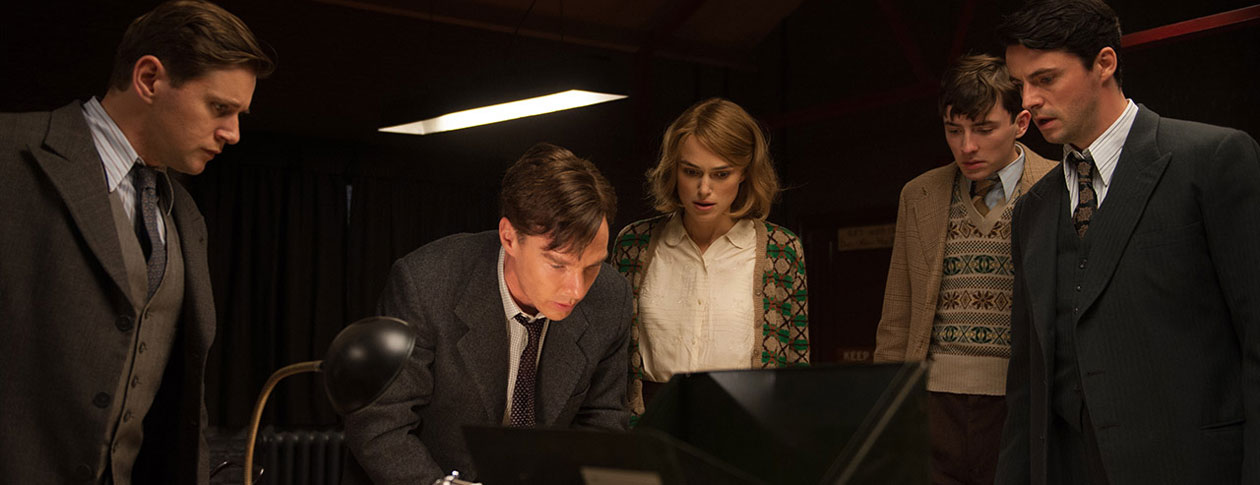
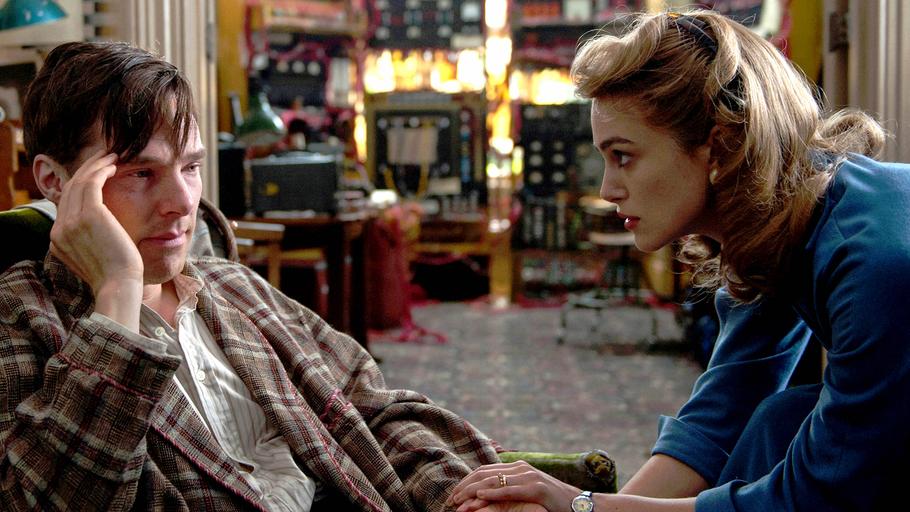
Alan Turing (Benedict Cumberbatch) is under police suspicion in 1951 after a mysterious break-in at his Manchester home. A keen detective (Rory Kinnear) suspects he may be a Russian agent – why else does he have no military record? But we know different, as flashbacks show Turing working at Bletchley Park on the cracking of the German cipher machine Enigma. Working with the support of an MI6 officer (Mark Strong), Turing has to win the trust of his team – with the support of best friend and maths genius Joan Clarke (Keira Knightley) – to build a ground-breaking computer that could crack the impossible code. But back in 1951, Turing is in trouble: he’s gay and that’s a crime in post-war Britain.
Now, Turing’s personality in this film. In real life, Turing was an eccentric, but perfectly capable of functioning perfectly normally in society. That’s not dramatic enough for the film, so Turing is reimagined as someone practically afflicted by Aspergers syndrome, incapable of understanding or relating to people without severe effort and prompting. Of course this is really there to introduce conflict – first with his team (who need to be won round to loving the old eccentric genius), secondly with his boss (who can’t stand his inability to fit in) and thirdly with the police (who can use it to write him off). It’s a film-disability for a character to overcome, another puffed up triumph that we can celebrate, while at the same time pat ourselves on the back because this is a victory for those “not normal”. But it’s probably bollocks.
But then that fits in rather nicely with the whole film, which is more or less probably bollocks from start to finish. The film of course can’t dramatise maths or computing very well, so it throws us all sorts of feeble clichés from tired old film genres instead. Charles Dance plays a reimagined Denniston (in real life a cryptographer) as a standard obstructive boss who all but shrieks “you’re off the case Turing!” at the one-hour mark. The key moment of inspiration of course comes from flirty pub conversation with a charming secretary. Running around and frantic throwing of papers takes the place of all that boring maths.
The film can’t resist any level of dramatic cliché. When a member of the code-breaking team mentions in passing “I have a brother in the navy you know”, as sure as eggs is eggs you can bet the team will decipher a message that could save his life but will be forced to make A Terrible Choice. Of course even this picture of a small code-breaking team making the calls themselves over which messages to act on is nonsense – it’s a decision that would be so far above their pay grade, they should be taking oxygen just thinking about it. But in this bonkers version of the universe, Turing himself makes the call to keep the initial breaking of the code a secret, and the government happily allows him alone to make the call about which codes to act on. Oh for goodness sake, spare me.
But then this is a film that wants to turn Turing into the man who won the war single-handed. While Turing was one of the key figures who made the breakthrough, this was a massive team effort, not one man’s inspiration, and reducing the victory of the war down to one (film cliché) difficult genius is the same old ripe nonsense we’ve seen many, many times before. The film tries to pretend that Bletchley Park and the breaking of Enigma, and Turing himself, is an unknown story – when it’s been pretty well-known since it was announced by the Government in the 1980s.
The film is rubbish, but it’s also gutless. Of course “fifth man” John Cairncross is part of the team – and of course Turing discovers he is a spy. (The reveal of course is due to the same old tedious movie cliché of “I found a book on his desk that was the key book he used for the code”.) And then in a moment of stunning tastelessness, Cairncross blackmails Turing into keeping his mouth shut which he agrees to do – an action that, if it had ever happened in real life, would have been an appalling moment of treachery from Turing, and reinforces all the suspicions of the time that homosexuals couldn’t be trusted.
Ah yes, homosexuality. This film is very, very, very proud of its crusading actions to expose the cruel treatment of Turing for his homosexuality. At the same time, the film is of course way too gutless to even begin to show Turing doing anything actually gay (he doesn’t even so much as hold another man’s hand) during the film. The one genuine moment of love the character is allowed to express, is in the form of a crush on a schoolfriend. (The film substitutes renaming Turing’s machine “Victory” after this school friend “Christopher”, the film keen to try and plug the gap of this film featuring virtually no LGBTQ content at all). But the film preaches intensly and proudly about the equal rights of homosexuality, while veering away with squeamishness from putting anything remotely homosexual on the screen.
The shoddy writing, over-written and self-important, is matched up with Morten Tyldum’s flat, “prestige” film-making that reduces everything to a chocolate box. The film does have some acting beyond what it deserves. Benedict Cumberbatch is good as Turing, although his performance is a remix of some of his greatest hits from past projects, from Hawking to Sherlock, and you feel hardly it’s a stretch for him – even if he plays with it real, and genuine, emotional commitment. Keira Knightley’s cut-glass accent is practically a cliché, but this is one of her best performances with real warmth and empathy. Most of the rest of the cast though are serviceable at best.
“Serviceable”, however, is still better than the film itself, which is a cliché-ridden, gutless, plodding and highly average pile of nothing at all – a totally over-hyped, over-promoted and completely empty film that is about a zillion times less interesting, brave or revealing than Hugh Whitemore’s 1980s play Breaking the Code. Not worth your time.
Matt Damon swings back into action in after-thought Jason Bourne
Director: Paul Greengrass
Cast: Matt Damon (Jason Bourne), Tommy Lee Jones (Director Robert Dewey), Alicia Vikander (Heather Lee), Vincent Cassel (The Asset), Julia Stiles (Nicky Parsons), Riz Ahmed (Aaron Kalloor), Ato Essandoh (Craig Jeffers), Scott Shepherd (Edwin Russell), Bill Camp (Malcolm Smith), Vinzenz Kiefer (Christian Dassault), Gregg Henry (Richard Webb)
They say you should never go back. Producers had been begging Paul Greengrass and Matt Damon to get back together again and make another Bourne film. After all, there was hardly anyone asking for a sequel to that Jeremy Renner one was there? But Jason Bourne seems like a film that’s been made after Greengrass and Damon ran out of reasons for saying no. I can’t decide if we can blame them for that or not. But their making the film at all suggests they aren’t really losing any sleep about whether people feel this half-hearted effort has an impact on the legacy of the others.
Anyway it’s ten years later. The world is an increasingly technical place, with people living in an era of increasing social unrest and anti-government fury. Jason Bourne (Matt Damon), recovered from his amnesia, now lives off-the-grid – until of course he’s unearthed by his old colleague Nicky Parsons (Julia Stiles). Parsons is now working with a hacker commune in Iceland, and has unearthed more evidence about the shady CIA programme, Treadstone, that Bourne used to be a part of, and about Bourne’s own recruitment into it. Meeting in Athens in the middle of an anti-government riot, Parsons is killed and Bourne is set on a collision course with the CIA as well as finding out more about the mysterious death of his father 20 years before.
Jason Bourne is basically going through the motions. There is an attempt to add another layer of mystery around Bourne’s background, but it barely seems to add much to the hinterland of Bourne we’ve already learned about in the last couple of films. Furthermore, I’m uncomfortable with a Bourne here who goes increasingly on a rampage of revenge. Part of the charm – or rather what makes Bourne different – in the previous films was that he was a man who lived in a world of violence, but didn’t care for it himself. He used brutal force only when it was absolutely necessary, and several times chose not to take a personal revenge. Here however, he dispatches at least three people, which doesn’t seem to square with the character as we’ve previously seen him.
Furthermore, the film seems to be struggling to reclaim Bourne as one of the formal good guys, a patriot and American hero. Again part of what made him different in the original trilogy was that he stood outside the government and nations, that (as Greengrass once said) “he’s on our side”. Here he’s clearly less than sympathetic to anti-government forces, and strongly opposed to exposing CIA secrets. In fact he ends up feeling rather conservative here to be honest, and more like the faceless killer that he started as rather than a renegade.
It’s not helped by the fact that the plot is pretty meh, a remix of different elements from previous films, carefully ticked off to make sure we get everything we could expect. So we get a reworking of various car chases, fights, tense meetings in public locations etc. etc. The film-making is very well done – Greengrass rewrote the book on how to make films like this, and he carries that on here, brilliantly mixing twitchy editing, handheld camera work, immersive film-making and gloomy silences to create a really wonderfully done viewing experience. It’s just more of the same from the originals. The film just ends up living in the shadow of the originals, rather than really forging something out on its own.
Greengrass tries to tap into contemporary ideas. We get the sense of anti-establishment clashes and Internet data scams – but it never really feels like it goes anywhere or coalesces into any real point at the end of it. What is the actual message of this film? There are hints that Tommy Lee Jones’ gravelly CIA Director and Riz Ahmed’s Mark Zuckerberg-lite tech expert are planning some sort of mass intrusion on people’s privacy – but the film never explains this or explores it. It never even makes Bourne aware of it – and since Bourne is our “window” into this world, that means we never understand it either.
I mean, the film is fine other than that, but that’s all it really is. Matt Damon still hasn’t lost it as Bourne – and blimey he should have some inverted award for how little he speaks in this film – and he has not only the physicality but also the worn-down, haunted look of a man who has seen way, way too much. There are professional performances from the rest, but nothing that stretches any of the actors here, with Alicia Vikander particularly under-used as an unreadable CIA agent.
But that sums up the whole film. Despite all the attempts to build in a modern “torn from the headlines” angle to the story, it feels more like Greengrass and Damon are quite happily (and with some enthusiasm at least) going through the motions in order to pick up a cheque. And I guess that’s fine. It just means we are probably not going to rush to see this again.















 Movie Musings