Category: Star Trek films

Star Trek: Insurrection (1998)

Star Trek: Insurrection (1998)

Playing like a double-length TV episode with some embarrassing humour, not enough special about Insurrection

Director: Jonathan Frakes

Cast: Patrick Stewart (Captain Jean-Luc Picard), Jonathan Frakes (Commander William Riker), Brent Spiner (Lt Commander Data), LeVar Burton (Lt Commander Geordi LaForge), Michael Dorn (Lt Commander Worf), Gates McFadden (Dr Beverly Crusher), Marina Sirtis (Counsellor Deanna Troi), F. Murray Abraham (Ru’afo), Donna Murphy (Anji), Anthony Zerbe (Admiral Doherty), Gregg Henry (Gallatin), Daniel Hugh Kelly (Sojef), Michael Welch (Artim)
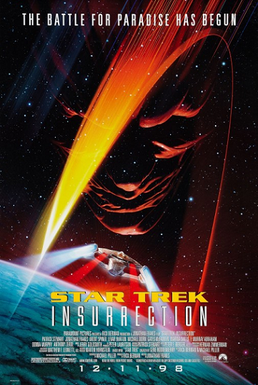
After the smash-hit success of Star Trek: First Contact, the Next Generation franchise had a golden opportunity. Like never before, Paramount put the cash up (almost twice what it did for First Contact) and geared up to make Insurrection a smash-hit. But then it all went a little wrong. There’s nothing particularly offensive about Star Trek: Insurrection – apart from that fact that there is nothing particularly outstanding about it either.

The Enterprise crew are called to a secluded planet in the middle of a nebula after Data (Brent Spiner), on secondment to an undercover mission observing the peaceful pre-Warp Ba’ku people, suddenly goes berserk and holds the rest of the mission hostage. Picard (Patrick Stewart) and the crew recapture and repair Data – only to find that the android flipped out after being injured discovering a secret conspiracy. Misguided Starfleet Admiral Doherty (Anthony Zerbe) is working with the shady Son’a, led by the clearly maniacal Ru’afo (F. Murray Abraham), to force the Ba’ku to leave the planet so the Federation and Son’a can mine (aka steal) the planet’s atmospheric particles which can regenerate humanoid bodies (the whole planet is basically the fountain of youth). Outraged, Picard and his crew decide this will not stand and rebel to stop it.

Now I love Star Trek: The Next Generation. If I had seen Star Trek: Insurrection in two parts, with a year-long cliff-hanger in the middle after Picard chucked in his com badge and went rogue, I’d probably think this was one of the best episodes ever. But as a film? It feels like an episode unwisely moved to the big screen. I can totally see why this failed to be the same breakout hit First Contact was. That dialled the stakes up to the Nth degree and felt cinematic: Insurrection feels like it could have sat quite nicely in two 45 minute, 4:3 chunks.

Even worse, despite the money lavished upon it, it actually looks cheaper than First Contact. This is partly because a large chunk of the money was poured into location shooting. While it must have felt very different to the cast and crew – used to sound stages and the odd trip out to the Californian valleys for an exterior – to suddenly be out in Sierra Nevada, honestly it doesn’t look that different to a host of other planets the crew visited in the show. Neither does the Ba’ku village look that different from the homespun, pre-Warp villages the crew visited at least a few times a season.

It doesn’t help that the Ba’ku are exactly the sort of new-age windbags the franchise has always had an inexplicable fondness for. In their cream robes, mouthing new-age mantras about putting self-discovery first and the beauty of self-improvement, they come across like a gang of smug hippies, rubbing their perpetual youth in the viewer’s face. Throw in the fact that they contribute little to their own defence, other than patronising shakes-of-the-head towards the Son’a, and it’s rather hard not to feel they deserve to be taken down a peg or two. And really, hoarding these life-changing regenerative particles so that only an elite few (happy to expel dissenters from their world) benefit rather than the billions in the galaxy, is a harder-sell the more you think about it.

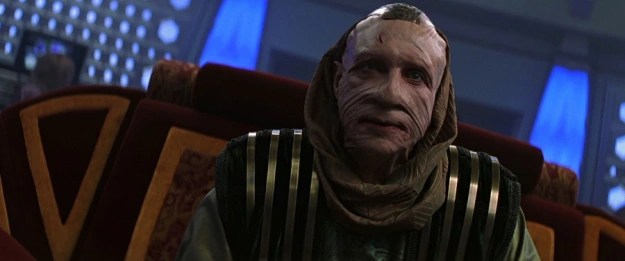
Mind you, it doesn’t help that the Son’a are a gang of less-than-compelling heavies, clinging to what’s left of their youth by constantly subjecting their bodies to a series of bang-on-the-nose cosmetic surgeries (nothing in Insurrection is remotely subtle). Blatantly untrustworthy villains from the start – it’s inexplicable to me why anyone would even consider working with these transparent gangsters from the get-go – their characterisation is one-note with Ru’afo, our villain, played in lip-smackingly precise tones by a slumming-it F. Murray Abraham. The more interesting by far villain is the deeply conflicted Admiral Doherty, a decent performance of “trying-to-do-the-right-thing” desperation that sees him edging towards damnation one tiny step at a time.
While some riffs land better than others, Insurrection unwisely plays the comedy card heavily. Picard, Worf and Data singing HMS Pinafore during their capture of the confused android is pretty droll (not least Michael Dorn’s excellent line in stunned reluctance), while Marina Sirtis and Jonathan Frakes actually manage to inject the re-discovered romantic spark between Riker and Troi with genuine playfulness that is rather sweet. But other stuff is the sort of gag-work that makes fans like me place fists in our mouths and hope no one catches us watching this. Beverly and Deanna talking about their boobs firming up anyone? Worf getting a pimple? Data playing in a haystack? Jesus Christ, no wonder I never told girls I liked Star Trek.

The comedy – and an awkwardly unconvincing romance between Picard and the frankly deeply annoying Anji, played with an irritating Earth-mother purity by Donna Murphy – often undermines the action and lowers the stakes. Although there is a noble attempt to engage with the moral complexities here – a classic “good of the many” situation – the film boils most of this down into a single crucial scene, which relies a lot on Patrick Stewart’s unmatched ability with a speech (Picard here is more like the character in the TV series then he is elsewhere in the film series) but the film isn’t deft enough to centre its moral dilemma. You end up wondering why the crew take such a radical stand. Its uncinematic stakes don’t help – it all feels similar to the sort of situation our heroes waded into exactly 175 times before over seven years. Why take it so much to heart now?

When action does kick-in, Jonathan Frakes does a decent job of directing it. Some of the Sierra Nevada-set action as Picard and his crew march the Ba’ku to the hills to prevent them being picked off the planet by the Son’a has a decent Western feel to it (including a Leone-homage series of frowning forehead shots). There is a decent space battle between the Enterprise – helmed by Riker – and the Son’a. I’ll even admit that the ridiculous “manual steering column” (essentially a joystick Riker uses to fly the Enterprise) is fairly entertaining. Like First Contact – and Nemesis would finally peak in this regard – the ending involves a Die Hard style smack-down between a trigger-happy, shirt-clad Picard and the villain on an utterly unconvincing set (which looks like they didn’t bother to finish the blue-screen work). But all this stuff never feels different from anything we’ve seen before.

So used, it seems, to making less stretch to more, I think the crew – and Frakes – didn’t know what to do when actually given more. They focused instead on all the wrong things: huge sets we almost never see, location shoots that don’t look that different from dozens of other films, more extras. Match that up with a bland story, unconvincing and plain irritating guest characters, and a tonal mess that slipstreams between half-hearted comments on ethnic cleansing to awkward pratfalls and Star Trek: Insurrection is the worst thing a Trek movie can be: a double-length episode which, if you missed, it wouldn’t really matter.
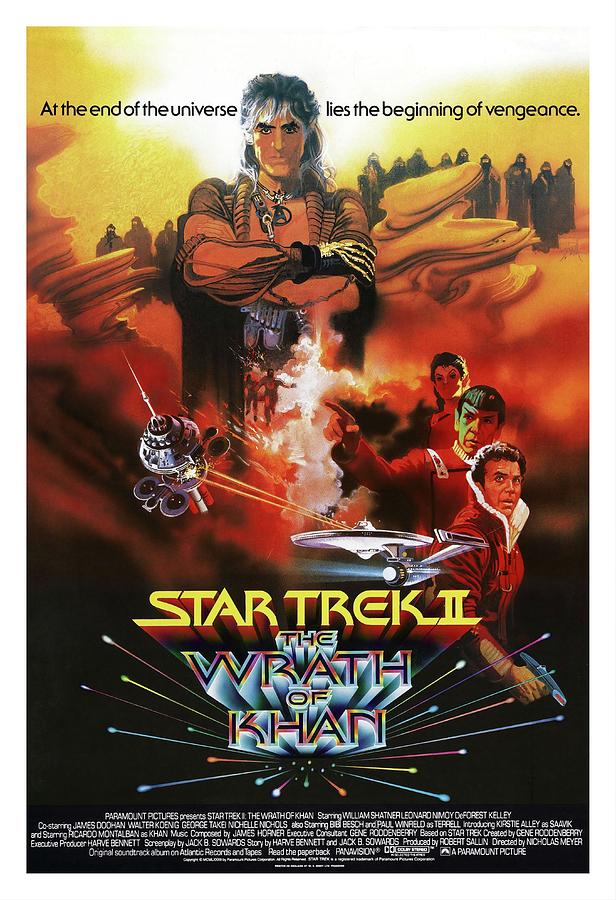
Star Trek II: The Wrath of Khan (1982)

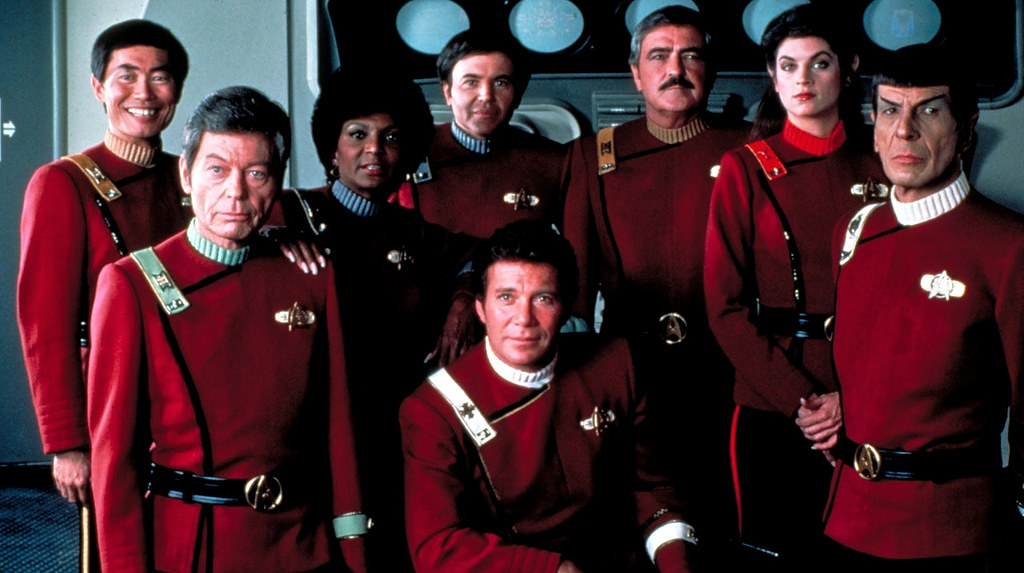
The Enterprise crew re-unite to face The Wrath of Khan

Director: Nicholas Meyer

Cast: William Shatner (Admiral James T Kirk), Leonard Nimoy (Spock), DeForest Kelley (Dr Leonard McCoy), Ricardo Montalban (Khan Noonien Singh), James Doohan (Montgomery Scott), George Takei (Hikary Sulu), Walter Koenig (Pavel Chekov), Nichelle Nichols (Uhura), Bibi Besch (Dr Carol Marcus), Merritt Butrick (Dr David Marcus), Paul Winfield (Captain Terrell), Kirstie Alley (Saavik)

After the overblown, slow and tedious The Motion Picture, you’d have been forgiven for thinking that we had seen the Enterprise crew boldly go for the very last time. If there was going to be a sequel Paramount had very clear guidelines for what it wanted: more entertaining, exciting, don’t involve Gene Roddenberry and above all make it for a fraction of the price. I think it’s fair to say that the decision to bring producer Harve (“I could make three movies for the cost of that first one!”) Bennett and above all writer and director Nicholas Meyer on board, saved the franchise.

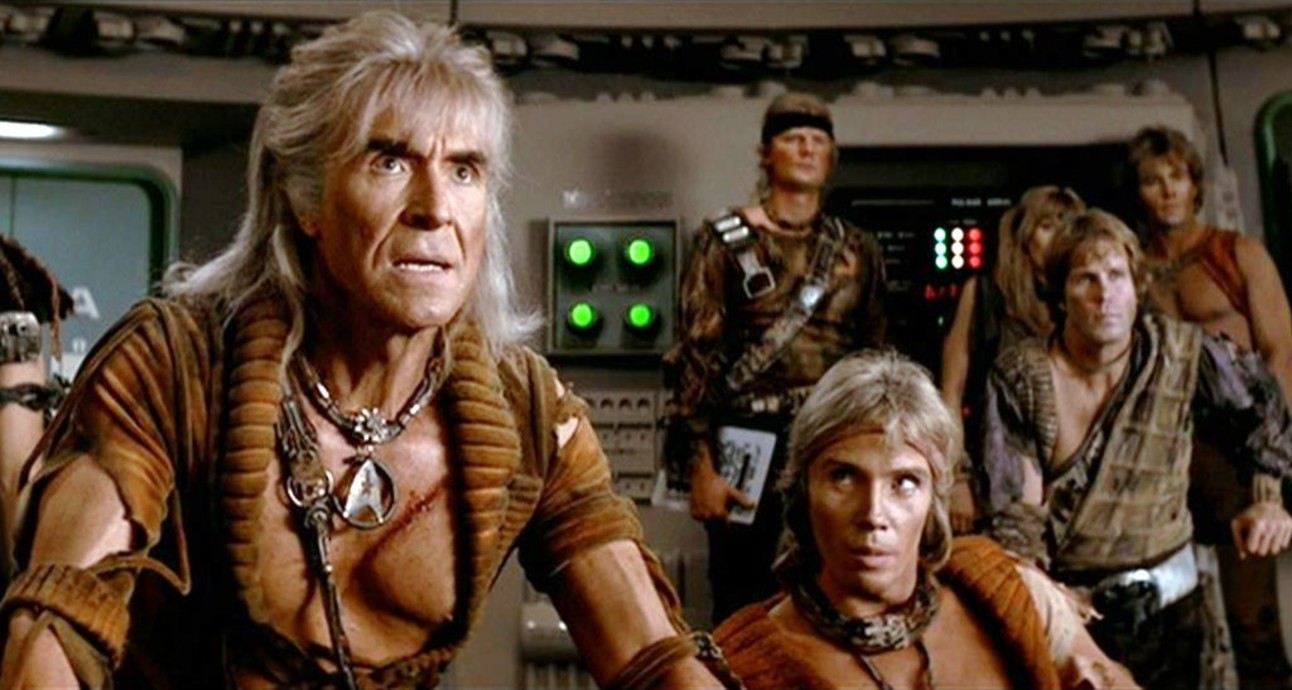
Neither Meyer or Bennett were familiar with the franchise in advance. But they did what those involved in the first film should have considered doing (looking at you Robert Wise!) – they went back and rewatched all the previous episodes and tried to work out exactly what people enjoyed about the show to begin with. And then tried to make a movie based around that. So first and foremost they decided they needed a villain – so after running through all the previous episodes they decided genetically-engineered superman Khan Noonien Singh, left abandoned on a planet with his followers after the episode Space Seed – was the best pick. Giving the film a simple “revenge” structure, it became a taught battle of minds and wills between Khan and the man he blames for all his problems – Admiral James T Kirk (William Shatner).

Star Trek II opens with an ageing Kirk, unsure of his place in the world while stuck in a desk job and scared about getting old. Running a cadet training voyage with his old crew, Kirk is called back into action after Starfleet loses touch with Federation scientists working on the Genesis device, a terraforming rocket that will help the Federation build new worlds and civilisations. The problems with Genesis are directly linked – without Kirk’s knowledge – with Khan’s (Ricardo Montalban) hijacking of the USS Reliantafter brainwashing the ship’s captain Terrell (Paul Winfield) and his first officer Chekov (Walter Koenig). Khan blames Kirk for the disasters that have taken place on the planet he was marooned on – and is determined to exact revenge on Kirk no matter the cost.

Unlike the dry Motion Picture, Wrath of Khan builds is action around a compelling, emotionally charged, story that gives each character a clear and relatable motive for their actions. Building a film about revenge may not exactly be in Roddenberry’s ideal for the 23rdcentury: but by heck it makes for a much better film. Because, if nothing else, while we may struggle to understand what the hell V’Ger wanted in the first film, everyone understands the dangerous obsession of revenge. It helps that the film has an excellent villain – a scowling, unbalanced but still strangely honourable and decent Khan, played with a grandstanding relish by Montalban who is clearly having a whale of a time. Despite never sharing the screen (or even being on set at the same time) Montalban and Shatner go at the rivalry and its impact on both characters with a real intensity that makes for compelling viewing.

Meyer also tightened and refocused the entire franchise. Roddenberry may have struggled with the increasingly naval view of Starfleet in this film – it’s at least twice referred to explicitly as the military – but Meyer recognised that if the franchise was partly Hornblower in Space, then why not redesign the film with that in mind. The ship is run with naval precision, including yeoman whistling to signal shifts and orders, uniforms that have a stylish naval formality to them, a greater focus on the ship’s movements being described in strictly naval terms – even the photon torpedo bays are prepped by enlisted men in what Meyer called his “running out the guns” sequences. This makes the entire operation not only easier to relate to, but interesting and entertaining in its own right.

It also adds huge tension to the duel that develops between the Reliant and the Enterprise that plays out part naval battle and late on – when battle turns to the Mutara nebula where systems and sensors work only intermittedly – part classic submarine drama, with Meyer practically throwing in depth charges. The battle scenes are filmed with simplicity and economy – but because the personal clashes between Kirk and Khan are so compelling and involving, they absolutely drip with tension, as these two go through move and counter move.

Meyer’s film is lean, engrossing and thrilling, and superbly well directed. It goes from skilled set-piece to set-piece, and never for a moment overlooks character. Unlike the first film, we get the moments of Kirk-Spock-McCoy discussing key themes together so beloved from the series, while most of the main cast also get their moment in the sun, most especially Walter Koenig who, as a brainwashed Chekov, gets more to work with here than he got in the whole original series. 

But this isn’t just an action adventure in space. Meyer’s literate and intelligent script has far more depth and thematic interest in it than the faux intellectualism of The Motion Picture. Taking as its starting point Kirk’s fear of on-setting age (the film opens with his 50th birthday, and McCoy’s gift of antique spectacles), it expands into an engrossing mediation of how we react to the impacts of our actions and lose-lose situations. Kirk has also to face the mortality of age and the impact of past actions – like his son (Merritt Butrick channelling Shatner’s impulsiveness) – coming back to bite him. All this while flying a ship of young cadets round – who need to shepherded into the risks of conflict. Khan meanwhile is confronted time and again with the damaging impact of his choices to follow revenge and obsession rather than settling for a winning hand.

Meyer gets his best work ever out of Shatner (allegedly after realising Shatner over committed to early takes, he made Shatner take multiple takes in order to focus his energy). This is a Kirk getting old, dealing with inner resentments and made to face up to the consequences of his actions – both with Khan and meeting the son he fathered. Shatner tackles all this with a world-weary resignation and touch of sadness that many felt were beyond him, while still making room for the fireworks that are his calling card (I suppose the famous “Khan!” was Meyer’s one major indulgence of Shatner’s exuberance).

However the other element the film is well known for is of course it’s tragic ending – the sacrifice of Leonard Nimoy’s Spock. Lured back to the film, but not convinced about ever returning, Nimoy agreed to the final reel shocker (although he enjoyed making the film so much he willingly agreed to leave the door open for Spock’s resurrection). It gives the film an emotional heft that none of the others in the franchise has. For the first time, our heroes would not magically escape unharmed to fly off onto the next adventure. Just as the film started with the cadets learning that sacrifice and facing a lose-lose scenario is a part of command (a lesson Kirk cheated on in his day, and a situation he has never faced or understood, as the film teaches him), so the film ends on the same beat. The ship can escape – but only if Spock takes a fatal radiation dose to restart the engine.

Both Nimoy and Shatner play the heck out of these scenes, probably the most emotional in the franchise – a low-key but deeply affecting moments of two old friends sharing their last moments together. It’s this successful switch into showing the real cost and loss associated with adventures like this that cap the thematic depth Meyer bought to the film.

Star Trek II succeeds on every count. Meyer’s intelligent script quotes and riffs everything from CS Forrester to Dickens via Moby Dick, while giving both heroes and villains deep and rich character arcs. It’s grippingly filmed – you wouldn’t believe how much cheaper it was than the first film, as it looks ten-times better with not a penny gone to waste – and hugely exciting. It carries real emotional force, and it’s hugely benefited by a fantastic score by a young James Horner. Even now it’s still the high point of Star Trek on screen – and probably a highlight of the franchise as a whole.

Star Trek: The Motion Picture (1979)

The Enterprise crew head to space in a tedious misfire that almost killed the franchise: Star Trek: The Motion Picture

Director: Robert Wise

Cast: William Shatner (Admiral James T Kirk), Leonard Nimoy (Spock), DeForest Kelley (Dr Leonard McCoy), James Doohan (Montgomery Scott), Walter Koenig (Lt Pavel Chekov), Nichelle Nichols (Lt Uhura), George Takei (Lt Hikaru Sulu), Persis Khambatta (Lt Ilia), Stephen Collins (Captain Willard Decker), Majel Barrett (Dr Christine Chapel), Grace Lee Whitney (Lt Janice Rand), Mark Lenard (Klingon Commander)

In the late 1970s the success of Star Wars meant every single studio was checking to find anything that could be turned into the next space-set mega-hit. Paramount’s eyes fell on a TV show that had been cancelled over ten years ago but had attracted a cult following. Hell it even had the word “Star” in the title! Quickly rejigging plans for a sequel TV series, instead Star Trek found itself heading towards the big screen. With a budget probably bigger than the amount spent making every single episode and two-time Oscar winning director Robert Wise calling the shots, what could go wrong?

Well as it transpires almost everything. Has there ever been a duller, flatter, less-engaging film that started a thirteen film franchise? Star Trek: The Motion Picture seems to have been made by people who looked at everything that made Star Wars a huge success and then decided “we ain’t going to do that!” Then they looked at everything that occasionally made the TV series self-important and hard to take seriously and said “We’re going to have some of that!” What we end up with a stupefyingly boring film that takes an immense amount of time to do almost nothing, with a story that might have made a passable 40 minutes of television into an empty and tedious two and a bit hours. Truly it was The Motionless Picture.

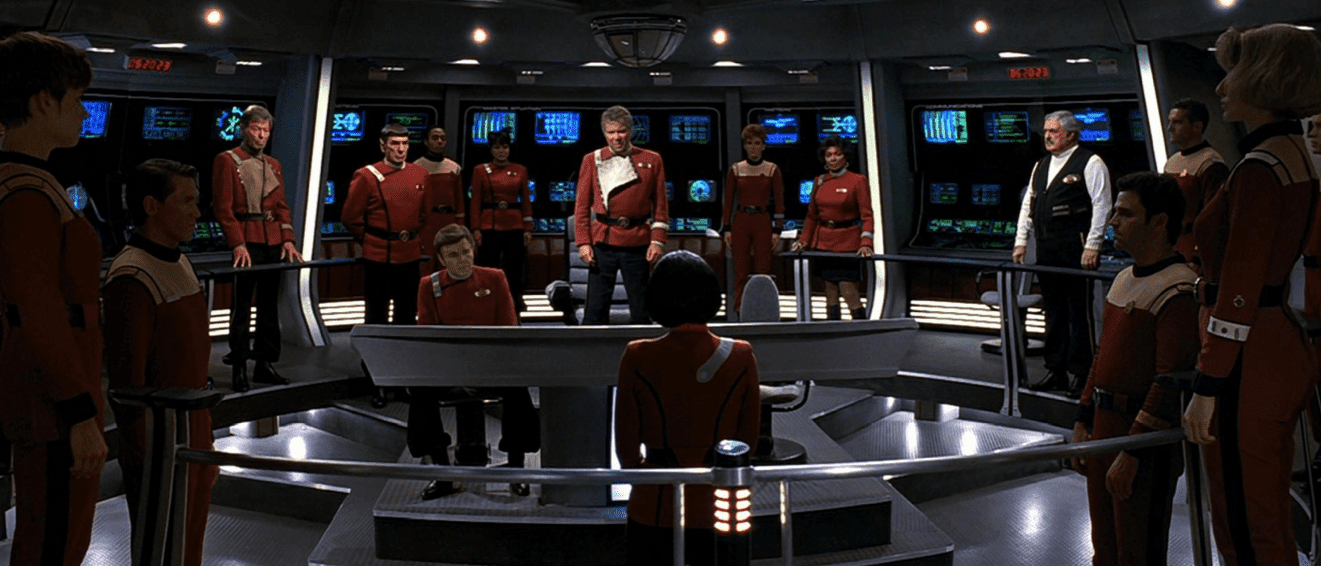
Anyway the plot, such as it was, features the now Admiral Kirk (William Shatner) taking back the reins of the newly revamped USS Enterprise to confront a giant cloud that is destroying everything it comes into contact with – and is on a direct course of Earth. Getting the old gang back together – including dragging Dr McCoy (DeForest Kelley) out of retirement and welcoming back Mr Spock (Leonard Nimoy), Kirk takes the place of the Enterprise’snew captain Willard Decker (Stephen Collins) and zooms out to encounter the cloud. What does the machine at the heart of this cloud want? Who is the mysterious creator that V’Ger wants to return to?

Where did it all go so wrong? The key problem lies with the script – and blame for that lies with Gene Roddenberry, Star Trek’s creator who took direct personal control of it. Determined that only he would control the Franchise’s future – after all it was his baby – Roddenberry rejected or minimised as much as possible many of the elements many of traditional film narratives (like villains, inter-personal conflict or the need for characters to ‘learn lessons’) for a science-fiction story he obviously felt dripped with importance. However, this shapeless machine like cloud searching for its “creator” tells us precisely nothing at all about the nature of faith or questions of identity. Because firstly V’Ger has no character and, secondly, the film takes so long to get this (almost three quarters of its running time) that there is no time to explore any of these themes anyway. 

No parallels are drawn between the questions V’Ger is asking, and issues the core characters are dealing with. It makes for a big airey expanse of nothing. We learn nothing about our heroes personalities from this adventure, and they in turn are so little affected by it that at the end of the film they jet off to some new random adventure. A potentially interesting idea about progress and faith gets completely lost – despite ample opportunities to have built contrasts between V’Ger’s loss of faith and the barely-explored crises that Kirk (back in command after five years) and Spock (struggling to work out if he should purge all his emotions) are experiencing. Instead no comparisons are drawn, no insights are made and all three crises either peter out completely or utterly forgotten. It’s part of the film’s failure to really make us engage with any of these characters, or to find a reason to care about them – like Roddenberry felt investment was pandering. It’s also The Emotionless Picture.

On top of which the film was obviously so thrilled with having the budget to include the sort of sweeping space vistas the show could only dream of, that a huge portion of the film was given over to watching these images draft past the screen. Slow, 2001-like pans across space vistas, around alien crafts and then through the trippy details of V’Ger’s inards clog up the film. But while Kubrick invested those with intense meaning, Wise makes them dull as ditchwater and as empty as light show. The bar is set early on with Kirk being given a long – almost four minute – silent shuttle tour around the exterior of the Enterprise. By the time the film is eating up almost ten minutes of the Enterprise flying through V’Ger, the actors have exhausted their “stare in wonder” faces and the audience are dozing off.

It’s not helped by the sub-par acting by all involved. Shatner and Nimoy give perhaps their worst, most lifeless performances in the history of the franchise. Perhaps they were caught between the mess of the script, the lifeless pace, the pressure of bringing these characters to the big screen – or perhaps the film just doesn’t give them anything interesting to do. Kelley gets a few moments of irascible charm, but the rest of the cast have barely got a few lines to rub together. Stephen Collins as Decker looks like he doesn’t really understand what he’s involved with, while Persis Khambatta looks more animated after her character has been lobotomised than she did intact.

The film drags on with a sonorous and stately pace, making no points at all and lacking any real thematic depth whatsoever. It’s not helped by Robert Wise’s lost direction. Wise prepared for making the 80th live-action entry into the franchise by watching precisely zero episodes of the show –and his utter lack of comprehension of what made the series popular in the first place perhaps explains why none of it made it into the film. There is no charm or wit here at all – everything is handled with such portentous importance it only draws attention to how little there is going on.

And it looks so bad as well. The overwhelming 1970s beige and muted colours that have been chosen for the new uniforms make it look as dull and disengaging as the words that are coming out of the actor’s mouths. It becomes even easier to notice the blandness of everything you are looking at that isn’t a matte special effect when you notice how full the script is with filler. Other a third of the film gone before the Enterprise leaves space dock. A tedious non-drama about problems going to warp (in a sequence of embarrassingly bad “slowed down” time disturbance as the ship falls into a wormhole). Almost two thirds gone before the crew make contact with V’Ger our nominal antagonist. A reveal about V’Ger’s origins and the identity of the creator that would have been shock only to people who had never seen an episode of the show before or had been living under a rock since about 1969. 

There are precisely two good things about the movie. Firstly the music is superb – Jerry Goldsmith’s themes for the film (re-used for The Next Generation) and other bits of music, especially his martial Klingon music, is so perfect, so brilliant it was used in the franchise forever more. Secondly the opening sequence with the re-designed Klingons nailed a look, design and language for them that would also stick for the rest of time and the sequence itself is pretty exciting. Other than that, there is almost nothing to recommend the film. 

As an advert for making someone want to watch any Star Trek ever again, it’s a disaster. Having gone way over budget, the series only returned due to loyal fans paying over the odds at the box-office. Roddenberry was dispatched from any future involvement, and the series bounced back with its best ever film with Star Trek II – which corrected all the script mistakes this one made.

Star Trek VI: The Undiscovered Country (1991)

Kirk has to overcome a lifelong prejudice against Klingons in the marvellous, best-in-series film Star Trek VI: The Undiscovered Country

Director: Nicholas Meyer

Cast: William Shatner (Captain James T Kirk), Leonard Nimoy (Captain Spock), DeForest Kelley (Dr Leonard ‘Bones’ McCoy), James Doohan (Scotty), Walter Koenig (Commander Pavel Chekov), Nichelle Nichols (Commander Uhuru), George Takei (Captain Hikaru Sulu), Christopher Plummer (General Chang), Mark Lenard (Ambassador Sarek), David Warner (Chancellor Gorkon), Kim Cattrell (Lt Valeris), Rosana DeSoto (Azetbur), Kurtwood Smith (Federation President), Brock Peters (Admiral Cartwright), Michael Dorn (Colonel Worf), John Shuck (Klingon Ambassador), Iman (Martia)

This will sound ridiculous, but there are few films that have had such an impact on me as Star Trek VI: The Undiscovered Country. How bizarre is that? But not only can I trace my love of all things Trek to this film, but it was also my basic introduction to Shakespeare, whose plays in various shapes and forms have been a big part of my life ever since. Throw into the mix that it sparked an interest in the Cold War and you’ve got quite a coup for this sixth film in (I’ll be honest!) a hit-and-miss franchise.

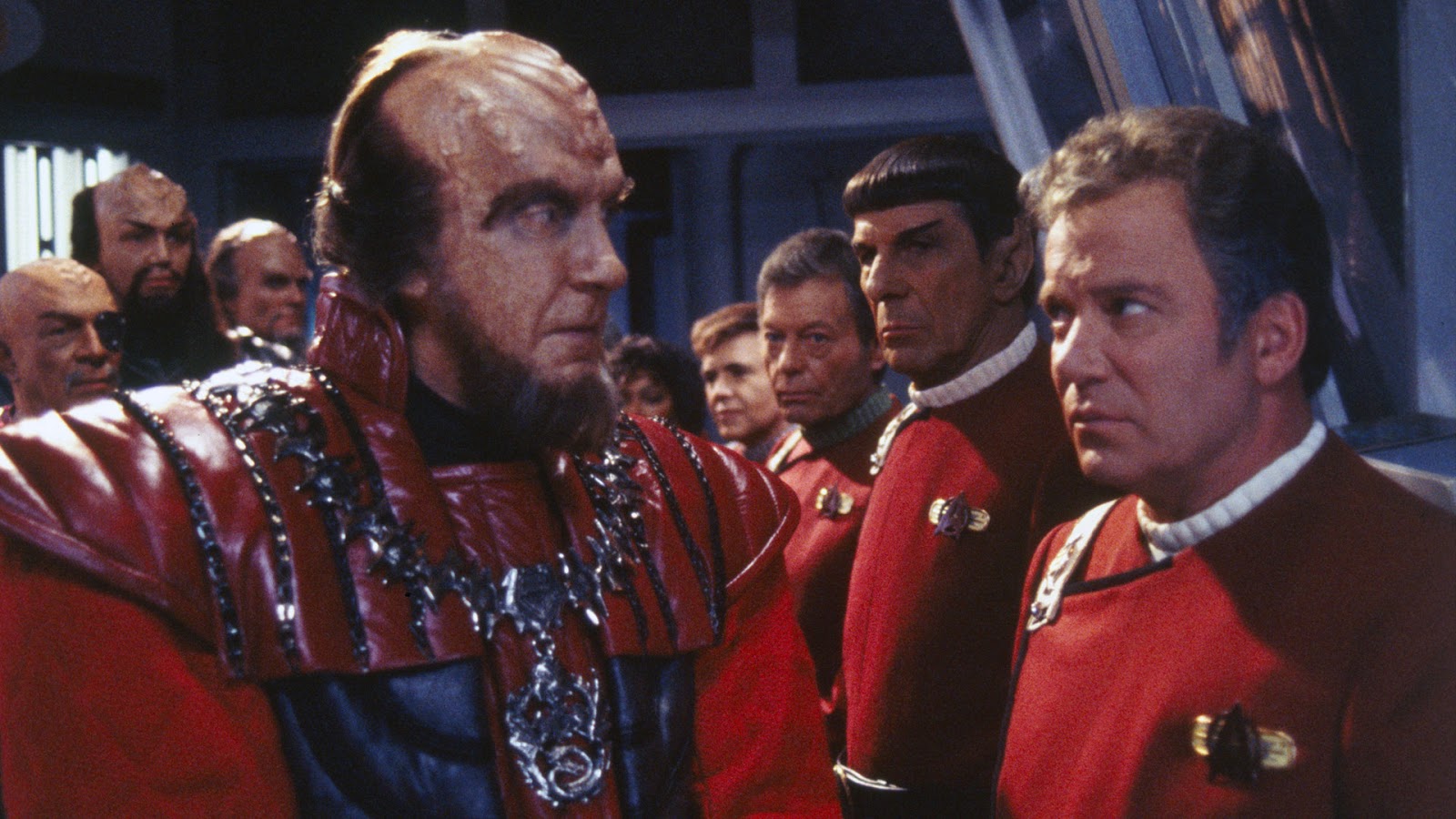
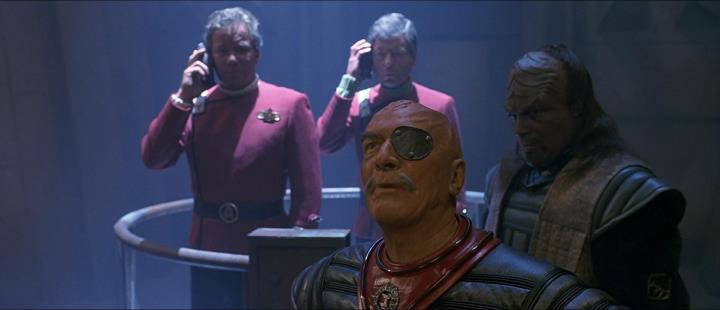
This film follows the final mission of Kirk (William Shatner) and company. There has been a disaster on the Klingon moon Praxis, which has devastated the Klingon economy and left them with no choice but to enter peace negotiation with the Federation, to try and end the Cold War that has existed for generations between the two powers. Sound familiar? While Spock (Leonard Nimoy) has been one of the leading negotiators with Klingon Chancellor Gorkon (David Warner), Kirk is reluctantly roped in to provide an escort for the Klingons to a peace conference. Kirk, and many of his crew, are weighed down with decades of prejudice and suspicion of Klingons (attitudes that erupt in a tense dinner between the Enterprisecrew and many of the equally suspicious Klingons). Kirk and McCoy (DeForest Kelley) however find themselves in trouble when Gorkon is assassinated and the two men are arrested and put on trial by the Klingons. Will Spock save them? Can they save the peace talks? Time for one last adventure.

Star Trek VI very nearly didn’t happen. The previous film, written and directed by Shatner, was a disaster, a messy, strange, flat-footed, cheap-looking adventure that was a huge flop, won several Razzies and nearly killed the series off. So it’s great that the cast got a chance to have one final swan-song in their parts – and that this basically turned into the most intelligent film they had made since Star Trek II. No surprise that Nicholas Meyer, an articulate, literate and intelligent novelist turned film-maker, was the common link between them. Not weighed down by Star Trek lore, nor the breezy “I’m above this” contempt that other directors in the series have had, Meyer understands what makes good Trek – a strong story, compelling character arcs, intelligent writing and a good balance between adventure and themes that resound with contemporary depth.

Star Trek VI was written as the Berlin Wall fell, and it’s a neat commentary on the sort of attitudes you would have seen in America and Russia at the time. Gorkon’s name even echoed Gorbachev (and Lincoln as well). But this isn’t just a historical parallel with the modern world. Instead Meyer also uses this to explore the attitudes of his characters. Like Star Trek II, this works into a neat deconstruction of Kirk’s persona. Kirk has to confront not age here (as in that film) but instead his own out-of-step anger, prejudices and refusal to change. At the same time, the film also explores Kirk as a man who can overcome his instinctive hostility, to make himself a better man. It’s such rich complexity that it’s no wonder I got sucked into a life-long love for Star Trek.

All this makes a fabulous framework for the strongest, most high-stakes entry in the franchise. Meyer’s direction is spot on: simmering with tension in the first half, investing every scene with a creeping intensity and rumbling sense of disagreement. He also works brilliantly with the regular cast, who turn in some of their best performances in this film: Shatner in particular reins in (mostly) the ham for a thoughtful and intelligence performance, while Kelley mixes deadpan snarks with a world-weary resignation. Nimoy also goes further than he has for a long time with Spock, who struggles under the surface with a host of emotions, from hope, pride, guilt and fury all bubbling away under that cool Vulcan façade. The rest of the cast also get moments to shine. 

This is a film that barely puts a foot wrong in its entire first act. From the opening explosion of Praxis – with a hugely exciting sense of danger as Sulu’s Excelsior starship gets caught up in the shockwave – through to the trial of Kirk and Bones, this film is tonally spot on. We understand completely the hostility and distrust Kirk feels towards the Klingons, just as we appreciate on a deeper level his desire to make the peace talks work. The awkward encounters with the Klingons simmer with an unspoken racism from the Federation characters (many of the cast reported being uncomfortable with the imperialist and superior tone their characters had to take), and a hostile resentment from the Klingons. The eventual assassination attempt has a grim inevitability about it, but is expertly shot and edited (a zero-gravity assault by two assassins on Gorkon’s disabled ship). The show-trial itself is like a nightmare of injustice. It’s scintillating and compelling stuff.

While the pace does slacken slightly when Kirk and McCoy find themselves in a Klingon prison camp – we are, by the way, introduced to the prison camp via a speech from the commandant eerily reminiscent of the greetings handed out in Bridge on the River Kwai – it never loses the audience’s attention. And it powers back up for a brilliant all-action, at first totally one-sided, fight between the Enterprise and a Klingon ship en route to the peace conference. A large measure of the film’s atmospheric success should also be given to the extraordinary score by Cliff Eidelman, a brilliant combination of familiar themes and fast-paced orchestral work, one of my favourite film scores.

And Shakespeare? Where does he come into it? Largely through Christopher Plummer, playing General Chang, the man who emerges as principal antagonist. Plummer’s exuberant performance is perfect for this larger-than-life warrior – a man who loves nothing more than reading Shakespeare “in the original Klingon” (one of many examples of the film’s wit). Plummer lets rip throughout the film, quoting endlessly from virtually every Shakespeare play you could imagine, just this side of ham. Plummer is also, for my money, the best villain this series had. But how could you not love a film where the villain rotates round in his command chair shrieking gleefully “Cry havoc and let loose the dogs of war!” Or says farewell to Kirk early on with a cheeky “we have heard the chimes at midnight…”. It’s possibly the best introduction to how great Shakespeare is that you can have.

But then that’s just part of Meyer’s witty, literate script, which throws in quotes from Conan Doyle and JM Barrie to Adlai Stevenson and Neville Chamberlain, and has Spock tells Kirk he’s the perfect choice for a mission to the Klingons as “there is an old Vulcan saying: only Nixon can go to China”. With stuff like that how can you not enjoy the film? It also understands the warmth between the main cast, their sense of character. The whole film combines an elegiac tone with a triumphant final mission, the passing of an era – with the final moments of the film capturing this, from its Peter Pan quote (“First star to the left and straight on until morning”), to the signatures of the cast appearing on the screen, literally signing off on their Star Trek careers.

The whole film is perfectly pitched like this. Every moment works from the off, and the action and adventure is balanced by some wonderful comic moments and beats of high tension and drama. The film’s use of the Cold War in Space as a backdrop works really well, and sheds a new light on attitudes in the franchise that have never really been touched before. It’s well acted, directed with flair and skill (the final space battle is brilliantly assembled), and the score is fantastic. There is a reason why I inflicted this film on my best man and ushers the morning before my wedding: it’s got a special place in my heart and it always will.

Star Trek: Nemesis (2002)


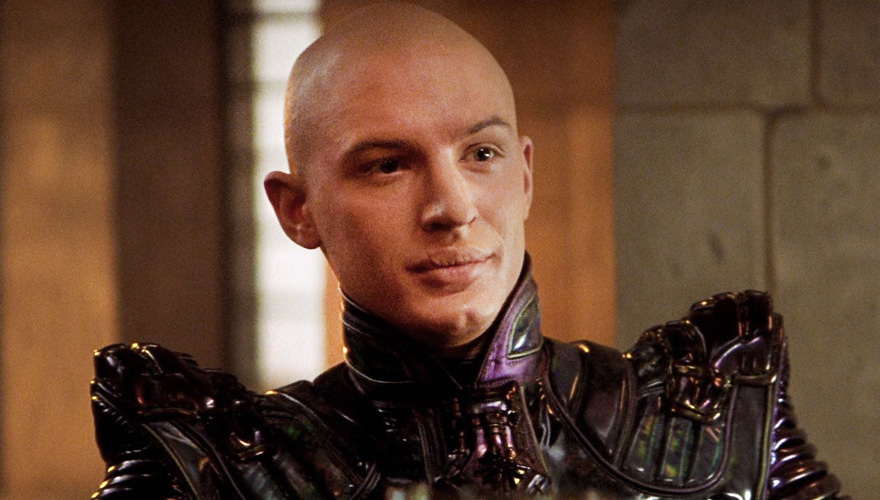
Tom Hardy plays a clone of the young Patrick Stewart in Star Trek: Nemesis. You can tell he’s identical ‘cos he’s got no hair

Director: Stuart Baird

Cast: Patrick Stewart (Captain Jean-Luc Picard), Jonathan Frakes (Commander William Riker), Brent Spiner (Lt Commander Data), LeVar Burton (Lt Commander Geordi LaForge), Michael Dorn (Lt Commander Worf), Gates McFadden (Dr Beverley Crusher), Marina Sirtis (Deanna Troi), Tom Hardy (Shinzon), Ron Perlman (Viceroy), Dina Meyer (Commander Donatra), Kate Mulgrew (Admiral Janeway)

There are few things in the Star Trek franchise with as poor a reputation as Star Trek: Nemesis. It’s as close as the series got to a franchise-killer, a film that bombed so colossally (the first ever Star Trek film to lose money at the box office) that it seemed to end not only the movie series but all planned television projects. Since then, it has been remembered as an incoherent, poorly plotted mess, crammed with terrible writing and direction and shoddy action. Is this memory fair? Well yes and no.

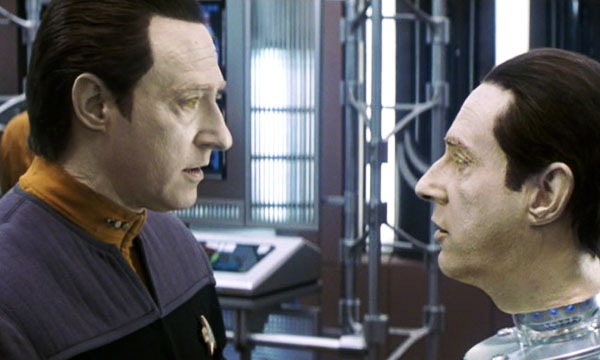
Picard (Patrick Stewart) and Data (Brent Spiner) have their sense of self thrown: first by Data’s discovery of an identical, unadvanced prototype of himself called B-4 (also Spiner) and then by Picard discovering on a mission to Romulus that the new leader of the Romulan Empire is a clone of his younger self, going by the name Shinzon (Tom Hardy). Having assassinated the Romulan government, Shinzon plans to give freedom to his “Reman brothers”, the slave race that raised him from childhood. But he also has sinister aims for the Federation…

This is a horrendously compromised product, cut to ribbons by the studio to get as close as possible to two hours as possible, regardless of the impact on plot or characters. Why? Because it was released at the same time as Lord of the Rings: Two Towers and the plan was all the people who didn’t want to see that would choose Nemesis instead. I won’t start to explain here all the reasons this plan was stupid. Suffice it to say, it didn’t work and meant we ended up with a gutted mess that jumps as quickly as it can to action set-pieces, many inadequately filmed on the cheap.

It also doesn’t help that Stuart Baird was brought on board to direct: a self-proclaimed “non-fan” who proudly announced he hadn’t watched any Trek before. A fresh perspective is great – but come on, if it’s the fourth film with the cast, following 175 episodes, you’d think some respect for the past would be good, right? Instead, Baird seems contemptuous of the whole genre and has no tonal understanding of Star Trek. The actors constantly struggle to keep their characters as consistent as possible, while events and actions keep spinning wildly out of whack. I could start nit-picking Star Trek errors (why is Worf here? Why is Wesley back in Starfleet? What’s happened to Data’s emotion chip? Why does no-one mention Data’s evil brother Lore? Picard was not always bald. Etc. etc. etc.) but I’d be here all day.

Anyway, if they were going to bring a new face on board, could they not have found a better director than Baird? Some of the sequences of this film are so wonkily filmed they look cheaper than they probably were. Any scene involving hand-to-hand fighting is cursed with poor shots and bizarre slow motion straight out of 1970s TV. They all look absurdly slow and cheap. The Romulans are redesigned as ludicrously camp, partly green skinned, heavily made-up softies. Shinzon and the Remans sashay around in noisy rubber costumes like space gimps. Baird has no sense of comic timing and virtually all the overtly “funny” parts of the film fall on their arse. The wedding scene is one long sequence of slightly embarrassing faux-comedy – the sort of thing that will confirm to any sceptic that loving Star Trek is desperately sad.

But the main problem is the plot. Shinzon is a character who should be really interesting: for starters, he’s played by the excellent Tom Hardy. He should be casting a dark light on Picard, with a feeling that these are men only a few degrees apart, or that Shinzon is a kind of renegade son pushing to find his own place in the universe. All lost in the edit. Shinzon’s back story and aims make no sense, and by the end his character degenerates into a motiveless nutter. If he’s all about freeing the Remans (a goal achieved at the start of the film) why does he want to destroy Earth? If his focus is on Picard why does he constantly delay capturing him? What would have worked was if the Enterprise were trying to stop Shinzon destroying Romulus, or if Shinzon’s focus was exclusively on Picard and we had more of a sense of Shinzon being a “dark Picard”. Instead he’s just a nutter with a homicidal plan for Earth which comes out of nowhere.

Badly structured as the Shinzon plot is, at least this has some decent scenes between Hardy and Stewart. However the B-4 plot makes little sense at all, while also providing an unfortunate opportunity for Spiner to play “simple Data”, like an android Rain Man. In terms of where he fits into Shinzon’s plan or the rest of the plot, B-4 makes no sense and provides no real contrast to Data or comment on the Picard/Shinzon relations. He should, of course, be another repeat of the theme of Picard seeing a disagreeable version of himself. But this never comes together. It just gets used for jokes or for Spiner to show-off. Neither option is that appealing.

This thematic material keeps getting constantly lost. It’s cut so badly that it often makes the film empty and unsatisfying. You keep wanting thematic juice: our heroes confronting dark versions of themselves, or the struggle of dealing with your lack of uniqueness in the galaxy. But the film only wants to sketch these in roughly in order to keep moving forward to action scenes. The worst of these is a prolonged car buggy chase on a primitive planet that not only takes ages, it’s desperately dully and makes no real sense at all when you think about (for starters, if the baddies wanted B-4 to be found, why break him up and sprinkle the bits all over a dangerous planet?). 

This means that, despite the title, we never get the sense of there being an actual nemesis in this film. Shinzon never really feels like a reflection of Picard. The film just tells us he’s a baddy, because, hell he just is. You can practically tick off the standard list of villain quirks. Lack of patience? Check. A creepy attitude to women? Check. Killing a subordinate for failing? Check. Any prospect of making him an interesting, different type of character gets pushed out in favour of the simple.

That’s many paragraphs saying what’s wrong. But it’s not all bad. Honestly it isn’t. In fact, there are some nice moments in there. There are some good character beats, and the cast are working hard to make these moments land. In particular, there are some lovely exchanges between Picard and Data, while Geordi gets more to do in this film than most of the last few (including some actual moments exploring his friendship with Data, often lost in the films). Picard feels more like the enlightened explorer and intellectual character from the TV show here than he did in any of the other films. When we are allowed to relax and breathe, the film touches on an elegiac, end-of-an-era quality (see scenes like that below).

Also, as awful as the buggy chase sequence is, the final space battle (while a clear lift from Star Trek II) is exciting and well filmed, and also showcases our characters’ professionalism. The hand-to-hand combat bits are hopeless, and Picard’s final “man on a mission” assault strains credibility. But Data’s final sacrifice is quite moving – especially the quiet moments afterwards where the rest of the cast respond to it. It’s sad because you know more of this warm interplay is on the cutting room floor with the thematic material of the film – leaving this neutered disappointment instead. Which is a shame because there is some decent material here – and some enjoyable moments. There is also a terrific score.

Star Trek: Nemesis is not as bad as you may remember. I mean, it’s a long way short of the best Star Trek films – but it’s got its moments. It’s made by a director who doesn’t understand (or care) about the franchise, but the cast do their best to hold it together. It’s a thoroughly compromised film, ruined by too many people trying to make a film that did too much, and it was clearly intended as a jumping off point for the next film (which never happened), but for all this, there is just about enough to keep a fan entertained – although probably not a non-fan. And if nothing else, this is the last chance to see the cast of one of the best sci-fi shows ever made.