Category: Submarine film

Das Boot (1982)

Das Boot (1982)

Perhaps the definitive submarine film, a terrifying masterpiece of claustrophobia and suspense

Director: Wolfgang Petersen

Cast: Jürgen Prochnow (Kapitänleutnant), Herbert Grönemeyer (Leutnant Werner), Klaus Wennemann (Chief engineer), Hubertus Bengsch (First watch officer), Martin Semmelrogge (Second watch officer), Bernd Tauber (Chief HelmsmanKriechbaum), Erwin Leder (Chief Mechanic Johann), Martin May (Ullmann), Heinz Hoenig (Hinrich), Uwe Ochsenknecht (Boatswain Lamprecht), Claude-Oliver Rudolph (Ario), Jan Fedder (Pilgrim), Ralf Richter (Frenssen)

In the annals of submarine movies, few have taken such a hold of the imagination than Das Boot. This is particularly remarkable since it follows the struggles not of Allied sailors but members of the German Kriegsmarine, the U-Boats who patrolled the Atlantic to sink as many merchant ships as they could, all in the service of aiding the Nazi war effort. But the sea knows no flags and holds no allegiances: to the watery deep, men are just men, and a small, rusty metal box is fragile at 280 metres no matter who sails in it. And the men sailing U-96 are just ordinary, regular men, with wives, girlfriends and regrets back home who above all just want to survive to see them again.

Wolfgang Petersen’s is a masterclass in immersing us in a claustrophobic world. The crew of U-96­ are led by the captain (Jürgen Prochnow), a hardened, cynical veteran is out here to do a job, not fight for radical cause he has little time for. Instead, his concern is to preserve the lives of his men, all younger (in most cases almost twenty years so) than him, during their time at sea where days (and even weeks) of bored inaction are interspersed with interludes of sheer terror as the submarine desperately runs from depth charges and dodges Allied destroyers.

Das Boot was filmed over almost a year, in chronological order. The actors practically lived in their confined set (deafened by the sound of its mechanics), their hair growing out to match their characters and their skin taking on a pallor from not enough time in the sun. For hours at a time we never leave the confines of the submarine – if you don’t count the odd trip to the ship’s bridge, where those lucky enough to venture up-top are lashed with salty sea water from near constant Atlantic storms. Aside from that, they are in what is effectively a 60m metal corridor, a specially designed camera operated by cinematographer Jost Vacano, tracking swiftly behind the frenetic pace of the sailors as they dive through hatches and pound along dripping quarters.

It’s a film where you cannot escape the tight confines of this boat, the sound track filled with groans and shudders as the boat cracks under the weight of water or buckles from high-pressure depth charges. When under attack, bolts burst out of pipes like machine gun bullets and water (which is obviously freezing) gushes through opened valves. It mixes with the sweat in the characters tension-filled faces. There is no comfort and no privacy under the water, bunks positioned on the edges of the ship’s corridor. The only food is whatever was taken aboard last time the ship was at shore – and if that means cutting layers of green mould off weeks-old bread, so be it.

Petersen’s capturing of this sense of a tiny, pressure-filled world is superb and he succeeds masterfully in getting the audience to feel the character’ stress and fear. When the film opened in America, crowds cheered an opening caption which details the losses the Kriegsmarine suffered during the war: at the end, the same audiences were reported stunned into sympathetic silence. None of these men are detestable Nazis. One man writes never-ending letters to his French fiancée. Another is a devout Christian. The Chief Engineer clasps tight photos of a skiing holiday with the wife he has not seen in months. Another is frustrated at radio reports of his football team losing a key match. All of them are haggard, unshaven and scruffy. None of them feel safe for a moment.

Only the first watch officer utters anything approaching true believe in the Nazi regime (he is also the only man to try and maintain some semblance of military smartness – at an encounter with a German merchant ship, he is inevitably mistaken for the captain). But his belief comes from naïve optimism: he has no wider idea of the world around him and his statements of trust in the regime noticeably dry up over time. For the rest: who has the time for ideology when you could be crushed by a mountain of water at any time? Captain Thomson (Otto Sander) opens the film by making a drunken speech at the launch of U-96, lambasting Hitler – a speech that is met with shocked silence because its being said rather than because of the content.

The sea also builds subconscious bonds for those who share its dangers, even with enemies. After returning later at night to the scene of a sinking ship (their only successful operation throughout the whole film), the Captain and his officers are horrified to find the Allied ship has not had its crew evacuated – a fact they notice too late, having already sent two more torpedoes into the water to finish the ship off. Haunted, the Captain orders U-96 to back off: after all, he knows (as we do) it will be impossible to take any survivors aboard his tiny boat. Even this successful mission is tinged with horror: the rest of their encounters mostly feature desperate attempts to dodge British destroyers.

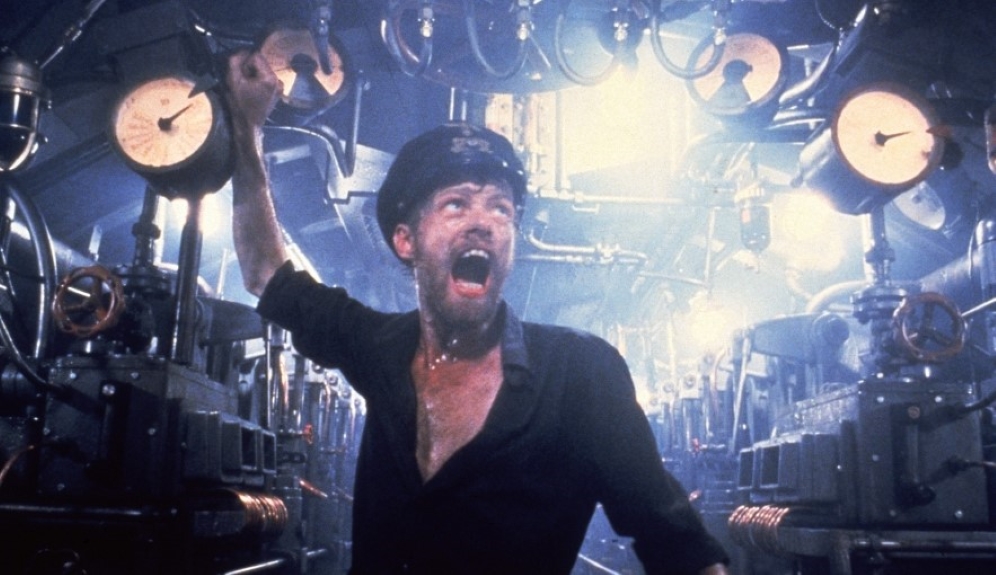
It’s relentless. Life under water is dull, but inescapable but could be broken at any moment by life-threatening terror, perhaps hours of shaking and leaking under depth charges explode around them. Even the most experienced can crack – Johann, the ship’s chief mechanic, at one-point breaking under the pressure, his wide-eyes desperately searching for some escape as he ignores orders. War correspondent Lt Werner (Herbert Grönemeyer) goes through the same experiences we do: his assumptions about brave soldiers and ice-cold professionals, breaking down as he and we realise these are ordinary people just trying to stay alive.

Their lives are the principle concern of the Captain, superbly played by a stoic Jürgen Prochnow, as a man who keeps his emotions on a tight leash because letting them slip may see them never getting under his control again. The Captain is a default father to his men, concerned above all with preserving their lives, over and above the war he is bitter and cynical about. Now of course, you can argue Petersen is stacking the deck by presenting a German crew with not a (determined) advocate for Nazism among them: but so superbly does the film bring-to-life the pressures, risks and terror of U-96, you fail to be surprised that they would come to focus overwhelmingly on their own survival rather than the gnomic ideology of the murderous dictator who started the whole thing.

By the time the film has send U-96 to the near bottom of the ocean, forcing the crew to battle against the odds to restore power and save it from sinking (it’s the golden rule of all submarine films, that the recommended depth should be exceeded and for the ship to sink like a stone), you will be rooting for these pressured-but-capable professionals to save themselves. The overall feeling you take from Das Boot is the futile, pointlessness of it all: months at sea almost for nothing, acts of extreme bravery rendered moot by flashes of ill luck and chance, the utter lack of having any to show for it when the boat returns to port. Das Boot understands the futile horror, the grim pressure and punishing impact of war, placing people into terrible situations for no real purpose. It’s that which helps make it one of the defining war films – and the great submarine film.
Hell and High Water (1954)

Hell and High Water (1954)

Action below the waves in this dutiful, for-the-money thriller from Samuel Fuller that lacks imagination or freshness

Director: Samuel Fuller

Cast: Richard Widmark (Captain Adam Jones), Bella Darvi (Professor Denise Gerard), Victor Francen (Professor Montel), Cameron Mitchell (“Ski” Brodski), Gene Evans (Chief Holter), David Wayne (Tugboat Walker), Stephen Bekassy (Neumann), Richard Loo (Hakada Fujimori), Wong Artarne (Chin Lee), Henry Kulky (Gunner McCrossin)

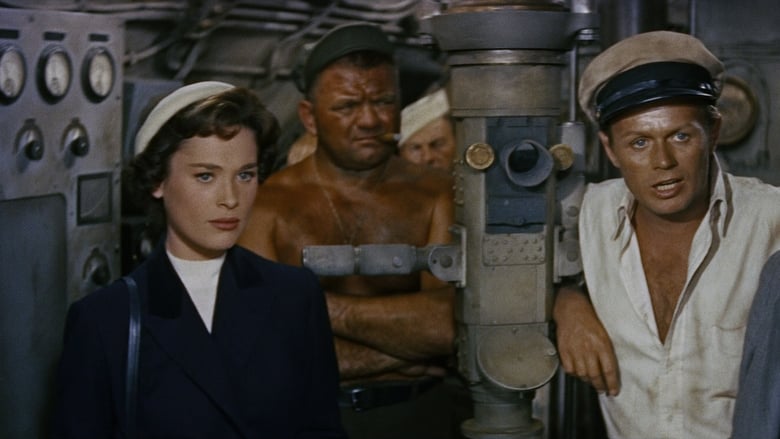
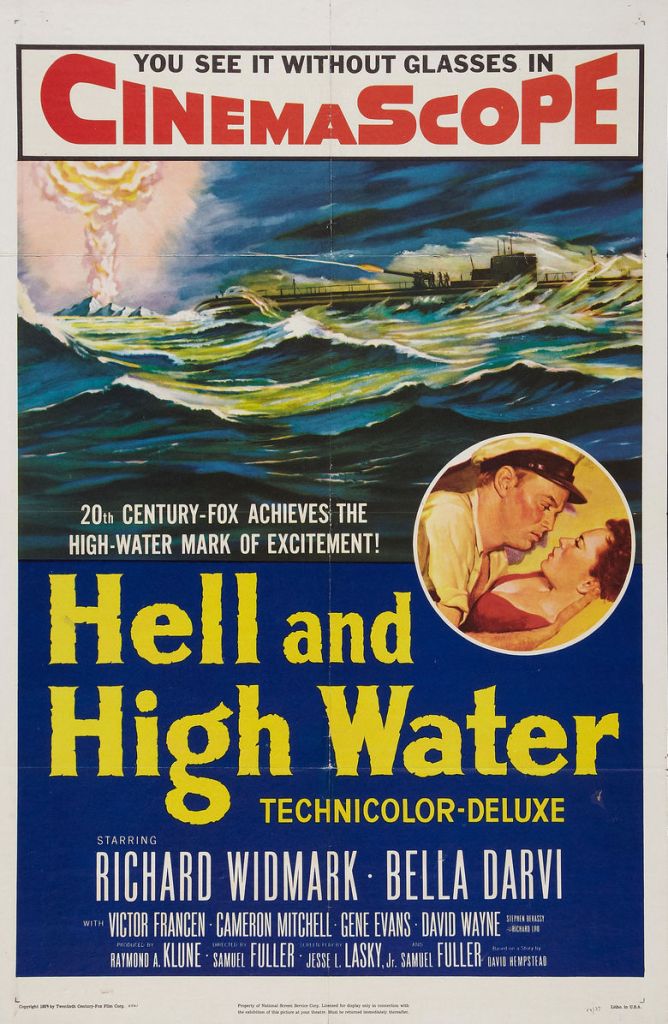
Few films start with a bigger bang than Hell and High Water: a nuclear explosion. What caused it? The film winds back to tell us. Retired submarine captain Adam Jones (Richard Widmark) is hired by a cabal of intellectuals and scientists working to maintain world peace. Somewhere on an island off Japan, the Commies are working on a secret nuclear bomb. Jones – in return for a fee – will shuttle Professors Montel (Victor Francen) and Denise Gerard (Bella Darvi) to investigate. Cue submarine duels, personality clashes, romance and shoot-outs.

To be honest, nothing in Hell and High Water lives up to that bang at the start. Samuel Fuller took on the film as a favour to producer Darryl F Zanuck, but had a low-opinion of the result (labelling it his worst film). Fuller rewrote the script, added a lot of his compulsive drive to the direction and handled it well – but it feels like a “gun for hire” film. Goodness only knows what Fuller made of Spielberg telling him in 1979 he loved it so much he carried a print of it in his car (perhaps “Have you not seen Pickup on South Street?”)

Hell and High Water is a serviceable men-on-a-mission film that sneaks in a few interesting beats, but otherwise goes for well-shot action and predictable events over invention and insight. It’s anchored by a grumpy Richard Widmark (who thought the script was crap and co-star Darvi couldn’t act) as a hard-to-like hero. Never-the-less Jones’ ruthless mercenaryism is the film’s most interesting beat – even if it is a repeat of the same actor’s attitude in Pickup on South Street, right done to mouthing almost the same contemptuous line about ostentatious flag wavers. Jones does his job professionally – and he’s got no truck with his country being dishonoured or attacked by Commies – but his main concern is always the $50,000 fee he’s been promised.

Also paid off are the whole crew who, in the film’s other interesting beat, are a regular united nations all of whom treat each other with equality and respect (the only people not represented here are Black people). We’ve got a German, a Japanese, a Frenchman, several Americans – considering only nine years previously all these nations had been working over-time to kill each other, it’s great to see the team on the ship working as a tension free-unit. We even have a Chinese sailor – who entertains his fellow crew with improvised ditties – becoming a crucial hero.

Fuller also shoots the sub action – a mix of models and trick photography – very well. The angles he uses of the subs underwater, in particular their turns, and the sweaty look of those underwater (and the increasing tensions) influenced several future films. All the submarine lingo you’d expect is trotted out with real commitment (“Right full rudder!”) and every box is carefully ticked, from sinking the bottom, to the costly rush to close a bulkhead. The torpedo fights are well-staged and whenever the film dives it’s at its best.

Where it is less so is whenever the film dwells on its characters. It tries to push the envelope a bit by introducing a female professor who is assured, competent, super-smart and gets stuck in with helping out when things go pear-shaped. She’s played by Bella Darvi, a protégé (and more) of Zanuck, who he was determined to elevate to stardom. Despite Widmark’s criticism, she’s fine here, even if she struggles to convey the charisma the role needs, often falling back on slightly grating over-earnest, head-girl smartness. What fails is the complete lack of chemistry between her and Widmark, their half-hearted, dutiful romance (probably mostly Widmark’s fault).

You’ll feel sorry for her though as the crew – and Jones – eye her up like a piece of meat when she arrives. Of course, this dated sexual leering is par for the course, but is still more than a little uncomfortable. But this is still the era when a sailor taking his top off to push his tattoos into a woman’s face was funny rather than a crime. The film does gives Darvi’s Professor a lot of proactivity and does generally take her side – even if she, inevitably, needs to learn our hero knows best.

Hell and High Water charges through to a decent ending, with just the right mix of self-sacrifice, tension and pay off. Victor Francen gives the films best performance as an illustrious, brave French scientist. But it never feels like anything more than a dutiful, for-the-money film. There is none of Fuller’s fire or feeling here, no real imagination or freshness in the ideas or concepts. It hits all the beats, ties things up with a bow and sends you home – but its very hard to really remember anything distinctive about it when the credits roll.

The Hunt for Red October (1990)

The Hunt for Red October (1990)

Shailing into Hishtory! The Hunt for Red October is the finest Tom Clancy adaptation made

Director: John McTiernan

Cast: Sean Connery (Captain Marko Ramius), Alec Baldwin (Jack Ryan), Joss Ackland (Ambassador Andrei Lysenko), Tim Curry (Dr Petrov), Peter Firth (Ivan Putin), Scott Glenn (Commander Burt Mancuso), James Earl Jones (Admiral James Greer), Jeffrey Jones (Skip Tyler), Richard Jordan (National Security Advisor Jeffrey Pelt), Sam Neill (Captain Vasily Borodin), Stellan Skarsgård (Captain Viktor Tupolev), Fred Dalton Thompson (Rear Admiral Joshua Painter), Courtenay B Vance (PO Jones)

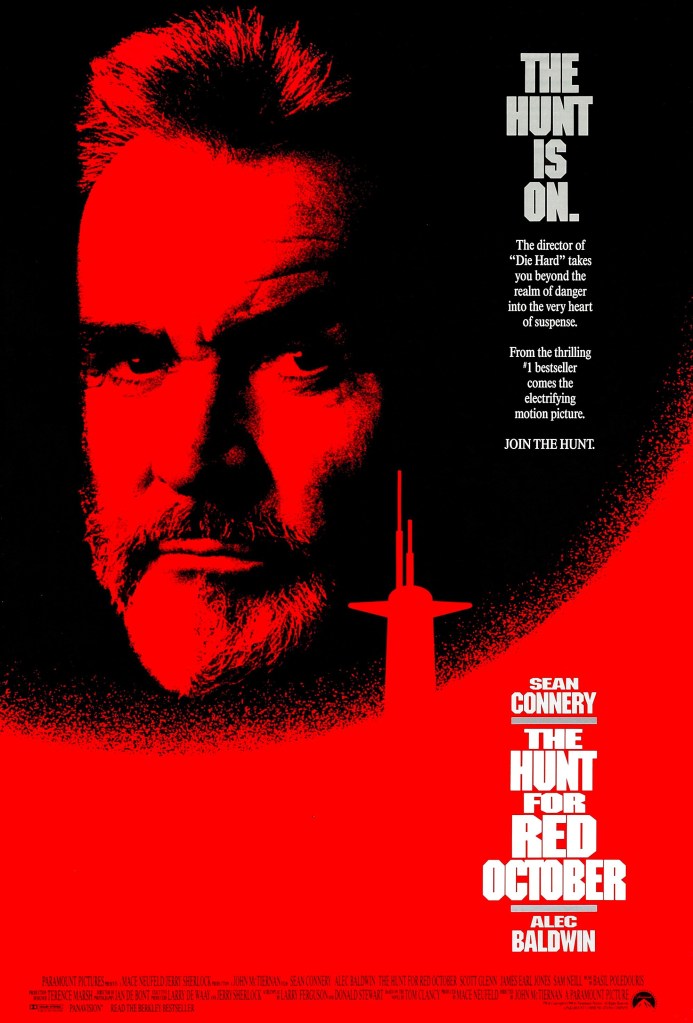
“We shail into Hishtory!” It’s the film that launched a thousand Sean Connery impressions. Only Connery could get away with playing a Soviet submarine captain with the thickest Scottish accent this side of Lithuania. He only took the role – from Klaus Maria Brandauer – at short notice, but he’s a pivotal part of the film’s success. The Hunt for Red October is a superb film, the finest Tom Clancy adaptation ever made and one of the cornerstones of the submarine genre. It expertly mixes beats of conspiracy, espionage, naval adventure and even touches of comedy, into a superbly entertaining cocktail.

Connery is Captain Marko Ramius, the USSR’s finest naval captain, given command of The Red October on its maiden voyage. The Red October is equipped with a technical miracle: a “caterpillar drive” that uses a water powered engine to run silently, making it invisible to sonar. So why is the entire Russian fleet being scrambled to find and sink the submarine? Could it be, as the USSR tells the US, that Ramius has gone mad and plans a nuclear strike? Or is it, as CIA analyst Jack Ryan (Alec Baldwin) argues, because Ramius plans to defect and bring the technological marvel with him?

Of course, we know Connery plans to defect. After all, we’ve already seen him murder shifty political officer Ivan Putin (Peter Firth – to whom alphabetical billing is very kind) and tell his handpicked crew of officers, led by loyal second-in-command Borodin (Sam Neill, so dedicated to affecting a Russian accent it’s as if he felt he needed to do in on behalf of himself and Connery) that there is no turning back. The film’s expert tension – and it rachets it up with all the precision of a well-oiled machine – is working out how. How will Ramius evade the Russian fleet? How will he manage to arrange his defection without communicating with the US? And will he and Ryan – unknowingly working together – persuade the US not to blow The Red October out of the water?

With McTiernan, in his prime, at the helm it’s not a surprise the film is expertly assembled. The parallel plot lines are beautifully intercut. Our two heroes, Ramius and Ryan, face very different obstacles (dodging Soviet torpedoes vs patiently making his case to sceptical superiors mixed with risky long-range travels to far-flung US subs) but somehow seem to be building a bond before they even meet. Ryan is an expert on Ramius and his career, while his thoughtful, good-natured decency is exactly the sort of American Ramius tells his crew they need to meet (as opposed to “some sort of buckaroo” – a word Connery relishes).

McTiernan isn’t just an expert mechanic though. There are lovely touches of invention and magic here. The Hunt for Red October has possibly one of the finest transitions ever. Connery, Neill et al start the film speaking in Russian. Ramius meets with Firth’s Putin (great name) in his quarters to open their orders. The two chat briefly in Russian, then Putin reads from Ramius’ copy of the Book of Revelations. As Firth reads (in fluent, expertly accented Russian), McTiernan slowly zooms in on his lips until he reaches the word “Armageddon” (the same in both languages) – the camera then zooms out and both Firth and Connery continue the scene in English (Firth switching mid-shot from Russian to English without missing a beat). It’s a beautifully done transition, rightly a stand-out moment.

But then it’s a film full of them. Many rely on Connery’s performance, superb as Ramius (this was his career purple patch, where one effortlessly excellent performance followed another). Ramius has a grizzled sea-dog charm and a twinkle in his eye, but he’s also nursing a private grief and pain that motivates his defection. He can be demanding of his men, but also inspires loyalty – that “We Shail into Hishtory!” pep-talk speech is delivered perfectly (and McTiernan makes Soviet sailors singing the Soviet anthem a punch-the-air moment even though (a) we know they are technically the bad guys and (b) we know Ramius is lying through his teeth in his speech). But he is always a commander, Connery investing him with every inch of his movie star cool.

Ramius is also an interesting reflection, in a way, of Ryan. Played with a great deal of young-boy charm by Baldwin (and also wit, Baldwin dropping impersonations of other cast members into the film – including a stand-out Connery), Ryan is brave, determined but also slightly naïve and out-of-his-depth. But like Ramius he respects his “enemy”, is open to negotiation, thinks before he acts and wants to save lives. The two even share similar upbringings. The film triumphantly shows a desk man, spreading his wings and doing stuff he couldn’t imagine: the guy who tells an air hostess in an early scene he can’t sleep on flights due to fear of turbulence, will later have himself dropped into the sea from a perilous helicopter flight, steer a Russian sub and duke it out with the last Soviet hard-liner standing in The Red October’s missile room.

McTiernan shoots Ryan’s conversations like combat scenes: quick reversals and cross shots and even whip pans and zooms. It ratchets up the tension and drama in these sequences – and allows him to play it cooler in the sub shots which (with its more constrained set) where patient studies of tense faces follow sonar reports of the approach of torpedoes or enemy subs. Sound is a triumph in Red October – every ping or sonar shadow is sound edited to perfection, with much of its tension coming from their perfect rising intensity.

It builds towards a superb resolution as several plot threads come together in a dramatic face-off that gives us everything from sub v sub to gunfights, with tragedy and triumph all mixed in. It’s a perfect ending to a film that is a masterpiece of plotting and construction, acted to perfection by the whole cast (Connery and Baldwin, but also Jones, Neill, Glenn – perfect casting as a no-nonsense naval captain – and several reliable players in smaller roles). McTiernan directs with exceptional pace and excitement, it’s sharply scripted and technically without a fault – from its gleaming Soviet sub (with church like missile room) to brilliantly edited sound-design. It’s a joy every time I watch it.

Crimson Tide (1995)

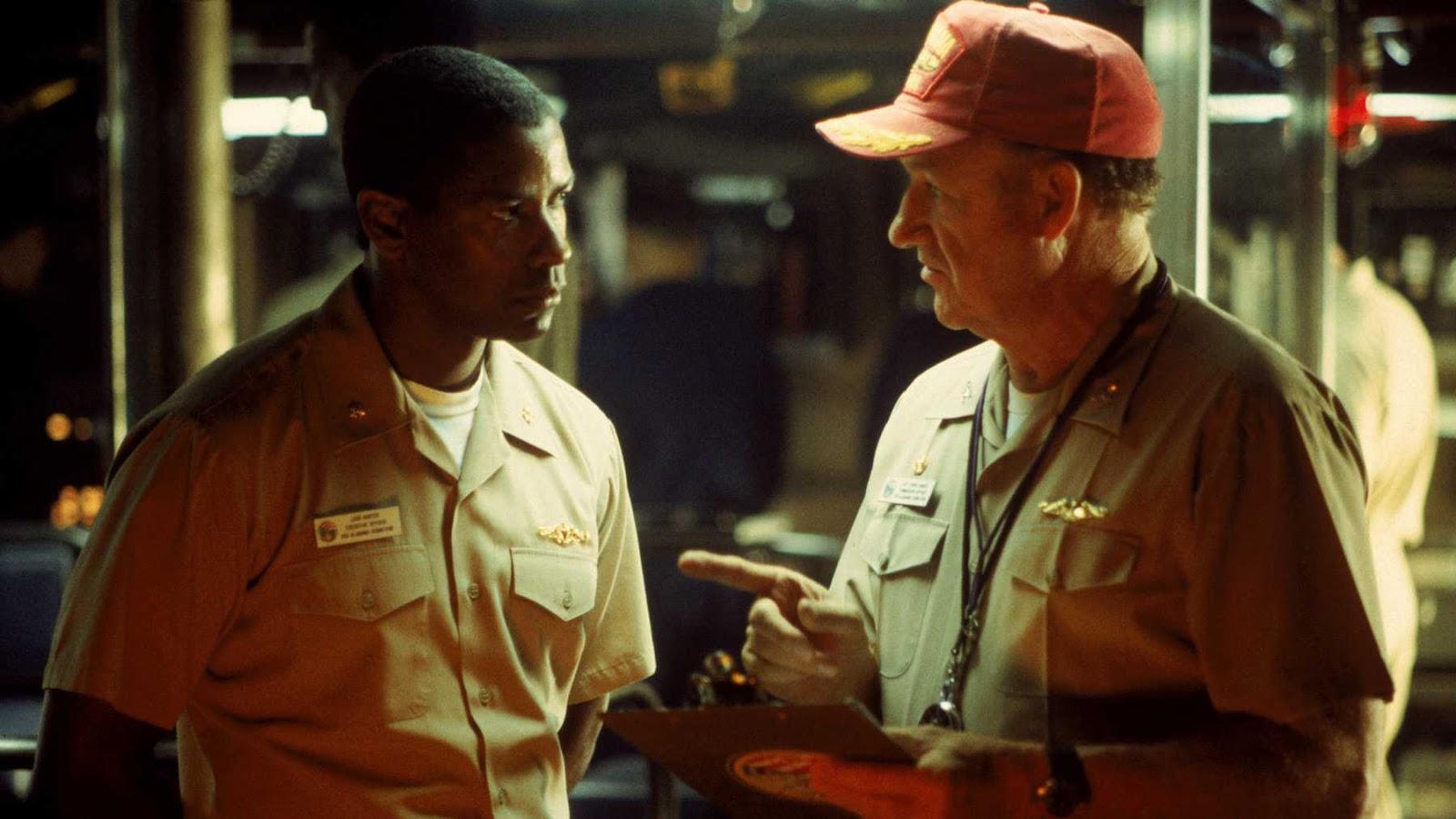
Denzel Washington and Gene Hackman face off under the water in Crimson Tide

Director: Tony Scott

Cast: Denzel Washington (Lt Commander Ron Hunter), Gene Hackman (Captain Frank Ramsey), George Dzundza (COB Walters), Matt Craven (Lt Roy Zimmer), Viggo Mortensen (Lt Peter Ince), James Gandolfini (Lt Bobby Dougherty), Rocky Carroll (Lt Darik Westerguard), Danny Nucci (PO Danny Rivetti), Lillo Brancato Jnr (PO Russell Vossler)

“The three most powerful people in the world: the President of the United States, the President of the Russian Republic and…the captain of a US ballistic missile submarine”. So boasts the film’s opening caption. This submarine drama explores the truth of that, during a clash of wills (and more) between Captain Frank Ramsey (Gene Hackman) and his XO Lt Commander Ron Hunter (Denzel Washington) over the launch of the sub’s nuclear missiles at a rogue Russian general. Ramsey has orders in hand. Hunter has a later, partial, order that may or may not be recalling the strike. Should the sub launch, or should they work to repair their radio and check the second message – possibly losing the narrow window of time they have to take out a rogue general’s missiles before he can launch them at America? Glad I don’t have that job.

Tony Scott’s submarine thriller is one of the best of the genre. It throws in all the clichés you would expect (the claustrophobia, the long dive, the game of cat and mouse with an enemy sub, the blips on the radar, the need to sacrifice someone to save the ship etc.) but presents them with a dynamic freshness (helped by Hans Zimmer’s exciting, award winning score). And at its heart it is a character study of two very different men, with very different styles of thinking and leading. Both rules are juicy, so it’s not surprising that two of the best actors in the game fill them out.

Denzel Washington is just about perfect as a Harvard-educated, committed soldier-thinker who believes in relating to the men as much as he does in firm order. Washington is careful not push Hunter towards being too cautious – under his command the Alabama bests a Russian sub in combat – and he may be alarmed by the impact of nuclear war but will reluctantly pull the trigger, but only once he is certain he has received the correct orders. A lot of the film depends on Washington’s natural moral authority, as well as his mix of forceful reserve and relatability. 

You need a big actor to not get steamrollered by Washington in those argument scenes – and few have the authority of Gene Hackman. Hackman is way too smart an actor to make the captain what he could have been in lesser hands – a trigger happy autocrat. Ramsey may be an old hand who believes in telling men what he wants and expecting delivery or a boot in their ass. But he’s not uncaring, he’s well-read, thoughtful, articulate and capable of acts of kindness and generosity. But he’s also a man rigid in his intent when he believes he is doing the right thing – and Hackman is always careful to establish that his intent on launching missiles is because he believes he is protecting innocent civilians back home.

The film becomes a compelling clash of tempers between two men who firmly believe they are both doing the right thing. The film is careful to throw up the fundamental lack of compatibility between the two from the start, even if it is tinged with respect. Their backgrounds, methods of discipline even ways of thinking about their role are different. There is an unspoken racial tension under the film, not because anyone in it is racist, but rather as Washington’s Hunter represents all round a newer America (an educated Black-American officer) that makes Hackman’s naval old hand feel like a relic of Cold War thinking.

But the film is, at heart, sympathetic towards both men, and probably places more blame on the system (an Admiral later reassures us both men were both right and wrong). Scott’s film with its expected flashy style (Scott loves the stark red lighting of the sub at alarm, mixed with the blaring greens of radar screens and the cool blues of sub interiors) gets a wonderful sense of the claustrophobia affecting decisions. Every character is a sweaty mess, while the sub seems to spend half the movie at an angle, forcing the crew to virtually pull themselves through it. 

The final hour takes place almost in real time, and covers the pressure cooker of men forced to make world-destroying decisions, cut-off under the ocean from any idea of what’s going on in the world, in extreme temperatures on little sleep. It’s a world of butch extreme masculinity – another way that makes Washington’s more cultured Hunter seem strangely other. Sweat pours off the men (the camera frequently focuses in on sweat-dripping faces). The officers of the ship generally come out badly, with Viggo Mortensen in particular a weak-willed man flip-flopping from side-to-side during the various changes of command on the sub. Many of the rest think little about what they are doing, and it’s telling Washington is largely supported by non-commissioned officers and regular sailors. Perhaps that’s where the true heart of America lies.

The film was written by a smorgasbord of writers (Robert Towne wrote much of the Hackman/Washington arguments at short notice, while Quentin Tarantino polished up much of the rest of the dialogue – no wonder it’s sprinkled with pop culture references). Initial support from the navy was cut off after Bruckheimer confessed the film was not about a HAL style computer trying to launch missiles, but a potential mutiny on a submarine and a feud between its two senior officers. Scott’s front-and-centring of the human drama between two great actors is what makes the film work – and take its place as one of the classic submarine movies.

U-571 (2000)


Matthew McConaughey and Harvey Keitel crack the Engima Code. With lots of guns. And no maths at all.

Director: Jonathan Mostow

Cast: Matthew McConaughey (Lt. Andrew Tyler), Bill Paxton (Lt. Com. Mike Dahlgren), Harvey Keitel (Chief Henry Klough), Jon Bon Jovi (Lt. Peter Emmett), David Keith (Major Matthew Coonan), Jake Weber (Lt. Michael Hirsch), Jack Noseworth (Bill Wentz), Erik Palladino (Anthony Mazzola), Thomas Kretschmann (Capt. Gunther Wassner)


On its release, U-571 was something of a sensational scandal– and in fact gained far more attention than a fairly standard submarine movie probably deserved. Why is that? Because it epitomised the perception in this country of American films taking war achievements from us poor Brits and giving them to Yankee heroes. Was this annoying for a British people all to used (it seemed) to having their war contribution lost in the crush of American films? You betcha.

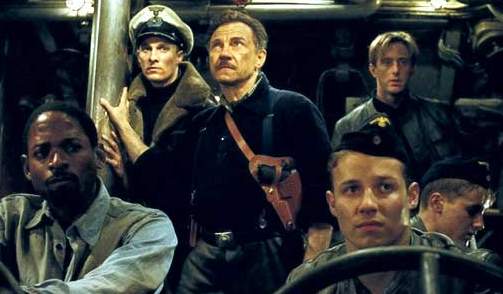
During World War 2, Lt. Andrew Tyler (Matthew McConaughey) is sent to lead a team of American sailors to capture an Enigma machine from a stranded German sub. The Enigma machine, and the inability of the Allies to break it, is losing America (whose involvement in the war has been moved forward for the purposes of this story) the war after all. However, the mission swiftly goes wrong and Tyler is left commanding a rogue bunch of terrified sailors on the captured German submarine, trying to get the Engima machine back to the US Navy before its loss is discovered. All that is missing is Alan Turing reinvented as a hard-boiled Brooklyner totting a machine gun and shouting “I gotta Bombe for ya, ya Kraut Bastards!”.

The movie itself is not too bad, to be honest. although nothing special. The expected clichés of the submarine are all there: the fears about water pressure, claustrophobia, a sequence where the boat sinks inexorably towards the bottom of the ocean, torpedoes in the water, depth charges, “right full rudder”, sonar pings, water gushing from pipes, someone having to undertake a vital repair underwater with limited air supply etc etc. – it’s all been done before, from Enemy Below to Crimson Tide. Saying that, Jonathan Mostow knows how to cut the heck out of a movie and as a result this charges forward with a relentless energy which works rather well and makes this a suitably tense film. Special mention also goes to the sound editing, which won an Oscar for its brilliant creation of the aural impact of everything from depth charges to torpedoes scraping hulls.

Of course the story itself is nothing unique: even the personal plot lines are largely recycled from other movies: will McConaughey’s young XO be placed in a situation where he has to prove his chops as a commander? You bet he will! Keitel is an Old Sea Dog, Paxton is a fatherly Captain, Kretschmann is a cold professional German – but the actors play these well shuffled stock characters with an admirable level of commitment. The film has a great “Dirty Dozen” vibe to it, and does manage to throw in a couple of surprises about character fates. For those of us who love the predictable trotted out with po-faced commitment and energy, it’s hard not to be entertained.

There are some well-done (if unsurprising) scenes as Tyler struggles with his authority over men who don’t have trust in him and are terrified of getting killed. It’s interesting how much the film asks us to invest in essentially willing Tyler (a decent performance by McConaughey) to have the guts to send a man to his death for the good of the ship. Centring this moral dilemma as a crucial qualification for leadership at least means the film does take a honest look at the complexities of command to counter the boys’-own heroics elsewhere. Saying that, the almost pathological mutinous rumblings of Seaman Mazzola against an officer we are told early in the film is “popular with the men” does seem rather sudden – possibly because making Tyler a distant stick-in-the-mud (which he would need to be for the level of rejection from the crew to really work) rather than a regular Joe might have made us less likely to root for him at the start.

Of course all of this seems pretty inconsequential next to the real issue of the film, which is its historical accuracy (or complete lack thereof). To be honest, the fury against the film’s appropriation of British Naval achievements is rather harder to sustain (a) nearly 20 years on and (b) when you see what an agenda-free, entertainment-only movie it is. Perhaps the real insult was that the crew of this mission contained actors like Jon Bon Jovi and the guy who played ER’s Dr Dave. But that doesn’t change the fact that this stuff didn’t happen, and the elements of the story that did certainly didn’t happen like this and were done by completely different people. It’s hard to shake the feeling, even while you enjoy the film, that it gives a false glory to the wrong people. If even a few people came out of it thinking the Americans cracked Engima (or that Engima was cracked like this rather than primarily by maths) it’s certainly a few people too many. 

As a side note, while reading up about the film before this review, I found that one of the screenwriters, David Ayer (now a purveyor of average WW2 films himself with Fury), had this to say about the controversy of the film’s re-writing of history: “[I do] not feel good…it was a distortion, a mercenary decision to create this parallel history in order to drive the movie for an American audience…Both my grandparents were officers in World War Two, and I would be personally offended if somebody distorted their achievements…I understand how important that event is to the UK, and I won’t do it again.”