Category: Western

The Big Country (1958)

Gregory Peck rides into town in The Big Country

Director: William Wyler

Cast: Gregory Peck (James McKay), Jean Simmons (Julie Maragon), Carroll Baker (Patricia Terrill), Charlton Heston (Steve Leech), Burl Ives (Rufus Hannassey), Charles Bickford (Major Henry Terrill), Alfonso Bedoya (Ramon Gutierrez), Chuck Connors (Buck Hannassey), Chuck Hayward (Rafe Hannassey)

From the very first frame when that score kicks in, you know you are in safe hands. The Big Country is a big film, and big entertainment. When I re-watched it I hadn’t seen it for years. I loved it. It’s a slab of prime Hollywood entertainment, not perfect, but it’s one of those films that always delivers.

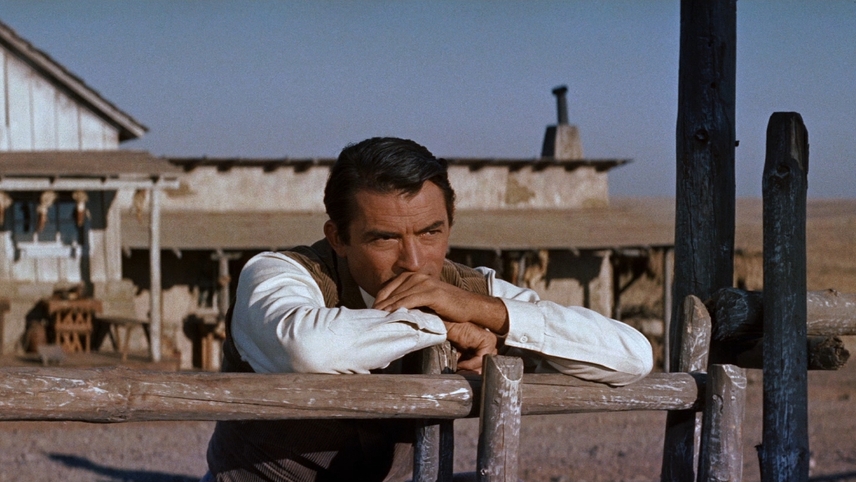
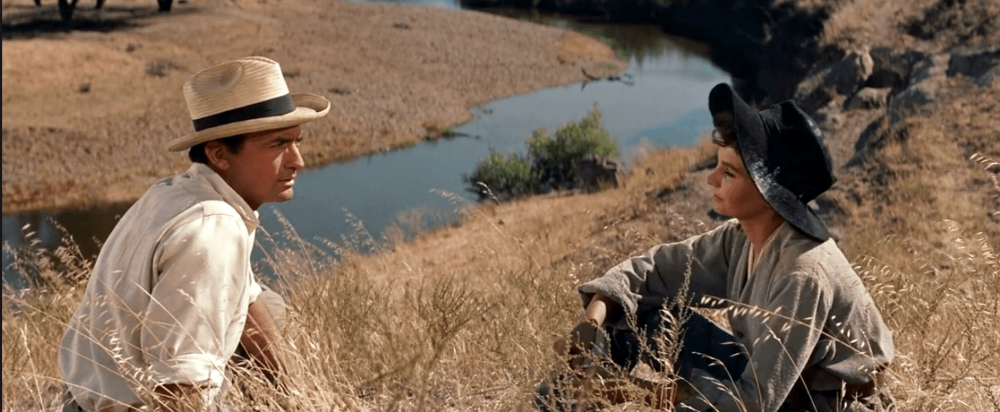
It’s the American West, and James McKay (Gregory Peck) arrives in town to marry Patricia Terrill (Carroll Baker), daughter of local landowner Major Henry Terrill (Charles Bickford) who is in the middle of a turf feud with patriarch of a cowboy clan, Rufus Hannassey (Burl Ives). This is a town where men-are-men and a harsh word is met with a sock to the mouth. It’s a world where McKay is out of step: a seasoned naval captain, with more experience than anyone, he couldn’t care less what people think of him and won’t be goaded into doing something foolish. His self-assurance and strength of character are interpreted as wimpy yellow-belly-ness by nearly everyone, including Patricia and Terrill’s macho foreman Steve (Charlton Heston). Only local schoolteacher Julie Maragon (Jean Simmons) understands him. But as events come to a head, only McKay has the strength of character to step up and try resolve things without mass bloodshed.

The Big Country is the classic set-up: a stranger in town, who has the guts to stand up. The only difference here, is that McKay has the guts to stand up and not conform to the macho bullshit being driven by the two feuding patriarchs. Both of these men are, of course, far more similar than they would admit, being perfectly contrasting personalities. Charles Bickford plays a genteel man with the principles of a thug, while Burl Ives plays a thug with the principles of a genteel man. No wonder they can’t get on, both see in each other qualities they most likely despise in themselves.

Compared to them, McKay looks like the very model of twentieth century liberal coalition building. Or at least McKay is a liberal who packs a punch, since it’s pretty clear Peck is probably the toughest son-of-a-bitch in the town. What’s glorious in McKay – and Peck’s sensational performance of reserved warmth and wry amusement, mixed with world-weary sufferance – is that you get a definite sense he’s seen way worse than this before. A man who has sailed around the world for decades, in the hardiest conditions, who has been keelhauled and saved men from sharks, recognises this for the slightly pathetic parochial dust-up it really is, and has no interest – or need – to put his life or the lives of others at risk to make crude points about his manliness.

If only, the film argues, we could all be as confident in our own skin. McKay keeps his cool in a way no-one in film, except perhaps Tracy in Bad Day at Black Rock, has managed so successfully. He laughs off his irritation at a hazing from the Hannassey’s – and makes clear, as the Terrill’s saddle up to fight back, that in doing so they are not acting in his name. He won’t make a fool of himself by trying to ride a wild horse in front of a crowd. He won’t rise to Steve’s provocation for a punch-up in front of the entire Terrill gang. McKay is a man who only needs to prove things to himself: so he’ll tame that horse in front of no crowd and swear the only witness to secrecy. He’s not one to brag.

And if it’s a fight that Steve wants, he’ll give him one on his own time and his own terms – those being a dusky morning in private. Wyler shoots one of the greatest fights of all time, an exhausting slugging match between Peck and Heston, played out mostly in long shot that soaks up the dawn Western atmosphere, as the two men fight themselves to an exhausted score-draw, with each punch landing with a punishing wallop. There is something very compelling about this unflashy, in-the-dust, clash of two alpha males, and the strange sense of respect that grows between them (as well as the dry wit of the script – “You certainly take your time to say goodbye”, Heston deadpans after this exhausting ‘I’m leaving but first this’ fight).

It also showcases how well Wyler uses sound (or the lack of it), the fight taking place often in a longshot silence that somehow makes the dusty scuffle even more effective. Silence also comes into play brilliantly to stress McKay’s isolation when first the Terrill men ride away to extract vengeance and then the disgusted Patricia closes the front door on him, leaving him standing in magnificent isolation on the porch. Silence will also come effectively into play during the late act ride of various characters through a white chalk lined gorge and to stress the danger that the kidnapped Julie is under when being held by the Hannassey’s.

The final act brings all the threats of danger and threat together into a brilliantly tense final confrontation. This sequence showcases, not only Peck’s granite principles and nobility, but also gives excellent opportunities for Ives to explore hidden depths in Old Hannassey (it surely helped him win the Oscar for Supporting Actor) and his dumb son Buck (excellently played with a swaggering arrogance by Chuck Connors) who is all mouth and no trousers.
Sure, at times the film overplays the anti-violence card. It’s particularly noticeable as it sometimes wants to have its cake and eat it, favouring probably a sort of gun-toting liberalism, of the “I could kill you but I want to make it so I don’t have to” variety. But then the film would be a heck of a less effective if we weren’t so convinced that Peck was as tough as they come and that his unwillingness to throw himself into events thoughtlessly is a mark of his unparalleled strength. Again, Wyler uses silence as effectively as sweeping camera movements and that brilliant score, to suggest moral strength.

There is probably very little tension about where the romantic plotlines are going, but both Carroll Baker and Jean Simmons are very good as two very different, but equally strong, women (although both women allegedly found Wyler’s perfectionist Kubrickian retakes on set extremely trying). But it still works a treat because of the strength of the acting, and its strongly scripted characterisation.

That and I’ve hardly mentioned the score, by Jerome Moross, which is powerful and famous you’ll instantly know it even if you’ve never seen the film. The Big Country is a Western where the hero has the strength to stick to his principles while still getting the job done. It’s superbly acted by Peck, with Simmons, Baker, Heston, Ives, Bickford and Connors all excellent in support. Wyler combines visual and a compelling story into a film that, while at points a little long, is still a bona fide classic. Again I’ll say: I loved it.

Cimarron (1931)

Richard Dix strikes a pose as Irene Dunne looks on in the appalling Cimarron

Director: Wesley Ruggles

Cast: Richard Dix (Yancey Cravat), Irene Dunne (Sabra Cavat), Estelle Tayler (Dixie Lee), Nance O’Neil (Felica), William Collier Jnr (The Kid), Roscoe Ates (Jesse Rickey), Stanley Fields (Lon Yountis), Robert McWade (Louis Hafner), Edna May Oliver (Tracy Wyatt), Judith Barrett (Donna Cravat), Eugene Jackson (Isaiah)

The only reason Cimarron doesn’t regularly top polls of the worst Best Picture winners ever made, must surely be because so few people have seen it since 1931. Believe me you are not missing anything. A ponderous, pompous, puff of a movie, Cimarron might have tricked people into thinking it looked radical, daring and inventive at the time – but it’s fooling no-one today.

Over 40 years in Oklahoma, from the Land Rush of 1889, the town of Osage grows from tents and mud hats to a thriving modern 1920s city. Part of the story of the town are the lives of two of its founders, Yancey Cravat (Richard Dix) and his wife Sabra (Irene Dunne). Yancey is a noble, man’s man with wanderlust, who rides into Osage, guns down the bullies and campaigns for the rights of the poor and down-trodden via his newspaper. Sabra picks up the pieces when he wanders off (often years or decades at a time) raising the children, running the newspaper and eventually becoming a congresswoman.

It should be a sprawling epic, but Cimarron is a dull fart of a film that runs out of any narrative drive after its opening hour (which largely focuses on 1889-1893) and collapses into a series of disconnected, uninteresting scenes, very dully filmed, that sees our characters obtain increasing amounts of old age make-up while shedding what little personalities they had to begin with.

Ruggles shoots the film with such tepid flatness, you might as well be in the theatre. Most of the scenes sees the camera set in a static position (to capture the sound – the sound mix on the film, by the way, is appalling making most of the dialogue extremely hard to hear) with scenes taking place in medium shot allowing us to see the sets and follow the actors walking in and out. You might as well be sitting in the theatre – although, if you were, it would be harder to leave.

It’s not helped by the generally terrible acting, pretty much across the board. Irene Dunne just about emerges with some dignity by underplaying and even showcases a surprising amount of feminine independence – even if her character is an insufferable prig, demonstrating flashes of racism as and when the plot requires. But you can at least see why she continued to have a career – just as you can see why this was Richard Dix’s highest profile sound film. Dix doesn’t know whether to go for a declamatory theatrical style or to telegraph every emotion with poses, silent movie style. So, he does both. The result is a ludicrous collection of poses and grandstanding, that his wild eyes, dyed hair and middle-distance starring stance doesn’t help with. It’s a dreadful performance.

It’s fitting it sits in a film as bad as this one. The only moment of invention the film manages is its opening sequence, restaging the Oklahoma Land Rush. This set piece uses an army of carts and horses to restage the entire land grab from start to finish, the camera capturing these waves of prospectors charging into Oklahoma to grab the best bits. Nothing else in the film beats it, not even the gun fight that occurs part way through. Instead, the film degenerates into long, vague scenes, usually centring around a self-important speech of self-righteous bluster from Dix.

Nothing looks more dated in the film than its depiction of anyone not white and Christian. Now I will cut the film a little bit of slack here. It’s clearly trying to make a plea for greater toleration. Dix’s character passionately campaigns for the rights of Native Americans (or “the red men” as he puts it). He treats his black servant Isaiah with love and affection. He defends the Jewish prospectors. This film is trying to push an agenda more advanced than its time. It gets points for that.

It loses them all though for how these characters are presented. The Jewish characters are smiling, wizened Shylocks. The Native Americans are exotics, forever “How”-ing and happily accepting their status as second-class citizens. Worst of all, Yancey’s servant Isaiah is one of the most shockingly racist caricatures put on film. You think Gone with the Wind is bad? Watch this. Isaiah is stupid, muddle-headed, speaks in a clumsy patois, ridiculously fawning, delighted to be a servant and treats the white men like Gods. The film encourages us to chuckle at him, while patting his head with a smiling paternalism. All the tragic death scenes in the world can’t wash the bad taste out of the mouth. Back then it was fairly forward-thinking – today its jaw dropping.

The main problem is the film is a dull, drifting, dawdling mess that goes nowhere and asks us to root for two characters who are both, in their ways, self-important prigs, convinced they are right about everything. It builds to nothing at all, other than mirroring the sort of relentless march of time you’ll experience while watching it. It’s patronising, uninteresting and outstays its welcome. I can’t even work out why it’s called Cimarron (the name of Yancey and Sabra’s son). Is it because it’s a film asking us to think about the future? It can’t be because Cimarron is important – in ten minutes he ages from about 12 to 40. But then the fact the title refers to an empty non-character is somehow fitting for a film that really should be put down at the earliest opportunity.

Unforgiven (1992)

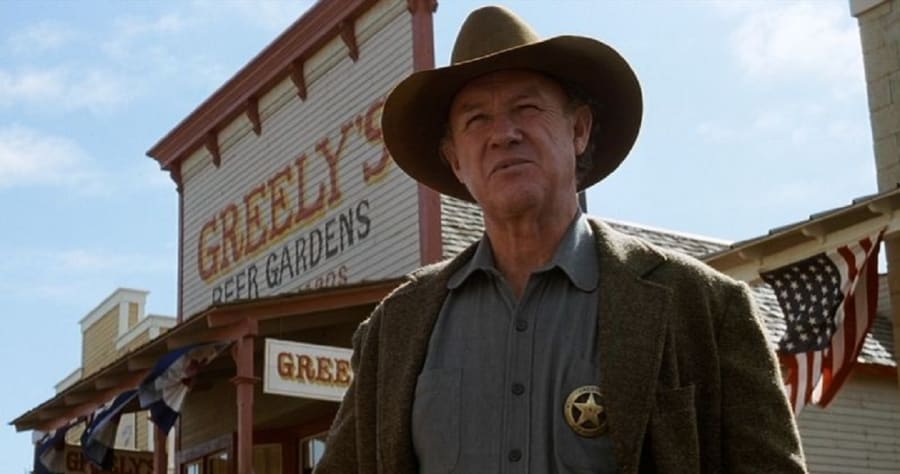
Clint Eastwood rediscovers the dangers of killing in classic Western Unforgiven

Director: Clint Eastwood

Cast: Clint Eastwood (William Munny), Gene Hackman (Sheriff Little Bill Daggett), Morgan Freeman (Ned Logan), Richard Harris (English Bob), Jaimz Woolvett (The Schofield Kid), Saul Rubinek (WW Beauchamp), Frances Fisher (Strawberry Alice), Anna Thomson (Delilah Fitzgerald), David Mucci (Quick Mike), Rob Campbell (Davey Bunting), Anthony James (Skinny Dubois)

The Western has a reputation for “white hats” and “black hats” – goodies and baddies, with sheriffs taking on ruthless killers with the backdrop of civilisation hewn out of the wildness of the West. It had passed out of fashion by 1992, and this memory is largely what remained. That helps describe the impact of Unforgiven. A great revisionist Western, searingly honest about the brutality of the West, it was made by an actor more associated with the Western than almost any other since Wayne, Clint Eastwood. Articulate, sensitive, intelligent and superbly made, it marked the transition of Eastwood from star to Hollywood artist. It’s still his greatest movie.

In 1880 in Big Whiskey, Wyoming, the face of prostitute Delilah (Anna Thomson) is slashed with a knife after she sniggers at a customer’s unimpressive manhood. The two cowboys responsible are ordered to compensate her pimp by sheriff “Little Bill” Daggett (Gene Hackman). Disgusted, the other prostitutes chip in for a $1000 bounty on the men responsible. A young man calling himself ‘The Schofield Kid’ (Jamiz Woolvett) seeks out famed gunslinger William Munny (Clint Eastwood) to help claim the bounty. Once a brutal killer, Munny is now a repentant widower raising two children – and desperate for money. Recruiting old friend Ned Logan (Morgan Freeman), Munny rides to Big Whiskey – but will he return to his violent ways?

Unforgiven explodes the romantic mythology of the West, in a way that really made people sit up and notice. In truth, revisionist Westerns had been made for decades before 1992 – Eastwood himself had already directed at least two – but as the public hadn’t flocked to see films like McCabe and Mrs Miller (wrongly!) the main memory of the Western was of the (excellent) likes of High Noon, Shane and John Wayne (but not the Wayne of Red River). Nearly every classic Western, to be frank, has a dark heart and questions the mythology. But few films so starkly exposed the violence, ruthlessness, cruelty and empty morality of the West – or more viciously attacked the romanticism built up around it.

In Unforgiven characters – particularly Munny – are constantly haunted by their past killings. The violence described is always cheap, pointless and brutal, fuelled by huge amounts of booze. Munny never seems to remember why he even did something – be it blowing a man’s face off to killing women and children. Whenever we hear about the past, it is a parade of short-tempered, violent, pissed men using the gun as a first-and-last resort, and never thinking of the consequences. The real ‘heroes’ of the West kill without batting an eyelid and, no matter how charming they might seem, have a terrifying capacity for sadism and violence. Place Munny back into this environment, and it isn’t long before his long-hardened ease with killing emerges once again.

It’s men like this the bounty will draw to Big Whiskey – and Little Bill knows it. Little Bill is superbly played by Gene Hackman (he won every award going), full of bonhomie and charisma matched only by a ruthless “end-justifies-the-means” philosophy that sees this law-giver carry out increasingly brutal and sadistic acts to preserve order. Brutally beating gunslingers – and worse – are justified in his mind, to prevent the chaos and slaughter they bring. And he mocks the pretensions of gunslingers fancying themselves romantic heroes, but doesn’t half enjoy telling tales of his own of exploits.

It’s not a surprise that the film’s face of law-and-order is shown to be just as at ease with violence as the killers he is protecting the town from. It’s part of Unforgiven’s intriguing study of morality. When, if ever, is violence justified? Do the ends justify the means, or is killing never acceptable? Or is it fine if you are convinced the cause is right or the target deserving? How long before you’ve slid so far down this slippery slope, that questions of right-and-wrong don’t even enter your head before you pick up a gun?

There couldn’t be a better face for this than Eastwood. Clint looks old, ravaged and tired, just as Munny is, haunted by the screams of men he no longer even remembers. He’s soulful enough to know he has no soul, capable of understanding he needs to change, but also able to revert to dealing out murder. Eastwood deconstructs his own screen personae of “the man with no name” into an old man who can’t face his past and is filled with regrets. As the film progresses, more and more Munny rebuilds his ease with killing – eventually exacting a revenge that leaves a trail of bodies behind.

There is nothing romantic about any of this: despite the best efforts of journalist WW Beauchamp (played with wide-eyed gusto and energy by Saul Rubinek) to inject it. Beauchamp has made a living turning the adventures of gunslingers into romantic best sellers – and is the films’ clearest attack on Hollywood itself for romanticising an era of violence and mayhem. Beauchamp is the biographer of genteel killer English Bob, who has made his money “shooting Chinamen” for the railroads. Played with a self-important grandness by Richard Harris (one of his finest performances), English Bob (actually a working-class oik masquerading as a gentleman) is living his own press release as a gentleman gunslinger. The fact that – as Little Bill delightedly reveals – he is just as much an alcoholic murderer with no principles is just another example of how little reality and fiction meet.

At least Munny accepts he’s a bad man. Perhaps that’s why his late wife shocked her mother by marrying him – he has enough self-knowledge to want to change even if he can’t. But of his three companions – Morgan Freeman is brilliant as the jovial Ned who has lost his taste for killing – only he lasts the course. That’s not a good thing. When we finally see a fully reverted Munny, downing a bottle of whiskey and shooting up a saloon he’s terrifying: brutally efficient with shooting, in a way that panicked shooters can never compete with.

In Unforgiven violence comes with a cost. A shot man takes a long time to die. The women who called most for violence, are left speechless by meeting the reality of it. A man’s soul is marked forever by taking life – “It’s a hell of thing killing a man. You take away everything he’s got and everything he’s ever going to have”. It’s a responsibility only a fool takes on lightly – or sober. Munny and Little Bill are they only ones we see who have come to terms with it in some way, one as a necessary evil, the other as an evil he can switch on and off like a tap. Their ruthless coldness is hardly an advert for wanting to be part of this world.

Eastwood’s masterpiece tackles all these ideas with gusto, while telling an engrossing story powered by brilliant performances – Hackman in particular, Freeman and Eastwood are all stunning – and asks you to take a deep look at what we admire so much about violence. It does this in a subtle, autumnal way (with a haunting score), its muted colours helping to drain any further romance from the West. Gripping, thought-provoking and engrossing, Unforgiven is one of the greatest of Westerns.

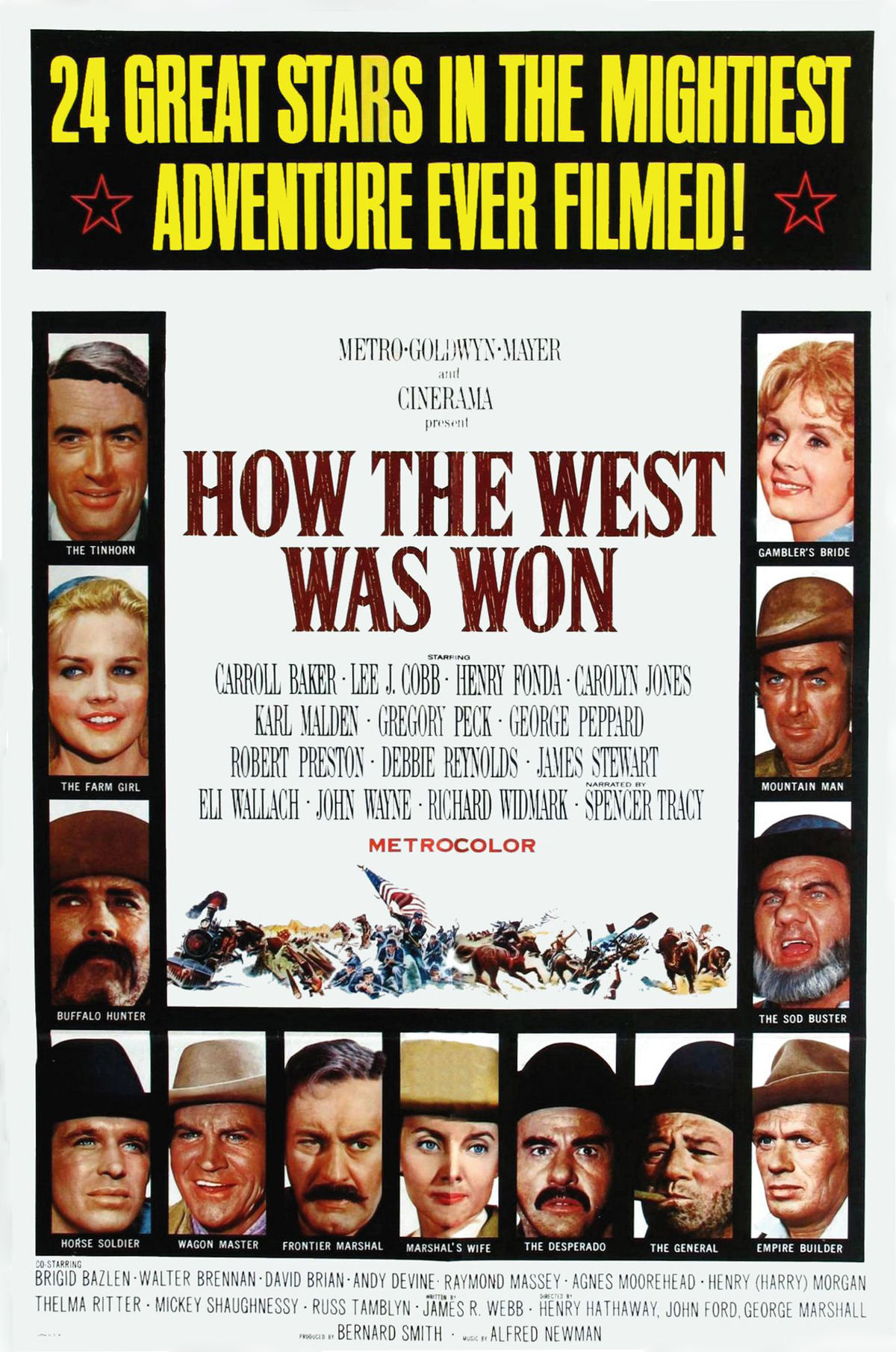
How the West Was Won (1963)

James Stewart helps us see How the West Was Won

Director: Henry Hathaway, John Ford, George Marshall

Cast: Spencer Tracy (Narrator), Carroll Baker (Eve Prescott Rawlings), Walter Brennan (Colonel Jeb Hawkins), Lee J Cobb (Marshal Lou Ramsey), Henry Fonda (Jethro Stuart), Carolyn Jones (Julie Rawlings), Karl Malden (Zebulon Prescott), Raymond Massey (Abraham Lincoln), Agnes Moorehead (Rebecca Prescott), Harry Morgan (Ulysses S Grant), Gregory Peck (Cleve van Valen), George Peppard (Zeb Rawlings), Robert Preston (Roger Morgan), Debbie Reynolds (Lilith Prescott van Valen), Thelma Ritter (Agatha Clegg), James Stewart (Linus Rawlings), Rus Tamblyn (Confederate deserter), Eli Wallach (Charlie Grant), John Wayne (William Sherman), Richard Widmark (Mike King)

How the West Was Won was the Avengers: Endgame of its day: every star of the biggest box-office genre in America coming together for one epic adventure that would stretch over generations. Stewart! Fonda! Peck! Wayne! Together for the first time (only of course they are not, none of them appearing the in same scene). Even more than that, How the West Was Won would be filmed in Cinerama, a three-screen shooting method producing a panoramic image. All this would make How the West Was Won the biggest, grandest, largest film ever made. It was a massive box-office success, nominated for eight Oscars (including Best Picture) and wowed audiences.

Plot wise though, it’s basically a series of short films cobbled together into a single film. The stories are basically self-contained, although some actors cross over (especially George Peppard and Debbie Reynolds). The first episode The Rivers covers the migration west, down the river, of the Prescott family, taking on river pirates and allying with James Stewart (looking at least twenty years too old as a young drifter). The Plains sees Debbie Reynolds, daughter of the Prescott family, migrate further West and eventually marry gambler Gregory Peck. The Civil War sees Stewart’s son George Peppard caught up in the war. In The Railroad, Peppard reluctantly runs security for ruthless railway builder Richard Widmark. Finally, in The Outlaws an older Peppard attempts to retire, but not before one final shoot out with old enemy Eli Wallach during an attempted train heist.

All these short stories – each about 30-45 minutes in length – are entertaining. So entertaining that you won’t mind at the end that you have no idea how the west was actually won (I assume it’s something to do with progress and the law) or that the characters are basically actors riffing off their own personas rather than fully realised individuals. Despite the attempt to build the story around one  family (the Prescott-Rawlings), the stories are so disconnected and the characters so lightly sketched, with such huge time jumps, each story might as well be about completely new characters.

Not that there is anything particularly wrong with that. But it boils down to the key issue with How the West Was Won, a very flabbily constructed film that lacks any real sense of guiding narrative or vision behind it. It’s a series of set pieces, which are all about scale – the river rapids, the battles of the Civil War, the final train-set shoot out – in which some loosely defined characters live their lives. There are some decent performances – Debbie Reynolds does a very good job anchoring a couple of stories (plus we get to see her do some song-and-dance routines), while Peck (a smooth operator) and Fonda (a gruff woodsman) have the best parts among the stars. Others, like Wayne, pop up for but a few seconds.

They needed all these stars to fill the frame. How the West Was Won’s main problem is also its principle reason to exist. It was designed to showcase the wideness of Cinerama, one of only two films to use the technique. Designed to be projected into curved screens, the technique essentially used one massive camera to produce an image so large it needed three synchronised projectors to screen it. This led to an impossible wide frame to fill, with two clear joins in the middle. The challenge of shooting this was not an enjoyable one for the directors.

To cover the visible joins, nearly every scene in the film sees an object placed one-third and two-thirds of the way through the image (usually a tree or a post). The actors stand carefully on their marks in their assigned third of the image. Close ups involved flying the massive camera almost into the faces of the actors (and even then it only produced an image from the waist up). Awkward compositions abound – either with actors standing rock still in front of huge scenery, or actors standing in carefully assigned rows, standing on marks they never move from.

The sweeping shots of the American west look impressive, but in a National Geographic way – it’s simply fitting as much of the imagery of the countryside in as possible. It was a hugely difficult job for the directors. It was not helped by two of them being competent journeymen and all three of them having done their best work in 4:3. Quite frankly I don’t think any of them have a clue about how to fill a frame this mighty. Instead, the film for all its grandeur is frequently visually conservative and unimaginative to look at. It’s got huge landscapes, but no real inspiration.

How the West Was Won is an enjoyable curiosity. It is very rarely, if ever, seen as it was intended on a Cinerama screen (the version I watched on a large television, still showed the slight fish-eye effect at points of a curved image flattened). Telling five short stories, each of them entertaining enough, it keeps the interest. It has a lusciously beautiful (famous) score by Alfred Newman that captures the spirit of the West. But, for all its grandness, it’s a strangely small experience.

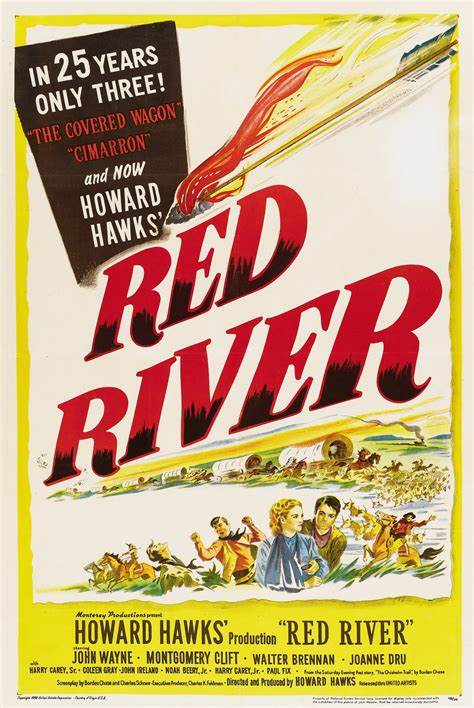
Red River (1948)

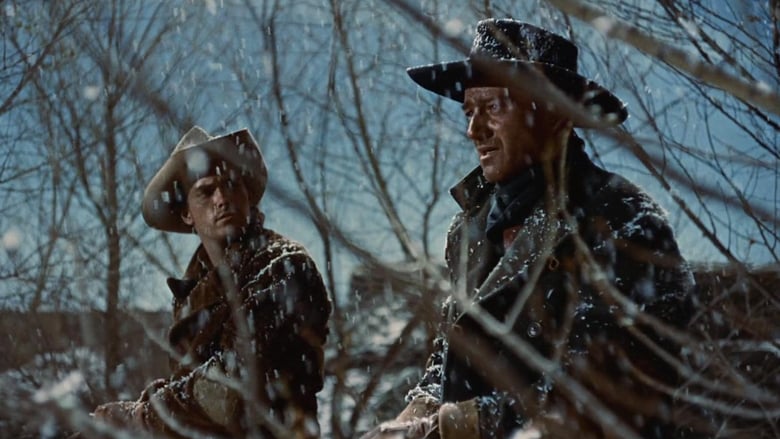
John Wayne and Montgomery Clift as duelling surrogate father and son in Red River

Director: Howard Hawks

Cast: John Wayne (Thomas Dunson), Montgomery Clift (Matt Garth), Joanna Dru (Tess Millay), Walter Brennan (Groot), Coleen Gray (Fen), Harry Carey (Melville), John Ireland (Cherry Valance), Noah Beery Jnr (Buster McGee), Harry Carey Jnr (Dan Latimer), Chief Yowlachie (Quo)

Some say Red River is, even more than Citizen Kane, the masterpiece in American film. That’s pushing it. But Red Rivercertainly is a prime slice of beefy entertainment. Hawks’ first Western (and how odd a director so associated with them didn’t turn his hand to them until late in his career – and then only made six), there is no greater compliment to make than to say you could mistake it for John Ford.

In fact, Ford was beyond impressed, famously observing of Wayne “I didn’t know the big son of a bitch could act”. Act he certainly does here as monolithic obsessive Thomas Dunson (surely a forerunner to the equally troubled – and troubling – Ethan Edwards in The Searchers). Dunson has spent almost two decades building his Texan cattle empire. Unfortunately, the Civil War means the bottom has dropped out of the Texas beef market. To make good his investment, Dunson needs to take the cattle (all 9,000 of them!) up north to Missouri (over a thousand miles) to sell at a good price. Along the way, Dunson’s ruthlessly focused ambition tips into tyranny, with Dunson (literally) judge, jury and executioner among his team. Can his more liberal adopted son, Matt Garth (Montgomery Clift), stop Dunson from destroying everything around him?

Red River covers the movement of cattle up the Chisholm Trail, a huge economic migration that saw millions of cattle moved from Texas to where their price was increased by a factor of ten. But the film has only a passing interest in the history – and the romantic, nostalgic look at it here, as a sort of boys-own adventure that goes wrong, is far more about the movies than social history. What the film is really focused on is the personal clash between two generations of men: one a relic of the first years of the new frontier, the other younger, more modern in his thinking, with a streak of humanity the other has beaten down.

Hawks’ film mixes this up with some terrific location footage. How did they wrangle all those cattle? The film is very strong in capturing the sense of excitement in the Frontier – the setting off on the trail, with its quick shot cacophony of horse-backed men whooping with joy, is full of a sense of adventure. The film is a triumph of quick-quick-slow story-telling. The 15 years of Dunson’s empire-building passes by with montage and Wayne voiceover which begins and ends with Wayne in the same position, but the actor considerably aged. Context is skilfully and swiftly given to us, but the tensions between Dunson and Matt are grow and develop naturally, simmering for a good hour-plus before erupting. Transition text between sequences bridges us from scene to scene, and is especially effective in charting Dunson’s descent into tyranny.

Tyranny is what it is all about. This is one of Wayne’s darkest – but also greatest – roles. Hawks taps into the despotic rigidity in this slab of Americana. Dunson is a man utterly and completely convinced not only of his invulnerability, but his rightness, embodying American manifest destiny. Claiming swathes of land as his own, Dunson is a man on the move, constantly striding forward (Hawks often shoots him in progressive, shark-like motion). He’ll leave behind him everything from the woman he loves (with a shocking toughness, as he looks back on the burning remains of the wagon train he left her in) to the land he claimed, to anyone who lets him down.

Dunson is also a ruthless embodiment of a time before law. No one seems to question the way he executes those who cross him. Practically the first thing he does on arrival in Texas is out-draw and kill the man sent to question his arrival. His farmstead has a full graveyard. A dark comic touch is added with his insistence in “reading the words” over graves of men he’s killed. On the trail he has those who back out, run away or question his leadership whipped or shot. Wayne’s certainty as an actor tips into a (literally) black-hatted despotism. His manly focus and ability to outdraw anyone turns him in the end into a nightmare avenger, a Western Terminator.

Opposite him is Clift (equally superb) as a more modern minded kid. Matt is the sort of man who knows that at times a bit of bend and a sympathetic ear gets better results than a beating. Hawks brilliantly builds the love-hate relationship between these two men who have very little in common, other than mutual affection. (Clift and Wayne themselves were polar opposites in acting style, social views and personalities.) There is a real love there – which makes it all the more inevitable Dunson will view Matt’s questioning of him as a betrayal nothing less than blood will redeem. The two of them, and their clash (like the clash between two sides of America) dominate the film, not letting too many other characters have a look-in.

Of the rest, Walter Brennan is a very good as Dunson’s loyal number 2, who may not always agree with the chief but largely (if reluctantly) sticks by him (for all he mutters to him “You’re wrong Mr Dunson”). John Ireland’s cocky gunslinger, who joins the trail because he admires Dunson’s no bullshit attitude, promises much at first but fails to deliver on much-hyped clashes. (Possibly because Ireland fell out with Hawks over a competition for the affections of his future wife Joanna Dru, his role later cut to ribbons in revenge.) There is however a strange, almost homoerotic, link between Clift and Ireland – mutual respect leading to an admiration love-in and much fondling of each other’s firearms during competitive rock shootings.

Red River’s ending has gained some criticism – largely because the film builds its sense of violence between the two leads so well that it feels a bit of a disappointment that they are effectively told to pull themselves together (by a woman of all things!). But, for all the film mines the clashes between two different outlooks, it never loses track of their very real affection. Sure Dunson may talk about killing Matt – but he certainly won’t in cold blood (even if he happily guns down anyone who gets in the way) and at the end of the day, he’s still the closest thing he’ll ever know as a son. Matt is emotionally mature enough to know Dunson is to-all-intents-and-purposes his father, even if he’s not above throwing a few punches at him. The clash is effectively a narrative dead-end – for all it would be exciting to see them take shots at each other, this is a family. And most families fight and make-up, not plug each other with bullets.

And it distracts from the grand entertainment of Red River, its excited love for the open country (the late act scenes inside are as disconcerting for us as they are the characters). This is a western of psychological depth successfully mixed with grand adventure. It’s hugely entertaining but also feels very true. It has two wonderful performances from Wayne and Clift. It’s not the Great American Film, but it’s directed by a superb understander of cinematic narrative and a hard film not to love.

Shane (1953)

Alan Ladd as the mysterious gunslinger Shane

Director: George Stevens

Cast: Alan Ladd (Shane), Jean Arthur (Marian Starrett), Van Heflin (Joe Starrett), Brandon de Wilde (Joey Starrett), Jack Palance (Jack Wilson), Ben Johnson (Chris Calloway), Edgar Buchanan (Fred Lewis), Emile Meyer (Rufus Ryker), Elisha Cook Jnr (“Stonewall” Torrey), Douglas Spencer (“Swede” Shipstead), John Dierkes (Morgan Ryker), Ellen Corby (Liz Torrey)

On the surface Shane is pretty much the definitive “white-hat-black-hat” Western. Crikey, Jack Palance’s vicious gunslinger Wilson practically wears nothing but black. Alan Ladd’s heroic Shane does what needs to be done, and the kid loves him to bits. But Steven’s film is more complex and intriguing than that. Because Shane is in fact only a few degrees away from Wilson. When he rides into the homestead, he is already weighted down by the memory of all the people he’s killed. Shane is no saint. He’s a tired man whose shed too much of other people’s blood to ever feel anything but an outsider.

Shane arrives at the Starrett farm. Joey (Brandon de Wilde), the boy-of-the-house immediately hero-worships this mysterious stranger with the distinctive guns. Joe Starrett (Van Heflin) is at first hostile but takes Shane in as a farm worker and he and his wife Marian (Jean Arthur) – maybe particularly Marian – are drawn towards this reserved but good-natured man. Starrett and the other homesteaders are in the middle of a feud with local cattle rancher Rufus Ryker (Emile Meyer), who wants to drive them off the land so he can use it for his cattle. Violence seems inevitable – but how long can Shane keep his unspoken pact to himself to put down his guns and try a life of normality?

Shane is one of Steven’s finest films, beautifully filmed with Oscar-winning photography and told with a lavishly poetic sense. It works so well because it juggles both a simple story, with a deep poetic understanding of humanity. You can see why this is “a Western for those who don’t like Westerns”. It’s got a beautiful, understated sense of struggle to it – the homesteaders against the bullying of Ryker – beautifully mixed with a sense of the dangerous glamour of violence. Match that with some wonderfully hissable villains and the honesty and decency of the Starretts and Shane’s quiet dignity, and you’ve got a perfectly judged morality play.

But the film works because there is so much operating on multiple levels. Which brings us back to Shane himself. Sure, he’s a decent guy. We expect him to be the hero. He fulfils much of that function in the plot. He’s kind and loving with the kid. He holds his cool and never seems to get angry. But why is this? The film makes clear that Shane has a past. A past of gun-slinging violence. And if Shane is still standing at the end of a life like that, he must have been good. And ruthless.

What was it that made Shane so desperate for a change? To try a life of normality, chopping down stumps and putting up fences on a farm? I suspect Shane in his prime wasn’t that different from the calm, cool and ruthless Wilson. You can see the guilt in his eyes when he finally shoots his weapon (at a rock!) two thirds into the film. This is a man who knows that killing carries a terrible burden – and he clearly knows all too well after sending so many to their graves. At the end of the film, with his emotional pean to Joey (“There’s no living with killing”) he’s speaking from the heart. And only someone who has killed many, many people – who doesn’t look remotely worried when facing off with Wilson and Ryker – could really know that.

It’s an idea that you could miss in the film, but it’s there all the way through. The casting of Alan Ladd – who was never better – is crucial to the success of this. Imagine the strength and power a Wayne or Cooper or Stewart would have given Shane. They would never have felt so slight, or beaten down by a life of violence. But Ladd’s smallness, his sadness and his reluctance works for the part. Stevens continually shoots him as an outsider, on the edge of scenes or even isolated in crowds. He can fade into the background in the way other stars couldn’t have done. He feels like a man who knows he has been a moral failure, who isn’t redeemed by star quality.

Stevens plays with our expectations of Shane through the reactions of the Starretts. Joe is (tellingly) instinctively hostile to him at first, before Shane wins him over. Marian’s reaction is however fascinating. She is both slightly repelled by what she can see as Shane’s past violence, but also increasingly drawn towards him. Is this because Shane’s internal knowledge, his worldliness, his depths of sadness make him more of a thoughtful kindred spirit than her husband can be? Joe is a simple man, decent beyond words, but not a thinker. Shane is more – for all his danger – and Marian feels like a woman who has accepted her place but perhaps dreamed of more. She would never act on this, but Shane to her seems to represent a path not taken.

And Joey? Shane is everything a boy could dream of in a hero. The man with few words who appears over the horizon with nothing but a six shooter. Stevens camera cuts back again and again to Joey’s adoring, worshipping face – and it’s an excellent performance from (the Oscar-nominated) Brandon de Wilde, as a young boy on the edge of becoming a teenager who wants to be a man, but still looks with the eyes of a child. Stevens throughout places the audience on the same level with Joey. Like him we want to believe in Shane, to see him play the hero. It’s part of the films skilful construction that it finishes before it occurs to you that the character the audience most closely related to was the uncritical, unknowing child. On first viewing we stare at Shane with the same hero worship as Joey.

Shane wants a life of normality. Shane isn’t a million miles away from Eastwood’s revisionist Unforgiven. In fact, Munny’s life in that film is basically Shane’s, without Ladd’s humbleness. The brutal killer who wants to leave it all behind, but is dragged back in. Who finally faces off and guns down a horde of enemies in a saloon bar before riding off into legend. Sure, Shane will be remembed with more fondness by those he leaves behind – and he saves the homesteaders – but just like Munny he does it by leaving a trail of bodies behind him.

Steven’s beautiful film is both a compelling narrative of goodies and baddies, but also a profound, fascinating and challenging film. It’s wonderfully made and has a host of reliable actors at the top of their game. Ladd is superb, Jean Arthur brings great depth to Marian, Van Heflin’s Joe is a the sort of simple, decent, salt-of-the-Earth type the West was made of. Facing them, Jack Palance makes the most of limited screentime (and got an Oscar nomination) as the sneering, bad-to-the-bone Wilson. It’s a perfect mixture of small, intimate scale that seems to be taking place in an epic environment. It’s influence has been so profound it’s virtually an archetype. An American classic.

The Searchers (1956)

Searchers header
Jeffrey Hunter and John Wayne on a long search, in John Ford’s exploration of racism in the West The Searchers

Director: John Ford

Cast: John Wayne (Ethan Edwards), Jeffrey Hunter (Martin Pawley), Vera Miles (Laurie Jorgensen), Ward Bond (Reverend Captain Samuel Johnson Clayton), Natalie Wood (Debbie Edwards), John Qualen (Lars Jorgensen), Olive Carey (Mrs Jorgensen), Henry Brandon (Scar), Beulah Archuletta (Look), Ken Curtis (Charlie McCorry), Harry Carey Jnr (Brad Jorgensen), Hank Warden (Mose Harper), Dorothy Jordan (Martha Edwards), Walter Coy (Aaron Edwards), Pippa Scott (Lucy Edwards)

John Ford’s career was a long tribute to the decency of the regular American. How fascinating then that one of his greatest films is in fact a dark investigation into the dangers of obsession, vengeance and prejudice in ordinary Americans. Working with his regular leading man, John Wayne, together they created a character who shared many qualities with Ford’s other leading men – a rugged, determined, taciturn man of the wilderness – but laced him with deeply negative attitudes and a horrendously damaged psyche. The Searchers becomes a masterpiece, presenting how narrow the line between hero and villain can be while – in an admittedly very gentle way – posing questions about the claims of the settlers to moral superiority.

Ethan Edwards (John Wayne) returns to his brother’s homestead from an unspecified (though clearly morally questionable) career as a gun for hire after fighting for the confederacy (a cause he sees no reason to disavow). He’s an awkward presence, with an unspoken love for his brother Aaron’s (Walter Coy) wife Martha (Dorothy Jordan) and a racial hostility towards their adopted son Martin (Jeffrey Hunter) who is one-eighth Cherokee. Shortly after his arrival, an Indian raid draws him and most of the local men on a futile chase. While they are gone, the Edwards’ homestead is destroyed, with the family all murdered except daughter Debbie. Ethan and Martin begin what becomes a five-year quest to find her and bring her home – although as he discovers Debbie has become wife to her kidnapper, the war chief Scar (Henry Brandon), Ethan’s aim shifts from rescue to executing Debbie for racial disloyalty.

Racism is what lies at the heart of The Searchers and around discussions of the film today. Firstly, let’s acknowledge how brave the film is in presenting Ethan’s racially motivated rage without excuse. This was after all John Wayne, the straightest shooter of the lot. Here, in no doubt his greatest ever performance, Wayne’s Mount Rushmore-like qualities are inverted into a bitter, lonely man whose murderous rage against the Native Americans is extreme, even within an environment which sees the tribes as a dangerous “other”.

Edwards’ racism tips into everything and is there right from the start: “I could mistake you for a half breed” he scowls at Martin. Later he will prevent Martin drinking alcohol – a clear reference to the belief among settlers that one drop of alcohol turns Indians into savage beasts. One of his first actions on the trail is to desecrate the buried corpse of an Indian, shooting out his eyes (condemning him to walk sightless in the afterlife). In a gunfight he has to be stopped from shooting retreating Indians in the back. Later, in a crazed fury, he guns down buffalo simply to deny them as food to the tribes. That’s not to mention his disgust with every trace of indigenous culture.

What’s striking watching the film is that, even though he’s the central character and is played by John Wayne, Ethan may well actually be the villain of the piece – or at best an anti-hero wild card. Our actual hero is the kindly, decent and brave Martin Pawley, played with a slight nervousness by Jeffrey Hunter. Martin is appalled by Ethan’s violence, his anger and above all by his plan for enforcing racial harmony by exterminating the niece he sees as a race traitor. It’s not just the fact he has Cherokee blood that makes Martin appalled by the danger in Ethan. It’s the simple fact that he’s just a decent guy, who recognises that good and bad isn’t a question of race but a question of people. And his presence on the quest, it’s made clear, is as much about protecting Debbie from Ethan as it is finding and rescuing her.

You can see these attitudes quite clearly late in the film, where the pair encounter white women who have been recovered from Indian kidnappers. These women are confused and traumatised. But while Martin attempts to communicate with and comfort them, to Ethan they are worse than nothing now. “They ain’t white anymore” he scowls at a soldier. Leaving them, Ford holds the shot on Wayne who turns to look back at them with a face dripping with such disgust and loathing, it sears into the memory.

Does the film condemn these attitudes? You can argue that the film plays into a racial nightmare – white women kidnapped and violated by savage tribesmen. But Ford is, I’d suggest, presenting racism here – and going as far as he could in the 1950s to attack it. Ethan and Martin encounter an Indian settlement that has been attacked by the cavalry. The settlement is a burnt-out husk, with Indian women and children among those indiscriminately slain – visually it is immediately reminiscent of the burnt-out Edwards homestead. Another later cavalry charge against the Indians will again see panicked women and children flee in terror. Even Scar, the villain of the piece, is motivated just like Ethan by anger – his actions are a response to the murder of two of his children. And his scalping, rape and murder don’t look so different from Ethan, who shoots people in the back, plans to murder his niece and later scalps a dead man.

The Searchers takes a slightly nihilistic view that the West was a violent place – for all the beauty Ford discovers in his crisply sublime shots of monument valley – and that many of the people in it had questionable motives and principles. A ”hero” for this time might well be Ethan, a sullen and violent man under a veneer of gentlemanly politeness, clearly motivated from the start far more by a desire for revenge for the murder of the woman he loves. Ford, Wayne and Jordan establish this love between Ethan and Martha subtly but unmistakably – the opening scenes are littered with moments of the two of them sharing glances and a hesitant but unmistakeable physical intimacy.

Again, a lot of the quality of this comes back to the wonderful work Ford draws from Wayne, helping the actor to find the cracks and flaws in this marble bust of Americanism. Wayne’s Ethan is awkward, angry, distant, difficult, cruel – a natural outsider, who has grown bitter against the world. Discovering Martha’s body, Wayne also allows Ethan to crumple into the sort of grief that translates within seconds into an iron loathing for the world and everything in it. He talks of the certainty of finding Debbie – but it’s a certainty born more of his idea of his own superior (white) determination rather than any faith (for all the language could suggest that). Ethan is in fact hostile and contemptuous of faith of any sort.

Ford frames Ethan frequently as an outsider, often framed uncomfortably in doorways, darkened walls seeming to close around him. Nowhere is this more beautifully done than in the film’s final shot which finds Ethan alone and forgotten outside the Jorgensen homestead, a man who has no place in the civilised world of family and friends, but an outsider with no place anywhere who must return to the wilderness. Wayne does this with a quiet, deflating gentleness – a beautiful suggestion of Ethan’s knowledge that the world is leaving him behind. Ford frames this beautifully in mid-shot to create one of the iconic images of cinema.

The Searchers isn’t perfect. There is a prolonged, slightly comic, sub-plot around Martin’s marriage to Laurie Jorgensen (Vera Miles in a thankless part), which culminates in the sort of fisticuff based comic stuff that looks more suited to The Quiet Man than here. The beautiful shots of monument valley are brilliantly done – but they also serve to point out the odd decision to shoot many of the exteriors on such obviously fake soundstages. While the film questions the attitudes and assumptions made about the Native American people in Hollywood films, the violent figure of Scar is the only Native American character given any real screen time (Martin’s accidental “wife” Look is treated as a joke, right up to her surprisingly tragic fate), making it easier to still see the tribes as an existential threat to civilisation, for all that Ford tries to contrast their suffering with the death of the settlers.

But Ford was trying to sneak something in here under the wire, at a time when people would only accept straight-forward stories of goodies and baddies in the West. He did this by turning Wayne for a pillar of taciturn goodness into someone who is almost a mirror image of his nemesis Scar, both men motivated by racial hatred. He parallels the violence of the Indians with the cavalry. He suggests in fact that there was good and bad on both sides. And I can’t think of another film where the viewer is convinced for a huge portion of the runtime that our hero intends to carry out an honour killing. The Searchers presents a man who holds racist views and trusts that we are smart enough to see the danger in Ethan’s extremism. Thankfully most of us are.

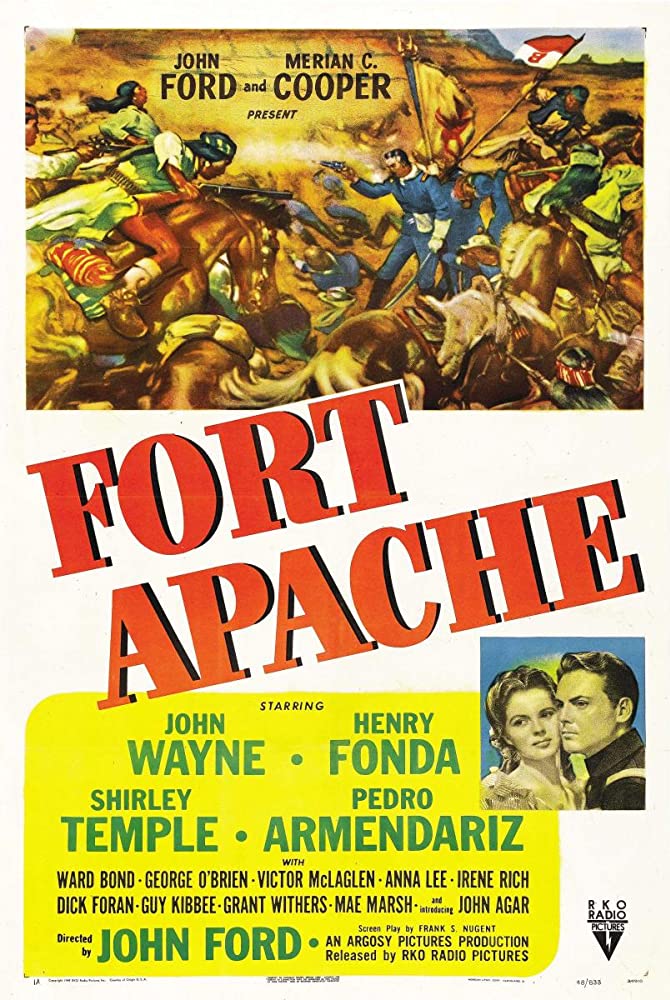
Fort Apache (1948)

Henry Fonda and John Wayne face off in John Ford’s Fort Apache

Director: John Ford

Cast: John Wayne (Captain Kirby York), Henry Fonda (Lt Colonel Owen Thursday), Ward Bond (Sgt Major Michael O’Rourke), Shirley Temple (Miss Philadelphia Thursday), John Agar (Lt Michael O’Rourke), Dick Foran (Sgt Quincannon), Pedro Armendariz (Sgt Beaufort), Miguel Inclan (Cochise), Victor McLaglen (Sgt Festus Mulcahy), Guy Kibbee (Captain Wilkens), George O’Brien (Captain Sam Collingwood), Anna Lee (Emily Collingwood)

Fort Apache was the first of Ford’s “cavalry trilogy”, exploring problems and personality clashes of remote cavalry posts in the middle of what used to Native American territory. Contrary to what you might expect, this is a complex, intriguing film that brilliantly explores tensions between very different ways of thinking and issues of class in America, which are so often overlooked. If it sells some of the tensions of clashing ideals down the river with an ending that fully endorses the myth over the reality, the fact the film makes clear that the idea of a well-meaning army all pulling together is a myth says a lot.

John Wayne is Captain Kirby York experienced, more liberal minded acting commander of Fort Apache. Aware of the difficult balance of maintaining good relations with the Apache tribe while protecting American expansionist interests, he’s perfectly suited for keeping the peace in the West. Unfortunately he’s replaced by Lt Col Owen Thursday (Henry Fonda), an arrogant, class-conscious – if polite and honourable man – who applies the letter of the law to all his dealings, so obsessed with rules (he protests “I’m not a martinet” while bemoaning the lack of proper uniform in the dust filled heat of the West) that he sees no reason to moderate even the most corrupt of the local officials who have driven the Apache to revolt, instead demanding the Apache submit. Disaster is on the cards.

Ford’s film revolves around the personality clash between York and Thursday. While both dutifully respect the chain of command, it’s clear that York has a closer bond and understanding with both the men under them and the complex considerations to balance when dealing with the Apache. Thursday, on the other hand, is an arrogant, prickly character, bemoaning his “demotion” from a field rank of General in the Civil War, to an “obscure” fort. A posting he is determined to escape from with an honour laden victory as soon as possible. 

With Ford’s romantic regard for the ordinary soldier and regular Joe, the sort of posh New-Englandish Thursday is a clear stand-out. A stiff-backed martinet, he never listens to others (he constantly needs to be reminded about names) and has a snobbish disregard for Lt O’Rourke (a callow John Agar) whose father, far from being officer class, is an Irish Sgt Major at Fort Apache. Thursday is notably uncomfortable at such Fordesque events as a NCO ball, or when talking with the men – he even looks unsettled in the desert, wearing full uniform and avoiding a hat in favour of an army cap with a dust-sheet attached at the back (no Ford hero would be seen dead wearing such a thing). 

The character works so effectively because he is played so delicately and skilfully by Henry Fonda. Cast against type – and looking older – Fonda plays Thursday as a frustrated man, terrified of failure who simply lacks the flexibility to adjust to situations. Rules instead are there to be followed in detail, regardless of his personal feeling. Corrupt government agent Meacham he treats with contempt, but he will defend his incompetent regime in Apache land to the death. With the Apache he can’t see past his own inbred ideas of superiority, treating them with a paternal disappointment, certain that they are no match for American cavalry might (spoiler, they certainly are). Fonda however keeps Thursday human, a flawed, rigid man dropped into a role he is ill-suited to and struggling to adjust.

John Wayne offers an equally careful performance as York. Unlike Thursday, York adjusts his actions and decisions based on situations and personalities, rather than enforcement of rules. Army regulations can be respected but applied with sense. Meacham to him should be hounded out of town as the root cause of all the problems. Cochise, the Apache chief, he treats with respect and honour – abiding by deals and attempting to compromise with him to find a peaceful solution (a negotiation Thursday of course torpedoes with his arrogance and intransigence). Wayne is often thought of as the action hero, but here Ford starts to explore his elder statesman quality, as well as his underlying decency and honour as an actor.

Other sub plots interweave neatly around this. John Agar’s young O’Rourke flirts with Thursday’s more liberal daughter (played brightly by Shirley Temple) – needless to say this relationship meets with no approval from Thursday. Thursday’s old colleague Sam Collingwood – now a time-serving captain at the Fort – is paralleled with him and York, as a time-server and mediocrity, a decent family man but lacking the will to do what he knows is right. Ward Bond provides both comedy and also a warm fatherly quality as Sgt Major O’Rourke, proud of his son and re-enforcing discipline on his (mostly Irish of course!) soldiers. 

And of course the action is handled extremely well. A chase sequence with Apache, cavalry and a wagon (under-manned and out-gunned, because Thursday believes a few men and rounds of ammunition should be enough to see off the Apache) is filled with excitement. And, of course, the film builds towards the inevitable disaster Thursday’s rigid mismanagement was always heading towards: a suicide charge against a well defended Apache position, fighting to defend a corrupt agent who Thursday and York both know should be replaced.

It’s a film that quite daringly shows that American’s “mission” in the West was often founded on corrupt officials, and that the military leaders were sometimes rigid, incompetent martinets who led their men to avoidable disaster. It’s shame then that the York – and the film – chooses in a flash forward at the films end to promote the idea of Thursday’s charge being a glorious defeat, rather than an avoidable disaster. And that, this printing of the legend, is important to protect the “why we fight” idea of America. It’s the downside of Ford’s love of the past, of the mythology of the West, that even in the end of a film about incompetence, it’s still seen as noble and important to protect people from the truth and promote the legend, than tell the truth. But then for Ford, protecting the memory of the ordinary soldiers who died is the key – and if that means never questioning the how or why, well then that’s a price worth paying. It’s an idea we perhaps have far less sympathy with today.

Once Upon a Time in the West (1968)

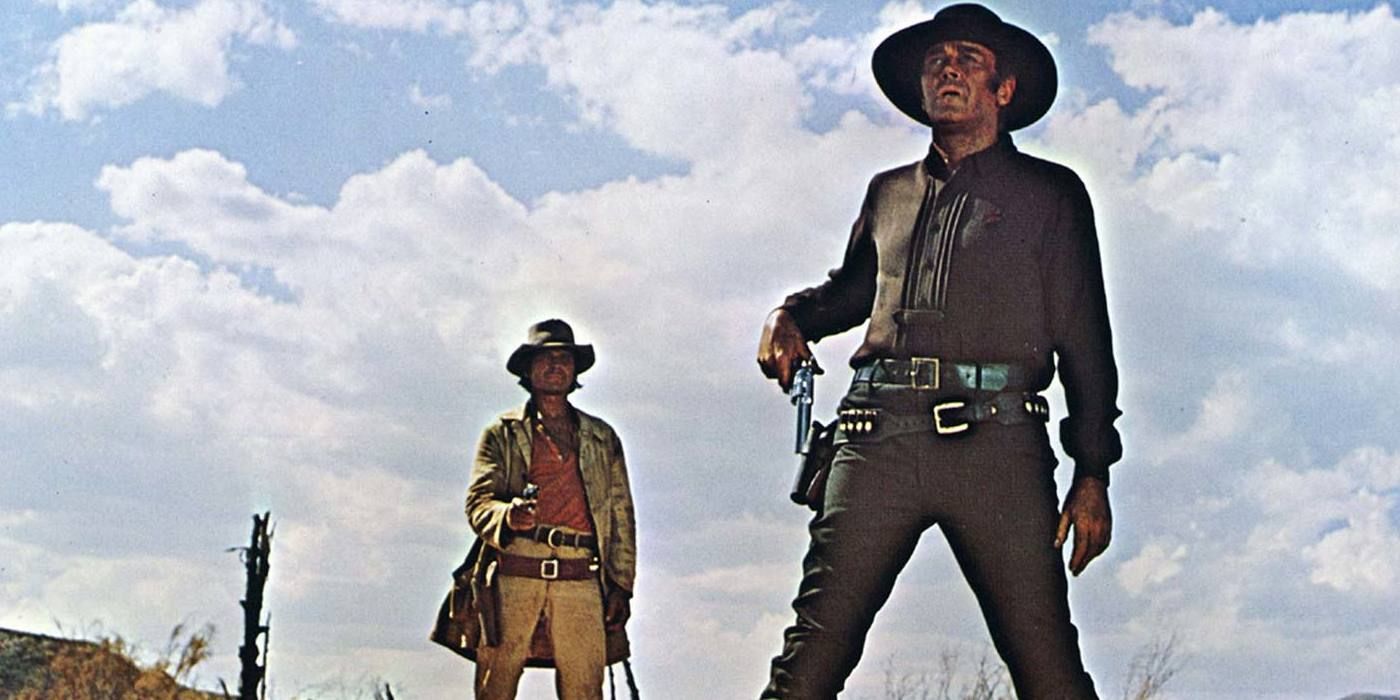
Fonda and Bronson prepare to face off in Leone’s epic Once Upon a Time in the West

Director: Sergio Leone

Cast: Henry Fonda (Frank), Claudia Cardinale (Jill McBain), Charles Bronson (“Harmonica”), Jason Robards (“Cheyenne”), Gabrielle Ferzetti (Morton), Paolo Stoppa (Sam), Marco Zuanelli (Wobbles), Keenan Wynn (Sheriff), Frank Wolff (Brett McBain), Lionel Stander (Barman), Woody Strode (First Gunman), Jack Elam (Second Gunman), Al Mulock (Third Gunman

Sergio Leone’s Westerns were always based, first and foremost, on his own love for the genre – and the great filmmakers, from John Ford onwards, who made them. Returning to the genre for the final time – putting on hold (for what turned out to be nearly fifteen years) his plans for a New York gangster film – Leone wanted to make his final, and ultimate, tribute to the Hollywood western. Collaborating with Bernardo Bertoloucci and Dario Argento (now there is an odd trio!) on the scripting, Leone’s final Western is a sweeping, grandiose, operatic Western littered with visual quotations from films he loved.

The story rather takes second fiddle to the general ambiance and visuals, but it never bothered Leone to have only the sketchiest of plots stretched across the many hours of his movies. The railroad is being built across America – changing the face of the West as it goes. Frank (Henry Fonda), hired gun of crippled railway tycoon Morton (Gabrielle Ferzetti), guns down farmer Brett McBain and his children. He had been sent to threaten them to clear off the land of Sweetwater. But why? And how will the return of McBain’s new wife Jill (Claudia Cardinale) – now heir to all of Frank’s holdings – affect their plans? And why does the mysterious “Harmonica” (Charles Bronson) – a shadowy gunman with no name have such an interest in events, and in Frank in particular? And will criminal gunman Cheyenne (Jason Robards) and his gang – blamed for the McCain killings – be able to establish their innocence?

The answers to all these questions come slowly – and often confusingly – in this long, slow but – as with many Leone films – engrossing Western, which features 3-5 minutes of Morricone build-up and extreme close-up before even the slightest action. This makes it very easy to mock, and perhaps by this point Leone had started to believe too heavily that he was an artist daubing in genre, rather than a purveyor of entertainments. Certainly, Once Upon a Time in the West is consciously weighted down with its own importance, it’s ominous sense of events heading to a pre-ordained conclusion and its half-hearted attempt to depict itself as sitting at a crossroads in American history, as technology squeezed out the old West.

But somehow you give Leone’s film a pass for all its many faults because it’s assembled with such unrivalled skill and breathtaking pizzazz. Sure the film is only half as smart as it thinks it is, but when at its strongest it offers unrivalled entertainment. Leone also mastered here his balance between the slow, tense, agonising build-up to violence – followed by its sudden and brutal enactment. 

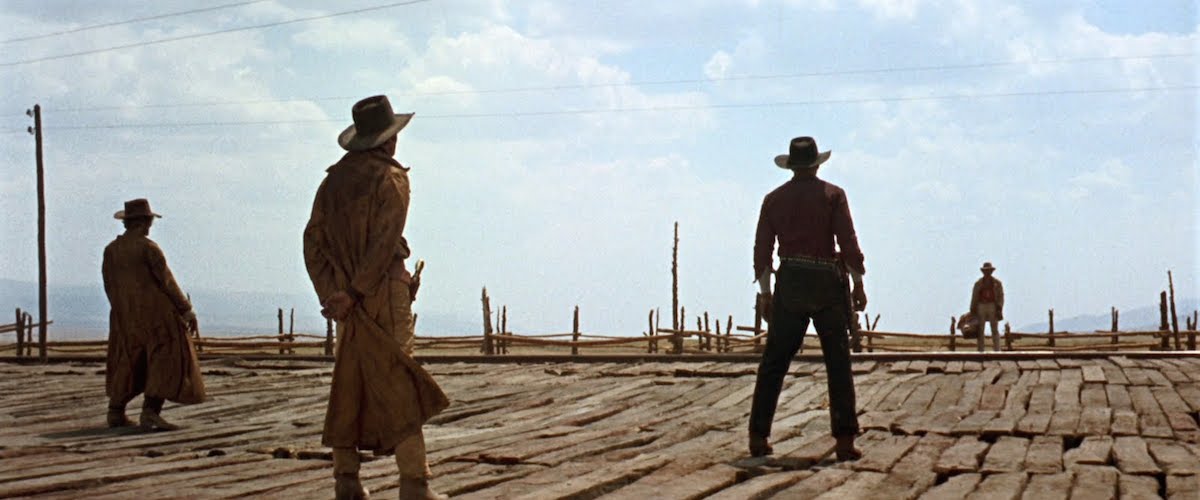
Never is that more clear than in the film’s opening ten minutes which features three gunmen (among them Ford favourite Woody Strode and reliable minor bad-guy Jack Elam) waiting at a train station for what turns-out to be the arrival of Charles Bronson’s “Harmonica”. The three gunmen sit, waiting, in silence. Around them the everyday sounds of windmills, buzzing flies and dripping water builds and relapses with all the dread of distant thunder. Leone’s camera crashes in for long, intense close-ups, as if drilling down into the souls of these bored men, the camera studying every detail of their faces. After almost ten minutes – during which the credits roll – “Harmonica” arrives. And promptly shoots all three men dead in seconds. You know it’s coming, but the tension and expectation of this confrontation makes the entire sequence compelling. 

It’s a trick that Leone repeats time and time again. Effectively the whole film is only prolonged extension of this sequence – the inconsequential back-and-forth of the lacklustre plot all really about giving us a chance to drill down into the character of Henry Fonda’s bad-to-the-bone Frank, while we wait for the inevitable gunfight between him and “Harmonica”. Leone’s film is a triumph of mood, filled with sweeping beautiful camera shot and luxiously paced editing, all mixed down with some stunning scoring from Ennio Morricone.

Once Upon a Time echoes a fairy tale in its title, and that’s what it is. For all that Leone attempts to throw in plotlines around progress, the influence of big money and the new order leaving gunmen behind, really everything it knows about America is taken from movies. Leone litters the film with visual quotes from High Noon, Shane and dozens of others, most especially Ford (he even insisted in transplanting some of the scenes to be shot at Monument Valley, which led to merry hell trying to get the other Spanish-shot locations to visually match). The entire film unfolds like a dream. At about the half way mark in particular – this might be due to cuts to be fair – the narrative suddenly becomes almost deliberately unconnected, key events seemingly skipped over and sudden character reversals taking place. There is a rumbling sense of everything in the film being artificial and the characters themselves being manipulated by something larger than them (like a film director!).

This is further heightened by “Harmonica” himself. Played with an empty blankness by Charles Bronson – the camera zooms into his expressionlessly craggy face endlessly as if searching for meaning – “Harmonica” is an almost mystical presence. He’s always in the right place at the right time, seems to be the only person in the film who knows what’s going on and Leone even shoots him regularly sliding into frame, as if the camera has stumbled upon him at the least expected times. Perhaps Bronson’s lack of real character helped make him perfect for this near-mystical presence. It also fits in with the shamanic feeling of a film where frequently not much happens at great length, but the inconsequential moments of events are filmed with a pregnant importance.

Compared to him the other principles are painted in earthy tones. Robards makes his bandit – who switches allegiances and escapes from undefined imprisonment several times in the movie – a jovial, grimy figure with a rogueish temperament. Claudia Cardinale – in what passes for a strong female character at the time – is a whore with a heart of gold who may, or may not be willing to do anything to ensure her own survival (the film is unclear). Is she a ruthless woman using sex as a weapon? Or is she the sort of radiant Earth-mother that the new West needs? Or is she a bit of both? The film isn’t really sure.

What it is sure about is that Fonda’s Frank is the meanest of the mean. Looking lean and tough, Fonda revels in the chance to play a villain – and not just any villain, this grinning sadist is so mean the first thing he does is gun down a child on screen. Leone loved Fonda – and above all he wanted those “baby blue” eyes to be the thing the viewers see as unspeakable deeds take place, expecting the cry of “Jesus Christ, that’s Henry Fonda!” Frank is a bully and tirelessly ambitious, and if we never get a real sense of what motivates him, it’s balanced by Fonda’s charismatic viciousness in the role.

It’s a pointer though to the fact that this is not a film about the West – as always the strange mixture of accents, faces and locations never makes the film feel for one moment like a real slice of America – but rather a film that is aiming to reflect the romance of movies. It’s a piece of Americana, that is really a love letter to other films. Perhaps it’s one of the first post-modern films ever made? But really your appreciation of the film can only really be complete if you have seen a lot of Westerns. Then it’s fairy tale like logic, and Leone’s operatic style and languid pace suddenly make sense. It’s not a film deep in meaning, other than perhaps our own love for cinema and the story it tells.

The Proposition (2005)

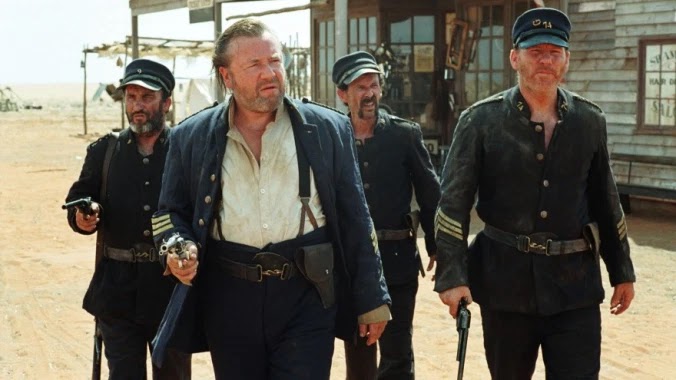
Guy Pearce is given a fateful mission in bleak Aussie Western The Proposition

Director: John Hillcoat

Cast: Guy Pearce (Charlie Burns), Ray Winstone (Captain Morris Stanley), Emily Watson (Martha Stanley), Danny Huston (Arthur Burns), David Wenham (Eden Fletcher), Richard Wilson (Mike Burns), John Hurt (Jellon Lamb), Tom E Lewis (Two Bob), Leah Purcell (Queenie), Robert Morgan (Sgt Lawrence), David Gulpilil (Jacko), Tom Budge (Samuel Stoart)

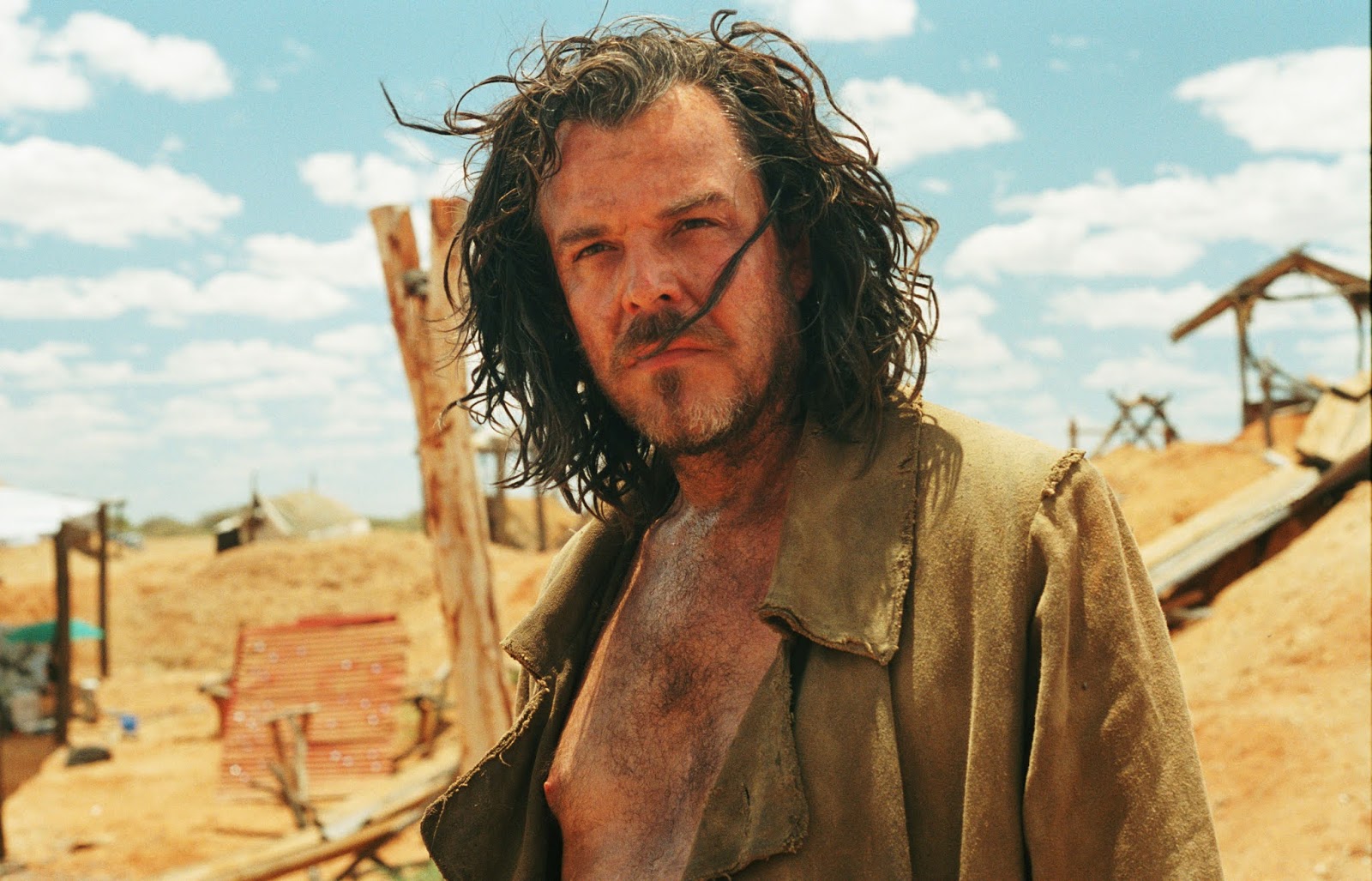
In the Australian outback at some point near the turn of the last century, a gang of ruthless killers are finally tracked down and killed by the police. The only survivors are Charlie Burns (Guy Pearce) and his younger brother Mikey (Richard Wilson). Charlie is offered a proposition by British émigré police captain Morris Stanley (Ray Winstone): find and kill Charlie’s other brother, the even more ruthless Arthur (Danny Huston), in nine days and Charlie and Mikey can go free. Will Charlie do it? And what view will Morris’ superiors take of his unusual decision? Either way violence and bleakness will ensue in the ruthless world of the Australian outback.

Scripted by Nick Cave – who also contributed the film’s sparse and haunting score – The Proposition is a dark, challenging and difficult film. It’s bleak, nihilistic and lacking in any real sense of hope or warmth. It presents a world where life is cheap and blood flows freely. All of this set in a wild, open-aired, dead, dry and dusty environment that in its gaping wildness and emptiness seems to consume the men who walk into it and leave them unhinged and capable of any depth of inhumanity.

How can there be any hope for mankind in all this? No wonder Stanley’s wife Martha (an intriguing performance of both optimism and disillusionment walking hand-in-hand from Emily Watson) tries to turn their house into a little slice of England, with a nice fence and traditional garden. It’s almost like she’s trying to slice something recognisable and safe from an environment that feels like it crushes everything it touches. It contrasts with every other ramshackle shack we see in the film, or dusty sandstone building – or the homes that most of the characters fashion among the rocks and the outback. What chance does civilisation have in this wild world?

It’s a world of ruthlessness where life is cheap. The local sport seems to be killing native Australians – something both police and gangs brag about. The native tracker used by the police – played by Walkabout’s David Gulpilil – quietly watches on as his drunken employers celebrate the (mercifully off screen) killing of a group of native Australians accused of murdering an Irish settling family. There is no pardon for him – later his throat is contemptuously slit by one of his fellows who now works as a sharp-shooter with Arthur’s gang. Hillcoat and Cave’s Australia has not a single touch of romance  or fellow feeling, but instead feels like a waiting room for hell.

Stanley is out of place here, not only by his Englishness, but also because his tough and pitiless policing is dwarfed by the cruelty he encounters. Ray Winstone gives one of his finest performances here as a toughened veteran who slowly realises he has only skimmed the surface of the brutality man can show man. Brutal and determined as he is, he has rules – and a wife he loves and a home he values – and that puts him at an utter disadvantage when going up against the amoral likes of Arthur Burns. Winstone’s Stanley also has a sense of fair play – he will struggle in vain to prevent a lethal flogging for Mikey that obsequious town mayor (a very good David Wenham) wants to inflict to placate the town. He frowns on the persecution of the indigenous people and treats his house servant well. Is it any wonder he isn’t remotely prepared for the bloodletting Arthur unleashes when he rides into town?

Danny Huston does excellent work as the poetic Arthur who lacks any touch of empathy. Softly spoken and chillingly calm at all times, with a lilting Irish accent, Arthur slaughters without any mercy and can charmingly undertake any level of depravity and violence. From mutilation to rape, from sudden slaughter to lingering sadism, worst of all it never seems to be personal with Arthur. More just a way of alleviating his own boredom with the world. Is there something about life in the outback that has turned Arthur slowly and quietly insane? Perhaps so, and it fits with Hillcoat and Cave’s nihilistic view of humanity as a destructive force with very little room for hope.

Guy Pearce’s Charlie perhaps offers what little hope we have – and even he is a murderer. Pearce does quiet, generous work in a reactive role, tipped pillar to post and dealing with conflicted family loyalties as well as some sense of right and wrong. Enough of a sense at least to believe wanton murder and destruction as practised by Arthur is too much. Pearce is a quiet, enigmatic figure in the film – perhaps a man struggling to work out where he sits. It’s a performance that cedes a lot of the fireworks elsewhere, with a moral conundrum that is almost deliberately elliptical, but striking nonetheless.

The Proposition is a tough and difficult film. It has a slightly disjointed narrative that at times skips gently over events or moves swiftly from one to another but missing connective events in between. It has the feel of a fever dream, the sort of bizarre tale you might throw together out of half-remembered nightmares. It allows wonderful opportunities for actors – all mentioned, and also John Hurt quite delightful as a drunken but deadly bounty hunter, his wizened looks perfect for the overbearing wilderness. Sure it’s a western that runs rampant with destruction, but it’s also a dark stare into the evil heart of man. It may end with a slight note of hope, but it’s an obscured and uncertain one and mixed in with more than enough suffering and destruction for the survivors.

The Proposition is still the finest film John Hillcoat has directed, and the best balance between compelling story telling and difficult nihilism.