Loro (2018)

Toni Servillo stands out as Berlusconi in Sorrentino’s scattergun satire

Director: Paolo Sorrentino

Cast: Toni Servillo (Silvio Berlusconi/Ennio Doris), Elena Sofia Ricci (Veronica Laria), Riccardo Scamarcio (Sergio Morra), Kasia Smutniak (Kira), Euridice Axen (Tamara), Fabrizio Bentivoglio (Santino Recchia), Roberto De Francesco (Fabrizio Sala), Dario Cantarelli (Paolo Spagnolo)

No one films decadence like Paolo Sorrentino. Many of his films have gone overboard to demonstrate Italy’s shallowness, corruption and greed. Loro feels like the subject he has been building towards his entire career: the heart of the whirlwind himself, Silvio Berlusconi. Sorrentino’s film is about Berlusconi, but it’s as much about the Italy he has created and the impact on Italians themselves. Its title translates as “Them” – and the film juggles with the idea of which “them” it’s referring too.

The film follows the career of Berlusconi from 2006 to 2009, as a he deals with the aftermath of losing power and the boredom of having very little to do in his palatial mansion. All around him – like flies around honey – the newly rich try everything to gain Berlusconi’s attention, throwing lavish prostitute-and-drugs parties. But what does Berlusconi want? Is it more of the same, is it a return to power, is it a chance to do good, is it a chance to make amends, is it a return to the spotlight? Who is Berlusconi?

Sorrentino’s film follows his usual style, and makes full use of his dynamic and electric directorial style. Boy this guy loves to keep the camera on the move, and he combines it with some snappily filmic editing that creates a series of scenes that fit sharply together. Sorrentino really can cut the hell out of a picture, and his style lends itself perfectly to depicting the extreme hedonism at the centre of the lives of many people whom he makes films about. His fast cut editing style, dynamic camerawork and use of modern music stringing it all together make for a perfect visual language for the shallowness he sees in large parts of modern Italy. But this approach doesn’t always engage the viewer, leaving them watching the technique instead – and that’s arguably what happens here.

A large chunk of the first half of the film centres around Riccardo Scamarcio’s Sergio Morra, a fictional “businessman” from Southern Italy who uses attractive women and drugs to land lucrative government contracts from ageing officials. Just in case we are in any doubt, it’s made clear very quickly that Morra is unbelievably shallow, venal, corrupt and interested only on what he can take from his country. His life is one of unalloyed selfishness, centred around drug-fuelled orgies (filmed very well by Sorrentino of course!). Morra builds a partnership with Berlusconi’s fading mistress (extremely well played with more than a hint of tragedy by Kasia Smutniak) focused solely on getting as close as possible to power. Almost all of the first 45 minutes (and yes that is too long!) is centred around establishing Morra’s vileness and his empty world. It’s as clear a portrait of modern Italy captured in one man as you can wish for, but its constant unpleasantness and prolonged sex and drugs with little plot gets more than a little wearying after a while. We get it Paolo!

But Sorrentino wants to make a clear point here: Berlusconi’s Italy has given rise to people like this, people who have an interest only in what they can take from the country, people who think being able to throw the most lavish party, having the most money, making the loudest noise makes them “better” than regular people. It’s these people interpreting the image of Berlusconi as giving them a green light for greed. When we promote puffed up egotists and fun-lovers as our leaders, then grasping venal imbeciles like Morra with no sense of morality or decency see that as an invitation to join them at the top table. 

After this introduction to Morra, when we finally meet Berlusconi himself it’s surprising how different he seems. Yes he’s a casual, shallow, rather grandiose figure – but in the hands of Toni Servillo, Sorrentino’s regular collaborator, he’s a more complex person than you might expect. Bored and a little depressed at home, Berlusconi also sees himself as far more than just a party animal turned politician. He’s a man, for all his shallowness and greed, who needs to believe that he is there for the good of the people. But what the film doesn’t quite do is “nail” him – perhaps because he is unnailable – but the film doesn’t feel like it lands a true blow. Or even makes a really clear point about the presidency of this man. Sorrentino’s anger is in every frame, but I’m not sure he really puts together a convincing – or completely engaging – argument about this.

Servillo’s performance as Berlusconi is the true highlight of the film, a complex mystery of a man who wants to be decent, but not enough to change or to actually carry out selfless acts. Sorrentino sees him as a salesman at heart – the salesman who sold himself as the corrupted answer to all Italy’s problems – and the film’s highlight is probably a sequence when Berlusconi girds his tired salesman’s loins to cold-call a random ageing woman, plucked from the phone book, to flog her a flat in an apartment block he hasn’t even started to build yet. It’s a neat capturing of what energises this man behind the fixed smile – and a sign as well of how little reality matters to this peddler of dreams. You can see why business partner Ennio Doris (played also by Servillo, making Doris a neat facet of Berlusconi’s own personality) pushes him to get back to selling and blagging to rebuild his confidence.

Sorrentino grounds most of the film in the growing disillusionment of Berlusconi’s wife Veronica, expertly played by Elena Sofia Ricci. Smart, quick-witted but too ready for too long to sacrifice her principles for the comfort of marriage to the loaded Silvio, Veronica becomes, if not exactly a conscience, at the very least a voice for sanity in Berlusconi’s world. In a film where the majority of the characters are gilded fronts like Berlusconi or soulless obscenities like Morra, she is the closest thing we have to a decent person. 

Veronica’s growing sense of discomfort at the “me-first”, power and money above everything world that Berlusconi has created draws the viewer’s attention to the other “them” the film deals with. Yes, we have the party-loving elite here, but the other them are the people we hardly see – the regular Italians, the ordinary citizens. These intrude rarely into the film, but tellingly they dominate the final sequences of the film which deal with the aftermath of the L’Aquila earthquake. As firefighters rest from their labours in the ruined city – including saving a statue of Jesus Christ from a ruined church – the camera pans across their exhausted, sweaty faces staring wearily, while the word “Loro” remains on screen. 

It’s in that final shot that Sorrentino’s film really seems to land. Because amongst all this partying and greed which has dominated – and often exhausted the viewer – we are finally reminded that the people really paying the price are the regular people, whose needs are not monitored, who are readily and easily forgotten. Sorrentino’s film may drift too often in really making a point or feeling like it nails Berlusconi. But when it makes points like this it really works.

A Star Is Born (2018)

Bradley Cooper and Lady Gaga excel in A Star is Born, truly one from the heart

Director: Bradley Cooper

Cast: Lady Gaga (Ally Campana), Bradley Cooper (Jackson Maine), Sam Elliott (Bobby Maine), Dave Chappelle (George “Noodles” Stone), Andrew Dice Clay (Lorenzo Campana), Anthony Ramos (Ramon), Rafi Gavron (Rex Gavron), Greg Grunberg (Phil), Ron Rifkin (Carl)

The story of A Star is Born is practically a staple of Hollywood. Bradley Cooper’s film is the fourth version (after 1937, 1954 and 1976) and re-packages the action to the country and western scene. Cooper injects the film with a real seam of emotion and complex, challenging humanity – represented above all by Cooper and Gaga’s searing, heartfelt, beautiful performances.

Jackson Maine (Bradley Cooper) is a famous country singer, and a self-destructive, if charming, alcoholic. One day, by chance, he stumbles into a bar and overhears a performance by Ally (Lady Gaga), a soulful artist rejected on multiple occasions for a record deal because of her slightly unconventional style and looks. Jackson and Ally form a deep connection and he invites her to perform with him. Their bond grows and Jackson is proud as her career starts to flourish. But this rise is matched by his own increasingly damaging alcoholism and drug addiction which puts his health and their happiness at risk.

A Star is Born brilliantly refocuses the story as a beautiful relationship drama. In previous versions, the man slumps into destructive behaviour due to resentment at the female protégé’s increasing success. Here though, Jackson – despite flashes of jealousy – remains supportive and proud of his wife, and she devoted to him. What Cooper has structured here is a story about the damage of depression and alcohol – and how they can shatter and destroy a person regardless of events in their life.

It also means we get a fresh perspective on an otherwise predictable drama. Having Jackson remain proud and supportive – and increasingly guilt-ridden by the impact his behaviour has on Ally – means we can also remain invested in him. Similarly, it’s hard not to share his feeling that Ally loses something of her beautiful soul as her manager crafts her into a manufactured pop icon. It’s the intrusion of the rest of the world into this couple that puts strain on their relationship, not internal tensions. 

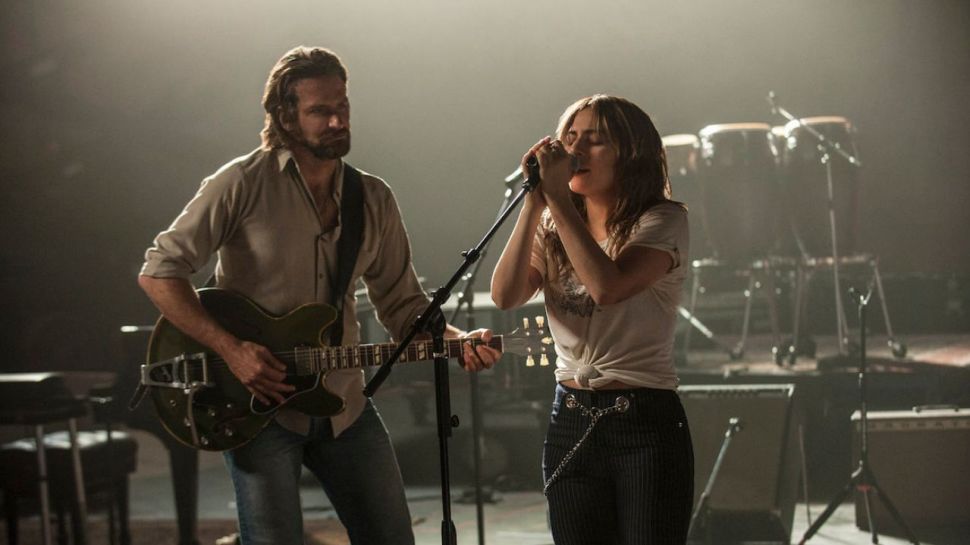
It’s a film in many ways that starts with a happy ending. The early, romantic meetings are beautifully done, the first performance of Shallow (Ally’s song) on stage plays like the fist-pump ending of any number of Cinderella stories. Her protective attraction matched with his old school chivalry in their early relationship is deeply romantic and shows what could be between them. Cooper sprinkles the film with happy endings – you’ll be begging the film to stop at any number of them – and barely a scene goes by that won’t have you choking back tears or watching through your fingers in pained horror at how badly things can go wrong.

It helps that for both leads this was clearly a deeply personal project. Both produce sensational performances. Cooper has talked about his struggles with both alcoholism and depression – and he brings all this deep rooted pain to bear here. Jackson is, in many ways, a wonderful man – caring, supportive and loving – but struggles with demons he can’t control. Cooper’s fragility, his suffering, his gut wrenching guilt and sadness are played beautifully in a performance that truly comes from the heart, and that leaves you wanting to give him a hug.

Lady Gaga is his match in a performance of tender innocence, of gentle humanity and earnestness. Again you sense the story of an unconventional person, with crippling self doubt, more than speaks to her. Gaga’s emotional bravery and commitment here is extraordinary, and you feel again she is showing in this film something very personal and tender to her. The chemistry between the two actors is electric – it’s rare to see two such performances complement each other so perfectly.

These two actors play off each other beautifully, with scenes that are at times hard to watch in their scarring emotional truth. At the same time, the investment of the audience is absolute in this loving relationship. The film also has some excellent performances in the support, not least from Sam Elliott as Jackson’s frustrated, but fundamentally loving, brother.

A Star is Born shocked me. It’s not the film I was expecting, or the story I anticipated. Instead it’s an entertainment industry parable, a love story, a film about the destructive unpredictability of depression and how sometimes love can’t conquer all. With some graceful direction from Cooper and above all his emotional honesty – and the truth of his and Gaga’s performances – this becomes a film that tugs on the heart strings until heart strings break. Beautifully made and wonderful.

The Miseducation of Cameron Post (2017)

Re-education classes turn out to be not for the good in The Miseducation of Cameron Post

Dir: Desiree Akhavan

Cast: Chloë Grace Moretz (Cameron Post), John Gallagher Jnr (Reverend Rick), Jennifer Ehle (Dr Lydia March), Sasha Lane (Jane Fonda), Forrest Goodluck (Adam Red Eagle), Marin Ireland (Bethany), Owen Campbell (Mark), Kerry Butler (Ruth Post), Emily Skeggs (Erin), Quinn Shepherd (Coley Taylor)

In 1993 teenager Cameron Post (Chloë Grace Moretz) is dispatched to a church-run sexual re-education camp after she is found to be in a same-sex relationship with a classmate. At the camp, her quietly cynical attitude quickly finds her aligned with the sceptical students Jane (Sasha Lane) and Adam (Forrest Goodluck) as they push up against the regime installed by Dr Lydia Marsh (Jennifer Ehle). How dangerous is the world of sexual re-education for its students?

Not surprisingly, the answer is very. The Miseducation of Cameron Post is a rather self-consciously indie film that sets up easy targets and then happily spends 90 minutes knocking them down. It’s often made with sensitivity, and has an excellent performance from Chloë Grace Moretz as its lead, a character you really root for, but this is a fairly empty viewing experience.

The film does get a lot of material out of the awful, cringing re-education programmes. It lands some blows against the hypocritical nature of the organisation, with at least one of the teachers (John Gallagher Jnr’s earnest Rick) also barely suppressing his homosexuality – and it re-enforces the cruelty of forcing people into becoming something they are not. But this is hardly news to any right-thinking person, and it doesn’t always make for good drama.

This is partly because Cameron herself never feels isolated in this re-education camp. She almost immediately falls in with like-minded rebel friends, and several of the other students are openly struggling with doubts. While the film perhaps wants to show that this sort of social engineering is never going to work, it does mean that our heroine never really feels at a disadvantage. You can’t help but feel a more effective film would isolate Cameron among people professing they are true believers (even if it turns out later they’ve been pretending), and show her struggling against conformity and clinging to her individuality. Instead, there seems no threat or any danger at all that she will ever drink the Kool Aid here at this camp – not for one second do you feel any chance that she is going to conform.

It makes for a major weakness for the film. It also makes Jane and Adam rather boring characters. They don’t challenge Cameron’s viewpoint at all, but merely echo her inner views with an added spice of rebellion. It makes for uninteresting scene constructions, and it’s not helped by the lack of chemistry between the three characters. By contrast, her relationship with roommate Erin, who is desperate to overcome her sexuality, makes for a far more interesting dynamic. Two characters with very different inner struggles, trying to find a common ground but frequently failing. Emily Skeggs is also heartbreaking as Erin, a young woman deeply unhappy and seemingly destined to remain so.

But there isn’t enough of this sort of thing. Nor is the viewer really challenged to consider the viewpoints of those running the camps. Jennifer Ehle, as the doctor running the camp, is a domineering Nurse Ratched figure, in a role which needed more shades of grey. She’s never a woman honestly doing what she believes is best, just a bully enjoying the power. John Gallagher Jnr’s conflicted worker doesn’t come into focus as a fully rounded human being, and his torment is touched on but his reasons for the decisions he has made are never explored.

It all contributes to a disappointing viewing experience. The film is too often shot with a self-conscious indie coolness, which gets on your nerves after a time, with its constant moody fall backs and gloomy set-ups. But it’s also a film that is taking a bit too much delight in making rather obvious and safe points over and over again, and failing to invest itself with enough drama to make for a compelling story. It’s a disappointment.

The Cruel Sea (1953)

The Cruel Sea (1953)

Command is a lonely, pressure-filled place in this complex and exceptional war film

Director: Charles Frend

Cast: Jack Hawkins (Lt Commander George Ericson), Donald Sinden (Lt Keith Lockhart), John Stratton (Lt Gordon Ferraby), Denholm Elliott (Lt John Morell), John Warner (Lt Baker), Stanley Baker (Lt James Bennett), Bruce Seaton (PO Bob Tallow), Liam Redmond (PO Jim Watts), Virginia McKenna (WRNS Julie Hallam), Moira Lister (Elaine Morell)

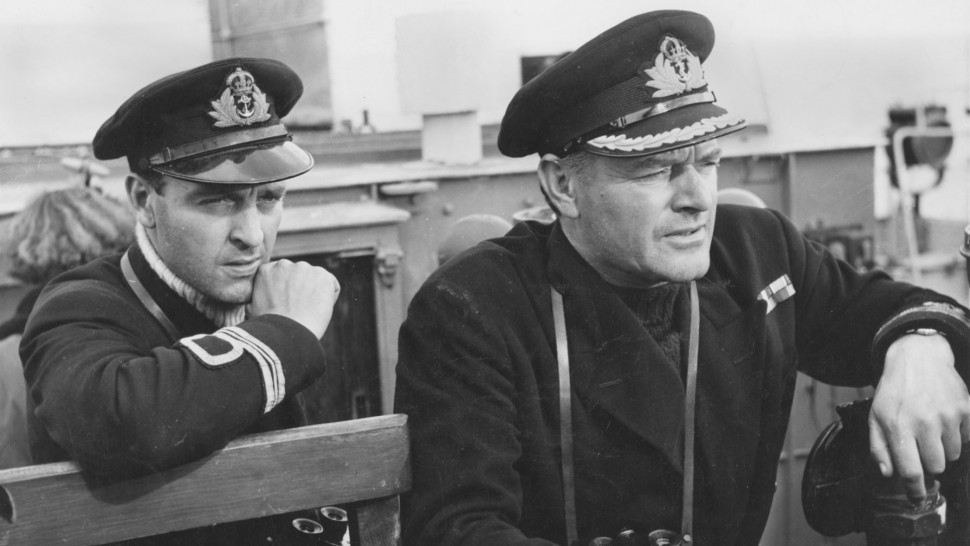
In 1953, The Cruel Sea was a colossal hit at the UK box office. With only a few years separating viewers from the sacrifices and struggles of war, it’s not hard to see why. The Cruel Sea is all about those struggles and sacrifices, about carrying on and doing your duty despite it all. But it’s also a film that understands the impact these have, and that that stiff upper lip is often covering a trembling bottom one. That stoic front is sometimes just that: a front. 

Jack Hawkins plays Lt Commander George Ericson, commanding a corvette on convoy duty in the Atlantic ocean. His mission? Make sure those ships make it through and destroy U-boats wherever possible – and everything else is secondary to that. But of course the real battle is against the cruel sea itself: and everyone sailing on her is at threat at any moment from losing their life. In the mid of this the men deal with losses at sea, losses at home, and the constant pressure of always being ready to do-one’s-duty.

On the surface, The Cruel Sea is pretty much the quintessential 50s British war movie. The upper lips are stiff, the accents are super clipped. Everyone is pulling together, regardless of class. Duty, king and country come before everything. But actually, this is a more complex film than all that. The Cruel Sea drills down into the psychological cost of war, and the impact of putting duty to the war above and beyond the needs of the regular sailor. Protecting the convoys and taking out these u-boats come first, and if that means sacrificing lives then it’s got to be done, regardless of the psychological impact that might have on the guy who makes the call.

Jack Hawkins is that guy, and this role pretty much cemented his niche in mainstream as the gruff, duty bound, slightly distant, quintessential officer type. But Hawkins performance here is that entire impression as a front, hiding his own doubt and guilt. During this film Ericson not only has to deal with his first ship sinking – with a huge loss of men – but also his decision to prioritise sinking a u-boat over saving men from a downed convoy ship trapped in the water. The depth charges he orders lead to the deaths of those men in the water: “bloody murderer!” screams an outraged crewman under his command.

And bloody murderer is exactly what Ericson thinks he is. Its’ the tough – and probably right – decision but the deaths of those sailors don’t sit easy with him. He’s the tough captain who can make the call – but his next shore leave sees him getting guiltily drunk and then tearfully expressing his doubts and guilt to his second-in-command. It’s clear that the pressure of making these calls, of sacrificing lives is something Ericson cannot wear lightly – and Hawkins performance in these moments breaks through the reserve of the 1940s to show a real depth of post-traumatic stress and guilt. Hawkins’ performance is raw, touching and above all real – and you feel he is expressing the survivor guilt of a generation who had all made tough calls during nearly a decade of war.

The Cruel Sea is all about those tough choices, and learning to deal with them. It’s also about that difficult balance between life at sea and life at home. Some families suffer terrible losses, some sailors come home to find loved ones have been killed in the blitz, others find that their wives have failed to stay loyal in the long months they have been away. At sea, there are more than enough pressures and threats, and that cruel sea takes a continuous toll, which is hard to forget. 

The scenes shot at sea have a professional tension and to them, and a really capture that sense that the most noble thing to do is to get on with doing your duty. The officers and men keep a reserve and a determination, as well as aiming to keep their spirits up as much as they can. There is very little patience for those who can’t or won’t put the good of the many first. Stanley Baker’s braggart second-in-command – an insecure stickler for rules, who is clearly both incompetent and cowardly – is treated with contempt and swiftly persuaded to jack it in for a spurious health reasons.

Meanwhile, the rest of the officers are decent, hard-working, determined and put duty and the lives of others in front of their own. Donald Sinden, underplaying (and a world away from the larger than life characters he would go on to play) is excellent as the young officer who grows in statue and authority, as well as having a very sweet romance with Virginia McKenna’s WRNS officer. John Warner and a young Denholm Elliott are equally good as young officers who have to deal with tragedy.

Because dealing with tragedy is what this film is about. The war at sea is long, often boring and punctuated with danger and loss. The opponent is hard to see, and the clashes with them never clean cut or open. For years of campaigning, you can count on one hand the number of direct clashes Ericson and his crew have with visible u-boats. Despite this, each of these attacks carries huge costs. The war at sea is unrelenting, tough and terrible: but also calls for men who are able to put themselves second, no matter the cost. It’s a great look at the mentality of a whole generation: no wonder it was such a hit.

Dark River (2017)

Ruth Wilson and Mark Stanley make for one unhappy family in Dark River

Director: Clio Barnard

Cast: Ruth Wilson (Alice Bell), Mark Stanley (Joe Bell), Sean Bean (Father), Joe Dempsie (David), Esme Creed-Miles (Young Alice), Dean Andrews (Matty)

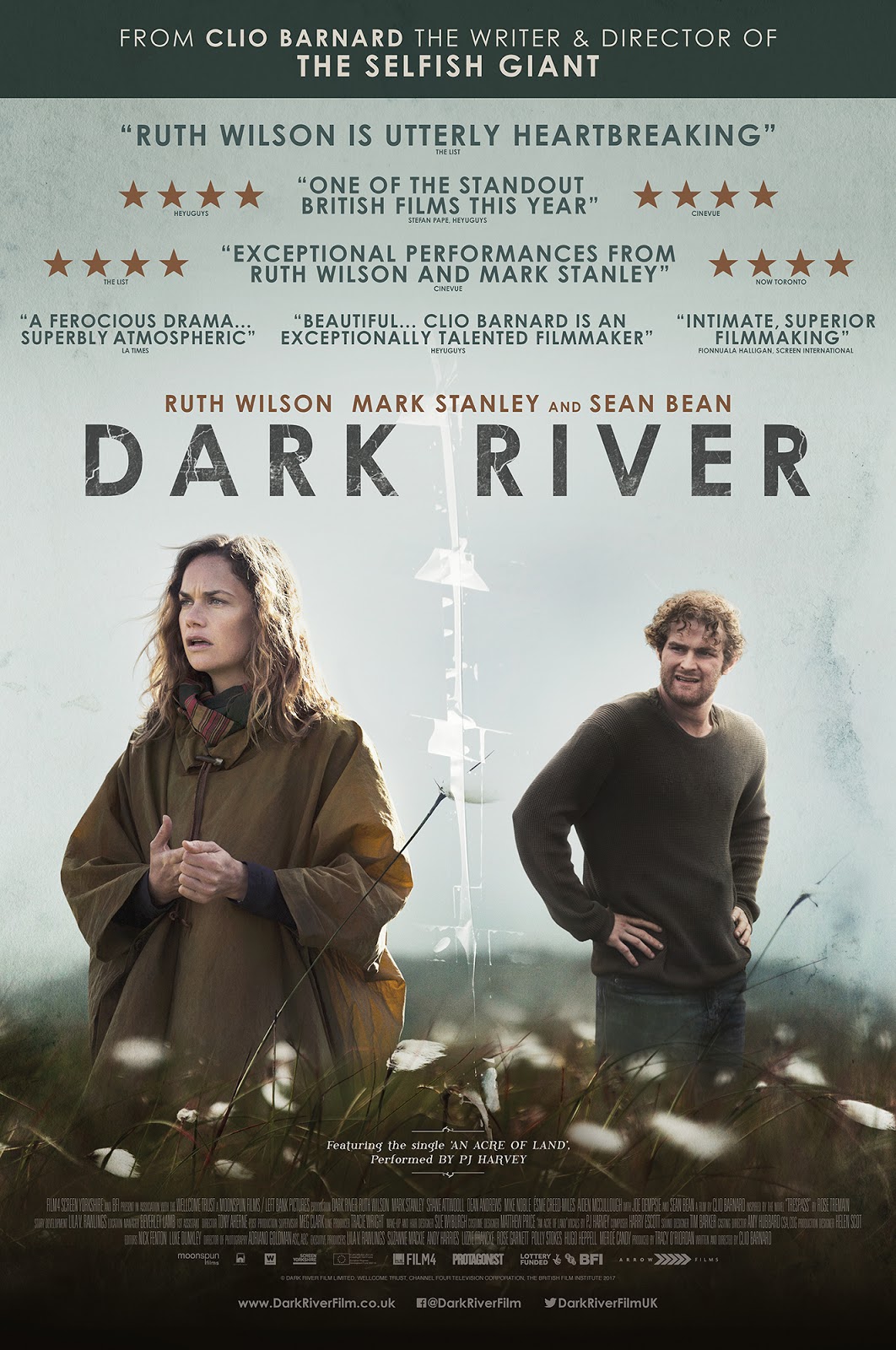
British Independent film can be a grim place. Clio Barnard is undoubtedly a gifted film-maker and visual stylist, and infuses her work with a striking poetic lyricism – but blimey Dark River is hard going. And not just because it’s a grim film about grim subject matter – it’s a film that feels likes it’s trying way too hard at almost every point. 

Alice Bell (Ruth Wilson) returns to her family’s farm after 15 years, on the death of her father (Sean Bean). A victim of her father’s continued sexual abuse, Alice finds the farm still haunted by memories – and feels threatened by her violent, depressed brother Joe (Mark Stanley) who resents being left to care for the farm and their dying father alone. Both siblings make legal claims for ownership of the farm – and the dispute and tensions swiftly escalate.

Dark River makes no secret of its historic child abuse plotline. But this narrative development seems to have become so common in grounded, grim dramas like this that it’s hard not to view almost everything you see as a walking cliché. Appalling as Alice’s experience has been, this film doesn’t show us anything that we haven’t seen hundreds of times before in a storyline like this. All the expressions of trauma, the style of shooting, the silent dread – it’s all been done before. It already feels tired here and lacking any form of originality.

It doesn’t help that the film is slow-paced, and determined to create an arty atmosphere. For all the beauty of the gloomy Yorkshire dales and rain-drenched sheep, you can’t help but feel the film is wallowing in all its Bronte inspired poetic grimness. Every second of the film seems to be designed to hammer home the “grim up north” feeling, in an attempt to add an amount of poetic weight to a story that feels slight, predictable and all-too-familiar.

Meanwhile, the central conflict of Alice’s determination to turn the farm around and claim ownership of it never seems to ring true. Every second on the farm she feels uncomfortable and haunted by memories: her brother even says she can’t step foot inside the farm house. Why does she want to stay here? Why does she fight so hard to claim possession of it? It never really makes sense.

The struggle between the siblings feels equally forced, remarkable as the film’s understanding of Joe’s drunken inarticulacy and ill-expressed emotional turmoil can be. The true emotional reasons behind their fury never click, as we never get a sense of any real relationship between them either past or present. For all the haunting, ghost-like presence of Sean Bean as the dead father (who appears as a constant vision or half-memory) that sense of the past, and the unspoken tensions don’t quite click into place, leaving the film reliant on the language of cliché.

The film’s main asset is the extraordinary performances of the lead cast. For all the clichéd and familiar scenes and story structure they encounter, Ruth Wilson and Mark Stanley are both exceptional. Wilson’s Alice is a heartbroken, vulnerable and confused figure only just able to understand the emotional trauma her father has left her with. Mark Stanley matches her as an angry young man, furious at the world, prone to dangerous outbursts, an inarticulate mountain of rage with no direction. The scenes between these two throb with an emotional strength and truth that the rest of the film can hardly match.

Dark River is very well made and striking in its visual language with some very strong performances. But it’s also overly familiar and trying too hard to be both important and artistic. You’ll quickly find yourself drifting away from it as it goes on, admiring it but never truly engaging with it.

The Pumpkin Eater (1964)

Anne Bancroft and Peter Finch in an unhappy marriage in the overlooked The Pumpkin Eater

Director: Jack Clayton

Cast: Anne Bancroft (Jo Armitage), Peter Finch (Jake Armitage), James Mason (Bob Conway), Cedric Hardwicke (Mr James), Richard Johnson (Giles), Eric Porter (Psychiatrist), Rosalind Atkinson (Mrs James), Frances White (Older Dinah), Alan Webb (Mr Armitage), Cyril Luckham (Doctor), Yootha Joyce (Woman at Hairdressers), Maggie Smith (Philpot)

Released in 1964, The Pumpkin Eater was rather unfairly seen as too strongly aping the new-wave of European film-making, in particular Michelangelo Antonioni and Ingmar Bergman. It’s a strange trend in British culture to ruthlessly lambast anything seen to be too good or too well made, as if trying too hard is vulgar and flies in the face of our love for the amateur. This is supremely unfair for The Pumpkin Eater (which I will say is weighed down by a pretty terrible title – Scenes From a Marriage would have been better, but that one got nabbed by Bergman) which is a little classic of a film.

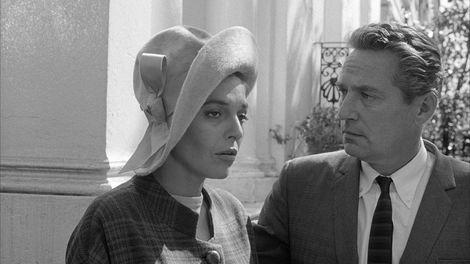
Based on a semi-autobiographical novel by Penelope Mortimer about her marriage to lawyer-turned-writer John Mortimer (creator of Rumpole), Anne Bancroft (with an impeccable British accent) plays Jo Armitage: an intelligent woman, suffering from depression, with a huge number of children from three marriages. Her new husband, Jake (Peter Finch), is a charming man, a hard working screenwriter, an excellent father to all the children – and, alas, a selfish serial adulterer. The film charts the ups and downs of their marriage, often in a non-linear way, including Jo’s battle with depression and the fallout from Jake’s affair with the wife of a film producer Bob Conway (James Mason).

Shot in sumptuous black-and-white, The Pumpkin Eater is so well made by Jack Clayton it became almost a stick to beat it with. One contemporary review even mentioned it was “irritatingly without flaws” in its film-making, as if this was a bad thing! Clayton’s direction is detailed, precise and beautifully done and throws a host of fascinating images at the screen, as well as drawing out some simply superb performances from the cast. Clayton chooses interesting angles and visual mirrors – events from scenes are reflected and repeated, in different contexts, in later scenes. The camera takes up unusual positions, not least a zoom in on James Mason’s mouth as his character spits out vile insinuations.

Clayton’s direction also captures a superb sense of empathy with his characters. His depiction of depression and ennui in Jo Armitage captures the sense of drift beautifully. Early in the film, she is captured in shot aimlessly standing in the shade of a car port. At her lowest she seems to get almost stuck in the frame. The film’s most famous moment features Jo breaking down in despair in Harrods – a wonderful sequence that uses a combination of POV, overhead shots, a camera attached to Anne Bancroft as she works, and a crashing close up on Bancroft’s face (also repeated later in the film) that all serve to stress her isolation, her despair and the mixed to hostile reaction to her tears from the shoppers around her. 

But the film doesn’t solely take Jo’s side. It’s interesting how many contemporary reviewers – men and women – found Jo a tiresome and selfish woman (she’s not, just an unhappy one). That’s partly due to the film’s success in making Jake a fully rounded character. Sure he’s charming and fun, but he’s also clearly a great dad and genuinely cares for Jo – it’s just that he can’t help himself doing things that end up hurting her. The film is also careful to suggest that, deplorable as some of his actions are, he has a point about the pressure of adding another child to a family which already has about seven (two of them at least have been farmed off to boarding schools, and it’s clear in one late sad scene that Jo now hardly knows them). How are they meant to cope? How are they going to be able to support another baby?

The film works as well because both Bancroft and Finch give extraordinary, fully rounded performances in the lead roles. Bancroft had just won the Oscar for Best Actress, and it’s quite something to think that committing to this British picture was her next gig. But she immerses herself in the character, and sells every single one of the complex emotional ups and downs Jo goes through. She’s perfect at drawing us deeply into Jo’s sorrow and uncertainty, but also her brittleness and anger. She’s not afraid to acknowledge that sometimes depressed people are immensely difficult and frustrating – or that they are also intensely vulnerable and fragile. Peter Finch is equally good as a hail-fellow-well-met, whose selfishness doesn’t quite fit into his self-image as a good guy but who is overflowing with good intentions and small moments of kindness.

Both actors are helped immeasurably by a very strong script by Harold Pinter. Pinter’s structure intelligently draws out great depths from the material, as well as playing smart games with structure and timeline that provoke thought. He is the master of the stand-out scene, and the film is crammed with smaller moments that stand out in the memory. Maggie Smith has a brilliant cameo as a shallow, gossipy house guest who may or may not be having an affair with Jake. In one extraordinary sequence, Jo is accosted at a hairdressers by a total stranger (played by Yootha Grace) who recognises her from a magazine article about Jake, who oscillates between wanting to be her friend and vicious bitterness that she isn’t. 

It’s a sign of the gift parts that this film gives to actors. Stand-out amongst the remaining cameos is the great James Mason, whose cuckolded husband at first seems to be a decent, if overly bombastic life-of-the-party type, who reveals himself to have unending reserves of bitterness and poison and delights in pouring anger and suspicion into Jo’s ears.

Clayton and Pinter’s work dovetails perfectly here into a sharply intelligent, haunting film which throws you into a marriage that refuses to paint either side as either completely wrong or completely right (Clayton was even concerned the film may have gone too far in making Jake sympathetic to the detriment of Jo). A compelling storyline, in a beautifully made film crammed with intelligent lines and wonderful moments, The Pumpkin Eater can rightly claim to be an overlooked classic of British cinema.

Red Sparrow (2018)

Jennifer Lawrence tries but fails with dismal material in the dreadful Red Sparrow

Director: Francis Lawrence

Cast: Jennifer Lawrence (Dominika Egorova), Joel Edgerton (Nate Nash), Matthias Schoenaerts (Ivan Vladimirovich Egorov), Charlotte Rampling (Marton), Mary-Louise Parker (Stephane Boucher), Ciaran Hinds (Colonel Zakharov), Joely Richardson (Nina Egorova), Bill Camp (Marty Gable), Jeremy Irons (General Vladimir Andreiovich Korchnoi), Thekla Reuten (Marta Yelenova), Douglas Hodge (Colonel Maxim Volontov)

Dominika Egorova (Jennifer Lawrence) is in trouble. After an act of sabotage by her dance partner, her career in ballet is over. Out of options, she is forced into enrolling at the elite FSB Sparrow School by her uncle Ivan (Matthias Schoenaerts). There young men and women are trained, under the tutelage of its controlling Matron (Charlotte Rampling), to sacrifice all their pride and their bodies for the good of Mother Russia. Thrown into the field, Dominika finds herself entangled with the CIA Agent Nate Nash (Joel Edgerton), whom she has been ordered to seduce.

Red Sparrow is a bad film on several levels. Firstly, it’s at heart a trashy espionage movie that confuses being about intelligence with actually being intelligent. A few late twists doesn’t suddenly make this a work of genius. Secondly, its attitude of being about this damn dirty business of spying manages to make it so grim it’s not even fun to watch. Finally, it’s the sort of film that thinks constantly telling us it has a strong female lead at its heart is the same as actually having a strong female lead at its heart.

To take that final point last… Poor Jennifer Lawrence. Surely only the $20million she was paid for this film attracted her to this. I’ll start by saying she feels miscast in a role that requires a ruthlessness and capacity for viciousness that is not a natural part of her range. But this film struggles to make her feel like a character with real agency. During the course of this film, she has her leg broken, nearly gets raped (twice), strips down in front of a group of people (twice), gets smacked in the face, beaten, tortured, stabbed, shot… And a few sudden last minute gear reversals which suggest that she has been playing her own game this whole time don’t shake the impression that the film is wallowing in the torture and violence that runs through the film.

Anyway, the film is reliant on that because it’s not sharp or clever enough to really have anything else in there in its place. So we stumble from violent set piece to violent set piece, while the characters talk incessantly about macguffins and characters we care almost nothing about. The film has an almost impenetrable plot, not because it’s complex, but because it’s poorly explained and impossible to care about. Actors who are way too good for this material – and I mean the whole cast – struggle to put fire and energy into a shaggy dog story that never goes anywhere.

This all serves to make it a dull film. It really should be a guilty pleasure. All the right material is in there. Spy thrillers make for fun films. It’s interesting to have a woman at the centre of it. It’s got good actors. But too many scenes and set pieces veer towards the overly violent and sexual. For a film that is about a silly spy training school turning out honey trap agents, this film seems determined to ram the grimness of spying in our faces at every turn. This makes sense for a high brow Le Carre adaptation. It makes no sense for silly high-concept Jennifer Lawrence star vehicle.

Who really needs to watch poor Jennifer being slapped about and ill-treated for over two hours? Who has the patience for it? Who is going to enjoy it? The film struggles to get across the idea that Dominika is good at this spying game so it needs other characters to say it openly. Its rug pull towards the end lacks all signposting so gives no satisfaction whatsoever. By the time it comes round you’ll have long ceased stop caring about anything in it as well. A tedious, grimy and rather unpleasant film from start to finish that leaves a sour taste in the mouth.

A Letter to Three Wives (1949)

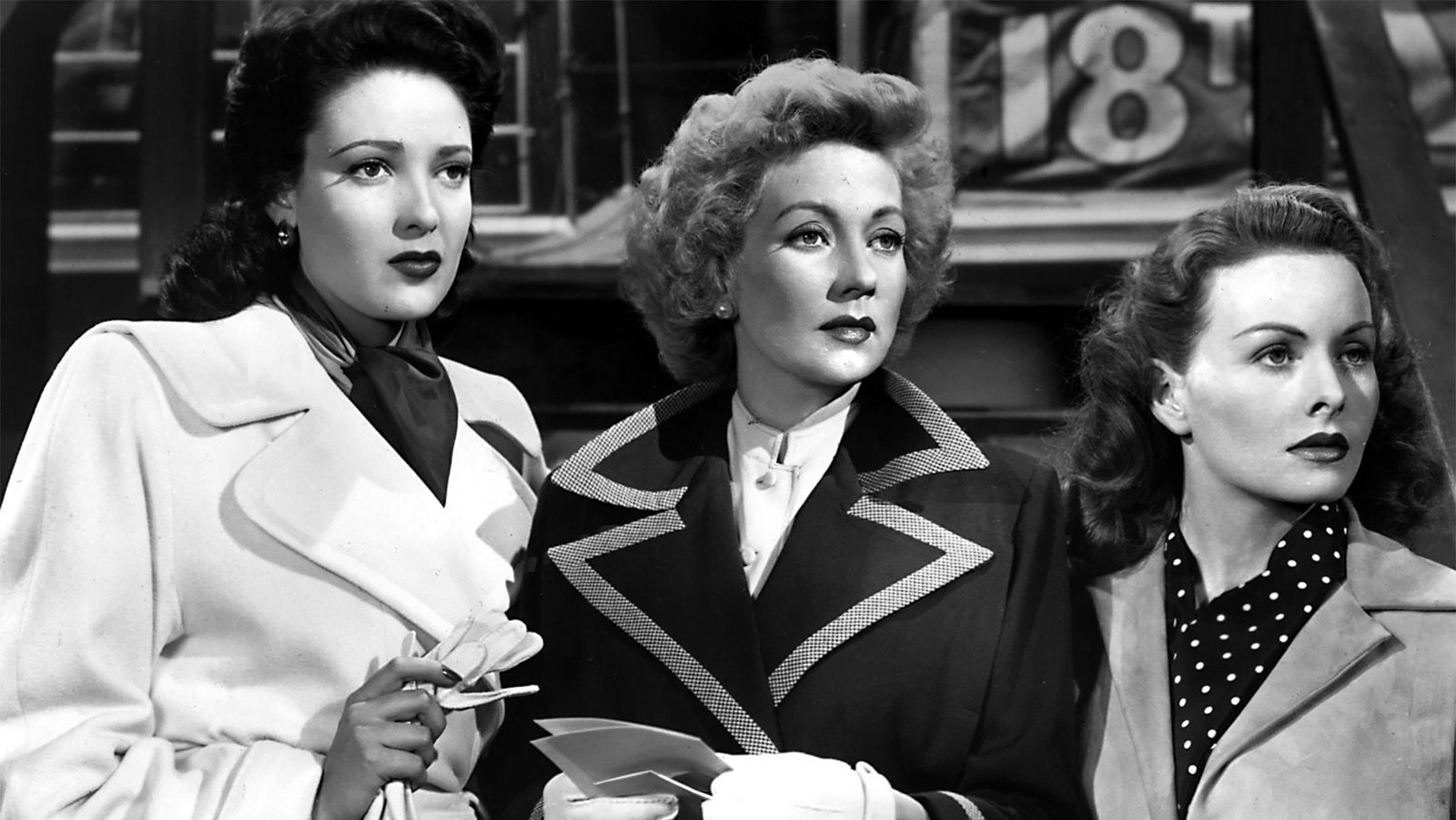
Linda Darnell, Ann Sothern and Jeanne Crain read over the eponymous Letter to Three Wives

Director: Joseph L. Mankiewicz

Cast: Jeanne Crain (Deborah Bishop), Linda Darnell (Lora Mae Hollingsway), Ann Sothern (Rita Phipps), Jeffrey Lynn (Brad Bishop), Paul Douglas (Porter Hollingsway), Kirk Douglas (George Phipps), Thelma Ritter (Sadie), Barbara Lawrence (Babe Finney), Connie Gilchrist (Ruby Finney), Florence Bates (Mrs Manleigh), Hobart Cavanaugh (Mr Manleigh), Celeste Holm (voice of Addie Ross)

It’s strange to think that, back in 1949, this slight story of three women one of whose husbands might have run off with another woman (the film’s narrator, the omnipresent Addie Ross, coolly voiced by Celeste Holm) was garlanded with multiple Oscars. It’s the sort of material you half expect would make an episode of Desperate Housewives– although of course today the whole thing would have been sorted out in a few minutes with mobile phones (A WhatsApp to Three Wives?). What makes it work so well is Mankiewicz’s dialogue, which lifts this slight melodrama of suburban couples into something that feels like it has more weight and intelligence than it really does.

Anyway, our wives are a mixed bag living in a commuter town “just outside the city”, all from middle-class or lower upper-class backgrounds. Seconds before taking some underprivileged children for a boat trip and picnic, insecure Deborah Bishop (Jeanne Crain), blowsy Lora Mae Hollingsway (Linda Darnell) and ambitious Rita Phipps (Ann Sothern) receive a goodbye letter from their “friend” Addie Ross, who announces she has left town with one of their husbands. But which one? Is it Addie’s ex-boyfriend, privileged Brad Bishop (Jeffrey Lynn), her school-yard sweetheart, academic George (Kirk Douglas), or her admirer, businessman Porter Hollingsway (Paul Douglas)? As the poster says, “While they wondered, one of them wandered”!

If that sounds to you like a rather small-scale storm in a teacup – well you’d probably be right. To be honest, it’s pretty hard to care which of these husbands might have headed into the sunset with the arch Addie Ross, since most of the characters seem at first rather smug, self-centred or tiresome. It takes time to warm up to these guys, but eventually Mankiewicz’s sparkling dialogue starts to work some magic and you invest in a clichéd little story (based, bizarrely, on a glassy magazine short story).

At one point the film was entitled A Letter to Four Wives – until studio executives decided that was one too many (bad news for Anne Baxter who had been cast as the final wife). That speaks to the episodic nature of the film. It has a clear five act structure – the set up, an act establishing the backgrounds of each of the marriages, and a final act that reveals who went where and wrapping the plot up. It’s a simple structure, and today it’s hard to see what all the fuss was about.

Mankiewicz’s framing device for his flashbacks may be a bit contrived, but he puts it together with skill. Each flashback is cleverly introduced with an intriguing device where various mechanical items near the women slowly take on a voice of their own, echoing their inner dread back to them. It sounds a bit odd – and it is at first – but it sort of works as an unsettling reflection of the unease of the central characters.

Once we get into the flashbacks themselves they are a mixed bag. The weakest by far is the first, focusing on Jeannie Crain’s Deborah Bishop. Rather plodding and dated – and forced to also introduce all the characters – it’s a shapeless section of reflection in which Deborah comes across unengaging, sulky, insecure and tiresome. Mind you that’s as nothing compared to her husband Brad, played with utter forgettability by Jeffrey Lynn, who is nothing more than a self-important idiot. Frankly, you end up thinking Deborah might be better off without him. The sequence focuses on the possibility that Brad might think Deborah is a little beneath him – compared to his old love Addie – but basically serves as a teaser for the next two flashbacks and an intro to the more interesting couples we are going to spend time with.

Our second sequence offers several comic highlights as it follows Ann Southern and Kirk Douglas (both very good) as the Phipps, middle-class intellectuals. George is an academic, Rita a writer for radio soaps, and the flashback revolves around their dinner party for Rita’s bosses, two radio-and-advert obsessed moneybags who demand the meal is interrupted so they can listen to episodes of assorted radio shows (accompanied by a long discussion of their advertising slots). Plenty of comic mileage comes out of George’s irritation at their vulgarity, but also serves to demonstrate the tensions in the Phipps marriage – George believes his wife is wasting her talent, Rita thinks her husband isn’t taking her career seriously. But underneath that is a nice little commentary on the insecurity of men returning from the war to find their wives have made professional lives of their own – and in this case, even become the main breadwinner in the household.

Our final flashback is probably the finest, around white-goods factory owner Porter Hollingsway (a bombastic Paul Douglas, with a touch of self-loathing) and his secretary turned wife Lora Mae (Linda Darnell, brassy self-confidence hiding vulnerability). Largely set in Lora Mae’s family home, a house on the wrong end of the tracks which hilariously has a train track running past its window (which at frequent occurrences leads to the whole house shaking, an action the family responds to with a casual familiarity). The drama here revolves around the couple’s feelings for each other – Porter can’t believe Lora Mae isn’t a gold digger, Lora Mae can’t believe her husband genuinely loves her for herself – but it’s told with a real sense of comic vibe laced with emotional truth. It’s the finest – and funniest – sequence and leads to a pay-off that really works.

A Letter to Three Wives maybe a little too soapy and frothy to be much more than an entertainment, but it is at least a very entertaining one. At all times this is due to Mankiewicz’s witty, sparkling and truthful dialogue that hums in every scene and gives all the actors some of the best opportunities of their career. Linda Darnell in particular is outstanding – warm, witty, fragile – but each wife has her moments, and Kirk Douglas is charm itself as George with Paul Douglas’ fragility under the surface eventually quite moving despite his bullying exterior. There is also fine support from Thelma Ritter among others. It’s a fine film, handsomely mounted and offers more than enough laugh-out-loud moments and moments of sweetness to make it really work.

The BFG (2016)

Mark Rylance motion captures through this rather dull Spielberg kids film The BFG

Director: Steven Spielberg

Cast: Mark Rylance (BFG), Ruby Barnhill (Sophie), Penelope Wilton (Queen Elizabeth II), Jermaine Clement (Fleshlumpeater), Rebecca Hall (Mary), Rafe Spall (Tibbs), Bill Hader (Bloodbottler), Michael Adamthwaite (Butcher Boy), Adam Godley (Manhugger), Ólafur Darri Ólafsson (Maidmasher)

It should be a match made in heaven right? Spielberg, one of the finest connoisseurs of family entertainment in Hollywood, and Roald Dahl, one of the most popular children’s authors of all time. But somewhere along the line, The BFG falls terribly, terribly flat. It’s a film that never really comes to life, that never really entertains or engages the audience until it’s way too late, and is probably something that your regular kid these days is probably going to find (whisper it) a little bit boring. It’s less entertaining, exciting or arguably well-made than the 1980s cartoon version with David Jason voicing the BFG. It doesn’t work.

The story is pretty much unchanged from Dahl. In the early 1980s, Sophie (Ruby Barnhill) is an orphan in a horrible orphanage in London. One night she spots a giant walking the streets of London, Panicked, the giant snatches her and carries her back to Giant Country. There he reveals himself to be a friendly, peaceful, rather sweet fella – the Big Friendly Giant or BFG (Mark Rylance) – but that he lives near a horde of much larger, man-eating monster giants. The BFG spends his days catching dreams and mixing them together, and his nights walking the streets of London giving the happy dreams to children. He and Sophie quickly become firm friends, but she remains at permanent risk of being discovered by the other giants and eaten.

The BFG has a long first act in which not a lot really happens. The first hour of the film is a slow, whimsical, largely plot-free amble through giant country and dream catching that, frankly, stretches on way too long. There is simply no drive to the plot, no impetus. Rather like Hugo,it feels like a children’s film made by someone who doesn’t seem to know what children actually like. Dahl’s book mixed fairy tales, horrible giants and a number of fart gags. This story focuses more on a slow, contemplative bonding between two characters, which seems low on energy and interest.

In fact the whole film – not helped by its John Williams score – feels like an attempt to replicate Harry Potter, with its magic, its extended magic dream trapping sequences, its constant reveals of something wonderful to a wide-eyed child. The problem is that the BFG’s world just isn’t really expansive enough for this approach to work – there isn’t enough magic or stuff to discover to support a constant stream of reveals. Instead, the more the film tries to make of the world of the BFG, the smaller and less epic it feels. 

On top of which, there is no sense of drama and peril about it. There is no plot or objectives for either of the characters for the whole of the first half of the film. The threat of the other giants is hinted at, and appears in other places, but the giants never really seem like truly plausible or terrifying antagonists. They are, quite simply, stupid, easily tricked and don’t seem vicious enough. Compared to the dread that the giants in the animated version carried, these seem like cruel but silly buffoons.

It also doesn’t help that the character of Sophie doesn’t come across as hugely engaging. I don’t blame Ruby Barnhill, who does very well, but the character is written a little bit too hard, a bit too grating in her strident certainty and general bossiness. Somehow, she never really seems like a truly engaging child character, more of a bit of a know-it-all. Too many of her lines carry a strident insistence that makes her finally a little irritating as a character.

The film’s main bonus is Mark Rylance’s heartfelt and very sweet work as the BFG. The film’s motion capture of Rylance (and the other giants) is very impressive, but Rylance is more than just a bag of computer tricks. He makes the BFG a truly gentle giant, tender, witty, kind and thoughtful and most of the film’s effective emotional moments come from him.

It also certainly looks handsome, even if its style feels very reminiscent of the Harry Potter series. You can’t fault the technical work on the film. Similarly the second half of the film kicks more into life, with a plan to stop the other man-eating giants by recruiting Queen Elizabeth (Penelope Wilton) to order the military to stop them. This section of the film brings the best jokes as well as finally giving the narrative of the film a bit of a kick. However, for many it will be too little too late for this meandering film and they will have long since given up hope of it springing into life.

Noah (2014)

Russell Crowe is getting ready for action as the rains come to Noah

Director: Darren Aronofsky

Cast: Russell Crowe (Noah), Jennifer Connelly (Naameh), Emma Watson (Ila), Ray Winstone (Tubal-Cain), Logan Lerman (Ham), Douglas Booth (Shem), Anthony Hopkins (Methuselah), Marton Csorkas (Lamech), Nick Nolte (Samyaza), Frank Langella (Og)

Everyone kind of understands what they are going to get when watching a Biblical epic right? A lot of “thous” and “thees”, sandals and swords, priests with long beards, sweeping musical scores and an actor like Charlton Heston (ideally just Charlton Heston) at the centre, standing tall with the word of God behind him. Obviously Darren Aronofsky must have been unfamiliar with this formula as he put together Noah, without a shadow of a doubt the weirdest Biblical epic you are ever going to see.

Set at a time that could be thousands of years either in the future or the past (with a steam-punk aesthetic and timeless mix of ancient and medieval technology with hints at modern ruins), God has had enough of man wrecking the world. He sends a cryptic vision to Noah (Russell Crowe), last descendent of Abel, telling him that a flood will take out the world. Noah will build an ark to protect the animals – but Noah also becomes convinced that God’s will is that mankind will not survive the flood. After Noah and his children die that’s it. This fanaticism is met with concern by his family, but also with fury from the rest of mankind led by descendant of Cain, Tubal-Cain (Ray Winstone). 

And that’s only scratching the surface of the film’s trippy eccentricity. The story of the ark is familiar to generations of children, and the image of Noah as a jolly bearded fella saving the animals like some sort of nautical Doctor Doolittle is one we all share. Aronofsky remixes this into a more adult mood by reminding us that this bloke was also happy to stand by and watch the rest of mankind drown, and followed the word of God with a fanatical monomania. Noah is, for large chunks of this film, not a nice bloke. As he tells son Shem “He chose me because he knew I would finish the job”. No hugs on this boat.

It makes sense that Noah is embodied by Russell Crowe at his most gritty. Going through a series of haircuts that reflect his journey from nature lover to chosen man of God to fanatical cult leader through to reborn family man, Crowe gives the role a blunt determination and earthiness ­– so much so you half expect him to address everyone as “mate”. But it’s essential for Aronofsky’s reimagining of the role as part environmentalist part cult leader. Noah is uncompromising, unshakeable and totally certain that all his decisions come direct from God, ergo they are unquestionable. As he shows time and time again in the film, he is willing to commit actions that are at best morally questionable, at worst down right bad, to do what needs to be done.

He’s the man who is willing to watch his crapsack world burn (or rather drown) and feel that, yes, it is good. Aronofsky’s vision of this wasteland of a world fits this perfectly. Resources are low, mankind has turned (it is heavily implied) partly cannibal, industry has destroyed nature, the law of man has become the law of the strong. There is a clear modern parallel here with environmentalism, and Noah himself is strongly reimagined as a man with a deep respect for nature – and the balance mankind must make with it; and the danger of us burning through our resources with no regard for the future is a major theme throughout the film. 

Evil mankind is represented by Ray Winstone as Tubal-Cain. Greedy, selfish, ambitious and a demagogue, Winstone is at his most physically imposing and dangerous here, a fitting obstacle for this reimagined muscular Noah. Aronofsky does however acknowledge that, for all his faults – and his unashamed embracing of violence – Tubal-Cain does have a point: it’s not fair for all of mankind to be sentenced to oblivion with no chance to save itself, regardless of their personal morality.

This uncomfortable darkness behind the story of Noah – and the destruction of mankind by their creator – is one of many things that made some Christians uncomfortable with the film. The Creator (as he is referred to throughout the film) is noticeable by his silence, speaking only to Noah through dreams and everyone else, not at all. Noah’s hardline interpretation of God’s plans (extinction) is enforced by him with all the obsession of a fanatic (a large chunk of the second half of the film is given over to the danger of an expectant mother sharing a boat with a man who has stated his intention to end the race with his immediate family). Of course the film shows Noah eventually changing his mind (and getting royally pissed in self-disgust at his lack of will), but it’s a way darker tone to take for a story more familiar to people through children’s playsets.

Aronofsky places this film at a hinge point of what sort of race are we. It’s expressed in several scenes that mankind is still fighting the struggle between Cain and Abel. Is it violence and strength that wins out? Or are there better qualities in man that can end the cycle of destruction? What sort of world has man built – and what sort of world does Noah believe could emerge from the floods? Striking imagery accompanies this musing throughout, not least a flashback to Cain killing Abel in silhouette against a blue dappled starry night sky – an image that shifts and changes at one point to replace the brothers with antagonists from our entire history of warfare.

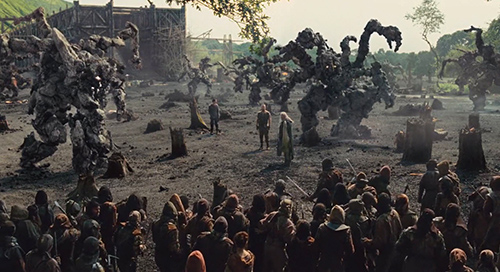
There are miracles and divine power in this film, but its actions seem to be based around inspiring fear and obedience rather than devotion. Forests spring from the ground for Noah to build from. Geysers of water take out mankind. Fires take out armies. There are moments of gentleness – a woman given back her ability to have children, rainbows etc. – but the Creator is a hard taskmaster. Noah is assisted by a gang of fallen angels – the Watchers – who, as punishment for siding with mankind when Adam and Eve were expelled from Eden, were thrown to the ground and encased in stone, turning them into freakish, gangly, giant rock monsters. Despite this, they retain their devotion to their creator – and their assistance is essential for the construction of the ark.

The inclusion of Giant Rock Monsters shows you again how far off the Biblical beaten track Aronofsky goes. This same embracing of unconventional oddness is seen throughout the film’s aesthetic – dirty clothes that have been cobbled together from several different eras, hints of metalwork and industrial ruins throughout Tubal-Cain’s kingdom, blasted wastelands – it’s miles away from The Ten Commandments. But it all sort of works because, regardless of his eccentricity, Aronofsky is a unique and intelligent director of visuals and his work is full of striking images and staging that draws inspirations from all over the shop, from old films to classical children’s story book images from Biblical tales.

Noah ain’t perfect. It’s overlong and its genre defying oddness occasionally feels a little too much. It suffers from the fact that the visuals and themes are so overwhelming that they crush most of the characters: Jennifer Connolly has little to do as Noah’s wife, while Emma Watson et al playing various Noah family members are left with just crusts to chew on. But embrace its bizarreness and the points it wants to make and you are left with a film that is quite unlike anything else you are likely to see. Aronofsky has made a Biblical epic unlike any that has ever, or will ever, be made. And that at least is worth some praise.