Suite Française (2015)

Matthias Schoenaerts and Michelle Williams love across the divide in this disappointing French Occupation epic

Director: Saul Dibb

Cast: Michelle Williams (Lucile Angellier), Kristin Scott Thomas (Madame Angellier), Matthias Schoenaerts (Oberleutnant Bruno van Falk), Sam Riley (Benoit), Ruth Wilson (Madeleine), Margot Robbie (Celine), Lambert Wilson (Viscount de Montmort), Harriet Walter (Viscountess de Montmort), Clare Holman (Marthe), Alexandra Maria Lara (Leah), Tom Schilling (Oberleutnant Kurt Bonnet), Eric Godon (Monsieur Joseph), Deborah Findlay (Madame Joseph)

The story behind the writing of Suite Française is compelling. Living in Nazi-occupied France, Irène Némirovsky began work on a five-novel series, Suite Française, which she intended to depict life in her homeland under German rule. She had only written two of the five books when she was arrested by the Gestapo as a Jew, and tragically died in Auschwitz. The books were written in a small notebook and kept by Némirovsky’s daughter while she moved from hiding place to hiding place evading the Nazis. Sixty years later, donating her mother’s papers to an archive, she deciphered the notebook and discovered the novels. They were published as a single volume to great success in 2004, regarded as an accomplished piece of literary fiction and a remarkable work of contemporary witness. 

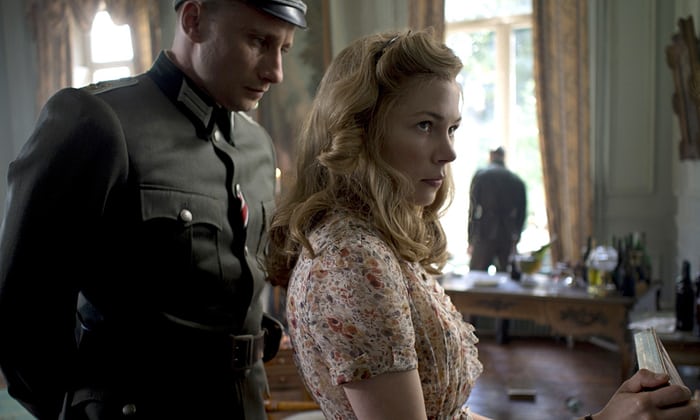
The short summary of the novel’s richness and complexity provided by this film can’t really compete. Based on the second of the two novels, the story takes place in a small French village in 1940. Following the arrival of the Germans, officers are billeted in people’s homes: Lucile Angellier (Michelle Williams) and her mother-in-law (Kristin Scott-Thomas) are assigned sensitive musician Bruno van Falk (Matthias Schoenaerts), while their neighbours, farmers Benoit and Madeleine (Sam Riley and Ruth Wilson), are forced to accommodate bullying officer Kurt Bonnet (Tom Schilling). As hostilities between the French residents and the German occupiers grow, so does the attraction between Lucile and Bruno, but Bonnet’s pursuit of Madeleine threatens to ignite the simmering tensions in the community.

Suite Française manages to turn its promising material into a conventional, chocolate box wartime romance – you can’t help but think that it does a great deal of disservice to the original novel. It’s filmed in an unremarkable style (there are at best 1-2 imaginatively done shots and sequences) and poorly paced. With its short runtime (barely more than an hour and a half), it constantly feels rushed. Quite simply it’s a story about simmering tensions in a confined environment – it needed more time for us to get a sense of the drama building, of the resentments between the Germans and the French growing. Because the film is so short we don’t get that at all.

Most notably, in a film about a romance between a French woman and a German officer, there is no sense at all of the risks that French women who started relationships with German officers were running. Besides a few small throw away lines, there is no sense of the physical danger and the social stigma that would be applied to these women. Instead, the tension of Lucile falling for Bruno seems to be based more on whether her mother-in-law will discover that she’s considering cheating on her (absent, unfaithful) husband. Even Celine the promiscuous farmgirl (a wasted Margot Robbie in a terrible wig) doesn’t seem to be running any risks of reprisals from the villagers when she’s banging a German officer in the woods.

This, however, is where the film’s rushing undermines it. If it had allowed us to develop a sense of the resentment, shame and loathing the occupied French felt for their German oppressors, a feeling of the whole town being willing to close doors on anyone they perceive as being too close to the  Germans, we could have felt a real danger for Lucile in flirting with a dalliance with Bruno. As well as giving the situation a bit of stakes, it would have made it a lot more emotionally engaging too. We could have witnessed her inner conflict at considering a romance with the enemy, and the emerging feelings between them would have had the conflict of a forbidden love. Instead the film rushes us as quickly as it can towards getting Bruno and Lucile into a passionate clinch, at times taking giant unsupported leaps forward in their relationship, so when it arrives it packs no punch.

This passionate clinch undermines the film. If it wasn’t going to take the time to really build the relationship through lingering glances and brief moments, convincingly charting the journey from hostility and suspicion to a forbidden attraction, it should have cut the relationship down to being something that tempts them both but which they cannot express. Have these two recognise a deep bond between them, a bond that in another time would have brought them together but cannot in the time of war. It’s a film where the only physical contact between them should feel like a window on what might have been – not a passionate locking of lips and sexy fondle or two. Think how much more affecting that might have been.

It would also have fit the structure of the film far better. As Lucile finally finds herself having to choose a side – deciding whether to help a renegade hunted by the Germans or not – her decision to sacrifice her chance of love with Bruno might have worked much better. Similarly, Bruno having to revert to the soldier taking responsibility for the growing persecution of the villagers would have been more affecting. (It further doesn’t help that the film doesn’t give time for Williams and Schoenaerts to build up an effective chemistry.) By chucking them into a clinch as soon as it can, the film undermines its message and also manages to make itself feel more like “Mills and Boon in Occupied France” than the serious tragedy it could have been.

When the film finally focuses on the battles between the French and Germans in its final third, it’s much more interesting than the slightly tired romance. Here we get tensions, stakes, drama – and finally a sense of the danger that being in this situation could have. After the rather soft focus romance that comes before, it really seizes the attention.

Williams does a decent job as Lucile, Scott Thomas could play her austere mother-in-law with hidden depths standing on her head (the film fumbles the unexpected alliance between these characters late on). Schoenaerts is a bit wasted in an underwritten role but does good work. The best performances largely come from the second tier: Lambert Wilson is excellent as the local Viscount who wants to try and work with the Germans but quickly finds himself out of his depth. Harriet Walter is similarly strong as his wife, as is Ruth Wilson.

But Suite Française could have been so much better than the movie that it actually becomes. A film that focused on the dangers of occupation and the tensions of a small community would have been great. A film that rushes through a Romeo and Juliet style romance, without building the sense of forbidden love, is a film that just doesn’t work.
Plenty (1985)

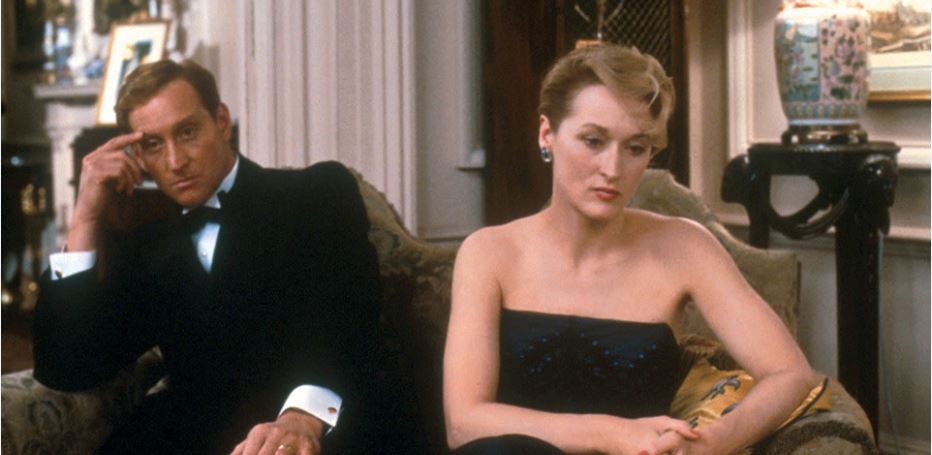
Charles Dance and Meryl Streep endure marital misery in the bleak, oblique and uninvolving David Hare drama Plenty

Director: Fred Schepisi

Cast: Meryl Streep (Susan Traherne), Charles Dance (Raymond Brock), Tracey Ullman (Alice Park), John Gielgud (Sir Leonard Darwin), Sting (Mick), Ian McKellen (Sir Andrew Charleson), Sam Neill (Lazar)

David Hare’s 1970s play Plenty looked at the impact of peace on the war generation. A “state of the nation” story on the growth of prosperity in the post-war era, and the return of many to the humdrum reality of life with Britain’s importance as a world power in rapid decline, led to isolation, anger and depression. It’s a shame that much of that really doesn’t come across in this buttoned-up, murky and unclear social drama, with a hard-to-follow plot and a hard-to-like central character.

Susan Traherne (Meryl Streep) is an SOE courier in France during the Second World War, who has a one-night stand with fellow SOE operative Lazar (Sam Neill) which has a profound effect on her. After the war, she marries Foreign Office civil servant Raymond Brock (Charles Dance), but is unable to find a purpose and contentment in regular civilian life. As the years tick by, and their surroundings grow ever more plentiful, Susan becomes more and more unhappy, difficult and demanding.

The central issue with Plenty (I can’t comment on the play, having never seen it) is that Meryl Streep creates possibly one of the least likeable leading performance you are going to see. Perhaps mistaking Britishness for cut-glass chill – or perhaps it’s the character – Streep’s Susan is brittle, bitter, angry, annoying and infuriating. She complains about everything around her, she lashes out at people, she sulks and whines with no self-insight, she constantly makes life difficult for those around her (most of whom are unbelievably patient) and she is almost impossible to work out. 

While the film perhaps intends her to be as sort-of PTSD sufferer, with undiagnosed personality disorders, who cannot reconcile the shallowness of her life with the excitement of war service, I’m not sure this comes across. All we really see is her deeply irritating self. We don’t get a sense of her war service – we see her breakdown early in the film in France – and her relationship with Lazar remains so ill-defined we are unclear what impact it had on her, other than part of a halcyon memory. The film’s final scene is a flashback to the end of the war: Susan watching a sunrise on a French hill dreaming of her life being full of days like this. That scene would have been helpful earlier – it’s the only time we see her optimistic or likeable in the film, and it gets lost by placing it at the end. With it in order we could have warmed to her more.

Instead she remains a shrill presence, in a hard to relate to film that never really makes clear whether we are meant to empathise with Susan, or find her as frustrating as some of the characters do. The film also fails to make this enigma part of its viewing design – I don’t feel like having the lines blurred made the film a richer experience, just one it was harder to engage in. Schepisi’s directing style is very cold and distant – from the slow camera moves, to the tight close ups on Susan at key moments, to the deliberate lack of clear time line (each scene moves on weeks, months or years from the previous one with only a few design and dialogue hints to suggest the change).

Combined with Hare’s indefinable script – crammed with elliptical conversations, unclear emotional and dramatic points, and political points delivered with a querying shrug – it makes for a film that is very hard work to engage with – and doesn’t offer much to reward the viewer if they do. 

What pleasures there are come from the performers. Charles Dance is good as Susan’s long-suffering husband – far from a domineering patriarch, his only real crime seems to be that he is a bit boring. Ian McKellen makes a great cameo as a senior civil servant, coolly and calmly telling Susan the errors of her thinking. Sting is an odd choice (I suspect his presence helped the film get backing) and Tracey Ullman does tend to go too far as Susan’s bohemian but more emotionally restrained friend.

John Gielgud steals the show. He is simply superb as Brock’s boss, an old-school diplomat who is, at first, a figure of fun with his Edwardian values but whom events (in particular Suez) reveal to have firm principles. Gielgud also gets most of the film’s best lines, while his quiet air of polite dignity is both endearing and admirable. His delivery of the following line to a tedious bore of a party guest basically is the high point of the movie: “But perhaps before I go, I may nevertheless set you right on a point of fact. Ingmar Bergman is not a bloody Norwegian, he is a bloody Swede.”

But there aren’t enough pleasures like this in this overbearing, rather trying film that never really decides what point it’s trying to make. I think it’s something about wealth and discontent and the more selfish and scrambling build of the post-war generation towards Thatcherism. But I’m really not sure. And to be honest I’m not sure I care.

The Ox Bow Incident (1943)

Henry Fonda tries to change the fate of a lynching, in gripping social-issue drama The Ox Bow Incident

Director: William A Wellman

Cast: Henry Fonda (Gil Carter), Dana Andrews (Donald Martin), Harry Morgan (Art Croft), Frank Conroy (Major Tetley), Harry Davenport (Davies), Anthony Quinn (Juan Martinez), Francis Ford (Alva Hardwicke), William Eythe (Gerald Tetley), Mary Beth Hughes (Rose Swanson), Jane Darwell (Ma Grier), Marc Lawrence (Jeff Farnley), Paul Hurst (Monty Smith)

Spoilers: Can’t quite believe I am saying this about a film that is over 60 years old – but I’m going to give away the whole plot here. Because you can’t really talk about the film without it. It’s a film that’s well worth watching not knowing what is going to happen, so you are warned!

We all like to believe that, when push comes to shove, we live in a civilised world. That when the chips are down, we would behave nobly and stand for what was right. The Ox Bow Incident is a challenging western, because it defiantly says the opposite. The world is a cruel and judgemental place – and sometimes good people are ineffective, regular people panic and lash out and decent people pay the price.

Gil Carter (Henry Fonda) and Art Croft (Harry Morgan) ride into town. Cattle rustlers are plaguing the town and a popular rancher has been gunned down outside his home. With the sheriff absent and the judge ineffective, the townspeople take justice into their own hands. Led by a faux-Civil War major Tetley (Frank Conroy) and aggrieved friend of the dead rancher Jeff Farnley (Marc Lawrence), they form a posse and ride out to lynch the three suspects (Dana Andrews, Anthony Quinn and Francis Ford). Carter and Croft follow, reluctant, but worried that if they protest too much suspicion will fall on them.

The Ox Bow Incident is a film you keep expecting to make a veering turn towards positivity – you keep expecting it to suddenly draw breath and for everything to turn out okay. Instead, it’s a grim insight into how mob mentality can drive people into sudden and cruel actions. It’s equally a testimony to how ineffective protest and principles can be in the face of anger and revenge. It’s a Western that feels years ahead of its time – there is no romanticism here, just grim everyday life.

In many ways it’s a po-faced and serious morality tale, and revolves around one long scene where the lynch victims are tried by mob justice, plead for their lives, are given a brief respite to say their prayers, protests from a few men are swept aside, and then they are strung up. Every time the viewer starts to think righteousness will slow things down, the certainty of the mob stops decency from taking hold. It’s a slippery slope towards the deaths of men we find out almost immediately afterwards were completely innocent.

The Ox Bow Incident is a film that preaches – and it feels very stagy, a feeling increased by the obviousness of its sets and the intense chamber feeling of the limited locations and scenes. But it works, because it’s so brilliantly put together and so grippingly involving. Wellman’s film is trimmed to the bone, the writing is very strong with Lamar Trotti’s script bristling with moral outrage at humanity’s weakness and fear. It’s a story of injustice and mob rage – and it works because it manages to tell a compelling story while also dealing with universal themes.

Henry Fonda listed this as one of his few early performances he felt was good. Fonda is often remembered as the archetype of American justice, so it’s fascinating here to see how ineffective and compromised Carter is. Carter knows what they are doing is wrong – but he lacks the decisiveness, strength of will or character to persuade people. In fact, his main contributions are quiet comments, or sniping from the wings of the action. 

It’s an inversion almost of Twelve Angry Men’s juror #7 – Carter can’t lead us to justice, because he’s a bit too afraid, a bit too weak, a bit too compromised. At the end, as he reads Martin’s final heartfelt and forgiving letter (beautifully filmed by Wellman with Croft’s hat obscuring Carter’s eyes while he reads, a shot that has multiple symbolic meanings), he projects not moral force but the shame and guilt of a man who, when it came down to it, didn’t have the determination to do what was right. It’s a perfect comment on what a writer may have felt was happening all over in 1943.

The real advocate of justice is Harry Davenport’s humane shop-keeper – but he can’t persuade anyone (Davenport is excellent). Instead, all the big personalities are leading the lynch mob, from Frank Conroy’s bullying Major, who just wants to see the action and stamp his domination on others, to Jan Darwell’s vile honking old woman excited by the killing, to Marc Lawrence’s just plain angry Farnley. Everyone who knows what they are doing is wrong – like Tetley’s weak-willed son (well played by William Eythe) – are just too weak, scared or uncharismatic to do much more than vainly protest. Their regular joe victims (all three actors are excellent as in turn, decent, old and confused and suspiciously alien) don’t stand a chance.

The Ox Bow Incident is a perfect little morality tale, crammed with brilliant performances and moments. It even has the guts (for the time) to reference that most lynchings didn’t have white victims, and introduces a sympathetic black honorary padre who is equally powerless. It’s a film that really feels like it came from an era when the world was going to hell in a handbasket, but it speaks to all ages. Because our fear and readiness to attack – and punish – those people we see as different hasn’t gone away. It’s chilling to think that the world hasn’t changed and this story could just as easily be transposed – with no changes – to half a dozen locations around our world today.

Marathon Man (1976)

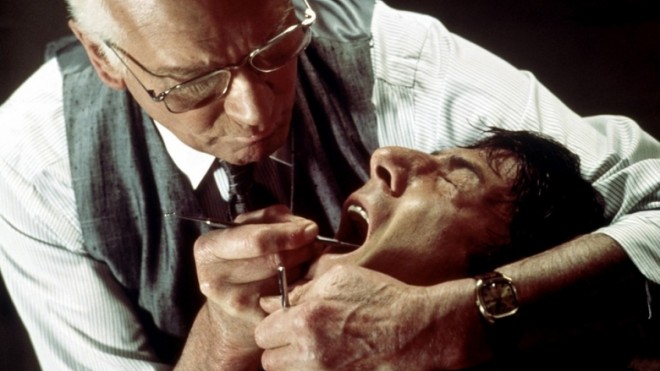
“Is it safe?”: Laurence Olivier interrogates Dustin Hoffman in Marathon Man

Director: John Schlesinger

Cast: Dustin Hoffman (Thomas “Babe” Levy), Laurence Olivier (Dr Christian Szell), Roy Scheider (Henry “Doc” Levy), William Devane (Peter Janeway), Marthe Keller (Elsa Opel), Richard Bright (Karl), Marc Lawrence (Erhadt), Fritz Weaver (Professor Biesenthal)

The 1970s were the era of the conspiracy thriller. These were deliberately enigmatic, almost opaque, mysteries in which a humble individual was thrown up against sinister forces, backed by equally shady governments. Marathon Man is a stylish (if rather impenetrable) mystery that offers some gripping moments but gets bogged down a little too much in pleasure at its edginess, darkness and professional assurance.

Thomas “Babe” Levy (Dustin Hoffman) is a post-graduate student working on a re-evaluation of the McCarthy era, partly aimed at clearing his father’s name (who committed suicide while under investigation). Babe’s brother Henry “Doc” (Roy Scheider) works for a shady government organisation, and has recently narrowly avoided assassination twice in France. Doc suspects the killers were sent by renegade-Nazi Dr Christian Szell (Laurence Olivier). Szell’s New York-based brother was recently killed in a car crash, and with his death Szell has lost vital access to his cash reserve of diamonds in a New York bank, which he needs to maintain his safety in Uruguay.

I hadn’t seen Marathon Man for several years, and I was struck by how long it takes to get going: it takes a solid 45 minutes to get to the point. Huge swathes of the opening act of the film is all about getting the set-up and atmosphere, rather than establishing the story. It also seems to be about setting up as complex as possible a context for a film that boils down to a pretty straightforward plot. Nearly all the action that Doc gets up to in Europe is pretty much impossible to work out and never seems to tie in with the rest of the plot once it starts (exciting as it is to watch him dodge assassination attempts). Even the marathon running of the hero, and his relationship with Marthe Keller’s mysterious swiss woman doesn’t in the end really tie in that closely with the story.

But then that’s often the way with Marathon Man. It’s a film in love with atmosphere, its Hitchcockian tricks and its brooding creepiness more than with logic, story or even (really) character. It’s pretty hard to work out what’s going on, and the muttered plot revelations and Schlesinger’s grimy, often deliberately obscure, filming style doesn’t always help the humble viewer work things out. It wants to be like other 70s thrillers and juggle huge events – but it’s actually a rather small-scale, humble film telling a deliberately dreary story, scored with a very 70s combination of electronic noises and plonking piano notes. Plot wise it never really explains what is it about, and gets so bogged down in cross and double cross that it eventually loses its own way.

Where the film does succeed is its individual scenes. Mention Marathon Man and anyone who has heard of it will immediately say “the dental torture film?” They might even say “Is it safe?”. Marathon Man’s dramatic centre-piece is this unnervingly taut torture scene (not too graphic it has to be said – gosh violence in films has moved on since 1976!) where Szell questions Babe (just the one question repeated over and over again) while using his dental skills to “encourage” Babe to answer (ouch!). Ever been even slightly squeamish about going for a dental check-up? This probably isn’t the film for you (heck even one of Szell’s murderous henchmen can’t watch). 

Schlesinger shoots this scenes extremely well, with the camera lingering effectively on everyday dental tools that become dreaded torture devices. Schlesinger builds sequences around action and violence very effectively: escape attempts by Babe are gripping and fight scenes are extremely tense, particularly Doc’s fending off of an assassin in a Paris hotel room.

That scene also highlights another effective part of Schlesinger’s direction of the film: his use of bystanders. The life and death struggle between Doc and an assassin is witnessed across the street by a wheelchair-bound old man powerless to intervene. The opening road-rage deaths of Szell’s Nazi brother and a furious New York Jew are intercut constantly with the reactions and confusions of people in New York’s streets. In the film’s finest scene, Szell has to undertake a terrifying (for him) walk through New York’s Jewish quarter to collect and value his diamonds. His paranoia and fear of being recognised mean he sweatily watches every face. When he is recognised by an old woman – who shrieks for help from bemused passers-by – you really feel Szell’s fear that this woman will turn the mass of watching New Yorkers into a lynch mob. The bystanders really add depth to the film’s paranoia – they are both dangerous and also help to isolate the characters.

The film’s main strength is Laurence Olivier’s stand-out sinister performance as the Mengele-like Szell. Terrifyingly cold, paranoid and sadistically proud, Szell is a truly great villain, and Olivier channels all his Shakespearean experience into turning him into an iconic villain. The film also really works matching Olivier’s imperious old-schoolishness with Hoffman’s edgy, brittle method (the famous anecdote from the film was Olivier’s aghast reaction to Hoffman’s decision to prepare for the torture scene by not sleeping for three days: “Dear boy, would it not be easier to just act?”).

Hoffman is actually very good in the film as a man out of his depth from the start who slowly becomes as hardened and dangerous as the people chasing him. In fact Hoffman, is so involving and empathetically frightened in this film (his desperate range of answers to “Is it safe” are really affecting) that you overlook that he is clearly far too old to be playing a college graduate. Roy Scheider is similarly good as his domineering, but loving spy brother.

But it’s Olivier’s mastery of nastiness that really makes the film lodge in your mind. Schlesinger’s film is often long-winded, opaque and confusing, but Olivier delivers a master-class in imperious nastiness. Szell is a nightmare image of the well-spoken, polite monster and Olivier’s eyes carry a spark of intense menace. Honestly I could happily watch just the scenes he is in – particularly that masterfully performed street walking scene – and be happy to stick with that. The rest of the film is often a bit of a murky mess, but when Oliver is at the centre you forget all that. Marathon Man is a conspiracy thriller so confusing I think it confuses itself – but in the individual scenes it often brilliantly captures dread, discomfort and fear.

Crash (2005)

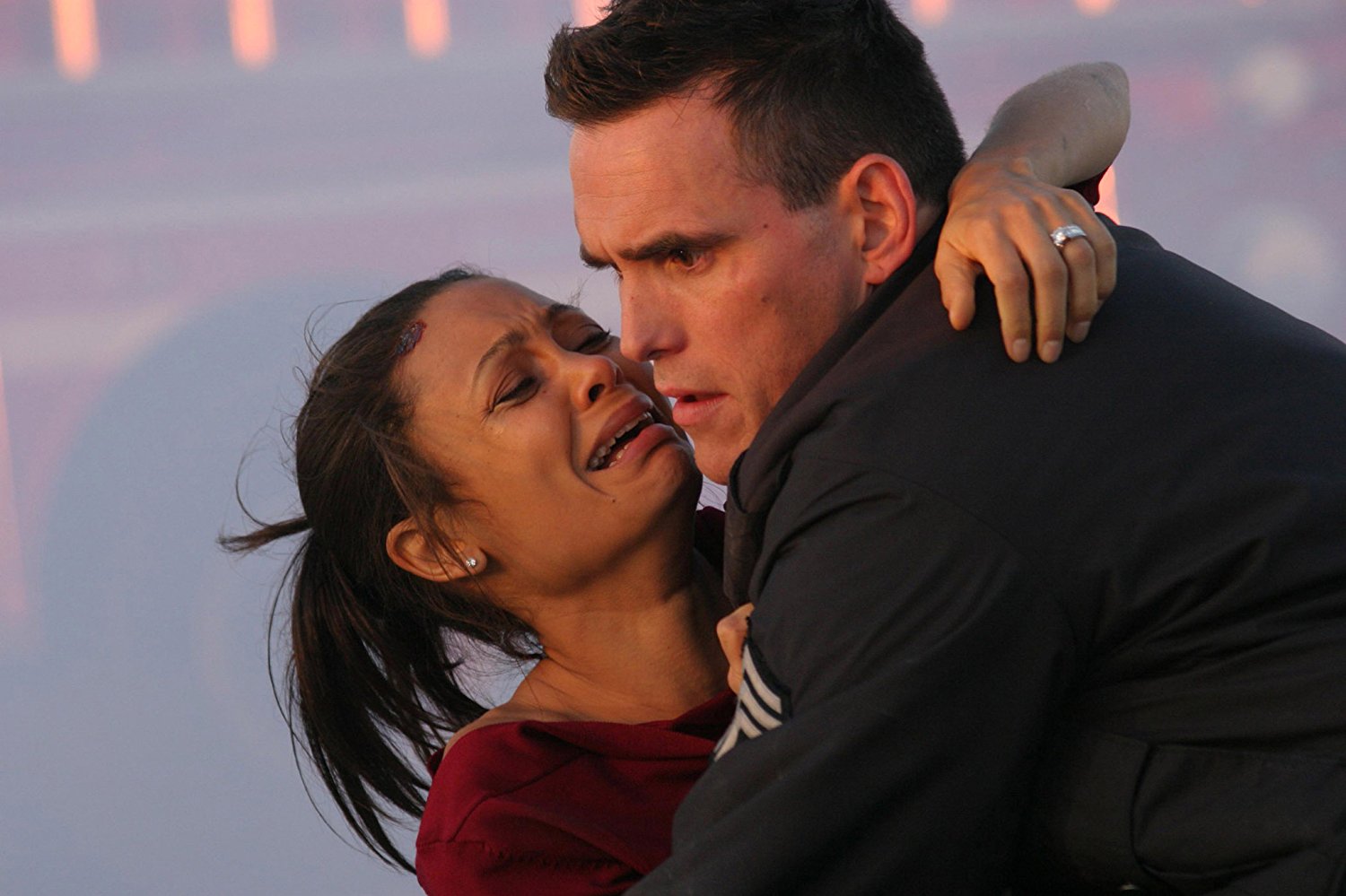
Matt Dillon and Thandie Newton deal with racism in tedious best picture disaster Crash

Director: Paul Haggis

Cast: Sanda Bullock (Jean Cabot), Don Cheadle (Detective Graham Walters), Matt Dillon (Sgt John Ryan), Jennifer Esposito (Ria), Brendan Fraser (DA Rick Cabot), Terrence Howard (Cameron Thayer), Ludacris (Anthony), Thandie Newton (Christine Thayer), Michael Peña (Daniel Ruiz), Ryan Phillippe (Officer Tom Hansen), Larenz Tate (Peter), Shaun Toub (Farhad), Bahar Soomekh (Dorri), William Fichtner (Flanagan), Keith David (Lt Dixon), Bruce Kirby (‘Pop’ Ryan), Beverly Todd (Mrs Waters)

If you had to name the least popular Best Picture winner, there is a fair chance the name you’d come up with Crash. Crash was a surprise winner in 2005, beating out Ang Lee’s tender gay-cowboy classic Brokeback Mountain. Crash was a little independent movie, filmed in and around Los Angeles, that seemed to be tackling big themes – racism, humanity, fate, blah blah blah. To be fair, Paul Haggis’ film is giving it a go. But what you get is just hugely, well, average. It’s not a film that has aged well, and it’s not a film that has enough depth to it to overcome the general cynicism towards it.

The film follows a kaleidoscope of events in Los Angeles, each of which revolves around clashes between different races, with stories that are shown to interlink. So we have an ambitious DA (a miscast Brendan Fraser) and his wife (a pretty good Sandra Bullock) carjacked by two gangbangers (Ludacris and Larenz Tate). A TV director (Terrence Howard) and his wife (Thandie Newton) are pulled over then assaulted by a bigoted cop (Matt Dillon), despite the fears of his nervous liberal partner (Ryan Phillippe). A locksmith (Michael Peña) deals with racial suspicions from the DA’s wife, and from a Persian shop owner (Shaun Toub), who is himself the victim of racial abuse. A cop (Don Cheadle) and his partner (Jennifer Esposito) investigate two undercover cops who shot each other, monitored by the DA. And so it goes on.

Crash could be pretty much relabelled Racism Actually. In fact, it shares a lot of traits with Richard Curtis’ loosely assembled series of shaggy dog stories, feeling as they do like off-cuts and half assembled scraps of ideas from Haggis’ writing desk. But what he ends up wheeling out here is a manipulative, cliché-filled pile of earnest claptrap, in which basically a series of unpleasant characters behave unpleasantly towards each other. You can see why the ageing academy might have warmed to it – it’s a film that looks at racism, by exploring how, gosh darn it don’t you know “everybody is a little bit racist” sometimes. 

On top of that, Haggis’ film relies overwhelmingly on coincidence and the tired “we are all linked together” clichés. It wants to try and make big statements about the prejudices and victimisation that we all suffer in our different ways – but it delivers them in such a clumsy and manipulative way your nose ends bruised by the number of points hit on it. For starters, do people really throw around racial slurs as readily and immediately as the characters in this film do? Surely the real danger of racism is not the people who shout racist nicknames and get angry immediately – isn’t the real danger of racism its incipient nature, the quiet whispers behind closed doors or the barriers gently but firmly put in the way? 

This film turns racism into something loud, obvious and crass. And then it produces a film that does the same thing. The script is full of scenes which never feel real, – every conversation in the piece turns into a clumsy series of “we all hold prejudiced views” or “I’ve got more depths than you think” statements that always feel fake. Not once do the characters sound like real people. It’s the sort of clumsy, crappy, thuddingly worthy film-making that ostentatiously believes itself to be great film-making, when in fact it’s as average as cornflakes.

Even the more effective moments only work because they are so manipulative: the confrontation at gunpoint between the locksmith and shop owner, and the rescue of Thandie Newton from a burning car by Matt Dillon’s brutish cop. When they are happening, these moments are strangely gripping – but literally the instant they finish, you are struck by how Haggis has filmed them in such an operatic, balls-to-the-wall way you would have to work pretty hard not to be swept up in them. Effective manipulation is still manipulation – and manipulation really shouldn’t be this easy to spot. Certainly not within seconds of it happening.

But nearly all the characters are so simple and cookie-cutter that, despite the quality of the acting, you never connect with them. It doesn’t help that Haggis’ unsubtle screenplay is desperate to point up “surprise” personality twists – the “you think they are like this, but look: here they behaving totally differently. People are more complex than you think!” card is played so often it starts getting worn out. All of this serves to boil down to a trite message that when we try and get along with each other everything eventually might work its way out. Oh please, give me a break.

The acting, though, is actually pretty good. Sure Brenda Fraser is horribly miscast, and Don Cheadle is stuck with a terrifically boring cop who has to hold some of the narrative threads together, but there are plenty of decent performances. Sandra Bullock gets to show she has some solid dramatic chops, Thandie Newton is a pretty much a revelation as a seemingly shrewish wife, Terrence Howard mines a lot out of a clichéd middle-class black man going through a mid-life crisis. Ludacris and Lorenz Tate are excellent as the two gangbangers, although their dialogue and actions never feel real at all. Michael Peña is very endearing as just about the only outright likeable character. Dillon got a lot of praise (and an Oscar nomination) as the racist cop and he is fine (though dozens of actors could do what he does here), even though the character is thin as paper and relies on having the two of the best impact scenes.

Dillon’s character is a good example of the film’s moral shallowness. Perhaps it’s the #MeToo era, but do I think that Dillon’s clearly racist manner and his sexual assault on Newton’s character is cancelled out because he saves her from a fire and treats his dying Dad well? I mean, what is this sort of laziness? The film says “ah ha look viewer you thought he was a bad guy, but look at his depth”. So forget the sexual assault because he saved his victim’s life the next day. Wow. Don’t get me started on the contrived weighting of the scales the film puts together so that our opinion is shifted on Phillipe’s good cop. The film is full of this sort of clumsy, ham-fisted, chin stoking, liberal garbage that feels overwhelmingly patronising.

But then this is a film that doesn’t trust you to think. It is the ultimate middle-class, hand-wringing exercise in “oh if only we could fix the world through good things” nonsense. It shouts and shouts and shouts at you about racism, but never really tells you anything other than that bad-tempered, ignorant people will do bad-tempered ignorant things. It smugly says “of course we are better, but guess what viewer, this sort of thing does happen”. Only of course the script is so thin, the general film-making so thuddingly average and unsubtle, the story and morality so shallow, that its preachy hectoring only really serves to turn you off.  Anyone with a brain will get the message within the first 10 minutes. The film takes another hour and a half to catch up with you. The worst Best Picture winner ever? It’s gotta be up there.

The Great Gatsby (2013)

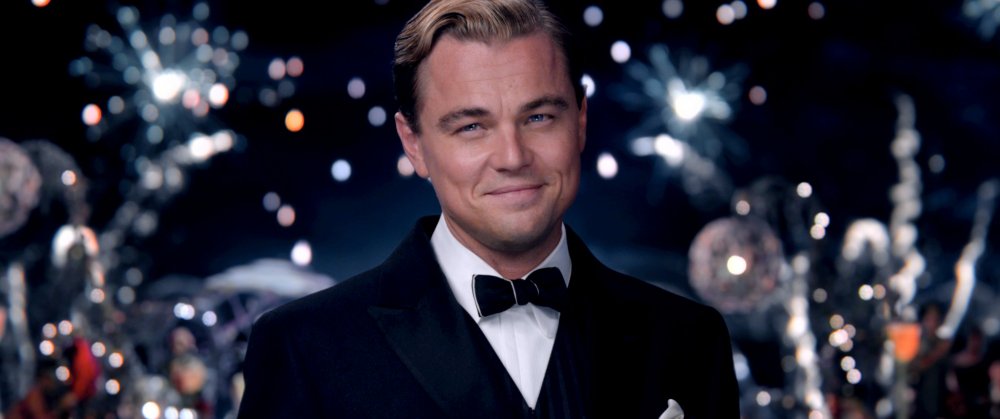
“Hello old sport”: Leonardo DiCaprio is The Great Gatsby

Director: Baz Luhrmann

Cast: Leonardo DiCaprio (Jay Gatsby), Tobey Maguire (Nick Carraway), Carey Mulligan (Daisy Buchanan), Joel Edgerton (Tom Buchanan), Elizabeth Debicki (Jordan Baker), Isla Fisher (Myrtle Wilson), Jason Clarke (George Wilson), Amitabh Bachchan (Meyer Wolfsheim), Jack Thompson (Dr Walter Perkins), Adelaide Clemens (Catherine)

The Great Gatsby is possibly the great American novel. I’ve only read it once, but I certainly admired its beautiful prose, capturing of an era of American life and understanding of the fragility behind America’s love of success. Baz Luhrmann is clearly a fan, as he spent years putting together this passion project, presenting the biggest, brashest version of Fitzgerald you are ever going to see.

Nick Carraway (Tobey Maguire) is a young writer turned bonds salesman in 1920s New York. He lives across the bay from his cousin, Daisy (Carey Mulligan) and her husband Tom Buchanan (Joel Edgerton), a brash old-money man carrying on an affair with Myrtle (Isla Fisher), the wife of his garage mechanic. Carroway’s next-door neighbour is the sumptuously wealthy, but mysterious, Jay Gatsby (Leonardo DiCaprio) whose parties and generosity are legendary. As Carraway gets to know Gatsby (as much as anyone can), he discovers that Gatsby has a deep, near obsessive, love for Daisy.

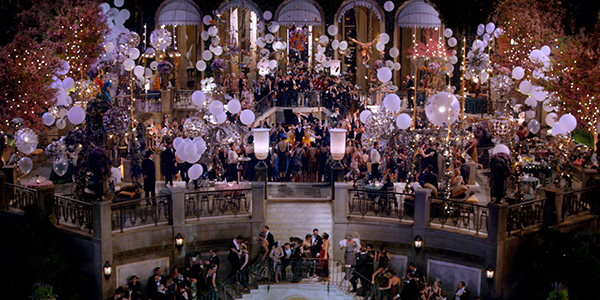
Luhrmann’s film is a technicolour explosion that uses many of the techniques you’ll be familiar with from any of director’s other films. The camera is a whirligig of motion. The colours are bright and primary. The whole tone of the film (certainly for its first hour) is larger than life. The narrative has been tweaked to take on the tone of a Greek Tragedy, with the loud noise, fast camera moves and speedy pace all inverted in the latter half to invoke sadness and tragedy. And of course, the music is deliberately anachronistic, mixing modern genre music with 1920s sounds.

Sometimes this high-budget technicolour brilliance does feel like it is partly getting in the way of the deeper themes that lie within the original. But that might be partly because the novel’s themes are so reliant on internalised feelings, unsaid or guessed emotions, and deeply purple prose, that these are ideas which are very hard to translate to the screen.

There is something to be said for Luhrmann turning one of the pillars of 20th-century American culture into a spiritual sequel to Moulin Rouge!. And Moulin Rouge! is what the film strongly resembles, not only in design, but its romantic structure, poetic retelling, high drama, sense of impending doom and danger behind the bright lights, assault on class and the way it stands in the way of true love, and the lack of freedom in our lives. Both even have sad, reflective authors book-ending events.

So your enjoyment of the film is probably going to depend on how you feel about Luhrmann’s OTT style. Love Moulin Rouge! and Romeo + Julietand you will probably find something to enjoy here (and you’ll also notice his love of tragic love stories). Saying that, of those three, Gatsby is the one the carries the least depth to it, which is intriguing as it probably mines the most psychologically rich source material. While Luhrmann understands that the book is about the real emotions masked by explosive parties and opulence – the film often feels as choked by these things as the characters do.

This is partly because I feel both Maguire’s and Mulligan’s performances don’t quite work. Maguire is so stripped back, quiet and passive he almost disappears – you don’t get a sense of Carraway as either a shrewd observer or someone wrapped up in events: instead he’s a passenger, like the plot contrivance Gatsby sometimes treats him as. Similarly, Mulligan is slightly overwhelmed by the movie, not giving a strong enough performance for her to break through. The film powers forward with such momentum and brashness, it squashes her.

It’s probably why the most successful lead performance by far comes from DiCaprio. He’s perfectly cast as Gatsby: so good in fact you wish he was in a more thoughtful, relaxed film that would give him a more of a chance to breathe. DiCaprio perfectly encapsulates the desperation just beneath Gatsby’s surface, the fear and uncertainty that lies under his suave urbanity. He completely gets the character, understands he is a showman presenting a front to the world because that’s what he thinks the world wants, but who is, in his own way, as empty and lost as the world of bright lights he is offering people. It’s an excellent performance.

Luhrmann’s work with DiCaprio is what gives the film it’s centre and, for all the colour, noise and joy of the first 40 minutes or so, it finds its heart in the moments of acting and character interplay as the Gatsby-Daisy-Tom love triangle comes to a head. This scene, with its bubbling emotions, high stakes and tension is like an oasis of calm in the high-faluting scenery that surrounds it. But then this is a film where the smaller moments actually come across as richer than the larger ones – partly helped by the fact that Joel Edgerton and Elizabeth Debicki both give excellent performances as the key supporting characters. 

The Great Gatsby captures the feel of Fitzgerald rather well, but for all the dialogue of the book placed over the film in voiceover, it never quite manages to capture the spirit of the book in the same way. It looks wonderful, and its dynamic filming is certainly enjoyably impressive, but it doesn’t quite become a film that deals in emotions and depth. It flashes and fizzles but it never lets us really soak in its ideas and themes. It’s all too much at times, and the tragic sadness at the heart of the story, of this lost boy trying to live the life of a man, never comes out as it should. An interesting and entertaining film, but not one that will last.

Sherlock Holmes (2009)

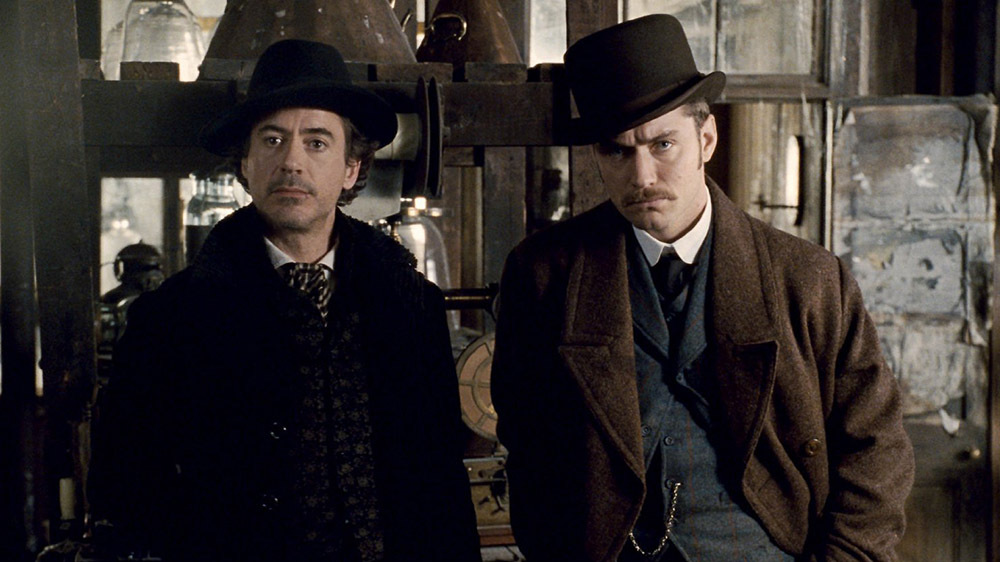
Robert Downey Jnr and Jude Law made a great odd couple in Sherlock Holmes

Director: Guy Richie

Cast: Robert Downey Jnr (Sherlock Holmes), Jude Law (Dr John Watson), Rachel McAdams (Irene Adler), Mark Strong (Lord Henry Blackwood), Kelly Reilly (Mary Morstan), Eddie Marsan (Inspector Lestrade), Hans Matherson (Lord Coward), James Fox (Sir Thomas Rotheram), Geraldine James (Mrs Hudson), William Houston (Constable Clark), William Hope (Ambassador Standish)

I don’t think there has been a single character brought to the screen more often than Sherlock Holmes. Sure there are certain tent-pole performances (Rathbone, Brett, Cumberbatch) that people automatically think of when you say “Sherlock Holmes”, but there are hundreds of others. It’s a character that survives constant re-imagination. In fact, you could argue it’s pretty much vital to bring something of your own to the table when putting together a Sherlock Holmes dramatisation. It’s what made Sherlock so successful. And it’s something that works very well here.

Sherlock Holmes (Robert Downey Jnr) is part Bohemian artist, part mad scientist, part kickboxer. The sort of guy who can think so far ahead he can plan out an entire fight in his mind before it even begins. He’s partnered up with determined, smart, handy-with-a-sword Dr Watson (Jude Law). With Watson preparing to move out of 221B to marry Mary Morstan (Kelly Reilly), they take on their last case: defeating creepy Dracula-lite Lord Blackwood (Mark Strong), who claims to have returned from the dead and wants to take over the British Empire. Along the way they are helped (or hindered) by the mysterious Irene Adler (Rachel McAdams) an old flame of Holmes’.

Guy Ritchie’s rollicking adventure is actually a huge amount of fun that, underneath the crashes and bangs, actually has a really strong respect for the original stories (the film is littered with references and quotes from the originals, none of which feel shoe-horned in except maybe Rachel McAdams’ Irene Adler, perhaps because the producers felt Holmes needed a love interest to stop any worries that he might be a bit too much in love with Watson). Ritchie has crafted a Holmes-Watson relationship that repositions them as a sort of odd-couple surrogate brothers, a marriage of equals (and make no mistake, a marriage is basically what this Holmes and Watson have). It’s big and silly, but then so were the original stories (The Creeping Man anyone?). 

Ritchie is a film-maker it’s easy to find faintly annoying, with his faux-geezer attitudes, his bizarre philosophical views and his love of the poor-taste gag. But on this film he’s basically a director-for-hire rather than putting his own story together and, you know what, putting this director into a studio strait-jacket is actually pretty good. It smacks some disciple on him, makes him drop his indulgent and poor-taste jokes and instead brings his strengths as a director – his sense of pace, his eye for a witty image, his rollicking sense of fun – to the fore. That’s probably why this is his most enjoyable and best film. 

It’s a film that mainly works because Downey Jnr and Law make a terrific pairing as Holmes and Watson. They have great chemistry, they spark off each other extremely well as performers and they really give the sense of two life-long devoted friends. Both actors are very good here. The film hits these notes of male friendship extremely well – a mixture of mocking and abuse, mixed with devotion and loyalty. The film gets the balance of these things exactly right: from debates to fights, you really get a sense that these two are honorary brothers, almost a bickering old married couple. 

In fact, the whole film revolves quietly around this relationship coming under threat (as Holmes sees it) of Watson leaving Holmes to get married – although, nicely, the film makes clear his fears of Mary are completely unfounded. Part of the dual engine of the film is Holmes continuing to tempt Watson into getting more and more involved with his cases, because he doesn’t want to lose his friend. It’s actually quite sweet. As are the protective feelings both have for the other: Watson knows Holmes puts himself at ridiculous risks, in turn Holmes shows a gentle worry for Watson’s gambling addiction (a popular Sherlockian society interpolation from references in the story).

All this warm, brotherly stuff from two excellent performers is built into a dramatic, thrillingly shot, series of action and detection scenes. The film’s big gimmick is Holmes’ ability to use his analytical abilities to accurately predict the outcome of fights (which the film communicates with slow motion and forensic narration by Downey Jnr, before staging the entire fight again at real time). It’s actually a fairly neat way of turning his deductive abilities into a visual language. Alongside this, plenty of this great fun – exciting or, as in Holmes’ battle with a 7ft giant, funny. All hugely entertaining.

Placing the focus on this relationship and the action does mean that the mystery elements of the plot get a bit short-changed. The story is a rather silly series of near-Dracula style high-Gothic mysteries that may or may not be real (all these occult references more than echo The Young Sherlock Holmes!). There isn’t much in the way of the small intricate puzzles of the early stories here – but then plenty of the later ones became increasingly hyper-real Gothic stories, so I guess that is fine. Mark Strong does a decent job as the villainous Blackwood, using his sinister looks and imperious voice extremely well. 

It also looks wonderful – the photography and set design is marvellous – and the score by Hans Zimmer must be one of his best ever, a sprightly mix of Irish music, Westerns and Music Hall. Ritchie directs it with a wonderfully, tongue-in-cheek, entertaining sprightliness, like Sherlock Holmes meets Indiana Jones. Holmes more than survives his re-imagination as an action superhero – and in fact he brings across a lot of the tone and character of the original book along with him. A terrific entertainment and a more than worthy entry to the Holmes movie cannon.

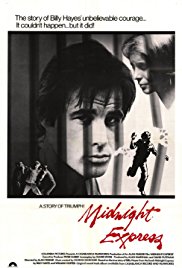
Midnight Express (1978)

Brad Davis and John Hurt find themselves in melodramatic hell in Midnight Express

Director: Alan Parker

Cast: Brad Davis (Billy Hayes), Randy Quaid (Jimmy Booth), John Hurt (Max), Paul L Smith (Hamidou), Irene Miracle (Susan), Bo Hopkins (Tex), Paolo Bonacelli (Rifkin), Norbert Weisser (Erich), Mike Kellin (Mr Hayes), Peter Jeffrey (Ahmet), Kevork Malikyan (Prosecutor)

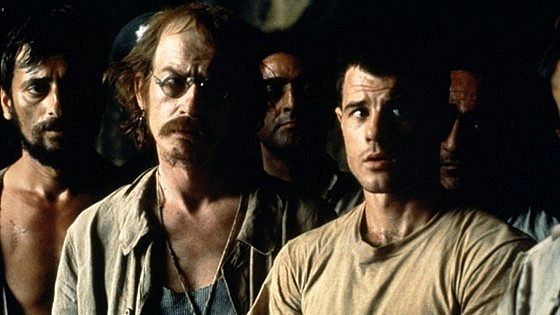
Ever wondered why “Turkish prison” was, for a long time, practically a synonym for “hell on earth”? A big reason is this film’s box-office success, a heavily fictionalised version of the experiences of Billy Hayes (Brad Davis), a young American caught smuggling hashish out of Turkey and eventually sentenced to 30 years in a prison notorious for violence, torture and rape. The film covers Hayes’ imprisonment, his alliances with fellow prisoners loud-mouthed American Jimmy (Randy Quaid) and sensitive, strung-out Englishman Max (John Hurt), and his ill-treatment at the hands of sadistic guard Hamidou (Paul L Smith). It’s not exactly a light watch.

Midnight Express was an unexpected controversial sleeper hit. Many felt the film was grossly violent, horrible, and borderline racist towards its Turkish characters. Looking back now, the violence is (with a few exceptions) no more than you might expect – but the attitude the film takes towards its Turkish characters really sticks out.

There is barely a Turk in this who isn’t crooked, sadistic, greedy, ugly or stupid (or a combination of all five). The depiction is so unsettlingly bad, the real Billy Hayes apologised at the time (he was joined years later by the film’s producers and writer, Oliver Stone). Many of the Turks are lascivious anal rapists, while the whole film has a queasy unease about homosexuality. The real Billy Hayes engaged in relationships with other men in prison – the film’s Hayes kisses a fellow prisoner in the shower but then shakes his head and leaves. A 1970s audience could cope with seeing a man flogged or tortured – but in no way could they be expected to watch two men making out.

Other than these unsettling black marks, Midnight Express is a taut, well-made, melodrama. And I say melodrama because both Stone and Parker frequently go over the top. After a friend is betrayed to a horrible fate by a Turkish prisoner, Hayes freaks out, violently beats the Turk, gouges his eyes and then (in almost laughable slow-mo) bites his tongue out and spits it across the room. Later, he is finally allowed to receive a visit from his girlfriend – she presses her breasts up against the glass while a near catatonic Hayes tearfully masturbates (“I wish I could make it better for you baby” she sighs, tearfully). Yes both those sequences are as OTT as they sound.

But when it calms down, Parker crafts a pretty affecting story. It cuts Hayes a lot of slack – I found it hard to feel sorry for a dumb, drug-smuggler who assumes his American passport will let him off with a slap on the wrist. I can’t be alone in thinking that someone who breaks the law deserves to pay some sort of price. To be fair, I think the film partly shares this view: it fast-forwards through most of Hayes’ original term, and only really hits into full misery once his sentence is arbitrarily extended by 27 years. I think Parker and Stone believe this switches the moral right to Hayes, who had served his term only to be hit with a sudden draconian change weeks before release. 

A lot of the film’s impact comes from Brad Davis’ impassioned performance as Hayes. There is something very sensitive and gentle about Davis, a real vulnerability that the film seizes upon to great effect. He looks like a bewildered lost soul, and Davis’ performance is scintillating first in its confusion, then his distress and anger. 

There are decent performances from the rest of the cast, with John Hurt standing out as the gentle Max. Garlanded with awards, Hurt is perfect as the straggled, beaten down, but still cynical and surly Max – and of course Hurt’s natural affinity for suffering works perfectly for a character who goes through the wringer. Quaid also does decent work as a thoughtless loudmouth, as does Kellin as Hayes’ impotent father. It’s also nice to see a small cameo from Peter Jeffrey as a well-spoken half-English paedophile in the prison’s psychiatric ward.

It’s a shame that Midnight Express too frequently goes too far, as it’s got an almost medieval understanding of suffering. The prison is a grim world of its own, where the prisoners largely self-police and acts of petty revenge are common. Later in the film, Hayes is sent to the film’s psychiatric ward, a hellish basement where prisoners walk in drugged-up dumbness pointlessly round and round a stone pillar.

Moments like this are far more impactful because they avoid the extremities of the rest of the film. Most of what we see isn’t true – Hayes’ story and his escape was vastly different, and the film exaggerates both his naïveté and his suffering – but it still works extremely well. Parker fought to end the film simply, rather than the all-action escape sequence filmed and this works wonderfully (it’s basically a Third Man homage, by way of Robert Altman’s The Long Goodbye) – although it still finds another moment for a threat of anal rape in the final ten minutes.

Midnight Express is a decent film, but not a pleasant one – and it leaves a slightly sour taste in the mouth, for all the competence with which it is made. Parker and Stone frequently go too far, and the reek of homophobic racism still comes off the film. However it is certainly a good piece of technical film-making and has some marvellous performances in the mix.

Three Colours: Red (1994)

Irène Jacob gives a soulful performance in Kieślowski’s crowning achievement Three Colours: Red

Director: Krzysztof Kieślowski

Cast: Irène Jacob (Valentine Dussault), Jean-Louis Trintignant (Joseph Kern), Jean-Pierre Lorit (Auguste Bruner), Frederique Feder (Karin), Samuel LeBihan (Photographer), Marion Stalens (Vet), Teco Celio (Barman)

Spoiler warnings: I wouldn’t usually do this for a film that was made over 20 years ago, but discussing this film is almost impossible without covering the entire plot so – be warned! This is a rich viewing experience you should discover for yourself.

Kieślowski’s great trilogy wraps up with Three Colours: Red, a fascinating, moving, intriguing puzzle of a film that opens itself up to countless interpretations. It’s a film that seems to be about a great many things, but wears its intelligence and insight very lightly, never hammering points home or getting too wrapped up in its own smartness. It’s primarily a story and never forgets that. It also pulls together threads and themes from the entire trilogy hugely effectively. It’s a great movie.

Valentine (Irène Jacob) is a student in Geneva, funding her time at university through part-time modelling. After accidentally hitting (but not killing!) a dog with her car, she meets the dog’s owner, retired judge Joseph Kern (Jean-Louis Trintignant). Joseph is spending his time in isolation from the world, listening to his neighbours’ phone calls, more out of a judge’s habit of finding out secrets than any truly malicious intent. Valentine challenges this blatant disregard of privacy, and she and Joseph begin to form an increasingly strong bond. 

Red is a beautiful film, wonderfully made and rewards constant analysis. Kieślowski described this as the hardest film of the trilogy to write, and you can see why. Dealing with themes of fraternity, it ties this in closely with love (romantic and otherwise). The entire film shows the strengths of people coming together, specifically Valentine and Joseph who develop a bond that enriches their lives. This is contrasted throughout with Valentine’s domineering boyfriend on the other end of the phone-line, and modern communication in general that builds distance between people. Joseph, a man distanced himself from all others, finds his humanity once he opens himself to considering other people as people.

Kieślowski’s film also plays interesting games with narrative and time. A seemingly minor character, Auguste, a lawyer training to become a judge, is slowly shown to share a huge number of life events with Joseph’s youth. The question that bubbles over the film is, is this a coincidence or are Auguste and Joseph somehow linked? Is Auguste in some way the same person as Joseph – some sort of reincarnation? Is this fate or chance or mere coincidence? Is Joseph, living like some lonely old-testament God in complete isolation, somehow trying to move events to correct errors in the past – to try and find some contentment for Auguste (whose conversations with his girlfriend he has been listening to) so that he avoids the life Joseph has led?

I like this idea. It appeals a lot to me, not least as I started to feel that Joseph was almost some sort of Prospero, using phone taps as his own private Ariel to know everything happening around him and then (more benignly perhaps than Prospero) using this to improve the lives of those close to him. Perhaps. There is even a seemingly magic storm at the end of the film that brings several characters together, not least the leading couples from the previous two films in the trilogy. It’s also a storm that, it is suggested, will bring Valentine and Auguste together.

It’s a romantic flourish at the end of the film that speaks of the possibilities for the future (though typically of this intriguing series, it’s a flourish that comes out of a ferry accident that kills over a thousand people – you can’t get something for nothing in this world, and no romantic story is straight forward). It’s also a natural development of the strong romantic link between Joseph and Valentine. If Joseph and Auguste are (essentially) versions of the same person, it’s a further suggestion that (in another life) Joseph and Valentine would certainly have fallen in love (to match the platonic love that develops between them). This interpretation of love joining people together is seen as well in the lead couples from Blue and White also surviving the accident.

Or is this all coincidence? Kieślowski plays the mystery and depth so lightly – lets these points float out or be lightly stated without tub-thumbing – that it leaves it all gently to the viewer’s imagination. You can make of it what you will: the story works just as effectively if you ignore all the things I just discussed. Joseph as the isolated, austere man who finds a warmth in himself awakened by the generosity and compassion of Valentine. All this stuff could just be the working of chance.

But either way, the film is about fraternity: people coming together, and communication and compassion making us human. Irène Jacob is wonderful as the endearing, romantic and empathetic Valentine, her brightness and humanity shining through. Jean-Louis Trintignant is superb as the judge, whose careful veneer of distance and coldness is punctured throughout the film. The scenes these two share are beautifully done: conversations that throb with emotion under the surface. Kieślowski again directs these scenes with a masterful minimalism, using differing heights and levels (they are very rarely on the same level, usually one sits or stands above the other) to show the dynamics subtly change between the two. These height differentials – with Valentine often kneeling at Joseph’s feet – also suggest a growing intimacy between the two characters. 

Technically the film is a marvel. It is lusciously filmed by Piotr Sobociński. The presence of red throughout is very well done and adds a poetic brilliance to the images. Kieślowski in particular shoots sunrises and sunsets with an astounding beauty, and uses light to add a huge emotional depth and beauty to private conversations. Zbigniew Preisner’s score is marvellous, a lyrical, beautiful series of compositions that rewards constant re-listening.

Red is a marvellous, thought-provoking and humane film crammed with wonderful and involving ideas, and brilliantly gives you loads to think about both narratively and thematically. It’s a warm and moving story, with darker elements that make those parts seem richer. With two marvellous performances at its centre, it’s brilliantly directed by Kieślowski (who tragically died shortly after the film’s release), with grace, poetry and passion. It looks wonderful, it sounds marvellous and it always make you think. It’s a masterpiece.

Captain America: Civil War (2016)

Captain America and Iron Man stand-off in overblown Captain America: Civil War

Director: Anthony and Joe Russo

Cast: Chris Evans (Steve Rogers), Robert Downey Jnr (Tony Stark), Scarlett Johansson (Natasha Romanoff), Sebastian Stan (Bucky Barnes), Anthony Mackie (Sam Wilson), Don Cheadle (James Rhodes), Jeremy Renner (Clint Barton), Chadwick Boseman (T’Challa), Paul Bettany (Vision), Elizabeth Olsen (Wanda Maximoff), Paul Rudd (Scott Lang), Emily VanCamp (Sharon Carter), Tom Holland (Peter Parker), Frank Grillo (Crossbones), William Hurt (Thaddeus “Thunderbolt” Ross), Daniel Brühl (Helmet Zemo), Martin Freeman (Everett K Ross), Marisa Tomei (May Parker), John Kani (T’Chaka), John Slattery (Howard Stark), Hope Davis (Maria Stark), Alfre Woodward (Mariah Dillard)

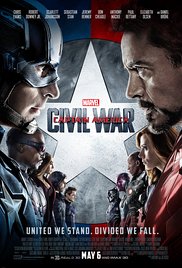
Captain America: Civil War is another explosive entry in the MCU, and is even more stuffed than usual, with nearly all our Avengers thrown into the mix – with the added twist that they fight each other! Yup it’s time for another playground argument: “If X fought Y, which one would win?!” That’s the main thrust of Captain America: Civil War, but it’s actually a distraction from the real plot. The much hyped fight at the airport (and the build-up to it) is a rather dull hour in the middle that distracts from a richer, more interesting film.

There is dissent in the ranks of the Avengers. The UN wants them to sign the “Zukovian Accords” – an agreement that they will work only under the direction of the UN. For Tony Stark (Robert Downey Jnr) this legal framework for their actions is essential – but Steve Rogers (Chris Evans) argues that the Avengers need to have the freedom to go where they are needed, not only where they are told. In this tense situation, a bombing in Vienna is swiftly blamed on Roger’s old friend Bucky Barnes (Sebastian Stan), who has become the brain-washed killer The Winter Soldier. In disagreement with Stark about the Accords and determined to protect Bucky, Steve quickly finds himself on a collision course with Tony.

The central idea here is actually fairly interesting: are superheroes people with a higher duty or just a group of vigilantes? Should they follow the direction of politicians – or be free to go where they are needed, when they are needed? How much accountability should they hold? If, in saving the world, dozens of civilians should die in the aftermath, is that acceptable or not? These are the ideas that lie under the arguments that the characters – principally Captain America and Iron Man – have. 

The first 40 minutes set this up nicely: an operation goes wrong, people are killed and the Avengers are confronted with footage of the collateral destruction they have caused while saving the world. But these ideas get left behind as the film gets caught up with pushing our characters into an artificial-feeling battle so destructive that an entire airport gets trashed by the “let’s cool our actions” team while trying to stop the “we should be independent” faction.

It would have been really nice to have these ideas explored in more depth, rather than a few moments here and there. Essentially, the film hires Alfre Woodard to deliver a top-notch performance as a mother whose son was Avengers collateral damage, to convince Tony things need to change, and leaves it at that. Steve’s counter-argument gets laid out swiftly – though he strangely makes no reference to the fact that the previous film saw a very similar “government organisation” revealed as the source of all evil in the Marvel world. It’s quick beats like this that set up this collision – but only Tony and Steve get any chance to express any form of developed views (in a few very well acted scenes). The motivations of the rest of the Avengers seem under-developed.

But that’s the problem with Captain America: Civil War: it’s seriously overstuffed. With some of these plots and characters removed, we could have actually had a very rich, thematic story.

The whole “Zukovia Accords” plot also has to constantly juggle for space with leftover “Winter Soldier” plotline from the previous two films. Truth be told, the latter is the more interesting, dealing with actual emotions, friendships and loyalties – chiefly the bond between Bucky and Steve (very well illustrated in a few brief, well played scenes). It’s this dilemma of whether Bucky can be held responsible for things he did under mind control that becomes the film’s key question. This plot line works far more effectively as it basically involves only three of the characters and feels like it has genuine things at stake, in a way I just can’t feel about the forced “civil war” angle. 

But it’s that civil war angle that the film is being sold on – and it’s what the middle section of the film is given over to. The big, airport-wrecking battle between the two sides is well shot, has good special effects and throws in plenty of neat one-liners. But what it completely lacks is any sort of dramatic tension or any stakes. As our heroes indestructibly bounce around while swapping light banter you never feel that this battle really amounts to anything. The sides don’t seem that far apart, or really that different – in fact the whole thing feels like playground horseplay.

The big battle is even undermined by the fact that we’ve already seen our heroes fight each other at least twice already in small combinations – and in all these cases, bodies are thrown about mercilessly but no one suffers more than a few scratches. Even after a character falls hundreds of feet to the ground, he’s later shown as basically being absolutely fine. The big battle is supposed to be the exciting showpiece, but it’s basically just big filler. A load of noise, where nothing really happens and no-one really feels at any risk, with no real consequences (all the emotional consequences emerge from the smaller scale final confrontation which would be unchanged if this airport fight was removed).

The film only really recovers again once that fight is benched, and we wind up with three of our heroes squaring off over very personal issues. This also brings to the fore the Daniel Brühl’s fascinating character, a very different type of villain: someone whom the film plays a neat game of misdirection with. The film reveals one of its themes as revenge, and how much it can dominate or twist our lives. This is given voice through a wonderfully written and played scene between Brühl and Boseman (very dynamic as the future Black Panther, dealing with grief over the murder of his father).

That scene gives an insight into the film’s real strengths: the small moments. The bits where the overblown fighting can be put to one side and we can see these characters (and the very good actors who inhabit them) talk. Moments like this carry more humanity, interest and tension than a thousand sequences of a giant Ant-man. In these moments, Downey Jnr and Evans are both terrific. Evans was born to play this part, making Rogers adamantine in his decency and nobility without being wearing, and also demonstrating an increasing streak of an old-soul who is tired of listening to other people and wants to make his own choices. Downey Jnr increasingly makes Stark a man hiding resentments, fears and doubts under a veneer of cool. Several other excellent performances also burst around the margins of the film (I’d single out Mackie who is excellent as the loyal Sam).

It’s just a shame Captain America: Civil War wastes some strong material in the prolonged set-up – and then enactment – of its superhero feud. Enjoyable as it can be to see this sort of stuff from time to time, after a while it’s tedious to watch invulnerable people taking pot shots at each other with no discernible impact. A single conversation with stakes – with a doubt about whether a friendship will hold or not – has more tension and excitement than a hundred sequences of heroes hitting each other. There is a more interesting story here – but between the action and the obligatory set-ups for future Black Panther and Spiderman movies (excellent as Boseman and Holland are in these roles) it doesn’t quite reach its potential.