Concussion (2015)

Will Smith takes on the NFL in solid but uninspired true-life story Concussion

Director: Peter Landesman

Cast: Will Smith (Dr Bennet Omalu), Alec Baldwin (Dr Julian Bailes), Albert Brooks (Dr Cyril Wecht), Gugu Mbatha-Raw (Prema Mutiso), David Morse (Mike Webster), Arliss Howard (Dr Joseph Maroon), Mike O’Malley (Daniel Sullivan), Eddie Marsan (Dr Steven T DeKosky), Adewale Akinnuoye-Agbaje (Dave Duerson), Stephen Moyer (Dr Ron Hamilton), Richard T Jones (Andre Waters), Paul Reiser (Elliot Pellman), Luke Wilson (Roger Goodell)

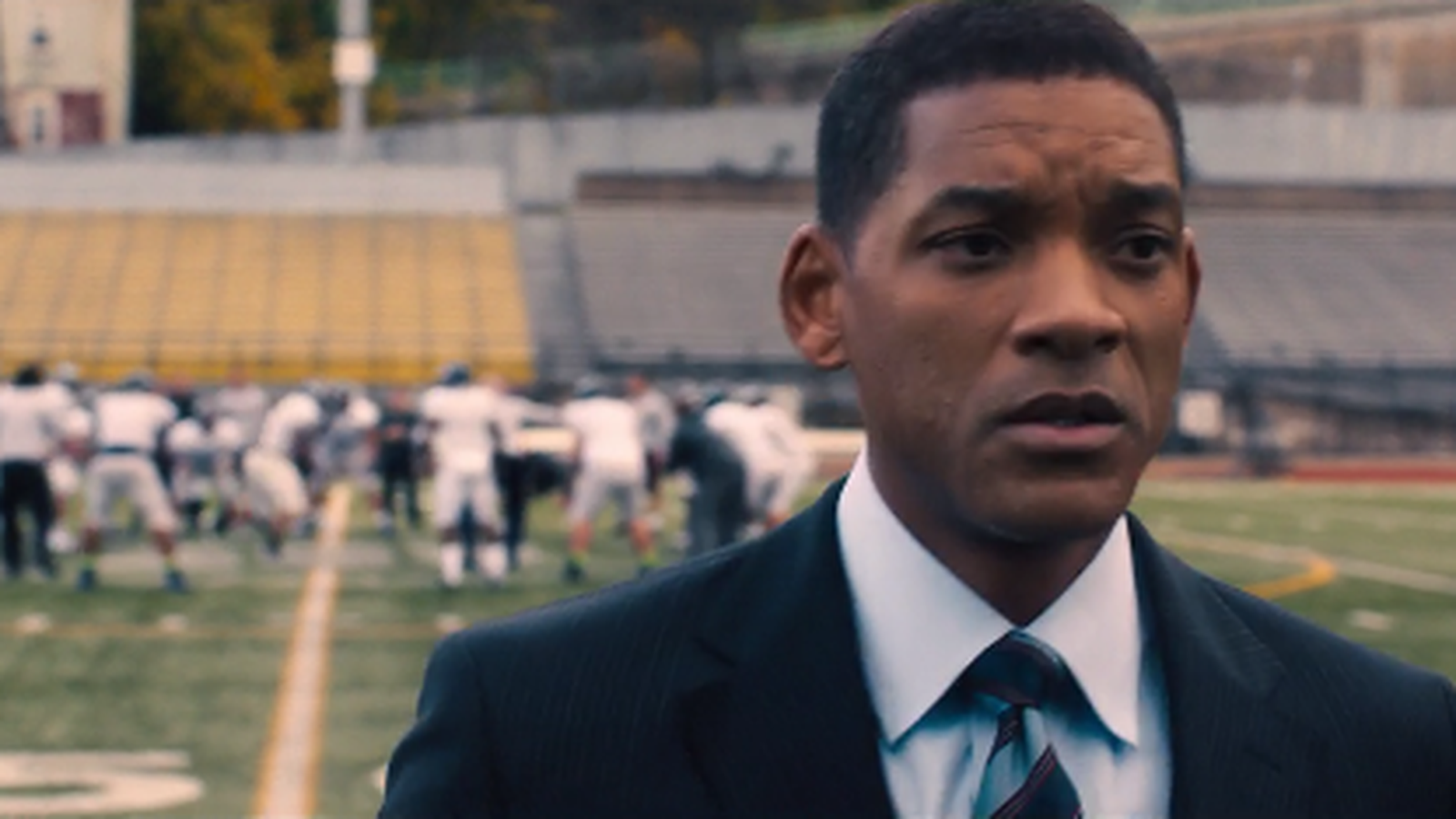
In 2002, Pittsburgh pathologist Dr Bennet Omalu (Will Smith) carried out an autopsy on deceased former Pittsburgh Steelers centre (and American Football legend) Mike Webster (David Morse). What he discovered – that the high speed impacts of American football massively increased the chances of players suffering serious brain damage and debilitating mental conditions – was to change his life, and lead to a six-year battle to get his research acknowledged by the NFL. This film dramatizes this story – with the obligatory inventions and dramatic changes (Landesman describes the film as “emotionally true” if not “factually true”).

Concussion is a fairly straight-forward, rather uninspired “one man’s struggle” kind of film. There isn’t much in it, to be honest, that is particularly unique or different from films of this type we’ve seen before. We’ve pretty much all seen the trope of a man pushing to get himself heard against the scorn, disbelief and anger of those who need to hear him the most. Does Concussionadd anything new to that? No not really.

Peter Landesman shoots the film with a methodical, workmanship that hits all the expected beats. The whole film plays like Michael Mann’s The Insider-lite: with the difference that the NFL never really convinces as an actual threat in the way Big Tobacco does in that film. The film falls over itself to repeatedly tell us how powerful the NFL is but never really shows us in the film how that power might work. When the FBI drum up charges against Omalu’s mentor, you never get the sense that this is being directed by the NFL themselves. They are simply never that dangerous an opponent.

Maybe because this is a film that doesn’t want to run the risk of saying America’s beloved sport is dangerous. It wants to blame bad eggs rather than an institutional failure – hence the repurposing of former player Dave Duerson as a sort of braggart bully. The characters playing the NFL heads are relegated to TV screens in the corner. It never wants to really look at the risks of this institution wilfully burying evidence their sport is dangerous, or question whether this sport is even a good idea. Throughout the world of sport, there are ungoing debates about the health risks of sport, from the danger of heart conditions to early onset dementia in football players from heading the ball. This film fails to really tap into any of this.

As such, there isn’t really any dramatic force behind the film: it doesn’t manage to suggest Omalu is in danger and it doesn’t want to turn the NFL into actual antagonists. It treads a weary middle ground. If the NFL was really positioned as a threat, then the pervasive presence of its stadium in Pittsburgh would be sinister. It isn’t for all Landesman tries to shoot it in that way.

Despite this though, Will Smith is very good as Omalu. The film’s version of the doctor seems a little different from the quirky, socially awkward real-life Omalu. But Smith nails the home-run scenes of Omalu raging at his research being disregarded. (In real life it was easy for the NFL to dismiss Omalu by using his Nigerian heritage (his ‘otherness’) quietly against him. The film doesn’t touch upon this by the way.) Smith has all the charisma the role needs and brings it a certain James-Stewartish moral decency.

The rest of the cast don’t get much else to play with. Alec Baldwin is pretty good as a former NFL doctor trying to ease his conscience (although his accent got some criticism). Gugu Mbatha-Raw has a fairly thankless role as the supportive wife, but does it well. Albert Brooks might be a bit too much at times as Cyril Wecht, but David Morse plays Mike Webster with sensitivity.

The film is not always that subtle. Shots of Webster haunting Omalu are a bit much. Omalu’s unhappiness and frustration are telegraphed using familiar clichés, from raging impotently at stony faced law officers, to trashing a room in his still-under-construction dream home in Pittsburgh (having read the source book it’s hard to believe the real Omalu ever did something like this). The timeline of the film isn’t always clear. There is a little too much lingering on funerals and tear-stained relatives for easy emotional hits.

The main issue is that Concussiondoes nothing special and doesn’t manage to make its familiar structure feel particularly fresh. It’s just a very, very familiar type of story told with no real unique imagination. Although Smith is very good, it’s not quite enough.

Singin' in the Rain (1952)

Singin' in the Rain (1952)

The most beloved of all musicals gives you a burst of pure enjoyment no matter when it plays

Director: Stanley Donen, Gene Kelly

Cast: Gene Kelly (Don Lockwood), Debbie Reynolds (Kathy Selden), Donald O’Connor (Cosmo Brown), Jean Hagen (Lina Lamont), Millard Mitchell (RF Simpson), Cyd Charisse (Woman in the green dress), Douglas Fawley (Roscoe Dexter), Rita Moreno (Zelda Zanders)

Is there a more loved musical than Singin’ in the Rain? Is there a more famous musical from Hollywood’s golden age? That second point is particularly interesting, as this was possibly the last of the big Hollywood song-and-dance films – most of the rest that followed were film versions of Broadway hits. Singin’ in the Rain also has that “late discovery” quality: inexplicably not nominated for Best Picture (or hardly any other Oscars), it was for many years considered a second tier musical behind works like An American in Paris. Now it stands tall over the lot of them.

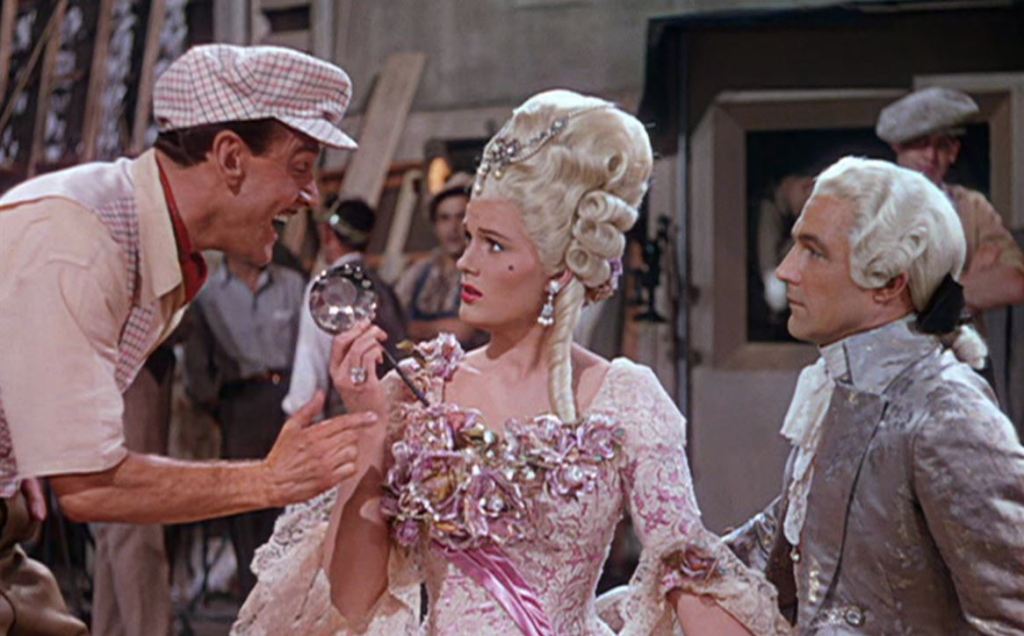
Singin’ is a film assembled from a collection of songs MGM held the rights to. The songs were given to Kelly, Donen and the screenwriters with the instruction to “come up with a movie”. What they came up with was this delightful film-about-films. Don Lockwood (Gene Kelly) and Lina Lamont (Jean Hagen) are the biggest stars of the silent screen in Hollywood, whose careers are in trouble overnight when sound is introduced. He can’t really act and she has a voice like nails on a blackboard. But Lockwood can sing and dance – so why not make their latest film a musical? Especially since the talented Kathy Selden (Debbie Reynolds), who Lockwood has fallen in love with, can sing and act and can dub Lina’s voice. What could go wrong?

There are few more purely enjoyable films than Singin’ in the Rain. Nearly every scene has a moment designed to make you burst out in a smile, be it a cracking line of dialogue, a piece of prodigious dancing skill or the simple warmth and joy of the leading actors. Every second something delightful seems to happen. The entire film is an explosion of gleeful joy in the sheer exuberance of singing and dancing. Kelly’s choreography brilliantly uses everyday props and pieces of furniture to give the numbers an exciting everyday charm. It gives the songs an immediate “gotta dance” energy. How could you not like it?

Threading these songs around a structure of Hollywood taking on sound for the first time was a brilliant idea. The recreation of the acting styles and technology of Hollywood is brilliant. Lockwood is a hopelessly stagy actor, hideously artificial in his gestures, while poor old Lina Lamont is horrendously wooden with an awful voice, and a complete lack of any talent. Jean Hagen as Lina Lamont is in many ways the butt – but she’s so demanding, bullying and selfish we don’t mind that most of the jokes are on her.

The shift towards sound in Hollywood is actually interesting as well as hilarious. Where do we place the mikes? How should the actors get used to speaking into a mike? How do we cancel out the background sound? What do we do with loud props? One of the highlights is the screening of this film-within-a-film to an audience for the first time. All the terribleness Lockwood and Lamont gets revealed. In a particularly genius moment, the sound of the picture gets out sync with the picture, with the voices seeming to come out of the young actors’ mouths to hilarious effect.

Alongside this we get some of the finest song-and-dance routines in the history of the movies. Donald O’Connor is electric as Cosmo and his dance routine for “Make ‘em Laugh” is an astounding early pace-setter in the film: how does he do what he does here? O’Connor goes bouncing off walls, swirling in circles on the floor, springing from place to place without a single pause for breath. Most of this number (like many of the others) is done in one take with electric pace. And that’s the film just warming up.

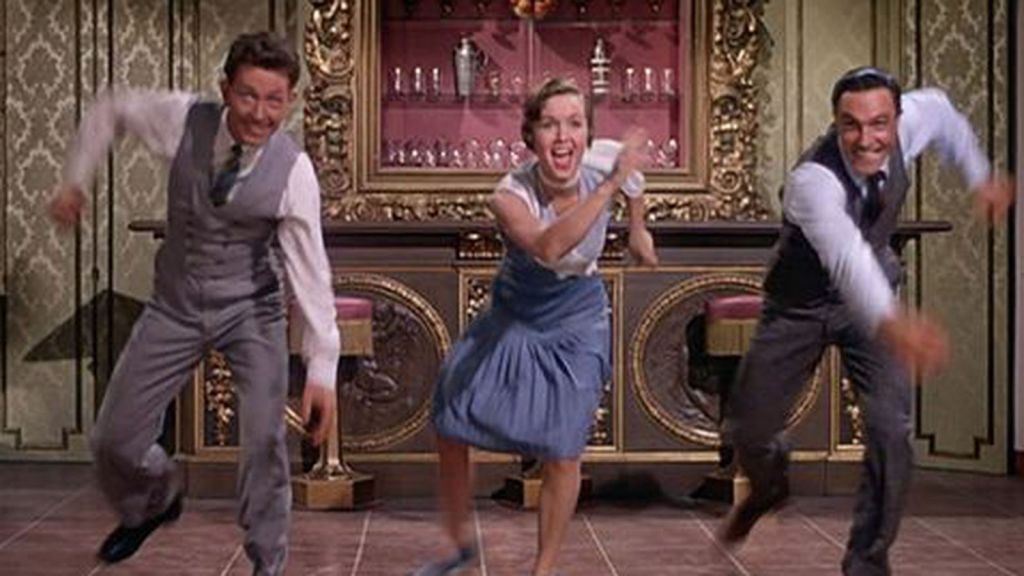
Debbie Reynolds famously described doing Singin’ as being (along with childbirth) one of the hardest things she’d ever done in her life. You can see that in ‘Good Morning’, another electric three-way number with herself, Kelly and O’Connor – she is pounding the floor to keep up with these two masters (and does a brilliant job). She was pushed to the extremes by Kelly who privately considered her a not quite strong enough dancer. Kelly dropped her from Broadway Ballet Medley, a complex ballet-heavy (as per all Kelly films from On the Town onwards – a sequence that I must confess I find a little dull). She’s still excellent – charming, sprightly, light, glorious fun – but it did mean Kelly re-worked the main number to showcase just himself.

Ah yes. ‘Singin’ in the Rain’. This sequence of the film is probably wedged in everyone’s mind. Even if they’ve never seen the film, people are familiar with Gene Kelly, soaked to the skin, dancing through puddles and swinging around lampposts. Kelly is of course marvellous in this sequence (hard to believe he was apparently suffering from the flu at the time) and the number has complete charm to it – that carefree vibrancy of realising you are falling in love. Especially as Lockwood’s ego is finally being put to one side in order to celebrate feelings he’s having for another person. But the whole scene is just sheer cinematic magic. And for something so famous, you never get tired of it. 

But then Kelly has pure star-quality here. Lockwood is a charming, handsome and smooth film star – but the film is happy to puncture his pomposity, or demonstrate in its opening sequence the self-aggrandising version of his early career (“Always dignity!”) with the reality of faintly embarrassing and dignity-free stage and stuntman work. Kelly is so charming you don’t mind that the film gives him an easy ride, considering Lockwood is actually quite selfish.

Singin’ in the Rain is pretty close to perfect. Even though I find some of the ballet stuff a little boring myself, it’s still filmed and shot with skill. It’s a pet discussion between film experts to ask how much of the film was directed by Kelly and how much of it was done by Donen. I guess it doesn’t really matter except to cinephiles, as the film is just beautifully directed: light, frothy, fun and with real technical expertise – the slow crane shot at the end of the famous number is justly famous. The pace is spot on, and the film is hilarious. Its understanding of filmmaking really pays off in the sequences that chronicle early film making.

So why did this film not get recognised at the time? Well to be honest, there were probably too many movies like this out at the time. It was a lot easier to miss in the crush of mega-MGM movies. It followed on the coat-tails of An American in Paris which had worn a huge number of Oscars (and was pushed back into cinemas in place of Singin’ in the Rain). Singin’ was still a big hit – but it perhaps needed film-fans to embrace it because it so perfectly married a love of Hollywood with the technicolour delight of 1950s musicals. Either way, Singin’ in the Rain is a delightful masterpiece which is guaranteed to pop a smile on your face. No matter the weather.

Apocalypse Now (1979)

Martin Sheen heads into insanity in Coppola’s epic pretentious masterpiece Apocalypse Now

Director: Francis Ford Coppola

Cast: Martin Sheen (Captain Willard), Marlon Brando (Colonel Kurtz), Robert Duvall (Lt Col Kilgore), Frederic Forrest (Chef), Albert Hall (Chief), Sam Bottoms (Lance), Laurence Fishburne (Mr Clean), Dennis Hopper (Photojournalist), GD Spradlin (Lt General Corman), Harrison Ford (Colonel Lucas), Scott Glenn (Captain Colby), Christian Marquand (Hubert de Marais), Aurore Clément (Roxanna Sarrault), Jerry Ziesmer (Mysterious Man)

During the 1970s, the director was king in Hollywood. Get a reputation as a visionary director, and Tinseltown fell at your feet. You could spare no expense to put together ambitious, thought-provoking, epic films. If you wanted to shoot on location at huge cost, or reconstruct elaborate sets for single shots, for a huge runtime that catered as much to your ideas of being an artist as it did to crowd-pleasing narrative, then Hollywood would give you keys. It didn’t last: several massive bombs (combined with the huge box office take of Star Wars) shattered the mystique of the director as an ego-mad, flawless genius who had to be indulged, and persuaded Hollywood the future was in big-budget, mass-produced action films (welcome to the 1980s, Hollywood’s nadir).

Apocalypse Now wasn’t one of those flops, like (most infamously) Heaven’s Gate. But, by golly gosh, it really could have been. In fact, in many ways it should have been. It has all the hallmarks: a huge runtime, filmed over a colossal period of time in a difficult location, a plot that mixes action, war and thrills with impenetrably pretentious musings on mankind’s dark soul. A maverick director throwing his own very personal vision at the screen, and damn the consequences. It’s a miracle Apocalypse Now wasn’t a career apocalypse for everyone. It escaped because, despite everything, it more or less gets the balance right between plot and character and pretention and faux-philosophy.

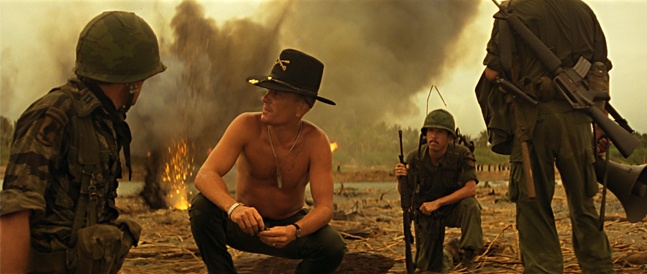
The film is famously a transposing of Joseph Conrad’s Heart of Darkness into Vietnam. Captain Willard (Martin Sheen) is ordered to head down the river to “terminate with extreme prejudice” rogue Special Forces Colonel Kurtz (Marlon Brando), who is conducting his own vigilante war. On the boat trip down the river, Willard encounters a host of increasingly bizarre and surreal scenes, from war-mad Colonel Kilgore (Robert Duvall) to a seemingly leaderless battle over a bridge, a playboy bunny show and a compound of ex-French colonials. And that’s before he even arrives at Kurtz’s compound and things get really strange.

Apocalypse Now is almost impossible to separate from the bizarre, tortuous route it took to get to the screen. Originally scheduled for a few months, the film took over a year to complete. A typhoon destroyed all the sets in the first two months. Original star Harvey Keitel was dismissed after a week (as his performance wasn’t right): his replacement, Martin Sheen, had a near-fatal heart-attack partway through filming. Marlon Brando not only turned up the size of a buffalo but refused to learn (or even speak) his lines. A year into production, the film had no ending. Coppola put his entire fortune up as collateral to complete the film. It was a nightmare.

But yet somehow what emerged has a sort of force-of-nature quality to it. Even though parts are basically pretentious rubbish, despite the fact I have twice fallen asleep in this film, despite the fact it is far from being a film that trades in complex ideas and offers profound insights, it still has a hypnotic quality about it. It’s done with a real force of commitment, a genuine labour of love, a film that doesn’t leave anything in the locker room but throws it all at the screen. The quality of what lands may sometimes be questionable, but the commitment with which it is thrown is beyond doubt.

And in a world of cookie-cutter films, it’s hard to have anything but respect and regard for a film that is so defiantly its own animal, that tells its story in its unique way. It’s perhaps one of the first “experience” films: no film could of course communicate what it was like to serve in Vietnam, but this film perhaps gets close to the surreal, drug-fuelled madness in that conflict.

Because Apocalypse Now is a very surreal film. Its plot is extremely thin, and each section of its (mammoth) runtime is all about experiencing another element of the American experience. In the commentary, Coppola talks about the river trip being partly a journey from the present into the past, a journey back not only into the history of the conflict (and its different stages) but also the regressing of mankind itself into a more primitive, malleable, basic state. It’s a big lump for a film to bite off – and I’m not sure if the idea really comes across without you knowing it. The real impression you get is of rules of society being left further and further behind.

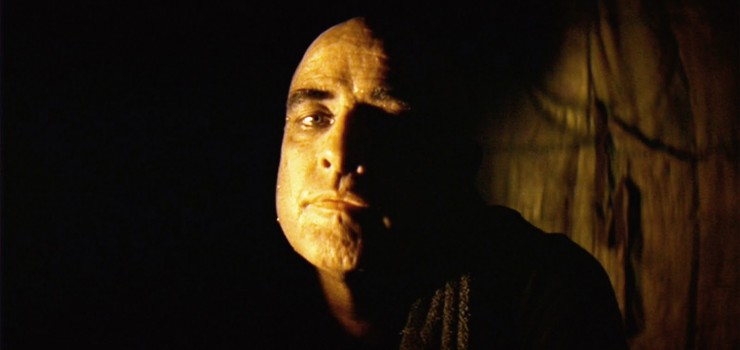
The arrival at Kurtz’s compound is the fufillment of this increasingly unnerving story. We’ve seen the madness on the journey, the pointlessness, and the bemused, carefree confusion of the crew. But at the camp we get the overblown, decadent lunacy of Kurtz. Brando dominates the final 30 minutes of the film, although his monologues are meaningless drivel, the sort of intellectual point-scoring you could hear in a sixth form debating society. To be honest, iconic as Brando’s appearance is, his performance of mumbling battiness is actually a little awful (like one big practical joke from the actor) and the film’s momentum grinds to a halt while he babbles on. 

In fact, so self-indulgent is Brando that in a way it’s a sort of tribute to Coppola’s mastery of cinema that he makes this pompous character make any sense at all – or that he makes this sort of nonsense even remotely watchable. But again it’s the hypnotic pull of the film: Coppola builds towards a chilling, haunting final sequence of Willard and Kurtz’s final confrontation intercut with The Doors’ The End and the real-life slaughtering of an ox by a crowd of real-life villagers (they were going to kill the animal anyway but offered to do it for the camera). Coppola somehow turns all this into iconic cinema, even though, viewed objectively, it’s overblown, indulgent, pretentious rubbish.

The whole film is a testament to hewing compelling filmmaking out of breathtaking insanity. After the film departs in the boat, most of reason, sense and conventional story-telling depart with it. Information only gets conveyed through rambling monologues from Willard. The crew of the boat get into scraps that reflect heightened versions of the American experience in Vietnam – from a war crime as the crew shoot-up what turns out to be an innocent boat, to an attack from unseen tribesmen with spears from the mists of the shore. Sam Bottoms, as surfer-turned-GI Lance, is our guide of a sort here – as he gets more stoned, so narrative logic departs with his senses. 

What keeps the film going throughout is the masterful film-making. Coppola shoots the bizarreness with brilliant, visionary imagination. As a social theorist he’s pretty basic – man is, by the way, a savage animal and the Americans didn’t know what they were getting themselves into in ‘Nam – but as a film-maker he’s one of the best. Who else could have made three hours of episodic boat journeys so strangely compelling? The film is crammed full of great scenes and moments which rarely feel like they tie together – in fact, they could almost be watched in any order – and there is barely a character in there, but the film feels like its throwing you into the madness of Vietnam. 

Even the sequence with a bit more narrative is still laced with absurdity. Kilgore’s helicopter assault on a village – and its use of Wagner blaring from helicopters to scare the Vietcong – is justly famous. This is a bravura film-making – and as much a tribute to the astoundingly amazing editing and sound work of Walter Murch as it is the photography of Coppola. Like most of the rest of the film it is visually outstanding, but it also has the film’s best writing (in the quotable but also strangely subtle characterisation of Kilgore) and also the film’s most iconic performance in Robert Duvall. Duvall is terrific as the war-loving, but strangely childish Kilgore, obsessed with surfing and with an ability to live totally in the moment. 

This sequence doesn’t hesitate in showing both the brutality of war – and also the insanity of our commanders. Kilgore is genuinely dreading the end of the war, and you can see why he would since he is clearly having a whale of a time bombing places. Kilgore is a lovable, quotable badass doing what needs to be done – but the film doesn’t forgot that he is also an insane soldier with no off-switch. And Apocalypse Now never really glamourises war, for all the excitement and beauty of watching those helicopters come over the horizon.

It’s the artistry in its film-making, and the genuine effort and work that helps make it a demented classic. Walter Murch’s sound design and editing is possibly flawless – this might be the best edited and sound designed movie ever – from the opening moment when the helicopter blade sounds transform into a hotel room fan you know you are seeing something special. Scenes such as Willard’s hotel-room breakdown hum with intensity as they feel genuinely real – that scene in particular feels like Martin Sheen exposing part of his tortured psyche at the time. Sheen is by the way perfect as Willard, a slightly unknowable killer with dead eyes and a dead soul, still aware of the vileness of his world.

Apocalypse Now is a sprawling batty film – and in many ways an intellectually empty one straining at a depth that ain’t there. But somehow, for all that, it still is a masterpiece. Which is in itself a bit of a miracle as it really should be a disaster. It’s pretentious. It’s overlong. It’s very full of its own importance as a work of art (the re-insertion of the long-winded political discussion at the French Plantation into the Redux version doesn’t help). Some of its performances are plain ridiculous, verging in Brando’s case on outright bad. But yet, it’s delivered with such force of conviction, it’s so wonderfully assembled, so hauntingly shot and edited, that it hammers itself into your brain. You literally can’t forget it, for all its many, many flaws. Despite yourself, you find yourself forgiving it an awful lot – a lot more than you might expect. A mess, but also a classic.

Three Colours: White (1994)

Zbigniew Zamachowski confronts the problems of revenge in Kieślowski’s Three Colours: White

Director: Krzysztof Kieślowski

Cast: Zbigniew Zamachowski (Karol Karol), Julie Delpy (Dominique Vidal), Janusz Gajos (Mikolaj), Jerzy Stuhr (Jurek), Aleksander Bardini (Lawyer), Grzegorz Warchol (Elegant man), Cezary Harasimowicz (Inspector), Jerzy Nowak (Old farmer), Jerzy Trela (Monsieur Bronek)

The second film in Kieślowski’s ambitious thematic trilogy probably couldn’t be much more different from the first. Whereas Blue was a romantic tragedy, this is a sort of bitter comedy, a kind of anti-farce if you like. Here, the themes of equality are much more about getting even rather than all men being equal. Just as Blue looked at the negativities of liberty, this looks at the dark side of equality, and the blinkered tunnel vision we follow in order to get ourselves even.

Polish hairdresser Karol Karol (Zbigniew Zamachowski) is divorced in Paris by his French wife Dominique (Julie Delpy). In quick succession, Dominique strips him of his home, access to their bank account, his passport and his share of the business, and takes another lover. Reduced to homeless penury on the streets of Paris, Karol finally finds a way to get home to Warsaw by befriending sad-sack successful businessman Mikolaj (Janusz Gajos), a fellow Pole, on the Métro. With Mikolaj’s help, Karol finds himself back home and soon in a position to start scheming his revenge.

White is, let’s be honest, a lot less of a triumph than Blue. That was a film that combined stunning visuals, directorial invention, profound depth and emotion. It was a story that looked at universal themes from a fascinating series of new angles. White,however, is more of a shaggy dog story. It feels like it’s aiming for some sort of Chaucerian fable, but it never really goes anywhere in particular, and it never really engages as much as it should while it tries to get there. While it’s not unentertaining film, it’s at best a good one rather than a great one.

My main problem is that Dominique’s character just never clicks. Why does she do the things she does? No idea. We are never given any insight into her character – she remains a cipher, bordering on a trope of the wicked beautiful seducer. Why does she jilt Karol? Surely it can’t be because of his (rather obvious) impotence ever since he arrived in France, and felt isolated in his new home? Why does she take such a delight in persecuting him, even down to audibly having sex with her lover when he calls her (“Perfect timing” she says before getting frisky)?

It’s hard not to get the sense of a film which has a slight suspicion of women. I don’t imagine that this a suspicion Kieślowski  in any way shares – sensitive and humane portrayals of women are central to his films (not least Blue) – but when the only female character in this is the distant and unknowable Dominique it’s not good. Without any sense of why she has done the things she does, it’s hard to feel comfortable with the semi-comic destruction of her Karol plans.

But then that is part of the film’s point: Karol is obsessed (without even really knowing it) with his wife. Not even so much with revenge for that matter – just getting the chance to take on his wife in a one-sided struggle makes him feel closer to her. The only possession he takes home from Paris is a bust that reminds him of his wife (and which he painstakingly repairs after it is smashed to pieces). Much as tries to build a new life, it’s a monofocus – he only gets what he gets in order to use the resources against his ex-wife. 

So equality is in Kieślowski’s design, not a good thing. Shy, sweet Karol basically ends up entrapping himself and his wife in equally frustrating positions: she in prison, he faking his own death without a penny. What was the point for Karol? No wonder he looks up at her in prison with tears rolling down his face – he’s still in love and he’s got nothing to really show for his equality, other than their joint misery.

All of this sits alongside Kieślowski’s brilliant understanding of post-Cold-war Poland, a bustling land of opportunity to make a quick buck, where simple peasant farmers can be bamboozled out of their land by smarter guys who know businesses from the West are just dying to buy up properties. Karol shares this understanding of Poland. No wonder he’s all at sea in the rest. The instant he arrives back he’s delighted, relaxed and more confident – “I’m home!” he cries joyfully, even when his first view on arriving in Poland is a mass rubbish dump. 

Moments like that show Kieślowski’s dry comedy. There are plenty of other moments, helped by Zamachowski’s pretty lovable performance of the naïve-but-growing-in-confidence Karol. Karol and Mikolaj (an excellent Janusz Gajos) put together quite an excellent double bill of bromance laced with darker themes of depression (it’s no real surprise who Mikolaj is talking about when he tells Karol that he will help him if Karol can help his “friend” who wants to die but can’t kill himself). Karol’s hapless fate in Paris raises a few smiles, as does his surreal escape stuffed in a suitcase.

But there aren’t quite enough of them. Too much of the film either doesn’t connect or hold together. I could have certainly done without Karol’s sexual prowess returning once he is confident and rich in Poland (yawn!). Dominique’s non-character remains a serious problem, and there just isn’t enough meat on the bones here. Compared to the richness of the first entry in the series, this feels remarkably empty. It’s also a lot less visually arresting and imaginatively done than the first film: I’m already struggling to remember any of the visuals.

Kieślowski may well have wanted a sort of anti-comedy to be the pivot of his trilogy, but it doesn’t really work here. He ends up with something that feels so slight and underdeveloped that it doesn’t stick with the viewer, and doesn’t engage them either. While it has moments, as you would expect from a great director, and some very good actors, it doesn’t have nearly enough of them.

Mary, Queen of Scots (1971)

Vanessa Redgrave and Glenda Jackson are the feuding queens in Mary, Queen of Scots

Director: Charles Jarrott

Cast: Vanessa Redgrave (Mary, Queen of Scots), Glenda Jackson (Elizabeth I), Patrick McGoohan (James Stuart, Earl of Moray), Timothy Dalton (Lord Henry Darnley), Nigel Davenport (Earl of Bothwell), Trevor Howard (Sir William Cecil), Daniel Massey (Robert Dudley, Earl of Leicester), Ian Holm (David Rizzio), Andrew Keir (Ruthven), Robert James (John Knox), Katherine Kath (Catherine d’Medici), Frances White (Mary Fleming), Vernon Dobtcheff (Duke of Guise)

So here we are, back in the Tudor history craze of late 1960s Hollywood. Charles Jarrott directed, following up his efforts in Anne of the Thousand Days with this professionally mounted, handsome and rather personality-free film adaptation. It occasionally falls a bit too much in love with its luscious romanticism – and it falls hard for Mary herself, surely one of the worst queens ever – but despite all that, it has an entertaining quality that never lets you down.

The film picks up with the recently widowed Mary (Vanessa Redgrave) essentially being chucked out of France after the death of her husband the King, and swiftly being sent back to Scotland to take up the throne there. Problem is: the very Catholic Mary isn’t exactly the choice of the lords of Scotland – led by her bastard brother James Stuart (Patrick McGoohan). Mary’s Catholicism also threatens to destabilise the relationship with Protestant England – particularly because she is the nearest successor to Elizabeth I (Glenda Jackson). But Mary lacks Elizabeth’s tactical understanding of ruling and is guided by her heart – leading her into a disastrous marriage with feckless alcoholic Henry Darnley (Timothy Dalton).

Mary Queen of Scots is a stately picture, which uses its location shots, costumes and production design to tell its familiar story with a sweep and relish that effectively hides the lack of inspiration in its film-making. Just as in Anne of the Thousand Days, Charles Jarrott shows he’s a fine producer of middle-brow entertainment, safe costume dramas that aren’t going to challenge anyone’s perceptions or give you any real wow moments of filming. He’s happy to set the camera up and let the actors do their thing, with the script ticking off the great events.

That’s what you get here. It’s a film that could have been a lot more of an exploration of the rivalries and different life philosophies of its feuding queens. But it doesn’t quite connect with that. This is partly because it can’t quite bring itself to engage with the reality of Mary herself, preferring the popular romantic image. The film doesn’t want to admit that many of Mary’s decisions were, to put it bluntly, completely misguided bordering on wrong. It is in love with her romantic image – and not as enamoured with Elizabeth’s wiser, more pragmatic, manipulative rule. It’s this rule by heart rather than head the film finally holds up for praise.

It doesn’t help that Vanessa Redgrave feels miscast in the lead role. Redgrave is too sharp an actor to convince as someone as easily led and foolish as Mary. She looks too shrewd, she feels too smart. Redgrave compensates by speaking softly and giving a lot of love-struck eyes to various male actors (principally Nigel Davenport’s bluff, masculine Bothwell), but it doesn’t quite work. It’s like she’s struggling to find the character – and to find the balance in a film that doesn’t want her to be seen as too stupid, while the viewer is left slapping their foreheads at every action she carries out.

This feeling stands out all the more with Glenda Jackson’s casting as Elizabeth. Having just finished playing the same role in a landmark six-part TV series, Elizabeth R(which covered a lot of the same ground), Jackson here confirms that she was the definitive Elizabeth. As smart and shrewd an actress as Redgrave, Jackson’s natural firmness marries up very well with these qualities to make the perfect Virgin Queen. There have been so many others who have taken on the role, but Jackson is simply perfect in this role – she becomes Elizabeth. Her Elizabeth is clever, manipulative, cunning but also quick tempered, capable of great wisdom but prone to moments of passionate lashing out.

The rest of the cast is a familiar parade of character actors – British actors of this generation made a living from films like this! Timothy Dalton stands out as a foppish, clearly useless Darnley (here reimagined as a syphilitic bisexual with anger management issues), as does Ian Holm as a cool-headed, would-be power behind the throne David Riccio, who meets a tragic end. Daniel Massey does a decent job as Leicester (though I can’t shake memories of Robert Hardy in the same role in Elizabeth R – was he busy at the time?), Trevor Howard gets saddled with a lot of plot as Burghley. Up in Scotland, Patrick McGoohan has a lot of fun as a scheming Earl of Moray.

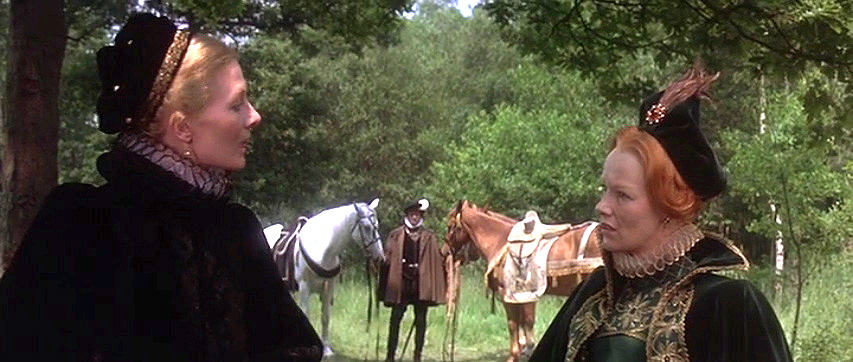
All of these actors fit comfortably into the slightly browned, grainy photography style of films of this type, and the screenwriters hammer together plenty of incident alongside dramatic invention. The focus on the soap opera of Mary’s three marriages (she’s widowed in the opening moments of the film) leaves plenty of scope for invention, from Darnley and Riccio’s affair to the inevitable non-historical meeting between Mary and Elizabeth – it seems like every drama going from Schiller onwards has invented a meeting between these two as a dramatic highpoint.

This final scene captures the lack of thematic depth to the film. In a film that had focused more on really comparing the differences between the two, this could have been the culmination of a debate running through the film (can you rule with a brain but not a heart?). Instead it misses the trick, and becomes a final game of one-up-man-ship, which the film allows Mary to win because she is the more romantic figure. 

It’s well mounted and assembled like many other films like this – but it’s not the best of its genre, and you do sometimes wish for something that had a little more meat on its bones.

Harry Potter and the Deathly Hallows Part 2 (2011)

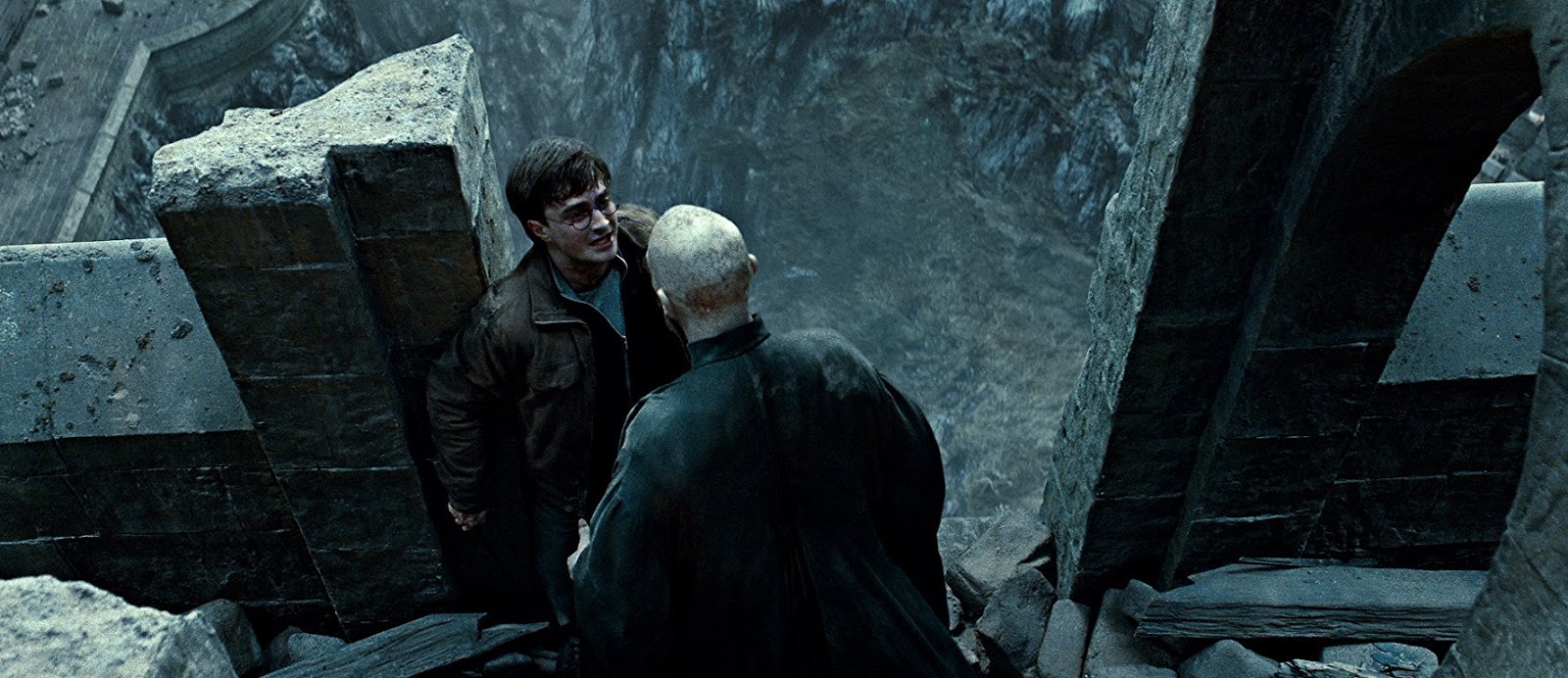
Harry and Voldemort prepare for their final showdown in Harry Potter and the Deathly Hallows Part 2

Director: David Yates

Cast: Daniel Radcliffe (Harry Potter), Rupert Grint (Ron Weasley), Emma Watson (Hermione Grainger), Helena Bonham Carter (Bellatrix Lestrange), Jim Broadbent (Professor Slughorn), Robbie Coltrane (Hagrid), Ralph Fiennes (Lord Voldemort), Michael Gambon (Albus Dumbledore), John Hurt (Ollivander), Jason Isaacs (Lucius Malfoy), Gary Oldman (Sirius Black), Alan Rickman (Severus Snape), Maggie Smith (Professor McGonagall), David Thewlis (Remus Lupin), Emma Thompson (Professor Trelawney), Julie Walters (Molly Weasley), Mark Williams (Arthur Weasley), David Bradley (Argus Filch), Ciarán Hinds (Aberforth Dumbledore), George Harris (Kingsley Shacklebolt), Gemma Jones (Madam Pomfrey), Kelly MacDonald (Rowena Ravenclaw), Helen McCrory (Narcissa Malfoy), Miriam Margolyes (Professor Sprout), Geraldine Somerville (Lily Potter), Adrian Rawlins (James Potter), Warwick Davis (Griphook/Professor Flitwick), Matthew Lewis (Neville Longbottom), Evanna Lynch (Luna Lovegood), Bonnie Wright (Ginny Weasley), James Phelps (Fred Weasley), Oliver Phelps (George Weasley), Domhnall Gleeson (Bill Weasley), Clémence Poésy (Fleur Delacour), Guy Henry (Pius Thicknesse), Nick Moran (Scabior), Natalie Tena (Tonks)
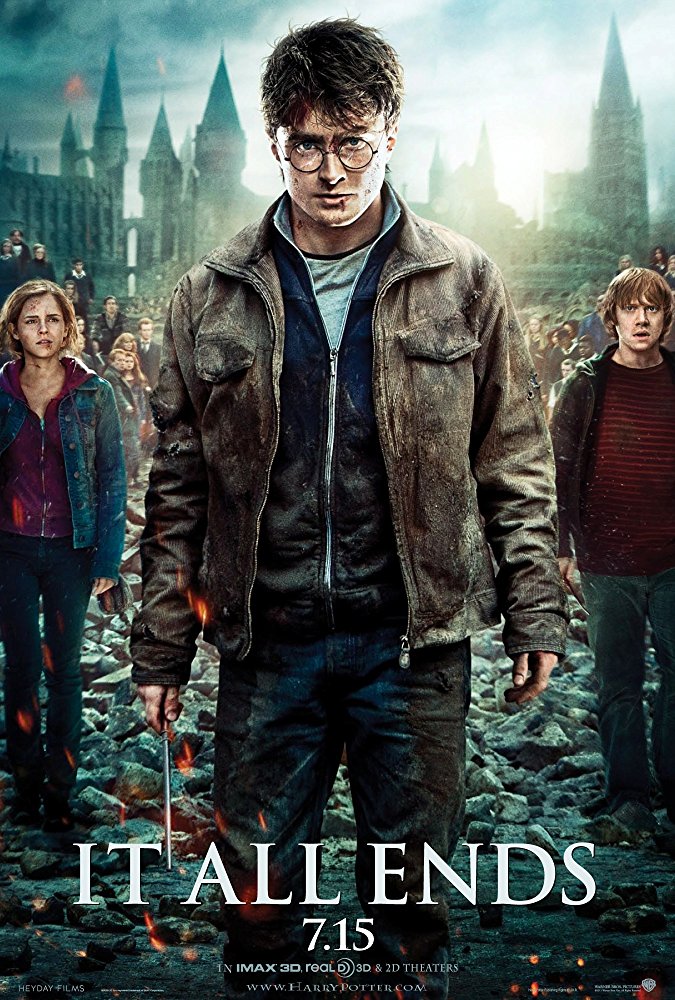
And so here we are. After 19 hours and 40 minutes, the Harry Potter franchise draws to a close in the rubble of Hogwarts. The franchise goes out swinging for some big hits – and it misses some of them – but at least it’s trying. If this turns out to be one of the least satisfying films in the franchise (at best the 6th best Harry Potter film), it’s not because they haven’t thrown anything at it.

The film adapts just under the last half of JK Rowling’s final novel. In an interesting structural twist, it actually ends up covering just over one day of time: between our heroes breaking into Gringotts Bank and the final confrontation between Harry and Voldemort, less than 24 hours has taken place. Nothing is really made of this in the film, but it’s an interesting thought. In fact Yates’ film is full of interesting half-thoughts that never go anywhere. More than any other film in the series, this is one where it is essential you’ve read the book before viewing it. Without the book you don’t get any of the rich context for most of the events.

This all culminates, for me, in the way the film falls apart in the last 20 minutes or so. This final section of the film changes, or cuts, so much of the book’s thematic depth, so many of its plot strands and explanations, that every time I see it I feel my disappointment starting to rise. I don’t want to be the guy who says “just shoot the book” – but if any film could have stuck with the book it’s this one. Why did they cut and change so much of this stuff? Did they really think, after almost 11 years and 20 hours of screen time, we wouldn’t have the patience for some of the more complex things from the book? Did they really feel that they had to stamp their own distinctive vision on it? Anyway, here are the things that always annoy me about this film:

1. Dumbledore’s backstory gets forgotten

Okay this is a minor one – and the film does leave some hints in. But for GOODNESS’ SAKE, they cut this book into two films, spent ages in the first film talking about the mysteries of Dumbledore’s dark past, then just as we meet Dumbledore’s brother Aberforth (a neat turn from Ciarán Hinds) and are about to get an explanation, Harry basically says words to the effect of “I’m not worrying about that. And neither should you folks. On with the film”.  

Even the Ghost of Dumbledore doesn’t get to explain any of this stuff. All the careful mood build of Part 1 is just thrown away. The book is about learning about death, the futility of the search for power, and humility. Dumbledore’s backstory of failed ambition is a massive part of this – and it gets dropped. It’s not like we didn’t have time in a series that has churned out films pushing up to three hours in length. I mean why put all that stuff in the first film, if you aren’t even going to reference it at all in the second film?

2. The Deathly Hallows get benched

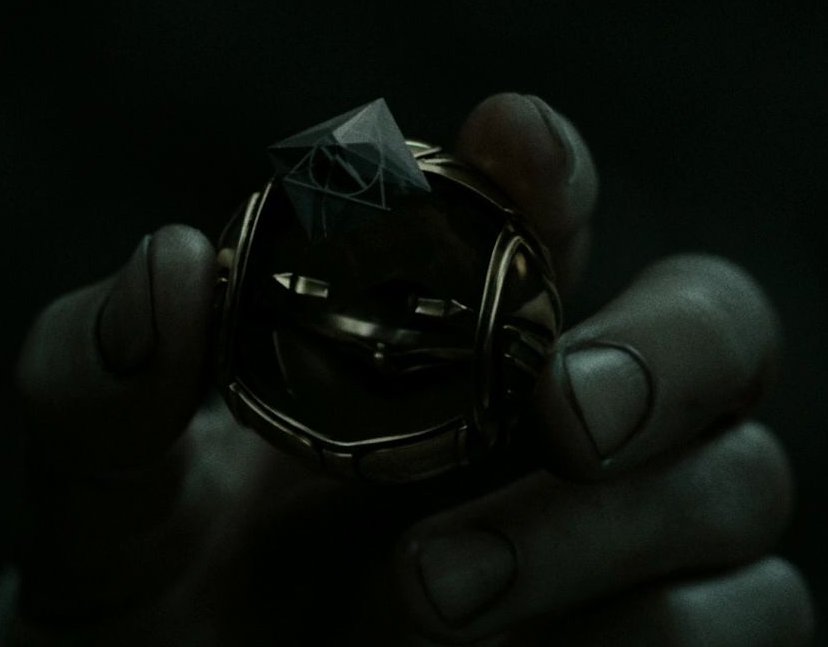
Again wouldn’t be quite so bad if we hadn’t spent a huge amount of time in the first film talking about them – but are the words Deathly Hallows even mentioned here? Instead, just like Voldemort, the film is seduced by the elder wand, focusing everything on the ownership of this MacGuffin. The point of the book is that all this stuff is a chimera –and that the real point is learning that death should not be feared but accepted at the proper time. 

As it is, this never gets built on – and the importance of the resurrection stone (including why it tempted Dumbledore so much) never gets explained. Rather it just comes down to who controls the powerful thing, with none of Rowling’s richer themes.

Harry ends up controlling all three here but we never really get the sense of Harry controlling them all, or understand his decision to throw away the stone, or his realisation that death is not to be feared but accepted.

3. Neville gets blown away

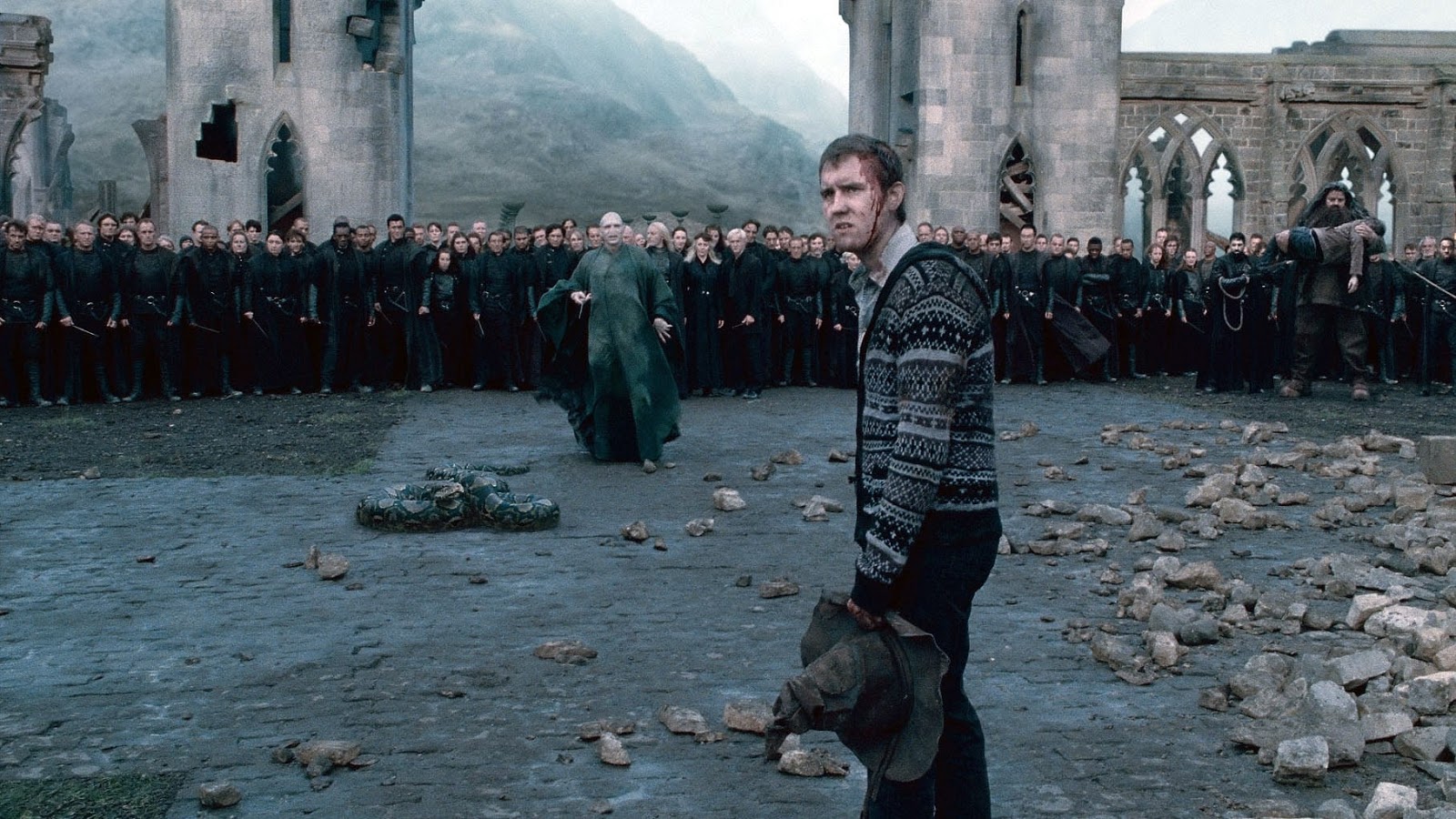
Gotta feel sorry for Matthew Lewis (who is very good here). Reading the book he must have been thrilled: “So I pull the sword out of the sorting hat and then in one move cut the head off the snake like a total bad ass”. This should have been a great moment (it’s an iconic one from the book). Instead Neville gets blasted and, presumably to give them something to do, Ron and Hermione spend ages trying to kill the snake (intercut with Harry and Voldemort fighting) until finally Neville gets to lop that head off – by which point the moment has well and truly passed.

 4. No one mentions Voldemort keeps making the same mistakes

In the book, Harry has a beautiful moment where he basically tells our Tom that he’s made the same mistakes over and over again. Namely that, by killing Harry, who sacrificed himself for love, he made exactly the same mistake as he did with Harry’s mother and now cannot harm any of those Harry died for (i.e. the rest of the cast). It’s a great moment, where finally Harry understands what the novels have been building towards. Doesn’t merit a mention.

Neither does Voldemort’s childish obsession with famous things – he is consumed with belief in the power of a wand, he can’t let go of associating his horcruxes with famous things and the lineage of iconic wizards, etc. etc. Voldemort is basically a big, silly, empathy-free, sulky teenager – the film misses this point entirely.

Instead of explanations and depth, the film reduces Harry and Voldemort’s final clashes into dull punchy-bashy stuff. The director clearly fell in love with the visual idea of Harry and Voldemort’s heads merging together while apparating. This is a visual image that I hate because it (a) feels like showing off and (b) would only work if they were semi-reflections of each other – which they certainly aren’t. They are polar opposites. It’s a flashy effect that actually makes no thematic sense what-so-bloody-ever.

5. Voldemort goes out like a 3D special effect

Perhaps not a surprise in a film, but Voldemort gets killed and disintegrates into a huge puff of 3D-film smoke. I hate this. I hate it. I really, really, really hate it. I’ll tell you why:

  • The spells used in the duel are really unclear – it’s a great moment in the book that Voldemort’s killing curse rebounds against Harry’s disarming curse – instead we get the bright lights.
  • Voldemort dreads death more than anything – and Rowling’s writing of his body falling dead to the ground like any other normal dead guy taps exactly into what Voldemort spent his whole life struggling against. It’s a beautiful irony.
  • No one knew if Voldemort was dead or not the first time because he disappeared. In the book he is killed, by his own curse, in front of everyone and his body is left behind for everyone to look at and say “yup. Guy is dead”. Not here. Here he blows up in a puff of smoke in front of no witnesses. Did Harry just head back into the great hall and say “Okay guys. Take my word for it. He’s dead. He just is. Trust me on this. It’s not like last time. Totally dead. Promise.”

Wow. Okay that’s not really a review is it? That’s just like a disappointed fan whining “I don’t like it because it is different”. But my point isn’t that this is bad because it’s different. It’s bad because it takes stuff from the original and changes it AND NOT FOR THE BETTER. Moments that worked beautifully, or carried so much weight in the original are bastardised crudely for no clear reason.

As I say, after almost 18 hours and a life time (for many viewers) of growing up with these characters: surely we could have given the film a bit more time and allowed some actual intelligent context from the books to creep in? Surely we had the patience for Harry getting to point out to Voldemort how wrong he is? Everyone in the audience was ready for that right? If there was one film people were probably willing to dedicate three hours of their life too, in order to see it done properly it was this one, right? Rather than rushed by in a little over two?

But no this film goes always, always, always for the big spectacle. Not that this always work: Yates doesn’t shoot the battle hugely well. Aside from one excellent sequence which shows our three heroes trying to get across the castle courtyard, while chaos rages around them (beautifully scored as well), the battle is unclear, dingy and not hugely exciting. Again, I’d have liked to have had a bit more of this – to get some moments with this huge cast doing stuff in the battle (especially since they are ALL back – kudos to the producers there).

It’s a real, real shame because honestly parts of this movie are really, really, really good. Tom Felton is cracking again as Draco – and the film gives real development time to showing the impact all this has on the Malfoy family with genuine empathy. The break-in at Gringotts is exciting and fun – as well as giving Warwick Davies his best moment in the series as two-faced Griphook. Inventions and flourishes, such as Harry having visions of an enraged Voldemort slaughtering the staff of Gringotts in fury, are chilling.

Some moments of the book are carried across really well, in particular Snape’s escape – a powerfully filmed sequence of bravery from the pupils, and some great work from Maggie Smith. Yates really understands how to get moments of magic to work: the creation of the shield around Hogwarts is totally spine-tingling. When the film sits and breathes it generally gets it right. Fiennes is terrific still as Voldemort, serpentine, arrogant, unsettling. He gets some lovely moments here – from fury, to pained fear (as horcruxes bite the dust) to an almost-funny-awkward-mateyness as he tries to seduce Hogwarts pupils to his side (his awkward hug of Draco is terrific).

The three leads are of course great. Daniel Radcliffe could certainly have delivered the more complex moments of the book if he had been given the chance. He even does his best to sell the slightly awkward coda “19 years later”: a controversial sequence, it makes a great footnote in the book but it was always going to be a tough ask to make three teenagers look like 40 year olds convincingly, particularly when we are nearly as familiar with their faces as our own.

There are some troubling and failed moments in this film, stuff that doesn’t work. But then there is this:

Oh wow. For all that the film changes stuff from the books for the worst – this is a moment it unquestionably does better. And a massive, massive part of this has to be down to Alan Rickman. Rickman was told this backstory from the start of the films – and he delivers it with a passionate commitment here. Helped by brilliant score, and fascinating re-editing of moments from previous films seen from new angles, Rickman delivers the reveal of Snape’s heartbreaking moments perfectly.

Was I tired? Was it the added impact of Rickman’s own depth? I don’t know but I shed tears watching this again. It’s just a beautiful, beautiful, beautiful piece of film making. Everything in it works perfectly: directing, writing, music, editing, filming and above all the acting. It’s just sublime. For all the film misses the point elsewhere it finally totally gets it here. I would take this moment over dozens of moments of Harry and Voldemort fighting each other.

And yes this Harry Potter film might miss the point, and it might bungle the ending, and it might well fail to carry across the richness and intricate plot explanations of Rowling’s original. Yes it gets bogged down in “who controls this wand” and yes it misses the point completely about the film being about learning to overcome a fear of death and defeat (something Voldemort totally fails to do) but then it has moments where it works wonderfully like this. 

But in these films we got a beautiful franchise, with some excellent films. It’s always going to reward constant viewing. And it will always move the viewer. And it’s always going to be great.

Always.

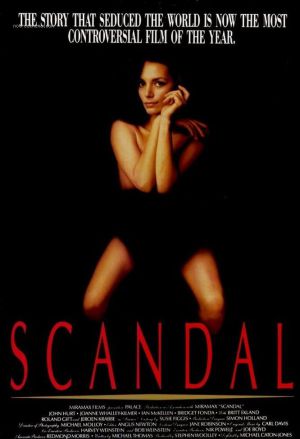
Scandal (1989)

Joanne Whalley and John Hurt get unwisely wrapped up in the Profumo affair in Scandal

Director: Michael Caton-Jones

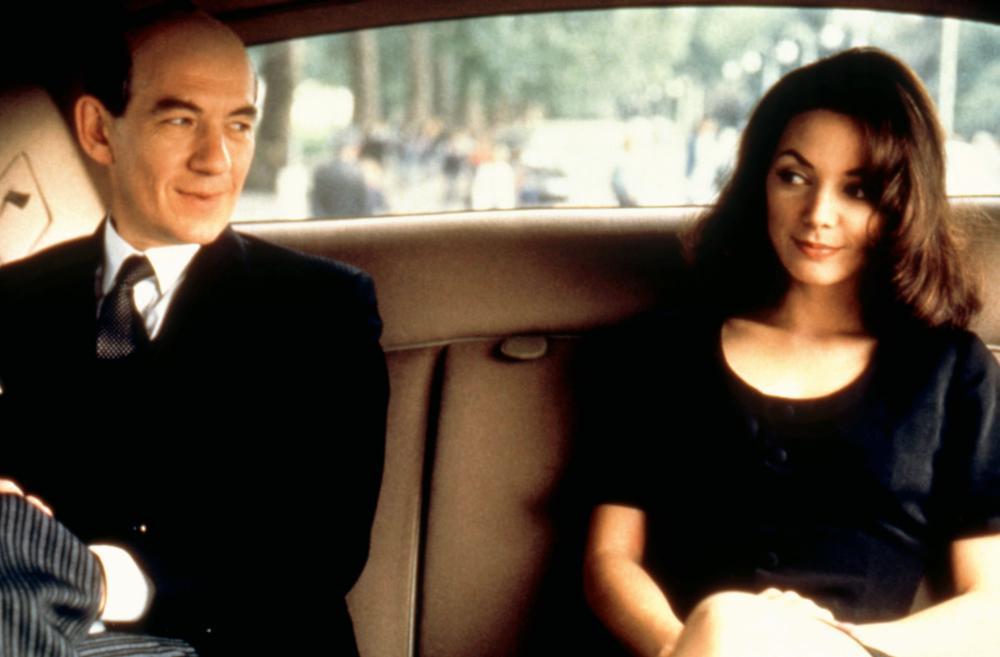
Cast: John Hurt (Stephen Ward), Joanne Whalley (Christine Keeler), Bridget Fonda (Mandy Rice-Davies), Ian McKellen (John Profumo), Leslie Phillips (Lord Astor), Britt Ekland (Mariella Novotny), Jeroen Krabbé (Eugene Ivanov), Daniel Massey (Mervyn Griffith-Jones), Roland Gift (Johnny Edgecombe), Jean Alexander (Mrs Keeler), Deborah Grant (Valerie Hobson), Alex Norton (Inspector), Ronald Fraser (Justice Marshall), Paul Brooke (Sergeant), Keith Allen (Reporter)

In 1963 the British Government was nearly destroyed by a sex scandal. John Profumo, Minister for War, was widely suspected of conducting an affair with Christine Keeler (a former show girl turned society figure) at the same time as she was sleeping with Russian naval attaché Eugene Ivanov. Profumo denied it to the House of Commons. A few weeks later he confessed he had lied and resigned from Parliament. The scandal shook the country to the core, and led to an exhausted Harold MacMillan’s resignation as PM. As the scandal span out to reveal sex parties in country homes, the country couldn’t get enough of the discovery that large numbers of the upper classes enjoyed nothing more than swinging, orgies and indiscriminate sex laced with sado-masochism. 

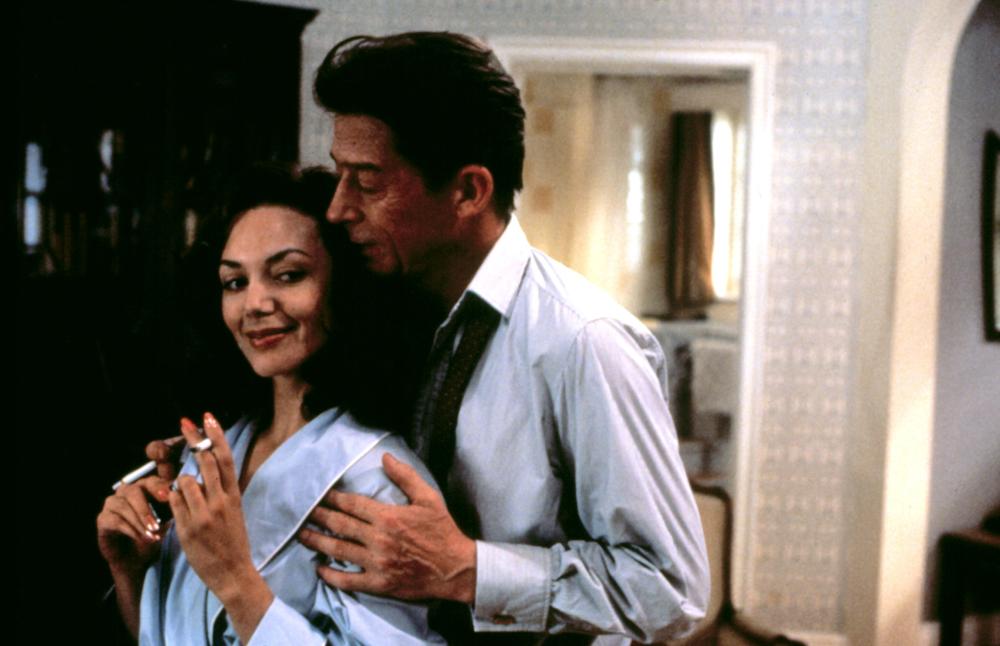
Scandal reconstructs the build-up to and eventual explosion of controversy around this affair, focusing on Keeler (Joanne Whalley) and Stephen Ward (John Hurt), the society osteopath and friend to the rich and famous who had worked out that if he found and coached attractive young girls, Henry Higgins-style, into engaging and fun companions, he could swiftly move up the social ladder by giving the rich and powerful people they could sleep with. When the Profumo affair blew up, it was Ward who was left holding the parcel: abandoned by his rich and powerful friends, Ward was placed on trial as a pimp, vilified in court and in the press, and eventually committed suicide the night before the court case finished (which convicted him in absentia of living off immoral earnings).

It’s this miscarriage of justice that Scandal zeroes in on – and the film does a good job of showing that Ward basically didn’t really do anything that wrong. He didn’t mistreat the girls, he thought he was helping them improve their lives and he didn’t attempt to blackmail his friends. His own sex drive seems curiously disconnected (he was clearly more of voyeur) and if anything, John Hurt (excellent as always) plays him as a slightly sad social-climber. A sort of Horace Slughorn of sex, far more excited by his bulging address book, access to the exclusive clubs of London and calling lords of the land by their matey nicknames, than by all the nooky.

Scandal however is a rather unemotional, unengaging and distant film. It’s hard to get too wrapped up in, as it too often goes for documentary checklist rather than real character engagement. On top of that, it’s often rather unclear – it’s tricky to tell the exact timelines, it’s hard to see often how some events relate to others, it’s unclear in particular how Christine Keeler’s relationship with jazz promoter and drug dealer Johnny Edgecombe led to exposure. It’s a film that’s both in love with telling the facts and so blinded by them that it doesn’t turn them into an engaging story.

But then perhaps part of this is because looking back today, it’s hard to see what all the fuss was about with the Profumo affair. After generations where government ministers have been accused of everything from toe-sucking to performing a sex act on a dead pig, it’s hard not to look at the Granddaddy of all government sex scandals and not think it rather quaint. Today it would barely merit more than few news cycles: and Profumo would certainly have been back in the cabinet within two years. Even the spy angle (was Profumo leaking secrets to Keeler, who in turn leaked them to Ivanov?) was widely (and almost immediately) discredited at the time. 

Not that the seismic impact really comes across anyway in the film. This is partly because the film focuses on Ward and Keeler in particular. For the two of them, there wasn’t much at stake – until their lives were destroyed. In fact, for most of these people at the various dodgy parties – other than embarrassing tittle-tattle – there wasn’t much at stake. A film that gave more space to Profumo – and really made-clear what he was running the risk of losing here, particularly after he lied to Parliament – might have made it clearer the dangers that all involved were inadvertently running.

But that would have been to dent the film’s purpose of showing Ward and Keeler as essentially innocents abroad. Joanne Whalley has a particularly difficult job as a Keeler so thoughtless, short-sighted and self-obsessed, she verges on the dim. Whalley makes her bright, engaging and fun-loving, but never with a whiff of sense. By the time Keeler is blurting out totally unconnected Profumo facts when speaking to the police about her relationship with Edgecombe, you can tell she doesn’t have a chance.

The film’s real strength though is John Hurt’s masterful performance as Stephen Ward. Hurt’s pock-marked face and ruddy complexion (going through a difficult divorce he allegedly spent most of the filming struggling with alcoholism) and slightly sweaty desperation are perfect for the role. A natural victim as an actor, he makes Ward always slightly desperate, always trying too hard, always the grammar-school boy pushing his nose up against society’s window. He’s a super creepy Henry Higgins grooming girls for a “better life” (his genuine belief!) and getting himself an entrée into posh society at the same time.  

Ward, the film argues, didn’t feel he was ever doing anything wrong – and he realises far too late that society, his posh friends and the government don’t agree. “It’ll blow over” he reassures Ivanov: totally wrong. Ward basically was a hedonist who wanted people to have a good time – and was thrilled to be invited to the party. When the shit hit the fan, he was dumped with the blame. It’s an angry note that the film – with its obsession with covering so much ground – fumbles slightly: it wants to be a searing indictment of the hypocrisy of the upper classes, but it fudges the emotional connection so much that you can’t feel it as much as you should.

Instead Scandal just sort of simmers rather than boils. It doesn’t communicate what a sea change this was in how Britain viewed its politicians and upper classes – from hereon they were always seen as men with feet of clay – and it doesn’t get the audience feeling as angry or engaged with things as you might expect. It has a lot of sex in it but (perhaps deliberately) it’s not sexy – the orgy scenes would make a great mood killer – and it seems to miss the hedonistic tone that dominated the class at the time. 

There is some decent directing – a scene of Mandy Rice-Davies and Christine Keeler preparing for a night on the town is particularly well done – and some strong acting, not least from Ian McKellen is a slimy Profumo (rumour has it a recently de-closted McKellen was keen on the role as it was the most hetrosexual role he could imagine playing!). But it never quite clicks together into something really emotionally engaging. And it isn’t quite as clear and easy to follow as you need. Structuring the story as a kind of love story between virtually the only people in the story who don’t have sex together is interesting – and Hurt and Whalley are good – but it’s just not quite a good enough film for what it wants to do.

Black Mass (2015)

Johnny Depp dives into his make-up box in this sup-par wannabe Goodfellas

Director: Scott Cooper

Cast: Johnny Depp (James “Whitey” Bulger), Joel Edgerton (John Connolly), Benedict Cumberbatch (William Bulger), Rory Cochrane (Stephen “The Rifleman” Flemmi), Kevin Bacon (Charles McGuire), Jesse Plemons (Kevin Weeks), Peter Sarsgaard (Brian Halloran), Dakota Johnson (Lindsey Cyr), Corey Stoll (Fred Wyshak), David Harbour (John Morris), Julianne Nicholson (Marianne Connolly), Adam Scott (Robert Fitzpatrick), Brad Carter (John McIntyre), W. Earl Brown (Johnny Martorano)

Well Goodfellas casts a long shadow doesn’t it? Certainly long enough to completely drown Black Mass which, despite some good acting and period detail, never really comes together into something compelling or engrossing or even really that interesting. But you’ve got to admire how often Scott Cooper must have watched Scorsese’s classic. Shame he didn’t bring anything new to the table.

In South Boston in the mid-1970s, James “Whitey” Bulger (Johnny Depp) controls organised crime. With his rule under challenge from rival gangs, Bulger turns informer to the FBI – specifically agent and childhood friend John Connolly (Joel Edgerton) – offering information on his rivals in return for being allowed to take over their business. Inevitably, Bulger exploits the relationship for his own gain – with the increasingly blind-eye of Connolly who becomes more and more embroiled in the underworld. 

So there are good things in this. The period detail is pretty good. There are plenty of good gangster moments, even if they’re the reheated leftovers from everything from The Sopranos to Goodfellas. The low-level gangsters we follow have a slightly different perspective – even if most of their characters are completely interchangeable. It’s interesting that Bulger moved in such legitimate circles as the FBI and his State Senate President brother (well played by Benedict Cumberbatch). But the film never really makes this come together to mean anything. You don’t learn anything, you don’t understand anything new – it’s just a series of events.

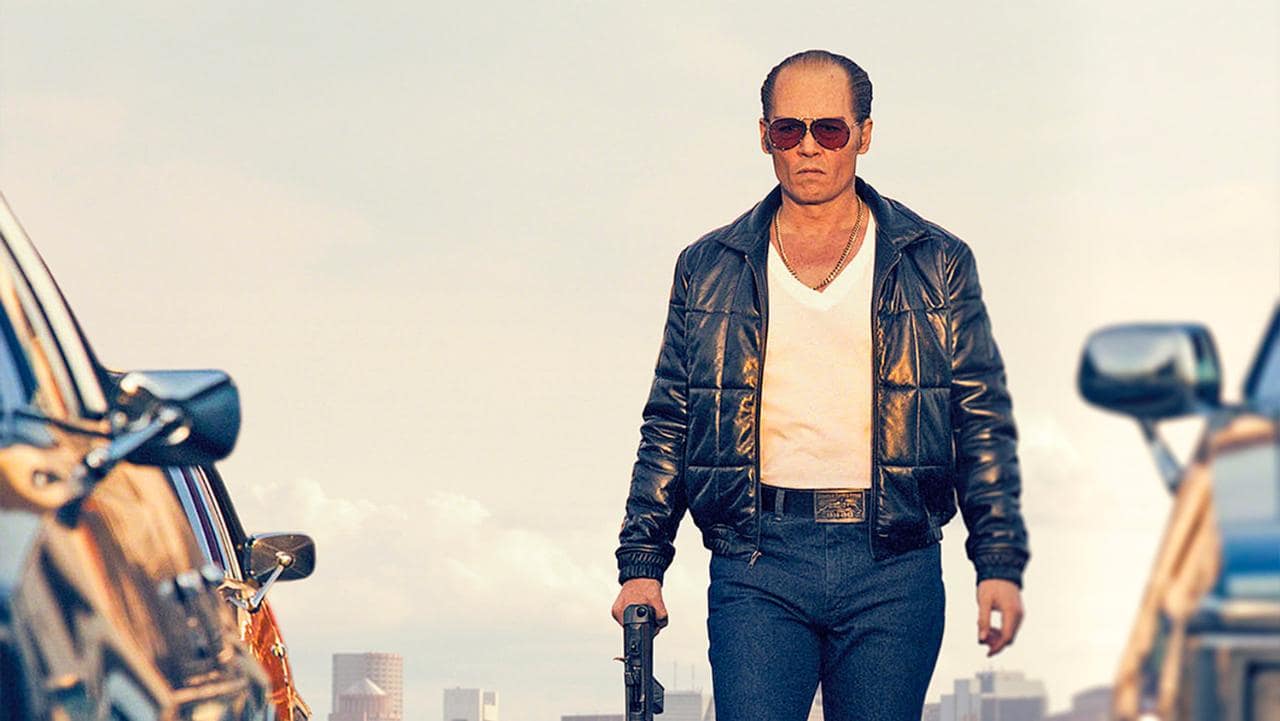
That’s despite, to be fair, a very good performance by Johnny Depp. Sure the part caters to Depp’s Olivier-like love of the dressing-up box – here he sports bad teeth, a bald patch, a paunch and a pair of searing bright-blue contacts that make him look like a Muppet demon – but for all that, he is very good. His natural presence works to make Bulger a leader and he has a swaggering, dry, cruel quality to him that never makes him anything less than unsettling. He also conveys the monstrous moral blankness behind Bulger, using a fig-leaf of loyalty to cover his destruction.

It’s a shame then that he’s not really given anything to do. Too much of the part is reminiscent of other things: from Jack Nicholson in The Departed (to be fair, Bulger was the inspiration for that character), to Joe Pesci’s “Do I amuse you?” speech or his insanity from Casino. Montages as tired as a sleepless night run through the collection of funds and the beating of rivals. It’s just all so predictable. It’s a box ticking exercise. Yawn.

The biggest shame is that, in Connolly, the film has a far more interesting potential lead character. Imagine it repositioned to follow him instead: the semi-chancer, semi-star-struck kid swept up in the glamour of crime. So much more interesting. How far did he turn a blind eye? How far was he essentially an accomplice? Did he feel or know he was doing the wrong thing? Consider Depp’s brilliance in Donnie Brasco and then imagine what he could have made of this Faustian figure: and what an interesting film we could have had.

Instead, good as Edgerton is, the film barely scrapes the surface of his thoughts or motivations. We get beats – and his wife (excellently played by Julianne Nicholson) is clearly disgusted by his gangster friends – but it constantly falls flat as we keep pulling back to Bulger, or internal FBI arguments that tell us nothing. On top of this Bulger’s empire is ham-fistedly explained: it’s never clear what his reach is, what his main crimes are or what his aims are. We see killings but don’t often know why – and a sequence in Miami is so poorly explained I still don’t know what it was about.

The film introduces Bulger’s lieutenants – but reduces them to identikit hangers on. All the flash-back retrospective confessions (a framing device the film uses to very mixed effect) in the world can’t turn them into characters. Even Bulger’s relationship with his patrician brother gets lost in the shuffle – again a film focused on a crime lord and his State Senator brother would have been more interesting.

Black Mass is well made – but its problem is that there is on the edges a far more interesting film that never comes into focus. If they had chosen a different focus we could have had a film worth watching. Instead, like Connolly, the film is seduced away by the dark soul of Bulger. Depp is great – but the film is so in love with him and his transformation that it becomes something completely forgettable.

Three Colours: Blue (1993)

Juliette Binoche seeks liberty from grief in Krzysztof Kieślowski’s masterpiece Three Colours: Blue

Director: Krzysztof Kieślowski

Cast: Juliette Binoche (Julie de Courcy/Vignon), Benoît Régent (Olivier Benôit), Emmanuelle Riva (Madame Vignon), Florence Pernel (Sandrine), Guillaume de Tonquédec (Serge), Charlotte Véry (Lucille), Yann Trégouët (Antoine), Hélène Vincent (La journaliste), Zbigniew Zamachowski (Karol Karol), Julie Delpy (Dominique)

There are few foreign language films that have cemented themselves in film’s cultural history more than Kieślowski’s Three Colours Trilogy. These three inter-linked films – made with French and Polish money – looked (individually) at themes of Liberty, Equality and Fraternity, while using a colour palate and design that reflected one colour of the French flag each. The first film in this interlinking trilogy is Blue, a sombre, intriguing, intimate drama that perhaps wears its intelligence a little heavily on its sleeve.

Julie de Courcy (Juliette Binoche) is the only survivor of a car crash that kills her husband, a famous composer, and her daughter. Lost in grief, Julie decides that she will separate herself from the world and live entirely independently. She rents out her home, distances herself from friends, takes back her maiden name and destroys what she believes to be the only copy of her husband’s final composition – a concert for the unification of Europe. But Julie finds that liberating herself from all worldly connections is not as easy as she hoped.

Blue is a heartfelt, gentle film that throbs with emotional intensity, much of it coming from Binoche’s searing performance of a woman consumed with a mixture of grief and survivor guilt, who sees complete isolation and “liberty” from all connections as the only chance for sanity. Kieślowski’s direction is masterful – patient, stable, quiet and with a brilliant eye for small details. The film is crammed with small moments that speak of peace and quiet reflection – from watching a lump of sugar being soaked in tea, to lingering studies of everything from rooms to streets. 

The opening sequences of the film convey this masterful confidence from Kieślowski. The camera is a still observer, alternating between subtle POV shots and gentle, perfectly placed observation of Julie. Every moment of the shocking discovery of Julie’s loss is wonderfully assembled – from the stumbling news from the doctor, to the crackling mini-TV on which she watches her family’s funeral being broadcast. Quietly we see Julie return to her own home – and Binoche bottles up emotion with a resolve that suggests as much her determination not to engage with the pain as it does self-control. No wonder her housekeeper bursts into tears at the fact that Julie isn’t crying.

This all ties in very interestingly with the film’s theme of liberty. Conventionally, we would have had Julie escaping from something to find her own life. Kieślowski’s film more interestingly explores the positive and negative of liberty. Julie chooses freedom from all of life’s connections – but this is shown constantly to be not only impossible, but also less than healthy. Her surface liberty is instead crushing her under the pressure of isolation.

At the same time, the film is partly about Julie learning to free herself from her survivor guilt. Cutting herself off from the world denies her a genuine emotional connection with her husband’s friend Olivier (a puppy doggish Benoît Régent). In the first months of her guilt she sleeps with Olivier, hoping it will get her a bit of peace (it doesn’t). Inevitably, as Julie finds out more about her husband’s life – and as we find out that his music output was heavily reliant on Julie’s secret collaboration – the film becomes a question of whether Julie will allow herself the liberty from her past to continue living.

Because in a way this is an anti-tragedy: it starts with a trauma and is about the survivor learning to continue her life. Kieślowski peppers the film with moments of falling, from items to bungee jumpers on the TV. Slowly, these images of falling progress to include being caught, or shots of the bungee cords snapping the person back from oblivion. It’s a neat, subtle continual reference to Julie’s unconscious search for support.

Particularly as it’s made clear that Julie’s entire personality is all about giving, about loving and supporting people. From her silent collaboration with her husband, to her patient caring for her mother suffering from increasing dementia (another perverse form of liberty), to her forming a reluctant friendship with an exotic dancer in her block of flats (who the rest of the tenants are trying to drive out), it’s clear that Julie’s attempt to distance herself is never going to truly work. A character late on even tells her that her husband had always described her as kind and forgiving – qualities Julie learns to re-embrace. 

The wider world that Julie is trying to escape is represented brilliantly throughout by the score of her husband’s (her?) music for Europe. This score – a richly exuberant piece of music by Zbigniew Priesner – constantly intrudes into the action, accompanied by moments where Kieślowski seems to suggest time has stopped as Julie becomes lost in her reflections. Kieślowski uses colour changes and slow zooms to suggest throughout these beats where Julie temporarily becomes lost in the past and memories. The continual presence of the music is perfectly done.

The one element I was less keen on was the over use of blue. From filters on the camera, to backlighting, to objects present in every frame, there is a lot of blue in this movie – every shot has something blue in it. Although this is clever, and clearly thematically intentional for the whole trilogy – I’ve got to be honest spotting this stuff probably took me out of the film at moments. I imagine on a second viewing this will be dramatically reduced – but it’s one of those curses of a trilogy of films that have been so hyped up on the arts circuit, that you are aware of some of its subtle tricks so much that they cease to be subtle.

But Three Colours: Blue is still a masterful, quiet study of grief, loss and yearning, that avoids the obvious and explores different types of liberty and freedom. Binoche is brilliant in the lead role, and Kieślowski sears the brains with images (I still wince remembering a sequence where Julie deliberately scrapes her knuckles over a wall she walks past) and his direction is impeccably sensitive and unshowy, letting the film speak for itself. I can’t wait to watch the other two films in the trilogy – and see how this might affect my views on this first one.

Platoon (1986)

Charlie Sheen goes to war in Oliver Stone’s Oscar winning Vietnam film Platoon

Director: Oliver Stone

Cast: Charlie Sheen (Chris Taylor), Tom Berenger (Sgt Barnes), Willem Dafoe (Sgt Elias), Kevin Dillon (Bunny), Keith David (King), Forest Whitaker (Big Harold), Mark Moses (Lt Wolfe), John C. McGinley (Sgt O’Neill), Francesco Quinn (Rhah), Reggie Johnson (Junior), Johnny Depp (Lerner)

Vietnam has been a long-standing scar on the American psyche. For over 12 years, American soldiers were rolled into Vietnam to fight for something many of them were pretty unclear about. Vietnam was a bloody shadow boxing match for super powers to indirectly combat each other. American casualties were high, and the country that sees itself as championing justice and the free world ended the war with the blood of millions of Vietnamese and Cambodians on its hands. Is it any wonder the country still struggles to compute this?

Before Platoon there had been films that had dealt with the Vietnamese experience. Apocalypse Now had embraced the druggy, morally confused insanity of the war. The Deer Hunter had effectively shown the traumatic impact the war had on regular blue-collar steel-workers. But Platoon was something different. This was the war on the ground, with privates and sergeants as the focus (many of them poor, working class and also black) – the lower rungs of American society flung into a war they don’t understand, in a country they can’t recognise, fighting an enemy they have no comprehension of. 

Platoon throws the audience into the visceral, cruel, terrifying horror of pointless conflict, with a feeling that the war will never end. Stone pulls off a difficult trick here: the film shows a horrifying picture of war and killing, but combines this with successfully showing the adrenalin rush that comes from conflict – and the excitement of visceral film-making. 

Oliver Stone had fought as a young man in a similar unit, after dropping out of college. Chris Taylor (Charlie Sheen) is effectively a surrogate figure for the director, with the film crafted from Stone’s own experiences and those of his fellow soldiers. The film is a simple, intense experience with a straightforward plot: Taylor is torn between two potential “father figures”. One, Sgt Barnes (Tom Berenger), is a supernaturally ferocious warrior and martinet whom the men hold in awe. The other, St Elias (Willem Dafoe), is an equally fierce fighter, but also a hippy, nearly saint-like protective figure. Which of these two will Taylor side with?

Well okay it’s not a massive surprise really is it? The strength of Oliver Stone’s film is its visceral, bloody, impressive intensity. You are thrown into the midst of a series of terrible battles, interspersed with bored soldiers bickering or taking pot. At no time is the viewer (or the soldiers) given any real idea about what is going on, what the aims of the war are, what is really happening in the battles. Stone plays the film totally from the soldier’s POV. Battles are a confused mess at night. The location of the enemy is frequently unclear. There are no indications of any tactics at all. There is barely any leadership – Mark Moses’ Lt Wolfe is an almost hilariously ineffective moral weakling, who follows the leads of his sergeants. The soldiers (or rather the two sergeants) essentially operate as lone wolves, doing what they think best for any particular circumstance.

The film pivots on a confused raid on a Vietnamese village, as the platoon descends on a village for no very clear reason – apart from seemingly being pissed off that one of their number has been killed in the night. Nominally they are searching for Vietcong fighters. But really it seems like an excuse to let off steam. Platoon must have hit hard in the 1980s, as it doesn’t flinch at all from watching American soldiers committing atrocities. Women are shot, teenagers are beaten to death, a fox hole containing what looks like a child is exploded after a brief warning. The soldiers are all terrified, thrusting guns into Vietnamese faces. Above all Sgt Barnes feels no guilt at all at executing villagers in order to pressure the elders into telling what he thinks they might know about the Vietcong (who equally are largely faceless figures of terror in the distance stalking the platoon).

Where the film is less strong is in its plotting and narrative ideas. These are straightforward in the extreme, with Barnes and Elias almost literally as opposing devil and angel on Taylor’s shoulders. The film is clearly weighted in favour of Elias’ hippie mentality, his desire to preserve innocent lives and his caring attitude to his men. Barnes is presented far more harshly – even though his brutality stems from his own deep-rooted desire to keep his men safe, and his belief that Vietnam is hell and you can’t pussyfoot your way around hell. 

Saying that, it’s hard to argue against Stone’s feelings that compromising your humanity is not worth it no matter the struggles to keep yourself and others alive. But these are (forgive me) rather obvious, even traditional points – and its part of the film being essentially a conventional morality tale with a breath-taking military setting laid over the top. The ideas in this film won’t really challenge you – and in fact the film itself is really more of an experience than something that rewards reflection.

Stone’s direction is extremely good – even though he at times falls too much into the trap of overblown, overly operatic visuals (Taylor’s final confrontation with Barnes in the forest falls heavily into this trap). Stone has never been accused of being the most subtle of directors, and there is no stone (sorry) left unturned here to get the message across. In fact Platoon frequently hits its points so hard and with such unsubtle force, that it actually leaves you very little to think about after its finished – the film does all the work for you, like an angry rant that goes into unbelievable depth of detail.

But the acting has a very healthy commitment to it. Sheen shows why he was an actor of promise before he became a self-destructing punchline. Dafoe is very good as the serene Elias – a man’s man, but one comfortable in his own skin, with a strange campness about him, whose courage extends to doing the right thing no matter what. Tom Berenger is hugely impressive as the cold-edged Barnes, who has had to stamp out his humanity to survive. The rest of the characters split into two rival camps following these different soldiers, and there are some fine performances here from some now far more recognisable actors.

Platoon was garlanded with Oscars, partly because it talked about the American experience in Vietnam in a manner (and from a perspective) that had not been addressed before. It is an important historical landmark of a film, even if it is possibly not a great film. A simple, at times less than subtle anti-war film dressed up as a war film, it will immerse you in the conflict and the horror – but I’m not sure it will give you as much to think about as it thinks it does.