Wonder Woman (2017)


Gal Gadot prepares to save the world as Wonder Woman

Director: Patty Jenkins

Cast: Gal Gadot (Diana), Chris Pine (Steve Trevor), Robin Wright (Antiope), Danny Huston (General Erich Ludendorff), David Thewlis (Sir Patrick Morgan), Connie Nielsen (Hippolyta), Elena Anaya (Isabel Maru), Lucy Davis (Etta Candy), Saïd Taghmaouri (Sameer), Ewen Bremner (Charlie), Eugene Brave Rock (Chief Napi)

The DC universe has largely been a feeble attempt to parrot the success of Marvel, but without the latter’s charm or sense of fun. Each film has been a crushingly, overwhelmingly, teenage-boy focused series of grim super-bashing. So it’s a refreshing change that for their fourth film we get something different: lighter, funnier, warmer and focused on women rather than men.

On a hidden island, the Amazons live in hiding, waiting for the day they will return to save humanity from the villainous fallen god Ares. Diana (Gal Gadot) is the daughter of Hippolyta (Connie Nielson) queen of the Amazons, trained by Antiope (Robin Wright) into becoming their greatest warrior. Their timeless world is shattered in 1918, when American pilot Steve Trevor (Chris Pine) crashlands his plane on the island – and explains the world is torn apart by war. Convinced this is Ares’ influence, Diana leaves the island with Steve – and finds herself thrown into a world she scarcely understands, with only her faith in the goodness of mankind to sustain her.

Wonder Woman is a change of pace from previous DC filmes – largely because it is pretty good. For the first time in this struggling universe, we have a bit of lightness and humour, and some engaging central characters. Which, considering the dark grimness of the previous entries is saying something. It’s bright, feels like a comic book (in a good way), has a decent story arc and, most importantly, you care. Is it the best comic book movie ever made? Of course not, but it’s a damn solid effort.

A lot of this is due to Gal Gadot being such an endearing lead. She gives Diana a perfect blend of serene, super-powered action goddess and naïve, charming lost-out-of-time sweetness. So one minute she can cooing over the first baby she’s ever seen, the next she can be laying out baddies in a scuffle. Her unquestioning faith in the fundamental goodness of people makes her innocence very winning. In fact, her secret weapon is empathy, a quality the film really embraces. Gadot’s skill is in keeping such unremitting goodness and positivity hugely loveable. She is terrific.

The film deals with her head-turning beauty with a witty affection (“You put specs on her and she’s suddenly not the most beautiful woman you’ve ever seen?” Etta comments on one particularly feeble disguise option Steve suggests). In fact, the romance between Diana and Steve (Chris Pine similarly engaging as an “above average” man head over heels in love) is really well drawn – he clearly adores her, while she has a shy, almost teenage crush which blossoms over time into a genuine affection. It’s a very innocent and heart-warming romance, that plays out extremely well.

Needless to say as well, the film makes a fine counter-balance to the leering cameras you see in other films. Diana’s unmatchable competence is immediately recognised by Steve: while Steve understands the world, Diana is very much the hero, for all her fish-out-of-water naïveté. The film holds off a reveal of the costume for a long time – but when it is, it’s not a sexualised moment, but one of awe. The opening section of the movie, with its Amazonian islanders, also allows plenty of ass-kicking to be given to the women (Robin Wright is especially terrific as an Amazonian general – she should get her own Taken style action series).

Wonder Woman is not perfect. Structurally it’s pretty similar to other origin stories. Much of the backstory makes little sense, while the powers (or not) of the Amazonians in comparison with Diana are poorly explained. Away from the charm of the lead characters, nothing feels particularly new – none of the action sequences feel unique, and are shot with competence rather than inspiration. The final battle briefly looks like it might do something different, before it becomes an all too familiar CGI bashing.

I’m also not sure about setting the film in the First World War. Seeing Diana lead a successful charge through the trenches where real people died in their thousands, somehow doesn’t sit quite right. It’s uncomfortable to watch a cartoon hero walking across no man’s land into gunfire, just as thousands of real people had to, but without super-powers to make it a moment of awesome cool. They just died; it wasn’t the setting for an action sequence, oh a moment of “wow she’s cool”.

I’m not sure about the film’s use of the grim trenches of the First World War for kick-ass action

Unlike the Second World War (where at least we know the SS were completely despicable) its portrayal of German soldiers as mostly faceless villains feels unjust – these were largely just ordinary people in a horrendous situation. Making Luddendorf a psychotic, lunatic also feels uncomfortable – he was real. Would it have been so difficult to make up a General von Baddie? (It doesn’t help that Danny Huston gives a truly abysmal performance of over-the-top hamminess). This is an area where Captain America handled its setting much better – the film may have been set in a real war, but the villains are specifically Hydra soldiers, a made-up army of made-up people who had consciously sworn allegiance to Evil. The First World War was a complex tragedy in shades of grey – presenting it as a good vs evil, with the Germans eager to embrace a horrifying nerve gas, just doesn’t feel right.

The strengths of the film are away from the action, and I think that’s why it has formed a bond with people. You genuinely care and root for Diana and Steve. It’s got wit and humour and it doesn’t take itself too seriously. When the action really kicks off the film isn’t anything special, but before then it has its moments: a charming sequence where Diana tries on (and breaks with various fighting moves) female costumes of the 1910s; a beautiful Renaissance-painting style flashback to the backstory of how the gods fell; the early fumbling scenes of romantic interest between Diana and Steve. It’s where the heart of the film is.

In fact that’s what the film is really about (and what really makes it work) – the heart at the centre. It gets a little bit lost in all the booms and bombast of the second half, but there is more than enough of it in the first half to carry it through. When the film is tightly focused you can really feel it coming to life. The more of that the better. It’s also a breath of fresh air for presenting such a strong female lead, whom the men are defined by their relationship to (rather than vice versa). It’s fun and it’s heart-warming. Its old ideas presented from a fresh perspective
Mission: Impossible – Rogue Nation (2015)


Tom Cruise is the Living Manifestation of Destiny in Mission: Impossible Rogue Nation

Director: Christopher McQuarrie

Cast: Tom Cruise (Ethan Hunt), Jeremy Renner (William Brandt), Simon Pegg (Benji Dunn), Rebecca Ferguson (Ilsa Faust), Ving Rhames (Luther Stickell), Sean Harris (Solomon Lane), Alec Baldwin (Alan Hunley), Simon McBurney (Atlee), Tom Hollander (Prime Minister)

Tom Cruise may be getting on a bit now, but he still does his own stunts with reckless disregard for his own safety: part of the franchise’s appeal is seeing the latest insane thing the Crusier will do. In M:I RN he gets this out of the way early (pre-credits) with a madcap stunt involving holding onto a plane while it takes off. A clever little tease, if for no other reason that no-one can complain about it being a spoiler when said stunt was placed on the poster and all the trailers, when it’s literally the first thing he does in the film.

Anyway, the mission accepted this time is Ethan Hunt (Tom Cruise) going toe-to-toe with a shadowy organisation known as The Syndicate (a sort of evil IMF), run by the serenely sinister Solomon Lane (Sean Harris). Things are made more difficult by IMF being disbanded (again!) by CIA director Alan Hunley (Alec Baldwin). However, help is at hand from old friends Benji (Simon Pegg), Brandt (Jeremy Renner) and Luther (Ving Rhames) – and possibly from mysterious double (or is it triple?) agent Ilsa Faust (Rebecca Ferguson) who may or may not be playing for the angels.

This continues the rich vein of form for this series. It’s light, fast-paced and huge amounts of fun that bombs along with plenty of cool stuff happening all the time. Once again, the stunts are pretty stunning and the set-pieces feel like they offer fresh alternatives. In fact Mission: Impossible – Rogue Nation might be one of the most fun entries in what’s already a hugely enjoyable franchise.

It’s still very much the Cruise franchise though. There’s a fascinating documentary on the DVD. It’s called “Cruise Control”, which is a revealing pun while you watch Tom constantly stand over the shoulder of Chris McQuarrie during shooting. He sets the camera, he storyboards the scenes, he talks to the actors, he edits the film. To all intents and purposes, he’s at lease the co-director. Perhaps this is why Cruise is so overwhelmingly the focus of the film. He spends a good 15 minutes displaying his chiselled body topless. Alec Baldwin even has a ludicrous speech where he calls Hunt “the living manifestation of destiny”. Fun as the film is, make no mistake it’s a showpiece for Cruise.

Here’s Tom hanging off a plane. Say what you like the guy is committed. Or should be committed.

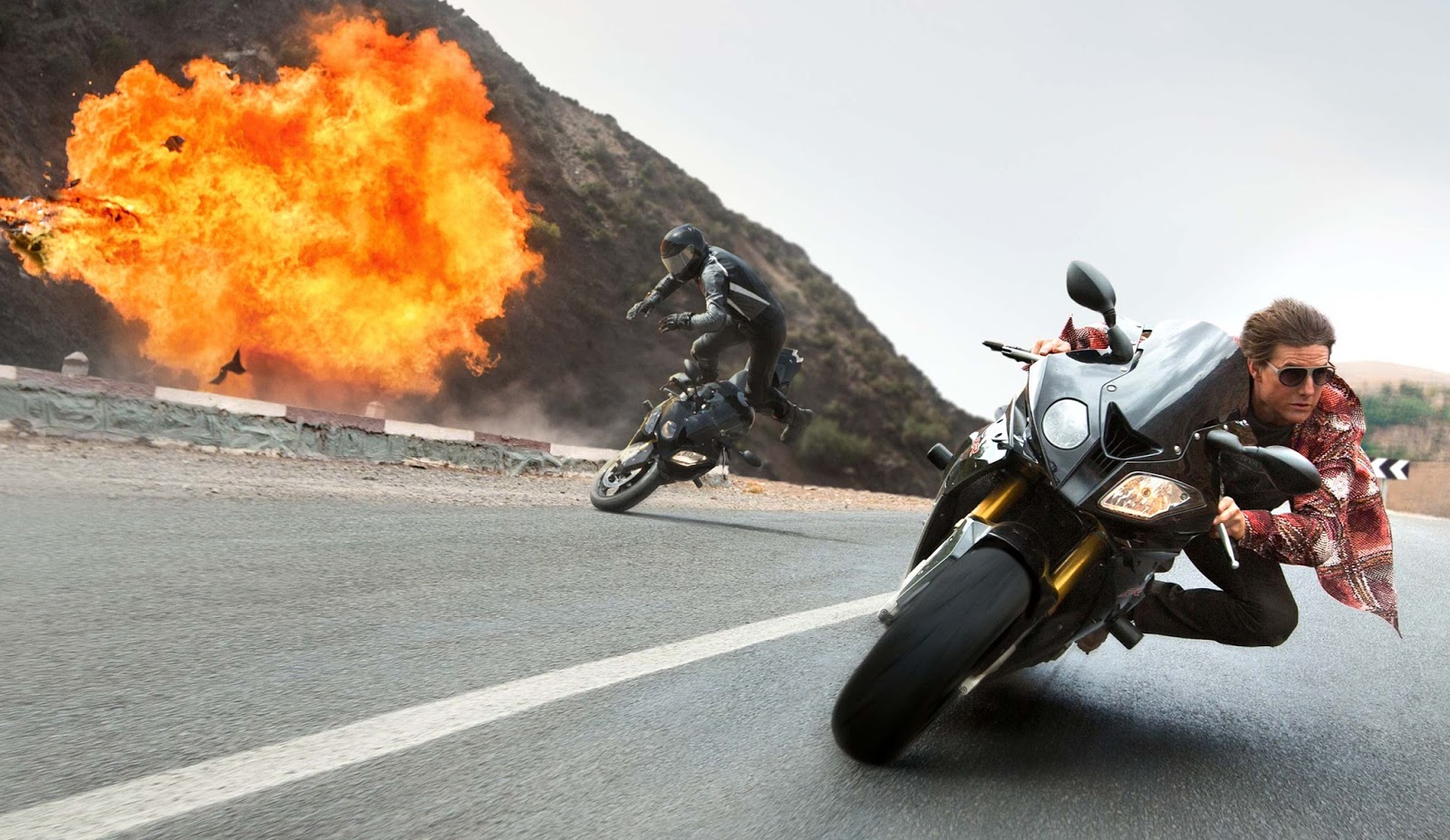
Not that there is much wrong with that if the end result is such good fun. Simon Pegg does a good job of puncturing the pretentions. Every 15 minutes we also get some sort of gripping action set-piece: Tom fighting in the Vienna Opera House, Tom holding his breath in an underwater computer bank for an unfeasibly long period of time, Tom driving a car then a motorbike (no helmet!) through a series of crazily risky chases… Even when escaping from captivity early from the film, he springs his escape with a nifty upside-down acrobatic jump-climb from a pole. Sure it’s all Tom, but he does it all so well that you can’t not be entertained.

But away from Tom, there is actually a nice sense of family that keeps the story bubbling over. Benji and Hunt increasingly feel like heterosexual life partners (in a really nice touch, it’s Benji who fills the damsel in distress role at the end of the film). The other returning characters, Brandt and Luther, don’t have masses to do but immediately settle into the bickering dynamic that keeps the family ticking over. Ilsa Faust is thrown into this boys-only club partly as a femme fatale, partly as some sort of a potential surrogate stepmum, who the kids are working out whether to trust.

Ilsa Faust could be the best thing about the film, a sort of super-efficient female version of Ethan, bests him a couple of times, and can do all the running, punching, shooting and driving that Tom does almost as well. Sure the camera can’t quite resist a few tracking shots up her body in a nice dress or motorcycle gear, but all-in-all she’s pretty well presented. There is a curious semi-flirtatious, semi-siblingy relationship between Faust and Hunt, with the film eventually settling as a kinda sweet dance of “what might have been”. Ferguson is terrific in the role, not only matching Tom’s athleticism, but also giving Faust a sort of arch mysteriousness. Goodness only knows what Hunt really makes of the first female interest he’s had in the series who can match him.

McQuarrie may, I suspect, be as much Cruise’s collaborator as the director, but he does craft an exciting and confident piece of film making. The Syndicate plot line is suitably twisty and turny – and helped by Sean Harris’ softly spoken, arrogant menace as Lane. You’ll be kept guessing as to the true agenda of nearly everyone involved. Simon McBurney offers good smarm as a shady MI6 head (called, bizarrely, Chief Attlee at every turn hardly the title you’d expect). A spycraft action sequence at the Vienna Opera House is a brilliantly entertaining routine of misdirection, which feels close in tone to the original Mission: Impossible film in its old-school smarts behind new-school flash.

Rogue Nation is, quite simply, a damn entertaining thrill ride – and it doesn’t really have pretensions to be more than that. McQuarrie and Cruise keep the action churning along nicely, each of the thrilling set pieces is exactly that, and the core characters on this rollercoaster are engaging and interesting. McQuarrie is a skilled enough writer to rope together some memorable scenes among the mayhem. It’s charming and hugely entertaining – any doubt that this franchise isn’t here for the long term can be firmly dispelled.

Blade Runner 2049 (2017)


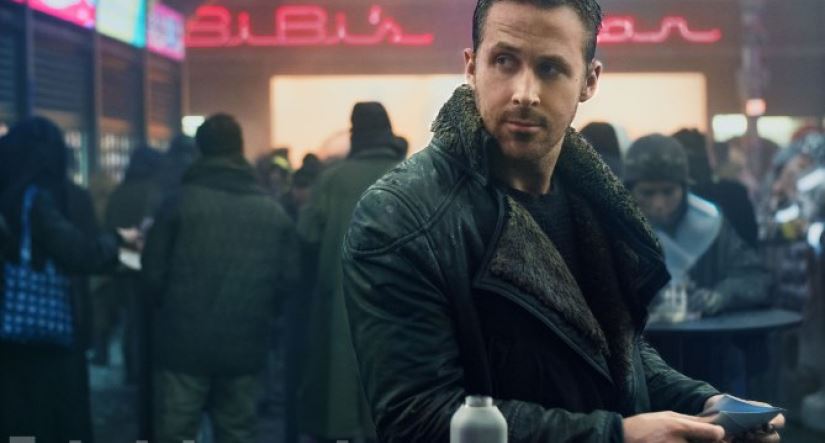
Ryan Gosling does a man’s job filling some difficult shoes in Blade Runner 2049

Director:  Denis Villeneuve

Cast: Ryan Gosling (Officer K), Harrison Ford (Rick Deckard), Ana da Armas (Joi), Sylvia Hoeks (Luv), Robin Wright (Lt. Joshi), Mackenzie Davis (Mariette), Carla Juri (Dr Ana Stelline), Lennie James (Mr Cotton), Dave Bautista (Sapper Morton), Jared Leto (Niander Wallace), Barkhad Abdi (Doc Badger), Edward James Olmos (Gaff), Sean Young (Rachael)

SPOILERS: It’s pretty much impossible to discuss Blade Runner 2049 without revealing some of the workings of the plot. Since the film makers have gone out of the way to say “don’t reveal any of the plot” I thought it fair to say I’ll discuss some things fairly freely here. So you’ve been warned!

Making a sequel is a risky business at the best of times. Then imagine making a sequel to a film that is not just a cultural and artistic landmark film but one people genuinely love. The possibility of creating a massive disappointment? Pretty big. You need some guts to take that on – like announcing you are making Gone with the Wind: Blown Away or Casablanca: Everyone Back to Rick’s. That’s the sort of challenge for the makers of the long-awaited Blade Runner sequel. Could they make something that both complemented and expanded on the original?

The year is 2049 (of course!). K (Ryan Gosling) is a Blade Runner with the task of hunting down long-lived Nexus-8 replicants – the twist being (and its revealed in the opening minutes of the film!) that K himself is a replicant, a more obedient Nexus-9 model. After “retiring” aged replicant farmer Sapper Morton (a career best Dave Bautista), K locates the buried remains of a female replicant who died after an emergency caesarean section. Terrified that replicants may be developing the ability to reproduce, K’s superiors order him to “retire” the child and all who know of it. As K investigates, his loyalties become ever more divided – while sinister corporate genius Niander Wallace (Jared Leto) and his Nexus-9 hit-woman Luv (Sylvia Hoeks) have their own plans for the replicant child.

So the big question is, does Blade Runner 2049 succeed? The answer is a firm and reassuring yes. The big issue is, does the existence of this film affect (or even ruin) the previous film? Blade Runner 2049 not only complements the original, it builds on and expands its themes, and poses far more questions than answers. In some ways it’s even more profound and searching than the original – arguably it engages with ideas and concepts even more overtly (and richly). If your concern going into this film was it would end any discussion about whether Deckard is a replicant or not, then have no fears – the question remains as open as ever (and works either way for this story).

Even more than the original, this film tackles what it means to be human and how we define humanity by the ability to express emotions and empathy. It comes at this from a different stand-point from Blade Runner by removing any doubt about our hero’s nature. What is more, he is a replicant deliberately designed to be more obedient than earlier models. A cool, minimalist actor with a mastery of small expressions, Ryan Gosling is almost perfectly cast as the quiet K, developing deep yearnings to be more than what he is. The entire film revolves around this question of how capable K is not only of forming emotions, but of making his own choices.

The ability to live freely and choose is at the heart of the conundrums for all our characters. To what extent are they able to do this? K goes about his work of dispatching fellow replicants with a quiet reluctance, but does his duty nevertheless. But he is a character yearning to be “more” – and what, in many ways, is more human than that? The film taps into this expertly with K’s belief that maybe he himself is replicant child. The film’s mantra is about choosing what we live and what we die for and, regardless of who or what we are, being able to do this is what makes us “more”.

In a film stuffed to the gills with replicants and other artificial characters, we are constantly asked to address and question how far each of them goes towards achieving “humanity”. Just as with Blade Runner, the only two definitely human characters (Niander Wallace and Lt Joshi) are strangely distant, hard to read or even cruel authoritarian figures, making a damn bad case for real humans.

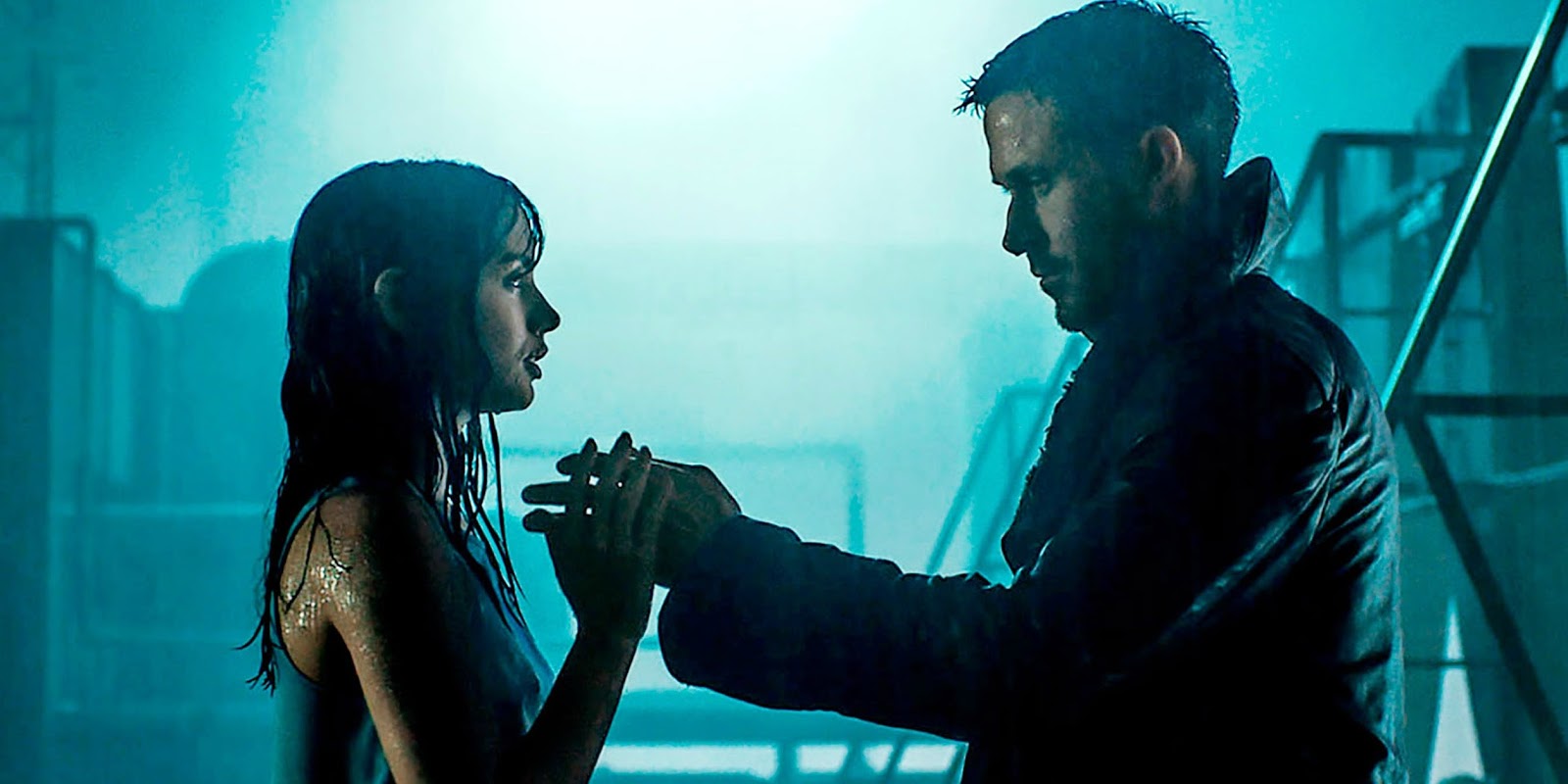
Joi (brilliantly played by Ana de Armas), K’s girlfriend, is a warm, caring, loving woman – but she’s also a hologram, designed to be the perfect companion. K and she go to great lengths to protect and care for each other over the film – and her final fate is a deeply moving moment. But Joi is a computer programme – and a late sequence in the film where K interacts sadly with a looming holographic advert of another Joi that repeats many of her phrases in a disconnected style casts a sad light on all their previous interactions. Every time Joi said anything with love or affection to K, was this just a computer reflecting back what her owner wanted to hear?

It’s not a great surprise to say K does eventually learn to make his own choices and to decide his own fate. In many ways this is a fable of growing up – K accepting his limitations while forging his own destiny – but it makes a contrast with other replicants. While the older models form their own resistance, K’s counterpart Luv (an imposing Sylvia Huks) can’t or won’t break free of following Wallace’s commands. There are more than a few hints Luv is not always happy with the duties she is asked to perform (at one point she weeps quietly as a replicant is dispatched). But at others, she’s clearly striving as much as K to be “special” – she triumphantly repeats a mantra to herself about being the best, like a daughter trying to impress her father.

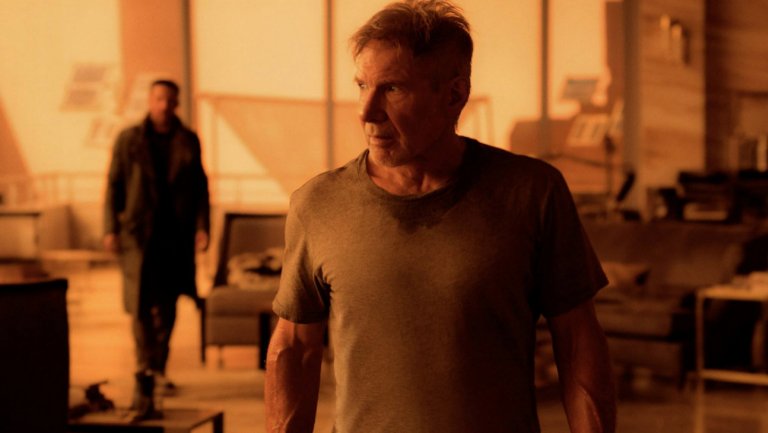
These new characters offer such diverse and exciting story-telling opportunities, you almost don’t notice that Deckard doesn’t appear in the film until nearly the third act. Harrison Ford may have been slightly uncomfortable in the original – but he fully understands the more assured, confident Deckard in this film, who has made his peace with leaving the world behind. Ford gives this new Deckard an almost Han Solo-ish shoot-first swagger, but mixes it with a world-weary sadness. I’d go so far as to say he’s actually better in this film than the first one.

Which is a further testament to the strength of this film. All the themes and ideas of the original are used as bouncing-off points for further exploration. This never feels like a retread, reboot or remake – it feels like a rich and rewarding piece of intelligent sci-fi by itself. I actually feel it could be watched independently of the first film, and still have plenty to offer. It’s not interesting in tying the first film up in a bow – instead it serves as a stimulus for future discussion. You could imagine a sequel to this film sustaining enough interest for 35 years.

Technically of course the film is an absolute marvel. Roger Deakins’ photography is gorgeous, capturing every element of this dystopian nightmare world in a series of brilliant images, in turns drained, bleached and sun kissed. Every frame is artfully composed for maximum impact. The production design is similarly magnificent, Dennis Gassner’s work melding the world of the original, with its steam-punk look, with a mix of technological developments. The score by Hans Zimmer and Benjamin Wallfisch is similarly perfect, giving the film a brooding intensity.

But most of this artistry comes back to the film-making mastery of Denis Villeneuve, a director so gifted I think he may be more interesting than Ridley Scott. His control of the pace of the film is brilliant – despite being very long, it never drags – and he shoots every scene with a careful, intellectually engaged brilliance. He is able – possibly even more than the original – to mix emotion and elliptical theorising, and to draw a raft of brilliant performances from an outstanding cast. More than anything else, he treats the audience with respect, giving them a measured and thoughtful film that trusts we have patience. Villeneuve tops Arrival here, and does so with confident aplomb.

Blade Runner 2049 is a film that demands to be seen more than once. It’s a patient and intensely thoughtful piece of science fiction, that asks profound questions about humanity and the characters in it. I don’t really feel from one viewing I’ve got a grip on it – in fact the more I think about it, the more its haunting, elegiac quality starts cramming into my head. You need to be patient and go with it – you need to be in the right mindset for this slowburn concept film. But, get in that mindset and this film is constantly rewarding. If you want to criticise something, I will acknowledge that many of the female characters are a little more clichéd (most are prostitutes or similar) – but this world where many women seem to be in subservient roles to men is in many ways an extension of the world created in the original film (and now an expression of the dystopian future).

However this is a great film. A really great piece of adult science-fiction. I’ll go out on a limb and suggest it is better than the original film.

Blade Runner (1982)


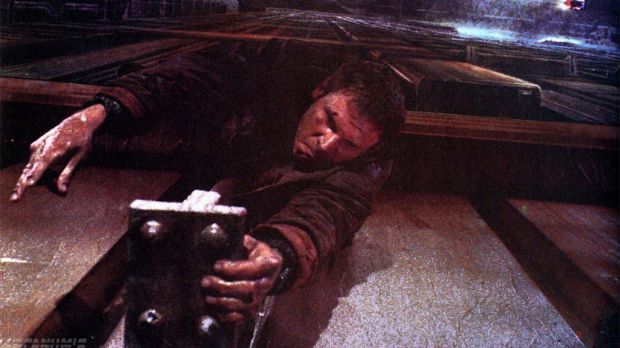
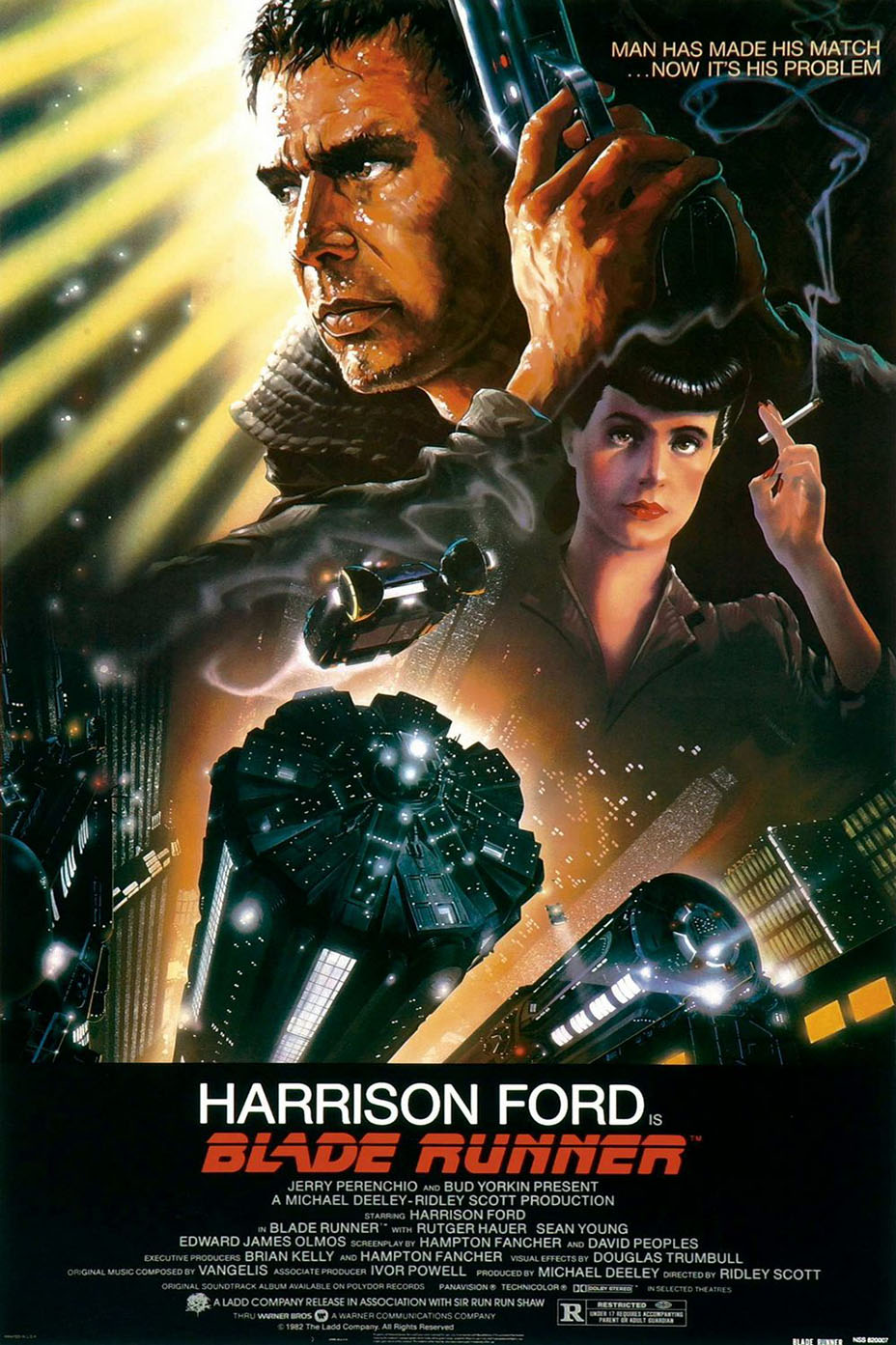
Harrison Ford hangs on for dear life in Blade Runner

Director: Ridley Scott

Cast: Harrison Ford (Rick Deckard), Rutger Hauer (Roy Batty), Sean Young (Rachael), Edward James Olmos (Gaff), M. Emmet Walsh (Harry Bryant), Daryl Hannah (Pris Stratton), William Sanderson (JF Sebastian), Brion James (Leon Kowalski), Joe Turkel (Dr Eldon Tyrell), Joanna Cassidy (Zhora Salome)

Everyone knows Blade Runner surely? And everyone has a viewpoint on its central mysteries. Why for a film largely ignored on release? Because as well as being tight and engaging, this is a rich thematic film, crammed with mystery and enigma. And there are few things more engaging than a film that succeeds in being as open to interpretation as possible.

In 2019 a dystopian, polluted Los Angeles is a launch pad for the wealthy to head out into the new colonies in the stars. Off-world, the unpleasant tasks are carried out by artificial humans known as replicants. Replicants are banned from returning to Earth – but a group of five led by soldier Roy Batty (Rutger Hauer) have come to Earth looking to extend their pre-programmed limited lifespans (no more than five years). On Earth, Rick Deckard (Harrison Ford) is reinstated as a Blade Runner, an agent whose job is to ‘retire’ (i.e. kill) replicants on Earth. Deckard is reluctant, having an increasing distaste for his work, but begins to hunt and eliminate the replicants.

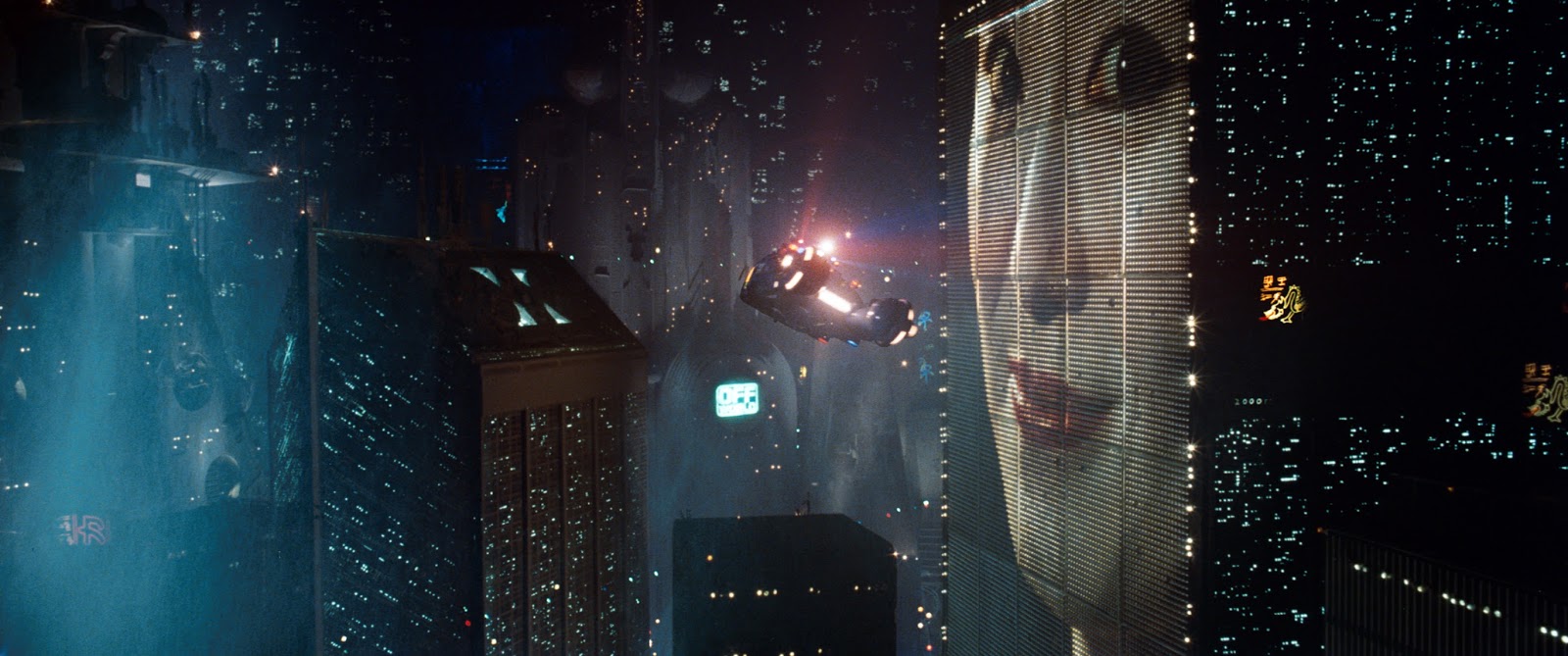
Blade Runner may be one of the most influential science fiction films ever made. Its look and style influenced virtually every other dystopian future you’ve seen in any other film since. Tall, run-down buildings. Overbearing corporate advertising. Flashing neon lights. Terrible weather. Everything dark all the time. Poverty and degeneracy on every corner. You’ve seen it in every dystopian future since. Visually, the film is a landmark, a testament to Ridley Scott’s graphic artistry.

But that wouldn’t be enough for Blade Runner to last the course. When released it was perhaps too elliptical and hard to categorise – equal parts dystopian thriller, noir detective story, sci-fi morality tale, dark romance – for audiences to really understand. Certainly the studio didn’t. After disastrous test screenings, it was re-cut. So began a fable of slice and dice that made Blade Runner perhaps second only to Brazil in the annals of re-versioned films.

The release included an overtly “happy ending” (bizarre images of our heroes driving into a blissful countryside, totally at odds with the rest of the film) and a disengaged voiceover from Harrison Ford that eradicated all the film’s subtlety. This was the only version for 10 years until a “Director’s cut” was released. This removed these elements, retooled scenes and introduced the famous “unicorn dream” sequence (of which more later). Fifteen years after that, Scott finally found the time to work on a “Final cut” which presented the film as Scott had intended it – with all its mysteries and questions intact. Has there been any other film with so many different “official” versions?

Anyway, was it worth the struggle? Certainly. While you could argue it is predominantly a triumph of style, Scott laces the film with a sense of mystery and profundity that makes it a rich and rewarding viewing experience. It’s a trim detective thriller that also questions the nature of humanity. It is a perfectly formed elliptical mystery, an archetypal cult film that engrosses the viewers to such an extent that 30 years later there is still a healthy debate about what the film means.

Humanity is =the key issue. The human characters are functional, cold, distant and unengaging. The hunt for the replicants (who are basically slaves) is brutally and unremorsefully executed. The replicants have been designed to learn and grow but cruelly had their lives capped to stop them taking advantage of this. Their world is polluted, tawdry, soulless and lost.

Meanwhile, the replicants exhibit far more (whisper it) humanity than the aloof human characters, ]despite the fact we are repeatedly reminded they cannot feel empathy. Clearly this is not completely true. And, the film argues, if an artificial human can display loyalty, fear, love, anger and pain, what actually is the difference between that and a “real” person. If a replicant can only be identified after dozens of questions in a test, can they really be that different from a human being?

Questions about this coalesce around Deckard. If the film has remained such a part of cultural discussions, it’s partly because of the fun of theorising about his true nature. Is he a replicant? Scott’s insertion of Deckard’s unicorn dream (implying the origami unicorn left by Gaff at the film’s end shows Gaff knows Deckard’s dream, meaning the dream is an implant in an artificial mind) very much suggests so. There is a case to be made either way, both of which work.

Deckard’s ruthless replicant hunt is deliberately juxtaposed with their own warm feelings. Deckard grows in humanity and reluctance as the film progresses – is this him becoming more human, or is it is humanity emerging? His coldness and reserved hostility contrast with the vibrancy of Batty, Pris and the replicants. In many ways, he fits in as the quintessential human in this world – a vague discomfort with what he is doing, but no real hesitation about continuing. Thematically, it makes more sense if Deckard is human – that he represents dehumanisation (and gradually realising it) while the replicants become more human.

However, clues are sprinkled throughout that Deckard is not what he appears. His distance from other characters. The treatment he receives from his co-workers. The photographs that fill his apartment (replicants enjoy photos as it gives them a sense of a past). His bond with Rachael. His relentlessness – and the fact that he is clearly considered expendable by the police. Then there is the rich irony: the best way of hunting down replicants is to create a hunter replicant. Either way, it’s a debate and conversation that sustains the film – and allows multiple interpretations of every scene.

It’s a debate that feeds into the main theme of the film: humanity, free will and our God complex. Batty, the dying replicant searching for new life, confronts his maker – a distant, arrogant man with no interest in his creation. And kills him. But Batty feels more human than any other character. He shows more affection, frustration, anger and grief than anyone else. His last words (the famous “tears in rain” speech) had such cultural impact because it has such poetic joy and depth to it. They are lines enthused with a desire to live, a romantic vitality. It’s the most poetic moment in the film and it comes from someone who isn’t “real”. What more sign do we need that the replicants are human? If we can create poetry in a machine, does it stop being a machine?

Empathy is the quality the replicants are judged on – but as we see replicants dispatched with little sense of regret, and then witness Batty and Leon’s grief for their fallen comrades, or Pris’ ease with man-child Sebastian, the lack of empathy from humans is all the more clear. Deckard is a fascinating character as he falls between two stools – either a human who has buried empathy, or a replicant discovering empathy. Strange and disjointed as the relationship between Deckard and Rachel is (and there is an uncomfortable moment where Deckard gets too physically forceful) it fits into this – are these two artificial people discovering the ability to bond? Or is it an emotionally stunted human finding himself drawn towards someone who feels more real than the other humans?

What makes the film work is that it doesn’t hammer home, these issues. It allows us to make our own minds up. It frames the action within a noirish detective thriller, laced with mood and awesome visuals. It’s sharply and sparingly written, with real intelligence. For all its discussions about humanity, it does feel at times a cold film – but it’s so rich in suggestion and implication that it doesn’t really matter. Yes you could argue the implication and playful suggestion imply more depth than actually exists, – but the film gets away with it, because it works so well.

Rutger Hauer gives easily the finest performance as Batty (he allegedly wrote the famous speech on the day). Batty is the most vibrant and dominant force in the film, who goes on the most engaging emotional arc. For me the dark secret of the film is Harrison Ford is slightly miscast– he’s aiming for moody, Bogartish disillusionment, but he comes across more disengaged (he’s strikingly better in Blade Runner 2049). I think Ford struggled with the character – it’s a role better suited to a John Hurt or James Caan, rather than Ford’s more conventional (if world-weary) magnetism – he’s not a natural fit for a bitter cynic. Olmos, Cassidy, Walsh, Sanderson and James give strong support.

Blade Runner is a visual triumph and a rich experience. Its story is compelling, but the real richness is the thematic layers under its skin. Scott created a film open to interpretation, and that’s what really grabbed the imagination. It marries mystery with curiosity and avoids pretension, becoming intriguing and engrossing. Scott has rarely made a film with such intense ideas and poignant confusion before. You could argue the final cut leans too far one way in the central mystery, but there is more than enough eerie richness under that – helped by Vangelis’ unsettlingly grand score – to keep people viewing and talking about it for another 30 years.

Mission: Impossible (1996)


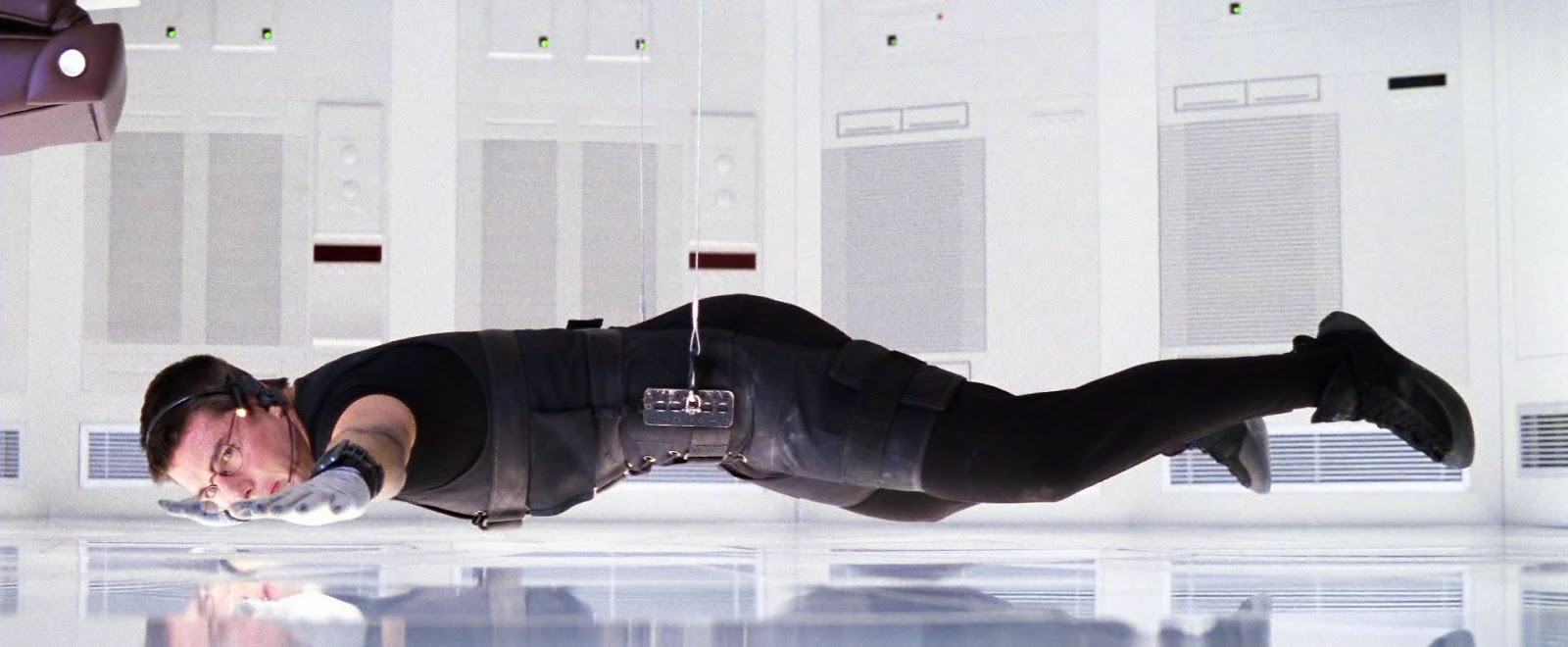
Tom Cruise doesn’t hang about in the most iconic sequence from the first Mission: Impossible

Director: Brian de Palma

Cast: Tom Cruise (Ethan Hunt), Jon Voight (Jim Phelps), Emmanuelle Béart (Claire Phelps), Henry Czerny (Eugene Kittridge), Jean Reno (Franz Kreiger), Ving Rhames (Luther Stickell), Kristin Scott Thomas (Sarah Davies), Vanessa Redgrave (Max), Emilio Estevez (Jack Harmon), Ingeborga Dapkūnaitė (Hannah Williams)

Everyone knows how it goes right? Bum bum bum-ba-bum-bum bum-ba-bum bum… Yup it’s the Mission: Impossible theme tune. Originally a hit TV series, it’s arguably more familiar now as this Tom Cruise-starring film series, a showpiece for his reckless physicality and insane commitment to ever more elaborate stunts.

Ethan Hunt (Tom Cruise) is framed as a traitor after a disastrous mission in Prague. While trying to reclaim a list of agents’ cover names, Cruise and his team are betrayed by a mole within IMF. The rest of his team, including his mentor Jim Phelps (Jon Voight), are killed though Phelps’ wife Claire (Emmanuelle Béart) survives. On the run, he has to steal the real secret list himself to help discover the identity of the traitor.

Who would have thought over 20 years later Tom Cruise would still be heading out on Impossible Missions? The success of the franchise is rooted in this engaging spy thriller. How many times have I seen this film? Countless times. It’s inventive and playful. It’s got a decently intriguing plot that keeps you on your toes.  Above all it’s fun.

At the time of its release people talked about its impenetrable plot, but it’s basically a standard “double cross” film. Someone we think is a hero is basically a wrong ‘un, so our hero has to follow every means in his power to find out who it is – including pretending to be a wrong ‘un himself. Understand that, and the plot is pretty basic. The main reason people find it confusing is the film assumes you’re smart enough to follow what’s going on, without characters sitting down and spelling everything out. Isn’t clumsy exposition the sort of thing we criticise other films for? Isn’t it nice not to have a film that just assumes you can follow the whole thing?

Anyway, the plot and characters are largely there to carry us from one spectacle to another. The film starts with a bang. Can you think of many films that kill off most of the cast (and the recognisable actors) in the opening 15 minutes? It’s such a daring opening it leaves a whiff of peril over everything else – even after we discover some people weren’t actually killed, and despite no other characters dying apart from the baddies.

Killing off the team does mean the film is a bit more “Tom Cruise with some back-up” rather than a team effort – but that doesn’t really matter does it? Wee Tom of course does all his own stunts and looks cracking. Acting wise, he’s “cruising” through his standard turn as a cocky protegee who goes through a steep learning curve. But it doesn’t really matter, because he looks great and everything he does is pretty damn cool. He even manages to mine some real emotional pain when he realise some of the people closest to him have betrayed him.

The film’s centre piece, that famous spiderlike descent from the roof to break into a sealed computer room in Langley, is probably most responsible for making this film a hit. How many times has that scene been spoofed? (So much so people no longer remember its almost completely lifted from 1960s crime caper Topkapi) It carries more impact than the big top-of-the-train scene that ends the film, because we immediately understand the difficulty of what Hunt is trying to do. How many times have we had to balance, played a game where you couldn’t step on something, had to be as quiet as possible, or keep as calm as you can? I’ve never had to balance on top of a speeding train, but I’ve had to do all that stuff. Everyone watching it can relate to the tension of doing this stuff. It’s a little masterpiece scene that also owes a fair deal to Riffi’s silent robbery scene.

The scene also shows what a triumph of style this is. De Palma directs with a breezy lightness and love for the business of spycraft (I suspect he was taking the money big time, as he injects very little of his personality into it, but it works and he has an eye for the memorable shot), Tom Cruise is pretty damn cool. The film understands the simplicity of iconic shots – Cruise jumping away from an exploding aquarium in a restaurant is a simple stunt, but it looks great. The film has a great range of small-scale spycraft as well – from Cruise cracking a bulb and sprinkling the glass outside a door as an early warning detector, to him carefully timing how long to stay on a phone call to allow a trace to go so far.

Of course, some things in the plot make very little sense. The traitor seems rather randomly motivated (he’s basically pissed off at the end of the Cold War, despite earning way more than the average joe and being married to an impossibly attractive younger wife) and his effectiveness and smartness fluctuates according to the demands of the plot (Bond villain-like, he inexplicably leaves Hunt alive at one point for no reason). The idea of a government organisation where missions can be chosen to be accepted or not is in itself rather silly. The use of the internet and e-mail in the film looks hilariously dated today (Hunt basically sends a series of random e-mails to made up addresses – Max@Job314 indeed…).

To be honest, its breakneck pace is probably why some people struggle to keep up with what’s going on, but generally I wouldn’t let it bother you. It helps as well that there is a terrific cast of interesting actors – one of the great strengths of this series has always been its unconventional casting decisions. Would anyone else have thought of Béart and Scott Thomas as secret agents? Each actor has the skill and confidence to invest often paper-thin characters with depth – Rhames plays Luther so well, he stuck around for the rest of the series, despite us learning very little about him here. Voight has a perfect world-weary fixedness as Phelps, Reno is great value as a sociopathic hired gun and Redgrave has a lot of a fun as a cut-glass arms dealer.

Mission: Impossible is, to be frank, tons of fun. It’s basically a simple film disguising itself as a complex one, but it’s rewarding enough that you enjoy working out the plot alongside Hunt. It treats the viewer with a certain rewarding confidence and it’s crammed with distinctive and iconic shots. Is it any wonder Cruise saddled up five more times (and counting) and chose to accept the mission again?

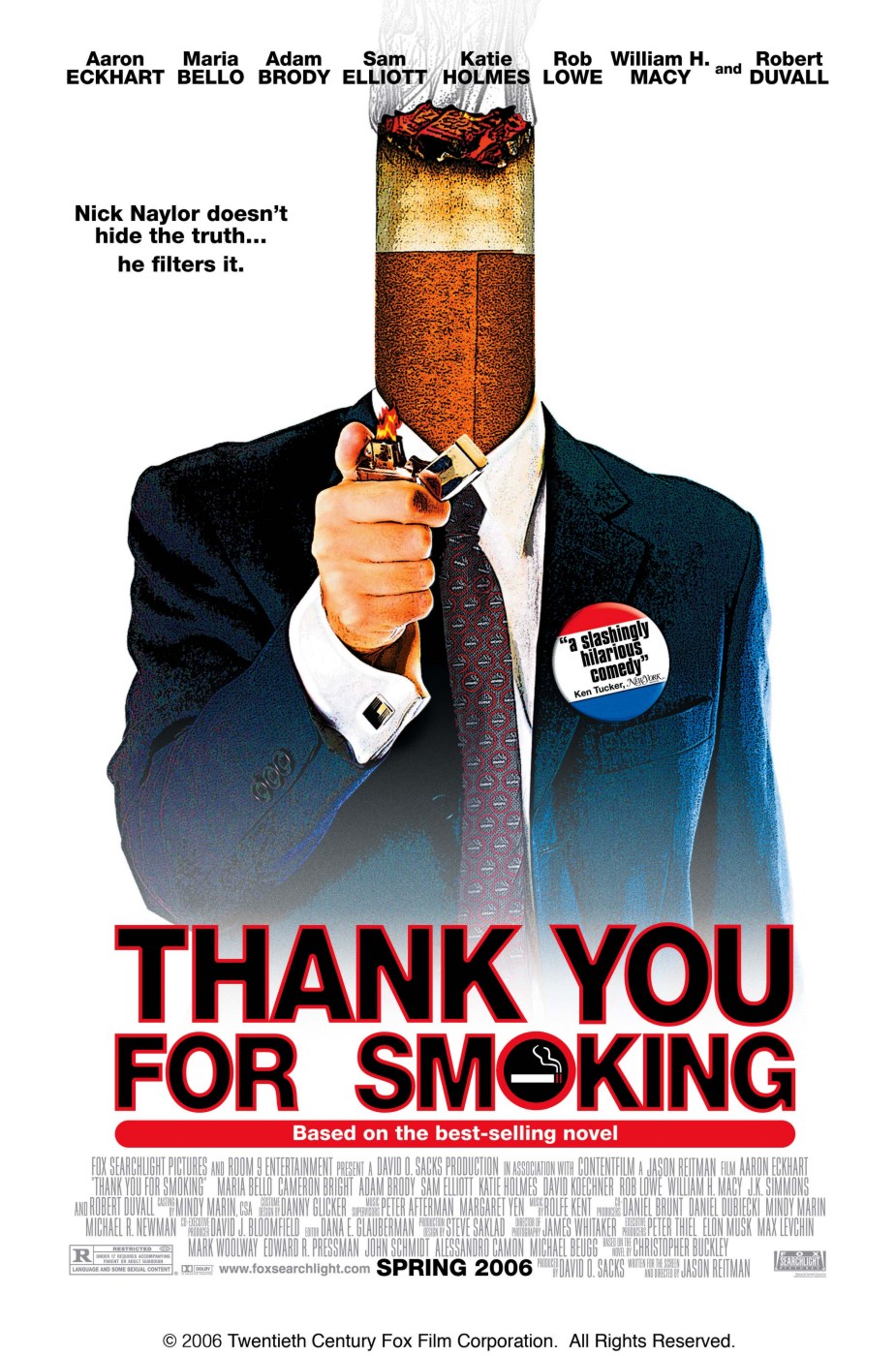
Thank You For Smoking (2006)


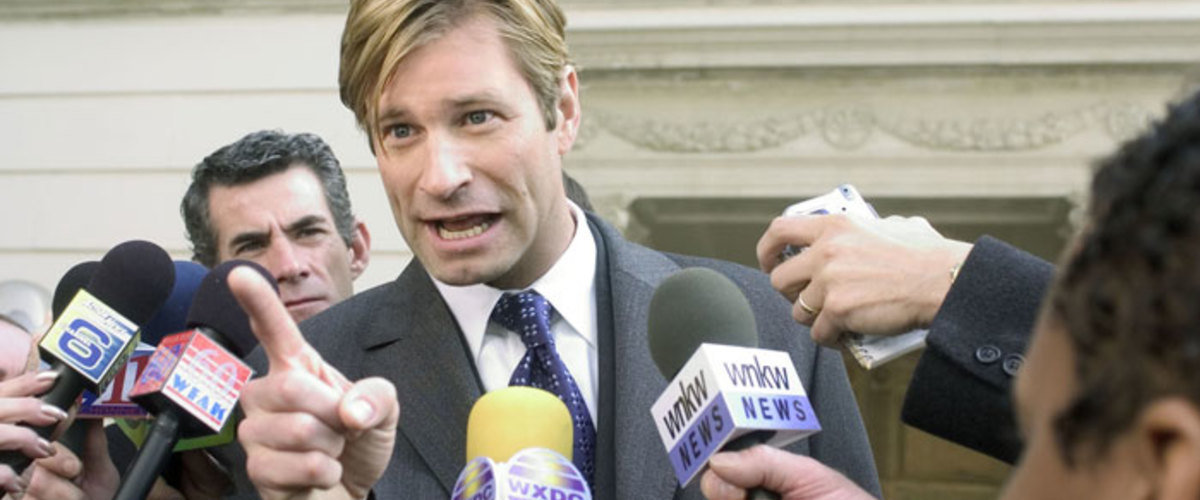
Aaron Eckhart does the big spin on Thank You For Smoking

Director: Jason Reitman

Cast: Aaron Eckhart (Nick Naylor), Cameron Bright (Joey Naylor), Katie Holmes (Heather Holloway), Maria Bello (Polly Bailey), David Koechner (Bobby Jay Bliss), William H. Macy (Senator Ortolan Finistirre), Robert Duvall (The Captain), J.K. Simmons (BR), Kim Dickens (Jill Naylor), Rob Lowe (Jeff Megall), Sam Elliott (Lorne Lutch)

Lobbyists: paid smooth talkers, whose goal is to win influence for often unattractive industries. Not a popular profession. Thank You For Smoking follows a few weeks in the life of Nick Naylor (Aaron Eckhart), a lobbyist for the tobacco industry. With senate hearings underway to place a skull-and-crossbones picture on every pack of cigarettes sold, Naylor has a host of pressures to deal with, not least rebuilding a relationship with his young son (Cameron Bright).

Thank You For Smoking is a smart and amusing satire on a pretty simple target. It’s a great showpiece for the skills of Jason Reitman, who directs his sharply written script with wit and verve. Reitman crafts a satire that’s never too heavy-handed, a well-balanced film that’s about morality and freedom of choice, without banging the righteous drum to death. He’s also got a keen eye for the quick and effective gag, meaning the film moves swiftly from punchline to punchline.

It helps a great deal that Aaron Eckhart is terrific in the lead role: handsome, cocky, charming but with a strange vulnerability. Nick Naylor a fascinating character: while he does adjust his views on issues, he is never humbled by events, and there is no “road to Damascus” moment where he denounces his career. He’s totally confident in his skin, who has come to terms with his role and doesn’t care what people think of him. And you’ve got to respect a man so skilled that he gets a 20 year-old dying of cancer from smoking to shake his hand on live television.

Similarly, the film avoids an open condemnation of smoking (it doesn’t even feature a single character smoking). If anything, the real targets for its criticism are anti-smoking campaigners (William H Macy’s sanctimonious senator is skin-crawling and unbelievably smug and petty), and the opportunistic recipients of lobbying. The film makes clear smoking is a bad habit, but also pushes the right we have to choose – if we want to poison ourselves, we should do so! I’m not sure if Reitman is willing to admit an argument like this is partially an abuse of ill-informed free speech, but at least he hopes we are smart enough to make up our own minds. It’s all part of the careful discussion of lobbying – what kind of person can be swayed by a professional counter-argument man?

There are several other terrific performances. Simmons is hilarious as Naylor’s aggressively vocal boss. Rob Lowe offers a brilliant self-parody as a smoothly empty Hollywood super-agent obsessed with Japanese culture. Maria Bello and David Koechner are both sharply witty as Naylor’s fellow lobbyists for alcohol and firearms respectively. The scenes between the three of these “Merchants of Death” (or “The MOD Squad” as they call themselves) offer a sharply funny commentary on the action throughout.

If the film has a problem though, it’s that it never feels like it develops into being much more than a framework for some good jokes. There is a thinly veiled morality tale here, but the film never really feels like it makes a point or a conclusion. Sure there are tonnes of excellent jokes and laugh-out-loud moments, but is it much more than a series of skilled sketches? Eckhart is of course brilliant in each of these, but there is often a sense of watching a series of misconnected events. Characters drop in and swiftly out of the movie. There is no overarching plot, as such.

The film largely dodges any real narrative conclusion. This is of course part of the smartness of its design – it’s not trying to make moral points, or hector us on health – but it also makes the film feel slightly empty, narratively adrift. Little changes for the characters from the start to the end of the story. Of course, the film is not so crude as to make its hero learn “a lesson”, but it also means Naylor is a more difficult character to sustain interest in over a period of time: complete lack of self-doubt does not tend to make great drama.

It’s very funny, smart, well written and acted. However, while brave enough to avoid predictability, it’s also inconsistent enough to not have a real shape. Some moments – in particular the relationship between Naylor and his son – lean heavily on cliché. Some of its more unusual moments – especially a sequence where Naylor is kidnapped by anti-smoking campaigners – fall the wrong side of surreal. But for all that it’s an imperfect film, it is certainly funny enough to justify itself and features a superb performance of alpha-male arrogance from Aaron Eckhart (I’ve asked this elsewhere, but how unlucky is this guy to not be a bigger star?). I guarantee you’ll laugh several times when you watch this – and if nothing else you’ll have a think about lobbying.

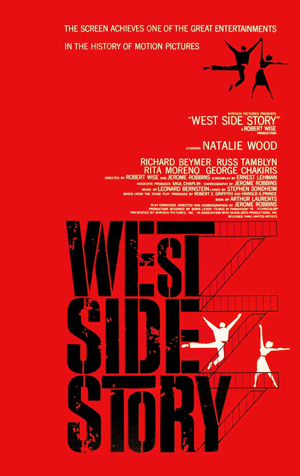
West Side Story (1961)


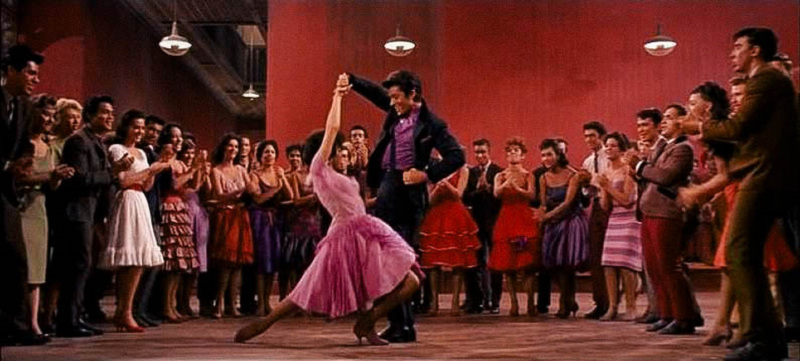
Dancers defy gravity and physics in the triumphant West Side Story

Director: Jerome Robbins, Robert Wise

Cast: Natalie Wood (Maria Nunez), Richard Beymer (Tony Wyzek), Russ Tamblyn (Riff Lorton), Rita Moreno (Anita Palacio), George Chakiris (Bernardo Nunez), Simon Oakland (Lieutenant Schrank), Ned Glass (Doc), William Bramley (Officer Krupke)

It’s strange to think now, but when it debuted on Broadway, West Side Story failed to win the Tony for Best New Musical (it went to The Music Man). Today, Bernstein and Sondheim’s masterpiece is a touchstone of musical theatre. Part of that surely must be connected to the fact that it’s so well known as a film – and that this triumphant movie production took 10 Oscars as well as holding a place in any list of Greatest Musicals on Film.

The story is of course Romeo and Juliet crossed with intricate ballet and light opera. On the streets of New York, the Jets (working-class white boys) and the Sharks (Puerto Rican immigrants) are two rival gangs fighting a street battle to control their district (via the medium of dance). But danger is about to explode when former leader of the Jets Tony (Richard Beymer) falls in love with Maria (Natalie Wood), the sister of Sharks leader Bernardo (George Chakaris). Will it end well? Surely not with these star-crossed lovers…

You can’t really begin to talk about West Side Story without first talking about the dancing. Not since Astaire and Rogers has a movie been defined so much by its physical grace and rhythmic control of movement. It’s awe-inspiring. Honestly, show-stoppingly, jaw-droppingly impressive. As the dancers defy gravity, physics and the limitations of a normal person’s body, you can’t help but want to spring to your feet and join in (don’t – I guarantee you are not as good). It’s simply amazingly good.

The opening Prologue sets the scene perfectly. It’s not easy to make a film about tough street gangs, where every fight scene is largely expressed through dance – the Prologue, however, does this perfectly, a stylised slow build of increasing musical tempo. From the simple device of clicking fingers, we build continually into an explosion of carefully controlled group choreography, where each of the twenty-odd dancers feels like an individual.

The camera choices are sublime: some shots hover in dramatic aerial shots. Tracking shots highlight the skill of the dancers. The crew dug pits into the tarmac to bury the cameras in so that they could stare straight up at the dancers at some points – during one brilliant sequence Chakiris and the Sharks seem to loom, God-like, over the viewer while moving in perfect synchronicity. It’s beyond a tour-de-force, it’s simply unlike anything else you’ve ever seen on film. The film would’ve deserved Oscars even if it had ended after ten minutes, it’s probably one of the best openings ever.

Fortunately it doesn’t, because there is more exquisite stuff to come. Moreno and Chakiris probably won their Oscars off the back of the scintillatingly “America”, a beautiful whirlygig, part debate, part argument, high-kicking joy of twirling dresses and pirouettes. It’s possibly the most exciting number in the whole film. “Cool” is an unbelievably wild and challenging dance number in a garage, that seems to throw in half a dozen different styles – the set itself seems to be struggling to survive under the rampant pace and passion of the dancers. It’s a deliriously giddy, passionate, dirty number with the actors clearly pushed way beyond their natural ease.

Famous Broadway choreographer Jerome Robbins directed the original production, and was the logical choice for the studio to choreograph the film. Robbins insisted he would only do so if he was also allowed to direct the entire film. A deal was eventually done where Robbins would direct everything involving music and dance, and seasoned professional Robert Wise would handle the rest. Robbins carries most of the credit for why this film really is unique – everything special and different about it is connected to his mastery of choreography.

As it happened, Robbins’ search for perfection was so great he ended up leaving the film running weeks behind and far over budget. After months of rehearsal, when the time came to film, Robbins would dramatically re-work the choreography to exploit locations. This was particularly expensive for the location. As take after take on expensive 65mm film mounted up, the producers eventually dismissed Robbins from the project after filming four numbers (“Prologue”, “Cool”, “America” and “I Feel Pretty”). Although the rest of the numbers used his choreography (and were directed by his assistants) they lack the inspired genius of the other four stand-out numbers. Wise, a skilled hired gun, took care of the rest of the filming.

It’s the weakness of West Side Story that very few things in the rest of the film live up to the heady, exhilarating joy of those core numbers. Both Beymer and Wood are uninspiring as the two leads. Wood is not remotely convincingly Puerto Rican, while Beymer is too clean-cut and nice-guy for a kid who was running a street gang not so long ago. The scenes focusing on these two drag– and are rather flatly shot considering the dynamism around anything involving dancing. Wood’s songs are at least memorable – largely because an uncredited Marnie Nixon supplies the singing – but Beymer’s voice replacement isn’t particularly inspiring and both “Maria” and “Tonight” get a bit lost here (he’s no Michael Ball, put it like that).

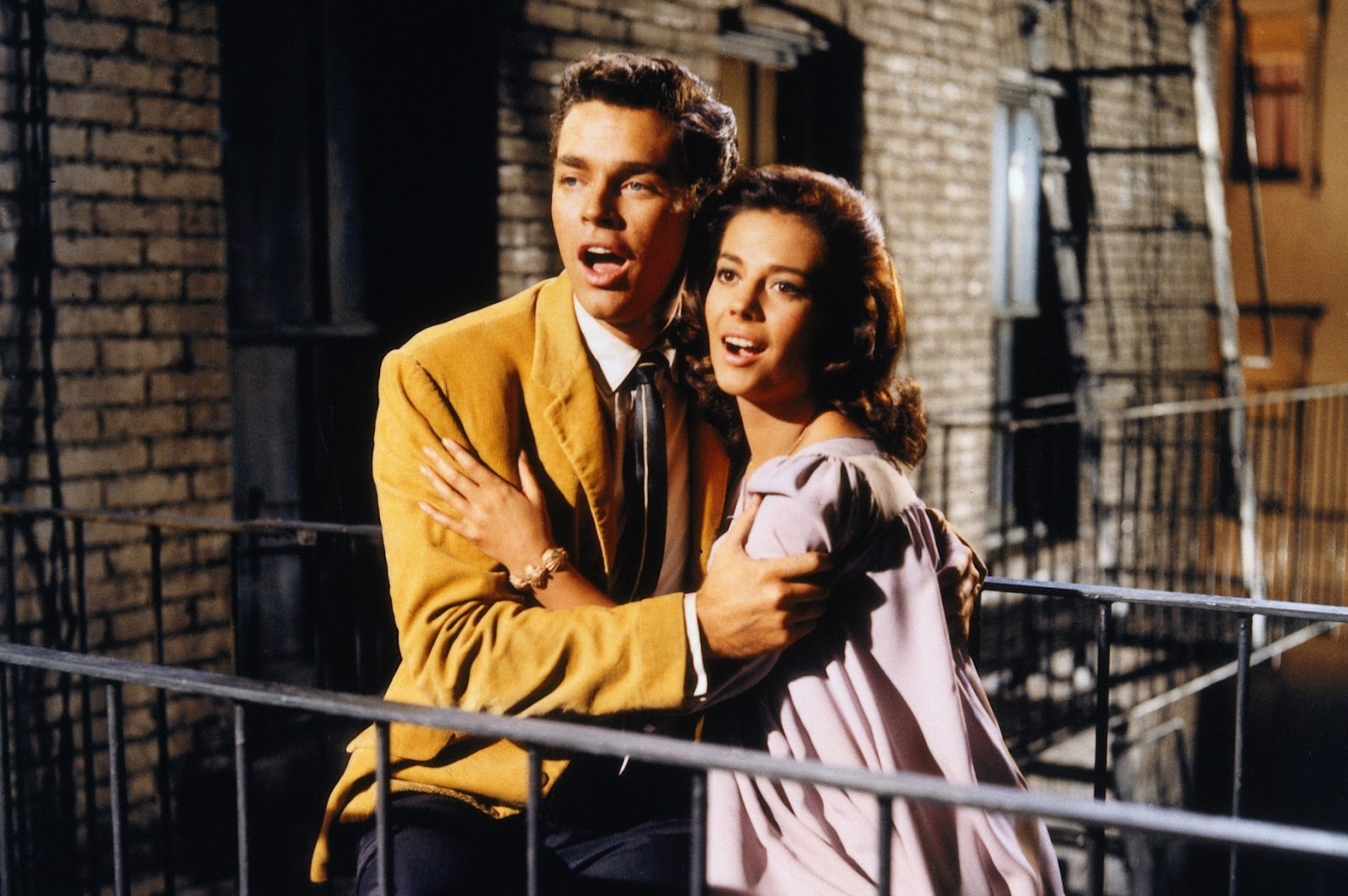
The script and storyline aren’t always the strongest. It’s a difficult to really remember any of the purely dramatic sequences. Tony and Maria’s meeting on the balcony summons up very little in the way of romantic frisson, let alone any favourable comparisons to Romeo and Juliet. (Truth be told, there is very little chemistry at all between the two performers). You get the feeling the film is reaching for a big socio-political message – hey kids, why don’t we all get along? – but never really quite gets there. It’s not quite got enough thematic weight behind it for the cultural acceptance angle it’s trying to push. But heck, Romeo and Juliet is a tough act to follow, so it’s not a surprise that the film works best as just a romance.

The big exception to the rule that the dramatic moments don’t hold a candle to the dance sequences is Anita’s assault by the Jets late on in the film – an unsettlingly visceral near gang-rape, which isn’t easy to watch, but works brilliantly. In fact any dramatic scene involving Rita Moreno stands out – she burns up the screen as the fiery Anita, a woman bubbling with passion but also with an emotional intelligence and sensitivity that nearly helps our heroes avoid disaster. Moreno’s dancing and singing are first class, but her acting throughout is similarly outstanding – any scene featuring her, your eyes are immediately drawn to her. She’s well matched as well by George Chakiris, another Oscar-winner, who’s a magnetic dancer and singer but also gives Bernardo a brilliant kindly pride laced with arrogance.

All this takes places in a regular technicolour wonderland of a setting. Daniel L. Fapp’s photography is marvellous, creating a rich palette that soaks up colour. Shots of a blood red sky at night set just the right ominous tone. He makes masterful use of colour and shade throughout. I’ve already talked about how the photography brilliantly helps build the impact of the dancers. But every scene is really carefully framed and presented, with the cages and barriers of the playground the gang fights over helping to hammer home the feeling of our heroes being trapped by fate. As you’d expect from Wise (the editor of Citizen Kane) the film is also brilliantly assembled in the editing room.

Parts of West Side Story are of course a bit dated. The dancers, for all their undeniable brilliance, are a little camp for rough and tumble street kids. The film’s costumes and settings look undeniably clean to modern eyes. The casting of Wood in particular as a Puerto Rican is odd today. It’s also probably too long a film – while the musical numbers could happily go on forever, other scenes drag a little. Most of the really strong, memorable material happens in the first half of the film. And like all brilliant works of art, it’s so distinctive it’s almost a little too ripe for parody. Some of the visual flourishes used to indicate fantasy sequences look slightly dated.

But these are niggles in a way, because even if parts of the film are a little bit below par, the overall impact of the film is quite extraordinary. There has never been – and I think never will be – a musical quite like this. I simply can’t imagine such a triumph of group choreography being made, or a film-maker spending such time and money to push the envelope of what it is possible for the human body to do in dance scenes. Despite its faults, I can’t imagine a viewer not being electrified by several sequences in this movie. And at the end of the day, what else is cinema for if not to bring our emotions and feelings to life in vibrant flashes?

Hell or High Water (2016)


Chris Pine and Ben Foster carry out a series of personally motivated bank robberies in Hell or High Water

Director: David Mackenzie

Cast: Jeff Bridges (Marcus Hamilton), Chris Pine (Toby Howard), Ben Foster (Tanner Howard), Gil Birmingham (Alberto Parker), Marin Ireland (Debbie Howard), Katy Mixon (Elsie), Kevin Rakin (Billy Rayburn)

In West Texas, two brothers – divorced father Toby Howard (Chris Pine) and his ex-con brother Tanner (Ben Foster) – carry out a series of early morning raids on branches of the Texas Midlands Bank. Their robberies are investigated by Texas Ranger Marcus Hamilton (Jeff Bridges) working his last case before retirement, and his partner Alberto Parker (Gil Birmingham). The brothers however are motivated by more than just a desire for money – and these motivations drive them to ever more desperate and dangerous actions.

Hell or High Water is a fine piece of skilled professional film-making. The story is tightly scripted, and Mackenzie’s direction marries up a modern outlook with the style of a classic John Ford western. But, for me, it reaches for a thematic richness that isn’t quite there. It’s in the same territory as No Country for Old Men but it never achieves that film’s complexity. It creates characters we care about, and the story keeps us gripped, but it lacks that certain extra dimension that profoundly moves us. It tries to tell itself (and us) that it’s a profound exploration of themes around life and death, but it never really reaches these feelings – its grasp is less than its reach.

But it’s still a hugely enjoyable and impressive movie. Mackenzie’s direction is superb, detailed and smooth, and he is able to bring to life both the drama and the action. The story has an old school heist quality, with our gangsters sort of proto-Robin Hoods, naïve enough for us to invest in their actions, but dangerous enough for us to understand why events spin outside their control. Sheridan’s script is full of punchy lines and genuine emotional weight. The plot line gets a bit bogged down in the ins and outs of the reasons why our ‘heroes’ are doing what they are doing, but there is an emotional truth to it that really works.

The film also creates a wonderful sense of Texas as a land that seems to have only just moved on from the Wild West. Everyone in the film seems to be either packing heat or wearing a Stetson (or both). Genuine cowboys guide cattle across a road. The rangers have an old school gruffness about them, staking out banks from across the road in saloon bars that don’t seem to have moved on from the days of Wyatt Earp. At the slightest sign of danger, ordinary people reach for their guns and start shooting. Everything takes place in dusty countries, or rural feeling towns. I can barely remember seeing a computer or mobile phone. The whole film feels slightly out of step with the modern world.

It also draws some very fine performances from its actors. Chris Pine may never have been better than as reluctant bank robber Toby. Toby is a classic western outsider, a man who is working to protect his family and preserve their future – often by dangerous means – but accepts that this family life he is building has no place for him in it. Pine brings the part a finely judged sadness, a sense of a man without a place in the world. Ben Foster is equally good as his firecracker brother, a damaged anarchist at heart whose love of impulsive danger will have fatal consequences.

The heart of the movie though is Jeff Bridges’ ranger, a marvellous portrait of gruff-old school machismo. Bridges invests this role throughout with a humane decency, an anger at the distress and violence. His friendship with his partner Alberto (a touching Gil Birmingham) provides much of the affectionate heart of the movie, their good natured joshing and banter a continual source of humour. Bridges’ world-weary, out-of-time quality matches perfectly with the timeless mood of the movie. It’s a beautifully judged, simple, unshowy performance.

It’s a beautifully judged combination of crime and family thriller, while its ability to balance the old-school feeling and aesthetic of West Texas with a punchy modern-feeling tale of the greed of bankers, works extremely well. It’s got a dark Butch Cassidy feeling to it, and the film’s focus is tightly kept on the four leads, allowing the audiences understanding of them to grow and develop. By the conclusion of the film, your loyalties will be firmly divided between both the law and robbers, summed up best by a beautifully played elegiac final scene, laced with regret, sadness and tension.

But despite all this, it never quite breaks out of its pulpy roots to become something else in the way that No Country for Old Men manages to do. Wonderful character study as it is, it feels like a film that wants to make a broader, spiritual comment about the American way and modern masculinity. It doesn’t quite manage to do this. I don’t feel that this film really succeeds in suggesting it is about much more than what’s on the surface.

But that doesn’t matter so much, when the surface is so strong and as well directed, acted and written as this. If Hell or High Water is, at the end of the day, just a smart cops-and-robbers story, it’s certainly one that’s full of freshness and intelligence and grips your interest from start to finish. In a world where Hollywood churns out over-promoted average films, it stands out as something far more heartfelt, expertly crafted and hugely enjoyable.

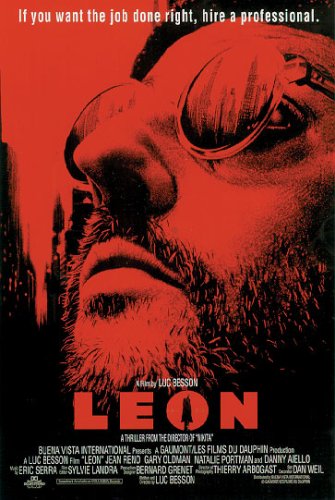
Leon (1994)


Jean Reno teaches Natalie Portman the ways of death in classic romantic thriller Leon

Director: Luc Besson

Cast: Jean Reno (Leon), Natalie Portman (Mathilda), Gary Oldman (Norman Stansfield), Danny Aiello (Tony), Michael Badalucco (Mathilda’s Father), Ellen Green (Mathilda’s Stepmother)

Luc Besson is an interesting film-maker, part visionary, part pulpy stylist. He has undeniable talent and visual flair, but far too often wastes this on trashy and juvenile comic book films, with a teenager’s preoccupations rather than a focus on story and character. One of the few exceptions to this is Leon, a film that marries his vibrancy with a heartfelt story.

Leon (Jean Reno) is a professional hitman working in New York, a dedicated professional with the stunted emotional maturity of a young teenager. One day the family of his next door neighbour is ruthlessly slaughtered by demented, drug-dealing cop Norman Stansfield (Gary Oldman), leaving only precocious 12-year Mathilda (Natalie Portman) alive. Despite his concerns about involving himself in the world, Leon takes Mathilda in – and these two outcasts develop a deep emotional bond, part mentor-pupil, part father-daughter, part celibately romantic.

In many ways, Leon should be an uncomfortable viewing experience. It’s a film that explores the growing emotional and sexual awakening of two characters, one of whom is a 12 year old girl, the other a hitman in his 40s. In fact it’s hard to imagine it even being made today by a Hollywood studio (it was controversial enough at the time). However, it works because the characters are so skilfully established. The 12 year old is precociously mature emotionally and sexually for her age, the man is so emotionally stunted and childlike in his outlook on the world he effectively feels like a 14 year old. The sexual interest is all from the girl, and is constantly batted gently aside (with a confused lack of understanding) by an adult who doesn’t understand the adult world and its feelings. As such, the film manages to side-step the creep factor and turn itself into a sort of touching fable.

It further works because our two leads give such terrific performances. Jean Reno perfectly understands Leon’s childish appreciation of the world, his touching faith in other people (his father-figure Tony is clearly swindling him), his simple delight in things (his wide-eyed appreciation of Singin’ in the Rain is very endearing). He’s naïve and has a child’s lack of understanding of violence and its impact. He’s focused so tightly on his narrow world, he’s clearly never developed any real emotional understanding of the wider world. Reno creates a character who is a seasoned killer who feels like a under developed teenager – emotionally and sexually he’s pretty close to being a 12 year old himself. His interest in Mathilda is rooted more in an elder brother/sister relationship. You get the feeling sex has never even really entered his mental equation. It’s a masterful performance, effortlessly cool but also stirringly real, sweet, vulnerable.

Equally brilliant is Natalie Portman’s enthralling performance as Mathilda. She creates a character who is sexually daring, seemingly far more adult and savvy than Leon in many ways, but is still recognisably a vulnerable child. She’s spiky and defiant, but this hides a deep rooted sensitivity and a desperation for love and affection. Her continued expression of sexual interest in Leon is as much rooted in a desire to feel part of a genuine caring family unit as it is some desire to initiate sexual contact. Her performance is perfectly nuanced and searingly real. Portman also feels both simultaneously adult and childish, so she never feels as out of place.

The film also works because it feels like a slightly unworldly drama. The rules of this world seem slightly fairy-tale like. It happens in a dreamy New York, with shady gangster chiefs, corrupt cops and hitmen moving serenely from location to location, with seemingly no intrusion of “real” people into this equation. The world seems oddly off-kilter, a self-contained fantasy where Leon is some sort of gentle ogre and Mathilda an Alice in Wonderland. While it’s set in a real place, Besson’s film feels like a sort of violent bedtime story. It becomes harder for sex in this context to seem threatening.

Instead, despite the killing and slaughter, this is a sweet and even slightly sentimental love story, about two souls who have an inherent understanding of each other. It’s a deep bond that transcends their ages and social conventions. Besson really understands this, and it’s what motivates and powers the film. They switch roles between child and adult smoothly: So one moment Leon is almost fatherly, teaching the basics of sniper work to Mathilda, the next she teaches him to read. There are undertones of sexuality, but the feeling is that neither of these characters really understands the complexities and realities of sex, because one is too young and the other is too emotionally immature.

Besson’s film making around this is sublime. The film is stylish beyond belief, the camera and editing fluid and dynamic. Action scenes hum with tension and excitement. The violent confrontations (of which there are many) are brilliantly done. Besson draws extraordinary, heartfelt performances from the two leads and creates a wonderfully moving fantasy-tinged world. His invention and pulp style brings a unique feel to what is a heartfelt, rather tender story. It’s a perfect marriage of style and content, where both complement each other. The story feels heartfelt, the execution gives it a swaggering extra dimension.

The tender reality of Reno’s and Portman’s performances – and the marvellous gentleness which Besson films this with – allows other parts of the film to go fully over-the-top. This is not least the case with Gary Oldman’s ramped-up-to-eleven Stansfield, a Grade A nutter. Oldman leaves nothing in the dressing room here, completely letting rip. In a way a performance of such utterly demented excessiveness should be absurd. But with the other performances feeling so genuine, and Besson’s fairy-tale styling, means Oldman feels a perfect part of this world, the dark monstrous heart of a corrupted land. In any other context it wouldn’t work, but here it really does.

Leon is a very tender, exciting and emotionally moving film – a great example of stylish film making married to a genuinely moving storyline between two people who feel like realistic, three dimensional characters. Both the style and the heart of the story complement each other perfectly. It’s a terrific piece of film making, with three performances at the heart each on their own way a stand-out. It must surely be Luc Besson’s finest ever film – and a height he’s very rarely ever reached again.

Spy (2015)


Melissa McCarthy takes on the bad guys in actually rather funny comedy Spy

Director: Paul Feig

Cast: Melissa McCarthy (Susan Cooper), Jason Statham (Rick Ford), Rose Byrne (Rayna Boyanov), Jude Law (Bradley Fine), Miranda Hart (Nancy B. Artingstall), Bobby Cannavale (Sergio De Luca), Allison Janney (Elaine Crocker), Peter Serafinowicz (Aldo), Morena Baccarin (Karen Walker)

Comedy is an unusual thing to write about, I often find. Unlike any other film genre, you know immediately whether it works or not, ‘cos if you ain’t laughing it probably ain’t working. Well the good thing is that Spy does work, as I certainly laughed. It’s actually a fairly well structured comedy, a smart parody of Bondish action films matched with the foul-mouthed crudity you get in the films from the Feig/Apatow stable.

Susan Cooper (Melissa McCarthy) is the cheery deskbound analyst who provides real-time data and intel to would-be 007 Bradley Fine (Jude Law). But after disaster strikes, Susan volunteers to go into the field to find out as much as she can about Rayna Boyanov (Rose Byrne), the daughter of a rogue arms dealer who is taking over the family business. Despite the concerns of her boss – and super-macho fellow agent Rick Ford (Jason Statham) – Susan proves surprisingly adept at espionage, disguise and above all action.

What Spy does well is that it feels like it’s been written and shot with a bit of discipline, rather than the over-indulged and forced “improvisation” that so often blights these sort of comedies. It feels more controlled, and therefore easier to engage with – we are watching a group of good actors tell a story, rather than a gang of comedians showing off. I think this is helped by the fact that most of the cast are not natural comedians, but instead actors delivering gags with skill. Feig also shoots the film with zip and punch – most scenes don’t drag on indulging forced banter.

Melissa McCarthy is very  good as the rather sweet lead, torn between the role she has given herself in life, and her own desire to use her capabilities. Her character delivers many of the comic moments of the film, but she’s not the joke – instead she is shown to be brilliantly proficient both as the “eyes and ears” of Jude Law’s suave Bond-spoof role, and also as the woman in the field. McCarthy’s comic timing is matched with an affection for her character that makes her likeable and easy to empathise with. What she creates here is a genuine character who grows and develops as the film progresses.

The film’s real weapon is the strong cast of proper actors giving expert comic turns. Rose Byrne is hilarious as an imperiously bitchy, foul-mouthed villain who makes every line into a thinly veiled (and often not veiled at all) insult. Jason Statham gives probably a career-best performance as a ludicrously macho secret agent bragging incessantly about a string of unlikely sounding exploits, while being barely competent in the field. Who knew The Transporter could do such a neat line in self-parody? Allison Janney’s foul-mouthed, impatient CIA boss and Miranda Hart’s ditzy surveillance expert offer similarly rich comic roles. These actors know that the trick of real comedy is to deliver well prepared punchlines with controlled efficiency rather than crummy flights of fancy.

Spy also works because it has an actual story, and mixes this effectively with action and hi-jinks that feel like solid spoofs of Bondish films but are also genuinely entertaining in themselves. It’s a plot that stands (more or less) on its own, rather than feeling like a shoddy framework to hang rude jokes on. As such, the rude jokes complement by the plot (rather than crushing it) and most land with a genuine chuckle. It’s also lovely to have a film that places female characters so front-and-centre, not as props or as “sexy fighting women” (I’m looking at you Pride and Prejudice and Zombies) but as confident individuals who know who they are and are not defined by their relationship to a man. McCarthy is terrific, as are the rest of the cast. This is a film you will definitely enjoy.