Tag: Aidan Quinn

Michael Collins (1996)

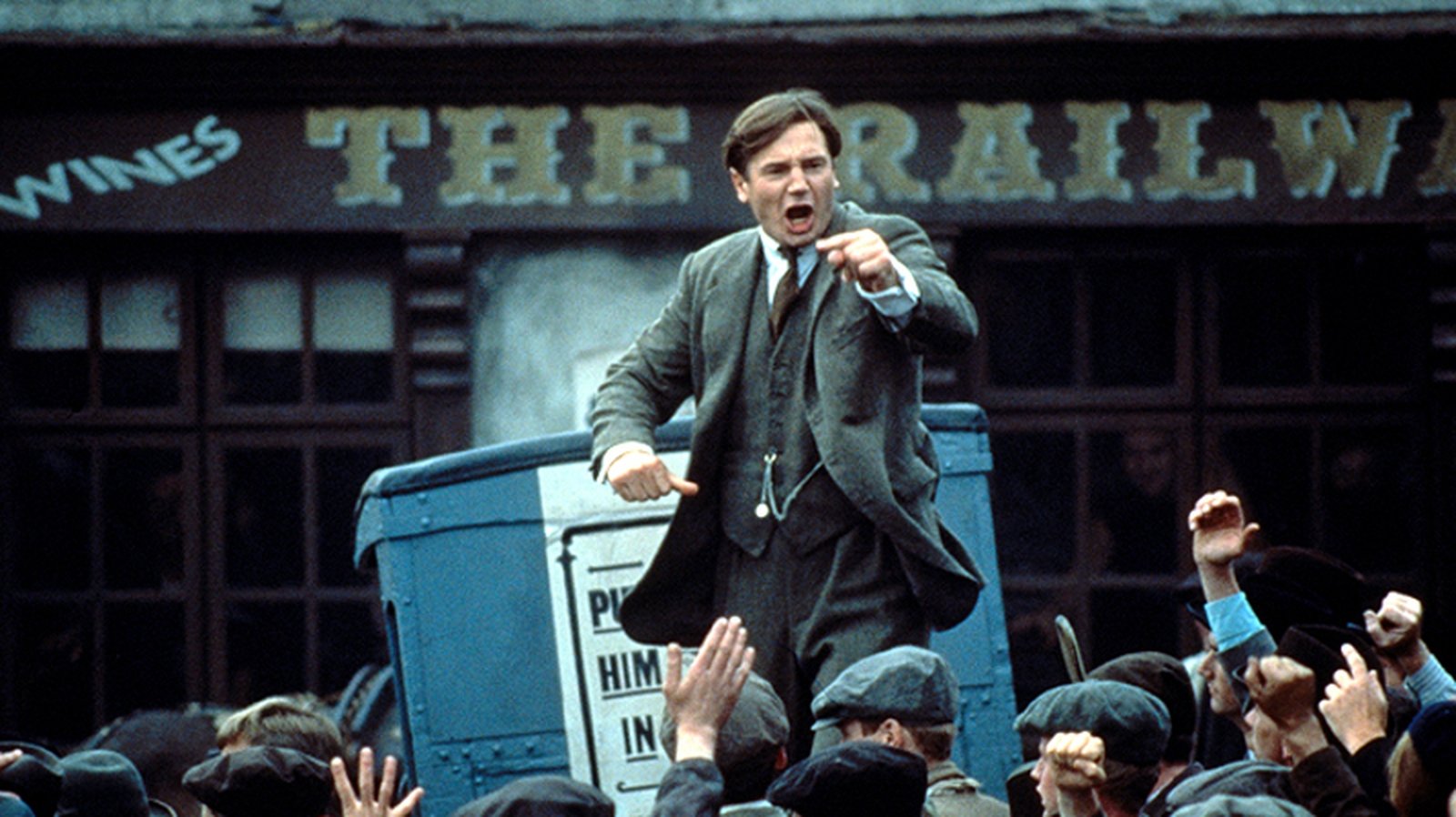
Liam Neeson is outstanding as Irish revolutionary leader Michael Collins

Director: Neil Jordan

Cast: Liam Neeson (Michael Collins), Aidan Quinn (Harry Boland), Stephen Rea (Ned Broy), Alan Rickman (Eamon de Valera), Julia Roberts (Kitty Kiernan), Ian Hart (Joe O’Reilly), Brendan Gleeson (Liam Tobin), Sean McGinley (Smith), Gerard McSorley (Cathal Brugha), Owen O’Neill (Rory O’Connor), Charles Dance (Soames), Jonathan Rhys Meyers (Assassin), Ian McElhinney (Belfast cop)

Britain’s colonisation of Ireland left a poisonous historical legacy that blighted much of the twentieth century. The story of Irish independence, is also one of guerrilla and political brutality, civil war and terrible lost opportunities. Jordan’s biopic of Michael Collins is a study of the man who did more than any other to turn the IRA into an effective guerrilla fighting force – only to be consumed by the very same uncompromising ruthlessness he had set in motion. It’s a powerful and beautifully made film that seeks to explore just how and why violence and politics ended up hand-in-hand in Ireland for almost 100 years.

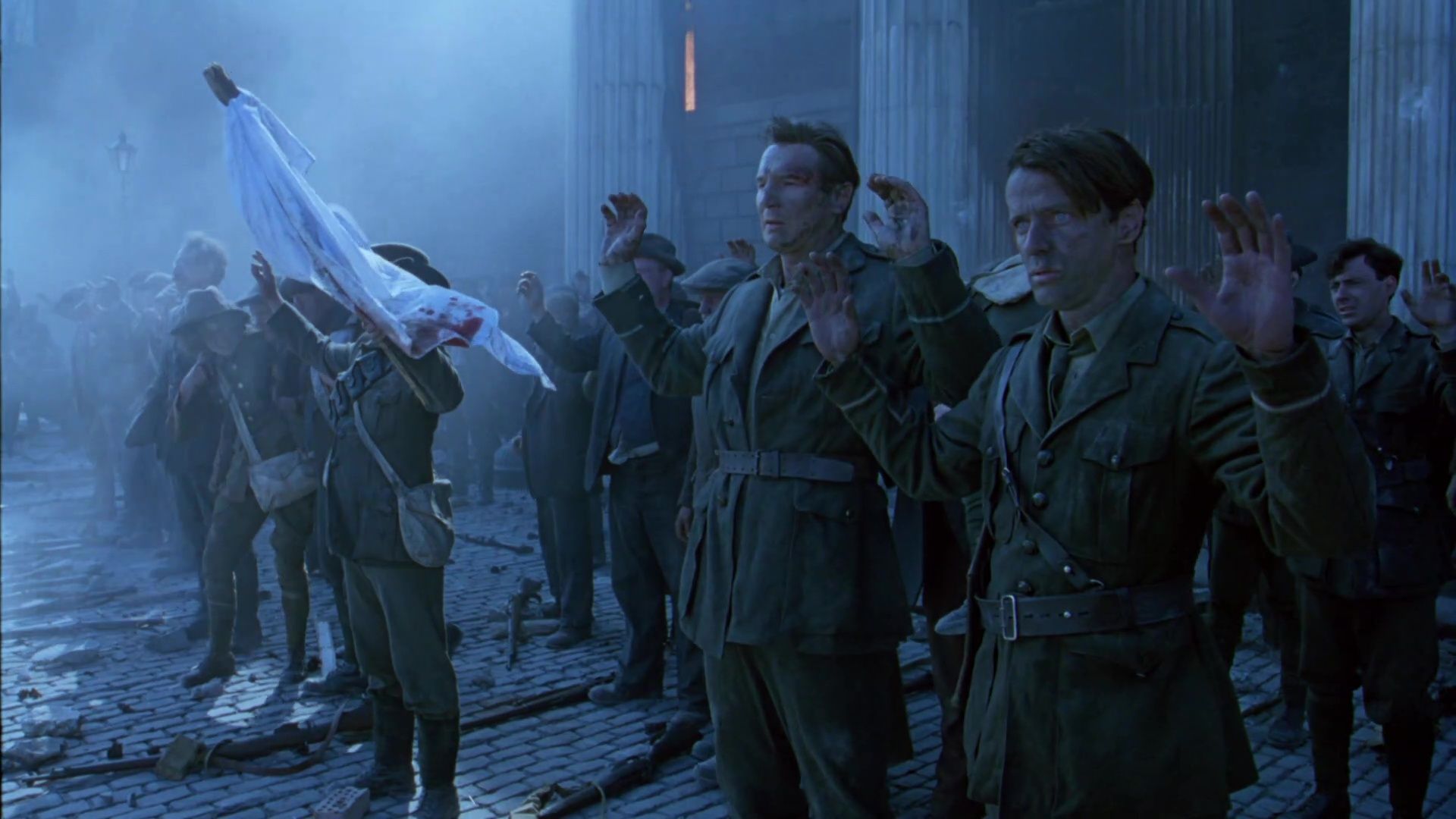
It opens with the 1916 Easter Uprising, an ignominious failure which the British managed to turn into a glorious one by executing rather than imprisoning its leadership. It’s one of many misjudgements in our occupation. It also the impetus for the young Michael Collins (Liam Neeson) to realise that playing by conventional military roles simply means defeat for the Irish time and again. Put simply, the IRA needs to stop trying to be a field army and instead become a guerrilla army, launching targeted hit-and-run terrorist attacks on the British. It’s a hugely successful campaign – despite the doubts of Sinn Fein leader Eamon de Valera (Alan Rickman), who favours more conventional conflict (“They call us murderers!” he cries, with some justification). But after the British agree a Treaty that divides Ireland, the IRA splinters into pro- and anti Treaty factions. Can Collins put the cork back in the bottle of violence, before the country tears itself apart?

Of course, anyone with a passing knowledge of history knows that he can’t. Hanging over the entire film is the knowledge that Collins’ new methods of political assassination, plainclothes soldiers, bombs and bullets in the middle of the night will eventually expand into the indiscriminate bombing and shooting that consumed Ireland for decades. Not that Collins will live to see it, as he was assassinated aged 31 attempting to negotiate an end to Civil War. What makes Collins such an engaging and intriguing figure is that he (or at least the version we see in this film) was a man forced into methods he knew were wrong, to achieve an end he knew was right.
Neeson is superb as the charismatic, blunt yet poetic Collins who is noble enough to know that training young men to quickly and efficiently commit murder is an ignoble legacy. Jordan’s film doesn’t condone Collins use of violence, but establishes why it was necessary. Playing by more conventional rules simply wasn’t going to work – and Ireland didn’t see why they had to wait for British politics to shift. Unlike, say Gandhi in India (and Michael Collins makes a dark companion piece with Attenborough’s Gandhi, two charismatic campaigners choosing radically different paths to independence), Collins believed Britain had to be forced to see holding Ireland wasn’t worth the blood sacrifice and emotional cost. (Jordan’s film is also clear that Britain’s hands were equally dirty, the British conducting their own counter-campaign of assassination and violence).

The tragedy that Jordan finds in all of this is that, when the British were gone, Ireland had become so used to dealing with political problems with violence that they couldn’t imagine solving their disagreements with anything else. Collins is in fact too successful: and the film demonstrates that in radicalising his followers, he’s unable to gearshift them towards compromise. His attempts to get Sinn Fein to accept a Treaty that offers a workable compromise (as opposed to an unwinnable full-scale war), leads to him becoming a victim of exactly the sort of insurgency he pioneered in the first place. To Jordan he is a man trapped in a world of his own making, unable to remove the gun from Irish politics.

Michael Collins makes some compromises with history – something that was bound to get it attacked when dealing with events of such earth-shattering controversy – but it always feel spiritually accurate. The British Black and Tans really were as brutal as they seem, and while they didn’t use an armoured car on the pitch at the “Bloody Sunday” massacre at Croke Park, they did shoot indiscriminately at the crowd and fire at the stadium from an armoured car outside causing 14 fatalities (including two children) and 80 serious injuries. Similarly, in the aftermath of Collin’s assassination of most of the British intelligence operation in Dublin, three IRA leaders were “killed while trying to escape” (even if these were different men than the one who suffers this fate in the film). Just as IRA killings in the street were swift and brutal, so interrogations in Dublin Castle could stretch way beyond what the Geneva Convention would suggest was acceptable.

Much of the first half of the film is structured in the style of an old-fashioned gangster film, with hits and street gangs. Plucky IRA under-dogs (and Neeson’s Collins is so charming, you immediately root for him), take-on the more hissable baddies in British intelligence (led first by a bullying Sean McGinley and then a suavely ruthless Charles Dance). But the romance slowly drains out of this as lifeless bodies hit the floor – and Jordan always gives the focus to the dead after they fall, regardless of their ‘side’. The film has an infectious momentum, which makes its final acts, with their air of tragedy, even more sad and moving. It’s all also quite beautifully shot by Chris Menges, the film bathed in some of the most luscious blues you’ll see.

While Michael Collins is more sympathetic to the Irish (as you would expect), it clearly shows the psychological damage of killing. Hesitant shooters become increasingly ruthless at the cost of their humanity. Collins spends a ‘dark night of the soul’ openly confessing that he hates what he is making young men do and knows it is morally wrong. In the end this explains why methods were chosen, but doesn’t praise them – just as it doesn’t outright condemn them, considering what the Irish were up against. It’s a difficult balance, but very well walked.

There are flaws. Excellent as Liam Neeson (at the time 15 years older than Collins was when he died) and Aidan Quinn as his number two Harry Boland are, the film’s insertion of a love triangle between them and Collin’s eventual fiancée Kitty Kiernan often descends into weaker “Hollywoodese”. It’s not helped by having Kitty played by an egregious Julia Roberts, who struggles gamely with the Irish accent, and who never transcends her star status.

Additionally, while the film has an excellent performance by Alan Rickman (in a pitch perfect vocal and physical impersonation) as Eamon de Valera, it also repositions de Valera as an antagonist. Although de Valera certainly was a prima donna who associated his interests and Ireland’s as being one and the same, the film implies that de Valera’s actions are motivated as much by jealousy as principle and lays most of the blame for the civil war on him. Not to mention implying de Valera’s complicity in Collins eventual death (a heavily disputed assertion, strongly denied by de Valera).

Michael Collins though is a thoughtful, complex and engaging film that brings a tumultuous period of history successfully to life. Jordan’s film manages to wrestle an enthusiastic admiration for Collins, with a questioning exploration of how his actions (however well motivated) led to a legacy of violence. But it doesn’t lose sight of how Collins was aware he was using wicked methods for a noble aim, or that his goal was to bring peace. Wonderfully acted by a great cast (every Irish actor alive seems to be in it), with Neeson sensational, it’s an essential watch for anyone interested in this period of history.
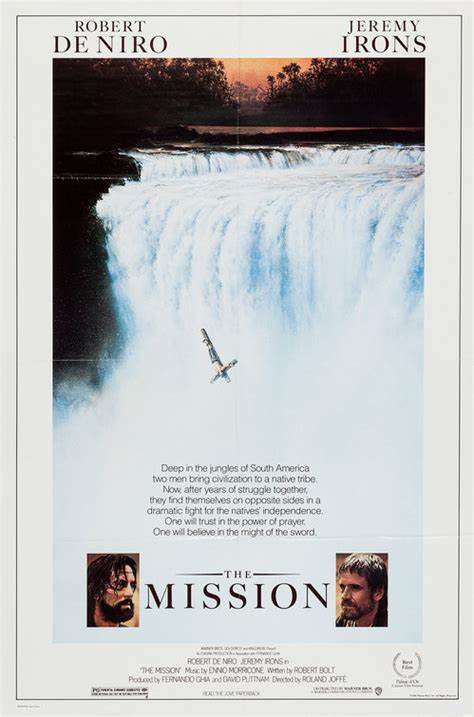
The Mission (1986)

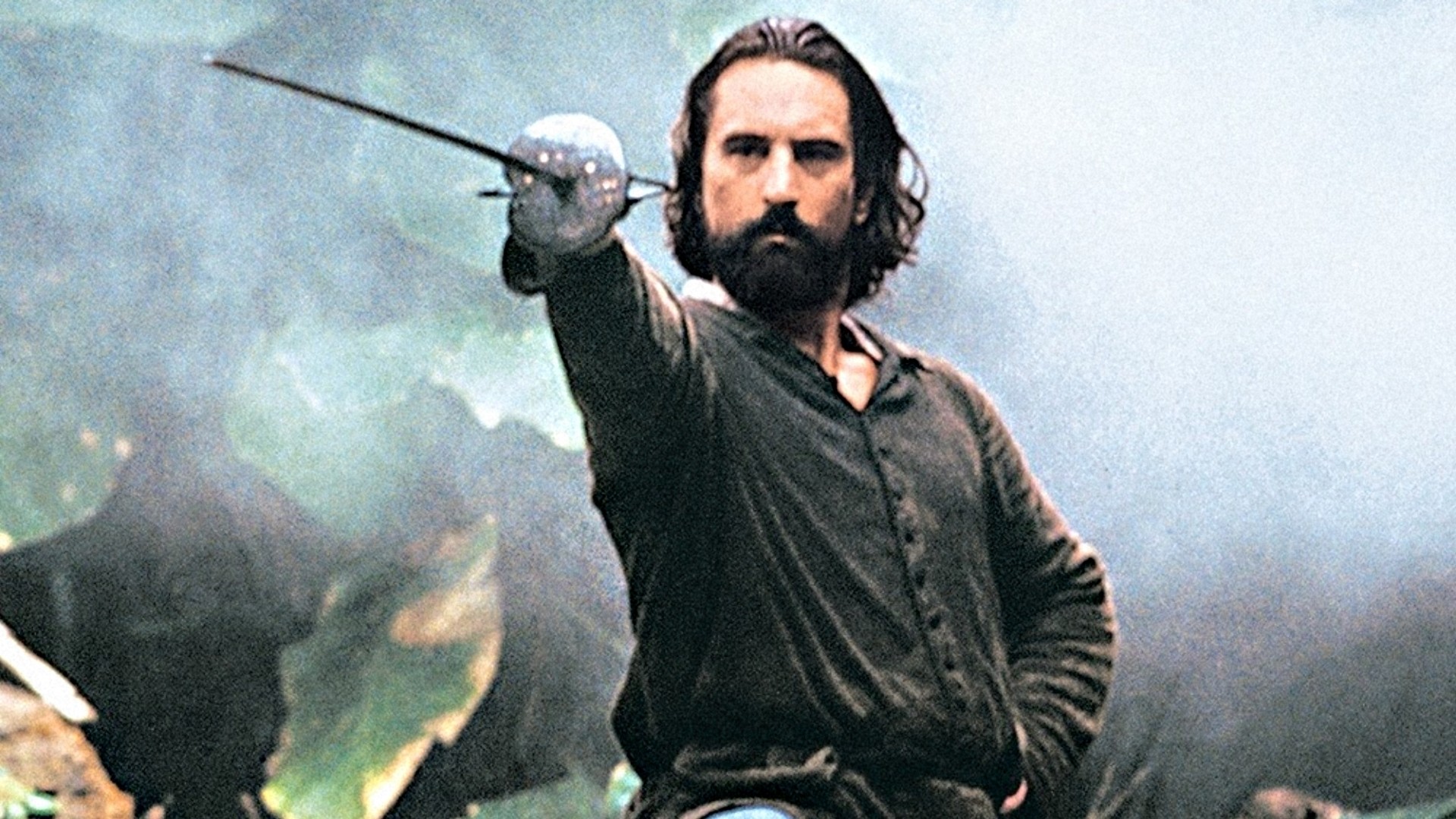
Robert de Niro turns aside from the Jesuit rule to fight for right in The Mission

Director: Roland Joffé

Cast: Robert de Niro (Rodrigo Mendoza), Jeremy Irons (Father Gabriel), Ray McAnally (Cardinal Altamirano), Aidan Quinn (Felipe Mendoza), Cherie Lunghi (Carlotta), Ronald Pickup (Hontar), Chuck Low (Don Cabeza), Liam Neeson (Father John Fielding)

Spoilers: The incredibly grim and depressing ending of The Mission is discussed in detail.

When the world is run by men, how much of a voice does God have? Roland Joffé’s film explores colonial politics and religious duty in Spanish and Portuguese controlled South America. Needless to say, God doesn’t get that much of a vote when questions of land ownership, slavery and money are in play – and no noble stand from Jesuit priests is going to make a jot of difference. Joffé’s beautifully made and moving epic might be slightly self-important, but it won the Palme d’Or. With powerful imagery and sequences but some under-explored themes and characters, its one of those films that probably would have benefited from being at least an hour longer.

In the Paraguayan jungle in the 1750s, Jesuit priest Father Gabriel (Jeremy Irons) successfully converts a Guarani community at his mission. Problem is to the Spanish and Portuguese empires the Guarani are fit only for exploitation and slavery. Mercenary slaver Rodrigo Mendoza (Robert de Niro) is one of them – but his world collapses after he murders his brother (Aidan Quinn) in a dispute over the woman (Cherie Lunghi) they both love. Mendoza makes his penance with the Jesuits, and the forgiveness he receives from the Guarani changes his life, leading to his conversion. But when a treaty – with the reluctant agreement of papal legate Cardinal Altamirano (Ray McAnally) – calls for an end to the mission, Gabriel and Mendoza resolve to fight: one with prayers the other with the weapons he has sworn off. Can they help the Guarani defend themselves from colonialism?

I don’t think its too much of a spoiler to say, no they can’t. The Mission may occasionally muddle itself by trying to say a lot in a short run-time, but on one thing it’s clear: the world is what men have made it, and they’ve made it a pretty dreadful place. The final quarter of the film is entirely given over to the spirited fight to protect the mission, as Mendoza and the other priests take up arms to help these people defend their homes. Joffé doesn’t gloss over the hideous cost of this, with a staggeringly high body count. The Europeans don’t differentiate between combatants and non-combatants, and the killed (and everyone is killed) fall with a sickening finality.

Watching the senseless destruction of this entire community for no purpose other than stripping the Guarani people of anything of value and shipping it back to Europe, you can only agree with Cardinal Altamirano that perhaps it would have been better for all concerned if ships had never crossed the Atlantic. When the dreams of bringing Christian civilisation end with Father Gabriel leading a march of peaceful converts into a hail of bullets, something has gone badly amiss in the world. Hammering home how helpless decency is, Mendoza is fatally wounded (and the village finally doomed) when he is distracted from destroying the bridge into the village, by running to safe a wounded child. No good deed goes unpunished in The Mission.

All of this is, by the way, immensely moving. It’s a tribute to Joffé’s quiet, coldly realistic eye for violence among the natural world that the final half hour is a hard watch. The European invaders may be faceless, scruffy monsters, but even they are briefly halted by the sound of prayer from the village (before they burn it down and kill everyone). The Mission is a profoundly beautiful film, which strains hard for spiritual meaning, and this final sequence is almost impossibly tragic to watch. Just as he had done in The Killing Fields, Joffé’s ability to report without sensationalism on real life tragedy, amongst scenery of great beauty, makes for powerful viewing.

There is so much right about The Mission, it feels harsh criticising it. The film was shot entirely on location (at times the cast show clear signs of the jungle-tummy that spread like wildfire through the cast and crew) and Chris Menges’ (Oscar-winning) cinematography captures the exotic beauty of the jungle, with a powerful visual sense of the spiritual and the sublime. It’s an effect built on immeasurably by Ennio Morricone’s extraordinary score (one of the greatest ever recorded), every single note perfectly chosen to communicate the holy serenity of the Jesuits and the dark flaws of mankind.

Its in exploring those flaws that the film feels a tad rushed. I dearly wish this was an hour longer, if for no other reason that it could bring greater focus to the balance between faith and realpolitik in greater depth. Although the Cardinal gets a few moments to reflect on this, and explicitly question the self-appointed right the Europeans have given themselves as masters of the world, the film never quite manages to dive into these. (McAnally however is excellent as this tortured and ashamed man). Too often these ideas are boiled down into “worldly men bad, priests good”.

The role of the Missionaries themselves also goes unquestioned – these are, after all, people who have crossed the seas with the same sort of imperialist missions as anyone else, finding the indigenous tribes and aiming to make them (no matter how decent their motives) as much like the Europeans as they can. Instead there are presented as purely good and holy. Just think what another hour could have done for expanding the insight into the role of the Church here.

There is a few too many blunt statements of intentions and plot information, rather then real insight. You come out of it still with only a most basic idea of why Gabriel and Mendoza make the decisions they do – or what they hope the outcomes might be. More of a dive into the characters could have given more context to their holy intentions.

In the end the film’s main aim is pushing a message of peace. It’s the message Mendoza must learn. The film’s other most successful sequence covers his extraordinary penance, dragging a huge bundle of armour and weapons up a mountain to the mission. De Niro sells the anguish as beautifully as he does Mendoza’s shamed gratitude when he is greeted warmly by the very people he had enslaved. Its moments like this where The Mission achieves its aim of grappling with something close to how spirituality can move and change us – which often gets bogged down elsewhere in ticking off plot.

The message of peace is embodied by Irons’ profound and generous performance as Gabriel, a man who believes the world should be simpler than it is. I just wish the film had given itself more room to delve into its themes. In trying to cover imperialism, religion, spirituality and native rights, all in two hours (the Guarani draw a short story, with not one of them really being given a character) its too much. A richer, more textured film would make for a richer overall experience. It’s a film of great beauty in score and photography, often moving, but doesn’t make its message much more than give peace a chance.

Mary Shelley's Frankenstein (1994)


Kenneth Branagh struggles to bring Mary Shelley’s Frankenstein to life

Director: Kenneth Branagh

Cast: Robert De Niro (The Creature), Kenneth Branagh (Victor Frankenstein), Tom Hulce (Henry Clerval), Helena Bonham Carter (Elizabeth), Ian Holm (Baron Frankenstein), John Cleese (Professor Waldman), Aidan Quinn (Captain Robert Walton), Richard Briers (Grandfather), Robert Hardy (Professor Krempe), Trevyn McDowell (Justine Moritz), Celia Imrie (Mrs Mortiz), Cherie Lunghi (Caroline Frankenstein)

In 1994 Kenneth Branagh was the heir of Laurence Olivier: a man who could act, direct and produce, who never had a false step, whose every film was a success. In other words he was ripe for a kicking, and Mary Shelley’s Frankenstein was the stick used to beat him. It was practically the founding text of “Branagh-bashing”, for a time one of the favourite sports of the British press.

Victor Frankenstein (Kenneth Branagh) grows up obsessed with defeating death, traumatised by the death of his mother. Training as a doctor in Vienna, after the murder of his mentor Professor Waldmann (an effectively serious John Cleese), he uses the body of the murderer to create the Creature (Robert De Niro) – but, horrified by what he has created, he flees home to Geneva. While the Creature comes to terms with being an outcast, Victor marries his sweetheart Elizabeth (Helena Bonham Carter) – only for her to become a target when the Creature vows revenge.

Okay the good stuff about this film: the production design is terrific, the Frankenstein house in particular a marvellous set. It’s also a very faithful adaptation, pretty much following the book (apart from a late, horribly melodramatic “Bride of Frankenstein” sequence). Branagh gets some affecting moments out of the film, particularly in the calmer moments – De Niro gives an interesting performance and the retention of the Walton framing device in the Arctic is well done. There is a good film in here. But it’s buried completely under the overblown shouting, swooping cameras and booming music that covers the rest of the film.

Contrary to his reputation as a purveyor of intricate Shakespeare adaptations, Branagh has always been a lover of big movies, who brings an operatic intensity to cinema. The problem is he goes too far here. This is at times so ridiculously overblown and frenetic in its tempo, you start to think Branagh is trying too hard, desperate to make a big budget smash. Wanting to make a big, gory, gothic horror film, he dials everything up to eleven, and the sturm und drang eventually becomes a tale full of sound and fury signifying nothing.

Interestingly, this intensity is particularly overbearing in the Frankenstein scenes, rather than those focusing on the Creature. Several scenes are filmed with the camera swooping round in circles over long intense takes, while the score thunders away. This principally happens in scenes of high emotion – the deaths of Frankenstein’s mother and his mentor Waldmann are both operatically overblown (in the latter Branagh literally cranes up and screams “No!”). Eventually it all becomes too much. You are crying out for everyone to take a breath and just deliver a line calmly.

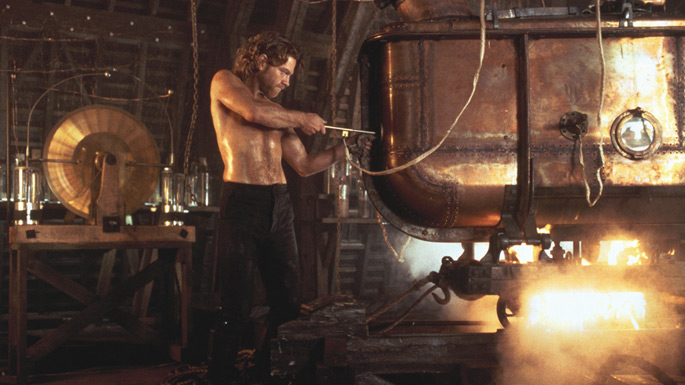
Now I can see what Branagh is doing here. He’s looking to emulate the high-Gothic semi-camp of 1930s horror films. That’s the charitable explanation for why he spends the entire Creature-birthing scene running round topless (he must have spent ages on that chest), with Patrick Doyle’s score booming away, while the camera swoops and sweeps around him. Branagh is partly channelling Colin Clive’s mad scientist from James Whale (he even bellows “Live!” in pure Clive style twice in the film), but by going for overwhelming bombast in his performance, he misses out on making the character relatable. Now Victor is a selfish asshole of course, but we should at least relate to him a little bit: I’m not sure many people can in this film.

It’s a real shame because there is in fact, under the frantic editing and dizzying camerawork, a quieter, more intelligent film trying to get out. Branagh’s Frankenstein is a man deep in trauma about death, unable to cope with losing people, whose fear becomes a dangerous obsession. The romance between Victor and Helena Bonham Carter’s sweetly innocent Elizabeth has a lot of warmth (the chemistry is also excellent: no surprise to hear that the actors started a long term relationship on the set of this film). There are moments here meditating on life and death, but they constantly get lost in the next ridiculous bloody action scene, or explosion of overblown acting.

Similarly, De Niro mines a lot of confused sympathy from the Creature – probably because he seems the quieter and more “normal” person, for all his scars and acts of murder. The sequence with the Creature looking after the family of a blind man (a decent Richard Briers) sees De Niro mine a great deal of vulnerability and innocence from his situation. The contained camera work and restrained acting make these the finest scenes in the film, more memorable than any of the blood and guts that fill the final half hour.

De Niro and Briers: Your only chance to see Travis Bickle and Tom Good share a scene

And those blood and guts are a problem, because this is not a scary film. Not even one little bit. Instead it’s either ridiculous or juvenile – in a sequence where a character literally has their heart ripped out by the Creature, Branagh can’t resist not only having the Creature holding it up to the camera, but for the camera to jump to a close up of the heart literally beating in its hand. Not scary, not gross, just stupid and childish. At any points of tension we get the pounding music and running around and shouting like a Gothic Doctor Who. If only Branagh had taken a breath and treated the material more calmly and sensibly we could have ended up with something creepy and spooky, rather than garish.

It’s a real, real shame because honestly there are some good things in this movie. I’ve mentioned De Niro, but Tom Hulce is also terrific as Clerval and Bonham Carter very good as Elizabeth. There are moments of real class in the design and production – I’ve lambasted Patrick Doyle’s score a bit, but there are some very good tracks in here. The problem, much as it massively pains me to say it because I love him, is Branagh. His performance and direction is just too much: too giddy, too overblown, too frantic, too overwhelming. The film comes across less as a tribute to old style melodramatic horror movies, more a very intelligent gifted man talking down at fans of the genre, giving them what it appears the genre is about on the surface, rather than the depths that actually appeal to people. Despite its merits, the film is not alive, but dead inside.