Tag: Al Pacino

Heat (1995)

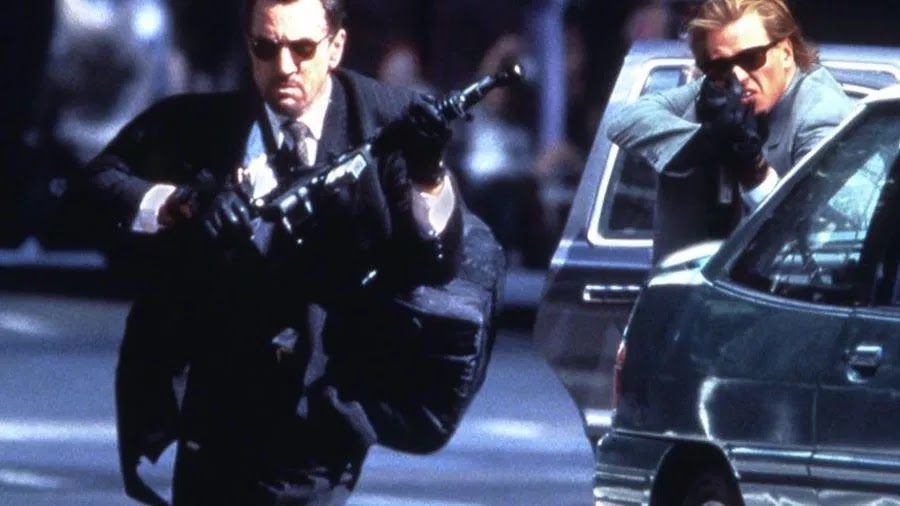
De Niro is packing Heat

Director: Michael Mann

Cast: Al Pacino (Lt Vincent Hanna), Robert De Niro (Neil McCauley), Val Kilmer (Chris Shiherlis), Jon Voight (Nate), Tom Sizemore (Michael Cheritto), Diane Venora (Justine Hanna), Amy Brenneman (Eady), Ashley Judd (Charlene Shiherlis), Mykelti Williamson (Sgt Drucker), Wes Studi (Detective Sammy Casals), Ted Levine (Detective Mike Bosko), Dennis Haysbert (Donald Breedan), William Fichtner (Roger van Zandt), Natalie Portman (Lauren Gustafson), Tom Noonan (Kelso), Kevin Gage (Waingro), Hank Azaria (Alan Marciano), Danny Trejo (Trejo), Xander Berkeley (Ralph)

In the mid-90s, Heat was the cinematic event of the year. De Niro! Pacino! Together! In one scene! The two acting heavyweights – wildly proclaimed and popular since the 1970s – had of course made The Godfather Part II together but had shared no scenes. Here, however, we’d see them both at the same time riffing off each other. The great thing is that there is so much more to Heat than just that one scene. Heat is a sort of poetic cops and robbers flick, part stunning action adventure, part profound exploration of the internal souls of men chasing down leads, both good and bad.

Neil McCauley (Robert De Niro) is a skilled career criminal who lives his life with a monastic self-denial, saying you can have nothing in your life “that you cannot walk out on in 30 seconds flat if you spot the heat around the corner”. Vincent Hanna (Al Pacino) is a bombastic, egotistical, workaholic detective with a self-destructive family life. Naturally, these two men find themselves on opposite sides, as McCauley plans his next job and Hanna works to stop him. But the men, with their similar codes dedicated to their chosen career, find that they have an increasing mutual respect – not that that will stop either of them “putting the other one down” if push comes to shove.

Heat is the pinnacle of Michael Mann’s career, and his most triumphant exploration of the conflicted, complex, masculine personalities at the heart of the high-adrenalin worlds of crime and police work. Mann has a gift for giving the simple rush and tumble of cops and robbers a sort of epic poetry, like a metropolitan Beowulf, and he achieves this again here. Heat is a film that throbs with meaning, it’s cool blue lensing and chilly, modern architecture serving as a perfect counterpoint to the cool, professional and focused personalities of its characters.

Heat also goes the extra mile by building this playground confrontation into a mythic battle of wills, a battle of principles and ways of living that seem separated only by a few degrees. Mann invests this with such sweep, such grandiosity (without pomposity), such scale that it becomes a sort of modern epic, a film where intense meaning can be mined by the viewer from every scene. Whether there is in fact any meaning there – avoid listening to Mann’s commentary which drills down so many of his elliptical character beats and open-ended scenes into the dullest, most predictable tropes that he had in mind while filming – is another issue, but Mann’s trick as always with his best work is to make something really quite small and everyday seem like a grand, timeless epic.

It all boils down to that famous coffee shop scene, where De Niro and Pacino for a few magic moments come together. It’s a scene that explicitly asks us to see cop and criminal and understand that there is in many ways very little to choose between them. It hinges on the gentle competitiveness of the actors, and the way they subtly play off each other. It also plays on our own histories of these two actors, of decades of seeing them as two sides of the same coin, both carrying so much cultural baggage for a string of iconic roles that saw them rule Hollywood for over a decade. It’s the sort of scene given extra investment, where you sense the mutual respect of the actors fuelling the strange bond that powers the scene. 

It’s also the one scene of the film that Pacino underplays in. The rest of the film he goes way bigger, powering through each scene with an explosion of shouting and drama. It’s a performance ripe for parody, with more than an edge of ham, but it just about works. Pacino turns Hanna (hilariously the character shares a name with a BBC political journalist of the 1980s) into the purest form of adrenalin junkie, a larger-than-life personality who tears through people and cases with a focused determination that allows no room for a personal life. De Niro downplays far more by contrast, apeing a sort of 1940s noir cool, a monkish insularity that prevents anyone from getting close to him, mixed with a laser-guided determination to do whatever it takes to make his score.

Mann’s film throws these two characters into a series of stunning set pieces with the bank robbery at the centre (“the one last score” that McCauley can’t pass up no matter the danger). The robbery – and the shoot out that follows it – is a triumph of action cinema, brilliantly shot and edited. The gun play is stunning, with Andy McNab having served as a consultant for the actors on the use of automatic weapons. The scene rips through the screen, spewing bullets all over the place in a ruthless, no-onlooker-spared rampage that also really pushes the limits of effective sound design. That’s just the highlight of several scenes that – with guns or otherwise – hum with tension, danger and excitement.

Mann also has enough room in this film though to skilfully establish a number of supporting characters with compelling story lines of their own. Val Kilmer is a tad wooden as McCauley’s number two, but his storyline of troubled marriage is mined for unexpecting pathos (thanks also to Ashley Judd’s fine work as his wife). Kevin Gage is very good as a psychopathic criminal unwisely brought on board to fill a slot in an early robbery. Dennis Haysbert has his own tragic plotline as a criminal trying to turn straight. Diane Venora is excellent as Hanna’s neglected wife, as is Portman as his vulnerable daughter-in-law. This isn’t to mention excellent performances from a rogues gallery of character actors, from Jon Voight to William Fichtner. 

Mann keeps all these plotlines perfectly balanced in a film that is very long but never drags for a minute. Crammed with exciting set pieces and brilliant sequences, it’s a film that manages to feel like it is about a very masculine crisis – the failures of men to balance the personal and their career, selfishly harming those around them because of their addiction to action. Mann’s film looks brilliantly at the essential emptiness and sadness this leads to – as well as the blinkered drive that never prevents men from stopping for a second and changing their lives, no matter how many reflective cups of coffee they have. Mann partners this existential, poetic feeling drama with the ultimate crash-bang cops and robbers and thriller, which will leave you on the edge of your seat no matter how many times you see it. Quite some film.
Carlito's Way (1993)


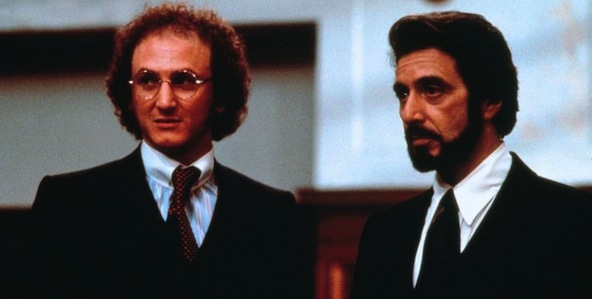
Sean Penn and Al Pacino struggle with the impact of a life of crime in Carlito’s Way

Director: Brian de Palma

Cast: Al Pacino (Carlito Brigante), Sean Penn (David Kleinfeld), Penelope Ann Miller (Gail), John Leguizamo (Benny Blanco), Luiz Guzmán (Pachanga), Jorge Porcel (Saso), James Rebhorn (Bill Norwalk), Joseph Siravo (Vincent Taglialucci), Frank Minucci (“Tony T” Taglialucci), Adrian Pasdar (Frank Taglialucci), Viggo Mortensen (Lalin)

Every so often from the 1990s onwards, Al Pacino actually bothered to act rather than rage in an orgy of self-parody. It’s the films where he does really embrace the challenge, like Carlito’s Way, that reminds you what a damn fine actor he is. Carlito’s Way may also be a reminder of what an overtly flashy director Brian de Palma is, but it’s a fine American gangster thriller.

In 1975, Carlito Brigante (Al Pacino) is released from prison after five years on a legal technicality, exposed by his friend and lawyer Dave Kleinfeld (Sean Penn). Carlito makes a speech at his hearing, claiming he is a reformed man who wants leave his criminal past behind him – and to the shock of Kleinfeld and his colleagues in the underworld, he’s telling the truth. Carlito attempts to go straight, and to rebuild a relationship with Gail (Penelope Ann Miller), the young woman he left behind. Unfortunately, Kleinfeld is not only becoming increasingly unpredictable due to his cocaine addiction, but he is starting to blur the lines between criminal lawyer and plain criminal. His actions continually threaten to drag Carlito back into the crime industry.

Carlito’s Way is a fine semi-morality tale, a modern tragedy of a man who, every time he thinks he’s out, “they pull me back in”. And of course we know that he’s on a hiding to nothing, as the film opens with Pacino gunned down by an unknown assailant and recounting most of the film’s plot (presumably) from beyond the grave. His attempts are doomed largely because, in order to go straight quick and easy, he has to raise money the only way he knows how – working in the very same flashy nightclubs and among the career criminals that he should absolutely be avoiding.

Carlito narrates the film with a weary reluctance, carefully recounting the mistakes he made and why. It’s a device that largely manages to avoid telling us the obvious, and actually gets us closer to, and like, Carlito. It also helps that Pacino’s voice itself has a gruff poetry to it, and he adds a Shakespearean grandeur to this familiar old-school tale of the crook who wants out.

Pacino’s intensity works fantastically for the part. He largely keeps the Pacino fireworks for the moments where they carry the most impact. He and de Palma carefully sketch out a portrait of Carlito as a world-weary man, who (try as he might) can’t leave behind the code and rules that have governed his life as a criminal. He can’t escape the confines of thinking like a criminal. Most terribly, his old-school sense of honour (few actors convey dishevelled personal morality better than Pacino) is what will doom him – he can’t break the code of the streets. It’s a terrific, empathetic performance from Pacino.

Pacino also develops a sweet, loving relationship between him and Penelope Ann Miller’s Gail. In the way of these films, Gail is a stripper – she alternates between sweetly loving and overtly sexually flirtatious as the plot demands – but Miller makes her feel like a real person. She and Pacino have great chemistry (which, rumour has it, also carried over into real life) and de Palma shoots their scenes with an old-school romanticism and a steady camera, which contrasts with the disjointed sweep and Dutch angles he uses elsewhere.

Sometimes these flashy angles get on my nerves. de Palma often feels like he’s trying too hard, rather than stretching his muscles. Saying that, he’s a master of the set-piece. The film has two action set-pieces and both simmer with tension and inventiveness. One involves a bungled drugs deal in a dingy bar. The other a thrilling chase sequence in Grand Central Station, a deliciously shot mixture of great editing and daring extended single shots. Sequences like this bring memories, inevitably, of Scarface and it’s tempting to see Carlito’s Way as a spiritual sequel – as if Tony Montana had been arrested and changed his ways.

Perhaps a testament to how good Carlito’s Way is (or rather how much I enjoy it) is that I even think Sean Penn is terrific in it. Penn is one of those actors I find tryingly self-important (both professionally and personally). But his weaselly lawyer, a hair-trigger addict, nowhere near as smart and adept as he thinks he is, is marvellous. Penn’s performance is a whipper-cracker mix of slimy self-confidence and arrogant blindness, with moments of curiously underplayed vulnerability that makes it make sense why Carlito remains so loyal to him. It’s one of Penn’s best, most controlled performances, a virtuoso performance of whining weakness.

Carlito’s Way is part pulp gangster thriller, part character study humanely outlining the impossible difficulty of changing our stars. Carlito may be ready to jack in the criminal world – but he continues to live the life of the criminal while persuading himself he isn’t. The whole film has a tragic inevitability about it – and would do even without the framing device. Carlito wants out – but he wants to rush to get the investment he needs, and walking the shadow line is the only thing he knows how to do. It’s a great modern tragedy.

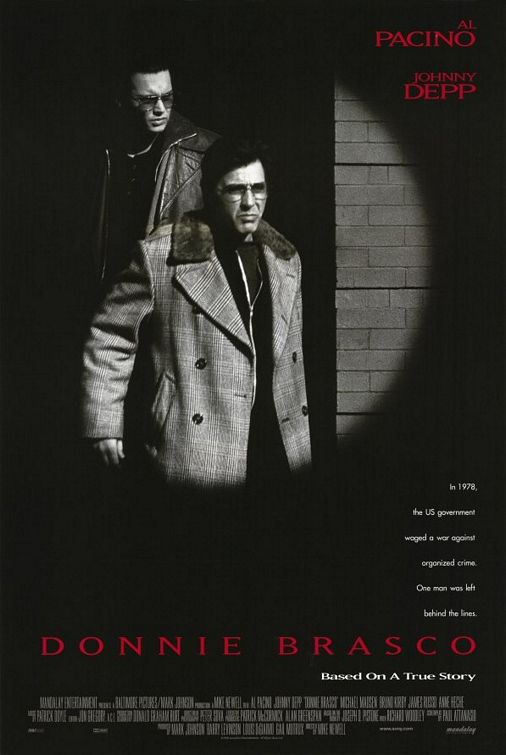
Donnie Brasco (1997)


Pacino and Depp deliver low-key, carefully controlled, sensitive performances: how often do you get to write that?

Director: Mike Newell

Cast: Al Pacino (Benjamin “Lefty” Ruggiero), Johnny Depp (Joseph Pistone/Donnie Brasco), Michael Madsen (Dominick “Sonny Black” Napolitano), Bruno Kirby (Nicky Santora), Anne Heche (Maggie Pistone), James Russo (“Paulie” Cersani), Željko Ivanek (Tim Curley), Gerry Becker (Dean Blandford), Robert Miano (Al “Sonny Red” Indelicato), Tim Blake Nelson, Paul Giamatti (FBI Technicians)

The Mafia film genre is a crowded market, so it’s a brave film maker who enters it with something a little different. But we get that with Donnie Brasco, which focuses on the bottom rungs of the Mafia ladder, suggesting that being a low-ranking member of “this thing of ours” is in many ways quite similar to being a corporate drone in the big city, only with more killing.

Joseph Pistone aka Donnie Brasco (Johnny Depp) is an undercover FBI agent, infiltrating the New York Mafia. He wins the trust of “Lefty” Ruggiero (Al Pacino), a Mafia hitman. Drawn deeper into the Mafia world, the pressure builds on Pistone/Brasco, who slowly becomes more and more indistinguishable from the criminals he spends his time with – and feels guilty about the deadly fate Lefty will meet if the Mafia discover he inadvertently introduced a rat into the family.

Newell’s film (from Paul Attanasio’s excellent script) is a dry deconstruction of the gangster life, bringing it closer to the grind of the 9-5. The criminals put in long hours to earn the income they need to push up to those above them. Class distinctions abound – in one scene, Sonny Black (a good performance of ambition and resentment from Michael Madsen) forces a smile onto his face while mob bosses laugh openly at his dress sense. Lefty whines like a mule about everything from his lack of recognition to how put-upon he is (never has a mantra about 26 hits over a lifetime sounded more like complaints about constant filing requests). He could easily be mistaken half the time for a harrassed office junior who never made the grade. When violence comes, it’s sudden, graphic, confused and brutal – a hit in a basement goes far from smoothly with one victim struggling for his life while another screams in pain.

On the other hand, the gangsters are also suggested to be maladjusted teens who never grew up. The more time Donnie spends with them, the less and less capable he becomes of relating to (or even communicating with) his wife and family. The gangsters have a routine lack of empathy for each other and treat the rules of “our thing” like a boys’ clubhouse. Many of their actions have an ill-thought-out juvenility to them: Sonny at one point steals a lion for Lefty as a gift – in a bizarre scene immediately afterwards, Lefty and Donnie feed it hamburgers through the window while it sits in the back seat of Donnie’s car. On a work-trip in Florida, the gangsters behave like kids – mucking around in the pool, delightedly going down waterflumes, burying Lefty in the sand on the beach while he sleeps. Even Lefty is overcome like a star-struck teen when meeting a famed Florida boss.

It’s not surprising that Donnie and Lefty, both outsiders in a way, are drawn together as kindred spirits in this strange, unbalanced world. Donnie obviously is an FBI agent, but Lefty is a world-weary old-timer, with a sense of honour who seems (apart from his ease with killing and violence) to be the most “normal” of the gangsters. The film is a careful construction of the growth of loyalty between these characters – particularly the slow development of Donnie’s feelings of genuine friendship towards Lefty. What’s effective is that this is a gradual process without a definable key moment. Instead, it becomes rather touching as Donnie starts to avoid moving closer to better “contacts” in order to remain close to Lefty. Donnie Brasco might be one of the few films that really gets a type of male friendship, and the unspoken emotional bonds that underpin them.

Perhaps the best things about Donnie Brasco are the two wonderful performances we get from actors who never knowlingly underplay. Watching this and Ed Wood is a reminder of the actor Johnny Depp could have been, before clowning in Pirates of the Caribbean seemed to shatter his focus. Brasco/Pistone is a brilliantly low-key presentation of a fractured personality. At first, the differentiation between the two personalities is distinct and clear – but as the film progresses, Depp allows the two to almost c/ollapse into each other. Everything from his body language to his manner of speaking slowly repositions itself as he becomes more consumed by the gangster world. Depp is also very good at not losing track of Pistone’s horror at murder and violence, while allowing the Brasco persona to take part in its aftereffects. The quiet building of guilt in his eyes at the fate he is creating for Lefty is also gently underplayed, making it more effective.

However, this is Al Pacino’s movie. It’s certainly Pacino’s last great performance: with the added frisson that he’s Michael Corleone demoted to the bottom rung of the ladder, Pacino is magnetic. Lefty is a put-upon whiner, who still has a charisma of his youth that draws Donnie (and others) in. A man of strong moral principles, who treats Donnie with a fatherly regard, uncomfortable with much of the ostentation of his fellow gangsters, he’s also a ruthless killer who blithely shrugs off his killing of an old friend. All Pacino’s bombast is only rarely deployed for impact – instead Lefty is a low-key, almost sad figure, whose chance in life has passed by.

One extraordinary scene late on deserves particular mention. I won’t spoil things too much, but Lefty prepares to leave the house after a phone call full of bad news. Carefully, sadly, he smartens himself up then returns (after saying goodbye to his wife) to gently remove his valuables and leave them in a drawer for his wife – he even carefully leaves the drawer ajar so she can find it. Setting himself before leaving the house, he takes a small look around. It’s a beautifully gentle scene, which could be overloaded with meaning from another actor, but Pacino plays it with such quiet but intense focus, and such careful precision it works brilliantly. Take a look at the scene here (warning spoilers!)

Newell’s strength as an actor’s director is apparent in all the performances, and Donnie Brasco is a film of many wonderful scenes and moments. The film never loses track of the danger of undercover heart – and several striking scenes have Pistone close to being discovered. The film is not perfect: the aim of the FBI investigation, and the impact Donnie’s work are never really made clear and the scenes involving Pistone’s homelife feel far more predictable and conventional than the rest of the movie (Anne Heche has a thankless part). But when it focuses on the two leads, and their dynamism together, it’s a damn fine film. It’s not going to challenge Goodfellas as a story of low-key hoods, but it’s certainly a worthy addition to cinema’s mafia films.