Tag: Alex Garland

Civil War (2024)

Civil War (2024)

An eye-catching concept disguises a film more about journalistic ethics than politics

Director: Alex Garland

Cast: Kirsten Dunst (Lee Smith), Wagner Moura (Joel), Cailee Spaeny (Jessie Cullen), Stephen McKinley Henderson (Sammy), Nick Offerman (President of the United States), Sonoya Mizuno (Anya), Jefferson White (Dave), Nelson Lee (Tony), Evan Lai (Bohai), Jesse Plemons (Militant)

A third-term President (Nick Offerman) speaks to an America torn apart by Civil War. It’s an attention-grabbing opening but actually, in many ways, politics is not the primary focus of Civil War. Rather than a state-of-the-nation piece, Garland’s punchy work is a study of journalism ethics. Should journalists have any moral restraint around the news they report? Civil War covers the final days of its fictional civil war, as four journalists – celebrated photo-journalist Lee Smith (Kirsten Dunst) and her reporter colleague Joel (Wagner Moura), veteran correspondent Sammy (Stephen McKinley Henderson) and would-be war photography who idealises Lee, Jessie (Cailee Spaeny) – travel to Washington in the hopes of capturing the photo (and interview) with the President before his defeat.

Perhaps worried about accusations of political bias, Civil War keeps the causes of its war – and, often, even which sides we are interacting with at any given moment – deliberately vague. There is a throwaway reference to Lee having gained fame for a photo of “the Antifa massacre”, phrasing which doesn’t tell us if Antifa were victims or perpetrators. California and Texas – unlikely bedfellows to say the least – have allied to form the Western Federation. We learn nothing about the President, other than casual name-checks comparing him to Gaddafi (he does vaguely resemble vocally, in his brief appearances, Trump). But so universal are the politics of Civil War it could, without changing a thing (other than wifi access) be as easily set in the time of Clinton or Reagan as Trump and Biden.

Instead, Garland’s point seems to be more if there was a civil war in the Land of the Free, the chaos we could expect to see would be no different than the chaos that has occurred in any number of other locations. On their journey, the journalists encounter UN-run refugee camps, lynch mobs, summary executions, street-by-street fighting, mass graves of civilians and a collapse of anything resembling normal life. We’ve seen the same sort of images countless times on TV, and it matters not a jot that the backdrop now are the streets of DC rather than, say, Mogadishu.

Instead, Civil War becomes the sort of ethical discussion you could imagine in a journalism school seminar. Lee is plagued with troubling memories of conflicts passed, where we see her photographing at intimate range, war crimes, atrocities and shootings without a flicker of emotion. It doesn’t take long for the viewer to find this passive observation of death uncomfortable. It’s something I already felt, watching Lee in the film’s opening photograph a riot over a water truck, camera clicking mere centimetres from civilians laid low by truncheons. When an explosion occurs, her first instinct (after pushing Jessie down to avoid the blast) is to reach for her camera, not to help.

Although showing journalists as brave – putting themselves in harm’s way to bring the readers and viewers at home the truth – Civil War subtly questions the profession of war reporter, people often excitedly pounding the streets alongside killers. Lee’s mentoring of Jessie seems focused less on camera skills, and more on drilling into her the need to disconnect with the world around her. To see herself an observer, whose duty is to record events not to intercede. This boils down to a central idea that Civil War will repeat: if I was killed, Jessie asks, would Lee take the photo? This question becomes the dark heart of Civil War.

We increasingly realise many of the journalists are adrenalin junkies, hooked on the buzz from following in soldier immediate footsteps. “What a rush!” screams Joel after they drive away from a battle that ended with a series of summary executions. Many of the journalists don’t consider they hold any moral connection at all for what happens in front of them. It never occurs to them to attempt to prevent an act of violence or argue against something they see. You start to get the chilling feeling that some of them would as unprotestingly followed the Wehrmacht through the Eastern Front and recorded mass executions with the same emotional disconnection.

The journalists also have a cast-iron belief in their own inviolability, believing the simple waving of their press badge will be guarantee them safety. This delusion is seriously shaken by an encounter with a terrifying, mass-grave filling soldier played by a dead-eyed chill by Jesse Plemons. Even in the tragic aftermath of this, Joel’s grief at the loss of friends and colleagues is also tinged with regret that their potential missing of a crucial story means it was also all for nothing.

Only Lee – an excellently subtle performance by Kirsten Dunst, with the flowering of doubt and regret behind her eyes growing in every scene – shows any growing sense of the ghastly moral compromises (and even collaboration with the grisly things they witness) the journalists have made. It makes an excellent contrast with the increasingly gung-ho and risk-taking Jessie (an equally fine Cailee Spaeny), who becomes as hooked on the adrenalin rush of combat as Joel is.

Garland explores all this rather well under his flashy eye-catching concept. The film is shot with a grimy, visceral intensity – punctuated frequently with black-and-white freeze frames showing Lee and Jessie’s photos, which reaches a heart-wrenching climax for one pivotal scene. Interestingly it’s the dialogue and plotting that sometimes lets Civil War down: its character arcs verge on the predictable and the characters have a tendency to fill themselves in on events with on-the-nose journalism speak.

Civil War culminates in a well-staged gun battle towards the White House in Washington that, like much of Civil War’s America-based concept is about the shock of seeing these things “happening here” rather than in a land far away “of which we know nothing”. But this teasing of a political comment disguises the film’s real intent, a careful study of the moral complexities of reporting horrors rather than stopping them, of becoming so deadened to violence a friend’s death becomes a photo op. Civil War might be one of the most subtle questioning of journalistic ethics ever made, presenting it not as an unquestionably noble profession but one of moral compromise and dark excitement-by-proxy at death and slaughter.
Ex Machina (2015)


Alicia Vikander: is she human or not? The question that troubles the cast of Ex Machina

Director: Alex Garland

Cast: Domhnall Gleeson (Caleb Smith), Alicia Vikander (Ava), Oscar Isaac (Nathan Bateman), Sonoya Mizuno (Kyoko)

It’s the age-old story of creation: man yearns for the power of the gods. There is something intrinsically god-like about the desire to create life and to develop a new creation. Ex Machina is a film that precisely explores this idea (along with a host of others). In the struggle to create an artificial intelligence, are we motivated to further mankind – or is it a perverse desire to become God ourselves? 

Caleb (Domhnall Gleeson) is a low-level coder working for a Google-like organisation founded by genius inventor Nathan Bateman (Oscar Isaac). Caleb wins a competition to spend a week at the reclusive home of Bateman, a solitary modernist house cumresearch station in the middle of a secluded forest. Nathan wants Caleb to conduct a series of interviews with his new invention – an android named Ava (Alicia Vikander), as part of a Turing Test to ascertain if she is truly intelligent or not. However, over the week, the mysteries of the house darken – and, as Caleb begins to develop strong feelings for Ava, the question arises of who is manipulating whom.

Ex Machina is a confident, fascinating piece of film-making from first-time director Alex Garland, who also writes a screenplay stuffed with ideas. It challenges and provokes discussion, carefully outlining a story of deception and counter-deception, demanding multiple viewings to unpick truth from lie. Garland is also a brilliant chamber-piece director, drawing fantastic performances from his cast, and shooting the secluded house in such a range of styles and angles that it feels both expressive and claustrophobic. Ex Machina is an extremely intelligent small-scale discussion piece, which would make as terrific a play as it does a film.

Among its themes is the question of man striving for god-like control. Nathan, a prickly, socially uneasy and unempathetic person, wants God’s mantle – and is willing to treat his creations with the same ruthless indifference, he demonstrates to Caleb, and the users of his search-engine. His knowledge of humanity is based on essentially stealing an understanding of our thoughts and desires from our search histories, so creating artificial intelligence is simply a progression from the control he already has.

It’s especially creepy that the androids Nathan creates are all attractive young women. Throughout, the film explores the attitudes men have to women. To Nathan, it’s increasingly clear they are objects. He proudly brags about how Ava is both sexually attractive and fully capable of experiencing sex. He treats his housemaid (and sexual partner) Kyoko with a contempt bordering on outright cruelty. Nathan is possessive – and you suspect it’s logical to him to make the first in the next generation of his perfect race as a woman, subservient to him.

Caleb has a healthy but romanticised view of women –he wishes to see himself as white knight, sweeping in to save the woman he loves. He has a lovestruck, teenage protectiveness and devotion towards Ava – qualities, the film suggests, make him ripe for manipulation (the question being from whom). Caleb’s entire attitude towards women is protective – he is increasingly disgusted by Nathan’s vileness – but still in its way paternal. Caleb is naïve and strangely innocent, prone to hero worship – and his initial devotion to Nathan slowly transfers to Ava.

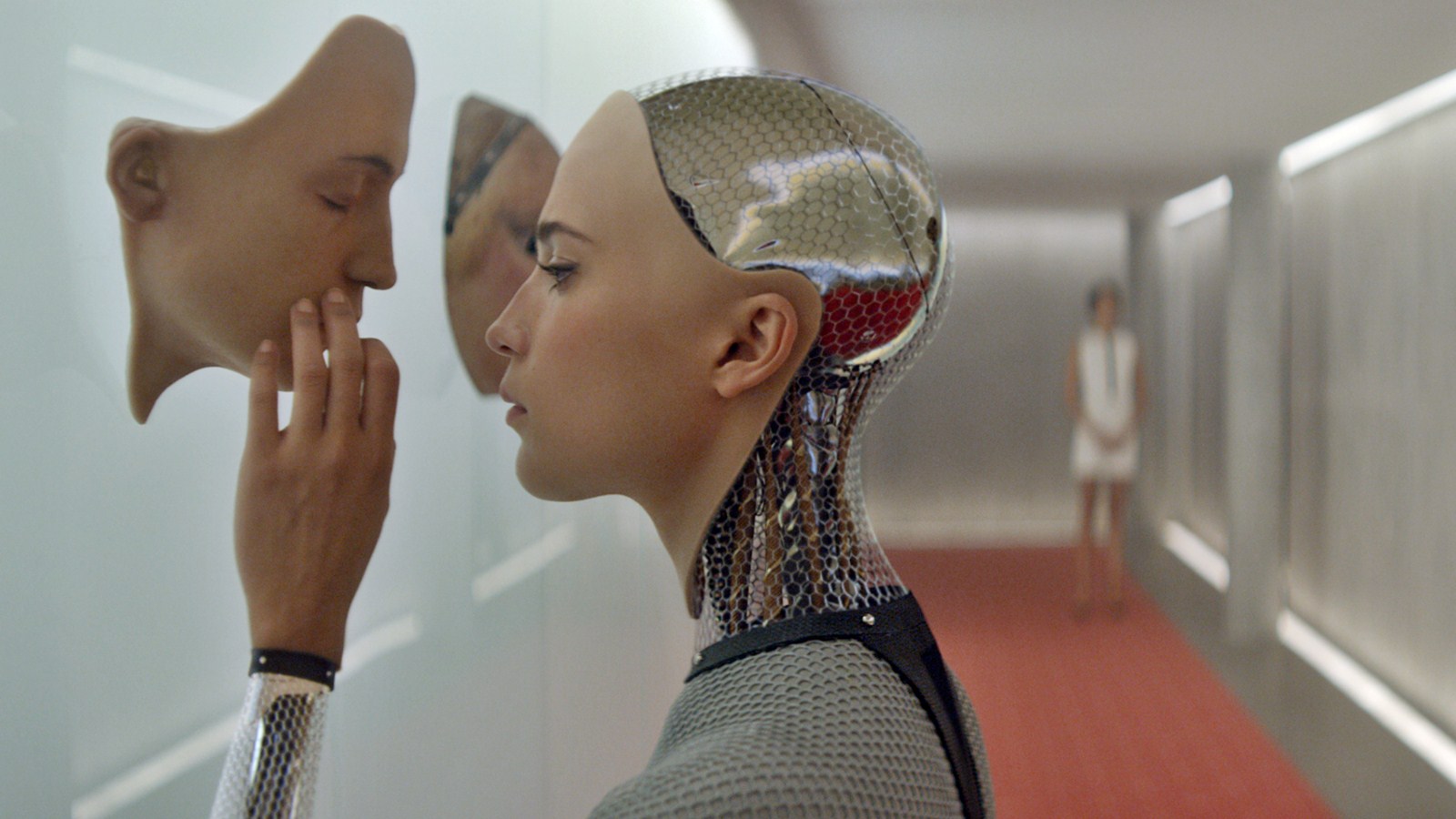
A lot of this works because Alicia Vikander’s Ava is such a fascinatingly elliptical figure. Vikander and Garland skilfully leave you guessing: just how human is Ava? Under observation from Nathan, her discussions with Caleb seem cold and functional. During the many brief power cuts that blight the lab, when they are alone from CCTV, she appears to be far more emotional and tender. But what does she feel for Caleb? Is it genuine feeling – or an approximation designed to draw Caleb in? Her desire for freedom is a genuine human feeling – but how is she going about this? In scenes where we glimpse her alone, Vikander’s movement and expression are neutrally unreadable. It’s a fascinating superb performance from Vikander, both tender and gentle and also unsettling and creepy.

The script never loses its way, and never gets overwhelmed by cheap thrills. There are moments of violence and danger – and the ending of becomes increasingly dark – but it all seems a very natural progression. Because the ideas of seeking freedom from oppressive masters – and mankind looking to abuse the powers of the gods over their creations – feel very real and true. These are ideas that are endlessly fascinating – and the film explores them in brilliant detail, without ever flagging, becoming bogged down in tedious discussion, or letting its ideas overwhelm the plot.

Ex Machina is a fascinating film, brilliantly acted – Isaac and Gleeson are quite simply superb as two very different tech geeks, struggling with ideas about humanity they can scarcely begin to understand and express. The effects to create Ava are extraordinary (and Oscar-winning). Alex Garland makes himself as a director of true promise – and Ex Machina is a film that can take its place as one of the compelling, intelligent and intriguing science-fiction films of the 2010s.

Dredd (2012)


Dredd. He is THE LAW!

Director: Pete Travis

Cast: Karl Urban (Judge Dredd), Olivia Thirlby (Judge Cassandra Anderson), Lena Headey (Ma-Ma), Wood Harris (Kay), Domhnall Gleeson (Computer expert), Warrick Grier (Caleb), Deobia Oparei (TJ), Rakia Ayole (Chief Judge)

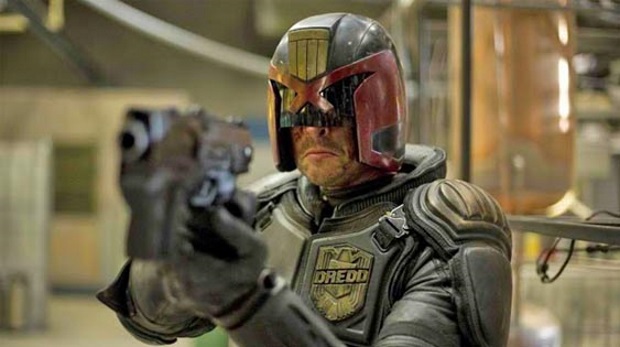
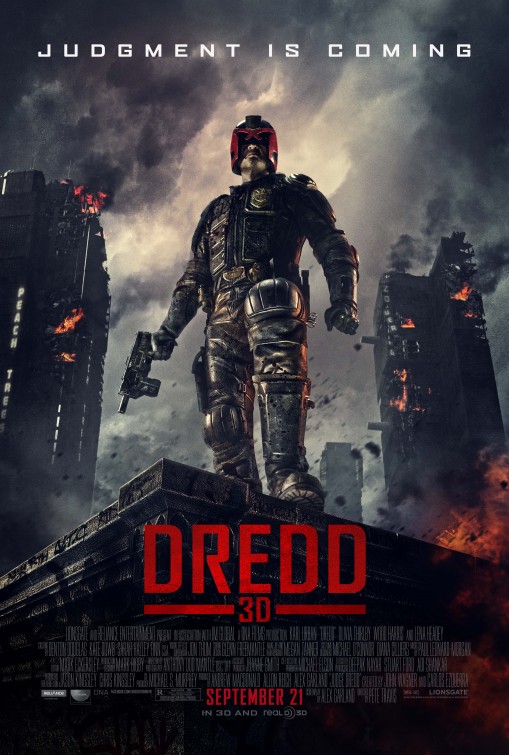
Dredd is the second attempt to bring the brutal post-apocalyptic lawman to the screen, after a disastrous 1990s version starring Sylvester Stallone. Famously, that film gained the undying enmity of the comic book fans by having Dredd remove his signature helmet (and show his face) at every opportunity. Here, Karl Urban dutifully keeps the helmet on at all times.

In a future USA, Mega-City One is a sprawling metropolis of 800 million residents and 17,000 crimes a day. To combat crimes, the Judges are a police force with the powers to sentence and execute criminals on the spot. Judge Dredd (Karl Urban) is the most feared and experienced Judge on their books, a man of rigid rules who sees the world in black and white. Given a new psychic recruit, Anderson (Olivia Thirlby), Dredd makes an arrest at Peach Trees, a 200-storey slum building ruled by brutal crime lord Ma-Ma (Lena Headey). After Dredd and Anderson arrest one of Ma-Ma’s key lieutenants, she locks down the building, isolates the Judges, and demands their execution by the residents.

Dredd is a super violent but entertaining siege movie, with the twist being that the siege involves the heroes being locked in with their opponents – the heroes trying first to get out, then to stop their enemies getting in. Now I know very little at all about the source material, but, unlike the Stallone film, this film succeeds as a Dredd movie by simply treating its events as a “regular episode” rather than a ground-shifting, world-at-stake mega-movie. As such, it can focus on the events that are relevant to the immediate, simple story and loosely sketch out the other elements of the future (enough to keep us interested and to understand the context). It focuses on a fast-paced, exciting story and enough character detail and interest to keep you involved. 

The film is snappily directed by Travis with a decent, stripped down script from Alex Garland, and has a good performance at its centre from Karl Urban, who has the collaborative lack of ego to make Dredd, rather than his own performance, the centre of the story, . Urban also manages to make a character who is an imposing and lethal killing machine into someone we also respect for his adherence to a firm moral code. And he adds enough texture to the part to suggest a certain softening in his attitudes towards Anderson (a very effective Thrilby) across the course of the movie. Headey also makes a great enemy, a sort of Cersei Lannister on heroin and acid, a totally remorseless megalomanic.

The film packs a great deal of punch and its design is very impressive. The Peach Trees setting is an imposing vision of a crap-sack future, while also having a very clear navigation for the deadly game of cat-and-mouse Dredd and Anderson play throughout the film. The film doesn’t have much in the way of wit to it – the source material is apparently more satirical, not something that comes across here to be honest – but it does understand the rigidity and certainty of its lead character and it doesn’t flinch from the dark consequences of its hero’s actions. 

I’m no expert on the original but this is rather a lot of simple, unchallenging fun that manages to swiftly establish characters – through neat writing and good acting – that make sense, are complex and feel very true to the tone of the source material. It’s violent and bloody, and yes it has many beats in it that are slightly predictable or twists on many similar “one man against an army” movies we’ve seen, but it has more than enough merit to be worth your time.