
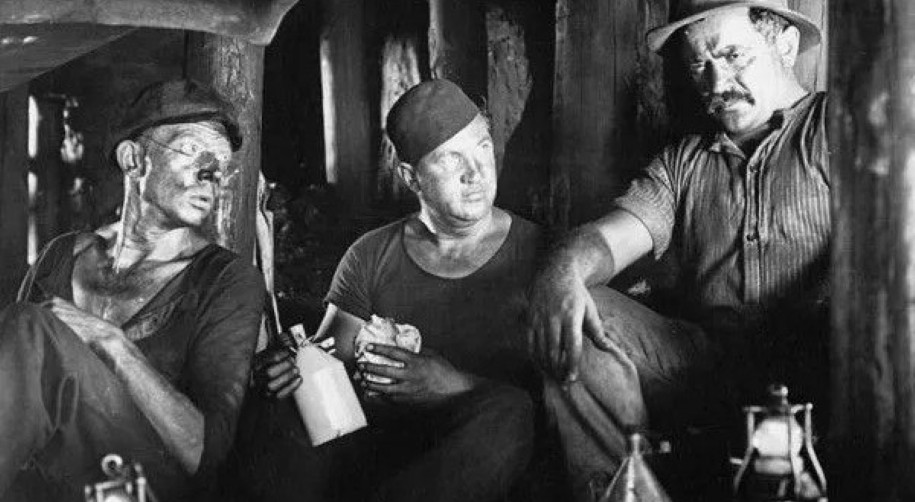
Tag: Alexander Granach

Kameradschaft (1931)

Kameradschaft (1931)

Pabst’s very earnest plea for brotherhood is also a gripping underground disaster epic

Director: GW Pabst

Cast: Alexander Granach (Kasper), Fritz Kampers (Wilderer), Daniel Mendaille (Jean Leclerc), Ernst Busch (Wittkopp), Elisabeth Wendt (Anna Wittkopp), Gustav Püttjer (Kaplan), Oskar Höcker (Mine foreman), Héléna Manson (Rose), Andrée Ducret (Françoise Leclerc), Alex Bernard (Grandfather Jacques), Pierre-Louis (Georges)
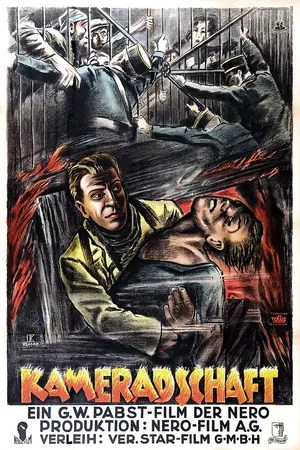
Pabst’s Kamerdschaft was his second sound film after Westfront 1918 and follows on from that film’s politics. Kamerdscaft is a heartfelt plea that, deep down, we are all comrades, who should be working together not tearing at each other. It’s based on a real 1906 mine disaster in Courrières where a coal dust explosion left thousands of French miners trapped underground, relying on teams of French and German (from Westphalia) miners to save them. Pabst shifts this to 1919 and the location to the French-German border (so new, it even runs through the mine itself with both sides literally walled off from each other). It’s straight after the war, and never have tensions been higher.

Pabst argues though that this lethal squabbling between nations distracts us from the ties that bind us. He opens with two children – one French, one German – arguing over a game of marbles both claim to have won, demanding the other hands over all the marbles. They even literally draw a border in the dirt to make their point. Pabst’s symbolism here is not exactly subtle, but it makes the point swiftly and clearly. Whenever we encounter the border officers, they are rules-bound and small-minded. A French border guard almost fires on a truck of German miners offering their help. Bosses from both sides put obstructions in the way of the effort to free the miners. The film closes with military forces from both sides solemnly re-building the underground border wall knocked down during the rescue.

It’s carried over into tensions between both communities. The French are generally encouraged to look down on the Germans. Life on the French side seems more secure and comfortable – with rows of workers houses, bars and plentiful jobs – with the Germans frequently crossing over to try and find work and relaxation in the French side. A trio of jolly Germans nearly get into a bar fight when a French girl declines to dance with one of them: a loud atmosphere in the bar disappearing, as Pabst’s camera pans past a row of faces suddenly turned confrontation and hostile.

This tension is increased by the language barrier. Kameradschaft was a French-German co-production and the actors used their native language. This allowed for a strong cast, with Alexander Granach particularly notable as the jolly Kasper. It’s fascinating to watch Kameradschaft with only one language translated, plunging you into trying to follow the stumbling French of the Germans and vice versa. Misunderstandings frequently arise. That bar near-fight is started when Fritz Kamper’s German miner assumes Héléna Manson’s Rose doesn’t want to dance with him because he’s German, when actually she says its only because she’s tired.

Misunderstandings continue throughout the film. The German’s underground struggle to make themselves understood, using a range of physical gestures and pigeon-French; the French stumble through basic German. While subtleties are missed, it’s striking how Pabst demonstrates in the big things, meaning is always clear: emotions and actions convey a universal meaning we all understand. In the aftermath, a French miner makes an impassioned speech about brotherhood: his German counterpoint responds with a heartfelt speech that he didn’t understand a word but he agrees they are all brothers.

“A miner is a miner” says Ernst Busch’s Wittkopp who insists on the rescue mission. (Busch was a veteran of Brecht and an impassioned Socialist). You can see why they feel this when you see the conditions below ground. Claustrophobic, dark, sooty and terrifyingly confined, the mines quickly become intimidating traps as support beams buckle and crumble. It’s even more impressive when you realise these extraordinarily convincing sets were indeed sets, build in a studio by Ernő Metzner and Karl Vollbrecht. It’s honestly hard to believe that the crew didn’t go underground when you watch, giving the film a strong steak of realism.

It’s a realism mixed with a moody expressionism in the lighting. When the explosion comes, the fire rolls through the smoke and steam filled rooms and then seems to continue, consuming everything in its path. Pabst uses a tracking camera to keep us just ahead of these advancing flames. He stages brilliantly the collapse of the mine, showing miners trapped or crushed as roofs cave in and rocks tumble down. Kameradschaft is just as strong in showing the panic above ground, as the families of those trapped race through the streets to gather at the mine’s locked gates, howling to be allowed in and help with the rescue of their nearest and dearest.

As in Westfront 1918, Pabst employs the same sound-proof casing to his camera to give it as much flexibility as possible while still capturing sound. Kameradshaft is full of the audio hustle and bustle of a town in torment, and he’s equally effective with sound below ground. Not only the collapse of the mine, but the sounds that come with being trapped: heavy breathing of rescuers in their breathing equipment, metallic tapping on pipes to attract attention, desperate scurrying of trapped miners to find a ringing phone in a ruined engine room. All of this is executed to perfection.

Pabst’s finest sound use comes when one trapped French worker succumbs to delusion under the pressure as a German rescuer approaches. As he sweats in panic, the tapping on pipes shifts to the rat-a-tat of machine guns. From his POV we see the approaching German in breathing transform from a miner into an infantryman. In a series of cuts, the French miner imagines himself in the trenches, launching himself in desperate self-defence against his would-be saviour. It’s a beautifully done moment that hammers home Pabst’s message that when nations turn natural friends into enemies, we are all left weaker.

Kameradschaft isn’t always subtle in saying this. You could frequently call it naïve. Pabst stresses the point with a zoom into the shaking hands of German and French rescuers meeting for the first time under-ground (holding the shot for longer than necessary). But it’s an earnest and decent message. But sadly, not one people were going to listen to. The film was, of course, banned in Nazi Germany almost immediately – and they would have approved of Pabst’s more cynical coda of the underground border being re-built (a scene cut from some prints, as being too glum). We may dream of brotherhood and peace, but sometimes it is just a dream. But Kameradschaft is a fine enough film to persuade us its worth dreaming.

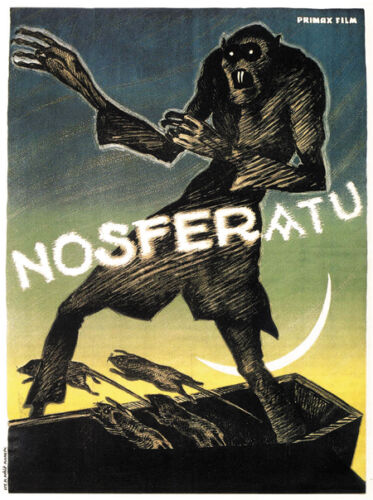
Nosferatu (1922)

Nosferatu (1922)

Cinematic vampires are established – along with most of the finest horror filmic ideas – in Murnau’s iconic and masterful silent epic

Director: FW Murnau

Cast: Max Schreck (Count Orlock), Gustav von Wangenheim (Hutter), Greta Schroeder (Ellen Hutter), GH Shnell (Harding), Ruth Landshoff (Ruth Harding), Gustav Botz (Professor Sievers), Alexander Granach (Knock), John Gottowt (Professor Bulwer), Max Nemetz (Captain)

Dripping with menace, a ghastly figure rises to spread his influence across the whole world. In a similar way, FW Murnau’s Nosferatu has wormed its way into the public consciousness, with its iconic film-making beauty, laced with menace and horror – and its iconic vision of the vampire as a creature of disgusting, animalistic viciousness still carries a ghoulish impact on vampire movies today. Murnau’s film is an extraordinary piece of bravura film-making, a breath-taking example of pictorial beauty, crammed with nightmarish imagery that cements itself into your brain.

If the plot sounds familiar, you share the view of Bram Stoker’s widow. Hutter (Gustav von Wangenheim) is arrives in Transylvania to finalise a land deal with Count Orlock (Max Schreck). But, staying in Orlock’s terrifying castle, Hutter starts to dread that his nocturnal, deformed host with the long teeth and nails might have more to him than meets the eye. Orlock wants to move to Hutter’s home in Wisborg to put himself out in the world – but increasingly also due to his fascination with a picture he finds of Hutter’s wife Ellen (Greta Schroeder). Leaving Hutter imprisoned, Orlock (coffins and rats in tow) climbs on board the Demeter and sets sail. Any wonder Florence Stoker sued?

It’s nearly a miracle we even have Nosferatu today. Florence Stoker won every single court case she ever fought against the filmmakers, with the verdict almost invariably being that the negative should be destroyed. Thank goodness we do have it though, as this is not only the finest adaptation of Dracula ever made but also a landmark horror film whose reputation has only grown. Murnau created a film that is darkly insidious, worming its way inside your head just as Orlock inveigles his way into Wisborg, marking forever everything it touches.

It’s remembered often as the height of German Expressionism: but really Murnau’s film is one of classical, painterly beauty. Although he can certainly use the power of montage effectively when he wants to – witness the thrilling cross-cutting as both Hutter and Orlock race back to Wisborg, one by sea, one by land – Murnau’s real power here is in his compositions. Few people could shoot vistas – be they town or country – with soulful searchingness like Murnau. From its opening shot of the Wisborg square, through its haunting visions of the Transylvanian countryside (shot with slow pans that drip with unease), this is a film that finds unsettling tension in the beauty of our surroundings. Throw in compositions inspired by painters like Caspar David Friedrich and (in a group of scientists gathered around a corpse) Rembrandt, and Nosferatu takes its place in the story of art.

But it also has a place firmly in the story of terror. That’s due, above all, to the terrifying design of Orlock himself. Played with a rigid unknowability by Max Schreck – the mystery of what motivates Orlock remains exactly that – Orlock looks like something out of the deepest reaches of our subconscious nightmares. Rat like, wizened, with ghastly elongated nails and teeth and a stillness that feels both hunched and rigid all at once, he is a natural predator. It’s surely no co-incidence that he resembles the rats that travel with him in the Demeter, and the interpretation of his attacks by the townspeople link us to what this spirit is: death itself, unreasonable and unstoppable.

Murnau often frames him in arches and doorways, as if he was constantly positioning himself in coffins. There are innumerable flourishes to cement the awful terror he carries. In one sinister sequence, he seems to rise, utterly straight and rigid, from his tomb. He appears to a sailor on the Demeter like a nightmarish transparent figure. Hutter opens his door at night in the castle to see Orlock standing outside, like a wolf waiting to strike. In one chilling sequence, the camera watches up from the hold of the ship as he haltingly walks, framed by the rigging, to consume the unseen ship’s captain. Ellen will stare out of her window at night to half see him in an upper corner of the building opposite, watching her. Orlock’s claws reach into everything from The Exorcist to BBC adaptations of MR James ghost stories.

There is seemingly nothing human about him. At night he transforms into a wolf – and Murnau went to great lengths to secure not a wolf, but a hyena as this night-time abomination, its twisted, grinning features and distinctive face reminiscent of Orlock’s own dreadful form. What motivates him? We are given no insight into what might influence or inspire him, the way we are with Dracula. Unlike Dracula he lives alone in his castle – no brides for company here. His victims are consumed and die: none turn. He expresses no interest in the wider world and seems focused on people solely as commodities to consume.

The one difference might just be Ellen. As Orlock goes to kill Hutter on his final night at the castle, Ellen awakens thousands of miles away in Wisborg, as if she knows her husband is in danger. And Orlock seems to sense it too. In a beautiful example of cross-cutting, Ellen is at the right of the frame starring to the left in Wisborg, while Orlock is at the left of the frame starring back to the right in Transylvania. It feels like they are looking at each other, even though of course they can’t be – and it forms a link between them whose motives are kept deliberately unclear. Does Orlock want to consume or ravish Ellen? Is she repelled or intrigued by this monster? While the film downplays the sort of sexual fascination that later Dracula films (and the novel itself) would play to the hilt, there are touches of it there (not least in the strangely chaste marriage between the Hutters).

Murnau experiments beautifully with the burgeoning language of cinema. The frame is given a tint at every shot to tell us when in the day we are: daylight is tinged in yellow, dusk and dawn in red and Orlock moves freely in the blue-tinged night-time. The camera is frequently fluid. There are some quite gorgeous – and terrifyingly unsettling – shots of the Demeter sailing, seemingly uncrewed, at sea (its sails filled with Orlock’s monstrous breath) then drifting controlled but abandoned into Wisborg harbour. As Hutter rides to Orlock’s castle the screen shifts to photo negative, as if he is crossing some terrifying boundary. Only one invention doesn’t pay off today: to Murnau, sped-up film was disjointed, unsettling and terrifying. To us it’s Keystone’s Kops stuff: watching Orlock’s carriage speed around is likely to raise a surprised titter, rather than a gasp of terror.

Other elements of Nosferatu have also not aged as well. The acting is frequently performative and stagy and varies wildly in style. Von Wangenheim and Schroder strike poses, Granach’s Renfield-like Knock goes wildly over the top. Shreck’s work is often done by the make-up, although his chilling stillness carries strength. It also takes surprisingly little from Dracula in terms of themes: any references to technology, the key weapon against the count, are dropped – even van Helsing is turned into a clueless dolt; the Lucy Westerna figure is little more than an extra; the victims are almost exclusively men and the response to Orlock’s ”plague” is medieval terror not modern reason.

But Nosferatu rides above this because it is such a chilling, elemental film about death and oblivion. It can only end with that as two characters are absorbed into a dance of death that closes the film (Murnau even stages what looks like a literal dance of death at one point, as enraged townspeople chase an escaped Knock, convinced he is to blame). The association of Orlock specifically with a plague, rather than a homicidal or sexual threat, is telling: this is vampirism as a destructive danger that strikes without reason, and leaves nothing (not even a dark afterlife) in its wake. It feels like a very post-World-War-One vampire story, where whole communities are left destitute by a terrifying event outside of their control.

Nosferatu looks simply sublime, and is the work of a master-director using his craft for the first time to make something truly unique, magical and genre-defining. Horror would wear a different face after Murnau’s masterpiece: a drained, pale, toothy grin that stares fixedly at us from across the void of our nightmares.

Hangmen Also Die! (1943)


Brian Donley on the run in Fritz Lang’s Nazi occupation thriller

Director: Fritz Lang

Cast: Hans Heinrich von Twardowski (Reinhard Heydrich), Brian Donlevy (Dr Franticek Svoboda), Walter Brennan (Professor Stephen Novotny), Anna Lee (Mascha Novotny), Gene Lockhart (Emil Czaka), Dennis O’Keefe (Jan Horak), Nana Bryant (Hellie Novotny), Margaret Wycherly (Ludmilla Novotny), Tonio Selwart (Chief of Gestapo Kurt Haas), Alexander Granach (Inspector Alois Gruber), Reinhold Schünzel (Inspector Ritter), Jonathan Hale (Dedic)

Film dramas “ripped from the headlines” have a mixed track record. Making a drama about an event that happened so recently the dust has hardly settled leaves you open to making decisions in your film that could later be exposed as mistakes. Few films in history are more headline-ripping though than Hangmen Must Die!, a film about the assassination of Heydrich, the planning of which must have started almost immediately after the news broke.

Dr Svoboda (Brian Donlevy) is on the run in Prague after shooting dead Reinhard Heydrich, Hitler’s deputy in occupied Czechoslovakia. After a chance meeting, he pleads with Mascha Novotny (Anna Lee) for shelter – but this only serves to endanger her family, particularly her father Professor Novotny (Walter Brennan), in the affair. Meanwhile the Gestapo, led by Alois Gruber (Alexander Granach) investigates and the Nazis take hundreds of Czech notables, including Novotny, into custody as hostages. The Germans promise to execute hostages until the assassin is handed over.

First things first: unlike 2016’s Anthropoid, this film is a complete work of fiction. It is first and foremost a film made by European exiles in the middle of World War II to sing the praises of those defying the march of fascism. Heydrich only appears at the start of the film, played with a sinister, mincing campness by von Twardowski (a notable German socialist exile). Despite this, the arrogance and cruelty of Heydrich is hammered home, with his lines delivered in a bullying, untranslated German. The film uses a dark humour to stress his villainy, Heydrich nonchalantly strolls down a crowded meeting room, forcing those in attendance to remain saluting, swivelling to follow Heydrich, until he finally settles and returns the salute allowing them to relax. It’s a neat little joke and perhaps one of the clear signs of the hand of co-writer Bertolt Brecht. Take a look at the sequence (and rest of the movie as well!) here:

That’s one of the film’s other claims to fame: noted director Fritz Lang worked with fellow exile Brecht to craft the script. As such, the film is a slightly unusual mix between the left-wing, idealist politics of Brecht and the film noir style of Lang. The primary aim is to serve as a propaganda tool, and the courage and bravery of the Czech people is repeatedly stressed. With a few key exceptions, the Czechs are loyal, honest and willing to make huge sacrifices. Lang films this with a stirring simplicity, low angle shots, skilful use of light, and dynamically involving crowd scenes, bringing this courage visually to life. Brechtian touches, such as a crowd of Prague locals confronting Mascha (with increasing menace) when she considers betraying the assassin to save her father’s life, are perfectly complemented by Lang’s skilful film making. The film’s final tribute to the heroes of Europe, with the people of Prague joining together to sing a hymn to the fallen hostages, surges with a left-wing Brechtian political outrage.

What’s most unusual about the film – and one of its problems – is the curious mixture of tones. Perhaps because of its film noir styles, perhaps because of the American accents of many of the Czech characters (interestingly, the exiles overwhelmingly play villainous Germans), this film becomes a sort of behind-the-lines 1930s hard boiled gangster thriller – with the difference that the cops are the baddies. The Gestapo go about their jobs like gangster gumshoes from Hollywood movies. The Czech people, for all their gumption, look and act like streetwise New Yorkers. It’s an odd tone that takes some getting used to.

On top of that, the film shows several hostages (including characters we get to know) shot due to the refusal to hand over the assassin. I can’t watch this without thinking about how little it gets near the true horror of Nazism. The Gestapo here are relative pussycats, compared to the brutal lengths they went to in real life: the Gestapo chief even prudishly talks about a need for evidence. Compared to the thousands of civilians killed in real life, this is nothing. The Germans even essentially “give up” in a coda and accept a defeat. This makes terrific propaganda of course, but it just ties into the sense that this film doesn’t even begin to touch the villainy of the occupation. It makes for better entertainment, but it’s strange to watch today.

Finally, the last problem with the film is the rather mixed performers. Put simply, Brian Donlevy is totally miscast as the assassin, a B-movie actor who is far too American for the part, and incapable of giving the role the depth it needs. Svobada just isn’t interesting or sympathetic. Anna Lee is similarly bland, while the less said about O’Keefe as her fiancée, the better. Not one of the American actors is completely convincing in their role, although Walter Brennan is close to an exception, effectively gentle and wise as the brave Novotny. The best performances are from the exiles, with Graucher in particular excellent as a shrewd, soulless, corrupt detective, with no guilt about the means he uses.

The film culminates in a rather hard-to-follow and far-fetched attempt by the resistance to frame a collaborator (played with weaselly self-importance by Gene Lockhart) for the crime. This plot tends to meander, but there are several very good scenes showing the Czech resistance, including a wonderful sequence in a restaurant that goes from a sit-down, to an unveiling, to a shootout. Lang skilfully builds the tension throughout, and the creeping relentlessness of hostage executions and Svoboda’s attempts to run from the Gestapo are very well done. Sequences such as Svobda ducking into a movie cinema, only to find a keen collaborator inside, sizzle with excitement.

In fact there are many excellent moments in the film. It is beautifully filmed, with a gorgeous use of expressionist shadow and camera angles to create a claustrophobic, doom laden world. Lang’s strength of plotting by-and-large works very well. Though it can’t bring across the full horror of Nazi occupation, the dread of the Gestapo is clear in the movie. “Enhanced interrogation” is underplayed, but it is sinisterly embodied in the fate that befalls an arthritic shopkeeper. We see him exhausted, but not broken, in a prison cell, forced to constantly pick up a chair under interrogation with her weakened hands. Later, a character throws himself out of a window rather than risk being interrogated to reveal information about the resistance. The hostages are brutally dispatched, with the level of panic, fear, collaboration or defiance having no impact on their fates.

It’s a fractured film, overlong but very well filmed, which creates a brilliant tribute to the strength of the Czech people. Trim 20 minutes off it and I think this could have been a great thriller.  It’s a strange mix of acting styles, but the marriage of Brecht and Lang works very well (it’s a real shame Brecht never made another film) and the drama of the film carries it over the strange bumps in the road. Brecht, by the way, spent the rest of his life rubbishing Lang, as he couldn’t understand why Lang put all the plot and character into a movie Brecht saw as being purely political.

It’s in many ways a strange historical monument – perhaps its makers couldn’t imagine the depths of Nazi atrocities, perhaps Hollywood wasn’t willing to bring such horrors to the screen. It’s not perfect, but in its own way, it’s a piece of cinematic history.