Tag: Alfred Hitchcock

The Birds (1963)

Tippi Hedron has a bad day at the birdcage in The Birds

Director: Alfred Hitchcock

Cast: Tippi Hedron (Melanie Daniels), Rod Taylor (Mitch Brenner), Jessica Tandy (Lydia Brenner), Suzanne Pleshette (Annie Hayworth), Veronica Cartwright (Cathy Brenner), Charles McGraw (Sebastian Sholes), Lonny Chapman (Deke Carter), Joe Mantell (Cynical Businessman)

Alfred Hitchcock is often seen as the master of technique, the doyen of suspense, the master of the shock twist. Perhaps it was his love of this sort of material that led him to this radical reworking of Daphne du Maurier’s short story The Birds. After all Hitch had already directed the greatest ever du Maurier adaptation (Rebecca), so working with du Maurier was hardly new and turning this English suspense story into a sort of post-apocalyptic, tension-filled plot-boiler was right up his street. The Birds is a master-class in the director’s craft, and a curiously empty experience with barely a human heart in sight.

Melanie Daniels (Tippi Hedron), a slightly spoiled heiress, arrives in a small coastal town in California in order to play a practical trick on lawyer Mitch Brenner (Rod Taylor). Deciding to stay the night, she quickly realises that she has chosen the wrong weekend to get away as, while sparks grow between her and Rod, they also grow between humanity and the birds, as our feathered friends (enemies?) begin a series of escalating attacks on the population of the town that eventually lead to multiple deaths and destruction.

Hitchcock’s film is as masterclass in the slow-burn, deliberately the slowest film the director perhaps ever made. Hitchcock prided himself on his films in suspense being the awaiting of an event to happen. The bomb you know will go off on the bus. The plane circling Cary Grant that seems ripe to attack. The Birds takes this to the nth degree. The film’s very title all but tells you that the birds are going to attack, so Hitchcock takes it nice and slow, letting scenes play out with a breezy lack of pace, almost like a low-rent romantic comedy. But somehow this long unwinding of not a lot happening works well, because every scene somehow becomes a corkscrew as tension as every single bird in shot becomes suspicious. 

This atmosphere is increased by the wide open locations and remote locale the film is set in, with these all-American small town sites seeming to stretch on forever around the characters only serving to stress their isolation and vulnerability in the middle of all this deadly nature. Hitchcock also carefully stripped out all musical score from the film, instead providing a sound track of natural noise complemented by slightly exaggerated bird noise (created by use of a Trautonium, supervised by master composer Bernard Herrmann). The often makes the film eerily and unsettlingly quiet, with the soundtrack only punctured by the frequently (perhaps deliberately) mundane dialogue. Suddenly with this brilliant combination game, the entire film becomes a tense waiting game for the unleashing of avian attacks, every frame a tense waiting for the bang you all know is coming. It’s Hitchcock using every aspect of his reputation, and the film’s promise of violence, to create an overwhelming effect that is deeply unsettling no matter how many times you see the movie. 

Hitchcock also gives a slow build to the bird violence. Events escalate quickly, from the unsettling gathering of the birds in several places (most notably along telephone lines and outside a school playground) to subtle messages about chicken’s refusing food, to first Melanie and the other characters colliding with or being bitten by birds. It all builds to a grim reveal of a local farmer who has been attacked over-night, with Rod’s mother stumbling across the mutilated old man, Hitchcock’s camera delightedly cross cutting onto the man’s pecked out eyes. It’s the most grotesque shot of the film – and coming before we’ve seen our first mass bird attack, leaves us in no doubt as to the danger of these animals.

And when those bird effects come they have a real unsettling violence to them. In a blur of both real birds and super-imposed images (I will admit that the special effects of this film do now look a little dated, with the mixture of real, model and photo trickery birds rather jarring) the birds fly with an almost unimaginable aggression at the human beings. Flocks descend, pecking, biting and clawing, leaving human bodies maimed, blinded and bloodied. Crowds of school children are attacked while fleeing their school. A gas attendant is brutally set upon leading to a firey conflagration. Passers-by and those unable to get refuge are beaten to the ground under a flood of winged assailants.

The film changes tack in its final sequence into a tense series of sieges as Melanie, Rod and his family hole up in Rod’s house by the lake, barricading doors and windows as the birds peck relentlessly at doors and windows, slowly forcing their way in. Rooms that fall to the birds become whirlpools of deadly flying creatures, a tornado of wings and pecks that few can stand against. Hitchcock’s camera cuts rapidly from the flood of birds, to ever increasing pecks at hands and arms, to hands thrown up to protect eyes – a brilliant call back to the eye horror shown earlier in the film that immediately inspires. The birds attack in unpredictable waves, their attacks dying down at moments as the sit calmly and placidly only to expectantly burst back into violence.

It’s just a shame that Hitchcock’s film is so enamoured with its undeniable technique that it neglects to feature any heart or soul at all. The characters are a stock collection of forgettable tropes, most played by forgettable actors, or mute ciphers. The film almost deliberately throws together a truly trivial collection of stories and character motivations to pepper the centre (perhaps this bland self-interest is what pisses the birds off so much) of the film, that frankly are not that interesting. Rod Taylor is a solid but uninspiring performer, Jessica Tandy is saddled with a truly pathetically weak role. So many of the other characters such little impact that they barely warrant names. Rarely in Hitchcock films have the human characters felt so much like devices, square pegs in square holes, totally subservient to the Master’s whims. Put frankly, for all the tension of when the birds will turn, you’ll care very little for any of their victims. 

A lot of focus on the film has been on Tippi Hedron, in particular her accusations of ill-treatment (routed in frustrated sexual obsession) from Hitchcock. These stories – and Hitchcock’s subsequent description of her as little more than an attractive prop (a feeling he tended to have for lots of actors) – have drawn attention away from the fact that she is actually very effective in The Birds, and that her brightness and intelligence makes her the only person who feels real in the whole film. It makes it all the more sad that the final sequence renders her into a mute, shell-shocked victim – but Hedron’s promise (never fulfilled due to Hitchcock’s sabotage of her career) is clear here.

Hitchcock’s film finally ends on a truly nihilistic, Armageddon tinged ending that speaks volumes for the post-apocalyptic nuclear anxiety prevalent in the West in the 1960s. The birds rest, triumphant, over the chilling silence of the world as what remains of our heroes beat a retreat. It’s a chilling flourish in a film that is a stylist’s triumph but lacks any real heart. It’s a film that haunts the memory but it doesn’t win the heart. If Hitchcock really did hate actors and most people, this film makes a good case for arguing that’s a pretty honest insight.

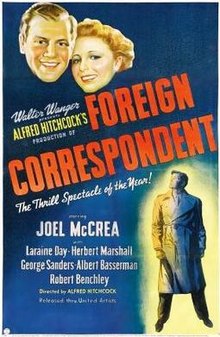
Foreign Correspondent (1940)

Foreign Correspondent (1940)

Hitchcock’s thriller is a stunning adventure story and a passionate call for action

Director: Alfred Hitchcock

Cast: Joel McCrea (John Jones/Huntley Havestock), Laraine Day (Carol Fisher), Herbert Marshall (Stephen Fisher), George Sanders (Scott ffolliott), Albert Basserman (Van Meer), Robert Benchley (Stebbins), Edmund Gwenn (Rowley), Eduardo Cianelli (Mr King), Harry Davenport (Mr Powers), Edward Conrad (Latvian)

In 1940, Hitchcock was new in America, after a parade of successes in Britain. 1940 was a red-letter year for the master, directing not one but two of the films up for Best Picture. The Oscar was carried home for his masterful gothic adaptation of Du Maurier’s Rebecca, but equally memorable was Foreign Correspondent, a stirring, heartfelt thriller about the build-up to war in Britain, a passionate cry for American intervention and brilliant propaganda contribution to the British war effort (even Joseph Goebbels tipped his hat to it).

John Jones (Joel McCrea) is the new foreign correspondent in Europe for the New York Morning Globe. Given the pseudonym “Huntley Havestock” (because it sounds better), Jones is picked out because he’s a hard-boiled crime journalist, practised at winkling out a story, rather than the cozy posh boys usually sent out to Europe. In Amsterdam, Jones attends a peace conference hosted by leader of the British peace party Stephen Fisher (Herbert Marshall), where eminent Dutch diplomat and architect of the fragile European peace Van Meer (Albert Basserman) is due to speak. While Jones falls in love with Fisher’s daughter Carol (Laraine Day), Van Meer mysteriously falls to show at the dinner – and arrives at the conference the next day only to fail to recognise Jones and immediately get assassinated. Suddenly Jones finds himself in the middle of a dangerous game of spies with only British journalist Scott ffolliott (George Sanders) and Carol to help him.

Hitchcock’s Foreign Correspondent is a masterful spy caper, in the style of many of his early successful works such as The Thirty-Nine Steps, superbly assembled by a genius at the top of his game, with access to funding and techniques beyond what he had in Britain. Hitchcock went through several versions of the script – there were no fewer than nine writers who worked on this film, four of whom are credited – but it matters not a jot when the script they finally came up with matched such superb, zingy, screw-ball style dialogue with such brilliant set-pieces.

The film also had a serious purpose as well. From the start, this is a cry of one of Britain’s most prominent ex-pats to his newly adopted nation to join the effort to preserve Western civilisation against the onslaught of Nazi oppression. Joel McCrea’s Jones – a part written for Gary Cooper, who forever regretted turning the role down – is the quintessential American, disinterested in the world, sure of America’s place in it, who has his eyes opened and passion ignited by seeing up-close and personal the dangers from the agents of totalitarianism. The agents of the enemy nation – probably Germany, a country that is referenced in passing, but the film deliberately keeps it shady in an attempt to appear even-handed – are ruthless, brutal and unscrupulous. Their plans are fiendish and they are bent on world domination. But all this is worn very lightly within a caper framework that has as much interest in Jones falling in love with Carol as it does with foiling the baddies.

It also plays neatly on Jones’ very old-school American obsession with fair-play, and bringing down the baddies no matter what. Witnessing Van Meer assassinated before his very eyes, Jones is determined to go to any lengths to ensure both that justice is done and he is the man who gets the story. At the same time, Jones also has an honest and homely sense of romanticism about him. The film gets a tonne of comic and romantic mileage out of the cracking dialogue between McCrea and Loraine Day as Carol, with the sort of intelligent, witty banter that wouldn’t seem out of place in a screwball comedy, with Jones’ blunt “I say what I mean” attitude crashing beautifully against Carol’s more English rectitude. 

Hitchcock shows himself a brilliantly adept director of comedy – something he doesn’t get enough credit for – in these sequences between the two of them sparring over the course of the movie. And it’s not just them, but also his work with George Sanders – cast against type as a cool, noble British agent – brilliantly hilarious as the curiously named “ffiolliott” (the sequence, mid car chase, where he calmly explains to the befuddled Jones while bullets fly why his name has no capital letter is hilarious). Comedy is a rich vein in Foreign Correspondent and it works so well here because it lightens both the drama of the thriller elements and the political message of “pro-intervention”.

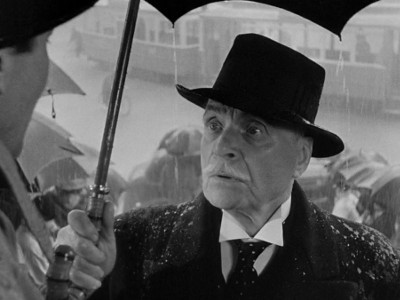
The thriller sequences are just as superb. The assassination sequence is a stand-out, a shooting on a rain soaked series of steps outside a conference, with the assassin making his retreat through a crowd of on-lookers carrying umbrellas under hot-pursuit from Jones. Hitchcock takes his camera above the crowd, meaning we only follow its progress through the disruption of the umbrellas, before the two men emerge (bullets flying) and move straight into a breathless car chase through the Dutch countryside. It’s a masterful sequence.

And it’s far from the last. The film has a superb series of tension-filled sequences, from Jones playing an elaborate game of cat-and-mouse in a Dutch windmill, trying to avoid being seen by the German agents occupying it while finding out as much as he can about their plans, to Jones reporting what he has found to a man we already know is a double agent. Edmund Gwenn, cast well-against type as a jovial, remorseless assassin, gets a brilliant sequence of attempts to kill Jones without putting him on guard, culminating in a vertigo inducing sequence at the top of Westminster Tower. It’s the second such sequence, Jones already having to climb over the roof of a hotel in Amsterdam to escape assassins (along the way brilliantly hitting the neon sign of the Hotel Europe so that it reads “Hot Europe”). Hitchcock tops it all with a brilliant plane-crash sequence shot with chutzpah and daring and is a technical marvel considering the resources available in 1940.

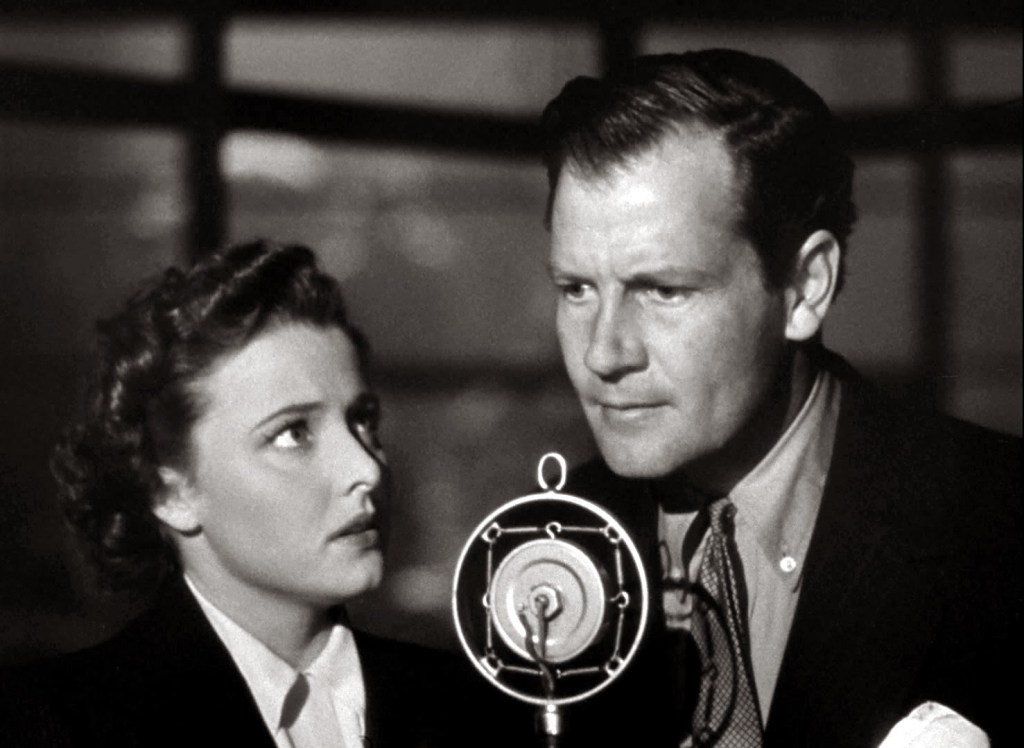
All this excitement and adventure helps to deliver the message of the film as strongly pro-interventionist to encourage the Americans to enter the war on the side of the Allies. Van Meer (a fabulous performance from Albert Bassermann of old-school nobility, made even more astonishing by the fact he didn’t speak a word of English and learned it all phonetically) has a brilliant, impassioned speech – all the more affecting for its  lack of histrionics – that condemns the brutality and violence of the dictatorships. The film is capped with Jones’ Ed Murrow-style broadcast from Blitz-besieged London. Both sequences raise genuine lumps to the throat – McCrea’s delivery is perfect – and the final sequence is all the more astonishing when you realise it was conceived and shot before the Blitz even started.

Not that the film is completely obvious in its allegiances. The turn-coat Brit in the film is a complex, even sympathetic figure who is merely serving his actual home country in the best way possible. He’s largely presented as reluctant to commit crimes, but believing that they must be done and is even allowed a heroic death. His identity perhaps is fairly guessable (he even has a Germanic dog!) but it still works very well in the film.

Hitchcock draws superb performances from the cast – helped by that script of zingers. McCrea is just about perfect, Day very sweet, Sanders is brilliant, Herbert Marshall’s Stephen Fisher a brilliant portrait of arrogance and tortured duty, Robert Benchley very funny (and writing his own scenes) as Jones’ colleague who’s struggling to stay on the wagon, Harry Davenport superb as Jones’ His Girl Fridayish editor. Basserman was Oscar nominated – and deserves it for his big speech – but it could have been any of the cast who got that nod, such is the quality here. Foreign Correspondent is often overlooked among the master’s many, many triumphs. But any pro-interventionist, anti-German film that has even Joseph Goebbels singing its praises must have a fair bit going for it.

Suspicion (1941)

Is Cary Grant plotting to murder Joan Fontaine? Oh the Suspicion.

Director: Alfred Hitchcock

Cast: Cary Grant (Johnnie Aysgarth), Joan Fontaine (Lina Aysgarth), Nigel Bruce (Gordon Cochrane ‘Beaky’ Thwaite), Cedric Hardwicke (General McLaidlow), May Whitty (Martha McLaidlow), Isabel Jeans (Helen Newsham), Heather Angel (Ethel), Auriol Lee (Isabel Sedbusk), Leo G Carroll (Captain George Malbeck)

What do you do when you suddenly start to believe you might be living in a murder mystery? When you begin to think that the person you are married to might just be planning to dispatch you as well? That’s the big suspicion that haunts the mind of Lina Aysgarth (Joan Fontaine), a shy and meek heiress who has been charmed into marrying waster Johnnie Aysgarth (Cary Grant), a lazy spendthrift and playboy. After they elope together, she quickly finds out that Johnnie has no work ethic or talent at all other than spending money. As real estate deals fall through, and Johnnie steals money from his employer to cover his debts, Lina starts to worry that her life insurance is looking more and more tempting to Johnnie.

Suspicion is a decent, middle-of-the-road Hitchcock thriller, which deals with familiar themes of doubt, dread and (of course) suspicion, but with Hitchcock very much in second gear. He’s not helped by the neutering of the source material. The original novel is very much a story of a woman who works out that her husband is definitely trying to kill her. The producers here, however, couldn’t abide the idea that CARY GRANT could be plotting to kill his wife. So the story is rejigged at the end to turn Lina into a silly, paranoid woman and Johnnie into, well yes a playboy, but also one who has been treated badly because of the suspicion thrown at him. This may have flown in 1941, but it’s impossibly sexist today. Plus it means the whole film basically builds towards – well – nothing.

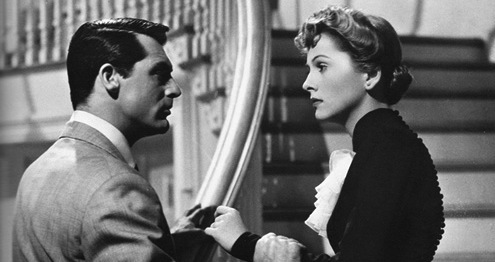
Hitchcock throws in the odd decent flourish – most famously the carefully lit glass of milk that Johnnie carries up the stairs near the film’s end, which may or may not be poisoned. But far too often the story seems to be taking place in a fairytale England, of horses riding to hounds, country villages, Agatha Christie style authors dispensing accidental poisoning advice, and careful class structures. For all the odd moments of danger, the film is safe, contained and as unthreatening as it can get. But the rest is Hitch on autopilot, which feels at time as a remix of the director’s earlier Oscar winning film Rebecca.

That mood carries across to Joan Fontaine as well in the lead role. Fresh off working with Hitchcock on Rebecca, Fontaine essentially recreates the same role again here as the timid, shy, would-be dutiful wife who wants to see the best in a husband who in fact seems dangerous and unknowable. Fontaine won the Oscar for this film – but it feels as much like a compensation award for her previous defeat for Rebecca as it does for Suspicion. Really she does very little here that lifts the film, or stretches her as a performer from her previous role. It’s a retread, and while it’s a trick she does well, it’s a trick she has done before.

A far more challenging performance comes from Cary Grant, who uses the role as a clever meta-commentary on his own persona. Johnnie has all the charm and engaging bonhomie of Grant himself, but all subtly twisted with a selfish superficiality and wastrel greed. Grant walks a very fine line of a man who could be plotting to murder his wife or could just be a greedy chancer – and walks it very well indeed. You always see that Johnnie is bad news, while also understanding why Lina finds him so engaging. It’s a terrifically skilled performance, a lovely riff on Grant’s own screen persona, that shows he’s a far better actor than people often give him credit for – and you feel he is only too willing to embrace the chance to play a weak-willed, opportunistic murderer with little conscience (except of course it turns out he isn’t a murderer). 

It’s a shame that nothing else in the film really rises to the occasion in the same way (although Nigel Bruce gives a very good performance as the gentle, ageing playboy Beaky). The film itself never really seems to be heading anywhere – it even takes a good two-thirds of its runtime before Lina begins to wake up to the fact that Johnnie is far from being the sort of husband women should dream of. It’s a bit slow, a bit too safe, and it largely lacks the element of danger. For the final few scenes, logic seems to evacuate the film as all the clues and hints we’ve had building towards us are shown to be – nothing more than red herrings and the inferences of a silly woman. Because, after all, CARY GRANT can’t be a murderer can he? No matter what he wants.

Psycho (1960)


Janet Leigh takes an unwise shower in Alfred Hitchcock’s disturbing slasher-noir Psycho

Director: Alfred Hitchcock

Cast: Anthony Perkins (Norman Bates), Janet Leigh (Marion Crane), Vera Miles (Lila Crane), John Gavin (Sam Loomis), Martin Balsam (Detective Milton Arbogast), John McIntire (Sheriff Al Chambers), Simon Oakland (Dr Fred Richman)

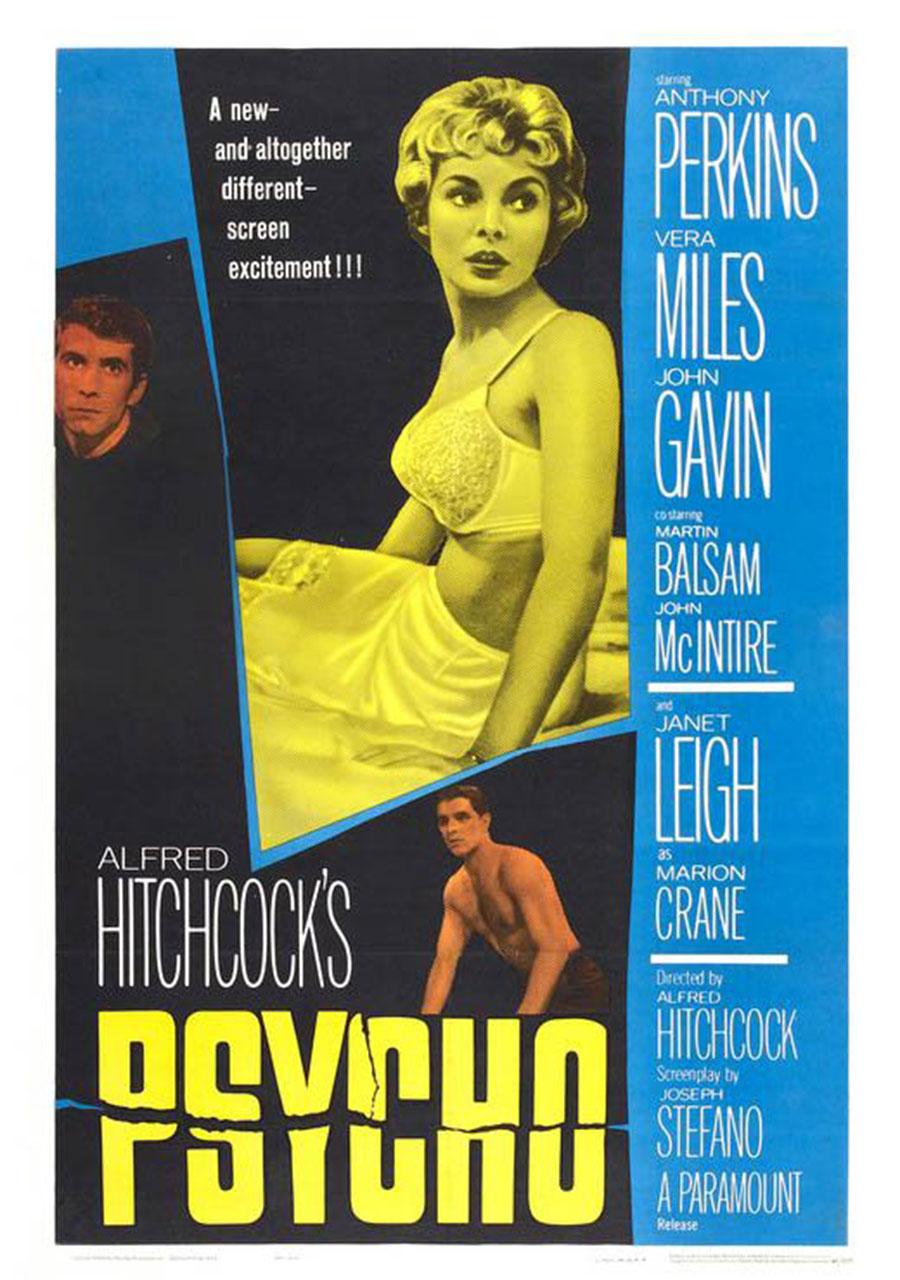
Psycho is so famous it’s almost impossible to watch it as Hitchcock intended. When it was released, the old showman made a huge amount of play from literally banning people from entering the cinema after it had started, with huge billboards in theatres urging people on no account to tell anyone what happens. It was the first major anti-spoiler campaign – and it worked a treat, because the film became a sensation. Such a sensation, that I don’t think there can be many people alive who aren’t familiar with the basic intricacies of its plot, whether you’ve seen it not.

Marion Crane (Janet Leigh) steals $40,000 from her employer, in order to marry her love Sam Loomis (John Gavin). Fleeing New York, she drives through two nights, changes her car, frets about being caught – and finally rests for the night at the Bates Motel, run by shy Mummy’s-boy (“A mother is a boy’s best friend!”) Norman Bates (Anthony Perkins). Exhausted by two days of stress, Marian thinks it’s time to have a shower – and so we suddenly switch genres completely….

Psycho is a masterpiece of mis-direction. If you didn’t know what the film was about, you would expect, from the first act, you are in for some sort of mix between Double Indemnity and a documentary true-crime thriller. The entire first act is essentially a brilliant Hitchcock MacGuffin – both the money and Marion Crane turn out to be things of immense importance to the characters, but essentially less so to the audience. Hitchcock pulls one of his best con tricks by presenting Janet Leigh as the main character, only to dispatch her brutally less than halfway through the film. 

Which is of course during one of the most famous scenes in film history: the shower scene. It’s a masterclass of unsettling, suggestive editing, disturbing imagery (you never see the knife plunging into flesh, but you certainly feel like you do, with constant cuts from knife, to body, to movement, to blood in the bathtub – but no links between them on screen), and of course Bernard Herrmann’s jagged strings scoring it all. For no other reason, this scene would cement the film in cinema history. It’s a slasher scene filmed by a master of cinema, a clear and simple statement for everyone else to come that this was how it was done – and no other director of slasher horror has come anywhere near Hitchcock’s skill here. It’s a phenomenal, terrifying, powerful piece of cinema.

It works so well because Marion Crane is not a faceless victim. Unwittingly, we’ve carefully followed her through the last few days of her life. We’ve seen her love affair with Loomis, we’ve felt her despair at their only being able to meet in motels, felt her temptation and then shared her paranoia and anxiety as she flees with the money. Leigh is barely off-screen for the entire opening third of the movie – and we’ve completely invested in her by the time the water is flowing. Leigh is excellent as Crane – and an overlooked coda to the shower scene is Hitchcock’s tight closeup on her eye immediately after the attack – Leigh pulls off the hugely difficult trick of letting her eye seem like the life is fading away from her in that second. 

It’s one of many outstanding directing feats in the film. Hitchcock slowly builds the uneasy atmosphere of the Bates motel from the moment Marian arrives there, using increasingly unsettling, gothic angles to capture Norman and to suggest that all is not what it seems. As our characters explore the Bates motel, jump cuts to innocuous objects make them carry great peril and uncertainty. Everything at the Bates motel is unnerving, unusual and every shot is not quite right. The Bates motel itself looks like the most nightmarish gothic mansion (seriously who would want to stay there?!).

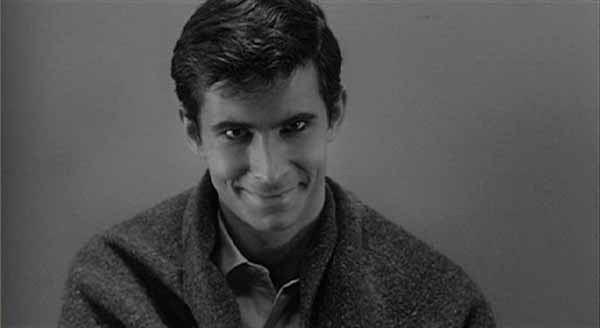
The identity of the murderer is pretty well known. Anthony Perkins is twitchy and fidgety, a softly-spoken peeping tom who is unable to meet anybody’s eyes and is obsessed with taxidermy – is it any great surprise? Perkins is perfect as Bates, and Hitchcock expertly inverts his boyish good looks to masterful effect. Could someone so shy, quiet and innocent-looking be a killer? As the final scenes show us mother’s disturbed voice in Bates’ mind (while the camera slowly tracks in on his increasingly unhinged, grinning face) we not only get some more Hitchcock tricks (a subliminal imposing of the mother’s decayed face over Bates) but also another wonderful scene, of iconic acting and simple but powerful camera work. Hitchcock could do it all.

Mother – oh yuck. It’s brilliant misdirection again. Who is mother? Where is she? Who is the woman we keep seeing? Who is the female murderer? Even when we are told categorically that mother died years ago, that information itself is immediately questioned (“If she wasn’t buried then who was?”). When we do find the truth it’s another horror moment – the greatest ever turn-the-body-around-to-see-the-horror moment you’re going to see in the movies. Lila’s scream and raised arms knock a lightbulb, which swings casting alarming light and shade over the scene.

So Psycho is a masterpiece of film, because it is such an unsettling clash of genres. It’s a film noir whose main character accidentally stumbles into a slasher film. Investigating the disappearance of Marion, Loomis and her sister Lila keep returning again and again to the money that has gone missing, assuming it is the motive of the crime – but they couldn’t be more wrong. 

As is explained to them at the end by the film’s psychiatrist character. This is the weakest mis-step in the film: a psychiatrist explains in a dull lecture exactly what has happened, what was wrong with Norman blah-blah-blah. Maybe we are just much more familiar with things like that, but this scene surely always had a “let me tell you all the answers” flatness to it. Sam Loomis and Lila Crane are not exactly the most interesting characters you are ever going to see – Loomis in particularly seems at first he is going to be a slight rogue, but the character quickly settles into being a bore (what does Marion see in him?). After the first 45 minutes have gone by, most of the scenes outside of the Bates Motel are (whisper it) dull – probably because they focus on a lot of discussion about the money, an issue the audience has long since lost interest in. Did Hitchcock deliberately make these scenes flatter, knowing we needed the rest from the horrors of the Bates Motel?

Psycho, though, is a classic and it will always be a classic. A slasher film and psycho-thriller, directed by an absolute master filmmaker at the top of his game. When Hitchcock made this film – on a low budget, using a TV crew, in black-and-white – people wondered why he was slumming it, why he was wasting his talent. They weren’t asking that after the film was released. Psycho is one of his purest, most unsettling thrill-rides, as horrifying, compelling and unsettling now as it was when it was first released.