
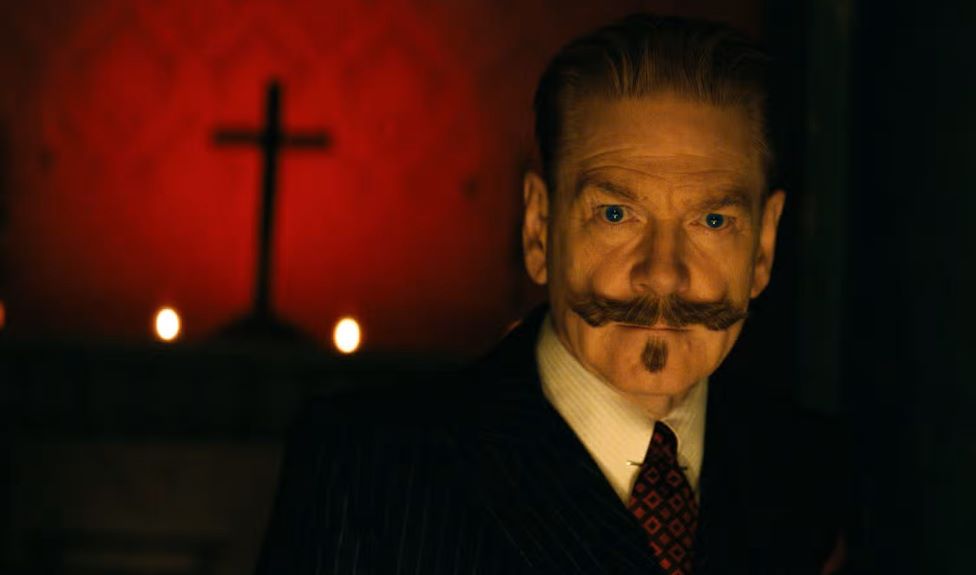
Branagh’s third Poirot outing lowers the scale but feels more real and involving than any others
Director: Kenneth Branagh
Cast: Kenneth Branagh (Hercule Poirot), Kyle Allen (Maxime Gerard), Camille Cottin (Olga Seminoff), Jamie Dornan (Dr Leslie Ferrier), Tina Fey (Ariadne Oliver), Jude Hill (Leopold Ferrier), Ali Khan (Nicholas Holland), Emma Laird (Desdemona Holland), Kelly Reilly (Rowena Drake), Riccardo Scamarcio (Vitale Portfoglio), Michelle Yeoh (Joyce Reynolds)
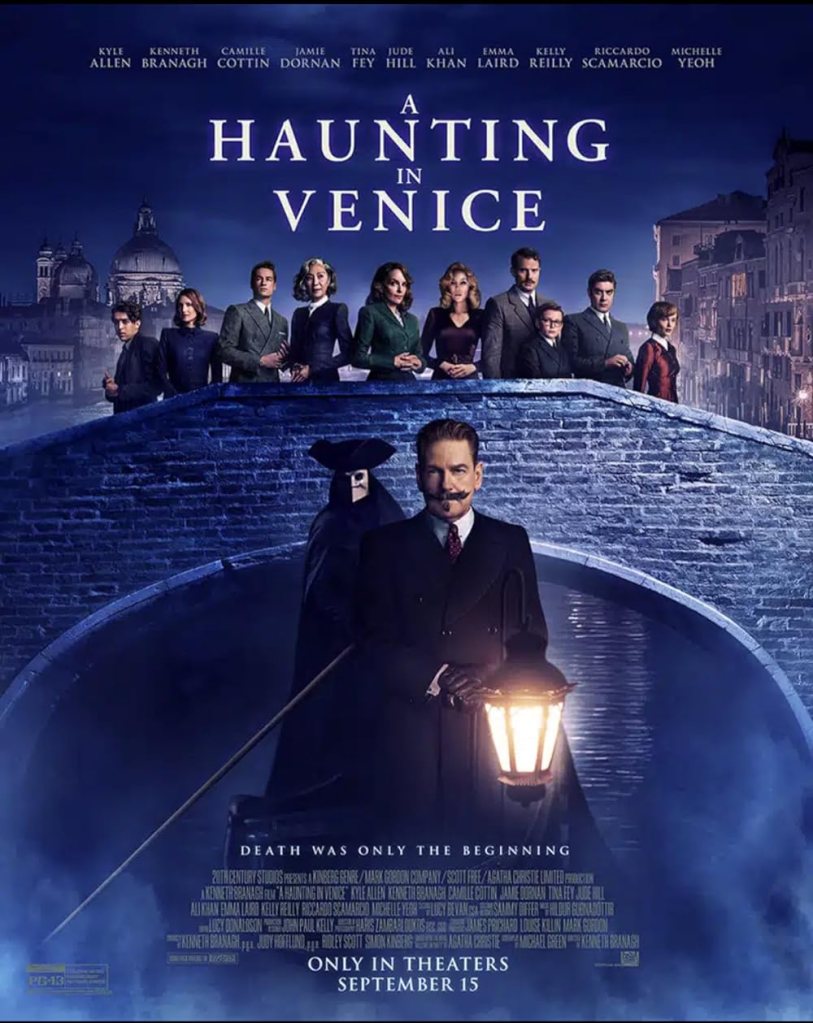
Branagh’s Poirot films have been a mixed bag. Big on starry cast and luscious locations, they’ve also succumbed too readily to bombast not to mention the sort-of tricksy directorial flourishes Branagh has such a weakness for. It’s a pleasant surprise then that A Haunting in Venice turns itself into the smallest-scale and tightest of his Poirot films and might just be the most successful of the lot.
It’s 1947 and a retired Hercule Poirot (Kenneth Branagh) lives as a recluse in Venice, studiously ignoring potential cases, his door firmly guarded by bodyguard (and retired policeman) Vitale Portfoglio (Riccardo Scamarcio). All this changes when he is visited by an old friend, crime novelist Ariadne Oliver (Tina Fey) who recruits Poirot to help debunk spiritualist Joyce Reynolds (Michelle Yeoh). Reynolds is conducting a séance for retired opera singer Rowena Drake (Kelly Reilly), still grieving the recent death of her daughter Alicia. With other guests including Alicia’s former fiancée Maxime (Kyle Allen), PTSD suffering Dr Ferrier (Jamie Dornan) and his precocious son Leopold (Jude Hill) and housekeeper Olga Seminoff (Camille Cotton), the stage is set when a storm and a murder all strike on the same night. Finally, Poirot takes up arms again.
A Haunting in Venice has a fair bit of latitude to work with since there is not an Agatha Christie Poirot mystery actually called that (or even set in Venice). Instead, this is a fast-and-loose adaptation of Hallowe’en Party (definitely one of the lesser-known books) which shifts its location, reshuffles the characters backgrounds, brings a few off-page murders very much “on page” and repackages the story to take place in a sadness-tinged, post-war misery which neatly reflects Poirot’s private grief and guilt at a life which has seen so much death.
This actually works rather well. Contrary to much of the publicity, which played up the horror elements, this is about a million miles away from The Exorcist (although Branagh clearly rewatched Don’t Look Now for Venice scares inspiration), offering instead a camp-fire spookiness and a couple of jump scares. A Haunting in Venice is actually the first Branagh Poirot that feels it would fit into the Suchet-Poirot mould: a slightly maudlin atmosphere mixed with gentle humour, a tight interview-based structure and a (thankful) reduction in gun-toting stand-offs.
A Haunting in Venice is predominantly set in one crumbling Venetian house over one night during a wild storm. The house is given a ghostly backstory of a medieval orphanage left walled-up to prevent a plague outbreak spreading – and there are suggestions of supernatural mischief (objects fall down seemingly on their own) at various points (most of which are swiftly debunked by Poirot). The film is shot and framed with a series of fish-eye lenses and some oblique angles (as per Branagh, the second shot of the film is a Dutch angle) to maximise the dimensions of the house but also at key points stress its claustrophobia, all of which works rather well. It’s moodily lit in a series of shadows (to maximise those spooky jump scares) but its horror elements are lite – a whirligig of screaming and bloodshot eyes at the séance are about as far as it goes.
Instead, it unfolds in a traditional manner, bookended by a prologue and epilogue that indulges the beauty of the location shooting (including a luscious final aerial shot over Venice). The film effectively uses its post-war setting to add emotional impact – after suffering through a war that claimed millions of lives, is it surprising that people are more susceptible to the attractions of taking to the dead? The impact of war blights several characters, from Jamie Dornan’s doctor (Dornan is very good in the role), forever scared by the sights he saw liberating Bergen Belsen to a pair of young Eastern European refugees who have fled the Nazis.
Poirot’s background as a soldier and his own traumatic familiarity with death are also rather neatly wrapped up in questions of his faith. In Branagh’s quiet, melancholic performance (where its clear moments of warmth are only covering deep regrets), it becomes clear his faith in God is as lost as his belief that the world can be improved by deduction. His rejection of spiritualism is pointedly based on a belief that there is nothing outside of the tangible.He fits in witha house awash with traumatised doctors, opera singers lost in grief, housemaids who feel their lives have no purpose and even a crime novelist who’s last three books were flops.
Tina Fey is very playful as this Agatha Christie self-portrait, bouncing effectively off Branagh’s more sombre Poirot. The cast is in fact uniformally strong – a reduced cast list from previous Branagh Poirot’s means each one feels slightly more developed. Yeoh bites into the juicy part of Joyce with movie-star confidence, Reilly is subtly fragile, Cottin and Scamarcio both effectively hiding secret depths. Jude Hill, fresh from playing the young Branagh in Belfast marks himself as a kid with a golden future with a stand-out turn as the mature, worldly-wise young Leopold, comforting and caring for his emotionally scarred Dad.
All of this is marshalled into a tight murder-mystery – we get a bit of Grand Guignal slaughter as well as an effective locked room mystery thrown on top (as well as a homage to the originals apple-bobbing murder) – with a Poirot who is unsettled and out of sorts (for reasons that I guessed but make perfect, secular sense when revealed). It even wraps up on a quietly affecting note of hope. By dialling down the flourishes, scale and action (even if Branagh can’t resist a snorricam shot of himself through the house), A Haunting in Venice actually becomes more rewarding than either of the previous films in the series – and Branagh’s Poirot remains a strong, very human interpretation of the character. Surprisingly, despite its playing with the supernatural, it feels more grounded and human and, despite effectively creating a new story, closer to Christie.
 Movie Musings