Tag: Amy Madigan

Weapons (2025)

Weapons (2025)

Creepy and unsettling horror with a fascinating puzzle-box structure

Director: Zach Cregger

Cast: Julia Garner (Justine Gandy), Josh Brolin (Archer Graff), Alden Ehrenreich (Paul Morgan), Austin Abrams (James), Cary Christopher (Alex Lilly), Toby Huss (Captain Ed Locke), Benedict Wong (Marcus Miller), Amy Madigan (Gladys), Sara Paxton (Erica), Justin Long (Gary), June Diane Raphael (Donna Morgan)

At exactly 2:17am, seventeen young children from the same third-grade class all wake up and run from their houses, their arms trailing behind them like aeroplane wings. The disappearance shatters the local community. Fingers of blame point quickly, most of them at their teacher Justine (Julia Garner). It feels like some bizarre conspiracy, but are there darker forces at play? That mystery will rope in obsessed father Archer (Josh Brolin), troubled cop Paul (Alden Ehrenreich), drug-addict and thief James (Austin Abrams), decent school principle Marcus (Benedict Wong) and the only child from Justine’s class who didn’t disappear, young Alex Lilly (Cary Christopher).

Cregger’s creepy horror movie tells its story from all these character’s perspectives, each section opening like a book’s chapter with their name on the screen. Events re-play from different angles and perspectives and our understanding of events (and their horror!) grows as each person sheds more light on the overall picture. There is a deeply unsettling sense of dread and menace hanging over Weapons, built from the start by an unsettling child narrator who promises us that we are set to see things so unbelievable and ghastly, the authorities covered the whole thing up.

Weapons is influenced by some of the best ensemble dramas – Cregger specifically name-checked Anderson’s Magnolia as an influence – and I also felt it follows very much in the footsteps of Kubrick’s The Shining. It embraces the deeply unsettling dread and horror of quiet menace and the tension of disturbing background events. Which isn’t to say it doesn’t miss out on shattering blood and guts and body horror inspired by Cronenberg and The Thing: when the gore comes in Weapons it’s visceral, gut-wrenching and impossibly bloody.

It taps into everyday fears and horrors then takes them to the nth degree. What parent hasn’t feared the inexplicable disappearance of a child? And when disasters like that happen, people often lash out the suspicious. Poor Justine – a fine performance of outer abrasiveness hiding gentleness and vulnerability by Julia Garner – sticks out like a sore-thumb in this small community. An outsider with a prickly personality and a destructive streak a mile long, a little too fond of vodka (which she buys by the bucketload) and extra-marital sex with married men (which cost her a job at her previous school).

Her stumbling attempts to sympathise with the parents is made worse by the fact she has no clues to offer them. Not helpful (and you can’t help but sympathise with Justine here, as this is a true nightmare set-up) when everyone else is convinced she must know something. Further modern fears are tapped into when Justine faces a campaign of silent intimidation in her home by a faceless persecutor and her car is painted with the word ‘Witch’ (a brilliant little touch making her car instantly recognisable in all the other perspectives that follow).

The loudest voice of this fractured community becomes Archer, played with gruff guilt and fury by James Brolin, pestering the police with his Justine-centred theories and bulldozing other parents for evidence. It’s a dark irony of course that Archer’s paranoid investigations – focused on triangulating a shared route from the direction the children are seen running in doorbell cameras – turns out to be much closer to the truth than the official investigation (but then the police don’t realise they are in a horror movie here, whereas Archer surely starts to think he might be). Similar to Justine, Archer surprises us with his concealed decency and emotional vulnerability, another success in Cregger’s film where greater character depths are constantly revealed.

It works both ways as the more we see of Alden Ehrenreich’s police officer Paul, the less we like him. At first he seems a slightly luckless soul with a gentle heart, but he emerges more and more as a selfish bully who doesn’t think about twice about hurting people around him then worries endlessly about the consequences. Similarly, Austin Abrahm’s drug-addict burglar stumbles far closer to the truth than anyone else – but his interest in it is connected solely to his desire for $50k reward (and it’s hard not to start to think Paul is fairly interested in that as well).

The storyline of these characters unspools in Cregger’s short story structure very effectively, the camera frequently trailing behind each character in a series of tracking shots (this means we often only see the facial reactions when the scene repeats from a different perspective). Cregger’s shies away from jump scares (not that he doesn’t use these quite effectively at several points) in favour of simple shots and draining out sounds to let quiet background moments create dread. Perhaps most chilling of all sees a character sleeping in a car being slowly approached by a mysterious woman, a scene of such sustained but simple tension it will have you twitching in your seat.
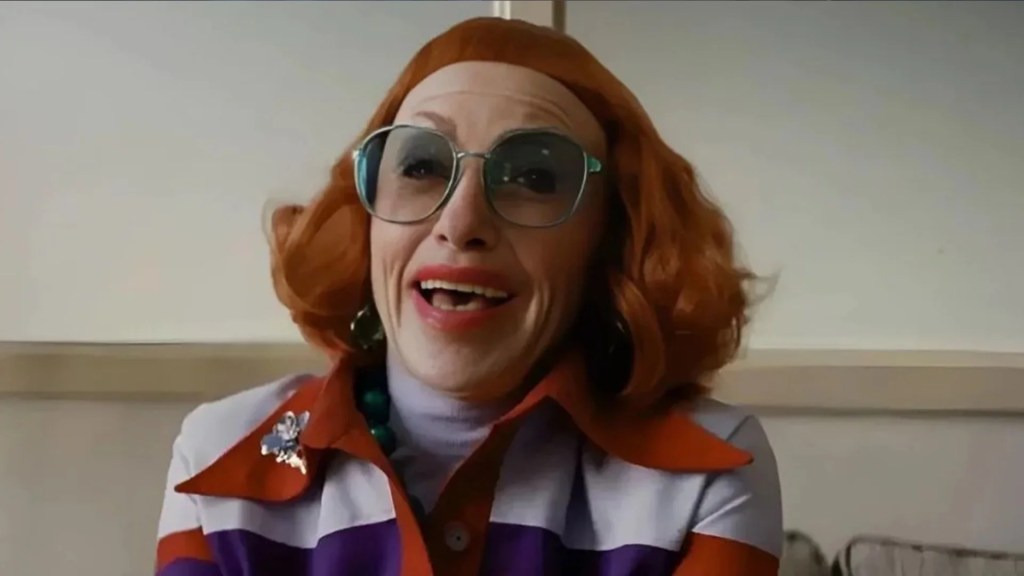
To reveal anything of what the secret cause of this horror is would be spoil things considerably – Weapons works best the less you know about it. But it’s not a spoiler to say there are dark forces at play – Weapons clues you in fairly quickly that a creepy house, with newspaper coated windows, is likely to be the centre of what nightmares may come. A big part of this is a performance of crazy off-the-wall freakishness by Amy Madigan, a gift of a role she rips into with gusto, an eccentric presence dripping with unsettling menace, both vicious and then eerily calm. Madigan bites into the role like Hopkins did Lecter, doing terrible things with a calm smile, making threats with calculated menace. Genuinely terrifying, truly memorable.

Weapons opens up a pot of terrifying, unsettling nightmare fuel. From the unnervingly unreal way the children run (arms trailing behind them) to background events that carry real terror. But there are moments of black comedy in here as well: the final sequence is both blood-soaked horror and also darkly hilarious (Cregger using distanced perspective shots to expert effect) and a housebound fight plays like a horror-slapstick. The main success of Weapons is it’s creeping sense of menace, the unsettling thought of horrific dark powers just on the edges of reality, that lack any sense of morality or decency. That what we can’t imagine is even more terrifying than what we can.

Places in the Heart (1984)

Places in the Heart (1984)

Overcoming adversity and racism are themes not always successfully balanced in Benton’s family epic

Director: Robert Benton

Cast: Sally Field (Edna Spalding), Lindsay Crouse (Margaret Lomax), Danny Glover (Moze Hardner), John Malkovich (Mr Will), Ed Harris (Wayne Lomax), Amy Madign (Viola Kelsey), Yankton Hatten (Frank Spalding), Gennie James (Possum Spalding), Lane Smith (Albert Denby), Ray Baker (Sheriff Royce Spalding), Terry O’Quinn (Buddy Kelsey), De’voreaux White (Wylie)

Partially based on his own childhood memories, set in Texas 1935 as the Depression grips America, Robert Benton’s Places in the Heart is a tear-jerking tale of overcoming adversity, mixed with an earnest attempt to look at Southern racism. It’s often a little heavy-handed in the former, and a little fudged (if very well-meaning) in the second. Places in the Heart is a frustrating film with a genuinely engaging, engrossing story that, for various reasons, the film never manages to quite bring into focus, for all the undoubted skill in its making.

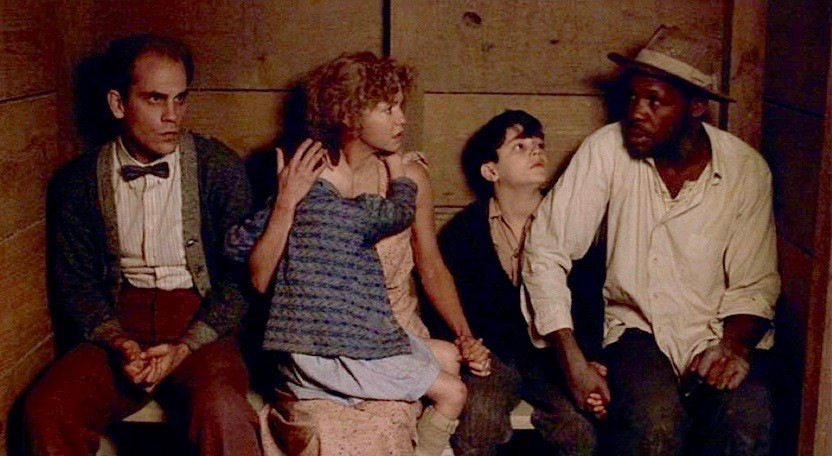
Sally Field plays Edna Spalding, a widow after her sheriff husband (Ray Baker) is accidentally shot and killed by a drunken Black teenager (promptly brutally lynched by the Klan the same day). With the bank pushing to foreclose on the farm she can no longer afford, poverty and homelessness seem certain until a chance meeting with Black drifter Moze (Danny Glover) offers hope. Moze is an experienced cotton worker, and he coaches Edna through getting the fastest cotton crop of the season (and the $100 prize for that feat). Edna and her children throw themselves into the task, and she starts to build a new family with Moze and blind war-veteran lodger Mr Will (John Malkovich). But will weather, the Klan and the banks allow it?

Benton’s film is, in many ways, a master-class in constructing a framework of highly impactful scenes. Places in the Heart is carefully paced with metronomic precision to give us an impactful, powerful scene roughly every ten minutes. From the shockingly sudden shooting of Sheriff Spalding and Edna cleaning his deceased body on her dining room table it gives us scenes that build perfectly to showcase high impact moments. Confrontations, tornadoes that place children in peril, triumphant confrontations with arrogant bankers and facing down corrupt cotton sellers, inevitable fireworks after a disastrous double date and heart-rending racist attacks. It’s a film almost completely constructed of tent-pole moments, to illicit maximum impact.

However, where it fails are the moments in-between. It’s so focused on nailing those big moments, that it allows the emotional journey that should inter-connect them (and make the story truly satisfying) to falter. The clearest example is Malkovich’s blind Mr Will: in no more than three scenes he goes from a man bitter at his disability, dumped on Mrs Spalding by a family who can’t be bothered to care for him, resenting her ‘hooligan’ children to risking his life to becoming their surrogate uncle. It’s a tribute to Malkovich that he sells this lightning fast emotional turn-around, but a more patient film would have spent this change feel organic (rather than, essentially, relying on a tornado act-of-God to complete the arc).

Similarly lightning fast work covers the bond between Edna and Moze: swiftly we go a few scenes from her greeting him with slightly less racist discomfort than her sister, to Jean-Valjean-like claiming she asked him to deliver to a friend the silver spoons he steals from her house, to him becoming another surrogate uncle to the kids and treated in the house like an equal (he notably doesn’t cross the door threshold for the first hour of the film). Now you can admire the efficiency here – for example, the film is good at establishing without fanfare the rope aids hung up around the farm to help Mr Will (vital for a later confrontation). But you can also regret that it is so keen to get to the emotionally cathartic moments, it skims on showing us the journey (after all, a one hundred mile walk seems less impressive if you only see the start and end).

Part of the problem is Benton keeps dragging us away from these engaging plotlines to wallow in a side-plot involving Mrs Spalding’s sister and her wayward husband’s affair with a school teacher. This storyline barely intersects with events on the Spalding farm, in no way serves as a commentary on events there (a braver film would have contrasted it with a romantic relationship between Edna and Moze, which you can be sure would not have been as genteelly resolved as that affair in a South as racist as this). All it really does – for all the efforts of Crouse (Oscar-nominated, presumably due to her husband-slapping confrontation scene), Harris and Madigan, it’s meandering, dull and feels pointless even while you are watching it.

And it always takes us away from the real interest on the farm. The depiction of triumph over adversity is fairly straight-forward – with a host of hissable strawmen, led by Lane Smith’s patronisingly sexist banker – but it’s told with such professional skill it can’t help but land.  Who doesn’t enjoy a woman who never believed she amounted to anything, suddenly discovering an inner-fire and sense of purpose she never knew. You may notice the similarity to Sally Field’s other Oscar-winning role (Norma Rae). Her performance here is cut from the same cloth, only this time she can’t find the same naturalness: she is frequently mannered, precise and actorly when she should feel raw, grounded and real.

The real daring interest here is the way the film tries to address racism. You can’t deny there is a certain romanticism in its looks at the Ol’ South, but its balanced with putting on screen something of the real horrors of racism. Perhaps even more shocking than the sudden shooting of Sheriff Spalding is the sight of young Wylie’s disfigured body dragged behind a truck full of gun-totting racists. (And that this is objected to, not for the violence, but for the poor taste of dragging a dead man to Spalding’s wake). Needless to say there is no investigation or punishment for this crime whatsoever.

Moze’s story captures some of the perils of being Black in Depression-era Texas. Danny Glover, in the film’s finest performance, perfectly captures both the anger of the unjustly oppressed and the fear (and shame of that fear) that death could come from the wrong word or looking at someone the wrong way. Moze constantly shuffles himself to the back, casting his-eyes down and changing the timbre of his voice to something slower and more humble when confronted with white men of power. It’s markedly different from the warmth, decency and sharp opinions he shows with people he trusts. And Places in the Heart’s most appalling moment is when he is confronted with the white-hooded face of the South’s ‘defenders’.

At times this sometimes over-balances a film that, at heart, wants to be optimistic. (As you can tell, all too clearly, from its bizarre, overly demonstrative, deliberately dream-like ‘we-can-all-be-the-same’ ending which must have felt meaningful to Benton but to me feels shockingly trite). Moze’s suffering is shown with real compassion, but he is still presented as a character who magically shows up at exactly the time he is needed and then disappears when his task is done. It’s a film that imagines a utopia where a desperate mother, a blind white man and a Black man can learn all men are equal, while struggling to accept that this is nestled in a land riddled with Klan racists where the n-word is so casually used it doesn’t even raise an eyebrow. In the end cold, hard reality is a little too much for Places in the Heart to digest.