Tag: Andre Braugher

She Said (2022)

She Said (2022)

Earnest, well-meaning but not entirely dramatic recounting of the New York Times investigation into Weinstein

Director: Maria Schrader

Cast: Carey Mulligan (Megan Twohey), Zoe Kazan (Jodi Kantor), Patricia Clarkson (Rebecca Corbett), Andre Braugher (Dean Baquet), Jennifer Ehle (Laura Madden), Samantha Morton (Zelda Perkins), Ashley Judd (Herself), Zach Grenier (Irwn Reiter), Peter Friedman (Lanny Davis), Angela Yeoh (Rowena Chiu)
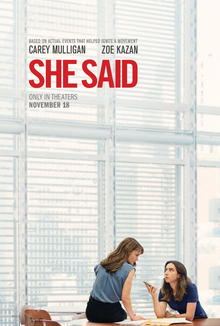
In 2017, the New York Times published revelations about Miramax kingpin Harvey Weinstein that shocked the world. Weinstein had used his position to force his sexual attentions on anyone from aspiring actresses to employees, with a rap sheet of crimes ranging from gropes to rape. It shook Hollywood to its core. She Said is the dramatization of the investigation carried out by reporters Jodi Kantor (Zoe Kazan) and Megan Twohey (Carey Mulligan) who sought out the victims, won their trust and pushed the story through despite threats of legal action.

She Said is a worthy, well-meaning film. It has moments of genuine power and its recreation of the testimony of the victims is tragic and heart-rending. But yet… I didn’t find it dramatic. I was left wondering, why did this true story of journalistic tenacity not carry the same impact as Spotlight or All the President’s Men?

Perhaps it’s because the film doesn’t really cover this story as an investigation. There isn’t the sense of facts slowly emerging to form a horrifying picture, or one small incident ballooning into an earth-shattering scandal. Instead, Twohey and Kantor are certain they have the basic facts from the start, with the film being instead a reveal of how many cases there are, rather than an expose of a wrong. While this is still important, it isn’t necessarily always dramatic and, eventually, She Said starts to feel every minute of its two-hour-plus run time.

The real focus of the film probably should have been the journalists’ determined work to win the trust of the principal witnesses – in particular Jennifer Ehle’s Laura Madden, whose whole life has been partially in the shadow of Weinstein’s assault in the 90s. Kantor – played with an empathetic richness by Zoe Kazan – worked night and day to encourage these women to bring their stories to the public. Instead, the film gets distracted with trying to cover too much, both the famous and the unknown victims, and the peripheral presence of Rose McGowan, Gwyneth Paltrow and Ashley Judd (playing herself) unbalance the movie away from the difficult, challenging – but more dramatically rewarding – work exploring office workers called into meetings to “massage” their gross boss.

It’s a shame the focus gets pulled away from these unknown women, who were little more than teenagers when Weinstein abused them in the 90s, since the sequences where they tell their stories are the ones that carry the most impact. There are superb cameo appearances from a trio of great actors. Ehle is superb as a woman resigned to trying to put things behind her, Morton brilliant as another prickling with rage and resentment, and Yeoh very good as a woman who never really managed to process her trauma. The careful, respectful, but deeply sad recounting of these women’s experiences by this trio are the film’s highlights.

Too much of the rest of the film gets bogged down in editorial procedure and the flat collecting of facts. It’s a bad sign when the film has to continuously state the “danger” the characters are facing while investigating and how every wall has ears. While Weinstein was a horrible man, terrifyingly powerful within his industry, I find it a stretch when (unchallenged) a character fears Weinstein will have him killed. I can’t see Weinstein hiring a hitman or utilising the sort of espionage techniques that would make the FBI jealous.

The film also struggles to get to grips with the depressing limits to any struggle for justice in the field of sexual harassment and assault. It starts by depicting Twohey’s investigation into Trump’s “locker room” pussy-grabbing “banter”, which peters out into a total failure to have any real impact at all. While the film suggests this as a motivating factor for the journalists to “get it right” this time, it doesn’t seem to acknowledge the limits of #metoo. It’s clearly very different to get Hollywood to clean out its house, compared to taking on someone with real power. Equally, the film gives no space to attempting to understand why Lisa Bloom, who represented victims of Bill O’Reilly and Trump, went to town defending Weinstein. There are interesting topics to explore here, but She Said wants to simplify its narrative down to goodies and baddies.

Time is also given over to the journalist’s home lives, none of which adds much to the overall narrative. Kantor’s relationship with a 10-year-old daughter just beginning to understand words like “rape” never quite solidifies into a thematic motivator. Twohey’s struggles with post-natal depression are bravely raised, but effectively disappear from the film (which makes me feel even a feminist film is squeamish about saying anything except motherhood is the dream for all women).

The final arc gets equally slightly bogged down in the fact-checking procedure. At times, the film has a little too much of a documentary feel, as if drama might have got in the way of the message. Despite this, there are some very good performances, with Kazan and Mulligan concealing mounting outrage under professional, dispassionate cool (Mulligan gets an outburst at a harassing bar patron, which does feel like too much of a “for your consideration” moment), even if we get little sense of who they are as people.

She Said is a very worthy look at a seismic news story, which never quite translates its coverage of impactful events into a truly compelling narrative.
Glory (1989)

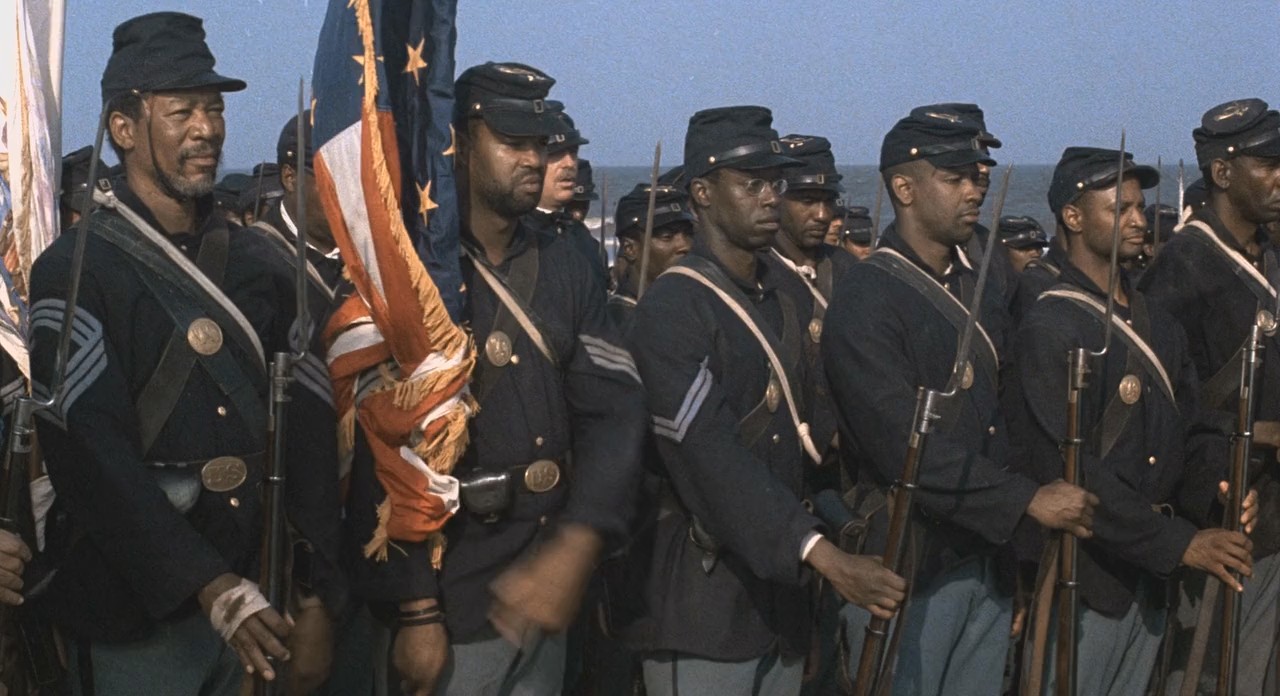
Morgan Freeman and Denzel Washington are among the first black American soldier in Glory

Director: Edward Zwick

Cast: Matthew Broderick (Colonel Robert Gould Shaw), Denzel Washington (Pvt Silas Trip), Cary Elwes (Major Cabot Forbes), Morgan Freeman (Sgt Major John Rawlins), Andre Braugher (Cpl Thomas Searles), Jihmi Kennedy (Pt Jupiter Sharts), Cliff De Young (Colonel James Montgomery), Alan North (Governor John Albion Andrew), John Finn (Sgt Mulcahy), Bob Gunton (General Charles Garrison Harker), Jay O Sanders (General George Crockett Strong)

The American Civil War started over slavery, but it took a long time for either side to admit it was a fight about slavery. Racism abounded on both sides, and it was a fight in which black Americans may have been the subject, but were rarely invited to join. Glory covers this point of history, and specifically the first all-black regiment and its struggle to be recognised as equal to the other regiments in the army. 

Wounded at the Battle of Antietam in September 1862, Robert Gould Shaw (Matthew Broderick) returns home to Massachusetts and accepts command of the first all-black regiment, which is currently being raised by abolitionists in the state. With his friend Cabot Forbes (Cary Elwes) as second-in-command (no one was progressive enough to actually allow black officers for the regiment), he recruits a wide range of black Americans, from free-man and bookish intellectual Thomas Searles (Andre Braugher) – an old friend of Robert and Cabot – to former slaves such as the wise John Rawlins (Morgan Freeman) and the resentful Silas Trip (Denzel Washington). Training is a struggle, with the army denying the regiment supplies and support, and it’s an equal struggle when they reach the front line to be recognised for duties other than looting and latrine digging. Will the Massachusetts 54th be given the chance to prove itself in the front line – and establish a black man can fight as hard and bravely as a white man can?

Edward Zwick’s beautifully filmed, carefully re-created historical epic set the tone for much of his future career. It’s an often overly-sentimental film straining for a very self-conscious sense of importance, weighed down by the pride at the “message” it is carrying. It often does hit the mark with presenting scenes that carry emotional force – but then seeing as it treats nearly every scene as being a “moment” that should move us (with James Horner’s choral manipulation working double time to get us experiencing feelings), it’s no wonder that it succeeds sometimes.

Which is not to say the message it presents isn’t an important one. Black Americans have often been pushed into the margins of American Civil War history. Or worst of all presented as the victims, reliant on the courage and bravery of the abolitionists of the North to save them from slavery in the South. Until Glory it was very rare for anything to push their stories front and centre – or to tell a story where former slaves were allowed to fight their own battles and choose their own destinies. 

It’s one of the strongest marks of the film: these are soldiers unlike any other, who enter battles with less concern about their own survival, and more about having the chance to live as freemen and to make a mark on the world. To show that they, and people like them, could do just as a white man could do. And if they had to die to do that, better to live a day on their feet as freemen then a lifetime on their knees. It’s the principle emotional message of the film, and something Zwick translates with some skill, even if he frequently overeggs the pudding while doing so.

However, with such a strong message, it’s a shame so much of the film is filtered through the experience of its white lead character. For many of the films of the 80s and 90s dealing with these issues – Cry Freedom, the Steve Biko biopic, with Biko as a supporting character to his white South African journalist friend, being perhaps the key example – it was essential to have a white man at the centre, as if worried that audiences couldn’t understand the story they were seeing unless they had it filtered through the perception of someone who looks a bit more like them.

Matthew Broderick takes on the lead role here of Shaw – with the film giving a significant slice of its running time to its coming-of-age theme of Shaw learning to become a leader of men – and while the character is meant to be callow and an unlikely Colonel, it doesn’t help that Broderick lacks the charisma for the part. Perhaps he is a little too lightweight an actor for such an enterprise, for a film that demands greater force of character (you can imagine Tom Cruise doing a much finer job in the role).  Similarly, the familiar beats of a young man learning how to lead feel trivial compared to the life-and-death issues facing his soldiers.

But too often Zwick’s film returns us to Shaw’s point-of-view, the narrative filtering so much of the action through his perceptions and decisions that the black soldiers become supporting actors in their own stories. Broderick is not helped by the soldiers being played by some of the finest American actors of the last 30 years. Braugher is fabulous in the thankless role of the bookish man who must grow a spine. Morgan Freeman established a persona – the wise and level headed older man, who will not let hate and fury define his life and his choices – that would last him for the rest of his career, and is superb (his Oscar nomination for Driving Miss Daisy is probably the only thing that led to him not getting a nod for this film).

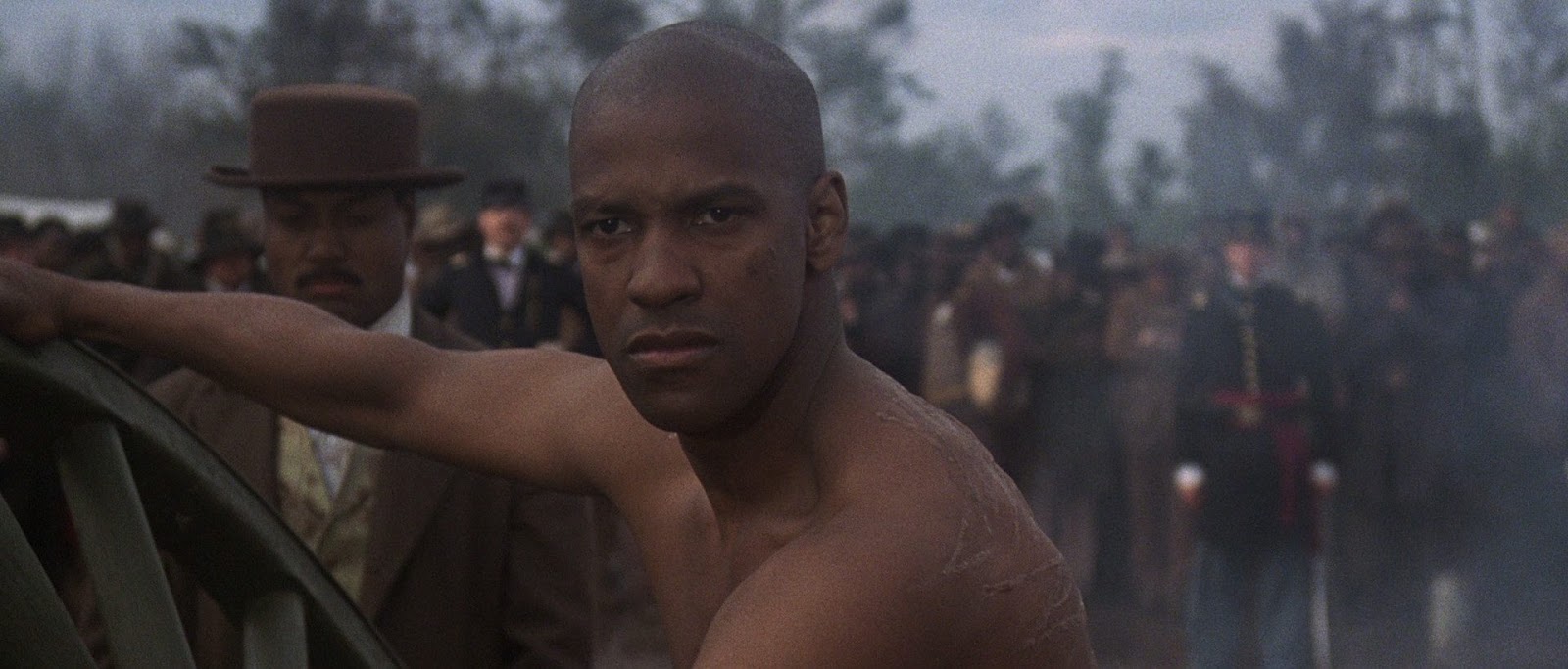
Denzel Washington took home an Oscar as the bitter, angry Trip – and it’s the sort of role an actor seizes with relish. Washington fills every frame with his rage at the system, his inarticulate, indiscriminate anger lashing out in every direction. It’s the fury of a man who has had all his choices taken from him in life, and would rather destroy things than run the risk of allowing himself to become committed to something, or form a bond. Washington probably won the Oscar alone for the astonishing scene where he silently, defiantly accepts a whipping (on a body covered with scars) for missing a curfew. He’s an elemental force of nature in the film.

There is plenty of strong stuff in Zwick’s work, but the film itself overplays its hand frequently. Moments of emotion are played so heavily to the hilt they sometimes fail to have an impact. It wants you to know at every turn that you are watching a film with an important social message – and the speechifying at points put into the mouths of the characters runs dry. While superbly made – veteran photographer Freddie Francis’ work is beautiful (and Oscar winning) – it’s a heavy-handed, overly pleased with itself film that knows all too well that it is about an important subject. While sometimes it lands – often in quieter moments, particularly those where Freeman and Washington are allowed to simply be human without overindulgent music cues hammering home the emotions – at others it comes across as too much.

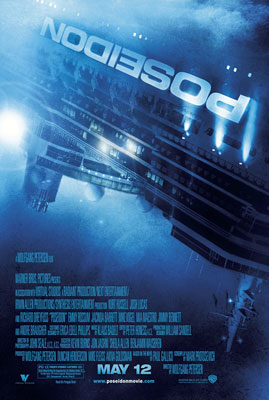
Poseidon (2006)


Our characters (such as they are) struggle from cliche to cliche in Poseidon

Director: Wolfgang Peterson

Cast: Josh Lucas (Dylan Johns), Kurt Russell (Robert Ramsey), Jacinda Barrett (Maggie James), Richard Dreyfuss (Richard Nelson), Emmy Rossum (Jennifer Ramsey), Mike Vogel (Chris Saunders), Mia Maestro (Elena Morales), Kevin Dillon (Lucky Larry), Freddy Rodriguez (Marco Valentin), Andre Braugher (Captain Michael Bradford)

In the 1970s the big tent-pole movies were all disaster films. They were the superhero films of their day. They also followed a very clear formula: big stars, big man-made structures, big crashing natural forces sweeping away man’s pride. Lots of death and tear jerking, with sub-plots for each character that could have been pulled out of an episode of EastEnders.

Poseidon is a remake of sorts of The Poseidon Adventure – but with plot and characters changed (not for the better). There is a ship called the Poseidon. It’s hit by a tsunami. It gets overturned, trapping the survivors at the top (now the bottom) of the ship. While most wait to be rescued, our heroes decide to climb down (now up) the ship to the hull to escape. Of course, not all of them will make it!

You notice I didn’t mention any characters there. That’s because what this film laughably calls its characters are so crudely drawn, they barely qualify as human beings, let alone characters. They exist purely to get into trouble. We spend only the most rudimentary time getting to know them before they (and their loosely defined characteristics) start dropping like flies. This is an anti-actor film – literally anyone off the street could play these parts, so disinterested is the film in them.

So we’ve got Kurt Russell as an over-protective father and Emmy Rossum as his semi-rebellious daughter. Will they grow closer together over the film? You betcha. Will Russell learn to accept the place his daughter’s boyfriend has in her life? Of course. Will “I work better alone” professional gambler Josh Lucas learn that he needs other people? Nope. Just kidding of course he does. Will suicidal architect Richard Dreyfuss discover a new love of life? See where I’m going?

In fact it’s so completely predictable you can take a pretty good guess who will make it and who won’t based solely on the opening few minutes. Some of its decisions lack any form of sensitivity. Any character from a remotely racial minority? Let’s just say that their chances are not good (Dreyfuss needs to actually kick Rodriguez’s waiter down a shaft so he doesn’t drag the others down – I thought at first “there’ll be consequences to that” – but nope it’s never mentioned again). Anyway, all the surviving characters are loaded white guys. One of them does need to make “the ultimate sacrifice” to save the others but, again, their identity can be pretty much worked out in the opening minutes. The most unpleasant character in the film? Yup he dies.

In fact you watch the film and feel sorry for the actors. Not only are the characters wafer-thin, but they spend so much time silently underwater or getting soaked, they look like they are suffering a lot for nothing. The focus is entirely on the mechanical progression from set-piece to set-piece, all of which stink of familiarity. So we get the long swim under water (of course someone gets trapped!), the impassable ravine that needs crossing (of course someone is stuck on the other side), the claustrophobic tunnel (of course one of the characters has claustrophobia). There is even a bit where the terminally stupid fucking kid wanders off and needs to be rescued. Is there anything new in this? It’s a re-tread of every disaster film ever.

Wolfgang Peterson directs all this with a professional detachment and disinterest that makes you want to cry that he once made Das Boot. If there is one thing he knows, it’s shooting confined spaces (see not only Das Boot but also Air Force One) and he makes the onslaught of water look pretty good. But this is such a piece of hack work, you despair that he clearly needed the money. The special effects are pretty good I guess (although the CGI ship looks totally dated), but it’s a staid, dead, predictable film.

It only really works in an “it passed the time watching it in two chunks over a couple of breakfasts” way. Because there is literally nothing new, interesting, unique, intelligent, imaginative, dynamic or individual about it, it passes in front of your eyes like a bland wall-paper. Compared to the classic disaster films of the 1970s it’s not fit to lace their explosions. Totally empty, unchallenging rubbish.

Primal Fear (1996)


Richard Gere prepares an impossible defence for unbalanced Edward Norton. Twist ahoy!

Director: Gregory Hoblit

Cast: Richard Gere (Martin Vail), Laura Linney (Janet Venable), John Mahoney (John Shaughnessy), Alfre Woodard (Judge Shoat), Frances McDormand (Dr Molly Arrington), Edward Norton (Aaron Stampler), Terry O’Quinn (Bud Yancy), Andre Braugher (Tommy Goodman)

Courtroom dramas are the bread and butter of film drama. You get to deal with good vs evil, right vs wrong – and you even have two advocates on each side there duelling it out on camera for you. Primal Fear came at a time when John Grisham and his like were ruling the bestseller charts, and it’s a fine demonstration of that very late 80s to mid 90s genre: the all-star court case film.

After the murder of a beloved archbishop in Chicago, bloodied altar-boy Aaron Stampler (Edward Norton) is found near the scene. There seems no doubt that he’s guilty. Top city lawyer Martin Vail (Richard Gere) takes his case for the publicity of a big trial, but finds himself believing the boy to be innocent. As the trial begins though, Vail’s psychiatric investigation reveals Stampler has a split personality – his gentle main persona and a violent defensive personality, “Roy”, who admits to the crime.

This is an advanced, well-written trial thriller which, through a combination of some neat lines and some very good performers, manages to bring a lot of life and originality to what could have been a collection of stock characters. Instead, each character in the film feels real and their actions seem part of a coherent personality. The mechanics of the plot also move very smoothly, with a well-handled twist. And as a bonus it has something to say about human nature, about our need to believe in something and how easy it is to tell lies about ourselves and believe them from others.

The film is shot with a good eye for grimy real-life locations and muddy shade-of-grey morality. Hoblit’s direction is crisp and straightforward and he avoids getting any pyrotechnics in the way of the actors – here the performances are the special effects. It’s also a brilliant twist movie that doesn’t telegraph the fact it contains a twist until it suddenly pulls the rug out from under your feet. Hoblit doesn’t give us any advantages over the characters and has the restraint not to show his hand too early – instead he sucker punches us with a sudden downer ending. It’s a masterpiece of genre craft film-making.

Richard Gere at first glance is playing well within his range – a smirking hotshot focused on the win, willing to defend anyone and anything. However, what Gere does really well here is play his persona as an actual persona of the character. The “real” Martin Vail, it becomes clear, is actually almost naïve in his underlying faith in the justice system. He has a touching faith in people and the twist of the film works because we believe how much Vail unwittingly allows himself too be manipulated and conned. He’s the sort of true believer who can playfully mock his faith because his belief in it is absolute. It’s even more crushing, then, when that faith is so cruelly used and abused. The final shot of him alone on the street all but screams “My God, what have I done?”.

But though this film has some of Gere’s best work, this is Ed Norton’s movie. Incredibly, this was Norton’s first ever film, and he seizes the film absolutely by the scruff of the neck. Re-watching the film now, it’s less of a surprise when Aaron’s “Roy” personality bursts out – Norton is so well known now you are almost waiting for him to really let rip – but he nails the contrasts between the stammering, gentle Aaron and the ferocious Roy. You always know which one he is at any time – and even better than that, Norton drops subtle hints throughout to set up the film’s twist (which I won’t give away). His performance is largely a triumph of masterful control of acting tricks and a brilliant demonstration of range, as well as a swaggering display of confidence, rather than a subtle piece of character work, but it’s still an absolute knock out for all that – and totally believable.

Strong performances also come from Laura Linney, making an awful lot of the role of Gere’s courtroom nemesis and part-time lover. Andre Braugher is particularly good as an investigating officer. Alfre Woodward is stern and authoritative but fair minded and just as the judge. Frances McDormand makes what could have been a wet liberal doctor feel like a genuinely caring and dedicated intelligent professional. There isn’t a weak link in the cast, and every character beat feels well observed and natural. How many genre films have failed to manage that?

It all works extremely well and offers all the courtroom fireworks you could want with maximum efficiency. All the actors are working at the top of their game, and the direction keeps the action taut and intriguing. Here’s the thing: the plot makes little sense if you think about it, and Norton’s plan depends on so many variables he could never have known that it would success. But the film is made with such confidence and assurance that it never really matters. The twist still has a lot of impact today – and the film bravely offers no happy endings, only hammers home the system’s corruptness. A very good example (perhaps one of the best) of the courtroom genre.