

The third film in the series is a decent effort – but pales in comparison to the others
Director: Francis Ford Coppola
Cast: Al Pacino (Michael Corleone), Diane Keaton (Kay Adams-Corleone), Talia Shire (Connie Corleone), Andy Garcia (Vincent Corleone), Eli Wallach (Don Altobello), Joe Mantegna (Joey Zasa), George Hamilton (BJ Harrison), Bridget Fonda (Grace Hamilton), Sofia Coppola (Mary Corleone), Raf Vallone (Cardinal Lamberto), Franc D’Ambrosio (Anthony Corleone), Donal Donnelly (Archbishop Gilday), Richard Bright (Al Neri), Al Martino (Johnny Fontane), John Savage (Father Andrew Hagen), Helmut Berger (Frederick Keinszig), Don Novello (Dominic Abbandando), Franco Citti (Calo)
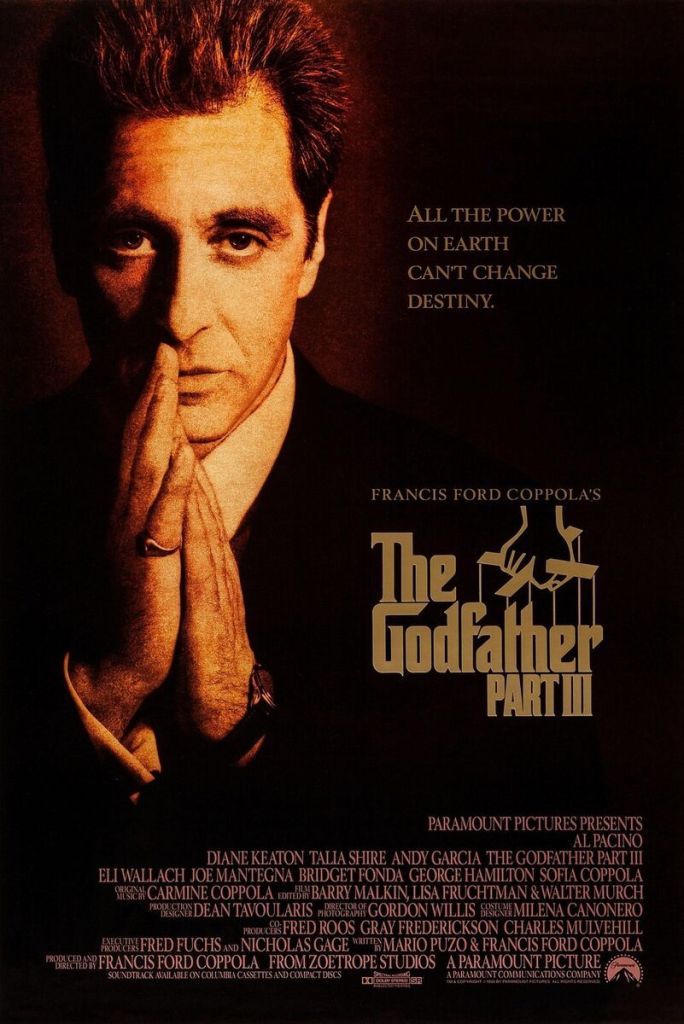
Coppola wanted to call it The Godfather Coda: The Death of Michael Corleone. He got his wish decades later with a belated re-edit release. But at the time, the studio wasn’t having it: this would be a full-blown Third Part to The Godfather. Problem is, those are some very big shoes to step into and The Godfather Part III wasn’t the genre-defining masterpiece its predecessors was. Instead, it’s a decent, melancholic gangster film with touches of King Lear. However, when you are following the sublime being “pretty good” winds up looking like “pretty awful”. The Godfather Part III became the infamous “fuhgeddaboutit” chapter in the saga, the one for completists and those who watch out of duty. On its own merits its fine, but perhaps it was a doomed venture from the start.
It’s 1979 and Michael Corleone (Al Pacino) has aged and mellowed. All his life he’s talked about getting out, and now it seems he finally has. He’s set up a charitable foundation, he’s been honoured by the Vatican and is rebuilding relationships with his children: daughter Mary (Sofia Coppola), now head of his foundation and son Anthony (Franc D’Ambrosio), an opera singer. Even Kay (Diane Keaton) is speaking to him again. Michael is grooming Vincent (Andy Garcia), illegitimate son of his brother Sonny, to take over the reins of the crime family. But then, they drag him back in. Bailing out the Vatican Bank, Michael finds is double-crossed by a collection of Euro-banking crooks, corrupt Church leaders and rival Mafiosi. Will he survive the dangers a return to Sicily will bring?
The unspoken secret of The Godfather is that everyone was always there for the money: they just also had something to prove the first two times and the fire in their bellies to turn gangster grist into cinematic beauty. Fast forward 15 years later, and there hangs an air of “give the studio what it wants” about Part III, coupled with a willingness to rest on laurels. Coppola agreed to do it because his last few films were bombs and he needed the money. Pacino demanded – and got – a massive sum. Keaton coined it. Robert Duvall asked for $1.5 million, didn’t get it and walked. Coppola agreed to turn the script around in lightening time to rush the film to the screen for the inevitable box-office and awards bonanza. No one involved really did the film for either love or passion.
Coppola’s script, written to a deadline, is torn awkwardly between two plots, neither completely satisfactory. His interest lies with the question of whether absolution (of any sort) for Michael is possible. This is the film Coppola wanted to make, but it keeps losing ground though to the other, a complex conspiracy thriller, riffing on real-life events in the Vatican. This conspiracy is frequently dense, difficult to follow and (frankly) not particularly interesting as it trudges through Papal politics and investment banking, seeming existing to provide faces for the inevitable violent montage of inventive hits.
A Part III that zeroed in on Michael himself, his guilts and shame, would have been both distinctive and unique. But The Godfather Part III fudges this. Crucially, the Michael we see here – for all he would have mellowed with age – feels very different from the cold, buttoned-down, calculating figure from the first two. Pacino – perhaps remembering the pressure of Part II that left him exhausted – invests it with more “hoo-hah”. This twinkly Michael, smiles to hide his regrets – when you feel, in reality, years of pressure would have turned him into even more of a murderous Scrooge. I also can’t believe he would be this close to his now adult children. Pacino embraces the moments of raw pain when they come, but this character just doesn’t quite mesh with his previous performances (and his hair looks just plain wrong).
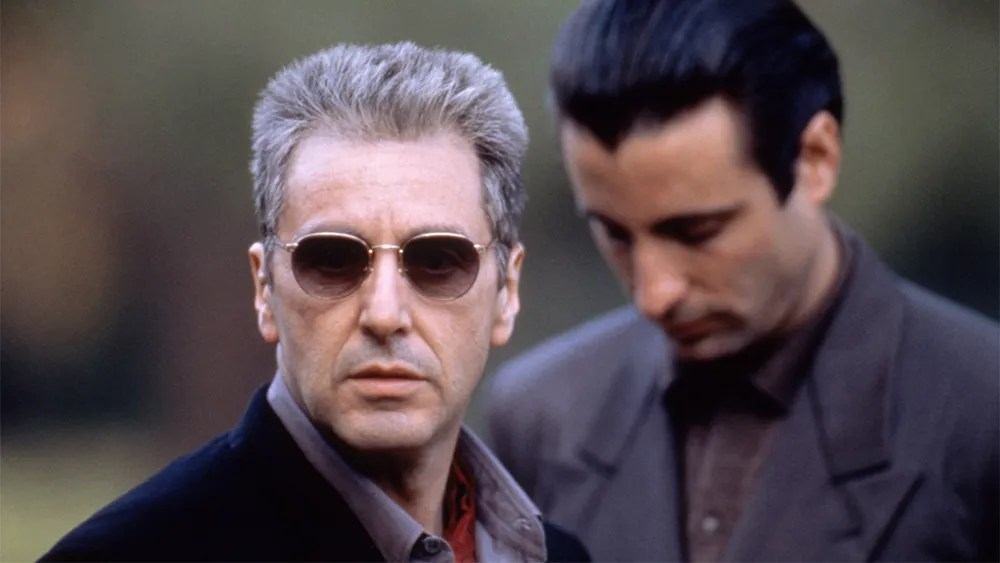
The rushed production further fatally holed this personal plot below the water-line. Duvall was originally intended to serve as the film’s ‘antagonist’, the film planned as a very personal battle between the last two ‘brothers’. Duvall’s departure ripped the heart out of this script, his role redistributed between George Hamilton’s anonymous lawyer, Talia Shire’s Connie (now turned inexplicable consigliere) and Eli Wallach’s treacherous Don Altobello. None of these make any real impact. Rushed production also meant Winona Ryder dropped out of the crucial role of Michael’s daughter, Coppola taking the (disastrous) last-minute decision to cast his daughter Sofia instead.
Sofia Coppola has suffered more than enough from lacerating reviews of her performance (the level of vitriol poured on her is shocking to read today). Let’s just say, while a great director, she is no actor. But then, neither really is Franc D’Ambrosio playing her brother. Both children never become either interesting or dynamic presences. Since their relationship – and the flowering of it – with Michael is crucial to the film’s emotional impact, it’s a fatal flaw. No matter how hard Pacino works, these scenes just don’t ring true. There is no sense of decades of anger and resentment. The drama seeps out of the family scenes and Mary becomes such a flat and two-dimensional character that her impact on the other principle characters never engages.
Sofia Coppola similarly struggles in her romantic scenes with Andy Garcia, again despite his best efforts. Garcia is the best thing in the film, full of cocksure confidence and instinctive cunning, channelling the best elements of Sonny and Michael into a character we’d dearly like to see more of. His facing down of two murderous home-invading hoods is the film’s most memorable moment while Garcia also does excellent work charting Vincent’s slow acceptance of the tragic sacrifices – the killing of parts of your nature – that being ‘the Godfather’ demands. Diane Keaton is also excellent as a far more seasoned and stronger Kay than we’ve seen before.

The Godfather Part III has several fine moments, even if it never coalesces into anything more than a decent film. Coppola restages with assurance and poise versions of previous scenes from the saga – a Little Italy festival assassination, Sicilian countryside violence, an assassin surreptitiously moving through a quiet building, Kay closing a door by choice, the montage of killings – mixed with large scale moments (a helicopter attack on a crime boss meeting is the film’s most ‘action moment’). He works really hard to channel a sense of melancholy: Michael is crippled with diabetes, plagued with guilt for his brother’s death, running to stand still and do the right thing. Pacino’s strongest moments are these moments of rawer emotion: his cloister confession to the future Pope is a masterclass in letting simmering pain suddenly rush to the surface.
But The Godfather Part III always feels like a perfunctory re-heat of key moments, not quite mixed successfully with a redemption (or lack of) tale. This film needed to be a more sombre, focused story about an army of chickens coming home to roost. It needed a stronger sense of Michael desperately scrambling to bring back together the family he was so desperate to protect that he destroyed it. Instead, it’s torn between recapturing old glories and being hampered by fudged attempts to provide emotional depth, linked to a poor structure, unfortunate casting choices and lack of focus. It’s not a bad film – but it is not a great one. And for the third in the greatest series of all time, that wasn’t good enough.


 Movie Musings