
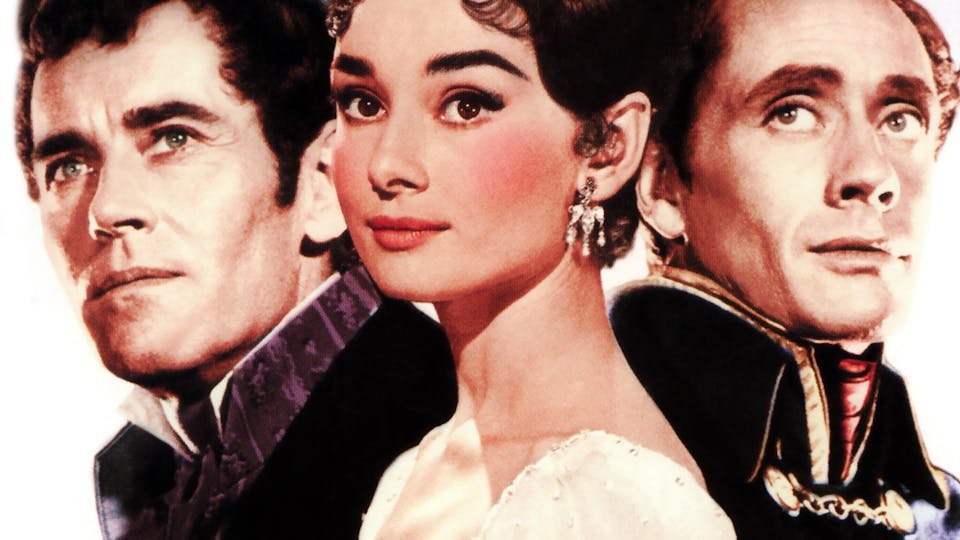
Tag: Anita Ekberg

War and Peace (1956)

War and Peace (1956)

Tolstoy is boiled down in this epic and luscious but soapy adaptation of the greatest novel ever

Director: King Vidor

Cast: Audrey Hepburn (Natasha Rostova), Henry Fonda (Pierre Bezukhov), Mel Ferrer (Andrei Bolkonsky), Vittorio Gassman (Anatole Kuragin), Herbert Lom (Napoleon Bonaparte), Oskar Homolka (Field Marshal Mikhail Kutuzov), John Mills (Platanov), Anita Ekberg (Hélène Kuragina), Helmut Dantine (Fedor Dolokhov), Tulio Carminati (Vasily Kuragin), Barry Jones (Mikhail Rostov), Milly Vitale (Lisa Bolkonskaya), Lea Seidl (Natalya Rostova), Anna Maria Ferrero (Mary Bolkonskaya), Wilfrid Lawson (Nikolai Bolkonsky), May Britt (Sonya Rostova), Jeremy Brett (Nicholas Rostov)
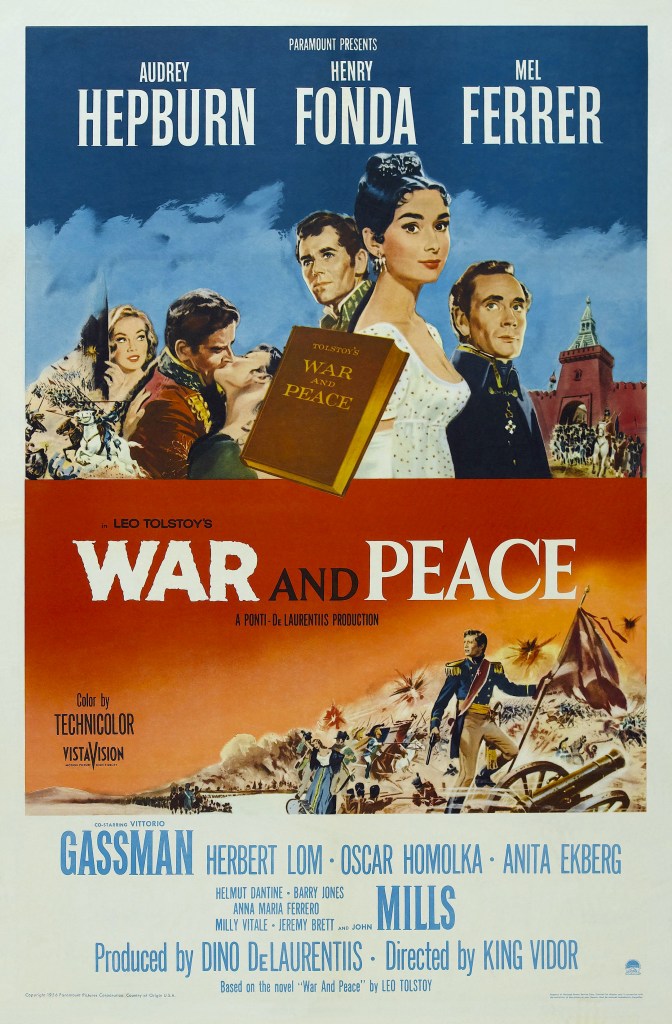
Let’s just say it right from the start: you can’t do Tolstoy’s War and Peace in three hours. All you can hope for is the little chunk of it you’ve bitten on is the most succulent part. King Vidor’s War and Peace zeroes in on the elements of the book Hollywood is most comfortably reproducing: a golden-tinged romance between Natasha and Pierre and the sweeping epic spectacle of Napoleon’s soldiers surging towards Moscow and limping home in the snow. While War and Peace, bravely, barely cuts a single major character or development, almost every other theme Tolstoy attempted gets shoved to the margins. This makes it both a SparkNotes version of the Greatest-Novel-Written, but also a very earnest attempt to do the impossible.

Tolstoy’s story stretched over seven years. The great Russian struggle against Napoleon is a backdrop to the lives of dilettante-turned-thinker Pierre Bezukhov (Henry Fonda), vivacious and impulsive Natasha Rostov (Audrey Hepburn) and stolid-but-thoughtful Andrei Bolkonsky (Mel Ferrer). Around them swirl other characters: Natasha’s warm-but-useless family, worthless womaniser Kuragin (Vittorio Gassman), his sister and Pierre’s faithless wife Hélène (Anita Ekberg), heartless roister Dolokhov (Helmut Dantine) and of course Napoleon (Herbert Lom) and his military antagonist, the pragmatic Kutuzov (Oscar Homoloka). Natasha falls in love with Andrei, betrays him then finds maturity caring for soldiers retreating from Napoleon, all while silently loved by Pierre.

This is compressed together into a film that certainly doesn’t feel like it is covering seven years despite its epic run-time. No one seems to age (just as well since everyone starts the film far too old) and the attempt to cover as much of the plot as possible means the film is moving forward so swiftly any sense of time is lost. It also means that the script frequently has to fill in the dots, communicating vital information that alters the lives of characters – major figures often die or are married off in short, easy-to-miss, sentences – and the ideas Tolstoy masterfully expounded about spirituality, destiny, fate, the quest for a life of meaning, are pretty much rinsed out in the plot focus.

War and Peace effectively reduces Tolstoy down into a sudsy romance against an epic backdrop. The romance is handled reasonably well, even if there is very little chemistry of any sort between any of the three protagnonists. Tolstoy’s rich leads, with the fascinating inner lives, are reduced to pen-portraits. There are odd moments where we have access to the inner thoughts and voices – sprinklings of voiceover dot around the picture – but they never feel real. Andrei has been robbed of the decency and warmth behind his thoughtfulness that attracts Natasha, while Pierre feels more like a second father or benevolent uncle than a soul mate.

This stripping down of Tolstoy’s complex characters to their bare principles fatally compromises all three lead performances. Hepburn comes off best, making a decent fist of Natasha Rostov. This is, after all, a character who embodies in her mix of passion, loyalty, fecklessness and self-sacrifice the very nature of Russia itself. No adaptation has ever managed to translate Tolstoy’s unplayable creation, but Hepburn has all the radiance and self-sacrificial guilt down pat. The film has to rush through her foiled elopement with Kuragin (Hepburn has more chemistry with Gassman than any of the others and their near elopement is artfully framed by Vidor with mirrors, reflections and a real illicit charge). Hepburn conveys the mesmeric impact this playboy has on Natasha and her selfish, tear-stained fury at the foiling of her disgraceful plans is laced with enough genuine guilt and pain by Hepburn to keep us caring. Hepburn skilfully translates this into a far wiser and more generous Natasha, placing others needs before her own.

By contrast, literally nobody reading the novel could picture Henry Fonda as Pierre (he’s the wrong age, shape, manner – there is nothing right about him at all), but Fonda does his best (as one reviewer at the time mentioned he’s one of the few actors who looks like he has read the book). He never convinces as the drunken playboy who gets into duels (he looks and sounds far too mature) and similarly doesn’t capture any of Pierre’s doubt and uncertainty (Fonda always looks like he knows exactly what he needs to do). It’s an intelligent reading for all that, but fundamentally miscast. Which is more than you can say about Mel Ferrer who turns Andrei into a stuff bore, ramrod straight and flatly monotone, an intellectual we never get interested in.

Honestly the film would have done better cutting more. Fonda is so unconvincing as the reckless young Pierre, they may as well have made him officially middle-aged to begin with. Similarly, Natasha’s brother Nicholas and his one-sided romance with cousin Sonya is given a mention so token its likely to confuse casual viewers. Andrei’s first marriage gets about five minutes and his sister Mary is reduced to a few dull scenes. Even John Mills’ thoughtful performance as Platanov strips out the characters worldview (and its profound impact on Pierre), turning it into one of simple, symbolic tragedy. It’s all the more noticeable when the film gets some stuff right, most notably Helmut Dantine’s bullying Dolokhov who war turns into someone with a sense of shame.

Faring much better are the historical characters. Like all War and Peace adaptations, this dials up the presence of Napoleon played with an excellent puffed-up grandeur by Herbert Lom, prowling with a swagger stick and collapsing into childish frustration, then silent tears as his plans for world domination collapse. Equally stand-out is Oscar Homoloka as scruffy realist Kutuzov.
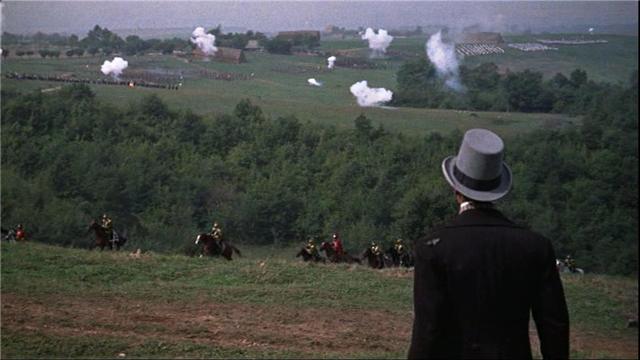
Vidor’s film may offer a simplified, romantic vision of the characters but he delivers on the scale. If you can bemoan the fact the peace leaves the characters neutered, the film completely nails the war.  War and Peace is a beautifully filmed by Jack Cardiff. From the sweeping vistas of the battlefield of Borodino, to the Dante-tinged flames at Moscow that cast orange light through the arches of a monastery where the Rostov’s take shelter, through the white-and-blue chill of the snow-covered retreat from Moscow, the film is an explosion of gorgeous colours. It’s also got the scale that old Hollywood loved. Borodino is restaged seemingly at 1:1 scale with a literal army of extras, soldiers and cavalry charging in their hundreds in long-shot and cannon fire peppering the land as far as the eye can see. Ballrooms are overflowing with extravagantly costumed extras and seemingly never-ending lines of Frenchmen march through the snow in the films closing moments.

It’s what this War and Peace is: a coffee-table accompaniment to the novel. You can look at the images it brings to life and the sweeping camera work Vidor uses to create nineteenth century Russia. But you’ll not understand anything that makes the novel great. In fact, to the uninitiated, you are likely to come away thinking the film must be a sort of high-brow Mills-and-Boon page-turner, a Gone with the Snow. What this tells us, more than anything, is that fifteen years on from the definitive Hollywood epic, Hollywood was still trying to remake it – and bringing Tolstoy to the screen was very much second to that.

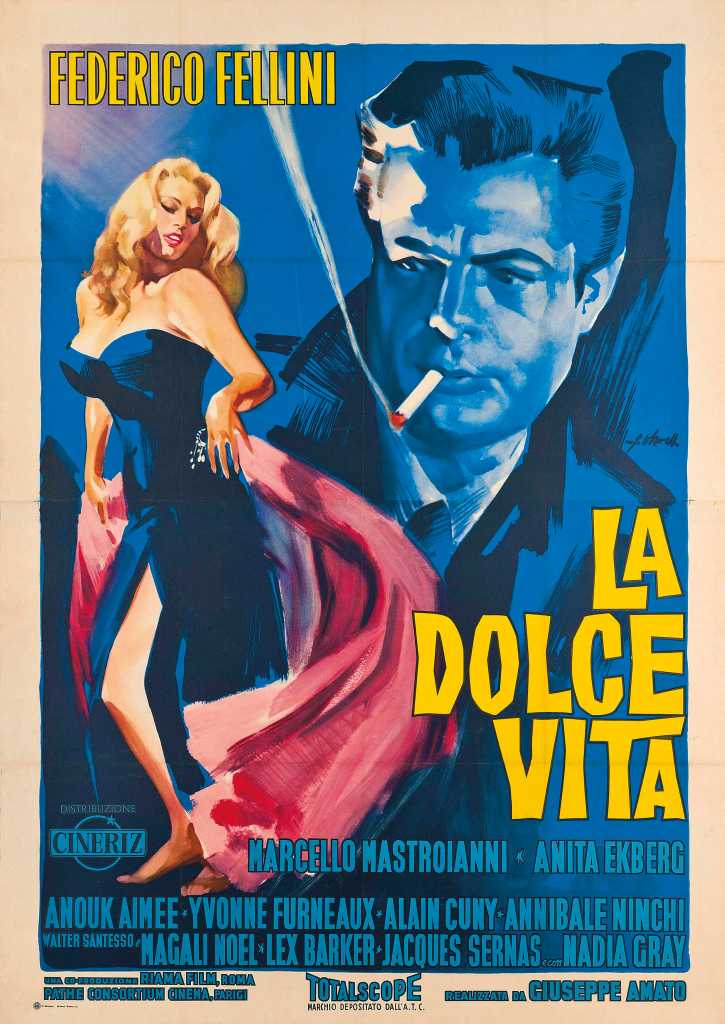
La Dolce Vita (1960)

La Dolce Vita (1960)

Ennui, emptiness and envy in Fellini’s coolly satirical portrait of a hedonistic Rome

Director: Federico Fellini

Cast: Marcello Mastroianni (Marcello Rubini), Anita Ekberg (Sylvia Rank), Anouk Aimée (Maddalena), Yvonne Furneaux (Emma), Walter Santesso (Paparazzo), Lex Barker (Robert), Magali Noël (as Fanny), Alain Cuny (Steiner), Nadia Gray (Nadia), Jacques Sernas (Divo), Laura Betti (Laura), Valeria Ciangottini (Paola)

It’s one of those films as much about everything as it is nothing. Fellini’s omnibus of interconnected shaggy-dog short stories follows Marcello (Marcello Mastroianni), a would-be novelist writing a gossip column, as he mixes with the great and the good in Rome. Casual affairs, Hollywood stars, nightclubs, drunken parties and would-be orgies – Rome is a whirligig of the shallow and meaningless, all wrapped up in a classic façade. La Dolce Vita was gloriously popular and hugely influential – it seemed to be casting a cynical eye over the 60s, even as they were kicking off – and remains possibly Fellini’s best-known and most popular film.

At its heart is Marcello. Gloriously played with a shallow suaveness smothering deep self-loathing by Mastroianni, Marcello has enough insight to understand the world he occupies is an empty and meaningless one – but not enough drive, discipline or determination to do anything about it. For all his dreams of becoming a novelist and artist, he’s all too easily seduced by the glamour and the hedonistic pleasures of Roman high society. When presented with choices, he invariably takes the easier one. He has enough soul to wish he had more of one.

Fellini lays out his journey through Roman night-life with a painterly skill – the frame is often full of fresco like images, taking in multiple characters at once, all preoccupied and busy with their own needs and wants. Fellini uses a superb mix of shifting POV shots to constantly place us in and then immediately out of Marcello’s shoes. Characters stare direct at the camera – are they looking at us or Marcello? Marcello arrives at Steiner’s house in a POV shot – but then Marcello walks into the shot and suddenly we are witnesses again. It’s a film where we are always reminded we are on the outside, like participants in a dream.

La Dolce Vita is long, but also spry. This is a city of people universally keeping ennui at bay, by a never-ending parade of parties and sex. While we might see and hear life-changing statements – declarations of love, resolutions to build a better life, the severing of personal relationships – these lead to nothing. Fundamental relationships and patterns of living remain unchanged across the (unspecified) period of time the film covers. Words come and go as easily as parties.

La Dolce Vita is constructed from seven short stories, each exploring a different aspect of Marcello’s empty, hedonistic existence. They cover: a sexual encounter with society heiress Maddalena (Anouk Aimée) in the water-logged flat of a prostitute; a night Marcelo spends trailing Hollywood star Sylvia (Anita Ekberg) across Rome; Marcello and other reporters reporting on a ‘miracle’ just outside Rome; a visit from Marcello’s estranged father; a party at an aristocrat’ faded palazzo with a failed encounter with Maddelena; finally a beach-house party where a jaded Marcello fails to initiate an orgy and collapses into something akin to a mini-breakdown, which he shrugs off. Intercut with this is Marcello’s friendship with Steiner (Alain Cury), the intellectual family-man Marcello aspires to be, who transpires to be as depressed and trapped as Marcello – with disastrous consequences.

These encounters are open to multiple interpretations: and part of the film’s strength is Fellini’s lightness in telling the story. Interpretation and significance isn’t forced upon the film: it’s long because it is stressing the repetition of its cycles. Each ‘short story’ is told with a pace and skill, frequently shifting in tone. Fellini will make you hoot with laughter or swoon with sensuality in one scene – and then shift uncomfortably in your chair the next.

Part of La Dolca Vita’s aim is to move Rome on from the tourist-centred attractiveness it had been given by a host of films from Roman Holiday on. It’s essentially marrying films like that with Rome Open City and Bicycle Thieves. It’s Fellini’s attempt to compare (and perhaps question) Rome’s classical cultural background with the hedonistic casualness of today’s world. It opens with a statue of Jesus being helicoptered across the outskirts of Rome towards St Peter’s. The statue is a glorious reminder of the power of Rome’s religious significance: but what follows it? A second helicopter, flown by Marcello and Paparazzo (his photographer), smirking and trying to pick up the numbers of the sun-bathing women waving up at them. New and old Rome intermixed, and not favourably.

The film is full of moments like this. The party at the aristocrat’s palazzo takes place in gorgeous grounds and rooms lined with busts of Roman emperors. At first it feels like a comparison between class and classlessness. But then you remember that ancient Rome was a hub of orgies and violence, and everything at this party would probably look pretty tame to the emperors watching.

The false miracle suggests affectations of Christianity are stage-managed and willingly performed at the dictates of the media. A priest may denounce the whole thing, but it doesn’t stop an army of people desperate to grab a piece of the action – from the media to ostentatious worshippers – descending on a small field, all of them willingly playing their expected parts. It only takes a downpour of rain to turn this devotional crowd into a panicked mass of people, blindly charging from shelter to shelter – with tragic results for one pilgrim. TV journalists stage-manage the crowd, give lines to members it and turn the whole place into a film-set.

As the film progresses, elements of classical Roman architecture slowly drift out, replaced by the harsher modernist buildings and blocks of flat (we’re subtly reminded, particularly with the arrival of Marcello’s father, mysteriously ‘absent’ for much of Marcello’s childhood, that a lot of these buildings were fascist in origin). Ironically the most famous sequence buries itself in classical architecture: Marcello’s night vainly following Sylvia (an alluringly playful Anita Ekberg, channelling Marilyn Monroe) in the hope of a sexual encounter (she remains wilfully oblivious of this). It culminates in Ekberg’s famous Trevi fountain dance – inspiring millions of would-be imitators.

Marcello’s life takes place in nightclubs and drunken parties, where social and sexual morals are modern and casual. Marcello’s most significant relationships are with Maddalena (Aimée is wonderfully archly cold), who toys with a profession of love only to instantly sleep with another man, and fiancée Emma (a clingy and desperate Yvonne Furnaux), who Marcello dutifully maintains a relationship with. Marcello wishes to see himself as a glamourous playboy, but he’s frequently on the backhand – picked up when wanted by Maddalena, played with by Anita and oppressed by Emma. We see him as often ignored and rejected as we do conquering.

Who Marcello really wants to be is the intellectual Steiner, who seems to have it all: fame, respect, and a loving family. It’s after meeting Steiner that we see Marcello doing the only novel writing in the film. Sitting in a beach café, he chats with a young waitress, Paola, who he compares to an angel in Umbrian paintings. Paola is also the last face we see in the film: waving to Marcello from a distance after his depressingly bitter failed orgy, as the guests gather around a leviathan washed up on a beach. She seems to be trying to ask him how the writing is going: he fails to understand and walks away. Paola feels like a moment of hope – a representative of a more fulfilled life of creativity and meaning – rejected by Marcello in favour of wallowing in pleasure. Fellini ends the film with Paola staring directly at the camera: is she making the offer of meaning to us instead?

It’s open to interpretation – as is the whole film. A big part of Fellini’s skill is not to hammer his points home, but let events speak for themselves, leaving the film open to interpretation. I see it as a sort of Dantesque parallel. Nearly every story is framed with characters moving up and down stairs – like the circular descent of Dante through Hell. Its structure seems to be broken into Cantos. And each step sees Marcello descend a little bit further – culminating in Mastroianni impotently ripping up pillows and spraying feathers over a laughing woman.

Is modern Rome hell? That might be a little bit too far. But it’s definitely a soulless purgatory. Paparazzo doesn’t care who he hurts to get the photo – a dead child or a grieving mother are all game. Marcello’s uses what talents he has for empty and cynical purposes and to seduce women. Everyone thinks only about their next hedonistic encounter. It’s a wonder that Fellini makes this as strangely enjoyable as it is: but then he is a master. And La Dolce Vita remains his most popular and most recognised work.