
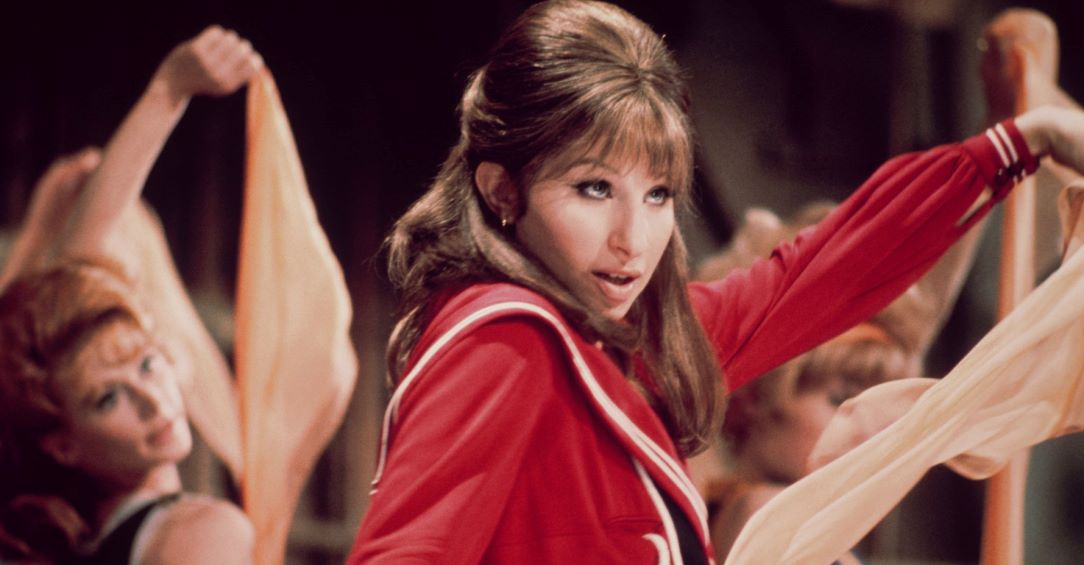
A star-turn is the main interest in this grand-scale but so-so musical
Director: William Wyler
Cast: Barbra Streisand (Fanny Brice), Omar Sharif (Nicky Arnstein), Kay Medford (Rose Brice), Anne Francis (Georgia James), Walter Pidgeon (Florenz Ziegfeld), Lee Allen (Eddie Ryan), Mae Questel (Mrs Strakosh), Gerald Mohr (Branca), Frank Faylen (Keeney)

Fanny Brice was the major pre-war star of Broadway, the leading lights of the Ziegfeld Follies, the sort of all-singing, all-dancing spectaculars they just don’t make any more. A fictionalised version of her life became a Broadway smash, produced by her son-in-law Ray Stark. Hollywood came knocking, leading to this film version. Shepherded to the screen by William Wyler (his first ever musical, a genre he’s avoided due to being deaf in one ear) it would tell of Brice’s early success, her relationship with Ziegfeld (Walter Pidgeon) and her marriage to dodgy gambler Nicky Arnstein (Omar Sharif). And to play Brice? It could only be the woman who created the role, a young sensation called Barbra Streisand.
Funny Girl begins, ends and is exclusively about Barbra Streisand. Making her film debut, Streisand is, not to put too fine a point on it, absolutely sensational. This is charismatic, star-making stuff from an actress who knew exactly how to tailor the part (already basically written for her) to her strengths. Streisand is funny, kooky, witty but also vulnerable, shy, preoccupied with her low-opinion on her looks. She totally convinces as a charismatic figure who can dominate the room with cheek, won’t think twice at bluffing she can roller-skate to land a role or pigeon-hole Zeigfeld and argue against being asked to do something in performance. But she equally easily embodies a vulnerable woman, worried she is an unlovable ugly duckling, so certain she is destined to be alone she zeroes in on the first man who shows interest in her.
That’s not even mentioning the magnetism of Streisand. A truly confident, unique performer you couldn’t imagine anyone else so brilliantly mixing power-ballad notes with this sort of quirky character comedy. She can belt out Don’t Rain on My Parade or I’m the Greatest Stars with an awe-inspiring voice. She can add layers of pathos and tragedy to songs like People and Funny Girl. But few other performers could be both a diva and a pratfall artist on roller-stakes or mix arch-wit with low-comedy by stuffing a pillow up her dress in performance to turn her bride character pregnant in His Love Makes Me Beautiful, the Ziegfeld number she desperately doesn’t want to perform (because she can’t see herself as a beautiful bride).
Streisand is so central to Funny Girl’s success that I’m not sure that so much as three minutes go by without her appearing. It’s not a surprise as, subtract her from the mix, and Funny Girl is a fairly bland, unoriginal and at times slightly flat musical that struggles to do or say anything interesting. It’s had millions poured into its elaborate sets, it’s grandiose costumes and its vintage, sepia-tinged photography. But it’s an overlong, overblown, poorly paced film blessed with a star turn.
Wyler’s main strength as a director on mega-budget spectaculars like this was his professionalism and control, the gifts a producer likes. Visually though, Funny Girl frequently looks lost in widescreen, sets shot in a way that magnifies their emptiness and lacking the sort of affinity for timing and musicality that something like Minnelli, Donen and Kelly made look so natural (Most of the larger musical numbers were worked on by Herbert Ross). There is the odd strong shot – a showy helicopter shot pans down to Fanny on a tug steaming past the Statue of Liberty during Don’t Rain on my Parade or a sunset that pops up between the faces of Sharif and Streisand during a dockside embrace. But too many shots favour getting the money on the screen or struggle to frame two people interestingly in widescreen.
Mind you the story is a bit of a struggle. Fanny’s ascent to success is fast-paced and untroubled by conflict. Every gamble she takes pays-off, every cheeky trick goes unpunished. She can’t roller-skate when hired to do so? She sabotages the closing number of Ziegfeld’s show with her pregnancy flourish? Doesn’t matter – everyone loves it. She teeters for a few minutes on being fired, then jumps to promotion and glory. Ziegfeld – the sort of elite, New England aristocratic role perfect for Walter Pidgeon – just sighs and acknowledges talent gonna talent.
There are a few more clashes in her personal life. Her marriage to Nicky is the core emotional plotline of the film, but Nicky’s rough edges (in real life he was a conman and a swindler) are shaved off. Instead, he is played as a charming rogue, a professional gambler who bamboozles Fanny’s manager into giving her a stonking payrise and plays with honour and grace at the card table. When his business dealings go south, it’s never really his fault and he’s so noble he works to save Fanny’s honour by taking the rap for a collapsed business and arguing she should divorce him forthwith.
It doesn’t help that Nicky is played by Omar Sharif. Sharif, while a striking screen presence, had an acting range pretty much restricted to playing Sherif Ali. He’s unable to give the role any depth or interest, he can’t sing (thankfully he only tries once) and he’s overly reliant on his expressive eyes. He’s no match for Streisand, with whom he has less chemistry than rumour suggests was the case.
Streisand though was one-in-a-million here. Rumours abound she was a difficult and demanding presence, who fought tooth-and-nail with Wyler. She requested endless retakes to get her performance just right and “contributed” to script cuts (Anne Francis, playing a blousy Ziegfeld singer, was furious that her role effectively ended on the cutting room floor). Her perfectionism made her a controversial figure in Hollywood – but it’s also the brilliant fine-tuning of her own skill that won her the Oscar she shared with Katherine Hepburn. On a side note, Streisand had been controversially invited to join the Academy before she made a film, meaning the vote I assume she cast for herself was the one that guaranteed her the Oscar.
Funny Girl is large, overlong, largely visually and narratively uninteresting film that has a bright, shining, tour-de-force superstar in the lead who is in absolute, total control of her talent. Without Streisand it would be a tedious turkey – with her, it’s a strange landmark.

 Movie Musings