Tag: Anne-Louise Lambert

The Draughtsman’s Contract (1982)

The Draughtsman’s Contract (1982)

Cryptic puzzles abound in Greenaway’s debut, a striking, oblique country house murder mystery (with bodily fluids)

Director: Peter Greenaway

Cast: Anthony Higgins (Robert Neville), Janet Suzman (Virginia Herbert), Anne-Louise Lambert (Sarah Talmann), Hugh Fraser (Mr Talmann), Neil Cunningham (Thomas Noyes), Dave Hill (Mr Herbert), Michael Feast (Living statue), David Meyer & Tony Meyer (Poulenc brothers), Nicholas Amer (Parkes), Susan Crowley (Mrs Pierpont), Lynda La Plante (Mrs Clement)

Peter Greenaway’s work often feels more like complex, intellectual art projects than films. They are dizzying, mystifying morasses of symbolism, veiled hints, numerical games, puzzles and oblique references, all wrapped up in a stunning visual originality that speaks volumes for Greenaway’s instincts as an artist. All of which means to say, don’t come to a Greenaway film expecting such comforting things as plot or characters. The Draughtsman’s Contract was his first ‘narrative’ feature film and is still (perhaps) the finest example of his complex, challenging (and often, let’s be honest, frustrating) style. Constantly keeping you in your toes, there are few films like it out there.

Its 1694 and famed draughtsman Mr Neville (Anthony Higgins) is approached by country lady Mrs Hebert (Janet Suzman) to create twelve drawings of her husband’s expansive house and gardens, while her husband is away in London. Neville is less than interested in the commission – until Mrs Herbert agrees to his unusual terms that he will have complete control over the house and access to her person at any time that he wishes to “take his pleasure”. Neville sets about his drawings with the detailed fanaticism of a man determined to capture reality exactly as it is: but strange items and objects keep appearing in his panoramas, dutifully reproduced in his drawings. Mrs Herbert’s daughter Mrs Talmann (Anne-Louise Lambert) inveigles Neville into her own ‘contract’ for ‘taking her pleasure’. Is there is something going on in this house that Neville is unaware of?

Greenaway described the film as, in part, an Agatha Christie style murder mystery, with the unloved, bullying husband Mr Herbert as the victim. But then, in true Greenaway style, he also stated any explanation of the identity of the killers, their motives or indeed anything that could explain the crime was unnecessary because the clues were all there and any half-way intelligent viewer could figure them out. In many ways it’s a huge pleasure to have a director who treats his audience with such respect. It’s also an indication, perhaps, that plot was also the thing he was least interested in.

The Draughtsman’s Contract is a fascinating, immersive, coldly intellectual but endlessly puzzling film. Visually it’s like an art-history banquet. Images inspired by a host of the greats (and some lesser knowns) abound. From the film’s opening with its Caravaggio candle-lit interiors to its Hogathian interior shots, it comments throughout on the differences in art between representation and imagination. Neville believes art to be defined by its ability to capture reality: the idea of creation and invention is almost anathema to him, his art a careful preserving of events. It’s why he controls the conditions he paints in so absolutely and why he powerlessly includes the random pieces of clothing (among other things) that appear in his tableaus.

What is happening here? It’s clear something is going on. What slowly becomes clear to us as well is, that for all his slightly repellent arrogant and confidence, Neville has no idea what it is, or even perhaps that anything is happening at all. For all his bragging of his magnificent eye and ability to immediately perceive the smallest change he pretty much misses everything of consequence in the film. He detects no real ulterior mystery here because he seems to lack the imagination to grasp one, so preoccupied is he with his arrogant enjoyment of his commission’s benefits.

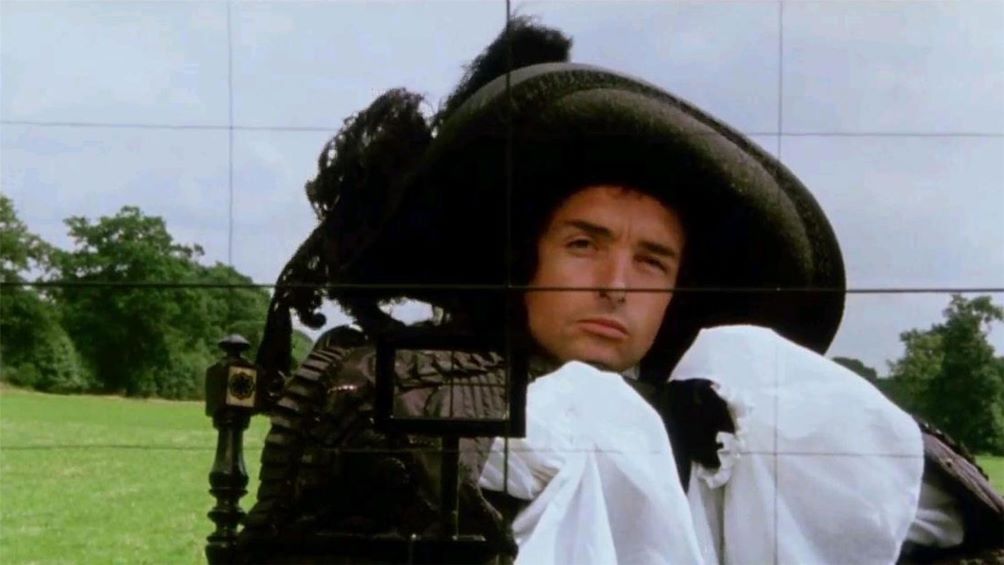
Greenaway presents Neville as the sort of pedestrian, camera-obsessed film-maker I imagine he scorns. Neville sets up his easels and perspective device (which even has a viewfinder) like a movie camera, obsessively fiddling with its set-up with never a thought for the deeper truth behind his striking images. Is this a comment on the lack of imagination in film-makers? Is Greenaway saying they are as bluntly obsessed with the beautiful cross-hatching of details stops them from creating something truly visually striking, or discovering the “spiritual truth” behind the details?
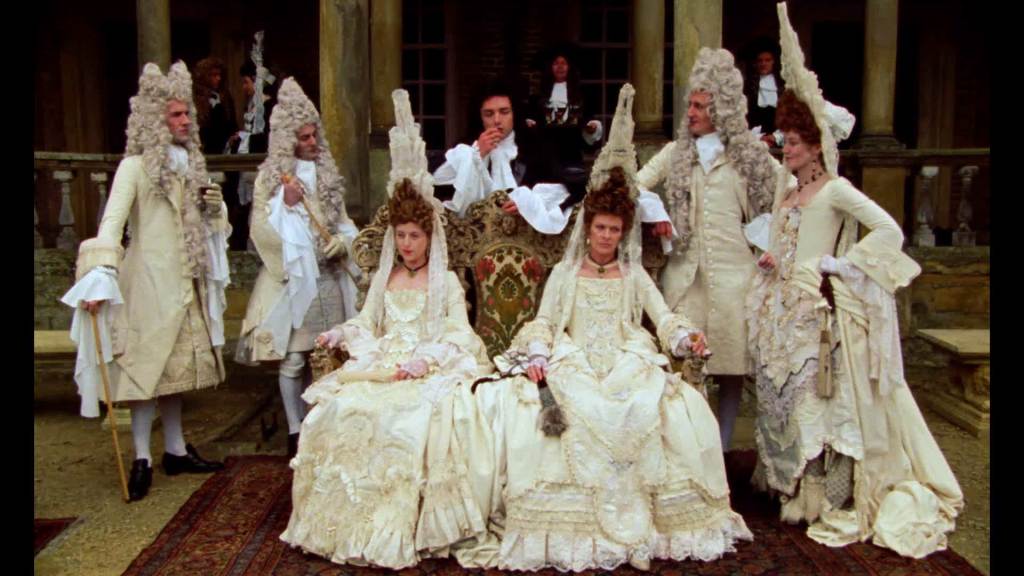
It’s that failure to pick up the spiritual truth that is Neville’s downfall. Slowly we realise the house’s owner is unlikely to return alive. The curiously artificial behaviour of everyone in the house, their sterile, detailed lives and obsessions with form, becomes overwhelming sinister. Neville however, charges about, aggressively pushing Mrs Herbert through sexual encounters (she even vomits after their first one – no Greenaway film is complete without every excretion the human body can produce), provoking her impotent son-in-law Mr Talmann (a vilely aristocratic Hugh Fraser) and endearing himself to no-one. It never occurs to him he might be being used.

Very few answers are spoken in the film. It’s left to us to figure out who might have committed the murder, and largely to surmise why two childless women allow Neville to take such liberties with them at a time of strict inheritance laws that denies rights to childless women. An elaborate trick is being played on Neville, dependent on his arrogant assumption that he is in charge. In fact, in his black clothes, loud voice and lack of over-elaborate hair and make-up, he is an out-of-his-depth outsider, even as he behaves with the rumbunctious confidence of a man at the top of the hierarchy.

Greenaway’s film is full of small curiosities that largely go unnoticed. Small details in the house are clearly out of period. A small boy sketches what looks like spaceships. Above all, the house’s grounds are populated by a nude living statue (played in a performance of physical dexterity by Michael Feast), painted grey, who seems to see and hear everything but is invisible to all. As to what this means, who can really say (Greenaway ain’t telling), although in true Greenaway style we get to watch him piss. Is it perhaps a comment on the increasingly obvious things Neville is missing? Or a sort of holy fool or Puck-figure, observing the mayhem with fascination?

This is a film that can get frustrating as its oblique conversations work overtime to obscure their meaning and intent. But it’s so marvellously, and intricately, assembled it just about gives you enough to fascinate to balance. The painterly shooting style – often with a static camera – is visually striking, as is the overblown grandeur of costume and design. Michael Nyman’s score – a remix of Purcell – is astoundingly good, subtle themes accompanying each action. The film descends into a bleakly terrible ending, that could sit comfortably in the worst kind of folk horror, as Neville discovers just how little he really saw while he was looking.

But it’s really an experience more than a film. Like a slice of recorded life carrying a deep allegorical message of mankind’s darkness in a way Greenaway, bless him, has the confidence we will get. There is a magnetic performance from Anthony Higgins, whose bombast and pride still somehow makes him just-about-sympathetic. An oblique commentary on art and life, The Draughtsman’s Contract offers no easy answers (or any answers at all really) but is full of images, moments and concept that will fascinate, appal and certainly stick with you long after it’s blackly nihilistic ending.

Picnic at Hanging Rock (1975)

Three girls go up a rock and are never seen again in Peter Weir’s masterpiece Picnic at Hanging Rock

Director: Peter Weir

Cast: Rachel Roberts (Mrs Appleyard), Anne-Louise Lambert (Miranda St Clair), Dominic Guard (Michael Fitzhubert), Helen Morse (Mlle de Poitiers), Margaret Nelson (Sara Waybourne), John Jarratt (Albert Crundall), Wyn Roberts (Sgt Bumpher), Karen Robson (Irma Leopold), Christine Schuler (Edith Horton), Jane Vallis (Marion Quade), Vivean Gray (Miss McGraw), Martin Vaughan (Ben Hussey), Kirsty Child (Miss Lumley), Jacki Weaver (Minnie)

Is there any film as haunting and elliptical as Picnic at Hanging Rock? An impenetrable puzzle shrouded in mystery and wrapped in an enigma, it’s the ultimate “mood” film, where everything you understand in the film has be teased out from its sidelines and the unspoken motivations. It’s not going to be for everyone: Peter Weir tells a story on the feature-length Blu-ray documentary (longer than the film) of the response of one US distributor when he saw the film: “[He] threw his coffee cup at the screen at the end of it because he had wasted two hours of his life – a mystery without a goddamn solution!” That’s a fair comment – but accept that this mesmeric film is somewhere between mystery, hynoptic trick and ghost story and you’ll find treasure in it.

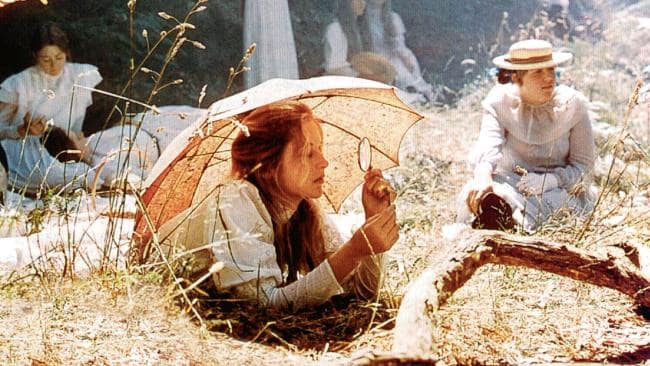
Based on Joan Livesey’s novel (which many believed to be true – a fate that also faced the film when it was released), on St Valentine’s Day 1900, a group of girls from a finishing school head to the Hanging Rock in Victoria for a picnic. Three of them (and one of their teachers) walk up to the rock and simply seem to disappear. The subsequent search by the authorities is baffling – and the impact on those left behind is brutal. 

There is barely any real plot in Picnic at Hanging Rock but it’s not a film about that. It’s all about the mood, the creeping sense of menace, and the general uneasy dream nature of the story. Everything follows a woozy dream-like logic – and the atmosphere is built upon by the use of panpipe music and skilful use of classical music. Weir’s film is a masterpiece of ghostly, unsettling spookiness with the rock itself as some unknown mystical source at its centre – the first shot of the film shows it slowly appearing in the mist, as if it has somehow been transported there from some fantasia land outside of the normal.

Weir’s film became the most influential film of Australian cinema, and its tone set many of the key thematic points followed by later films of what became known as the “Australian New Wave”. It explores uneasy balances in Australia between the wildness of the country – and indigenous people’s beliefs and culture – and the social structures from the British residents who had claimed the land. Picnic also explores the beginnings of a split between long-standing Australian residents and those clinging to the upper class Brit lifestyle of the motherland. Weir’s film – with its brilliant photography – lingers on the nature surrounding the rock. Not only the rock itself, with its odd formations and strange structure, but also the animals and the environment about it. There is something unknowable, wild and untamed about these surroundings – something mankind can’t control or understand.

Weir shoots the film with a lush impressionism – everything has a hazy unreality about it – and the dreamy nature of the film is built on with the dark hints of sexual feeling bubbling under the surface. The girls are all on the cusp of discovering their own sexuality – and there are plenty of open suggestions of same-sex crushes, of growing awareness of their sexual natures among the girls. It doesn’t stop with them either – the adults are equally drawn towards unspoken desires (left very much open to interpretation). Weir gets some perfect visual representations of the stonking repression forced on top of all these feelings, not least a wonderful shot which shows several of the girls standing in a line tightly doing up each other’s corsets.

And that perhaps, it’s hinted, is what happens on the rock when the girls disappear. Trance-like, they walk towards a gap in the rock and seem to disappear. What drew them there? Lead girl Marian (a perfect performance of ethereal other-worldliness from Anne-Louise Lambert) even seems dimly aware in the opening scenes that she is bring drawn towards something. The only girl who isn’t drawn towards the mystic is more repressed, dumpy Edith – whatever the force is that calls the other girls, it leaves her panicking and screaming. What’s going on? Something dark, sinister – and you can’t help but think sexual.

And what does that mean for those left behind? A mess. Rachel Roberts (a late casting replacement for Vivien Merchant, and famously awkward around the girls on set) is very good as the distant, draconian headmistress of Appleyard Academy (basically a sort of finishing school for posh girls). The regime she runs at the school is a mixture of oppressive and discriminate, with punishments handed out according to Mrs Appleyard’s personal feelings about the students rather than any reflection of their own behaviour. Part of the film’s story is the fracturing of her own personality that happens as response to the disappearance – her collapse slowly into a sort of paranoid insanity, powered by drink. What dark secrets is she hiding? (The film hints that she has more knowledge than she should have of at least some of the darker events of the story, but never reveals how much or indeed why.) 

But then the whole cast are dealing with problems they scarcely seem to understand. There is a curious – perhaps homosexual bond – between Dominic Guard’s repressed English teen and John Jarrott’s earthy, ultra-Aussie outbacker (a very good performance from Jarrott in a character that could easily have fallen into stereotype). Perhaps that’s why Guard’s character is drawn constantly back to the rock – and also why he too seems to have such an overwhelmed reaction to it.

The sole character in the film who feels most capable of expressing their emotions is the school’s French teacher Mlle de Poitiers. Played exquisitely by Helen Morse – she gives the warmest, most engaging performance in the film – she is the only character who seems able to get in touch with her emotions, unfiltered by too much repression. Perhaps it is no coincidence that as a “double foreigner” (French among the Brits in Australia) she is less affected by the rules around her. Either way, she becomes a perfect audience surrogate, as slowly horrified and confused by the actions she sees around her in the college as the viewer is. Morse is fabulous in these scenes, from a burst of emotion when reunited with a character she thought lost, to quietly watching Mrs Appleyard’s disintegration late in the film.

But the real star is Weir’s masterful direction of the mood of this film. Like that distributor said, there isn’t any plot as such – vital events happen off screen, and there is the distinct feeling that you are only being told half the story – but despite that, the film is compelling. So much is conveyed in the mood, the tensions, the style of the film that you are invited to bring your own interpretation to events. That makes it a continually rewarding piece of cinema – it invites you to make your own answers. 

This juggling of atmosphere to make something so enigmatic is so crucial to the film’s success that the recent mini-series remake effectively continued the trick (with a few extra insights into Mrs Appleyard), and contained arguably even fewer answers over its 5 hours than this did in 2. But Weir’s brilliantly made, beautifully shot, eerily unforgettable film rightly takes its place as (perhaps) the greatest Australian film ever made: it’s a film that is about Australia, and about the tensions, confusions and mysteries of that country. Brilliant.