Tag: Antoine Fuqua

Training Day (2001)

Training Day (2001)

Pulsating corrupt-cop drama, highly entertaining with a full-throttle Denzel Washington

Director: Antoine Fuqua

Cast: Denzel Washington (Detective Alonzo Harris), Ethan Hawke (Officer Jake Hoyt), Scott Glenn (Roger), Tom Berenger (Stan Gursky LAPD), Harris Yulin (Doug Rosselli LAPD), Raymond J Barry (Lou Jacobs LAPD), Cliff Curtis (Smiley), Dr Dre (Officer Paul), Snoop Dogg (Blue), Macy Gray (Sandman’s wife), Charlotte Ayanna (Lisa), Eva Mendes (Sara)

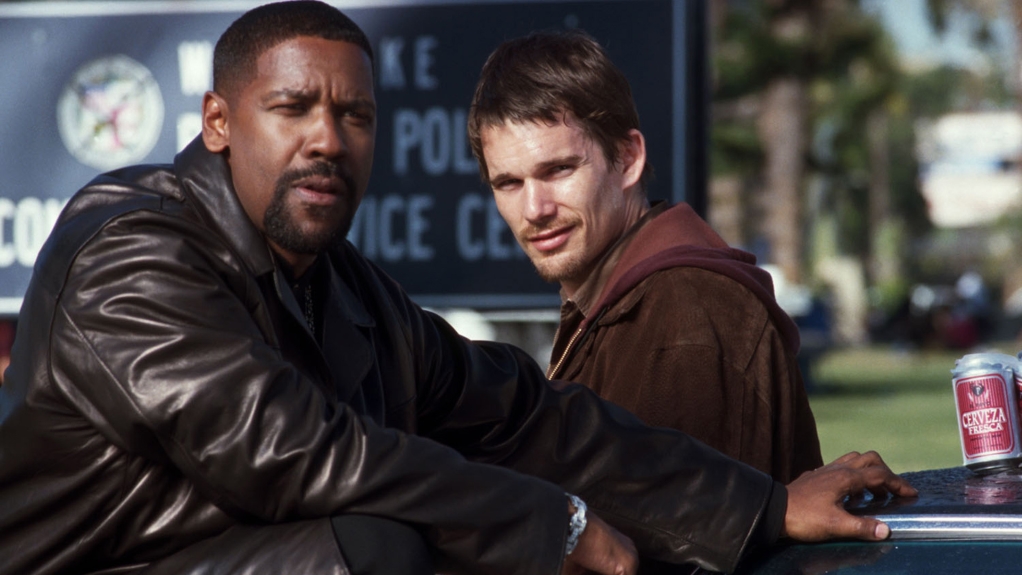
“King Kong ain’t got nothing on me!” That’s the mantra of larger-than-life legendary cop Alonzo Harris (Denzel Washington), who has immersed himself so much in the dirty neighbourhood gangland of LA that it’s hard to see where cop ends and crook begins. Alonso claims to believe to keep the town clean, you gotta break a few rules. But then he also believes in filling his own pockets with stolen money. It’s all going to come to a head in one day: first day on the job for ambitious boy-scout officer Jake Hoyt (Ethan Hawke) who thinks he’s auditioning to join an elite squad only to find he’s the victim of a series of elaborate mind-games and dodgy moves by Alonzo, testing to see whether he is potential asset or sacrificial pawn. It’s going to be a long day.

Training Day is basically a massive dance with the devil, offering his little Faustus all the wonders of the world in return for his soul. It’s all there for Hoyt’s taking: respect, glory, standing – and of course oodles of plastic-wrapped dollar bills. All he has to do is sacrifice every inch of his integrity and personal morality to Alonzo Harris, a grandstanding Mephistopheles. This first day is all about Harris pushing Hoyt to see how far he will go. Will he smoke a little dope so he could pass as an undercover druggie? Will he search a house under a false warrant? Will he rough up a suspect? Will he murder a drugdealer and steal his cash?

Throughout all this, Denzel Washington barnstorms to fantastic Oscar-winning effect. This is a delightfully Devilish performance, Washington leaving it all out on the pitch. Alonzo Harris has inhabited the persona of the gangsters he follows for so long he’s basically become one. Harris is scarily charismatic, the unshakeable confident cool he uses to cow and terrify criminals and punks on the street, also making him a hugely attractive figure. This is despite his complete amorality, his ruthless capacity for violence and his shocking willingness to abuse and use almost everyone around him. He does all this by convincing Hoyt for long stretches that his poor treatment, abuse and deception of him is all in Hoyt’s own interest: to toughen up this naïve puppy into a killer.

Hoyt spends half the time if this is some elaborate show-and-test. Who can blame him? Washington’s exuberance plays masterfully on the edges of someone putting on a massive performance. There are neat moment where we see how fragile some of Harris’ control is, once he is outside of his comfort zone: he’s in hoc for millions to Russian gangsters and as events of the day pile up his thermonuclear self-confidence tips into moments of impotent fury. Washington is fantastic as this street monster, whose seductive lines on modern policing (do a little bad to do a greater good) start off sounding like common sense before you realise they tip quickly into justifying open criminality. It’s a performance of perfect physical swagger matched with his limitless charisma, inverting the qualities that made him a perfect Steve Biko or Malcolm X into a Lectorish monster.

Ethan Hawke is also extremely good as his polar opposite, the eager to please rookie who realises there is a lot more going on here than he thought. Training Day suggests there may well be a middle ground between Hoyt’s straight-as-an-arrow idea of policing and Harris’ corruption – and it’s part of Harris’ appeal that his perverted mentoring ends up making Hoyt a tougher, more unrelenting (better?) cop than he was before. But also, Hawke is great at showing that Hoyt (under his sheen of moral uprightness) is also a tough, hardened professional. In classic story-telling style, Harris is a dark reflection of Hoyt: they share a stubbornness, a conviction that they are right, a refusal to be intimidated (Hoyt may nervously try to please Harris at first, but once he realises the score he refuses to be forced into doing anything he doesn’t want to do) and a capacity for throwing themselves into decisive action. There is a reason why this rookie can get the drop on Harris – much to his wicked mentor’s delight and admiration – in a way no one else can.

That alone shows the dark magnetism of people like Harris: like Hoyt we end up wanting their approval even when we hate or fear them. Even as he holds a shotgun to his head, there is a part of Hoyt you suspect is proud that Harris’ gut reaction is to shout an impressed “My man!”. Of course Harris knows his validation is important to people. Monsters like this know the weaker-willed crave their respect. But then Harris also knows no one else in his team – all of them weak-willed bullies, desperately trying to imitate them – have even a quarter of the independence of mind Hoyt has.

What Harris under-estimates is Hoyt’s survival instinct. The final third of the film, the clash that has been building inevitably between these two, again demonstrates both their similarities and their fundamental differences. The main difference between them being Hoyt cares for, and protects others, and Harris cares only about himself. Hoyt’s humanitarianism will save him from dangerous situations and even Harris’ girlfriend (a tough-but-cowed performance from Eva Mendes) recognises Hoyt has shown more concern for her son in a few minutes than his father, Harris, ever has in his whole life.

The final act of Training Day hinges a little too much on one whopper of a coincidence: the sort of narrative contrivance so colossal that, in a less magnetic film, you’d be throwing stuff at the TV shouting “oh come on!” It’s final, inevitable, confrontation between Harris and Hoyt feels rather too much like many, many other films before it in every single beat, while the ending has a whiff of Hays Code morality (all wrongs righted!) about it that rather undermines the edgy, unpredictable film it precedes.

But when Training Day focuses on the sound and the fury of Washington and the Faustian dance on the deep grey lines of street policing, this is a sensational, energetic and highly watchable cop thriller, pulsatingly directed by Antonie Fuqua. With Washington superb and Hawke easy to overlook as his straight-laced partner, it’s a character study that constantly shifts our expectations and leaves us genuinely worried about the fate of its hero. The sort of slick entertainment Hollywood does at its best.

King Arthur (2004)


Clive Owen leads his merry men in clumsy would-be Arthurian epic King Arthur

Director: Antoine Fuqua

Cast: Clive Owen (Arthur), Ioan Gruffudd (Lancelot), Keira Knightley (Guinevere), Stellan Skarsgård (Cerdric), Ray Winstone (Bors), Mads Mikkelsen (Tristan), Joel Edgerton (Gawain), Hugh Dancy (Galahad), Ray Stevenson (Dagonet), Stephen Dillane (Merlin), Til Schweiger (Cyrnic)

The story of King Arthur has entertained generations for so long, it’s actually a bit of a surprise that there hasn’t been a great movie made about it. Sure there have been entertaining guilty pleasures (like my love for the bobbins Excalibur) but there hasn’t been a great action adventure made about the legendary king. And this Jerry Bruckheimer actioner sure ain’t it. But it re-enforces my seemingly never-ending appetite for distinctly poor, big-budget, epic films.

Arthur (Clive Owen) is a half-Celtic Roman cavalry officer who commands a Sarmatian cavalry unit, serving a fixed term of service with Rome. They help to guard Hadrian’s Wall against rebel native Britons. Before their discharge, the knights are given one last job: go behind enemy lines to rescue a prominent Roman citizen living beyond the wall. Once they arrive, they find he has enslaved the local Brits – including imprisoning a young woman named Guinevere (Keira Knightley). Knowing a Saxon invasion force lead by the fearsome Cerdric (Stellan Skarsgård) is ravaging Britain – and that the Romans are withdrawing from the empire – Arthur decides to lead the whole group back to the wall and safety.

King Arthur isn’t a terrible film, just a totally mediocre one. It’s an uninspired coupling together of half-a-dozen other better movie: from its Dirty Dozen line-up, through its Gladiator style score (Hans Zimmer rips himself off again), to its remix of a thousand period sword epics from Spartacus on, mixed with its Braveheart style design and battle scenes. It’s almost completely unoriginal from start to finish. There is no inspiration here at all – it’s made by people who have seen other films and based everything on that rather than wanting to make a film themselves.

It even wraps itself up with an unseemly haste, as if all involved knew they hadn’t nailed it so decided the best thing to was to knock the whole thing on the head and call it a bad job.

The film probably stumbles from the start with its claim to present a sort of “true historical story” of King Arthur. Now I’m not one to get hung up on historical accuracy too much – except when it’s making extravagant claims which are just not true – but the “true story” here is bobbins. Nothing really feels right – from the Roman politics to the idea of a group of loaded Roman settlers setting up a huge estate deep into Scotland (I mean what the fuck was Hadrian’s Wall for eh?). The knights bear very little resemblance indeed to their legendary counterpoints. In fact it’s almost as if they had a script about a brave band of Roman soldiers and just stuck the name King Arthur on it for the name recognition (perish the thought!).

The idea of a group of seasoned, grizzled warriors isn’t a bad one – and it works rather well here because most of the actors in these roles are pretty good (particularly Mads Mikkelsen as a sort of Samurai Tristan). It makes for some interesting dynamics and always some fine character work – the best arc going to Ray Stevenson’s Dagonet as a knight who finds something to fight for. It also contrasts rather well with Stellan Skarsgard’s world-weary villain, who’s seen it all and finds it hard to get excited about ravaging and pillaging anymore.

But it’s a shame that this promising set-up gets wasted. After a good start, when we get to see all our heroes’ personalities reflected in their fighting styles as they repel an attack on a bishop, these dynamics quickly settle down into the usual tropes: you’ve got the joker, the cocky one, the reluctant one who’s only out for himself… Fortunately the Director’s Cut (which I watched) deletes the worst of Ray Winstone’s comic “banter”, but it’s still pretty standard stuff.

The mission behind the wall then pretty much follows the pattern you would expect: the guy they go to rescue is an unsympathetic bastard, they find themselves protecting the weak, it’s a dangerous journey back to safety, blah-blah-blah. Although a battle on the ice has some genuine excitement to it, there isn’t anything new here at all. Everyone just feels like they are going through the motions. 

When the battles kick off in earnest, they are pretty well mounted – even if they are hugely reminiscent of the opening battle of Gladiator and the low-camera, immersive battles of Braveheart. Sure there is a smoky immediacy about them, like a sword wielding Saving Private Ryan, but it’s still pretty much what you would expect. The action pans out with no real surprises – our heroes and villains even match up for the expected clashes.

Clive Owen is a fine actor, but he is manifestly wrong for the role of a classical hero and the awe-inspiring battlefield heroics he is called to carry out here. He’s too modern an actor, with too much of the world-weary smoothness to him, for him to really convince as this hardened medieval warrior. Owen’s delivery and style is so restrained he can’t bring the bombast or elemental force the part requires. Allegedly he was cast because Bruckheimer believed he would be the next James Bond – the actor they turned down for Arthur? Daniel Craig… 

Nope. Sorry.

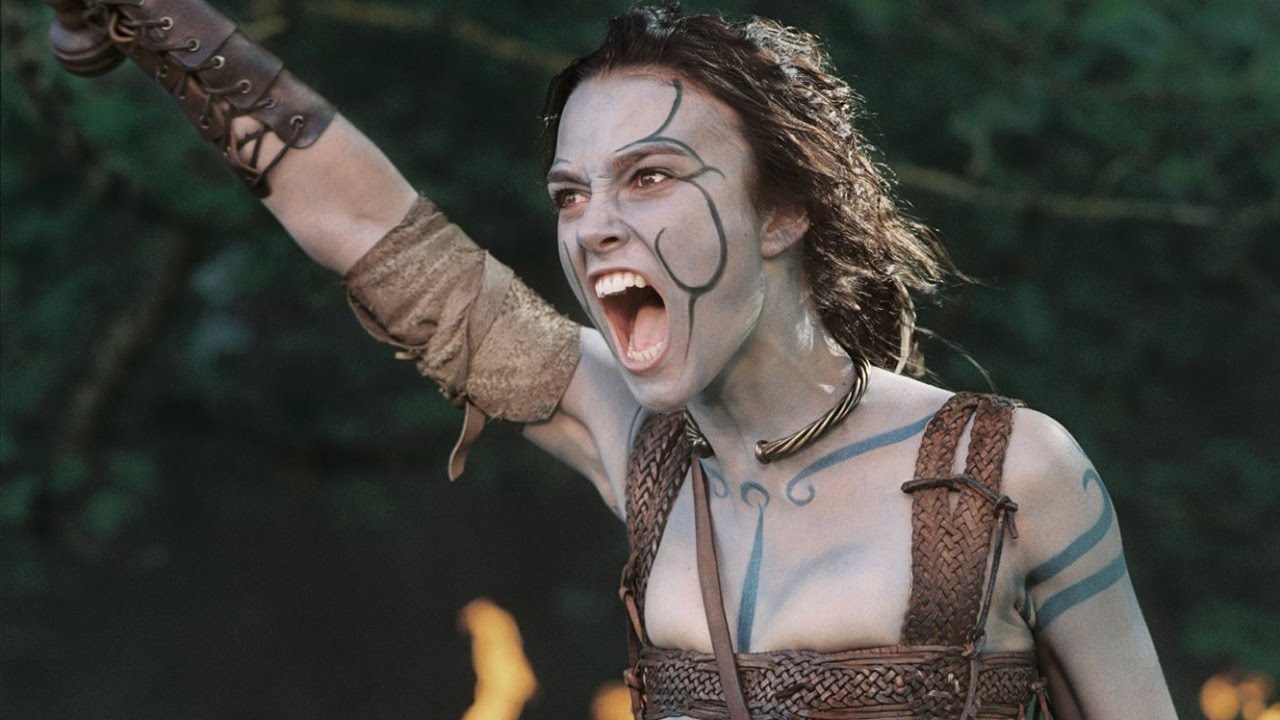
Similarly Kiera Knightley is just as miscast. Let’s put aside the fact that she is half Owen’s age. There is a prep school headgirlishness to her that just doesn’t work when we are asked to buy her as woad-covered warrior princess. She’s too strait-laced, too polite, too sophisticated. When she does step into the full-on Boudicca look, you’ll giggle rather than tremble. For all her exertion, she’s not convincing in the role either.

But then that’s King Arthur all over: trying hard but not convincing, with such a tenuous link back to the original myth that the fact they are just using the Arthur name to flog some more tickets is all the more obvious. Major elements of the legend are missing – in particular the Arthur-Lancelot-Guinevere love triangle is cut down to the merest of suggestions, enough for it to be noticed but not enough for it to feel like a real plot – and other elements (Merlin, the Sword in the Stone, the Round Table) seem shoe-horned in for no real effect. It’s basically just a bombastic B-movie, a sort of Gladiator rip-off without the poetry. Moments of fun, but still not that good.

The Magnificent Seven (2016)


Denzel Washington leads his gang of seven wildly different souls to do battle for the little guy

Director: Antoine Fuqua

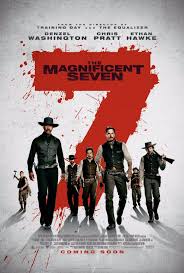
Cast: Denzel Washington (Sam Chisolm), Chris Pratt (Joshua Faraday), Ethan Hawke (Goodnight Robicheaux), Vincent D’Onofrio (Jack Horne), Byung-hun Lee (Billy Rocks), Manuel Garcia-Rulfo (Vasquez), Martin Sensmeier (Red Harvest), Haley Bennett (Emma Cullen), Peter Sarsgaard (Bartholomew Bogue), Luke Grimes (Teddy Q)

The Magnificent Seven is a much loved staple of BBC bank holiday weekend screenings. The original wasn’t a brilliant piece of film-making art, but it was a brilliant piece of film-making entertainment, and it had simple, wry, heartfelt (if sometimes on-the-nose) observations to make about the sacrifices the life of a gunslinger calls for. How does the remake measure up?

In 1879, the village of Rose Creek is besieged by would-be industrialist Bartholomew Brogue (Peter Sarsgaard), who orders the villagers to leave as he plans to expand the local mine. Newly widowed Emma Cullen (Haley Bennett) sets out to recruit gunslingers to help protect the town. Warrant Officer Sam Chisolm (Denzel Washington) is her first recruit, and he helps her to gather six others from drunken cardsharp Joshua Faraday (Chris Pratt) to legendary sharpshooter Goodnight Robicheaux (Ethan Hawke). But the battle to protect the village will lead to many good men six feet under before our heroes can have the chance to prevail…

One thing’s for sure. In 60 years’ time they won’t be playing this film every bank holiday weekend. That doesn’t mean this is a bad film, it’s just quite an average one. It’s decently done, has several good scenes and even one or two witty lines in among a fairly routine script, but there is very little imagination or inspiration behind this. It’s got a decent cast of actors, but you always feel they are lifting average material rather than working with the good stuff. While the original film combined a sense of boyhood heroics and some iconic performances with some exploration of the emptiness of the life of a gunslinger and the attraction of a normal life, this film manages to deliver much less on all these counts.

So first the good parts. Much of the gun-toting action is very well done. The first shootout as our heroes arrive in the town is terrific (see link below), full of thrilling beats and rewindable moments. To be honest, it’s the best moment of the film, and as close as it comes to capturing the excitement of old-school gunslinging action. The final battle scene is decent, but offers generally more of the same with additional (no spoilers to say) sacrifice. Even without the inspirations of the original film, many of the character beats will be familiar to the watching audience. I successfully predicted which of the cowboys would survive early in the film, and only one death is near to a surprise. It’s well done, but it’s not got the filmmaking expertise of Kevin Costner’s Open Range, with its final small-band-against-an-army structure, nor that film’s intelligent and low-key analysis of the cost of violence.

It’s that lack of human insight that I think is one of the film’s principal weaknesses. The original had more to say about the damage a life of violence can inflict on people, and the longing even the most hardened man of the world can find for  the simple life – as well as the lengths they will go to in order to protect it. This film offers none of that. The motivations for the seven in joining are incredibly thin, almost after-thoughts. At least two members of the team simply turn-up, as if dropped from the sky. Team leader Chris has a “very personal” motivation, signposted from the very start, that serves to undermine much of the depths we seem to learn about his character during the film – as well as making him just another “man looking for revenge” architype.

On top of that, a serious trick is missed when setting this film near the end of the Western era. Already the time of these lawless gunslingers is coming to an end, and they have no place in the modern world. The villain is a sort of corporate bully, launching a hostile take-over of the village for his mining company. There is plenty of thematic material to mine here of these men taking a stand not only against the strong persecuting the weak, but also against the onrush of time that is leaving them behind. Now I’m not expecting the film to be a serious socio-economic discussion, but I’d like to watch a film that at least tips the hat to ideas like this (or any ideas at all) rather than just push through a well-filmed but-by-the-numbers remake.

Saying all this, it is pretty entertaining in an unchallenging way. It does make you want to go back and re-watch the original version (which was itself, to be fair, little more than a crowd pleaser). But that’s kind of all it is – and it doesn’t have any ambition to be more. But it’s a good watch and some of the updating ideas work very well. The multiracial composition of the seven works very well, and Haley Bennett as the “Eighth” member of the team, is a strongly written role that feels like a character rather than an accessory. Washington can do this role standing on his head, but brings his customary authority. Chris Pratt is at his Harrison Fordish charming best, particularly on the edge of bursting out into a childish grin, in gleeful excitement at being paid to play cowboys. Hawke is saddled with the thematic content as a gunslinger with PTSD, but makes a good fist of it. Much of the rest of the gang are a collection of moments rather than characters, but do their jobs well.

The Magnificent Seven, it seems too easy to say, isn’t magnificent. It’s an unambitious film without any real thinking or imagination in its conception. It seems scared of introducing anything too conceptual or thought-provoking in its setting or plot. It’s just about entertaining enough to survive while you are watching it, but its life is going to be little longer than the two hours you watch it, not the 60 years of its predecessor.

The Equalizer (2014)

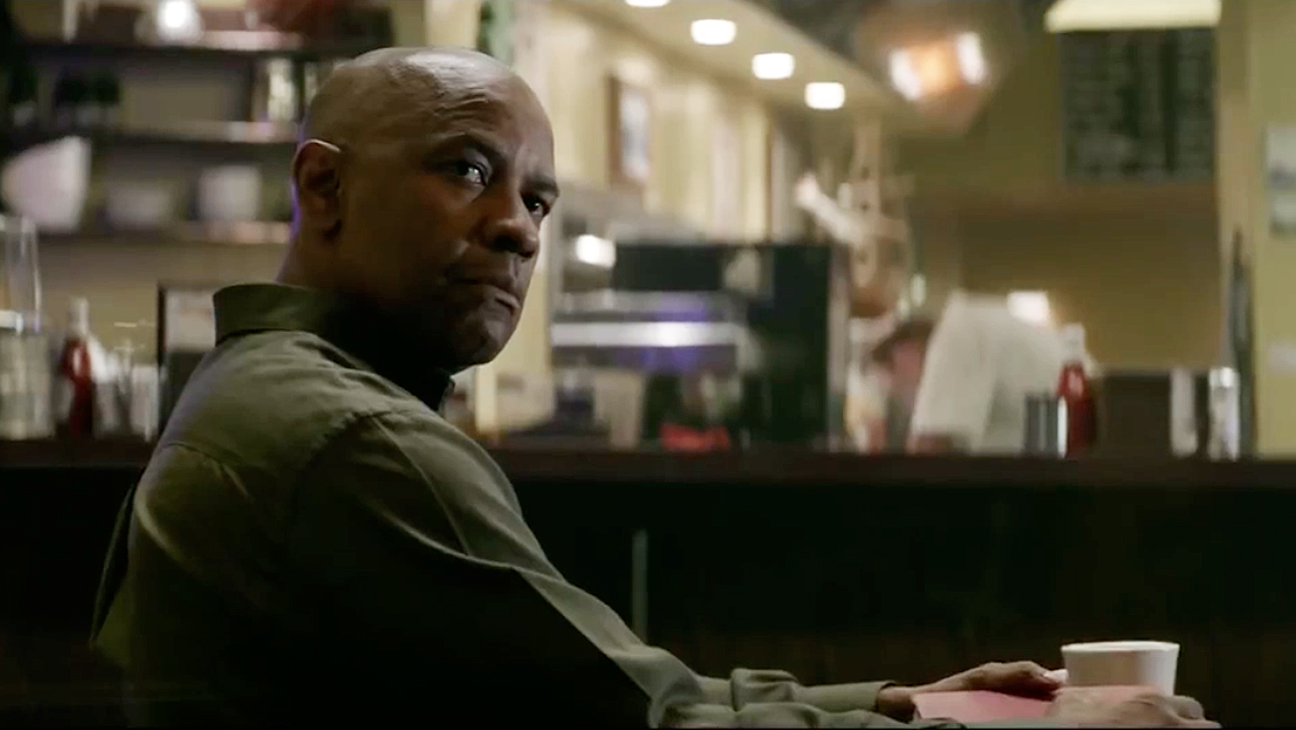
Denzel rests up. In about five seconds of screen time that scolding hot coffee will probably be in someone’s face.

Director: Antoine Fuqua
Cast: Denzel Washington (Robert McCall), Marton Csokas (Nicolai Itchenko) , Chloe Grace Moretz (Alina/Teri), Melissa Leo (Susan Plummer), Bill Pullman (Brian Plummer), David Harbour (Frank Masters), Johnny Skourtis (Ralph)

In the 1980s Edward Woodward had a sudden massive success in the States starring as Robert McCall, akaThe Equalizer, a former agent of a Government Agency, making atonement for past misdeeds by offering his skills free-of-charge to help the innocent and falsely accused. It ran for four seasons and then largely faded from memory. As such, it seems a strange choice for Denzel Washington to bring back to life – until you remember that Washington has a fondness for appearing in trashy action films. Kinda like I have a fondness for watching them.

Because I’ll be honest, this film is more or less exactly what you would expect from a film whose poster is the star male actor holding a gun (and, after watching this on Netflix and seeing my recommendations I am now aware how many films out there have posters of late middle age actors holding guns. Liam Neeson has a lot to answer for. Half of Hollywood’s middle aged men should be paying him some sort of commission.)

Here McCall is reimagined as a quietly retired man, works at a hardware store, is beloved by his colleagues and in mourning for his wife, who of course he promised he would leave his old life behind. There are hints that he has a certain level of OCD, and meticulously times every action he carries out. Concerned at the poor treatment handed out to a teenage prostitute by her Russian Mafia pimp, he attempts to intervene politely but firmly – but of course a blood bath of slaughtered goons ensues, and before we know it the whole Russian mafia is trying to work out who our hero is and what he wants.

It’s a pretty familiar set-up and the film wastes no time in letting us understand it before hurling us into events that will shatter any peace its lead character has. After all we all know that this zen peace isn’t going to last and that Washington will soon be dishing out pain and taking names like nobody’s business. What the film does do quite well though is sketch out the everyday folk in the film so well (with only brief moments on screen of things like baseball games) that you actually do care for them, and you actually do understand why McCall finds this life so enjoyably unstressful.

The violence when it comes is very effectively filmed. It has a great “Bourne-ish” quality to it, as McCall uses a series of everyday items with lethal effect. The final sequence takes place in the very hardware store McCall works at, and there is some imaginative use of the various products contained therein. Similarly, throughout the film McCall uses various hardware items for purposes other than those intended by the manufacturer, and niftily cleans the items to return them for sale (a great way of junking the evidence).

My one issue with the violence in this film is that I felt, at times, it was a little too graphic, a little too delighting in its mayhem. It largely gets away with this as it establishes that the victims of the violence throughout the film are mobsters and killers. The film is also slightly too long – the momentum dries up in places – and the script or direction fails to deliver a single key ‘moment’ to make this stand out from the crowd of films in this genre. It’s entertaining and good fun for fans of the genre, but it never really seems completely original, instead an effective remix of things from other movies.

Denzel Washington is of course the film’s MVP, and he tackles the part extremely well, adding a great deal of depth to McCall’s shame at his past, his discomfort with violence and his need to carefully organise his life into time managed compartments. He has the quiet, cool confidence that the part needs and suitably manages to look normal enough that you can believe he would fade into the background. Of course he could do the part standing on his head, but he still gives it a lot of interest. Marton Csorkas also does a good job as his nemesis, though the part is paper thin.

The ending feels rather tacked on and designed as sequel bait – but there are far worse films out there that will get sequels. Decent fun, nothing special, an effective remix of other films.