Tag: Apocalyptic dramas

The Birds (1963)

Tippi Hedron has a bad day at the birdcage in The Birds

Director: Alfred Hitchcock

Cast: Tippi Hedron (Melanie Daniels), Rod Taylor (Mitch Brenner), Jessica Tandy (Lydia Brenner), Suzanne Pleshette (Annie Hayworth), Veronica Cartwright (Cathy Brenner), Charles McGraw (Sebastian Sholes), Lonny Chapman (Deke Carter), Joe Mantell (Cynical Businessman)

Alfred Hitchcock is often seen as the master of technique, the doyen of suspense, the master of the shock twist. Perhaps it was his love of this sort of material that led him to this radical reworking of Daphne du Maurier’s short story The Birds. After all Hitch had already directed the greatest ever du Maurier adaptation (Rebecca), so working with du Maurier was hardly new and turning this English suspense story into a sort of post-apocalyptic, tension-filled plot-boiler was right up his street. The Birds is a master-class in the director’s craft, and a curiously empty experience with barely a human heart in sight.

Melanie Daniels (Tippi Hedron), a slightly spoiled heiress, arrives in a small coastal town in California in order to play a practical trick on lawyer Mitch Brenner (Rod Taylor). Deciding to stay the night, she quickly realises that she has chosen the wrong weekend to get away as, while sparks grow between her and Rod, they also grow between humanity and the birds, as our feathered friends (enemies?) begin a series of escalating attacks on the population of the town that eventually lead to multiple deaths and destruction.

Hitchcock’s film is as masterclass in the slow-burn, deliberately the slowest film the director perhaps ever made. Hitchcock prided himself on his films in suspense being the awaiting of an event to happen. The bomb you know will go off on the bus. The plane circling Cary Grant that seems ripe to attack. The Birds takes this to the nth degree. The film’s very title all but tells you that the birds are going to attack, so Hitchcock takes it nice and slow, letting scenes play out with a breezy lack of pace, almost like a low-rent romantic comedy. But somehow this long unwinding of not a lot happening works well, because every scene somehow becomes a corkscrew as tension as every single bird in shot becomes suspicious. 

This atmosphere is increased by the wide open locations and remote locale the film is set in, with these all-American small town sites seeming to stretch on forever around the characters only serving to stress their isolation and vulnerability in the middle of all this deadly nature. Hitchcock also carefully stripped out all musical score from the film, instead providing a sound track of natural noise complemented by slightly exaggerated bird noise (created by use of a Trautonium, supervised by master composer Bernard Herrmann). The often makes the film eerily and unsettlingly quiet, with the soundtrack only punctured by the frequently (perhaps deliberately) mundane dialogue. Suddenly with this brilliant combination game, the entire film becomes a tense waiting game for the unleashing of avian attacks, every frame a tense waiting for the bang you all know is coming. It’s Hitchcock using every aspect of his reputation, and the film’s promise of violence, to create an overwhelming effect that is deeply unsettling no matter how many times you see the movie. 

Hitchcock also gives a slow build to the bird violence. Events escalate quickly, from the unsettling gathering of the birds in several places (most notably along telephone lines and outside a school playground) to subtle messages about chicken’s refusing food, to first Melanie and the other characters colliding with or being bitten by birds. It all builds to a grim reveal of a local farmer who has been attacked over-night, with Rod’s mother stumbling across the mutilated old man, Hitchcock’s camera delightedly cross cutting onto the man’s pecked out eyes. It’s the most grotesque shot of the film – and coming before we’ve seen our first mass bird attack, leaves us in no doubt as to the danger of these animals.

And when those bird effects come they have a real unsettling violence to them. In a blur of both real birds and super-imposed images (I will admit that the special effects of this film do now look a little dated, with the mixture of real, model and photo trickery birds rather jarring) the birds fly with an almost unimaginable aggression at the human beings. Flocks descend, pecking, biting and clawing, leaving human bodies maimed, blinded and bloodied. Crowds of school children are attacked while fleeing their school. A gas attendant is brutally set upon leading to a firey conflagration. Passers-by and those unable to get refuge are beaten to the ground under a flood of winged assailants.

The film changes tack in its final sequence into a tense series of sieges as Melanie, Rod and his family hole up in Rod’s house by the lake, barricading doors and windows as the birds peck relentlessly at doors and windows, slowly forcing their way in. Rooms that fall to the birds become whirlpools of deadly flying creatures, a tornado of wings and pecks that few can stand against. Hitchcock’s camera cuts rapidly from the flood of birds, to ever increasing pecks at hands and arms, to hands thrown up to protect eyes – a brilliant call back to the eye horror shown earlier in the film that immediately inspires. The birds attack in unpredictable waves, their attacks dying down at moments as the sit calmly and placidly only to expectantly burst back into violence.

It’s just a shame that Hitchcock’s film is so enamoured with its undeniable technique that it neglects to feature any heart or soul at all. The characters are a stock collection of forgettable tropes, most played by forgettable actors, or mute ciphers. The film almost deliberately throws together a truly trivial collection of stories and character motivations to pepper the centre (perhaps this bland self-interest is what pisses the birds off so much) of the film, that frankly are not that interesting. Rod Taylor is a solid but uninspiring performer, Jessica Tandy is saddled with a truly pathetically weak role. So many of the other characters such little impact that they barely warrant names. Rarely in Hitchcock films have the human characters felt so much like devices, square pegs in square holes, totally subservient to the Master’s whims. Put frankly, for all the tension of when the birds will turn, you’ll care very little for any of their victims. 

A lot of focus on the film has been on Tippi Hedron, in particular her accusations of ill-treatment (routed in frustrated sexual obsession) from Hitchcock. These stories – and Hitchcock’s subsequent description of her as little more than an attractive prop (a feeling he tended to have for lots of actors) – have drawn attention away from the fact that she is actually very effective in The Birds, and that her brightness and intelligence makes her the only person who feels real in the whole film. It makes it all the more sad that the final sequence renders her into a mute, shell-shocked victim – but Hedron’s promise (never fulfilled due to Hitchcock’s sabotage of her career) is clear here.

Hitchcock’s film finally ends on a truly nihilistic, Armageddon tinged ending that speaks volumes for the post-apocalyptic nuclear anxiety prevalent in the West in the 1960s. The birds rest, triumphant, over the chilling silence of the world as what remains of our heroes beat a retreat. It’s a chilling flourish in a film that is a stylist’s triumph but lacks any real heart. It’s a film that haunts the memory but it doesn’t win the heart. If Hitchcock really did hate actors and most people, this film makes a good case for arguing that’s a pretty honest insight.

Mad Max: Fury Road (2015)


George Miller’s Mad Max: Fury Road – a crazy car chase film

Director: George Miller

Cast: Tom Hardy (Max Rockatansky), Charlize Theron (Imperator Furiosa), Nicholas Hoult (Nux), Hugh Keays-Byrne (Immortan Joe), Rosie Huntington-Whiteley (The Splendid Angharad), Nathan Jones (Rictus Erectus), Riley Keough (Capable), Zoë Kravitz (Toast the Knowing), Abbey Lee (The Dag), Courtney Eaton (Cheedo the Fragile), Josh Helman (Slit)

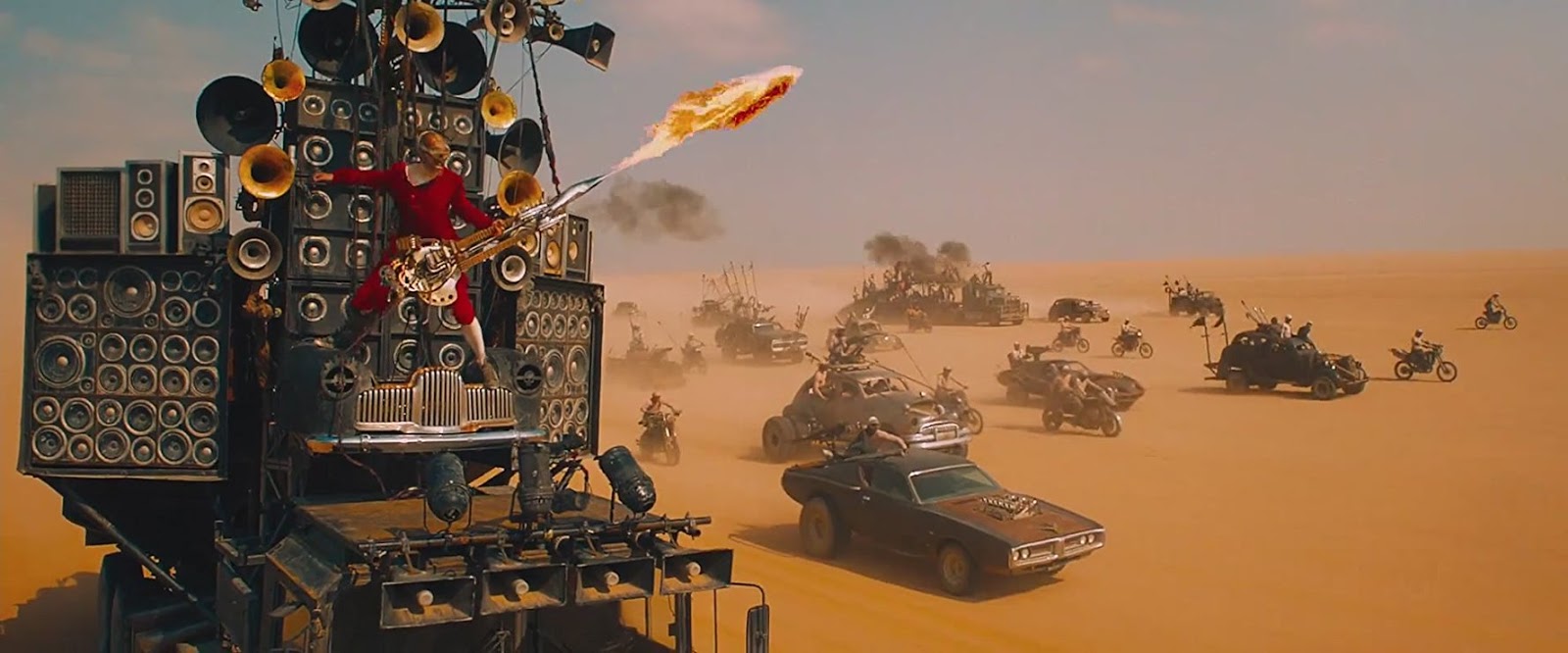
Sometimes films seem designed to give you a visceral thrill, to throw you into an experience and see whether you sink or swim. To pull off that sort of hard-edged momentum, you need a film-maker skilful enough to create an addictive energy that never slackens and never gives you a second to question the film while it’s going on. Mad Max: Fury Road has such a director in George Miller, and its demented, high-octane excess, married with a film-making style that felt modern, vibrant and grounded in reality, surprisingly made it one of the most acclaimed films of 2015.

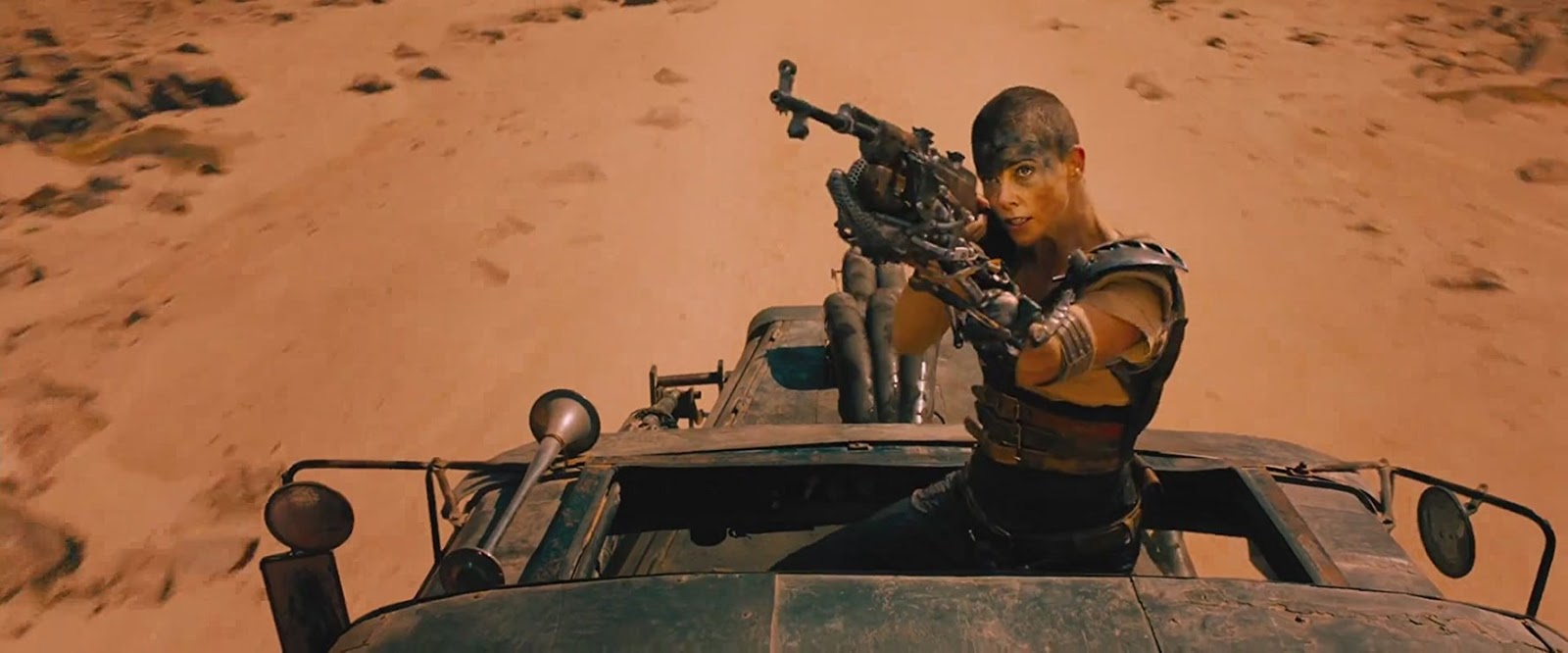
In a post-apocalyptic future Australia, the world is a ruined desert and basic requirements like water, greenery and fuel are more valuable than anything. In a rocky outcrop, cult-leader Immortan Joe (Hugh Keays-Byrne) rules one of the few populations by controlling access to the water. “Road warrior” Max Rockatansky (Tom Hardy) is captured by Immortan Joe’s warriors and put to work as a “blood bag” to transfuse into Immortan Joe’s warriors. However, this coincides with a planned escape by Immortan Joe’s wives (the few remaining women capable of conceiving children). Led by road warrior Imperator Furiosa (Charlize Theron), the women flee to find a mysterious paradise in the wilderness. Cue an almighty chase and running battle between Furiosa’s road carrier and Immortan Joe’s forces, desperate to reclaim the wives.

Mad Max: Fury Road is a bizarre, extreme, surreal thrill ride, a high-octane road chase, crammed with action, thrills and dynamism. It’s directed with extraordinary vibrancy by George Miller, who makes it fresh and scintillating. Miller crams the action and design with an explosion of style. Everything is amped up to 11, from the look to the characterisations and motivations. But what makes this such a well-directed film is that Miller shoots much of it with careful, professional clarity: so many other films would be cut with a frantic craziness, but this has a polished traditionalism to it. Basically Miller knows the actual content of the story is “insane” enough that he doesn’t need to gild the lily with bizarre, swooping camera angles or choppy editing. 

That’s partly why this film has had such a strong positive reaction. While being insanely OTT, it’s actually quite an old-fashioned piece of film-making, and it looks like a lot of it was shot for real on location, using real practical stunts. This may or may not be the case, but it certainly looks like this. And in an era where so many action films are about superheroes, and crammed with special effects, to have a world where things feel grimy and real, where the objects we are watching feel like they exist, is like a breath of fresh air. The design throughout the film accentuates this sense of reality. It makes things feel like they have depth and force. It immediately adds stakes to the action.

That action takes place in a unique looking world. The visuals in this film are crazy. The design of Immortan Joe’s half-nude soldiers, with their silver paint aerosol and petrol smeared faces, is terrifyingly cultish. The look of the many different vehicles is immediately striking, with each being clearly of the same world, but each distinctive in look, like some Wacky Races. The steampunkish mix of cobbled-together remains of technology to create the cars and trucks is brilliantly done. It’s a film that looks like nothing else, and shot with radiant streaks of yellows and blues, mixed with scenes shot in almost painterly black and white. It’s an explosion of style, but not straining too hard to force itself upon you like so many films do. 

The film also has a simple structure and storyline, that allows it to focus on the action. It’s slick, steamlined and very focused. The villains are clear, and their motivations easy to understand. They are presented with a certain depth, but their essential villainy is easy to have a gut instinct against. This also helps us bond with our heroes – despite the fact that most of the wives have only the most briefly sketched of characters. But we totally understand their position, fear and desire for freedom. Just as the film is a primal explosion of “fight or flight”, so are the feelings our heroes carry. Everyone can relate to them.

It’s also great that this is an action film where the women largely drive (literally!) much of the action. The film may have the Mad Max name on it, but the true lead of the film is Furiosa. It’s her actions that drive the film, it’s her conflicts that are at its heart, the film is her journey and Max is largely along for the ride (again literally!). Charlize Theron is very impressive in the lead, a strong warrior woman, but also someone with a buried poetic soul and a clear emotional arc. Tom Hardy delivers as the grizzled Max, but this is very much Theron’s film.

Mad Max: Fury Road is an exciting and engrossing film. But it’s made with such professional inspiration on the visuals that it invites people to read into it a lot more depth than I think is actually there. It’s got such old-fashioned control and brilliance to it, while being so explosive and vibrant, that it’s tempting to read into it a thematic complexity. Let’s be honest, this is a chase movie. It’s a hell of a chase movie, but it’s a chase movie.

It may be set in a world of post-apocalyptic totalitarianism, but it’s not trying to tell us anything hugely original about what such a world may be like. It creates such a world with huge inventiveness, but it’s not an enlightening film. Similarly, this is a film that places women at the centre of its action, but I’m not sure you could call it a film that has much to say about feminism. Most of the women in this film are still defined primarily by their breeding abilities. Furiosa may be the leader, but most of the rest of the women are under her protection. The film does something different with gender, but it also does a lot of quite traditional things. 

It’s really tempting to see great symbolism in such a dynamic and striking piece of film-making. But thematically there isn’t much there. Miller directs a film that is brilliant too experience, so brilliant you expect there to be more at its heart. In truth there isn’t really – it’s largely what it appears to be on the tin. There’s nothing wrong with that though. You just need to know what you are going to get. This is not some great game changer of a motion picture, that will reinvent and reposition the genre. It is a skilfully made and compelling chase movie, where a group of people run to a point, turn around and head back, being chased all the way. It’s shot with a near poetic, old-school brilliance – but it’s still just a chase movie. Accept it as that – a high-octane action thriller – and you will be swept away. Look to it for the thematic depth some have claimed it carries and you will be disappointed.

Dawn of the Planet of the Apes (2014)


Andy Serkis becomes the Ape Caesar in a triumphal marriage of performance and special effects

Director: Matt Reeves

Cast: Andy Serkis (Caesar), Toby Kebbell (Koba), Jason Clarke (Malcolm), Gary Oldman (Dreyfus), Keri Russell (Ellie), Kodi Smit-McPhee (Alexander), Kirk Acevedo (Carver), Judy Greer (Cornelia), Terry Notary (Rocket), Karin Konoval (Maurice)

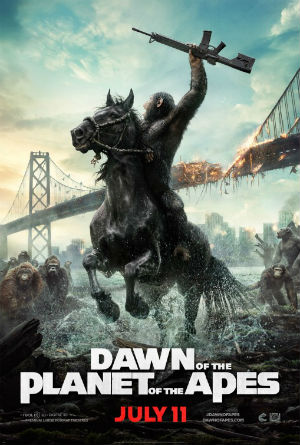
In 2011, Rise of the Planet of the Apes was another attempt to relaunch the money-spinning ape vs. human franchise. Unlike Tim Burton’s disastrous 2001 effort, it took a stance that felt truly unique. Sure, it still felt the need to reference back to the original film in places, but it was a terrific piece of story-telling. Anticipation was high for this sequel – and it met those expectations.

Ten years after the outbreak of a virus that has decimated the human race, the apes have built their own community in the forests near San Francisco, led by Caesar (Andy Serkis). A human party, led by Malcolm (Jason Clarke), enters the forest looking to restart a hydroelectric dam to supply power to the human’s San Francisco community. As the two communities collide, Caesar and Malcolm must work out a truce, despite the doubts of human leader Dreyfus (Gary Oldman) and Caesar’s lieutenant, former lab-chimp Koba (Toby Kebbell).

Dawn is an intelligent and visceral piece of film-making, which enrichens the first film in the series, as well as offering a surprisingly deep analysis of human (and ape) nature. Marry this  up with some quite astonishing special effects, and staggering work from the actors creating the apes through motion capture, and you have a hugely rich science fiction film that helps to cement this trilogy as the finest version of the Apes story so far. It’s also damn good fun.

Even more than the first film, Dawn places apes front-and-centre. The film is book-ended with close up shots of Caesar’s eyes, the determination and resolve in them springing from very different causes. The questioning of the nature of humanity revolves around Caesar – the leader balancing the urge to protect his own people against a willingness to support the needs of his people’s only potential threat. Caesar is the most humanitarian character– yet his determination to view other apes as does himself prevents him from seeing Koba’s treachery. It’s his own generosity that is his Achilles heel.

Andy Serkis, the Master of Motion Capture, has mastered this art like few other actors, but his performance as Caesar is his triumph. The degree of emotion he is able to communicate is astounding, while his physicality is extraordinary – it’s a perfect marriage of ape traits and human characteristics. It’s a triumph as well of special effects, but you quickly forget this and embrace the character you are watching. Serkis gives Caesar a deep hinterland of warmth and emotion, a desperation to protect what he has built, touched with a hint of blindness to the reactions his dismissal of Koba’s concerns will have on someone so damaged.

What’s interesting is that, although the film swings heavily in favour of the Apes, it’s the humans who become the victims of aggression, and the humans who are the most open (or desperate) to negotiation and co-operation. A simpler film would have turned Gary Oldman’s Dreyfus into a despotic counterpart to the traumatised Koba. Instead, Dreyfus proves surprisingly open to negotiation, demonstrates great affection for his followers, weeps ecstatically over finally being able to turn his tablet back on and look at photos of his family and only resorts to drastic measures after the human colony seems doomed.

The villain of the piece is Koba (remarkable work from Toby Kebbell). The film, though offering many indicators of Koba’s ruthless lack of regard for any life but his own, gives us reasons (even though these are sometimes stated directly for his feelings and the trauma that lie underneath them. The film doesn’t short change us on Koba’s obvious bravery in battle or his ability to inspire troops. Koba’s inability to adjust his thinking (unlike any other character in the film) leads to the violence. Just as Caesar’s urge to see all apes as meeting his own standards allows violence to grow around him, so Koba’s urge to judge all humans by the standards he has given them leads him to sacrifice countless ape lives in a bloody attack.

These themes of divided loyalty and the damage our own urges (for both good and evil) play out in a cracking storyline, packed to the rafters with action, shot with a confidence and skill by Matt Reeves. Despite being a film that always feels about larger themes, it wears this rather lightly, and offers more than enough popcorn thrills to please any Ape action fan. Koba’s assault on the human stronghold is both grippingly exciting, but also unbearably tense – the film embraces the grim sacrifice and slaughter of war. The final confrontation between Caesar and Koba is shot with a giddying, vertigo-inducing sharpness.

The ape effects are, it goes without saying, extraordinary. These are expressive, living, breathing characters – a brilliant meeting of some wonderful acting and brilliant special effects. Could you imagine a few years ago a film being anchored by a special effect ape played by motion capture? You quickly forget that they are not ‘real’ and accept them as genuine characters. Even more so than Rise, Caesar and the apes are front-of-centre and this is Caesar’s story. Serkis is of course a huge part of this – his influence and dedication to the motion capture and ape portrayal is superb.

Dawn of the Planet of the Apes is a terrific and thought provoking epic film, one that deepens, darkens and enriches the previous film and leaves an audience with not only a lot to consider but also highly thrilled. Unlike the previous film it doesn’t shoe-horn in weak references to earlier films, but concentrates on telling a terrific and character-led story. It’s another terrific entry into a series that feels like it could become one of the great science fiction trilogies.

I Am Legend (2007)


Rush hour is a lot easier to beat when its just you and your dog.

Director: Francis Lawrence

Cast: Will Smith (Robert Neville), Alice Braga (Anna Montez), Charlie Tahan (Ethan), Salli Richardson (Zoe Neville), Willow Smith (Marley Neville), Emma Thompson (Dr. Alice Krippin)

If you’re going to make a movie that involves the viewer watching one person, alone with just a dog, for well over an hour, you’d better be sure that the person you recruit to play that role can actually hold the viewer’s interest for that time. Factor in, for Hollywood, that the person you pick needs to be capable of getting big box-office, and you ain’t got a lot of choices. But casting Will Smith in this was a choice the studio largely got right.

The year is 2012 and the world has ended. Robert Neville (Will Smith) is a military virologist, the last surviving human in New York. A miracle cure for cancer went disastrously wrong three years before and killed 94% of the world’s population, mutated 5% into feral “darkseekers” who attack anything living at night, leaving just 1% of the world’s population immune. Neville lives alone in New York, with only his deceased daughter’s dog for company, and works to find a cure for the disease by capturing and experimenting on the darkseekers.

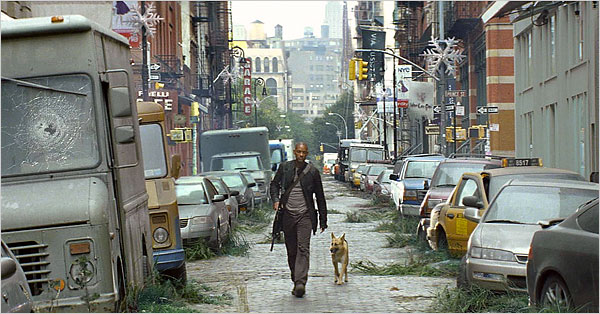
In a remarkably brave and unusual move for a blockbuster, Will Smith is essentially alone on screen for a solid hour. The film takes a measured, well-paced delight in following his daily routines, covering everything from his work in immunology to scavenging for supplies, hunting deer (escaped from the zoo), hitting golf balls off aircraft carriers, and having free run of a video store he has filled with mannequins. His Washington Square house is heavily fortified, but also remarkably homely and certainly not that bad a place to watch the end of the world from.

Following this daily routine is, by far and away, the most interesting part of the film, as it is one of the few parts that actually feels unique and original. In fact, you wish it could go on longer and that the film didn’t need to revert back its more predictable “one man against the monsters” theme. The ingenuity of survival in extreme circumstances, and the eerie freedom of the busiest city in the world completely empty, makes you wonder not only “could I do that” but also, secretly “would it be fun for a while to drive a fast car around Times Square or whack golf balls off the wing of a stealth bomber?”.

“For a while” is the key thing here, as the film also explores the deeply damaging effect extreme isolation has had on Neville’s psychology. It’s here that Smith earns his chops. He’s an extremely engaging actor, so you’re happy to spend time with him, but he’s also skilled enough to play a cracked psyche without going overboard. Neville chats (and flirts) with mannequins, knows Shrek so well he can speak in perfect unison (inflections and all) with the film, and keeps up a regular stream of conversation with his dog Sam, including asking her what she is planning to do for his birthday. Much of this is played lightly, but at key moments Smith allows Neville to snap. He also plays the tragedy gently – his reactions to Sam’s death are genuinely quite moving because they are quiet and restrained.

This is all interesting stuff. Less interesting are the “darkseekers” and the film’s final resolution. Firstly, the darkseekers themselves are bog-standard zombie monsters – screaming, running, deadly creatures with their one quirk being their fear of UV light. Other than that, it’s nothing you haven’t seen in half a dozen movies before (better). Turning them into zombie creatures does make Neville even more isolated but makes encounters with them fairly predictable, mostly inspired by films past. Most of the film’s big confrontation set pieces have a slightly tired familiar feeling to them. I’m already struggling to remember them, and I only saw the film two days ago.

The major problem with this film is its ending. I Am Legend had its ending re-shot after test audiences saw it. Originally, a reveal would have been that the darkseekers were far more intelligent than appeared, and their motivation was to prevent Neville’s experimentation on them. Two scenes still make a point of discussing Neville’s Mengele-like wall of photos of dead darkseekers, killed by his cure experiments, and other hints remain through the film: the traps they set , the presence of an “Alpha” leader among the monsters, repeated shots of the tattoo on Neville’s last captured darkseeker, which was intended to be a crucial clue that she was the mate of the Alpha.

But test audiences weren’t having that. So in the final version, all this build-up and suggestion is shoved aside as Neville grabs a grenade and blows himself and them to hell to allow a cure to be taken to the rest of mankind. As the cure is taken to an idyllic community in the country (church and all) mankind’s future is his “legend” or some such guff. It’s a major loss of nerve that makes the film just another run-of-the-mill monster flick. It doesn’t match with hints that remain in the whole film and it doesn’t tie in with the more successful first hour of the film. It doesn’t question the possible rights and wrongs of Neville’s actions (at best comprehensive animal experimentation), but fully endorses them.

It’s a shame as this has ideas, its vistas of New York being reclaimed by nature are interesting and memorable, and Will Smith is pretty good in a straight acting role. But instead it settles for being a schlocky monster pic, where we can unquestioningly cheer as everything is neatly tied up with a bow and everything we thought about all of its characters is confirmed. As such, this film isn’t a classic and it hasn’t had the sort of life it might have been able to have. Despite good moments, it’s definitely not a Legend.