

Superb fantasy film, full of heart, visual imagination and beautiful story-telling, truly one from the heart
Director: Guillermo del Toro
Cast: Ivana Baquero (Ofelia), Sergi López (Captain Vidal), Maribel Verdú (Mercedes), Doug Jones (The Faun/The Pale Man), Ariadna Gil (Carmen), Álex Angulo (Doctor Ferreiro), Manolo Solo (Garcés), César Vea (Serrano), Roger Casamajor (Pedro), Pablo Adán (Narrator/Voice of the Faun)

What do you do when your world is terrible? Sometimes the only way to survive is to embrace your own world, even if that world has its own darkness and terrors. Guillermo del Toro’s masterful Gothic fairy tale mixes the terrors of Francoist Spain with one of untrustworthy magic and monstrous spirits and compellingly balances bleak horrors with the chance of hope. Visually stunning, thematically rich and heartbreakingly emotional, Pan’s Labyrinth is a Grimm’s fairy tale bought shockingly up-to-date, a uniquely heartfelt film from a distinctive director.
It’s 1944 in the woods of Spain and the Reds are still fighting their lonely crusade against Franco’s fascists. Captain Vidal (Sergi López) is here to stamp out these rebels and has summoned his heavily pregnant wife Carmen (Ariadna Gil) and twelve-year old step-daughter Ofelia (Ivana Baquero) to his distant command post so that he can be present at the imminent birth of his son. Ofelia hates the punctilious and coldly obsessive Vidal (rightly so – he’s capable of coldy indifferent but shocking acts of violence) and escapes more-and-more into her fairytale books. One night, she wanders into an old maze and encounters a Faun (Doug Jones), who tells her she is the long-lost princess of the fairy kingdom and must perform three tasks to return home. Ofelia now exists in two worlds: an increasingly Gothic fairy one of and a real one of violence, ruled by her monstrous father-in-law.
Pan’s Labyrinth is a beautifully balanced film of multiple interpretations. It’s never clearly stated whether Ofelia’s fairytale world is ‘real’ of a product of her imagination. It’s clearly a way a scared girl could process real world traumas – the death of her father, the appalling Vidal, the horrors of war around her – with many elements of the fairy world reflecting things happening around her. But on the other hand, the mandrake root the Faun gives her to help heal her sick mother by placing it under her bed has an immediate impact and Ofelia’s magic chalk and the labyrinth itself offer secret doorways that allow her to escape Vidal in the film’s final act (or perhaps a by then disoriented and drugged Vidal is just mistaken). Essentially, you are left to embrace the idea you prefer – much as it is implied Ofelia herself chooses the version of her life she wishes to embrace.
Choosing for yourself and not blindly following orders is one of the key lessons of Pan’s Labyrinth. The ‘real’ world of Franco’s Spain is full of regimented orders to be blindly obeyed without question. In this it has the collaboration of the Church – at Vidal’s dinner-party, a subservient priest self-satisfyingly fills his plate with food while shrugging off concerns of the starving poor – and Fascism echoes Church mantras (one of Vidal’s lieutenants repeats the same propaganda ‘prayer’ to Franco over-and-over again while he hands out the bread ration to the cowed villagers). Franco’s Spain is one of order and regimen, where individuality and choice is stamped out.
And there are echoes of this in Ofelia’s fantasy world. Played with a gentleness, vulnerability and strikingly earnest decency by Ivana Baquero, Ofelia refuses to accept the world must be the way it is (unlike her mother who has sadly accepted it must). But her fairy world, the Faun – expertly portrayed by Doug Jones’ lithe physicality – is a far from gentle guide. Creaking from the wood he is formed from, he’s sinister, mixes vague statements with subtly presented orders and constantly holds information back while presenting Ofelia with tight rules for her tasks. Just as Fascism takes choice away real world, the Faun presents Ofelia with a book that reveals the future (but only one page at a time) and her tasks increasingly demand complete obedience, under the threat of punishment.
This is not a comforting world. Ofelia – who at one-point wears costumes reminiscent of those other famous children in dark, surreal and dangerous fantasy-worlds Alice and Dorothy – confronts a vile toad and, most chillingly, an albino child-eater with eyes in his stigmata hands who lives in a room decorated with nightmare reflections of the real horrors of the 40s (most strikingly a Holocaust-reminiscent pile of children’s shoes). For all its fantastical, it’s also very much a nightmare version of a real-world that could have been dreamed up by a child processing horrors.

Pan’s Labyrinth celebrates individuality and choosing for yourself. Ofelia’s story is one of increasingly taking her own choices: from refusing to accept her mother’s new husband, to escaping into her fantasy world (twisted as it is), to finally outright refusing the increasingly dark instructions of the Faun. It’s in doing this that she can eventually prove herself a true hero, someone who does not accept the established order but can make her own decisions.
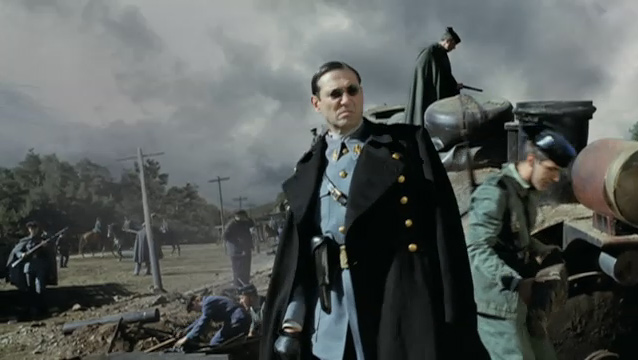
This makes her a contrast to Vidal. Truly he is one of cinema’s most loathsome monsters. In a superbly controlled performance by Sergi López, Vidal isn’t repulsive because he is a larger-than-life, sadistic monster but because he is a small, inadequate bully who has controls his small world in order to make himself feel important. Vidal is obsessed with order and detail – introduced tutting at the 15-minute-late arrival of his wife, his office is filled with the gears of the mill and he fetishistically cleans his pristine uniform, shaves himself and repairs his father’s watch. This watch – the only memoir he has of his hero father, who died when he was a baby – is the root of his obsessions, Vidal desperate to become his father and pass on his own toxic legacy of ancestor worship to his son. It’s striking that, as Vidal’s world collapses around him, his clothing and body becomes more and more scarred, bloody and disordered – his external appearance resembling the monster within.
In Vidal’s world everything fits neatly into place, governed by his Fascist ideology. Carmen – a fragile Ariadna Gil, struggling to accommodate to a world of harsh choices – is of interest to him only because of the baby she carries. He operates the mill as a tightly organised regime, in which the rebels are unwanted ghosts in the machine. He uses violence ruthlessly but as a tool, not with sadistic relish. He brutally beats a suspected rebel to death with a bottle with robotic indifference and tortures suspects with a practised patter. To him, everything is justified if it is obeying an order. So much so, that he literally cannot understand the refusal of Dr Ferreiro (in one of the film’s most moving moments) to blindly follow orders, no matter the consequences.
Dr Ferreiro (a beautifully judged performance by Álex Angulo) is one of two figures whose independent thought Vidal is unable to recognise, even when they are under his nose. His maid Mercedes (Maribel Verdú, one of the passionate hearts of the film) is fiercely independent, the sister of the rebel leader and working subtly against Vidal. She forms a bond with the gentle Ofelia while showing that refusing to be part of a blind system is a crucial part of humanity. She also provides possibly one of the most satisfying moments in cinema during a confrontation with Vidal.
Del Toro’s film beautifully balances these fascinating ideas of choice and independence within its brilliantly evocative design. It’s a beautifully shot film, in a gorgeous array of Velazquez-inspired tones, its moody darks and blues gorgeously captured by Guillermo Navarro while its design work is extraordinary in its texture and detail. But it’s a classic because del Toro’s superb creativity and quietly emotional direction. Pan’s Labyrinth makes us really care for this child just as it makes us despise the cruelty of her step-father. Combined with gorgeous design, del Toro’s film truly comes from the heart, a loving, very personal tribute to the power of stories and individual choices. The film is so powerful, you even forget that it opens as it ends, and that we know in our heart-of-hearts how this journey will finish. Nevertheless, Pan’s Labyrinth ends on a note of joy and acceptance so pure, it could only be from the fantasy world not the real one.
 Movie Musings