Tag: Barbra Streisand

Hello Dolly! (1969)

Hello Dolly! (1969)

Bloated, miscast and over-produced musical that nearly sank the genre and studio

Director: Gene Kelly

Cast: Barbra Streisand (Dolly Levi), Walter Matthau (Horace Vandergelder), Michael Crawford (Cornelius Hackl), Marianne McAndrew (Irene Molloy), EJ Peaker (Minnie Fay), Danny Lockin (Barnaby Tucker), Joyce Ames (Ermengarde Vandergelder), Tommy Tune (Ambrose Kemper), Judy Knaiz (Gussie Grander), David Hurst (Rudolph Reisenweber), Louis Armstrong (Band leader)

The old-fashioned musical had always been a winner for Hollywood. So, I guess it made perfect sense to pump $25 million (just over $200 million in today’s money) into Hello Dolly!. Reality didn’t agree though. Hello Dolly! was a massive box-office bomb which, despite its seven Oscar nominations (including Best Picture, due to intense studio lobbying) pretty much killed the traditional, Freed-style musical stone-dead. After this, musicals would have drama at their heart (like Fiddler on the Roof or Cabaret) and scale down the production numbers.

It also didn’t help that the mega-budget, colossal production values across its bum-numbing two-and-a-half hour run time ruthlessly exposed Hello Dolly! as a perilously slight story, in a way its years playing on Broadway hadn’t. Dolly Levi (Barbra Streisand) is a widowed matchmaker, hired by grumpy “half-a-millionaire” Horace Vandergelder (Walter Matthau) to find him a wife. However, Dolly rather fancies getting back into the game with Horace herself. Around them other parties flirt, such as Horace’s niece Ermengarde (Joyce Ames) with artist Ambrose Kemper (Tommy Tune) and his clerks Corenlius Hackl (Michael Crawford) and Barnaby Tucker (Danny Luckin) with fashion store owner Irene Molloy (Marianne McAndrew) and her assistant Minnie Fay (EJ Peaker).

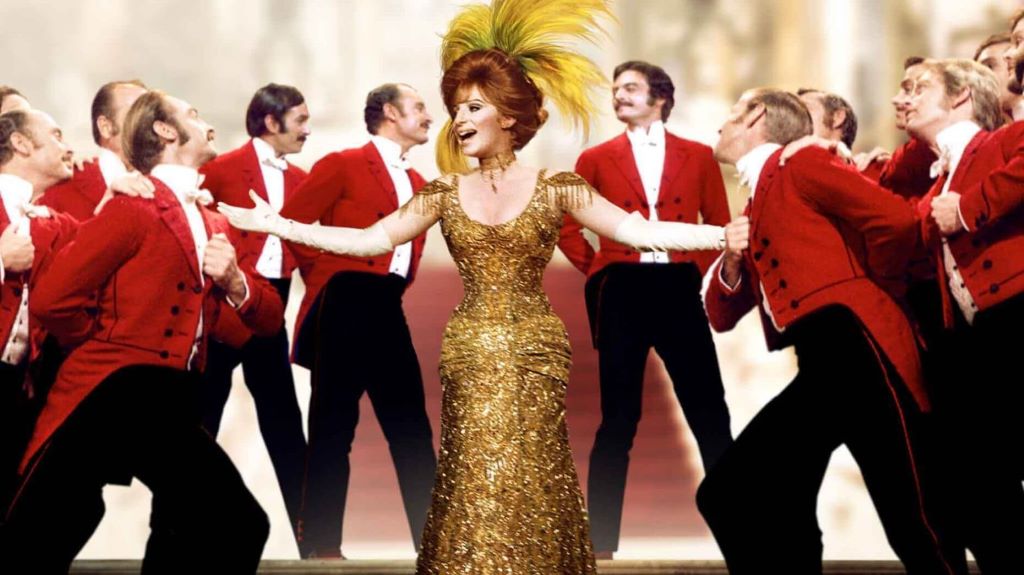
I’ll grant the scale and sets are impressive. Whole streets and parks were built. Grand, elaborate costumes (some of Streisand’s costumes cost thousands and thousands of dollars by themselves) add wow factor. If you believe “more is more” Hello Dolly! is for you, it’s Oscar for set design well deserved. But as you watch Streisand hit a high note in long shot while an entire parade of thousands takes place around her, you start to realise you’ve not formed a bond with the characters. When we finally get them all in one place (a crowded restaurant in New York) the best part of thirty minutes is taken up with three massive numbers (Dancing waiters! Streisand’s entrance number! Comedy foot-tapping from Crawford! Louis Armstrong cameo!) that piles so much stuff on, that you almost forget what the scene was meant to be about in the first place.

What this probably needed to be is a tighter, American in Paris style romantic comedy, the sort of stuff Arthur Freed would have run out in 100 minutes with a few set pieces. Instead, it’s a bloated mega-production with colossal sets, 12,000 extras, widescreen soaking up the action and vast, never-ending dance numbers that fail to progress either story or emotion. After being bludgeoned by balletic leaps, you suddenly realise not only has nothing much happened, but you are being asked to invest in the future happiness of characters you barely know and often hardly even like.

It’s not helped by the chronic miscasting of the leads. Barbra Streisand was the hottest star in town – the studio was (correctly) convinced mega-stardom was inevitable after watching the rushes of Funny Girl – but she is wrong on almost every level for Dolly Levi. A part intended for a slightly-over-the-hill widower in her late 40s, was barely retrofitted for a glamourous diva aged 26. Streisand, clearly painfully aware she was wrong for the part, struggles to work out how to play it. Sometimes she’s coquetteish, other times she goes for a mother-in-law largeness, most of the time she ends up channelling Mae West sauciness. While her singing is (of course) outstanding, she never looks comfortable. Equally out-of-place is Walter Matthau, whose grouchy comedy style never meshes with the tone of the film (although he has a great bit of business with a walking stick which he hammers down onto a table with such irritated force it almost rebounds and hits him in the face).

It also doesn’t help that Matthau and Streisand all-too-clearly can’t stand each other (their closing kiss is hilariously awkward – try replicating their physical positions to see how unnatural and unromantic it is). On set Matthau felt Streisand was too big for her newcomer boots while Streisand saw him as envious of her star quality. The two frequently fell into heated rows: this at least meant they fitted in naturally on a set where almost no-one got on. Streisand and Kelly’s working styles (both being demanding perfectionists) proved incompatible, Kelly stopped speaking to the official choreographer who also stopped speaking to the costume designer.

With the leads struggling, most of the film’s charm actually relies on its secondary leads. Hello Dolly! is, actually, an effective showcase for Michael Crawford’s physical dexterity (some would say recklessness) and his sweet romance with Marianne McAndrew’s charming Irene Molloy is the film’s emotional heart. It’s a shame both their film careers effectively ended here (though Crawford would go on to greater things on stage). Their dance number Elegance is one of the film’s most engaging while their duet It Only Takes a Moment is the simplest filmed and most moving moment in the film.

Bloat and bombast overwhelms the rest. Although Kelly knows how to shoot dancing – effective camera moves and having the dancers move towards the camera, increasing their dynamism is very well done – he’s far less suited to the character moments which Stanley Donen and Vincente Minnelli excelled at. The gags very rarely land, either because the timing is off or the camera is so focused on getting the mammoth sets in that the bits of business look like minor irrelevances.

Fundamentally, Hello Dolly! bet the house on throwing all the budget on the screen to wow audiences the way something like The Great Ziegfeld had over thirty years ago. But audiences needed an emotional connection with what they were watching. Hello Dolly spectacularly fails to deliver on this. What we were left with is a very slight story about matchmaking, basically a chamber piece with about six characters, transposed onto the sort of epic backdrop that makes Gone with the Wind look humble. The mismatch never works and the entire enterprise eventually collapses under its own gravitational pull. A box office dud that nearly sank the studio, the musical would never be the same again.
Funny Girl (1968)

Funny Girl (1968)

A star-turn is the main interest in this grand-scale but so-so musical

Director: William Wyler

Cast: Barbra Streisand (Fanny Brice), Omar Sharif (Nicky Arnstein), Kay Medford (Rose Brice), Anne Francis (Georgia James), Walter Pidgeon (Florenz Ziegfeld), Lee Allen (Eddie Ryan), Mae Questel (Mrs Strakosh), Gerald Mohr (Branca), Frank Faylen (Keeney)

Fanny Brice was the major pre-war star of Broadway, the leading lights of the Ziegfeld Follies, the sort of all-singing, all-dancing spectaculars they just don’t make any more. A fictionalised version of her life became a Broadway smash, produced by her son-in-law Ray Stark. Hollywood came knocking, leading to this film version. Shepherded to the screen by William Wyler (his first ever musical, a genre he’s avoided due to being deaf in one ear) it would tell of Brice’s early success, her relationship with Ziegfeld (Walter Pidgeon) and her marriage to dodgy gambler Nicky Arnstein (Omar Sharif). And to play Brice? It could only be the woman who created the role, a young sensation called Barbra Streisand.

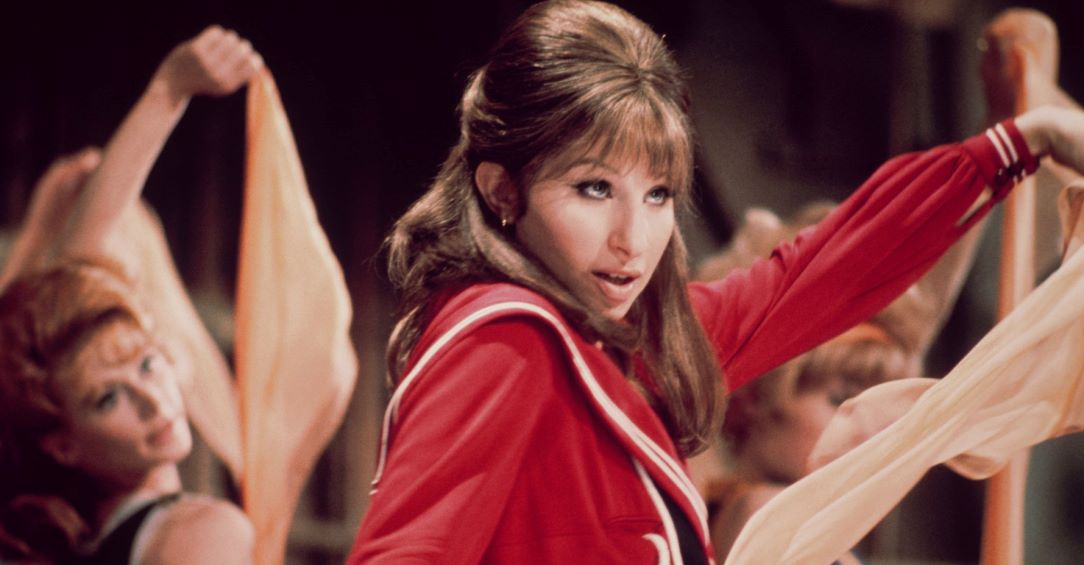
Funny Girl begins, ends and is exclusively about Barbra Streisand. Making her film debut, Streisand is, not to put too fine a point on it, absolutely sensational. This is charismatic, star-making stuff from an actress who knew exactly how to tailor the part (already basically written for her) to her strengths. Streisand is funny, kooky, witty but also vulnerable, shy, preoccupied with her low-opinion on her looks. She totally convinces as a charismatic figure who can dominate the room with cheek, won’t think twice at bluffing she can roller-skate to land a role or pigeon-hole Zeigfeld and argue against being asked to do something in performance. But she equally easily embodies a vulnerable woman, worried she is an unlovable ugly duckling, so certain she is destined to be alone she zeroes in on the first man who shows interest in her.

That’s not even mentioning the magnetism of Streisand. A truly confident, unique performer you couldn’t imagine anyone else so brilliantly mixing power-ballad notes with this sort of quirky character comedy. She can belt out Don’t Rain on My Parade or I’m the Greatest Stars with an awe-inspiring voice. She can add layers of pathos and tragedy to songs like People and Funny Girl. But few other performers could be both a diva and a pratfall artist on roller-stakes or mix arch-wit with low-comedy by stuffing a pillow up her dress in performance to turn her bride character pregnant in His Love Makes Me Beautiful, the Ziegfeld number she desperately doesn’t want to perform (because she can’t see herself as a beautiful bride).

Streisand is so central to Funny Girl’s success that I’m not sure that so much as three minutes go by without her appearing. It’s not a surprise as, subtract her from the mix, and Funny Girl is a fairly bland, unoriginal and at times slightly flat musical that struggles to do or say anything interesting. It’s had millions poured into its elaborate sets, it’s grandiose costumes and its vintage, sepia-tinged photography. But it’s an overlong, overblown, poorly paced film blessed with a star turn.

Wyler’s main strength as a director on mega-budget spectaculars like this was his professionalism and control, the gifts a producer likes. Visually though, Funny Girl frequently looks lost in widescreen, sets shot in a way that magnifies their emptiness and lacking the sort of affinity for timing and musicality that something like Minnelli, Donen and Kelly made look so natural (Most of the larger musical numbers were worked on by Herbert Ross). There is the odd strong shot – a showy helicopter shot pans down to Fanny on a tug steaming past the Statue of Liberty during Don’t Rain on my Parade or a sunset that pops up between the faces of Sharif and Streisand during a dockside embrace. But too many shots favour getting the money on the screen or struggle to frame two people interestingly in widescreen.

Mind you the story is a bit of a struggle. Fanny’s ascent to success is fast-paced and untroubled by conflict. Every gamble she takes pays-off, every cheeky trick goes unpunished. She can’t roller-skate when hired to do so? She sabotages the closing number of Ziegfeld’s show with her pregnancy flourish? Doesn’t matter – everyone loves it. She teeters for a few minutes on being fired, then jumps to promotion and glory. Ziegfeld – the sort of elite, New England aristocratic role perfect for Walter Pidgeon – just sighs and acknowledges talent gonna talent.

There are a few more clashes in her personal life. Her marriage to Nicky is the core emotional plotline of the film, but Nicky’s rough edges (in real life he was a conman and a swindler) are shaved off. Instead, he is played as a charming rogue, a professional gambler who bamboozles Fanny’s manager into giving her a stonking payrise and plays with honour and grace at the card table. When his business dealings go south, it’s never really his fault and he’s so noble he works to save Fanny’s honour by taking the rap for a collapsed business and arguing she should divorce him forthwith.

It doesn’t help that Nicky is played by Omar Sharif. Sharif, while a striking screen presence, had an acting range pretty much restricted to playing Sherif Ali. He’s unable to give the role any depth or interest, he can’t sing (thankfully he only tries once) and he’s overly reliant on his expressive eyes. He’s no match for Streisand, with whom he has less chemistry than rumour suggests was the case.

Streisand though was one-in-a-million here. Rumours abound she was a difficult and demanding presence, who fought tooth-and-nail with Wyler. She requested endless retakes to get her performance just right and “contributed” to script cuts (Anne Francis, playing a blousy Ziegfeld singer, was furious that her role effectively ended on the cutting room floor). Her perfectionism made her a controversial figure in Hollywood – but it’s also the brilliant fine-tuning of her own skill that won her the Oscar she shared with Katherine Hepburn. On a side note, Streisand had been controversially invited to join the Academy before she made a film, meaning the vote I assume she cast for herself was the one that guaranteed her the Oscar.

Funny Girl is large, overlong, largely visually and narratively uninteresting film that has a bright, shining, tour-de-force superstar in the lead who is in absolute, total control of her talent. Without Streisand it would be a tedious turkey – with her, it’s a strange landmark.

The Prince of Tides (1991)

The Prince of Tides (1991)

Past traumas are uncovered and a gentle love story unfolds in Streisand’s extremely effective relationship drama

Director: Barbra Streisand

Cast: Nick Nolte (Tom Wingo), Barbra Streisand (Dr Susan Lowenstein), Blythe Danner (Sally Wingo), Kate Nelligan (Lila Ward Newbury), Jeroen Krabbé (Herbert Woodruff), Melinda Dillon (Savannah Wingo), George Carlin (Eddie Detreville), Jason Gould (Bernard Woodruff)

For many, La Streisand is easy to knock. She developed a reputation as difficult: controlling, demanding and perfectionist. But don’t we praise these qualities in men? Perhaps she has more than a point when she claims complaints against her are grounded in sexism. Her snubbing by the Academy – The Prince of Tides got seven nominations including Best Picture, but none for Streisand bar as Producer – certainly feels like a crusty boys’ club deciding there is no place at their big night for a strong-minded woman. Doubly unfair since Streisand deserves plenty of praise for a film as rich, heartfelt, moving and surprisingly funny as The Prince of Tides.

Tom Wingo (Nick Nolte) is a football coach in South Carolina, where his marriage to Sally (Blythe Danner) is drifting towards the rocks, largely thanks to Tom’s jovial inability to be emotionally open. He’s called to New York when his poet sister Savannah (Melinda Dillon) attempts suicide. To aid her recovery, Tom must talk to her psychiatrist about the traumas of their childhood. But Tom himself is far, far away from putting bottled-up pain behind him. Streisand plays the psychiatrist, Dr Susan Lowenstein, struggling in an unhappy marriage with an arrogant violinist (Jeroen Krabbé, being Euro-smug as only he can) and with a troubled relationship with her son Bernard (played by Streisand’s real-life son Jason Gould). Despite initial uncertainty, will a spark of romance flair up between Wingo and Lowenstein?

Well, if you listen to the luscious score by James Newton Howard for a few seconds, you can be pretty confident the answer will be “yes”. (But it’s fine – Lowenstein’s husband is an arrogant tosser and Wingo’s wife tearfully confesses her own affair; no need to worry about betrayal here.) Officially adapted from his own huge novel by Pat Conroy,working with Becky Johnston (though it was an open secret Conroy frequently confirmed that Streisand wrote the script), it distils a massive novel into a tightly paced, extremely well-made romance that feels, in many ways, a throwback to the “women’s pictures” of the 1940s. (Conroy was thrilled.)

The big difference is that the typical Bette Davis role is here played by Nick Nolte. This is an extraordinarily superb performance by Nolte: never before had I appreciated what a deeply soulful, sensitive performer he is, especially when he is called to play the “gruff” card so frequently. Nolte’s Wingo is a Southern, gentlemanly good-old-boy, a man’s man who laughs off trouble and moves with the physicality of a rough-and-tumble sportsman. But, under the surface, he’s a sensitive, vulnerable a man tortured by past traumas he can barely bring himself to think about and consumed with guilt, self-loathing and the inability to express his feelings.

In nearly every frame of the film, Nolte is sensational: endearing, funny, joyful (his dancing at a house party has a hilarious self-mockery to it) but also stand-offish and self-contained. The film revolves around key meetings between him and Streisand’s Lowenstein, which grow increasingly intense as the taciturn joker Tom, almost against his will, has his carefully mounted defences stripped away. We see nothing, by the way, of Lowenstein’s treatment of Savannah, so tightly focused is the drama on Tom’s story. While narratively sensible, this does mean that Savannah is reduced to little more than a narrative device.

It makes for effective drama, well directed by Streisand. It’s a film that mixes moments of shock – Tom seeing his sister’s bloodstains on her apartment floor or deflate into mumbling incoherence when pushed on his past – with moments of genuine warmth and sweetness. Heck even a heated argument between the two of them segues suddenly into something comic when Lowenstein impulsively throws an Oxford English Dictionary at him, damn near breaking his nose. It should also be noted Streisand unselfishly casts herself in the less showy role – essentially a feed for Nolte – and cedes the finest moments and meat of the film to him.

Perhaps that’s also partly why Streisand’s doctor is the least convincing part of the film. With her diva nails and famous features, no amount of dome-like-glasses ever really makes you forget you are watching one of the world’s icons pretend to be a psychiatrist. (Particularly as the film relies on the magic therapist trope so beloved of Hollywood, where gentle probing and quiet “what do you think” lines lead to huge emotional revelation.) If anything, she’s more convincing and comfortable as the socialite mum struggling with her dreadful husband and resentful son.

Why the son is quite as resentful as he is to his mother, is left a bit of a mystery. Nevertheless, Jason Gould does a decent job as a young man torn between playing the football he loves and fulfilling the musical promise his father expects. (He also has a great father-son chemistry with Nolte, who coaches him in football skills.) Much clearer is why Lowenstein is struggling with her ghastly husband. Jeroen Krabbé is beautifully, smackably, smug and condescending. So much so that I laughed heartedly at the film’s most crowd-pleasing moment, as Tom punishes him for his rudeness over a dinner party by juggling his priceless Stradivarius over the edge of a penthouse balcony.

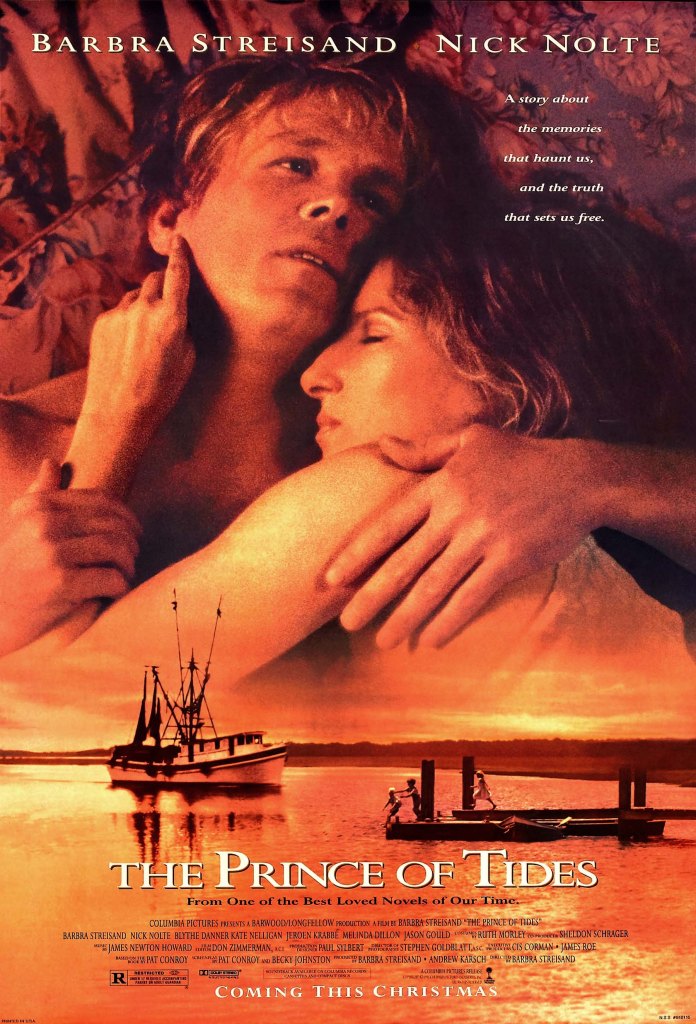
It makes it easy for us to accept Streisand’s eventual affair – much as Blythe Danner’s Sally regretfully confessing that Tom’s emotional closed-offness has driven her into the arms of another man. Despite the poster’s impression though, this is far from a steamy romance, waiting almost four fifths of its runtime before the two confess their feelings for a cathartic affair. For the bulk of the film, it’s an unspoken mutual affection, driven by Tom’s Southern flirtatious manner and Susan’s half-smiles. Again, it’s a slow-build, carefully paced romance that feels real.

Also because the film’s real build is not towards the two stars converting flirting to grinding, but in uncovering the exact trauma Tom is suppressing and has made him resent his mother (Kate Nelligan very good as an aspirant social-climber, refusing to invest love in her children) almost as much as his violent father (a surly Brad Sullivan). The reveal is, in some ways, expected – but also shockingly unexpected, particularly due to the visceral rawness which Streisand shoots the Nolte-narrated flashback with (Nolte is, needless to say, wonderful in this scene).

It’s part of the surprisingly effectiveness of a film that, in other hands, could have been a sentimental family drama, but is lifted by excellent, committed performances (Streisand is clearly a whizz with actors) and sensitive, patient direction. Streisand resists attention-grabbing flash, carefully letting scenes and emotions build, using subtle but effective camera movements. It comes together into a film that surprised me greatly with its richness. It eventually has a heart-warming message to tell of the power and importance of having the courage to admit your pain and emotions and, in its portrait of a man’s man engaging with his vulnerability, projects a message still powerful today. If Redford or Eastwood had directed it, they would have won an Oscar.